


Abstract
The detection of redundant or irrelevant variables (attributes) in datasets becomes essential in different frameworks, such as in Formal Concept Analysis (FCA). However, removing such variables can have some impact on the concept lattice, which is closely related to the algebraic structure of the obtained quotient set and their classes. This paper studies the algebraic structure of the induced equivalence classes and characterizes those classes that are convex sublattices of the original concept lattice. Particular attention is given to the reductions removing FCA’s unnecessary attributes. The obtained results will be useful to other complementary reduction techniques, such as the recently introduced procedure based on local congruences.
1. Introduction
Redundant data hinder the efficient acquisition of information from datasets. Obviously, the elimination of redundant data should not modify the information contained in a dataset. The most common redundant data consist of repeated entries, which can be removed without cost, or dependent variables, which can be derived from the independent variables, whose detection is an appealing research topic in many areas dealing with data analysis, such as Formal Concept Analysis (FCA). This mathematical theory was original developed in the 1980s by R. Wille and B. Ganter [1], and it has intensively been studied from a theoretical and applied point of view [2,3,4,5,6,7,8,9,10,11,12]. Two important features of FCA, in which the notion of Galois connection is fundamental [13,14,15,16], is that the information contained in a relational dataset can be described in a hierarchic manner by means of a complete lattice [17] and that dependencies between attributes can be determined [18,19,20,21], which is fundamental to applications. In both features, the removal of redundant data has a great impact.
The detection of (ir)relevant attributes or objects of a given formal context in FCA has been studied from different points of view, for example: in order to obtain a concept lattice isomorphic to the original one [22,23,24,25,26], to efficiently reduce the size of the concept lattice [8,27,28,29,30,31,32], to extensional stability [33], to consider contexts with positive and negative attributes [34], to apply the rough set philosophy [35,36,37], etc. Notice that the different mechanisms focused on attribute reduction can dually be adapted to object reduction.
In [36], it was demonstrated that attribute reductions of formal contexts induce equivalence relations whose equivalence classes have the structure of join-semilattices. In addition, in [38], local congruences were introduced as equivalence relations defined on lattices whose equivalence classes are sublattices of the original lattice. Therefore, local congruences were intended to complement the attribute reductions of formal contexts in order to ensure that the equivalence classes are sublattices of the original concept lattice. Due to a join-semilattice with the least element being a lattice, if the infimum belongs to the equivalence class, we can assert that the class already is a sublattice. Obviously, in these cases, the use of local congruences, as a complementary mechanism to the attribute reduction, turns out to be unnecessary since they do not provide any modification in the classes, and so, it modifies neither the attributes nor the objects generating the concepts of these classes. Therefore, it is very interesting to characterize the required conditions in which these cases hold, which was precisely the main issue addressed in [39].
In this paper, we continue with the research line initiated in [39], improving the results introduced in that work. Specifically, in this paper, we show an enhanced version of Proposition 4 and Corollary 1 in [39], which characterize the infimum of the elements belonging to a non-singleton classes. In addition, due to the attribute reductions usually carried out in FCA tending to discard the set of unnecessary attributes from the formal context, we also analyze the characterization of the infimum of the induced equivalence classes when the considered attribute reduction does not contain unnecessary attributes. The fact of considering attribute reductions that do not contain unnecessary attributes allows us also to prove some interesting results. For example, we establish a sufficient condition to ensure an equivalence between meet-irreducible concepts in the reduced context and in the original one. Furthermore, under this consideration, we also prove that when the original concept lattice is isomorphic to a distributive lattice, the induced equivalence classes by the reduction are always sublattices. Finally, all the results presented in this work are accompanied by illustrative examples whose objective is to clarify all the introduced ideas.
The paper is structured as follows: Section 2 reviews some preliminary notions related to formal concept analysis and attribute reduction. In Section 3, the contributions of this paper are presented, the study on the equivalence classes induced by an attribute reduction.This section is divided into two parts: first, we study sufficient conditions to characterize the infimum of equivalence classes, and second, we carry out an analysis of the characterization when the considered subset of attributes in the reduction does not contain unnecessary attributes. Finally, Section 4 presents some conclusions and provides some prospects for future work.
2. Preliminaries
First of all, we recall some basic notions about formal concept analysis and attribute reduction. A context in FCA is a triple where A is a set of attributes, B is a set of objects, and is a relation, such that , if the object possesses the attribute , and , otherwise. The derivation operators are the mappings and defined for each and as:
A concept in is a pair , where , , and satisfies that and . The subset X is called the extent of the concept, and the subset Y is called the intent; they are denoted by and , respectively. Furthermore, a concept generated by an attribute , that is , is called an attribute concept.
In addition, the set of concepts is denoted by and is a complete lattice with the inclusion order on the left argument, that is for each , we have if . is called the concept lattice of the context . The meet ∧ and join ∨ operators are defined by:
for all .
Considering a subset of attributes and the restriction relation , the triple is also a formal context. There are two relevant notions regarding subsets of attributes in FCA that we recall below.
Definition 1.
Given a context , if there exists a subset of attribute such that , then Y is called a consistent set of . Moreover, if , for all , then Y is called a reduct of .
Then, we can recall the definition of the three types of attributes considering the notation in [40] to denote the subsets of attributes.
Definition 2.
Given an index set Λ, a formal context , and the set of all reducts of , the set of attributes A can be divided into the following three parts:
- Absolutely necessary attributes .
- Relatively necessary attributes .
- Absolutely unnecessary attributes .
The set of attributes of the context is closely related to the meet-irreducible concepts, whose notion is recalled in the following definition.
Definition 3.
Given a lattice , such that ∧ is the meet operator, and an element verifying:
- If L has a top element ⊤, then ;
- If , then or , for all ;
x is called a meet-irreducible (∧-irreducible) element of L.
In particular, in this paper, we use the notion of the unnecessary attribute and, specifically, the following characterization introduced in [26].
Theorem 1.
Given a formal context and the set of ∧-irreducible elements of , denoted by , the following equivalences are obtained:
- if and only if .
- if and only if and there exists , , such that .
- if and only if and , for all , .
With respect to attribute reductions in FCA, we recall the main results related to the induced equivalence relation on the set of concepts of the original concept lattice when we reduce the set of attributes of a formal context. For more detailed information, we refer the reader to [36,39]. The following proposition was proven in [36] for the classical setting of FCA.
Proposition 1
([36]). Given a context and a subset , the set is an equivalence relation, where denotes the concept-forming operator given in Expression (2), restricted to the subset of attributes .
Moreover, the authors also proved that each equivalence class of the induced equivalence relation has a structure of join-semilattice, and they also determined the maximum element.
Proposition 2
([36]). Given a context , a subset , and a class of the quotient set , the class is a join-semilattice with maximum element .
In addition, an ordering relation on the set of equivalence classes given by the relation was defined in [41].
Proposition 3
([41]). On the quotient set associated with a context , the relation , defined as if , for all , is an ordering relation.
The quotient set with the ordering relation is closely related to the reduced concept lattice as shown in the following result presented in [41].
Theorem 2
([41]). Given a context and a subset of attributes , we have that the quotient set given by and the reduced concept lattice by D are isomorphic, that is:
where is the ordering in the original concept lattice restricted to the reduced one.
Next, the notation of the infimum of an equivalence class is given to simplify the expressions in which it is involved.
Definition 4.
Given a context , a subset of attributes , and an equivalence class , with , of the induced equivalence relation, the infimum of the subset of concepts is denoted by , that is .
The following result was presented in [39], and it establishes preliminary consequences whenever a class, of the equivalence relation induced by an attribute reduction, contains its infimum.
Proposition 4
([39]). Let be a context, a subset of attributes, and an equivalence class of the induced equivalence relation, with , which is not a convex sublattice, then we have that one of the following statements is satisfied:
- There exists at least one attribute such that .
- There exists a concept in a meet-irreducible decomposition of , such that for a concept .
We continue, in the following sections, this study exploring characterizations of the infimum of equivalence classes. Lastly, distributive lattices play an important role at the end of the paper. We recall their definition below.
Definition 5.
A lattice is called distributive if, for all ,
Distributive lattices offer interesting properties such as the uniqueness of meet and join-irreducible decompositions and the following result.
Proposition 5
([17]). Given a distributive lattice and a meet-irreducible element p, if , then there exists , such that .
3. Characterizing the Infimum of Classes
In this section, we continue with the study on the equivalence classes induced by a reduction of attributes presented in [39], improving the results introduced in it. From this point forward, a formal context is fixed, and the maximum element of an equivalence class , with and , is denoted by . Notice that Proposition 2 characterizes as , and therefore, is also the extent of a concept of the reduced concept lattice .
First of all, different technical results are introduced. Given a context and any two concepts of its corresponding concept lattice , it is known that if , then there exists , such that . This attribute is completely determined when attribute concepts are considered.
Proposition 6.
Given a context , , , , and a concept , we have that:
Proof.
If , then by the properties of the concept-forming operators, we obtain that , which leads us to a contradiction with the hypothesis . Thus, .
By reduction ad absurdum, we assume that , then , which implies that:
Hence, we obtain a contradiction with the hypothesis . □
In a similar way, the following proposition arises for equivalence classes induced by an attribute reduction.
Proposition 7.
Given a context , with , and , we have that if and only if there exists , such that and .
Proof.
We consider a context and a subset of attribute . Let us assume any two concepts such that . On the one hand, if , then we obtain straightforwardly that , and hence, there exists , such that and . On the other hand, if there exists an attribute such that and , then by the definition of in Proposition 1. □
In Proposition 7, we chose the concept to represent the equivalence class , but this class univocally determines a concept in the reduced concept lattice by Theorem 2. In order to differentiate between classes and associated concepts in the reduced concept lattice, we denote the latter with a line over the concept, that is .
3.1. Characterizing the Infimum of Classes
The following property determines a sufficient condition to ensure that the equivalence class of the infimum element is generated by an attribute concept.
Theorem 3.
Let be a context, a finite subset of attributes , and such that , for all concepts in any meet-irreducible decomposition of . If is not in , then there exists an attribute such that .
Proof.
Since is not in , by Proposition 7, there exists , such that and .
If , we are finished. Otherwise, there exists , such that . If , then , and we obtain that:
which leads us to a contradiction. Therefore, we have that . Hence, in particular, cannot be meet-irreducible, since by hypothesis, in this case, should be in . Therefore, we consider a meet-irreducible decomposition of . Due to , the meet-irreducible concepts are in a meet-irreducible decomposition of , which implies by hypothesis that for all . Therefore,
for all , where is the ordering defined in Proposition 3. As a consequence, if , then we are finished. Otherwise, we have that . Thus, there exists , such that and . This process can be repeated, and due to D being finite, it must finish in an attribute such that . □
Note that Theorem 3 arises from the restriction of the hypotheses of Proposition 4. The following example is useful to illustrate the previous result. This example also inspects Corollary 1 presented in [39], and as a consequence, it also argues that Theorem 3 must be considered instead of this corollary.
Example 1.
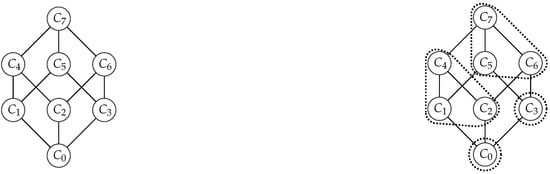
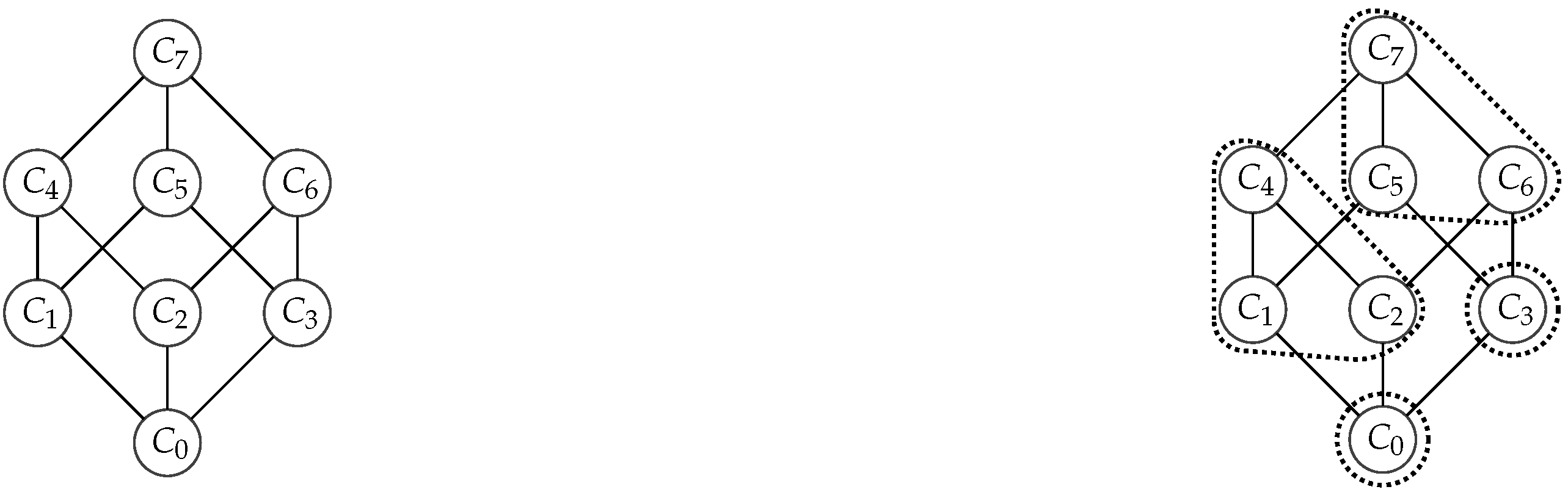
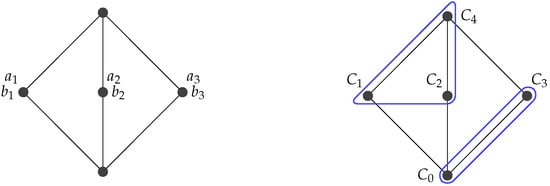
We consider a context composed of the set of attributes and the set of objects , related by , defined on Table 1, which has the concepts listed on Table 2. The associated concept lattice is given on the left side of Figure 1.
Table 1.
Relation of the context of Example 1.
Table 2.
List of extents and intents of every concept of the context of Example 1.
Figure 1.
Concept lattice of Example 1 (left) and the partition induced by the elimination of attributes and in Example 1 (right).
From this context, we obtain the attribute concepts listed below, together with the induced equivalence classes obtained by removing attributes and , that is considering only the subset of attributes .
The partition induced by such a reduction is shown on the right side of Figure 1. Notice that two of the obtained equivalence classes are not convex sublattices of the original concept lattice. The first one contains the concepts , , , and the other one contains the concepts , , . However, the reasons for which these classes are not convex sublattices are well differentiated.
On the one hand, if we consider the equivalence class , we have that the infimum of the concepts of this class is the concept . Notice that the meet-irreducible decomposition of is , and both concepts and belong to ; this means that we are under the conditions given in Theorem 3. Since , we have that , with . Specifically, in this case, we have that the concept is just generated by the attribute . Notice that is not always an attribute concept. For example, if we consider , then we obtain two classes: and , where and satisfying that belong to . Therefore, the hypotheses of Theorem 3 hold; indeed, ; however, is not an attribute concept.
On the other hand, if we consider the equivalence class , we have that the infimum of the equivalence class is the concept . In this case, the decomposition of is , we observe that there are two meet-irreducible concepts, and , such that . Therefore, we cannot apply Theorem 3 since the hypothesis are not satisfied. Moreover, since the concept lattice is distributive, the condition that the meet-irreducible concepts of the decomposition are in the class is a required hypothesis in [39], Corollary 1. In addition, this corollary must also be corrected in its conclusion, since can only be ensured. Thus, Theorem 3 presents an improved version of Corollary 1 given in [39].
Next, we present one of the main results of this paper, which characterizes the infimum of the elements of non-singleton classes.
Theorem 4.
Given a context , a subset of attributes , and a concept such that its equivalence class of the induced equivalence relation is not a singleton, we have that if and only if one of the following statements is satisfied:
- There exists at least one attribute such that .
- There exists a concept , such that with , , and . Moreover, is in a meet-irreducible decomposition of . Recall that the concept of the reduced concept lattices is denoted with an overline.
Proof.
Let us assume that we reduce the context by a subset of attributes . Given a concept , we consider the induced equivalence class , which is not a singleton. The concept does not necessarily belong to the class since is a join-semilattice by Theorem 2.
Therefore, if , then we can distinguish two cases:
- If there exists such that , the first statement holds.
- Otherwise, is not generated by any attribute of D. On the one hand, since , we have that and for all ; applying Proposition 7 to the reduced context, we can assert that there exists at least one attribute such that and for all . On the other hand, there exists an attribute concept such that , which implies that . Moreover, , because for all . If , then the concept is the required concept, and the second statement holds.If , we consider a meet-decomposition of in the reduced concept lattice , that is , where for all . Since and , then by Proposition 6, we have that . If , for all , then, by the infimum property, we obtain that , which leads us to a contradiction. Therefore, there exists , such that is in a meet-decomposition in the reduced context of , with . This last property implies that (since, otherwise, ) and . Moreover, since is a meet-irreducible concept of the reduced context, then there exists , such that .Thus, is the required concept in the second statement.
Now, we assume that one of the statements is satisfied, and we again consider two cases:
- There exists such that , then since is not a singleton, we have that , and so, and . Therefore, by Proposition 7, we obtain that .
- There exists a concept , such that with , , and is in a meet-irreducible decomposition of . Hence, by Proposition 6, we have that and . Due to being in a meet-irreducible decomposition of , in particular, we have that , which implies that . Thus, since and , by Proposition 7, we obtain that .
□
Notice that, given with , if , then cannot belong to , and so, . Hence, the hypothesis is not considered in the implication to prove . Moreover, from the hypothesis that is in a meet-irreducible decomposition of , only is used. These hypotheses are included in the characterization in order to collect as much as possible the consequences of . The following corollary presents the reduced version.
Corollary 1.
Given a context , a subset of attributes , and a concept such that its equivalence class of the induced equivalence relation is not a singleton, then if and only if one of the following statements is satisfied:
- There exists at least one attribute such that .
- There exists a concept , such that with , , and .
Notice that the previous corollary improves Proposition 4, since the concept must be generated by an attribute of the reduced attribute subset D, and it does not need to be a meet-irreducible concept in order to obtain the equivalence. An application of Theorem 4 is illustrated in the following example.
Example 2.
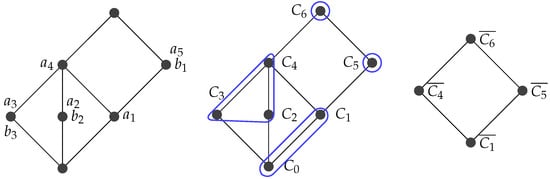
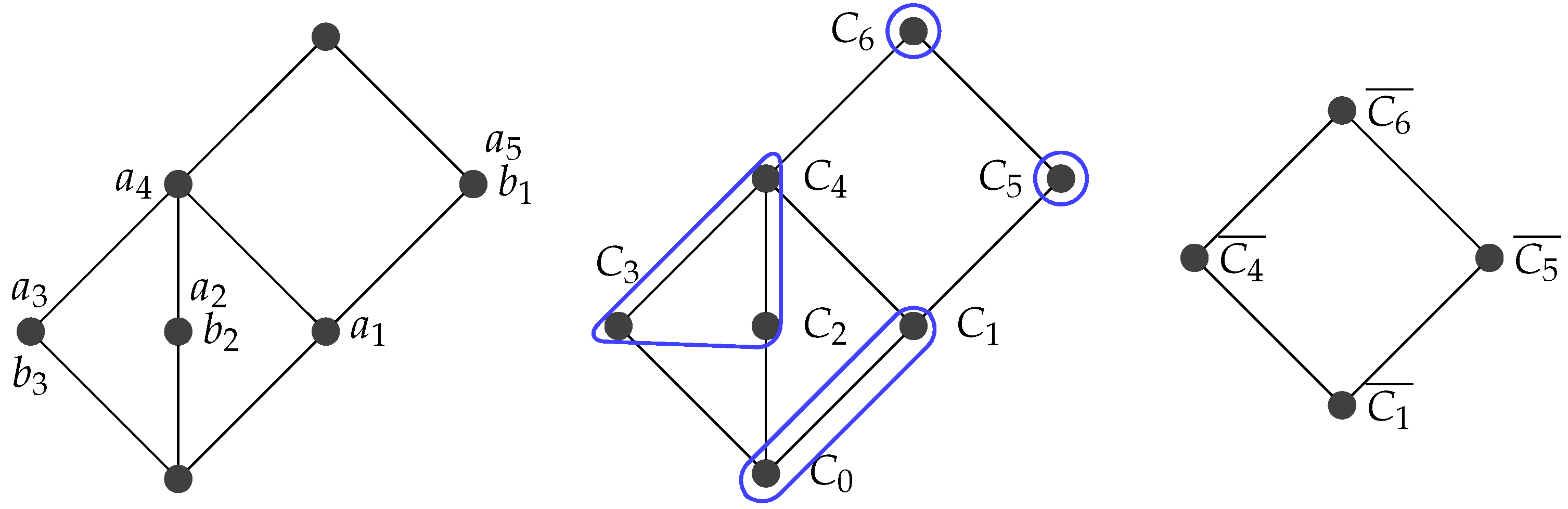
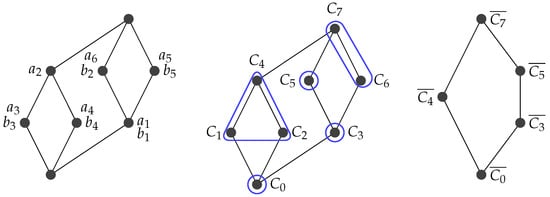
We consider a context whose Hasse diagram of its concept lattice is on the left side of Figure 2. Labels in the concept lattice indicate the mappings γ and μ of the fundamental theorem, that is the node labeled as a represents the concept for , and similarly, the node labeled as b represents the concept for .
Figure 2.
Concept lattices of Example 2.
Now, if we consider a subset of attributes , we obtain an induced partition, which is illustrated in the middle of Figure 2. We choose the class , which is not a singleton, and therefore, we are under the conditions of Theorem 4. Thus, if and only if one of the statements of Theorem 4 is satisfied. In this case, we have that , and the second statement holds, as we show next.
We have that the concept is the attribute concept generated by , , where , and it satisfies that and . Moreover, the meet-irreducible decomposition of in the reduced concept lattice, shown on the right side of Figure 2, is the set . Since is in the meet-irreducible decomposition of , we can conclude that the second statement is satisfied.
3.2. Attribute Reduction without Unnecessary Attributes
Attribute reduction in FCA usually removes unnecessary attributes. Hence, this section analyzes the characterization when the set D does not contain unnecessary attributes. This study is interesting, for example, for any attribute reduction strategy merging FCA and other frameworks, such as rough set theory [35,42,43]. The first result shows that Statement 1 in Proposition 4 only arises when the context contains unnecessary attributes.
Proposition 8.
Given a context , a subset of attributes , and a concept , if the equivalence class of the induced equivalence relation is not a singleton and there exists such that , then .
Proof.
Since is not a singleton, and with , we have that is not a ∧-irreducible concept. Therefore, generates a non-irreducible concept, and by Theorem 1, we obtain that . □
As a consequence of this result, Statement 1 in Theorem 4 and Statement 1in Corollary 1 cannot be satisfied when D does not contain any unnecessary attribute of A. Hence, according to this consideration, Theorem 4 can be written as follows.
Corollary 2.
Given a context , a subset of attributes , such that , and a concept , where is not a singleton, then, if and only if there exists , such that with , , , and is in a meet-irreducible decomposition of .
In general, a meet-irreducible in the reduced concept lattice does not have an associated meet-irreducible concept in the original concept lattice as the following example shows.
Example 3.
Let us consider the concept lattice on the left side of Figure 3, which is associated with a context . If we select the subset of attributes , then we obtain the induced partition illustrated in the middle of Figure 3. As we can see in the figure, there is a class, , such that the concept . Therefore, by Theorem 4, there exists a concept satisfying the second statement of this theorem (the first statement is not satisfied since is not generated by any attribute).
Figure 3.
Concept lattices of Example 3.
Moreover, we have that the meet-irreducible decomposition of is the set , as we can see in the reduced concept lattice induced by the attribute reduction depicted on the right side of Figure 3. In this case, the concept , which satisfies the conditions of the second statement of Theorem 4, is a meet-irreducible concept in the reduced concept lattice ; however, the concept is not a meet-irreducible concept in .
The following result shows that removing unnecessary attributes provides a sufficient condition to ensure the equivalence between meet-irreducible concepts in the reduced context and in the original one.
Proposition 9.
Given a context , a subset of attributes , and a concept , such that , with , the following equivalence holds:
Proof.
On the one hand, if we assume the concept C is a meet-irreducible concept in the original concept lattice, , then taking into account that , the set of extents of the reduced concept lattice is included in the set of extents of the original, and if , then holds too; we have that is also a meet-irreducible concept in the reduced concept lattice, .
On the other hand, if we assume that , then there exists such that . Furthermore, since , we have that by Theorem 1. □
Notice that in Example 3 is an unnecessary attribute, which is the reason why is not a meet-irreducible element of the original concept lattice. Hence, as a consequence of the previous results, Theorem 4 can be rewritten as follows.
Theorem 5.
Given a context , a subset of attributes , an equivalence class with , of the induced equivalence relation, and the concept , then if and only if there exists a concept in a meet-irreducible decomposition of , such that with and .
Proof.
The proof straightforwardly holds from Corollary 2 and Proposition 9. □
Therefore, if the subset contains no unnecessary attribute, which is the case of the reducts in FCA [1,26], the characterization is mainly based on the concepts of the original concept lattice instead of Theorem 4. This fact simplifies the detection of lattices whose equivalence classes of an attribute reduction are not convex sublattices of the original concept lattice. Moreover, this result also improves Proposition 4, showing that must be included in the hypothesis of this proposition in order to obtain the equivalence.
Thus, the previous results and examples have a relevant interest for the application of local congruences, since they characterize the cases when the classes are not sublattices [36,39] and, so, what classes are affected when a local congruence is applied after an attribute reduction mechanism. In particular, we can determine the kind of lattices for which, after applying any attribute reduction, we obtain equivalence classes that are convex sublattices, that is for any class of any attribute reduction, the concept belongs to the class. Based on these results, different particular cases are analyzed next.
Example 4.
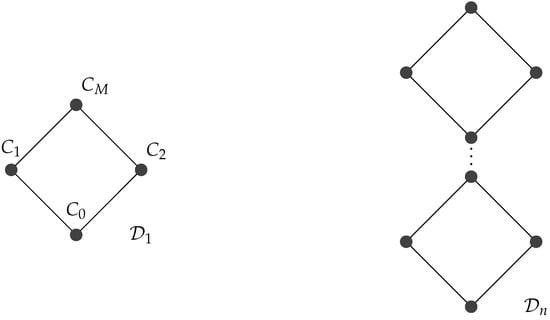
The simplest non-linear concept lattice satisfying that “, for every class and attribute reduction ” is the one associated with the lattice , which is also denoted as [44] (left side of Figure 4) and without unnecessary attributes. If is a singleton, then clearly, . Otherwise, the only case in which does not contain is when D implies that . In this case, all meet-irreducible concepts in the decomposition of belong to the class , and by Theorem 3, we obtain that there exists , such that , which implies in this particular case that . Thus, by Proposition 8, we have that , which contradicts the hypothesis.
Figure 4.
Concept lattices of Example 4.
The concatenation of this lattice (right side of Figure 4) also satisfies this statement as the following result shows.
Proposition 10.
Given a context , whose concept lattice is isomorphic to , with , , and a class , we have that .
Proof.
Let us consider a context whose associated concept lattice is isomorphic to , with . In addition, let us consider a subset of attributes , a concept , and the equivalence class of the induced equivalence relation.
If is a singleton, then clearly, . Hence, we assume that is not a singleton. Since, by Proposition 8, cannot be a meet-irreducible concept, we have that all meet-irreducible concepts in the decomposition of belong to the class , because of the shape of this lattice. Therefore, by Theorem 3, we have that , with and . If , then by Proposition 8, we obtain that , which leads us to a contradiction. Otherwise, there exists a concept such that and . As a consequence, by the shape of , must be a meet-irreducible concept in the meet-irreducible decomposition of . Thus, we obtain a contradiction with the fact that all meet-irreducible concepts in the decomposition of belong to the class . □
The following example shows that the basic non-distributive lattices and do not satisfy the previous property.
Example 5.
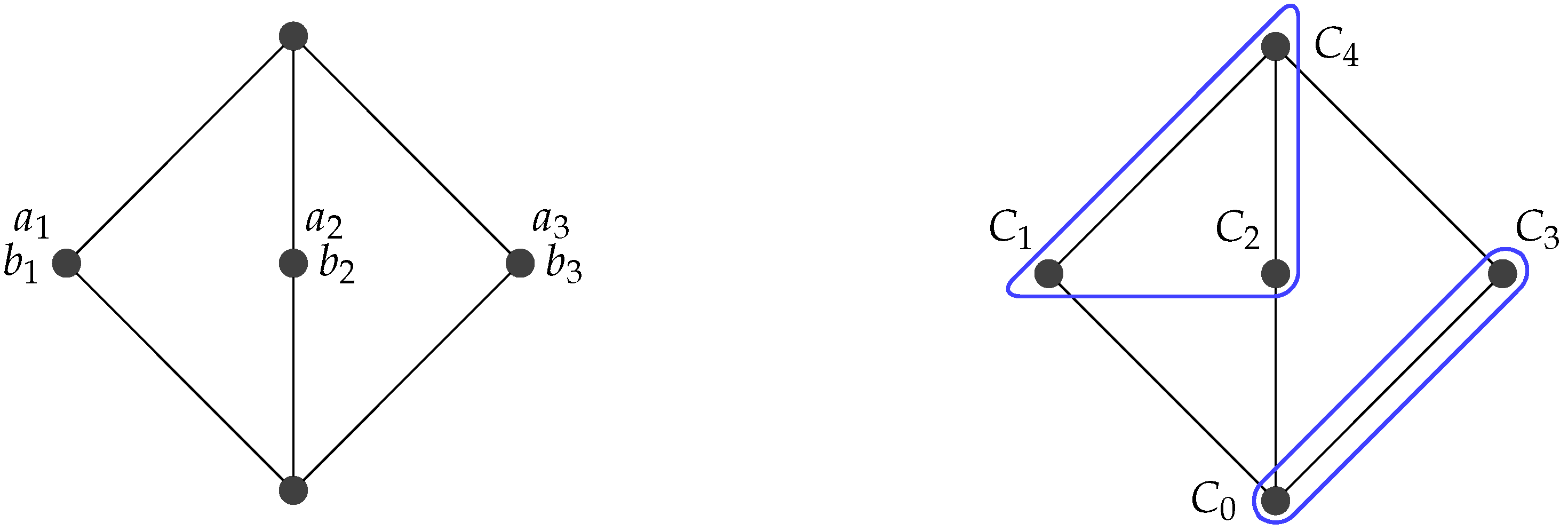
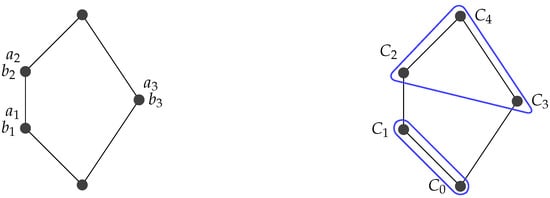
We consider a context , where the Hasse diagram of its concept lattice is depicted on the left side of Figure 5, which is isomorphic to , and it has no unnecessary attribute. If we carry out any attribute reduction on this particular context, we cannot ensure that every induced equivalence class obtained by the reduction is a convex sublattice. For instance, we consider the subset of attributes , and therefore, the induced partition obtained by this attribute reduction is the Venn diagram depicted on the right side of Figure 5.
Figure 5.
Concept lattice isomorphic to and induced partition by .
We can notice that the infimum concept of the class does not belong to the class since there is a concept such that , with , and , that is Statement 2 of Corollary 1 is satisfied.
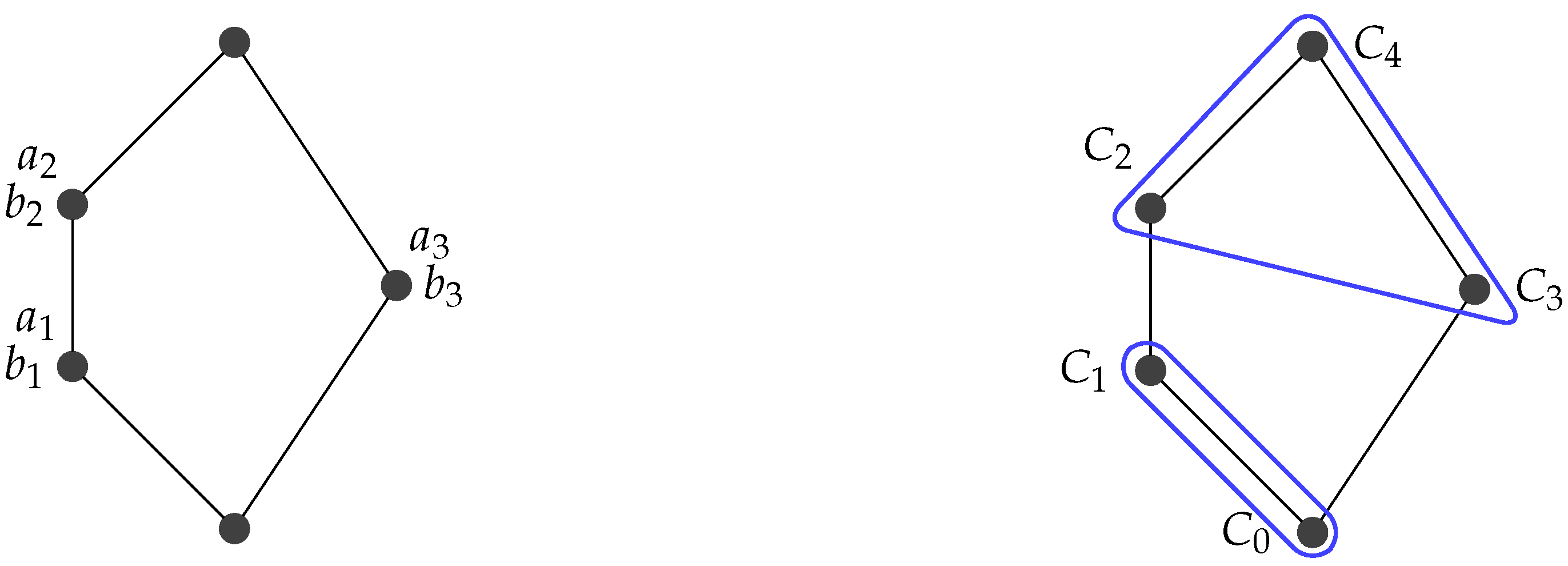
A similar case arises when a context , with concept lattice isomorphic to (left side of Figure 6) and without unnecessary attributes, is considered.
Figure 6.
Concept lattice isomorphic to and induced partition by .
If we consider the singleton , we obtain the partition shown on the right side of Figure 6. In this case, Statement 2 of Corollary 1 also holds, because there is a concept , such that with , , and . Thus, .
Finally, we prove that, in general, every distributive lattice satisfies the property.
Theorem 6.
Given a context , whose concept lattice is isomorphic to a distributive lattice, , and a class , we have that .
Proof.
We proceed by reduction ad absurdum. Hence, we assume that , and we get a contradiction.
From , by Proposition 7, we have that there exists , such that and . Since , by Proposition 8, there exists a concept such that and , which must be meet-irreducible, because otherwise, .
Moreover, by the definition of , we have that:
where is the unique meet-irreducible decomposition of . The uniqueness arises because the concept lattice is distributive. Hence, in particular, the concept belongs to this decomposition. Therefore, by Proposition 5, there exists , such that , which implies that:
which contradicts that . □
This result and the previous example are very interesting since they characterize the concept lattices providing convex sublattices for every attribute reduction. In addition, when the concept lattice is not distributive, we highlighted that many possibilities exist such that an attribute reduction provides equivalent classes, which are not sublattices of the original one. Moreover, Theorem 6 holds when the attribute reduction does not contain unnecessary attributes, as in FCA. If the reduction is given by another mechanism, such as based on the rough set theory philosophy [35,42,43], we can obtain classes that are not sublattices, as Example 3 shows. These facts also reinforce the necessity of studying mechanisms to lightly modify the equivalence relation given by the reduction in order to ensure that the classes are convex sublattices, as the new notion of local congruence [38,45] does.
4. Conclusions and Future Work
In this paper, we improve the results presented in [39], giving a characterization of the infimum of the elements belonging to a non-singleton class induced by an attribute reduction. Furthermore, we also found the characterization of these infimum elements when the considered attribute reduction does not contain unnecessary attributes, which is of special interest in FCA since attribute reductions usually discard this kind of attribute. We also introduced other interesting results in this framework. For example, we proved that the equivalence classes, induced by an attribute reduction on a distributive concept lattice, always have the structure of a convex sublattice. All the theoretical development carried out in this paper has a direct impact on the theory of local congruences [38].
In the future, we will study sufficient conditions on a (fuzzy) context in order to ensure that its concept lattice is distributive. This is an interesting problem, which has already attracted the attention of other researchers [46]. Moreover, the introduced results will be applied to real cases, such as the ones obtained from the COST Action DigForASP, which is focused on the application of artificial intelligence and automatic reasoning tools to digital forensics.
Author Contributions
All authors contributed equally to this work. All authors read and agreed to the published version of the manuscript.
Funding
This research was partially supported by the 2014–2020 ERDF Operational Programme in collaboration with the State Research Agency (AEI) in Projects TIN2016-76653-P and PID2019-108991GB-I00 and with the Department of Economy, Knowledge, Business and University of the Regional Government of Andalusia in Project FEDER-UCA18-108612 and by the European Cooperation in Science & Technology (COST) Action CA17124.
Institutional Review Board Statement
Not applicable.
Informed Consent Statement
Not applicable.
Conflicts of Interest
The authors declare no conflict of interest.
References
- Ganter, B.; Wille, R. Formal Concept Analysis: Mathematical Foundation; Springer: Berlin/Heidelberg, Germany, 1999. [Google Scholar]
- Belfodil, A.; Kuznetsov, S.O.; Kaytoue, M. On pattern setups and pattern multistructures. Int. J. Gen. Syst. 2020, 49, 785–818. [Google Scholar] [CrossRef] [Scilit]
- Krídlo, O.; Krajči, S.; Antoni, L. Formal concept analysis of higher order. Int. J. Gen. Syst. 2016, 45, 116–134. [Google Scholar] [CrossRef] [Scilit]
- Antoni, L.; Krajči, S.; Krídlo, O. On stability of fuzzy formal concepts over randomized one-sided formal context. Fuzzy Sets Syst. 2018, 333, 36–53. [Google Scholar] [CrossRef] [Scilit]
- Bělohlávek, R. Lattices of Fixed Points of Fuzzy Galois Connections. Math. Log. Quartely 2001, 47, 111–116. [Google Scholar] [CrossRef] [Scilit]
- Medina, J.; Ojeda-Aciego, M.; Ruiz-Calviño, J. Formal concept analysis via multi-adjoint concept lattices. Fuzzy Sets Syst. 2009, 160, 130–144. [Google Scholar] [CrossRef] [Scilit]
- Medina, J.; Ojeda-Aciego, M.; Ruiz-Calviño, J. Relating generalized concept lattices with concept lattices for non-commutative conjunctors. Appl. Math. Lett. 2008, 21, 1296–1300. [Google Scholar] [CrossRef] [Scilit]
- Alcalde, C.; Burusco, A. Reduction of the size of L-fuzzy contexts. A tool for differential diagnoses of diseases. Int. J. Gen. Syst. 2019, 48, 692–712. [Google Scholar] [CrossRef] [Scilit]
- Demko, C.; Bertet, K.; Faucher, C.; Viaud, J.F.; Kuznetsov, S.O. NextPriorityConcept: A new and generic algorithm computing concepts from complex and heterogeneous data. Theor. Comput. Sci. 2020, 845. [Google Scholar] [CrossRef] [Scilit]
- Cordero, P.; Enciso, M.; Mora, A.; Ojeda-Aciego, M.; Rossi, C. Knowledge discovery in social networks by using a logic-based treatment of implications. Knowl. Based Syst. 2015, 87, 16–25. [Google Scholar] [CrossRef] [Scilit]
- Singh, P.K. Complex neutrosophic concept lattice and its applications to air quality analysis. Chaos Solitons Fractals 2018, 109, 206–213. [Google Scholar] [CrossRef] [Scilit]
- Xie, J.; Yang, M.; Li, J.; Zheng, Z. Rule acquisition and optimal scale selection in multi-scale formal decision contexts and their applications to smart city. Future Gener. Comput. Syst. 2018, 83, 564–581. [Google Scholar] [CrossRef] [Scilit]
- Antoni, L.; Krajči, S.; Krídlo, O. Representation of fuzzy subsets by Galois connections. Fuzzy Sets Syst. 2017, 326, 52–68. [Google Scholar] [CrossRef] [Scilit]
- Cabrera, I.P.; Cordero, P.; Muñoz-Velasco, E.; Ojeda-Aciego, M.; De Baets, B. Relational Galois connections between transitive digraphs: Characterization and construction. Inf. Sci. 2020, 519, 439–450. [Google Scholar] [CrossRef] [Scilit]
- Denecke, K.; Erné, M.; Wismath, S.L. (Eds.) Galois Connections and Applications; Kluwer Academic Publishers: Dordrecht, The Netherlands, 2004. [Google Scholar]
- Díaz-Moreno, J.C.; Medina, J.; Ojeda-Aciego, M. On basic conditions to generate multi-adjoint concept lattices via Galois connections. Int. J. Gen. Syst. 2014, 43, 149–161. [Google Scholar] [CrossRef] [Scilit]
- Birkhoff, G. Lattice Theory, 3rd ed.; American Mathematical Society: Providence, RI, USA, 1967. [Google Scholar]
- Belohlávek, R.; Vychodil, V. Attribute dependencies for data with grades I. Int. J. Gen. Syst. 2016, 45, 864–888. [Google Scholar] [CrossRef] [Scilit]
- Cordero, P.; Enciso, M.; Mora, A.; Vychodil, V. Parameterized simplification logic I: Reasoning with implications and classes of closure operators. Int. J. Gen. Syst. 2020, 49, 724–746. [Google Scholar] [CrossRef] [Scilit]
- Belohlavek, R.; Cordero, P.; Enciso, M.; Mora, A.; Vychodil, V. Automated prover for attribute dependencies in data with grades. Int. J. Approx. Reason. 2016, 70, 51–67. [Google Scholar] [CrossRef] [Scilit]
- Dubois, D.; Medina, J.; Prade, H.; Ramírez-Poussa, E. Disjunctive attribute dependencies in formal concept analysis under the epistemic view of formal contexts. Inf. Sci. 2021. [Google Scholar] [CrossRef] [Scilit]
- Antoni, L.; Cornejo, M.E.; Medina, J.; Ramirez, E. Attribute classification and reduct computation in multi-adjoint concept lattices. IEEE Trans. Fuzzy Syst. 2020. [Google Scholar] [CrossRef] [Scilit]
- Belohlavek, R.; Konecny, J. A reduction theorem to compute fixpoints of fuzzy closure operators. Fuzzy Sets Syst. 2019, 369, 132–144. [Google Scholar] [CrossRef] [Scilit]
- Cornejo, M.E.; Medina, J.; Ramírez-Poussa, E. Characterizing reducts in multi-adjoint concept lattices. Inf. Sci. 2018, 422, 364–376. [Google Scholar] [CrossRef] [Scilit]
- Cornejo, M.E.; Medina, J.; Ramírez-Poussa, E. Attribute reduction in multi-adjoint concept lattices. Inf. Sci. 2015, 294, 41–56. [Google Scholar] [CrossRef] [Scilit]
- Medina, J. Relating attribute reduction in formal, object-oriented and property-oriented concept lattices. Comput. Math. Appl. 2012, 64, 1992–2002. [Google Scholar] [CrossRef] [Scilit]
- Alcalde, C.; Burusco, A. Study of the Relevance of Objects and Attributes of L-fuzzy Contexts Using Overlap Indexes. Information Processing and Management of Uncertainty in Knowledge-Based Systems. In Theory and Foundations; Medina, J., Ojeda-Aciego, M., Verdegay, J.L., Pelta, D.A., Cabrera, I.P., Bouchon-Meunier, B., Yager, R.R., Eds.; Springer International Publishing: Cham, Switzerland, 2018; pp. 537–548. [Google Scholar]
- Bělohlávek, R.; Vychodil, V. Formal concept analysis and linguistic hedges. Int. J. Gen. Syst. 2012, 41, 503–532. [Google Scholar] [CrossRef] [Scilit]
- Chen, J.; Mi, J.; Xie, B.; Lin, Y. A fast attribute reduction method for large formal decision contexts. Int. J. Approx. Reason. 2019, 106, 1–17. [Google Scholar] [CrossRef] [Scilit]
- Cornejo, M.E.; Medina, J.; Ramírez-Poussa, E. Attribute and size reduction mechanisms in multi-adjoint concept lattices. J. Comput. Appl. Math. 2017, 318, 388–402. [Google Scholar] [CrossRef] [Scilit]
- Cornejo, M.E.; Medina, J.; Ramírez-Poussa, E. On the use of thresholds in multi-adjoint concept lattices. Int. J. Comput. Math. 2015, 92, 1855–1873. [Google Scholar] [CrossRef] [Scilit]
- Cornejo, M.E.; Medina, J.; Ramírez-Poussa, E. On the use of irreducible elements for reducing multi-adjoint concept lattices. Knowl. Based Syst. 2015, 89, 192–202. [Google Scholar] [CrossRef] [Scilit]
- Kuznetsov, S.; Obiedkov, S.; Roth, C. Reducing the Representation Complexity of Lattice-Based Taxonomies. In Conceptual Structures: Knowledge Architectures for Smart Applications; Priss, U., Polovina, S., Hill, R., Eds.; Springer: Berlin/Heidelberg, Germany, 2007; pp. 241–254. [Google Scholar]
- Bartl, E.; Konecny, J. L-Concept lattices with positive and negative attributes: Modeling uncertainty and reduction of size. Inf. Sci. 2019, 472, 163–179. [Google Scholar] [CrossRef] [Scilit]
- Benítez-Caballero, M.J.; Medina, J.; Ramírez-Poussa, E.; Ślȩzak, D. Rough-set-driven approach for attribute reduction in fuzzy formal concept analysis. Fuzzy Sets Syst. 2019. [Google Scholar] [CrossRef] [Scilit]
- Benítez-Caballero, M.J.; Medina, J.; Ramírez-Poussa, E.; Ślȩzak, D. A computational procedure for variable selection preserving different initial conditions. Int. J. Comput. Math. 2020, 97, 387–404. [Google Scholar] [CrossRef] [Scilit]
- Benítez-Caballero, M.J.; Medina, J.; Ramírez-Poussa, E. Unifying Reducts in Formal Concept Analysis and Rough Set Theory. Stud. Comput. Intell. 2019, 796, 89–95. [Google Scholar] [CrossRef] [Scilit]
- Aragón, R.G.; Medina, J.; Ramírez-Poussa, E. Reducing concept lattices by means of a weaker notion of congruence. Fuzzy Sets Syst. 2020. [Google Scholar] [CrossRef] [Scilit]
- Aragón, R.G.; Medina, J.; Ramírez-Poussa, E. Impact of Local Congruences in Attribute Reduction. In Information Processing and Management of Uncertainty in Knowledge-Based Systems; Lesot, M.J., Vieira, S., Reformat, M.Z., Carvalho, J.P., Wilbik, A., Bouchon-Meunier, B., Yager, R.R., Eds.; Springer International Publishing: Cham, Switzerland, 2020; pp. 748–758. [Google Scholar]
- Wang, X.; Zhang, W. Relations of attribute reduction between object and property oriented concept lattices. Knowl. Based Syst. 2008, 21, 398–403. [Google Scholar] [CrossRef] [Scilit]
- Aragón, R.G.; Medina, J.; Ramírez-Poussa, E. Impact of local congruences in variable selection from datasets. J. Comput. Appl. Math. 2021, 113416. [Google Scholar] [CrossRef] [Scilit]
- Benítez-Caballero, M.J.; Medina, J.; Ramírez-Poussa, E. Unifying Reducts in Formal Concept Analysis and Rough Set Theory. In Trends in Mathematics and Computational Intelligence; Cornejo, M.E., Kóczy, L.T., Medina, J., De Barros Ruano, A.E., Eds.; Springer International Publishing: Cham, Switzerland, 2019; pp. 89–95. [Google Scholar] [CrossRef] [Scilit]
- Benítez-Caballero, M.J.; Medina, J.; Ramírez-Poussa, E. Attribute Reduction in Rough Set Theory and Formal Concept Analysis. Lect. Notes Comput. Sci. 2017, 10314, 513–525. [Google Scholar]
- Davey, B.; Priestley, H. Introduction to Lattices and Order, 2nd ed.; Cambridge University Press: Cambridge, UK, 2002. [Google Scholar]
- Aragón, R.G.; Medina, J.; Ramírez-Poussa, E. Weaken the congruence notion to reduce concept lattices. Stud. Comput. Intell. 2019, 1–7, in press. [Google Scholar]
- Gély, A.; Couceiro, M.; Napoli, A. Steps towards achieving distributivity in formal concept analysis. In Proceedings of the CEUR Workshop Proceedings CLA 2018-The 14th International Conference on Concept Lattices and Their Application, Olomouc, Czech Republic, 12–14 June 2018; Volume 2123, pp. 105–116. [Google Scholar]

Publisher’s Note: MDPI stays neutral with regard to jurisdictional claims in published maps and institutional affiliations. |
© 2021 by the authors. Licensee MDPI, Basel, Switzerland. This article is an open access article distributed under the terms and conditions of the Creative Commons Attribution (CC BY) license (http://creativecommons.org/licenses/by/4.0/).