


Abstract
In this paper, we apply the notion of soft rough neutrosophic sets to graph theory. We develop certain new concepts, including soft rough neutrosophic graphs, soft rough neutrosophic influence graphs, soft rough neutrosophic influence cycles and soft rough neutrosophic influence trees. We illustrate these concepts with examples, and investigate some of their properties. We solve the decision-making problem by using our proposed algorithm.
1. Introduction
Smarandache [1] introduced neutrosophic sets as a generalization of fuzzy sets and intuitionistic fuzzy sets. A neutrosophic set has three constituents: truth-membership, indeterminacy-membership and falsity-membership, in which each membership value is a real standard or non-standard subset of . In real-life problems, neutrosophic sets can be applied more appropriately by using the single-valued neutrosophic sets defined by Smarandache [1] and Wang et al. [2]. Ye [3,4] and Peng et al. [5] further extended the study of neutrosophic sets. Soft set theory [6] was proposed by Molodtsov in 1999 to deal with uncertainty in a parametric manner. Babitha and Sunil discussed the concept of soft set relation [7]. On the other hand, Pawlak [8] proposed the notion of rough sets. It is a rigid appearance of modeling and processing partial information. It has been effectively connected to decision analysis, machine learning, inductive reasoning, intelligent systems, pattern recognition, signal analysis, expert systems, knowledge discovery, image processing, and many other fields [9,10,11,12]. In literature, rough theory has been applied in different field of mathematics [13,14,15,16]. Dubois and Prade [17] developed two concepts called rough fuzzy sets and fuzzy rough sets and concluded that these two theories are different approaches to handle vagueness. Feng et al. [18] combined soft sets with fuzzy sets and rough sets. Meng et al. [19] dealt with soft rough fuzzy sets and soft fuzzy rough sets. Broumi et al. [20] studied rough neutrosophic sets. Yang et al. [21] proposed single-valued neutrosophic rough sets, and established an algorithm for decision-making problem based on single- valued neutrosophic rough sets on two universes.
A graph is a convenient way of representing information involving relationship between objects. The objects are represented by vertices and relations by edges. When there is vagueness in the description of the objects or in its relationships or in both, it is natural that we need to design a fuzzy graph model. Fuzzy models has vital role as their aspiration in decreasing the irregularity between the traditional numerical models used in engineering and sciences and the symbolic models used in expert systems. The fuzzy graph theory as a generalization of Euler’s graph theory was first introduced by Kaufmann [22]. Later, Rosenfeld [23] considered fuzzy graphs and obtained analogs of several graph theoretical concepts. Mordeson and Peng [24] defined some operations on fuzzy graphs. Mathew and Sunitha [25,26] presented some new concepts on fuzzy graphs. Gani et al. [27,28,29,30] discussed several concepts, including size, order, degree, regularity and edge regularity in fuzzy graphs and intuitionistic fuzzy graphs. Parvathi and Karunambigai [31] described some operation on intuitionistic fuzzy graph. Recently, Akram et al. [32,33,34,35,36] has introduced several extensions of fuzzy graphs with applications. Denish [37] considered the idea of fuzzy incidence graph. Fuzzy incidence graphs were further studied in [38,39]. Due to the limitation of humans knowledge to understand the complex problems, it is very difficult to apply only a single type of uncertainty method to deal with such problems. Therefore, it is necessary to develop hybrid models by incorporating the advantages of many other different mathematical models dealing uncertainty. Recently, new hybrid models, including rough fuzzy graphs [40,41], fuzzy rough graphs [42], intuitionistic fuzzy rough graphs [43,44], rough neutrosophic graphs [45] and neutrosophic soft rough graphs [46] are constructed. For other notations and definitions, the readers are refereed to [47,48,49,50,51]. In this paper, we apply the notion of soft rough neutrosophic sets to graph theory. We develop certain new concepts, including soft rough neutrosophic graphs, soft rough neutrosophic influence graphs, soft rough neutrosophic influence cycles and soft rough neutrosophic influence trees. We illustrate these concepts with examples, and investigate some of their properties. We solve decision-making problem by using our proposed algorithm.
This paper is organized as follows. In Section 2, some definitions and some properties of soft rough neutrosophic graphs are given. In Section 3, soft rough neutrosophic influence graphs, soft rough neutrosophic influence cycles and soft rough neutrosophic influence trees are discussed. In Section 4, an application is presented. Finally, we conclude our contribution with a summary in Section 5 and an outlook for the further research.
2. Soft Rough Neutrosophic Graphs
Definition 1.
Let B be Boolean set and A a set of attributes. For an arbitrary full soft set S over B such that (a)⊂B, for some a∈A, where :A→ is a set-valued function defined as (a)={b∈B|(a,b)∈S}, for all a∈A. Let (B,S) be a full soft approximation space. For any neutrosophic set N = {(b,,,)|b∈B}∈(B), where (B) is neutrosophic power set of set B. The upper and lower soft rough neutrosophic approximations of N w.r.t (B,S), denoted by and , respectively, are defined as follows:
where
In other words,
The pair (,) is called soft rough neutrosophic set (SRNS) of N w.r.t (B,S).
Example 1.
Suppose N = {(,,,,(,,,),(,,,),(,,,),(,,,)} is a neutrosophic set on the universal set B={,,,,} under consideration. Let A={,,} be a set of parameter on B. A full soft set over B, denoted by S, is defined in Table 1.
Table 1.
Full soft set S.
A set-valued function :A→ is defined as ()={,},()={,},()={,,,}. From Equation (1) of Definition 1, we have
Similarly,
Thus, we obtain
Definition 2.
A soft rough neutrosophic relation(SRNR) (,) on = B×B is a soft rough neutrosophic set, R:(A×A)→() is a full soft set on and defined by
for all (,)∈R, such that ()⊂ for some ∈, where :→() is a set-valued function, for all ∈, defined by
For any neutrosophic set M∈, the upper and lower soft rough neutrosophic approximation of M w.r.t (,R) are defined as follows:
where
In other words,
If = , then it is called induced soft rough neutrosophic relation on soft rough neutrosophic set, otherwise, soft rough neutrosophic relation.
Remark 1.
For a neutrosophic set M on and a neutrosophic set N on B, we have neutrosophic relation as follow
From Definition 2, it follows that:
Definition 3.
In Definition 2 is called effective, if
Definition 4.
A soft rough neutrosophic influence (SRNI) is a relation from soft rough neutrosophic set to soft rough neutrosophic relation, denoted by (,) on =B × , where X:(A×)→() is a full soft set on defined by
for all (,)∈X and for some i≠j≠k and l≠m≠n. Let :→() be a set-valued function defined by
For any Q∈(), the upper and lower soft rough neutrosophic approximation of Q w.r.t (,X), for all ∈, are defined as follows:
where
In other words,
Remark 2.
For a neutrosophic set Q on and a neutrosophic set N and M on B and , respectively, we have neutrosophic relation as follow
From Definition 4, we have
Definition 5.
In Definition 4 is called influence effective, if
Example 2.
Let a full soft set S on an universal set B={,,,} with A={,,} a set of parameters can be defined in tabular form as Table 2 as follows:
Table 2.
Full soft set S.
Now, we can define set-valued function such that
Let N(,,,),(,,,),(,,,),(,,,)} be a neutrosophic set on B, then by using Equation (1) of Definition 1, we have
Hence is soft rough neutrosophic set. Let a full soft set R on C={,,,}⊆ with L={,,}⊆ can be defined in Table 3 (from L to C) as follows:
Table 3.
Full soft set R.
Now, we can define set-valued function such that
and M(,,,),(,,,),(,,,),(,,,),(,,,)} a neutrosophic relation on B, then by using Equation (2) of Definition 2, we get
Hence is an induced soft rough neutrosophic relation. Let a full soft set X on D={,,,,,,,,,,}⊆ with P = {,,}⊆ can be defined in Table 4 (from P to D) as follows:
Table 4.
Full soft set X.
Since X is not full soft set on D, therefore, soft rough neutrosophic influence cannot be defined on D.
Definition 6.
A soft rough neutrosophic graph on a nonempty V is a 5-ordered tuple G = (A,S,,R,) such that
- (i)
- A is a set of attributes,
- (ii)
- S is an arbitrary full soft set over V,
- (iii)
- R is an arbitrary full soft set over ,
- (vi)
- = (,) is a soft rough neutrosophic set of V,
- (v)
- = (,) is a soft rough neutrosophic set on ,
In other words G = (,)=(,) is a soft rough neutrosophic graph(SRNG), where = (,) and = (,) are lower soft rough neutrosophic approximate graphs (LSRNAGs) and upper soft rough neutrosophic approximate graphs (USRNAGs), respectively, of G = (,).
Example 3.
Let V={,,,,,} be a vertex set and A={,,} a set of parameters. A full soft set S from A on V can be defined in tabular form in Table 5 as follows:
Table 5.
Full soft set S.
Let N = {(,,,,(,,,),(,,,),(,,,),(,,,),(,,,)} be a neutrosophic set on V. Then from Equation (1) of Definition 1, we have
Hence, = (,) is a soft rough neutrosophic set on V. Let E={,,,,,,,, ,,}⊆ and L=,,,,}⊆. Then a full soft set R on E (from L to E) can be defined in Table 6 as follows:
Table 6.
Full soft set R.
Let M = {(,,,,(,,,),(,,,),(,,,),(,,,),(,,,),(,,,),(,,,),(,,,),(,,,),(,,,)} be a neutrosophic set on E. Then from Equation (2) of Definition 2, we have
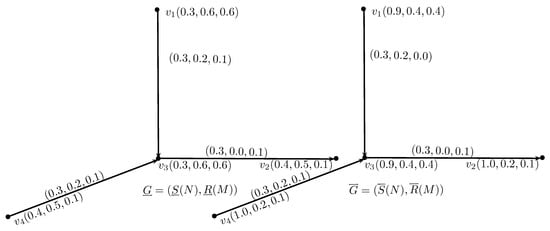
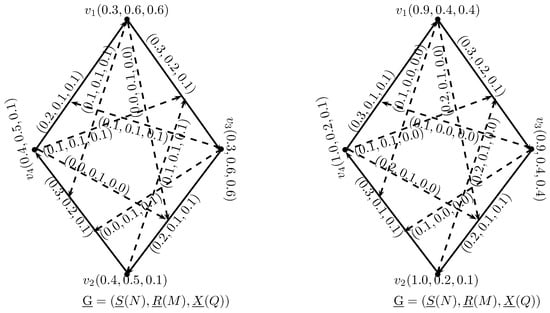
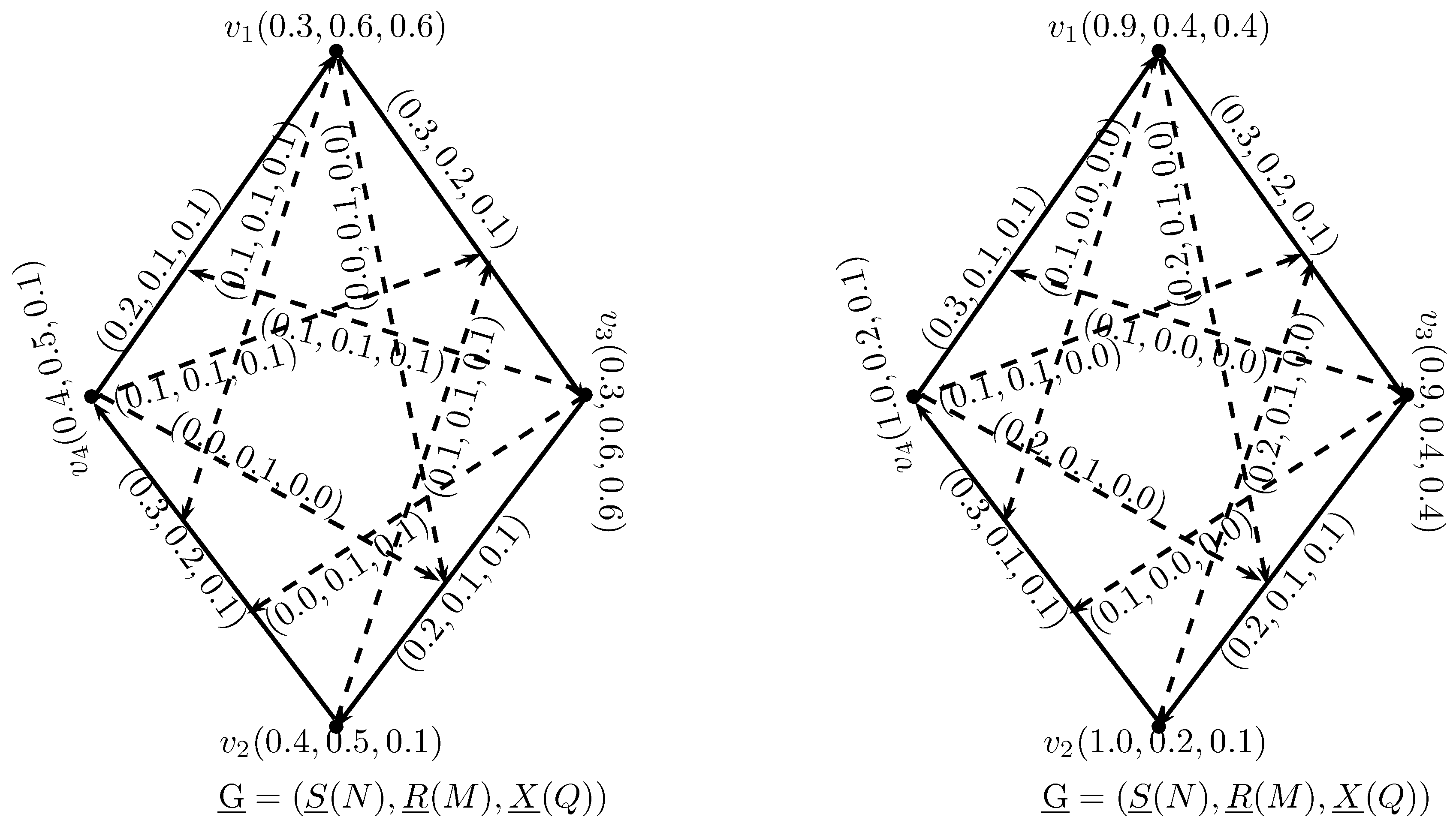
Hence, = (,) is soft rough neutrosophic set on E. Thus, = (,) and = (,) are LSRNAG and USRNAG, respectively, as shown in Figure 1.
Figure 1.
Soft rough neutrosophic graph .
Hence, G = (,) is SRNG.
Definition 7.
An underlying graph(supporting graph) = (,) of a soft rough neutrosophic graph G = (,) is of the form = (,) and = (,),
Definition 8.
A soft rough neutrosophic graph has a walk if each approximation graph has an alternative sequence of the form
such that
where , ∀k=0,1,⋯,n−1. If , then it is called closed walk. If the edges are distinct, then it is called a soft rough neutrosophic trail (SRN trail). If the vertices are distinct, then it is called a soft rough neutrosophic path (SRN path). If a path in a SRNG is closed, then it is called a cycle.
Definition 9.
A strength of soft rough neutrosophic graph, denoted by stren, is defined as
Definition 10.
A strongest path joining any two vertices and is the soft rough neutrosophic path which has maximum strength from and , denoted by or , is called strength of connectedness from and .
Definition 11.
A soft rough neutrosophic graph is a cycle if and only if the underlying graphs of each approximation is a cycle. A soft rough neutrosophic cycle is a soft rough neutrosophic graph if and only if the supporting graph of each approximation graph is a cycle and there exist ,∈,,∈ and ≠ such that
Equivalently, each approximation graph is a cycle such that
Example 4.
Let V={,,,} be a vertex set and A={,,,} a set of parameters. A relation S over A × V can be defined in tabular form in Table 7 as follows:
Table 7.
Full soft set S.
Let N = {(,,,,(,,,),(,,,),(,,,)} be a neutrosophic set on V. Then from Equation (1) of Definition 1, we have
Hence, is soft rough neutrosophic set on V. Let E={,,,}⊆ and L=,,}⊆. Then a full soft set R on E (from L to E) can be defined in Table 8 as follows:
Table 8.
Full soft set R.
Let M = {(,,,),(,,,),(,,,),(,,,)} be a neutrosophic set on E. Then from Equation (2) of Definition 2, we have
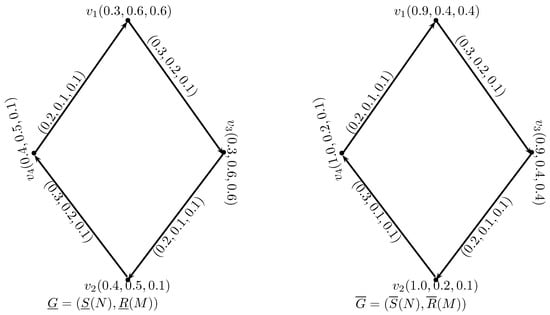
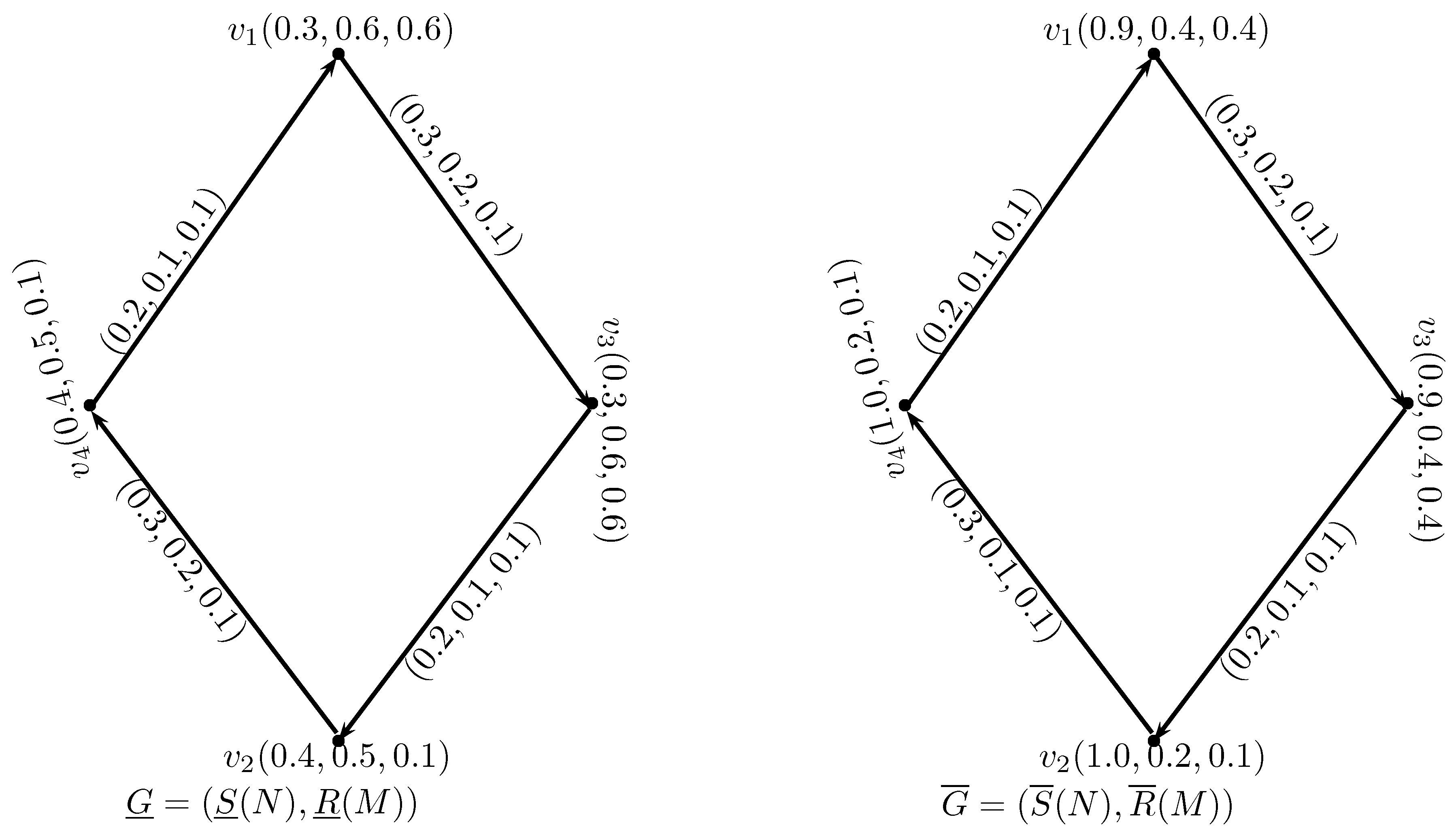
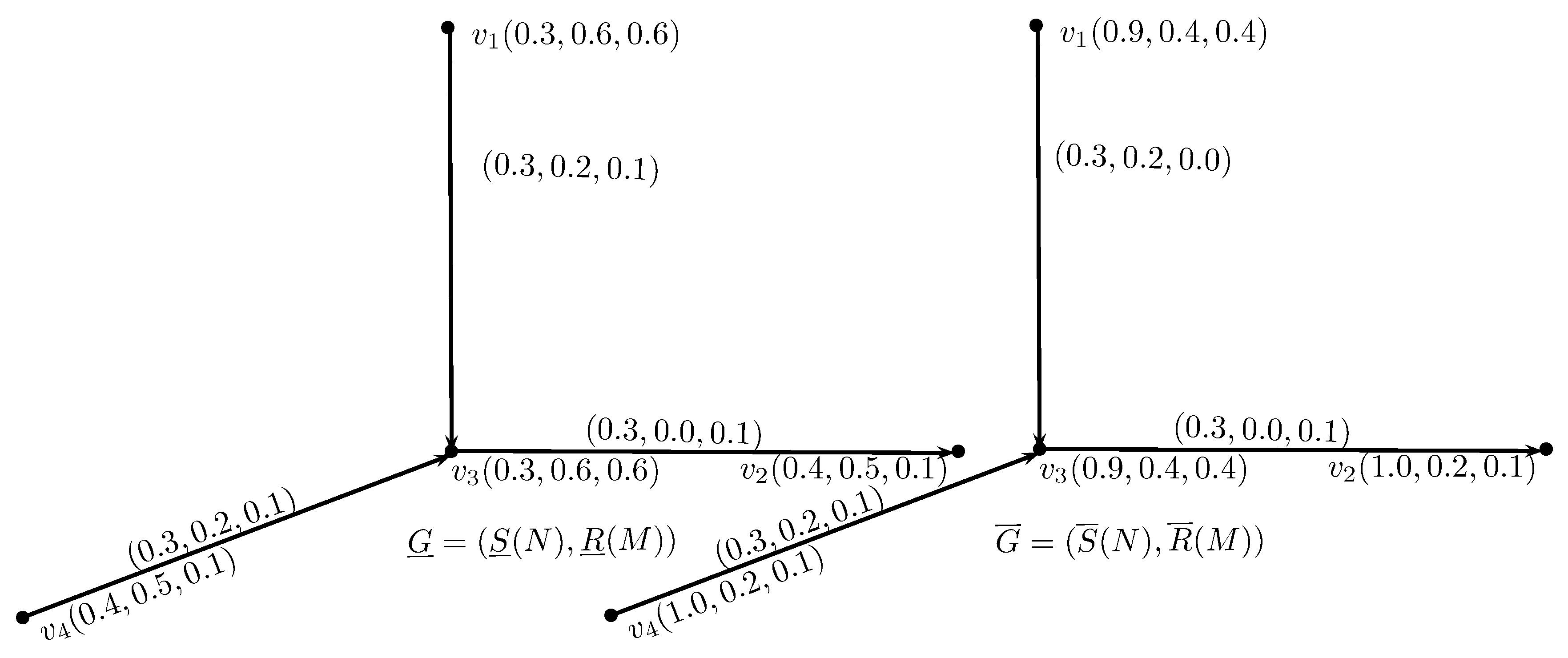
Hence, is soft rough neutrosophic set on E. Thus, and are LSRNAG and USRNAG, respectively, as shown in Figure 2. Hence, is SRNG and it is also a soft rough neutrosophic cycle.
Figure 2.
Soft rough neutrosophic cycle .
Definition 12.
A soft rough neutrosophic subgraph H = (,) of a soft rough neutrosophic graph G = (,), if v∈H such that
and ∈H,
Definition 13.
A H = (,) is called soft rough neutrosophic spanning subgraph of a soft rough neutrosophic graph G = (,), if H is a soft rough neutrosophic subgraph such that
Definition 14.
A soft rough neutrosophic graph is a ditree if and only if each supporting approximation graph is a ditree. A soft rough neutrosophic graph G = (,) is a soft rough neutrosophic ditree if and only if there exists a soft rough neutrosophic spanning subgraph H = (,) is a ditree such that ∈G−H
Definition 15.
Let G = (,) be a soft rough neutrosophic graph, an edge is a bridge if the edge is a bridge in both supporting graph of and , that is the removal of disconnects both the and . An edge is a soft rough neutrosophic bridge in a soft rough neutrosophic graph G = (,), if ∈G
Definition 16.
Let G = (,) be a soft rough neutrosophic graph then a vertex in G is a cutnode(cutvertex) if it is a cutnode in each supporting graph of and . That is, the deletion of from the supporting graphs of and increase the components in the supporting graphs. A vertex is called soft rough neutrosophic cutnode(cutvertex) in a soft rough neutrosophic graph if the removal of reduces the strength of the connectedness from nodes ∈,
Definition 17.
An edge in soft rough neutrosophic graph G is called strong soft rough neutrosophic edge if
Definition 18.
An edge in soft rough neutrosophic graph G is called strong soft rough neutrosophic edge if
Definition 19.
An edge in soft rough neutrosophic graph G is called strong soft rough neutrosophic edge if
Definition 20.
An edge in soft rough neutrosophic graph G is called strong soft rough neutrosophic edge if
Example 5.
Let V={,,,} be a vertex set and A={,,,} a set of parameters. A relation S over can be defined in tabular form in Table 9 as follows:
Table 9.
Full soft set S.
Let N = {(,,,,(,,,),(,,,),(,,,)} be a neutrosophic set on V. Then from Equation (1) of Definition 1, we have
Hence, = (,) is soft rough neutrosophic set on V. Let E={,,}⊆ and L=,,}⊆. Then a full soft set R on E (from L to E) can be defined in Table 10 as follows:
Table 10.
Full soft set R.
Let M = {(,,,),(,,,),(,,,)} be a neutrosophic set on E. Then from Equation (2) of Definition 2, we have
Hence, = (,) is soft rough neutrosophic set on E. Thus, = (,) and = (,) are LSRNAG and USRNAG, respectively, as shown in Figure 3. Hence, is SRNG and a tree. is a bridge and is a cute node.
Figure 3.
Soft rough neutrosophic graph .
We state the following Theorems without their proofs.
Theorem 1.
Let G = (,) be a soft rough neutrosophic graph tree. An edge is the strongest edge if is an edge of its subgraph H = (,).
Theorem 2.
If v is a common node of at least two soft rough neutrosophic bridges, then v is a soft rough neutrosophic cutnode.
Theorem 3.
If is a soft rough neutrosophic bridge of G, then
3. Soft Rough Neutrosophic Influence Graphs
Definition 21.
A soft rough neutrosophic influence graph on a nonempty set V is a 7-ordered tuple (A,S,,R,,X,) such that
- (i)
- A is a set of parameters,
- (ii)
- S is an arbitrary full soft set over
- (iii)
- R is an arbitrary full soft set over
- (iv)
- X is an arbitrary full soft set over
- (v)
- = (,) is a soft rough neutrosophic set on V,
- (vi)
- = (,) is a soft rough neutrosophic set on E,
- (vii)
- = (,) is a soft rough neutrosophic set on I,
Thus, = (,)=(,,) is a soft rough neutrosophic influence graph (SRNIG), where = (,,) and = (,,) are lower and upper soft rough neutrosophic influence approximation graphs (LSRNIAGs) and (USRNIAGs), respectively, of .
Example 6.
Let V={,,,,,} be a vertex set and A={,,,} a set of parameters. A full soft set S over can be defined in tabular form in Table 11 as follows:
Table 11.
Full soft set S.
Let N = {(,,,,(,,,),(,,,),(,,,), (,,,),(,,,)} be a neutrosophic set on V. Then from Equation (1) of Definition 1, we have
Hence, = (,) is soft rough neutrosophic set on V. Let E={,,,,,,}⊆ and L=,,,}⊆. Then a full soft set R on E (from L to E) can be defined in Table 12 as follows:
Table 12.
Full soft set R.
Let M = {(,,,,(,,,),(,,,),(,,,), (,,,),(,,,)} be a neutrosophic set on E. Then from Equation (2) of Definition 2, we have
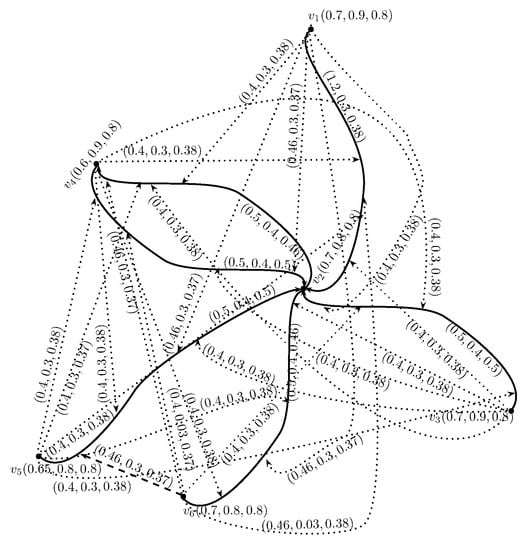
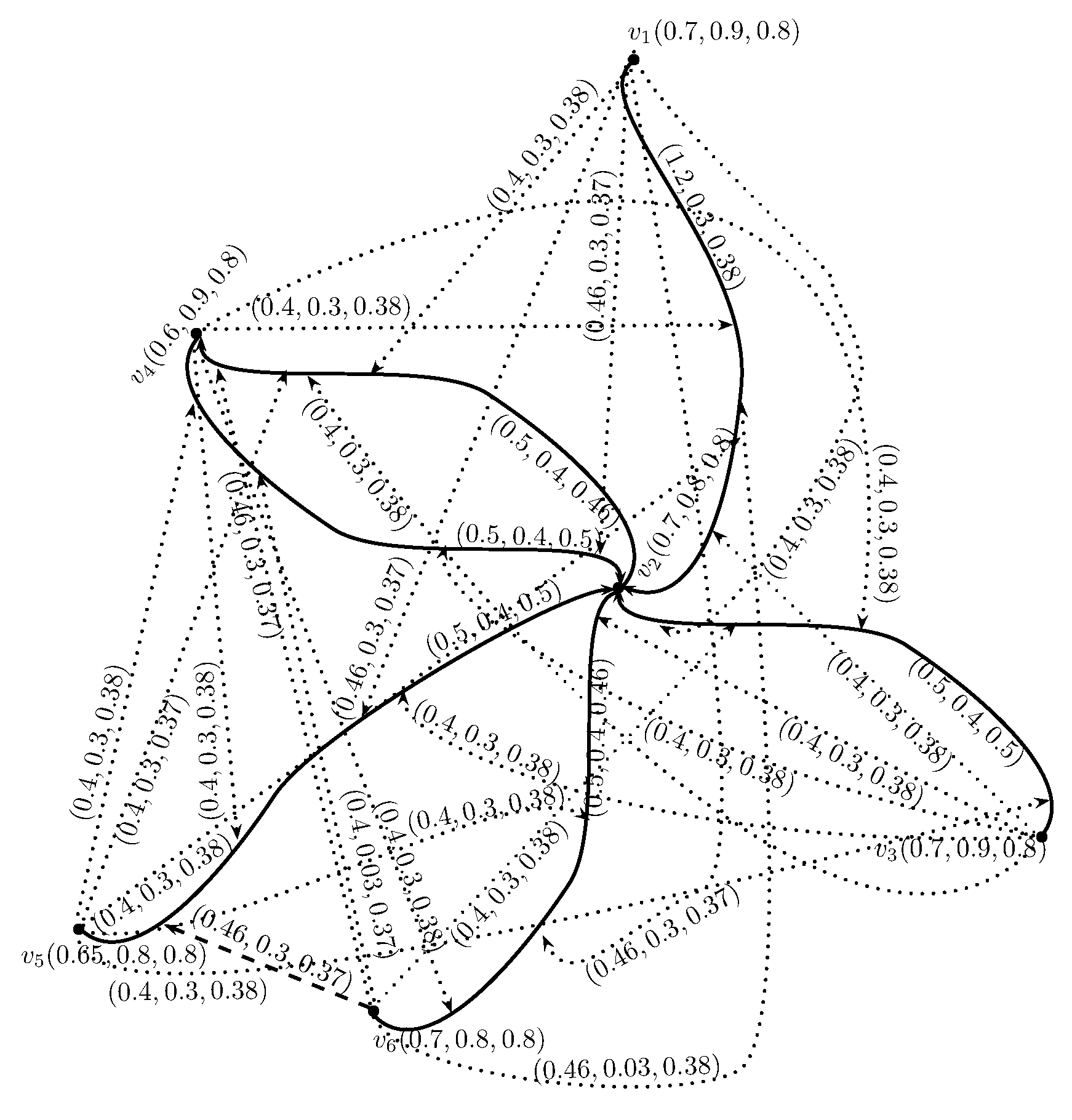
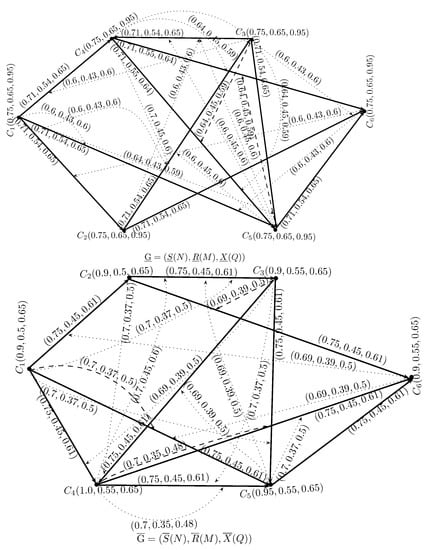
Hence, = (, is soft rough neutrosophic set on E. Thus, = (,) and = (,) are LSRNAG and USRNAG, respectively, as shown in Figure 4. Hence, G = (,) is SRNG. Let I = {,,,,,,, ,,,,,,,, ,,,,,,,,}⊆ and P=,,,,,,,}⊆. Then and Q a neutrosophic set on I and a full soft set X on I (from P to I) can be defined in Table 13, respectively as follows:
Figure 4.
Soft rough neutrosophic graph .
Table 13.
Full soft set X.
Then the lower and upper soft rough neutrosophic approximation is directly calculated using Equation (3) of Definition 4, we have
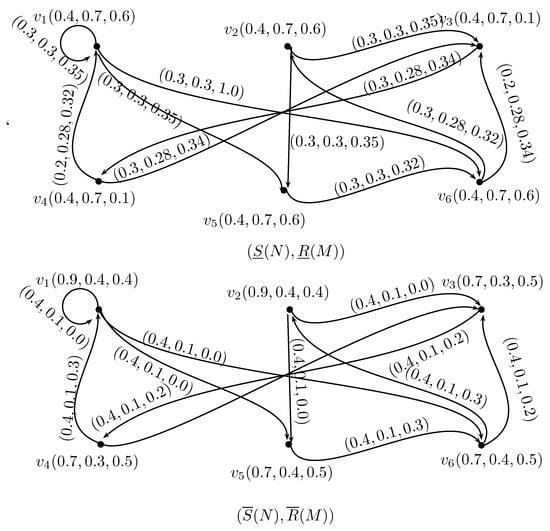
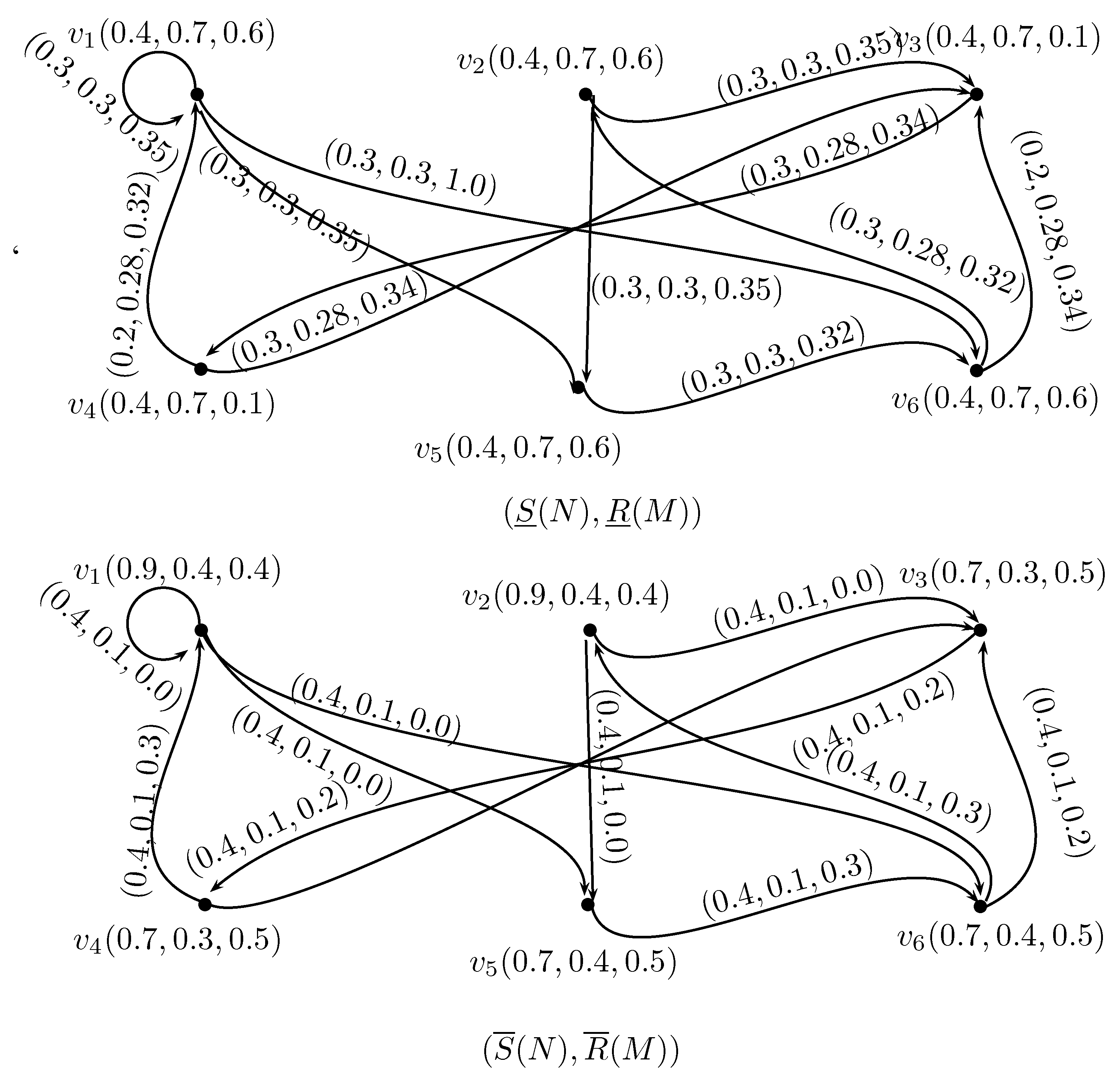
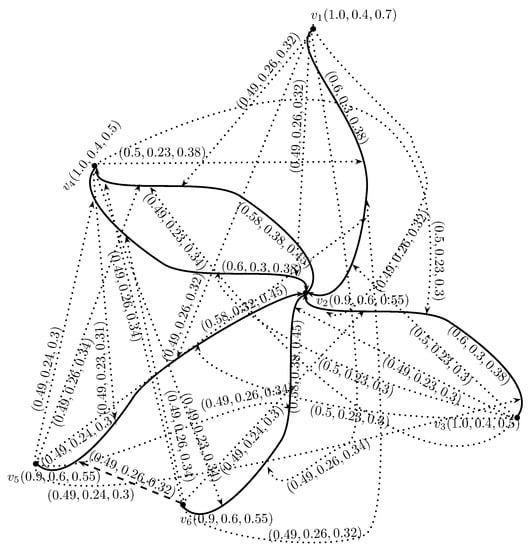
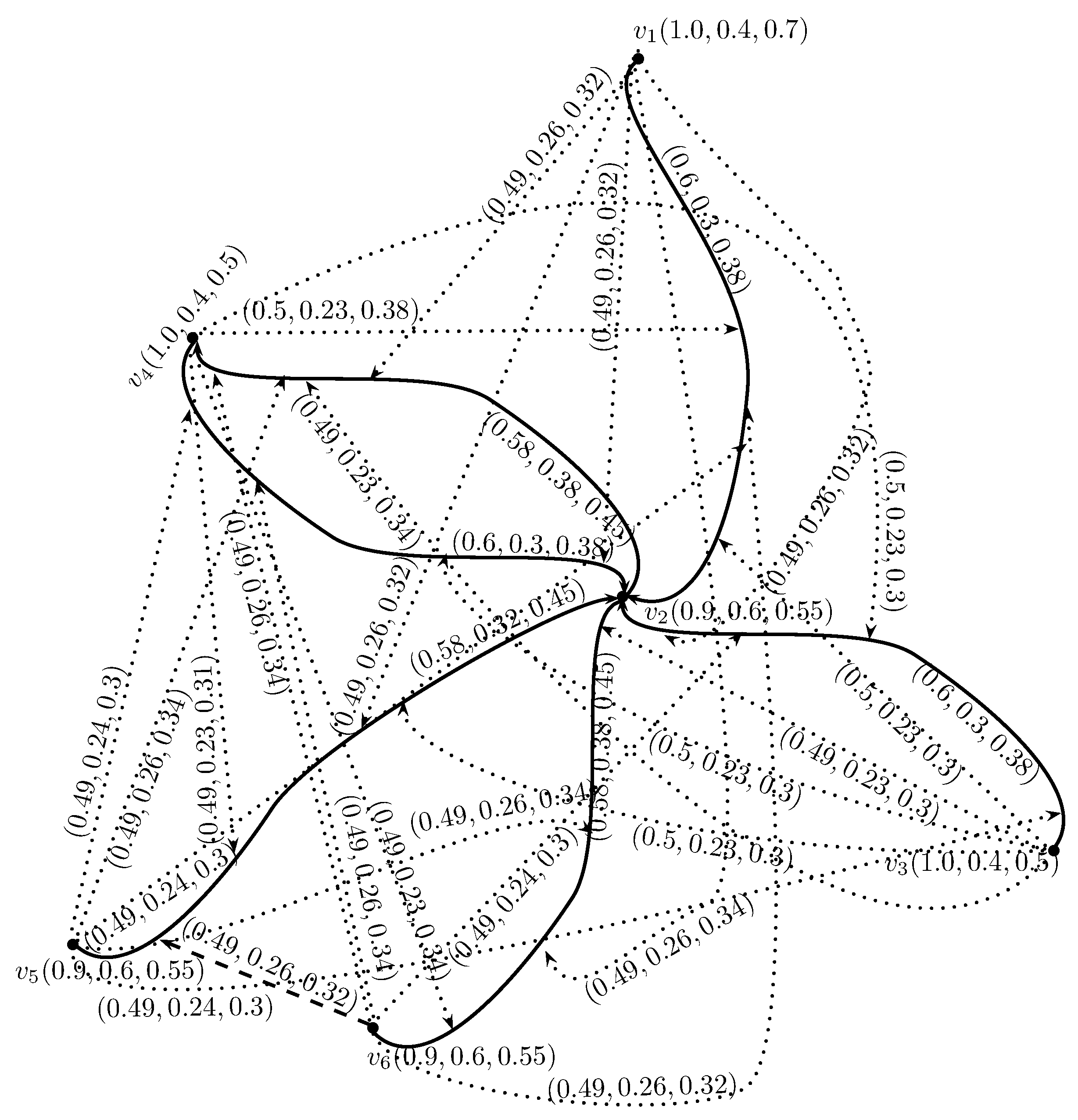
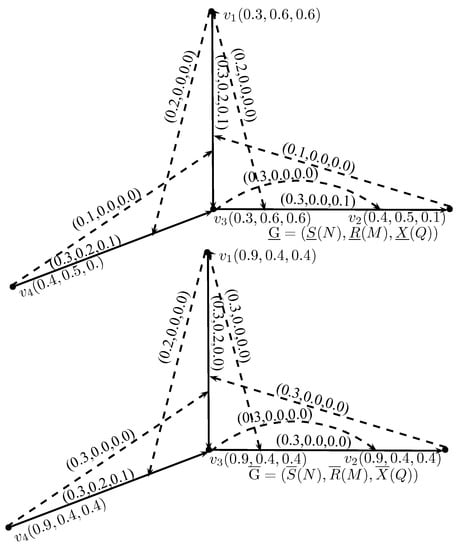
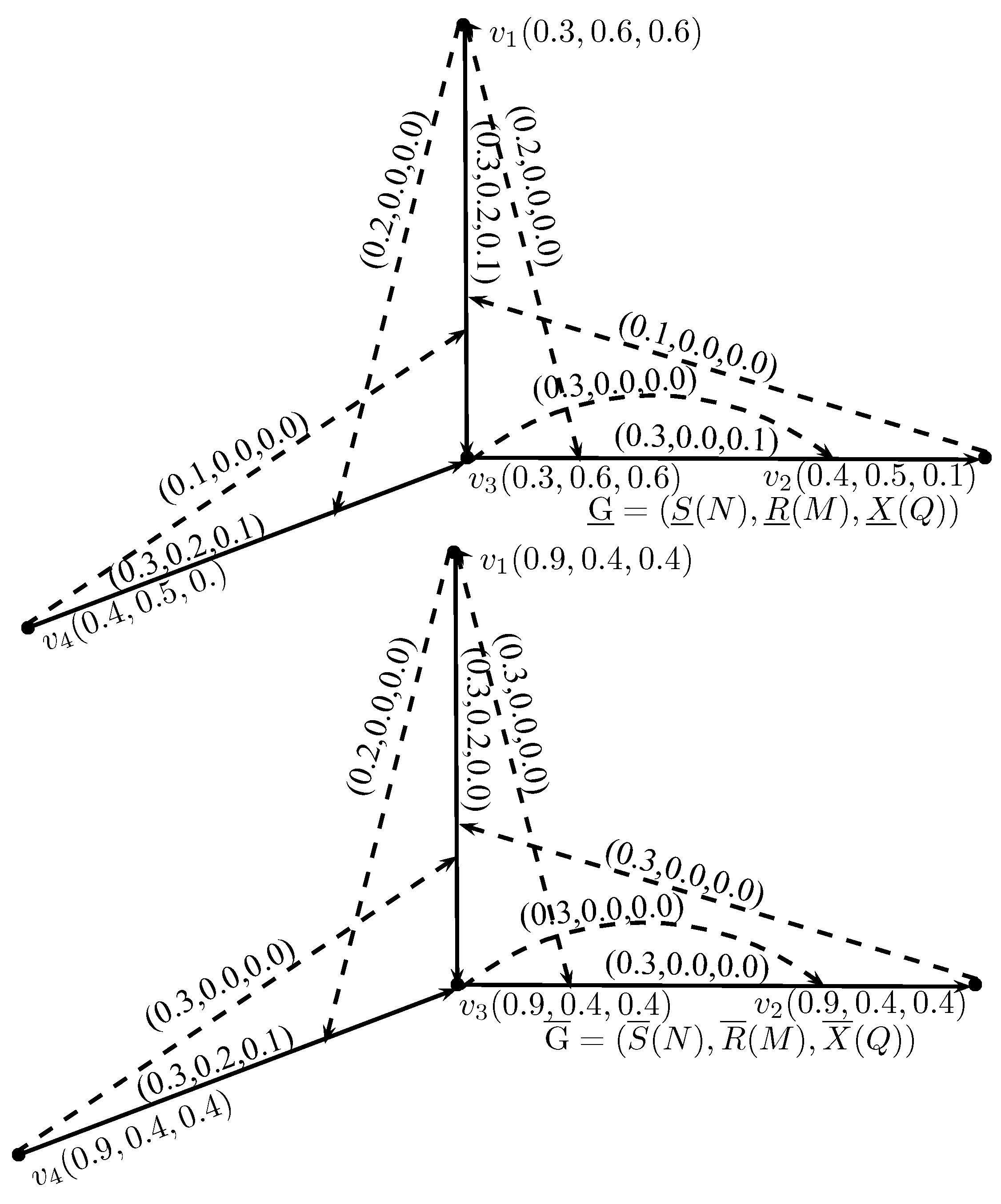
Thus, = (,,) and = (,,) are LSRNIAG and USRNIAG, respectively, as shown in Figure 5 and Figure 6. Hence, G = (,) is SRNIG.
Figure 5.
Lower Soft rough neutrosophic graph .
Figure 6.
Upper Soft rough neutrosophic graph .
Definition 22.
An underlying influence graph(supporting influence graph) = (,) of a soft rough neutrosophic influence graph = (,) is of the form = (,,) and = (,,), where
Definition 23.
If ∈ (), then is a lower edge (upper edge) of the soft rough neutrosophic influence graph. If ∈ (), then is lower pairs (upper pair). If ∈() and , is not lower pairs (upper pairs), then it is a lower non-influence edge (upper non-influence edge).
Definition 24.
A soft rough neutrosophic influence graph has a walk if each approximation graph has an alternative sequence of the form
such that
where = (), =, = () and ∀k=0,1,⋯,n−1. If , then it is called closed. If the pairs are distinct, then it is called a soft rough neutrosophic influence trail (SRNI trail). If the edges are distinct, then it is called a soft rough neutrosophic trail (SRN trail). If the vertices are distinct in SRN trail, then it is called a soft rough neutrosophic path (SRN path). If the vertices, edge and pairs are distinct in a walk of SRNIG, then it is called a soft rough neutrosophic influence path (SRNI path). A path is a trail and an influence trail. If a path in a soft rough neutrosophic influence graph is closed, then it is called a cycle.
Definition 25.
A strength of soft rough neutrosophic influence graph, denoted by stren, is defined as
An influence strength of soft rough neutrosophic influence graph, denoted by In stren, is defined as
Definition 26.
In a soft rough neutrosophic influence graph , if in each approximation graph
where
and
Thus it is the strength of strongest path from to in .
In a soft rough neutrosophic influence graph , if in each approximation graph
where
and
Thus it is the strength of strongest path from to in .
Definition 27.
A SRNIG is called connected if each two vertex and are joined by a SRN (SRNI) path. Maximal connected partial subgraphs in each approximation subgraph are called component.
Definition 28.
A soft rough neutrosophic influence graph is a cycle if and only if the underlying graphs of each approximation is a cycle. A soft rough neutrosophic influence graph is a soft rough neutrosophic cycle if and only if the underlying graphs of each approximations is a cycle and there exist ,∈,,∈ and ≠, such that
A soft rough neutrosophic influence graph is a soft rough neutrosophic influence cycle if and only if the graphs is soft rough neutrosophic cycle and there exist ,∈,,∈ and ≠, such that
Example 7.
Considering Example 4. Let I = {,,,,,,}⊆ and P = {,,}⊆. Then a full soft set X on I (from P to I) can be defined in Table 14 as follows:
Table 14.
Full soft set X.
Let Q = {(,,,),(,,,),(,,,),(,,,),(,,,),(,,,)} be a neutrosophic set on I. Then from Equation (3) of Definition 4, we have
Thus, and are LSRNIAG and USRNIAG, respectively, as shown in Figure 7. Hence, is SRNIG. The underlying graph = (,) such that = (,,), = (,,) where =V=, =E= and =I=,,, are the lower edge and upper edge and , is a lower pair and upper pair. is both lower and upper non-influence edge. is a path of the sequence of the form ,,,,,,,,,,,. By direct calculations, the strength and influence strength of this path are (,,) and (,,), respectively. is cycle, soft rough neutrosophic cycle and soft rough neutrosophic influence cycle.
Figure 7.
Soft rough neutrosophic influence graph .
Definition 29.
A soft rough neutrosophic influence subgraph = (,,) of a soft rough neutrosophic influence graph = (,,), if v∈H such that
∈H,
and ∈H,
Definition 30.
A = (,,) is called soft rough neutrosophic influence spanning subgraph of a soft rough neutrosophic influence graph = (,,), if H is a soft rough neutrosophic influence subgraph such that
Definition 31.
A soft rough neutrosophic influence graph is a forest if and only if each supporting approximation graph is a forest. A soft rough neutrosophic influence graph G = (,,) is a soft rough neutrosophic forest if and only if there exist a soft rough neutrosophic spanning subgraph = (,,) is a forest such that ∈−
A soft rough neutrosophic influence graph = (,,) is a soft rough neutrosophic influence forest if and only if there exist a soft rough neutrosophic spanning subgraph = (,,) is a forest such that ∈−
Definition 32.
A soft rough neutrosophic influence graph is a tree if and only if each supporting approximation graph is a tree. A soft rough neutrosophic influence graph G = (,,) is a soft rough neutrosophic tree if and only if there exist a soft rough neutrosophic spanning subgraph = (,,) is a tree such that ∈−
A soft rough neutrosophic influence graph = (,,) is a soft rough neutrosophic influence tree if and only if there exist a soft rough neutrosophic spanning subgraph = (,,) is a tree such that ∈−
Definition 33.
Let = (,,) be a soft rough neutrosophic influence graph, an edge is a bridge if edge is a bridge in both underlying graphs of and . Let = (,,) be a soft rough neutrosophic influence graph, an edge is a soft rough neutrosophic bridge if ∈
Let = (,,) be a soft rough neutrosophic influence graph, an edge is an soft rough neutrosophic influence bridge if ∈
Definition 34.
Let = (,,) be a soft rough neutrosophic influence graph, a vertex is a cutnode if a vertex is a cutnode in underlying graphs of and . Let = (,,) be a soft rough neutrosophic influence graph then a vertex in is a soft rough neutrosophic cutnode if the deletion of from reduces the strength of the connectedness from nodes →∈,
Let = (,,) be a soft rough neutrosophic influence graph then a vertex in is an neutrosophic influence cutnode if the deletion of from reduces the influence strength of the connectedness from →∈,
Definition 35.
Let = (,,) be a soft rough neutrosophic influence graph. A pair is called a cutpair if and only if is a cutpair in both supporting influence graph of and . That is after removing the pair there is no path from to in both supporting influence graph of and . Let = (,,) be a soft rough neutrosophic influence graph. A pair is called a soft rough neutrosophic cutpair if and only if if deleting the pair reduces the connectedness from to in both graph and . That is,
A soft rough neutrosophic influence cutpair is a pair in a soft rough neutrosophic influence graph = (,,) if there is spanning influence subgraph reduces the strength of the influence connectedness from to . That is,
Definition 36.
An edge in soft rough neutrosophic influence graph is called strong soft rough neutrosophic edge if
A pair in soft rough neutrosophic influence graph is called strong pair if
Definition 37.
An edge in soft rough neutrosophic influence graph is called strong soft rough neutrosophic edge if
A pair in soft rough neutrosophic influence graph is called strong pair if
Definition 38.
An edge in soft rough neutrosophic influence graph is called strong soft rough neutrosophic edge if
A pair in soft rough neutrosophic influence graph is called strong pair if
Definition 39.
An edge in soft rough neutrosophic influence graph is called strong soft rough neutrosophic edge if
A pair in soft rough neutrosophic influence graph is called strong pair if
Definition 40.
A strong soft rough neutrosophic edge is called a strong soft rough neutrosophic edge if
A strong pair is called a strong pair if
A strong pair is called a strong pair if ≠
Definition 41.
A soft rough neutrosophic influence graph is said to be a soft rough neutrosophic influence block if it has no soft rough neutrosophic influence cutnodes.
Example 8.
Consider Example 5 Let I = {,,,,}⊆ and P = {,,}⊆. Then a full soft set X on I (from P to I) can be defined in Table 15 as follows:
Table 15.
Full soft set X.
Let Q = {(,,,),(,,,),(,,,),(,,,),(,,,} be a neutrosophic set on I. Then from Equation (3) of Definition 4, we have
Thus, = (,,) and = (,,) are LSRNIAG and USRNIAG, respectively, as shown in Figure 8. Hence, = (,) is SRNIG. Hence is a tree, is a cutvertex, is a bridge, is a cutpair.
Figure 8.
Soft rough neutrosophic influence graph .
Theorem 4.
is a soft rough neutrosophic influence forest if and only if in any cycle of , there is a pair such that
Proof.
The proof is obvious. ☐
Theorem 5.
A soft rough neutrosophic graph is a soft rough neutrosophic influence forest if there is at most one path with the most influence strength.
Proof.
Let be not a soft rough neutrosophic influence forest. Then by Theorem 4, there exist a cycle C in such that
for every pair of C.
Therefore, is the path within the most influence strength from to . Let be a pair such that
in C. Then remaining part of C is a path with the most influence strength from to . This is a contradiction to the the fact there is at most one path with the most influence strength. Hence, is a soft rough neutrosophic influence forest. ☐
Theorem 6.
Assume that is a cycle. Then is not a soft rough neutrosophic influence tree if and only if is a soft rough neutrosophic influence cycle.
Proof.
Let = (,,) be a soft rough neutrosophic influence cycle. Then there exist at least two distinct edge and two distinct pair such that
Let = (,,) be a spanning soft rough neutrosophic influence tree in . Then there exists a path from to not involving such that −={()}. Hence there does not exist a path in from to such that
Thus is not a soft rough neutrosophic influence tree.
Conversely, suppose that is not a soft rough neutrosophic influence tree. Since, is a soft rough neutrosophic influence cycle. So for all ∈ and ∈, we have a soft rough neutrosophic spanning influence subrgraph = (,,) which is tree and ()=0, ()=0 such that
and
Therefore,
where not uniquely. Therefore is a soft rough neutrosophic influence cycle.
Theorem 7.
If
in a soft rough neutrosophic graph. Then is a cutpair in soft rough neutrosophic influence graph .
Proof.
Suppose is not a cutapir in soft rough neutrosophic influence graph, then
Since,
Therefore,
which is a contradiction. Hence, it is proved. ☐
Theorem 8.
If
for some among all cycles in soft rough neutrosophic influence graph . Then
Proof.
Since
Therefore, there exists a path from to not involving () such that
This along with is a cycle and is least value. ☐
Theorem 9.
If is a soft rough neutrosophic influence cutpair in soft rough neutrosophic influence graph . Then
for some among all cycles of .
Proof.
Suppose on contrary in a cycle, we
Then any path involving it can be converted into a path not involving it with influence strength greater than and equal to the value of for previously deleted pairs. So is not a cutpair. This is a contradiction to our assumption. Hence is not a pair with the least value among all cycle. ☐
Theorem 10.
If = (,,) is a soft rough neutrosophic forest, then the pairs of neutrosophic spanning subgraph H = (,,) such that
are exactly the cutpairs of .
Theorem 11.
A soft rough neutrosophic influence graph is a cycle. Then an edge is a soft rough neutrosophic influence bridge if and only if it is an edge common to atmost two cutpair.
Theorem 12.
Let be a soft rough neutrosophic influence graph. Then the following conditions are equivalent.
- 1.
- For a pair ∈
- 2.
- is an influence cutpair
4. Application to Decision-Making
Decision making is a process that plays an important role in our daily lives. Decision making process can help us make more purposeful, thoughtful decisions by systemizing relevant information step by step. The process of decision making involves making a choice among different alternatives, it starts when we do not know what to do.
The selection of the right path for transferring goods from one state to another states illegally. Every state has different polices within or out side the state, there are several factors to take into consideration for selecting the right path. Whether the economy of a country is good, having job opportunity or a safety.
Suppose a trader wants to extend his business to the countries ,,,, and . Initially, he takes and extends his business one by one. Assume A is set of the parameters, consisting of element job, economy above average, safety, other.
Table 16.
Soft Neutrosophic Set S.
Suppose N={(,,, ),(,,,),(,,,),(,,,),(,,,),
(,,, is most favorable object describes membership of suitable countries foreign polices corresponding to the boolean set V, which is a neutrosophic set on the set V under consideration.
is a full soft rough set in full soft approximation space where
Let E={,,,,,,,,,}⊆ and L={}⊆.
Table 17.
Full soft set R.
Let M={(,,,),(,,,),(,,,),(,,,),(,,,),(,,,),(,,,),(,,,),(,,,),(,,,
be most favorable object describes membership of countries foreign polices toward others countries corresponding to the boolean set E, which is a neutrosophic set on the set V under consideration.
, ) is a soft neutrosophic rough relation, where
Let I={,,,,,,,,,,,, ,,}⊆ and F={,,,,}⊆.
Table 18.
Full soft set X.
Let be most favorable object describes membership of countries impact toward others countries regarding trade corresponding to the boolean set I, which is a neutrosophic set on the set I under consideration.
is a soft neutrosophic rough influence, where
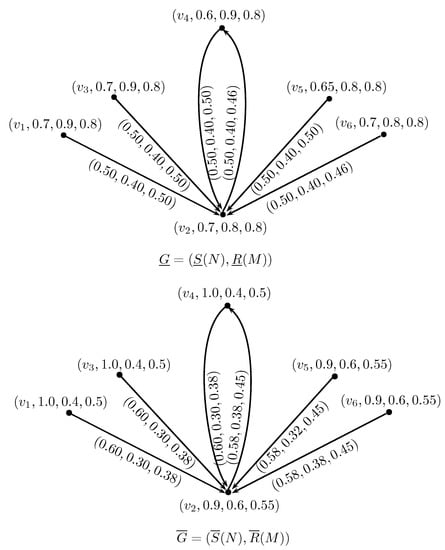
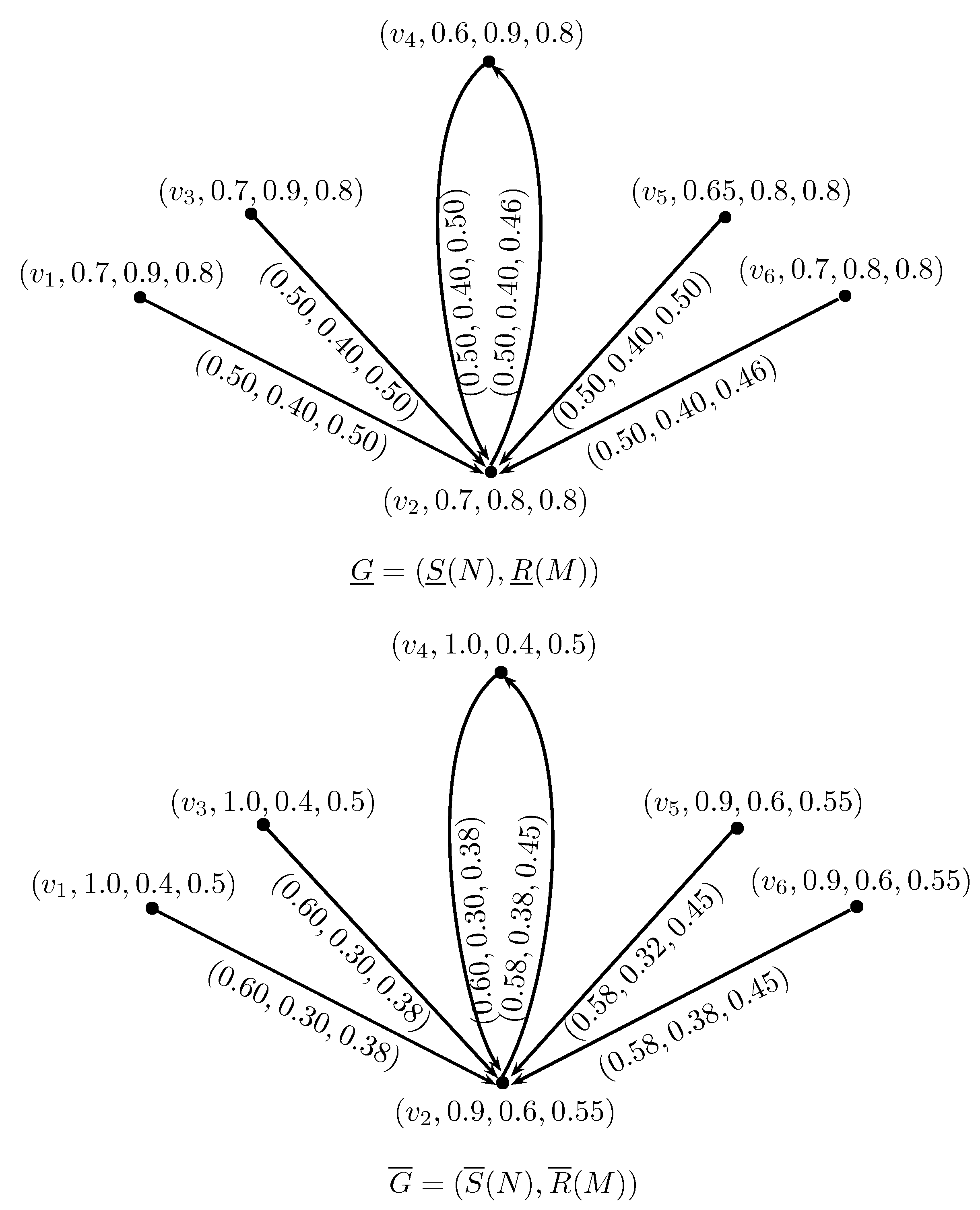
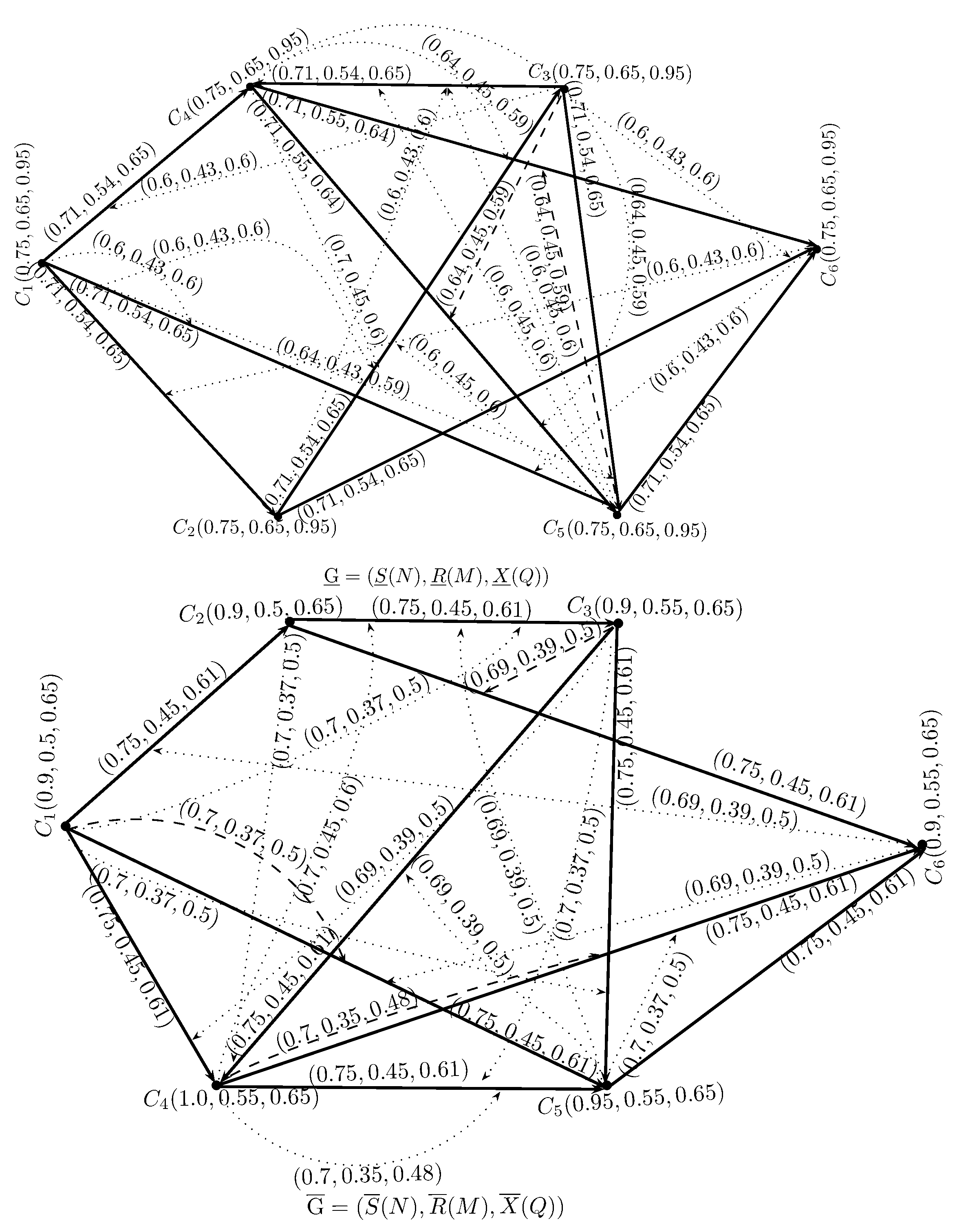
Thus, is a soft neutrosophic rough influence graph as shown in Figure 9. He finds the strength of each path from to . The paths are
with their influence strength as (,,), respectively.
Figure 9.
Soft rough neutrosophic influence graph .
Since, there is more than one path, therefore, the trader calculates the score function which is formulated in Equation (4):
For each , the score values of is calculated directly and as shown in Table 19.
Table 19.
Score Function.
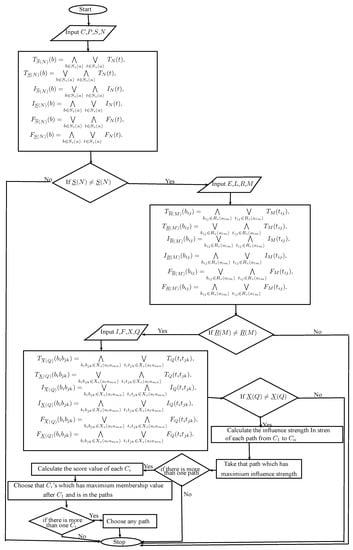
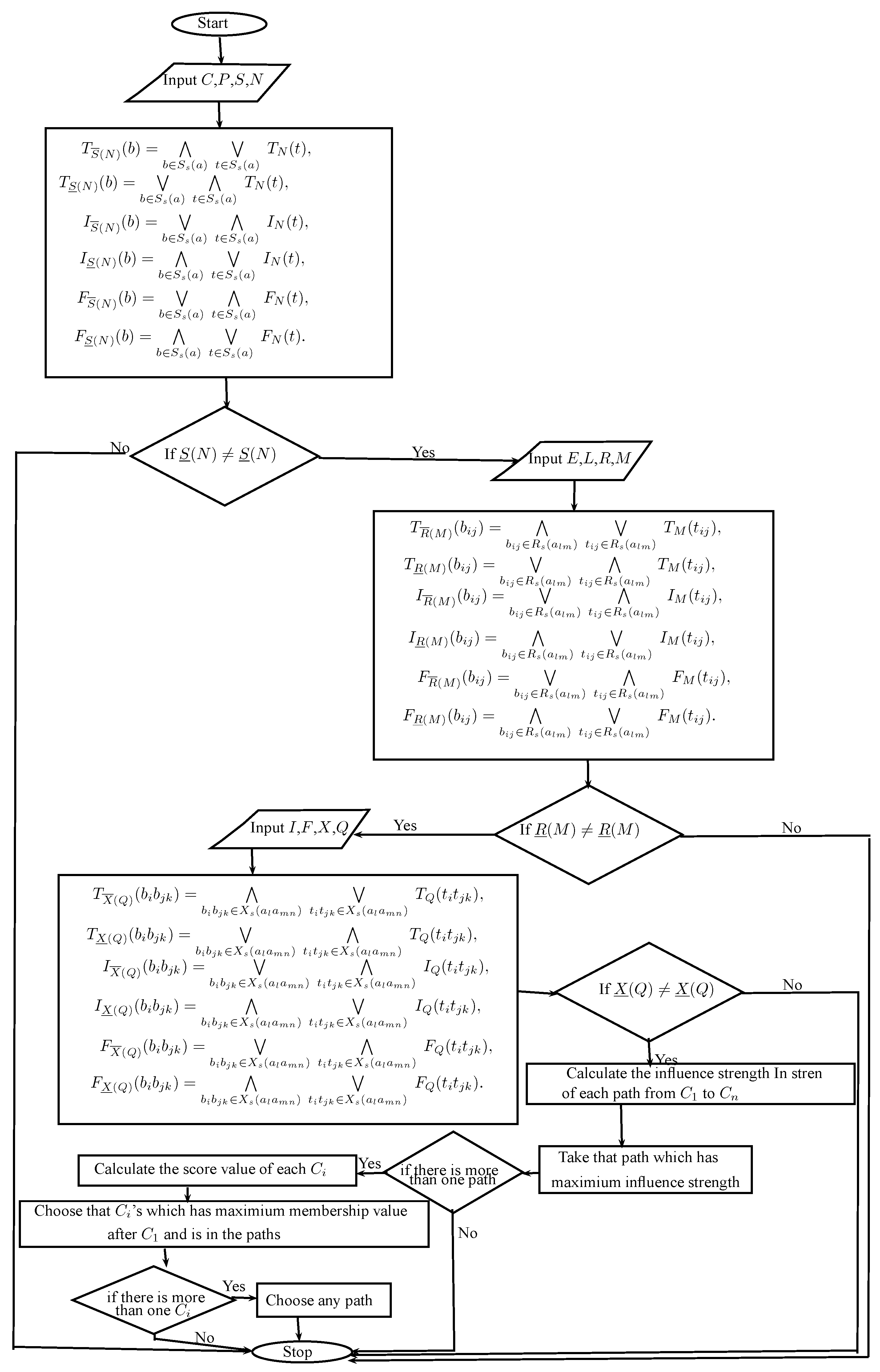
So, he chooses the path :,,,,. The Algorithm 1 of the application is also be given in Algorithm 1. The flow chart is given in Figure 10.
| Algorithm 1: Influence strength of each path in rough neutrosophic influence graph |
| 1. Input the universal sets C and P. |
| 2. Input the full soft set S and neutrosophic set N on V. |
| 3. Calculate the Soft rough neutrosophic sets on V. |
| 4. Input the universal sets E and L. |
| 5. Input the full soft set R and neutrosophic set M on E. |
| 6. Calculate the Soft rough neutrosophic sets on E. |
| 7. Input the universal sets I and F. |
| 8. Input the full soft set X and neutrosophic set Q on I. |
| 9. Calculate the Soft rough neutrosophic sets on I. |
| 10. Find the number of path and calculate their influence strength of |
| each path from to . |
| 11. Choose that path which has maximum membership, minimum |
| indeterminacy and falsity value. If , than calculate the |
| score values of each , choose that which has maximum |
| membership and come immediately after in one of the paths. |
Figure 10.
The flow chart of the application.
5. Conclusions
Graph theory has been applied widely in various areas of engineering, computer science, database theory, expert systems, neural networks, artificial intelligence, signal processing, pattern recognition, robotics, computer networks, and medical diagnosis. Present research has shown that two or more theories can be combined into a more flexible and expressive framework for modeling and processing incomplete information in information systems. Various mathematical models that combine rough sets, soft sets and neutrosophic sets have been introduced. A soft rough neutrosophic set is a hybrid tool for handling indeterminate, inconsistent and uncertain information that exist in real life. We have applied this concept to graph theory. We have presented certain concepts, including soft rough neutrosophic graphs, soft rough neutrosophic influence graphs, soft rough neutrosophic influence cycles, soft rough neutrosophic influence trees. We also have considered an application of soft rough neutrosophic influence graph in decision-making to illustrate the best path in the business. In the future, we will study, (1) Neutrosophic rough hypergraphs, (2) Bipolar neutrosophic rough hypergraphs, (3) Neutrosophic soft rough hypergraphs, (4) Decision support systems based on soft rough neutrosophic information.
Author Contributions
H.M.M., M.A. and F.S. conceived and designed the experiments; M.A. and F.S. analyzed the data; H.M.M. wrote the paper.
Conflicts of Interest
The authors declare no conflict of interest.
References
- Smarandache, F. Neutrosophy Neutrosophic Probability, Set, and Logic; Amer Res Press: Rehoboth, MA, USA, 1998. [Google Scholar]
- Wang, H.; Smarandache, F.; Zhang, Y.; Sunderraman, R. Single-valued neutrosophic sets. Multispace Multistruct. 2010, 4, 410–413. [Google Scholar]
- Ye, J. Multicriteria decision-making method using the correlation coefficient under single-valued neutrosophic environment. Int. J. Gen. Syst. 2013, 42, 386–394. [Google Scholar] [CrossRef] [Scilit]
- Ye, J. Improved correlation coefficients of single valued NSs and interval NSs for multiple attribute decision making. J. Intell. Fuzzy Syst. 2014, 27, 2453–2462. [Google Scholar]
- Qeng, J.J.; Wang, J.Q.; Zhang, H.Y.; Chen, X.H. An outranking approach for multi-criteria decision-making problems with simplified neutrosophic sets. Appl. Soft Comput. 2014, 25, 336–346. [Google Scholar]
- Molodtsov, D.A. Soft set theory-first results. Comput. Math. Appl. 1999, 37, 19–31. [Google Scholar] [CrossRef] [Scilit]
- Babitha, K.V.; Sunil, J.J. Soft set relations and functions. Comput. Math. Appl. 2010, 60, 1840–1849. [Google Scholar] [CrossRef] [Scilit]
- Pawlak, Z. Rough sets. Int. J. Comput. Inf. Sci. 1982, 11, 341–356. [Google Scholar] [CrossRef] [Scilit]
- Pawlak, Z. Rough Sets-Theoretical Aspects to Reasoning about Data; Kluwer Academic Publisher: Boston, MA, USA, 1991. [Google Scholar]
- Pawlak, Z.; Skowron, A. Rudiments of rough sets. Inf. Sci. 2007, 177, 3–27. [Google Scholar] [CrossRef] [Scilit]
- Pawlak, Z.; Skowron, A. Rough sets: Some extensions. Inf. Sci. 2007, 177, 28–40. [Google Scholar] [CrossRef] [Scilit]
- Pawlak, Z.; Skowron, A. Rough sets and Boolean reasoning. Inf. Sci. 2007, 177, 41–73. [Google Scholar] [CrossRef] [Scilit]
- Biswas, R.; Nanda, S. Rough groups and rough subgroups. Bull. Polish Acad. Sci. 2000, 42, 247–251. [Google Scholar]
- Davvaz, B. Roughness in rings. Inf. Sci. 2004, 164, 147–163. [Google Scholar] [CrossRef] [Scilit]
- Kuroki, N. Rough ideal in semigroup. Inf. Sci. 1997, 100, 139–163. [Google Scholar] [CrossRef] [Scilit]
- Shahzamanian, M.H.; Shirmohammadi, M.; Davvaz, B. Roughness in Cayley graphs. Inf. Sci. 2010, 180, 3362–3372. [Google Scholar] [CrossRef] [Scilit]
- Dubios, D.; Prade, H. Rough fuzzy, fuzzy rough sets. Int. J. Gen. Syst. 1990, 17, 191–209. [Google Scholar] [CrossRef] [Scilit]
- Feng, F.; Li, C.; Davvaz, B.; Ali, M.I. Soft sets combined with fuzzy sets and rough sets: A tentative approach. Soft Comput. 2010, 14, 899–911. [Google Scholar] [CrossRef] [Scilit]
- Meng, D.; Zhang, X.; Qin, K. Soft rough fuzzy sets and soft fuzzy rough sets. Comput. Math. Appl. 2011, 62, 4635–4645. [Google Scholar] [CrossRef] [Scilit]
- Broumi, S.; Smarandache, F.; Dhar, M. Rough neutrosophic sets. Neutrosophic Sets Syst. 2014, 3, 62–67. [Google Scholar]
- Yang, H.L.; Zhang, C.L.; Guo, Z.L.; Liu, Y.L.; Liao, X. A hybrid model of single valued neutrosophic sets and rough sets: Single valued neutrosophic rough set model. Soft Comput. 2016, 21, 6253–6267. [Google Scholar] [CrossRef] [Scilit]
- Kauffmann, A. Introduction a la Theorie Des Sous-Emsembles Flous; Masson et Cie: Paris, France, 1973; Volume 1. [Google Scholar]
- Rosenfeld, A. Fuzzy graphs. In Fuzzy Sets and Their Applications; Zadeh, L.A., Fu, K.S., Shimura, M., Eds.; Elsevier: New York, NY, USA, 1975; pp. 77–95. [Google Scholar]
- Mordeson, J.N.; Peng, C.S. Operations on fuzzy graphs. Inf. Sci. 1994, 79, 159–170. [Google Scholar] [CrossRef] [Scilit]
- Mathew, S.; Sunitha, M. Types of arcs in a fuzzy graph. Inf. Sci. 2009, 179, 1760–1768. [Google Scholar] [CrossRef] [Scilit]
- Mathew, S.; Sunitha, M. Strongest strong cycles, fuzzy graphs. IEEE Trans. Fuzzy Syst. 2013, 21, 1096–1104. [Google Scholar] [CrossRef] [Scilit]
- Gani, A.N.; Latha, S.R. On irregular fuzzy graphs. Appl. Math. Sci. 2012, 6, 517–523. [Google Scholar]
- Gani, A.N.; Radha, K. On regular fuzzy graphs. J. Phys. Sci. 2008, 12, 33–40. [Google Scholar]
- Gani, A.N.; Radha, K. The degree of a vertex in some fuzzy graphs. Int. J. Algorithms Comput. Math. 2009, 2, 107–116. [Google Scholar]
- Gani, A.N.; Begum, S.S. Degree, order, size in intuitionistic fuzzy graphs. Int. J. Algorithms Comput. Math. 2010, 3, 11–16. [Google Scholar]
- Parvathi, R.; Karunambigai, M.G.; Atanassov, K.T. Operations on intuitionistic fuzzy graphs. In Proceedings of the FUZZ-IEEE 2009 IEEE International Conference on Fuzzy Systems, Jeju Island, Korea, 20–24 August 2009. [Google Scholar]
- Akram, M.; Ashraf, A.; Sarwar, M. Novel applications of intuitionistic fuzzy digraphs in decision support systems. Sci. World J. 2014. [Google Scholar] [CrossRef] [Scilit] [PubMed]
- Akram, M.; Nawaz, S. Fuzzy soft graphs with applications. J. Intell. Fuzzy Syst. 2016, 30, 3619–3632. [Google Scholar] [CrossRef] [Scilit]
- Akram, M.; Shahzadi, S. Novel intuitionistic fuzzy soft multiple-attribute decision-making methods. Neural Comput. Appl. 2016. [Google Scholar] [CrossRef] [Scilit]
- Akram, M.; Alshehri, N.; Davvaz, B.; Ashraf, A. Bipolar fuzzy digraphs in decision support systems. J. Multiple-Valued Logic Soft Comput. 2016, 27, 531–551. [Google Scholar]
- Akram, M.; Dudek, W.A. Regular bipolar fuzzy graphs. Neural Comput. Appl. 2012, 21, 197–205. [Google Scholar] [CrossRef] [Scilit]
- Dinesh, T. Fuzzy incidence graph and introduction. Adv. Fuzzy Sets Syst. 2016, 21, 33–48. [Google Scholar] [CrossRef] [Scilit]
- Mordeson, J.N. Fuzzy incidence graphs. Adv. Fuzzy Sets Syst. 2016, 21, 1–13. [Google Scholar] [CrossRef] [Scilit]
- Mathew, S.; Mordeson, J.N. Fuzzy influence graphs. New Math. Nat. Comput. 2017, 13, 311–325. [Google Scholar] [CrossRef] [Scilit]
- Zafar, F.; Akram, M. A novel decision-making method based on rough fuzzy information. Int. J. Fuzzy Syst. 2018, 20, 1000–1014. [Google Scholar] [CrossRef] [Scilit]
- Akram, M.; Zafar, F. Rough fuzzy digraphs with application. J. Appl. Math. Comput. 2018. [Google Scholar] [CrossRef] [Scilit]
- Akram, M.; Shumaiza; Arshad, M. A new approach based on fuzzy rough digraphs for decision-making. J. Intell. Fuzzy Syst. 2018. [Google Scholar] [CrossRef] [Scilit]
- Malik, H.M.; Akram, M. A new approach based on intuitionistic fuzzy rough graphs for decision-making. J. Intell. Fuzzy Syst. 2018, 34, 2325–2342. [Google Scholar] [CrossRef] [Scilit]
- Zhan, J.; Malik, H.M.; Akram, M. Novel decision-making algorithms based on intuitionistic fuzzy rough environment. Int. J. Mach. Learn. Cybern. 2018. [Google Scholar] [CrossRef] [Scilit]
- Ishfaq, N.; Sayed, S.; Akram, M.; Smarandache, F. Notions of rough neutrosophic digraphs. Mathematics 2018, 6, 18. [Google Scholar] [CrossRef] [Scilit]
- Akram, M.; Malik, H.M.; Shahzadi, S.; Smarandache, F. Neutrosophic soft rough graphs with application. Axioms 2018, 7, 14. [Google Scholar] [CrossRef] [Scilit]
- Zhang, X.; Dai, J.; Yu, Y. On the union and intersection operations of rough sets based on various approximation spaces. Inf. Sci. 2015, 292, 214–229. [Google Scholar] [CrossRef] [Scilit]
- Bao, Y.L.; Yang, H.L. On single valued neutrosophic refined rough set model and its application. J. Intell. Fuzzy Syst. 2017, 33, 1235–1248. [Google Scholar] [CrossRef] [Scilit]
- Maji, Q.K. Neutrosophic soft set. Ann. Fuzzy Math. Inform. 2013, 5, 157–168. [Google Scholar]
- Broumi, S.; Smarandache, F. Interval-valued neutrosophic soft rough sets. Int. J. Comput. Math. 2015. [Google Scholar] [CrossRef] [Scilit]
- Akram, M.; Shahzadi, S.; Smarandache, F. Multi-attribute decision-making method based on neutrosophic soft rough information. Axioms 2018, 7, 19. [Google Scholar] [CrossRef] [Scilit]

© 2018 by the authors. Licensee MDPI, Basel, Switzerland. This article is an open access article distributed under the terms and conditions of the Creative Commons Attribution (CC BY) license (http://creativecommons.org/licenses/by/4.0/).