


Abstract
Equitable prioritization of public investments is increasingly critical as municipalities face constrained budgets, heterogeneous neighborhood needs, and demands for transparent decisions. This paper proposes a fairness-aware group multi-criteria decision-making (MCDM) framework for ranking municipal infrastructure investments when budgets are constrained, and neighborhood needs differ. Six alternatives are assessed in the Istanbul case study: flood risk mitigation, inclusive public realm and cooling, smart and energy-efficient municipal assets, walking and cycling infrastructure, healthcare access improvements, and seismic retrofitting of public buildings. The criteria system combines efficiency, implementability, socio-environmental performance, and equity-oriented priorities through five main dimensions and 23 sub-criteria. In addition to cost, feasibility, and service effectiveness, the framework incorporates fairness-related criteria such as baseline need and deficit severity, vulnerability-targeting effectiveness, minimum service guarantee for the worst-off, and priority for low-accessibility centers. Public acceptance and environmental performance are also included. Stakeholder panels provide expert judgments using intuitionistic fuzzy sets, capturing membership, non-membership, and hesitation to reflect uncertainty. Criteria weights are derived with Intuitionistic Fuzzy Step-wise Weight Assessment Ratio Analysis (IF-SWARA), enabling importance elicitation and group aggregation without forcing crisp consensus. Alternatives are then ranked using Intuitionistic Fuzzy Combined Compromise Solution (IF-CoCoSo), which blends additive and multiplicative compromise solutions to balance overall performance with equity objectives. Robustness is assessed through sensitivity analysis by varying the γ parameter within the IF-CoCoSo procedure. A municipal case study demonstrates that healthcare access improvements achieve the highest compromise performance, followed by flood risk mitigation and seismic retrofitting of public buildings, while smart and energy-efficient municipal assets rank last. The findings confirm that explicitly embedding fairness criteria can shift municipal priorities toward alternatives that more directly reduce deprivation, risk, and spatial inequality. The main contribution of this study is not merely empirical application, but the development of a fairness-aware group MCDM framework that operationalizes distributive justice in municipal investment prioritization through a structured set of criteria.
Keywords:
fairness-aware; MCDM; municipal infrastructure investment; intuitionistic fuzzy sets; SWARA; CoCoSo MSC:
90B50
1. Introduction
Municipalities increasingly face a complex prioritization challenge: they must select and sequence heterogeneous public investments under budgetary, timing, and organizational capacity constraints while remaining accountable to diverse stakeholders and communities [1,2,3]. Because infrastructure and public service investments shape access to essential opportunities such as healthcare, mobility, education quality, and climate risk protection, ranking projects solely by aggregate efficiency can unintentionally perpetuate or intensify spatial and socioeconomic inequalities across neighborhoods [4,5]. This has heightened the demand for decision-support approaches that integrate economic, technical, environmental, and social objectives in a transparent and auditable manner suitable for public-sector governance [1,2,3]. Nevertheless, fairness metrics and worst-off protections are rarely operationalized in cross-sector municipal portfolio rankings under uncertainty.
Multi-criteria decision making (MCDM) is widely adopted when decisions involve multiple conflicting objectives and mixed quantitative and qualitative information [2]. In municipal and urban investment contexts, MCDM has been applied to structure decision criteria, elicit expert or stakeholder preferences, and produce defensible rankings or portfolios of projects [1,3], for instance, a sustainability-oriented operationalized multi-dimensional criterion to evaluate and prioritize public investment projects in an urban setting [3]. Municipal project prioritization has also been addressed through Analytic Hierarchy Process (AHP)-based structures combined with additional analytical steps to align project choice with strategic goals and perceived local needs [1]. More broadly, fuzzy formulations and goal-programming approaches have been employed for public-sector project selection to represent trade-offs and handle criteria that resist crisp measurement [6,7].
Domain-focused MCDM research is also closely aligned with the types of alternatives typically faced in municipal investment planning, including flood mitigation, school infrastructure upgrades, heat-stress mitigation, and health-access interventions [2,5,8,9]. In urban storm water adaptation, an AHP–TOPSIS (Technique for Order of Preference by Similarity to Ideal Solution) design has been proposed to integrate stakeholder perspectives and evaluate pluvial flood management measures, demonstrating MCDM’s suitability for multi-departmental and stakeholder climate decisions [2]. For school facilities, AHP-based decision support has been applied to prioritize interventions in school buildings by linking technical performance, sustainability, and programmatic considerations [8]. For outdoor heat-stress mitigation, comparative MCDM studies show how criteria and method choices can alter recommended interventions and motivate robustness checks [9]. In healthcare-access contexts, MCDM frameworks have been used to measure equitable access and compare barriers across areas and populations, illustrating how spatial and socioeconomic factors can be integrated into decision-relevant structures [5].
Despite these advances, much municipal and infrastructure MCDM remains oriented toward aggregate performance (e.g., total beneficiaries, cost, feasibility, implementation time, or overall impact) without explicitly representing distributive fairness or formally protecting disadvantaged groups from being deprioritized [1,4,6]. When equity is included, it is often treated as a single criterion without an explicit normative interpretation of which equity principle is pursued or without a mechanism that guarantees meaningful improvement for the least-advantaged groups [4,10]. Equity-focused network design studies demonstrate how accessibility-based equity objectives can be formalized and traded off against efficiency objectives, providing transferable templates for “gap reduction” and distribution-sensitive evaluation in public investment settings [10,11].
A practical challenge in fairness-aware evaluation is selecting inequality metrics that are interpretable, measurable, and theoretically grounded [12]. The Atkinson family of inequality measures provides a principled approach to quantify inequality and welfare loss under explicit inequality aversion, making it suitable for capturing how investment benefits are distributed across districts or groups [12]. In parallel, accessibility-based equity studies operationalize inter-area “gaps” in access and evaluate how interventions reduce disparities, supporting the translation of fairness aims into measurable criteria [4,10]. Together, gap-reduction indicators and inequality indices enable equity impacts to be assessed beyond simple counts of beneficiaries, distinguishing projects that primarily benefit already well-served areas from those that narrow service deficits [10,11].
Municipal prioritization is typically a group decision problem involving multiple stakeholder panels with divergent preferences and varying confidence across criteria [1,2]. Crisp scoring can underrepresent ambiguity and hesitation, particularly for legitimacy, acceptance, and equity criteria, where evidence may be incomplete or contested [13]. Fuzzy set theory provides a foundation for representing vagueness in linguistic assessments, enabling MCDM models to work with imprecise evaluations more realistically than purely crisp approaches [13]. Intuitionistic fuzzy sets extend this logic by representing membership and non-membership simultaneously and explicitly modeling hesitation, which is advantageous in stakeholder-based assessments where agreement is partial and confidence differs across criteria [14]. Recent applied MCDM studies further demonstrate the feasibility of intuitionistic fuzzy environments for combining subjective judgments with structured weighting and ranking under uncertainty [15].
Within uncertainty-aware group MCDM, weighting and ranking method choices are consequential because they determine how stakeholder trade-offs translate into final priorities [2,9]. Step-wise Weight Assessment Ratio Analysis (SWARA) was introduced as a stepwise expert-based weighting method that aligns well with panel elicitation [16], and extensions to fuzzy environments have been proposed to reflect uncertainty in subjective judgments [17]. For compromise ranking, the Combined Compromise Solution (CoCoSo) method combines additive and multiplicative aggregation logics to produce compromise solutions in MCDM [18], and it has motivated intuitionistic fuzzy extensions in group decision settings [19]. These developments indicate that an IF-SWARA + IF-CoCoSo pipeline can support municipal project ranking under uncertainty while balancing efficiency and fairness objectives [16,18,19].
Although the proposed framework is designed as a rational and structured decision-support model, real-world municipal investment decisions are also shaped by institutional and contextual constraints. In practice, public procurement rules, administrative procedures, budget approval processes, and political priorities may influence not only the timing of implementation but also the practical feasibility of the preferred alternatives. Therefore, the present model can be interpreted as a transparent prioritization aid.
Motivated by this literature and its gaps, this study proposes a fairness-aware group MCDM framework for equitable municipal investment prioritization using IF-SWARA for criteria weighting and IF-CoCoSo for alternative ranking [14,16,18]. The framework targets cross-sector portfolios typical of municipalities, including neighborhood healthcare units, flood mitigation and drainage upgrades, public transport accessibility enhancements, school infrastructure upgrades, and urban greening for heat mitigation [2,5,8,9]. In addition to conventional criteria, we incorporate explicit fairness indicators to capture distributional effects and protect vulnerable groups, including inclusion impact for vulnerable populations, access gap reduction between districts, inequality reduction via an Atkinson-type index, and a minimum-satisfaction (maximin-like) rule to safeguard the worst-off group [4,10,11,12]. Robustness is assessed via sensitivity analysis and benchmarking against an intuitionistic fuzzy TOPSIS-style comparison [2,9,15], consistent with methodological triangulation practices in applied.
Accordingly, the present study makes three main contributions. First, it develops, to the best of our knowledge, the first integrated IF-SWARA–IF-CoCoSo framework under intuitionistic fuzzy sets for municipal investment prioritization. Second, it extends this integrated decision structure to a fairness-aware setting by embedding equity-sensitive evaluation within a group MCDM environment under uncertainty. Third, it demonstrates the applicability and robustness of the proposed framework through an Istanbul case study supported by parameter-based and expert-weight sensitivity analyses.
2. Proposed Methodology
In this study, an MCDM problem was addressed to evaluate public investments in terms of fairness and efficiency, and methods based on the Intuitionistic fuzzy set (IFS) theory were preferred to comprehensively reflect expert assessments that involve uncertainty. A review of the relevant literature reveals that studies evaluating public investments are mostly efficiency-oriented, with limited modeling of their effects on fairness, equity, and vulnerable groups. To address this gap, the study adopted an integrated methodological framework comprising the Intuitionistic Fuzzy Step-wise Weight Assessment Ratio Analysis (IF-SWARA) for criterion weighting and the Intuitionistic Fuzzy Combined Compromise Solution (IF-CoCoSo) for ranking alternatives.
The IF-SWARA method uses an IFS structure that allows experts to express their assessments in terms of membership, non-membership, and uncertainty levels during the criterion weighting stage. This enables more effective modeling of uncertainty and hesitation. IFS are based on the theoretical framework developed by Atanassov and can represent the lack of information and uncertainty in expert judgments more effectively than classical fuzzy approaches [14]. The SWARA method is a method that stands out with its low comparison load and high applicability, allowing decision makers to gradually weight criteria by ranking them according to their relative importance [16,20]. IF extensions of this method have been successfully applied in determining criterion weights under uncertainty in group decision-making problems [21].
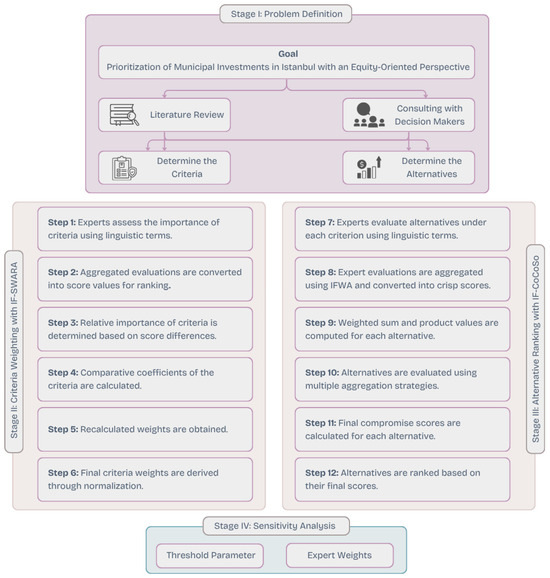
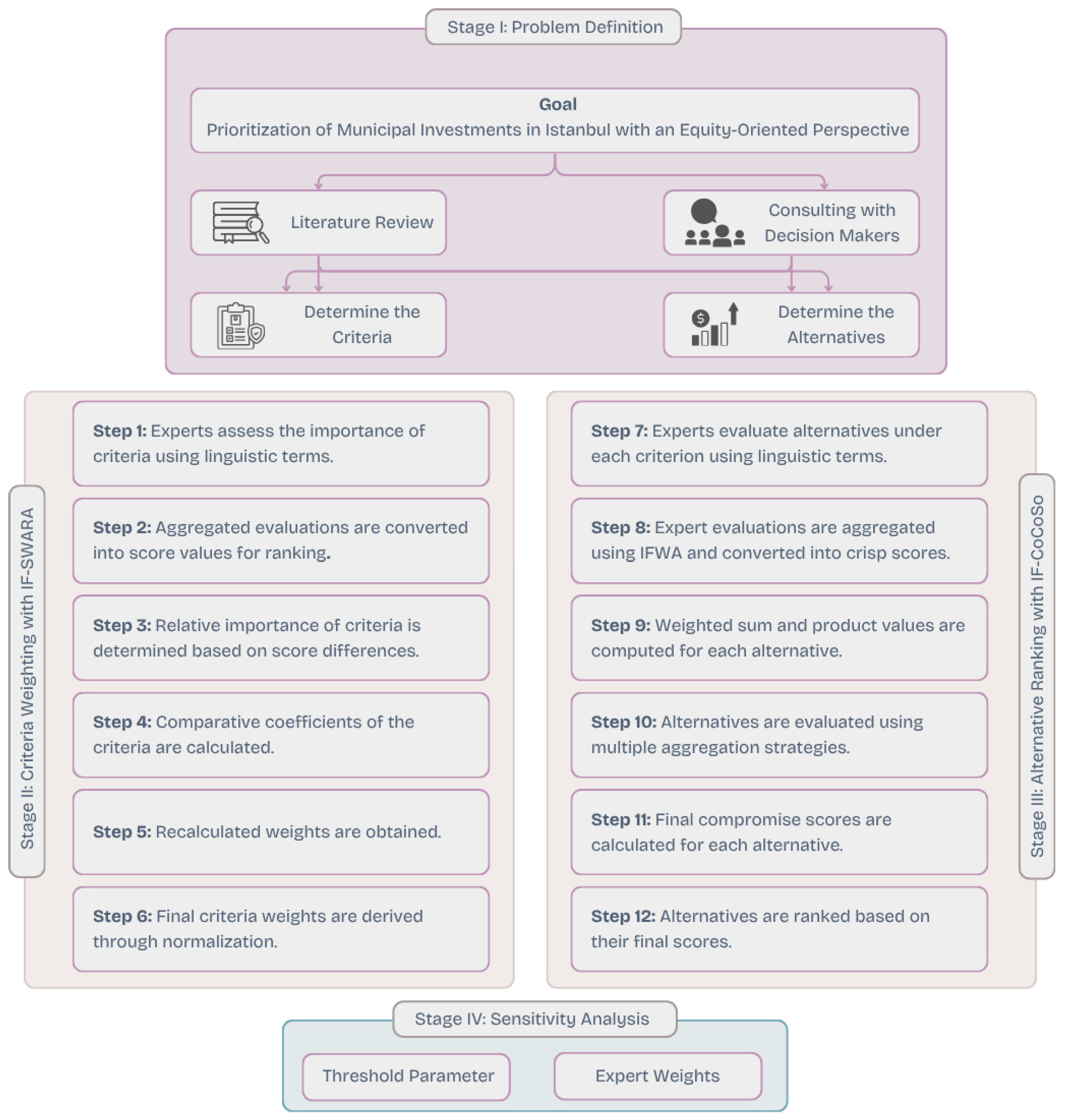
The IF-CoCoSo method is an adaptation of the CoCoSo approach to the fuzzy environment [18]. It integrates additive and multiplicative compromise solutions, simultaneously considering both the overall performance of alternatives and their balance across different criteria dimensions. This structure offers more flexible, balanced results than ranking methods based solely on a single ideal solution. The literature shows that the IF-CoCoSo method yields effective results in complex and multidimensional decision problems, particularly in the joint evaluation of social, environmental, and justice-based criteria [22]. In this context, the combined use of the IF-SWARA and IF-CoCoSo methods offers a methodologically appropriate and literature-consistent approach for decision-making problems that holistically address the effectiveness and fairness dimensions of public investments. The flow chart of the methodology adopted in the study is shown in Figure 1.
Figure 1.
Flowchart of the study.
2.1. Preliminaries of Intuitionistic Fuzzy Sets
IFSs were developed because classical fuzzy set theory proved inadequate for expressing uncertainty using a single membership degree. It is an advanced uncertainty modeling approach that addresses such shortcomings [23]. In classical fuzzy sets, the membership degree of an element is defined in the range [0, 1], and non-membership information is implicitly accepted as the complement of this value [13]. However, this approach is inadequate, especially in complex decision problems where incomplete information, conflicting expert opinions, and decision-maker hesitation are prevalent. IFS theory, proposed by Atanassov [14], to address this shortcoming, enables more detailed and realistic modeling of uncertainty by defining each element in terms of membership, non-membership, and a hesitation degree representing the remainder of their sum [24].
According to Atanassov’s definition, the sum of membership and non-membership degrees does not have to equal one, and this flexibility ensures that information deficiency and decision-maker uncertainty are clearly represented [14]. Numerous studies in the literature have shown that IFSs offer a stronger representation capability than classical fuzzy sets, particularly in areas involving high uncertainty, such as multi-criteria decision making, risk assessment, and sustainability-based problems [25,26]. In this respect, the IFS approach provides significant analytical depth to decision support models by distinguishing not only the degree of uncertainty but also its source. The fundamental properties of IFSs are as follows.
Ambiguity in decision-making problems can be effectively represented using IFS. An IFS is formally defined as in Equation (1) [14]:
The degree of hesitation, also known as the intuitionistic index, is given by Equation (2):
Here, represents the membership degree of element in set , while denotes its non-membership degree. The hesitation degree reflects the level of uncertainty or incomplete information regarding the classification of element in set .
Let and are signify IFN [27]:
Score functions are commonly used to assess and compare intuitionistic fuzzy numbers (IFNs). A widely adopted score function for an IFN is defined in Equation (8):
The score function takes values within the interval , where a larger value indicates a higher dominance of membership over non-membership. Normalized versions of score function is also utilized, as presented in Equation (8) [28]:
The normalized score function maps values to [0, 1]. This normalization improves consistency during aggregation and comparison processes involving IFNs.
The intuitionistic fuzzy weighted averaging (IFWA) operator aggregates IFNs based on their associated weights, yielding a composite IFN. Given a set of IFNs for , with corresponding weights such that and . The IFWA operator is defined as:
2.2. IF SWARA-CoCoSo Framework
Step 1: The experts’ views on the importance of the criteria are gathered using the linguistic terms shown in Table 1.
Table 1.
IF language scale for criteria and alternative evaluation [28].
Step 2: The score values of the aggregated assessments are calculated using Equation 8. According to the scores obtained, the criteria are ranked and arranged in descending order.
Step 3: For each criterion, the relative importance () is defined by subtracting the score value (j) from the score value of the second-ranked criterion (j − 1).
Step 4: The comparative coefficients of the criteria are determined:
Step 5: The recalculated criterion weights are calculated.
Step 6: Finally, the normalized importance weights of the criteria are obtained by dividing each value by the sum of all recalculated weights, as shown in Equation (12):
Step 7: Using the linguistic scale in Table 1, experts evaluate the performance of each alternative under each criterion.
Step 8: The individual expert decision matrices are then aggregated by IFWA operator. Each aggregated intuitionistic fuzzy evaluation is converted into a crisp score by using the score function.
Step 9: For each alternative , the weighted sum comparability sequence and the weighted product comparability sequence are calculated.
The weighted sum comparability:
The weighted product comparability:
Step 10: The relative performance of each alternative is evaluated using three aggregation strategies:
Step 11: The final compromise score for each alternative is calculated as:
Step 12: Alternatives are ranked in descending order according to their values. The alternative with the highest value is selected as the best compromise solution.
2.3. Theoretical Properties of the Proposed Framework
To further clarify the mathematical consistency of the proposed IF-SWARA-CoCoSo framework, this subsection presents two basic theoretical results related to the weighting stage. These results show that the IF-SWARA procedure generates a valid weight vector and preserves the priority ordering determined by the experts.
Theorem 1.
Let the criteria be ordered according to decreasing importance, and let the comparative importance coefficients in IF-SWARA satisfy for . Define . Let the normalized criterion weights be defined as
Then,for all, and
Proof.
Since , it follows that for all . Because and , each is strictly positive. Therefore, all normalized weights are also strictly positive. Moreover, by construction,
Hence, the IF-SWARA weights form a valid normalized weight vector. □
Theorem 2.
Under the same assumptions as in Theorem 1, the recalculated weights satisfy
and therefore the normalized weights satisfy
Proof.
For each
, since
, we have
Thus, the sequence is non-increasing. Since normalization divides each by the same positive constant , the ordering is preserved. Therefore,
This shows that the IF-SWARA procedure preserves the priority order established by the experts. □
3. Case Study
This study focuses on Istanbul, where municipal investment prioritization must be conducted under constrained budgets while simultaneously addressing risk reduction, service performance, environmental co-benefits, and social equity. Istanbul’s heterogeneous urban structure and exposure to multiple hazards, particularly pluvial flooding and seismic risk, create uneven service needs across districts and population groups. To avoid decisions being driven solely by efficiency, the framework explicitly embeds fairness considerations by prioritizing improvements for worst-off areas and socially vulnerable residents. The analysis relies on expert-based assessments under uncertainty, using IF-SWARA to derive criteria weights and IF-CoCoSo to rank the proposed investment alternatives.
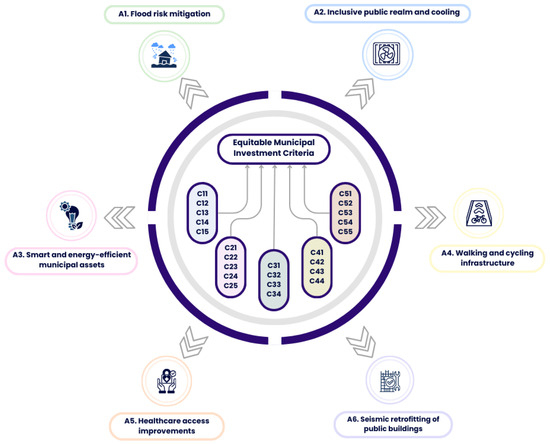
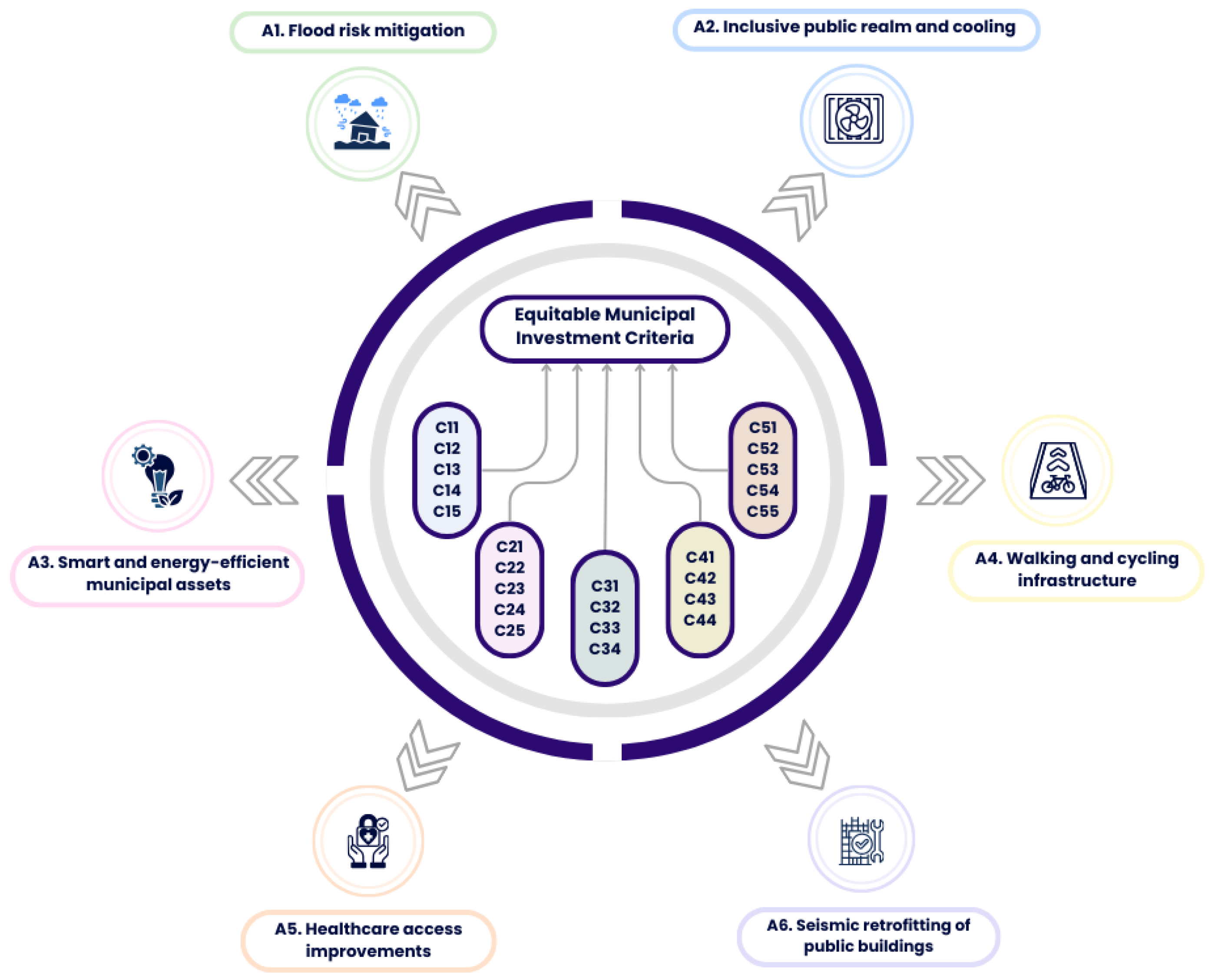
Istanbul is a large metropolitan municipality with highly diverse districts in terms of population density, built-environment quality, and access to essential services. The city faces compounded urban risks, including recurrent pluvial flooding, intensifying heat stress and urban heat-island effects, and high seismic hazard, which threaten the safety and continuity of public services. These pressures are not distributed evenly; historically underinvested neighborhoods and vulnerable groups typically experience higher exposure and lower adaptive capacity, which reinforces spatial and social disparities. Therefore, the decision objective is not only to improve overall performance, but also to narrow inequalities by directing investments toward areas with the greatest needs and risks. In line with these urban challenges and policy priorities, six municipal investment alternatives were defined for evaluation in the Istanbul case, as illustrated in Figure 2.
Figure 2.
Municipal investment alternatives evaluated in the Istanbul case study.
To capture both scientific and practice-oriented perspectives, an expert panel of eight members was formed for the evaluation process. The panel included four academics and four non-academic experts from relevant municipal and professional domains. Experts completed two structured assessments using the same linguistic scale represented with intuitionistic fuzzy numbers: (i) the relative importance of criteria for IF-SWARA weighting, and (ii) the performance ratings of the six investment alternatives under each criterion for IF-CoCoSo ranking. Individual judgments were aggregated at the group level to obtain a single set of weights and a consolidated alternative-performance matrix. A summary of the expert panel is provided in Table 2.
Table 2.
Expert information.
3.1. Investment Alternatives
In Istanbul, municipal investment decisions must address multiple, co-occurring challenges, including flood risk, heat stress, seismic vulnerability, service accessibility gaps, and resource-efficiency needs. To represent these priorities without conceptual overlap, six mutually distinct investment alternatives were defined as policy packages, each capturing a dominant intervention pathway and a clear implementation scope. The alternatives are designed to be comparable under a shared set of cross-cutting criteria, while still reflecting different mechanisms through which urban risk reduction and equity improvements can be achieved. The final set includes flood risk mitigation (A1), inclusive public realm and urban cooling (A2), smart and energy-efficient municipal assets (A3), walking and cycling infrastructure (A4), healthcare access improvements (A5), and seismic retrofitting of public buildings (A6). A concise description of each alternative and the supporting references used to ground the definitions are provided in Table 3.
Table 3.
Investment alternatives considered in the Istanbul case study.
3.2. Criteria System and Hierarchical Structure
To evaluate the six municipal investment alternatives in Istanbul in a transparent and comparable manner, a hierarchical criteria system was developed. The structure consists of five main dimensions capturing financial viability, implementability, strategic and regional alignment, socio-environmental impacts, and equity-oriented priorities. Importantly, the selected sub-criteria are formulated as cross-cutting evaluation lenses, so that each item can be meaningfully assessed across all alternatives, enabling consistent group evaluation and a defensible ranking. The final hierarchy includes 23 sub-criteria under the five main dimensions, as summarized in Table 4.
Table 4.
Criteria and definitions.
3.3. Application of IF-SWARA for Criteria Weighting
As stated earlier, the judgments of eight experts were elicited to determine the relative importance of the evaluation criteria for the municipal investment prioritization problem in Istanbul. The experts assessed the criteria by considering their contributions. Particular attention was given to the ability of the criteria to capture the needs of disadvantaged areas, socially vulnerable groups, and spatially uneven service conditions across the city. These assessments were expressed using the linguistic terms presented in Table 1, while the corresponding evaluations for the main criteria are reported in Table 5.
Table 5.
Main criteria evaluations.
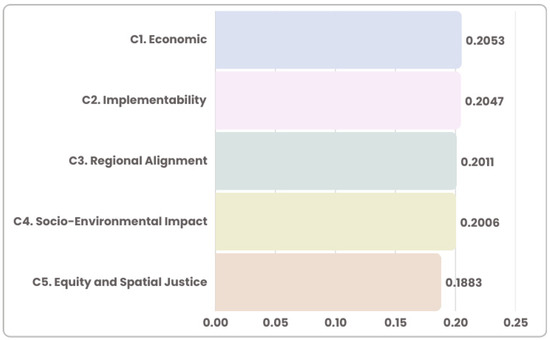
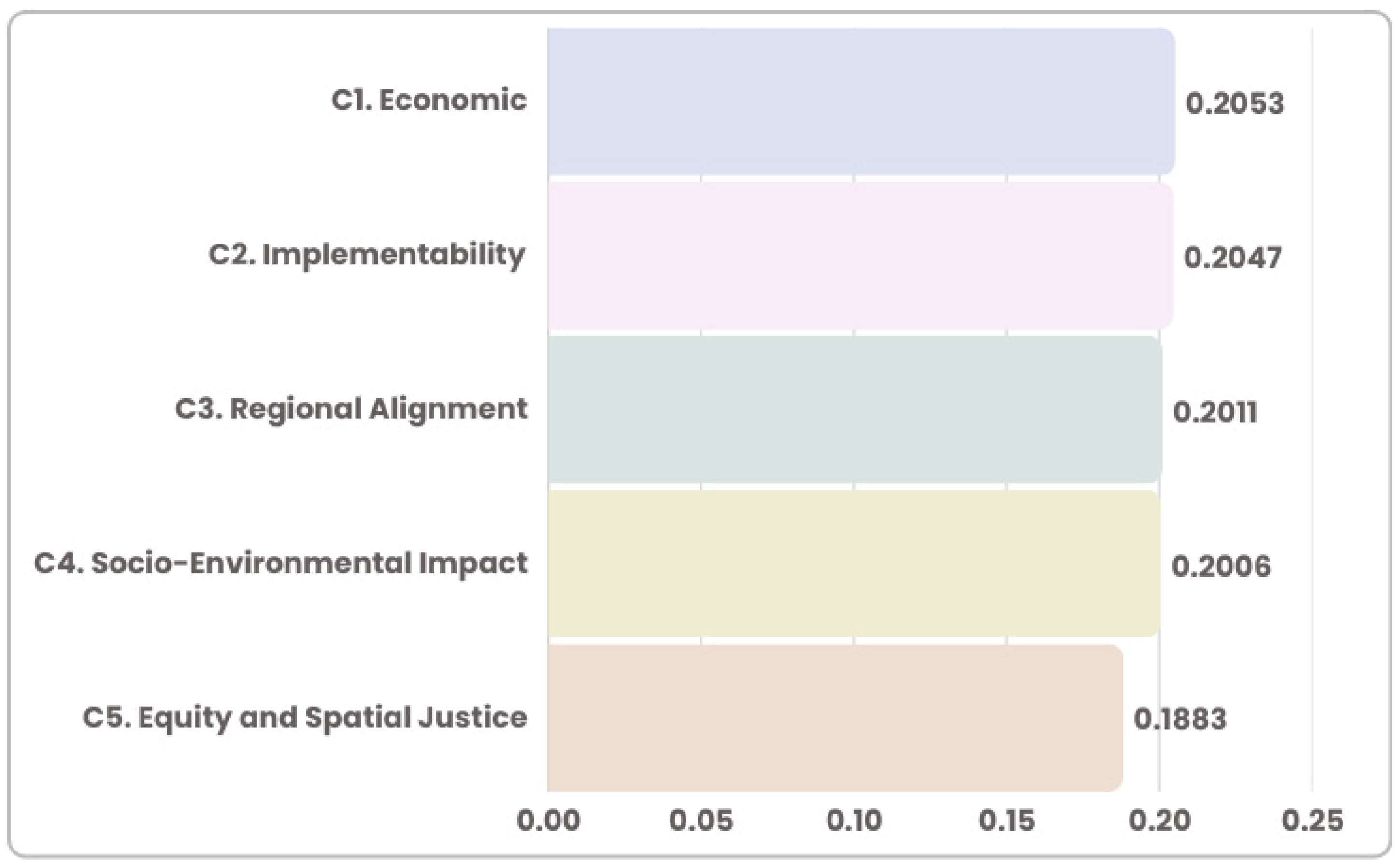
At the first stage, the linguistic evaluations were converted into intuitionistic fuzzy numbers in order to reflect uncertainty and hesitation in expert judgments. The individual assessments were then aggregated by assuming equal importance for all experts, using the IFWA operator. Next, the aggregated intuitionistic fuzzy values were processed through the IF-SWARA procedure, and the resulting weights of the main criteria are presented in Figure 3.
Figure 3.
Main criteria weights.
The results indicate a highly balanced distribution of weights across the five main criteria. Implementability (0.2053) received the highest weight, whereas Regional Alignment (0.1883) obtained the lowest. The relatively high weight assigned to Equity and Spatial Justice (0.2011) also confirms that fairness-oriented considerations play a prominent role in the municipal investment prioritization framework.
After establishing the weights of the main criteria, the analysis proceeded to the sub-criteria level. The expert evaluations and the corresponding local and global sub-criteria weights derived through the IF-SWARA method are reported in Table 6. The global weights of the sub-criteria were calculated by multiplying their local weights by the corresponding main criteria’s weights.
Table 6.
Evaluations and weights of sub-criteria.
The sub-criteria results show that Risk to human health and safety (C41) received the highest final weight (0.0558), indicating that experts gave the greatest importance to investments that directly reduce human exposure to urban hazards. It was followed by Net environmental benefit (C43) and Public acceptance (C42), suggesting that environmental performance and social legitimacy are also central in the evaluation of municipal investment options. Within the regional alignment and equity-related dimensions, Long-term equity and benefit sustainability (C33), Reducing inequalities (C32), and Contribution to regional balance (C34) ranked prominently, confirming that fairness considerations are strongly embedded in the decision structure. By contrast, Induced private cost burden (C14), Institutional coordination complexity (C23), and Coverage and beneficiaries (C51) received comparatively lower weights, implying that the experts placed greater emphasis on strategic public outcomes than on secondary implementation burdens.
3.4. Application of IF-CoCoSo for Ranking Alternatives
In the final stage of the analysis, the six municipal investment alternatives were ranked using the IF-CoCoSo method. Each expert evaluated all alternatives against the full set of criteria using the same linguistic terms defined in Table 1, thereby ensuring consistency and comparability across judgments. The individual alternative evaluation matrices are reported in Table A1 in the Appendix A. Next, the linguistic assessments were transformed into intuitionistic fuzzy numbers, and the expert-based decision matrices were aggregated under the assumption of equal importance for all experts. For this purpose, the IFWG operator was employed to obtain a single group decision matrix, which is presented in Table 7.
Table 7.
Aggregated alternative evaluation matrix.
After constructing the aggregated alternative evaluation matrix, the IF-CoCoSo procedure was applied to rank the six municipal investment alternatives. First, the weighted sum and weighted product comparability sequences for each alternative were computed by incorporating the sub-criteria weights previously obtained through the IF-SWARA method. These intuitionistic fuzzy values were then transformed into comparable crisp scores using the relevant score function. Subsequently, the three aggregation strategies of the IF-CoCoSo method were employed to derive the compromise scores of the alternatives. Based on these scores, the final preference ranking of the municipal investment alternatives was determined and presented in Table 8.
Table 8.
The ranking of the strategies ().
For γ = 0.5, the strategies were sorted as follows: A5 ≻ A1 ≻ A6 ≻ A2 ≻ A4 ≻ A3. A3. A5. Healthcare access improvements achieved the highest compromise score and ranked first, indicating that this alternative provides the strongest overall balance when all weighted criteria are considered together. It was followed by A1. Flood risk mitigation and A6. Seismic retrofitting of public buildings suggests that interventions that directly address critical urban risks and protect essential services also perform very strongly within the proposed framework. In contrast, A3. Smart and energy-efficient municipal assets received the lowest rank, indicating that although they offer important efficiency and environmental benefits, their overall performance is more limited than that of the other alternatives under the selected criteria structure. In addition, municipal investment choices in Istanbul are inevitably affected by procurement regulations, interdepartmental administrative procedures, and political considerations, which may constrain or delay the implementation of technically preferred options.
4. Sensitivity Analysis
A sensitivity analysis was conducted to examine the extent to which changes in the γ parameter affect the preference ranking of the alternatives. For this purpose, γ was varied systematically from 0 to 1 in increments of 0.1, and the corresponding changes in the final compromise scores were recorded. This procedure enabled assessment of the stability of the ranking results across different parameter settings and identification of whether any alternative positions were sensitive to changes in the aggregation structure. The resulting scores and ranking variations are reported in Table 9.
Table 9.
The sensitivity analysis results.
The sensitivity analysis indicates that the IF-CoCoSo results are highly robust across different γ values. In particular, A5 consistently remains the top-ranked alternative, while A3 remains the lowest-ranked option throughout the entire range from γ = 0 to γ = 1, confirming the stability of the best and worst choices. Similarly, A1, A6, A2, and A4 maintain their respective second, third, fourth, and fifth positions across all scenarios, further supporting the consistency of the ranking structure. No rank reversal is observed among the alternatives, indicating that the compromise performances are not sensitive to changes in the γ parameter. Overall, the findings demonstrate that the proposed ranking is stable and that A5’s superiority is not dependent on a particular γ setting.
To further examine the robustness of the proposed framework, an additional sensitivity analysis was conducted by varying the weights assigned to experts in the aggregation stage. While the baseline model assumes equal expert influence, real-world group decision-making processes may involve differences in expertise orientation, professional background, or relative influence. For this reason, six expert-weighting scenarios were considered, including the equal-weight baseline and five alternative configurations reflecting academic emphasis, practitioner emphasis, risk-resilience emphasis, equity-accessibility emphasis, and heterogeneous expert influence. The scenarios were constructed according to the main professional profiles represented in the panel, so that potential differences in expert influence could be tested in a structured and interpretable way.
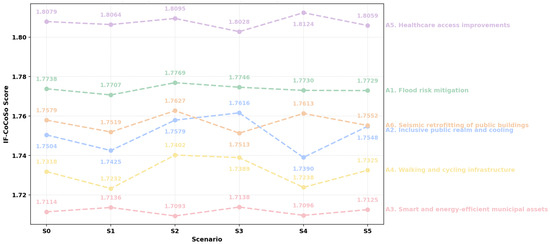
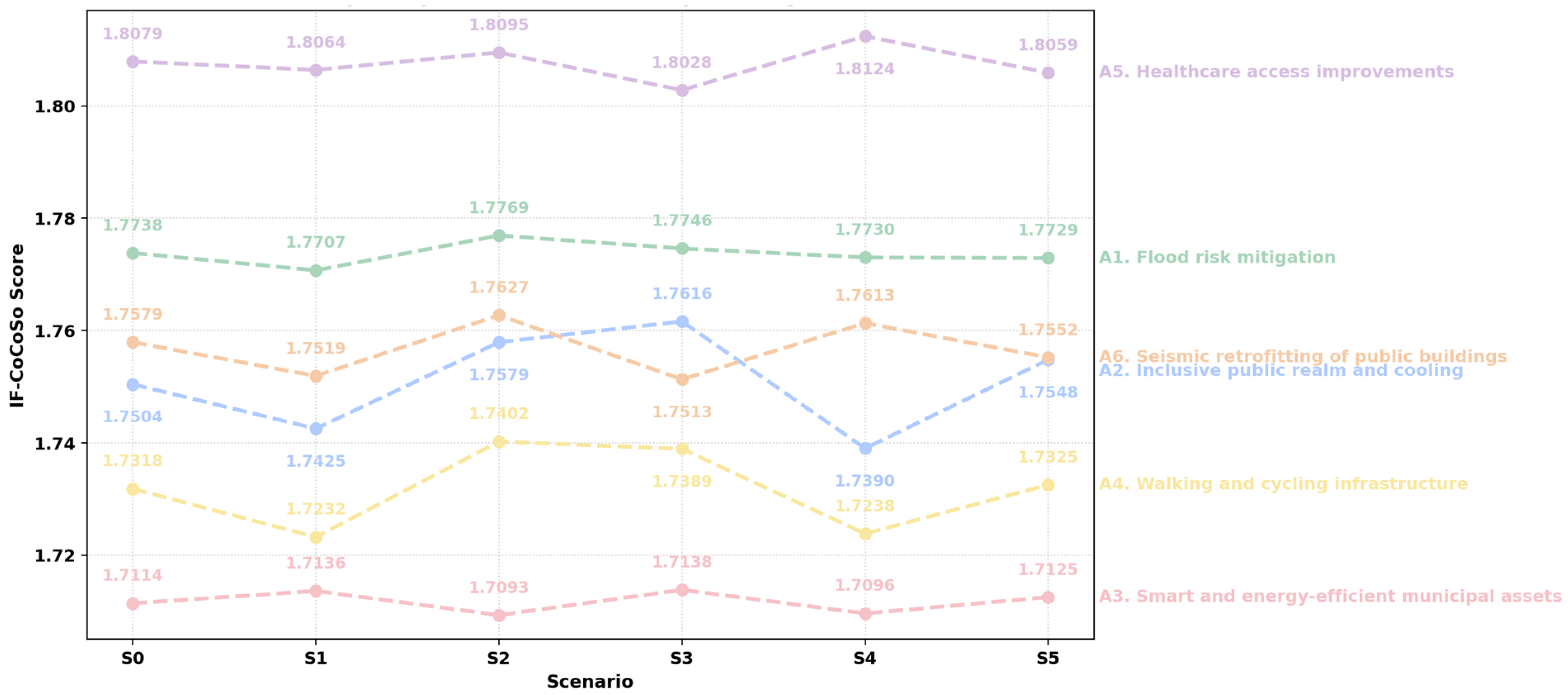
In each scenario, the expert judgments were re-aggregated using the revised expert weights, and the full IF-SWARA and IF-CoCoSo procedure was repeated. In this way, both the criteria weighting stage and the alternative ranking stage were recalculated under each expert-weighting configuration. The expert-weighting scenarios are presented in Table 10, while the resulting compromise scores and rankings are reported in Figure 4.
Table 10.
Expert-weighting scenarios used in the sensitivity analysis.
Figure 4.
Sensitivity analysis results across expert weight scenarios.
The results indicate a high degree of stability across expert-weighting scenarios. In all scenarios, A5. Healthcare access improvements remained the top-ranked alternative, whereas A3. Smart and energy-efficient municipal assets consistently ranked last. Similarly, A1. Flood risk mitigation preserved its second position and A4. Walking and cycling infrastructure remained fifth in all cases. Only one minor rank change was observed in S3, where A2. Inclusive public realm and cooling and A6. Seismic retrofitting of public buildings exchanged the third and fourth positions. Rank correlation analysis further confirmed this stability, with Spearman’s ρ values of 1.000 for S1, S2, S4, and S5, and 0.943 for S3 relative to the baseline. In addition, Kendall’s coefficient of concordance showed a very high overall agreement among scenarios (W = 0.984, χ2 = 29.524, p < 0.001), indicating that the ranking structure is highly robust to changes in expert-weighting assumptions.
5. Discussion
The findings demonstrate that municipal investment prioritization changes substantively when fairness is treated not as a rhetorical afterthought but as an operative decision rule. The prominence of healthcare access improvements in the final ranking suggests that, in a metropolitan setting marked by uneven service provision and socially differentiated vulnerability, investments that directly reduce access deprivation can outperform alternatives that are strong primarily in technical or efficiency-oriented terms. This result is consistent with earlier studies showing that accessibility-sensitive and distribution-aware decision structures can alter conventional priority orders by revealing needs that remain invisible under aggregate efficiency logics alone [4,10,11].
A second important implication concerns the relationship between fairness and resilience. The strong performance of flood risk mitigation and seismic retrofitting indicates that a fairness-aware framework does not displace risk-reduction objectives; rather, it recontextualizes them. In other words, the model does not force a choice between justice and resilience, but shows that the most policy-relevant interventions are often those that can address both simultaneously. This is particularly meaningful for Istanbul, where environmental hazards, infrastructure vulnerability, and spatially unequal service conditions are deeply intertwined. Accordingly, the results suggest that equitable municipal planning should not be understood as a separate agenda from urban resilience, but as one of its most concrete operational forms.
The weighting results reinforce this interpretation. The high salience of human health and safety, environmental benefits, and public acceptance indicates that municipal decision-makers do not evaluate public investments solely through budgetary or implementation-centered concerns. Instead, they assign substantial importance to protective outcomes, environmental co-benefits, and procedural legitimacy. This pattern aligns with the broader MCDM literature in urban and public-sector decision-making, where technically feasible solutions are increasingly expected to demonstrate social legitimacy and distributive relevance in addition to operational performance [1,2,3,8,9]. At the same time, the relatively lower emphasis placed on secondary implementation burdens suggests a normative shift: what matters most is not merely whether a project is easy to deliver, but whether it addresses structurally significant deficits in a publicly defensible way.
From a methodological perspective, the study offers a distinct contribution by operationalizing fairness through a multidimensional architecture rather than a single undifferentiated equity criterion. The inclusion of baseline need and deficit severity, vulnerability targeting effectiveness, a minimum service guarantee for the worst-off, low-accessibility priority, regional balance, and long-term equity sustainability creates a much richer representation of distributive justice than is typical in municipal prioritization studies [4,10,11,12]. This is one of the paper’s central innovations. Many earlier applications acknowledge equity in principle, yet leave it weakly specified in practice. By contrast, the present framework translates fairness into measurable decision components that can actively reshape the ranking outcome. This is precisely where the study moves beyond conventional efficiency-dominant MCDM applications.
Another noteworthy innovation is the integration of these fairness dimensions into an intuitionistic fuzzy group decision environment. Public investment decisions are rarely made under conditions of full information or unanimous confidence. Expert judgments often contain hesitation, ambiguity, and partial disagreement, especially when criteria such as vulnerability, legitimacy, or long-term equity are being assessed. The use of intuitionistic fuzzy sets is therefore not merely a technical refinement; it is epistemically appropriate for the type of municipal decision problem addressed here. By combining IF-SWARA for weighting and IF-CoCoSo for ranking, the framework preserves hesitation information while still producing a transparent compromise solution [14,15,16,17,18,19]. This strengthens the model’s credibility for real-world public-sector use, where forced crisp consensus may conceal rather than resolve disagreement. The novelty of this study does not lie merely in the empirical application to Istanbul. Rather, the study proposes, to the best of our knowledge, the first integrated IF-SWARA–IF-CoCoSo decision framework developed under intuitionistic fuzzy sets for fairness-aware municipal investment prioritization. In this respect, the contribution is methodological as well as applied: the study combines an intuitionistic fuzzy weighting procedure and an intuitionistic fuzzy compromise-ranking procedure within a single coherent framework tailored to municipal investment decisions that simultaneously involve efficiency, feasibility, socio-environmental performance, and fairness considerations. The Istanbul case is used to demonstrate the applicability and robustness of this integrated framework in a real urban decision context.
The robustness results further enhance the analytical value of the proposed framework. The stability of the ranking structure across parameter variation indicates that the observed preference order is not an artifact of a single aggregation setting. This matters because fairness-sensitive rankings can sometimes be criticized as normatively desirable but methodologically fragile. The present findings provide the opposite message: once fairness is explicitly embedded into the decision architecture, the resulting prioritization remains stable under reasonable variations in model settings. Such robustness is particularly important for municipal governance contexts, where policy recommendations are expected to withstand scrutiny from multiple institutional and political actors.
These findings also carry direct implications for practice. Municipalities facing severe fiscal and organizational constraints need prioritization tools that are both analytically rigorous and normatively defensible. The framework developed in this study offers such a tool by allowing decision makers to justify investment choices not only in terms of total impact, but also in terms of who benefits, which deficits are reduced, and whether the least-served groups receive meaningful improvement. Thus, the study contributes to a more accountable form of urban governance: one in which fairness becomes auditable, discussable, and operationally actionable rather than remaining a broad policy aspiration.
An additional point that deserves emphasis is the potential risk of procedural or algorithmic bias in fairness-oriented decision frameworks. Although the proposed model explicitly incorporates equity-related criteria, the final ranking may still be shaped by normative choices embedded in the evaluation process, including criterion design, expert composition, equal expert weighting, and aggregation settings. To examine this issue more carefully, additional sensitivity scenarios were conducted by varying expert weights across different expertise configurations. The results remained broadly stable across these scenarios, indicating that the overall ranking structure was not driven by a single expert group or by the equal-weight assumption alone. This finding strengthens the credibility of the proposed framework by showing that its fairness-oriented outcomes are not merely an artifact of one particular expert-weighting scheme, while also highlighting the importance of transparency in identifying and mitigating possible sources of unintended discrimination. The proposed ranking reflects a rational decision-support perspective and does not eliminate the institutional realities of municipal governance. In practice, procurement legislation, administrative approval procedures, inter-agency coordination requirements, and political bargaining may alter the pace, scope, or sequencing of investment decisions. For this reason, the framework is best viewed as a structured and transparent prioritization tool that can inform real-world municipal investment choices.
Notwithstanding these contributions, several limitations should be acknowledged. The analysis relies on expert-based assessments, and while this is appropriate for a structured group MCDM setting, future work could enrich the framework through direct citizen participation, neighborhood-level preference elicitation, or institutional stakeholder weighting schemes. In addition, the case study is city-specific. Comparative applications across municipalities with different governance capacities, hazard profiles, and spatial inequalities would help assess the external validity of the framework. Future studies could also integrate GIS-based accessibility metrics, scenario-based budget constraints, or dynamic portfolio optimization modules in order to connect fairness-aware ranking with implementation sequencing and fiscal feasibility.
6. Conclusions
This study developed a fairness-aware group MCDM framework for municipal investment prioritization and showed that equity can be translated from a normative aspiration into a concrete decision mechanism. The principal originality of the study lies in its refusal to treat fairness as a peripheral criterion. Instead, fairness is embedded directly into the evaluation structure through worst-off protection, vulnerability targeting, spatial justice, and sustained equity-oriented benefit assessment. In this respect, the study advances a stronger conception of public decision support: one in which the distribution of benefits matters as much as their aggregate magnitude.
The study also makes a methodological contribution by integrating IF-SWARA and IF-CoCoSo within a group decision environment characterized by uncertainty, hesitation, and heterogeneous judgments. This integrated structure enables a more realistic representation of expert reasoning while preserving analytical coherence in the final prioritization. The resulting framework therefore contributes simultaneously to the MCDM literature, to fairness-oriented urban policy analysis, and to the practical design of municipal decision-support systems.
At a substantive level, the study shows that once fairness is made explicit, municipal priorities can shift in meaningful ways. Projects that directly narrow service gaps, protect vulnerable populations, and strengthen basic access conditions gain strategic visibility within the evaluation process. This insight is especially important for contemporary cities, where infrastructure deficits, hazard exposure, and social inequality increasingly intersect. The framework proposed here offers a replicable pathway for addressing these intersections without sacrificing methodological transparency.
Overall, the paper argues that equitable urban investment planning requires more than adding social language to conventional appraisal models. It requires redesigning the prioritization logic itself. By doing so, this study contributes a novel and policy-relevant approach that can support municipalities in making decisions that are not only efficient and feasible but also publicly legitimate. Another limitation of the present study is that the framework was demonstrated on a bounded set of six municipal investment alternatives. Although this scope was sufficient to illustrate the applicability of the proposed fairness-aware group MCDM approach, future studies may extend the framework to larger and more complex project portfolios in order to further examine its scalability and practical applicability under real-world municipal decision environments.
Author Contributions
Conceptualization, E.A. and N.A.; methodology, M.C. and B.K.; formal analysis, B.K., M.C. and B.Y.K.; data curation, T.K.K., M.C. and B.Y.K.; writing—original draft preparation, B.K., B.Y.K. and N.A.; writing—review and editing, M.C. and B.Y.K.; visualization, N.A. and T.K.K.; supervision, E.A. All authors have read and agreed to the published version of the manuscript.
Funding
This research received no external funding.
Data Availability Statement
The original contributions presented in this study are included in the article. Further inquiries can be directed to the corresponding author.
Conflicts of Interest
The authors declare no conflicts of interest.
Appendix A
Table A1.
Expert evaluations for alternatives.
References
- Aljabri, B.; Aburas, H.M.; Alkahtani, M.; Almalki, A.; Alharthy, A. Methodological Approaches in Prioritizing Municipal Projects: A Case Study of the Municipality of the Holy Capital (Makkah). J. Infrastruct. Policy Dev. 2024, 8, 9664. [Google Scholar] [CrossRef] [Scilit]
- Axelsson, C.; Giove, S.; Soriani, S. Urban Pluvial Flood Management Part 1: Implementing an AHP-TOPSIS Multi-Criteria Decision Analysis Method for Stakeholder Integration in Urban Climate and Stormwater Adaptation. Water 2021, 13, 2422. [Google Scholar] [CrossRef] [Scilit]
- Pujadas, P.; Pardo-Bosch, F.; Aguado-Renter, A.; Aguado, A. MIVES Multi-Criteria Approach for the Evaluation, Prioritization, and Selection of Public Investment Projects. A Case Study in the City of Barcelona. Land Use Policy 2017, 64, 29–37. [Google Scholar] [CrossRef] [Scilit]
- Jafino, B.A. An Equity-Based Transport Network Criticality Analysis. Transp. Res. Part Policy Pract. 2021, 144, 204–221. [Google Scholar] [CrossRef] [Scilit]
- Roy, A.; Kar, B. A Multicriteria Decision Analysis Framework to Measure Equitable Healthcare Access during COVID-19. J. Transp. Health 2022, 24, 101331. [Google Scholar] [CrossRef] [Scilit] [PubMed]
- Baysal, M.E.; Kaya, İ.; Kahraman, C.; Sarucan, A.; Engin, O. A Two Phased Fuzzy Methodology for Selection Among Municipal Projects. Technol. Econ. Dev. Econ. 2015, 21, 405–422. [Google Scholar] [CrossRef] [Scilit]
- Benjamin, C.O. A Linear Goal-Programming Model for Public-Sector Project Selection. J. Oper. Res. Soc. 1985, 36, 13–23. [Google Scholar] [CrossRef] [Scilit]
- Fiore, P.; Donnarumma, G.; Falce, C.; D’Andria, E.; Sicignano, C. An AHP-Based Methodology for Decision Support in Integrated Interventions in School Buildings. Sustainability 2020, 12, 10181. [Google Scholar] [CrossRef] [Scilit]
- Qureshi, A.M.; Rachid, A. Comparative Analysis of Multi-Criteria Decision-Making Techniques for Outdoor Heat Stress Mitigation. Appl. Sci. 2022, 12, 12308. [Google Scholar] [CrossRef] [Scilit]
- Feng, Z.; Li, G.; Wang, W.; Zhang, L.; Xiang, W.; He, X.; Zhang, M.; Wei, N. Emergency Logistics Centers Site Selection by Multi-Criteria Decision-Making and GIS. Int. J. Disaster Risk Reduct. 2023, 96, 103921. [Google Scholar] [CrossRef] [Scilit]
- Santos, B.; Antunes, A.; Miller, E.J. Integrating Equity Objectives in a Road Network Design Model. Transp. Res. Rec. J. Transp. Res. Board 2008, 2089, 35–42. [Google Scholar] [CrossRef] [Scilit]
- Atkinson, A.B. On the Measurement of Inequality. J. Econ. Theory 1970, 2, 244–263. [Google Scholar] [CrossRef] [Scilit]
- Zadeh, L.A. Fuzzy Sets. Inf. Control 1965, 8, 338–353. [Google Scholar] [CrossRef] [Scilit]
- Atanassov, K.T. Intuitionistic Fuzzy Sets. Fuzzy Sets Syst. 1986, 20, 87–96. [Google Scholar] [CrossRef] [Scilit]
- Patel, A.; Jana, S.; Mahanta, J. Intuitionistic Fuzzy EM-SWARA-TOPSIS Approach Based on New Distance Measure to Assess the Medical Waste Treatment Techniques. Appl. Soft Comput. 2023, 144, 110521. [Google Scholar] [CrossRef] [Scilit]
- Keršulienė, V.; Zavadskas, E.K.; Turskis, Z. Selection of Rational Dispute Resolution Method by Applying New Step-Wise Weight Assessment Ratio Analysis (SWARA). J. Bus. Econ. Manag. 2010, 11, 243–258. [Google Scholar] [CrossRef] [Scilit]
- Keshavarz-Ghorabaee, M.; Amiri, M.; Zavadskas, E.; Turskis, Z.; Antucheviciene, J. An Extended Step-Wise Weight Assessment Ratio Analysis with Symmetric Interval Type-2 Fuzzy Sets for Determining the Subjective Weights of Criteria in Multi-Criteria Decision-Making Problems. Symmetry 2018, 10, 91. [Google Scholar] [CrossRef] [Scilit]
- Yazdani, M.; Zarate, P.; Kazimieras Zavadskas, E.; Turskis, Z. A Combined Compromise Solution (CoCoSo) Method for Multi-Criteria Decision-Making Problems. Manag. Decis. 2019, 57, 2501–2519. [Google Scholar] [CrossRef] [Scilit]
- Peng, X.; Garg, H. Intuitionistic Fuzzy Soft Decision Making Method Based on CoCoSo and CRITIC for CCN Cache Placement Strategy Selection. Artif. Intell. Rev. 2022, 55, 1567–1604. [Google Scholar] [CrossRef] [Scilit]
- Ayyildiz, E.; Karaca, T.K.; Cari, M.; Yalcin Kavus, B.; Aydin, N. Smart Risk Assessment and Adaptive Control Strategy Selection for Human–Robot Collaboration in Industry 5.0: An Intelligent Multi-Criteria Decision-Making Approach. Processes 2025, 13, 3206. [Google Scholar] [CrossRef] [Scilit]
- Tumsekcali, E.; Ayyildiz, E.; Taskin, A. Interval Valued Intuitionistic Fuzzy AHP-WASPAS Based Public Transportation Service Quality Evaluation by a New Extension of SERVQUAL Model: P-SERVQUAL 4.0. Expert Syst. Appl. 2021, 186, 115757. [Google Scholar] [CrossRef] [Scilit]
- Nie, J. A Novel IFN-CSM-CoCoSo Approach for Multiple-Attribute Group Decision-Making with Intuitionistic Fuzzy Sets: An Application in Assessing Corporate Social Responsibility Performance. Heliyon 2024, 10, e29207. [Google Scholar] [CrossRef] [Scilit]
- Yildiz, A.; Cari, M.; Seyhan, M.; Ayyildiz, E. Hybrid Multi-Criteria Framework for Membrane Electrode Assembly Selection. Energy Sources Part A Recovery Util. Environ. Eff. 2026, 48, 2613105. [Google Scholar] [CrossRef] [Scilit]
- Ayyildiz, E.; Kesici, B.; Erdogan, M.; Cari, M.; Aydin, N. An Integrated Framework for Mapping Barriers and Strategies in Green Hydrogen Deployment. Int. J. Hydrogen Energy 2026, 217, 153935. [Google Scholar] [CrossRef] [Scilit]
- Madenoğlu, F.S. A Multi-Criteria Group Decision-Making Method for Outranking Problems Under Sustainability, Risks, and Intuitionistic Fuzzy Environment. Pamukkale Univ. J. Soc. Sci. Inst. 2023, 56, 123–137. [Google Scholar] [CrossRef] [Scilit]
- Salimian, S.; Mousavi, S.M.; Tupenaite, L.; Antucheviciene, J. An Integrated Multi-Criteria Decision Model to Select Sustainable Construction Projects under Intuitionistic Fuzzy Conditions. Buildings 2023, 13, 848. [Google Scholar] [CrossRef] [Scilit]
- Xu, Z.; Yager, R.R. Some Geometric Aggregation Operators Based on Intuitionistic Fuzzy Sets. Int. J. Gen. Syst. 2006, 35, 417–433. [Google Scholar] [CrossRef] [Scilit]
- Mishra, A.R.; Rani, P.; Pandey, K.; Mardani, A.; Streimikis, J.; Streimikiene, D.; Alrasheedi, M. Novel Multi-Criteria Intuitionistic Fuzzy SWARA–COPRAS Approach for Sustainability Evaluation of the Bioenergy Production Process. Sustainability 2020, 12, 4155. [Google Scholar] [CrossRef] [Scilit]
- Jayasooriya, V.M.; Muthukumaran, S.; Ng, A.W.M.; Perera, B.J.C. Multi Criteria Decision Making in Selecting Stormwater Management Green Infrastructure for Industrial Areas Part 2: A Case Study with TOPSIS. Water Resour. Manag. 2018, 32, 4297–4312. [Google Scholar] [CrossRef] [Scilit]
- Rioux, A.; Lacroix, S.; Kuller, M.; Bichai, F.; Dagenais, D. Urban Tree Planning: Can MCDA-Driven Approaches Help Improve Current Practices? A Canadian Case Study. Trees For. People 2025, 22, 101029. [Google Scholar] [CrossRef] [Scilit]
- Daniel, S.; Ghiaus, C. Multi-Criteria Decision Analysis for Energy Retrofit of Residential Buildings: Methodology and Feedback from Real Application. Energies 2023, 16, 902. [Google Scholar] [CrossRef] [Scilit]
- Orobio Quiñones, J.C.; Guzmán Rodríguez, D.E.; Murillo-Hoyos, J.; Jaramillo Molina, C. Spatial Accessibility to Opportunities in the Integrated Mass Transportation System of Santiago de Cali: Equity Analysis. Int. J. Transp. Sci. Technol. 2025; in press. [CrossRef] [Scilit]

Disclaimer/Publisher’s Note: The statements, opinions and data contained in all publications are solely those of the individual author(s) and contributor(s) and not of MDPI and/or the editor(s). MDPI and/or the editor(s) disclaim responsibility for any injury to people or property resulting from any ideas, methods, instructions or products referred to in the content. |
© 2026 by the authors. Licensee MDPI, Basel, Switzerland. This article is an open access article distributed under the terms and conditions of the Creative Commons Attribution (CC BY) license.