


Abstract
A class of self-similar solutions to the model of a cylindrical shock wave in non-uniform atmosphere in the presence of monochromatic radiation and gravitation in magneto gas dynamics has been obtained by using a similarity method. The propagation of a cylindrical shock wave in an ideal gas with monochromatic radiation and gravitating effects has been discussed. Through applying similarity transformations to the system of equations, we obtained the symmetry generators of the system. By using the symmetry generators and the surface invariance condition, we obtained the group invariant solution and then, with the help of group invariant solution, we converted the given system of PDEs to the system of ODEs together with the boundary condition. The obtained system of ODEs together with boundary condition has been solved numerically by using Runge–Kutta method of order four. The flow variables are analyzed graphically behind the shock with respect to the variation of parameters.
Keywords:
monochromatic radiation; gravitation; shock waves; similarity solutions; magneto gas dynamics (MGD) MSC:
35L67; 76M60; 76L05; 35L60
1. Introduction
The analysis of shock propagation and related flows in astrophysical phenomena such as supernova explosion is of great interest. The study of the propagation of strong shock waves in a self-gravitating medium behind the shock front has always received much attention by researchers in various fields such as nuclear science, geophysics, plasma physics, and astrophysics. In recent years, considerable attention has been given to the study of one-dimensional gas motion occurring in an inhomogeneous non-gravitating and self-gravitating medium on a gaseous substance in stellar interiors. Using the dimensionality method, Sedov [1] obtained self-similar solutions to the number of problems with disturbed energy release. Nath [2] presents a theoretical model of cylindrical shock waves in magnetogasdynamics in the presence of monochromatic radiation following the work of Khudyakov [3]. Furthermore, cylindrical shock waves in the presence of monochromatic radiation without a magnetic field effect have been discussed by Nath and Takhar [4]. The propagation of a shock wave produced by the sudden point expansion in an inhomogeneous non-gravitating medium has been analyzed by many authors; Taylor [5] and Cavaliere and Messina [6] have studied the similarity flow behind the shock wave. A blast/shock wave interacting with three objects was examined by Dey et al. [7] for the diaphragm pressure ratio of 56.
A theoretical study of converging shock waves for a cylindrically or spherically symmetric flow in an ideal gas was first performed by Guderley [8]. In particular, we refer to the work by Sakurai [9], Zeldovich and Raizer [10], and Lazarus [11]. Sharma and Radha [12] and Sharma and Arora [13] investigated the implosion problem to obtain more accurate results. Logan and Perez [14] derived the complete class of similarity solutions for the one-dimensional, time-dependent shock hydrodynamics problem using the Lie group method. Tomar et al. [15] and Chauhan et al. [16] obtained the global solution to the imploding shock wave problem for non-ideal gas in the absence and presence of a magnetic field by using the perturbation series technique. The method of similarity transformations has been applied by Arora et al. [17] to the problem of strong shock waves in magnetogasdynamics without thermal radiation. A theoretical study of the converging strong shock waves problem for cylindrically and spherically symmetric flow in non-ideal gas using a Mie–Gruneisen-type equation of state has been done by Narsimhulu et al. [18]. Wanga and Fakhar [19] applied Lie symmetry method to an extended (2 + 1)-dimensional Zakharov-Kuznetsov-Burgers equation. By taking the general form of the equation of state, Pandey et al. [20] applied the symmetry method to the system of PDEs governing one-dimensional unsteady motion of a viscous compressible fluid. Khalique and Biswas [21] determined the stationary solutions of the nonlinear Klein–Gordon equations in dimensions by applying the Lie symmetry approach. Bajargaan and Patel [22] obtained the self-similar solution to the cylindrically symmetric shock wave in self-gravitating, rotating, axisymmetric dusty gas in which they also considered the presence of heat conduction and radiation heat flux.
The mathematical model investigated in this study describes the propagation of a cylindrically symmetric shock wave in a non-uniform medium under the combined effects of gravitation, magnetic field, and monochromatic radiation. Such models are of considerable importance in understanding several astrophysical and high-energy plasma phenomena where cylindrical symmetry is more appropriate than spherical symmetry. The role of monochromatic radiation in modifying shock dynamics was first systematically examined by Onkar Nath, who studied self-similar cylindrical MHD shock waves in the presence of radiation and demonstrated its significant influence on the flow field and shock strength [2]. Subsequently, Nath extended this analysis to rotating atmospheres and highlighted the combined effects of rotation and radiation on cylindrical shock propagation [23]. In many realistic physical situations, such as astrophysical jets, supernova remnants, accretion-driven outflows, and laboratory plasma experiments, shock waves propagate through magnetized, radiating, and gravitationally influenced media. The inclusion of a magnetic field alters the post-shock structure through magnetic pressure and tension effects, while monochromatic radiation accounts for radiative energy transfer in optically active media. Motivated by these earlier studies, the present work extends the existing literature by incorporating gravitation into the cylindrical magnetogasdynamics framework with monochromatic radiation and by employing Lie symmetry analysis to obtain self-similar solutions. This approach provides deeper insight into the coupled influence of magnetogasdynamics, radiation, and gravitation on the evolution of cylindrical shock waves. This study is the first to perform a Lie symmetry analysis of strong cylindrical shocks incorporating gravity, radiation, and MHD effects simultaneously, extending the works of Nath [2,4] and Bajargaan a Patel [22].
In this paper, we applied the Lie group transformation method, as discussed by Bluman et al. [24] and Logan [14], to obtain similarity solutions for the propagation of cylindrical shock waves in a non-rotating, non-uniform atmosphere under the influence of monochromatic radiation and gravitation. In addition, the effect of the magnetic field has been taken into account as a significant factor in the analysis.
2. Basic Equations and Shock Conditions
In magnetogasdynamics, the governing equations for one-dimensional cylindrically symmetric motion of an inviscid perfect gas in a non-uniform medium, under the influence of monochromatic radiation and gravitational forces, can be expressed as (cf. Khudyakov [3]; Whitham [25]; Nath et al. [26]; Zedan [27]):
here, denotes the density, p the pressure, u the velocity, h the magnetic field, and j the monochromatic radiation flux. The symbol e represents the energy per unit mass at a radial distance r. The parameter is the ratio of specific heats, m is the mass per unit length, and r is the radial distance from the centre. Time is denoted by t, K is the absorption coefficient, and G represents the gravitational constant. The internal energy is given by
For the ideal gas, the equation of state is
where T and R respectively denote the absolute temperature and the gas constant which obeys the thermodynamic relations and . Here, is the ratio , where and represents the specific heat at constant volume and constant pressure, respectively. Let the initial condition at time be given by , , , , and , which are all the functions of r. The Rankine–Hugoniot (R-H) jump conditions at the shock are given by (Whitham [25] ):
where , , , and respectively denote the density, pressure, magnetic field, mass and radiation flux in the undisturbed medium, and V denotes the velocity of shock wave. The parameters just behind the shock is represented by the suffix 1.
The absorption coefficient is given as
where the dimensions of this constant K are given by
The constant values taken by Nath and Takhar [4] are Moreover, the dimensionless constants , , are related as follows:
3. Lie Group of Transformation
Similarity methods for obtaining self-similar solutions of partial differential equations are typically based on the principle of reducing the number of independent variables. In multidimensional problems, a one-parameter Lie group of transformations reduces the one independent variable at each step, thereby generating a new equation with one fewer variable than in the previous step. The transformed equation at each stage must remain invariant under the corresponding Lie group of transformations. Once the Lie group of transformations that leave the partial differential equations invariant is determined, it becomes possible to construct a solution that is invariant under these transformations [28,29,30,31,32]. In this work, we investigate the motion of a converging shock wave in a self-gravitating medium under the influence of monochromatic radiation using the similarity method.
The symmetry generators are functions of the variables and j. The one-parameter infinitesimal transformation (8) is constructed in such a way that the system of partial differential equations given by Equation (1), together with the shock conditions specified in Equation (4), remains invariant. The parameter is chosen to be sufficiently small so that its square and higher-order terms can be neglected. This invariance group reduces the number of independent variables in the system of PDEs by one, thereby enabling the reduction of the PDE system (1) into a corresponding system of ODEs.
For simplicity, let us take and , where and .
The system of basic Equation (1) can be represented as
which remains constantly conformally invariant under the Lie group of transformation (8), if there exist constants such that
holds for all smooth surfaces, . The Lie derivative L in the direction of the extended vector field is given by
with , , , , , , , , and
where l = 1, 2, j = 1, 2, i = 1, 2, 3, 4, 5, 6, m = 1, 2, 3, 4, 5, 6 and k = 1, 2, 3, 4, 5, 6. Here, summation convention is represented by repeated indices and represents the generalised derivative transformation.
Equation (9) implies
By putting the value of from Equation (10) into Equation (11), we found a polynomial equation in . On setting all the coefficients of and to zero, we obtain a system of first order, linear PDEs, which are considered a system for determining equations in terms of symmetry generators . Further, we solved the system of determining equations, which yields the invariant group (8) completely.
We apply the above procedure to the system of PDEs (1). We derived the following determining equations from the invariance of the continuity Equation :
Similarly, from the invariance of the momentum Equation , we derived the following determining equations:
Next, the invariance of the magnetic field equation, , yields the following determining equations:
Next, the invariance of the energy Equation yields the following determining equations:
Next, the invariance of the Equation gives the following determining equations:
Finally, the invariance of the Equation gives the following determining equations:
After solving the above systems of determining equations simultaneously, we get the following symmetry generators:
where and are the arbitrary constants. Also, we have the relation and .
4. Construction of Similarity Solutions
Let us take the case of when and .
The invariant surface conditions (see, Logan [14] and Bluman et al. [24] are as follows):
On integrating the set of Equations (13) together with (12), we obtain the following forms of flow variable:
where , . , and are the functions of similarity variable , which are determined as follows:
and the similarity curve is defined as
Let the shock path and the shock velocity V at the basic position of the shock be given as
The boundary conditions at the strong shock at which are as follows:
Invariance of the jump condition in Equation (4) suggests that , , and must be of the following form:
where , , and are the arbitrary constants and
On applying jump conditions (4) and using Equations (20) and (21), we obtained the following conditions on the functions , and :
where , , and are the constants associated with the medium.
By using the Equations (17), (18) and (20), Equation (14) can be rewritten as:
where , , , , , and .
On substituting Equation (23) into the system (1) of governing equations and using Equations (15)–(18) and (20), we obtained the following system of ODEs in , and in the following form after dropping the asterisk sign:
where the prime have been used for the differentiation with respect to the similarity variable . Also, we obtained the following conditions for the strong shock from the jump conditions (4),
5. Results and Discussion
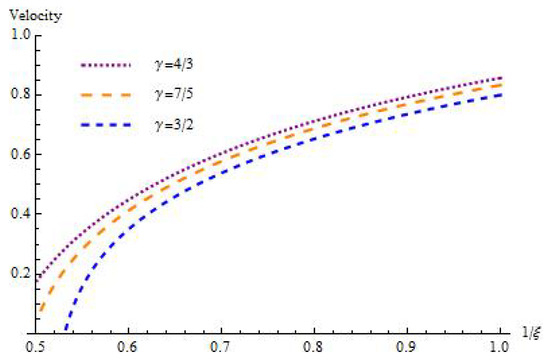
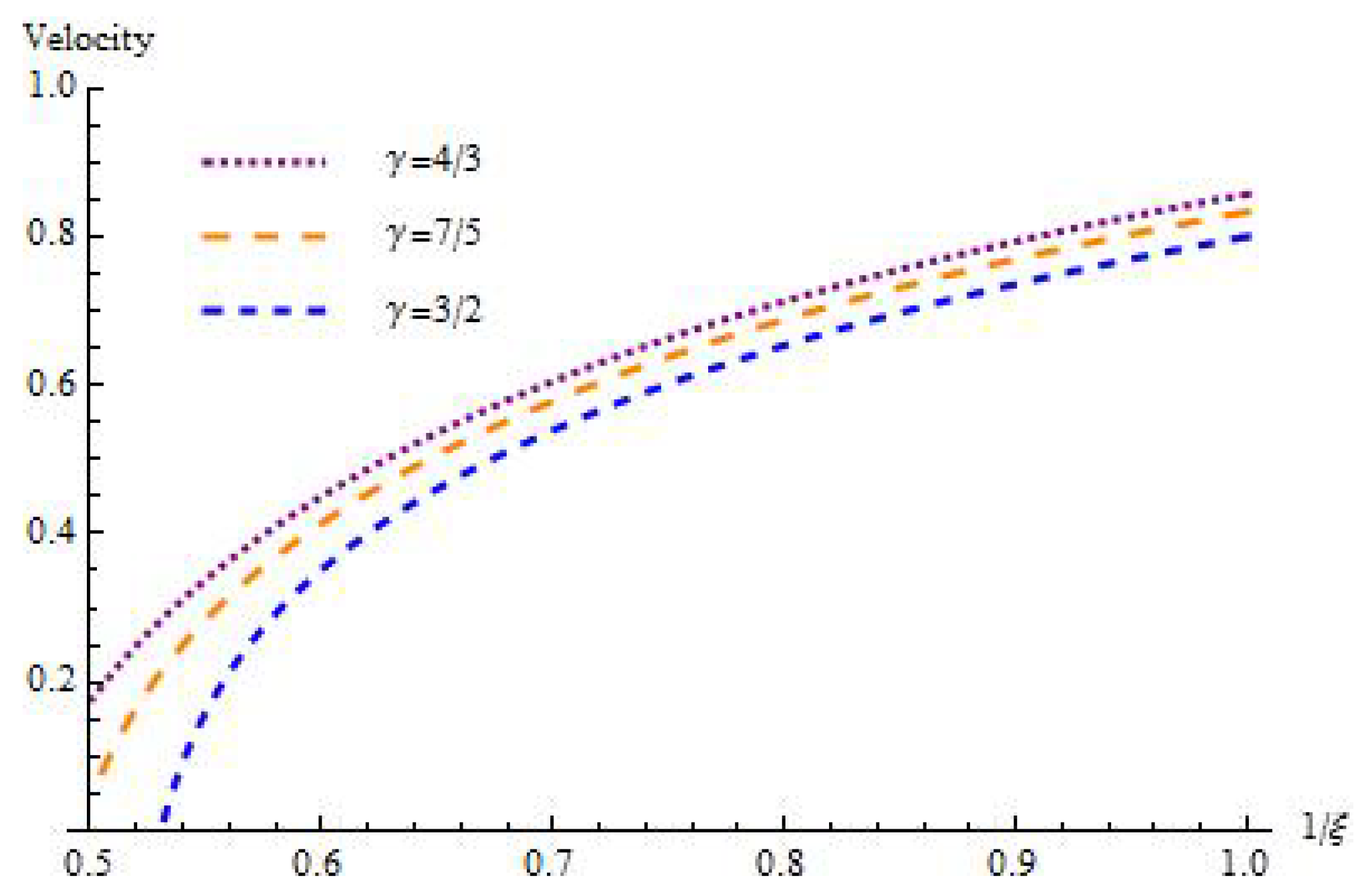
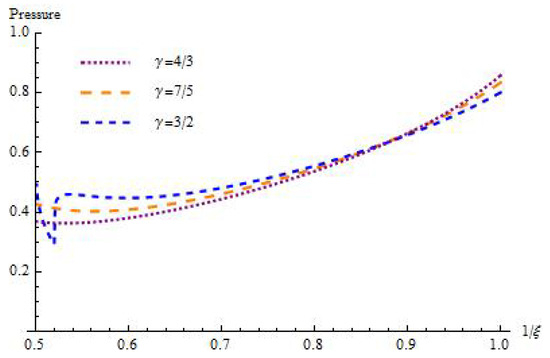
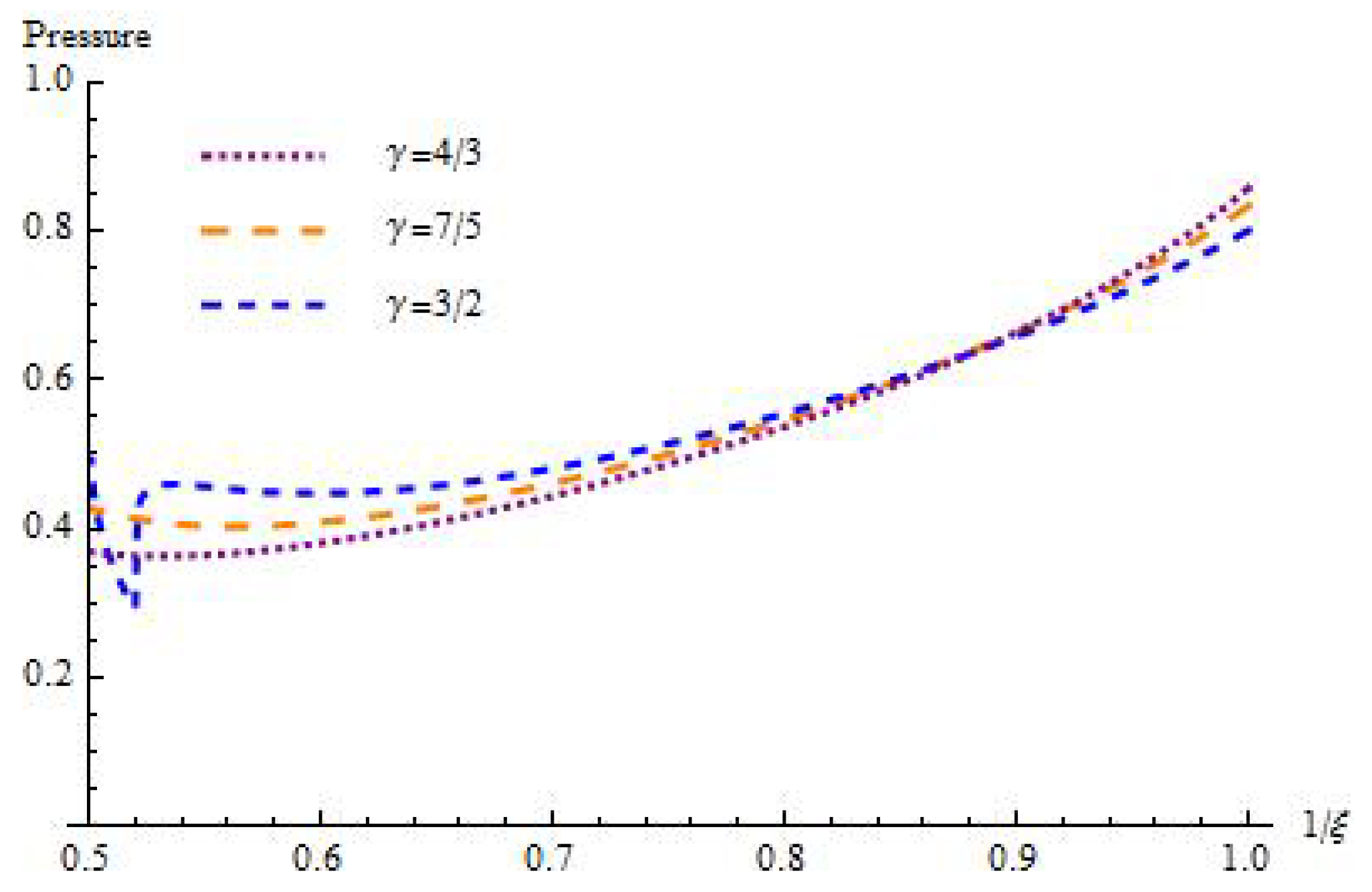
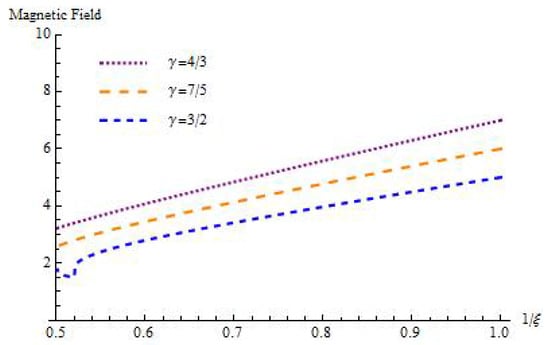
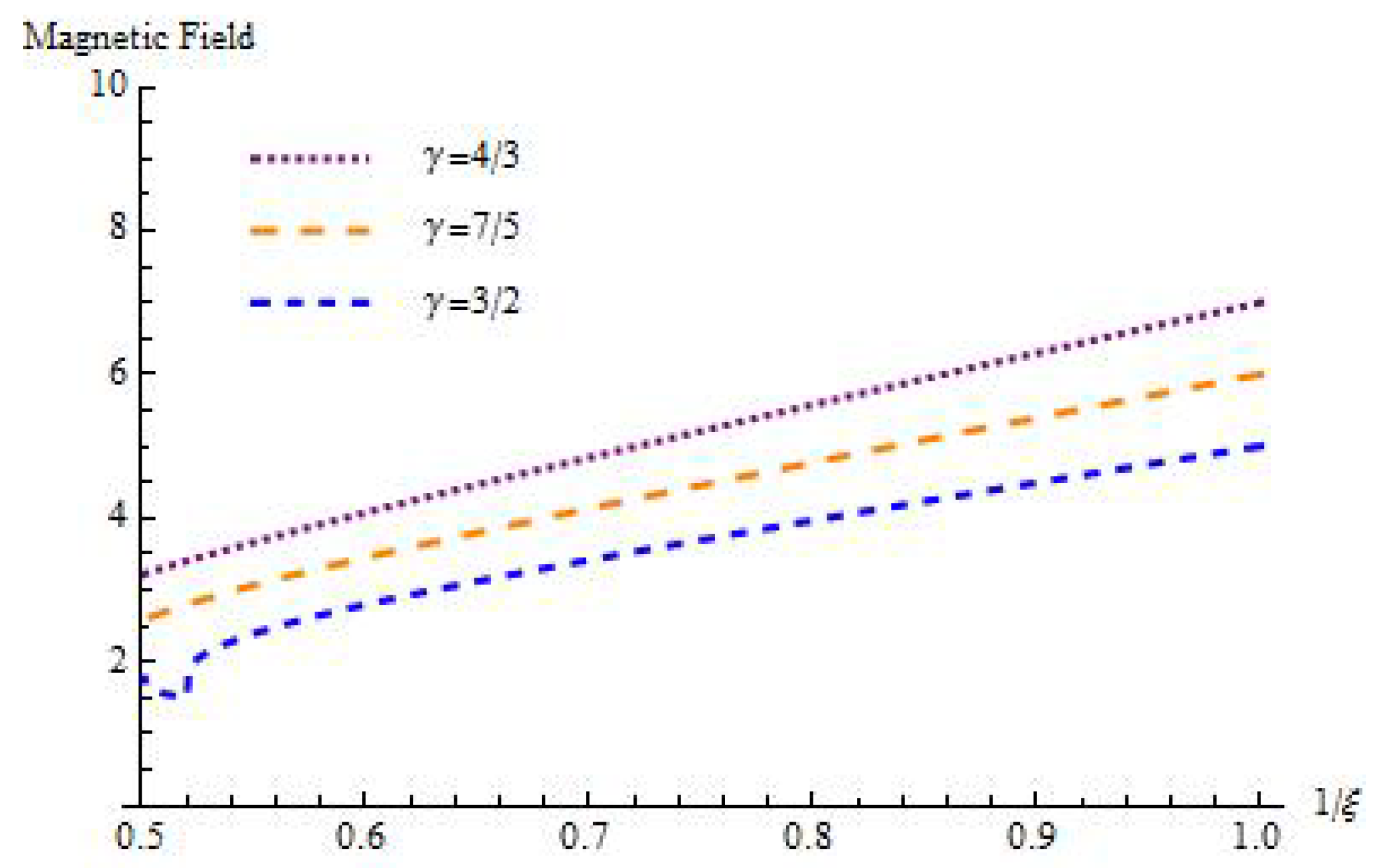
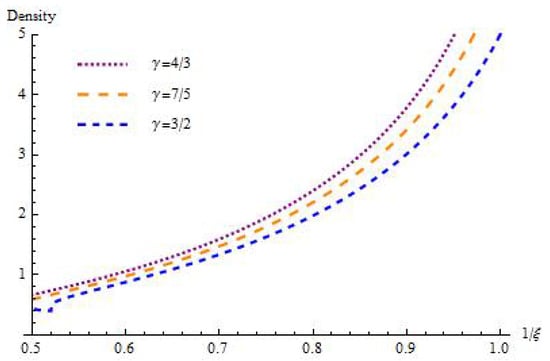
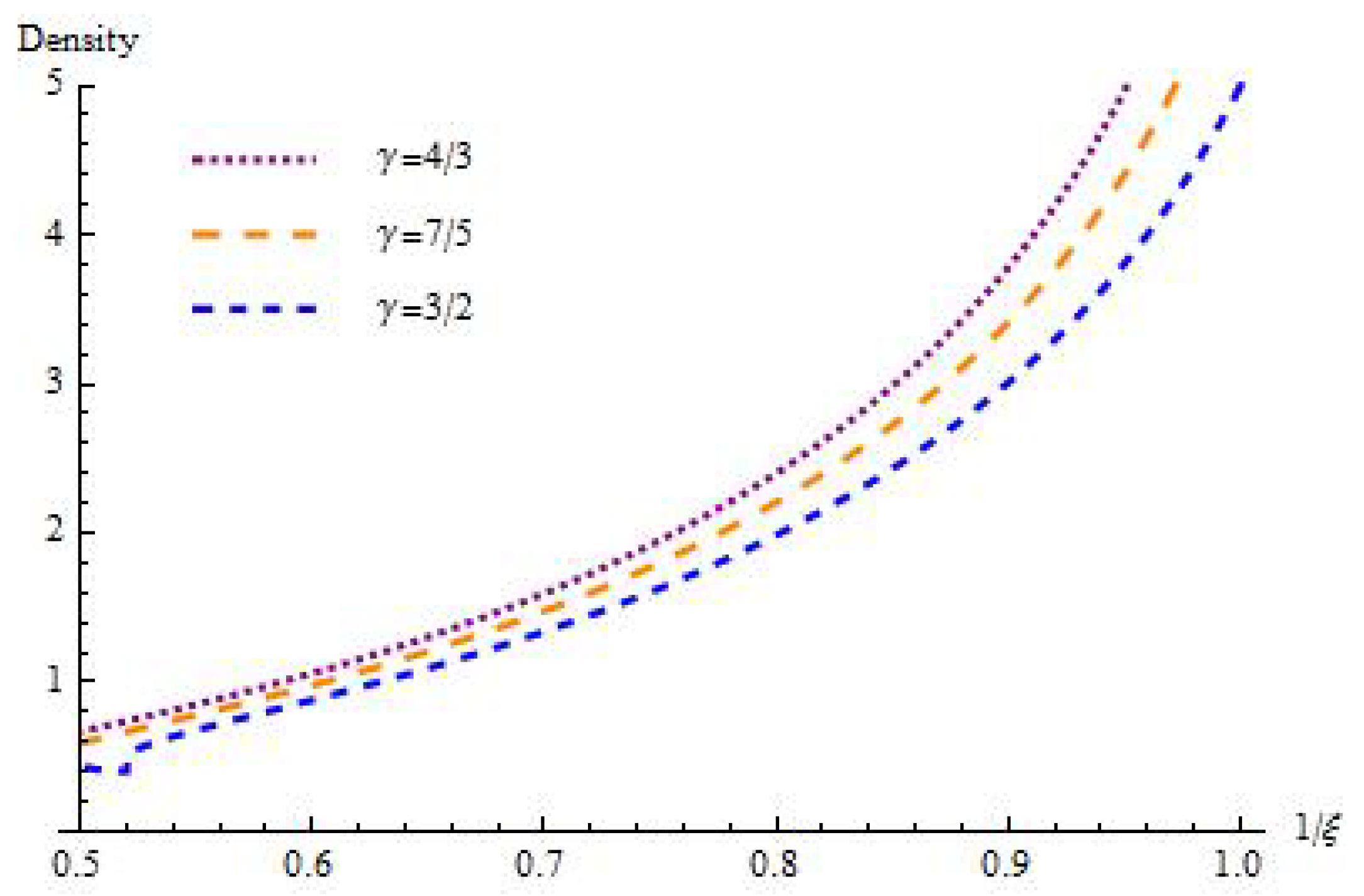
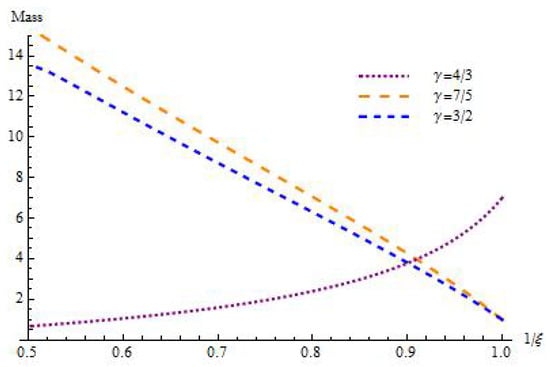
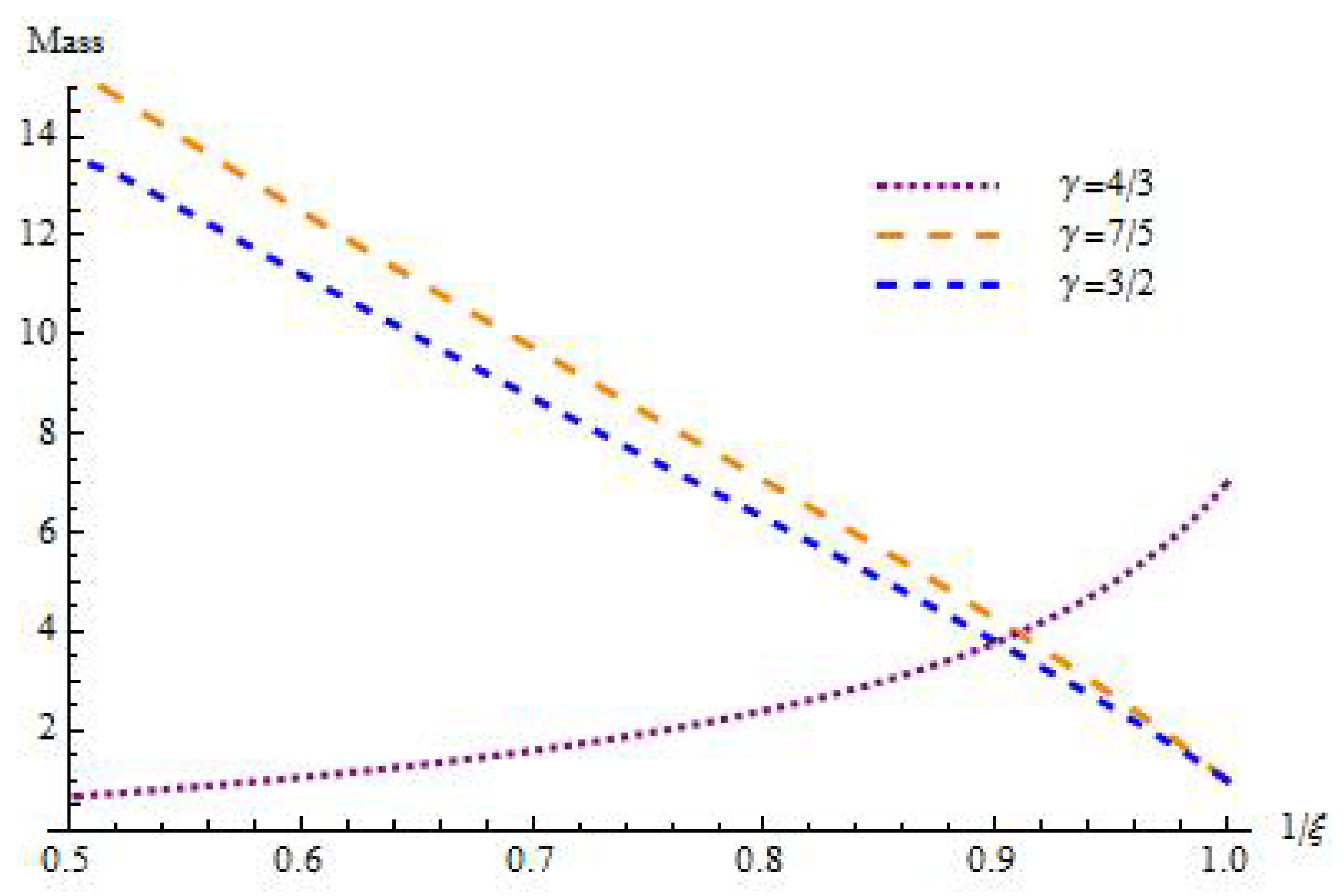
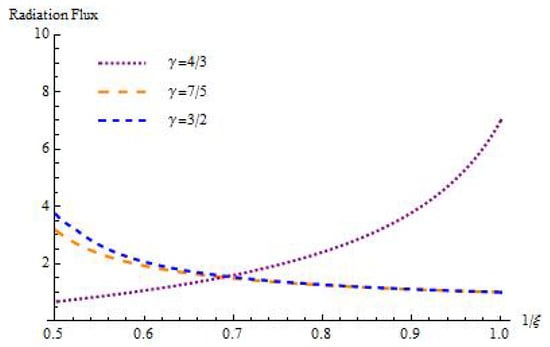
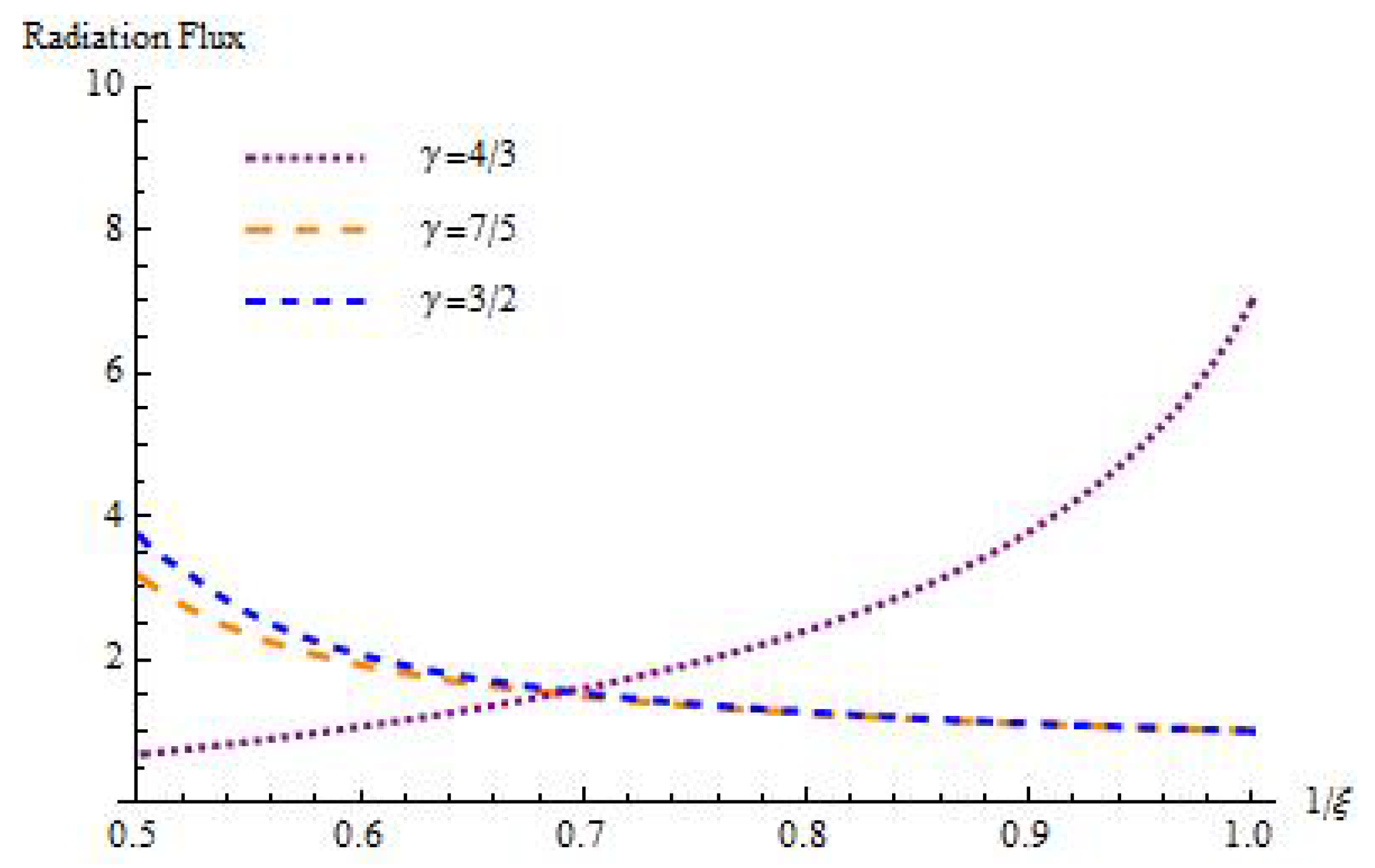
The values of the ambient density exponent and similarity exponent have been calculated from the relations given in Equation (21) as and . The set of differential equations (24) together with the boundary conditions (25) has been solved for by using the well-known Runge–Kutta method of order four. The results are depicted in Figure 1, Figure 2, Figure 3, Figure 4, Figure 5 and Figure 6. We have depicted the variation of velocity in Figure 1, variation of pressure in Figure 2, variation of magnetic field in Figure 3, variation of density in Figure 4, variation of mass in Figure 5 and variation of radiation flux in Figure 6, with respect to the change in parameter . This helps us to understand the importance of gravitation on flow parameters.
Figure 1.
The velocity profiles of cylindrical shock for and .
Figure 2.
The pressure profiles of cylindrical shock for and .
Figure 3.
The magnetic field profiles of cylindrical shock for and .
Figure 4.
The density profiles of cylindrical shock for and .
Figure 5.
The mass profiles of cylindrical shock for and .
Figure 6.
The radiation flux profiles of cylindrical shock for and .
From Figure 1, it is observed that the velocity behind the shock wave decreases monotonically for = 4/3, 7/5, and 3/2. The results for = 4/3 and 7/5 are in excellent agreement with those reported by Nath [2]. From Figure 2, Figure 3 and Figure 4, we see that pressure, magnetic field, and density decrease monotonically for , while for , all three, i.e., pressure, magnetic field, and density, first decrease monotonically and then begin to increase monotonically. From Figure 5 and Figure 6, we see that the mass and the radiation flux increase monotonically for , and decrease monotonically for as we move towards the center of the implosion. The variation of flow parameters velocity, pressure, magnetic field, density, mass, and radiation flux have been shown in the figures given below.
6. Conclusions
In this study, we applied the similarity transformation method to investigate the propagation of cylindrical MHD shock waves in a non-uniform atmosphere under the combined influence of gravitation and monochromatic radiation. Employing the symmetry transformation method to the system of PDEs (1), we derive the corresponding symmetry generators, expressed in terms of arbitrary constants. Based on these constants, we categorized the possible self-similar solutions of the problem, which follow power law behavior. Using surface invariance conditions, the flow variables were obtained in terms of the symmetry generators as functions of the similarity variable. These flow variables allowed us to reduce the PDEs system into an ODEs system subject to appropriate boundary conditions. Furthermore, we established a relation between the similarity exponent and the ambient density exponent . Finally, the system of ODEs is integrated using a fourth-order Runge–Kutta method with a step size ; convergence and accuracy were verified by step-size refinement and by ensuring consistency with the shock boundary conditions , and the results have been presented graphically.
Author Contributions
Methodology, A.C.; formal analysis, A.T.; investigation, A.T. and S.S.K.R.; writing—original draft, A.C. and A.T.; writing—review & editing, M.A.; visualization, M.A.; funding acquisition, M.A. and S.S.K.R. All authors have read and agreed to the published version of the manuscript.
Funding
This work was supported by the Deanship of Scientific Research, Vice Presidency for Graduate Studies and Scientific Research, King Faisal University, Saudi Arabia [Grant No. KFU260759].
Data Availability Statement
The original contributions presented in this study are included in the article. Further inquiries can be directed to the corresponding authors.
Acknowledgments
Research funding from International Centre for Theoretical Physics (ICTP), Trieste, Italy, under the scheme “ICTP-INdAM Collaborative Grants and Research in Pairs Programme 2024” vide grant no: SMR/3994/TA31077891 (Amit Tomar) is gratefully acknowledged.
Conflicts of Interest
The authors declare no conflicts of interest.
Nomenclature
| r | Radial distance from the axis of symmetry |
| t | Time |
| e | Internal energy per unit mass |
| T | Absolute temperature |
| R | Gas constant |
| Specific heat at constant pressure | |
| Specific heat at constant volume | |
| Ratio of specific heats | |
| G | Gravitational constant |
| K | Absorption coefficient of the medium |
| Dimensional constant in the absorption coefficient | |
| V | Velocity of the shock front |
| Density distribution index of the ambient medium | |
| Dependent variables | |
| Partial derivatives | |
| Group (infinitesimal) parameter | |
| L | Lie derivative operator |
| Conformal invariance constants |
References
- Sedov, L.I. Similarity and Dimensional Methods in Mechanics; Academic Press: London, UK, 1959. [Google Scholar]
- Nath, O. A study of self-similar cylindrical MHD shock waves in monochromatic radiation. Astrophys. Space Sci. 1989, 155, 163–167. [Google Scholar] [CrossRef] [Scilit]
- Khudyakov, V.M. The self-similar problem of the motion of a gas under the action of monochromatic radiation. Sov. Phys. Dokl. 1983, 28, 853–855. [Google Scholar]
- Nath, O.; Takhar, H.S. Propagation of cylindrical shock waves under the action of monochromatic radiation. Astrophys. Space Sci. 1990, 166, 35–39. [Google Scholar] [CrossRef] [Scilit]
- Taylor, J.L. An Exact Solution of the Spherical Blast Waves Problem. Philos. Mag. 1953, 46, 317–320. [Google Scholar] [CrossRef] [Scilit]
- Cavaliere, A.; Messina, A. Propagation of Blast Waves. Astrophys. J. 1976, 209, 424–428. [Google Scholar] [CrossRef] [Scilit]
- Dey, S.; Murugan, T.; Chatterjee, D. Numerical Visualization of Blast Wave Interacting with Objects. J. Appl. Fluid Mech. 2018, 11, 1201–1206. [Google Scholar] [CrossRef] [Scilit]
- Guderley, G. Starke Kugelige und Zylindrische Verdichtungsstosse in Der Nahe Des Kugelmittelpunktes bzw Der Zylinderachse. Luftfahrtforschung 1942, 19, 302–312. [Google Scholar]
- Sakurai, A. On the Problem of a Shock Wave Arriving at the Edge of a Gas. Commun. Pure Appl. Math. 1960, 13, 353–370. [Google Scholar] [CrossRef] [Scilit]
- Zeldovich, Y.B.; Raizer, Y.P. Physics of Shock Waves and High Temperature Hydrodynamic Phenomena; Academic Press: San Diego, CA, USA, 1967; Volume II. [Google Scholar]
- Lazarus, R.B. Self-Similar Solutions for Converging Shocks and Collapsing Cavities. SIAM J. Numer. Anal. 1981, 18, 316–371. [Google Scholar] [CrossRef] [Scilit]
- Sharma, V.D.; Radha, C. Similarity Solutions for Converging Shocks in a Relaxing Gas. Int. J. Eng. Sci. 1995, 33, 535–553. [Google Scholar] [CrossRef] [Scilit]
- Sharma, V.D.; Arora, R. Similarity Solutions for Strong Shocks in an Ideal Gas. Stud. Appl. Math. 2005, 114, 375–394. [Google Scholar] [CrossRef] [Scilit]
- Logan, J.D.; Perez, J.D.J. Similarity Solutions for Reactive Shock Hydrodynamics. SIAM J. Appl. Math. 1980, 39, 512–527. [Google Scholar] [CrossRef] [Scilit]
- Tomar, A.; Arora, A.R.; Chauhan, A. Propagation of strong shock waves in a non-ideal gas. Acta Astronaut. 2019, 159, 96–104. [Google Scholar] [CrossRef] [Scilit]
- Chauhan, A.; Arora, R.; Tomar, A. Convergence of strong shock waves in non-ideal magnetogasdynamics. Phys. Fluids 2018, 30, 116105. [Google Scholar] [CrossRef] [Scilit]
- Arora, R.; Tomar, A.; Singh, V.P. Similarity Solutions for Strong Shocks in a Non-Ideal Gas. Math. Model. Anal. 2012, 17, 351–365. [Google Scholar] [CrossRef] [Scilit]
- Narsimhulu, D.; Ramu, A.; Satpathi, D.K. Self-similar motion of strong converging cylindrical and spherical shock waves in non-ideal stellar medium. J. Appl. Fluid Mech. 2018, 11, 1717–1726. [Google Scholar] [CrossRef] [Scilit]
- Wangaand, G.; Fakhar, K. Lie symmetry analysis, nonlinear self-adjointness and conservation laws to an extended (2 + 1)-dimensional Zakharov-Kuznetsov-Burgers equation. Comput. Fluids 2015, 119, 143–148. [Google Scholar]
- Panday, M.; Panday, B.D.; Sharma, V.D. Symmetry groups and similarity solutions for the system of equations for a viscous compressible fluid. Appl. Math. Comput. 2009, 215, 681–685. [Google Scholar] [CrossRef] [Scilit]
- Khalique, C.M.; Biswas, A. Analysis of non-linear Klein-Gordon equations using Lie symmetry. Appl. Math. Lett. 2010, 23, 1397–1400. [Google Scholar] [CrossRef] [Scilit]
- Bajargaan, R.; Patel, A. Similarity solution for a cylindrical shock wave in a self-gravitating, rotating axisymmetric dusty gas with heat conduction and radiation heat flux. J. Appl. Fluid Mech. 2017, 10, 329–341. [Google Scholar] [CrossRef] [Scilit]
- Nath, O. Propagation of cylindrical shock waves in a rotating atmosphere under the action of monochromatic radiation. Il Nuovo Cimento D 1998, 20, 1845–1852. [Google Scholar] [CrossRef] [Scilit]
- Bluman, G.; Cheviakon, A.; Anco, S. Applications of symmetry methods to partial differential equations. In Applied Mathematical Sciences; Springer: New York, NY, USA, 2010; Volume 168. [Google Scholar]
- Whitham, G.B. Linear and Nonlinear Waves; Wiley-Interscience: New York, NY, USA, 1980. [Google Scholar]
- Nath, G.; Pathak, R.P.; Dutta, M. Similarity solutions for unsteady flow behind an exponential shock in a self-gravitating non-ideal gas with azimuthal magnetic field. Acta Astronaut. 2018, 142, 152–161. [Google Scholar] [CrossRef] [Scilit]
- Zedan, H.A. Applications of the group of equations of the one-dimensional motion of a gas under the influence of monochromatic radiation. Appl. Math. Comput. 2002, 132, 63–71. [Google Scholar] [CrossRef] [Scilit]
- Chauhan, A.; Rajan, R.; Tomar, A. Converging strong shock waves in magnetogasdynamics under isothermal condition. Ric. Mat. 2020, 71, 297–313. [Google Scholar] [CrossRef] [Scilit]
- Chauhan, A.; Tomar, A.; Ali, M.; Raju, S. Similarity Solutions of Spherical Strong Shock in an Inhomogeneous Self-Gravitating Medium Using Lie Group Approach. Symmetry 2025, 17, 662. [Google Scholar] [CrossRef] [Scilit]
- Chauhan, S.; Chauhan, A.; Arora, R. Shock wave kinematics in an inviscid gas with solid dust particles. Eur. Phys. J. Plus 2025, 139, 871. [Google Scholar] [CrossRef] [Scilit]
- Chauhan, A.; Yadav, S.; Arora, R. Propagation of shock waves in a non-ideal gas with dust particles in an interstellar medium. Indian J. Phys. 2023, 97, 3065–3080. [Google Scholar] [CrossRef] [Scilit]
- Chauhan, A.; Arora, R. Evolution of steepened wave in interstellar gas clouds. Indian J. Phys. 2025, 99, 1–9. [Google Scholar] [CrossRef] [Scilit]
Disclaimer/Publisher’s Note: The statements, opinions and data contained in all publications are solely those of the individual author(s) and contributor(s) and not of MDPI and/or the editor(s). MDPI and/or the editor(s) disclaim responsibility for any injury to people or property resulting from any ideas, methods, instructions or products referred to in the content. |
© 2026 by the authors. Licensee MDPI, Basel, Switzerland. This article is an open access article distributed under the terms and conditions of the Creative Commons Attribution (CC BY) license.