


Abstract
Decay centrality is a parameter-dependent distance-based centrality measure, and a graph is called decay-stable when the induced ranking of its vertices is independent of the decay parameter. Building on our earlier result that almost all trees are decay-unstable, we study connected unicyclic graphs. We first prove a pendant reduction which replaces the part of the graph outside a fixed pendant tree by a single path while preserving all eccentricities inside the tree. This yields a local sufficient criterion for decay-instability in a tree attached to the unique cycle. In particular, a pendant copy of attached to the rest of the graph through one of its leaves forces decay-instability of the graph. Combining this local obstruction with the classical enumeration of labeled unicyclic graphs and a pendant-appearance theorem of McDiarmid, we prove that the proportion of decay-stable connected labeled unicyclic graphs tends to zero. Thus almost all connected labeled unicyclic graphs are decay-unstable. We conclude with remarks on possible extensions to cactus graphs.
MSC:
05C80; 05C12; 05C07
1. Introduction
Centrality measures are a basic tool for identifying important vertices in a network. Among the classical distance-based measures, closeness centrality ranks vertices according to their distances from the remaining vertices. Decay centrality was introduced independently by Jackson and Wolinsky [1] and by Dangalchev [2], the latter under the name of generalized closeness. It is a parameter-dependent distance-based measure in which a vertex at distance i contributes , where . Consequently, the ranking of the vertices may depend on the choice of the decay parameter .
The notion of a decay-stable graph was introduced by Coroničová Hurajová, Gago, and Madaras [3]. A graph is called decay-stable if its ranking by decay centrality is independent of , and decay-unstable otherwise.
The present work builds on our earlier study of decay-stability in trees, where we established that almost all labeled trees are decay-unstable [4]. The local degree-eccentricity criterion developed there remains an important tool in the present paper. The unicyclic setting, however, introduces a genuinely new structural feature: the presence of a unique cycle prevents the whole graph from being treated as a rooted tree. To overcome this difficulty, we introduce the pendant reduction, which isolates a pendant tree and replaces the remainder of the graph by a single path of suitable length while preserving the eccentricities of all vertices in the pendant tree. This provides a local substitute for the tree-specific structural arguments and leads to the instability criterion used in the unicyclic case.
We also recall the classical theorem of Harary and Norman that the center of a connected graph lies in a single block, together with Truszczyński’s characterization of the possible centers of unicyclic graphs. These results provide useful structural context for the local analysis.
For the asymptotic result we use a different mechanism. A particularly small pendant configuration, namely a copy of attached to the rest of the graph through one of its leaves, already forces decay-instability. The class of connected labeled unicyclic graphs has growth constant e, and the Pendant Appearances Theorem implies that a uniformly random graph from this class contains such a configuration with probability tending to one. This gives a short proof that almost all connected labeled unicyclic graphs are decay-unstable.
The main new contribution of the present paper is the pendant reduction, which provides a local mechanism for transferring eccentricity comparisons from a unicyclic graph to an attached tree. Combined with the rooted obstruction and McDiarmid’s Pendant Appearances Theorem, this yields the first asymptotic decay-instability result for connected labeled unicyclic graphs.
The paper is organized as follows. Section 2 reviews the relevant literature, and Section 3 fixes notation and recalls the decay-instability criterion used throughout. Section 4 contains the structural results for unicyclic graphs, the pendant reduction, the local instability criterion, and the proof of the asymptotic result. Section 5 summarizes the results and discusses possible extensions to cactus graphs.
2. Related Work
Decay centrality is a distance-based centrality measure in which the contribution of a vertex decreases geometrically with its distance from the vertex under consideration.
Yang and Zhuhadar [5] observed that rankings arising from generalized closeness may depend on the decay parameter. Coroničová Hurajová, Gago, and Madaras [3] studied this phenomenon systematically and formulated several questions concerning decay-stability. Rupnik Poklukar and Žerovnik [6] further studied decay-stability and disproved two conjectures by showing that certain graph products are decay-unstable.
Most relevant for the present paper is our recent work on trees [4]. There we proved that almost all trees are decay-unstable. The proof uses a level-by-level construction of rooted trees, a central decomposition of arbitrary trees, and the fact that monotonic rooted trees form an asymptotically negligible subfamily for fixed root eccentricity. We also established the simple sufficient criterion recalled as Theorem 1 below. In the present paper the same criterion is combined with a local pendant reduction; the asymptotic argument then uses a pendant-appearance theorem for labeled graph classes rather than a new level-by-level enumeration.
The location of the center in unicyclic graphs is well understood. In 1953, Harary and Norman [7] proved that the center of every connected graph is contained in a single block. Truszczyński [8] later gave a complete characterization of the induced subgraphs of the unique cycle that can occur as centers of unicyclic graphs. We recall these results as structural background for our study of unicyclic graphs.
For the asymptotic argument we use the theory of pendant appearances in random labeled graph classes. McDiarmid [9] gives a general Pendant Appearances Theorem: under a growth-constant hypothesis, a fixed attachable rooted connected graph occurs linearly many times as a pendant appearance with probability tending to one.
3. Basic Definitions
3.1. Graph-Theoretic Terminology
Throughout, denotes a finite, simple, connected graph. For , let denote the degree of v, and for let denote the length of a shortest path in G.
Definition 1.
Let G be a connected graph. The eccentricity of a vertex is
The radius and diameter of G are, respectively,
The center of G is
A vertex v of a connected graph is a cut vertex if has more connected components than G. A block of G is a maximal connected subgraph with no cut vertex. We use the standard convention that a bridge together with its two end vertices is also a block.
Definition 2.
A connected graph is unicyclic if it contains exactly one cycle. A connected graph G is a cactus if every edge belongs to at most one cycle. Equivalently, any two cycles of a cactus have at most one vertex in common.
Every unicyclic graph is therefore a cactus. If G is unicyclic and is its unique cycle, deleting the edges of leaves a collection of trees, one rooted at each vertex of the cycle. This decomposition will be used throughout Section 4.
3.2. Decay Centrality and Decay Stability
For and , let
Thus
is the distance-degree sequence of v.
Definition 3.
Let . The decay centrality of a vertex is
The graph G is decay-stable if, for every pair of vertices , one of the inequalities
or
holds. Otherwise G is decay-unstable.
In other words, G is decay-unstable if there are two vertices u, v for which there exist such that and . We will use the following sufficient condition for decay-instability throughout the paper.
Theorem 1
([4]). Let G be a connected graph. If there exist vertices such that
then G is decay-unstable.
Thus we seek pairs of vertices for which eccentricity and degree increase in the same direction. The presence of a cycle makes the behavior of eccentricity less rigid than in a tree; the next section develops a local reduction that restores enough tree structure for Theorem 1 to be applied.
4. Decay-Instability of Unicyclic Graphs
4.1. Structure and Centers of Unicyclic Graphs
The following classical results describe the possible location and structure of the center in a connected unicyclic graph. They are not needed directly in the proofs below, but they provide useful structural background and highlight the additional geometry introduced by the unique cycle in comparison with the tree case.
We first recall a classical result of Harary and Norman.
Theorem 2
(Harary and Norman [7]). Let G be a connected graph. Then the center is contained in a single block of G.
For a cactus this has a particularly simple interpretation: every nontrivial block is either a bridge edge or a cycle. Hence the center of a connected cactus is contained in the vertex set of some bridge block or of some cycle block.
Now let G be a connected unicyclic graph, and let
be its unique cycle. Removing the edges of leaves k tree components. For each , let denote the component containing , regarded as a rooted tree with root . Thus
where a trivial consists only of its root .
By Theorem 2, the center is contained in the vertex set of either a bridge block or the unique cycle. In particular, if it is contained in a bridge block then . Truszczyński [8] (Theorem 7) gave a complete characterization of the induced subgraphs of the unique cycle that can occur as centers of unicyclic graphs.
Theorem 3
(Truszczyński [8], Theorem 7). Let be a cycle, and let S be a nonempty subset of . There exists a unicyclic graph G with unique cycle whose set of central vertices is exactly S if and only if the following condition holds:
- If k is even, there is no additional restriction on S;
- If k is odd, then for every three-vertex path in ,
Truszczyński formulates the result in terms of the subgraph induced by the central vertices; Theorem 3 is the equivalent set-theoretic formulation used here. In particular, the fact that central vertices on the cycle need not occur in a symmetric configuration is illustrated by several examples in [8].
4.2. Pendant Reduction
We first record a local reduction that replaces the part of the graph outside a pendant tree by a single path. It gives a useful sufficient criterion for decay-instability and will also provide the local obstruction used in the asymptotic argument.
Call an induced subtree R of a connected graph G x-pendant if and every path from a vertex of to a vertex of passes through x. Equivalently, is a union of components of . Each rooted tree in the unicyclic decomposition above is -pendant.
Lemma 1.
Let R be an x-pendant tree in a connected graph G, and define
and
Let be the tree obtained from R by attaching at x a new pendant path
of length ; when , no new edge is added and . Then
Proof.
Fix . Because R is induced and x-pendant, a shortest path in G between two vertices of R cannot leave R. Indeed, any path between two vertices of R that leaves R must pass through the attachment vertex x when leaving R and must pass through x again when re-entering R. Such a path therefore contains a closed detour through the part of the graph outside R and can be shortened by deleting this detour. Hence a shortest path in G between two vertices of R is contained entirely in R. Therefore distances between vertices of R are the same in G, R, and .
Since R is x-pendant, every path from w to a vertex
passes through x. Therefore
and hence
Consequently,
□
The parameter records the largest distance from the attachment vertex x to the part of the graph outside . Thus, from the point of view of any vertex of R, only the maximum distance that can be reached through x is relevant for its eccentricity. Replacing the entire exterior of R by a single path of length attached at x reproduces exactly this largest external distance, while leaving all distances within R unchanged. This is the basic idea behind the pendant reduction.
4.3. A Local Criterion in an Attached Tree
We apply Lemma 1 to one of the rooted trees attached to the unique cycle. For such a tree R rooted at a cycle vertex , put
The parameter determines how far from the attachment vertex x one must move before the external part of the graph becomes sufficiently relevant for the eccentricity comparison along a parent–child edge. If , then , and the required comparison is available throughout the pendant tree. If , then vertices close to x may still have their eccentricity determined by the height of R rather than by distances through x. The threshold marks the depth from which the two competing contributions can be compared in the required direction.
Theorem 4.
Let G be a connected unicyclic graph, let , and let R be the rooted tree attached at . Let be as in Lemma 1, and define as above. Suppose that R contains an edge , where u is the parent of v, such that
Then G is decay-unstable.
Proof.
Put
so that . By Lemma 1,
so it suffices to compare the eccentricities of u and v in the tree .
Let be the endpoint of the pendant path added at . Then
and therefore
Let satisfy
If the path does not contain v, then the path in the tree passes through u, and hence
Thus .
Suppose instead that the path contains v. Then lies in the component of containing v, and hence
It follows that
Since , we have and therefore
Therefore in all cases
Together with , Theorem 1 implies that G is decay-unstable. □
Remark 1.
We call the vertices of R at a distance less than from the inner zone of R. If , then , so the zone is empty and every parent–child edge satisfying
is covered by Theorem 4. If , only edges whose parent lies at a distance less than from are not covered. Since
the uncovered part has bounded depth whenever the height of R is bounded. The theorem makes no assertion about the ordering of eccentricities inside the inner zone.
Remark 2.
Theorem 4 is a sufficient criterion, not a characterization of decay-instability. A unicyclic graph may be decay-unstable because of a pair lying in different attached trees, a pair involving cycle vertices, or another pair not detected by this theorem. The asymptotic argument below will use a particularly simple pendant configuration detected directly by Lemma 1.
4.4. Asymptotic Instability
We now combine the pendant reduction with a standard result on pendant appearances in random labeled graph classes. For general background on labeled enumeration and asymptotic methods, we refer to Flajolet and Sedgewick [10].
Let denote the class of connected unicyclic graphs. For , let be the set of graphs in with vertex set , and put . The classical enumeration of connected labeled unicyclic graphs gives
see, for example, [11]. Here k denotes the length of the unique cycle. Indeed, after choosing and cyclically arranging the k cycle vertices, the remaining vertices form a forest rooted at the cycle vertices, which gives the summand in (1). Using Stirling’s formula,
together with (1) we obtain
We use the following terminology of McDiarmid [9].
Definition 4.
Let be a graph class, and let denote the graphs in with vertex set . We say that has a growth constant γ, where , if
In our case, from (2),
since . Hence the class of connected labeled unicyclic graphs has growth constant e.
Informally, a pendant appearance of a rooted graph is a copy of the graph attached to the rest of the ambient graph by exactly one edge, with the attachment occurring at the root.
Definition 5.
Let be a connected graph H with a specified root r. A pendant appearance of in a graph G is an induced copy of H with vertex set W such that there is exactly one edge between W and , and the endpoint of this edge in W corresponds to r.
The rooted graph is attachable to a graph class if, whenever G has a pendant appearance of on W and , then .
Let be the rooted tree obtained from by choosing one of its leaves as the root. Then is attachable to : attaching this tree by one additional edge to a connected unicyclic graph preserves connectedness and creates no additional cycle.
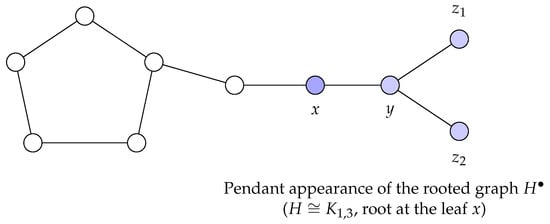
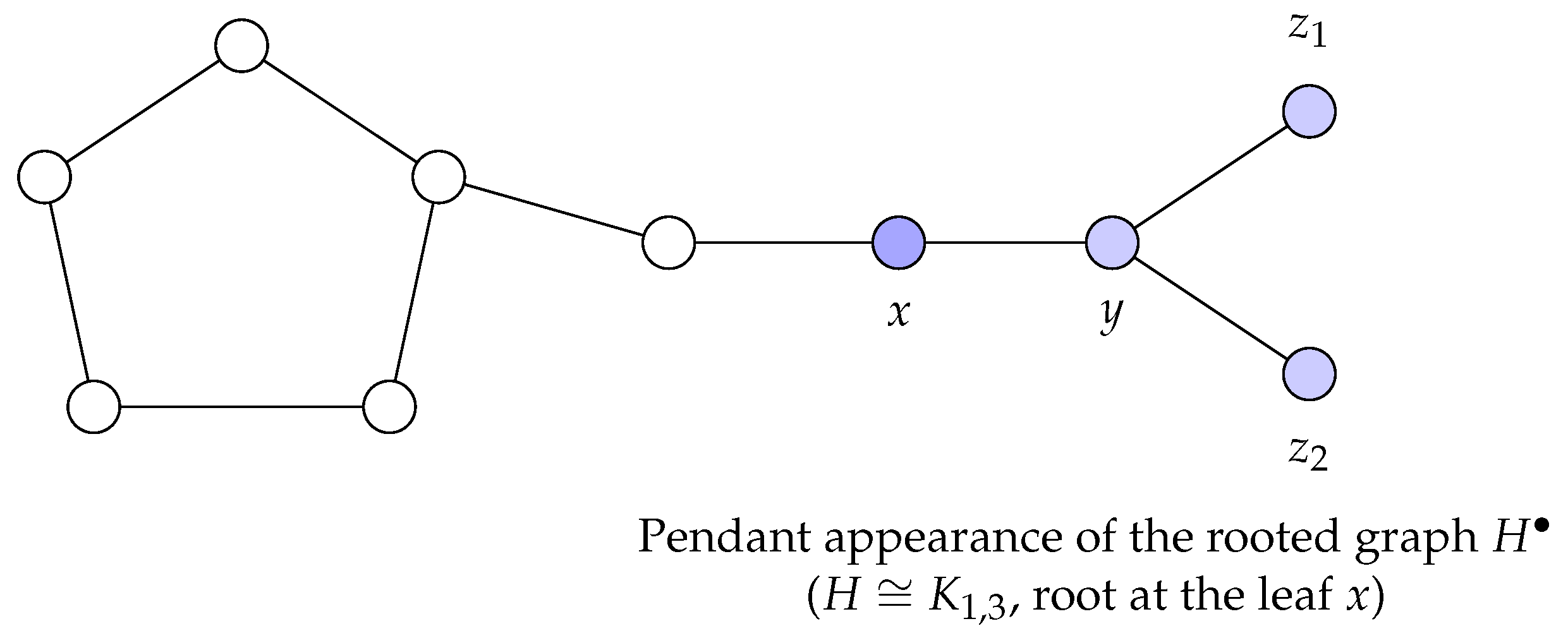
Figure 1 shows an example of a pendant appearance of the rooted graph used in the asymptotic argument. The induced subgraph on the highlighted vertices is a copy of , the root is the leaf x, and the only edge linking this copy to the rest of the unicyclic graph is incident with x.
Figure 1.
An example of a pendant appearance of the rooted graph in a unicyclic graph. Here , the root is the leaf x, and the unique edge joining the copy to the rest of the graph is incident with the root.
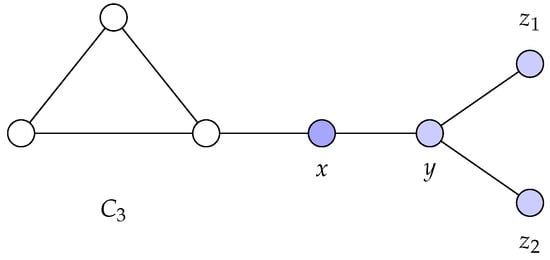
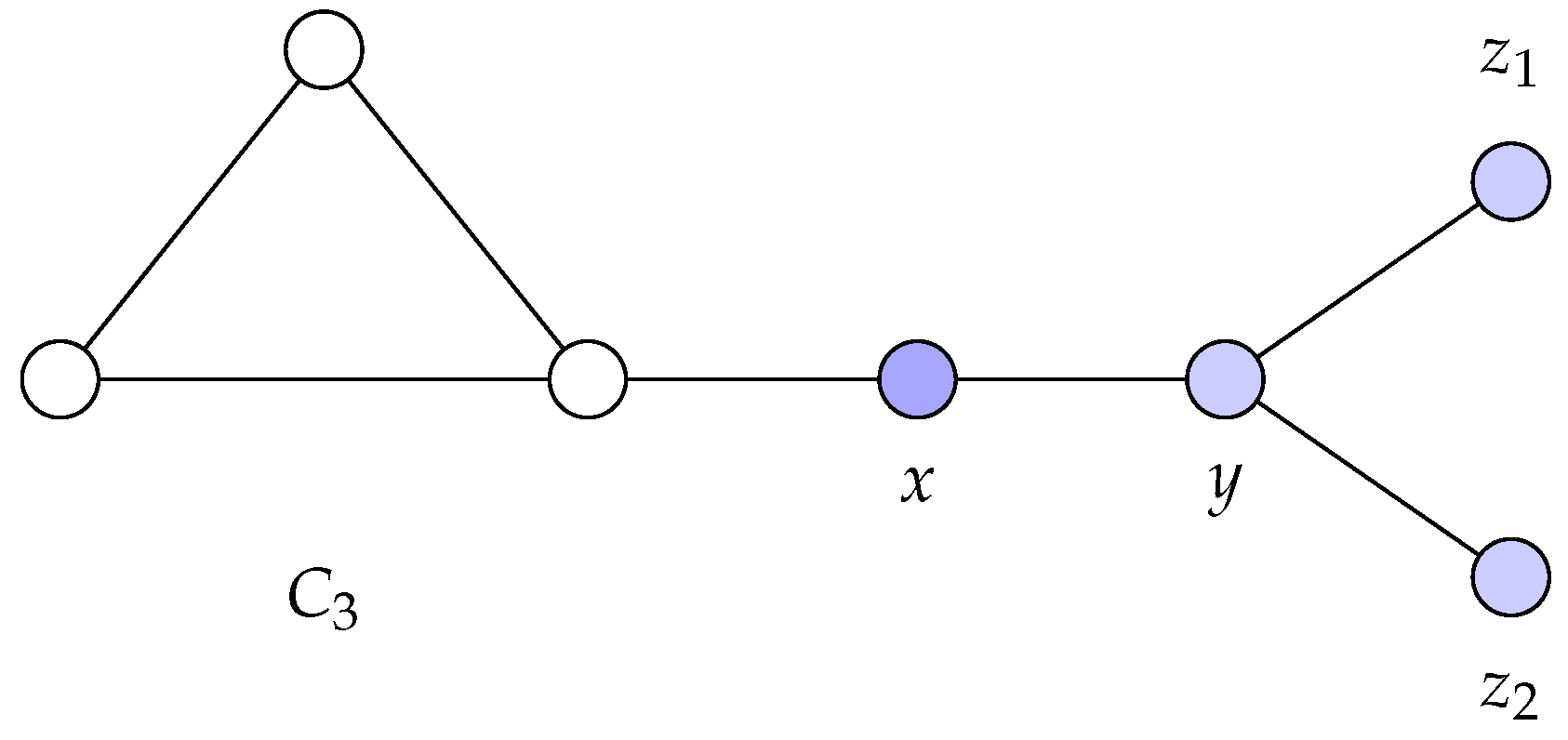
The smallest possible unicyclic part outside the pendant copy is a triangle. Even in this case, if the root is attached directly to a vertex of the triangle, there is a vertex outside the pendant copy at distance two from the root. See Figure 2.
Figure 2.
A smallest-order unicyclic example containing a pendant appearance of . The root x is attached directly to a vertex of , so the other two cycle vertices are at distance two from x.
Lemma 2.
If a connected unicyclic graph G contains a pendant appearance of , then G is decay-unstable.
Proof.
Let x be the root of the pendant copy, let y be its vertex of degree three, and let R denote this copy of . Since x has one neighbor in R and is incident with the unique additional edge, y has three neighbors in R,
The tree R is x-pendant and has height . The unique edge joining R to the rest of G is a bridge, so the unique cycle of G lies entirely outside R. Hence there is a vertex outside R at a distance of at least two from x, and therefore
Apply Lemma 1. Since , the reduced tree satisfies
Moreover, the vertex y is adjacent to x, so its distance to the end of the added path is , and hence
By Lemma 1,
Together with
Theorem 1 implies that G is decay-unstable. □
Theorem 5.
The proportion of decay-stable connected labeled unicyclic graphs on n vertices tends to zero as . Equivalently, almost all connected labeled unicyclic graphs are decay-unstable.
Proof.
As shown above, has growth constant e. Moreover, is attachable to , since attaching the rooted tree to a connected unicyclic graph by one additional edge preserves connectedness and creates no additional cycle. Hence McDiarmid’s Pendant Appearances Theorem [9] (Section 1.1, Equation (1)) implies that there exists a constant such that a uniformly random graph from contains more than pendant appearances of with probability tending to one as . In particular, the probability that it contains at least one such appearance tends to one. Although McDiarmid’s theorem gives the stronger conclusion of linearly many pendant appearances with high probability, only the existence of one such appearance is needed here.
By Lemma 2, every graph containing such an appearance is decay-unstable. Hence the proportion of decay-stable graphs in tends to zero. □
5. Conclusions and Further Work
We studied decay-instability in connected unicyclic graphs from both a local and an asymptotic point of view. The pendant reduction of Lemma 1 replaces the part of the graph outside a fixed pendant tree by a single path while preserving eccentricities inside the tree. This yields the local criterion of Theorem 4. We emphasize that this criterion is sufficient, but not necessary: decay-instability may also arise from configurations that are not detected by the degree-eccentricity comparison used in that theorem.
For the asymptotic result, only a very small local obstruction is needed: a pendant copy of attached through one of its leaves is already enough to force decay-instability. This particular rooted graph is useful because it provides, independently of the degree of the attachment vertex in the ambient graph, adjacent vertices whose degrees are 2 and 3, while the pendant reduction guarantees the required strict inequality of their eccentricities. The classical enumeration of labeled unicyclic graphs shows that the corresponding graph class has growth constant e, and the Pendant Appearances Theorem implies that such a configuration occurs with probability tending to one. Consequently, almost all connected labeled unicyclic graphs are decay-unstable.
The pendant reduction itself does not depend on the graph being unicyclic and therefore remains valid for cactus graphs. The main new difficulty is that a cactus may contain several cycle blocks, so the structure outside a pendant tree is no longer controlled by a unique cycle and may interact with several cyclic blocks. On the asymptotic side, one would also need an appropriate enumeration, or at least a growth-constant result, for the cactus class under consideration before the Pendant Appearances Theorem can be applied. Thus the local part of the present method extends naturally, whereas the global structural and asymptotic steps require additional work. This provides a natural avenue for future research.
Author Contributions
Conceptualization, D.R.P. and J.Ž.; Formal analysis, D.R.P. and J.Ž.; Writing-original draft preparation, D.R.P. and J.Ž.; Writing-review and editing, D.R.P. and J.Ž. All authors have read and agreed to the published version of the manuscript.
Funding
The second author (J.Ž.) was partially supported by ARIS (the Research Agency of Slovenia) through the annual work program of Rudolfovo and by the ARIS research grants P2-0248 and L1-60136. This work was also supported in part by the Horizon Europe project Quantum Excellence Centre for Quantum-Enhanced Applications (QEC4QEA).
Data Availability Statement
No new data were created or analyzed in this study. Data sharing is not applicable to this article.
Acknowledgments
The authors would like to thank the anonymous reviewers for their careful reading of the manuscript and for their constructive comments and suggestions, which helped us to improve the presentation and clarity of the paper.
Conflicts of Interest
The authors declare no conflicts of interest.
References
- Jackson, M.O.; Wolinsky, A. A strategic model of social and economic networks. J. Econ. Theory 1996, 71, 44–74. [Google Scholar] [CrossRef] [Scilit]
- Dangalchev, C. Residual closeness and generalized closeness. Int. J. Found. Comput. Sci. 2011, 22, 1939–1948. [Google Scholar] [CrossRef] [Scilit]
- Coroničová Hurajová, J.; Gago, S.; Madaras, T. On decay centrality in graphs. Math. Scand. 2018, 123, 39–50. [Google Scholar] [CrossRef] [Scilit]
- Rupnik Poklukar, D.; Žerovnik, J. Almost all trees are decay-unstable. Math. Scand. 2026, 132, 1–16. [Google Scholar] [CrossRef] [Scilit]
- Yang, R.; Zhuhadar, L. Extensions of closeness centrality? In Proceedings of the 49th Annual Southeast Regional Conference; ACM: New York, NY, USA, 2011; pp. 304–305. [Google Scholar] [CrossRef] [Scilit]
- Rupnik Poklukar, D.; Žerovnik, J. Generalized closeness and decay stability of some graphs. Mathematics 2025, 13, 939. [Google Scholar] [CrossRef] [Scilit]
- Harary, F.; Norman, R.Z. The dissimilarity characteristic of Husimi trees. Ann. Math. 1953, 58, 134–141. [Google Scholar] [CrossRef] [Scilit]
- Truszczyński, M. Centers and centroids of unicyclic graphs. Math. Slovaca 1985, 35, 223–228. [Google Scholar]
- McDiarmid, C. Pendant appearances and components in random graphs from structured classes. Eur. J. Comb. 2024, 120, 103994. [Google Scholar] [CrossRef] [Scilit]
- Flajolet, P.; Sedgewick, R. Analytic Combinatorics; Cambridge University Press: Cambridge, UK, 2009. [Google Scholar] [CrossRef] [Scilit]
- Wright, E.M. The number of connected sparsely edged graphs. J. Graph Theory 1977, 1, 317–330. [Google Scholar] [CrossRef] [Scilit]
Disclaimer/Publisher’s Note: The statements, opinions and data contained in all publications are solely those of the individual author(s) and contributor(s) and not of MDPI and/or the editor(s). MDPI and/or the editor(s) disclaim responsibility for any injury to people or property resulting from any ideas, methods, instructions or products referred to in the content. |
© 2026 by the authors. Licensee MDPI, Basel, Switzerland. This article is an open access article distributed under the terms and conditions of the Creative Commons Attribution (CC BY) license.