


Abstract
Generalized uncertainty principle (GUP) algebras, which modify the standard Heisenberg commutation relations, emerge in several approaches to quantum gravity. Recent studies indicate that these deformed quantum algebras support a dual phase space interpretation involving two canonically equivalent phase spaces, and , referred to as the deformed and non-deformed phase spaces, respectively. Building on this observation, the present work investigates the occupation-number representation associated with deformed Heisenberg algebras and examines the emergence of Fock-space structures within the corresponding canonical descriptions. From a dynamical perspective, deformed algebras of the form (called deformed in the position and momentum, respectively) introduce nontrivial self-interactions into the Hamiltonian operator, fundamentally altering the system’s dynamics and resulting in highly nonlinear behavior in both dual phase space descriptions. In the case of the one-dimensional harmonic oscillator Hamiltonian H, these deformations imply that usual definitions of creation and annihilation operators do not work. Thus, we must construct a new deformed version of these ladder operators for each deformation type. These new ladder operators are associated with the quadratic part of the deformed Hamiltonian H, and can be written in both deformed phase spaces. For position-dependent deformations, it is demonstrated that the natural Fock representation is associated with the canonical phase space , where and . Within this framework, canonical ladder operators generate the standard complete orthonormal occupation-number basis for . In contrast, in the description, the corresponding vacuum and excited states depend explicitly on the deformation function . For momentum-dependent deformations, the natural Fock representation is instead associated with the non-deformed canonical phase space . In this case, the ladder operators are independent of the deformation function , and both the vacuum state and the occupation-number basis coincide with those of the ordinary harmonic oscillator. Consequently, the dual phase space framework extends naturally to a dual Fock-space interpretation within generalized uncertainty principle quantum mechanics. For instance, in the linear position-deformation case , the self-interactions arise from an infinite series of terms in the deformation parameter originating from the elastic potential term. For the linear momentum deformation , the self-interactions arise from an infinite series in that comes from the kinetic part of the Hamiltonian. For both linear position and momentum deformation models, we obtain perturbative corrections that notably reproduce the exact spectrum.
Keywords:
generalized uncertainty principle; harmonic oscillator; Fock space; ladder operators; occupation-number representation; canonical transformations; modified Heisenberg algebras MSC:
81S08
1. Introduction
The harmonic oscillator is one of the most universal and studied systems in physics. Classically, it appears in a wide range of systems, such as Hooke’s law [1], in solutions to the Newtonian gravitational force law [2], and in materials engineering [3]. In quantum mechanics, the dynamics of the harmonic oscillator are well established and are a standard topic in many textbooks [4,5]. The significance of the quantum harmonic oscillator arises from the fact that its Hamiltonian operator can be expressed as the product of creation and annihilation a operators, which satisfy the canonical bosonic commutation relation [6].
This algebraic formulation enables the construction of the vacuum state, the complete Fock basis, and the number-operator representation. These elements play a central role in many-body physics and form the foundation for the quantization of free fields, including the scalar field, the electromagnetic field, and the Dirac field [7,8,9].
In all the above aspects, a standard quantization mechanism is used that relies on the usual Heisenberg commutation relation.
In recent years, researchers have shown considerable interest in possible modifications of the Heisenberg algebra (2). Such modifications arise naturally in several approaches to quantum gravity, including string-inspired models, minimal-length theories, black-hole physics, and generalized uncertainty principle (GUP) frameworks [10,11,12,13,14,15,16,17,18,19,20,21,22,23,24,25]. In these theories, the canonical commutation relation (2) is replaced by a more general algebra of the form
where is a function of position and momentum. The structure of the quantum algebra (3) ensures that the system possesses a classical limit as ħ approaches zero. In standard quantum mechanics, the momentum and position operators are typically assumed to be Hermitian (), ensuring real eigenvalues. Furthermore, these operators are well defined over an open subset of the real axis, which may include the entire real axis.
Two of the simplest realizations of (3) are the position-dependent and momentum-dependent commutation relations
Here, and characterize the specific form of the deformation. This situation raises a fundamental question. Since both the harmonic oscillator and quantum field theory are naturally formulated in terms of ladder operators and occupation-number states, it is important to determine the structure of the Fock space when the underlying Heisenberg algebra is deformed as in (4) or (5). More specifically, does a generalized uncertainty principle admit an occupation-number representation analogous to the standard one? If so, what are the appropriate ladder operators and what is the corresponding vacuum state?
A closely related issue arises from a recent Hamiltonian interpretation of modified Heisenberg commutation relations (4) and (5). In [20], it was shown that these deformed algebras admit a dual description in terms of two canonically equivalent phase spaces, called the deformed and non-deformed . In that sense, the deformed algebras (4) or (5) can be interpreted as a hybrid object connecting operators that belong to distinct canonical descriptions.
The existence of these dual canonical phase spaces introduces a new and previously unexplored problem. Although the two phase space descriptions are physically equivalent, it is not immediately evident which one naturally supports the occupation-number representation. In particular, it remains unclear whether the ladder operators should be associated with the deformed variables or with the non-deformed canonical variables.
The present work addresses this question. We construct the Fock representations associated with generalized uncertainty principle algebras and analyze their relationship with the dual phase space structure.
From a dynamical perspective, deformed algebras (4) and (5) introduce nontrivial self-interactions into the Hamiltonian operator, fundamentally altering the system’s dynamics and resulting in highly nonlinear behavior in both dual phase space descriptions. In the case of the one-dimensional harmonic oscillator Hamiltonian H, these deformations imply that usual definitions of creation and annihilation operators do not work. Thus, we must construct a new deformed version of these ladder operators for each deformation type. These new ladder operators are associated with the quadratic part (called the auxiliary Hamiltonian) of the deformed Hamiltonian H, and can be written in both deformed phase spaces and .
These results reveal a fundamental asymmetry between position-deformed and momentum-deformed Heisenberg algebras. For example, in the undeformed phase space , position deformations yield genuinely deformed occupation-number representations, whereas momentum deformations preserve the standard harmonic-oscillator Fock space. We must emphasize that this asymmetry concerns realizing the deformed Hamiltonians and oscillator structures in terms of phase variables, rather than inequivalent representations of the canonical commutation relations.
This work therefore extends the dual phase space interpretation of generalized uncertainty principles to a dual Fock-space interpretation. It provides a unified occupation-number framework for deformed quantum algebras.
The following Table 1 presents a comparison between this work and other related studies.
Table 1.
Comparison of different GUP frameworks and their associated operator and Hamiltonian structures.
2. GUPs Dual Phase Space Description
In this section, we review the basic ideas associated with the dual description of a deformed Heisenberg commutation relation of the form (4) and (5).
Consider first the usual Heisenberg commutation relation (2). The standard differential operators that can represent this algebra are
and define a phase space , which we call the non-deformed phase space. The corresponding momentum eigenstates
are
Instead, the deformed commutation relation (4) can be represented by
Note that is a deformed version of generated by a multiplicative factor, so we call the deformed momentum. In strict Hamiltonian terms, in view of (4), clearly cannot be considered canonically conjugate to the operator. So the question is: what is the operator such that satisfies ? For example, what is the canonically conjugate variable of the deformed momentum? And how this variable (that we call y) is related to the non-deformed phase space ? Now, if one considers the deformed eigenstates of
one has that
with . Comparing (6) and (8) one would identify the y variable with . In this way, the deformed commutation relation (4) generates two phase spaces: the non-deformed and the deformed one . As is shown in [20], these phase spaces are equivalent at both classical and quantum levels. The Heisenberg commutation relations for the and phase spaces are the standard ones:
Thus, for a GUP relation of the form (4), there exist two equivalent ways to describe the classical and quantum physics. In fact, the GUP (4) must be interpreted as a hybrid object, which contains canonical variables from different phase spaces. The same ideas apply for the momentum deformation case (5).
The operator representation used for the deformed momentum operator in (7) is non-Hermitian. If, instead, one uses a Hermitian deformed representation such as
the momentum eigenstates become
so the wave functions of Hermitian operators acquire an extra factor. This fact is due to the change in measure induced by the canonical transformation [20].
between the phase spaces and , such that
with and and . Thus, eigenstates of Hermitian operators become automatically normalized in the flat measure . For details on these issues, see, for example, [20,21].
3. Dual Fock Representations and the Position Deformation Case
For the harmonic oscillator, the Hamiltonian operator is given by
and the standard creation and annihilation operators are defined through the relations [6]
where
and . The commutator between and is
Because , for the standard Heisenberg commutation relation (2), the above equation gives the usual result (1). For the deformed Heisenberg commutation relation (4) one obtains instead
or, by (13) and (14)
Then, the standard creation and annihilation operators and satisfy, in this case, a higher non-trivial commutation relation depending on the deformation function .
3.1. Creation and Annihilation Operator for the Position Deformation Case
Thus, only for , does one recover the usual commutation relation (1). So, naturally, one asks if it is possible to find a new set of deformed creation A and annihilation operators that satisfy the usual relation (1), that is
Throughout the rest of this work, we restrict attention to admissible deformation functions f or g for which the transformed canonical variables generate regular irreducible representations of the Weyl algebra on the corresponding Hilbert space. Under these assumptions, the Stone–von Neumann theorem guarantees unitary equivalence with the standard oscillator representation (if these assumptions are not met, the properties of the wave functions must be examined on a case-by-case basis for the functions f or g). With these assumptions, we can state the following theorem:
Theorem 1.
Proof.
To find such a set, we consider the deformed annihilation and creation operators constructed from the standard ones as
where is some continuous complex function to be determined, and denotes its complex conjugate. One also needs a Hermitian representation of (4), so using (10), one has that
Because and due to (15), one arrives to
Now,
and
so
By integrating the above equation, one obtains
where we define the function by . Thus, is given by
in which the imaginary parts and remain indeterminate.
Then, the annihilation operator is finally
Due to that, , and one obtains
For the usual case , one has that , so
Corollary 1.
The annihilation A and the creation operator may be written in the deformed phase space as
that is
Proof.
These ladder operators arise directly from Equation (24), (10) and the canonical coordinate transformation identified in [20] between the phase spaces and :
so
Thus, , satisfy the standard commutation relations (9). Then in the phase space, the momentum admits the natural representation , , so
Thus, in the deformed phase space , the operators and correspond to the standard Fock representation. □
Corollary 2.
The annihilation A and creation operator may be written in the non-deformed phase space as
Proof.
Note that the operators and as written in (24) are hybrid objects.
Finally, one can construct an auxiliary Hamiltonian operator defined in terms of the deformed ladder operators in the usual sense
which summarizes the dynamics of the annihilation operator A and the creation operator and is associated with a fictitious free Harmonic oscillator.
3.2. Fock Space of in the Case of Position Deformations
Define the vacuum by
The normalized occupation-number states are
Then the completeness and orthogonality of the deformed Fock basis set follows from Equation (16). It is a fact that the representation generated by A and is unitarily equivalent to the standard harmonic oscillator representation. Under the regularity assumptions stated at the start of Section 3.1 above, the Stone–von Neumann theorem implies that all irreducible representations of the Weyl algebra are unitarily equivalent. Therefore, inherits orthonormality and completeness from the standard oscillator basis.
3.3. The Deformed Position Vacuum of
For the auxiliary Hamitonian , the deformed vacuum state associated with the annihilation operator in the phase space is defined by
that is
The solution of the above equation implies that the deformed vacuum state is given by
Instead, in the , the vacuum is defined by
that is
whose solution is the standard vacuum
Note that the vacuum is not directly the substitution of in . There is an extra factor. This factor comes from the Jacobian associated with the change in measure and the choice to represent the states using a function normalized with respect to the flat measure [20,21], that is
where
3.4. Wave Functions of
Consider the classical Hamiltonian version of (12), that is
In the phase space this Hamiltonian reads [20]
where represents an affective potential term induced by deformation f.
If one expands the in a Taylor series,
then, at , there is no deformation at all, so to recover the standard Heisenberg commutation relations. In the same way
But, very near the origin
where the integration constant is chosen such that , so , which implies that
Thus, one has
where the self-interaction potential contains all the series expansion of U in y, except the quadratic term. Note that, for , then , and .
By quantizing the quadratic part in the phase space, by the rule given on the right-hand side of (9), one obtains the Hamiltonian
corresponding to the usual quantum harmonic oscillator. Thus, it is just the free part of the Hamiltonian or auxiliary Hamiltonian given in (26). Since the vacuum in the phase space is given by the standard one, the wave functions of the excited states of are also the usual ones
with , and where denotes the Hermite polynomial. Then, by the transformation the wave functions in the space are then
with and the factor ensures orthogonality with respect to the physical measure , precisely as discussed in [20,21].
3.5. Example: The Linear Position Deformation Case
For the linear deformation case
where can be thought of as a continuous deformation parameter. The form of the f function guarantees that for one recovers the usual Heisenberg commutation relations. The deformed quantum commutation relation then reads
The standard annihilation and creation operators , satisfy the commutation relations
For this case,
and the Hermitian momentum operator is
so the deformed annihilation and creation operators (, ) are given by
which satisfy the commutation relation (16). In this case, the vacuum state of satisfies the equation
whose solution is
Note that for
and in this limit, the deformed vacuum goes to the standard Gaussian vacuum of the harmonic oscillator
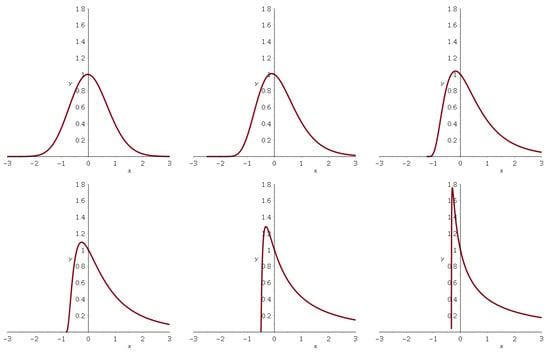
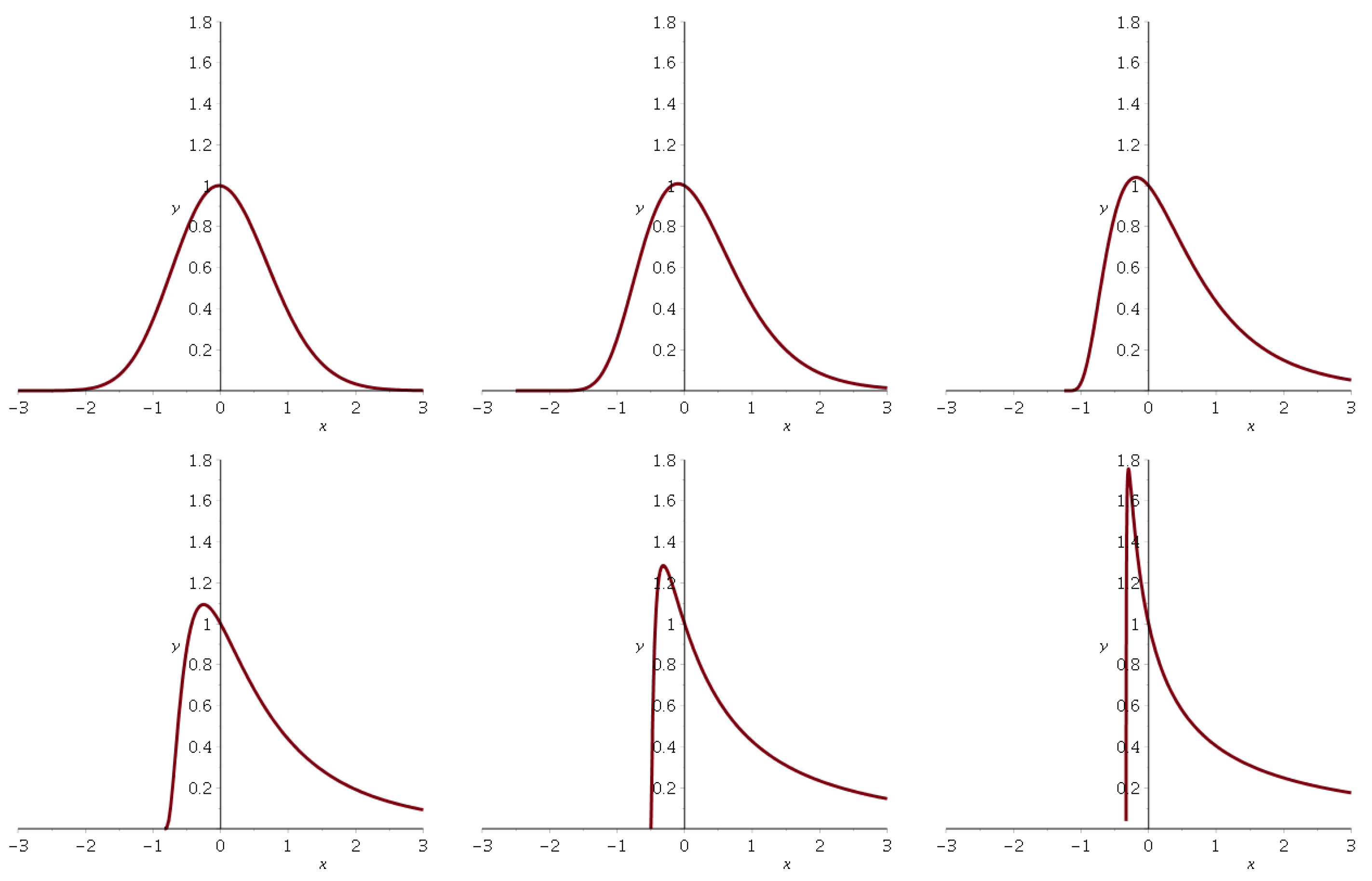
Figure 1.
The deformed solution for different values. From left to right and from top to bottom: = 0.1, 0.4, 0.8, 1.2, 2.0, 3.0. Here, the quotient .
Consider now the true Hamiltonian operator (12) in the Fock representation. From Equation (34) one has that
and
so the full quantum harmonic oscillator Hamiltonian (12), written in terms of the creation and annihilation and operators, reads
Now
Then is
or
that is
But
Thus, one can write the full Hamiltonian operator as
where is the auxiliary Hamiltonian given in (26), and
represent an auto-interaction potential term generated by the deformation of the quantum algebra over the harmonic oscillator. The first terms in are just
Note that the Hamiltonian (38) is not diagonal in the deformed occupation number operator
as in the standard case; this is due to the presence of the interaction potential , which contains powers of that, in general, are not diagonal in the number operator .
Of course, in the limit (, ), one recovers the usual free diagonal Hamiltonian in the number operator. Thus, for position-deformed algebras (4), the Hamiltonian operator does not commute with the number operator
Finding the exact energy eigenstates of the Hamiltonian (38) can be harder, but one can use standard perturbation theory to find the energy corrections generated by the interaction potential term (39). Note that, due to the form of the Hamiltonian (38), one can use all standard algebraic manipulations of the Fock representation.
Energy Corrections for the Linear Position Deformation Case
In this section, we compute the energy corrections generated by the interaction term (40) on the free energy solution
of the auxiliary Hamiltonian, at second order in perturbation theory. If one writes the potential (40) as
with
standard perturbation theory implies that the energy eigenvalues of the exact Hamiltonian operator (37)
can be calculated in an approximate way as
where
which gives contributions, in principle, at first and second order in , and
gives second-order corrections in [26].
Because
and
one gives that
Now, from the fact that
implies that the only non-zero terms are
and from
one gets
or
then
using that
gets
that is
Therefore, there are no first-order energy corrections, and the second-order corrections reduce the initial energy. Furthermore, all third-order corrections are zero, and it can be shown that the result (41) obtained here using perturbation theory is exact.
4. Dual Fock Representations and the Momentum Deformation Case
For the case of deformation in momentum, the Heisenberg commutation relation is given by Equation (5), which admits the representation [12]
where is the usual non-deformed momentum operator, with
and the real-valued function fulfills the equation
Note that . Relation (5) implies that the annihilation and creation operators defined in (13) and (14), satisfy the following algebra
or, by (13) and (14)
Thus, we again need to find a new set of deformed creation and annihilation operators, which satisfy the usual relation (1), namely
We can now state a second theorem:
Theorem 2.
Associated with the deformed Heisenberg commutation (5), there exists a set of annihilation and creation operators defined by
which satisfy relation (46). These operators are just the annihilation and creation operators of the non-deformed phase space associated with the usual Heisenberg commutation relation (43) and do not depend on the function.
Proof.
We consider the following deformed annihilation and creation operators, defined by
where is some continuous complex function to be determined, and denotes its complex conjugate. Now
Because and due (45) one has that
But
Thus,
Thus,
and
Because one gives
For , one has that , so
For this special case, one hopes to recover the usual non-deformed solution (13); thus , and the constant . Finally, the deformed annihilation and creation operators are given by
Interestingly, these last equations can be written in terms of the non-deformed operator
This implies that
and that
But these operators are just the annihilation and creation operators associated with the usual non-deformed Heisenberg commutation relation (43), and their structure does not depend on at all. □
Corollary 3.
For the momentum-deformed GUPs, the vacuum state is universal; that is, it is given by the Gaussian one (36), for any admissible momentum deformation satisfying the assumptions stated in Section 3.1 above.
Proof.
For the momentum-deformed GUPs, the vacuum is defined by
But due to Equation (50) one has that
Again, one can construct an auxiliary Hamiltonian operator defined in terms of the deformed ladder and operators in the usual sense
which summarizes the dynamics of the annihilation operator and the creation operator and is associated with a fictitious free Harmonic oscillator for the momentum deformation.
4.1. Example: The Linear Momentum Deformation Case
In the linear deformation case of the form
where can be thought of as a continuous deformation parameter, the deformed Heisenberg commutation relation reads
The standard annihilation and creation operators , satisfy the commutation relations
A representation of these commutation relations (52) in terms of differential operators is given by
The full quantum harmonic oscillator Hamiltonian (12) is then in the phase space
By expanding the exponential, one has
that is
so
where the self-interaction term generated by deformation of the Heisenberg algebra is
From (50) one has that
In terms of the , the Hamiltonian operator becomes
with given by the auxiliary Hamiltonian (51).
Note again that the full Hamiltonian operator is not diagonal in the number operator
4.1.1. Energy Corrections for the Linear Momentum Deformation Case
Now, we compute the energy corrections generated by the interaction term (55) on the free energy solution
of the auxiliary Hamiltonian (51), at second order in perturbation theory. By using the same algebraic machinery and the results of the position deformation case, one can show that
where
so
The perturbative result (57) coincides with the expansion of the exact Morse spectrum. This assertion can be proven by starting from the Hamiltonian (54), and by introducing the variables (we thank the anonymous reviewer for pointing this out).
Then and
This is precisely the Hamiltonian of a one-dimensional Morse potential problem. Consequently, the momentum-model bound-state spectrum is exactly
Then, fourth and higher corrections vanish in (57). Note that both linear examples in Section 3.5 and Section 4.1 require a finite bound-state n range
respectively. So, the exact energy formulas cannot be extended to all nonnegative integers for the deformed cases.
4.1.2. Minimum-Uncertainty Scenarios
To end this section, following the reviewer’s observation, one may ask whether the linear deformations considered above can lead to minimum-uncertainty scenarios. Note that one must distinguish between:
- Deformed commutation relations;
- Geometric restrictions associated with the transformed canonical variables;
- Genuine minimum uncertainties.
In the first case, as shown in [27], the deformed canonical commutation relations alone do not uniquely determine minimal-length scenarios. These depend on the explicit representations of the deformed position and momentum operators in terms of the phase space variables. For the second case, in the linear deformed position example, the coordinate transformation
restricts the physical coordinate domain to
This geometric boundary may induce state-dependent lower bounds for particular families of states. However, because these bounds depend explicitly on moments such as , they cannot be interpreted as universal minimum uncertainties associated with the algebra itself. This distinction is particularly relevant because the existence of an endpoint in the physical coordinate domain does not, by itself, imply a nonzero state-independent minimum uncertainty.
In the third case, applying the Robertson inequality to the deformed commutation relations (32) and (52) one obtains
or
respectively. In this case, these relations do not imply the existence of a universal, state-independent minimum uncertainty of the type arising in the original Kempf-Mangano-Mann (KMM) construction, because, unlike the quadratic KMM algebra, these relations do not generate terms proportional to or inside the uncertainty bound and therefore they do not imply a state-independent minimum uncertainty in the KMM sense.
5. Conclusions
In this work, we have analyzed occupation-number representations associated with generalized uncertainty principle algebras and their connection to the dual phase space structures and , as previously identified in [20] for modified Heisenberg commutation relations. We have demonstrated that for deformed Heisenberg commutation relations of the form (4) or (5), the conventional definition of the annihilation and creation operators, expressed in terms of position and momentum operators, no longer satisfies the standard Fock algebra (1). Therefore, we must identify new deformed annihilation and creation operators, constructed as functions of the canonical operators, that satisfy the standard commutation relation (1). Given the dual phase space description generated by the GUP, this duality is also reflected in the ladder operators.
The dynamics of these deformed ladder operators are governed by the auxiliary Hamiltonian , which corresponds to the quadratic part of the full deformed Hamiltonian H and can be written in both phase spaces. This construction allows the study of the energies and eigenstates of the full Hamiltonian via perturbation theory in terms of those of .
For position-dependent deformations (4), we have established that the corresponding deformed annihilation and creation operators satisfy the standard bosonic algebra and generate a complete orthonormal basis (for any admissible position deformation satisfying the assumptions stated in Section 3.1) of occupation-number states. The vacuum state, wave functions, and excited states in the phase space description remain standard, whereas in the phase space, they depend explicitly on the deformation function. Consequently, we construct the natural Fock representation in the canonical phase space .
For momentum-dependent deformations (5), the deformed ladder operators and differ from the and set, but also satisfy the standard Fock algebra. In this case, the situation is reversed. In the phase space, the ladder operators coincide with those of the ordinary harmonic oscillator. Consequently, the vacuum state remains Gaussian, and the entire Fock basis is standard for all momentum deformations. In the phase space, the states appear deformed. Therefore, the natural occupation-number representation for momentum-dependent GUP is the non-deformed canonical phase space .
A key result of this work is identifying a Fock-space asymmetry between position and momentum GUP deformations. Although both classes of generalized uncertainty principles admit dual canonical phase space descriptions, they do not yield equivalent occupation-number structures. Position deformations select the deformed phase space as the natural and simpler arena for Fock quantization, whereas momentum deformations select the undeformed phase space. We emphasize that this asymmetry concerns realizing the deformed Hamiltonians and oscillator structures in terms of phase variables, rather than inequivalent representations of the canonical commutation relations.
Although the creation and annihilation operators are described in two ways, all relevant information is encoded in the algebraic structure of the Fock space itself, which remains invariant regardless of the phase space representation. This property is utilized to determine the energy eigenstates by perturbation theory.
From a dynamical perspective, GUPs introduce nontrivial self-interactions into the Hamiltonian operator, fundamentally altering the system’s dynamics and resulting in highly nonlinear behavior in both dual phase space descriptions. Notably, for both position and momentum deformations, the full Hamiltonian becomes non-diagonal in the number operator. For example, for linear position deformation, the self-interactions arise from an infinite series of terms in the deformation parameter originating from the elastic potential term. Therefore, determining the exact Hamiltonian eigenvalues is nontrivial. We used perturbation theory to compute the energy corrections to second order in . For linear-momentum deformation, the self-interactions arise from an infinite series of terms in the deformation parameter coming from the kinetic part of the Hamiltonian operator. We derived a similar expression for the second-order energy corrections in . Notably, for both linear deformations, the perturbative calculation reproduces the exact spectrum.
In summary, from the perspective of the non-deformed phase space , every admissible position-type GUP considered within the assumptions of Section 3.1, induces a genuinely deformed bosonic representation and a modified vacuum. In contrast, every admissible momentum-type GUP considered within the assumptions of Section 3.1, is algebraically equivalent to a standard bosonic theory, with all deformation effects transferred to an effective Hamiltonian interaction term.
We believe that the distinction between deformation-dependent and deformation-independent Fock structures could have important implications for quantizing free fields in GUP frameworks, where harmonic oscillators serve as the fundamental building blocks.
Finally, the dual Fock-space interpretation developed in this work opens several avenues for future research. These include constructing coherent and squeezed states in dual phase spaces, investigating interacting quantum fields based on deformed occupation-number representations, and extending the present formalism to multidimensional and covariant generalized uncertainty principle algebras. We think that these developments will provide further insight into the interplay between canonical structures, generalized uncertainty principles, quantum gravity-motivated deformations, and quantum mechanics.
Author Contributions
Conceptualization, M.C.G., R.O.H., M.C. and J.M.G.; methodology, M.C.G., R.O.H., M.C. and J.M.G.; formal analysis, M.C.G. and J.M.G.; investigation, M.C.G., M.C. and R.O.H.; writing—original draft, M.C.G.; writing—review and editing, M.C.G., R.O.H., M.C. and J.M.G. All authors have read and agreed to the published version of the manuscript.
Funding
This research received no external funding
Data Availability Statement
No new data were created or analyzed in this study. Data sharing is not applicable to this article.
Conflicts of Interest
The authors declare no conflicts of interest.
References
- Mazurek, D.F.; Beer, F.P.; Johnston, R.E.; Cornwell, P.; Self, B. Vector Mechanics for Enginners: Dynamics; McGraw-Hill Education: New York, NY, USA, 2019. [Google Scholar]
- Fetter, A.L.; Walecka, J.D. Theoretical Mechanics of Particles and Continua; Dover Books on Physics: Garden City, NY, USA, 2003. [Google Scholar]
- Hibbeler, R.C. Mechanics of Materials; Pearson: London, UK, 2017. [Google Scholar]
- Griffiths, D.J.; Schroeter, D.F. Introduction to Quantum Mechanics; Cambridge University Press: Cambridge, UK, 2018. [Google Scholar]
- Sakurai, J.J.; Napolitano, J. Modern Quantum Mechanics; Cambridge University Press: Cambridge, UK, 2020. [Google Scholar]
- Merzbacher, E. Quantum Mechanics; Wiley: Hoboken, NJ, USA, 1998. [Google Scholar]
- Weinberg, S. The Quantum Theory of Fields, 3 Volume Set; Cambridge University Press: Cambridge, UK, 1996. [Google Scholar]
- Schwartz, M.D. Quantum Field Theory and the Standard Model; Cambridge University Press: Cambridge, UK, 2013. [Google Scholar]
- Strickland, M. Relativistic Quantum Field Theory; Springer: Berlin/Heidelberg, Germany, 2026. [Google Scholar]
- Tawfik, A.N.; Diab, A.M. A review of the generalized uncertainty principle. Rep. Prog. Phys. 2015, 78, 126001. [Google Scholar] [CrossRef] [Scilit] [PubMed]
- Bruneton, J.P.; Larena, J. Quantum theory of the generalised uncertainty principle. Gen. Relativ. Gravit. 2017, 49, 56. [Google Scholar] [CrossRef] [Scilit]
- Pedram, P. A class of GUP solutions in deformed quantum mechanics. Int. J. Mod. Phys. D 2010, 19, 2003–2009. [Google Scholar] [CrossRef] [Scilit]
- Seifi, M.; Sefiedgar, A.S. The effects of the covariant generalized uncertainty principle on quantum mechanics. Can. J. Phys. 2022, 101, 242–247. [Google Scholar] [CrossRef] [Scilit]
- Luciano, G.G.; Petruzziello, L. Generalized uncertainty principle and its implications on geometric phases in quantum mechanics. Eur. Phys. J. Plus 2021, 136, 179. [Google Scholar] [CrossRef] [Scilit]
- Bosso, P.; Luciano, G.G. Generalized uncertainty principle: From the harmonic oscillator to a QFT toy model. Eur. Phys. J. C 2021, 81, 982. [Google Scholar] [CrossRef] [Scilit]
- Scardigli, F. The deformation parameter of the generalized uncertainty principle. J. Phys. Conf. Ser. 2019, 1275, 012004. [Google Scholar] [CrossRef] [Scilit]
- Casadio, R.; Scardigli, F. Generalized Uncertainty Principle, Classical Mechanics, and General Relativity. Phys. Lett. B 2020, 807, 135558. [Google Scholar] [CrossRef] [Scilit]
- Chester, D.; Arsiwalla, X.D.; Kauffman, L.H.; Planat, M.; Irwin, K. Quantization of a New Canonical, Covariant, and Symplectic Hamiltonian Density. Symmetry 2024, 16, 316. [Google Scholar] [CrossRef] [Scilit]
- Cremaschini, C.; Tessarotto, M. Planck Length Emerging as the Invariant Quantum Minimum Effective Length Determined by the Heisenberg Uncertainty Principle in Manifestly Covariant Quantum Gravity Theory. Symmetry 2024, 16, 1042. [Google Scholar] [CrossRef] [Scilit]
- Contreras González, M.; Ortiz Herrera, R.; González, J.M. Modified Heisenberg Commutations Relations and Its Standard Hamiltonian Interpretation. Mathematics 2025, 13, 3872. [Google Scholar] [CrossRef] [Scilit]
- Bishop, M.; Hooker, H.; Singleton, D. Symmetrized operators or modified integration measure in generalized uncertainty principle models. Phys. Lett. B 2026, 874, 140277. [Google Scholar] [CrossRef] [Scilit]
- Contreras, M.; Ortiz, R.; González, M. Modified Heisenberg commutation relations and the infinite-square well potential: Some simple consequences. Symmetry 2024, 16, 1268. [Google Scholar] [CrossRef] [Scilit]
- Kempf, A.; Mangano, G.; Mann, R.B. Hilbert space representation of the minimal length uncertainty relation. Phys. Rev. D 1995, 52, 1108. [Google Scholar] [CrossRef] [Scilit] [PubMed]
- Bagchi, B.; Fring, A. Minimal length in quantum mechanics and non-Hermitian Hamiltonian systems. Phys. Lett. A 2009, 373, 4307–4310. [Google Scholar] [CrossRef] [Scilit]
- Bruno, M.; Segreto, S.; Montani, G. Generalized uncertainty principle theories and their classical interpretation. Nucl. Phys. B 2024, 1009, 116739. [Google Scholar] [CrossRef] [Scilit]
- Bosso, P.; Das, S. Generalized ladder operators for the perturbed harmonic oscillator. Ann. Phys. 2018, 396, 254–265. [Google Scholar] [CrossRef] [Scilit]
- Bishop, M.; Lee, J.; Singleton, D. Modified commutators are not sufficient to determine a quantum gravity minimal length scale. Phys. Lett. B 2020, 802, 135209. [Google Scholar] [CrossRef] [Scilit]

Disclaimer/Publisher’s Note: The statements, opinions and data contained in all publications are solely those of the individual author(s) and contributor(s) and not of MDPI and/or the editor(s). MDPI and/or the editor(s) disclaim responsibility for any injury to people or property resulting from any ideas, methods, instructions or products referred to in the content. |
© 2026 by the authors. Licensee MDPI, Basel, Switzerland. This article is an open access article distributed under the terms and conditions of the Creative Commons Attribution (CC BY) license.