


Abstract
A new class of high-order simultaneous iterative methods is constructed for the simultaneous computation of all simple roots of a nonlinear equation. The objective is to develop efficient iterative schemes with improved convergence characteristics and computational performance. The schemes are constructed by applying suitable weight functions and attain a convergence order of , where p denotes the order of the predictor iterative method. Their performance is investigated through comprehensive numerical experiments on several nonlinear biological models, including the Population Model with Allee Effect and Density–Dependent Migration, the Epidemic Disease Model, and the Michaelis–Menten Enzyme Kinetics Model, to illustrate the accuracy, efficiency, and convergence behavior of the proposed schemes. Additionally, error graphs are plotted to compare the proposed methods with existing methods. The numerical results show that some of the proposed schemes achieve faster convergence and lower residual errors than existing schemes and have better computational performance. The results indicate that the proposed methods are competitive and reliable for solving nonlinear equations arising in biological and applied mathematical models.
MSC:
65H05
1. Introduction
Many science, engineering, biology, and applied mathematical applications involve nonlinear equations [1,2]. Consider the nonlinear equation
where is a sufficiently differentiable function. In many cases analytical solutions are not available and iterative techniques are very important in providing a numerical approximation to the roots. These methods could be categorized as “single root method”, “multiple root method”, and “simultaneous root finding method”. Simultaneous iterative methods are extensively used for finding all roots of an equation simultaneously. These methods are efficient, well suited to parallel implementation, and generally converge rapidly [3,4,5,6]. Recent developments in simultaneous and multipoint iterative methods can be found in [7,8,9,10].
Among the earliest and most popular methods is the Weierstrass method [11], which was later developed independently by Durand [12], Kerner [13], Dochev [14], and Presic [15]. This method exhibits second-order convergence for polynomials of degree n and serves as the foundation for many later developments in simultaneous root-finding, and is given by
Another important method is the Ehrlich–Aberth method [16,17], which achieves third-order convergence for polynomial equations of degree n and is as follows:
The local convergence of the Ehrlich method has been studied in detail by Proinov [18], while further convergence analyses of simultaneous methods include the works of Proinov and Ivanov [10] and Proinov and Vasileva [9].
Motivated by these classical methods, many researchers have developed higher-order simultaneous schemes. Petković et al. [19,20] proposed several high-order methods for simultaneously approximating polynomial zeros. A comprehensive treatment of multipoint methods for nonlinear equations is given in [7,8]. Later, Mir et al. [21] introduced families of fourth- and sixth-order methods, while Shams et al. [22] extended iterative methods designed for single-root problems to the simultaneous approximation of all roots. Cordero et al. [23] presented a general technique for nonlinear equations that constructs a simultaneous method of convergence order , where p is the order of the predictor iterative method. The local convergence of higher-order iterative methods for nonlinear equations has also been investigated in [24].
The present work is motivated by the fourth-order simultaneous method proposed by Wang and Zheng [25] for approximating the zeros of polynomial equations :
, where n is the degree of . The Wang–Zheng method achieves fourth-order convergence for polynomials by making use of second-derivative information. Recent work on Wang–Zheng-type methods further investigates their convergence properties, including extensions to multiple zeros [26].
Inspired by this idea, we extend the method to nonlinear scalar equations. To avoid the direct evaluation of the second derivative, we replace it with the finite-difference approximation, which approximates . By doing this, the number of functional evaluations decrease. Furthermore, suitable weight functions are incorporated to construct a new class of simultaneous iterative methods. We also introduce these weight functions to obtained a more generalized family of methods. The obtained family is presented in Equation (5). The convergence analysis shows that the resulting schemes attain a convergence order of , where p denotes the order of the predictor iterative method.
The remainder of the paper is organized as follows. Section 2 presents the construction of the proposed methods and their convergence analysis. Section 3 presents numerical experiments on several nonlinear biological models, along with error graphs, tables, and comparative analyses to evaluate the convergence behavior and performance of the proposed schemes. Finally, concluding remarks are given in Section 4.
2. Construction and Convergence Analysis of the Proposed Scheme
Consider the nonlinear equation where is an analytic function possessing n distinct simple roots denoted by , for . Let denote the approximation to the root at the iteration, where . The proposed simultaneous iterative scheme is defined as follows:
where denotes the fixed-point function corresponding to the predictor method of order p, which is used to construct the proposed multipoint method. Here, represents an approximation to the second derivative, and the weight function is a holomorphic mapping in a neighborhood of the origin 0. The variable of the weight function is
The first step of the proposed scheme given in Equation (5) can be any iterative method having convergence order p. The second step is designed in such a way that the resulting method attains a higher convergence order. Theorem 1 establishes that the proposed method achieves a convergence order of at least , provided that the weight function satisfies certain suitable conditions given in Theorem 1.
2.1. Convergence Analysis
The following result establishes the convergence analysis of the proposed simultaneous iterative scheme (5), denoted by .
Theorem 1.
Let be an analytic function defined in a neighborhood D containing the simple roots , , such that Assume that are sufficiently close initial approximations to the roots respectively. Further, suppose that the predictor step of (5) is generated by any iterative method of convergence order p that obtains simple roots non-simultaneously. Then the proposed scheme (5) attains at least order of convergence provided that the weight function is a not null function that satisfies the conditions
Proof.
Let denote the error in the approximation of the root at the iteration. By expanding and in a Taylor series about the simple root , , we obtain
and
where On the other hand, let denote the error in the predictor approximation to the root . Taking into account that the predictor has convergence order p, its error can be expanded around as
where .
Using the Taylor series expansion of and about the simple root , we obtain
and
The value of is obtained from Equalities (10) and (11).
From Equation (12), it follows that is of order . Since the weight function is holomorphic in a neighborhood of the origin 0, as assumed above, it admits a convergent Taylor (Maclaurin) expansion about 0 as follows:
Further, using the expansions (8) and (11), we obtain
Now, the second step of the proposed scheme (5) as , where can be written as:
where
Therefore, using the values of (14) and (9) into the second step of proposed method (5)
To achieve convergence of order at least using the proposed scheme defined in Equation (5), the coefficient of the term must vanish. Thus, from Equation (15), the following condition involving the weight function is obtained:
Equation (16) provides the required restriction on the weight function . By substituting Equation (16) into Equation (15), the proposed scheme (5) satisfies the following error equation:
Hence, the proposed simultaneous iterative scheme attains a convergence order of at least when the first step is chosen as any existing iterative method of order p. This completes the proof. □
2.2. Special Cases of the Proposed Class
In this subsection, several special cases of the proposed class of iterative schemes (5) are constructed by choosing different existing iterative methods in the first step . For each selected scheme, a new modified variant is obtained and denoted by , .
- (1)
- By considering the first step as the damped Newton’s method of first-order convergence and then applying the second step of the proposed scheme, a third-order method is obtained, denoted by , which is given as follows:In this case, and, therefore, . So, its error equation is
- (2)
- Choosing the first step as the classical Newton’s method [1] of quadratic convergence and then applying the proposed correction step yields a fifth-order method, denoted by , as follows:In this case, and . So, its error equation is
- (3)
- Applying the proposed correction step to the modified Newton’s method [27] of cubic convergence results in a seventh-order method denoted by , which is expressed asIn this case, as , , and the resulting error equation is
- (4)
- If two consecutive Newton’s steps are employed in the first stage, then the resulting predictor possesses fourth-order convergence (). By applying the proposed correction step, a ninth-order method is obtained, denoted by , and defined as follows:Now, , being it error equation
2.3. Some Special Cases of Weight Functions
This section presents different rational forms of the weight function used in the proposed method (5). For convenience, the methods corresponding to the first, second, and third weight functions are denoted by respectively, where . The following weight functions are considered:
- For the first weight function, the corresponding methods are denoted by :
- For the second weight function, the corresponding methods are denoted by :
- For the third weight function, the corresponding methods are denoted by :
3. Numerical Experiments and Computational Analysis
In this section, several nonlinear test problems are considered to investigate the convergence behavior, numerical stability, and computational efficiency of the proposed simultaneous iterative schemes , and , defined in Equation (5).
All numerical computations and graphical illustrations were performed using Mathematica Version 11.1 with variable-precision arithmetic at 10,000 significant digits. The implementation of the proposed method follows directly from the iterative scheme given in (5), and its computational steps are outlined in Algorithm 1. For each iteration, the values are obtained from the current approximations, and the new approximations , , are then computed from (5) simultaneously. The compared methods were implemented in the same computational environment according to their respective iterative schemes. The iterations were terminated when
or when the prescribed maximum number of iterations was reached.
| Algorithm 1 Computational procedure for the scheme |
|
For comparison purposes, the following iterative methods are employed:
- Ehrlich’s method, denoted by [16], possessing quadratic convergence for nonlinear transcendental equations and cubic convergence for polynomial equations:
- The method proposed by Cordero et al. [23], denoted by , having fourth-order convergence:
- Another method proposed by Cordero et al. [23], denoted by , having sixth-order convergence:
- The method proposed by Cordero et al. [23], denoted by , having eighth-order convergence:
- The fifth-order simultaneous iterative method proposed by Shams et al., denoted by [22]:For the numerical computations, the parameter is chosen as .
The numerical results presented in Table 1, Table 2 and Table 3 provide detailed information regarding the convergence characteristics and computational performance of the considered methods. The following information is given:
Table 1.
Comparison of numerical results for Example 1 obtained using various iterative methods.
Table 2.
Comparison of numerical results for Example 2 obtained using various iterative methods.
Table 3.
Comparison of numerical results for Example 3 obtained using various iterative methods.
- (i)
- The notation denotes .
- (ii)
- The quantity represents the Euclidean norm of the difference between two consecutive iterates.
- (iii)
- CPU denotes the computational time measured in seconds. Note that the time for CPU executions was measured for a mean of 10 computation runs for each test problem. The CPU times should be considered as indicative measures of the computational effectiveness of the considered methods.
- (iv)
- The residual norm at the iteration is represented by where
- (v)
- The approximate computational order of convergence (ACOC), [28] which estimates the theoretical convergence order , is computed by
The computational experiments were performed on a desktop computer with the following specifications:
- 11th Gen Intel(R) Core(TM) i3-1125G4 processor, 2.00 GHz (64-bit architecture);
- 8 GB RAM and Intel(R) UHD Graphics;
- Microsoft Windows 10 operating system.
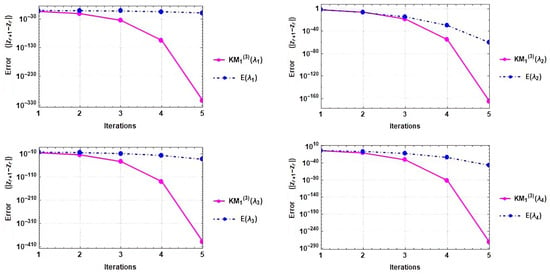
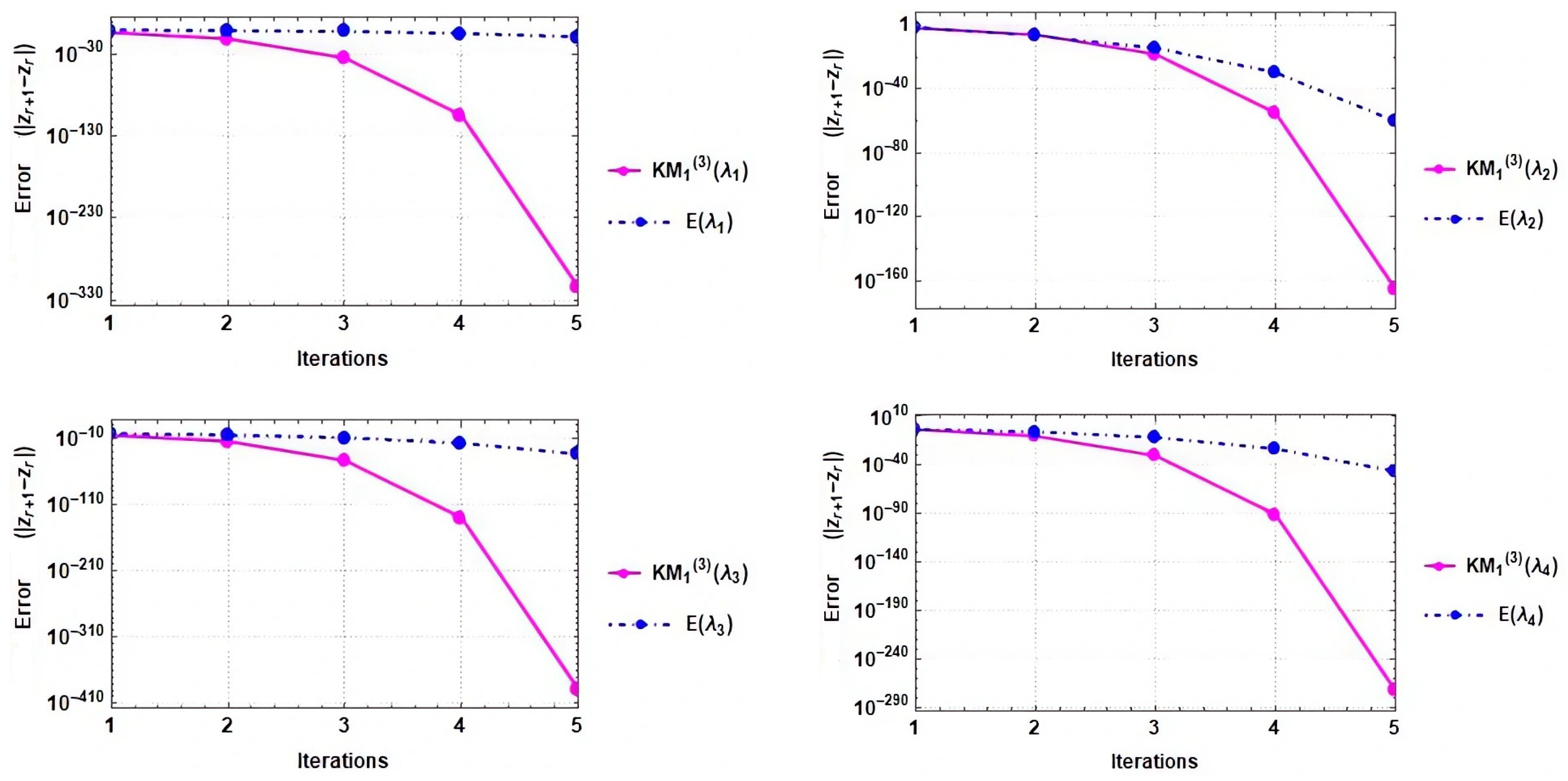
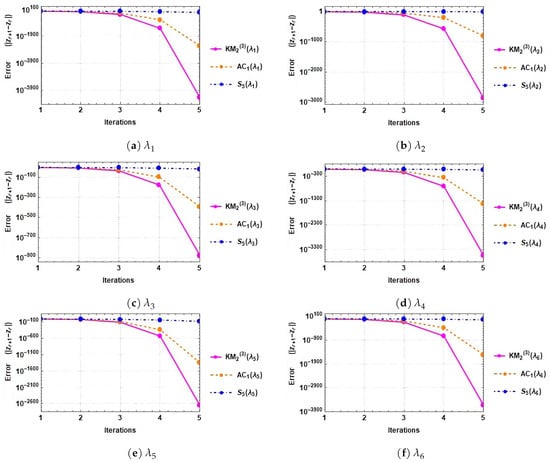
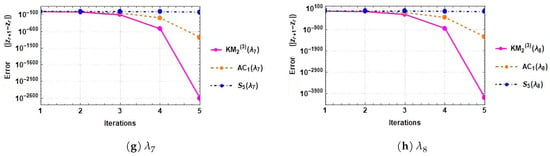
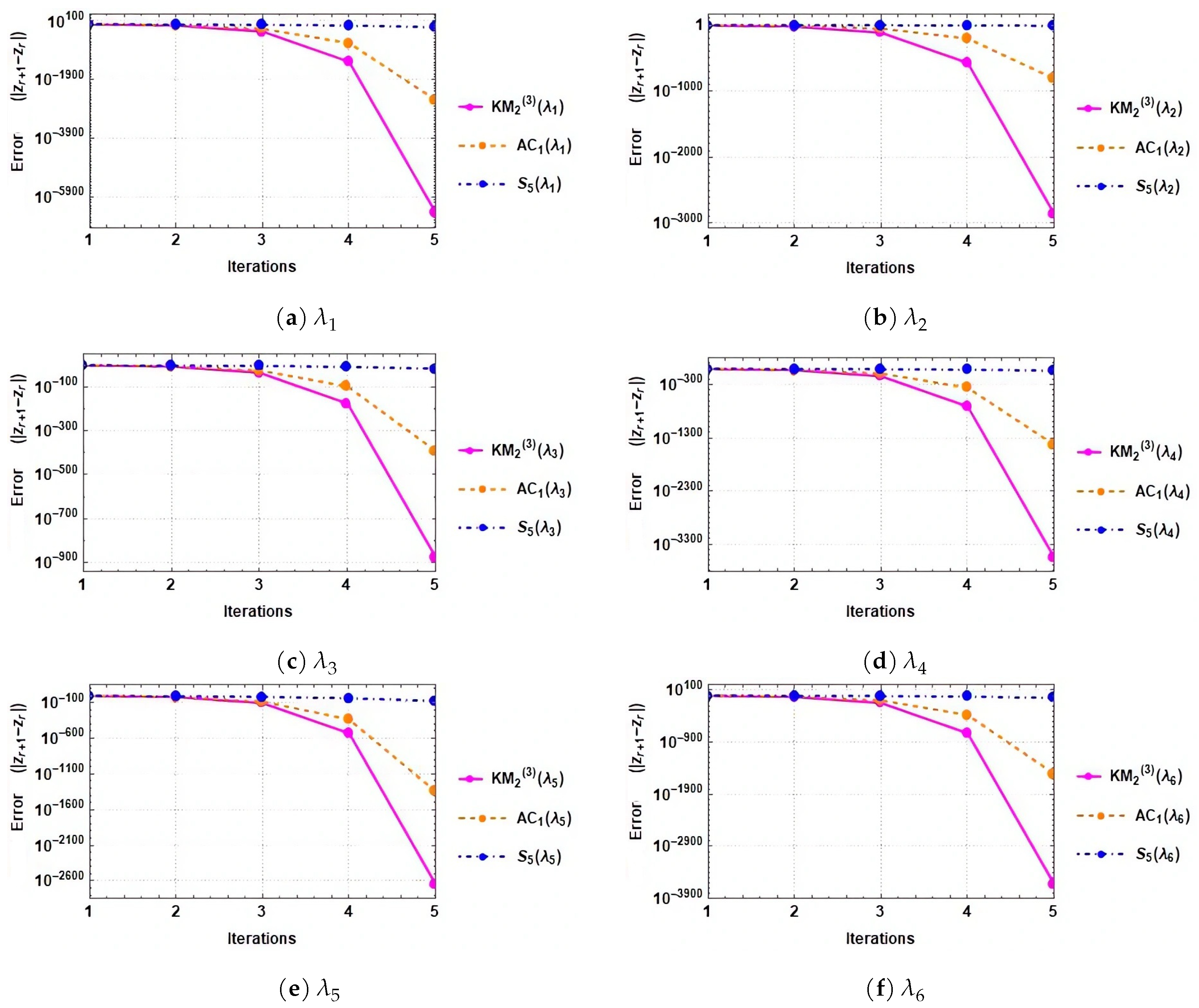
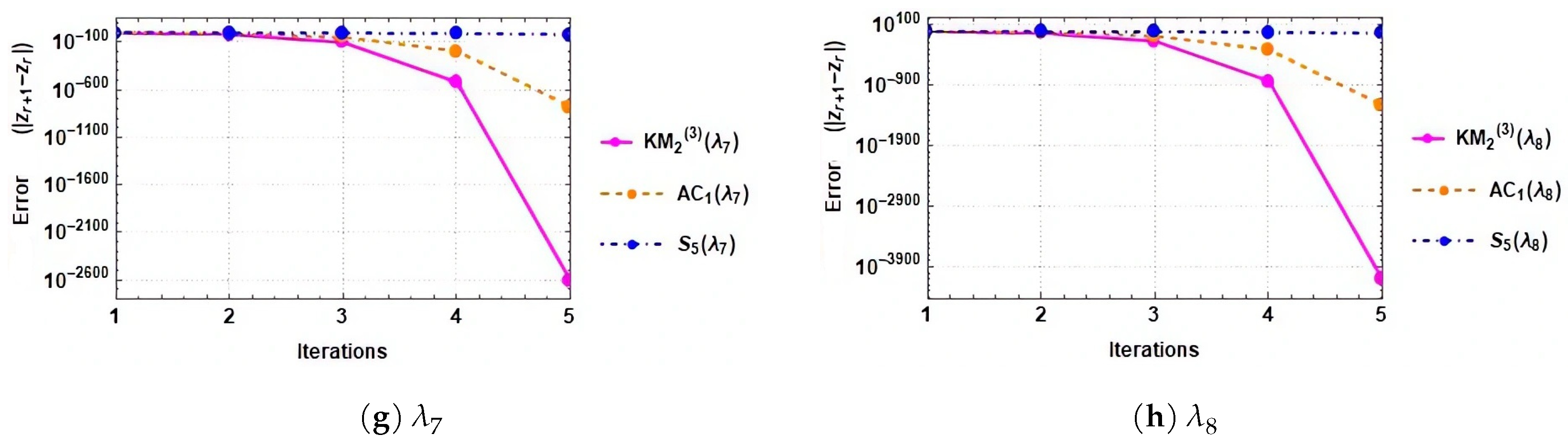
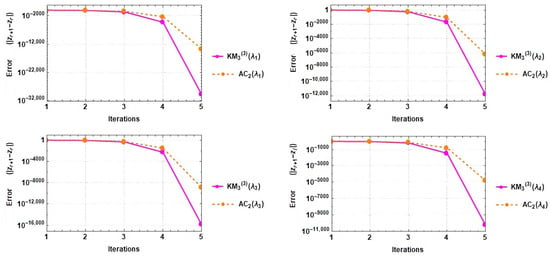
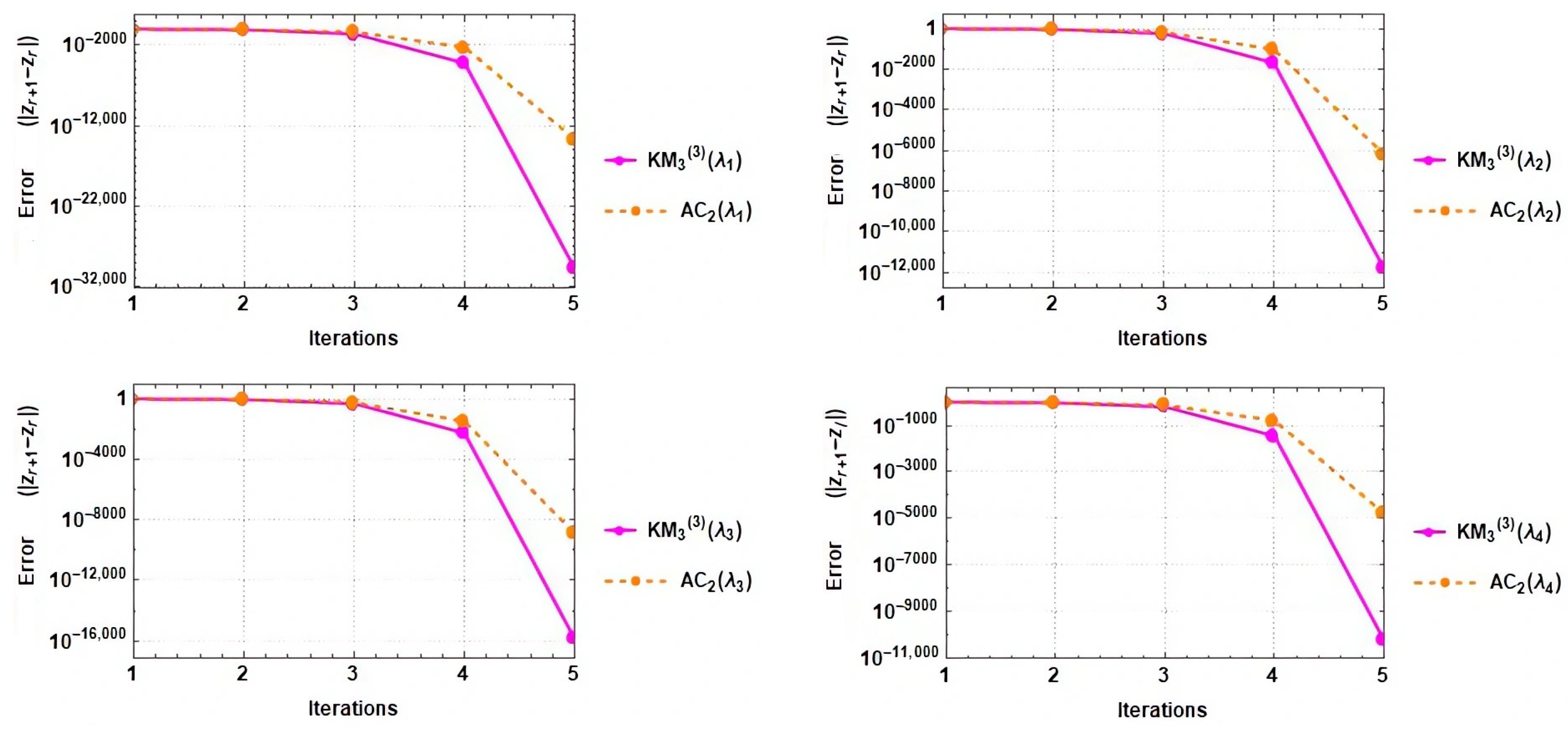
Further, the computational analysis in terms of iteration process and residual error reduction for Examples 1–3 is illustrated graphically in Figure 1, Figure 2 and Figure 3. In these figures, denotes the root of the nonlinear equation under consideration. The solid curves correspond to the proposed methods, whereas the dotted curves represent the existing iterative methods used for comparison. Since all three weight functions exhibit similar convergence behavior, only the graphs corresponding to the third weight function are presented.
Figure 1.
Error analysis of and E corresponding to the roots , , , and for Example 1.
Figure 2.
Error analysis of , , and corresponding to the roots for Example 2.
Figure 3.
Error analysis of and corresponding to the roots , , , and for Example 3.
Example 1
(Population Model with Allee Effect and Density-Dependent Migration). To predict the growth, persistence, and extinction of a biological species in response to changes in environmental conditions, it is necessary to understand the population dynamics of the species [29,30]. If the population density drops below a critical threshold, for many species, the reduction in growth rate is connected with the inability to reproduce, cooperate, and defend themselves from predators. This effect is referred to as a strong Allee effect. Moreover, migration behavior can be influenced by population density and environmental fluctuations. We consider the following nonlinear model of a population to see these effects.
in which is the population density at time t, r the intrinsic growth rate, K the carrying capacity, A the Allee threshold and B the strength of the migration. The first term is logistic growth with a strong Allee effect, and the second term is density dependent migration with environmental variability. When the population is in equilibrium, the density of the population is unchanged, so that:
Consequently, the equilibrium condition yields the nonlinear transcendental equation
For the numerical examples, the parameter values are chosen as
Substituting these parameter values into Equation (25) yields
Equation (26) is a nonlinear transcendental equation possessing multiple real roots that correspond to different equilibrium states of the biological population system. For the selected parameter values, the computed roots are The initial approximations employed for the simultaneous iterative schemes are chosen as There is no biological meaning to the negative equilibrium since the population densities are restricted to being nonnegative. Three positive roots are located in the vicinity of the Allee threshold; they represent critical transition states that are very sensitive to environmental perturbations and migration effects. The largest positive root, which lies near the carrying capacity , represents a stable population persistence state resulting from the combined effects of intrinsic growth, the Allee effect, and density-dependent migration.
Example 2
(Epidemic Disease Model). In many problems in epidemiology, population biology and infectious disease dynamics, a nonlinear epidemic disease model is encountered [31,32]. Many biological systems have infectious diseases that are spread nonlinearly between susceptible and infected populations. In addition, the system is subject to environmental fluctuations, seasonal influences, and nonlinear transmission mechanisms that add further complexities to the dynamic behavior. These biological factors can interact in a nonlinear way, resulting in a transcendental equation with several equilibrium points.
In the present study, a modified epidemic disease model is considered and represented by the following nonlinear equation:
where z denotes the dimensionless infected population density, represents the nonlinear disease transmission or infection interaction term, models seasonal or environmental fluctuations affecting disease spread, and the constant term 30 corresponds to the external recovery or control parameter.
The equilibrium states of the epidemic system are obtained by solving The approximate numerical roots of the equation are found as The corresponding initial approximations are taken as
The negative root corresponds to a mathematically admissible but biologically unrealistic equilibrium state since negative population densities are not physically meaningful in epidemiological systems. This equilibrium is generally associated with unstable or nonphysical disease dynamics generated by the strong nonlinear behavior of the model. The positive roots represent biologically feasible equilibrium states where infection transmission, recovery mechanisms, and environmental effects remain balanced. The equilibrium states near correspond to comparatively stable endemic states associated with controlled disease spread and balanced epidemic behavior. The higher states of equilibrium near associations with increased disease transmission and unstable or critical epidemic areas. This higher equilibrium can be associated with outbreaks of epidemics, fast disease progression, or unstable populations. Simultaneous root-finding methods are especially significant in finding all the possible roots of a nonlinear transcendental equation in one run, because the model has several different equilibrium solutions. To investigate epidemic stability, disease persistence and biologically stable operating conditions, the computation of all the roots is indispensable. Hence, the present model serves as a useful test problem for the study of higher order simultaneous iterative schemes, analysis of convergence and the stability behavior of numerical algorithms.
Example 3
(Michaelis–Menten Enzyme Kinetics Model). Michaelis–Menten enzyme kinetics models frequently arise in biochemistry, pharmacokinetics, molecular biology, and metabolic reaction analysis [33]. In biological systems, enzymes catalyze biochemical reactions by interacting with substrate molecules. The reaction rate initially increases rapidly with substrate concentration; however, after a certain level, enzyme saturation occurs and the reaction rate approaches a limiting value. This saturation phenomenon introduces strong nonlinear behavior into the biochemical system.
In many biological processes, environmental fluctuations, regulatory mechanisms, and nonlinear metabolic effects further complicate the system dynamics, leading to nonlinear transcendental equations possessing multiple equilibrium states.
In the present study, a modified Michaelis–Menten type biological model is considered and represented by the following nonlinear equation:
where z denotes the dimensionless substrate concentration, represents the nonlinear enzyme saturation kinetics, models degradation or removal of substrate concentration, represents oscillatory biological or environmental effects, and the constant term 5 corresponds to external biochemical regulation.
The equation is nonlinear and non-polynomial because it simultaneously contains rational and trigonometric nonlinearities. Owing to the transcendental nature of the equation, exact analytical determination of equilibrium states becomes difficult. Therefore, efficient numerical iterative methods are required for accurate computation of all feasible roots.
The equilibrium states of the biological system are obtained by solving The approximate numerical roots of the equation are found as The seed values corresponding to the above are considered as The smaller equilibrium point is near Low substrate operating condition which is biologically stable and maintains a balance between substrate use and enzyme activity.The higher lying equilibrium states near indicate high levels of substrate concentration, when enzyme saturation occurs and biochemical activity is high, in the case of nonlinear enzyme saturation behaviour. They are equilibrium states that could represent very high metabolic activity or enzyme reaction saturation. Since the model possesses multiple equilibrium solutions, simultaneous root-finding methods are important for computing all feasible roots efficiently. Therefore, the present model serves as an effective benchmark problem for testing higher-order simultaneous iterative schemes and convergence behavior for nonlinear biological systems.
Analysis of Numerical Results
Table 1, Table 2 and Table 3 illustrate that the proposed methods consistently converge and validate the theoretical findings presented in Section 2 and Section 3. The numerical experiments are performed on three nonlinear problems, namely, Examples 1–3. The obtained numerical outcomes show the effectiveness, stability, and higher convergence behavior of some of the proposed schemes. Furthermore, the graphical analysis presented in Figure 1, Figure 2 and Figure 3 corresponds to the third weight-function-based methods, namely, , , and , respectively. Since all weight functions exhibit similar convergence behavior, the graphical study is carried out only for one representative method in each example and compared with the corresponding existing methods to avoid redundancy while preserving the essential convergence characteristics.
- Table 1 presents the numerical results obtained for the Population Model with Allee Effect and Density-Dependent Migration. It is observed that the proposed method , with three different weight functions consistently achieve smaller absolute errors and faster convergence toward the required roots as compared to the existing methods. The errors decrease rapidly at each iteration, demonstrating the high computational efficiency and robustness of the proposed scheme. Figure 1 presents the error analysis for Example 1, where the proposed method is compared with the existing method E for the roots , , , and , since both methods possess the same order of convergence.
- Table 2 corresponds to the Epidemic Disease Model. The numerical outcomes indicate that the proposed method , with three different weight functions, get better results than the existing iterative schemes in terms of convergence speed, accuracy, and residual reduction. In particular, these proposed methods reduce the errors more efficiently in successive iterations, thereby requiring fewer computational steps to obtain high-precision approximations of the equilibrium states of the epidemic system. It is also observed that the method diverges for this problem, demonstrating its lack of robustness compared with the proposed schemes. The error analysis presented in Figure 2 corresponds to Example 2 and compares the proposed method with the existing methods and for the roots . The results show a faster decrease in the errors for the proposed method, highlighting its convergence behavior and computational efficiency.
- Table 3 shows the Michaelis–Menten Enzyme Kinetics Model. The numerical results clearly prove that the proposed method , with three different weight functions achieve faster convergence, smaller residual errors and better computational accuracy than the available iterative schemes. The errors are seen to become more significant in the successive iterations for the proposed methods, resulting in reaching to the equilibrium enzyme states in fewer iterations. Furthermore, the error analysis presented in Figure 3 corresponds to Example 3 and compares the proposed method with the existing method for the roots , , , and . The graphical results further confirm the convergence behavior, stability, and computational efficiency of the proposed method.
- Importantly, the proposed algorithms and Cordero’s schemes (, , and ) require exactly the same number of function evaluations of the algorithm per iteration. The methods proposed have a convergence order of while Cordero’s methods have an order of . With this, the proposed schemes provide greater computational efficiency, in terms of functional evaluations.
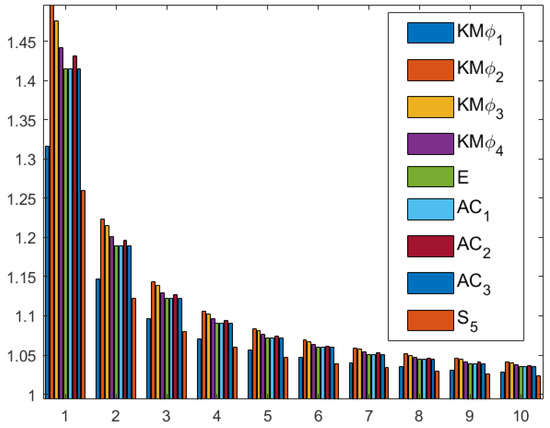
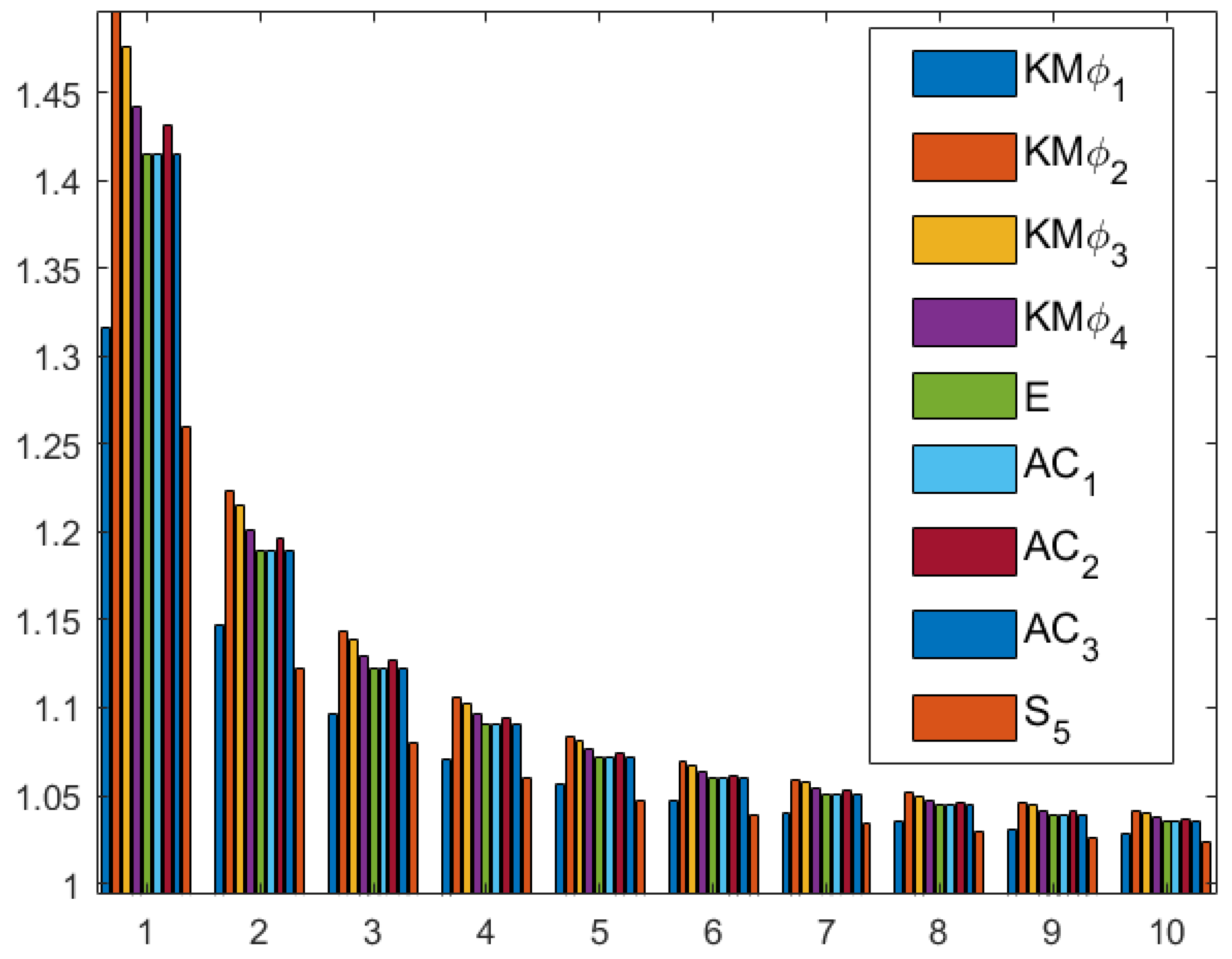
- Furthermore, the numerical experiments shows that method is only second order computational convergent even though it is a fifth order method, theoretically. On the other hand, the proposed methods retain their theoretical convergence orders and consistently show high-order convergence for all the nonlinear problems that were tested, with stable results. Using the computational order of convergence described by ACOC, we calculate their Ostrowski’s efficiency index [34], defined by , where d is the number of functional evaluations per iteration. Using this definition, the of all the used methods for a function of n zeros, appears in Table 4. In it, , denotes the proposed methods with any of the weight functions (none of them have functional evaluations). In Figure 4, we observe that the most efficient scheme is , for all n between 1 and 10. It has been checked that this performance is held for bigger values of n.Table 4. Efficiency indices for the different methods.Figure 4. Efficiency indices for new and known methods.
In summary, the numerical investigations confirm that some of the proposed iterative techniques can be very efficient and they are competitive with the already available iterative methods.
4. Conclusions
In this paper, a new class of higher-order simultaneous iterative methods has been presented for the simultaneous computation of the roots of nonlinear equations. The proposed schemes incorporate different weight functions into a predictor–corrector framework and achieve a convergence order of , where p denotes the order of the predictor iterative method. The theoretical convergence analysis establishes the order of convergence and confirms the validity of the proposed schemes.
Several nonlinear biological models, including population and epidemic disease models, have been considered to demonstrate the applicability and computational performance of the proposed methods. The numerical results show that the proposed schemes converge rapidly to the desired roots with high accuracy and small residual errors and error estimations. The error graphs further illustrate the effective reduction in errors over successive iterations. With the same number of iterations, some of the proposed methods achieve smaller residual and estimated errors than existing methods for the considered test problems, while maintaining comparable function-evaluation costs.
The comparative numerical results demonstrate that the proposed simultaneous iterative methods provide reliable convergence behavior, small residual errors, and improved computational performance. Therefore, the developed methods constitute effective and competitive computational tools for the simultaneous solution of nonlinear equations arising in applied mathematics, biological sciences, engineering, and other scientific applications.
Author Contributions
Conceptualization, M.P., S.B., R.B., P.T.-N., A.C. and J.R.T.; methodology, M.P., S.B., R.B., P.T.-N., A.C. and J.R.T.; software, M.P.; validation, M.P., S.B. and R.B.; formal analysis, M.P., S.B. and R.B.; investigation, M.P., S.B., R.B., P.T.-N., A.C. and J.R.T.; resources, S.B., R.B., A.C. and J.R.T.; data curation, M.P.; writing—original draft preparation, M.P.; writing—review and editing, M.P., S.B., R.B., P.T.-N., A.C. and J.R.T.; visualization, M.P.; supervision, S.B. and R.B.; project administration, S.B. All authors have read and agreed to the published version of the manuscript.
Funding
This research is partially supported by the IMU-Simons Research Fellowship.
Institutional Review Board Statement
Not applicable.
Informed Consent Statement
Not applicable.
Data Availability Statement
The original contributions presented in this study are included in the article. Further inquiries can be directed to the corresponding author.
Acknowledgments
The authors have reviewed and edited the output and take full responsibility for the content of this publication. Also, the authors would like to thank the anonymous reviewers for their useful comments and suggestions, that have improved the final version of this manuscript.
Conflicts of Interest
The authors declare no conflicts of interest.
References
- Sendov, B.; Andreev, A.; Kjurkchiev, N. Numerical solution of polynomial equations. In Handbook of Numerical Analysis; Elsevier: Amsterdam, The Netherlands, 1994; Volume 3, pp. 625–778. [Google Scholar]
- Alharbi, A.R. Traveling-wave and numerical solutions to nonlinear evolution equations via modern computational techniques. AIMS Math. 2023, 9, 1323–1345. [Google Scholar] [CrossRef] [Scilit]
- Freeman, T.L. Calculating polynomial zeros on a local memory parallel computer. Parallel Comput. 1989, 12, 351–358. [Google Scholar] [CrossRef] [Scilit]
- Freeman, T.L.; Bane, M.K. Asynchronous polynomial zero-finding algorithms. Parallel Comput. 1991, 17, 673–681. [Google Scholar] [CrossRef] [Scilit]
- Cosnard, M.; Fraigniaud, P. Analysis of asynchronous polynomial root finding methods on a distributed memory multicomputer. IEEE Trans. Parallel Distrib. Syst. 1994, 5, 639–648. [Google Scholar] [CrossRef] [Scilit]
- Ghidouche, K.; Sider, A.; Couturier, R.; Guyeux, C. Efficient high degree polynomial root finding using GPU. J. Comput. Sci. 2017, 18, 46–56. [Google Scholar] [CrossRef] [Scilit]
- Petković, M.S.; Neta, B.; Petković, L.D.; Džunić, J. Multipoint methods for solving nonlinear equations: A survey. Appl. Math. Comput. 2014, 226, 635–660. [Google Scholar] [CrossRef] [Scilit]
- Petković, M.S.; Neta, B.; Petković, L.D.; Džunić, J. Multipoint Methods for Solving Nonlinear Equations; Academic Press: Oxford, UK, 2013. [Google Scholar]
- Proinov, P.D.; Vasileva, M.T. On the convergence of high-order Gargantini–Farmer–Loizou type iterative methods for simultaneous approximation of polynomial zeros. Appl. Math. Comput. 2019, 361, 202–214. [Google Scholar] [CrossRef] [Scilit]
- Proinov, P.D.; Ivanov, S.I. Convergence analysis of Sakurai–Torii–Sugiura iterative method for simultaneous approximation of polynomial zeros. J. Comput. Appl. Math. 2019, 357, 56–70. [Google Scholar] [CrossRef] [Scilit]
- Weierstrass, K. Neuer Beweis des Satzes, dass jede ganze rationale Function einer Veränderlichen dargestellt werden kann als ein Product aus linearen Functionen derselben Veränderlichen. In Sitzungsberichte der Königlich Preussischen Akademie der Wissenschaften zu Berlin; Verlag der (Königlichen) Akademie der Wissenschaften: Berlin, Germany, 1891; pp. 1085–1101. [Google Scholar]
- Durand, E. Numériques des Équations Algébriques, Tome 1: Équations du Type F(x) = 0, Racines d’un Polynôme; Masson: Paris, France, 1960. [Google Scholar]
- Kerner, I.O. Ein Gesamtschrittverfahren zur Berechnung der Nullstellen von Polynomen. Numer. Math. 1966, 8, 290–294. [Google Scholar] [CrossRef] [Scilit]
- Dochev, K. Modified Newton method for the simultaneous computation of all roots of a given algebraic equation. Phys.-Math. J. Bulg. Acad. Sci. 1962, 5, 136–139. [Google Scholar]
- Prešić, S.B. Un procédé itératif pour la factorisation des polynomes. Comptes Rendus L’Académie Sci. Paris Série A 1966, 262, 862–863. [Google Scholar]
- Ehrlich, L.W. A modified Newton method for polynomials. Commun. ACM 1967, 10, 107–108. [Google Scholar] [CrossRef] [Scilit]
- Aberth, O. Iteration methods for finding all zeros of a polynomial simultaneously. Math. Comput. 1973, 27, 339–344. [Google Scholar] [CrossRef] [Scilit]
- Proinov, P.D. On the local convergence of Ehrlich method for numerical computation of polynomial zeros. Calcolo 2016, 53, 413–426. [Google Scholar] [CrossRef] [Scilit]
- Petković, M.S.; Tričković, S.; Herceg, D. On Euler-like methods for the simultaneous approximation of polynomial zeros. J. Ind. Appl. Math. 1998, 15, 295–315. [Google Scholar] [CrossRef] [Scilit]
- Petković, M.S.; Petković, L.D.; Džunić, J. On an efficient simultaneous method for finding polynomial zeros. Appl. Math. Lett. 2014, 28, 60–65. [Google Scholar] [CrossRef] [Scilit]
- Mir, N.A.; Muneer, R.; Jabeen, I. Some families of two-step simultaneous methods for determining zeros of nonlinear equations. ISRN Appl. Math. 2011, 2011, 817174. [Google Scholar] [CrossRef] [Scilit]
- Shams, M.; Rafiq, N.; Kausar, N.; Agarwal, P.; Park, C.; Mir, N.A. On iterative techniques for estimating all roots of nonlinear equation and its system with application in differential equation. Adv. Differ. Equ. 2021, 2021, 480. [Google Scholar] [CrossRef] [Scilit]
- Cordero, A.; Garrido, N.; Torregrosa, J.R.; Triguero-Navarro, P. Iterative schemes for finding all roots simultaneously of nonlinear equations. Appl. Math. Lett. 2022, 134, 108325. [Google Scholar] [CrossRef] [Scilit]
- Singh, S.; Martínez, E.; Maroju, P.; Behl, R. A study of the local convergence of a fifth order iterative method. Indian J. Pure Appl. Math. 2020, 51, 439–455. [Google Scholar] [CrossRef] [Scilit]
- Wang, X.H.; Zheng, S.M. A family of parallel and interval iterations for finding all roots of a polynomial simultaneously with rapid convergence. J. Comput. Math. 1984, 2, 70–76. [Google Scholar] [CrossRef] [Scilit]
- Vasileva, M.T.; Cholakov, S.I. Convergence Analysis of Wang–Zheng-Type Iterative Methods for the Simultaneous Approximation of Multiple Zeros. Axioms 2026, 15, 232. [Google Scholar] [CrossRef] [Scilit]
- Kou, J.; Li, Y.; Wang, X. A modification of Newton method with third-order convergence. Appl. Math. Comput. 2006, 181, 1106–1111. [Google Scholar] [CrossRef] [Scilit]
- Cordero, A.; Torregrosa, J.R. Variants of Newton’s method using fifth-order quadrature formulas. Appl. Math. Comput. 2007, 190, 686–698. [Google Scholar] [CrossRef] [Scilit]
- Courchamp, F.; Berec, L.; Gascoigne, J. Allee Effects in Ecology and Conservation; Oxford University Press: Oxford, UK, 2008. [Google Scholar]
- Lewis, M.A.; Kareiva, P. Allee dynamics and the spread of invading organisms. Theor. Popul. Biol. 1993, 43, 141–158. [Google Scholar] [CrossRef] [Scilit]
- Kermack, W.O.; McKendrick, A.G. A contribution to the mathematical theory of epidemics. Proc. R. Soc. A 1927, 115, 700–721. [Google Scholar] [CrossRef] [Scilit]
- Brauer, F.; Castillo-Chavez, C. Mathematical Models in Population Biology and Epidemiology; Springer: New York, NY, USA, 2012. [Google Scholar]
- Cornish-Bowden, A. Fundamentals of Enzyme Kinetics; Wiley-Blackwell: Weinheim, Germany, 2012. [Google Scholar]
- Ostrowski, A.M. Solution of Equations and Systems of Equations; Academic Press: New York, NY, USA, 1960. [Google Scholar]

Disclaimer/Publisher’s Note: The statements, opinions and data contained in all publications are solely those of the individual author(s) and contributor(s) and not of MDPI and/or the editor(s). MDPI and/or the editor(s) disclaim responsibility for any injury to people or property resulting from any ideas, methods, instructions or products referred to in the content. |
© 2026 by the authors. Licensee MDPI, Basel, Switzerland. This article is an open access article distributed under the terms and conditions of the Creative Commons Attribution (CC BY) license.