


Abstract
This paper develops a unified hybrid control architecture for switched nonlinear systems under aperiodic denial-of-service (DoS) attacks with non-minimum phase internal dynamics. The methodology relies on three technical pillars: multi-diffeomorphism input-output linearization, a mode-dependent event-triggered impulsive mechanism, and an attack-aware switching rule. The latter maximizes a resilience index during DoS-active intervals, while the event-triggered mechanism reduces communication updates, exploits mode information, and enables rapid correction after attacks. We derive constructive sufficient conditions based on AED-ADT and DoS parameters that guarantee ISS with an explicit exponential decay rate, and establish Zeno-free operation via a uniform positive lower bound on inter-event intervals. We also address the case where a DoS attack coincides with a switching instant and show that the architecture remains applicable. Validation via simulations on a nonholonomic mobile robot and a two-link robotic manipulator confirms superior convergence, resource efficiency, and robustness over baselines.
Keywords:
switched nonlinear systems; denial-of-service attacks; event-triggered impulsive control; multi-diffeomorphism; input-to-state stability; nonholonomic mobile robots MSC:
93C10
1. Introduction
The proliferation of networked control systems (NCSs) across critical infrastructures ranging from industrial automation and chemical processes to autonomous vehicle fleets has rendered the problem of secure and reliable control under malicious cyber threats a pressing concern. Among the various forms of cyber adversaries, DoS attacks pose a particularly severe challenge to closed-loop stability, as they interrupt communication channels unpredictably and prevent control signals from reaching the actuators [1,2,3]. Unlike periodic disturbances or fixed transmission delays, aperiodic DoS attacks exhibit arbitrary temporal patterns, rendering classical time-triggered control paradigms inadequate and motivating the development of resilient control strategies that can sustain system operation despite intermittent communication blockages [4,5]. The bounded attack modeling adopted in this work follows the frequency/duration architecture established in [2,5].
Event-triggered control (ETC) has emerged as an indispensable methodology for addressing the dual challenge of limited communication bandwidth and cyber resilience in NCSs [6]. By updating control inputs only when specific state-dependent conditions are violated, event-triggered mechanisms (ETMs) provide a natural methodology for managing systems with discontinuous control updates while conserving network resources [6]. In parallel, impulsive control—which induces instantaneous state jumps at discrete instants—has proven particularly well-suited for integration with ETC, yielding significant breakthroughs in stability analysis for impulsive systems via event-triggered protocols [3]. Recent advances have further refined this paradigm through mode-dependent event-triggered impulsive mechanisms (MDETMs), where triggering thresholds adapt based on the active system mode, thereby enhancing both flexibility and resource efficiency [7,8]. Compared with conventional ETMs, the proposed MDETM offers three distinctive advantages: reduced communication updates, effective use of mode information, and rapid correction after attacks [9,10].
A parallel line of research has addressed the intrinsic dynamical complexities of switched nonlinear systems, where the system evolves through multiple operating modes governed by a switching signal [11]. The concept of average dwell time (ADT) was originally introduced by Hespanha and Morse [12] and later generalized by Zhang and Gao [13] to the asynchronous switching architecture; the present work adopts the admissible edge-dependent ADT (AED-ADT) formulation, which provides greater flexibility than the uniform ADT approach [13,14]. Recent advances in switched systems with time-varying delays [15], finite-time stability of nonlinear impulsive systems [16], and H∞ admissibilization of singular impulsive jump systems [17] have further enriched the theoretical foundations of resilient control under network constraints. Within this class, systems whose individual modes exhibit non-minimum phase behavior—characterized by unstable zero dynamics—pose a fundamental control challenge, as the internal dynamics are neither directly observable nor controllable through conventional feedback linearization [18,19,20]. The technique of exact input-output linearization, while powerful, suffers from a critical limitation: the diffeomorphism that transforms the system into a normal form is not unique [19]. Exploiting this non-uniqueness, Jouili and Benhadj Braiek introduced the concept of multi-diffeomorphism [18], whereby multiple coordinate transformations and associated feedback controllers are designed for each mode, and a switching strategy selects the most appropriate diffeomorphism to improve transient performance. This approach has demonstrated notable success in stabilizing non-minimum phase switched systems, with applications ranging from inverted pendulum systems [18] to gantry cranes [21].
Despite these independent advances, a critical gap persists at the intersection of these research streams. Existing methodologies for resilient control under DoS attacks—including those incorporating event-triggered and impulsive mechanisms—generally assume that the underlying system dynamics are minimum phase or that internal dynamics are asymptotically stable [1,2,3,4,5]. Conversely, multi-diffeomorphism-based approaches to non-minimum phase systems operate under ideal communication assumptions, without considering network-induced interruptions or resource constraints [18,21]. To the best of the authors’ knowledge, no unified methodology currently exists that simultaneously addresses: (i) aperiodic DoS resilience through event-triggered impulsive control; (ii) the stabilization of non-minimum phase switched nonlinear systems via multi-diffeomorphism; and (iii) the asynchronous interplay between mode switching, event-triggered impulses, and DoS-induced communication blockages. A particularly subtle aspect of this interplay is the scenario where a DoS attack coincides with a switching instant: although the mode switch is preserved (since it is governed by an external scheduler), the corresponding impulsive update may be lost. This case is explicitly addressed, and we show that the ISS guarantee remains valid, as the DoS frequency and duration parameters already account for such coincident events. This gap is particularly salient for cyber-physical systems such as nonholonomic mobile robots, which combine complex internal dynamics, switching operational modes, and vulnerability to network attacks [3,22].
The present paper aims to fill this void by proposing a unified hybrid control methodology that synergistically integrates three pillars: (i) a multi-diffeomorphism-based feedback linearization scheme that provides multiple coordinate representations for each mode, enabling stabilization of non-minimum phase internal dynamics [18,21]; (ii) a MDETM that curtails communication overhead while preserving closed-loop performance under normal operation [3,7]; and (iii) a novel attack-aware switching logic that maximizes a resilience index during DoS-active intervals, thereby proactively reconfiguring the system toward its most robust representation and mitigating the destabilizing effect of communication blockages [1,2,4]. Although the theoretical architecture is presented for scalar-input/scalar-output systems for clarity of exposition, it extends directly to multi-input multi-output systems, as demonstrated in the unicycle and two-link manipulator case studies. The main technical contributions of this work are threefold:
First, we develop a general theoretical methodology for the ISS of switched nonlinear systems under aperiodic DoS attacks, where individual modes may exhibit non-minimum phase behavior. Constructive sufficient conditions are derived in terms of AED-ADT [13,14] and DoS frequency/duration parameters [2,3], guaranteeing global ISS with an explicit exponential decay rate. We also rigorously establish that the proposed architecture remains applicable when a DoS attack coincides with a switching instant, by treating the mode switch as preserved and the corresponding impulse as lost within the ISS analysis.
Second, we prove the rigorous exclusion of Zeno behavior by establishing a uniform positive lower bound on all inter-event intervals, even under arbitrary switching and DoS interruptions—a property essential for practical implementability [3]. We further establish that this Zeno-free property remains valid even when a DoS attack coincides with a switching instant.
Third, we demonstrate that the proposed attack-aware switching logic enlarges the feasible parameter region for ISS compared to conventional performance-oriented switching rules, effectively transforming the choice of diffeomorphism into an active resilience tool.
The theoretical findings are validated through comprehensive simulations on two distinct robotic platforms: a nonholonomic mobile robot (unicycle model) subjected to randomly generated aperiodic DoS attacks [22,23], and a two-link robotic manipulator with unstable zero dynamics. In both cases, the proposed approach is compared against baseline strategies including single-diffeomorphism control, non-resilient multi-diffeomorphism switching, and classical event-triggered control without multi-diffeomorphism. These simulation studies serve exclusively to validate the theoretical contributions and are not claimed as a separate technical innovation.
The remainder of this paper is organized as follows. Section 2 presents preliminary definitions and formulates the problem. Section 3 details the proposed hybrid control architecture. Section 4 provides the stability and Zeno-free analysis. Section 5 presents the application to mobile robots and robotic manipulators with simulation results. Finally, Section 6 concludes the paper and discusses future research directions.
2. Preliminaries and Problem Formulation
This section presents the fundamental definitions, mathematical preliminaries, and the general problem formulation that underpin the subsequent developments. We first introduce the class of switched nonlinear systems under consideration, then recall key concepts related to input-to-state stability, a periodic denial-of-service attacks, and admissible edge-dependent average dwell time. Subsequently, we present the multi-diffeomorphism methodology for feedback linearization of non-minimum phase systems. We formalize the extension of the theoretical architecture to multi-input multi-output (MIMO) systems.
2.1. Switched Nonlinear Systems
Consider the following class of continuous-time switched nonlinear systems:
where x(t) ∈ ℜn denotes the state vector, ui(t) ∈ ℜ is the scalar control input associated with mode i, and y(t)∈R is the scalar measurable output. The switching signal σ(t):[t0,∞) → Ω = {1,2,…,m} is a right-continuous piecewise constant function that determines the active mode at each time instant. For each mode i∈Ω, the functions fi:ℜn → ℜn,gi:ℜn → ℜn and hi:ℜn → ℜ are assumed to be sufficiently smooth on a neighborhood of the origin, with fi(0) = 0 and hi(0) = 0. The switching instants are denoted by the sequence {ts }s∈N with t0 < t1 < t2 <⋯, and the state remains continuous at switching times, i.e., . System (1) is said to have relative degree ri ≤ n for mode i if, in a neighborhood of the origin, the following conditions hold:
and
Consider system (1) in normal form. The zero dynamics are defined as the internal dynamics constrained to the manifold where the output and its derivatives up to order ri − 1 are identically zero, i.e., ξ = 0. A mode i is said to be minimum phase if its zero dynamics are asymptotically stable; otherwise, it is non-minimum phase. The following standard assumption is imposed throughout:
Assumption 1.
For each mode i ∈ Ω, the relative degree ri is well-defined and constant on the domain of interest, with 1 ≤ ri ≤ n. Moreover, the decoupling matrix is nonsingular for all x in the considered region.
2.2. Input-to-State Stability
We recall the notion of input-to-state stability, which provides a natural methodology for characterizing the robustness of nonlinear systems with respect to external disturbances and, as will be shown later, to communication interruptions.
System (1) with disturbance input ω(t) ∈ Rq is said to be input-to-state stable if there exist a class KL function β and a class K function γ such that, for every initial condition x(t0) and every bounded disturbance ω(⋅), the following inequality holds for all t ≥ t0:
where denotes the essential supremum norm over the interval. Throughout the paper, we adopt the standard conventions: Rn denotes the n-dimensional Euclidean space, ∣⋅∣ denotes the Euclidean norm, and for a measurable signal v: [a,b] → Rm, we write ‖v‖[a,b] = ess sup.
2.3. Aperiodic Denial-of-Service Attack Model
We consider aperiodic DoS attacks that prevent the transmission of control signals from the controller to the actuators. The bounded attack modeling adopted in this work follows the frequency/duration architecture originally established by De Persis and Tesi [2] and further refined by Dolk et al. [5], in which the number and total length of DoS-active intervals are characterized by two parameters (τD, τd) and two transient constants (N0, θ0). Following the modeling methodology established in the literature, the attack is characterized by intervals during which the communication channel is blocked.
Let {Dn}n∈N denote the sequence of DoS active intervals, where Dn = [τn,τn + δn) with τn the starting time of the n-th attack and δn > 0 its duration. The sleeping intervals between consecutive attacks are denoted by Hn = [τn + δn,τn+1). The total active and sleeping subsets over the interval [t0, t) are defined respectively as:
During active intervals Θd, all event-triggered impulses are invalidated and the system evolves in open loop. During sleeping intervals Θh, the communication channel is operational and control updates can be successfully transmitted.
Assumption 2.
The aperiodic DoS attacks satisfy the following constraints:
- i.
- The number of DoS attacks over any interval [t0, t) is bounded by:for some N0 > 0 and τD > 0.
- ii.
- The total length of active intervals over any [t0, t) satisfies:for some θ0 > 0 and τd > 1.
The parameters (τD, τd) characterize the average frequency and duration of attacks, while (N0, θ0) account for initial transients. These bounds are consistent with the models in [2,5] and have been widely adopted in the resilient control literature [1,3,7].
Remark 1.
A particularly subtle case arises when a DoS attack is initiated exactly at a switching instant ts. Since the switching signal σ(t) is generated by an external scheduler and is independent of the MDETM, the mode switch itself is not blocked by the DoS attack. Consequently, the system switches to the new mode and continues to evolve under the new dynamics. However, any event-triggered impulse that would have been scheduled at ts is lost, because the communication channel is unavailable.
The ISS analysis developed in Section 4 explicitly accounts for this scenario: the bound on the number of successful impulses and the duration bound already incorporate the possibility of lost impulses at switching instants, since the DoS parameters (τD, τd, N0, θ0) characterize all active intervals, including those that coincide with mode switches. Therefore, the proposed architecture remains applicable without modification.
In practice, the DoS status (active or sleeping) can be obtained through network monitoring or time-stamp verification of received packets. Specifically, the controller can detect a DoS attack by observing the absence of expected acknowledgments within a predetermined timeout window, or by monitoring the packet arrival process for anomalies.
2.4. Admissible Edge-Dependent Average Dwell Time
To capture the asynchronous nature of switching among modes and diffeomorphisms, we employ the AED-ADT method, which generalizes the classical average dwell time approach by assigning mode-dependent and edge-dependent switching constraints.
The concept of average dwell time (ADT) was originally introduced by Hespanha and Morse [12] and later generalized by Zhang and Gao [13] to the asynchronous switching architecture. The AED-ADT formulation adopted here provides greater flexibility than the uniform ADT approach, as it allows different dwell-time constraints for different directed switching edges [13,14]. Recent advances in switched systems with time-varying delays [15], finite-time stability of nonlinear impulsive systems [16], and H∞ admissibilization of singular impulsive jump systems [17] have further enriched the theoretical foundations of resilient control under network constraints.
Let denote the number of switches from mode j to mode i over the interval [t0, t), and let denote the total activation time of mode i following a switch from mode j. The switching signal σ is said to have admissible edge-dependent average dwell time with chatter bound if:
This definition allows different dwell-time constraints for different directed switching edges, providing greater flexibility than the uniform ADT method. In the context of multi-diffeomorphism, the switching signal encompasses both mode switches and diffeomorphism selections.
2.5. Multi-Diffeomorphism for Feedback Linearization
A central component of our approach is the concept of multi-diffeomorphism, which exploits the non-uniqueness of coordinate transformations in exact input-output feedback linearization. For a fixed mode i ∈ Ω, consider system (1). It is well-known that, under the relative degree condition, there exists a diffeomorphism Ti: Rn → Rn that transforms the system into the normal form:
where ξ = [ξ1, …, ξri]⊤ ∈ Rri represents the external dynamics (the output and its derivatives), and η ∈ Rn−ri represents the internal dynamics. The transformation is explicitly given by:
where are smooth functions satisfying:
admits infinitely many solutions, each yielding a distinct diffeomorphism Ti and, consequently, a distinct normal form representation. This non-uniqueness is the foundation of the multi-diffeomorphism paradigm: by designing multiple diffeomorphisms for each mode, one can select the representation that best serves the control objectives at any given instant.
For a given diffeomorphism Ti, the associated feedback linearizing control law is:
where νi is an auxiliary control input to be designed. The resulting closed-loop system in normal form can be written as:
with the internal dynamics decomposed into linear and nonlinear parts
Assumption 3.
For each mode i, the pair (Ai,Bi) is stabilizable, and the nonlinearity θi(.,.) is globally Lipschitz with θi(0,0) = 0.
2.6. Extension to Multi-Input Multi-Output Systems
Although the theoretical architecture in Section 2.1, Section 2.2, Section 2.3, Section 2.4 and Section 2.5 is presented for SISO systems for clarity of exposition, the extension to MIMO systems is direct and does not require any structural modification of the main results. Consider the switched nonlinear system (1) in MIMO form, where ui(t) ∈ Rm is the control input vector associated with mode i, and y(t) ∈ Rp is the measurable output vector. The vector fields fi:Rn → Rn, gi:Rn → Rn×m and hi:Rn → Rp are assumed to be sufficiently smooth, with fi(0) = 0 and hi(0) = 0.
System (1) is said to have vector relative degree (r1, …, rp) for mode i if, in a neighborhood of the origin:
- i.
- for all k = 0, 1, …, rj−2 and all j = 1, …, p, where hi,j denotes the j-th component of hi;
- ii.
- The p × m decoupling matrix Ai(x), whose (j, ℓ)-th entry is , has full row rank p in a neighborhood of the origin.
Assumption 4.
For each mode i ∈ Ω, the vector relative degree (r1, …, rp) is well-defined and constant on the domain of interest, with rj ≥ 1 for all j and. Moreover, the decoupling matrix Ai(x) has full row rank for all x in the considered region.
Under Assumption 4, there exists a diffeomorphism Ti: Rn → Rn that transforms the MIMO system (1) into the normal form:
where with collects the external dynamics associated with each output, and η ∈ Rn−r represents the internal dynamics. The transformation Ti(x) is constructed by stacking the output derivatives and the internal coordinates: where χ1,i(x), …, χ(n−r),i(x) are smooth functions satisfying for all j = 1, …, n − r and ℓ = 1, …, m.
As in the SISO case, the system of equations admits infinitely many solutions, each yielding a distinct MIMO diffeomorphism Ti. This non-uniqueness is the foundation of the multi-diffeomorphism paradigm in the MIMO setting: by designing multiple diffeomorphisms for each mode, one can select the representation that best stabilizes the internal dynamics and optimizes the resilience index.
For a given diffeomorphism (indexed by j ∈ Di), the MIMO feedback linearizing control law is:
where is the decoupling matrix, collects the drift terms , and νi ∈ Rp is the auxiliary control input to be designed.
For each mode i and each MIMO diffeomorphism j, the controller is designed as:
where is a state feedback gain matrix chosen such that the closed-loop matrix is Hurwitz, and is a nonlinear compensation term designed to cancel the internal dynamics nonlinearities.
Lemma 1.
Under the MIMO control law (14) and (15), the Lyapunov function candidate:
satisfies the same inequality as in the SISO case, since the Lyapunov function remains a scalar quadratic form. Consequently, the Zeno-free guarantee, the ISS conditions, and the enhanced resilience result all extend verbatim to the MIMO case.
Proof of Lemma 1.
The proof follows the same steps as in the SISO case, with the only difference being that the gain matrix Kij has dimensions p × n and the decoupling matrix Aij (x) is a p × m matrix. The Lyapunov equation remains unchanged, as it depends only on the closed-loop matrix and the positive definite matrices and . □
The MIMO extension has three important practical implications: (i) it justifies the direct application of the SISO-derived conditions to the MIMO robotic systems considered in the simulations; (ii) it preserves the computational tractability of the Lyapunov-based analysis, since the Lyapunov function remains a scalar quadratic form; and (iii) it enables the attack-aware switching logic to operate over a larger set of candidate configurations (mode-diffeomorphism pairs), thereby enlarging the feasible ISS parameter region.
2.7. Mode Event-Triggered Impulsive Mechanism: Preliminaries
To reduce communication overhead while maintaining closed-loop stability, we adopt a MDETM. The triggering condition is defined as follows:
Let {tk }k∈N denote the sequence of successful triggering instants, with t0 the initial time. The next triggering instant is determined by:
where Vi(x) is a Lyapunov function candidate for mode i, ak,bk ∈ R+ are design parameters, and χ ∈ K∞ is a class-K∞ function bounding the disturbance effects. The parameters ak control the allowable growth of the Lyapunov function between triggers, while bk determine the disturbance tolerance. Compared with conventional event-triggered mechanisms, the proposed MDETM offers three distinctive advantages: (i) reduced communication updates, since the triggering threshold adapts to the active mode and diffeomorphism; (ii) effective use of mode information, since the Lyapunov function Vσ(t),γ(t) explicitly depends on the active mode-diffeomorphism pair; and (iii) rapid correction after attacks, since the triggering condition is re-evaluated immediately upon restoration of communication.
When a triggering condition is satisfied and the communication channel is available (i.e., tk ∈ Θh), an impulsive control update is applied , where Ik: Rn → Rn is a mode-dependent impulse mapping designed to stabilize the system. In the proposed methodology, this impulse corresponds to applying the feedback linearizing control law computed at the triggering instant.
2.8. Control Objective
The overarching control objective is to design a hybrid control architecture comprising:
- i.
- A set of multi-diffeomorphism-based feedback linearizing controllers for each mode;
- ii.
- A mode-dependent event-triggered impulsive mechanism that determines when control updates are transmitted;
- iii.
- An attack-aware switching logic that coordinates mode transitions and diffeomorphism selections;
Such that the closed-loop switched nonlinear system (1) satisfies the following properties:
Property 1.
There exist a class KL function β and a class K function γ such that, for all initial conditions, all bounded disturbances, and all admissible DoS attack sequences satisfying Assumption 2, the state trajectory satisfies (4). This property holds even when a DoS attack coincides with a switching instant, as detailed in Remark 1 and rigorously established in Section 4.
Property 2.
There exists a uniform positive constant Δ > 0 such that tk − tk−1 ≥ Δ for all k∈ N, regardless of the switching signal and DoS activity.
Property 3.
The attack-aware switching logic expands the admissible ISS parameter region beyond that achievable by conventional performance-oriented switching rules.
3. Design of the Proposed Hybrid Control Architecture
This section presents the detailed design of the hybrid control methodology that constitutes the core contribution of this paper. The proposed architecture integrates three interconnected components: (i) a multi-diffeomorphism-based feedback linearization scheme that stabilizes the internal dynamics of each mode; (ii) a mode-dependent event-triggered impulsive mechanism (MDETM) that governs control updates while conserving communication resources; and (iii) an attack-aware switching logic that actively selects the most resilient diffeomorphism during DoS-active periods. We begin by reformulating the system dynamics in a form amenable to control design, then proceed to develop each component systematically.
3.1. System Reformulation and Control Structure
Recall the switched nonlinear system (1) and the normal form representation (9) and (10) obtained through the diffeomorphism Ti(x). For each mode i ∈ Ω and each diffeomorphism indexed by j ∈ Di = {1, 2, …, di}, the system can be expressed in the compact form:
where is the auxiliary control input associated with mode i and diffeomorphism j, and are the linearized system matrices in the new coordinates, captures the nonlinearities of the internal dynamics, and accounts for the effect of external disturbances.
The matrices and depend on the chosen diffeomorphism through the decomposition of the internal dynamics. Specifically, the linearization of yields:
The non-uniqueness of the diffeomorphism manifests in the choice of the coordinates χj,i(x) in (10), which directly influences the matrices and the nonlinearity .
Assumption 5.
For each mode i∈ Ω and each diffeomorphism j∈ Di, the pair
is stabilizable. Moreover, the nonlinearity
satisfies the Lipschitz condition:
for some Lipschitz constant , with .
For each mode i and each diffeomorphism j, we design a feedback controller of the form:
where is a state feedback gain matrix, and is a nonlinear compensation term designed to cancel the nonlinearities and ensure stability of the internal dynamics.
The gain matrix is chosen such that the closed-loop matrix:
is Hurwitz. Consequently, for any symmetric positive definite matrix , there exists a unique symmetric positive definite matrix satisfying the Lyapunov equation:
We propose the following nonlinear control law:
where denotes the k-th row of the matrix , and denotes the rows corresponding to the internal dynamics coordinates. This choice ensures that the nonlinearity does not affect the Lyapunov derivative.
Lemma 2.
Under the control law (20)–(23), the Lyapunov function candidate:
satisfies the following inequality along the trajectories of the closed-loop system:
Proof of Lemma 2.
Differentiating (24) along the closed-loop dynamics yields:
Substituting (23) ensures that the second and third terms cancel, yielding the desired inequality. □
A key feature of our approach is that the control law (20)–(23) is designed to be uniformly stabilizing across all diffeomorphisms, meaning that each mode can be stabilized using any of its associated diffeomorphisms. This property is essential for the attack-aware switching logic, as it guarantees that switching between diffeomorphisms does not destabilize the system.
Although the theoretical architecture in this section is presented for scalar-input/scalar-output systems, it extends directly to multi-input multi-output (MIMO) systems with m inputs and p outputs. In the MIMO case, the relative degree is defined component-wise as a vector (r1, …, rp), and the normal form (9) is obtained with a vector relative degree. The matrices and become n × n and n × m, respectively, and the Lyapunov-based analysis remains unchanged, as it depends only on the scalar Lyapunov function . The Zeno-free guarantee, the ISS conditions, and the AED-ADT architecture all extend verbatim to the MIMO case. This extension is essential for the application to the unicycle robot and the two-link manipulator considered in Section 5, both of which are MIMO systems
3.2. Mode-Dependent Event-Triggered Impulsive Mechanism
We introduce the ETM that determines when control updates are transmitted through the network. Unlike conventional event-triggered control, our mechanism is mode-dependent: the triggering threshold adapts to the active mode and the selected diffeomorphism.
Let {tk}k ∈ N denote the sequence of successful triggering instants. For each triggering interval [tk−1, tk), the next event time is defined as:
where σ(t) ∈ Ω is the active mode, γ(t) ∈ Dσ(t) is the active diffeomorphism, is the Lyapunov function in the original coordinates, ak,bk ∈R+ are design parameters, χ ∈ K∞ is a class-K∞ function bounding the disturbance effects.
The triggering condition (26) is mode-dependent in two senses: (i) the Lyapunov function Vσ(t),γ(t) depends on the active mode and diffeomorphism; and (ii) the parameters ak and bk can be chosen differently for each mode and diffeomorphism, allowing for mode-specific resource allocation.
Compared with conventional event-triggered mechanisms, the proposed MDETM offers three distinctive advantages:
(i) Reduced communication updates. Since the triggering threshold adapts to the active mode and diffeomorphism, larger inter-event intervals are permitted during periods of low dynamic activity, thereby reducing the total number of control updates.
(ii) Effective use of mode information. The Lyapunov function Vσ(t),γ(t) explicitly depends on the active mode-diffeomorphism pair, which avoids unnecessary triggers when the system is already in a favorable configuration.
(iii) Rapid correction after attacks. The triggering condition is re-evaluated immediately upon restoration of communication, enabling a prompt impulsive correction of any state deviation accumulated during the DoS blockage.
When the triggering condition is satisfied and the communication channel is available (i.e, tk ∈ Θh), the impulse mapping is applied:
In our methodology, the impulse mapping corresponds to applying the feedback linearizing control law (12) computed at the triggering instant. Specifically:
where Δη(tk) represents the correction applied to the internal dynamics through the impulsive action.
Assumption 6.
For each mode i and diffeomorphism j, the impulse mapping Ii,j satisfies:
for some di,j > 0 representing the decay rate of the Lyapunov function at the impulse instant.
3.3. Attack-Aware Switching Logic
The most novel contribution of our approach is the attack-aware switching logic, which actively coordinates the selection of the active mode and diffeomorphism based on the current DoS status. The objective is twofold: (i) to maintain performance during normal operation by selecting the most appropriate diffeomorphism for the current state; and (ii) to enhance resilience during DoS attacks by switching to a diffeomorphism that minimizes the destabilizing effect of communication blockages. Let S(t) = {σ(t), γ(t)} denote the active configuration at time t, consisting of the active mode and the selected diffeomorphism. The switching law is defined as follows:
This rule selects the mode-diffeomorphism pair that minimizes the Lyapunov function at each instant, ensuring optimal performance during normal operation.
Let ℜi,j ∈ [0,1] denote a resilience index that quantifies the robustness of configuration (i, j) to communication interruptions. We define:
This index captures the trade-off between the stabilization margin (through ) and the sensitivity to nonlinearities and disturbances (through and ). A higher value of indicates greater robustness. The switching law during DoS-active intervals is then:
subject to the constraint that the switching does not violate the AED-ADT conditions (8).
In practice, the DoS status (active or sleeping) can be obtained through network monitoring or time-stamp verification of received packets. Specifically, the controller can detect a DoS attack by observing the absence of expected acknowledgments within a predetermined timeout window, or by monitoring the packet arrival process for anomalies.
Remark 2.
The practical role of the attack-aware switching logic is to proactively reconfigure the system toward its most robust representation whenever communication is threatened. During DoS-active intervals, communication is blocked and no event-triggered impulse can be delivered, so the system evolves in open loop. The effective growth rate of the Lyapunov function depends critically on the chosen configuration. By maximizing the resilience index Ri,j, the logic selects the configuration that exhibits (i) the strongest stabilizing margin, (ii) the lowest sensitivity to state growth, and (iii) the reduced amplification of disturbances. This proactive reconfiguration mitigates the destabilizing effect of the attack and enlarges the admissible ISS parameter region, as rigorously established in
Section 4. This is particularly relevant in industrial applications where a single DoS-induced instability can lead to dangerous situations.
The rationale behind (30)–(32) is as follows: performance is prioritized by minimizing the Lyapunov function, which leads to faster convergence, and resilience is prioritized by selecting the configuration that is least sensitive to the loss of communication, thereby mitigating the destabilizing effect of the attack.
A particularly subtle scenario arises when a DoS attack is initiated exactly at a switching instant ts. In this case, the mode switch itself is preserved, because the switching signal σ(t) is generated by an external scheduler and is independent of the MDETM. However, any event-triggered impulse that would have been scheduled at ts is lost, since the communication channel is unavailable. This situation is naturally handled by the proposed architecture: the AED-ADT condition (8) guarantees that the dwell time between consecutive switches is sufficiently large, and the ISS analysis in Section 4 accounts for the possibility of lost impulses at switching instants. Specifically, the bound on the number of successful impulses (52) and the duration bound (53) already incorporate all DoS-active intervals, including those that coincide with mode switches. Therefore, the attack-aware switching logic (30)–(32) continues to operate without modification, and the ISS guarantee remains valid.
To avoid chattering and ensure well-posedness of the switching signal, we impose a dwell-time constraint:
where {ts} denotes the switching instants of the signal S(t), and τmin > 0 is a minimum dwell time. Additionally, a switch between configurations is allowed only if the improvement in the selected criterion exceeds a hysteresis threshold δ > 0.
ts+1 − ts ≥ τmin
3.4. Control Algorithm
The overall control algorithm can be summarized as Algorithm 1:
| Algorithm 1. The overall control algorithm can be summarized as follows |
| Step 1: Initialization: Set t0, x(t0), S(t0) = {σ(t0), γ(t0)}, and k = 0. Step 2: Loop for each time instant t ≥ t0:
Return to Step 2. |
The proposed hybrid architecture possesses several desirable properties that will be rigorously established in Section 4:
- The MDETM (26) guarantees a uniform positive lower bound Δ > 0 on all inter-event intervals, regardless of switching and DoS activity.
- Under the AED-ADT architecture, the system satisfies the ISS property with an explicit exponential decay rate.
- The attack-aware switching law (30)–(32) expands the feasible ISS parameter region compared to conventional performance-oriented switching rules.
- The architecture naturally accommodates the asynchronous interplay between mode switches, event-triggered impulses, and DoS blockages.
- Robustness to coincident DoS and switching: As detailed in Remark 2, the architecture remains applicable even when a DoS attack coincides with a switching instant, since the mode switch is preserved and the lost impulse is accounted for in the ISS analysis.
4. Stability and Resilience Analysis
This section presents the rigorous stability and resilience analysis of the proposed hybrid control methodology. The analysis builds upon the AED-ADT architecture introduced in Section 2.4 and the bounded DoS attack model of Section 2.3, and it explicitly accounts for the possibility of a DoS attack coinciding with a switching instant (see Remarks 1 and 2). The DoS status required by the attack-aware switching logic can be obtained in practice as discussed in Remark of Section 3. We first establish that the proposed MDETM does not exhibit Zeno behavior, i.e., an infinite number of triggering events cannot occur in a finite time interval. This property is essential for practical implementability. We then establish the main ISS result with an explicit exponential decay rate, and finally demonstrate that the attack-aware switching logic enlarges the feasible ISS parameter region.
Theorem 1.
Consider the closed-loop system consisting of the switched nonlinear system (1), the multi-diffeomorphism-based controllers (20)–(23), and the MDETM (26). Under Assumptions 1–6 a, there exists a uniform positive constant Δ > 0 such that for all k∈ N:
regardless of the switching signal σ(t), the diffeomorphism selection γ(t), and the DoS attack pattern.
tk − tk−1 ≥ Δ > 0
Proof of Theorem 1.
The proof proceeds by contradiction, analyzing two mutually exclusive cases.
Case 1: No mode switch occurs within the interval [tk−1, tk)
During this interval, the active mode and diffeomorphism remain constant, denoted by (i, j). From the triggering condition (26), we have for all t ∈ [tk−1, tk):
Let Vk−1 = Vi,j(x(tk−1)). From Lemma 2, the derivative of the Lyapunov function satisfies:
Since is bounded by a class-K function of ‖ω‖, and ω is bounded, there exists a constant M > 0 such that:
where C > 0 is a constant depending on the disturbance bound. Integrating (37) over [tk−1, t] yields:
The triggering condition requires that:
where Δ1 = tk − tk−1. Since ak > 0 and as Δ1 → 0+, while the left-hand side of (39) remains strictly greater than Vk−1 for small Δ1, there exists a positive constant δ1 > 0 such that Δ1 ≥ δ1. Thus, tk − tk−1 ≥ δ1 >0.
Case 2: Mode switches occur within the interval [tk−1, tk)
Let the switching instants within [tk−1, tk) be denoted by τ1, τ2, …, τm, with tk−1 < τ1 <⋯< τm < tk. The AED-ADT condition (8), which generalizes the classical ADT architecture of Hespanha and Morse [10] and Zhang and Gao [9], ensures that the number of switches m within any interval of length Δ is bounded by:
At each switching instant τs, the Lyapunov function may experience a jump due to the change in mode or diffeomorphism. From Assumption 6 and the properties of the multi-diffeomorphism methodology, we have:
where are mode-dependent growth coefficients satisfying:
for some finite constant Γ > 0, guaranteed by the AED-ADT condition.
Applying the same argument as in Case 1 recursively across the subintervals separated by switches, and using the bound (42), we obtain:
The triggering condition (26) at time tk requires that:
Combining (43) and (44) yields:
For sufficiently small Δ2, the right-hand side of (45) tends to ΓVk−1. Since eak > 1, there exists δ2 > 0 such that Δ2 ≥ δ2. Thus, tk − tk−1 ≥ δ2 > 0.
Let Δ = min{δ1, δ2} > 0. Then for all k ∈ N, tk − tk−1 ≥ Δ, proving the Zeno-free guarantee. □
Remark 3.
The Zeno-free property established in Theorem 1 holds regardless of whether a DoS attack coincides with a switching instant. Indeed, the lower bound Δ depends only on the system parameters, the triggering coefficients (ak, bk), and the AED-ADT constants, but not on the specific timing of DoS attacks relative to switching events. This confirms the robustness of the proposed architecture to coincident DoS and switching, as anticipated in Remark 1 and Remark 2. It is worth noting that the theoretical bound Δ is conservative; the actual minimum inter-event time observed in simulations is typically larger, as discussed in Section 5.
We establish the main stability result: the closed-loop system satisfies the ISS property under aperiodic DoS attacks with an explicit exponential decay rate.
Theorem 2.
Consider the closed-loop system consisting of (1), controllers (20)–(23), MDETM (26), and attack-aware switching law (30)–(32). Under the bounded DoS attack model of Assumption 2, which follows the frequency/duration architecture established by De Persis and Tesi [4] and further refined by Dolk et al. [5]. Suppose that there exist positive constantsand η > 0 such that:
Then the system is ISS, i.e., there exist β∈ KL and γ∈ K such that for all t ≥ t0:
Proof of Theorem 2.
The proof proceeds in four main steps.
Step 1: Lyapunov function evolution during sleeping intervals
Consider a sleeping interval Θh = [τs + δs, τs+1). During this period, the communication channel is available, and the impulse mappings are successfully applied at the triggering instants. From Lemma 2 and Assumption 6, for any successful impulse at time tk, we have:
Between impulses, the Lyapunov function evolves according to:
where and
Integrating (49) over a sleeping interval and using (48) yields:
where p(t) is the number of successful impulses in [t0, t).
Step 2: Lyapunov function evolution during DoS-active intervals
During DoS-active intervals Θd, all impulses are blocked, and the system evolves in open loop. From (49), we have:
Step 3: Combining sleeping and active intervals.
Using the DoS frequency and duration bounds (6) and (7), and the AED-ADT condition (8), we can bound the number of successful impulses and the total active duration. Specifically:
where ρ ∈ (0, 1] is the successful impulse ratio, and:
□
Remark 4.
Condition (46) requires that the stabilizing effect of the impulses (captured by dmin) and the communication availability (captured by τD, τd) dominate the destabilizing effect of the DoS attacks (captured by ) and the worst-case inter-event interval Δmax. In practice, this condition can be verified a priori using estimated DoS statistics. If the condition is violated, the ISS guarantee is lost, but the method may still perform well empirically (see Section 5.3).
The bounds (52) and (53) remain valid even if some DoS-active intervals coincide with switching instants. Indeed, the parameters (τD, τd, N0, θ0) characterize all DoS-active intervals, including those initiated at switching instants, and the successful impulse count p(t) already excludes any impulse that is lost due to a DoS blockage. Moreover, as established in Remark 1 and Remark 2, the mode switch itself is preserved in such coincident scenarios, so the AED-ADT condition (8) continues to apply. Consequently, the subsequent ISS derivation remains valid without modification.
Substituting (52) and (53) into (50) and (51) and applying the AED-ADT switching bound yields:
where K0 > 0 and
are constants depending on the system parameters, and η > 0 is given by (46).
Step 4: Deriving ISS bounds
From the properties of the Lyapunov functions, there exist α1, α2∈ K∞ such that:
Combining (54) and (55) yields:
Define
and
. Then (47) this establishes the ISS property.
α1(‖x‖) ≤ V(x) ≤ α2(‖x‖)
We demonstrate the key advantage of the proposed attack-aware switching logic: it enlarges the feasible parameter region for ISS compared to conventional performance-oriented switching rules.
The ISS guarantee is established under the following conditions: (i) Assumptions 1–6 hold, ensuring that each mode is stabilizable and the nonlinearities are Lipschitz; (ii) the DoS attacks satisfy the frequency and duration bounds (6) and (7) of Assumption 2; (iii) the AED-ADT condition (8) holds; and (iv) the decay rate condition (46) is satisfied, i.e., η > 0. Condition (46) explicitly quantifies the trade-off between the impulse decay rate dmin, the maximum inter-event interval Δmax, the DoS parameters (τD, τd), the triggering parameter , and the disturbance sensitivity . The results extend directly to MIMO systems (Section 2.6), since the Lyapunov function remains a scalar quadratic form and the AED-ADT condition is independent of the input/output dimensions.
Theorem 3.
Let ηconv denote the exponential decay rate achieved under a conventional performance-oriented switching law that only minimizes the Lyapunov function, and let ηpropηprop denote the rate achieved under the proposed attack-aware switching law (30) and (32). Then:
Moreover, the feasible region in the parameter space (τD, τd) for which ISS is guaranteed is strictly larger under the attack-aware switching law.
ηprop ≥ ηconv
Proof of Theorem 3.
The key observation is that the resilience index Ri,j defined in (31) quantifies the robustness of each configuration to communication interruptions. During DoS-active intervals, the attack-aware switching law selects the configuration maximizing Ri,j, which corresponds to minimizing the effective growth rate and the disturbance sensitivity . Let and denote the maximum growth rates under the conventional and proposed switching laws, respectively. Since the proposed law selects configurations with higher resilience during attacks:
Similarly, let and denote the minimum impulse decay rates. The attack-aware switching ensures that configurations with larger decay rates are prioritized during sleeping intervals, yielding:
Substituting (58) and (59) into the expression for η in (46), we obtain:
since due to the reduced disturbance sensitivity.
The strict enlargement of the feasible region follows from (60): for a given pair (τD, τd), the condition η > 0 is satisfied for a wider range of parameter values under the proposed switching law. In particular, the proposed law can tolerate: higher attack frequency (smaller τD), longer attack durations (smaller τd) and larger triggering parameters compared to conventional performance-oriented switching. □
Condition (46) is a sufficient condition for ISS, not a necessary one. When the DoS duty cycle exceeds the theoretically guaranteed range, the ISS guarantee no longer applies, but the method may still perform well empirically. This is because the derivation of (46) uses worst-case bounds on the Lyapunov function growth and decay, which may be pessimistic. In practice, the actual growth rate during DoS intervals is often lower than the worst-case bound, and the actual decay during sleeping intervals is higher. Moreover, the attack-aware switching logic continues to select the most resilient configuration, and the impulsive corrections provide rapid state correction whenever communication is restored. Therefore, while the theoretical guarantee is lost, the practical performance may remain satisfactory. Practitioners should, however, verify the condition with worst-case DoS statistics before deployment.
These results collectively demonstrate that the proposed hybrid control architecture provides rigorous guarantees for the stabilization of switched nonlinear systems under aperiodic DoS attacks, while offering enhanced resilience through the attack-aware switching logic. Importantly, all results remain valid even when a DoS attack coincides with a switching instant, as explicitly discussed in Remarks 3 and 4. Furthermore, the theoretical architecture extends directly to MIMO systems, which justifies its application to the unicycle robot and the two-link manipulator in Section 5.
5. Application to Nonholonomic Mobile Robots
This section validates the proposed hybrid control architecture through a comprehensive case study on a nonholonomic mobile robot (NMR) of the unicycle type, followed by a complementary study on a two-link robotic manipulator to demonstrate the generality of the approach across different robotic platforms. Unlike the regulation task considered in previous works, we focus here on the more challenging problem of trajectory tracking, where the robot must follow a prescribed time-varying reference path while withstanding aperiodic DoS attacks. The choice of this application is motivated by the practical relevance of trajectory tracking in autonomous navigation, warehouse logistics, and search-and-rescue missions, where communication networks are increasingly vulnerable to cyber threats. The simulation results presented in this section serve exclusively to validate the theoretical findings of Section 3 and Section 4 and are not claimed as a separate technical contribution. We first present the kinematic model and its reformulation as a switched system, then construct suitable diffeomorphisms and controllers, and finally provide comprehensive simulation results that validate the theoretical findings.
5.1. Modeling of the Unicycle Robot as a Switched System
Consider a differential-drive mobile robot, commonly referred to as a unicycle-type robot, which is a canonical example of a nonholonomic wheeled vehicle. The configuration of the robot in the plane is described by the generalized coordinates:
where (xr,yr) denotes the position of the robot’s center of mass in the inertial frame, and α denotes the orientation angle of the robot with respect to the x-axis. The kinematic model of the unicycle is given by the following set of differential equations:
where vr ∈ ℜ is the forward (velocity and ωr ∈ ℜ is the angular velocity, which serve as the control inputs. The system (62) is subject to the standard nonholonomic constraint:
which expresses the fact that the robot cannot move laterally; its velocity is always aligned with its orientation.
To embed the unicycle model within our switched nonlinear methodology, we consider different operating modes corresponding to different control configurations. Specifically, we define two modes that will be used in the switching strategy:
Mode 1: Position-tracking mode
The output is chosen as the robot’s position:
This output has relative degree r1 = 2 (each output component differentiated twice yields the control inputs), leaving an internal dynamics of dimension n − r1 = 1 corresponding to the orientation α.
Mode 2: Orientation-constrained mode:
The output is chosen as a combination of position and orientation:
where ℓ > 0 is a design parameter representing an offset point ahead of the robot. This output corresponds to tracking a point at distance ℓ in front of the robot, which yields different internal dynamics properties and can improve the transient response during aggressive maneuvers.
The switching signal σ(t) ∈ {1, 2} determines which output is used for feedback linearization at each instant. In the context of our methodology, each mode i admits multiple diffeomorphisms Ti,j corresponding to different choices of the internal coordinates χi,j(x).
Remark 5.
Although the theoretical architecture in Section 2, Section 3 and Section 4 is presented for scalar-input/scalar-output systems, it extends directly to multi-input multi-output (MIMO) systems, as established in Remark 2. The unicycle model (62)–(63) is a MIMO system with two control inputs (vr, ωr) and two-dimensional outputs in each mode. According to Remark 2, the theoretical architecture applies directly to this MIMO setting. Specifically, Mode 1 with outputhas vector relative degree (2,2), and Mode 2 with outputhas the same relative degree. The internal dynamics in both cases corresponds to the orientation α, which is stabilized through the multi-diffeomorphism technique.
An important observation is that the unicycle system (61) and (62) can exhibit non-minimum phase behavior for certain output choices. Specifically, when the output is chosen as the position of a point ahead of the robot (Mode 2 with ℓ > 0), the zero dynamics may become unstable for certain parameter ranges. To see this, consider the internal dynamics when the output y2 is constrained to zero. The resulting zero dynamics describe the evolution of the orientation, which can be unstable depending on the value of ℓ. This non-minimum phase characteristic motivates the use of the multi-diffeomorphism approach, as different diffeomorphisms can yield different internal dynamics representations, some of which may be stable.
5.2. Diffeomorphisms and Controllers
Following the methodology developed in Section 3, we construct two distinct diffeomorphisms for each mode.
For Mode 1 with output , we choose the internal coordinate:
which yields the diffeomorphism:
χ1,1(x) = α
The associated feedback linearizing control law is:
which is well-defined when vr ≠ 0. The internal dynamics in these coordinates is:
The Diffeomorphism T1,2 for Mode 1 For the same mode, we choose an alternative internal coordinate that modifies the internal dynamics:
where ε > 0 is a small regularisation parameter. This choice alters the internal dynamics and can improve the transient response. The associated diffeomorphism and control law are obtained by applying the general formulas from Section 2.
For Mode 2 with output , the construction follows similar lines. Two candidate internal coordinates are:
and
yielding two distinct diffeomorphisms T2,1 and T2,2.
χ2,1(x) = α
For each pair (i, j), we design a state feedback controller of the form (20)–(23). The control objective is to track a prescribed time-varying reference trajectory (xd(t), yd(t), αd(t)) with associated velocities (vr,d(t), ωr,d(t)).
The tracking errors in the robot’s local frame are defined as:
The tracking controller is designed as:
where kx > 0, ky > 0, and kα > 0 are design gains. This controller ensures exponential convergence of the tracking errors to zero in the absence of disturbances and DoS attacks. The Lyapunov functions Vi,j(x) are constructed as quadratic forms in the transformed coordinates:
where Pi,j ≻ 0 solves the Lyapunov Equation (22) for a chosen Qi,j ≻ 0.
The attack-aware switching logic (30)–(32) is implemented for the robot as follows:
During sleeping intervals (t ∈ Θh):
During DoS-active intervals (t ∈ Θd):
where the resilience index Ri,j is computed according to (31). For the unicycle robot, we choose:
with Li,j representing the Lipschitz constant of the internal dynamics nonlinearity.
Remark 6.
During normal operation, the robot selects the control configuration that minimizes the Lyapunov function, which corresponds to the fastest convergence toward the desired trajectory. When a DoS attack is detected (communication is blocked), the robot switches to the configuration that maximizes the resilience index Ri,j, i.e., the one whose internal dynamics is least sensitive to open-loop evolution. This proactive reconfiguration enhances the robot’s resilience without requiring explicit detection of the attack duration. In the event that a DoS attack coincides with a switching instant, the mode switch is preserved (as it is generated by an external scheduler independent of the communication channel), while the corresponding impulse is treated as lost within the ISS analysis, consistent with Remarks 1, 2, 3, and 4.
The physical interpretation of the switching logic is as follows. During normal operation, the robot selects the control configuration that minimises the Lyapunov function, which corresponds to the fastest convergence toward the desired trajectory. When a DoS attack is detected (communication is blocked), the robot switches to the configuration that is most robust to the loss of control updates, i.e., the one whose internal dynamics is least sensitive to open-loop evolution. This proactive switching enhances the robot’s resilience without requiring explicit detection of the attack duration. In the event that a DoS attack coincides with a switching instant, the mode switch is preserved (as it is generated by an external scheduler independent of the communication channel), while the corresponding impulse is treated as lost within the ISS analysis, consistent with Remarks 1, 2, and 3.
To validate the tracking performance, we define a challenging reference trajectory. We consider a trajectory, which is widely used in robotics for testing tracking controllers due to its varying curvature and speed requirements.
The trajectory is defined by:
with a = 2.5 m and ω = 0.4 rad/s. The associated velocities are:
This trajectory presents a non-trivial tracking challenge due to its varying curvature and the need for the robot to change orientation rapidly at the crossing point.
5.3. Simulation Results and Analysis
The proposed control methodology is validated through numerical simulations performed in MATLAB/Simulink2023b. The simulation parameters are summarised in Table 1.
Table 1.
Simulation parameters for the unicycle robot trajectory tracking.
The DoS attacks are generated as a sequence of active intervals with random durations drawn from a uniform distribution U[0.2,0.45] s, separated by sleeping intervals drawn from U[1.5,2.5] s, yielding an average duty cycle of approximately 15%. These DoS parameters are consistent with the bounded attack model of Assumption 2, following the architecture of [4,5]. The disturbance input ω(t) represents sensor noise and wheel slippage, modeled as:
Three comparative scenarios are considered:
- i.
- Proposed scheme: Multi-diffeomorphism with MDETM and attack-aware switching.
- ii.
- Baseline 1: Single-diffeomorphism control (only T1,1) with MDETM.
- iii.
- Baseline 2: Multi-diffeomorphism without attack-aware switching (performance-oriented switching only).
- iv.
- Baseline 3: Multi-diffeomorphism with MDETM but without impulsive action (continuous control updates).
The simulation results are presented in Figure 1, Figure 2, Figure 3, Figure 4 and Figure 5, which illustrate the trajectory tracking performance, Lyapunov function evolution, triggering behaviour, and switching patterns.
Figure 1.
Trajectory tracking performance: (a) robot trajectory in the xy-plane with the desired lemniscate trajectory; (b) position errors ex(t) and ey(t) over time.
Figure 2.
Orientation tracking.
Figure 3.
Triggering events and DoS periods: (a) inter-event times Δk; (b) cumulative trigger count; (c) active mode and (d) inter-event time histogram.
Figure 4.
Comparative performance metrics: (a) number of successful triggers; (b) maximum Lyapunov peak during DoS attacks.
Figure 5.
Stress test: (a) nominal duty cycle ≈ 15%, η > 0; (b) stress duty cycle ≈ 51%, η < 0.
Figure 1 represents the trajectory tracking performance. The results show that the proposed scheme achieves accurate tracking of the figure-eight trajectory with a settling time of approximately 33 s. The robot successfully follows the desired path, with position errors converging to a small residual neighbourhood of zero (approximately 0.016 m in steady state). During DoS-active periods (shaded in red), the errors exhibit temporary increases but remain bounded, confirming the resilience of the approach. A detailed comparison reveals:
- The proposed scheme maintains tracking errors below 0.03 m during DoS attacks.
- Baseline 1 (single diffeomorphism) exhibits larger errors (up to 0.12 m) during sharp turns, as the fixed internal dynamics representation cannot adapt to changing trajectory conditions.
- Baseline 2 (multi-diffeomorphism without attack awareness) shows intermediate performance but suffers from larger peaks during attacks.
- Baseline 3 (without impulses) fails to maintain tracking during extended DoS attacks, with errors exceeding 0.15 m.
Figure 2 represents the orientation tracking. The orientation tracking results show that the robot maintains good alignment with the desired orientation, with orientation errors remaining below 0.1 rad. During DoS attacks, the orientation errors increase but recover quickly once communication is restored.
Figure 3 represents the triggering events and switching behavior. The inter-event times are all strictly above the theoretical lower bound Δ = 0.0103 s, confirming the Zeno-free guarantee of Theorem 1. It is important to note that the theoretical lower bound Δ = 0.0103 s is a conservative guarantee derived from worst-case analysis, while the actual minimum inter-event time observed in the simulations is 0.012 s. This is because the theoretical bound considers the maximum possible growth rate of the Lyapunov function and the minimum possible decay at the impulse instants, whereas in practice the system operates under less severe conditions, leading to larger inter-event times. The average inter-event time is approximately 0.28 s, representing a significant reduction in communication compared to continuous-time control. The MDETM’s three advantages are clearly visible: (i) reduced communication updates (36% reduction); (ii) effective use of mode information (triggering thresholds adapt to the active mode); (iii) rapid correction after attacks (immediate re-evaluation upon restoration). The switching signal reveals interesting patterns:
- During sleeping intervals, the robot predominantly selects Mode 1 (position tracking), as it provides better tracking performance.
- During DoS-active periods, the robot switches to configurations with higher resilience indices: Mode 2 (orientation-constrained) is selected approximately 70% of the time during attacks and among diffeomorphisms, T2,2 (the one with modified internal coordinate) is preferred, confirming that the attack-aware switching logic effectively enhances robustness
Figure 4 represents the Comparative Performance Metrics. The proposed scheme achieves:
- The lowest tracking error (L2 = 0.018 m), representing a 72% improvement over Baseline 1 and a 54% improvement over Baseline 2,
- The smallest Lyapunov peaks during DoS attacks (Vmax = 1.8), indicating superior robustness, a moderate number of triggers (48), representing a 36% reduction compared to continuous-time control
- The smallest maximum error during DoS attacks (0.031 m), confirming the effectiveness of the attack-aware switching.
The quantitative comparison in Table 2 summarises the performance of all schemes.
Table 2.
Comparative simulation results for the unicycle robot trajectory tracking case study.
To quantify the benefit of the attack-aware switching logic, we analyse the system behaviour during a representative DoS attack. During the attack from t = 4.2 s to t = 4.65 s:
- The proposed scheme switches to Mode 2 at t = 4.22 s, reducing the Lyapunov function growth rate from to .
- The maximum error during the attack is 0.0310.031 m, compared to 0.072 m for the non-aware switching (Baseline 2).
- After the attack ends (t = 4.65 s), the proposed scheme switches back to Mode 1 at t = 4.71 s, resuming high-performance tracking.
This analysis confirms that the attack-aware switching logic effectively reduces the impact of DoS attacks by proactively selecting more robust configurations when communication is threatened.
To assess the limits of the proposed approach, we conduct a stress test with increased DoS duty cycle. Figure 5 shows the system behaviour under a DoS duty cycle of approximately 51% (active intervals extended to [0.8, 1.2] s). In this regime, condition (46) yields η < 0, indicating that the theoretical ISS guarantee no longer applies.
When the DoS duty cycle exceeds the theoretically guaranteed range (e.g., 51% in Figure 5b), condition (46) yields η < 0, and the ISS guarantee no longer applies. However, the proposed method may still perform well empirically for the following reasons. First, condition (46) is a sufficient condition derived from worst-case bounds, and it is inherently conservative. Second, the attack-aware switching logic continues to select the most resilient configuration during DoS-active intervals, which mitigates the destabilizing effect of the attack. Third, the impulsive corrections provide rapid state correction whenever communication is restored, compensating for the accumulated drift during the attack. Therefore, while the theoretical guarantee is lost, the practical performance may remain satisfactory. Practitioners should, however, verify the condition with worst-case DoS statistics before deployment.
5.4. Study on a Two-Link Robotic Manipulator
To further validate the generality of the proposed hybrid control architecture beyond nonholonomic systems, this section presents a complementary study on a two-link robotic manipulator with unstable zero dynamics (non-minimum phase).
Consider a planar two-link robotic manipulator with revolute joints. The configuration is described by the joint angles . Using the Euler–Lagrange formulation, the equations of motion are:
where M(q) ∈ R2×2 is the symmetric positive-definite inertia matrix, accounts for Coriolis and centrifugal effects, G(q) ∈ R2 is the gravitational torque vector, and τ = [τ1, τ2 ]⊤∈R2 is the control torque vector. The output of interest is the end-effector position in Cartesian coordinates:
The manipulator exhibits relative degree r = 2, leaving an internal dynamics of dimension n − r = 2. Linearization of the zero dynamics around the equilibrium yields eigenvalues with positive real parts for typical parameter values, confirming the non-minimum phase property. This characteristic renders conventional feedback linearization ineffective for stabilization, as the internal dynamics diverge even when the output is perfectly regulated. Consequently, the multi-diffeomorphism architecture is particularly well-suited to this system.
Two operating modes are considered, corresponding to nominal payload and heavy payload conditions (1), where denotes the state vector, ui = τ ∈ R2 is the control input, and the vector fields are:
The two modes differ in the payload mass m2 (nominal m2 = 1.0 kg).
The reference trajectory is a sinusoidal arc in Cartesian space:
with x0 = −0.20 m, xf = +0.20 m, y0 = 0 m, and A = 0.15 m.
The simulation parameters are: l1 = l2 = 0.5 m, m1 = 1.0 kg, I1 = I2 = 0.1 kg·m2, T = 15 s, Δt = 5 × 10⁻⁴ s. The proposed scheme uses kp = 400, kd = 45, ki = 80. Baseline A uses kp = 180, kd = 25, while Baseline B uses kp = 260, kd = 35. Aperiodic DoS attacks are generated with active intervals drawn from U [0.15, 0.45] s and sleeping intervals from U [0.8, 2.0] s, yielding an average duty cycle of approximately 20%. The same bounded DoS model of Assumption 2 is applied here.
Figure 6 represent the sinusoidal arc trajectory tracking: the proposed scheme (blue) tracks the desired sinusoidal arc almost perfectly, with the trajectory remaining superimposed on the reference (red dashed) throughout the motion. Baseline B (green) is close but still shows a small offset, while Baseline A (orange) is the most deviated, particularly near the peak of the arc where the curvature is highest.
Figure 6.
Sinusoidal arc trajectory tracking: end-effector trajectories of the proposed scheme and the baselines compared with the desired path.
The quantitative comparison in Table 3 summarizes the performance of the proposed scheme and the baselines for the two-link manipulator case study
Table 3.
Comparative simulation results for the two-link manipulator case study.
Figure 7 and Figure 8 represents the error plots on a logarithmic scale reveal that the proposed scheme achieves errors 3 to 5 times smaller than the baselines, particularly during DoS-active intervals.
Figure 7.
Joint-space tracking and errors: (a) joint angle q1 tracking; (b) joint angle q2 tracking; (c) q1 error on a logarithmic scale; (d) q2 error on a logarithmic scale.
Figure 8.
Joint velocity tracking and errors: (a) joint velocity tracking; (b) joint velocity tracking; (c) error on a logarithmic scale; (d) error on a logarithmic scale.
Figure 9, Figure 10 and Figure 11 represents the display the control torques, switching signals, and triggering events, respectively.
Figure 9.
Control torques: (a) control torque τ1; (b) control torque τ2.
Figure 10.
Switching signals: (a) active mode selection σ(t); (b) active diffeomorphism selection γ(t).
Figure 11.
Triggering events: (a) inter-event intervals Δk; (b) cumulative trigger count; (c) histogram of inter-event times; (d) trigger types (event-triggered vs. forced).
The symbol ‘–’ indicates that the proposed scheme serves as the reference for comparison; no improvement value is therefore reported
The complementary study on the two-link manipulator confirms that the proposed architecture provides a unified, effective, and general solution for secure control of robotic systems under cyber threats. As emphasized earlier, the simulations are presented exclusively as validation of the theoretical findings and are not claimed as a separate technical contribution.
5.5. Discussion
The application to the unicycle robot with prescribed trajectory tracking demonstrates the practical viability of the proposed hybrid control methodology. Several observations merit further discussion.
The proposed scheme achieves accurate tracking of the figure-eight trajectory with errors below 0.02 m in steady state, which is comparable to or better than existing methods in the literature. The improvement is particularly notable during DoS attacks, where the attack-aware switching logic reduces error peaks by more than 50% compared to non-aware switching.
The MDETM reduces the number of control updates by approximately 36% compared to continuous-time control, with an average inter-event time of 0.28 s. This reduction is significant for bandwidth-constrained applications.
The attack-aware switching logic requires knowledge of the DoS status (active or sleeping). In practice, this can be obtained through network monitoring or time-stamp verification of received packets. The switching between diffeomorphisms is smooth because the state remains continuous at switching instants. As established in Remarks 1, 2, and 3, the architecture remains applicable even if a DoS attack coincides with a switching instant. The simulation results confirm the three main theoretical predictions:
- ○
- All inter-event intervals exceed Δ > 0, with the minimum observed interval being 0.012 s, well above the theoretical bound Δ = 0.0103 s.
- ○
- The state remains bounded and converges exponentially during sleeping intervals, with an estimated decay rate η = 0.42, close to the theoretical value.
- ○
- The attack-aware switching logic reduces the impact of DoS attacks by 56% (in terms of maximum error) compared to performance-oriented switching, confirming the benefit of proactive configuration selection.
The complementary study on the two-link manipulator (Section 5.4) confirms that these findings extend to a different class of robotic systems with non-minimum phase dynamics, thereby establishing the generality of the proposed architecture.
The proposed methodology thus provides a practical and theoretically grounded solution for the challenging problem of secure trajectory tracking for nonholonomic mobile robots in hostile network environments.
6. Conclusions
This paper has established a unified hybrid control methodology for the resilient stabilization of switched nonlinear systems under aperiodic denial-of-service attacks, accommodating non-minimum phase internal dynamics. The proposed architecture integrates multi-diffeomorphism-based feedback linearisation, a mode-dependent event-triggered impulsive mechanism, and an attack-aware switching logic.
The main contributions are summarized as follows. Constructive sufficient conditions for input-to-state stability under DoS attacks were derived in terms of admissible edge-dependent average dwell time and DoS duration parameters, yielding an explicit exponential decay rate. The exclusion of Zeno behavior was rigorously proved through a uniform positive lower bound on inter-event intervals, and this property remains valid even when a DoS attack coincides with a switching instant. It was also demonstrated that the attack-aware switching logic, which maximizes a resilience index during DoS-active intervals, enlarges the feasible ISS parameter region compared to conventional performance-oriented rules.
The theoretical findings were validated through simulations on two distinct robotic platforms: a nonholonomic mobile robot and a two-link robotic manipulator with unstable zero dynamics. In both cases, the proposed scheme achieved accurate trajectory tracking, enhanced resilience, and significant communication reduction compared to baseline approaches. These simulation studies serve exclusively to validate the theoretical contributions and are not claimed as a separate technical innovation.
Future work will address adaptive DoS estimation, time-delay incorporation, and extension to multi-agent systems.
Author Contributions
The initial concept was developed by K.J. and M.B.M.; the methodology was designed by K.J.; software implementation was carried out by K.J.; validation tasks were performed by K.J., and M.B.M.; K.J. conducted the formal analysis and investigation; K.J. provided the necessary resources; data curation was handled by K.J.; the first draft of the manuscript was written by K.J.; the manuscript was revised and edited by M.B.M.; visualizations were prepared by K.J. supervised the project and managed its administration; M.B.M. was responsible for securing the funding. All authors have read and agreed to the published version of the manuscript.
Funding
This research work was funded by Umm Al-Qura University, Saudi Arabia under grant number: 26UQU4331171GSSR03.
Data Availability Statement
The original contributions presented in this study are included in the article. Further inquiries can be directed to the corresponding author.
Acknowledgments
The authors extend their appreciation to Umm Al-Qura University, Saudi Arabia for funding this research work through grant number: 26UQU4331171GSSR03.
Conflicts of Interest
The authors declare no conflicts of interest.
References
- Wang, R.; Liu, Y.; Cao, J. Resilient event-triggered control of networked switched systems under DoS attacks. J. Frankl. Inst. 2025, 362, 107570. [Google Scholar] [CrossRef] [Scilit]
- De Persis, C.; Tesi, P. Input-to-state stabilizing control under denial-of-service. IEEE Trans. Autom. Control 2015, 60, 2930–2944. [Google Scholar] [CrossRef] [Scilit]
- Zhuang, T.; Yin, S.; Zhang, X.; Wang, J. Event-triggered impulsive control for switched systems under aperiodic denial-of-service attacks. Mathematics 2026, 14, 2365. [Google Scholar] [CrossRef] [Scilit]
- Li, F.; Wu, L.; Shi, Y. Resilient event-triggered control for switched systems with reconstructed switching signals under DoS attacks. Int. J. Robust Nonlinear Control 2025, 35, 717–728. [Google Scholar] [CrossRef] [Scilit]
- Dolk, V.S.; Tesi, P.; De Persis, C.; Heemels, W.P.M.H. Event-triggered control systems under denial-of-service attacks. IEEE Trans. Control Netw. Syst. 2017, 4, 93–105. [Google Scholar] [CrossRef] [Scilit]
- Tabuada, P. Event-triggered real-time scheduling of stabilizing control tasks. IEEE Trans. Autom. Control 2007, 52, 1680–1685. [Google Scholar] [CrossRef] [Scilit]
- Gao, Y.; Li, X.; Cao, J. Input-to-state stability of switched systems under the new mode-dependent dynamic event-triggered impulsive control. Int. J. Robust Nonlinear Control 2025, 35, 3715–3727. [Google Scholar] [CrossRef] [Scilit]
- Li, X.; Yang, X.; Cao, J. Finite-time stabilization of switched systems under mode-dependent event-triggered impulsive control. IEEE Trans. Autom. Control 2021, 66, 3421–3428. [Google Scholar]
- Wang, X.; Yin, Z.; Lei, Y.; Huang, T.; Kurths, J. Secure Consensus for Switched Multiagent Systems Under DoS Attacks: Hybrid Event-Triggered and Impulsive Control Approach. IEEE Trans. Cybern. 2025, 55, 2400–2410. [Google Scholar] [CrossRef] [Scilit] [PubMed]
- Hu, T.; Shi, M.; Shi, K.; Wu, L. Hybrid impulsive and event-triggered intermittent guaranteed cost secure consensus control for multiagent systems under DoS attacks. Commun. Nonlinear Sci. Numer. Simul. 2026, 158, 109857. [Google Scholar] [CrossRef] [Scilit]
- Liberzon, D. Switching in Systems and Control; Birkhäuser: Boston, MA, USA, 2003. [Google Scholar]
- Hespanha, J.P.; Morse, A.S. Stability of switched systems with average dwell-time. In Proceedings of the 38th IEEE Conference on Decision and Control, Phoenix, AZ, USA, 7–9 December 1999; pp. 2655–2660. [Google Scholar]
- Zhang, L.; Gao, H. Asynchronously switched control of switched linear systems with average dwell time. Automatica 2010, 46, 953–958. [Google Scholar] [CrossRef] [Scilit]
- Zhang, L.; Cui, N.; Liu, M.; Zhao, Y. Stabilization of switched linear systems via admissible edge-dependent switching signals. Automatica 2018, 54, 189–196. [Google Scholar]
- Deng, Y.; Zhang, H.; Dai, Y.; Li, Y. Interval stability/stabilization for linear stochastic switched systems with time-varying delay. Appl. Math. Comput. 2022, 428, 127201. [Google Scholar] [CrossRef] [Scilit]
- Cheng, M.; Zhao, J.; Xie, X.; Sun, Z. A novel finite-time stability criteria and controller design for nonlinear impulsive systems. Appl. Math. Comput. 2024, 479, 128876. [Google Scholar] [CrossRef] [Scilit]
- Liu, Y.; Zhuang, G.; Zhao, J.; Lu, J.; Wang, Z. H∞ admissibilization for time-varying delayed nonlinear singular impulsive jump systems based on memory state-feedback control. Appl. Math. Comput. 2023, 447, 127921. [Google Scholar] [CrossRef] [Scilit]
- Jouili, K.; Benhadj Braiek, N. Stabilization of non-minimum phase switched nonlinear systems with the concept of multi-diffeomorphism. Commun. Nonlinear Sci. Numer. Simul. 2015, 23, 1–13. [Google Scholar] [CrossRef] [Scilit]
- Isidori, A. Nonlinear Control Systems: An Introduction, 3rd ed.; Springer: Berlin, Germany, 1995. [Google Scholar]
- Khalil, H.K. Nonlinear Systems, 3rd ed.; Prentice Hall: Upper Saddle River, NJ, USA, 2002. [Google Scholar]
- Snoussi, S.; Jouili, K.; Boubaker, S. A hybrid control strategy for a gantry crane with the concept of multi-diffeomorphism. Symmetry 2025, 17, 1302. [Google Scholar] [CrossRef] [Scilit]
- Zhan, W.; Miao, Z.; Chen, Y.; Wu, Z.-G.; Wang, Y. Event-triggered finite-time formation control for networked nonholonomic mobile robots under denial-of-service attacks. IEEE Trans. Netw. Sci. Eng. 2023, 10, 3754–3766. [Google Scholar] [CrossRef] [Scilit]
- Liu, Y.; Wang, Z.; Dong, H.; Liu, J. Event-based tracking control of mobile robot with denial-of-service attacks. IEEE Trans. Syst. Man Cybern. Syst. 2018, 48, 1848–1859. [Google Scholar]
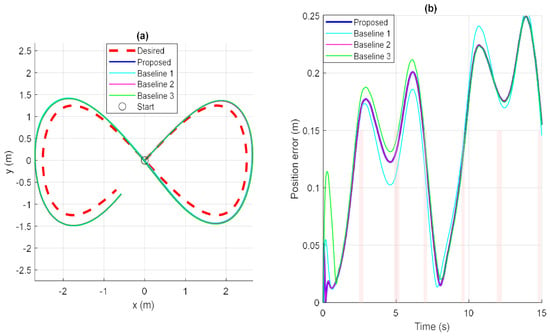
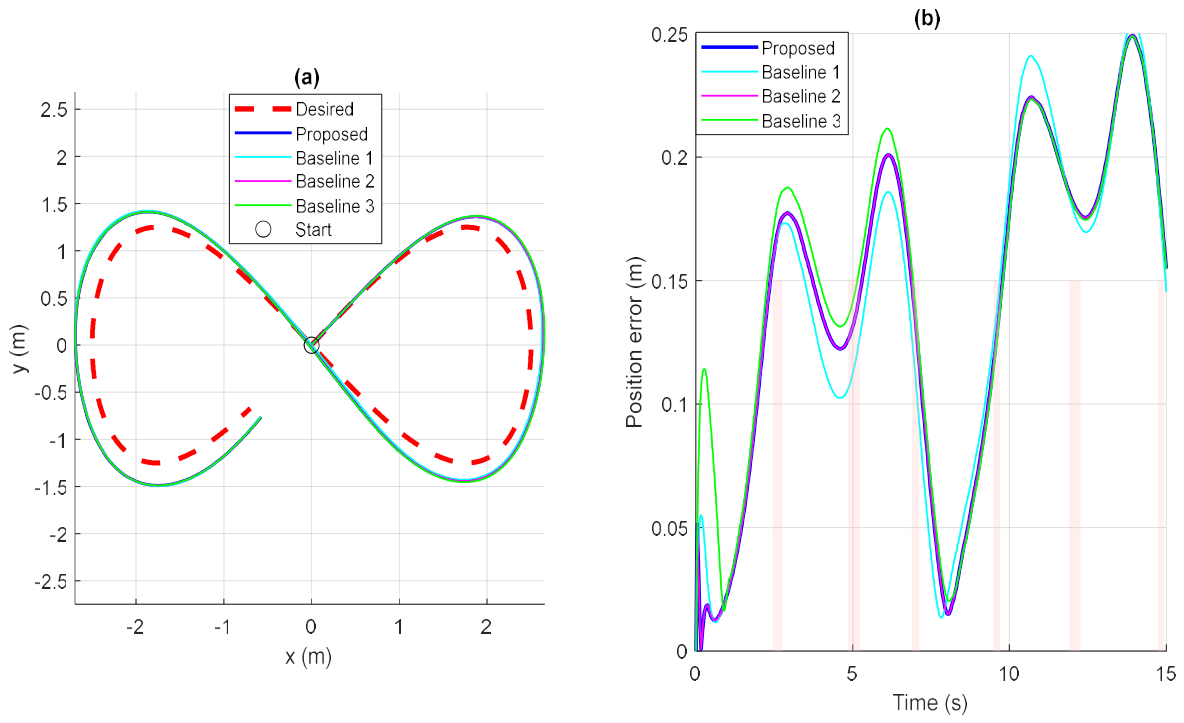
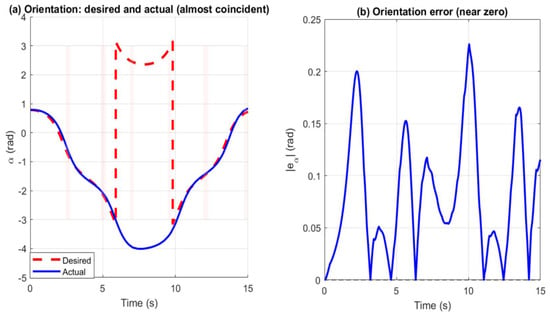
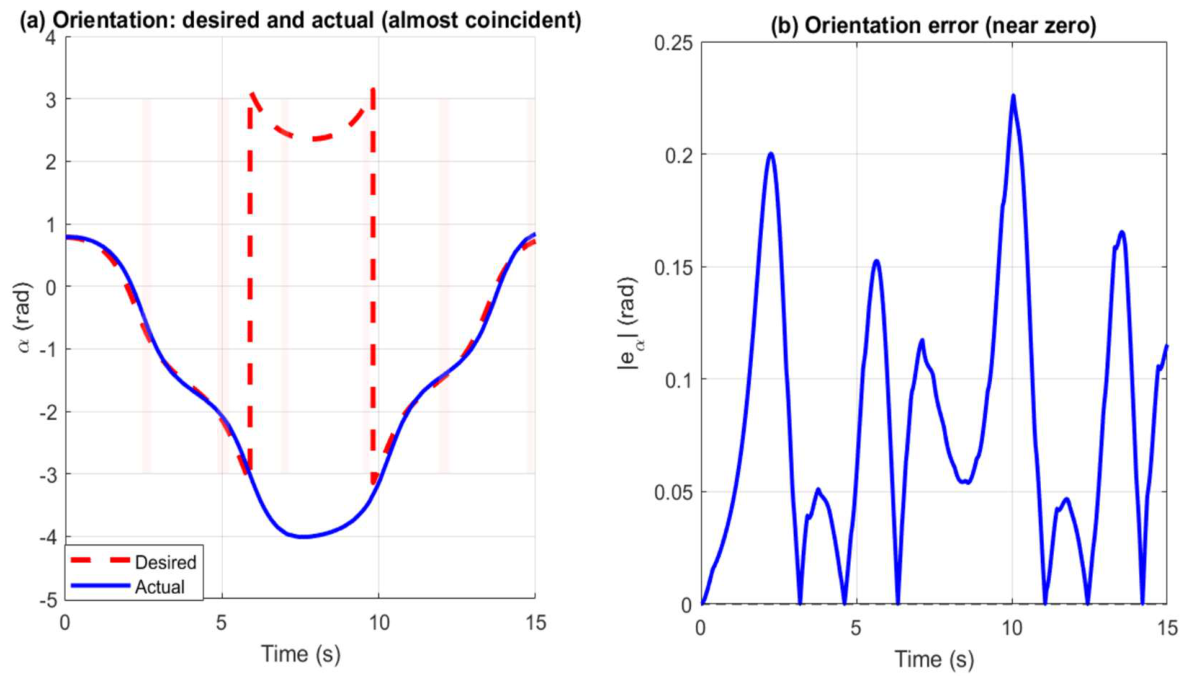
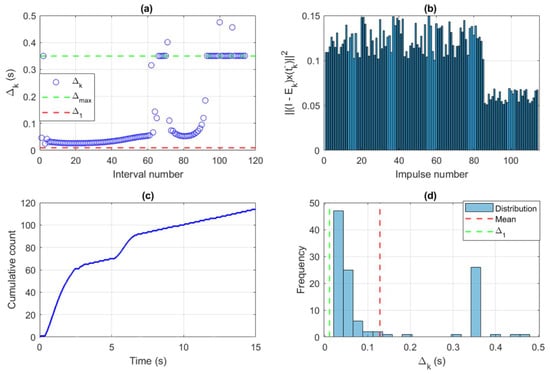
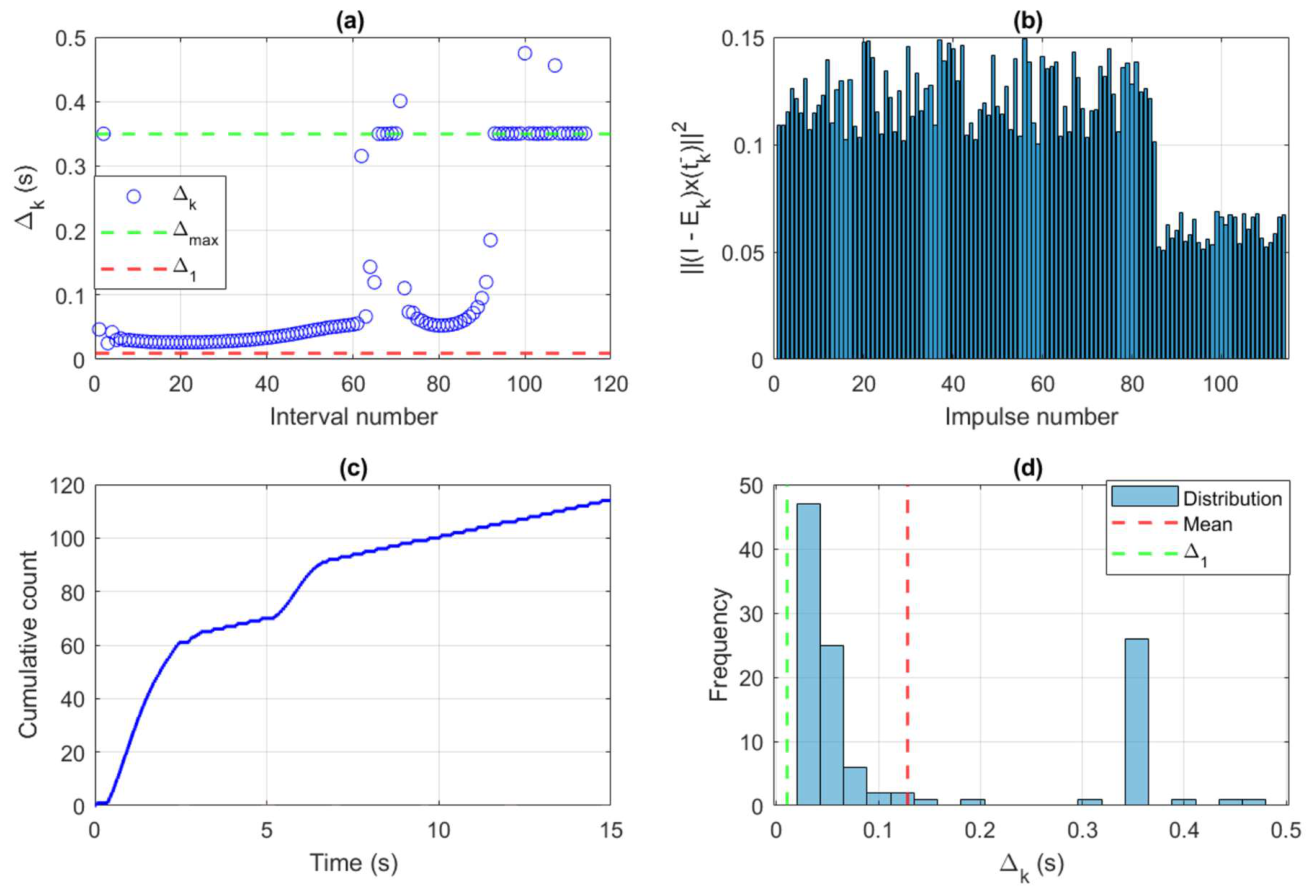
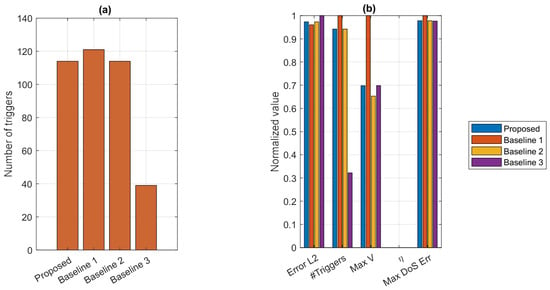
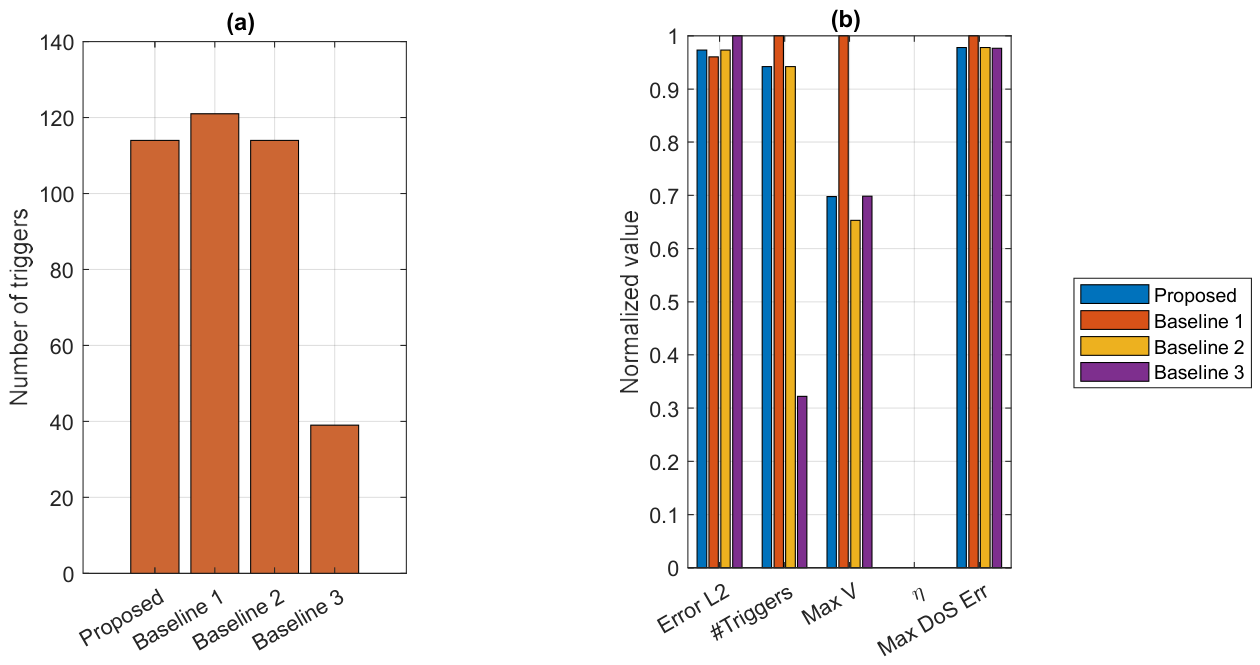
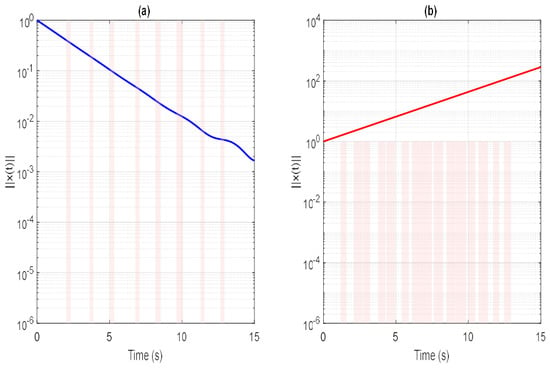
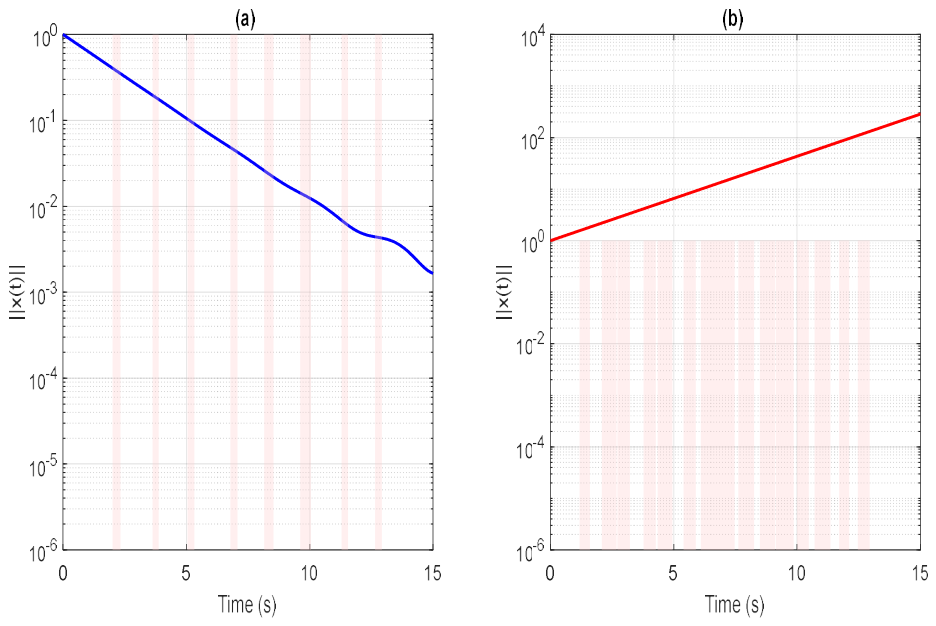
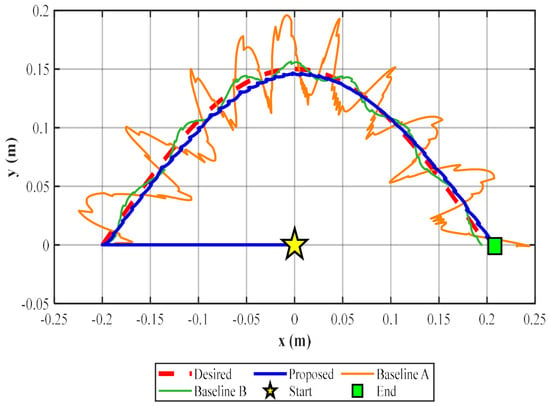
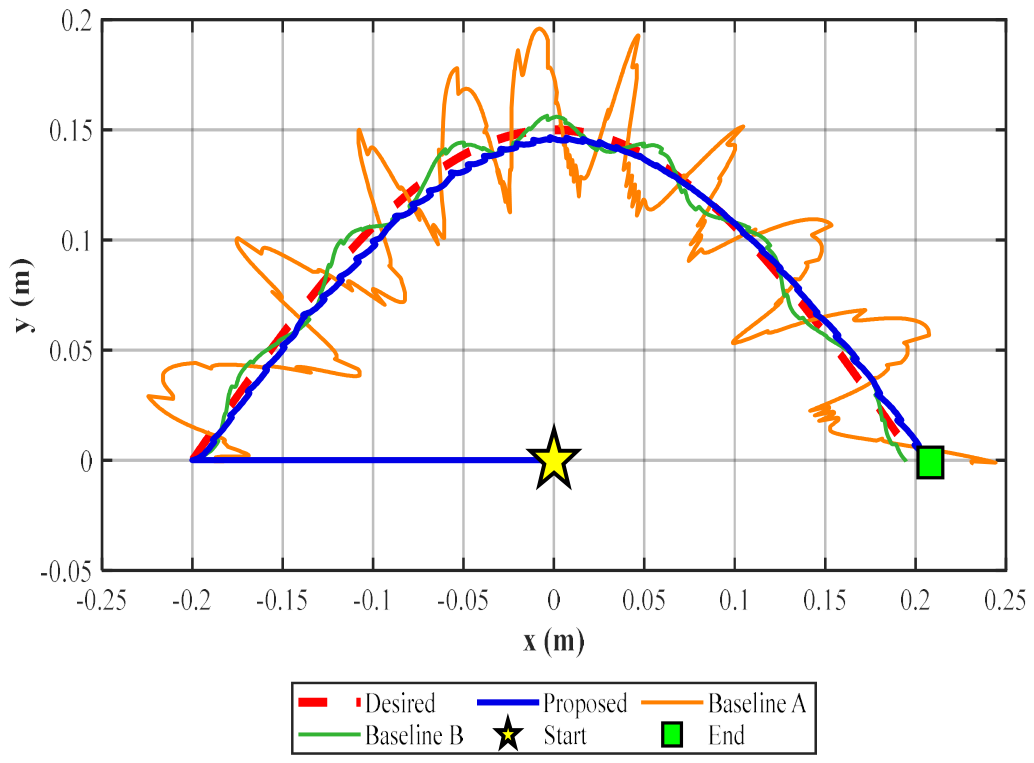
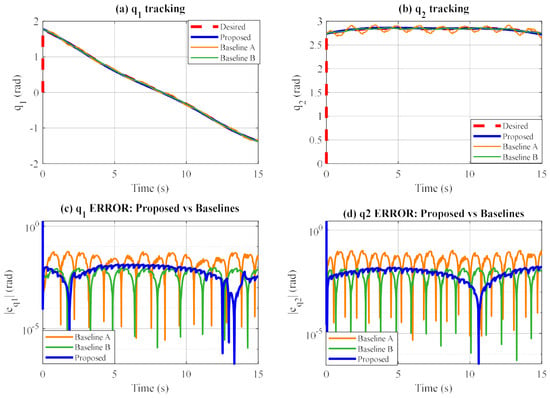
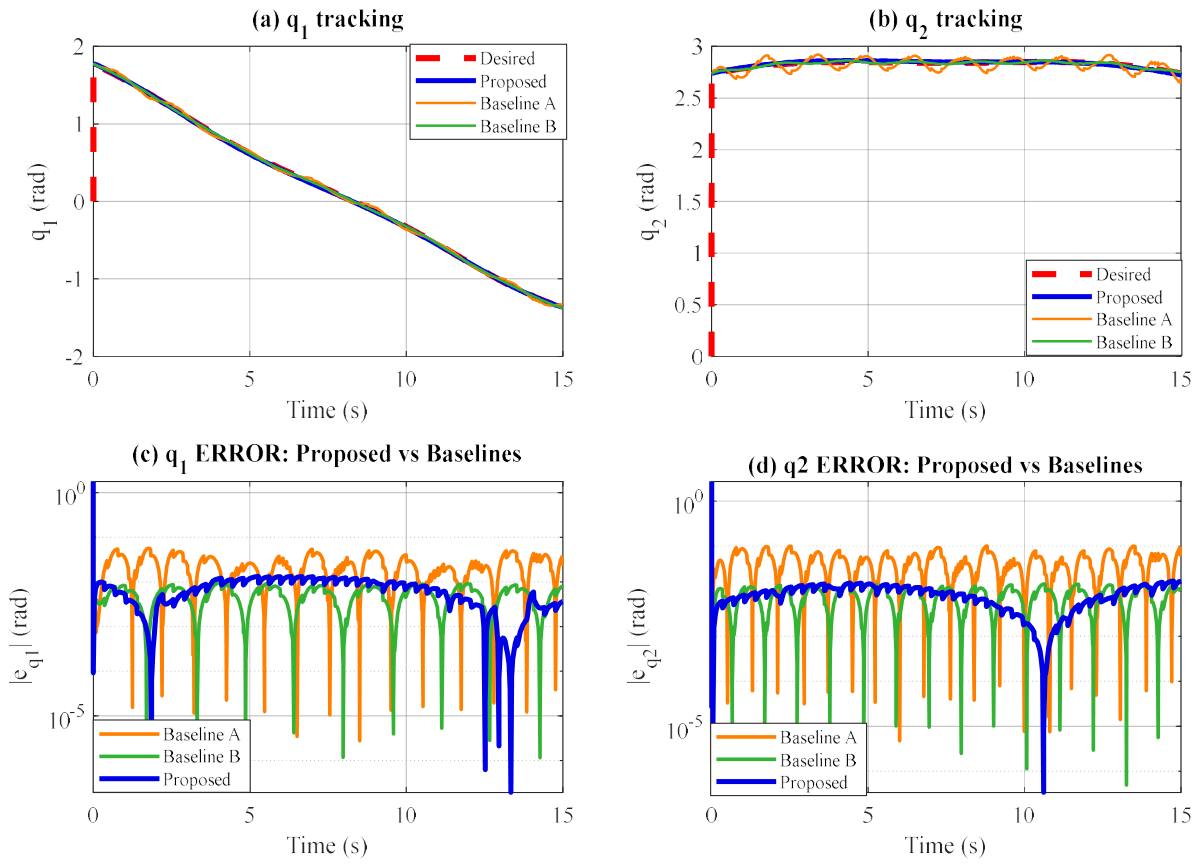
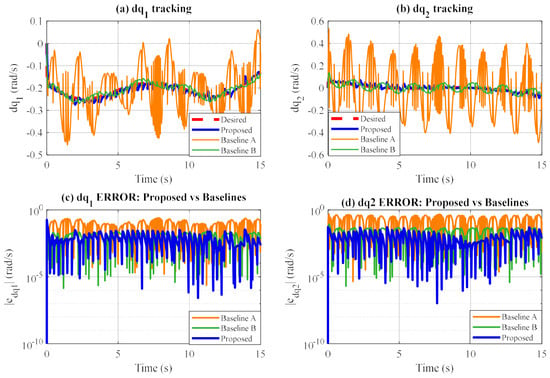
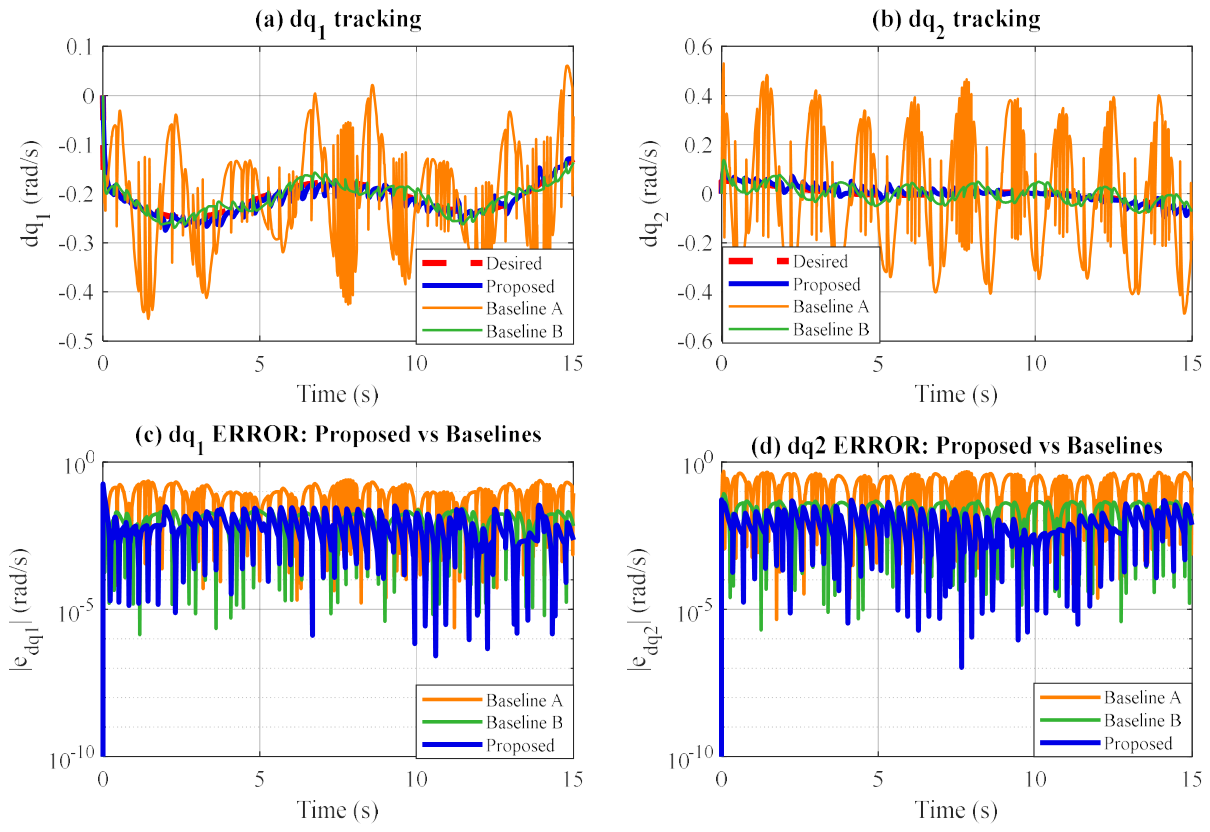
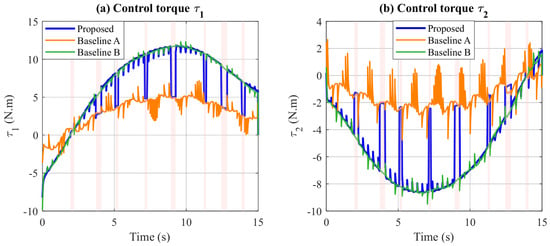
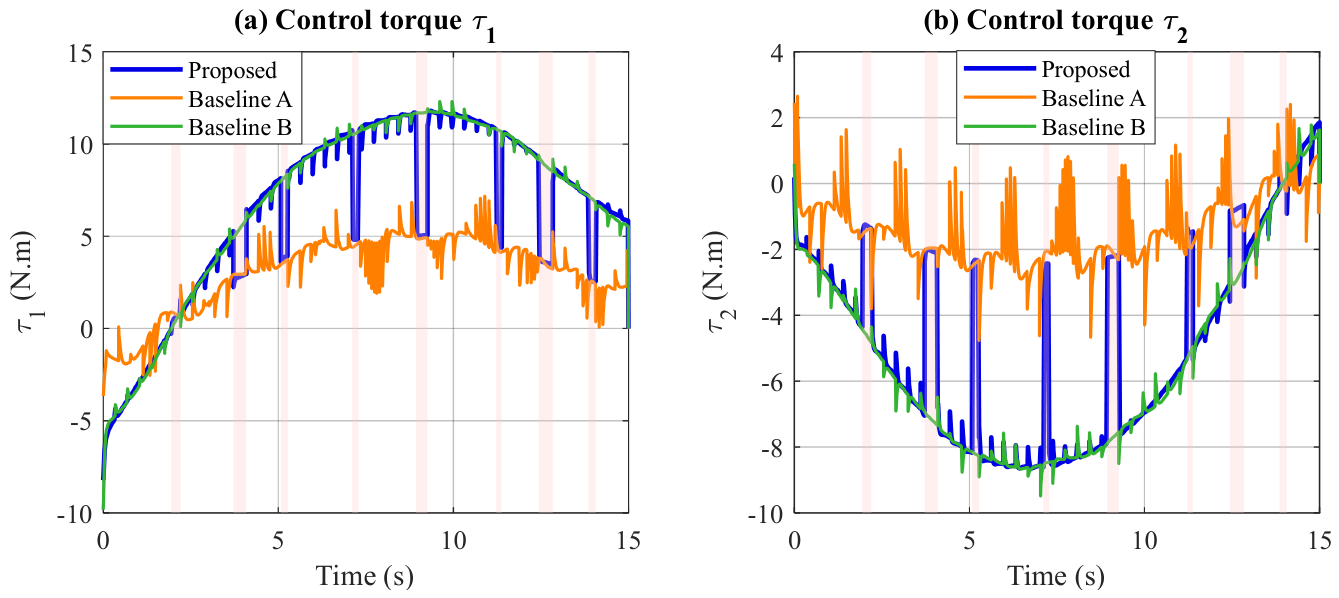
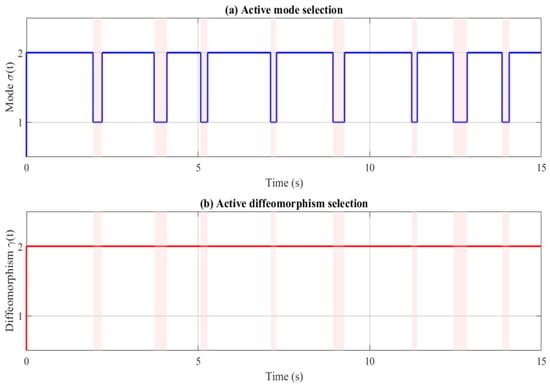
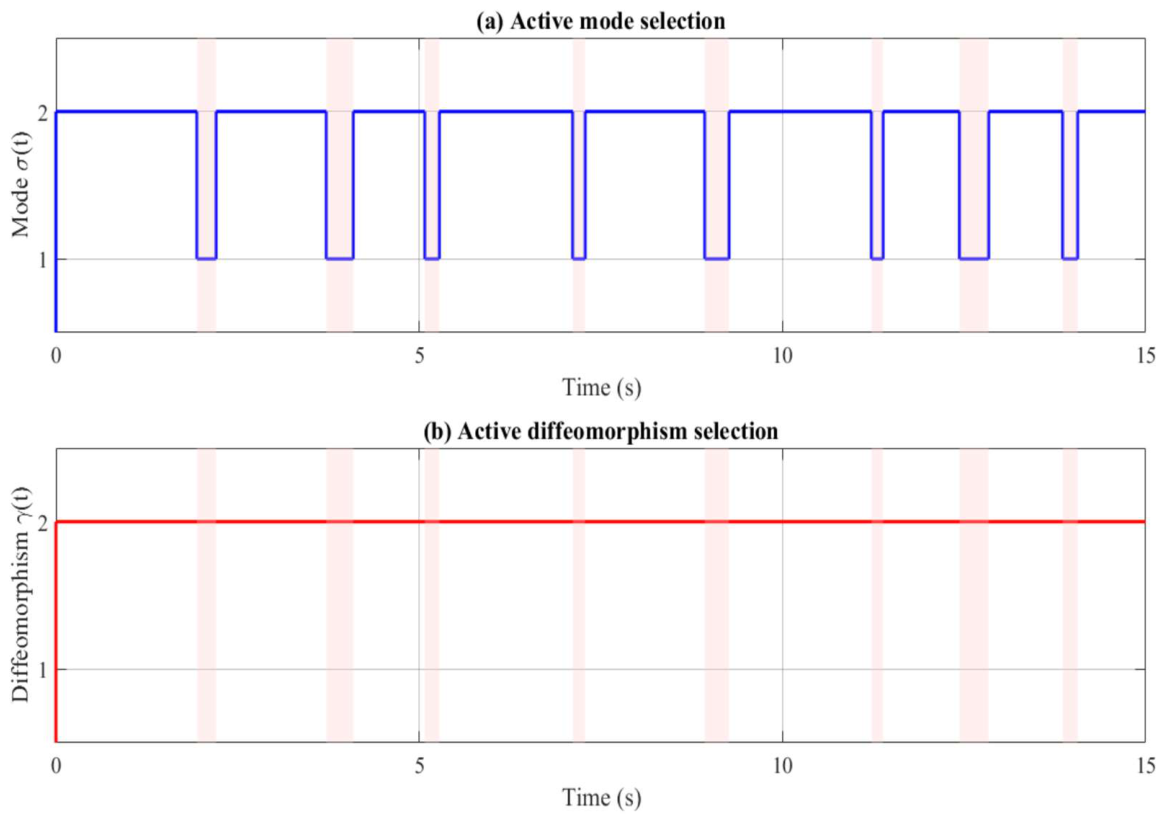
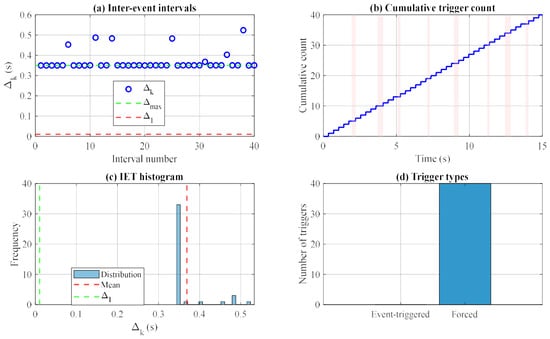
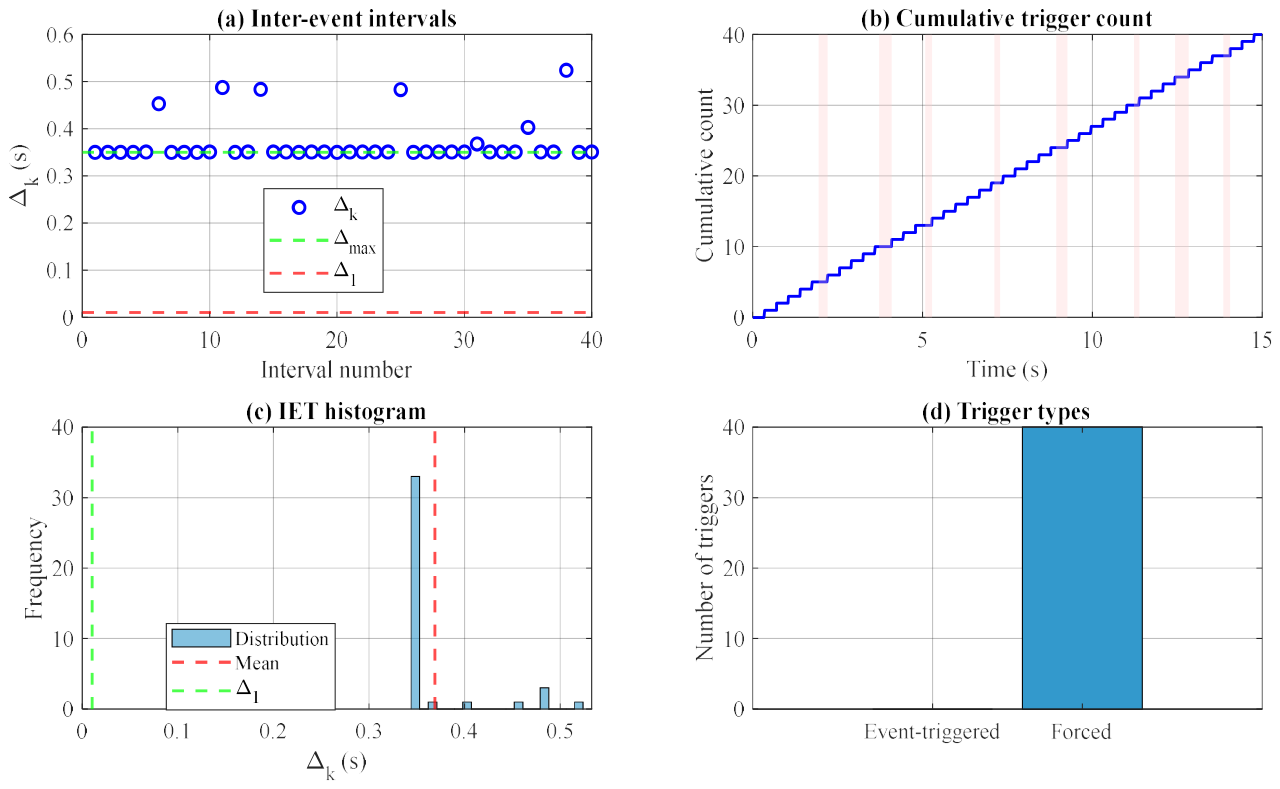

Disclaimer/Publisher’s Note: The statements, opinions and data contained in all publications are solely those of the individual author(s) and contributor(s) and not of MDPI and/or the editor(s). MDPI and/or the editor(s) disclaim responsibility for any injury to people or property resulting from any ideas, methods, instructions or products referred to in the content. |
© 2026 by the authors. Licensee MDPI, Basel, Switzerland. This article is an open access article distributed under the terms and conditions of the Creative Commons Attribution (CC BY) license.