


Abstract
We examine independent start-to-goal path generation in bounded, static two-dimensional geometry, motivated by UAV inspection. RAL-MultiRRT combines artificial-potential-field-guided tree expansion, normalized finite-horizon scoring, and feasibility-checked shortcut refinement. A reconstructed implementation and benchmark provide 700 main path-set attempts and 96 exploratory ablation and sensitivity attempts. An additional 140 budget-validation attempts evaluate increasing iteration budgets and a common nominal search setting, giving 936 recorded attempts in the revised study. The main benchmark comprises four fixed maps with 20 seeds per method, 45 independently generated maps with one seed per method, and one narrow-passage geometry with 15 seeds per method. Five executable variants are reported with explicit implementation identities and budgets. On the fixed maps, APF-MultiRRT and RAL-MultiRRT returned valid sets in 74/80 and 78/80 attempts, respectively. Both succeeded on all 45 independent maps; RAL reduced mean paired path length by 11.38 m but added 0.394 s of recorded planner time. The length difference was not significant after Holm correction across the 20 reported quality/cost comparisons. On S3, however, jointly valid RAL paths were significantly longer and had a larger turning-angle proxy than APF paths after Holm correction. On the single narrow-passage map, valid-set counts were 1/15 and 9/15. The new iteration-budget sweep shows empirical reachability saturation by approximately 200–400 iterations in S1/S2 for the APF-guided variants, while the common-setting diagnostic confirms that matching nominal iteration and step limits does not equalize computational work. These observations support a scenario-dependent quality–computation trade-off, without establishing a general look-ahead advantage, flight-dynamic feasibility, or remote-sensing mission performance.
Keywords:
UAV path planning; multi-goal path-set generation; risk-aware sampling; finite-horizon look-ahead; sampling-based planning; feasibility-preserving refinement MSC:
68T40; 68T20; 90C59
1. Introduction
Unmanned aerial vehicles (UAVs) are increasingly used for inspection, monitoring, and emergency reconnaissance, where a vehicle may need to reach several spatially separated targets under geometric and safety constraints. When all paths begin at a common launch point, inefficient local expansion or unstable waypoint selection can accumulate across targets. A useful planner must therefore balance reachability, geometric compactness, a waypoint-level turning-angle proxy, computation, and obstacle clearance. Here, UAV inspection motivates the geometric task; coverage, image acquisition, and mission execution are outside the evaluated scope.
Sampling-based planners remain attractive because they explore non-convex spaces without a dense global discretization. RRT and RRT* provide the classical foundation, while recent reviews emphasize guided sampling, hybrid search, and task-aware constraints as practical routes to improved efficiency and solution quality. Multi-goal RRT variants extend this family to repeated or cooperative UAV tasks. A feasible tree, however, does not determine how local candidates are generated, how waypoints are selected, or whether refinement preserves feasibility.
Recent UAV planners increasingly combine global search with local directional guidance. Artificial potential fields (APFs) provide low-cost goal attraction and obstacle repulsion and have been embedded in graph, RRT, and formation-planning frameworks. Directional guidance can still be myopic when a waypoint is chosen from immediate distance alone. We therefore use a bounded rollout policy to score short-horizon consequences; the method is not a Monte Carlo tree search and has no action-tree selection or backup stage.
Here we ask whether a MultiRRT-derived planner can couple risk-aware local expansion, finite-horizon waypoint evaluation, and feasibility-preserving refinement within a predictable local computation budget. The question has three linked components: where candidates are generated, how short-term consequences are scored, and whether post-processing preserves the geometric constraints imposed during planning.
To address this question, we implement RAL-MultiRRT as a separate APF-guided tree search for each goal. A bounded evaluator ranks local candidates, and randomized shortcuts are accepted only when the resulting polyline passes the shared geometry and turn checks. The reconstructed implementation and new maps replace the earlier incomplete experimental package. Its central controlled comparison enables or disables look-ahead while retaining the same APF expansion and refinement procedures.
The study makes three bounded contributions:
- 1.
- A MultiRRT-derived workflow for independent paths from one start point to multiple goals, coupling local candidate generation, bounded look-ahead, and constrained refinement.
- 2.
- An APF-guided candidate rule and a finite-horizon score that jointly account for goal distance, local travel, turning, and obstacle risk.
- 3.
- An empirical analysis of 700 recorded benchmark attempts, supported by 96 exploratory parameter trials, that distinguishes independent-map evidence from repeated-seed evidence and reports the computational cost of look-ahead. A further 140 budget-validation attempts test increasing iteration limits and common nominal search settings.
2. Related Work
Bibliometric analyses document the recent growth and diversification of UAV path-planning research [1]. The related literature is organized around the planning problems addressed in this study rather than around a list of isolated algorithm components. The first stream concerns sampling-based and multi-goal UAV planning, the second concerns directional and risk-aware sampling, and the third concerns look-ahead decision and feasibility-preserving refinement. The final subsection positions the present work relative to these streams.
2.1. Sampling-Based UAV Path Planning and Multi-Goal Formulations
RRT rapidly explores continuous non-convex spaces, whereas RRT* adds rewiring to improve asymptotic solution quality [2,3]. RRT*-Smart further adds path optimization and informed sampling after an initial solution is found [4]. Reviews identify sampling distribution, steering, collision checking, and dynamic feasibility as major determinants of practical performance [5,6,7]. UAV studies consequently combine sampling-based planning with informed regions, bidirectional search, local dynamics, semantic information, or task-specific constraints [8,9,10,11,12].
Multi-goal planning covers several distinct task formulations. Some studies optimize a single tour through several targets, while others coordinate multiple UAVs, allocate tasks, or jointly consider inter-vehicle conflicts and dynamic constraints [13,14,15]. The task considered here is narrower: a single UAV starts from the same location and generates a separate collision-free path to each goal. No goal-visitation order, temporal synchronization, or inter-vehicle collision avoidance is optimized. This task boundary separates geometric path-set generation from coordinated mission planning.
Multi-robot navigation provides a useful neighboring robotics formulation. Ali et al. proposed a shortest-distance collision-free navigation strategy that uses the current positions and orientations of multiple robots to coordinate motion in dynamic multi-robot settings [16]. That problem is complementary rather than equivalent to the present one: our planner generates independent geometric paths from a common start in a static map, whereas simultaneous deployment of multiple robots would additionally require temporal coordination, inter-robot collision constraints, and robot-specific motion models. This distinction motivates the robotics transfer discussion in Section 6 without treating the cited multi-robot method as an experimentally matched baseline.
Complementary UAV perception studies address the quality of visual inputs. Recent preprints introduce geometry-aware multimodal alignment in GAAT [17]. Geometric gating selects between homography and optical flow to support temporally consistent low-altitude video segmentation [18]. EgoSIS constructs motion-canonical spatial evidence for UAV reasoning from video [19]. GeoComp and GeoCoT address image geolocation through human gameplay data and visual-context reasoning [20]. These works concern perception and localization; the present experiments assume prescribed obstacle geometry and map coordinates, without evaluating image quality or localization uncertainty.
Communication security introduces a separate risk model for UAV missions. An anti-jamming survey organizes agent decisions around a perception–decision–action loop with game-theoretic and reinforcement-learning strategies [21]. UAV-FPG uses expert knowledge for frequency selection and language models for episode-level opponent trajectory generation in an adversarial communication simulator [22]. IDTD-RL uses a conditional value-at-risk objective for adaptive anti-spoofing defense in UAV communications based on orthogonal frequency-division multiplexing (OFDM) [23]. These communication risks differ from the deterministic obstacle-clearance penalty used here, and their reported results do not establish collision-free geometric planning performance.
2.2. Directionally Guided and Risk-Aware Sampling
APF converts goal attraction and obstacle repulsion into a local motion direction [24]. Its low computational cost makes it suitable as a bias inside a global planner rather than as the sole planning mechanism. Recent UAV studies combine APF with A*, RRT*, bidirectional RRT*, and formation-control schemes [25,26,27,28,29]. These studies motivate potential-guided candidate generation while highlighting its local-minimum and complex-obstacle limitations.
The present implementation uses APF to construct a local candidate fan at a tree node selected by a goal-biased random target. Wider angular supplements are tested when the fan is sparse. This couples directional guidance with tree exploration, but does not by itself establish probabilistic completeness.
2.3. Look-Ahead Decision and Feasibility-Preserving Refinement
Monte Carlo tree search (MCTS) estimates action values through selection, expansion, simulation, and backup [30,31]. We use only the rollout idea as a local evaluator: candidate actions are simulated for a finite depth and scored by their short-term consequences [32]. The planner has no MCTS action tree, selection policy, or backup operation, so we call the module finite-horizon look-ahead.
A second issue arises after a feasible polyline has been found. Node reduction and shortcutting can remove redundant waypoints, while Bézier curves and polynomial trajectories are often used to smooth geometric paths [33,34,35]. These operations are useful only when they preserve the collision and turning constraints imposed during planning. The evaluated implementation uses feasibility-checked shortcuts followed by collinear subdivision, without curve smoothing.
2.4. Research Gap and Positioning
The literature shows substantial progress in guided sampling, hybrid UAV planning, and multi-UAV coordination. This study examines a compact MultiRRT-derived workflow in which risk-aware candidate generation, finite-budget look-ahead, and feasibility-preserving refinement share one task definition and validator. The present experiments isolate the look-ahead switch within the APF-guided implementation and quantify its conditional benefits and added computation.
3. Proposed Method
3.1. Independent Paths and Geometric Feasibility
The revised implementation constructs a separate rooted tree for each goal and returns a path set from a common start . These are independent planning tasks, without goal ordering or inter-path scheduling; the paths within a map are not independent statistical replicates. The present benchmark uses in a static rectangular domain .
For safety radius m, the allowed map region is the closed rectangle . Each obstacle is inflated to . Rectangle inflation uses the exact rounded Minkowski boundary, and a circular obstacle of radius becomes a disk of radius . Obstacle contact is rejected within numerical tolerance ; points on the eroded map boundary are admitted by the implementation. Every accepted path segment is checked continuously against this geometry. For rectangles, the checker uses two orthogonal strips and four corner disks; for circles, it compares the segment–center distance with the inflated radius.
For a feasible point , let be the minimum clearance to the inflated obstacles and the eroded map boundary. Thus c is the remaining clearance after the safety margin has already been applied. The path validator additionally limits each waypoint deflection to , with no prescribed initial heading. These are geometric constraints on polylines, rather than velocity, acceleration, or minimum-turning-radius constraints.
3.2. APF Guidance and Tree Expansion
Let , , and be the normalized numerical clearance gradient, obtained by coordinate perturbations of 2 m clipped to . The implemented guidance vector is
where , , , and m. The repulsive contribution is omitted when the gradient vanishes; a vanishing total force falls back to the goal bearing. This implementation uses the nearest-clearance field, including map boundaries, rather than a sum of individual obstacle forces.
At each expansion, the tree-selection target is the goal with probability 0.45 and a uniform point in otherwise. The nearest existing tree node is selected. Its parent supplies the incoming direction, while APF guidance continues to point toward the actual goal. With , candidates are
The default fan has equally spaced offsets in and m. Candidates must satisfy point, edge, and incoming-turn constraints. A feasible goal connector is also offered when the goal is within one step. If fewer than candidates remain, twelve full-circle directions supplement the fan; if none remain, sixteen full-circle directions are tried. The supplements obey the same geometric checks. No A* or grid-recovery branch is used.
3.3. Normalized Local Cost and Bounded Look-Ahead
For predecessor , current node , and candidate , define and
The turn term is zero at the root. Defaults are and . Distance and travel terms are scaled by the map extent, turning by , and clearance by , giving dimensionless components; this does not imply equal empirical contributions. These benchmark settings replace the earlier unnormalized coefficients. They are declared benchmark choices; no preserved search establishes their optimality. Sensitivity is examined experimentally. The risk term is a clearance penalty, not a collision probability.
APF-MultiRRT ranks candidates using ℓ. RAL-MultiRRT instead averages trials with at most additional transitions after each candidate. Each transition perturbs the APF direction by an independent rad draw and advances by . An infeasible simulated point, edge, or turn terminates its trial with an additive penalty of 0.8. For trial j, let index accepted simulated transitions, indicate this termination, and be a terminal-connection cost. The implemented score is
The coefficient 0.55 is applied equally to each accepted additional transition. When a simulated state comes within one step of the goal, the trial terminates: a collision-free connector contributes ; a blocked connector adds nothing. This terminal scoring branch does not check its new turn, whereas actual tree goal insertion and final path validation do. Consequently, the rollout is a heuristic score rather than a certificate of feasible completion, and failed trials retain finite scores.
Both variants add to the ranking score. The best candidate and, when at least three candidates exist, the third-ranked candidate are considered for insertion. Candidates within of an existing node are skipped. Valid goal connection terminates the search; otherwise it continues for at most 700 expansion iterations per goal. The APF and RAL branches share the tree, candidate generator, nominal iteration limit, and refinement; rollout draws consume the same random-number stream, so matching seeds does not impose identical subsequent samples. Bounded rollout work is proportional to per expansion, in addition to tree search and collision checking. Algorithm 1 summarizes the executable expansion and acceptance procedure.
| Algorithm 1 Executable APF-guided tree search with optional look-ahead |
|
3.4. Feasibility-Preserving Refinement and Implementation Identity
Each reconstructed path receives up to 80 randomized shortcut attempts. A shortcut removes the intervening vertices only when the connecting segment and the full replacement path pass the geometric and turn checks. The resulting polyline is then subdivided into collinear segments no longer than 12 m. This preserves its geometry; no Bézier smoothing is applied. Final acceptance requires every goal path to pass the path validator.
For the supplied comparators, the code key MultiRRT denotes separate goal-biased RRT searches. The RRTStar implementation adds least-cost parent selection and rewiring within a fixed 70 m neighborhood. It may terminate on a new goal connection more than 20 iterations after the first connection, rather than exhausting its iteration limit; the returned connection is the latest one recorded. It is evaluated as a finite-budget implementation, without an asymptotic-optimality claim. The key RRTStarSmart adds 120 shortcut attempts before the common refinement and is therefore reported as RRT*+shortcut, rather than as the canonical RRT*-Smart algorithm. These comparator implementations use 260 iterations, 60 m steps, and goal bias 0.35. Thus, APF versus RAL is the direct mechanism comparison; the five-method benchmark does not equate iteration, sample, collision-check, or elapsed-time budgets across all methods. Baseline identity was re-audited for this revision. The internal key RRTStarSmart is retained only for code compatibility; throughout the manuscript and new budget diagnostics, it is labeled RRT*+shortcut. We do not claim that this implementation reproduces canonical RRT*-Smart, whose informed sampling mechanism is discussed only as prior work [4].
4. Experimental Design and Analysis
4.1. Reconstructed Maps and Replication
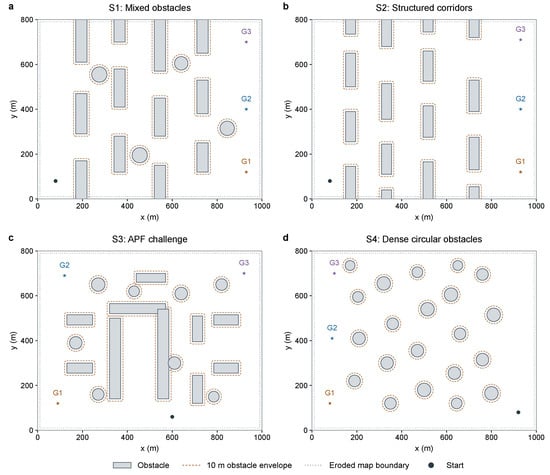
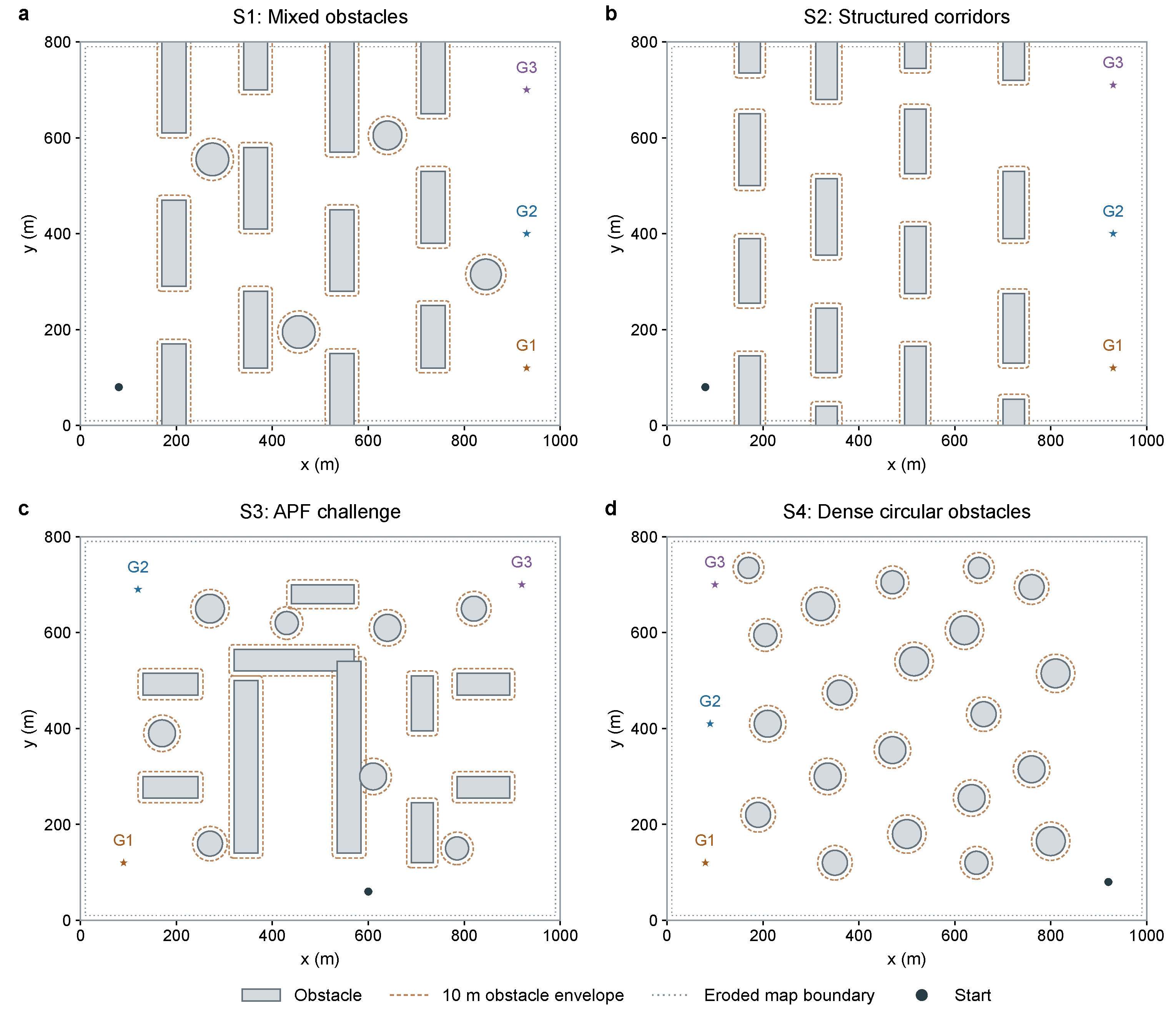
The revised package contains the planner, validator, drivers, obstacle geometry, starts, and every goal coordinate. Because the earlier implementation and complete coordinates were unavailable, this is a new benchmark with reconstructed algorithms and maps, rather than a numerical reproduction of the old tables. All maps have extent m and safety radius 10 m. The fixed scenarios contain 12 rectangles and 4 circles (S1), 16 rectangles (S2), 10 rectangles and 8 circles (S3), and 21 circles (S4), respectively. Figure 1 shows their geometry.
Figure 1.
Reconstructed fixed benchmark maps: (a) S1, (b) S2, (c) S3, and (d) S4. Coordinates are in meters; dashed outlines show the 10 m obstacle safety envelope. The orange, blue, and purple stars mark goals G1, G2, and G3, respectively; the black circle marks the start. Starts and all three goals are preserved in the supplied scenario JSON files. These layouts replace the incompletely archived earlier scenarios.
The main benchmark contains 400 fixed-map attempts, with seeds 1000–1019 for each method and map. D1, D2, and D3 contain 15 independently generated layouts each, with 10, 18, and 26 obstacles, respectively. These layouts share three fixed obstacle anchors and sample the remaining obstacles subject to spacing and terminal-clearance filters. Map acceptance uses a coarse 25 m grid-node reachability screen and requires at least two obstructed direct start–goal rays; continuous feasibility is assessed by the planner validator. Each accepted map is evaluated once per method. The 15 files labeled Narrow have identical obstacle geometry and differ only in identifier. They therefore provide 15 planner-seed repeats on one fixed stress map, not 15 independent map replicates. The 300 extended-suite attempts comprise 225 independent-map attempts and 75 Narrow repeats.
Methods share map/seed blocks. For goal index , the driver initializes the random generator with , where s is the run seed. D1–D3 use distinct map-seed ranges 50000–50014, 51000–51014, and 52000–52014; planner seeds are 8000–8014 within each group. Shared seeds provide matched initialization, but extra rollout draws change subsequent target and shortcut sequences. The 96 additional trials are exploratory parameter sweeps and do not increase the independent-map sample size (Table 1). No prospective power calculation or independent tuning/test split is documented.
Table 1.
Verified experiment inventory. Bold column headings identify the table fields, and the bold final row gives the totals. One attempt evaluates three goal paths; these paths are not three statistical replicates. Auxiliary settings use smaller iteration limits and are not included in the main benchmark.
4.2. Budget, Timing, and Execution Checks
APF and RAL share the nominal search and refinement settings in Table 2; look-ahead adds work per candidate. The RRT-family branches use different iteration limits, step lengths, and stopping rules. Their results are implementation-specific reference comparisons, not equal-resource rankings. The extended suite has a common 12 s wall-time cap per path-set attempt; auxiliary sweeps have a 4 s cap and iteration limits of 150 for look-ahead and 180 for the other sweeps. No recorded attempt reached the wall-time cap.
Table 2.
Implemented main-benchmark settings. Limits are per goal. RRT*+shortcut denotes the supplied extra-shortcut variant, not canonical RRT*-Smart.
Two additional diagnostics were run after the main benchmark. First, APF-MultiRRT and RAL-MultiRRT were evaluated on S1 and S2 at with five seeds per setting (80 path-set attempts) to measure finite-budget reachability and quality saturation. Second, all five executable variants were rerun on S1–S4 with a common nominal setting of , 50 m step length, and target probability 0.45 where that parameter is exposed, using three seeds per map (60 attempts). This common-setting replay improves comparability of nominal search limits, but it is not an equal-computation experiment because APF, look-ahead rollouts, rewiring, shortcuts, and collision checks perform different amounts of work per iteration.
Recorded runtime sums the planner/refinement timers for the three goals and excludes metric calculation and the outer final validation call. APF/RAL also perform an internal validation inside their timed routine, so the recorded times are not identical end-to-end workloads across families. Cost counters report expanded nodes, segment collision checks, full-path validator calls, APF evaluations, and rollout trials. The sample counter counts target samples in the RRT branches but candidate attempts in APF/RAL; it is not a common unit of work across those families. Hardware and complete original runtime metadata are not embedded in the records, limiting external timing comparisons.
The executable dispatch was inspected and its identity test rerun. APF-MultiRRT calls APF without rollout; RAL calls both, and neither route includes A* or grid recovery. All 700 main records have consistent call counters, and scenario hashes match the supplied map files. The continuous geometry tests passed 10,000 random segment cross-checks. All 20 saved representative path sets passed the geometric audit. A five-variant replay of S1 seed 1000 reproduced the saved validity, path lengths, and operation counters, excluding runtime; this was a targeted reproducibility check, not a second main benchmark. The 140 added budget-validation attempts are reported separately from the original 796-run exact-revalidation release. The legacy A*-labeled stress results are not used in the revised tables.
4.3. Evaluation Populations and Metrics
Length is computed on the returned polyline. For turning and clearance summaries, every path is sampled at arc lengths m and at its endpoint, leaving a potentially shorter final interval. If K sampled interior angles are available, the reported turning statistic is and the curvature proxy is ; both are assigned zero when no interior angle exists. The reported minimum clearance is at these samples, rather than the exact continuous minimum along the path. Common sampling reduces representation differences but does not establish continuous curvature or flight-dynamic feasibility. Within a complete path set, length and turning are averaged across the three goals, whereas clearance is the minimum across goals.
We denote sampled minimum clearance by to distinguish it from the continuous path minimum. Although collision checks are continuous, can exceed the true minimum between samples and is not a certified additional safety margin. The curvature proxy is exactly , so it is not treated as an independent endpoint. The driver marks a path set valid only when all three goal outputs pass its path validator, which checks geometry and turns; endpoint identity is imposed by path construction rather than independently tested in that validator. Length and turning are averaged over the three returned paths, while runtime includes attempts that fail. The stored complete, collision-free, and valid columns are identical by construction and are not interpreted as separately measured attrition stages.
4.4. Statistical Analysis
Descriptive tables report valid-set counts, medians of quality metrics among valid attempts, and runtime medians over all attempts. APF–RAL comparisons use paired map/seed blocks. Quality differences include only jointly valid pairs; runtime differences include all paired attempts. Consequently, quality effects are conditional on joint success and are interpreted alongside success counts. S1–S4 analyses describe seed variability conditional on each fixed map. Narrow is reported separately as a fixed-map stress test. Independent-map inference is restricted to the 45 D1–D3 maps, with equal representation of the three density strata.
The revision reanalysis computes mean paired differences (RAL minus APF) and 95% percentile bootstrap intervals from 10,000 paired resamples. D1–D3 bootstrap resampling preserves 15 maps per density. Two-sided random-sign tests use the absolute mean difference, enumerating all sign patterns for and using 100,000 random sign patterns otherwise, with a plus-one Monte Carlo correction. These tests assume exchangeability of method labels within pairs, or sign symmetry under the null; identical seed numbers alone do not establish that assumption. The reported Holm correction covers 20 comparisons: four endpoints (length, turning, , runtime) in each of S1–S4 and pooled D1–D3. The nominal bootstrap intervals are not simultaneous intervals. This is a post hoc analysis, not a preregistered test family. Narrow success and the small parameter sweeps are descriptive. The reanalysis reported here was performed with NumPy 2.4.3 and pandas 2.3.3. The cited public repository contains an earlier grouped analysis and does not include the executable script for the final 20-comparison reanalysis; accordingly, the final inferential results cannot currently be regenerated from the public release alone.
5. Results
5.1. Fixed-Map Benchmark
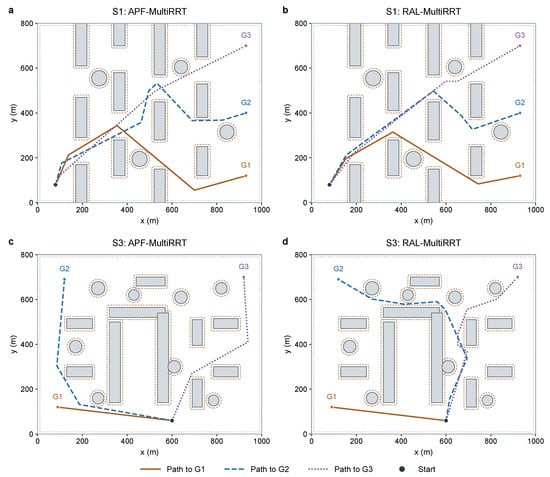
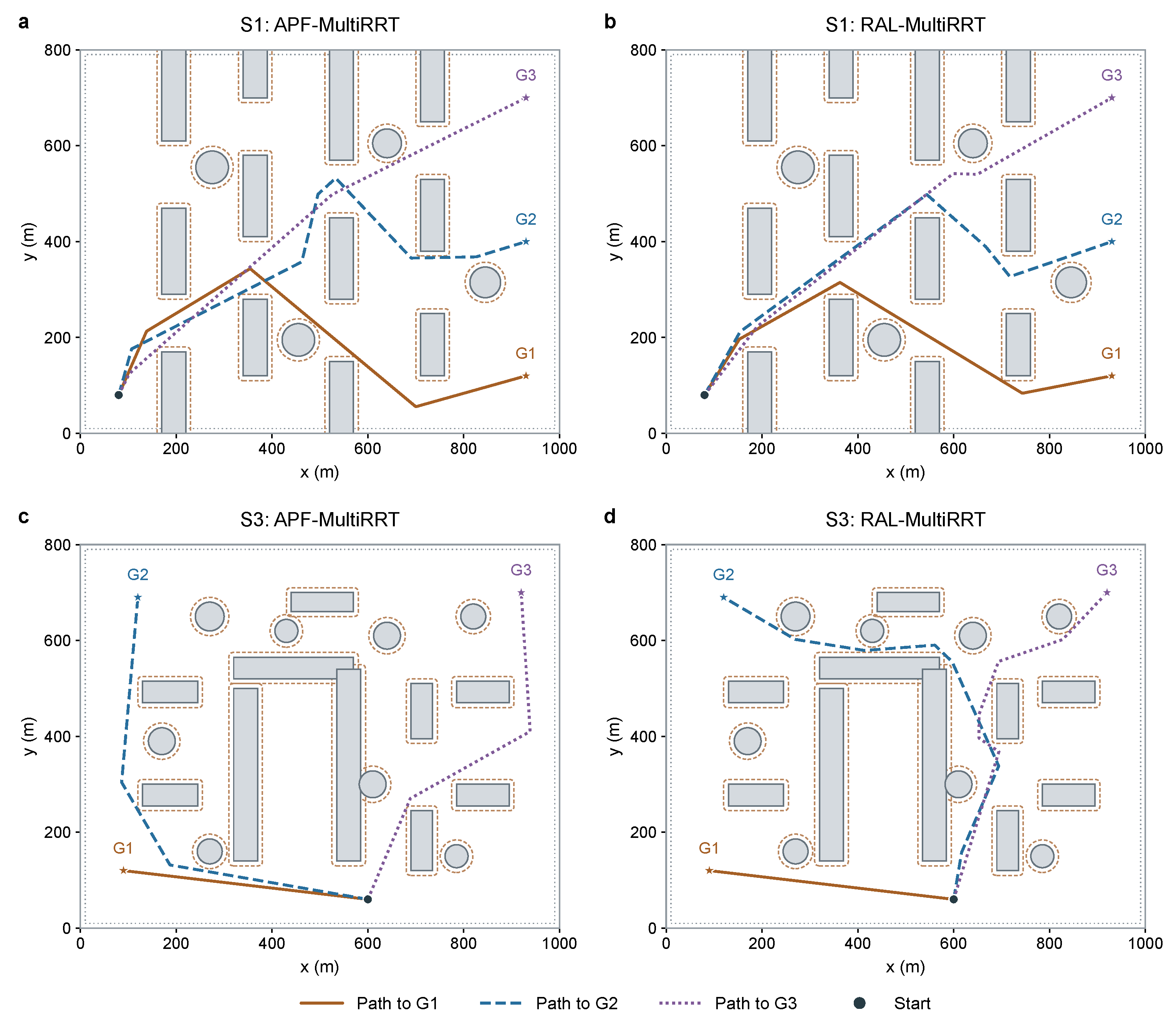
All five executable variants produced valid path sets in the reconstructed fixed scenarios (Table 3). Across 80 attempts per variant, valid counts were 49 for MultiRRT, 48 for RRT*, 49 for RRT*+shortcut, 74 for APF-MultiRRT, and 78 for RAL-MultiRRT. S3 was the most difficult fixed scenario. The larger sample replaces the earlier single-run descriptors, but the comparator budgets and the extra-shortcut baseline identity limit cross-family ranking. Figure 2 shows saved APF/RAL outputs rather than a selection of best-scoring runs.
Table 3.
Fixed-map outcomes with 20 seeds per method and scenario. Quality columns are medians among valid attempts; T includes every attempt. L is mean length per goal, S the resampled turning proxy, and the sampled clearance to safety-inflated geometry.
Figure 2.
Illustrative saved paths using seed 1000: (a) APF-MultiRRT on S1, (b) RAL-MultiRRT on S1, (c) APF-MultiRRT on S3, and (d) RAL-MultiRRT on S3. Every displayed set contains three start-to-goal paths and was rechecked against the stored map, endpoints, and validator. Different paths across methods reflect different candidate rankings and subsequent random-number consumption; these examples do not establish a distributional ranking.
5.2. Independent Maps and Narrow-Passage Repeats
Table 4 replaces the earlier stress table with the corrected APF execution route. APF and RAL each succeeded on all 45 D1–D3 maps. On the one Narrow geometry, APF succeeded in 1/15 seed repeats and RAL in 9/15; MultiRRT and the two RRT* variants each succeeded in 4/15. This is a difference conditional on that map, not evidence from 15 distinct narrow-passage layouts. Only one Narrow pair is jointly valid, so no paired quality interval is estimated for that case.
Table 4.
Extended-suite results. D1–D3 each contain 15 independent maps, one attempt per map and method. Narrow contains one geometry with 15 planner-seed repeats. Quality medians use valid attempts and runtime medians use all attempts; column definitions match Table 3.
5.3. Incremental Look-Ahead Effects
The paired analysis does not support a universal path-quality benefit from look-ahead. In S3, jointly valid RAL paths were longer and had a larger turning proxy; the Holm-adjusted p values were 0.0073 and 0.0359, respectively. S1 and S2 length intervals spanned zero. The nominal length decrease in S4 did not survive the 20-comparison correction. Recorded runtime increased in every fixed scenario (Table 5). These conditional quality comparisons do not erase RAL’s additional successful attempts in S2 and S3.
Table 5.
Fixed-map APF–RAL paired effects, conditional on each map. Differences are RAL minus APF. Length uses jointly valid pairs; runtime uses all pairs. Intervals are nominal 95% percentile bootstrap intervals. Adjusted p values use the full 20-comparison Holm family, including turning and clearance tests retained in the analysis outputs.
Across D1–D3, RAL paths were shorter on average, with a nominal interval below zero, but the length test did not survive the full Holm correction (Table 6). Neither the turning proxy nor sampled clearance showed an established improvement. The consistently greater runtime, coupled with identical observed success on these 45 maps, makes the result a possible length–cost trade-off rather than a general advantage in reachability or risk reduction.
Table 6.
Paired effects on the 45 independent D1–D3 maps, all jointly valid for APF and RAL. Differences are RAL minus APF. Density-stratified bootstrap intervals are nominal; adjusts the full 20-comparison family. Narrow is excluded from this independent-map analysis.
5.4. Budget-Sensitivity and Common-Setting Diagnostics
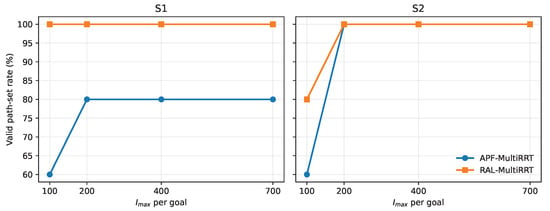
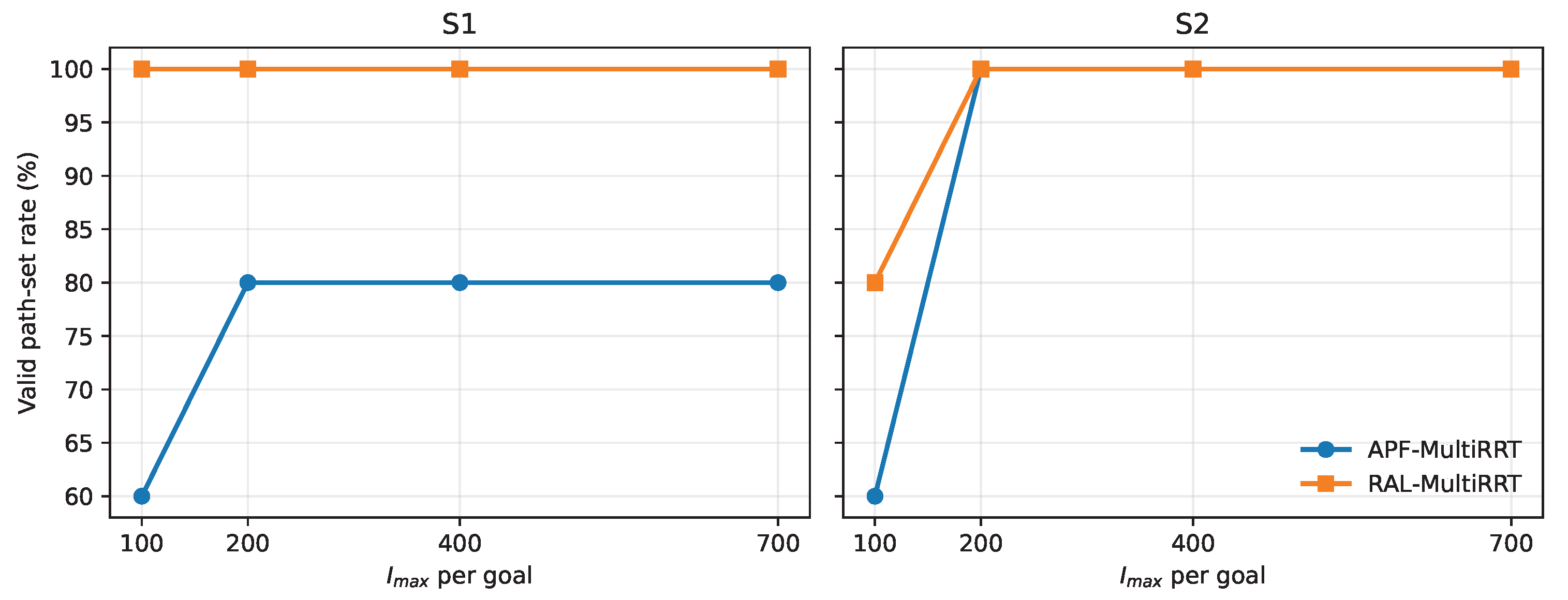
The increasing- diagnostic provides the previously missing empirical reachability check. Figure 3 and Table 7 show that increasing the iteration budget from 100 to 200 improved APF validity on S1 from 3/5 to 4/5 and on S2 from 3/5 to 5/5; RAL was 5/5 on S1 at every tested budget and improved from 4/5 to 5/5 on S2. From 200 through 700 iterations, the observed valid-set counts did not increase further in these two maps. Median path length also did not improve monotonically with . The result is evidence of finite-budget saturation under these settings, not a proof of probabilistic completeness or asymptotic convergence.
Figure 3.
Increasing- reachability diagnostic for APF-MultiRRT and RAL-MultiRRT on S1 and S2. Each point summarizes five path-set attempts.
Table 7.
Increasing- diagnostic. Valid counts are out of five seeds. Length and runtime are medians at ; length uses valid attempts, and runtime includes all attempts.
A second diagnostic applies the same nominal and 50 m step to all five implementations. No attempt reached the 6 s diagnostic cap. Table 8 reports valid path sets from three seeds per map. The result reduces one source of budget mismatch but still does not support a claim of equal computational cost: for example, look-ahead requires thousands of extra collision checks relative to a tree iteration, and RRT* rewiring and shortcut trials also add method-specific work. The table is therefore a matched-setting robustness check rather than a new overall ranking.
Table 8.
Common nominal-search-setting diagnostic: valid path sets out of three attempts on each fixed map. All variants use and a 50 m nominal step; target probability 0.45 is applied where exposed by the implementation.
5.5. Look-Ahead and Parameter Sensitivity
The sweep increased recorded runtime without monotonic improvement in path quality or success (Table 9). At , all six S1/S2 attempts failed under the 150-iteration auxiliary limit; none reached the 4 s wall-time cap. These trials show sensitivity to rollout settings and search behavior, not convergence as increases. The smaller auxiliary budgets and three seeds per setting do not establish an optimal default.
Table 9.
Look-ahead sweep on S1/S2. Each setting uses three seeds, , and a 4 s path-set cap. Length medians use valid attempts; runtime medians include failures. A dash indicates no valid output.
The remaining S2 sweeps also produced mixed outcomes (Table 10). Candidate count and influence radius changed both success and cost. The weight sweep retained 26/27 valid attempts, with length and sampled-clearance medians varying across settings; it does not show that the declared weights uniquely balance the objectives. Increasing repulsion gain improved observed success in this small sweep while the corresponding sampled-clearance medians decreased. Thus, normalization makes the cost terms dimensionless, but does not imply equal contributions, monotonic risk reduction, or globally optimal tuning.
Table 10.
Exploratory S2 sensitivity trials, using and a 4 s cap. Unvaried parameters retain their defaults. Each row reports valid attempts, median length and sampled clearance among valid attempts, and median runtime over all attempts. Three seeds are used per candidate/radius or weight setting, and four per repulsion setting.
6. Discussion
The reconstructed experiment provides executable algorithm and geometry evidence beyond the earlier single-run audit. Its central comparison is APF versus RAL, whose implementations share the search and refinement mechanisms while differing in finite-horizon ranking. The new results show where that additional ranking changes the outcome, but not a universal gain. RAL obtained more valid sets on S3 and the single Narrow geometry, while S3 jointly valid paths were longer and had larger turns. On independent D1–D3 maps, the average length decrease was small relative to approximately kilometer-scale paths and did not survive correction across all reported comparisons. Additional computation was the most consistent effect.
Interpretation should therefore emphasize task-dependent trade-offs. A user who values success on the tested narrow layout may prefer the extra computation, whereas the present independent-map evidence does not establish improved safety clearance or broad superiority over the simpler APF variant. The clearance objective remains a geometric penalty; neither the sampled clearance metric nor the rollout score estimates collision probability. The rollout terminal-connection behavior and shared random-number stream also limit a stronger causal interpretation of the scoring mechanism.
The five-method main tables use transparent but unequal search budgets. The extra-shortcut RRT* implementation does not supply the intelligent sampling of canonical RRT*-Smart, and fixed-radius rewiring with early termination does not test asymptotic RRT* behavior. The Narrow repeats concern one layout, and parameter sweeps are small and exploratory. These limitations remain concise boundaries on the reported evidence rather than completed extensions.
The added increasing- sweep supplies an empirical finite-budget saturation check on S1/S2, while the common-setting replay reduces nominal budget mismatch across the five implementations; neither experiment proves completeness, asymptotic convergence, or equal computational effort.
The geometric path-set formulation also has a potential robotics interpretation. A warehouse, inspection, service, or mobile-manipulator fleet may depart from a common depot and require alternative static-map routes to several workstations or inspection points. In that setting, the present APF-guided expansion, exact geometric validator, and per-goal path-set output could serve as a spatial planning layer. It is not, however, a complete multi-robot navigation system. Ali et al. explicitly use multiple robots’ current positions and orientations to construct collision-free navigation in a dynamic multi-robot setting [16]; adopting the present planner for simultaneous robots would similarly require temporal assignment and scheduling, inter-robot collision constraints, robot footprint and kinematic models, velocity and acceleration limits, and online replanning for moving obstacles. Thus, the recommended robotics literature identifies a concrete extension path while remaining outside the evidence tested here.
The study is restricted to static two-dimensional polylines. The safety disk and waypoint-turn limit do not establish velocity, acceleration, jerk, attitude, minimum turning radius, or control feasibility. No 3D environment, moving obstacle, coverage objective, or image-acquisition measure was evaluated. Remote sensing and UAV inspection remain application motivations; empirical conclusions apply only to the tested geometric planning task.
7. Conclusions
The revised RAL-MultiRRT benchmark contains 700 main path-set attempts and 96 exploratory parameter trials with complete local planner and map files. The present editorial revision adds 140 budget-validation attempts, for 936 recorded path-set attempts in total, including an increasing iteration-limit reachability check and a common nominal-setting replay. It replaces the earlier mislabeled APF stress route and single-run tables with an explicitly specified APF-guided tree implementation, continuous segment collision checking, and common arc-length metric sampling. The results show higher observed valid-set attainment in selected fixed scenarios at greater computation, without a general corrected path-quality advantage.
The added diagnostics support finite-budget saturation in the tested S1/S2 settings but do not establish completeness or equal computational cost. The potential robotics application is therefore framed as a spatial planning layer that would require additional multi-robot coordination and dynamic feasibility mechanisms.
The evidence supports a bounded static 2D study and a conditional quality–cost trade-off. The experiment package is publicly available, with the scope and limitations of the released materials specified in the Data Availability Statement.
Author Contributions
Conceptualization, D.S. and T.Z.; methodology, D.S. and T.Z.; software, D.S. and T.Z.; validation, C.F., S.J. and M.Z.; formal analysis, C.F.; investigation, D.S.; resources, S.J.; data curation, T.Z.; writing—original draft preparation, T.Z.; writing—review and editing, C.F. and S.J.; visualization, T.Z.; supervision, S.J.; project administration, S.J.; funding acquisition, D.S. All authors have read and agreed to the published version of the manuscript.
Funding
This research was funded by the National Natural Science Foundation of China, grant number 62003225; and by the Liaoning Province International Industrial Technology Research and Development Program, grant number 2026JH2/101900019.
Data Availability Statement
The original contributions presented in this study are included in the article. Further inquiries can be directed to the corresponding author.
Conflicts of Interest
The authors declare no conflicts of interest.
References
- Wu, Q.; Su, Y.; Tan, W.; Zhan, R.; Liu, J.; Jiang, L. UAV path planning trends from 2000 to 2024: A bibliometric analysis and visualization. Drones 2025, 9, 128. [Google Scholar] [CrossRef] [Scilit]
- LaValle, S.M. Rapidly-Exploring Random Trees: A New Tool for Path Planning; Technical Report TR 98-11; Iowa State University: Ames, IA, USA, 1998. [Google Scholar]
- Karaman, S.; Frazzoli, E. Sampling-based algorithms for optimal motion planning. Int. J. Robot. Res. 2011, 30, 846–894. [Google Scholar] [CrossRef] [Scilit]
- Nasir, J.; Islam, F.; Malik, U.; Ayaz, Y.; Hasan, O.; Khan, M.S.; Muhammad, M.S. RRT*-SMART: A rapid convergence implementation of RRT*. Int. J. Adv. Robot. Syst. 2013, 10, 299. [Google Scholar] [CrossRef] [Scilit]
- Orthey, A.; Chamzas, C.; Kavraki, L.E. Sampling-based motion planning: A comparative review. Annu. Rev. Control Robot. Auton. Syst. 2024, 7, 285–310. [Google Scholar] [CrossRef] [Scilit]
- Debnath, D.; Vanegas, F.; Sandino, J.; Hawary, A.F.; Gonzalez, F. A review of UAV path-planning algorithms and obstacle avoidance methods for remote sensing applications. Remote Sens. 2024, 16, 4019. [Google Scholar] [CrossRef] [Scilit]
- Meng, W.; Zhang, X.; Zhou, L.; Guo, H.; Hu, X. Advances in UAV path planning: A comprehensive review of methods, challenges, and future directions. Drones 2025, 9, 376. [Google Scholar] [CrossRef] [Scilit]
- Huang, Y.; Li, H.; Dai, Y.; Lu, G.; Duan, M. A 3D path planning algorithm for UAVs based on an improved artificial potential field and bidirectional RRT*. Drones 2024, 8, 760. [Google Scholar] [CrossRef] [Scilit]
- Wu, T.; Zhang, Z.; Jing, F.; Gao, M. A dynamic path planning method for UAVs based on improved Informed-RRT* fused dynamic windows. Drones 2024, 8, 539. [Google Scholar] [CrossRef] [Scilit]
- Sun, T.; Sun, W.; Sun, C.; He, R. Path planning of UAV formations based on semantic maps. Remote Sens. 2024, 16, 3096. [Google Scholar] [CrossRef] [Scilit]
- Boiteau, S.; Vanegas, F.; Gonzalez, F. Framework for autonomous UAV navigation and target detection in global-navigation-satellite-system-denied and visually degraded environments. Remote Sens. 2024, 16, 471. [Google Scholar] [CrossRef] [Scilit]
- Fu, H.; Li, Z.; Lu, J.; Zhang, W.; Feng, Y.; Zhu, L.; Liu, H.; Li, J. A hierarchical path planning framework of plant protection UAV based on the improved D3QN algorithm and remote sensing image. Remote Sens. 2025, 17, 2704. [Google Scholar] [CrossRef] [Scilit]
- Khuat, T.H.; Bui, D.-N.; Nguyen, H.T.T.; Trinh, M.L.; Nguyen, M.T.; Phung, M.D. Multi-goal rapidly exploring random tree with safety and dynamic constraints for UAV cooperative path planning. IEEE Trans. Veh. Technol. 2025, 74, 13446–13457. [Google Scholar] [CrossRef] [Scilit]
- Rahman, M.; Sarkar, N.I.; Lutui, R. A survey on multi-UAV path planning: Classification, algorithms, open research problems, and future directions. Drones 2025, 9, 263. [Google Scholar] [CrossRef] [Scilit]
- Xiong, T.; Liu, F.; Liu, H.; Ge, J.; Li, H.; Ding, K.; Li, Q. Multi-drone optimal mission assignment and 3D path planning for disaster rescue. Drones 2023, 7, 394. [Google Scholar] [CrossRef] [Scilit]
- Ali, A.A.; Rashid, A.T.; Frasca, M.; Fortuna, L. An algorithm for multi-robot collision-free navigation based on shortest distance. Robot. Auton. Syst. 2016, 75, 119–128. [Google Scholar] [CrossRef] [Scilit]
- Yang, J.; Tang, D.; Sun, Y.; Ji, F.; Zhu, J.; Ding, W.; Wang, Y. GAAT: Geometry-aware alignment transformer for multimodal UAV perception. arXiv 2026, arXiv:2608.27971. [Google Scholar] [CrossRef] [Scilit]
- Yang, J.; Ji, F.; Lai, Z.; Wu, J.; Cui, M.; Wang, Y. Zero-parameter geometric gating for temporally stable low-altitude UAV video semantic segmentation. arXiv 2026, arXiv:2606.09162. [Google Scholar] [CrossRef] [Scilit]
- Yang, J.; Ji, F.; Cui, M.; Sun, Y.; Zhang, H.; Zhu, J.; Wang, Y. EgoSIS: From factorized visual ego-transitions to motion-canonical spatial evidence for UAV reasoning. arXiv 2026, arXiv:2609.08938. [Google Scholar] [CrossRef] [Scilit]
- Song, Z.; Yang, J.; Huang, Y.; Tonglet, J.; Zhang, Z.; Cheng, T.; Fang, M.; Gurevych, I.; Chen, X. Geolocation with real human gameplay data: A large-scale dataset and human-like reasoning framework. arXiv 2025, arXiv:2502.13759. [Google Scholar] [CrossRef] [Scilit]
- Yang, J.; Cui, M.; Zhang, H.; Ji, F.; Lai, Z.; Wang, Y. Agent-based anti-jamming techniques for UAV communications in adversarial environments: A comprehensive survey. arXiv 2025, arXiv:2508.11687. [Google Scholar] [CrossRef] [Scilit]
- Yang, J.; Zhang, H.; Ji, F.; Wang, Y.; Wang, M.; Luo, Y.; Ding, W. Frequency point game environment for UAVs via expert knowledge and large language model. Drones 2026, 10, 147. [Google Scholar] [CrossRef] [Scilit]
- Zhang, H.; Ding, W.; Wang, Y.; Yang, J.; Luo, Y. IDTD-RL: An intelligent dual-track defense risk-sensitive reinforcement learning framework for anti-spoofing in UAV communications. IEEE Trans. Inf. Forensics Secur. 2026, 21, 7858–7873. [Google Scholar] [CrossRef] [Scilit]
- Khatib, O. Real-time obstacle avoidance for manipulators and mobile robots. Int. J. Robot. Res. 1986, 5, 90–98. [Google Scholar] [CrossRef] [Scilit]
- Liu, J.; Yan, Y.; Yang, Y.; Li, J. An improved artificial potential field UAV path planning algorithm guided by RRT under environment-aware modeling: Theory and simulation. IEEE Access 2024, 12, 12080–12097. [Google Scholar] [CrossRef] [Scilit]
- Choi, J.; Choi, Y. Path planning for unmanned aerial vehicle: A-Star-guided potential field method. Drones 2025, 9, 545. [Google Scholar] [CrossRef] [Scilit]
- Yan, Y.; Liu, S.; Hao, R. RRT*-APF path planning and MA-AADRC-SMC control for cooperative 3-D obstacle avoidance in multi-UAV formations. Drones 2025, 9, 611. [Google Scholar] [CrossRef] [Scilit]
- Zhao, J.; Zhang, Y.; Ning, L.; Xiao, X.; Bai, C.; Zhang, J.; Yang, M. Adaptive path planning of UAV based on A* algorithm and artificial potential field method. Drones 2026, 10, 93. [Google Scholar] [CrossRef] [Scilit]
- Pan, Z.; Zhang, C.; Xia, Y.; Xiong, H.; Shao, X. An improved artificial potential field method for path planning and formation control of the multi-UAV systems. IEEE Trans. Circuits Syst. II Express Briefs 2022, 69, 1129–1133. [Google Scholar] [CrossRef] [Scilit]
- Kocsis, L.; Szepesvari, C. Bandit based Monte-Carlo planning. In Machine Learning: ECML 2006; Springer: Berlin/Heidelberg, Germanmy, 2006; pp. 282–293. [Google Scholar] [CrossRef] [Scilit]
- Browne, C.B.; Powley, E.; Whitehouse, D.; Lucas, S.M.; Cowling, P.I.; Rohlfshagen, P.; Tavener, S.; Perez, D.; Samothrakis, S.; Colton, S. A survey of Monte Carlo tree search methods. IEEE Trans. Comput. Intell. AI Games 2012, 4, 1–43. [Google Scholar] [CrossRef] [Scilit]
- Bertsekas, D.P.; Castanon, D.A. Rollout algorithms for stochastic scheduling problems. J. Heuristics 1999, 5, 89–108. [Google Scholar] [CrossRef] [Scilit]
- Mellinger, D.; Kumar, V. Minimum snap trajectory generation and control for quadrotors. In Proceedings of the 2011 IEEE International Conference on Robotics and Automation, Shanghai, China, 9–13 May 2011; pp. 2520–2525. [Google Scholar] [CrossRef] [Scilit]
- Richter, C.; Bry, A.; Roy, N. Polynomial trajectory planning for aggressive quadrotor flight in dense indoor environments. In Robotics Research; Springer: Cham, Switzerland, 2016; pp. 649–666. [Google Scholar] [CrossRef] [Scilit]
- Farin, G. Curves and Surfaces for CAGD: A Practical Guide, 5th ed.; Morgan Kaufmann: San Francisco, CA, USA, 2002. [Google Scholar]

Disclaimer/Publisher’s Note: The statements, opinions and data contained in all publications are solely those of the individual author(s) and contributor(s) and not of MDPI and/or the editor(s). MDPI and/or the editor(s) disclaim responsibility for any injury to people or property resulting from any ideas, methods, instructions or products referred to in the content. |
© 2026 by the authors. Licensee MDPI, Basel, Switzerland. This article is an open access article distributed under the terms and conditions of the Creative Commons Attribution (CC BY) license.