


Abstract
Plate heat exchangers are widely used in compact thermal systems, where heat-transfer enhancement must be balanced against hydraulic losses. This study develops a computational fluid dynamics (CFD) and regression-based surrogate framework for a novel plate heat exchanger (NPHE) under two working-fluid regimes. Three-dimensional finite-volume simulations were performed over Re = 500–5000 using air and water as hot-side fluids, while water was maintained on the cold side. The CFD results show that the proposed wavy geometry promotes flow redistribution and secondary-flow structures that enhance convective heat transfer. For the air-side case, an indicative literature-based comparison with a conventional 60° chevron plate heat exchanger suggests average increases of approximately 30% in Nusselt number and 56% in thermohydraulic performance index. A compact dimensionless surrogate was constructed using Reynolds and Prandtl numbers as inputs. Based on 20 CFD observations and leave-one-out cross-validation, the selected logarithmic Nusselt-number model reduced the mean absolute percentage error from 7.22% to 3.51% relative to a power-law baseline. The friction-factor surrogate achieved a MAPE of 3.51%, while the derived performance index exhibited a MAPE of 3.15%. The equations provide an interpretable interpolation for the investigated geometry, boundary conditions, Reynolds-number interval, and air–water cases without extrapolation.
Keywords:
plate heat exchanger; computational fluid dynamics; surrogate modeling; regression analysis; Reynolds number; Prandtl number; Nusselt number; friction factor; thermohydraulic performance MSC:
76R05; 65D15; 62J02
1. Introduction
Plate heat exchangers (PHEs) are widely used in thermal systems because of their compact structure, high surface-area density, relatively low weight, and high heat-transfer capability. Improving their thermal performance while limiting pressure losses is increasingly important in energy-efficient and low-carbon systems, where reductions in pumping power and energy consumption directly affect overall system efficiency. PHEs are used in power generation, aerospace systems, nuclear power stations, chemical processes, industrial cooling, energy recovery, and other applications requiring compact and reliable thermal management. Their ability to operate with different working fluids further broadens their applicability. Consequently, the development of plate geometries that enhance heat transfer without imposing excessive hydraulic penalties remains an important research objective.
Conventional chevron plate heat exchangers (CPHEs) rely on established corrugation patterns to promote mixing and heat-transfer enhancement, whereas more recent designs employ alternative surface topologies and flow-disturbance mechanisms to improve the thermohydraulic balance. Previous studies have investigated heat exchangers for next-generation nuclear reactors [1], geometric effects in milk–water PHE channels [2], air-side performance of plate–fin exchangers with turbulence promoters [3], and the influence of the chevron angle, pitch, and corrugation height on pressure loss [4]. Other computational and experimental studies have examined turbulence-model selection [5], capsule-type plate geometries [6], annular fined tubes over broad Prandtl-number ranges [7], wavy channels [8], and Prandtl-number effects in fined exchangers [9,10]. Additional investigations have addressed different aspects of plate heat-exchanger analysis, including alternative thermal-analysis approaches for PHEs [11], the effect of corrugation angle on the thermal performance of cross-corrugated plate heat exchangers [12], single-phase convective heat-transfer behavior in brazed plate heat exchangers [13], and the thermohydraulic characteristics of corrugated plate heat exchangers [14]. Recent CFD and analytical studies have further emphasized the importance of turbulence-model selection, geometric configuration, pressure losses, and flow development in predicting heat-exchanger performance [15,16]. Other studies have compared flow resistance and port maldistribution in novel and conventional plate heat exchangers [17] and investigated compact brazed plate heat exchangers with lung-pattern geometries [18]. Collectively, these studies indicate that plate geometry, flow arrangement, working-fluid properties, and hydraulic losses must be considered together when assessing the practical applicability of enhanced heat-exchanger designs.
CFD simulations provide detailed information on the velocity, temperature, heat-transfer, and pressure-loss fields within complex heat-exchanger passages. However, repeated high-resolution simulations can become computationally expensive when rapid parametric evaluation or preliminary design assessment is required. Reduced-order surrogate models offer a complementary approach by approximating the high-fidelity CFD response through compact mathematical relationships. For plate heat exchangers, dimensionless quantities such as the Reynolds number (Re), Prandtl number (Pr), Nusselt number (Nu), and friction factor (f) provide a natural basis for constructing such reduced representations. Regression-based formulations are particularly attractive when the available CFD database is limited because they retain interpretability and can be evaluated directly against established empirical correlation forms.
Data-driven approaches have increasingly been used to estimate heat-exchanger performance parameters. A closely related multi-stage hybrid machine-learning framework has been reported for predicting thermohydraulic flow parameters in an advanced heat exchanger [19]. Such approaches demonstrate the potential of data-driven prediction but generally require larger datasets and introduce model complexity that may not be justified when only a limited number of high-fidelity CFD observations are available. In such cases, an interpretable regression surrogate can provide a more appropriate balance between predictive accuracy, analytical transparency, and computational simplicity.
The present study addresses two related questions. First, it investigates whether the thermohydraulic advantages of the previously proposed novel plate heat exchanger (NPHE), defined here as the proposed wavy-plate heat exchanger geometry, are maintained when the hot-side working fluid is changed from water to air, thereby representing two distinct thermophysical and Prandtl-number regimes. Second, it examines whether the resulting CFD response can be represented accurately by a compact dimensionless regression surrogate using the Reynolds number (Re) and Prandtl number (Pr) as explanatory variables. A three-dimensional finite-volume CFD model is employed over Re = 500–5000 to characterize the Nusselt number (Nu), friction factor (f), and overall thermohydraulic performance, and air-specific correlations are also developed for Nu and f.
The contributions of this work can therefore be summarized as follows: (1) numerical characterization of the proposed NPHE under two distinct working-fluid regimes using a three-dimensional CFD model supported by mesh-independence assessment and analytical benchmark comparison; (2) indicative literature-based benchmarking of the air-side NPHE response against available conventional chevron-plate data over a comparable Reynolds-number interval; (3) construction of an interpretable regression-based surrogate mapping the dimensionless inputs Re and Pr to the CFD-derived responses Nu and f; and (4) assessment of surrogate accuracy using leave-one-out cross-validation and comparison with a conventional power-law baseline. Because the CFD database contains only two discrete Prandtl-number levels, the surrogate is intended as an interpolative approximation of the investigated air and water cases rather than as a generally validated correlation over a continuous Prandtl-number range.
2. Methodology
2.1. Geometric Model of the NPHE
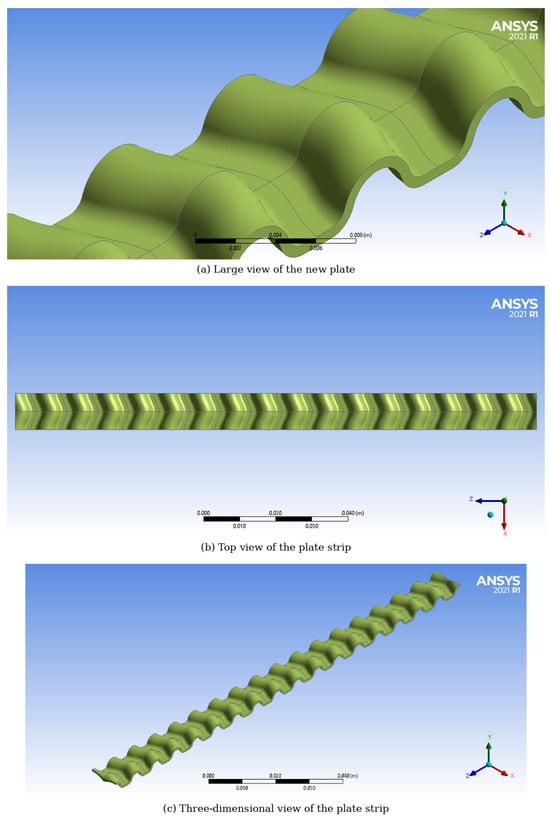
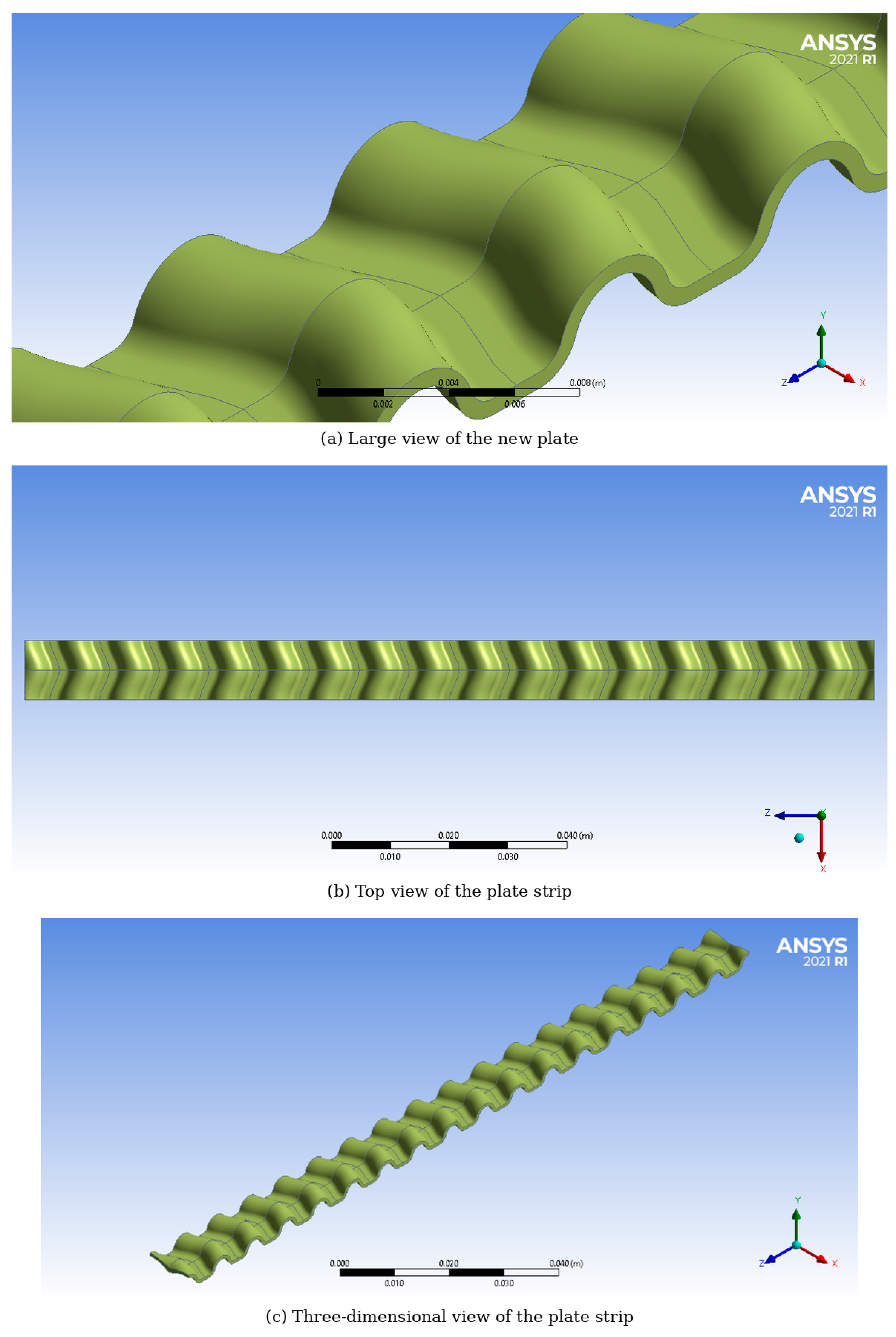
The proposed plate is based on a periodically wavy surface generated from the hyperbolic tangent function (HTF) over the range from −2.5 to +2.5 mm. The transverse section is defined as a semi-elliptical profile with b = 2.5 mm and a = 2.4 mm. This elementary unit is then mirrored and repeated in the X and Z directions to construct the computational plate strip shown in Figure 1 [20,21]. The wavy topology is intended to promote repeated flow redistribution along the passage. In particular, the alternating geometry can induce spiral, reverse, and secondary-flow structures that disturb the near-wall region and reduce the thickness of the thermal boundary layer. These flow disturbances are expected to enhance mixing and modify the near-wall thermal boundary layer, thereby influencing convective heat transfer. The gradual variation of the plate surface is also intended to moderate the hydraulic penalty associated with flow disturbance. The extent to which these mechanisms affect heat transfer, frictional resistance, and overall thermohydraulic performance is evaluated through the CFD analysis presented in the following subsections.
Figure 1.
Geometrical configuration of the proposed plate strip.
2.2. Numerical Study
2.2.1. Boundary Conditions and Computational Domain
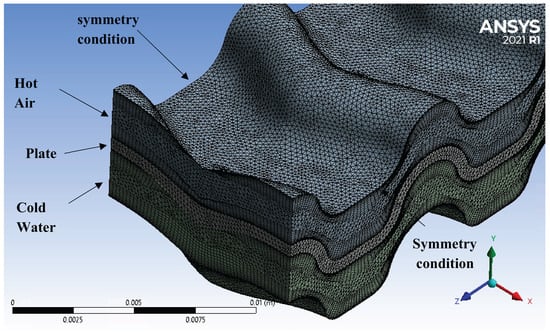
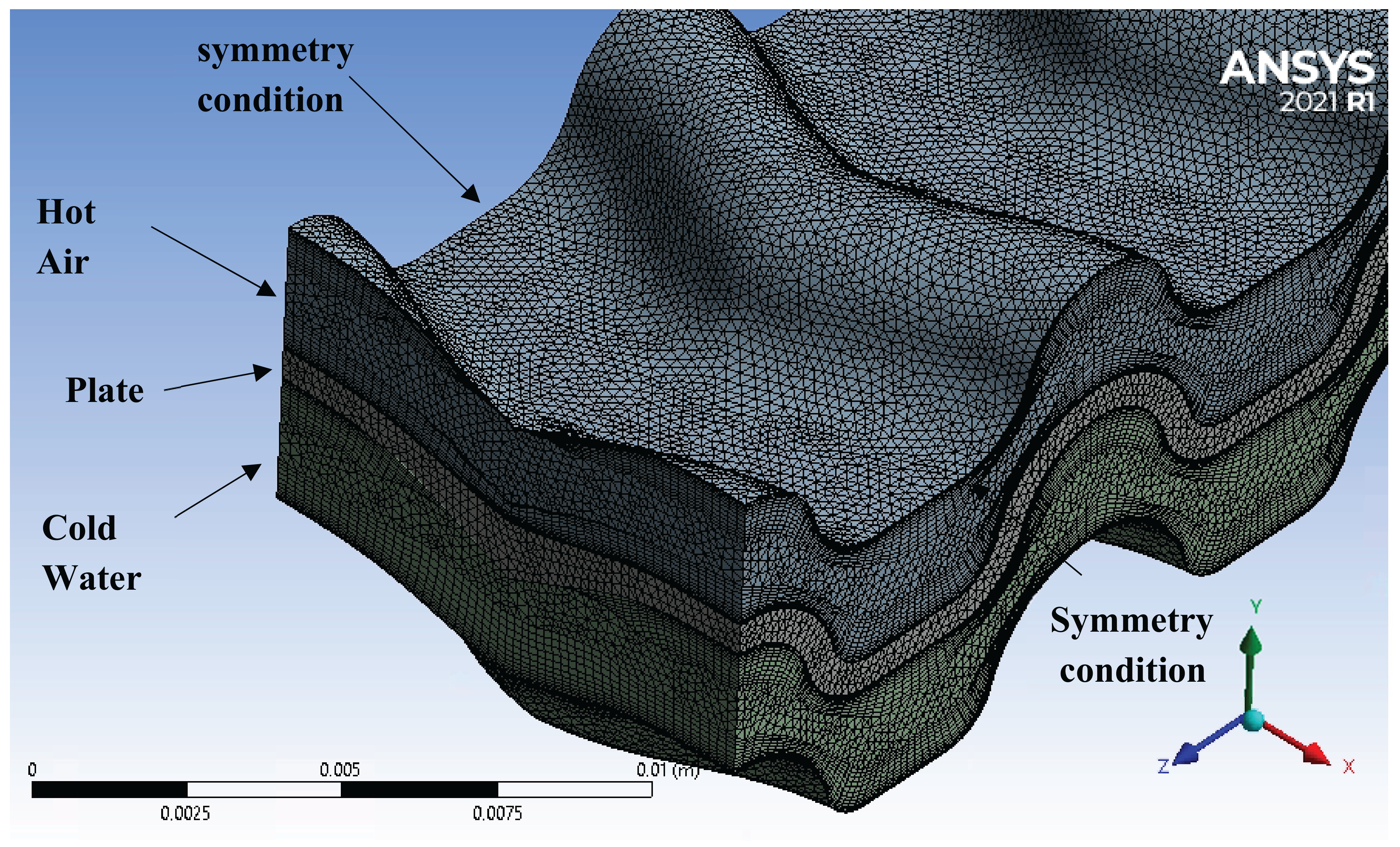
Because the plate geometry is symmetric, only a representative longitudinal strip of the heat-transfer region was modeled, reducing the computational cost while preserving the dominant flow features. The computational domain shown in Figure 2 consists of two counter-flow passages separated by the proposed steel plate strip; the upper passage carries the hot fluid, and the lower passage carries the cold fluid.
Figure 2.
Computational domain used in the numerical simulations. The different colors are used only to distinguish the upper hot-fluid passage (shown here for the air case), the lower cold-water passage, and the separating steel plate; they do not represent temperature, velocity, or other field-variable magnitudes.
Two simulation sets were performed to evaluate the NPHE response under two distinct working-fluid regimes. In both sets, water was used on the cold side, while the hot side was assigned either water (Pr ≈ 4.3) or air (Pr ≈ 0.71). Because changing the working fluid also changes the density, viscosity, specific heat, and thermal conductivity, the comparison represents the combined effect of different thermophysical properties rather than an isolated variation of the Prandtl number. The separating plate was made of steel and had a thickness of 0.6 mm. The material properties adopted in the simulations are summarized in Table 1.
Table 1.
Thermophysical properties of the fluids and solid material used in the computational domain.
Symmetry boundary conditions were assigned to the two lateral sides of the modeled strip, as illustrated in Figure 2. The inlet temperatures were fixed at 14 °C for the cold stream and 50 °C for the hot stream. A pressure outlet of 5 bar was imposed at the exits. The upper and lower external surfaces were treated as adiabatic walls, and the no-slip condition was applied at all solid–fluid interfaces. For each prescribed Reynolds number, the mass flow rate was calculated separately for each working fluid using its corresponding thermophysical properties and the hydraulic characteristics of the computational domain. This procedure allowed the air and water cases to be compared at matched Reynolds-number conditions despite their different densities and viscosities.
2.2.2. Mesh Procedures
Owing to the wavy and spatially complex NPHE passages, the computational grid was generated in ANSYS Fluent 2021 R1 using unstructured tetrahedral elements. This meshing strategy allows the cells to follow the curved plate surface and the irregular flow channel while still resolving the velocity and temperature gradients. Additional refinement was applied in the near-wall regions around the separating plate, where the largest thermal and hydrodynamic gradients are expected. Accurate resolution of these zones is essential for calculating the local heat-transfer coefficient and, consequently, the Nusselt number. A mesh-independence assessment was carried out as a numerical verification step by increasing the number of elements while monitoring the convective heat-transfer coefficient h and the pressure drop Δp [22]. The mesh was refined from 10,103,869 to 13,468,903 elements, corresponding to an increase of about 33.3%. This refinement changed h by only 2.5% and Δp by 2.7%, indicating that further refinement would not materially affect the main numerical outcomes. Therefore, the finer grid was adopted for the subsequent simulations, and the small changes in the monitored thermohydraulic quantities were used to support grid-independent numerical behavior within the investigated configuration.
2.2.3. Solver Settings and Benchmark Assessment
The numerical model was formulated for steady forced-convection conditions. The fluid density, dynamic viscosity, thermal conductivity, and specific heat were treated as constant within each simulation. Radiation and buoyancy-driven natural convection were neglected so that the analysis focused on forced convective transport through the plate passages. The investigated range was Re = 500–5000. Because transition and turbulent behavior in plate heat-exchanger channels may occur at Reynolds numbers substantially lower than those associated with conventional internal flows, the SST k-ω model was employed over the investigated range [23]. This model was selected because it provides strong near-wall resolution while retaining suitable behavior away from solid boundaries, making it appropriate for the curved passages and strong velocity and thermal gradients present in the NPHE geometry. Accordingly, the governing equations for the flow are as follows:
The symbols appearing in Equations (1)–(5) are defined here to improve the readability and reproducibility of the CFD formulation. In the conservation equations, ui denotes the velocity component in the xi direction [m s−1], while ux, uy, and uz are the Cartesian velocity components [m s−1]. The symbol xi denotes the Cartesian coordinate [m], p is the static pressure [Pa], ρ is the density [kg m−3], μ is the dynamic viscosity [Pa s], ν = μ/ρ is the kinematic viscosity [m2 s−1], T is the temperature [K], and α is the thermal diffusivity [m2 s−1].
In the SST k-ω transport equations, k denotes the turbulent kinetic energy [m2 s−2], ω is the specific dissipation rate [s−1], μt is the turbulent or eddy viscosity [Pa s], Pk is the turbulent-kinetic-energy production term, and F1 is the SST blending function. The coefficients β, β*, σk, and σω2 are the standard dimensionless SST k-ω model constants used in the turbulence closure.
The calculated thermohydraulic parameters were obtained from the relations listed in Table 2, where each symbol is defined together with its unit or physical meaning.
Table 2.
Definitions and calculation equations for the main thermohydraulic parameters.
In this study, the thermohydraulic performance index P is used as a combined performance metric that relates the heat-transfer benefit to the associated hydraulic penalty. It increases with the Nusselt number and decreases with increasing friction factor according to P = Nu/f1/3. Therefore, a higher value of P indicates that the heat-transfer enhancement is achieved with a relatively smaller frictional penalty, making the index useful for comparing heat-exchanger configurations when thermal enhancement and flow resistance must be assessed simultaneously.
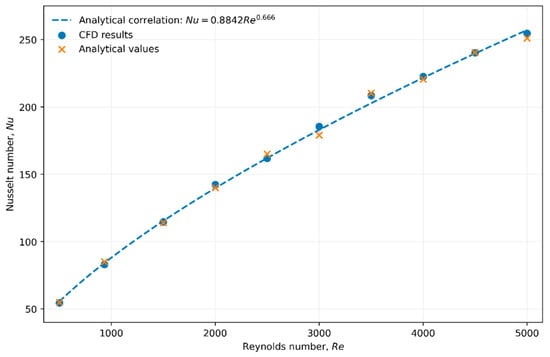
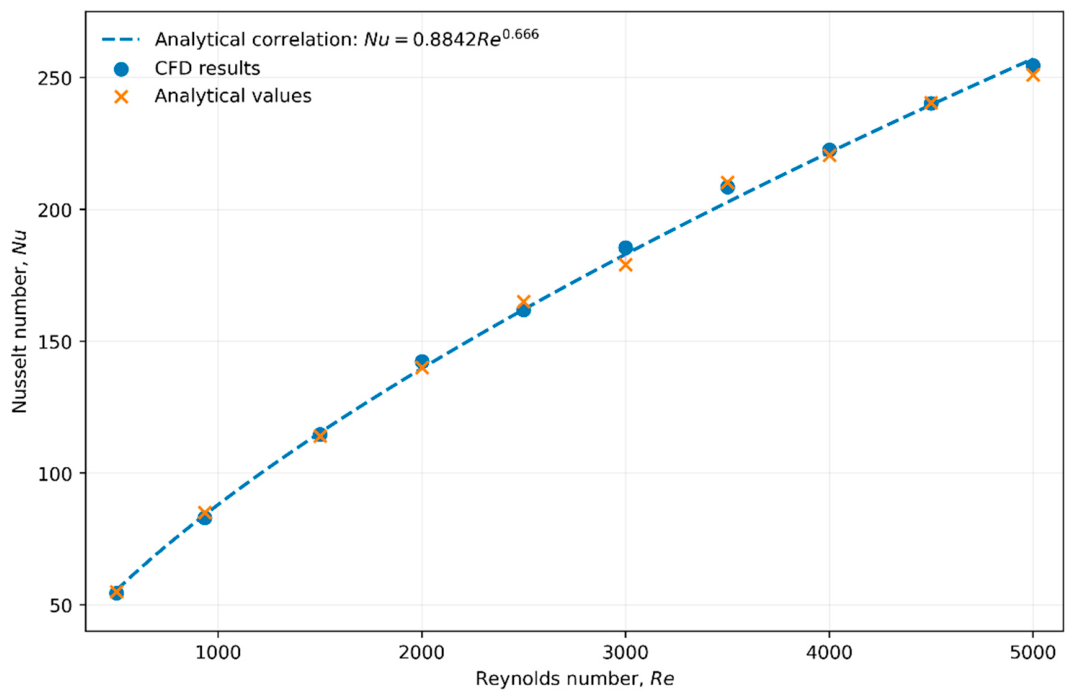
The numerical reliability of the CFD database was assessed using the above mesh independence and an analytical benchmark comparison. The CFD model was benchmarked against the analytical Nusselt-number trend previously reported for the same plate concept [21]. Over Re = 500–5000, the maximum deviation between the numerical and analytical Nusselt numbers was 3.6%, as shown in Figure 3. This comparison is retained as an analytical benchmark and numerical consistency check rather than presented as independent experimental validation. Together with the mesh-independence assessment, it supports the use of the CFD solutions as the reference database for the subsequent thermohydraulic and surrogate-model analyses. However, direct experimental measurements under identical geometry and operating conditions would provide a stronger validation basis and are therefore identified as an important direction for future work.
Figure 3.
Comparison of CFD-predicted Nusselt numbers with analytical values and the analytical correlation over the investigated Reynolds-number range. Vertical segments indicate the local deviation between CFD and analytical results.
2.3. Dimensionless Regression-Based Surrogate Formulation
To complement the high-fidelity CFD analysis, a compact regression-based surrogate formulation was developed to approximate the thermohydraulic response of the proposed NPHE within the investigated operating domain. The surrogate represents the CFD response through the dimensionless input variables Reynolds number (Re) and Prandtl number (Pr), while the Nusselt number (Nu) and friction factor (f) are treated as response variables. Accordingly, the reduced input–output relationship can be expressed in general form as
The overall thermohydraulic performance index (P) was not fitted independently. Instead, it was calculated from the surrogate-estimated values of Nu and f using the physical definition given in Equation (11). This treatment preserves the algebraic dependence of P on its constituent thermohydraulic quantities and avoids introducing an additional independently fitted response. It also ensures that the surrogate-derived performance index retains its physical meaning as a measure of the balance between convective heat-transfer enhancement and frictional resistance.
The regression database consisted of 20 CFD observations obtained under two working-fluid conditions: 10 air–water cases and 10 water–water cases. The air–water cases were generated in the present study at Re = 500, 1000, 1500, 2000, 2500, 3000, 3500, 4000, 4500, and 5000, whereas the water–water cases were retained from the previously published CFD dataset for the same NPHE geometry and comparable boundary-condition framework [20]. The water–water dataset covers the same overall Reynolds-number domain; however, the second retained water-side value is Re = 785 rather than Re = 1000. No interpolated water value at Re = 1000 was introduced in the present work in order to preserve the traceability of the CFD database and to avoid mixing directly simulated CFD results with correlation-derived estimates. The corresponding Prandtl numbers were Pr = 0.71 for air and Pr = 4.3 for water. Consequently, the regression fitting treats Re as a continuous explanatory variable, while direct air–water comparisons are interpreted as trend-based comparisons over the common Reynolds-number domain rather than strictly paired point-by-point comparisons at every Reynolds-number value. Because the number of high-fidelity CFD observations is limited, an interpretable low-dimensional regression model was preferred to a more highly parameterized data-driven model.
A logarithmic transformation was applied to reduce the differences in variable scale and to represent the nonlinear dependence of the thermohydraulic responses more compactly. This choice is also consistent with conventional heat-transfer and friction-factor correlations, which are commonly expressed in dimensionless power-law form. In logarithmic space, these power-law-type relations can be estimated using linear least-squares procedures while retaining direct interpretability of the dependence on Re and Pr. A conventional power-law correlation was therefore first considered as a baseline. In its general form, such a relation can be written as
The selected logarithmic formulation was retained only after comparison with the baseline model using the same leave-one-out cross-validation procedure. For the Nusselt-number response, the extended logarithmic model reduced the cross-validated MAPE and RMSE relative to the conventional power-law form, while the friction-factor response was adequately represented by the simpler logarithmic power-law relation. Thus, model complexity was introduced only where it produced a measurable improvement in the internal cross-validation statistics and remained compatible with physically interpretable dimensionless correlations.
which permits estimation of the coefficients using linear least squares in the transformed space.
For the regression models considered in this study, the transformed observations can be represented in matrix form as
where is the vector of transformed CFD responses, is the regression design matrix constructed from the selected functions of (Re) and (Pr), is the vector of model coefficients, and represents the regression residuals. The coefficient vector is estimated by ordinary least squares as
The regression procedure consisted of the logarithmic transformation of the variables, construction of the regression design matrix, least-squares coefficient estimation, leave-one-out cross-validation, inverse transformation to recover Nu and f, and calculation of P from the estimated values. Regression fitting and cross-validation were implemented in Python 3.13.5 using NumPy 2.3.5 and scikit-learn 1.8.0. The selected empirical regression equations are
The additional quadratic Prandtl-number term included in the selected (Nu) formulation was retained only because it improved the empirical representation of the available CFD observations relative to the simpler power-law baseline. Because the database contains only two discrete Prandtl-number levels, (Pr = 0.71) and (Pr = 4.3), this term must not be interpreted as evidence of an independently established nonlinear dependence of (Nu) on (Pr). The resulting equations are therefore reduced-order approximations of the simulated air and water cases rather than universal heat-transfer or friction correlations.
Leave-one-out cross-validation (LOOCV) was employed to assess the internal interpolation accuracy of the regression equations. The CFD database contained N = 20 observations. In each LOOCV cycle, one observation was temporarily removed and used as the validation point, while the remaining 19 observations were used for coefficient estimation. The fitted equation was then used to estimate the omitted response, and the process was repeated 20 times until each CFD observation had served once as the validation sample. Denoting the resulting prediction by, the procedure can be written conceptually as
where denotes the surrogate fitted without observation (i). This procedure was repeated for all 20 observations.
The cross-validated predictions were evaluated using the coefficient of determination , root-mean-square error (RMSE), mean absolute error (MAE), and mean absolute percentage error (MAPE). The latter three measures are defined as
and
After regression in the transformed space, the predictions were converted back to their original physical scale to recover (Nu) and (f), and the performance index (P) was subsequently calculated from these estimated quantities. Regression fitting and LOOCV were implemented in Python using NumPy and scikit-learn.
The surrogate models are intended only for interpolation within the operating conditions represented by the CFD database. In particular, the Reynolds-number domain is 500 <= Re <= 5000, while the available CFD data contain only the two discrete Prandtl-number conditions associated with air and water. Because the observations are obtained from closely related CFD cases for the same geometry, the LOOCV errors may still be optimistic compared with validation on an independent fluid or geometry. Consequently, the reported cross-validation errors quantify internal interpolation performance across the available observations and do not constitute independent validation for other fluids, intermediate Prandtl-number values, or extrapolated operating conditions.
3. Results
3.1. CFD Results
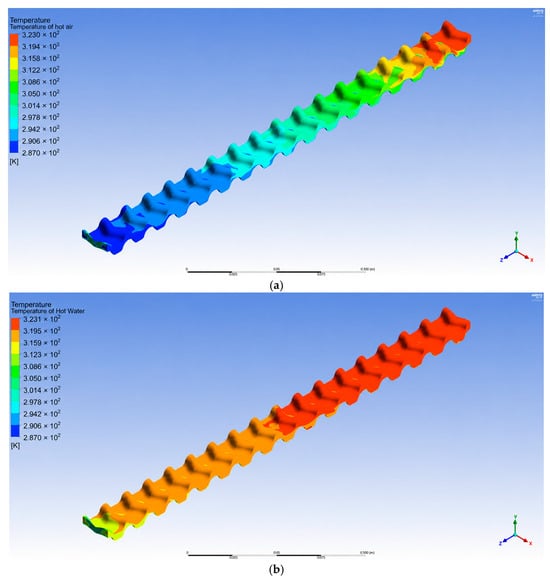
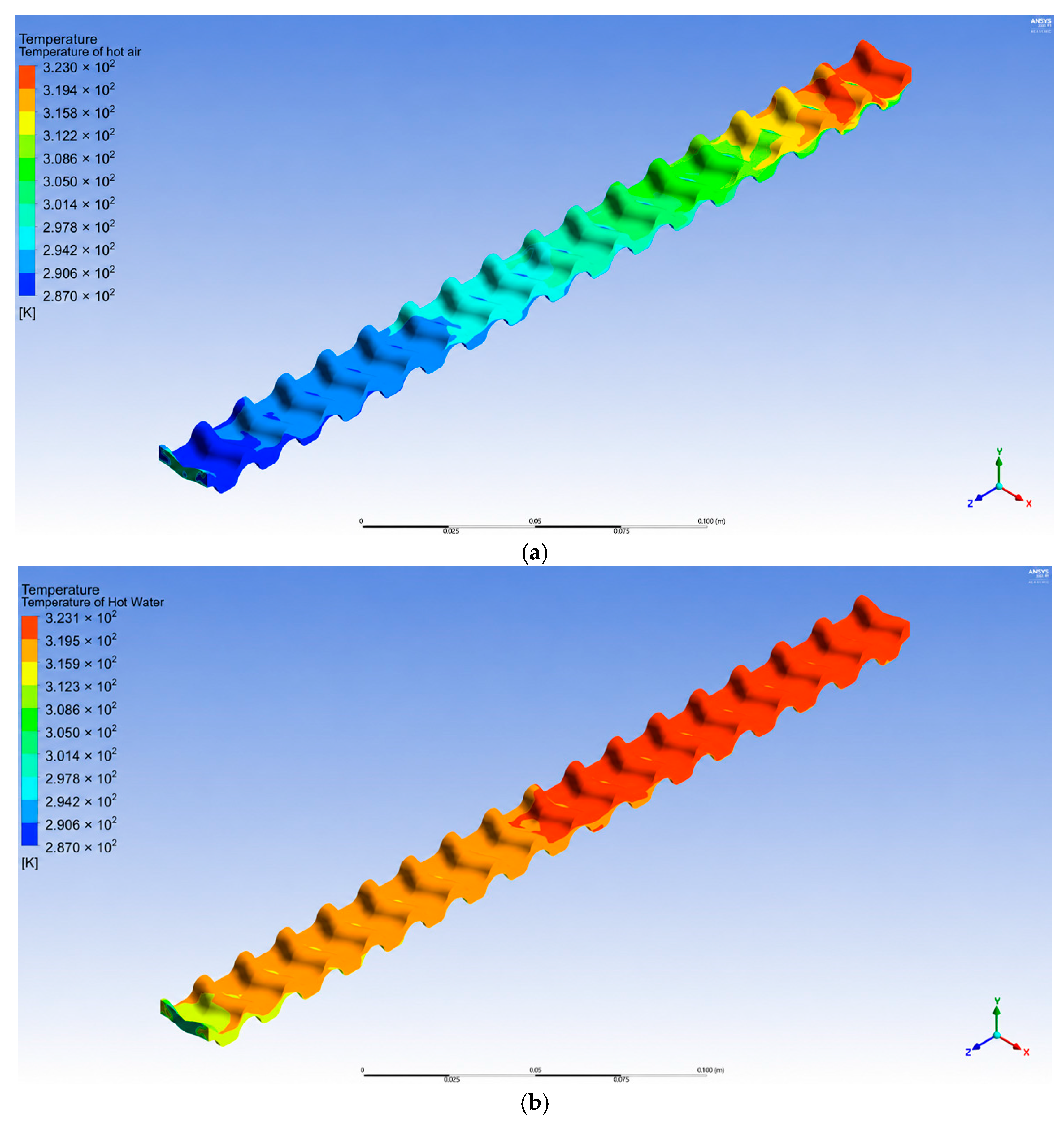
Figure 4 compares the temperature field on the NPHE surface at Re = 2000 for the two hot-fluid cases: air in Figure 4a and water in Figure 4b. In both simulations, heat is removed by the cold-water stream; so, the hot-fluid temperature decreases along the flow path. The hot-water case shows a slower temperature reduction than the hot-air case. This difference is attributed to the much larger volumetric heat capacity of water, whereas air has substantially higher thermal diffusivity and therefore responds more rapidly to cooling.
Figure 4.
Surface temperature contours at Re = 2000 for (a) hot air and (b) hot water.
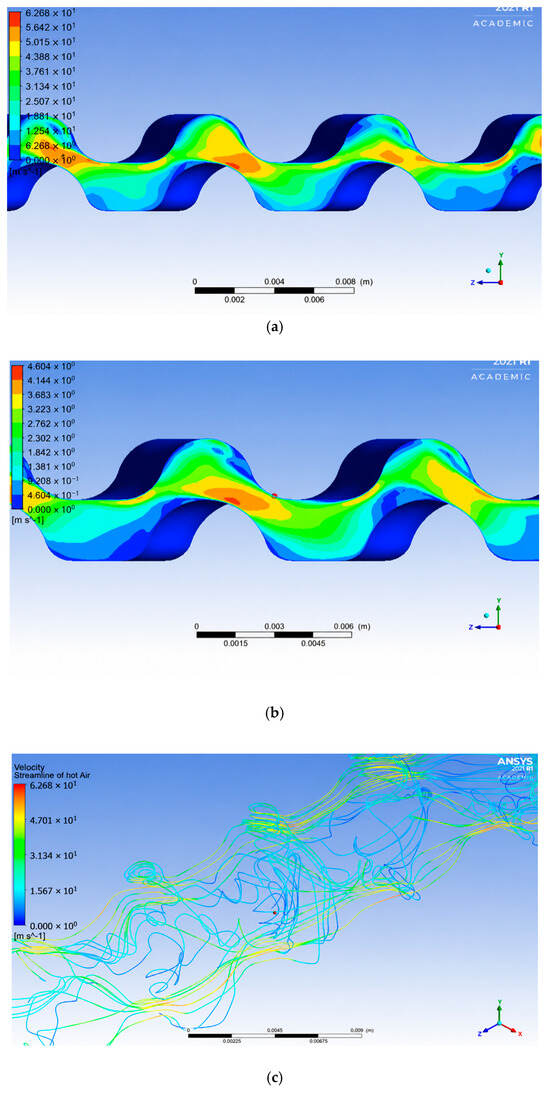
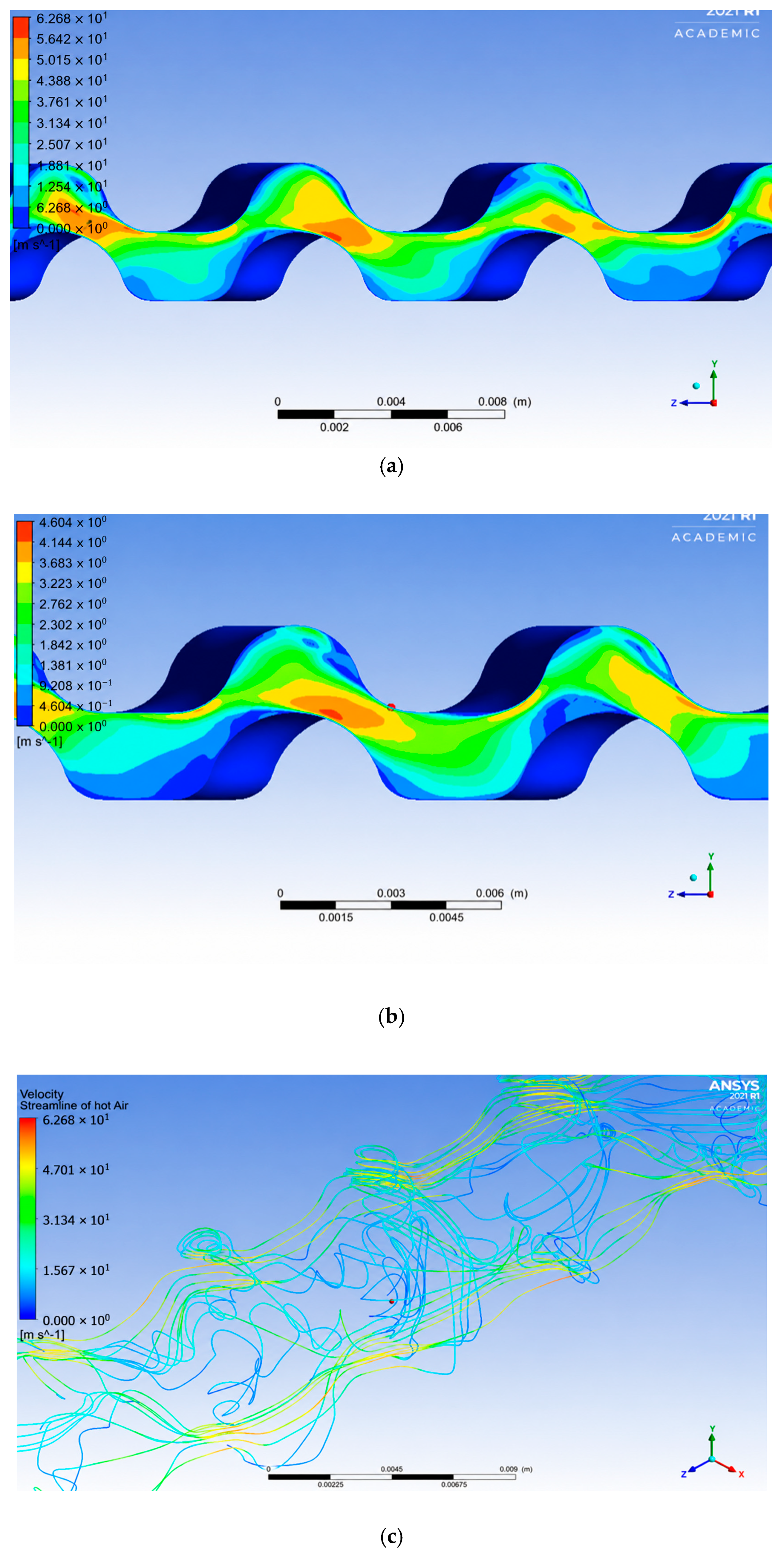
The velocity contours for the hot-water and hot-air cases are presented in Figure 5 on the side symmetry section. Both fluids display comparable overall flow structures: the highest velocities occur in the narrow regions where the two plate surfaces approach each other, while lower velocities appear in wider zones and near walls. The proposed wavy geometry also generates reverse motion, twisted-groove trajectories, and spiral-like flow paths. These secondary structures enhance fluid mixing and support the observed heat-transfer improvement, as shown in Figure 5c.
Figure 5.
Velocity-field contours at Re = 2000 for (a) hot water, (b) hot air, and (c) representative flow trajectories.
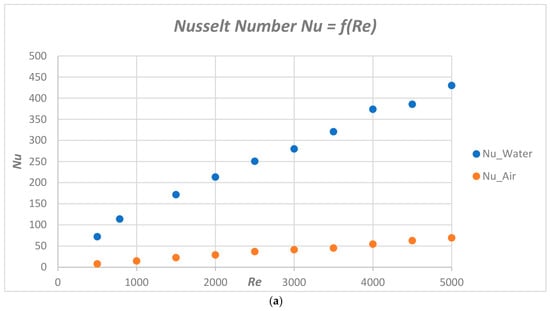
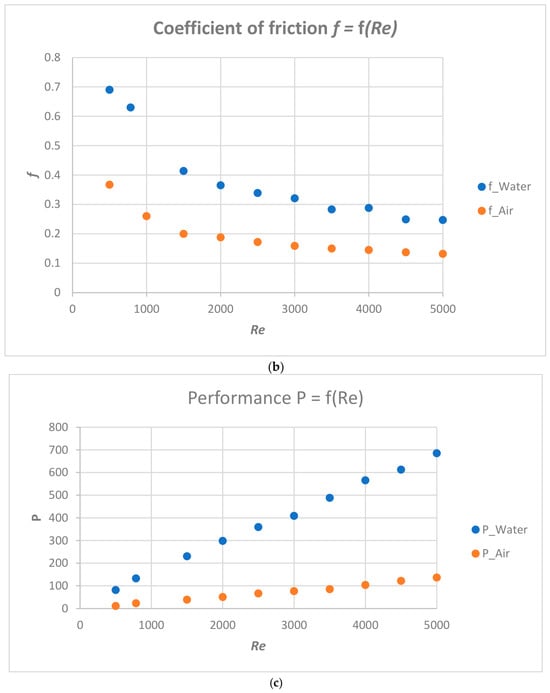
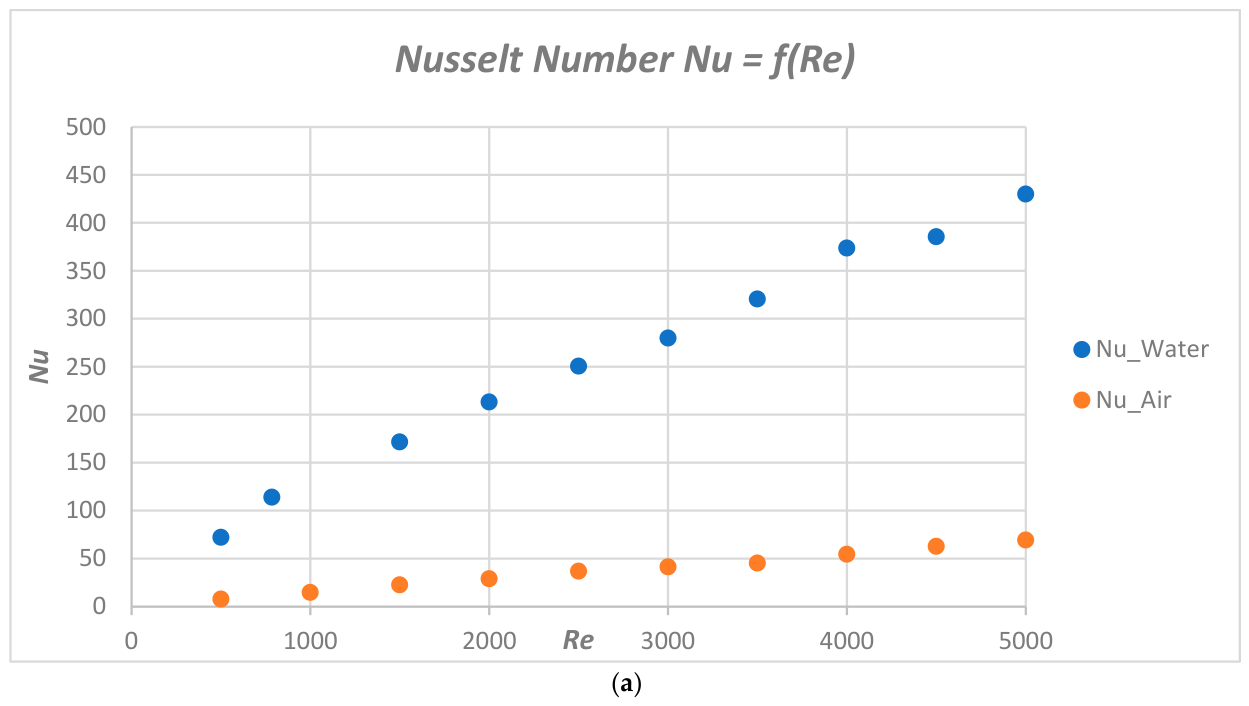
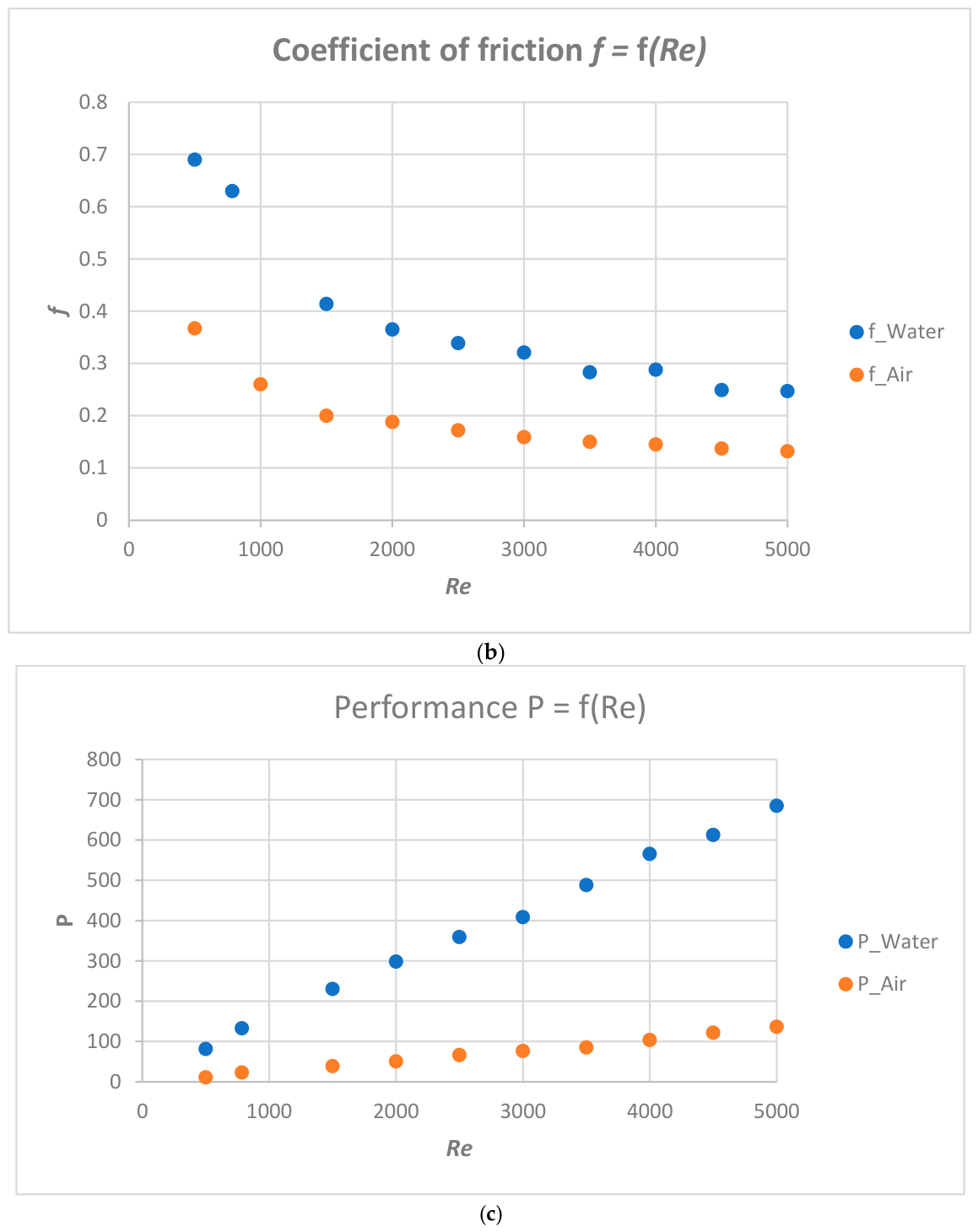
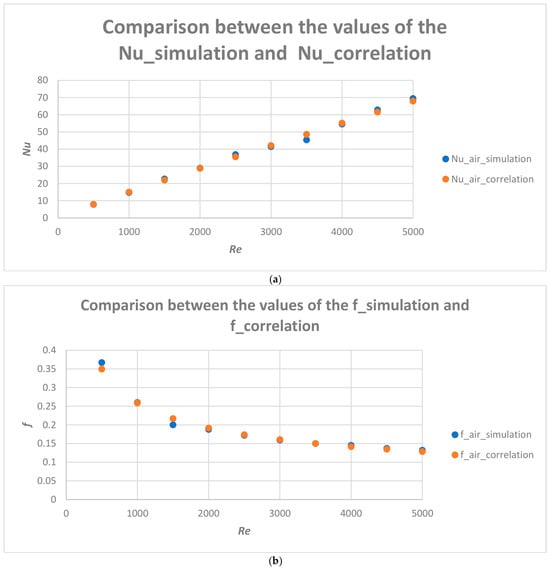
The thermohydraulic response of the NPHE was evaluated over (Re = 500)–5000 for two working-fluid conditions: hot water (Pr = 4.3) and hot air (Pr = 0.71), as shown in Figure 6. For both fluids, the Nusselt number increases with the Reynolds number because the increase in flow velocity intensifies forced convection and enhances wall-to-fluid heat transfer. The water case exhibits substantially higher (Nu) values than the air case. This behavior is consistent with the different thermal transport characteristics of the two working fluids and with the higher Prandtl-number regime represented by water.
Figure 6.
Variation in NPHE thermohydraulic parameters with Reynolds number for water and air: (a) Nu, (b) f, and (c) performance index.
For both working-fluid conditions, the friction factor decreases as the Reynolds number increases. The decrease is more pronounced at lower Reynolds numbers and becomes more gradual as (Re) increases, which is consistent with the general trend reported for plate heat exchangers [25]. At a given Reynolds number, the water and air cases exhibit different friction-factor levels because changing the working fluid simultaneously changes several thermophysical properties, including the density and viscosity. Therefore, the difference in (f) should not be interpreted as an isolated Prandtl-number effect.
Combining the heat-transfer and hydraulic responses through Equation (11) shows that the thermohydraulic performance index increases when the gain in Nu outweighs the frictional penalty represented by f. Within the investigated dataset, the water case exhibits a higher performance-index level than the air case, reflecting its stronger heat-transfer response under the same NPHE geometry. This comparison highlights the need to evaluate thermal enhancement and hydraulic resistance simultaneously rather than relying on the Nusselt number alone.
Based on the CFD database, correlations were obtained for the air case to express the dependence of Nu and f on the Reynolds number over the investigated interval:
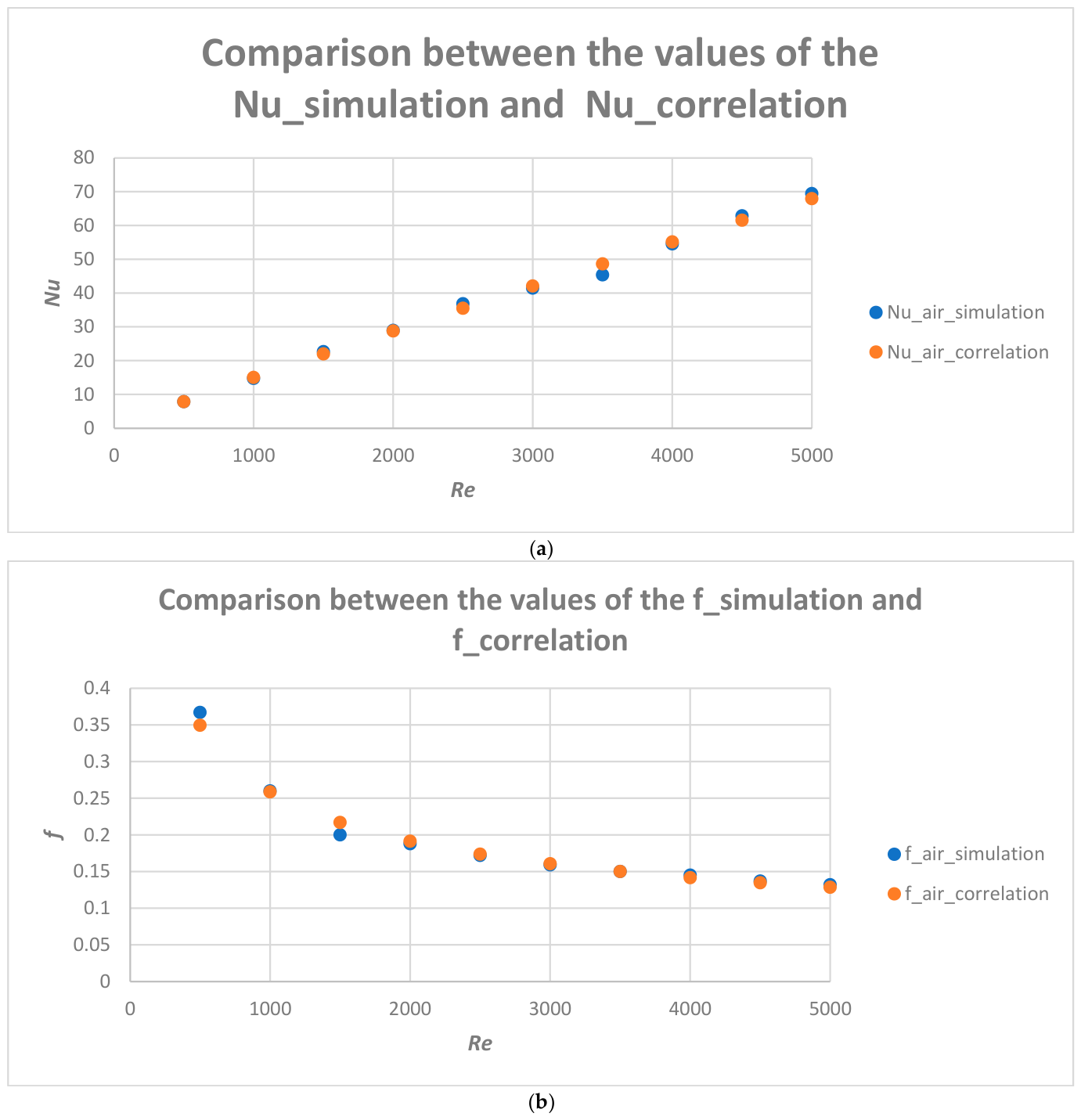
The proposed air correlations are valid for Re = 500–5000. Their predictions closely follow the numerical data, with R2 values of 0.995 for Nu and 0.986 for f, confirming that the fitted expressions capture the observed trends with good accuracy (Figure 7).
Figure 7.
Comparing the values from modeling with those from correlations for both (a) Nu number and (b) friction factor f in the Reynolds number range 500–5000.
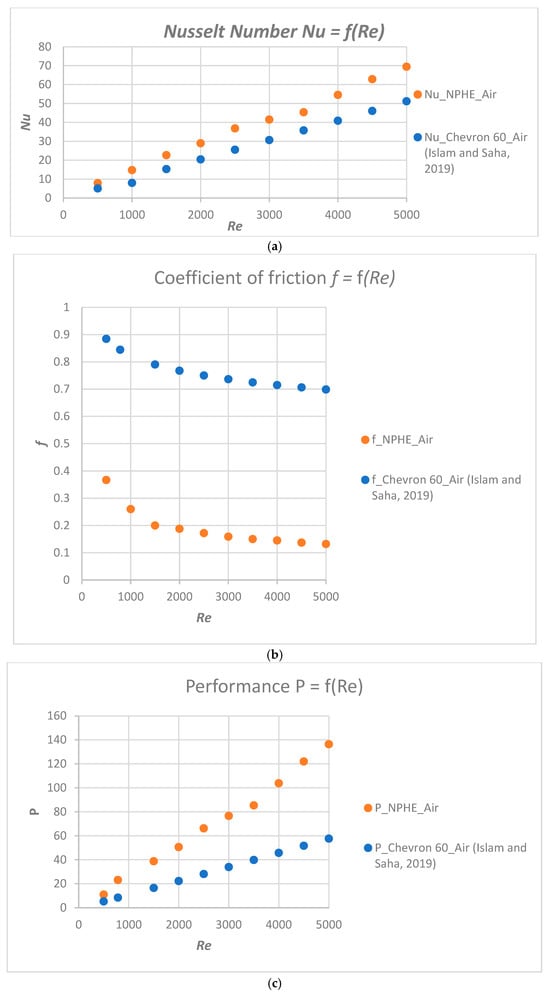
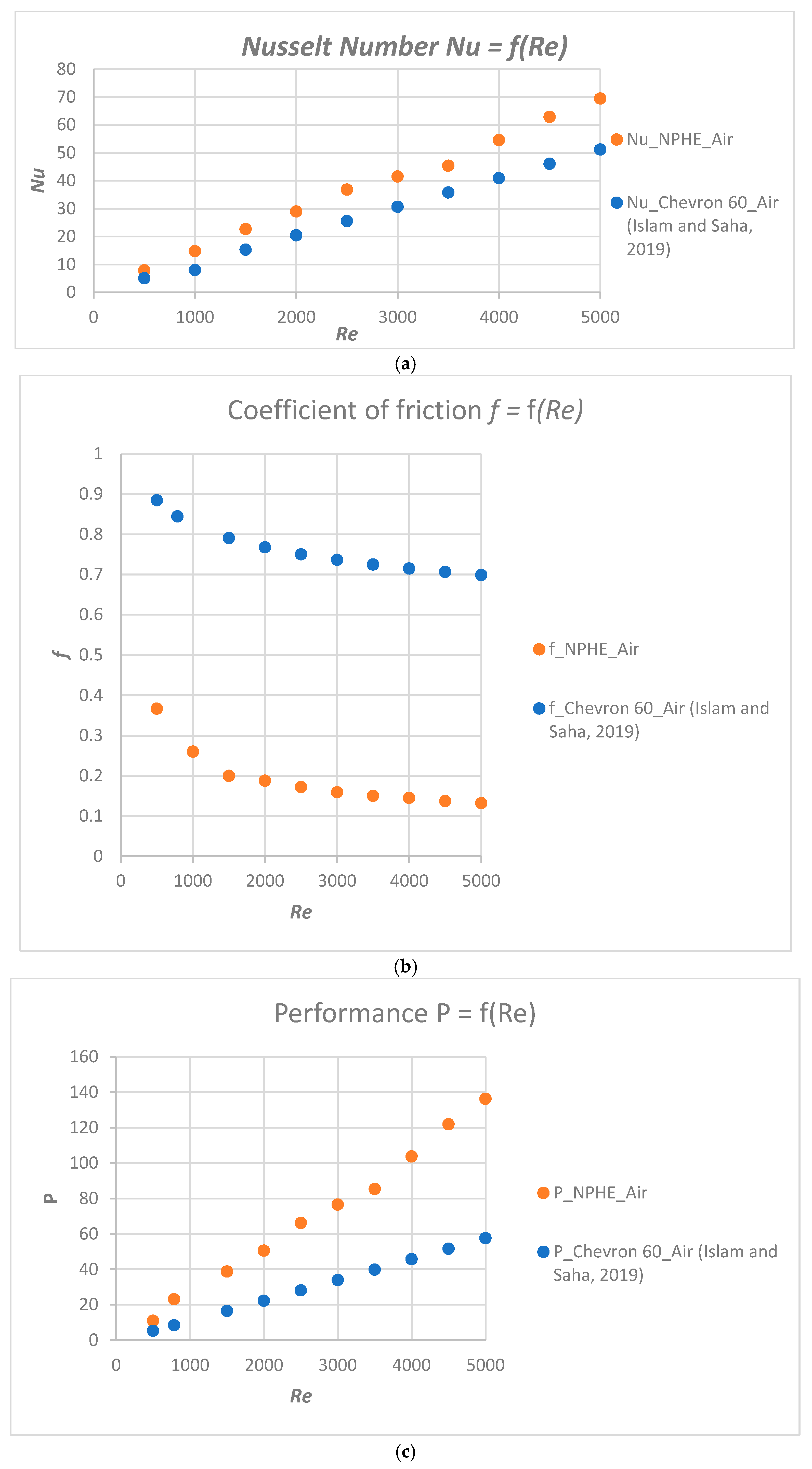
Because direct comparison among different PHE configurations is affected by differences in fluids, Reynolds-number intervals, plate dimensions, and boundary-condition implementation, the air-side NPHE results were benchmarked against available 60° chevron-plate data for CPHEs [14,26,27] over a comparable Reynolds-number interval, as shown in Figure 8. This benchmark is literature-based and should not be interpreted as a strictly controlled one-to-one CFD comparison under identical geometrical dimensions, solver settings, operating conditions, or thermal boundary conditions. Within this limitation, the comparison suggests that the proposed NPHE provides promising relative performance, with higher Nu and thermohydraulic performance-index values and a lower friction-factor level than the referenced chevron data over the investigated air-side Reynolds-number range. A direct NPHE-CPHE comparison under matched numerical and boundary-condition settings is recommended for future work to establish a definitive performance ranking.
Figure 8.
Air-side comparison between NPHE and CPHE over Re = 500–5000: (a) Nu, (b) f, and (c) performance index. The CPHE data are taken from Islam and Saha [14].
3.2. Surrogate Model Accuracy and Cross-Validation Results
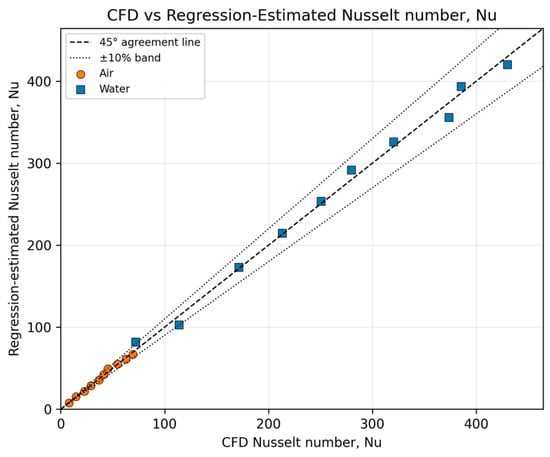
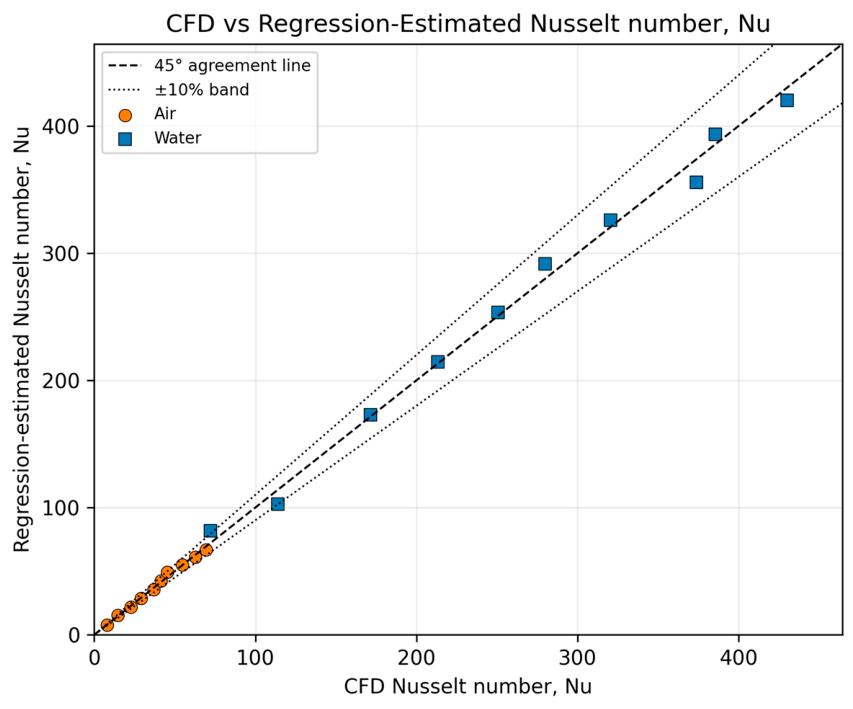
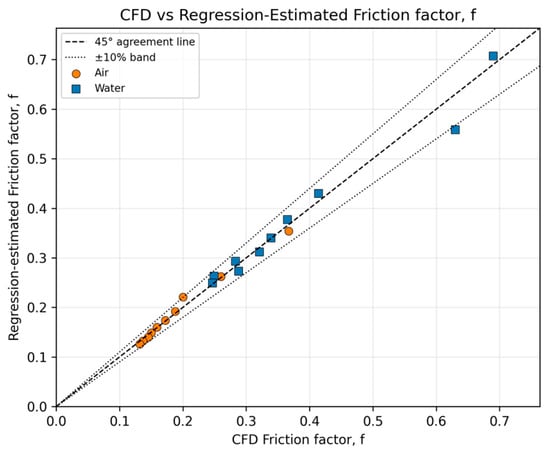
The predictive consistency of the regression-based surrogate models was assessed using the leave-one-out cross-validation procedure described in Section 2.3. Figure 9 and Figure 10 compare the CFD-derived values of the Nusselt number and friction factor with their corresponding surrogate estimates for the air and water cases. The 45° reference line represents perfect agreement, while the ±10% bands provide a visual indication of the prediction error. For both response variables, the cross-validated estimates remain generally close to the agreement line over the investigated range, indicating that the surrogate models reproduce the CFD response trends with relatively small internal prediction errors.
Figure 9.
CFD versus regression-estimated values of the Nusselt number. Markers identify air and water; dashed and dotted lines denote the 45° agreement line and ±10% bands, respectively.
Figure 10.
CFD versus regression-estimated values of the friction factor. Markers identify air and water; dashed and dotted lines denote the 45° agreement line and ±10% bands, respectively.
To evaluate whether the additional flexibility of the selected surrogate formulation provides a measurable advantage over a conventional correlation structure, the Nusselt-number model was compared with a standard power-law formulation using the same LOOCV procedure. As summarized in Table 3, the conventional power-law model yields R2 = 0.9892 and MAPE = 7.22%, whereas the selected logarithmic model achieves R2 = 0.9977 and reduces the MAPE to 3.51%. The corresponding RMSE decreases from 14.3067 to 6.6694, and the MAE decreases from 9.2408 to 4.5465. These improvements justify retaining the selected logarithmic formulation for the available Nusselt-number dataset, although the interpretation remains limited to the internal CFD database. For the friction factor, the logarithmic power-law formulation provides satisfactory accuracy with R2 = 0.9842 and MAPE = 3.51%; therefore, no additional terms were introduced for f.
Table 3.
Cross-validated comparison between the conventional power-law and selected regression equations.
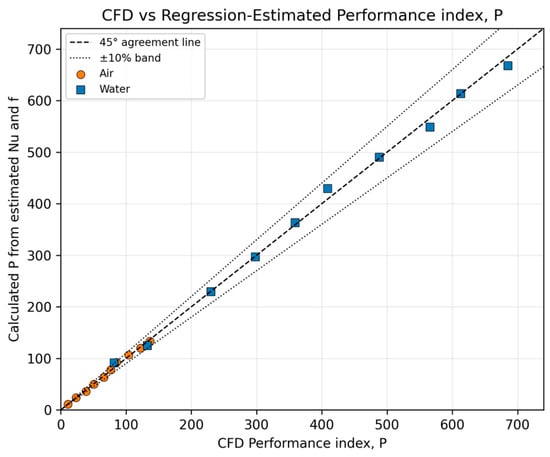
The overall cross-validated accuracy of the selected surrogate equations is reported in Table 4. The Nusselt-number and friction-factor models achieve MAPE values of 3.51% each. The thermohydraulic performance index, calculated from the surrogate-estimated values of (Nu) and (f) rather than fitted independently, exhibits a MAPE of 3.15% and an value of 0.9985. The close agreement obtained for (P), shown in Figure 11, indicates that the errors associated with the individual (Nu) and (f) approximations do not produce a substantial deterioration in the derived performance metric within the investigated dataset.
Table 4.
Cross-validated accuracy of the selected regression-based surrogate equations.
Figure 11.
CFD versus calculated performance index obtained from regression-estimated Nu and f.
Table 5 further separates the cross-validation errors according to the working fluid. For the Nusselt number, the MAPE values are 3.00% for air and 4.03% for water, while the corresponding friction-factor errors are 3.09% and 3.92%, respectively. The performance-index errors are similar for the two cases, with MAPE values of 3.14% for air and 3.16% for water. The comparable error levels obtained for the two working-fluid conditions suggest that the surrogate does not exhibit a pronounced accuracy imbalance between the two thermophysical regimes represented in the CFD database.
Table 5.
Per-fluid MAPE of the selected regression-based surrogate equations.
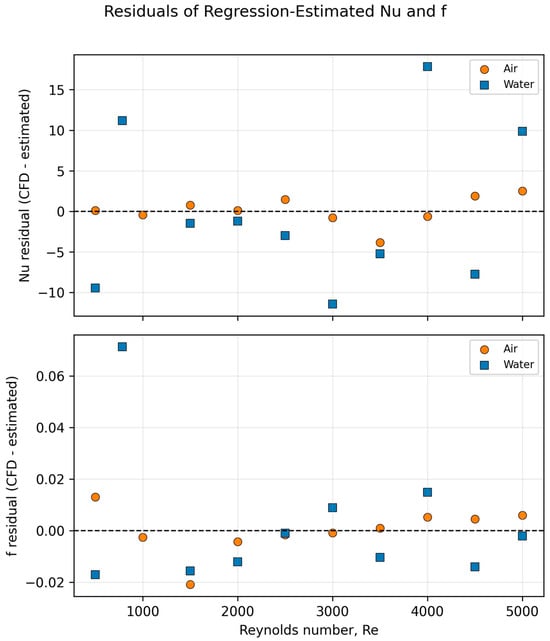
The residual distributions for Nu and f are presented in Figure 12 as functions of the Reynolds number, and the corresponding residual-based uncertainty information is summarized in Table 6. The mean residuals are close to zero for all reported outputs, while the approximate 95% residual intervals provide a quantitative indication of the expected internal LOOCV error spread within the available CFD database. No strong systematic monotonic trend is evident across the full Reynolds-number interval, although the largest Nusselt-number residual occurs at the lowest water-side Reynolds-number condition. The residual behavior therefore supports the use of the proposed equations as compact approximations of the available CFD response within the investigated operating domain.
Figure 12.
Residuals of the regression-estimated Nu and f values plotted against Reynolds number for air and water.
Table 6.
Residual-based uncertainty summary for the LOOCV estimates. The approximate 95% residual interval is calculated as mean residual +/− 1.96 standard deviations and is reported as a descriptive interval for the available CFD dataset, not as an independent uncertainty bound for untested fluids or geometries.
Nevertheless, these accuracy measures and residual intervals must be interpreted within the limits of the available database. LOOCV evaluates the internal predictive consistency of the surrogate across the 20 CFD observations, but it can still produce optimistic estimates when the omitted point is close to neighboring CFD observations. Therefore, the low cross-validation errors demonstrate the suitability of the equations for interpolation of the investigated air and water CFD responses; they should not be interpreted as evidence of broad robustness, independent-fluid validation, or universal predictive validity outside the specified Reynolds-number range and fluid-pair conditions.
4. Discussion
4.1. Thermohydraulic Response Under Different Working-Fluid Regimes
The CFD results demonstrate that the proposed NPHE exhibits substantially different thermal and hydraulic responses when the hot-side working fluid is changed from air to water. For both fluids, increasing the Reynolds number enhances convective heat transfer, as reflected by the monotonic increase in the Nusselt number. At the same time, the friction factor decreases with increasing Reynolds number, while the overall performance index increases over the investigated range.
The water case produces considerably larger Nusselt numbers and a higher overall performance index than the air case. These differences are associated with the distinct thermophysical properties of the two working fluids and with the corresponding Prandtl-number regimes represented in the simulations. Because changing the fluid simultaneously changes the density, viscosity, specific heat, thermal conductivity, and thermal diffusivity, the observed differences should not be interpreted as the isolated effect of the Prandtl number alone. Rather, the comparison characterizes the response of the same exchanger geometry under two distinct thermophysical regimes.
Because the air and water datasets do not contain perfectly identical Reynolds-number sequences, the air–water comparison should not be interpreted as a strictly paired point-by-point comparison. The comparison is instead trend-based and uses the common Reynolds-number domain to assess whether the same NPHE geometry maintains physically consistent thermohydraulic behavior under the two represented fluid regimes. This treatment preserves direct CFD traceability while avoiding the artificial insertion of interpolated values into the regression dataset.
The velocity-field results provide a physical explanation for the favorable thermohydraulic behavior of the proposed geometry. The periodically wavy plate produces repeated flow redistribution, locally accelerated flow, and secondary-flow structures along the passage. These mechanisms promote fluid mixing and disturb the near-wall thermal boundary layer, thereby enhancing convective heat transfer. The comparison with the conventional 60° chevron-plate data is retained as an indicative literature-based benchmark. However, because the reference data were obtained from published studies rather than from direct simulations performed under the same geometry, boundary conditions, and solver settings, the reported average increases in Nu and P should be interpreted as evidence of promising relative performance over a comparable air-side Reynolds-number interval and not as a conclusive one-to-one proof of superiority under fully matched conditions.
4.2. Surrogate Accuracy and Model Complexity
The regression-based surrogate formulation was introduced as a computationally inexpensive and interpretable approximation of the CFD-derived thermohydraulic response rather than as a replacement for the underlying numerical model. The selected logarithmic representation follows the structure of conventional dimensionless correlations while allowing limited additional flexibility for the Nusselt-number response. The model-comparison results show that this formulation represents the available Nusselt-number data more accurately than the conventional three-parameter power-law baseline, reducing the MAPE from 7.22% to 3.51% and lowering both the RMSE and MAE.
This improvement is obtained at the cost of increasing the number of regression coefficients from three to six. Given the small CFD database, this additional flexibility is interpreted cautiously. The purpose of the selected formulation is not to establish a highly parameterized universal correlation but to obtain a compact analytical approximation that reproduces the available CFD response more accurately while retaining interpretability. The residual plots and residual-based intervals were therefore added to complement the global error metrics and to avoid relying exclusively on R2 or average percentage errors.
For the friction factor, the simpler logarithmic power-law model already provides satisfactory cross-validated accuracy, with an MAPE of 3.51%. Additional model complexity was therefore not introduced. This difference between the selected (Nu) and (f) formulations illustrates that surrogate complexity was determined according to the response behavior rather than imposed uniformly on all thermohydraulic quantities.
A further consistency check is provided by the performance index. Because (P) is calculated from the surrogate-estimated values of (Nu) and (f), rather than fitted independently, its cross-validated MAPE of 3.15% indicates that the approximation errors associated with the two constituent models do not accumulate sufficiently to compromise the derived thermohydraulic metric within the investigated cases.
4.3. Prandtl-Number Representation and Generalization Limits
An important limitation of the present surrogate formulation is that the CFD database contains only two discrete Prandtl-number values, corresponding to air (Pr = 0.71) and water (Pr = 4.3). Consequently, although (Pr) is included as an explanatory variable in the regression model, the present data are not sufficient to establish a continuously validated functional dependence on the Prandtl number.
This consideration is particularly relevant to the additional nonlinear Prandtl-number term retained in the selected Nusselt-number model. The term improves the empirical representation of the available observations relative to the simpler power-law baseline, but its coefficient should not be interpreted as evidence of a physically established quadratic dependence of (Nu) on (Pr). Such an interpretation would require CFD or experimental observations at several intermediate and possibly higher Prandtl-number levels.
The reported LOOCV results should therefore be interpreted as measures of internal predictive consistency across the available CFD observations. They demonstrate that the surrogate equations interpolate the simulated air and water responses with relatively small errors, but they do not establish predictive validity for an independent third fluid, intermediate Prandtl numbers, or operating conditions outside the calibrated domain.
4.4. Applicability and Numerical Reliability
The present framework combines a high-fidelity CFD model with compact mathematical surrogate equations. The CFD database was subjected to a numerical reliability assessment consisting of mesh-independence verification and comparison with previously reported analytical Nusselt-number values for the same plate concept. Increasing the mesh size from approximately 10.1 million to 13.47 million elements changed the convective heat-transfer coefficient by only 2.5% and the pressure drop by 2.7%. In addition, the maximum deviation between the numerical and analytical Nusselt numbers over the investigated Reynolds-number range was 3.6%. These results support the numerical consistency of the CFD solutions used as the reference database for the surrogate formulation. Nevertheless, this evidence should be interpreted as mesh-based verification and analytical benchmarking, not as independent experimental validation.
Nevertheless, the applicability of the combined CFD-surrogate framework remains restricted to the geometric configuration, boundary conditions, working fluids, and Reynolds-number interval investigated in this study. In particular, the surrogate equations should be used for preliminary estimation only within 500 ≤ Re ≤ 5000 and for conditions represented by the simulated air and water cases. Extrapolation beyond this domain is not supported by the present data.
5. Conclusions
This study combined finite-volume CFD simulations with regression-based surrogate modeling to examine the thermohydraulic behavior of a novel plate heat exchanger under two hot-side working-fluid regimes. The CFD results show that the proposed wavy plate geometry promotes flow redistribution and secondary motion within the passage, thereby supporting convective heat-transfer enhancement while preserving the need to account for the associated hydraulic penalty. The air–water comparison indicates that the exchanger response is governed by the overall thermophysical regime of the working fluid rather than by an isolated Prandtl-number effect alone.
The comparison with conventional 60° chevron-plate data suggests favorable air-side performance for the proposed NPHE over the investigated Reynolds-number interval. However, because the reference chevron data were taken from the literature, this comparison is presented as an indicative benchmark rather than as a strictly controlled one-to-one comparison under identical geometry, operating conditions, thermal boundary conditions, and solver settings. A direct CFD or experimental comparison under matched conditions would be required to establish a definitive performance ranking between the proposed geometry and conventional chevron plates.
The regression analysis shows that compact logarithmic surrogate equations can provide useful preliminary estimates of the CFD-derived Nusselt number and friction factor within the available dataset. The cross-validation and residual analyses support their use as internal interpolation tools for the simulated cases, not as universal predictive correlations. Accordingly, the proposed surrogate equations are restricted to the present NPHE geometry, boundary conditions, Reynolds-number range, and air–water working-fluid cases. Extrapolation to other fluids, intermediate Prandtl-number levels, other geometries, or different operating conditions requires additional CFD data and, preferably, independent experimental validation under controlled conditions. Future work should therefore include direct NPHE-CPHE comparisons under identical conditions, expanded thermophysical datasets, and experimental verification of the proposed geometry.
Author Contributions
Conceptualization, A.A.K. and A.H.A.H.; methodology, A.A.K. and A.H.A.H.; software, A.A.K.; validation, A.A.K. and A.H.A.H.; formal analysis, A.A.K. and A.H.A.H.; investigation, A.A.K.; data curation, A.A.K.; writing—original draft preparation, A.A.K.; writing—review and editing, A.A.K. and A.H.A.H.; supervision, A.H.A.H. All authors have read and agreed to the published version of the manuscript.
Funding
This work was supported by the Deanship of Scientific Research, Vice Presidency for Graduate Studies and Scientific Research, King Faisal University, Saudi Arabia. Grant No. KFU265520.
Data Availability Statement
The data supporting the findings of this study are available from the corresponding author upon reasonable request.
Acknowledgments
The authors used ChatGPT PLUS during manuscript preparation for language editing and text refinement only. All scientific content, data interpretation, references, and conclusions were checked and approved by the authors, who take full responsibility for the final version. Due to the author having dual citizenship, his name can be written in two ways: Ahmad Aboul Khail or Ahmed Sadık.
Conflicts of Interest
The authors declare no conflict of interest.
References
- Li, X.; Le Pierres, R.; Dewson, S.J. Heat exchangers for the next generation of nuclear reactors. In Proceedings of the ICAPP ’06, Reno, NV, USA, 4–8 June 2006. [Google Scholar]
- Panday, N.K.; Singh, S.N. Effect of geometrical parameters on the performance of plate heat exchanger using milk-water as medium fluids in the channels. Int. J. Therm. Sci. 2023, 185, 108022. [Google Scholar] [CrossRef] [Scilit]
- Wang, Z.; Wang, R.; Li, Z.; Wang, M.; Wan, L. Numerical investigation on the effect of cylindrical turbulator on performance of corrugated plate-fin heat exchanger. Appl. Therm. Eng. 2023, 230, 120726. [Google Scholar] [CrossRef] [Scilit]
- Wang, Y.-N.; Lee, J.-P.; Park, M.-H.; Jin, B.-J.; Yun, T.-J.; Song, Y.-H.; Kim, I.-S. A study on 3D numerical model for plate heat exchanger. Procedia Eng. 2017, 174, 188–194. [Google Scholar] [CrossRef] [Scilit]
- Hu, Z.; He, X.; Ye, L.; Yang, M.; Qin, G. Full-scale research on heat transfer and pressure drop of high flux plate heat exchanger. Appl. Therm. Eng. 2017, 118, 585–592. [Google Scholar] [CrossRef] [Scilit]
- Jiang, C.; Bai, B.; Wang, H.; Shi, J.; Tang, X.; Zhou, W. Heat transfer enhancement of plate heat exchangers with symmetrically distributed capsules to generate counter-rotating vortices. Int. J. Heat Mass Transf. 2020, 151, 119455. [Google Scholar] [CrossRef] [Scilit]
- Raje, M.; Dhiman, A.K. Three-dimensional CFD study on thermo-hydraulic behaviour of finned tubes in a heat exchange system for heat transfer enhancement. Chem. Prod. Process Model. 2023, 18, 931–944. [Google Scholar] [CrossRef] [Scilit]
- Kumar, P.; Dwivedi, R.; Pandey, K. Numerical investigation of thermo-hydraulic transport characteristics of laminar flow through partially filled porous wavy channel: Effect of Prandtl number. Numer. Heat Transf. Part A Appl. 2023, 83, 1045–1066. [Google Scholar] [CrossRef] [Scilit]
- Hu, S.; Herold, K.E. Prandtl number effect on offset fin heat exchanger performance: Experimental results. Int. J. Heat Mass Transf. 1995, 38, 1053–1061. [Google Scholar] [CrossRef] [Scilit]
- Hu, S.; Herold, K.E. Prandtl number effect on offset fin heat exchanger performance: Predictive model for heat transfer and pressure drop. Int. J. Heat Mass Transf. 1995, 38, 1043–1051. [Google Scholar] [CrossRef] [Scilit]
- Selbaş, R.; Şencan, A.; Kılıç, B.J.H.; Transfer, M. Alternative approach in thermal analysis of plate heat exchanger. Heat Mass Transf. 2009, 45, 323–329. [Google Scholar] [CrossRef] [Scilit]
- Saha, S.K.; Khan, A.H. Numerical study on the effect of corrugation angle on thermal performance of cross corrugated plate heat exchangers. Therm. Sci. Eng. Prog. 2020, 20, 100711. [Google Scholar] [CrossRef] [Scilit]
- Mutumba, A.; Coletti, F.; Reip, A.; Mahmoud, M.M.; Karayiannis, T.G. Experiments and correlations for single-phase convective heat transfer in brazed plate heat exchangers. Heat Transf. Eng. 2023, 44, 211–231. [Google Scholar] [CrossRef] [Scilit]
- Islam, M.S.; Saha, S.C. A thermo-hydraulic characteristics investigation in corrugated plate heat exchanger. Energy Procedia 2019, 160, 597–605. [Google Scholar] [CrossRef] [Scilit]
- Sahrane, S.; Niou, S. Evaluating turbulence models for accurate thermo-fluid simulation in STHE with combined tube bundles. Turk. J. Eng. 2025, 9, 258–271. [Google Scholar] [CrossRef] [Scilit]
- Shakir, R.; Algburi, S. Design and analytical investigation of a parallel-flow plain shell-pipe heat exchanger considering pressure losses. Turk. J. Eng. 2026, 10, 885–892. [Google Scholar] [CrossRef] [Scilit]
- Al-Zahrani, S.; Islam, M.S.; Saha, S.C. Comparison of flow resistance and port maldistribution between novel and conventional plate heat exchangers. Int. Commun. Heat Mass Transf. 2021, 123, 105200. [Google Scholar] [CrossRef] [Scilit]
- Gürel, B.; Akkaya, V.R.; Göltaş, M.; Şen, Ç.N.; Güler, O.V.; Koşar, M.İ.; Keçebaş, A. Investigation on flow and heat transfer of compact brazed plate heat exchanger with lung pattern. Appl. Therm. Eng. 2020, 175, 115309. [Google Scholar] [CrossRef] [Scilit]
- Aboul Khail, A.; Karah Bash, A. Improved forecasting using a novel hybrid machine learning model for flow parameters in an advanced heat exchanger. Therm. Sci. Eng. Prog. 2026, 71, 104565. [Google Scholar] [CrossRef] [Scilit]
- Khail, A.A.; Erişen, A. Heat transfer and performance enhancement investigation of novel plate heat exchanger. Therm. Sci. Eng. Prog. 2022, 34, 101368. [Google Scholar] [CrossRef] [Scilit]
- Aboul Khail, A.; Erişen, A. Improvement of plate heat exchanger performance using a new plate geometry. Arab. J. Sci. Eng. 2021, 46, 2877–2889. [Google Scholar] [CrossRef] [Scilit]
- Zhang, Y.; Jiang, C.; Yang, Z.; Zhang, Y.; Bai, B. Numerical study on heat transfer enhancement in capsule-type plate heat exchangers. Appl. Therm. Eng. 2016, 108, 1237–1242. [Google Scholar] [CrossRef] [Scilit]
- Gherasim, I.; Galanis, N.; Nguyen, C.T. Heat transfer and fluid flow in a plate heat exchanger. Part II: Assessment of laminar and two-equation turbulent models. Int. J. Therm. Sci. 2011, 50, 1499–1511. [Google Scholar] [CrossRef] [Scilit]
- Fan, J.; Ding, W.; Zhang, J.; He, Y.; Tao, W. A performance evaluation plot of enhanced heat transfer techniques oriented for energy-saving. Int. J. Heat Mass Transf. 2009, 52, 33–44. [Google Scholar] [CrossRef] [Scilit]
- Thonon, B.; Vidil, R.; Marvillet, C. Recent research and developments in plate heat exchangers. J. Enhanc. Heat Transf. 1995, 2, 149–155. [Google Scholar] [CrossRef] [Scilit]
- Sieder, E.N.; Tate, G.E. Heat transfer and pressure drop of liquids in tubes. Ind. Eng. Chem. 1936, 28, 1429–1435. [Google Scholar] [CrossRef] [Scilit]
- Kumar, H. Evaporation in plate heat exchangers. In AIChE Symposium Series; American Institute of Chemical Engineers: New York, NY, USA, 1993. [Google Scholar]

Disclaimer/Publisher’s Note: The statements, opinions and data contained in all publications are solely those of the individual author(s) and contributor(s) and not of MDPI and/or the editor(s). MDPI and/or the editor(s) disclaim responsibility for any injury to people or property resulting from any ideas, methods, instructions or products referred to in the content. |
© 2026 by the authors. Licensee MDPI, Basel, Switzerland. This article is an open access article distributed under the terms and conditions of the Creative Commons Attribution (CC BY) license.