


Abstract
Particle swarm optimization (PSO) is a classical metaheuristic algorithm that has been widely used to solve continuous optimization problems. However, it still suffers from inherent drawbacks, such as being prone to premature convergence and an imbalance between exploration and exploitation. To address these problems, a Multi-swarm Collaborative Particle Swarm Optimization with Adaptive Learning Strategy (MCPSO-ALS) is proposed in this paper. Firstly, an Adaptive Population Division Strategy (APDS) is designed to realize effective information interaction among particles. At each iteration, the overall population is dynamically divided and reorganized, based on the fitness values of all the particles. Specifically, particles with high fitness form an elite population focusing on local search; particles with low fitness form a poor population focusing on global search; and ordinary particles form a general population aiming to achieve a balance between exploration and exploitation. Secondly, an Adaptive Learning Mechanism (ALM) is introduced. In this mechanism, particles with different roles adopt distinct updating strategies, which productively guarantees the dynamic equilibrium between exploration and exploitation. To validate the outstanding performance of the proposed algorithm, comprehensive experiments are conducted on CEC2013 and CEC2017. The experimental results demonstrate that the proposed method exhibits significant advantages in convergence speed, solving accuracy, and comprehensive optimization capabilities compared with several state-of-the-art algorithms.
MSC:
20-XX; 20-08
1. Introduction
Optimization problems are ubiquitous in various scientific and engineering fields, ranging from path planning and parameter estimation to machine learning model training [1,2]. With the increasing complexity of real-world applications, traditional gradient-based optimization methods often struggle to find satisfactory solutions, especially when dealing with non-differentiable, non-convex, or highly nonlinear objective functions [3,4]. Over the past few decades, metaheuristic algorithms have gained significant attention due to their simplicity, flexibility, and derivative-free mechanisms [5].
Over the last three decades, a wide array of evolutionary algorithms has been introduced to tackle optimization challenges. Notable examples include Particle Swarm Optimization (PSO) [6], the Whale Optimizer (WOA) [7], the Salp Swarm Algorithm (SSA) [8], Differential Evolution (DE) [9], and the Grey Wolf Optimizer (GWO) [10]. These methodologies have demonstrated significant success across various applied engineering domains.
Among these metaheuristic algorithms, Particle Swarm Optimization (PSO), originally proposed by Kennedy and Eberhart [6], is one of the most prominent swarm intelligence algorithms. Inspired by the social foraging behavior of bird flocks, PSO utilizes collective intelligence to search for optimal solutions in a multidimensional space. Because of its fast convergence speed, easy implementation, and low computational complexity, PSO has been successfully applied to numerous complex continuous optimization problems. However, despite its widespread application, the standard PSO algorithm suffers from inherent drawbacks. Specifically, it is highly prone to premature convergence and frequently struggles to maintain a dynamic equilibrium between exploration and exploitation during the evolutionary process. In reference [11], the authors proposed a phased-enhanced Marine Predators Algorithm for global optimization and health insurance fraud detection; notably, they innovatively introduced a phased enhancement strategy to improve the algorithm’s solving capability.
To mitigate these limitations, researchers have proposed a multitude of PSO variants. These improvements primarily focus on parameter adaptation, novel learning strategies and multi-swarm cooperation. (1) Parameter adaptation: in Reference [12], the authors employ a dynamic adaptive coefficient to adaptively adjust the inertia weight based on the evolutionary state of the population. In Reference [13], the authors employ sine and cosine acceleration coefficients to dynamically adjust the learning weights of the particles, thereby achieving a balance between exploration and exploitation. Different particles are assigned distinct weights, based on their fitness values. In the literature [14], non-role particles possess varying learning weights, thereby enhancing population diversity. In the literature [15], the authors employ adaptive learning weights to achieve a more efficient global search. (2) Novel learning strategies: the comprehensive particle swarm optimization algorithm was proposed in Reference [16]. In this paper, each particle is influenced by other excellent particles in its neighborhood, which increases the algorithm’s global search capability. In Reference [17], an integrated Particle Swarm Optimization Algorithm was proposed, which integrates five common algorithms and adaptively selects the appropriate one, based on the situation. In Reference [18], a dimensional variation strategy was proposed to help populations undergo purposeful variation. In Reference [19], each particle selects different learning samples, based on its own fitness value, to achieve a balance between global and local search. (3) Multi-swarm cooperation: in Reference [20], the initial population was randomly divided into two subpopulations of the same size, with the two subpopulations dedicated to exploration and exploitation, respectively. In the literature [21], multiple populations achieve adaptive segmentation and recombination in M generations, and divide the initial population into N sub- swarms, respectively. In addition, it performs population splitting and recombination randomly. In References [22,23], the evolutionary state of the population was taken into consideration when dividing and reorganizing the population, and the mechanisms of population division and reorganization were different at different evolutionary stages. In the literature [24,25], the initial population was randomly divided into multiple subpopulations, and different subpopulations adopted different evolutionary strategies. In these algorithms, they perform population splitting at intervals of N generations and divide the initial population into two and four sub-swarms, respectively. In addition, in the literature [24,25] population splitting and recombination are performed randomly.
Recently, multi-swarm collaborative strategies have emerged as a promising direction. By dividing the entire population into several sub-swarms, the diversity of the algorithm can be effectively preserved, and the information exchange among different regions of the search space can be enhanced. Furthermore, various adaptive learning mechanisms have been introduced to dynamically adjust the behaviors of particles based on their evolutionary states, thereby accelerating convergence while avoiding stagnation. In Reference [26], the authors propose a Fish-School Crowding Optimization Algorithm based on the Ant Colony Algorithm; the paper introduces the concept of adaptive partitioning and employs a crowding-based approach to enhance the algorithm’s efficiency.
Despite these significant advancements, many existing multi-swarm PSO variants still face several challenges. On the one hand, some algorithms adopt rigid or static population division rules, which fail to accurately reflect the real-time fitness landscape and the heterogeneous nature of particles. On the other hand, applying a homogeneous learning strategy to all sub-swarms—or failing to differentiate the evolutionary responsibilities of individual particles—can easily disrupt the delicate balance between exploration and exploitation. When high-fitness particles and low-fitness particles are updated using the same mechanism, the algorithm either wastes computational resources on ineffective global searches or converges too rapidly toward suboptimal regions.
To address these critical problems, this paper proposes a novel Multi-swarm Collaborative Particle Swarm Optimization with Adaptive Learning Strategy (MCPSO-ALS). By integrating dynamic population reorganization with role-specific update mechanisms, the proposed algorithm can comprehensively enhance the optimization performance. The main contributions of this paper are summarized as follows:
- (1)
- An Adaptive Population Division Strategy (APDS) is designed to realize effective and continuous information interaction among particles. At each iteration, the overall population is dynamically divided and reorganized, based on the real-time fitness values of all particles. Specifically, particles with high fitness form an elite population focusing on intensive local search; particles with low fitness form a poor population focusing on broad global search; and the remaining ordinary particles form a general population aiming to achieve a balance between exploration and exploitation.
- (2)
- An Adaptive Learning Mechanism (ALM) is introduced to match the dynamically divided populations. In this mechanism, particles with different roles (elite, poor, and general) adopt distinct position updating strategies. This targeted learning approach productively guarantees the dynamic equilibrium between exploration and exploitation, enabling the swarm to escape from local optima without sacrificing convergence speed.
- (3)
- To validate the outstanding performance of the proposed algorithm, comprehensive experiments are conducted on the challenging CEC2013 and CEC2017 benchmark test suites and a practical engineering problem. The experimental results systematically demonstrate that the proposed method exhibits significant advantages in convergence speed, solving accuracy, and comprehensive optimization capabilities compared with several state-of-the-art algorithms.
The remainder of this paper is organized as follows. Section 2 briefly reviews the standard PSO algorithm. Section 3 elaborates on the details of the proposed algorithm, including the APDS and ALM mechanisms. Section 4 presents the experimental setup, results, and comprehensive statistical discussions. Finally, Section 5 concludes the paper and outlines potential directions for future work.
2. Particle Swarm Optimization (PSO)
PSO operates as a stochastic swarm intelligence technique. Within this framework, every particle in a population of size N serves as a potential solution within a D-dimensional search space. During any given iteration t, an individual particle i navigates the feasible domain using its specific position and velocity vectors. The algorithm updates a particle’s velocity based on three components: its current momentum (inertia), its deviation from its best-known historical position (pbest), and its distance from the swarm’s overall best position (gbest). The standard mathematical formulations for these iterative updates are expressed as
Here, w represents the inertia factor, while c1 and c2 denote the cognitive and social acceleration coefficients, respectively. The variable d = 1, 2, …, D indicates the specific dimension being evaluated, and r1 and r2 in [0, 1] are uniformly distributed random variables.
3. The Proposed Method: MCPSO-ALS
In this part, the proposed MCPSO-ALS is described in detail. Firstly, the Adaptive Population Division Strategy (APDS) is designed to realize effective information interaction among particles. Secondly, the Adaptive Learning Mechanism (ALM) is introduced. In this mechanism, particles with different roles adopt distinct updating strategies, which productively guarantees the dynamic equilibrium between exploration and exploitation. Finally, MCPSO-ALS is described in detail in Algorithm 1.
| Algorithm 1. MCPSO-ALS |
| 01. Objective function: f(x) |
| 02. Input: , pbest, gbest, Sbest, D, d, t, Tmax, r, r1, r2, N, w, c1, c2; |
| 03. Output: Optimal solution; |
| 04. Initialization: |
| 05. while (t ≤ Tmax) |
| 06. Split the initial population into 3 sub-swarms based on Equation (3); |
| 07. for i = 1:N do |
| 08. Elite sub-swarm: Update particles’ velocity and position based on Equations (4) and (5) |
| 09. and Equation (2); |
| 10. General sub-swarm: Update particles’ velocity and position based on Equations (2) and (6); |
| 11. Poor sub-swarm: Update particles’ velocity and position based on Equations (2) and (7); |
| 12. end for |
| 13. end while |
3.1. Adaptive Population Division Strategy (APDS)
The multi-swarm approach has a significant advantage in solving complex optimization problems because it can effectively maintain the diversity of the population and prevent premature convergence. However, static sub-swarm divisions often fail to reflect the real-time evolutionary state of the particles. To address this, an Adaptive Population Division Strategy (APDS) is proposed, to realize efficient information interaction and dynamic reorganization among particles.
At each iteration t, the fitness value of every particle in the population of size N is evaluated and ranked in ascending order (assuming a minimization problem). Based on this ranking, the entire population is dynamically partitioned into three distinct sub-swarms: the elite sub-swarm, the general sub-swarm, and the poor sub-swarm. The mathematical model for this dynamic division is defined as shown in Equation (3).
In this strategy, particles with the highest fitness values are assigned to the elite sub-swarm and are tasked with intensive local search (exploitation). Particles with the lowest fitness values are assigned to the general sub-swarm and are responsible for broad global search (exploration). The remaining ordinary particles constitute the poor sub-swarm, acting as a bridge to maintain the dynamic balance between global and local search. By continuously reorganizing the population at each iteration, APDS ensures that particles dynamically adapt their roles based on their real-time evolutionary status.
3.2. Adaptive Learning Mechanism (ALM)
In the standard PSO and many existing variants, all particles share a homogeneous learning strategy, which easily disrupts the delicate balance between exploration and exploitation. To fully exploit the advantages of the APDS, an Adaptive Learning Mechanism (ALM) is introduced. In this mechanism, particles with different roles adopt distinct velocity and position updating strategies tailored to their specific evolutionary responsibilities. The ALM proposed in this paper refers to the ability of each particle in the population to adaptively select learning samples, rather than the adaptation of parameters. As the evolutionary process unfolds, particles in the population can adaptively select learning samples based on their own states (fitness values); here, “adaptive” refers to the particle’s capability to adaptively choose the samples from which it learns. To determine the global best value, the particle should incorporate information from all high-performing members of the population. Consequently, the learning sample for the global best particle is the average of the historical best positions of all particles in the population, denoted as Mpbest, as described in Equation (4). This approach enables the particle to assimilate information from all elite members, thereby facilitating a more refined local search by the algorithm. The velocity update process is illustrated in Equation (5). Mpbest encapsulates information regarding all elite individuals in the population, aiming to guide particles toward regions that warrant further exploration.
For the optimal value of a given population, internal information is no longer worth learning; instead, the algorithm should learn from the superior information found in other populations. Therefore, the learning sample for the particle representing the population’s optimal value is the fitness value of the best particle from another population, denoted as Spbest, as described in Equation (6). This enables the particle to incorporate information from particles in other populations, thereby facilitating a broader global search. The velocity update process is illustrated in Equation (6). Sbest represents a randomly selected optimum from the other two sub-populations (excluding the current one). Specifically, it is the best solution chosen at random from the two sub-populations, other than the one currently being considered.
For ordinary particles, the primary objective is to explore the entire search space of the population; consequently, the learning sample is the local best value, lbest, within the population. In this approach, each particle learns from the global best value, and the update process is described by Equation (7). Nbest refers to the best solution within the current sub-population; its purpose is to enable the sub-population to conduct its search without external interference.
4. Experimental Studies
4.1. Benchmark Functions and Comparative Algorithms
This section evaluates the optimization capabilities of the proposed MCPSO-ALS algorithm utilizing the CEC2013 and CEC2017 benchmark suites, alongside three real-world engineering challenges: the welded beam, pressure vessel, and tension-spring design problems. Detailed descriptions of the widely recognized CEC2013 [27] and CEC2017 [28] test suites can be found in the Supplementary Materials.
To conduct a comprehensive performance analysis, MCPSO-ALS is benchmarked against seven state-of-the-art metaheuristic and PSO-based variants. The baseline algorithms include CLPSO [15], which employs an innovative comprehensive learning mechanism to boost PSO capabilities; EPSO [17], an ensemble approach merging five distinct PSO techniques; and HCLPSO [19], which utilizes a dual-population strategy to maintain swarm diversity. Additional comparative methods comprise the Grey Wolf Optimizer (GWO) [10], the Sparrow Search Algorithm (SSA) [8], and the Whale Optimization Algorithm (WOA) [7]. The final peer algorithm is HCLDMS-PSO [20], a heterogeneous comprehensive learning dynamic multi-swarm framework that fuses two classical optimization paradigms. Table 1 details the parameter configurations for all evaluated algorithms. To ensure an equitable comparison, the control parameters for the baseline methods strictly follow the recommendations from their respective original publications. Furthermore, the maximum number of fitness evaluations is capped at 10,000 × D for all functions, and each algorithm is executed 30 independent times to minimize statistical variance.
Table 1.
Parameters for seven comparison methods and MCPSO-ALS.
The experimental framework is structured into the following segments: Section 4.1 introduces the baseline algorithms utilized for performance comparison. Section 4.2 assesses the proposed method against the seven selected variants on the CEC2013 suite, focusing on optimization accuracy, convergence behavior, and Friedman statistical tests. Section 4.3 extends the performance evaluation of MCPSO-ALS to the CEC2017 suite against the competing PSO variants. Due to manuscript length constraints, this subsequent analysis is restricted to the 30-dimensional (D = 30) configurations, examining solution accuracy, standard deviations, and Friedman test rankings.
4.2. Some Analysis of MCPSO-ALS
In this part we analyze the parameters and strategies of MCPSO-ALS, including the setting of parameter φ1 and φ2, and the effectiveness of the involved strategies: Adaptive Population Division Strategy (APDS) and Adaptive Learning Mechanism (ALM). Due to space limitations and the number of tables, we only carry out experiments in the CEC2013 (D = 30).
4.2.1. Effects of the Parameter φ1 and φ2
In this part, six different values of φ1 and φ2 (0.1,0.9; 0.2,0.8; 0.3, 0.7; 0.4, 0.6; 0.25; 0.75; 0.33, 0.66) are tested. Different values of φ1 and φ2 lead to the different degrees of information interaction among all sub-swarms. Therefore, it is of great significance to select an appropriate value of S. The results in Table 2 show that MCPSO-ALS obtains the best performance in 19 benchmark functions, when φ1 = 0.33 and φ2 = 0.66. Hence, the setting φ1 = 0.33 and φ2 = 0.66 seems to be a preferable selection, because it can obtain a better result.
Table 2.
Accuracy comparison using various values of the parameter φ1 and φ2.
4.2.2. Effects of Involved Strategies (APDS and ALM)
There are three novel strategies in MCPSO-ALS, i.e., Adaptive Population Division Strategy (APDS) and Adaptive Learning Mechanism (ALM). The comparison experiments are summarized in Table 3. Through the results in Table 3, we get the ranking order of the four comparison algorithms as MCPSO-ALS, PSO-ADPS and PSO-ALM, and PSO. It can be observed that MCPSO-ALS achieved the optimal value in 22 out of the 28 test functions, demonstrating the effectiveness of the algorithm. Furthermore, MCPSO-ALS retains the advantages of APDS and ALM. Hence, we reach the conclusion that MCPSO-ALS is a comprehensive and effective algorithm.
Table 3.
The analysis of ADPS and ALM strategies.
4.3. Performance Evaluation on CEC2013
Rigorous simulations were conducted using the CEC2013 benchmark functions to validate the efficacy of MCPSO-ALS (D = 30 and D = 50). The numerical outcomes are summarized in Table 4 and Table 5, with the optimal results for each test case highlighted in boldface.
Table 4.
Experimental results of peer methods on CEC2013 (D = 30).
Table 5.
Experimental results of peer methods on CEC2013 (D = 50).
4.3.1. Unimodal Test Functions
According to the data in Table 4, MCPSO-ALS demonstrated superior optimization accuracy across the five unimodal problems, with WOA and GWO ranking second and third, respectively. While HCLPSO and EPSO did not secure the absolute best values on any single unimodal terrain, they still exhibited highly competitive optimization capabilities in these scenarios. In higher dimensions, MCPSO-ALS also achieved the best results, attaining the optimal value in three out of the five functions, thereby demonstrating the algorithm’s versatility. Conversely, CLPSO yielded suboptimal convergence in the majority of these unimodal environments.
4.3.2. Multimodal Test Functions
MCPSO-ALS exhibited dominant performance on the 15 multimodal functions, successfully identifying the global best solutions in eight of those instances. Both HCLPSO and CLPSO also delivered highly satisfactory optimization results within this category. Regarding the frequency of locating the global optimum, the proposed algorithm significantly outperformed all competing methodologies. Interestingly, WOA displayed stronger performance on multimodal topologies than on unimodal ones, reinforcing the premise that multi-swarm algorithms are inherently better equipped to navigate complex fitness landscapes. Our algorithm also demonstrated competitive performance in 50-D settings, achieving the best results on seven out of the 20 test functions. The experimental results indicate that MCPSO-ALS exhibits powerful capabilities.
4.3.3. Composition Test Functions
As detailed in Table 4, MCPSO-ALS secured exceptional results across the eight composition functions. HCLDMS-PSO was the runner-up, effectively optimizing two of these highly complex topologies. The strong showing of multi-strategy frameworks like HCLPSO and EPSO indicates that integrating diverse search mechanisms is crucial for accurately resolving intricate optimization tasks. Ultimately, these findings empirically validate the profound effectiveness of the introduced Adaptive Population Division Strategy (APDS) and the Adaptive Learning Mechanism (ALM). In the 50-D case, MCPSO-ALS demonstrates outstanding results, indicating the algorithm’s strong capability to solve complex optimization problems. HCLPSO also exhibits competitive results.
4.3.4. Convergence Dynamics Analysis
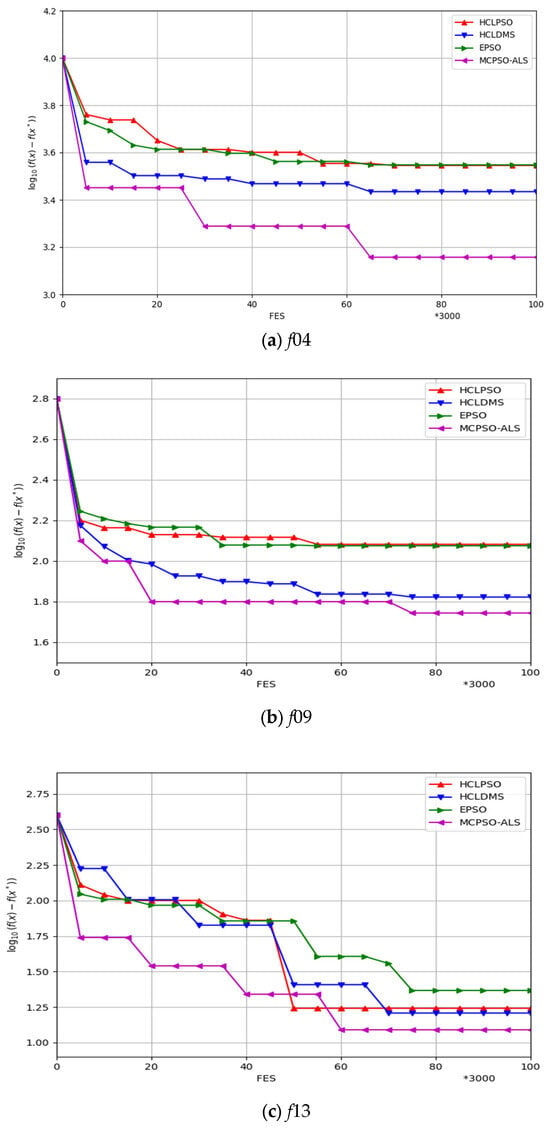
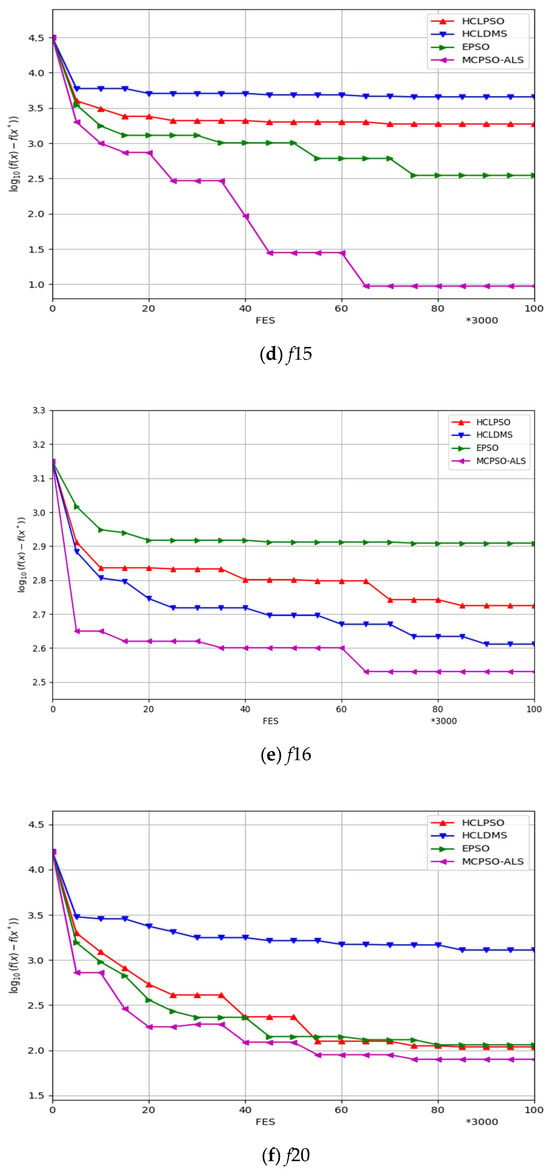
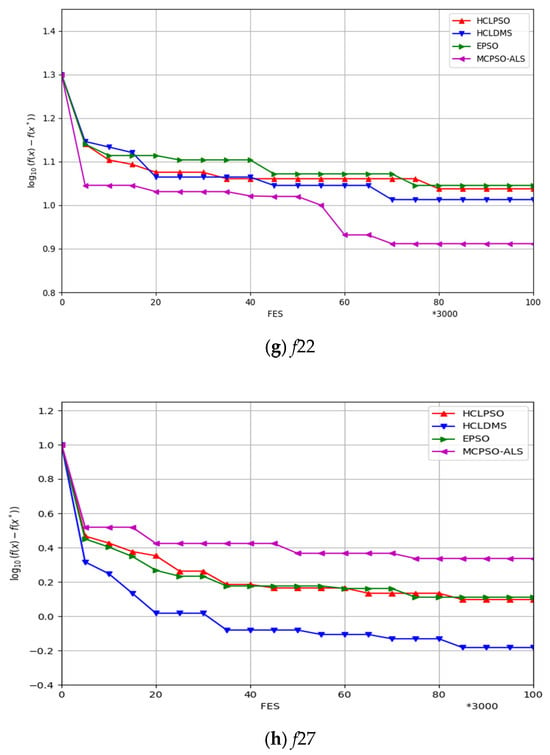
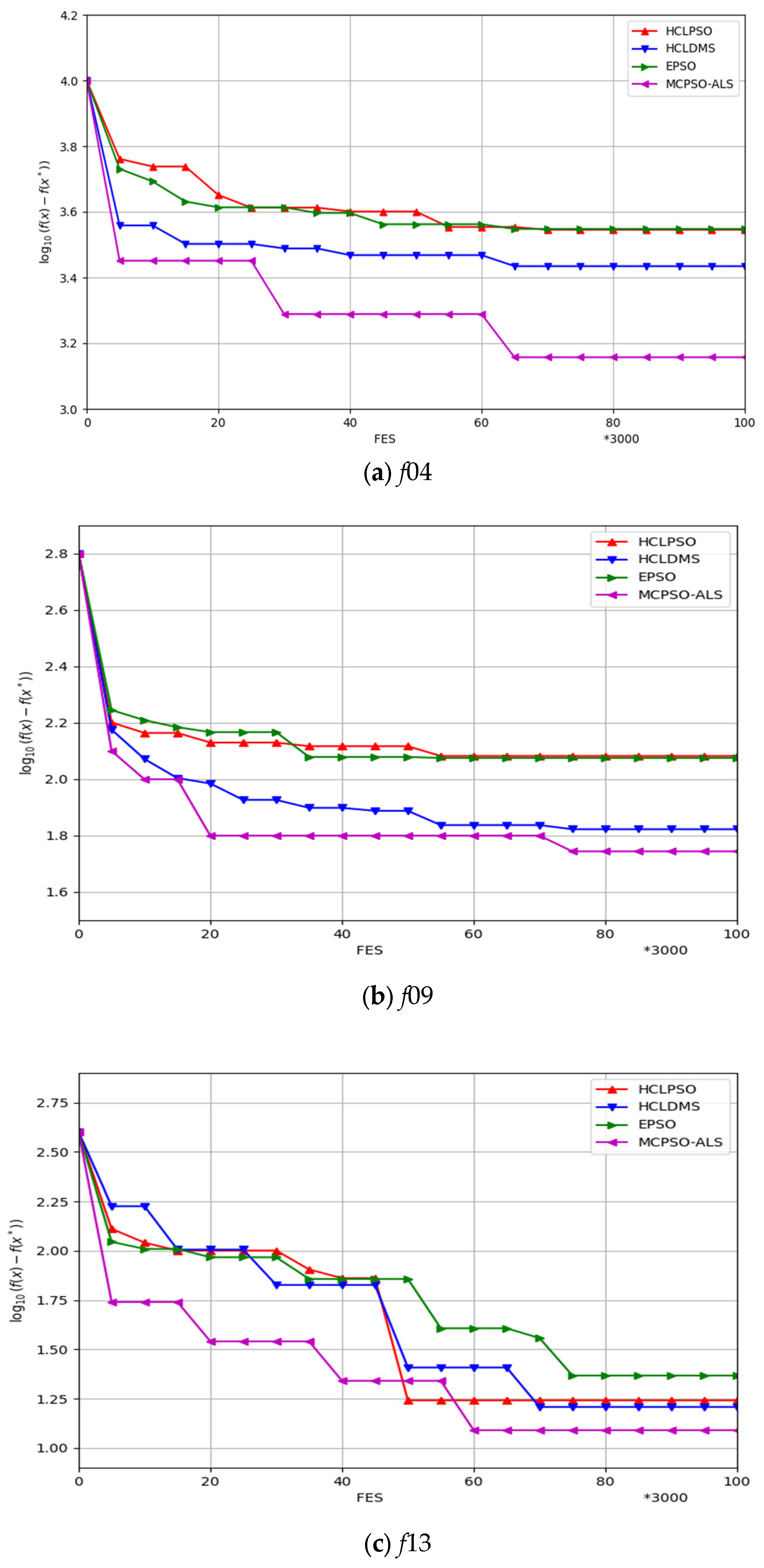
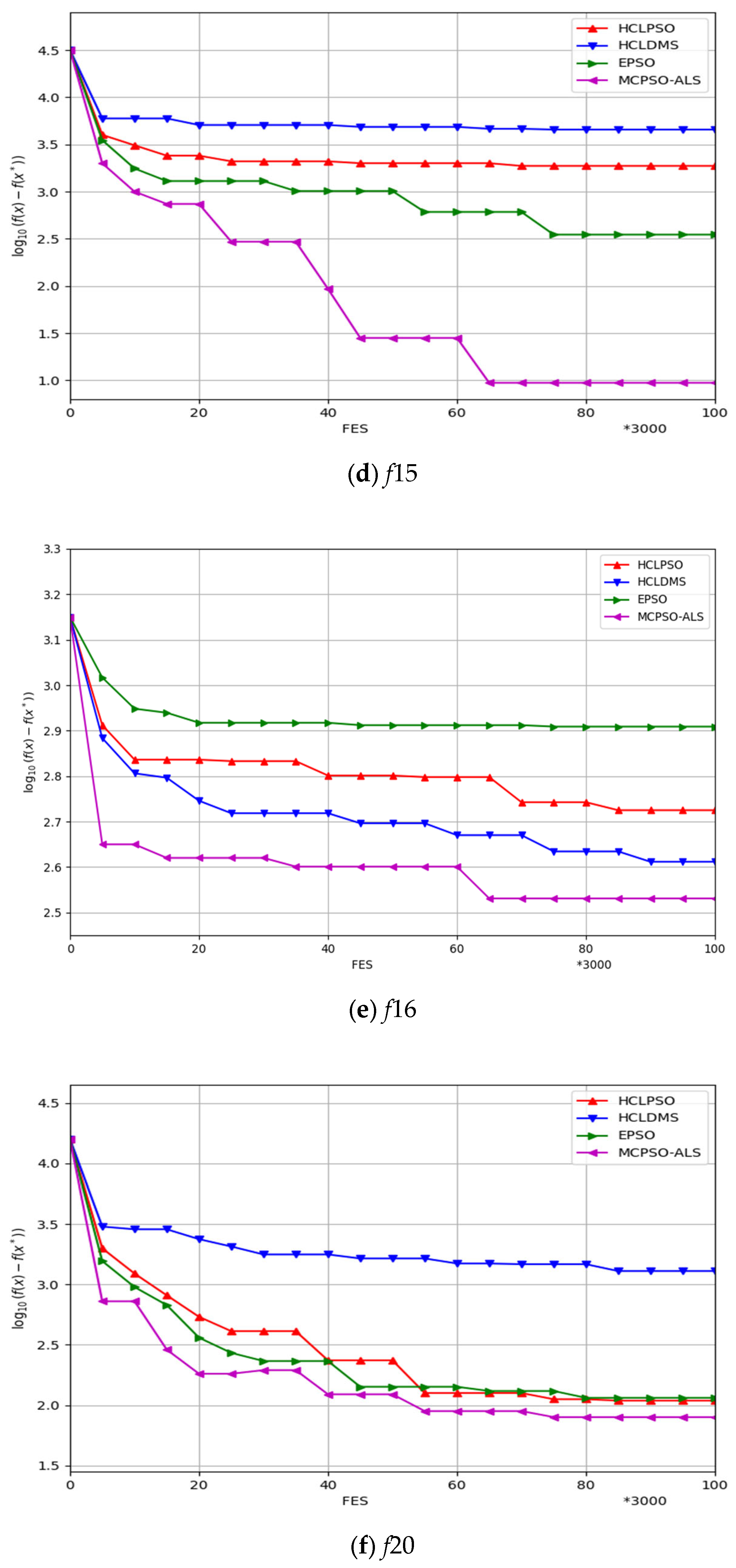
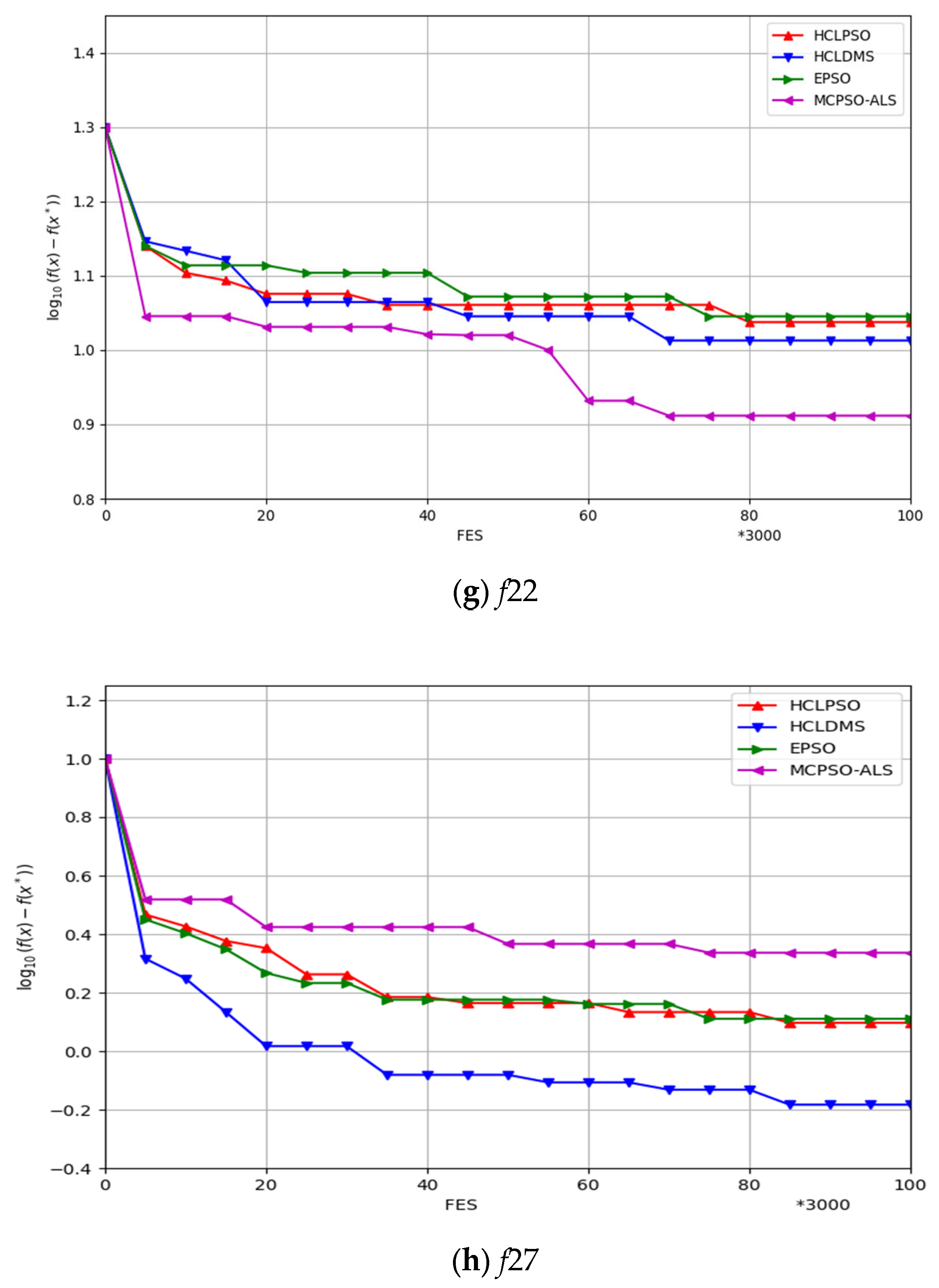
An algorithm’s convergence profile provides critical insight into its local exploitation capabilities. To evaluate its evolutionary trajectory, MCPSO-ALS was plotted against several formidable peers (specifically, HCLPSO, HCLDMS-PSO, and EPSO), with the resulting convergence curves illustrated in Figure 1. The graphs plot the algorithmic iterations along the abscissa against the optimization error (the discrepancy between the derived solution and the true global optimum) on the ordinate. To comply with manuscript space constraints, the visual discussion is narrowed to two unimodal functions (f4, f9), four multimodal cases (f13, f15, f16, f20), and a selection of complex composition functions (f22, f27).
Figure 1.
Convergence process of MCPSO-ALS and comparison methods in CEC2013.
An examination of Figure 1 reveals that MCPSO-ALS maintains an accelerated convergence rate across the majority of the selected functions, notably f4, f9, f13, f15, f20, f22, and f25.
For Function 4, which possesses only a single local optimum, MCPSO-ALS is able to rapidly locate the global optimum and conduct a precise search. As shown in the figure, MCPSO-ALS exhibits the fastest convergence speed, demonstrating that the ALM strategy enhances the algorithm’s local search capability. For function 16, which contains multiple local minima, MCPSO-ALS is capable of escaping local minima to perform a global search; the figure indicates that it achieves the fastest convergence. This demonstrates that APDS and ALM effectively enhance the algorithm’s global and local search capabilities. For Function 22, which involves rotation and translation, MCPSO-ALS is capable of escaping local minima to conduct a global search; as shown in the figure, MCPSO-ALS exhibits the fastest convergence speed. For function f27, its convergence trajectory closely mirrors those of EPSO and HCLDMS-PSO, while still decisively outpacing the remaining competitors. The proposed method exhibited its weakest convergence on f27; however, this behavior is theoretically consistent with the well-known “No Free Lunch” theorem.
Overall, this extensive empirical evidence substantiates the fact that MCPSO-ALS possesses robust local exploitation capabilities, enabling it to successfully tackle a wide array of challenging optimization functions.
4.3.5. Friedman Statistical Test Results
The Friedman test, a non-parametric statistical evaluation method, was applied to objectively rank the performance of all competing algorithms. Table 6 documents these test outcomes. The statistical evidence clearly demonstrates that MCPSO-ALS secured the top rank across the tested dimensionalities. Consequently, it is evident that the proposed algorithm holds a significant statistical advantage over its peer variants.
Table 6.
Friedman test results of all peer methods on CEC2013.
4.3.6. Wilcoxon Detection Experimental Results
This study employs the Wilcoxon rank-sum test, a typical non-parametric statistical tool, to quantitatively identify performance discrepancies between different benchmark algorithms. The statistical outcomes for all comparative groups are summarized in the footnote sections of Table 4 and Table 5. More detailed results are shown in Table 7 and Table 8. All experimental comparisons are implemented under a standard statistical scenario, where the significance level is set to 0.05 for difference judgment. In the statistical results, the notations of “+”, “−” and “=“ separately indicate that the performance of the MCPSO-ALS algorithm is better, poorer, or equivalent to its peer algorithms. According to the statistical data presented in the two tables, the proposed MCPSO-ALS algorithm delivers more competitive overall performance than all comparison strategies, and presents a dominant superiority in the comparative tests.
Table 7.
Wilcoxon signed-rank test results of single-problem analysis on CEC2013 (D = 30).
Table 8.
Wilcoxon signed-rank test results of single-problem analysis on CEC2013 (D = 50).
4.4. Performance Evaluation on CEC2017
To provide a more exhaustive validation of MCPSO-ALS, its optimization capabilities were further evaluated using the CEC2017 test suite. CMA-ES [29] and the latest multi-swarm PSO variants ACEPSO [24] and MSC-PSO [25] from the past two years were used for comparative experiments. As necessitated by page limits, this phase of comparative analysis focuses exclusively on the D = 30 search space. As shown in Table 9, MCPSO-ALS captured the most accurate solutions across the unimodal terrains. Within the seven multimodal scenarios, the proposed approach attained the global best in three functions (f5, f7, and f9), with HCLDMS-PSO and EPSO exhibiting the next best performances. When applied to the 10 hybrid and 10 composition functions, MCPSO-ALS dominated by achieving optimal results on seven and eight of those functions, respectively. These empirical findings underscore the highly competitive nature of MCPSO-ALS on the CEC2017 suite. Furthermore, Table 10 presents the Friedman test rankings for this specific suite, confirming once more that MCPSO-ALS achieved statistically remarkable outcomes. This reinforces its distinct superiority over the alternative swarm-based methods.
Table 9.
Comparison results of peer methods on CEC2017.
Table 10.
Friedman results of peer methods on CEC2017.
4.5. Tension-Spring Optimization Problem
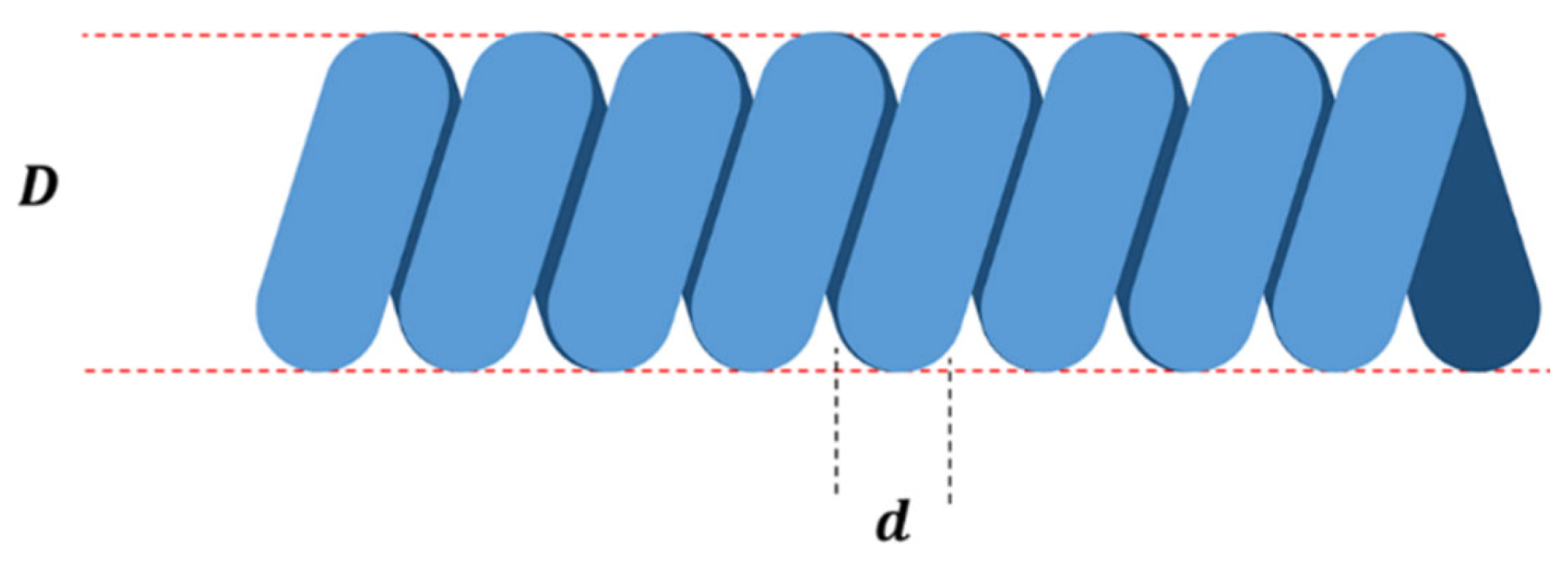
In this part, our goal is to find the minimum weight [30]. The construction weight is composed of onevariable (d(x1), D(x2), N(x3)), as shown in Figure 2. The constraints satisfied by these variables are described in detail in Equation (8). From Table 11, we can obtain the fact that MCPSO-ALS is remarkable, and has the best performance.
Figure 2.
Tension-spring optimization problem.
Table 11.
The experimental results in the tension-spring optimization problem.
5. Conclusions
In this paper, a Multi-swarm Collaborative Particle Swarm Optimization with Adaptive Learning Strategy (MCPSO-ALS) is developed to address the inherent drawbacks of premature convergence and the imbalance between exploration and exploitation in solving complex continuous optimization problems.
In the algorithm design part, an Adaptive Population Division Strategy (APDS) is firstly designed to dynamically partition and reorganize the overall population into elite, poor, and general sub-swarms, based on real-time fitness evaluations. Secondly, an Adaptive Learning Mechanism (ALM) is introduced to assign distinct updating strategies to particles with different roles, productively guaranteeing a dynamic equilibrium between global and local search capabilities. To validate the superior performance of the proposed algorithm, MCPSO-ALS is tested on the challenging CEC2013 and CEC2017 benchmark test suites and compared with several state-of-the-art algorithms. The experimental results systematically demonstrate that the proposed MCPSO-ALS algorithm exhibits significant advantages in convergence speed, solving accuracy, and comprehensive optimization capabilities.
Although MCPSO-ALS achieves considerable advancements in algorithm design and numerical simulation optimization, its potential in specialized real-world engineering scenarios warrants further exploration. In future research, we plan to extend the application of the MCPSO-ALS algorithm to the parameter optimization of lightweight neural-network architectures, facilitating highly efficient model execution for mobile and edge deployment. Furthermore, investigating its integration within multi-task learning frameworks for advanced OCR and intelligent recognition of complex historical archives remains a promising direction to fully exploit the algorithm’s robust search capabilities in high-dimensional and noisy environments.
Supplementary Materials
The following supporting information can be downloaded at: https://www.mdpi.com/article/10.3390/math14173210/s1. Table S1: CEC2013 test suite; Table S2: CEC2017 test suite.
Author Contributions
Conceptualization, Z.G.; Methodology, Z.G.; Software, Z.G.; Validation, Z.G.; Investigation, X.Y.; Resources, X.Y.; Writing—original draft, Z.G.; Writing—review & editing, X.Y.; Supervision, X.Y. All authors have read and agreed to the published version of the manuscript.
Funding
This work is supported by the Project of Liaoning Provincial Department of Education (LJ212410153075, 2025-R-089) and the Natural Science Foundation Doctoral Launch Project of Liaoning Provincial Science and Technology Plan Joint Program (1731655739405).
Data Availability Statement
The original contributions presented in this study are included in the article and Supplementary Materials. Further inquiries can be directed to the corresponding author.
Conflicts of Interest
The authors declare no conflict of interest.
References
- del Rio, A.; Barambones, O.; Uralde, J. Design and Experimental Validation of a Novel Particle Swarm Optimization Algorithm Designed to Optimize Solar Power Extraction. Mathematics 2026, 14, 2079. [Google Scholar] [CrossRef] [Scilit]
- Chen, L.; Wang, H.; Tang, Y.; Ma, Y.; Wen, S.; Geda, M.W. IWOA-Optimized deep learning for bearing fault diagnosis under noisy and variable conditions. IEEE Trans. Instrum. Meas. 2025, 74, 1–18. [Google Scholar] [CrossRef] [Scilit]
- Xiao, T.; Li, Q.; Zhang, J. Distributed Particle Swarm Optimization with Dimension-Level Interactions for Large-Scale Separable Optimization Problems. Processes 2026, 14, 642. [Google Scholar] [CrossRef] [Scilit]
- Wang, Y.; Cui, D. Interpretable Data-Driven Prediction, Optimization, and Decision-Making for Coking Coal Flotation. Processes 2026, 14, 1289. [Google Scholar] [CrossRef] [Scilit]
- Ke, X.; Lv, J.; Liu, X.; Huang, Y.; Qiu, G. Multi-Objective Coordinated Scheduling and Trading Strategy for Economy and Security of Source–Grid–Load–Storage Under High Penetration of Renewable Energy. Processes 2026, 14, 1117. [Google Scholar] [CrossRef] [Scilit]
- Kennedy, J. Particle swarm optimization. In Proceedings of the ICNN’95 -International Conference on Neural Networks, Perth, WA, Australia, 27 November–1 December 1995. [Google Scholar]
- Mirjalili, S.; Lewis, A. The Whale Optimization Algorithm. Adv. Eng. Softw. 2016, 95, 51–67. [Google Scholar] [CrossRef] [Scilit]
- Mirjalili, S.; Gandomi, A.H.; Mirjalili, S.Z.; Saremi, S.; Faris, H.; Mirjalili, S.M. Salp Swarm Algorithm: A bio-inspired optimizer for engineering design problems. Adv. Eng. Softw. 2017, 114, 163–191. [Google Scholar] [CrossRef] [Scilit]
- Sun, G.; Yang, B.; Yang, Z.; Xu, G. An adaptive differential evolution with combined strategy for global numerical optimization. Soft Comput. 2019, 24, 6277–6296. [Google Scholar] [CrossRef] [Scilit]
- Mirjalili, S.; Mirjalili, S.M.; Lewis, A. Grey Wolf Optimizer. Adv. Eng. Softw. 2014, 69, 46–61. [Google Scholar] [CrossRef] [Scilit]
- Long, W.; Wang, Y.; Long, Q.; Yang, Y.; Xu, M. Phased-enhancement marine predators algorithm for global optimization and medical insurance fraud detection. J. Bionic Eng. 2026, 23, 1088–1111. [Google Scholar] [CrossRef] [Scilit]
- Gao, M.; Yang, X. APSO-SL: An Adaptive Particle Swarm Optimization with State-Based Learning Strategy. Processes 2024, 12, 400. [Google Scholar] [CrossRef] [Scilit]
- Chen, K.; Zhou, F.; Yin, L.; Wang, S.; Wang, Y.; Wan, F. A hybrid particle swarm optimizer with sine cosine acceleration coefficients. Inf. Sci. 2018, 422, 218–241. [Google Scholar] [CrossRef] [Scilit]
- Xia, X.; Xing, Y.; Wei, B.; Zhang, Y.; Li, X.; Deng, X.; Gui, L. A fitness-based multi-role particle swarm optimization. Swarm Evol. Comput. 2019, 44, 349–364. [Google Scholar] [CrossRef] [Scilit]
- Wang, M.-H.; Cheng, H.-Y.; Sian, H.-W. Hung C-C: PSO and GA-Based Inspection Route Optimization for Offshore Wind Farm Maintenance: A Case Study in Taiwan. Processes 2026, 14, 2114. [Google Scholar] [CrossRef] [Scilit]
- Liang, J.J.; Qin, A.K.; Suganthan, P.N.; Baskar, S. Comprehensive learning particle swarm optimizer for global optimization of multimodal functions. IEEE Trans. Evol. Comput. 2006, 10, 281–295. [Google Scholar] [CrossRef] [Scilit]
- Lynn, N.; Suganthan, P.N. Ensemble particle swarm optimizer. Appl. Soft Comput. 2017, 55, 533–548. [Google Scholar] [CrossRef] [Scilit]
- Yang, X.; Li, H.; Yu, X. A dynamic multi-swarm cooperation particle swarm optimization with dimension mutation for complex optimization problem. Int. J. Mach. Learn. Cybern. 2022, 13, 2581–2608. [Google Scholar] [CrossRef] [Scilit]
- Yang, X.; Li, H. Multi-sample learning particle swarm optimization with adaptive crossover operation. Math. Comput. Simul. 2023, 208, 246–282. [Google Scholar] [CrossRef] [Scilit]
- Lynn, N.; Suganthan, P.N. Heterogeneous comprehensive learning particle swarm optimization with enhanced exploration and exploitation. Swarm Evol. Comput. 2015, 24, 11–24. [Google Scholar] [CrossRef] [Scilit]
- Wang, S.; Liu, G.; Gao, M.; Cao, S.; Guo, A.; Wang, J. Heterogeneous comprehensive learning and dynamic multi-swarm particle swarm optimizer with two mutation operators. Inf. Sci. 2020, 540, 175–201. [Google Scholar] [CrossRef] [Scilit]
- Yang, X.; Li, H.; Huang, Y. An adaptive dynamic multi-swarm particle swarm optimization with stagnation detection and spatial exclusion for solving continuous optimization problems. Eng. Appl. Artif. Intell. 2023, 123, 106215. [Google Scholar] [CrossRef] [Scilit]
- Yang, X.; Li, H. Evolutionary-state-driven multi-swarm cooperation particle swarm optimization for complex optimization problem. Inf. Sci. 2023, 646, 119302. [Google Scholar] [CrossRef] [Scilit]
- Hu, G.; Cheng, M.; Sheng, G.; Wei, G. ACEPSO: A multiple adaptive co-evolved particle swarm optimization for solving engineering problems. Adv. Eng. Inform. 2024, 61, 102516. [Google Scholar] [CrossRef] [Scilit]
- Tang, Y.; Huang, K.; Tan, Z.; Fang, M.; Huang, H. Multi-subswarm cooperative particle swarm optimization algorithm and its application. Inf. Sci. 2024, 677, 120887. [Google Scholar] [CrossRef] [Scilit]
- Song, Z.; Yang, B. Ant colony based fish crowding degree optimization algorithm for magnetic resonance imaging segmentation in sports knee joint injury assessment. Expert Syst. 2023, 40, e12849. [Google Scholar] [CrossRef] [Scilit]
- Jing, L.; Bo-Yang, Q.; Suganthan, P.N. Problem Definitions and Evaluation Criteria for the CEC 2013 Special Session on Real-Parameter Optimization; Nanyang Technological University: Singapore, 2013; pp. 281–295. [Google Scholar]
- Awad, N.H.; Ali, M.Z.; Liang, J.J.; Qu, B.Y.; Suganthan, P.N. Problem Definitions and Evaluation Criteria for the CEC 2017 Special Session and Competition on Single Objective Bound Constrained Real-Parameter Numerical Optimization; Nanyang Technological University: Singapore, 2016; pp. 1–34. [Google Scholar]
- Ghosh, S.; Das, S.; Roy, S.; Minhazul Islam, S.K. Suganthan PN: A Differential Covariance Matrix Adaptation Evolutionary Algorithm for real parameter optimization. Inf. Sci. 2012, 182, 199–219. [Google Scholar] [CrossRef] [Scilit]
- Cuong-Le, T.; Minh, H.-L.; Khatir, S.; Wahab, M.A.; Tran, M.T.; Mirjalili, S. A novel version of Cuckoo search algorithm for solving optimization problems. Expert Syst. With Appl. 2021, 186, 115669. [Google Scholar] [CrossRef] [Scilit]


Disclaimer/Publisher’s Note: The statements, opinions and data contained in all publications are solely those of the individual author(s) and contributor(s) and not of MDPI and/or the editor(s). MDPI and/or the editor(s) disclaim responsibility for any injury to people or property resulting from any ideas, methods, instructions or products referred to in the content. |
© 2026 by the authors. Licensee MDPI, Basel, Switzerland. This article is an open access article distributed under the terms and conditions of the Creative Commons Attribution (CC BY) license.