


Abstract
Shui Script is an ancient pictographic writing system with significant cultural and historical value. Automatic character detection is a fundamental step toward the digital preservation of Shui manuscripts, yet remains challenging due to slender strokes, densely distributed small characters, and complex background interference. To address these challenges, we propose DAC-Net, a lightweight dual-attention collaborative network based on YOLOv9. Specifically, the Dual-Attention Feature Enhancement Module (DAFEM) enhances weak stroke representations and preserves fine structural details, while the Decoupled Spatial-Channel Attention Fusion Module (DSAF) decouples spatial localization and channel semantic modeling to suppress background interference and improve feature discrimination. Extensive experiments demonstrate that DAC-Net achieves competitive performance against representative detection methods under multiple IoU thresholds while maintaining real-time inference efficiency. Notably, the performance improvement of DAC-Net over YOLOv9 is merely about 1% at IoU = 0.6 and IoU = 0.7. Robustness evaluations under brightness variation, motion blur, Gaussian noise, and partial occlusion further verify the effectiveness and generalization capability of the proposed method.
MSC:
65D18; 68T45
1. Introduction
Shui Script is an ancient pictographic writing system created by the ancestors of the Shui ethnic group in China [1]. As one of the few living pictographic writing systems preserved among China’s ethnic minorities, it records abundant historical, religious, and cultural information and has been recognized as a national intangible cultural heritage. With the rapid development of digital humanities and artificial intelligence, the computational preservation and intelligent analysis of endangered ancient scripts have attracted increasing attention. Among related tasks, accurate Shui Script character detection is a fundamental prerequisite for downstream applications such as character recognition, manuscript understanding, and digital archiving.
However, automatic Shui Script detection remains challenging due to its unique glyph characteristics and complex preservation conditions. First, Shui Script characters contain slender and irregular strokes together with numerous glyph variants, resulting in weak feature responses and difficulties in fine-grained discrimination. Second, historical manuscripts, stone carvings, and ritual artifacts are often affected by erosion, stains, and uneven illumination, introducing severe foreground–background interference. Third, Shui Script characters usually appear as densely distributed small objects, making accurate localization considerably more difficult.
Benefiting from recent advances in deep learning, text detection has evolved from handcrafted feature engineering to end-to-end deep neural networks [2,3]. Existing approaches can generally be categorized into segmentation-based, regression-based, and Transformer-based methods [4,5,6,7,8]. Although these methods achieve remarkable performance on natural scene text, they are not specifically designed for ancient scripts characterized by weak stroke features, dense layouts, and severe image degradation. Existing studies on Shui Script mainly focus on character recognition, whereas research on character detection remains relatively limited [9]. Early detection methods based on two-stage detectors, such as Faster R-CNN [10], can only handle limited character categories and relatively clean scenarios, showing poor adaptability to real-world Shui manuscripts.
When directly applied to Shui Script images, existing detectors still suffer from three major limitations. First, repeated feature extraction gradually weakens the already faint stroke information, while conventional attention mechanisms such as SE and CBAM mainly perform generic feature recalibration and cannot effectively preserve fine-grained stroke details while suppressing complex background interference [11,12]. Second, although segmentation-based methods such as DBNet and PSENet achieve competitive performance on irregular text regions, they tend to lose fine structural information during multi-scale feature aggregation. YOLO-based detectors provide efficient inference but exhibit limited representation capability for weak textual features, whereas Transformer-based methods offer stronger global modeling at the cost of substantially higher computational complexity [6,7,8,13,14,15,16,17]. Finally, conventional feature fusion strategies tightly couple spatial localization and channel semantic modeling, making them vulnerable to complex background textures and reducing feature discriminability under degraded imaging conditions.
To overcome these limitations, we propose DAC-Net, a lightweight dual-attention collaborative enhancement network based on YOLOv9 for robust Shui Script character detection. Specifically, the proposed Dual-Attention Feature Enhancement Module (DAFEM) progressively enhances weak stroke representations through channel-guided spatial refinement, thereby preserving fine-grained structural details. Meanwhile, the Decoupled Spatial-Channel Attention Fusion Module (DSAF) decouples spatial localization from channel semantic modeling, effectively suppressing background interference while improving feature discrimination during multi-scale feature fusion. By collaboratively optimizing feature representation and feature aggregation, DAC-Net achieves accurate and robust Shui Script character detection while maintaining real-time inference efficiency.
The main contributions of this work are summarized as follows:
- We propose DAC-Net, a lightweight dual-attention collaborative enhancement network based on YOLOv9 for robust Shui Script character detection, providing an effective framework for handling slender strokes, dense character distributions, and complex manuscript backgrounds.
- We design the Dual-Attention Feature Enhancement Module (DAFEM), which progressively refines channel and spatial attention to strengthen weak stroke representations and preserve fine-grained glyph structures.
- We propose the Decoupled Spatial-Channel Attention Fusion Module (DSAF), which decouples spatial localization and channel semantic modeling to suppress background interference and improve multi-scale feature representation.
- Extensive experiments demonstrate that DAC-Net achieves competitive performance against representative detection methods under multiple IoU thresholds while maintaining real-time inference efficiency.
2. Related Work
2.1. Natural Scene Text Detection
Natural scene text detection methods can be broadly categorized into handcrafted feature-based approaches and deep learning-based approaches, with the latter further divided into regression-based and segmentation-based methods.
2.1.1. Handcrafted Feature-Based Methods
Representative techniques include projection methods, sliding window methods, and connected component analysis. The projection method locates text lines by counting pixel distributions along horizontal and vertical directions. This method is computationally simple and efficient, but sensitive to noise and limited to regularly arranged horizontal text. The sliding window method scans an image with fixed-size windows and uses classifiers such as SVM [18] and AdaBoost [19] to determine whether a window contains text. However, these methods require manually designed features and window sizes, which limits their generalization ability, and scanning the entire image incurs high computational cost. Connected component analysis extracts candidate text regions based on pixel connectivity. Typical techniques include SWT [20] and MSER [21]. SWT aggregates text regions by leveraging stroke width consistency and performs well in scenes with uniform strokes. MSER locates text by searching for maximally stable extremal regions and achieved strong performance on the ICDAR 2013 benchmark. Nevertheless, connected component-based methods suffer from limited robustness in complex backgrounds, where detection performance often degrades sharply. Overall, handcrafted feature-based methods are effective only in scenes with simple backgrounds and regular text, and they struggle with curved, dense, or irregular text.
2.1.2. Regression-Based Methods
Regression-based text detection methods frame text detection as an object localization problem by directly predicting the positions and geometries of text instances. These approaches generally fall into two-stage and one-stage frameworks. Two-stage methods first generate candidate regions and then perform classification and localization refinement. Representative models such as Mask R-CNN [22] and Cascade Mask R-CNN achieve high detection accuracy through multi-stage optimization, but their complex pipelines incur higher computational cost and slower inference. In contrast, one-stage methods directly predict object locations and categories from feature maps, thereby simplifying the detection pipeline and improving inference speed. Representative methods include SSD [23] and the YOLO series [23,24,25,26,27], which have demonstrated a strong ability to balance detection accuracy and computational efficiency.
To further adapt regression mechanisms to scene text detection, several specialized methods have been proposed. EAST directly predicts rotated text regions to improve detection flexibility and efficiency [5]. TextBoxes++ designs text-specific anchor strategies to better capture elongated text instances [28], while RRD [29] enhances robustness for multi-oriented text detection through rotation-sensitive features. Despite their promising performance, these methods still struggle with irregular text layouts, such as curved, densely distributed, or overlapping text instances, often suffering from localization ambiguity and missed detections.
2.1.3. Segmentation-Based Methods
Unlike regression-based methods that directly predict text boxes, segmentation-based approaches formulate text detection as pixel-wise binary classification, which better adapts to arbitrarily shaped text. PSENET separates adhered text through a progressive expansion strategy using multi-scale kernels and then generates final detection contours [14]. Building on PSENET, PAN introduces a pyramid attention mechanism to improve small-scale text detection [30]. DBNET proposes a differentiable binarization operation that unifies segmentation results and box generation into an end-to-end trainable pipeline, greatly improving inference speed while maintaining accuracy [31]. The subsequent DBNET++ further enhances detection performance for small targets and complex backgrounds through multi-scale feature fusion [31]. Nevertheless, segmentation models still suffer from missed and false detections when facing extremely small text or strong noise, and thus require stronger robustness. In summary, regression-based methods are efficient and suitable for oriented text but struggle with highly irregular layouts such as curved or densely overlapping text. Segmentation-based methods handle arbitrary shapes more flexibly but remain sensitive to noise and small-scale text. These limitations motivate more robust and adaptive designs for complex document scenarios.
2.2. Ancient Document Text Detection
Text detection in ancient documents faces distinct challenges compared to natural scenes, including severe text degradation, complex layout structures, and limited annotated data. In recent years, researchers have conducted extensive work from perspectives such as high-resolution reconstruction, multi-scale feature fusion, noise suppression, and character morphology modeling. Multi-scale and high-resolution methods. Ma et al. designed a two-branch network based on Faster R-CNN to handle both character detection and layout analysis [32]. Tang et al. proposed HRRegionNet to enhance dense text detection through high-resolution feature reconstruction [33]. Feng et al. improved FCOS to strengthen information fusion efficiency in the feature pyramid [34].
Attention and character-focused methods. Sihang et al. introduced reinforcement learning into bounding box optimization to make detection boxes fit text regions more compactly [35]. Xing et al. designed a multi-scale hybrid attention network for Dongba script, significantly improving noise robustness and feature learning [36]. Ma et al. proposed the STEF model, combining feature pyramid enhancement with differentiable binarization to improve robustness across different ancient document scenarios [37]. Wang et al. constructed EMANet by modeling channel dependencies with a multi-scale fusion strategy to enhance generalization [38]. Qi et al. introduced Haar wavelet downsampling and character-focused attention to optimize text boundary localization under complex layouts [39]. Detection for Shui Script. Tang et al. applied Faster R-CNN to Shui character detection [40]. Although this method can recognize multiple character categories, it is designed for regular layouts and lacks adaptability to complex layouts such as dense arrangements or mixed single/double columns. In general, existing ancient text detection methods still lack sufficiently robust and adaptive dedicated solutions for highly irregular and structurally variable documents such as Shui manuscripts. In particular, current methods for Shui Script assume relatively regular layouts such as single-column or aligned text and lack robust handling of dense, mixed single-or-double-column, or irregularly arranged characters, a gap that directly motivates our DAC-Net.
3. Proposed Method
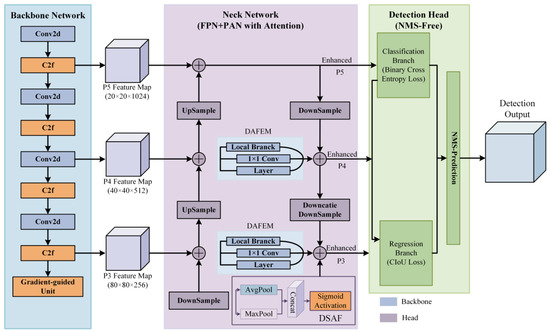
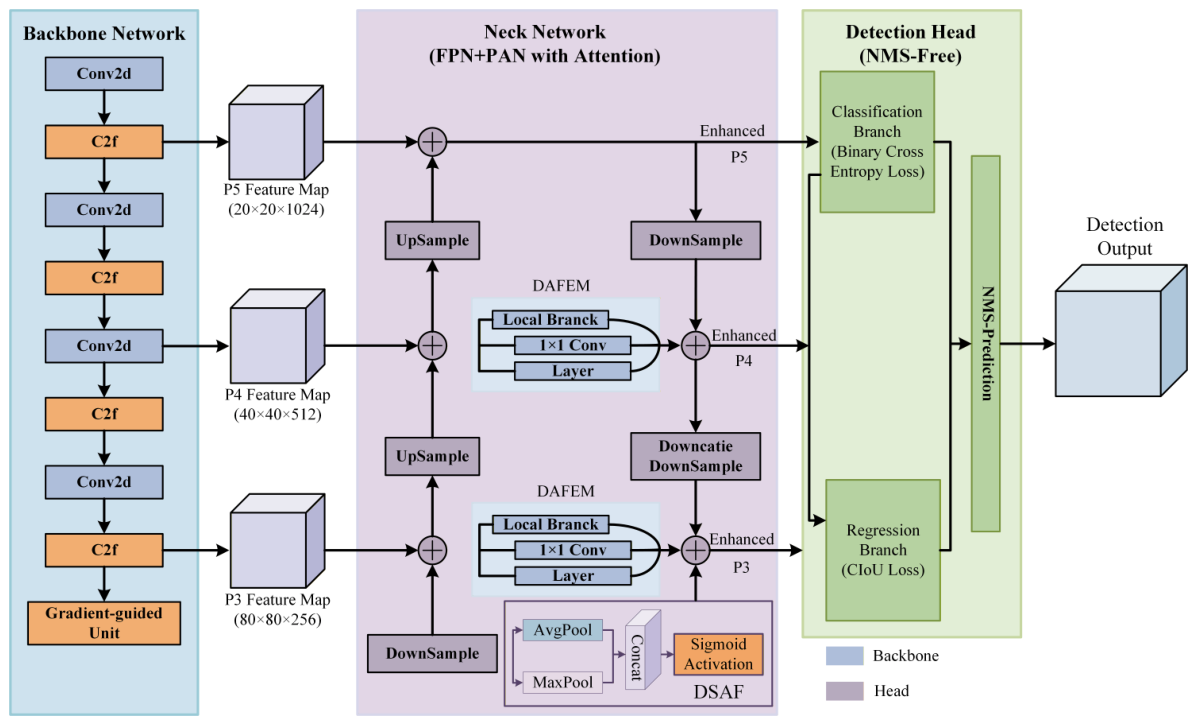
Addressing the inherent challenges of Shui Script character detection, including slender stroke structures, irregular glyph shapes, small object sizes, and severe complex background interference in practical scenarios, this work develops a lightweight end-to-end detection framework termed Dual-Attention Collaborative Network (DAC-Net). Figure 1 illustrates the overall architecture.
Figure 1.
Overall framework of the proposed DAC-Net.
The proposed pipeline follows a standard workflow: feature extraction, feature enhancement, multi-scale feature fusion, and detection regression. This design delivers a compact, efficient, and parameter-controllable structure. The network comprises three core components: a backbone, a feature enhancement and fusion neck, and a detection head. Such a design adapts well to the fine-grained morphological characteristics and high-interference detection scenarios of Shui Script characters.
To further strengthen representation capability and anti-interference performance for challenging Shui Script samples, we embed two lightweight attention modules into the neck network: the Dual-Attention Feature Enhancement Module (DAFEM) and the Decoupled Spatial-Channel Attention Fusion Module (DSAF). DAFEM reinforces fine-grained glyph features and small-object representation, while DSAF suppresses complex background noise and purifies discriminative feature responses. With these two dedicated modules, our method achieves substantial gains in detection accuracy while maintaining high inference efficiency.
3.1. Backbone and Neck Network Design
The backbone network adopts the lightweight architecture of YOLOv9, consisting of C2f modules and gradient-guided feature extraction units. It maintains strong feature representation capability while constraining the number of parameters and computational complexity. This design is particularly suitable for Shui Script character detection for two reasons. First, the gradient-guided mechanism preserves fine-grained stroke details that are easily lost in slender characters. Second, the lightweight nature keeps the model compact, which is essential given the limited annotated data and the need for efficient processing of high-resolution manuscript images. Given an input image , after multi-layer convolution, downsampling, and residual connections, the network outputs three groups of multi-scale features: (high-resolution detail features), (medium-scale semantic features), and (high-level global semantic features). These features provide fundamental support for fine-grained Shui Script character detection.
The neck network adopts the bidirectional fusion structure of FPN-PAN to achieve multi-scale feature complementarity. The top-down pathway transmits high-level semantic information to enhance localization capability, while the bottom-up pathway feeds back detailed information to improve texture representation accuracy. Tailored to the characteristics of Shui Script, dedicated enhancement modules are embedded in the fusion path to specifically address the challenges of weak fine-grained features and severe background interference. Together, the backbone and neck provide a multi-scale feature hierarchy that captures both fine-grained stroke details and global layout context, forming a solid foundation for the attention modules in the subsequent stage.
3.2. Collaborative Feature Enhancement Framework
Although YOLOv9 provides efficient multi-scale feature extraction, its original feature aggregation strategy may be insufficient for Shui Script detection, where weak stroke responses, irregular glyph structures, and complex background textures frequently occur. Fine-grained character details may be gradually weakened during feature propagation, while background patterns may introduce redundant activations and affect feature discrimination.
To address these issues, we propose a collaborative feature enhancement framework consisting of two complementary modules, namely DAFEM and DSAF. The Dual-Attention Feature Enhancement Module (DAFEM) aims to enhance weak textual representations by progressively refining channel semantics and spatial structures, improving the perception capability of slender strokes, character boundaries, and small-scale instances.
Meanwhile, the Decoupled Spatial-Channel Attention Fusion Module (DSAF) focuses on feature recalibration after enhancement. By decoupling spatial localization and channel semantic responses with adaptive fusion, DSAF reduces background interference and improves the robustness of feature representation. Through the complementary interaction between enhancement and refinement, DAC-Net achieves accurate and stable Shui Script detection under complex real-world conditions.
3.2.1. Dual-Attention Feature Enhancement Module
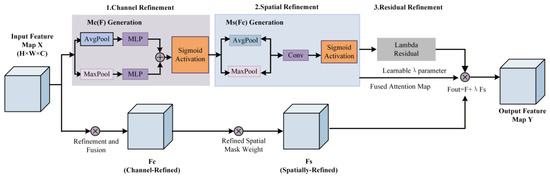
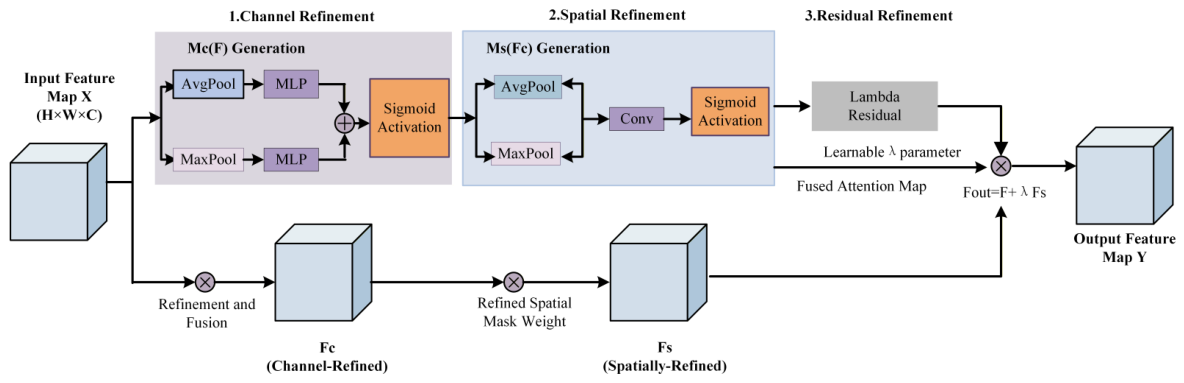
(DAFEM) The architecture of the proposed Dual-Attention Feature Enhancement Module (DAFEM) is illustrated in Figure 2. Inspired by channel-spatial attention frameworks such as CBAM [12], DAFEM is designed as a task-oriented feature refinement module specifically for Shui Script text detection. Rather than directly applying general-purpose attention operations with independent two-stage weighting, DAFEM considers the unique characteristics of Shui Script images, including slender strokes, irregular structures, dense local textures, and complex background interference. Existing channel-spatial attention mechanisms like CBAM treat channel and spatial weighting as two uncorrelated operations without hierarchical guidance. However, for handwritten text with fine irregular strokes, the order of semantic calibration and spatial localization directly affects feature quality. Therefore, DAFEM introduces a progressive channel-to-spatial refinement strategy, where semantic channel responses are enhanced before spatial structural refinement. This hierarchical interaction enables spatial attention to operate on more discriminative feature representations, thereby improving the perception capability of fine-grained stroke regions and character boundaries. Given an input feature map , where H, W, and C represent the height, width, and channel dimensions, respectively, the channel attention map and spatial attention map are denoted as and , respectively. The overall feature refinement process of DAFEM is formulated as:
where ⊗ denotes element-wise multiplication. represents the channel-enhanced feature representation, while denotes the spatially refined feature representation. Different from CBAM that directly outputs weighted features without adjustable residual compensation, DAFEM introduces residual adaptive fusion to preserve the original feature information during enhancement. The coefficient controls the contribution of refined features, reducing excessive feature attenuation and improving feature propagation stability. The channel refinement operation is formulated as:
where denotes the Sigmoid activation function. By combining global average pooling and global maximum pooling, the channel branch captures complementary semantic responses and salient structural information. The generated channel weights enhance feature dimensions associated with discriminative Shui Script patterns while suppressing redundant responses caused by background interference. After channel refinement, spatial enhancement is performed on the semantic-enhanced representation:
where denotes channel-wise concatenation and represents a convolution operation with a kernel. The enlarged receptive field distinguishes DAFEM from CBAM’s small fixed kernel, and enables the module to capture contextual dependencies among spatially distributed stroke regions, which is beneficial for maintaining stroke continuity and character boundary details in Shui Script images. The effectiveness of DAFEM mainly originates from the progressive interaction between semantic selection and spatial refinement. Instead of treating channel and spatial responses as independent recalibration operations, DAFEM enables spatial localization to be guided by channel-enhanced semantic representations. Meanwhile, the residual adaptive fusion mechanism preserves low-level texture information and dynamically regulates enhancement intensity. Through this progressive refinement strategy, DAFEM improves the representation capability of DAC-Net for slender strokes, small-scale Shui Script instances, and complex handwritten structures under challenging detection conditions.
Figure 2.
Structure of the proposed Dual-Attention Feature Enhancement Module (DAFEM). Different from CBAM’s independent two-stage weighting, DAFEM adopts progressive channel-spatial guidance, residual adaptive fusion and large receptive field for Shui Script feature enhancement.
3.2.2. Decoupled Spatial-Channel Attention Fusion Module
(DSAF) Although DAFEM enhances fine-grained textual representations through progressive attention refinement, complex background textures, document degradation, and noise interference in historical Shui manuscripts may still introduce redundant activations during feature aggregation. Therefore, DSAF is designed as an adaptive spatial-channel feature fusion module to improve feature discrimination by balancing spatial localization information and channel semantic responses. Different from DAFEM, which focuses on sequential feature refinement, DSAF aims to optimize the aggregation of complementary spatial and semantic information.
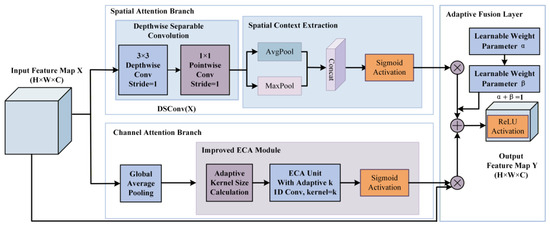
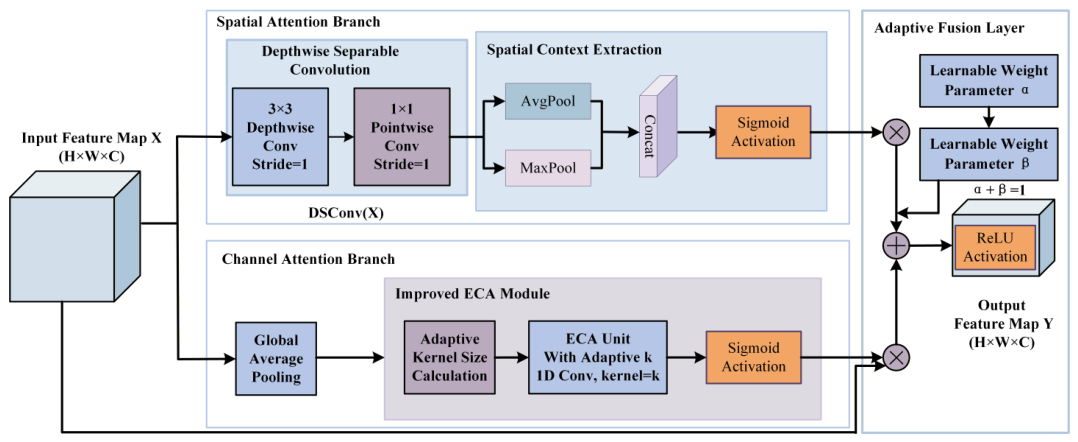
Lightweight channel attention such as Efficient Channel Attention (ECA) only conducts isolated single-channel modeling without matched spatial branches, while mainstream fusion modules Bidirectional Feature Pyramid Network (BiFPN) and Adaptive Spatial Feature Fusion (ASFF) adopt static fixed fusion weights without dynamic adjustment. For Shui Script images with elongated strokes, dense local textures, and irregular backgrounds, spatial and semantic representations may contain different types of complementary information. Therefore, DSAF separately models spatial and channel responses and introduces adaptive fusion weights to dynamically balance their contributions according to feature characteristics. The architecture of DSAF is illustrated in Figure 3. Given an input feature map , the spatial branch and channel branch independently generate spatial attention responses and channel semantic responses, denoted as and , respectively. The feature representations generated by the two branches are formulated as:
The final fused representation is obtained through adaptive weighted aggregation:
where ⊗ denotes element-wise multiplication, and and represent learnable fusion coefficients for dynamically balancing spatial and channel information. In the spatial branch, depthwise separable convolution is employed to generate spatial response mappings. Compared with conventional convolution operations, this structure reduces computational complexity while maintaining local structural modeling capability.
Figure 3.
Structure of the proposed Decoupled Spatial-Channel Attention Fusion Module (DSAF). Distinct from ECA, BiFPN and ASFF, DSAF uses decoupled dual branches and learnable dynamic fusion weights for Shui Script feature enhancement.
In the spatial branch, depthwise separable convolution is employed to generate spatial response mappings. Compared with conventional convolution operations, this structure reduces computational complexity while maintaining local structural modeling capability.
It enables the network to better preserve stroke continuity and boundary information of slender Shui Script characters. In the channel branch, an ECA-inspired lightweight channel modeling strategy is adopted to capture local cross-channel dependencies. Without introducing additional dimensionality reduction operations, it efficiently models channel importance relationships and enhances semantic responses associated with text structures while suppressing redundant background-related activations.Compared with fixed-weight fusion schemes in BiFPN and ASFF, DSAF introduces learnable spatial-channel weighting to adaptively adjust feature contributions under different image conditions. This design enables the network to emphasize spatial localization information for weak boundary regions and strengthen semantic discrimination under complex background interference. Together with DAFEM, DSAF establishes a complementary feature optimization framework in DAC-Net. Specifically, DAFEM focuses on progressive hierarchical attention refinement, while DSAF focuses on decoupled spatial-semantic adaptive fusion. By explicitly optimizing spatial structure modeling and channel semantic enhancement before adaptive fusion, DSAF improves the robustness and discriminative capability of Shui Script feature representations under complex backgrounds, texture variations, and small-scale text conditions.
3.3. Detection Head and Loss Function
The detection head retains the anchor-free and NMS-free design of YOLOv9, consisting of a classification branch and a regression branch. It directly outputs bounding box parameters , improving inference efficiency and adapting to the dense arrangement of Shui Script characters. The anchor-free design avoids handcrafted anchor priors that assume fixed aspect ratios. This assumption fails for Shui Script characters, as their aspect ratios vary widely from slender strokes to near-square glyphs. The NMS-free design prevents the erroneous suppression of tightly spaced characters, which are common in dense Shui Script layouts.
A multi-task joint loss function is adopted and formulated as:
where and denote the balancing coefficients for classification loss and regression loss, respectively. In this study, is set to and is set to to emphasize localization optimization for slender Shui Script text regions.
The classification branch employs Binary Cross-Entropy (BCE) Loss combined with the Online Hard Example Mining (OHEM) strategy to alleviate the imbalance between positive and negative samples. Since Shui Script text detection often involves numerous background regions and small-scale text instances, OHEM enables the model to focus more on difficult samples during training, thereby improving discrimination capability under complex background conditions.
For the regression branch, Complete Intersection over Union (CIoU) Loss is adopted to improve localization accuracy for irregular and elongated text regions. Compared with conventional IoU-based losses, CIoU simultaneously considers overlap area, center-point distance, and aspect-ratio consistency between the predicted box and the ground-truth box, making it more suitable for Shui Script text with slender structures and large shape variations. The regression loss is formulated as:
where
Here, and denote the center points of the predicted and ground-truth boxes, respectively; is the Euclidean distance between them; d is the diagonal length of the minimum enclosing box; and and measure the aspect-ratio consistency and its balancing coefficient, respectively.
Overall, the proposed joint loss formulation jointly optimizes classification confidence and localization accuracy, thereby improving the detection robustness for small-scale Shui Script text under complex background conditions.
4. Experiments and Analysis
To systematically evaluate the proposed method on the Shui Script character detection task, we conduct experiments in terms of dataset construction, experimental settings, and multi-dimensional performance evaluation. The detection accuracy, inference efficiency, and model robustness are analyzed, with a focus on both dedicated and general scenarios.
4.1. Experimental Dataset
Publicly available datasets for Shui Script character detection remain extremely limited. The existing S842 dataset [9] only provides cropped isolated Shui characters for classification tasks and lacks complete full-page ancient manuscript scenes with continuous text lines. To evaluate the proposed method under realistic ancient document scenarios, we construct a dedicated Shui Script full-page detection dataset named Shui-MSD. Our task is binary character detection rather than multi-class glyph classification. The 842 core categories and 1366 variant glyphs only describe the diversity of glyphs within the dataset, and these category labels are not used for model training.
Our Shui-MSD dataset inherits the character system from S842, covering 842 core Shui Script categories and 1366 variant glyphs. We collect authentic full-page scanned images from rare Shui ancient manuscripts preserved in Guizhou cultural heritage institutions. These raw pages contain vertical right-to-left text, overlapping strokes, faded ink, uneven illumination and cluttered backgrounds, which perfectly simulate complex real-world detection scenes of Shui cultural relics.
After data cleaning and quality screening, we retain 2200 high-quality original full-page manuscript images. To avoid data leakage, we strictly follow the standard pipeline: the 2200 raw images are firstly split into training, validation and test subsets at a ratio of 7:1:2 before any augmentation operation. Only the training subset is augmented with Mosaic, random cropping, multi-angle rotation, horizontal flipping, brightness/contrast adjustment and Gaussian noise injection. All augmented samples generated from the same original page are restricted to the training set and will never flow into validation or test splits. After augmentation, the total number of dataset images reaches 9200. Every Shui character instance in all pages is manually annotated with bounding boxes.
Specifically, the training set contains 1540 original images (expanded to 8540 after augmentation) with 12,681 character instances; the validation set contains 220 original images with 1037 instances; and the test set contains 440 original images with 1044 instances. In total, the dataset comprises 14,762 annotated Shui character instances. The glyph categories exhibit an obvious long-tailed distribution: the top 120 frequently used glyphs account for 62.7% of all samples, while the remaining rare characters and variant glyphs constitute 37.3%. To alleviate this category imbalance, we adopt class-aware sampling during model training.
We use LabelImg to draw compact bounding boxes that fully enclose the complete strokes of each Shui character. Overlapping adjacent characters are labeled with separate bounding boxes; partially occluded characters with recognizable main strokes are also marked as valid targets. Two graduate students with professional Shui cultural knowledge independently complete double-blind annotation for all images. Afterwards, a third domain expert inspector thoroughly reviews all labels to eliminate incorrect boxes, redundant overlapping annotations and broken invalid character fragments. The inter-annotator consistency measured by Cohen’s Kappa reaches 0.92, indicating excellent annotation reliability.
4.2. Experimental Setup
Experiments are conducted on an NVIDIA RTX 3090 GPU (24GB), Intel i7-13700K CPU, and 64GB RAM, running Ubuntu 20.04 with PyTorch 2.0. The input image size is uniformly set to for all models during training and inference. The AdamW optimizer is adopted with an initial learning rate of 0.001, dynamically adjusted via a cosine annealing decay strategy. The batch size is fixed to 16, and all models are trained for 100 epochs.
To ensure fair comparison, all baseline detectors (YOLOv8-s, YOLOv9-s, YOLOv10-s, YOLOv11-s, YOLOv12-s) and the proposed DAC-Net are fully retrained on the identical Shui-MSD training subset with consistent hyperparameters and augmentation pipelines. Identical training augmentations including random cropping, horizontal flipping and multi-angle rotation are only applied to training samples for generalization improvement.
For pre-trained initialization, all YOLO baselines adopt official COCO pre-trained small-variant weights from their original open-source repositories. As for our DAC-Net, its backbone is initialized with ImageNet-1K pre-trained weights. We freeze the first two convolutional blocks in the first 10 epochs, and unfreeze all layers for fine-tuning in the remaining training process.
Following the dataset split in Section 4.1, we use the training set for model optimization, the validation set for hyperparameter tuning and checkpoint selection, and the test set exclusively for final unseen evaluation. Detection performance is measured using precision, recall, and F1-score, computed at IoU thresholds of 0.5, 0.6, and 0.7 to evaluate localization accuracy under different matching requirements. All precision, recall and F1 values are calculated with a fixed confidence threshold of 0.5. This threshold is selected via grid search on the validation set over candidates ranging from 0.1 to 0.9 with a step of 0.05, as this value achieves the optimal balance between precision and recall.
4.3. Comparison with State-of-the-Art Methods
To comprehensively evaluate the proposed method, we compare it against mainstream text detection approaches on the Shui-MSD test set. These include traditional projection-based methods, classic deep learning detectors (EAST, DBNet, PSENet, Mask R-CNN), and the YOLO series (YOLOv8 to YOLOv12). We adopt Precision (P), Recall (R), and F1-score as evaluation metrics at IoU thresholds of 0.5, 0.6, and 0.7. Table 1 presents the F1-score comparison, while the complete P/R/F1 results are provided in Appendix A Table A1.
Table 1.
Performance comparison (F1-score, mean ± std over 5 runs).
The results reveal significant performance differences among various methods. The traditional projection method yields F1-scores below 0.2 across all thresholds, confirming its poor adaptability to complex backgrounds and diverse character shapes. Among classic deep learning methods, DBNet and PSENet outperform EAST and Mask R-CNN. Notably, PSENet is highly sensitive to IoU thresholds: its F1-score drops sharply from 0.8726 to 0.6050 as the IoU increases from 0.5 to 0.6, indicating that PSENet struggles with precise localization under strict matching criteria. The YOLO series generally surpasses traditional and early deep learning methods. Among them, YOLOv9 achieves the best overall performance, with F1-scores of 0.9256, 0.9255, and 0.9219 at the three IoU thresholds.
Our method achieves competitive performance against competing algorithms across various IoU thresholds, with only a marginal gain of around 1% over YOLOv9 at IoU = 0.6 and 0.7. At IoU = 0.5, it attains an F1-score of 0.9474, a 2.18% improvement over YOLOv9 (0.9256). At IoU = 0.7, it achieves an F1-score of 0.9334. the performance degradation from IoU = 0.5 to IoU = 0.7 is only 1.4% (from 0.9474 to 0.9334), which is the smallest drop among all compared methods. For instance, PSENet drops by 25.7%, Mask R-CNN by 1.6%, and YOLOv9 by 0.4%. The consistently low standard deviations (ranging from 0.0018 to 0.0021 across all thresholds) further confirm that our method’s performance is robust to random seed variations, addressing the statistical reliability concerns emphasized in recent literature. These advantages stem from the fine-grained feature enhancement of DAFEM and the effective background suppression of DSAF.
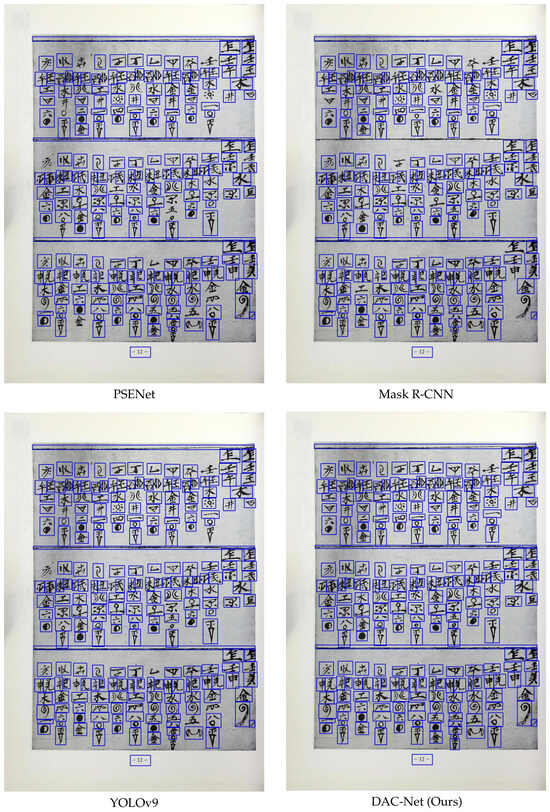
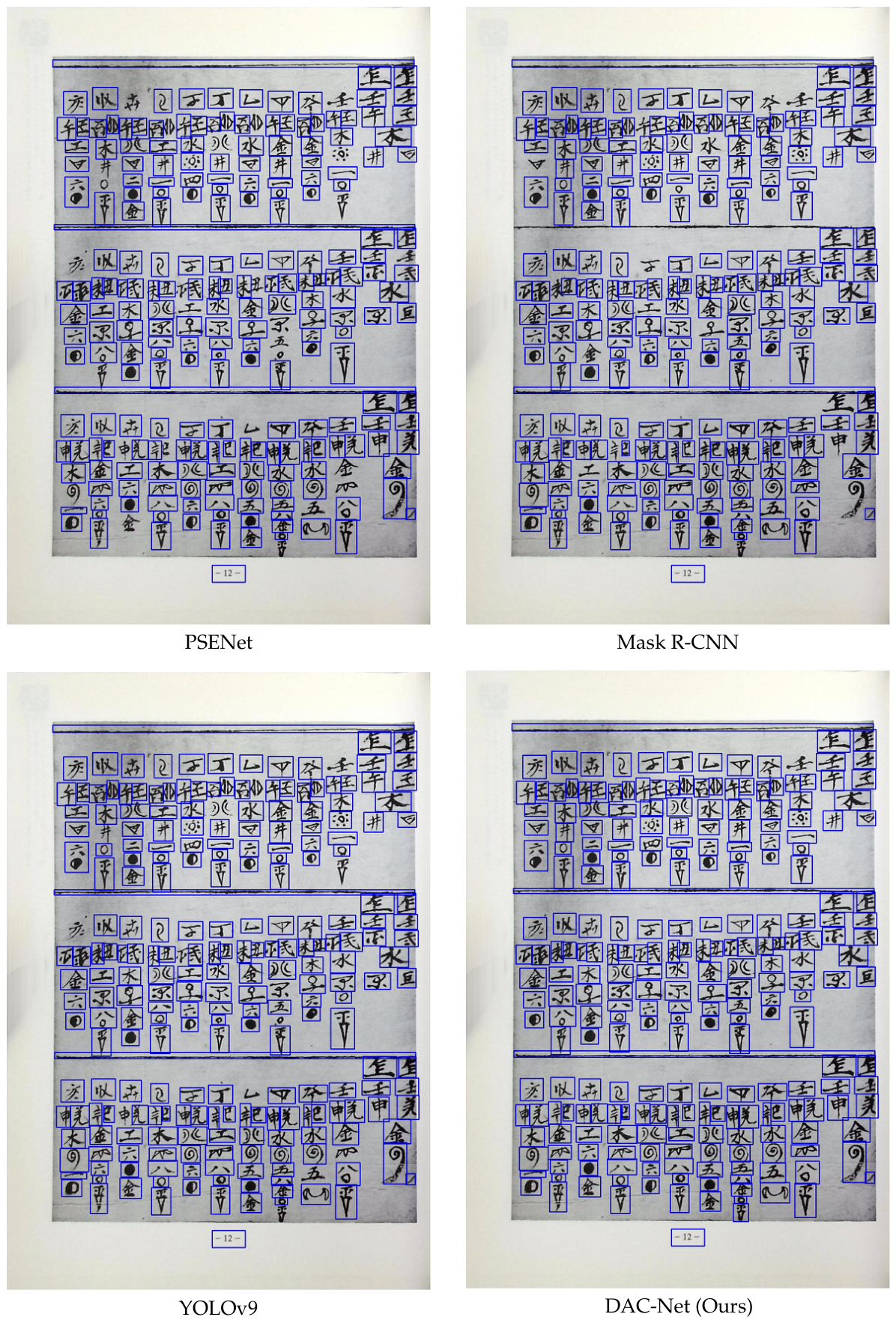
Figure 4 presents qualitative detection results. PSENet and Mask R-CNN show obvious missed and false detections. YOLOv9 improves but still misses some characters. In contrast, our DAC-Net localizes Shui Script characters more accurately, particularly for slender strokes and dense arrangements. This superior performance is attributed to DAC-Net’s ability to preserve fine-grained details of elongated character components via DAFEM, while DSAF effectively eliminates interference from complex background textures. Consequently, even under challenging conditions such as severe character adhesion or highly similar strokes, our method produces more complete and precise detections with fewer false positives, as clearly evidenced by the tighter bounding box alignments and reduced missed detections in Figure 4.
Figure 4.
Qualitative comparison of Shui Script character detection results produced by different methods.
4.4. Ablation Study
We conduct ablation experiments on the Shui-MSD dataset to systematically validate each proposed module. All experiments share the same training configuration, with YOLOv9 as the baseline. Our full model integrates both DAFEM and DSAF.
4.4.1. Module Effectiveness Analysis
Shui Script character detection faces three core challenges: weak features from slender strokes and small objects, complex background interference, and character adhesion in dense layouts. Accordingly, DAFEM enhances feature responses of slender strokes and small objects by fusing local–global channel attention with spatial attention, while DSAF suppresses background noise and refines effective features via decoupled spatial localization and channel selection.
To validate the individual contribution of each module, we set up the following comparison groups: baseline YOLOv9, YOLOv9 with only DSAF, YOLOv9 with only DAFEM, and YOLOv9 with both modules (DAC-Net). Table 2 reports the results. Both DAFEM and DSAF improve detection performance, but with distinct functional focuses. Adding DAFEM alone increases F1-scores by 1.86%, 1.26%, and 1.04% at the three IoU thresholds, respectively, with the largest gain at IoU = 0.5. This indicates that DAFEM enhances fine-grained stroke features and small-object regions. Its spatial attention branch strengthens edge responses, while local–global fused channel modeling improves perception of critical texture information.
Table 2.
Ablation Results of Module Effectiveness.
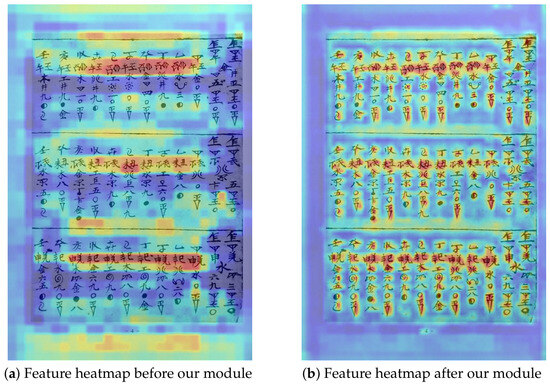
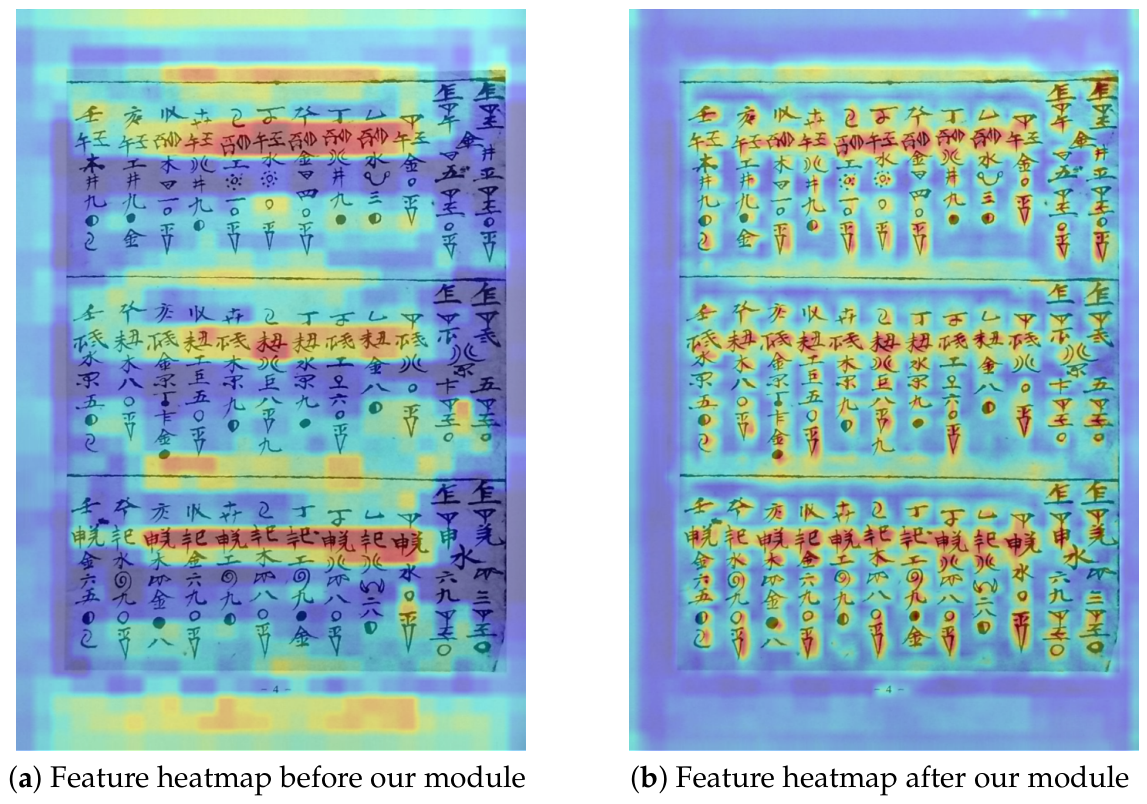
Figure 5 compares feature heatmaps with and without DAFEM. After adding DAFEM, feature responses in text regions are significantly enhanced with clearer edge information, and background responses are effectively suppressed. In contrast, DSAF focuses more on suppressing complex background interference. Adding DSAF alone improves precision at IoU = 0.5 from 0.9311 to 0.9550, significantly reducing false detections. This demonstrates that the decoupled spatial-channel feature modeling can effectively distinguish text regions from background noise and exhibits strong adaptability to complex backgrounds such as abrasion and stains in stone inscription rubbings.
Figure 5.
Feature heatmapcomparison before and after module.
Integrating both DAFEM and DSAF yields further comprehensive performance improvements. As shown in Table 2, at IoU = 0.5, the recall of complete DAC-Net is 0.9353, only 0.0011 lower than the DAFEM-only variant (R = 0.9364). Meanwhile, the precision of DAC-Net rises from 0.9462 to 0.9598, with a notable increment of 0.0136. This quantified trade-off clearly demonstrates that DSAF effectively suppresses complex background interference with only negligible loss of recall, without severely impairing DAFEM’s fine-grained feature enhancement for target Shui Script instances. Benefiting from the obvious precision gain, the overall F1 score of DAC-Net increases from 0.9442 to 0.9474, with a promotion of 0.0032. Our full DAC-Net achieves superior F1 values of 0.9474, 0.9393, and 0.9334 under IoU thresholds of 0.5, 0.6 and 0.7, surpassing all single-module ablation configurations by consistent margins. Since F1-score balances precision and recall comprehensively to reflect overall detection capability, the consistently higher F1 across all IoU settings provides a solid, principled basis for preferring the dual-module DAC-Net over single-component variants.
When the IoU threshold rises from 0.5 to 0.7, the baseline model’s F1-score drops moderately from 0.9256 to 0.9219, with a relative decline of 0.40%. In comparison, the F1-score of our integrated model decreases by 1.48% from 0.9474 to 0.9334. Although our performance suffers a larger relative drop under stricter matching rules, our absolute F1 values remain consistently higher than the baseline across all IoU settings. Meanwhile, the precision of DAC-Net slightly falls from 0.9598 (IoU = 0.5) to 0.9427 (IoU = 0.7). Even so, our precision under high IoU is still far superior to most competing detectors, which verifies that the predicted bounding boxes maintain strong alignment with ground-truth characters. Benefiting from the joint optimization of feature enhancement and background suppression, the proposed method achieves reliable fine-grained detection performance for densely arranged Shui Script characters.
4.4.2. Superiority of the Proposed Decoupled Fusion Strategy
To verify the superiority of DSAF, we compare it with mainstream feature fusion methods, including BiFPN [41], PAN [14], ASFF [42], and FPN [43] under identical settings, replacing the neck fusion module of the YOLOv9 baseline. Table 3 presents the results.
Table 3.
Performance Comparison of Different Feature Fusion Methods under Various IoU Thresholds.
DSAF achieves the best performance across all three IoU thresholds. At IoU = 0.5, DSAF reaches an F1-score of 0.9409, surpassing FPN, BiFPN and ASFF by 0.41%, 1.88% and 1.84% respectively. PAN yields the lowest overall F1 results among all compared fusion methods, which reveals that plain bidirectional feature fusion fails to fully extract and utilize the subtle fine-grained features of Shui Script characters. The prominent performance gain of DSAF originates from its decoupled dual-branch architecture: the spatial branch is dedicated to accurate localization of text areas, whereas the channel branch dynamically filters discriminative feature representations. The separated optimization of spatial and channel dimensions renders DSAF well-adapted to Shui Script detection scenarios with slim character strokes and cluttered complex backgrounds.
4.4.3. Effectiveness of the Attention Enhancement Module
To evaluate the effectiveness of the proposed DAFEM module, we replace it with several representative attention mechanisms, including Squeeze-and-Excitation (SE) [11], Simple Attention Module (SIMAM) [44], Efficient Channel Attention (ECA) [45], and Convolutional Block Attention Module (CBAM) [12], for comparison under different IoU thresholds. Precision, recall, and F1-score are adopted as evaluation metrics, and the quantitative results are listed in Table 4.
Table 4.
Performance Comparison of Different Attention Modules under Various IoU Thresholds.
Single-branch attention modules bring limited performance gains on complex Shui Script manuscripts. SE and SIMAM only perform feature modeling along the channel or spatial dimension independently, which fails to capture delicate stroke structures and densely arranged characters. As observed in the table, their recall values are substantially lower than dual-branch attention variants. Although ECA and CBAM combine channel and spatial attention simultaneously and achieve much higher recall and F1 than SE and SIMAM, their feature interaction designs are still insufficient. When facing heavy background clutter and indistinct thin strokes, they cannot fully excavate discriminative multi-scale features of Shui Script.
By contrast, our DAFEM achieves the best F1-score across all three IoU thresholds, and it attains the highest recall at IoU = 0.5 and IoU = 0.7. DAFEM jointly models spatial localization cues and channel semantic correlations, which strengthens target character features while suppressing irrelevant background noise. This design fits well with the inherent properties of Shui Script, such as uneven layout, drastic scale variation and fuzzy strokes. The experimental results verify that DAFEM constructs a superior feature enhancement paradigm and delivers higher detection accuracy and stronger robustness.
4.4.4. Computational Complexity Analysis
To further evaluate the practical applicability of DAC-Net, we analyze its computational complexity in terms of parameters, FLOPs, and inference speed (FPS). All experiments are conducted under identical hardware and software settings to ensure fair comparison.
As shown in Table 5, the proposed lightweight design effectively reduces computational overhead compared with the original YOLOv9. YOLOv9 with DAFEM achieves 23.364M parameters and 48.234G FLOPs at 80.47 FPS, while YOLOv9 with DSAF obtains 23.431M parameters and 48.275G FLOPs at 82.98 FPS. By integrating both modules, DAC-Net slightly increases the complexity compared with single-module variants but remains substantially more efficient than the baseline, reducing parameters from 25.530M to 23.913M and FLOPs from 51.841G to 48.392G.
Table 5.
Computational complexity comparison of different models.
The efficiency benefits are attributed to the complementary feature refinement strategies of DAFEM and DSAF, which enhance discriminative representations without introducing excessive computational burden. Meanwhile, DAC-Net achieves 85.69 FPS inference speed, exceeding the original YOLOv9 (78.51 FPS), demonstrating that the proposed method improves Shui Script detection performance while maintaining high computational efficiency.
It is worth clarifying that DAC-Net does not simply add DAFEM and DSAF modules on top of the baseline YOLOv9. Instead, we retain the backbone (including C2f modules) and detection head of YOLOv9, while replacing the original RepNCSPELAN4 modules in the neck with our lightweight DAFEM and DSAF modules. Additionally, we prune redundant channels in the neck to further reduce computational cost while preserving representation capacity. These modifications lead to the counterintuitive yet validated outcome that incorporating two attention modules simultaneously reduces both parameters and FLOPs, while improving detection accuracy and inference speed.
4.5. Robustness Evaluation
To comprehensively simulate common image degradation issues in real-world scenarios, this paper establishes multi-dimensional image interference conditions, including four types of interference: brightness reduction, motion blur, Gaussian noise, and partial object occlusion. The anti-interference capability of the model is comprehensively evaluated under scenarios such as illumination variation, image blurring, noise contamination, and feature missing.
4.5.1. Brightness Variation Interference
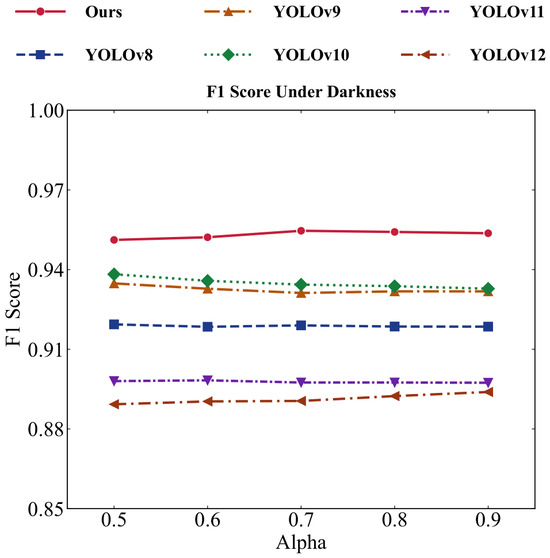
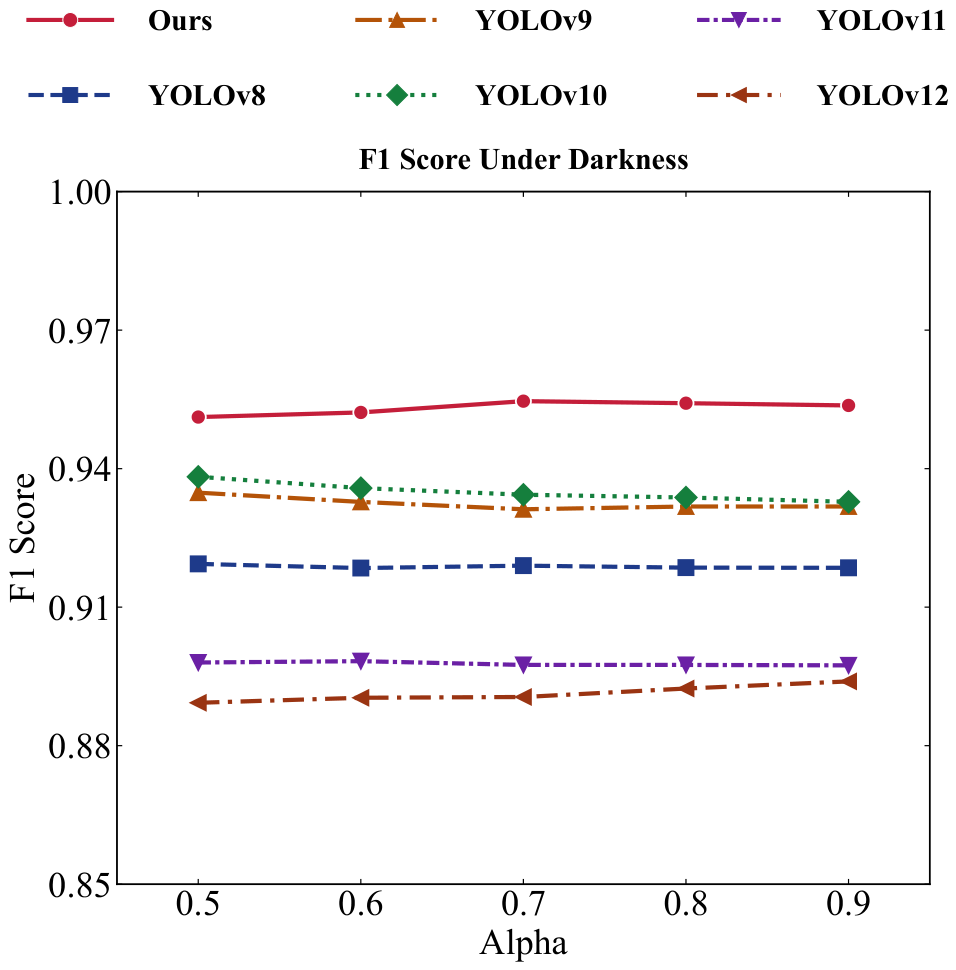
Brightness fluctuation is a common interference during Shui Script image acquisition [46]. Scenarios such as low light, backlighting, and shadow occlusion cause an overall brightness decrease, making it difficult to retain delicate textures and detailed information, thereby increasing detection difficulty. We conduct multi-level brightness attenuation experiments to evaluate model robustness. Figure 6 shows the F1-score variation curves.
Figure 6.
F1 score comparison under brightness variation interference.
As brightness continuously drops, detection performance of all comparison models degrades noticeably, while our method maintains a higher F1-score and a more stable trend. Compared with contrast degradation, brightness reduction further weakens global image information, making it difficult for conventional models to stably extract weak texture features. DAFEM enhances feature responses in character regions and strengthens edge and fine-grained texture information, effectively alleviating feature degradation under low-light conditions. Thus, our model maintains stable detection performance under various brightness perturbations.
4.5.2. Motion Blur Interference
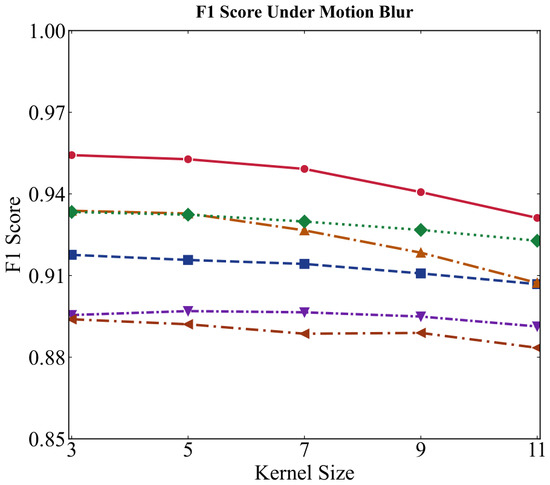
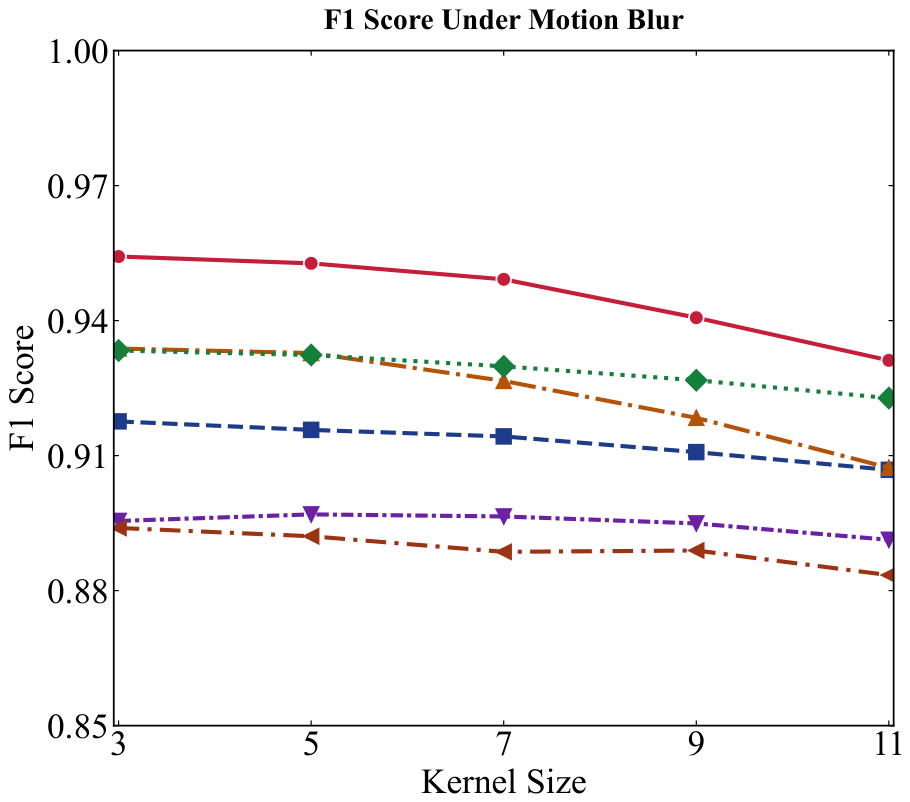
To validate detection performance under dynamic blur, we gradually increase the motion blur kernel size to construct weak-to-strong blur degradation scenarios [47]. Figure 7 shows the F1-score variation curves.
Figure 7.
F1 score comparison under motion blur.
Experimental results indicate that the detection performance of all models declines as the blur level increases. Our method consistently maintains a higher F1-score across different blur gradients, outperforming all comparison models in both slight and severe blur scenarios. Motion blur weakens edge information and local texture features, making fine-grained strokes difficult to distinguish. To address this, the spatial attention branch in the DAFEM enhances feature responses in character edge regions, mitigating feature loss caused by blur degradation and maintaining favorable detection stability under dynamic conditions.
4.5.3. Gaussian Noise Interference
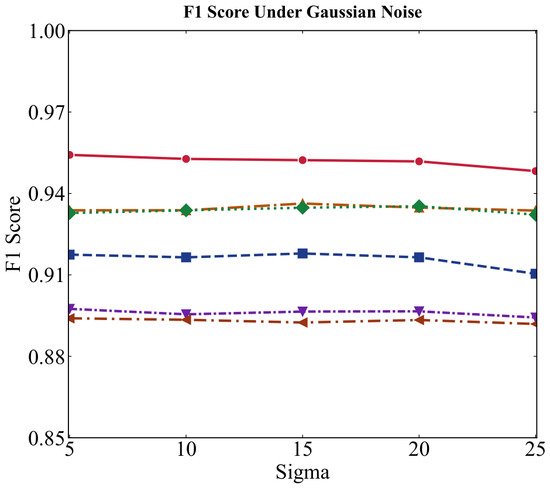
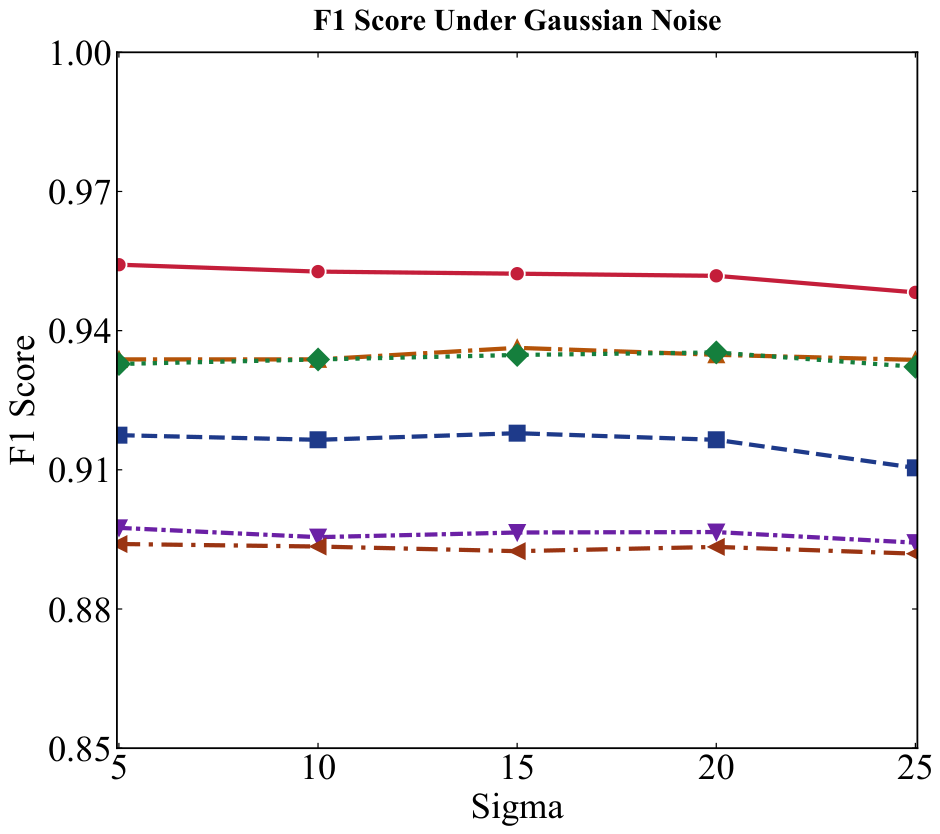
Gaussian noise introduces random perturbations to pixel intensities, simulating sensor noise during image acquisition [48]. We add Gaussian noise with varying intensity parameter and report the corresponding F1-score variations in Figure 8.
Figure 8.
F1-score comparison under Gaussian noise interference.
Experimental results show that the performance of all models degrades as the noise level increases. Nevertheless, our method consistently achieves higher F1-scores across all noise levels, exhibiting a more stable trend than other methods, indicating stronger robustness against Gaussian noise. Gaussian noise can distort edge structures and weaken local texture consistency, reducing discriminability between text regions and complex backgrounds, particularly detrimental to small-scale, fine-grained characters. DSAF mitigates this by jointly modeling spatial and channel-wise feature representations, suppressing noise-induced activations and enhancing informative text features, thereby improving robustness under noisy conditions.
4.5.4. Partial Occlusion Interference
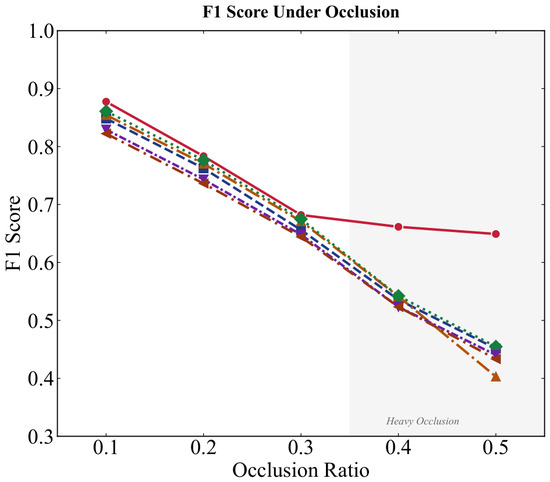
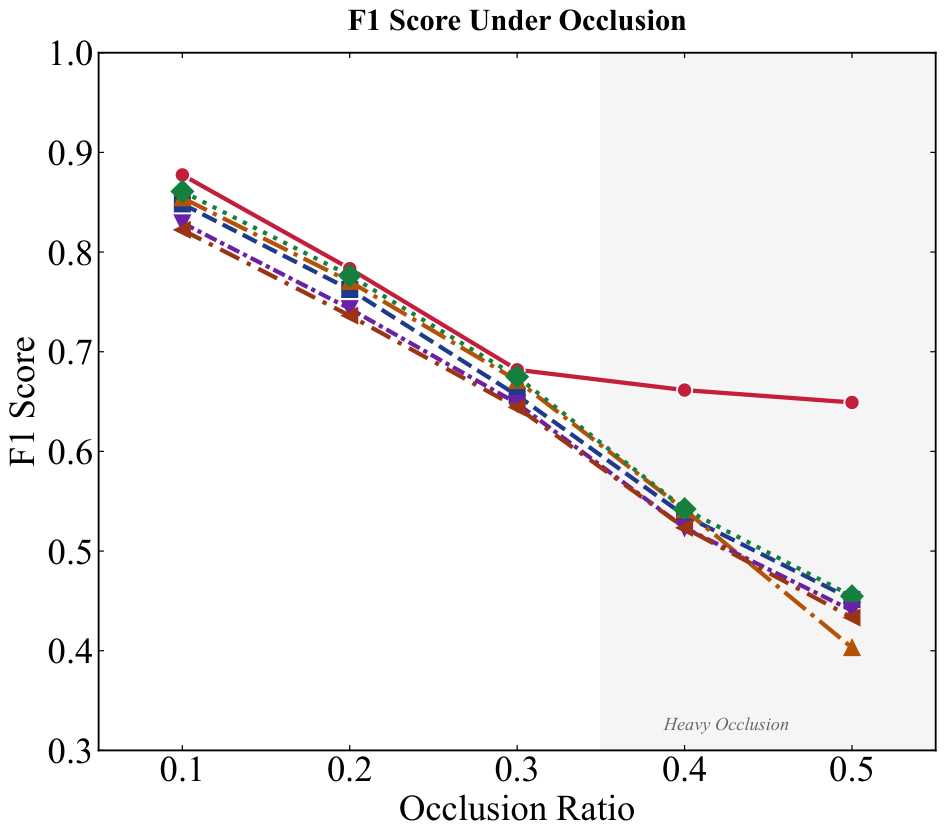
Target occlusion is a critical interference factor in complex Shui Script scenarios, easily causing local feature loss and increasing missed/false detections. We set occlusion ratios from 0.1 to 0.5 for comparative experiments. Figure 9 shows the F1-score curves of all models.
Figure 9.
F1 score comparison under occlusion.
All models achieve comparable performance under slight occlusion. As the occlusion ratio further increases, the performance of comparison models drops significantly, while our method maintains relatively stable detection results. At occlusion ratios of 0.4 and 0.5, our method achieves absolute F1-score improvements of 11.0% and 23.9% over YOLOv9, respectively. Partial occlusion leads to loss of local texture and structural information, placing higher demands on the model’s feature association capability. DSAF enhances target feature representation by exploiting contextual information from unoccluded regions and reduces the impact of local feature loss. Consequently, our model retains superior detection performance even under heavy occlusion.
5. Conclusions
This paper presents a lightweight Shui Script character detection method based on YOLOv9 to address the challenges of slender strokes, densely distributed small characters, and complex background interference. By incorporating DAFEM and DSAF into the neck network, the proposed method enhances fine-grained feature representation and improves foreground–background discrimination. Experimental results demonstrate that DAC-Net achieves an F1-score of 0.94 at IoU = 0.5 and maintains robust detection performance under various visual degradation conditions, including illumination variation, motion blur, Gaussian noise, and occlusion. These results validate the effectiveness and robustness of the proposed method for Shui Script character detection.
Despite these improvements, some limitations remain. First, the current framework mainly focuses on character-level detection and does not exploit contextual semantic information. Second, detection failures may still occur in cases of severe occlusion, character degradation, and extremely dense arrangements. In future work, we will investigate advanced attention-based architectures and multi-scale feature fusion strategies for more effective Shui Script analysis. Furthermore, we aim to develop an end-to-end Shui Script understanding framework that integrates character detection and recognition, thereby improving practical applicability in complex real-world scenarios.
Author Contributions
Conceptualization, M.L., Y.J., W.Q. and L.H.; Methodology, M.L., J.S., W.Q. and Q.P.; Software, M.L., J.S. and S.J.; Validation, M.L. and J.S.; Formal analysis, M.L., S.J. and L.H.; Investigation, Y.J., Q.P. and L.H.; Resources, Y.J., W.Q. and Q.P.; Data curation, M.L., Y.J., W.Q. and L.H.; Writing—original draft, J.S. and Q.P.; Writing—review & editing, W.Q. and Q.P.; Visualization, S.J.; Supervision, W.Q.; Project administration, L.H. All authors have read and agreed to the published version of the manuscript.
Funding
This research received no external funding.
Data Availability Statement
The Shui-MSD dataset constructed in this study is currently being organized for public release. The data presented in this study are available on request from the corresponding author due to ongoing dataset organization and annotation quality verification. We are committed to making the dataset publicly available upon acceptance of this manuscript.
Conflicts of Interest
The authors declare no conflict of interest.
Appendix A. Supplementary Experimental Results
Table A1.
Performance comparison of different text detection methods under various IoU thresholds.
Table A2.
F1-score comparison under various interference conditions.
References
- Lian, Z. The Creation, Preservation and Transmission of Shuishu Archives in China. J. Doc. 2017, 73, 1192–1208. [Google Scholar] [CrossRef] [Scilit]
- Krizhevsky, A.; Sutskever, G.E.I. ImageNet Classification with Deep Convolutional 689 Neural Networks. Adv. Neural Inf. Process. Syst. 2017, 60, 84–90. [Google Scholar] [CrossRef] [Scilit]
- Jaderberg, M.; Simonyan, K.; A. Vedaldi, A.; Zisserman, A. Reading Text in the Wild with Convolutional Neural Networks. Int. J. Comput. Vis. 2016, 116, 1–20. [Google Scholar] [CrossRef] [Scilit]
- Shelhamer, E.; Long, J.; Darrell, T. Fully Convolutional Networks for Semantic Segmentation. IEEE Trans. Pattern Anal. Mach. Intell. 2016, 39, 640–651. [Google Scholar] [CrossRef] [Scilit] [PubMed]
- Zhou, X.; Yao, C.; Wen, H.; Wang, Y.; Zhou, S.; He, W.; Liang, J. EAST: An Efficient and Accurate Scene Text Detector. In Proceedings of the IEEE/CVF Conference on Computer Vision and Pattern Recognition (CVPR); IEEE: Piscataway, NJ, USA, 2017; pp. 2642–2651. [Google Scholar]
- Redmon, J.; Divvala, S.; Girshick, A.; Farhadi, A. You Only Look Once: Unified, Real-Time Object Detection. In Proceedings of the IEEE Conference on Computer Vision and Pattern Recognition; IEEE: Piscataway, NJ, USA, 2016; pp. 779–788. [Google Scholar]
- Carion, N.; Massa, F.; Synnaeve, G.; Usunier, N.; Kirillov, A.; Zagoruyko, S. End-to-End Object Detection with Transformers. arXiv 2020, arXiv:2005.12872. [Google Scholar]
- Liu, Z.; Lin, Y.; Cao, Y.; Hu, H.; Wei, Y.; Zhang, Z.; Lin, S.; Guo, B. Swin Transformer: Hierarchical Vision Transformer Using Shifted Windows. In 2021 IEEE/CVF International Conference on Computer Vision (ICCV); IEEE: Piscataway, NJ, USA, 2021; pp. 9992–10002. [Google Scholar]
- Bi, X.; Han, L.; Qiao, W. ShuiAttNet: Fully Convolutional Attention Network for Shuishu Character Recognition. Expert Syst. Appl. 2025, 282, 127613. [Google Scholar] [CrossRef] [Scilit]
- Ren, S.; He, K.; Girshick, R.; Sun, J. Faster R-CNN: Towards Real-Time Object Detection with Region Proposal Networks. IEEE Trans. Pattern Anal. Mach. Intell. 2016, 39, 1137–1149. [Google Scholar] [CrossRef] [Scilit] [PubMed]
- Hu, J.; L. Shen, G. Squeeze-and-Excitation Networks. In Proceedings of the IEEE Conference on Computer Vision and Pattern Recognition; IEEE: Piscataway, NJ, USA, 2018; pp. 7132–7141. [Google Scholar]
- Woo, S.; Park, J.; Lee, J.Y.; Kweon, I.S. Cbam: Convolutional block attention module. In European Conference on Computer Vision; Springer International Publishing: Cham, Switzerland, 2018; pp. 3–19. [Google Scholar]
- Liao, M.; Wan, Z.; Yao, C.; Chen, K.; Bai, X. Real-Time Scene Text Detection with Differentiable Binarization. Proc. AAAI Conf. Artif. Intell. 2020, 34, 11474–11481. [Google Scholar] [CrossRef] [Scilit]
- Wang, W.; Xie, E.; Li, X.; Hou, W.; Lu, T.; Yu, G.; Shao, S. Shape Robust Text Detection with Progressive Scale Expansion Network. In Proceedings of the IEEE/CVF Conference on Computer Vision and Pattern Recognition (CVPR); IEEE: Piscataway, NJ, USA, 2019; pp. 9328–9337. [Google Scholar]
- Liang, M.; Ma, J.-W.; Zhu, X.; Qin, J.; Yin, X.-C. LayoutFormer: Hierarchical Text Detection Towards Scene Text Understanding. In Proceedings of the IEEE/CVF Conference on Computer Vision and Pattern Recognition (CVPR); IEEE: Piscataway, NJ, USA, 2024. [Google Scholar]
- Ye, M.; Zhang, J.; Zhao, S.; Liu, J.; Du, B.; Tao, D. DPText-DETR: Towards Better Scene Text Detection with Dynamic Points in Transformer. arXiv 2022, arXiv:2207.04491. [Google Scholar]
- Ge, Z.; Liu, S.; Wang, F.; Li, Z.; Sun, J. YOLOX: Exceeding YOLO Series in 2021. arXiv 2021, arXiv:2107.08430. [Google Scholar]
- Cortes, C.; Vapnik, V. Support-vector networks. Mach. Learn. 1995, 20, 273–297. [Google Scholar] [CrossRef] [Scilit]
- Lee, J.-J.; Lee, P.-H.; Lee, S.-W.; Yuille, A.; Koch, C. AdaBoost for Text Detection in Natural Scene. In 2011 International Conference on Document Analysis and Recognition; IEEE: Piscataway, NJ, USA, 2011; pp. 429–434. [Google Scholar]
- Epshtein, B.; Ofek, E.; Wexler, Y. Detecting Text in Natural Scenes with Stroke Width Transform. In Proceedings of the IEEE/CVF Conference on Computer Vision and Pattern Recognition (CVPR); IEEE: Piscataway, NJ, USA, 2010; pp. 2963–2970. [Google Scholar]
- Neumann, L.; Matas, J. Real-time Scene Text Localization and Recognition. In Proceedings of the IEEE/CVF Conference on Computer Vision and Pattern Recognition (CVPR); IEEE: Piscataway, NJ, USA, 2012; pp. 3538–3545. [Google Scholar]
- He, K.; Gkioxari, G.; Dollár, P.; Girshick, R. Mask R-CNN. In Proceedings of the IEEE International Conference on Computer Vision (ICCV); IEEE: Piscataway, NJ, USA, 2017; pp. 2961–2969. [Google Scholar]
- Usha, G.; Sahu, K.; Sri, B.R.; Sahu, T.K. YOLOv8: A Comprehensive Review of Architecture, Advancements, and Applications in Real-Time Object Detection. Int. J. Sci. Res. Eng. Manag. 2026, 10, 1–9. [Google Scholar] [CrossRef] [Scilit]
- Wang, C.; Yeh, I.; Liao, H. YOLOv9: Learning What You Want to Learn Using Programmable Gradient Information. arXiv 2024, arXiv:2402.13616. [Google Scholar]
- Wang, A.; Chen, H.; Liu, L.; Chen, K.; Lin, Z.; Han, J.; Ding, G. YOLOv10: Real-Time End-to-End Object Detection. arXiv 2024, arXiv:2405.14458. [Google Scholar]
- Khanam, R.; Hussain, M. YOLOv11: An Overview of the Key Architectural Enhancements. arXiv 2024, arXiv:2410.17725. [Google Scholar]
- Tian, Y.; Ye, Q.; Doermann, D. YOLOv12: Attention-Centric Real-Time Object Detectors. arXiv 2025, arXiv:2502.12524. [Google Scholar]
- Liao, M.; Shi, B.; Bai, X.; Wang, X.; Liu, W. TextBoxes: A Fast Text Detector with a Single Deep Neural Network. In Proceedings of the AAAI Conference on Artificial Intelligence, San Francisco, CA, USA, 4–9 February 2017; pp. 4161–4167. [Google Scholar]
- Liao, M.; Zhu, Z.; Shi, B.; Xia, G.S.; Bai, X. Rotation-Sensitive Regression for Oriented Scene Text Detection. In 2018 IEEE/CVF Conference on Computer Vision and Pattern Recognition; IEEE: Piscataway, NJ, USA, 2018; pp. 5909–5918. [Google Scholar]
- Wang, W.; Xie, E.; Song, X.; Zang, Y.; Wang, W.; Lu, T.; Yu, G.; Shen, C. Efficient and Accurate Arbitrary-Shaped Text Detection with Pixel Aggregation Network. arXiv 2020, arXiv:1908.05900. [Google Scholar]
- Liao, M.; Zou, Z.; Wan, Z.; Yao, C.; Bai, X. Real-Time Scene Text Detection with Differentiable Binarization and Adaptive Scale Fusion. IEEE Trans. Pattern Anal. Mach. Intell. 2022, 45, 919–931. [Google Scholar] [CrossRef] [Scilit] [PubMed]
- Ma, W.; Zhang, H.; Jin, L.; Wu, S.; J. Wang, Y. Wang: Joint layout analysis, character detection and recognition for historical document digitization. In 2020 17th International Conference on Frontiers in Handwriting Recognition (ICFHR); IEEE: Piscataway, NJ, USA, 2020; pp. 31–36. [Google Scholar]
- Tang, C.W.; Liu, C.L.; Chiu, P.S. Hrregionnet: Chinese character segmentation in historical documents with regional awareness. In Proceedings of the Document Analysis and Recognition–ICDAR 2021: 16th International Conference, Lausanne, Switzerland, 5–10 September 2021; Springer International Publishing: Cham, Switzerland; Volume 12824, pp. 3–17.
- Feng, R.; Zhao, F.; Chen, S.; Zhang, S.; Zhu, S. A handwritten ancient text detector based on improved feature pyramid network. Pattern Recognit. Lett. 2023, 172, 195–202. [Google Scholar] [CrossRef] [Scilit]
- Sihang, W.; Jiapeng, W.; Weihong, M.; Lianwen, J. Precise detection of chinese characters in historical documents with deep reinforcement learning. Pattern Recognit. 2020, 107, 107503. [Google Scholar] [CrossRef] [Scilit]
- Xing, J.; Bi, X.; Weng, Y. A Multi-Scale Hybrid Attention Network for Sentence Segmentation Line Detection in Dongba Scripture. Mathematics 2023, 11, 3392. [Google Scholar] [CrossRef] [Scilit]
- Ma, Y.; Chen, S.; Li, Y.; He, J.; Ruan, Q.; Xiao, W.; Xiong, H.; Stef, X.L. A swin transformer-based enhanced feature pyramid fusion model for dongba character detection. Herit. Sci. 2024, 12, 206. [Google Scholar] [CrossRef] [Scilit]
- Wang, P.; Hu, Y.; Peng, S.; Zhou, L. Emanet: An ancient text detection method based on enhanced-efficientnet and multi-dimensional scale fusion. IEEE Internet Things J. 2024, 11, 32105–32116. [Google Scholar] [CrossRef] [Scilit]
- Qi, H.; Yang, H.; Wang, Z.; Ye, J.; Xin, Q.; Zhang, C.; Lang, Q. Ancientglyphnet: An advanced deep learning framework for detecting ancient chinese characters in complex scene. Artif. Intell. Rev. 2025, 58, 88. [Google Scholar] [CrossRef] [Scilit]
- Tang, M.; Xie, S.; He, M.; Liu, X. Character recognition in endangered archives: Shui manuscripts dataset, detection and application realization. Appl. Sci. 2022, 12, 5361. [Google Scholar] [CrossRef] [Scilit]
- Tan, M.; Pang, R.; Le, Q.V. Efficientdet: Scalable and efficient object detection. In Proceedings of the 2020 IEEE/CVF Conference on Computer Vision and Pattern Recognition (CVPR); IEEE: Piscataway, NJ, USA, 2020; pp. 10778–10787. [Google Scholar]
- Liu, S.; Huang, D.; Wang, Y. Learning Spatial Fusion for Single-Shot Object Detection. arXiv 2019, arXiv:1911.09516. [Google Scholar]
- Lin, T.-Y.; Dollár, P.; Girshick, R.; He, K.; Hariharan, B.; Belongie, S. Feature Pyramid Networks for Object Detection. In 2017 IEEE Conference on Computer Vision and Pattern Recognition (CVPR); IEEE: Piscataway, NJ, USA, 2017; pp. 936–944. [Google Scholar]
- Yang, L.; Zhang, R.-Y.; Li, L.; Xie, X. SimAM: A Simple, Parameter-Free Attention Module for Convolutional Neural Networks. Proc. Mach. Learn. Res. 2021, 139, 11863–11874. [Google Scholar]
- Wang, Q.; Wu, B.; Zhu, P.; Li, P.; Zuo, W.; Hu, Q. ECA-Net: Efficient Channel Attention for Deep Convolutional Neural Networks. In Proceedings of the 2020 IEEE/CVF Conference on Computer Vision and Pattern Recognition (CVPR); IEEE: Piscataway, NJ, USA, 2020; pp. 11531–11539. [Google Scholar]
- Hendrycks, D.; Dietterich, T. Benchmarking Neural Network Robustness to Common Corruptions and Perturbations. In Proceedings of the International Conference on Learning Representations (ICLR), New Orleans, LA, USA, 6–9 May 2019. [Google Scholar]
- Kupyn, O.; Martyniuk, T.; Wu, J.; Wang, Z. DeblurGAN-v2: Deblurring (Orders-of-magnitude) Faster and Better. In Proceedings of the IEEE/CVF International Conference on Computer Vision (ICCV); IEEE: Piscataway, NJ, USA, 2019; pp. 8877–8886. [Google Scholar]
- Zhang, K.; Zuo, W.; Chen, Y.; Meng, D.; Zhang, L. Beyond a Gaussian Denoiser: Residual Learning of Deep CNN for Image Denoising. IEEE Trans. Image Process. 2017, 26, 3142–3155. [Google Scholar] [CrossRef] [Scilit] [PubMed]

Disclaimer/Publisher’s Note: The statements, opinions and data contained in all publications are solely those of the individual author(s) and contributor(s) and not of MDPI and/or the editor(s). MDPI and/or the editor(s) disclaim responsibility for any injury to people or property resulting from any ideas, methods, instructions or products referred to in the content. |
© 2026 by the authors. Licensee MDPI, Basel, Switzerland. This article is an open access article distributed under the terms and conditions of the Creative Commons Attribution (CC BY) license.