


Abstract
Graph-based nonnegative matrix factorization (GNMF) has been widely used for dimensionality reduction and data clustering because it can preserve the intrinsic geometric structure of data. However, many existing GNMF-based methods still rely on full sample similarity graphs, resulting in high computational costs; moreover, their sparsity constraints usually treat all features uniformly, making it difficult to distinguish structurally important features from redundant or noisy ones. To address these issues, this paper proposes a feature-graph-guided adaptive Log-L2,1 sparse NMF with anchor dual graphs under a logarithmic framework. Specifically, anchor-based representations are simultaneously constructed in the sample and feature spaces to approximate the corresponding full-scale graphs. The sample anchor graph preserves the local manifold structure among samples, whereas the feature anchor graph plays a dual role: it preserves structural relationships among features and provides degree information for generating the adaptive weights gi of the row-wise Log-L2,1 penalty imposed on the basis matrix U. Consequently, structurally well-connected features receive weaker sparsity penalties, while weakly connected and potentially redundant features are more strongly suppressed. In addition, a logarithmic reconstruction framework is introduced to reduce the influence of large residuals caused by noise and outliers. These mechanisms jointly integrate sample structure preservation, feature structure preservation, and feature-aware sparse learning within a unified graph-NMF model. To optimize the model, multiplicative update rules are derived, while the nonnegativity of the factor matrices is inherently preserved throughout the iterations. Extensive evaluations on several benchmark datasets demonstrate the effectiveness and robustness of the proposed method.
Keywords:
anchor graph; nonnegative matrix factorization; clustering; sparsity constraint; local structure learning MSC:
68Q99
1. Introduction
Graph-based NMF (GNMF), as a significant extension of NMF, is designed to integrate the intrinsic geometric relationships and class-relevant information of the data, thereby enhancing its discriminative representation capabilities. Originally proposed by Lee and Seung [1], NMF has been widely utilized in image processing [2,3,4,5], text classification [6,7,8], and data mining [9,10,11]. However, NMF is incapable of fully exploiting structural characteristics, such as the geometric relationships and local similarities embedded in the data. This limitation becomes particularly pronounced in high-dimensional and complex datasets, such as images or gene expression profiles, where neglecting structural information can significantly reduce the expressiveness and applicability of NMF. To address this issue, GNMF uses an affinity graph whose nodes represent data points and whose edge weights encode their similarities or connections, thereby modeling the relationships among the data points [12]. By doing so, the local geometric structure of the data is effectively preserved, and the quality of the decomposition results is enhanced through the incorporation of discriminative information, thereby improving data representation capabilities and analysis outcomes.
Due to its ability to fully leverage latent information within graph structures, GNMF has shown markedly superior performance compared to traditional NMF across various practical applications. For instance, in hyperspectral unmixing tasks, GNMF is capable of preserving the geometric relationships between data points to obtain more discriminative representations of spectral components, thereby substantially improving unmixing accuracy [13,14]. In data segmentation and clustering, by effectively capturing the similarity relationships between data points, GNMF enhances both the accuracy and robustness of clustering results [15,16]. In the realm of image processing, the inherent strengths of graph structures in extracting local image features can offer a more stable and reliable foundation for target recognition and feature analysis [17]. Moreover, recent studies on GNMF have demonstrated its remarkable versatility and adaptability in broader data analysis tasks [18,19,20], solidifying its significant role in complex data processing. Although GNMF performs well in many fields, it mainly captures the neighborhood relationships among data samples and does not adequately account for the coupled roles of samples and features. To overcome this drawback, Shang et al. [21] introduced DNMF, which incorporates manifold information from both the sample perspective and the feature perspective. Two independent graphs are constructed to characterize the manifold distributions of data points and features, respectively. However, this method still exhibits certain limitations because sparsity is not adequately considered. For this reason, DSNMF-LDC [22] and SDGNMF [23] have been proposed to enhance nonnegative matrix factorization by incorporating sparsity constraints on the basis matrix. Specifically, DSNMF-LDC applies an -norm constraint to encourage row sparsity in the basis matrix, thereby improving feature selection, whereas SDGNMF employs an -norm constraint to achieve sparsity. Nevertheless, these sparsity constraints are usually imposed in a fixed manner and do not use the feature graph structure to adaptively guide the sparsity strength, which leaves room for further improvement.
More recently, Ma et al. [24] proposed SFLRNMF and its tri-factorization extension SFLRNMTF. These methods jointly learn sample-side and feature-side similarity graphs under dual Laplacian rank constraints and incorporate feature weighting, sparsity, and orthogonality constraints to improve clustering representations. Nevertheless, they do not construct sample-feature dual anchor graphs or use feature-graph degree information to adaptively regulate the row-wise sparsity imposed on the basis matrix.
Beyond graph-based NMF, recent multi-view clustering studies have also explored anchor-based and compact spectral representations to improve scalability and cluster-structure learning. Xue et al. [25] proposed OMCAL, which adaptively learns a low-rank consensus anchor graph and integrates cluster-indicator acquisition into a one-step framework. Yang et al. [26] developed FMVDC, which fuses compact view-specific spectral embeddings and employs an anchor-based spectral embedding strategy to directly obtain discrete clustering labels. Yang et al. [27] introduced SMMSC, which uses anchor graphs within a min-max formulation to support scalable multi-view spectral clustering. These studies demonstrate the value of anchor-based approximation for scalable graph clustering. Although OMCAL also considers a single-view extension, its graph construction remains centered on sample-side anchor relationships. In contrast, FGAS-ADG-LNMF operates on a single data matrix and constructs separate sample-side and feature-side anchor graphs within graph-regularized NMF. Moreover, the feature-graph degree is used to generate gi and adaptively regulate the row-wise Log-L2,1 sparsity imposed on U.
Although these graph-based NMF algorithms have achieved varying degrees of performance improvement, they still fail to sufficiently exploit the label information inherent in the original data and overlook the non-correspondence between images and basis vectors. This limitation hinders their effectiveness in classification and recognition tasks. To address this issue, recent studies [28,29,30] have demonstrated that the incorporation of semi-supervised learning can effectively enhance the performance of NMF, especially when partial label information is available. By leveraging labeled data to guide the factorization process, semi-supervised methods can improve the interpretability of the basis matrix and enhance clustering and classification accuracy to a certain extent. For instance, Li et al. [31] developed SGLNMF, a semi-supervised NMF model with local coordinate constraints, which ensures that the learned representations preserve the neighborhood geometry of the data while leveraging available label information to improve discriminative power. To further optimize graph-structured NMF, Huang et al. [32] introduced adaptive NMF (NMFAN), in which matrix factorization and similarity matrix learning are jointly embedded into an adaptive graph construction scheme. Building on this idea, Zhang et al. [33] presented adaptive graph-regularized nonnegative matrix factorization (AGNMF). This approach enhances the quality of the graph and improves the reliability of the decomposition results by adaptively and iteratively optimizing the neighborhood graph construction process. However, these methods either depend on available label information or mainly focus on adaptive sample-graph construction, while the role of the feature graph in guiding sparsity learning has not been sufficiently explored.
In addition, conventional graph-based NMF methods typically assign equal importance to all features, which can weaken the class separability of the learned low-dimensional embeddings. To overcome this drawback, Chen et al. [34] introduced feature NMF (FNMF), an approach that adaptively learns feature importance through a feature weighting mechanism. By assigning appropriate weights to individual features and leveraging multiple weighting components to preserve the diversity of samples and the relevance of features, the discriminative capability of the learned representations is enhanced. Ma et al. [35] proposed SWAGNMF, which adaptively assigns weights based on feature importance during graph construction, thereby improving the quality of the graph and the discriminative power of the resulting low-dimensional representations. Experimental results demonstrate that SWAGNMF outperforms traditional graph-based NMF methods in both clustering and classification tasks, highlighting the effectiveness of its adaptive feature weighting strategy. These studies indicate that feature importance is closely related to representation learning performance. However, most existing methods mainly introduce feature weights into the representation or graph construction process, while the sparsity constraint on the basis matrix is not explicitly adjusted according to the feature graph structure.
Nevertheless, the aforementioned methods typically rely on constructing a similarity graph for the entire dataset to measure the similarity between samples. The construction of such a global similarity graph often incurs high computational complexity, significantly reducing the efficiency of the algorithm, particularly when applied to large-scale datasets. Moreover, a global similarity graph may fail to fully capture the intricate characteristics of the local data distribution, thereby limiting the structural representation capability of the data to some extent. Consequently, an important research focus in this field is how to effectively reduce the computational overhead of similarity graph construction while simultaneously enhancing its ability to represent the underlying structure of the data. In this regard, anchor graph learning provides a feasible strategy by using a small number of representative anchors to approximate the full graph, which offers an effective basis for improving graph construction efficiency while retaining local structural information.
In both graph-based NMF and other NMF variants, the -norm is commonly used to measure reconstruction loss or regularization terms. In fact, real-world data often contain noise and outliers, which can significantly degrade both performance and stability. To address this challenge, some researchers have explored the -norm or introduced additional constraints into the optimization process. These strategies aim to enhance robustness by mitigating the influence of outliers, thereby improving the reliability of the resulting low-dimensional representations. For instance, Kong et al. [36] proposed a robust NMF algorithm based on the -norm error function. Experimental results demonstrate that, compared with standard NMF, this algorithm not only produces more reliable decomposition results but also achieves superior clustering performance. Wang et al. [37] further introduced a sparse GNMF method with -norm constraints. By imposing an -norm sparsity constraint on the basis matrix, the method in [37] promotes row sparsity and selects the most important and discriminative features. The -norm is employed to measure the reconstruction error in a robust manifold orthogonal NMF [38], in which an orthogonality constraint is imposed on the coefficient matrix to enhance the discriminative capability of the decomposition. Similarly, -norm is utilized to optimize the loss function in the robust dual graph discriminant nonnegative matrix factorization (RDGDNMF) algorithm [39] to further improve robustness to noise. is a logarithmic norm; for example, . Under this norm, large residuals grow more slowly than under the Frobenius norm. This property makes the norm particularly effective at suppressing the influence of outliers, leading to improved robustness. By jointly learning the similarity matrix and incorporating the loss, RLNMFAG integrates an adaptive similarity matrix with the loss function, achieving higher accuracy and stability in the low-dimensional representations, especially when dealing with noisy or corrupted data [40]. However, most existing robust or sparse NMF methods introduce robustness and sparsity separately, and the feature graph structure is rarely used to adaptively guide the sparsity penalty imposed on the basis matrix.
In summary, while graph-based NMF methods offer significant advantages in various fields due to their ability to capture and encode the intrinsic geometric structure of data, they still encounter several challenges. For instance, most existing methods rely on constructing a full-sample similarity graph to characterize the relationships between samples. However, constructing a global similarity graph incurs high computational costs, particularly for large-scale datasets, which significantly limits further improvement in efficiency and practical applicability. Additionally, although some methods have incorporated sparsity constraints, such as the -norm, -norm, and -norm, to optimize reconstruction error or enhance feature learning, there remains considerable scope for improvement. Specifically, the design of more efficient and flexible sparsity constraints that can better adapt to diverse data types and task requirements remains an open research question. Therefore, it is necessary to develop a more efficient and robust NMF framework that can jointly consider anchor-based graph approximation, noise-resistant reconstruction, and feature-graph-guided adaptive sparsity.
Although anchor graph learning, dual-graph regularization, sparsity regularization, and logarithmic loss functions have been investigated in previous studies, their roles are fundamentally different from the structural coupling developed in this work. Existing methods do not simultaneously employ sample-space and feature-space anchor graphs to approximate the corresponding full graphs and then use the degree information of the resulting feature graph to adaptively regulate the row sparsity of the basis matrix. Therefore, the novelty of the proposed method does not lie in a simple combination of independent components, but in the specific interaction established among dual anchor graph approximation, feature-graph-guided adaptive sparsity, and logarithmic reconstruction.
In this paper, to further address the aforementioned challenges, we propose an improved anchor graph-based NMF method, namely, feature-graph-guided adaptive Log- sparse NMF with anchor dual graphs under the logarithmic framework (FGAS-ADG-LNMF). The proposed method has the following main contributions:
- (1)
- To the best of our knowledge, this is the first graph-regularized NMF framework that simultaneously constructs anchor graphs in the sample and feature spaces to approximate the full sample and feature graphs, respectively. The resulting sample-feature dual anchor graphs preserve the manifold structures of both spaces while avoiding the direct construction and processing of two full-scale similarity graphs.
- (2)
- A feature-graph-guided adaptive Log-L2,1 sparse regularization mechanism is proposed for the basis matrix U. Specifically, the adaptive weight gi is generated from the degree information of the feature graph and is used to regulate the sparsity penalty imposed on the i-th row of U. Thus, the feature graph not only provides feature-side manifold regularization but also directly guides feature-wise sparse learning, allowing structurally important features to be retained and weakly connected or potentially redundant features to be more strongly suppressed.
- (3)
- A logarithmic reconstruction framework is introduced into the proposed graph-NMF model. Since the logarithmic function grows more slowly for large residuals than the conventional squared Frobenius loss, it reduces the influence of large reconstruction errors caused by noisy or abnormal samples.
Extensive experiments on multiple public datasets are conducted to evaluate the effectiveness of the proposed mechanisms and the clustering performance of FGAS-ADG-LNMF.
The remainder of this paper is organized as follows. Section 2 presents a comprehensive review of classical NMF and its related extensions, serving as the theoretical foundation for this study. Section 3 introduces the proposed FGAS-ADG-LNMF model and details its construction process, adaptive sparse regularization strategy, and theoretical analysis, including the convergence analysis. Section 4 evaluates the performance of the proposed algorithm through extensive comparative experiments, demonstrating its superiority across multiple publicly available datasets. Finally, Section 5 summarizes the key contributions of this work and offers insights into potential directions for future research.
2. Related Work
This section briefly reviews classical nonnegative matrix factorization (NMF) [1] and several representative NMF variants closely related to the proposed FGAS-ADG-LNMF model, including graph-regularized, sparse, and robust NMF methods.
2.1. NMF
For a nonnegative data matrix , the goal of nonnegative matrix factorization (NMF) is to find nonnegative matrices and that minimize the following objective function, thereby minimizing the difference between and . Here, denotes the original data matrix, whose i-th column represents the i-th sample. The matrices and are referred to as the basis and coefficient matrices, respectively. The objective function for NMF is given as follows:
where is the Frobenius norm and is the matrix transpose operator.
Although the NMF objective function is non-convex in and jointly, it is convex in either variable when the other is fixed. Therefore, the iterative update rules corresponding to Equation (1) are as follows:
2.2. GNMF
To overcome the drawback that standard NMF does not explicitly capture the intrinsic geometry of data, Cai et al. [12] introduced graph-regularized nonnegative matrix factorization (GNMF), which embeds manifold learning principles into the NMF framework through graph regularization. Specifically, GNMF constructs a nearest-neighbor graph to model local affinities among samples, thereby encouraging nearby data points to have similar low-dimensional representations. Its objective function is formulated as follows:
Here, denotes the graph Laplacian, and is the weight matrix, where measures the similarity between data points and . is the diagonal degree matrix defined as . The iterative update rules for GNMF are as follows:
2.3. -NMF
With the continuous advancement of technology, the dimensionality of data has increased significantly, leading to a corresponding rise in noise and outliers within datasets. As a result, the development of more robust NMF algorithms has become a key focus for researchers. Generally, using the -norm to measure the loss function of NMF provides greater robustness compared to the traditional approach of using the -norm. Based on this concept, Kong et al. [36] proposed a robust nonnegative matrix factorization method, -NMF, which uses the -norm instead of the -norm, thereby improving robustness to noise and outliers. The objective function is defined as follows:
Here, denotes the -norm. To solve Equation (7), a diagonal matrix is introduced, where the elements of are defined as follows:
Therefore, the iterative update rules for the basis matrix and the coefficient matrix are expressed as follows:
3. Proposed Method
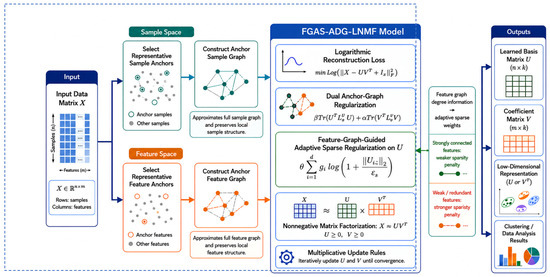
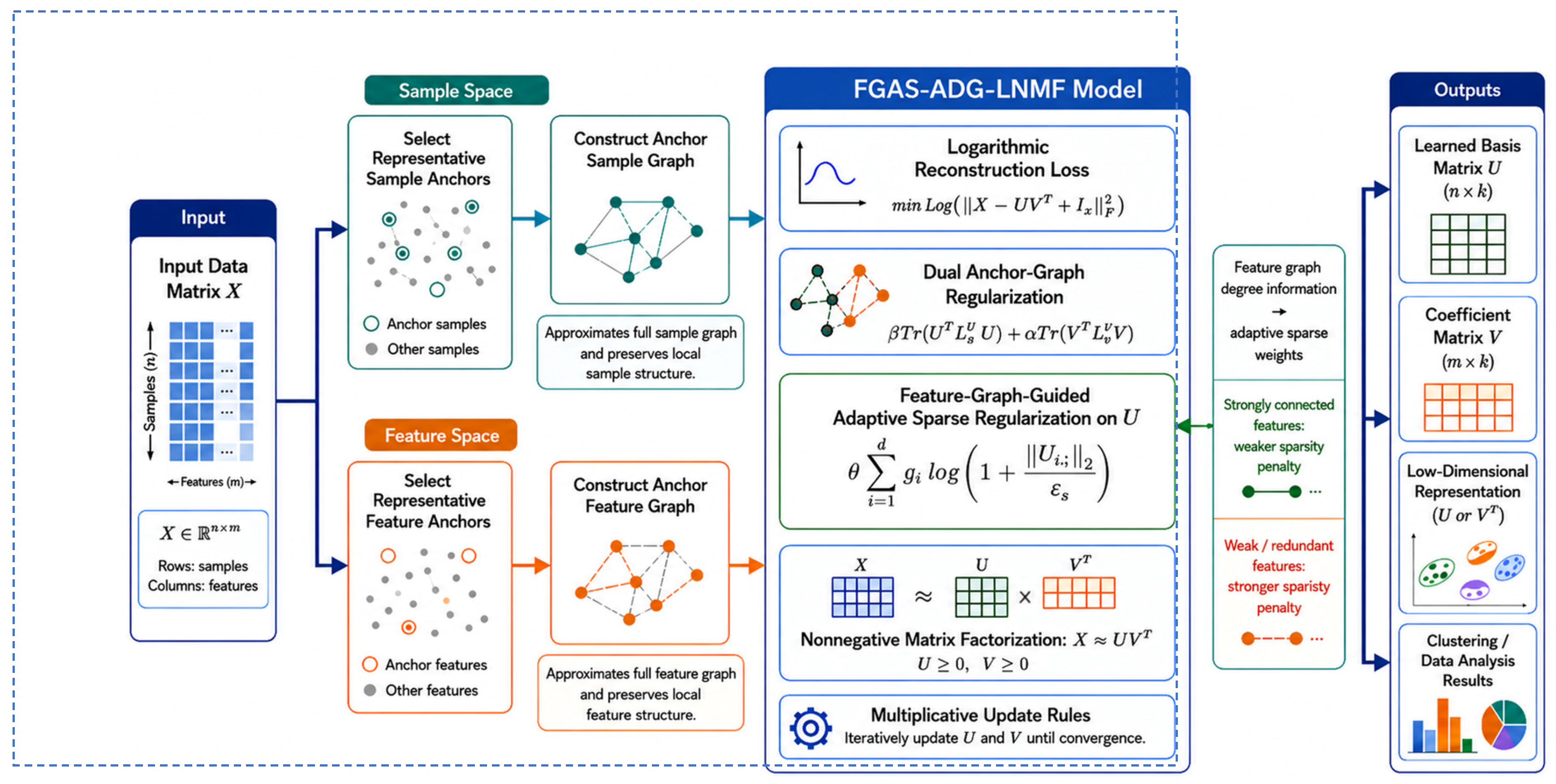
In this paper, we propose Feature-Graph-Guided Adaptive Sparse NMF with Anchor Dual Graphs under the Logarithmic Framework (FGAS-ADG-LNMF). The main idea of the proposed method is illustrated in Figure 1, which outlines its construction process. First, anchor points are selected using the k-means algorithm in both the sample space and the feature space to construct anchor dual graphs. This strategy preserves the structural relationships among samples and features while reducing the computational burden of full graph construction. Next, the anchor graph learning strategy is employed to generate high-quality similarity graphs for subsequent graph regularization. Finally, a logarithmic reconstruction framework and a feature-graph-guided adaptive Log- sparse regularization term are introduced to enhance robustness against noise and outliers and to guide the sparse learning of the basis matrix U. For ease of reference, the principal symbols and parameters used in FGAS-ADG-LNMF are summarized in Table A1 in Appendix A.
Figure 1.
Framework of the FGAS-ADG-LNMF algorithm.
3.1. Anchor Graph Construction
Graph-structured NMF algorithms have demonstrated excellent performance in clustering tasks by constructing similarity graphs to maintain the neighborhood manifold relationships embedded in the data. For instance, GNMF and NMFAN build similarity graphs to capture neighborhood relationships among data points. However, these graph-building procedures usually require a computational complexity of , where is the number of samples and is the number of features. Therefore, these methods encounter scalability limitations on large-scale datasets, which motivates the use of anchor graph construction to approximate the full graph with a smaller set of representative anchors.
Additionally, the performance of graph-based NMF methods depends heavily on the quality of the constructed graph. Therefore, improving the similarity graph is important for enhancing representation learning. To reduce the cost of full graph construction, the proposed FGAS-ADG-LNMF first employs an anchor graph to approximate the full-sample similarity graph in the sample space. Constructing the anchor graph requires selecting suitable anchors from the original data, and common anchor selection methods include random sampling and k-means. Because k-means offers good interpretability and empirical performance, we use it for anchor selection. Given an input sample matrix and a sample anchor matrix , for each nonnegative sample , denotes its association probability with the j-th anchor among . If the distance between and is small, the probability that they are neighbors is higher. In other words, the smaller the , the larger the value of . Based on this principle, the sample-space anchor graph is constructed by solving the following optimization problem:
Here, is an m-dimensional vector, and its j-th element is denoted by . According to Equation (11), only the nearest anchor point can be selected as the neighbor of with probability 1, whereas all other anchor points are assigned probability 0. This hard assignment may weaken the ability of the anchor graph to describe the local structure of the data. To address this issue, the above problem is reformulated as the following optimization problem:
Equation (12) mitigates the trivial solution in Equation (11), ensuring that all sample anchor points have an equal probability of becoming neighbors. By combining Equations (11) and (12), the following optimization problem is obtained:
Here, is the regularization parameter, calculated as follows:
where is the index of the anchor point nearest to the sample point . A specific expression for is provided in Section 3.5. By optimizing Equations (13) and (14), the elements of matrix are expressed as follows:
In Equation (15), the computational complexity is , representing a substantial improvement in efficiency compared to the method that constructs a full-sample graph.
3.2. Dual Graph Regularization
Recent research on co-clustering algorithms [41,42] suggests that manifold structures exist across both the data and feature spaces. Consequently, dual graph regularization provides an effective way for NMF to jointly capture the structural information of both spaces. In the proposed FGAS-ADG-LNMF model, anchor graphs are constructed within the sample and feature spaces, respectively. The sample anchor graph is used to preserve the local relationships among samples, whereas the feature anchor graph is used to characterize the structural correlations among features and further provides guidance for the adaptive sparse regularization on the basis matrix.
In the data space, for each sample , the adjacency probability associated with is denoted by . To determine , the following optimization problem must be solved:
Because constructing a full-sample similarity graph is time-consuming, we draw inspiration from the anchor-based graph clustering algorithm [43] to design an anchor-based similarity graph, formally expressed as follows:
Here, is the sample-anchor relation matrix obtained from Equation (15), and is a diagonal matrix defined by .
Therefore, the similarity matrix can be constructed using Equations (15) and (17). Map each sample to a low-dimensional representation . Its smoothness over the sample graph is measured as follows:
Here, is the Laplacian matrix constructed in the data space using the sample anchor graph, is the adjacency matrix, and is a diagonal matrix. According to the definition of the Laplacian matrix, we have , , and .
Similarly, in the feature space, anchors are first selected using k-means, resulting in feature anchor points . For each feature vector , let denote its association probability with the j-th feature anchor. It is obtained as follows:
The regularization parameter is , and the derivation of is presented in Section 3.5.
Similarly, the similarity graph in the feature space can be obtained from Equations (19) and (20):
Here, is the feature-anchor relation matrix obtained from Equation (19), and is a diagonal matrix defined by . The smoothness of the matrix is then derived as follows:
Similarly, is the Laplacian matrix constructed from the feature anchor graph in the feature space, is the symmetric similarity matrix, and is a diagonal matrix. Specifically, , , and .
3.3. NMF Under the Logarithmic Framework
In conventional NMF, the -norm is commonly used to quantify the reconstruction error; however, this choice makes the model highly susceptible to noisy observations and outlying samples. To mitigate this issue, researchers have explored alternative norms, such as the -norm and -norm, to strengthen NMF’s resistance to such disturbances. Inspired by this idea, we propose the FGAS-ADG-LNMF model. Compared with the direct F-norm loss, the logarithmic function compresses large residuals and therefore reduces the influence of abnormal samples. The logarithmic NMF model is expressed as:
Although the logarithmic reconstruction loss improves robustness, it does not explicitly select discriminative features. In the proposed model, a feature-graph-guided adaptive Log-L2,1 sparse regularization term is imposed on the basis matrix U. Specifically, the adaptive weight is derived from the degree information of the feature graph. Features with stronger structural connectivity receive smaller sparse penalties, whereas weakly connected and potentially redundant features are more strongly suppressed. Consequently, the objective function with the adaptive sparse regularization term is reformulated as follows:
Here, is the parameter of the sparsity constraint term. The matrix has diagonal elements equal to 1, while all other elements are 0. denotes the i-th row of the basis matrix U, and is a small positive constant used to avoid numerical singularity. The adaptive weight is computed from the feature graph degree:
where is the i-th diagonal element of the feature graph degree matrix, and is a small positive constant. The weights are then normalized by their mean value to keep the scale of the sparse regularization term stable. The matrix is introduced to ensure that the argument of the logarithmic reconstruction term is greater than zero. For concise notation in the following objective, let Y = X + Ix.
3.4. Iterative Update
Based on the above analysis, the objective function of the proposed FGAS-ADG-LNMF is formulated as follows:
Here, stabilizes the logarithmic reconstruction term, and is the smoothed row norm used consistently in the Log-L2,1 sparse regularizer and its optimization.
In the above formula, the first term denotes the logarithmic reconstruction error, which is used to lessen the impact of noisy observations and outlying samples. The second term is the feature-graph-guided adaptive Log-L2,1 sparse regularization term imposed on the basis matrix U. Unlike a fixed sparsity constraint, this term uses the adaptive weight , which is derived from the feature graph degree, to guide the row sparsity of U. Thus, structurally important features are assigned smaller sparsity penalties, whereas weakly connected and potentially redundant features are more strongly suppressed. The third term is the feature-space graph regularizer, whereas the fourth term is the sample-space graph regularizer, where and . represents the structural fitting errors of the anchor graphs constructed in the data and feature spaces. The parameters , α, and β are used to adjust the weights of the adaptive sparse regularization, data graph regularization, and feature graph regularization terms, respectively, while λ and μ balance the structural fitting errors of the anchor graphs.
It should be emphasized that the three components of the proposed model are not independent add-on terms. The sample and feature anchor graphs provide compact approximations of the corresponding full graphs and are used to construct the two graph regularization terms. More importantly, the feature anchor graph is further coupled with the sparse learning of U because its degree information determines the adaptive weight gi in Equation (24). Therefore, the feature graph simultaneously preserves feature-side manifold structure and regulates the row-wise Log-L2,1 sparsity of the basis matrix. The logarithmic reconstruction term operates jointly with these structure-preserving and structure-guided sparse terms to reduce the influence of large residuals. This coupling distinguishes the proposed objective from models that independently combine a fixed sparsity penalty with conventional sample or feature graph regularization.
Since the anchor graphs are constructed before matrix factorization and kept fixed during the update of U and V, is treated as a constant in the following iterative optimization. Therefore, does not affect the gradient calculations for U and V.
Let
When U is fixed, the partial derivative with respect to V is
According to the KKT conditions, the multiplicative update rule for V is
When V is fixed, define
and
Then the partial derivative with respect to U is
Therefore, according to the KKT conditions, the multiplicative update rule for U is obtained as follows:
The adaptive feature weight is calculated as .
Here, is the i-th diagonal element of the feature graph degree matrix, and is a small positive constant. After calculation, each is normalized by the mean of all weights to keep the scale of the sparse regularization term stable.
The proposed algorithm alternately updates V and U until the stopping criterion is satisfied. Since the update rules are multiplicative, the nonnegativity of U and V is naturally maintained during optimization. Let O(t) denote the objective value after the t-th iteration. After at least three iterations, the procedure stops when |O(t) − O(t − 1)| < 10−2, or when the iteration index reaches the prescribed maximum N, which is set to 200 in the experiments.
The proposed algorithm alternately updates V and U until the stopping criterion is satisfied. Since the update rules are multiplicative, the nonnegativity of U and V is naturally maintained during optimization. Let O(t) denote the objective value after the t-th iteration. After at least three iterations, the procedure stops when |O(t) − O(t−1)| < 10−2, or when the iteration index reaches the prescribed maximum N, which is set to 200 in the experiments.
Based on the above analysis, the computational procedure of FGAS-ADG-LNMF is summarized in Algorithm 1.
| Algorithm 1: Feature-Graph-Guided Adaptive Sparse NMF with Anchor Dual Graphs under the Logarithmic Framework (FGAS-ADG-LNMF) |
| Input: data matrix , number of clusters , numbers of sample-space and feature-space anchors and , parameters , , , , , number of neighbors , small positive constants , , and the maximum number of iterations . Initialization: Select the sample and feature anchors by k-means, and initialize the nonnegative factor matrices U and V using an NNDSVD-based strategy. |
| Update: Construct according to Equation (15) and according to Equation (17). |
| Construct according to Equation (19) and according to Equation (20).Compute the feature-graph-guided adaptive weights and normalize each by the mean of all weights. |
| Update V according to Equation (28), and then update U according to Equation (32). |
| Stopping criterion: After at least three iterations, terminate the alternating updates if |O(t) − O(t− 1)| < 10−2 or t = N; otherwise, continue iterating. Output: basis matrix U and coefficient matrix V. |
| Clustering: Apply k-means to the coefficient matrix to obtain the cluster labels. |
3.5. Discussion of Parameters and
Because the sample and feature spaces are treated symmetrically, the derivations of and are analogous. We therefore derive the regularization parameters associated with the sample graph and the feature graph below. Specifically, we focus on :
First, let . Next, we form the Lagrangian of Equation (13) with respect to , as follows:
According to the KKT conditions, the optimal solution for is obtained as follows:
Because is the sample-space similarity graph, a sparse is desirable for clustering. Accordingly, the relation matrix should also be sparse. Assume that are arranged in ascending order and that contains only k non-zero values. In this case, . Therefore, based on the constraint , the optimal solution for is obtained as follows:
Therefore, based on the above, we obtain the following inequality:
Since the are arranged in ascending order, to obtain the optimal , we set as follows:
The value of is determined as using a method similar to the one described above.
Since the number of neighbors k is an integer, it is easier to tune than the regularization parameters and . Therefore, we determine the values of and by searching for the optimal number k of nearest neighbors.
It should be noted that the anchor graphs obtained through this procedure are further used to construct the sample and feature Laplacian matrices. In particular, the feature graph also provides degree information for calculating the adaptive sparse weight in the proposed feature-graph-guided Log- regularization term.
3.6. Convergence Proof
Although the anchor representation provides a compact approach for deriving sample-side and feature-side graph relationships, the complete computational cost of FGAS-ADG-LNMF also includes anchor selection, formation of the two graph approximations, NNDSVD initialization, and iterative optimization with logarithmic reconstruction and feature-graph-guided adaptive sparse regularization. Therefore, the practical efficiency of the proposed method should not be inferred solely from the use of anchor graphs. A detailed empirical runtime evaluation is provided in Section 4.7.
Next, we establish the convergence property of the proposed alternating updates. Let , , and . During the updates of and , the two anchor graphs, , and are fixed. We assume element-wise strictly positive initialization, , , and positive diagonal anchor normalizations and . Hence and .
Theorem 1.
Under the update rules in Equations (28) and (32), equivalently the block forms in Equations (46) and (50), the objective in Equation (25) is non-increasing after every complete iteration. Moreover, the resulting sequence of objective values converges.
Definition 1.
A function is an auxiliary function for if it satisfies
Lemma 1.
If is an auxiliary function of , minimizing it at the current iterate gives the standard MM descent relation
In Equation (40), ⊘ denotes element-wise division; that is, [Ay⊘y]i = (Ay)i/yi.
The quadratic auxiliary functions used below rely on the following identity. For any symmetric matrix with nonnegative elements, any positive vector , and any vector , we have:
Thus, . Together with the positive semidefiniteness of and , this identity verifies the second-level quadratic majorizers introduced below.
For the first majorization layer, the concavity of the logarithm gives the following tangent upper bound for :
Equality holds at . For the sparse term, let . Applying the tangent inequality to and using yields
Here, is independent of and is chosen so that equality holds at . This completes the two common first-layer upper bounds.
The algorithm first updates . With , define , , and . After applying Equation (41) and collecting the terms that depend on , the first-level majorizer is
The constant is selected so that and equality holds at . Using , its gradient is decomposed as
For , define the following model-specific auxiliary function for :
By Equation (40), the difference is a sum of positive semidefinite quadratic forms. The Gram part is controlled by the diagonally scaled term, while the graph remainder contains . Therefore, and equality holds at . Setting the element-wise derivative of to zero, together with the KKT conditions , , and , gives
All numerator and denominator terms in Equation (46) have dimension , and the common factor of two cancels in the positive-negative gradient ratio. Equation (46) is the iteration-indexed form of Equation (28).
After updating , the reconstruction scale must be recomputed as . Define , , , and . Applying Equations (41) and (42) gives
The constant ensures that with equality at . Since , the gradient becomes
For , define
The same identity in Equation (40) shows that and that the two functions coincide at . The nonnegative diagonal term involving is represented exactly in the quadratic curvature, while the remaining graph contribution is . Applying the element-wise KKT complementarity conditions and minimizing therefore yields
Every term in Equation (50) has dimension . In particular, the reconstruction term is , without a transpose on . Thus, Equation (50) is consistent with the corrected Equation (32).
Applying Lemma 1 first to the block and then to the block gives, respectively,
Combining the two inequalities produces the complete alternating descent chain
Consequently, the objective value is non-increasing throughout the alternating updates. Since , the logarithmic reconstruction term is bounded below by , while the sparse and graph-regularization terms are nonnegative. Therefore, the sequence of objective values is bounded below and converges.
4. Experimental Results and Analysis
In this section, numerical experiments are conducted on nine benchmark datasets to evaluate the effectiveness, robustness, parameter sensitivity, and convergence behavior of the proposed FGAS-ADG-LNMF method. The contribution of anchor graph construction in both the data and feature spaces is further investigated on selected datasets. The clustering performance of the proposed method is compared with several representative NMF-based and graph-regularized algorithms, and the corresponding experimental results are analyzed in detail. All experiments were implemented in MATLAB R2021a on a Windows 10 computer equipped with an NVIDIA RTX 3050 GPU and 8 GB of RAM.
4.1. Datasets
To evaluate the clustering performance of the proposed FGAS-ADG-LNMF, we conduct experiments on nine publicly available datasets, including the Vote and Sonar datasets from the UCI Machine Learning Repository, four image datasets (JAFFE, JAFFE50, PIE_pose27, and COIL100), and three biological datasets (Lung, Lung_dis, and TOX-171). Detailed information for each dataset is presented in Table 1.
Table 1.
Dataset information.
4.2. Parameter Settings
In this subsection, we specify the parameter settings used for all comparison algorithms. For each comparison method, 10 trials are conducted under different parameter configurations, and the results yielding the highest average performance are reported for comparison. In the clustering experiments, the number of clusters for each dataset is set to the number of its ground-truth classes. For NMF and its variants, k-means is repeated 20 times on the learned feature matrix, and the best outcome is retained. The maximum number of iterations is set to 200.
For these graph-based NMF variants (GNMF [12], DSNMF-LDC [22], SGLNMF [31], NMFAN [32], FNMF [34], HxNMF [44]) and the proposed FGAS-ADG-LNMF method, the neighborhood size is set to k = 5, and the graph regularization parameter is chosen from the interval . The remaining parameters of these algorithms are selected from the same range as the graph-regularization parameter. For the semi-supervised SGLNMF, the proportion of labeled samples is set to per = 20%. For the comparison algorithms EWNMF and EWRNMF, all parameters are selected from the ranges specified in the original papers.
Two recently published dual-graph methods, SFLRNMF and SFLRNMTF [24], were further included in the clustering comparison. Both methods were evaluated using the same experimental protocol described above. In Table 2 and Table 3, SFLRNMF and SFLRNMTF are abbreviated as SFLR and SFLRT, respectively.
Table 2.
ACC scores for different algorithms on different datasets.
Table 3.
NMI scores for different algorithms on different datasets.
The numbers of sample and feature anchors, and , are set to approximately 50% of the total numbers of samples and features, respectively. Additionally, and , which balance the structural fitting errors of the anchor graphs in the sample and feature spaces, respectively, are both set to 1.
4.3. Clustering Experiments
Table 2 and Table 3 summarize the clustering performance of all compared methods, including the recently published SFLRNMF and SFLRNMTF models. For compact presentation, several NMF variants are abbreviated in the tables; in particular, NMFAN is denoted as AN, SFLRNMF and SFLRNMTF are denoted as SFLR and SFLRT, respectively, and the proposed method is denoted as FGAS-ADG-L. For each dataset, the best result is shown in boldface, whereas the second-best result is underlined. Based on the updated set of comparison methods and datasets in Table 2 and Table 3, the following observations can be made.
- (1)
- From the ACC results in Table 2, FGAS-ADG-L obtains the highest scores on seven out of nine datasets, namely Sonar, Vote, JAFFE, PIE_pose27, Lung, COIL100, and Lung_dis. It ranks second on JAFFE50 and TOX-171, where SFLRNMTF and SGLNMF obtain the highest ACC values, respectively. On the seven datasets where FGAS-ADG-L ranks first, its improvements over the strongest competing method are 2.69, 0.15, 0.89, 2.61, 4.08, 2.60, and 1.00 percentage points, respectively. In terms of average ACC, FGAS-ADG-L reaches 79.19%, which is 5.71 percentage points higher than the second-ranked DSNMF-LDC. These results indicate that the proposed method maintains competitive and consistently high clustering accuracy after the inclusion of the recent SFLRNMF and SFLRNMTF methods.
- (2)
- From the NMI results in Table 3, FGAS-ADG-L achieves the highest scores on six datasets, namely Sonar, JAFFE, PIE_pose27, Lung, COIL100, and Lung_dis. It ranks second on Vote, JAFFE50, and TOX-171, where SGLNMF, SFLRNMF, and SGLNMF obtain the highest NMI values, respectively. On the six datasets where FGAS-ADG-L ranks first, its improvements over the strongest competing method are 10.42, 0.35, 3.36, 1.90, 2.77, and 0.65 percentage points, respectively. FGAS-ADG-L also achieves the highest average NMI of 67.28%, outperforming SGLNMF, SFLRNMF, and DSNMF-LDC by 4.93, 5.55, and 6.73 percentage points, respectively.
- (3)
- Extensive numerical experiments on multiple public datasets demonstrate that the proposed FGAS-ADG-LNMF achieves notable improvements in clustering accuracy over representative algorithms, further verifying its effectiveness.
In summary, after adding the recently published SFLRNMF and SFLRNMTF methods, FGAS-ADG-L ranks first or second on every dataset in terms of both ACC and NMI and achieves the best average performance for both metrics. These results provide a more comprehensive and balanced evaluation of the competitiveness of the proposed method.
4.4. Parameter Sensitivity Analysis
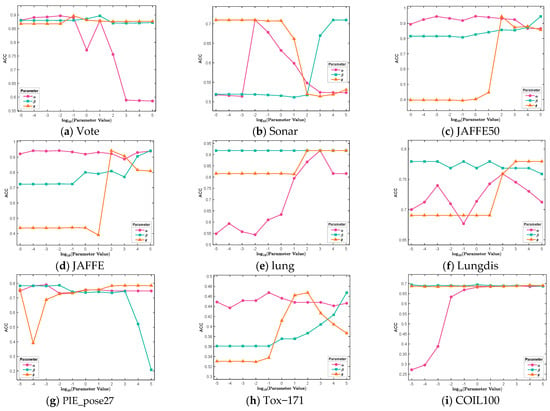
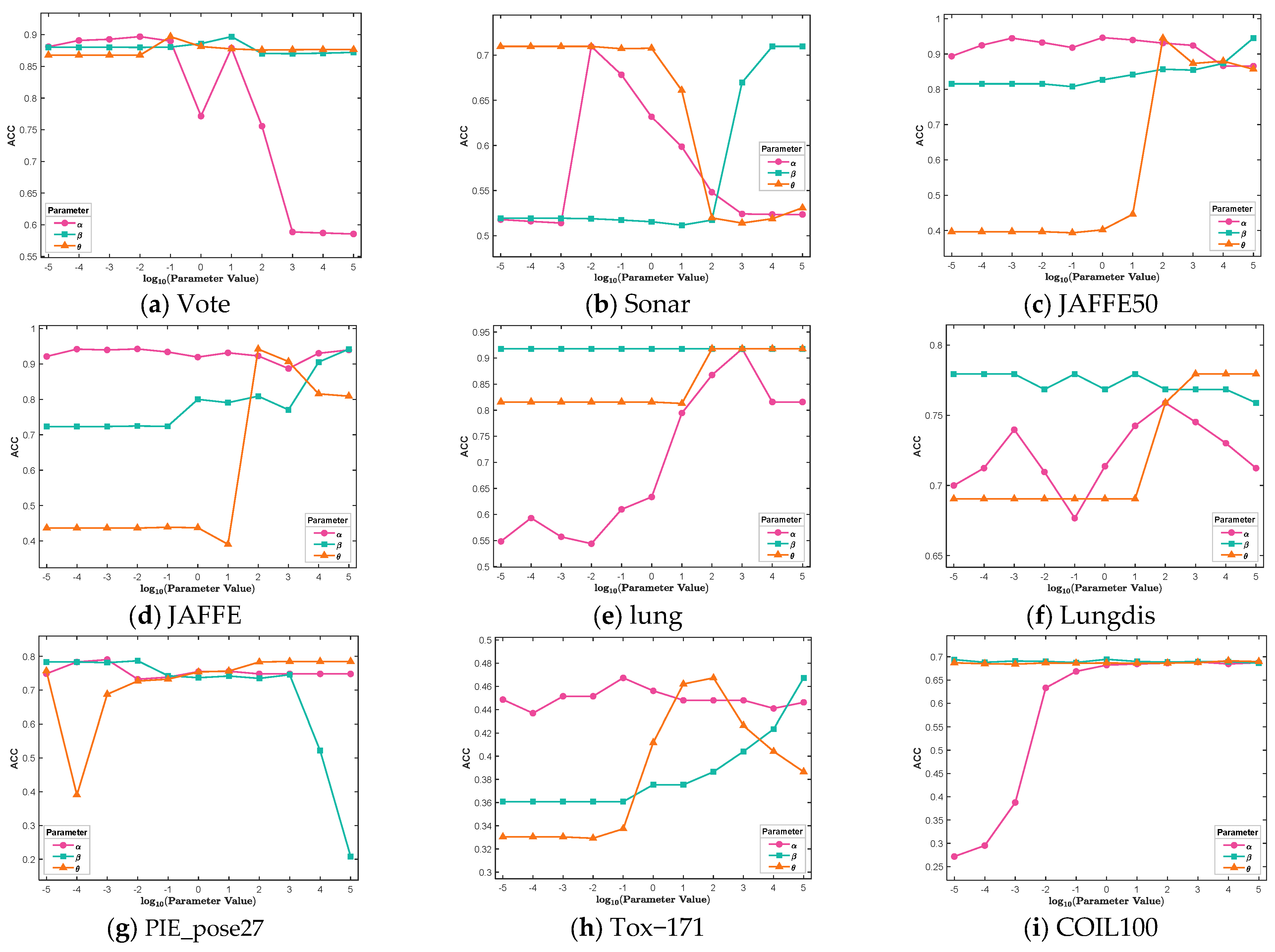
This section examines the sensitivity of FGAS-ADG-LNMF to different parameter settings in terms of clustering performance. The experiments are carried out on the same nine datasets used in Table 2 and Table 3. When one parameter is varied, the remaining parameters are fixed at their optimal values on the corresponding dataset, so that the influence of the selected parameter can be observed independently. To improve reliability, each parameter configuration is run 10 times, and the mean ACC value is reported. The maximum number of iterations is set to 200. Figure 2 presents the effects of the data graph regularization parameter α, the feature graph regularization parameter , and the adaptive sparse regularization parameter , while Figure 3 analyzes the effect of the neighborhood size on clustering performance.
Figure 2.
ACC of FGAS-ADG−LNMF on Different Datasets with Respect to , and
Figure 3.
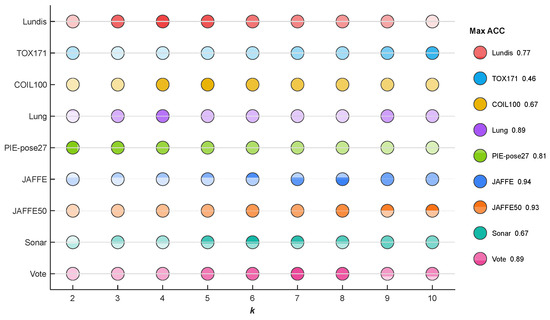
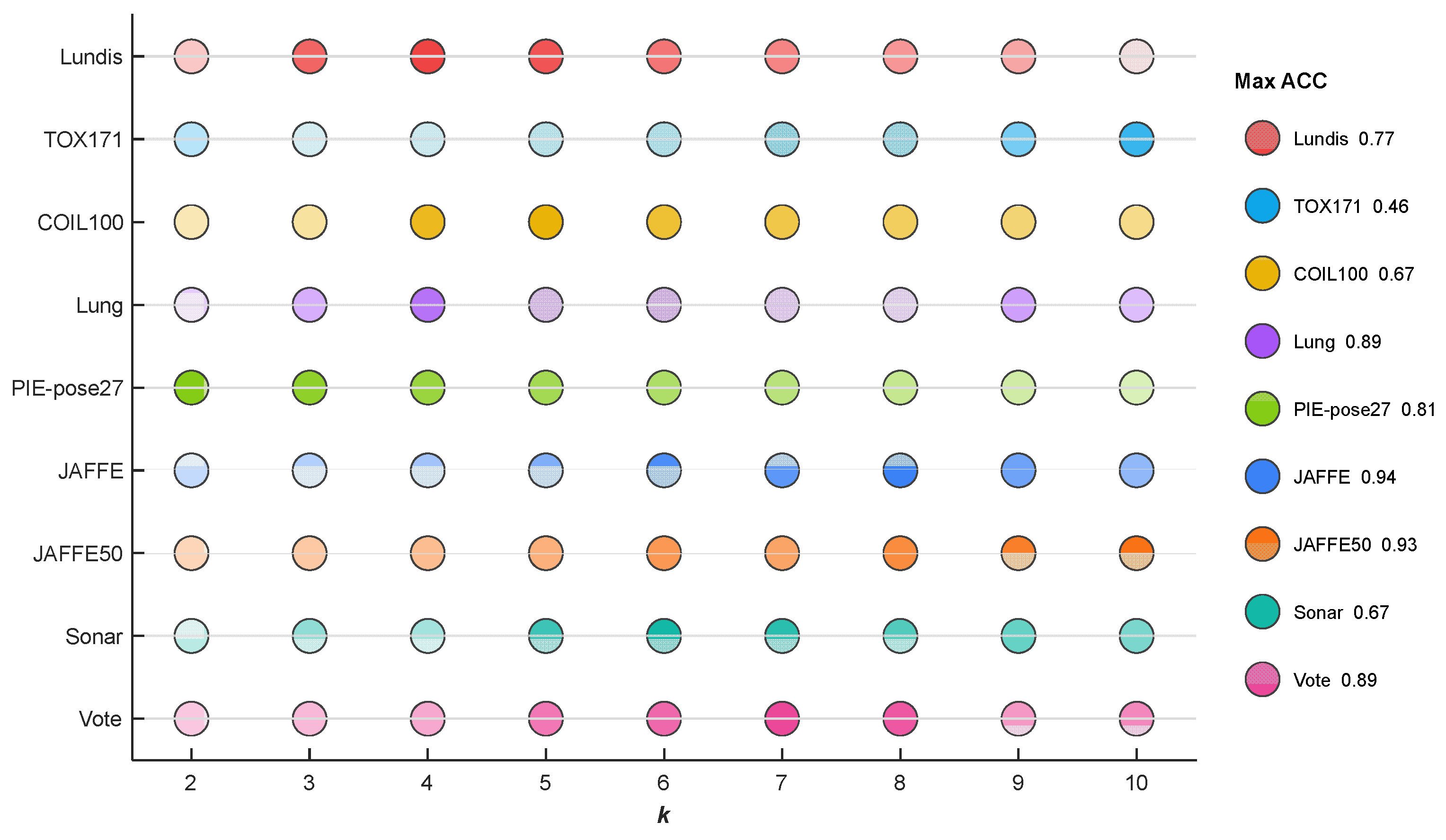
ACC of FGAS-ADG-LNMF on Different Datasets with Respect to k.
First, the impact of the data graph regularization parameter on algorithm performance is analyzed. As shown in Figure 2, the sensitivity to differs across datasets. On JAFFE50, JAFFE, and TOX-171, the ACC curve changes relatively smoothly within a broad parameter range, indicating that FGAS-ADG-LNMF is relatively robust to on these datasets. On COIL100 and Lung, increasing within a suitable range can noticeably improve the clustering performance, which shows that the sample-space graph regularization helps preserve useful local structure. However, on Vote and Sonar, an excessively large α leads to an obvious decline in ACC. This indicates that too weak a data graph constraint may be insufficient to capture neighborhood information, whereas too strong a constraint may over-smooth the sample representation and weaken the discriminative ability of the learned coefficient matrix.
Second, the impact of the feature-graph regularization parameter on clustering performance is analyzed. As shown in Figure 2, the influence of varies across datasets. On Vote, JAFFE50, and COIL100, the ACC curve with respect to remains relatively stable over a wide parameter range, indicating that FGAS-ADG-LNMF is not overly sensitive to on these datasets. On Sonar and TOX-171, increasing within a suitable range can improve the clustering performance, which suggests that strengthening the feature-space graph constraint helps preserve useful feature relationships. However, when becomes too large, the performance on some datasets, such as PIE_pose27 and Lung_dis, may fluctuate or decrease. Therefore, should be selected according to the feature distribution of each dataset so as to balance feature-graph structural preservation and model flexibility.
Next, the impact of the adaptive sparse regularization parameter on algorithm performance is analyzed. As shown in Figure 2, the effect of is also dataset-dependent. On Vote and COIL100, the ACC curve changes only slightly over a wide parameter range, indicating that FGAS-ADG-LNMF is relatively robust to on these datasets. On JAFFE50, JAFFE, Lung, and TOX-171, a moderate value can improve the clustering performance, which shows that an appropriate adaptive sparse constraint helps suppress redundant features and enhance the discriminative representation of the basis matrix. In contrast, on Sonar and PIE_pose27, an excessively large or otherwise unsuitable value of may lead to a clear performance decline or fluctuation. This indicates that although the logarithmic sparsity term can avoid overly aggressive sparsity to some extent, the strength of the feature-graph-guided sparse regularization still needs to be selected according to the feature distribution and structural complexity of each dataset.
More specifically, a moderate increase in θ may improve the algorithm’s performance across these datasets. Notably, on the Lung_dis dataset, the influence of θ on the algorithm’s performance is relatively stable, indicating that the method is relatively robust to this parameter. In contrast, the model is more sensitive to θ on the Sonar dataset, suggesting that appropriately tuning this parameter according to the characteristics of different datasets can help improve clustering performance.
Finally, the influence of the neighborhood parameter k on clustering performance is analyzed. As shown in Figure 3, the ACC of FGAS-ADG-LNMF varies across different datasets, and a larger k does not necessarily lead to better clustering results. Specifically, when k is small, the sample- and feature-space anchor graphs may be too sparse to adequately model the local associations represented in the two graph spaces, resulting in insufficient local information and weak connectivity of the induced graphs. As k increases to a suitable range, the algorithm can use more stable neighborhood information, and the ACC usually improves. However, when k is too large, the anchor graphs may contain less relevant or noisy anchor connections, which may over-smooth the local structures and blur discriminative boundaries. Thus, if k is either too large or too small, the algorithm’s clustering performance may not achieve optimal results. From the experimental results, most datasets obtain better ACC values at a moderate neighborhood size, for example, COIL100 at k = 5, Lung and Sonar at k = 6, Vote and TOX-171 at k = 7, and JAFFE at k = 8. This indicates that an appropriate k value can balance the compactness of local structure and graph connectivity. Meanwhile, the optimal k is not always located in the middle range. For instance, PIE_pose27 achieves its best result at k = 2, while JAFFE50 obtains its best result at k = 10. This phenomenon further demonstrates that the optimal value of k is closely related to the data distribution, feature dimensionality, and inter-category relationships. Therefore, in practical applications, k should be selected according to the specific characteristics of each dataset to avoid insufficient neighborhood information caused by too small a value and less relevant anchor connections introduced by too large a value.
From an optimization perspective, α, β, and θ determine how strongly the sample-graph structure, feature-graph structure, and adaptive sparse constraint participate in the joint optimization, respectively. Increasing α strengthens the preservation of local neighborhood consistency among sample representations, whereas increasing β places greater emphasis on maintaining structural relationships among feature representations. The parameter θ controls the strength of sparse feature selection; a moderate value helps suppress redundant feature information, while an excessively large value may also remove useful discriminative information. From the graph-structure perspective, k determines the number of nearest anchors retained during the construction of the sample and feature anchor graphs, thereby affecting their locality and connectivity. These mechanisms explain why suitable parameter settings balance data reconstruction, dual-graph structural preservation, and sparse feature selection, and why the preferred settings vary across datasets with different structural characteristics.
4.5. Visualization
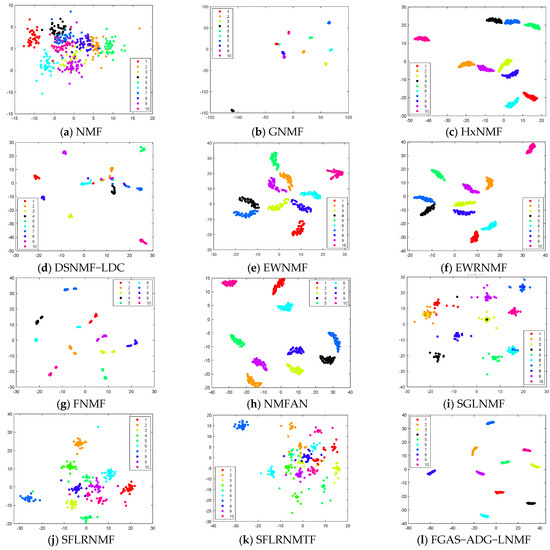
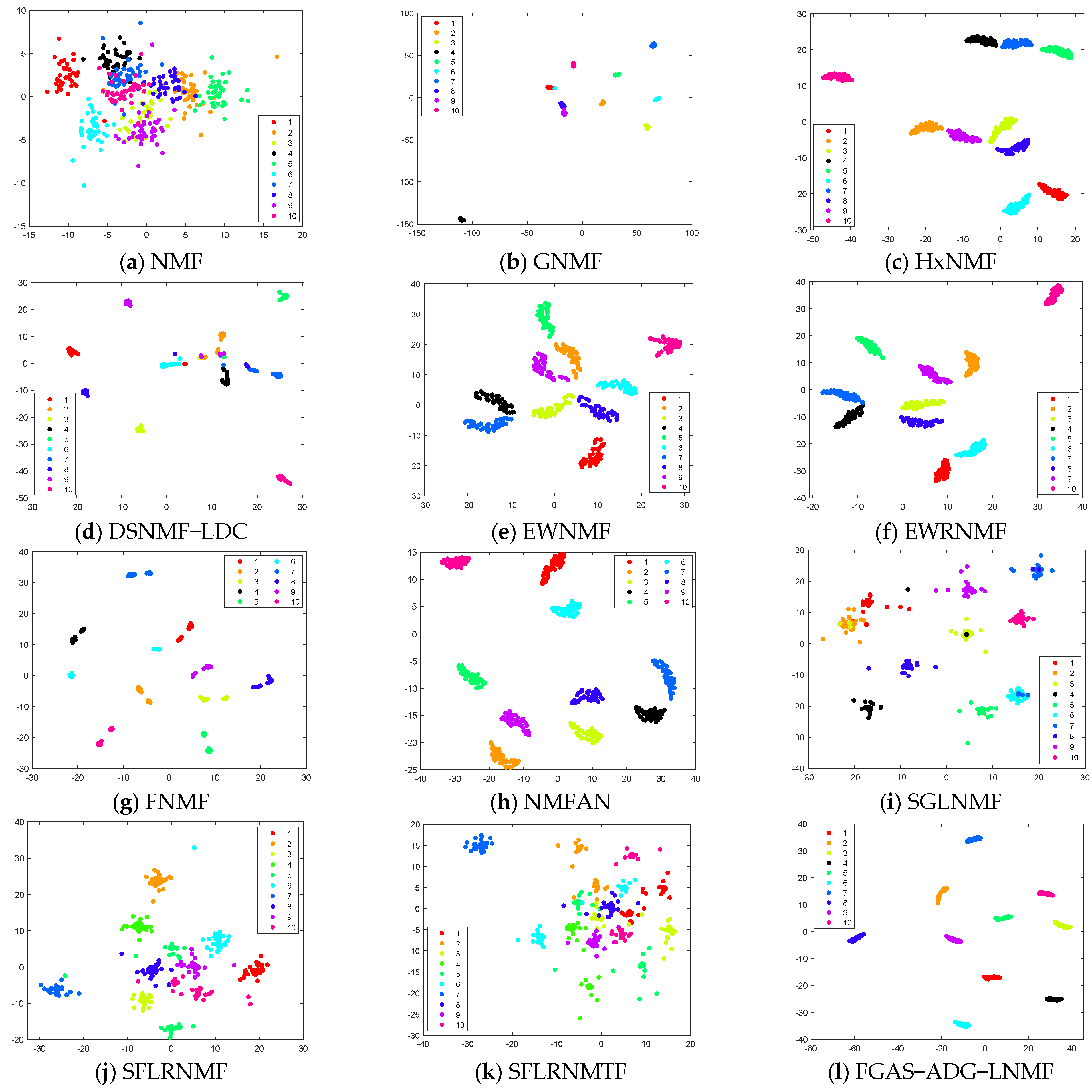
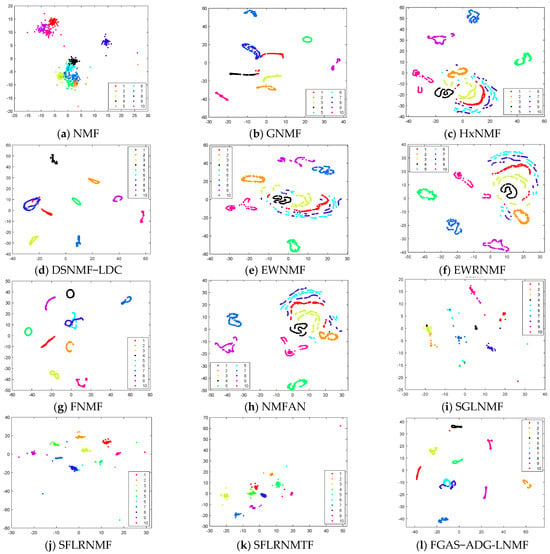
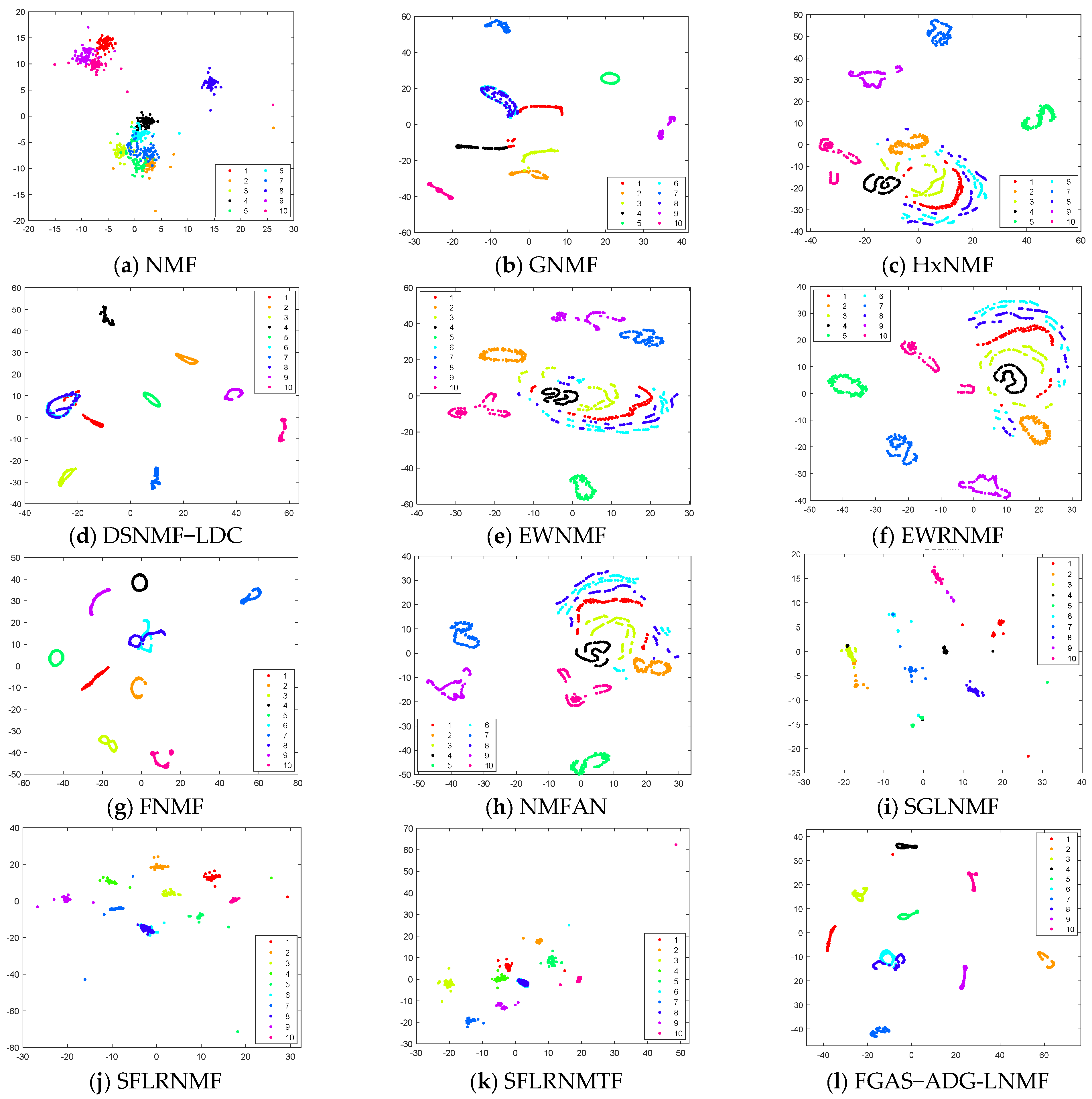
On the PIE_pose27 and COIL100 datasets, we projected the low-dimensional representations obtained by selected representative comparison algorithms and the proposed FGAS-ADG-LNMF onto a two-dimensional plane using t-SNE for visualization. To avoid cluttered visualizations, we selected samples from 10 classes in each dataset as input. The visual comparison results are presented in Figure 4 and Figure 5.
Figure 4.
t-SNE 2D Clustering Results on the PIE_pose27 Dataset for Different Methods.
Figure 5.
t-SNE 2D Clustering Results on the COIL100 Dataset for Different Methods.
As shown in Figure 4 and Figure 5, the low-dimensional representations learned by FGAS-ADG-LNMF exhibit clearer cluster structures than those learned by NMF and several graph-based variants on both datasets. In both visualizations, NMF and some comparison methods show substantial overlap among different categories, which indicates that their learned representations are insufficiently discriminative. By contrast, FGAS-ADG-LNMF produces more compact within-class distributions and clearer interclass separation. This advantage is particularly evident on the COIL100 dataset, where most clusters obtained by FGAS-ADG-LNMF exhibit larger interclass distances and less overlap, demonstrating better within-class cohesion and between-class discrimination.
On the PIE_pose27 dataset, because of the complex pose variations and inter-category differences, several comparison methods still show scattered distributions or overlaps between categories in the t-SNE space. FGAS-ADG-LNMF maintains relatively compact sample distributions within most classes and improves the separation between different categories. Although some comparison algorithms can form compact clusters for subsets of the samples, their inter-class distances are still small in some regions, which may cause category confusion. Therefore, the visualization results further verify that the feature-graph-guided adaptive sparse regularization and dual-anchor-graph structure help enhance the discriminative ability of the learned subspace representation.
4.6. Convergence Analysis
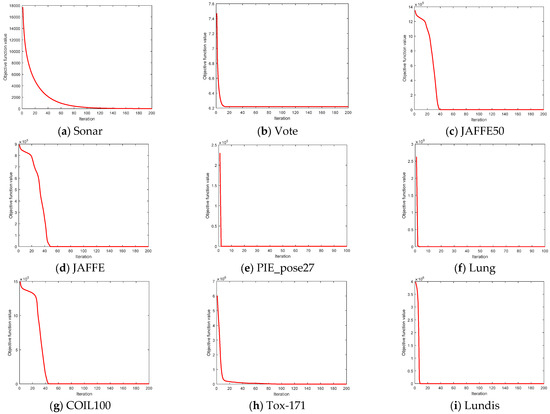
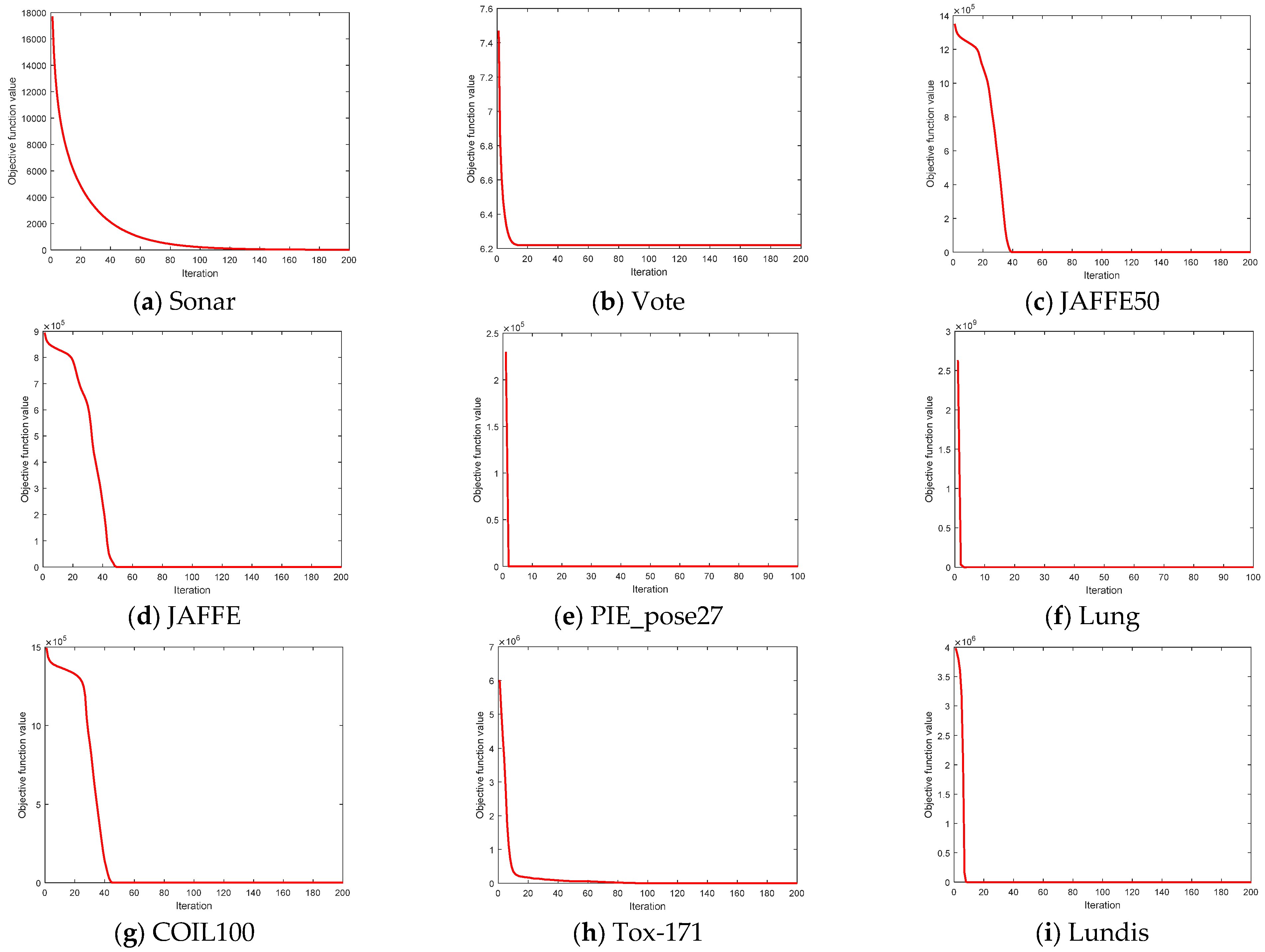
This subsection analyzes the convergence behavior of FGAS-ADG-LNMF using the convergence curves obtained on the nine benchmark datasets described above, as shown in Figure 6.
Figure 6.
Convergence curves of FGAS-ADG-LNMF on the nine benchmark datasets.
As shown in Figure 6, the objective function values of FGAS-ADG-LNMF decrease continuously and gradually become stable on all nine datasets, indicating that the proposed algorithm has good convergence behavior. The convergence speed varies across datasets. On Vote, PIE_pose27, Lung, and Lung_dis, the objective function drops sharply in the early iterations and quickly reaches a stable state. On JAFFE50, JAFFE, and COIL100, the curves show a short transition stage before rapidly decreasing and then converging within several dozen iterations. For Sonar and TOX-171, the objective function decreases more gradually, but the curves still present a clear downward trend and eventually stabilize. These results demonstrate that FGAS-ADG-LNMF can effectively optimize the objective function on datasets with different sample sizes, feature dimensions, and category structures, further verifying the stability and reliability of the proposed iterative update rules.
4.7. Computational Efficiency Analysis
To provide a structurally aligned assessment of computational efficiency, the runtime comparison focuses on SFLRNMF, SFLRNMTF [24], and DSNMF. Among the comparison methods included in this study, these three methods, like FGAS-ADG-LNMF, explicitly exploit both sample-side and feature-side graph information. They therefore enable a targeted comparison of the computational cost of dual-graph modeling rather than an exhaustive speed ranking of all NMF variants. SFLRNMF and SFLRNMTF represent dual-graph learning based on matrix factorization and matrix tri-factorization, respectively, whereas DSNMF provides a relatively compact dual-graph NMF baseline.
To evaluate computational efficiency across different data scales, Sonar and PIE_pose27 were selected as two representative datasets. Sonar contains 208 samples, 60 features, and two classes, representing a small-scale, low-dimensional binary clustering scenario. In contrast, PIE_pose27 contains 2856 samples, 1024 features, and 68 classes, representing a relatively large-scale, high-dimensional multi-class scenario. The substantial differences in sample size, feature dimensionality, and number of classes allow the computational costs of the four methods to be evaluated across different data scales. Compared with larger datasets such as COIL100, PIE_pose27 provides a computationally demanding yet tractable setting in which all four methods can complete the repeated runtime experiments under the same protocol.
For each method-dataset pair, the complete experimental pipeline was independently executed ten times, and the mean runtime and standard deviation were reported. All four methods used the same number of parameter configurations (G = 10), the same predefined list of ten random seeds, and a fixed maximum of 200 model iterations. Each clustering evaluation used 20 internal k-means repetitions. The measured time covered data loading, a common normalization procedure, parameter search, graph construction, initialization, model optimization, k-means clustering, ACC and NMI computation, figure generation, and result saving. Before formal timing, each method was executed once for warm-up, and the warm-up time was excluded.
As shown in Table 4, FGAS-ADG-LNMF required considerably less mean runtime than SFLRNMF and SFLRNMTF on both datasets. On PIE_pose27, SFLRNMF and SFLRNMTF required approximately 16.24 and 20.41 times the runtime of FGAS-ADG-LNMF, respectively. On Sonar, the corresponding ratios were approximately 20.27 and 20.32. These results indicate that the proposed method has a clear runtime advantage over the two structurally related SFL methods under the unified experimental protocol.
Table 4.
End-to-end runtime of the complete experimental pipeline on two datasets over ten independent runs (mean ± standard deviation, seconds).
DSNMF achieved the lowest mean runtime on both datasets. This result should be interpreted within the specified comparison scope. Only its dual-graph factorization stage was included, whereas the subsequent LDC post-processing stage was excluded. Moreover, DSNMF uses sparse k-nearest-neighbor dual graphs, random initialization, relatively compact multiplicative updates, and algebraically equivalent memory-efficient matrix operations. In contrast, FGAS-ADG-LNMF additionally learns sample and feature anchor sets, forms two anchor-based graph approximations, employs NNDSVD initialization, and combines logarithmic reconstruction with feature-graph-degree-guided adaptive Log-L2,1 reweighting. The graph-guided sparse mechanism is therefore one additional source of computational cost rather than the sole explanation for the runtime difference. Accordingly, the proposed method is not claimed to be universally the fastest; instead, it provides competitive computational efficiency and a favorable trade-off between structure-adaptive modeling and computational cost.
4.8. Ablation Study
To examine how clustering performance changes as the structural mechanisms of the proposed model are progressively removed, an ablation study was conducted on Vote and PIE_pose27. The complete model and two progressively simplified variants were evaluated. Full denotes the complete FGAS-ADG-LNMF model. The w/o Sparse variant removes the entire feature-graph-guided adaptive Log-L2,1 sparse regularization term. The w/o Sparse and Dual Graph variant further removes the sample-side and feature-side graph components. These model variants form a progressive removal path from the complete model to a simplified factorization model.
Vote and PIE_pose27 were selected to represent contrasting data settings. Vote contains 435 samples, 16 features, and two classes, and therefore represents a compact low-dimensional binary setting. PIE_pose27 contains 2856 samples, 1024 features, and 68 classes, and represents a high-dimensional multi-class setting with richer sample and feature relationships. This contrast allows the behavior of the structural mechanisms to be examined under markedly different feature and class structures.
For each dataset, the full model and the two ablated variants used the same fixed parameter setting, preprocessing procedure, and predefined list of ten random seeds, and no additional parameter search was performed. The full model and the two ablated variants were independently run ten times under the same experimental settings. The maximum number of model iterations was fixed at 200, and each clustering evaluation used 20 internal k-means repetitions. The mean and standard deviation of ACC and NMI are reported. Table 2 and Table 3 report the best results obtained through dataset-specific parameter search, whereas Table 5 adopts a common fixed-parameter protocol without additional search. Therefore, the Full results in Table 5 are not intended to reproduce the best values in Table 2 and Table 3; instead, the full model and the two ablated variants in Table 5 are evaluated using this common protocol.
Table 5.
Ablation results on Vote and PIE_pose27 over ten independent runs (mean ± standard deviation, %).
As shown in Table 5, the complete model achieves the highest mean ACC and NMI on both datasets. On Vote, removing the adaptive sparse regularization decreases ACC and NMI by 0.39 and 4.41 percentage points, respectively; further removing the dual-graph components produces additional decreases of 2.53 and 4.94 percentage points. On PIE_pose27, removing the adaptive sparse regularization decreases ACC and NMI by 28.84 and 20.53 percentage points, respectively; further removal of the dual-graph components produces additional decreases of 1.62 and 1.71 percentage points. The larger decrease caused by removing the sparse regularization on PIE_pose27 is consistent with a more prominent role for sparse learning in its high-dimensional multi-class representation. Overall, the progressive performance decreases observed on both datasets indicate that retaining the adaptive sparse regularization and the dual-graph structural constraints is beneficial for the clustering performance of the complete model.
5. Conclusions
This paper presented FGAS-ADG-LNMF, whose principal methodological distinction lies in the coupled use of dual anchor graphs in the sample and feature spaces and feature-graph-guided adaptive sparse learning. The sample and feature anchor graphs approximate the corresponding full graphs, while the degree information of the feature graph is further used to generate gi and regulate the row-wise Log-L2,1 penalty on U. In addition, a logarithmic reconstruction framework is introduced to reduce the influence of large residuals. Consequently, the proposed method integrates sample structure preservation, feature structure preservation, and feature-aware sparse learning within a unified graph-NMF model. Experimental results on nine public datasets show that FGAS-ADG-LNMF achieves competitive clustering performance compared with existing methods, especially with respect to within-class cohesion and between-class discrimination. The visualization and convergence results further verify the effectiveness, robustness, and stable convergence behavior of the proposed method. The efficiency evaluation further shows that FGAS-ADG-LNMF requires considerably lower mean end-to-end runtime than SFLRNMF and SFLRNMTF on both representative datasets, although the compact DSNMF factorization stage remains faster, indicating a favorable trade-off between structure-adaptive modeling and computational cost.
Nevertheless, FGAS-ADG-LNMF still requires dataset-dependent choices of regularization parameters, neighborhood size, and anchor settings. Moreover, the quality of the constructed sample and feature anchor graphs may influence how effectively the corresponding structural relationships are preserved. Although the dual-anchor formulation reduces the cost of constructing full sample and feature graphs, there remains room to improve the computational and storage efficiency of dual-graph construction, parameter tuning, and iterative optimization when processing extremely large or high-dimensional data. Future work will investigate automatic parameter selection, more robust and efficient methods for dual-anchor-graph construction and optimization, and extensions of the proposed method to practical applications such as image representation, document clustering, and community detection.
Author Contributions
Q.L., software, data curation, and writing—original draft preparation; T.M., conceptualization, methodology, writing—review and editing, and validation; F.X., visualization and investigation; Z.W., supervision and writing—review and editing. All authors have read and agreed to the published version of the manuscript.
Funding
This research received no external funding.
Institutional Review Board Statement
Not applicable.
Informed Consent Statement
Not applicable.
Data Availability Statement
The data presented in this study are available from the corresponding author, Q. Li, upon reasonable request. The data are not publicly available at this time because they are related to an unpublished manuscript.
Acknowledgments
The authors would like to thank the providers of the public benchmark datasets used in this study.
Conflicts of Interest
The authors declare no conflicts of interest.
Appendix A. Principal Symbols and Parameters
Table A1 summarizes the principal symbols and parameters used in the objective function and algorithm of FGAS-ADG-LNMF.
Table A1.
Principal symbols and parameters used in FGAS-ADG-LNMF.
References
- Lee, D.D.; Seung, H.S. Learning the parts of objects by non-negative matrix factorization. Nature 1999, 401, 788–791. [Google Scholar] [CrossRef] [Scilit] [PubMed]
- Jing, L.; Zhang, C.; Ng, M.K. SNMFCA: Supervised NMF-based image classification and annotation. IEEE Trans. Image Process. 2012, 21, 4508–4521. [Google Scholar] [CrossRef] [Scilit] [PubMed]
- Yin, J.; Peng, S.; Yang, Z.; Chen, B.; Lin, Z. Hypergraph based semi-supervised symmetric nonnegative matrix factorization for image clustering. Pattern Recognit. 2023, 137, 109274. [Google Scholar] [CrossRef] [Scilit]
- Zhang, Y.; Li, X.; Jia, M. Adaptive graph-based discriminative nonnegative matrix factorization for image clustering. Signal Process. Image Commun. 2021, 95, 116253. [Google Scholar] [CrossRef] [Scilit]
- Guo, Z.; Zhang, Y. A sparse corruption non-negative matrix factorization method and application in face image processing & recognition. Measurement 2019, 136, 429–437. [Google Scholar] [CrossRef] [Scilit]
- Lu, M.; Zhao, X.-J.; Zhang, L.; Li, F.-Z. Semi-supervised concept factorization for document clustering. Inf. Sci. 2016, 331, 86–98. [Google Scholar] [CrossRef] [Scilit]
- Cai, D.; He, X.; Han, J. Locally consistent concept factorization for document clustering. IEEE Trans. Knowl. Data Eng. 2010, 23, 902–913. [Google Scholar] [CrossRef] [Scilit]
- Lydia, E.L.; Kumar, P.K.; Shankar, K.; Lakshmanaprabu, S.K.; Vidhyavathi, R.M.; Maseleno, A. Charismatic document clustering through novel K-Means non-negative matrix factorization (KNMF) algorithm using key phrase extraction. Int. J. Parallel Program. 2020, 48, 496–514. [Google Scholar] [CrossRef] [Scilit]
- Berry, M.W.; Browne, M.; Langville, A.N.; Pauca, V.P.; Plemmons, R.J. Algorithms and applications for approximate nonnegative matrix factorization. Comput. Stat. Data Anal. 2007, 52, 155–173. [Google Scholar] [CrossRef] [Scilit]
- Xu, J.; Wang, Y.; Xu, X.; Cheng, K.-K.; Raftery, D.; Dong, J. NMF-based approach for missing values imputation of mass spectrometry metabolomics data. Molecules 2021, 26, 5787. [Google Scholar] [CrossRef] [Scilit] [PubMed]
- Mouri, K.; Suzuki, F.; Shimada, A.; Uosaki, N.; Yin, C.; Kaneko, K.; Ogata, H. Educational data mining for discovering hidden browsing patterns using non-negative matrix factorization. Interact. Learn. Environ. 2021, 29, 1176–1188. [Google Scholar] [CrossRef] [Scilit]
- Cai, D.; He, X.; Han, J.; Huang, T.S. Graph Regularized Nonnegative Matrix Factorization for Data Representation. IEEE Trans. Pattern Anal. Mach. Intell. 2011, 33, 1548–1561. [Google Scholar] [CrossRef] [Scilit] [PubMed]
- Rajabi, R.; Khodadadzadeh, M.; Ghassemian, H. Graph regularized nonnegative matrix factorization for hyperspectral data unmixing. In Proceedings of the 2011 7th Iranian Conference on Machine Vision and Image Processing; IEEE: New York, NY, USA, 2011; pp. 1–4. [Google Scholar]
- Tong, L.; Zhou, J.; Qian, B.; Yu, J.; Xiao, C. Adaptive graph regularized multilayer nonnegative matrix factorization for hyperspectral unmixing. IEEE J. Sel. Top. Appl. Earth Obs. Remote Sens. 2020, 13, 434–447. [Google Scholar] [CrossRef] [Scilit]
- He, X.; Wang, Q.; Li, X. Robust adaptive graph regularized non-negative matrix factorization. IEEE Access 2019, 7, 83101–83110. [Google Scholar] [CrossRef] [Scilit]
- Huang, S.; Wang, H.; Li, T.; Li, T.; Xu, Z. Robust graph regularized nonnegative matrix factorization for clustering. Data Min. Knowl. Discov. 2018, 32, 483–503. [Google Scholar] [CrossRef] [Scilit]
- He, J.; He, D.; Liu, B.; Wang, W. Orthogonal graph regularized nonnegative matrix factorization for image clustering. In Proceedings of the Big Data: 7th CCF Conference, BigData 2019, Proceedings 7, Wuhan, China, 26–28 September 2019; Springer: Singapore, 2019; pp. 325–337. [Google Scholar]
- Li, R.; Yang, G.; Wang, K.; Huang, Y.; Yuan, F.; Yin, Y. Robust ECG biometrics using GNMF and sparse representation. Pattern Recognit. Lett. 2020, 129, 70–76. [Google Scholar] [CrossRef] [Scilit]
- Berahmand, K.; Mohammadi, M.; Saberi-Movahed, F.; Li, Y.; Xu, Y. Graph regularized nonnegative matrix factorization for community detection in attributed networks. IEEE Trans. Netw. Sci. Eng. 2022, 10, 372–385. [Google Scholar] [CrossRef] [Scilit]
- Liu, Z.; Luo, X. A symmetry and graph regularized nonnegative matrix factorization model for community detection. arXiv 2023, arXiv:2302.12122. [Google Scholar]
- Shang, F.; Jiao, L.; Wang, F. Graph dual regularization non-negative matrix factorization for co-clustering. Pattern Recognit. 2012, 45, 2237–2250. [Google Scholar] [CrossRef] [Scilit]
- Meng, Y.; Shang, R.; Jiao, L.; Zhang, W.; Yuan, Y.; Yang, S. Feature selection based dual-graph sparse non-negative matrix factorization for local discriminative clustering. Neurocomputing 2018, 290, 87–99. [Google Scholar] [CrossRef] [Scilit]
- Sun, J.; Wang, Z.; Sun, F.; Li, H. Sparse dual graph-regularized NMF for image co-clustering. Neurocomputing 2018, 316, 156–165. [Google Scholar] [CrossRef] [Scilit]
- Ma, H.; Ma, Z.; Li, H.; Wang, J. Sparse feature-weighted double Laplacian rank constraint non-negative matrix factorization for image clustering. Mathematics 2024, 12, 3656. [Google Scholar] [CrossRef] [Scilit]
- Xue, Z.; Yang, B.; Zhang, X.; Wang, F.; Lin, Z. One-step multi-view clustering with adaptive low-rank anchor-graph learning. IEEE Trans. Multimed. 2026, 28, 3768–3780. [Google Scholar] [CrossRef] [Scilit]
- Yang, B.; Zhang, X.; Xue, Z.; Nie, F.; Chen, B. Fast multi-view discrete clustering via spectral embedding fusion. IEEE Trans. Pattern Anal. Mach. Intell. 2026, 48, 5095–5112. [Google Scholar] [CrossRef] [Scilit] [PubMed]
- Yang, B.; Zhang, X.; Wu, J.; Nie, F.; Wang, F.; Chen, B. Scalable min-max multi-view spectral clustering. IEEE Trans. Knowl. Data Eng. 2025, 37, 2918–2931. [Google Scholar] [CrossRef] [Scilit]
- Jia, Y.; Kwong, S.; Hou, J.; Wu, W. Semi-supervised non-negative matrix factorization with dissimilarity and similarity regularization. IEEE Trans. Neural Netw. Learn. Syst. 2019, 31, 2510–2521. [Google Scholar] [CrossRef] [Scilit] [PubMed]
- Cui, G.; Li, Y.; Li, J.; Fan, J. Discriminatively constrained semi-supervised multi-view nonnegative matrix factorization with graph regularization. Big Data Min. Anal. 2023, 7, 55–74. [Google Scholar] [CrossRef] [Scilit]
- Guo, W.; Hu, W.; Boulgouris, N.V.; Patras, I. Semi-supervised visual recognition with constrained graph regularized non-negative matrix factorization. In Proceedings of the 2013 IEEE International Conference on Image Processing; IEEE: New York, NY, USA, 2013; pp. 2743–2747. [Google Scholar]
- Li, H.; Gao, Y.; Liu, J.; Zhang, J.; Li, C. Semi-supervised graph regularized nonnegative matrix factorization with local coordinate for image representation. Signal Process. Image Commun. 2022, 102, 116589. [Google Scholar] [CrossRef] [Scilit]
- Huang, S.; Xu, Z.; Wang, F. Nonnegative matrix factorization with adaptive neighbors. In Proceedings of the 2017 International Joint Conference on Neural Networks (IJCNN); IEEE: New York, NY, USA, 2017; pp. 486–493. [Google Scholar]
- Zhang, L.; Liu, Z.; Pu, J.; Song, B. Adaptive graph regularized nonnegative matrix factorization for data representation. Appl. Intell. 2020, 50, 438–447. [Google Scholar] [CrossRef] [Scilit]
- Chen, M.; Gong, M.; Li, X. Feature weighted non-negative matrix factorization. IEEE Trans. Cybern. 2021, 53, 1093–1105. [Google Scholar] [CrossRef] [Scilit] [PubMed]
- Ma, Z.; Wang, J.; Li, H.; Huang, Y. Adaptive graph regularized non-negative matrix factorization with self-weighted learning for data clustering. Appl. Intell. 2023, 53, 28054–28073. [Google Scholar] [CrossRef] [Scilit]
- Kong, D.; Ding, C.; Huang, H. Robust nonnegative matrix factorization using l2,1-norm. In Proceedings of the 20th ACM International Conference on Information and Knowledge Management; ACM: New York, NY, USA, 2011; pp. 673–682. [Google Scholar]
- Wang, Z.; Min, W. Graph Regularized NMF with L2,0-norm for Unsupervised Feature Learning. arXiv 2024, arXiv:2403.10910. [Google Scholar]
- Huang, J.; Nie, F.; Huang, H.; Ding, C. Robust manifold nonnegative matrix factorization. ACM Trans. Knowl. Discov. Data (TKDD) 2014, 8, 1–21. [Google Scholar] [CrossRef] [Scilit]
- Lu, G.; Leng, C.; Li, B.; Jiao, L.; Basu, A. Robust dual-graph discriminative NMF for data classification. Knowl.-Based Syst. 2023, 268, 110465. [Google Scholar] [CrossRef] [Scilit]
- Tang, J.; Feng, H. Robust local-coordinate non-negative matrix factorization with adaptive graph for robust clustering. Inf. Sci. 2022, 610, 1058–1077. [Google Scholar] [CrossRef] [Scilit]
- Gu, Q.; Zhou, J. Co-clustering on manifolds. In Proceedings of the 15th ACM SIGKDD International Conference on Knowledge Discovery and Data Mining; ACM: New York, NY, USA, 2009; pp. 359–368. [Google Scholar]
- Yoo, J.; Choi, S. Orthogonal nonnegative matrix tri-factorization for co-clustering: Multiplicative updates on Stiefel manifolds. Inf. Process. Manag. 2010, 46, 559–570. [Google Scholar] [CrossRef] [Scilit]
- Zhang, R.; Hang, S.; Sun, Z.; Nie, F.; Wang, R.; Li, X. Anchor-based fast spectral ensemble clustering. Inf. Fusion 2025, 113, 102587. [Google Scholar] [CrossRef] [Scilit]
- Wang, Q.; He, X.; Jiang, X.; Li, X. Robust bi-stochastic graph regularized matrix factorization for data clustering. IEEE Trans. Pattern Anal. Mach. Intell. 2020, 44, 390–403. [Google Scholar] [CrossRef] [Scilit] [PubMed]

Disclaimer/Publisher’s Note: The statements, opinions and data contained in all publications are solely those of the individual author(s) and contributor(s) and not of MDPI and/or the editor(s). MDPI and/or the editor(s) disclaim responsibility for any injury to people or property resulting from any ideas, methods, instructions or products referred to in the content. |
© 2026 by the authors. Licensee MDPI, Basel, Switzerland. This article is an open access article distributed under the terms and conditions of the Creative Commons Attribution (CC BY) license.