


Abstract
Underwater laser range-gated imaging (ULRGI) effectively suppresses water backscattering via time-slicing mechanisms, making it a primary modality for underwater vision. However, factors such as the inherent optical properties of water, intra-slice residual scattering, gating timing errors, and sensor noise make it difficult to separate target signals from the background. Consequently, the resulting images are generally affected by texture degradation and low contrast, severely limiting the accuracy of downstream tasks like object detection and environmental perception. To this end, we propose the use of a Wavelet-guided Multi-stage Gated Enhancement Network (WMGNet). Operating progressively across three stages, WMGNet’s first two stages employ an encoder–decoder architecture that leverages multi-scale frequency decomposition in the wavelet domain to pinpoint intra-slice scattering and decouple target signals from noise. To precisely extract fine details, we design a TextureBlock integrating feature gating (ConvGLU) and high-frequency attention (HFAttention). Additionally, a pixel-wise ground-truth guided attention module (GGAM) is introduced to optimize the precision and target-specificity of multi-stage feature fusion. Extensive comparative and ablation experiments demonstrate that the proposed WMGNet effectively eliminates scattering interference and restores texture details in underwater imaging. On our custom ULRGI dataset, it achieves state-of-the-art performance with a PSNR of 36.31 dB, an SSIM of 0.921, an MAE of 2.672, and an LPIPS of 0.060. Notably, it outperforms the second-best method by a margin of 3.06 dB in PSNR and reduces the MAE by 50.69%. Furthermore, evaluations on three public datasets confirm its robust cross-scenario generalization, yielding competitive PSNR values of 33.22 dB, 31.59 dB, and 32.06 dB, respectively. Overall, WMGNet provides a highly effective and robust solution for high-resolution underwater imaging.
Keywords:
underwater laser range-gated imaging; wavelet-guided; multi-stage network; feature gating mechanism; image enhancement MSC:
68-11
1. Introduction
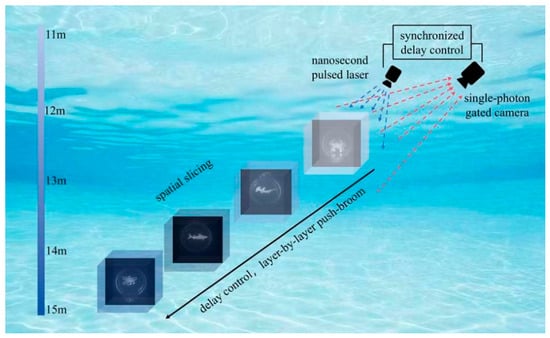
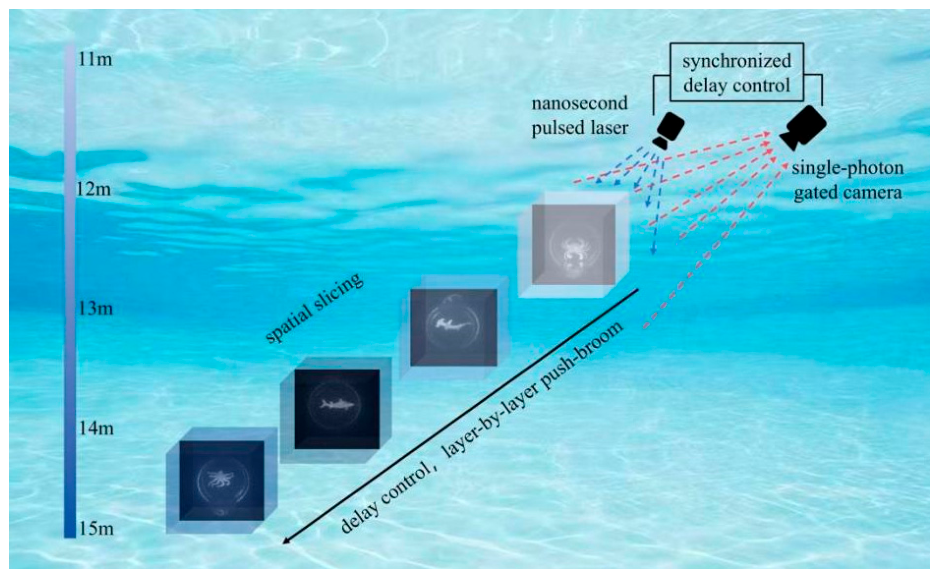
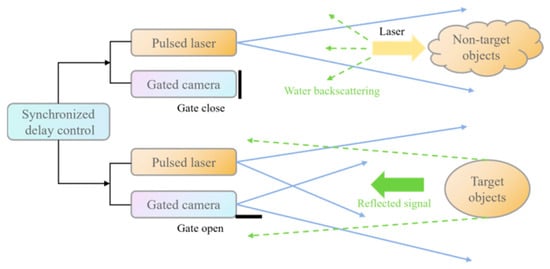
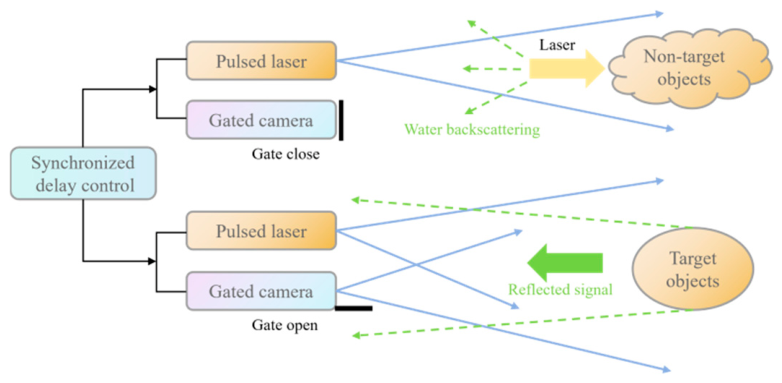
As underwater exploration tasks—such as dam inspection, deep-sea development, and underwater cultural heritage exploration—become increasingly complex, they impose stricter requirements on imaging precision. In complex underwater environments, suspended particles significantly increase light scattering and photon absorption probabilities [1], limiting the effective imaging distance of traditional optical cameras to less than 2 m [2]. Compared to traditional methods, underwater laser range-gated imaging (ULRGI) utilizes nanosecond-level synchronization between the gated camera and laser pulses to perform time-sliced scanning of the water volume. By granting the system “selective vision”, it receives only the reflected signals within the target’s slice, effectively filtering out most of the backscatter along the optical path [3,4] (Figure 1) and extending the detection range to 3–5 attenuation lengths [5]. However, the clarity of the output images often fails to meet practical detection needs. This degradation is caused by absorption attenuation and intra-slice residual scattering, compounded by hardware noise such as gating timing errors and sensor dark current [6]. Consequently, achieving high-quality enhancement of underwater gated images has become the core bottleneck restricting the practical application of this technology.
Figure 1.
Schematic of underwater laser range-gated imaging.
Existing underwater image enhancement methods generally comprise physical models, visual priors, and deep learning frameworks. Physical models [7,8,9,10,11,12], such as Dark Channel Prior variants and Sea-thru, reverse optical degradation by estimating global backscatter and distance-dependent attenuation. Visual prior methods [13,14,15,16] bypass complex modeling, relying on statistical features and fusion techniques for perceptual restoration. Recently, deep learning architectures [17,18,19,20] have leveraged CNNs, GANs, and Transformers for end-to-end color and contrast enhancement. To further improve scene adaptability and color fidelity, recent advancements have explored lightweight dual-branch networks operating in stabilized color spaces [21], as well as adaptive frameworks that fuse Generative Adversarial Networks (GANs) with physical models and multi-scale feature extraction across diverse color spaces [22]. However, tailored for conventional underwater images, these paradigms fail to generalize to range-gated systems. Physical models utilize a “global scattering and attenuation” framework. This assumption fails under the coupled interference of localized intra-slice residual scattering, sensor noise, and timing errors specific to gated images, causing inaccurate parameter estimation and detail loss. Similarly, visual priors rely on standard spatial distributions. Because range-gated images exhibit localized scattering, irregular dark-pixel distributions, and fragmented textures, traditional statistical priors become invalid, often amplifying noise. Deep learning approaches also overlook the time-slicing nature of gated imaging, failing to model the specific noise distributions induced by intra-slice scattering residuals and timing errors. In summary, lacking targeted designs for the essential characteristics of gated images—localized scattering, time-coupled noise, and the failure of global statistics—existing methods cannot effectively separate target signals from noise. This remains the core bottleneck in underwater range-gated image enhancement.
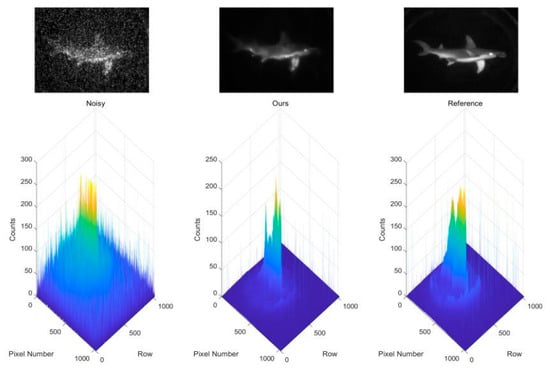
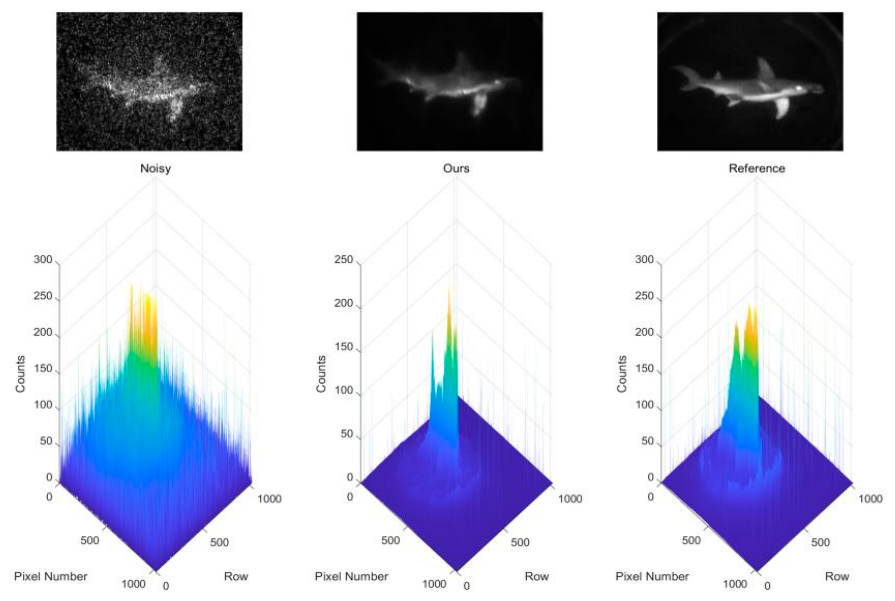
To circumvent these bottlenecks, we propose the Wavelet-guided Multi-stage Gated Enhancement Network (WMGNet). Diverging from conventional approaches, WMGNet leverages Discrete Wavelet Transform (DWT) to partition the visual input across separate frequency spectra, explicitly directing the architecture to discriminate fine-grained high-frequency details from foundational low-frequency structures. By integrating a multi-stage collaborative architecture with a feature gating mechanism, the network progressively isolates noise and restores structural details. The enhancement efficacy is directly quantified by the 3D signal intensity surface plot in Figure 2. Mapping spatial coordinates (X, Y) against pixel intensity (Z), this plot illustrates the amplitude distribution of valid signals, scattering, and sensor noise. The high noise floor in the raw image highlights the critical overlap between target and noise signals inherent to gated imaging. Conversely, WMGNet significantly suppresses this background noise, producing sharply concentrated signal peaks in target regions. This substantial improvement in the signal-to-noise ratio (SNR) provides a reliable basis for downstream tasks such as underwater object detection.
Figure 2.
Three-dimensional signal intensity distribution.
The primary innovations and contributions of this study are articulated below:
- Wavelet-guided encoder–decoder architecture: We integrate the wavelet transform throughout the feature extraction and reconstruction process. Leveraging the multi-scale and multi-directional resolution capabilities of the wavelet domain, this architecture explicitly guides the network to accurately capture image features, effectively decoupling target signals from strongly coupled noise inherent to gated imaging.
- Collaborative enhancement mechanism via TextureBlock and GGAM: We introduce a mechanism that combines a TextureBlock—integrating feature gating (ConvGLU) and high-frequency attention (HFAttention)—with a ground-truth-guided attention module (GGAM). During feature extraction, the TextureBlock filters noise and strengthens edge details. Building on this, the GGAM uses recovery residuals from preceding stages to generate pixel-wise attention maps, directing the network to focus on under-restored areas. This collaboration enables precise cross-stage optimization and significantly improves the reconstruction accuracy of complex textures.
- Custom gated imaging system and paired dataset: To address the absence of datasets in this domain, we developed a miniaturized, low-power underwater range-gated imaging system and constructed a paired dataset. Comprising strictly paired “one-shot” and “multi-image fused” images, this dataset provides necessary, high-quality data for the training, validation, and benchmarking of underwater gated image enhancement networks.
2. Related Work
2.1. Underwater Range-Gated Imaging Systems
As a novel approach to breaking through the bottlenecks of underwater optical imaging, underwater range-gated imaging systems can be used to combine pulsed laser illumination with nanosecond-level gated technology to achieve high-contrast, high-resolution imaging of submerged targets. This capability has made them a major research focus in recent years.
2.1.1. Working Principle
The core of this technology is the laser gating mechanism, illustrated in Figure 3. By precisely synchronizing a high-peak-power pulsed laser with the shutter of a single-photon camera, the system performs layered time-slice imaging of the underwater space, effectively suppressing backscatter. Specifically, as the laser pulse propagates, a portion of the light is reflected by the target to form a useful echo, while the rest is scattered by suspended particles and absorbed by water molecules, creating background interference. Because the laser and camera operate in strict synchronization, the shutter opens exclusively within a predefined spatial depth window. It captures only the target’s echo within that specific slice, blocking out-of-slice backscatter and ambient light [23]. This targeted signal collection significantly enhances image contrast, resolving the detection challenges that traditional optical equipment faces in harsh underwater environments.
Figure 3.
Operating principle of the laser range-gating mechanism.
2.1.2. System Composition
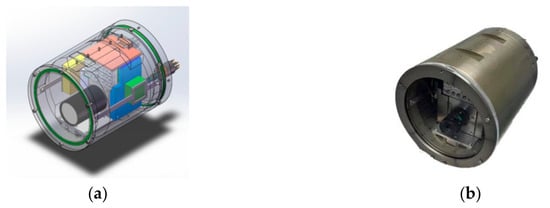
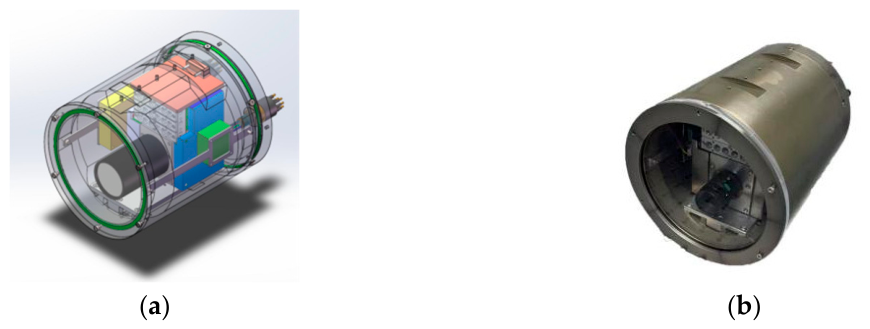
The proposed modular range-gated underwater imaging setup (Figure 4) is essentially composed of two primary modules: a 450 nm semiconductor laser featuring an ultra-high repetition frequency, alongside a miniaturized nanosecond single-photon gated camera. Operating at an average power of 0.9 W with a field of view (FOV) of 6.8° × 4.9°, the active laser utilizes the blue-green optical window to effectively extend the underwater transmission distance. The camera provides a lower-bound gating interval of 3 ns coupled with a peak operating frequency of 500 kHz, employing ultra-narrow time-slicing to precisely suppress background scatter while sustaining an acquisition speed reaching 90 frames per second for real-time dynamic target capture. In addition to these primary components, the system integrates three essential sub-modules [24]. A precise synchronization module ensures the strict timing between laser emission and shutter opening required for accurate time-slicing. An optical coupling unit optimizes the laser transmission path and the camera’s light collection efficiency, minimizing optical loss. Finally, a data transmission module manages real-time acquisition and storage. Working collectively, these components effectively mitigate underwater scattering and ambient light interference, providing the high-contrast raw image data necessary to support the research and training of the Wavelet-guided Multi-stage Gated Enhancement Network (WMGNet).
Figure 4.
(a) Three-dimensional structure of the underwater laser range-gated system; (b) overall appearance of the underwater laser range-gated system.
2.2. Frequency-Domain Based Image Enhancement Methods
In underwater optical imaging, medium absorption and strong scattering cause frequency-dependent degradation [25]. The distortion of low-frequency components leads to global background and color degradation, while the attenuation of high-frequency components erases structural textures. To overcome the limitations of purely spatial feature extraction, recent frequency domain methods [26,27,28,29,30,31,32] have demonstrated the effectiveness of cross-domain optimization. These studies generally follow two paths: employing Fourier transforms for global residual diffusion or utilizing the Discrete Wavelet Transform (DWT) for multi-scale and directional parsing. By decomposing images into distinct frequency sub-bands, DWT enables the decoupling of low-frequency color correction from high-frequency detail restoration. Inspired by these approaches and addressing the difficulty of separating intra-slice scattering in gated imagery, we build a wavelet-guided encoder–decoder network to investigate the usefulness of frequency domain decomposition for enhancing underwater gated images.
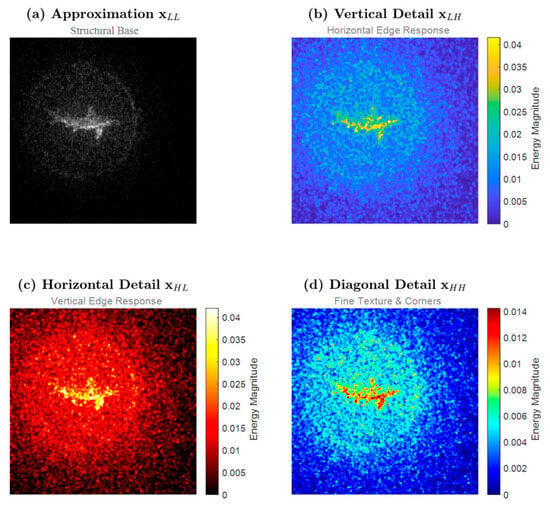
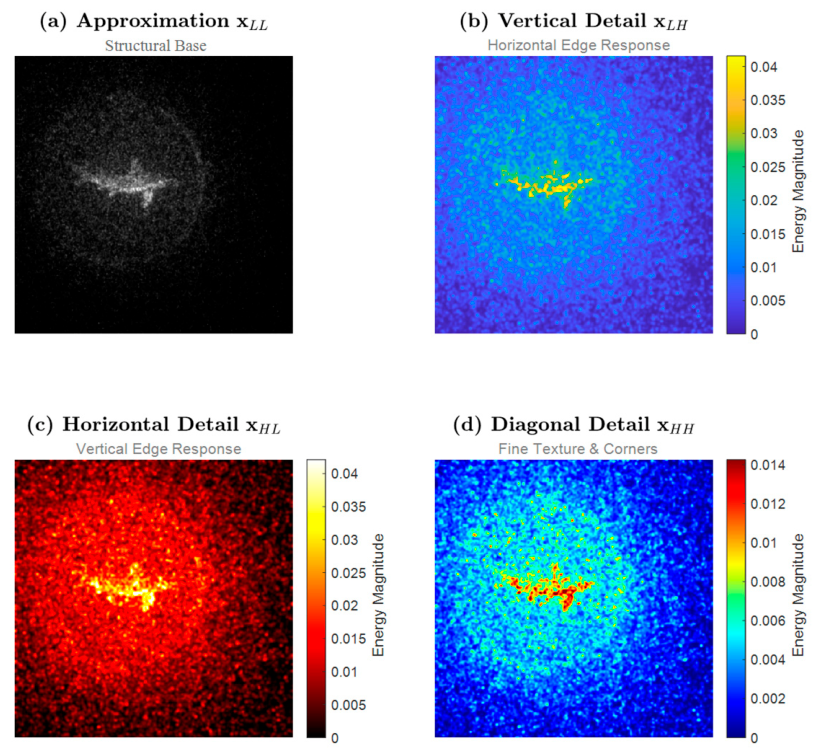
Figure 5 illustrates the multi-scale composition of an underwater gated image processed via DWT. The low-frequency approximation sub-band XLL retains the backscatter-dominated baseline and target contours. Meanwhile, the three high-frequency detail sub-bands (XLH, XHL, and XHH) isolate key features such as horizontal edges, vertical edges, and fine textures, respectively. This amplitude distribution validates the explicit capability of the wavelet transform to separate the scattering-dominated background from target-dominated details. By processing these sub-bands independently within the frequency domain, our framework effectively resolves the technical bottlenecks of intra-slice scattering separation and texture loss. Aligning with the core principles of existing frequency domain methods, this decomposition establishes the theoretical foundation for our multi-stage gated enhancement network.
Figure 5.
Multi-scale wavelet decomposition of the range-gated imagery, (a) The low-frequency approximation sub-band XLL, retaining the backscatter-dominated baseline and target contours; (b) The high-frequency detail sub-band XLH, isolating horizontal edges; (c) The high-frequency detail sub-band XHL, isolating vertical edges; (d) The high-frequency detail sub-band XHH, isolating fine textures.
2.3. Multi-Stage Feature-Transfer-Based Image Enhancement Methods
When simultaneously addressing background interference and detail loss, conventional single-stage networks often encounter feature coupling and optimization bottlenecks. In contrast, existing multi-stage underwater enhancement strategies [33,34,35,36,37,38] adopt a “divide-and-conquer” approach. By utilizing cascaded architectures, cross-stage contrastive learning, and progressive physical regressions, these methods decompose complex reconstruction tasks into sequential subspace optimizations, facilitating a smooth transition from global correction to local detail recovery.
However, underwater range-gated imagery faces specific challenges regarding texture fragmentation and high-frequency blurring. Although the time-slicing mechanism effectively truncates background backscatter, it also weakens continuous target edges and micro-texture information. This unique degradation pattern makes single-pass networks prone to local optima, generating over-smoothing artifacts. Overall, multi-stage enhancement methods provide efficient solutions for various degradation problems by decomposing the degradation task, applying stage-wise supervised optimization, and balancing global and local information. Inspired by these approaches, and to address the specific texture blurring in gated images, we construct a framework based on multi-stage feature passing to explore its application in underwater range-gated image enhancement.
3. Methodology
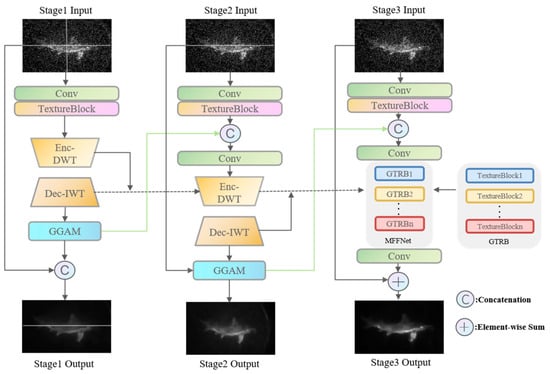
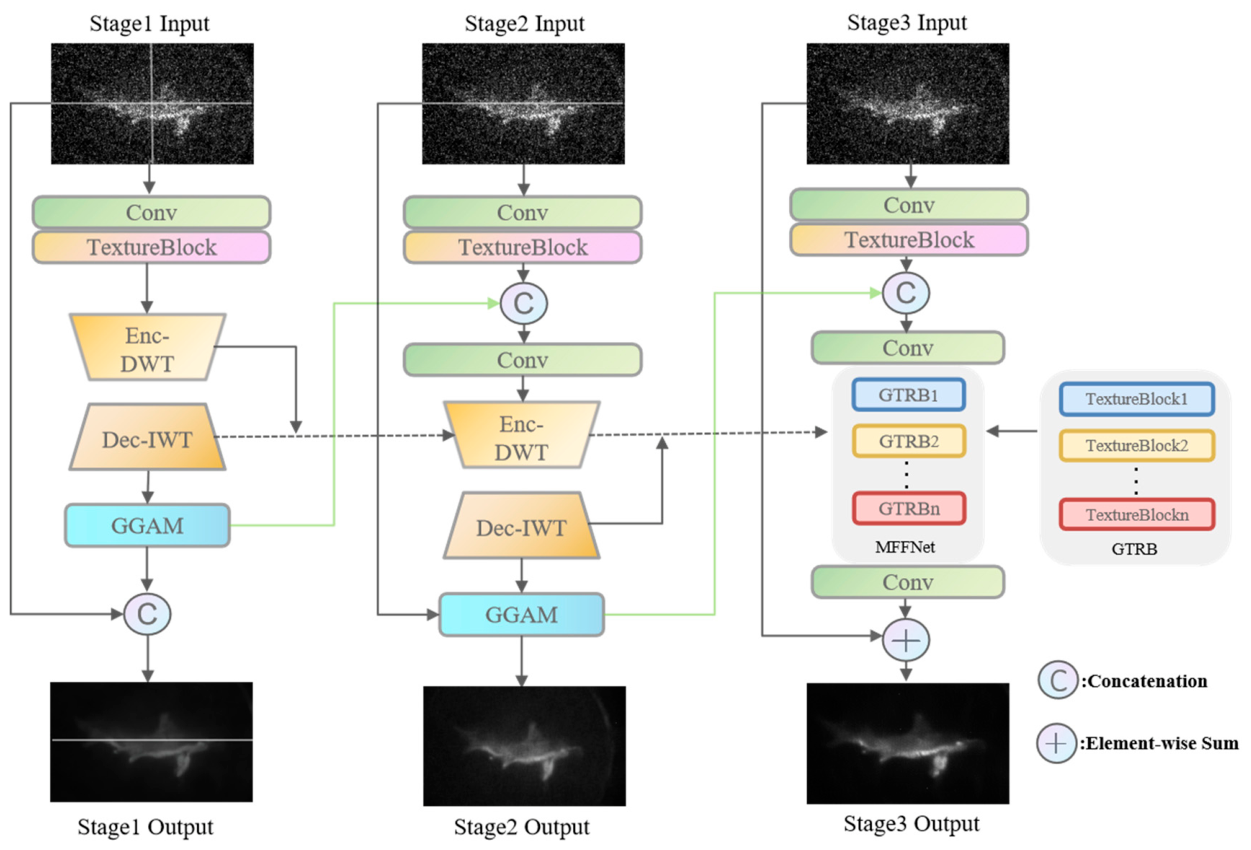
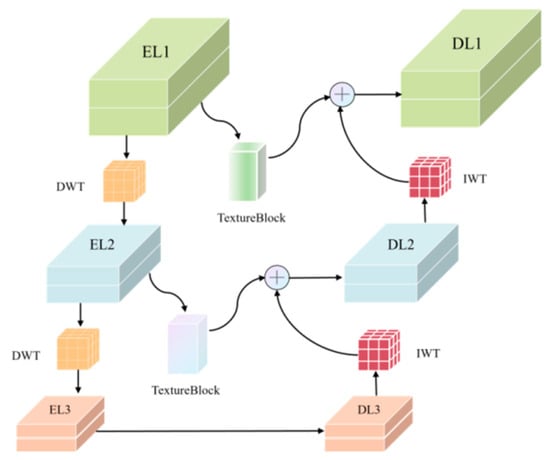
To address residual scattering, texture loss, and low contrast in underwater gated images, we propose the Wavelet-guided Multi-stage Gated Enhancement Network (WMGNet). As shown in Figure 6, its progressive three-stage architecture integrates stage-wise enhancement, multi-dimensional feature complementation, and adaptive supervised fusion. The first two stages employ a wavelet-based encoder–decoder that decomposes the input into low-frequency structural (LL) and high-frequency (HL, LH, HH) components. This explicit frequency separation efficiently isolates intra-slice scattering. Simultaneously, an embedded TextureBlock—incorporating feature gating (ConvGLU) and high-frequency attention (HFAttention)—filters valid features to precisely recover micro-textures. The third stage refines the output using a pixel-wise ground-truth-guided attention module (GGAM) for precise cross-stage feature fusion. Finally, a composite loss function—comprising Charbonnier, gradient, wavelet, and perceptual losses—constrains the network across multiple dimensions, ensuring simultaneous numerical and visual optimization.
Figure 6.
Overall architecture of the proposed WMGNet.
3.1. Three-Stage Wavelet-Guided Encoder–Decoder Architecture
3.1.1. Three-Stage Enhancement Logic
WMGNet employs a progressive three-stage strategy—block-wise refinement, global optimization, and multi-feature fusion—tailored for underwater gated images.
Stage 1 divides the input into four spatial sub-blocks, processed via a wavelet-based encoder–decoder with shared network weights. A single encoder–decoder instance processes all four quadrants, ensuring parameter efficiency and translational equivariance while suppressing local scattering and preventing cross-regional interference. Crucially, seam continuity is maintained through a hierarchical feature-space concatenation strategy rather than explicit image-space stitching (e.g., blending, overlapping, or feathering). Specifically, left and right sub-block features are concatenated along the width dimension at each encoder level before joint decoder processing. This design allows the Stage 1 decoder to operate on seamless half-image features, naturally learning boundary-consistent representations across the vertical seam. Stage 2 then receives these top and bottom half features (each already seam-free horizontally) and concatenates them along the height dimension before further processing. Operating on this fully concatenated feature map, Stage 2 employs the ground-truth-guided attention module (GGAM) to fuse Stage 1 features and attenuate residual scattering. The multi-scale receptive fields in this stage further smooth any residual boundary discontinuities. Finally, Stage 3 reconstructs the fine details of the full image, utilizing a Multi-Feature Fusion Network (MFFNet) to integrate multi-scale features from previous stages for global, fine-grained enhancement.
3.1.2. Wavelet Domain Encoder–Decoder Module
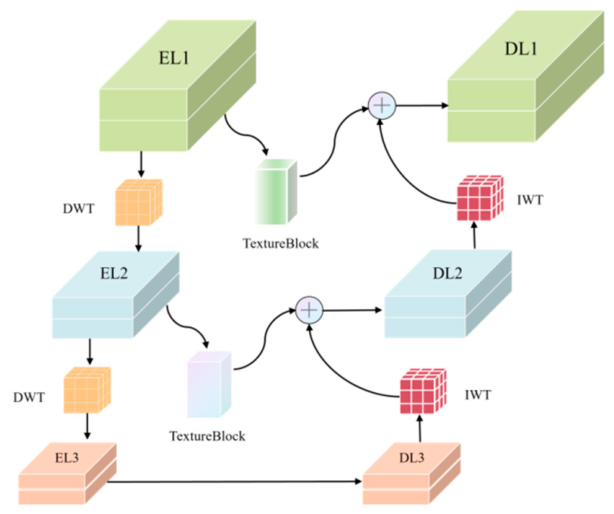
Conventional encoder–decoder frameworks typically rely on pooling and upsampling operations, which inherently discard high-frequency textures and scattering details. To address this, we replace these standard scaling methods with Discrete and Inverse Wavelet Transforms (DWT/IWT) to construct the wavelet domain architecture depicted in Figure 7. In our implementation, we specifically adopt the Haar wavelet as the basis function for the decomposition. The Haar wavelet is chosen for three primary reasons: (1) its orthogonality ensures lossless frequency decomposition without information leakage between sub-bands; (2) its compact support (filter length = 2) minimizes boundary artifacts at sub-block edges in Stage 1; and (3) its computational simplicity allows for efficient GPU parallelization without adding learnable overhead. Ultimately, because the Haar transform coefficients correspond to sum/difference operations on 2 × 2 spatial neighborhoods, this basis naturally decomposes local scattering patterns from structural textures.
Figure 7.
Wavelet-guided encoder–decoder architecture.
Our three-level U-Net backbone employs DWT for lossless downsampling. The encoder’s first two scales stack TextureBlocks to extract deep spatial-frequency features, while the third retains raw features. The decoder subsequently applies IWT for high-fidelity upsampling. A scale-adaptive strategy governs skip connections. At the first two scales, independent TextureBlocks refine encoder features prior to element-wise addition with the upsampled decoder features. The third scale directly fuses raw encoder features. This differential design efficiently balances critical detail reinforcement with raw feature preservation during resolution recovery. The fusion is formulated as:
Here, denotes the low-resolution feature from the decoder at the k-th scale. represents the high-resolution skip feature from the encoder at the k-th scale. indicates the channel expansion convolution operation. refers to the feature enhancement module. The index k {1, 2, 3} corresponds to the three hierarchical scales of the encoder–decoder architecture.
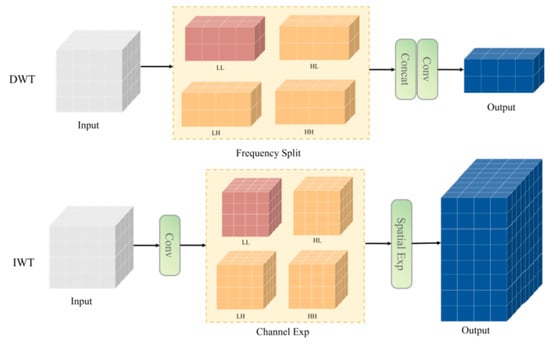
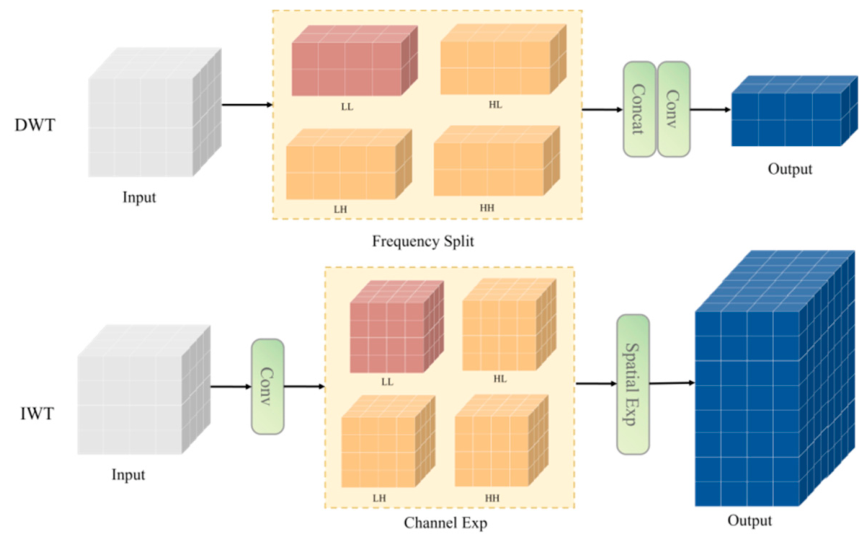
Wavelet downsampling module: The encoder employs DWT for lossless spatial reduction, decomposing the input into four frequency-dependent sub-bands: the low-frequency approximation LL (primary structure), alongside high-frequency details HL (horizontal edges and backscatter), LH (vertical edges and backscatter), and HH (diagonal micro-textures and noise). The decomposition is formulated as:
Here, denotes the input feature map. The symbol represents the 2D convolution operation. The generation of the four frequency components expands the output channel dimension to four times that of the input. To align with the codec’s channel dimensions, a 1 × 1 convolution projects the quadrupled feature maps onto the target space:
As illustrated in Figure 8, unlike conventional pooling, DWT achieves lossless downsampling while explicitly isolating scattering-dominated high frequencies (HL, LH) from texture-centric details (HH). This decoupling provides the frequency domain foundation for directional backscatter suppression and precise texture preservation.
Figure 8.
Architecture of the wavelet sampling module.
Wavelet upsampling module: Functioning as the inverse of DWT, the decoder utilizes IWT for feature recovery. A 1 × 1 convolution first quadruples the low-resolution input channels to match the DWT decomposition depth. Subsequently, IWT reconstructs these frequency components into a high-resolution spatial feature, formulated as:
where denotes the low-resolution decoder input, splits the expanded channels into the LL, HL, LH, and HH sub-bands, and represents the reconstructed high-resolution feature. Unlike conventional bilinear upsampling, IWT reconstructs spatial structures directly from the frequency domain (Figure 8). This bypasses interpolation-induced edge blurring, ensuring precise recovery of micro-textures and spatial topologies.
3.1.3. Multi-Feature Fusion Network (MFFNet) and Gated Texture Residual Block (GTRB)
Stage 3 of the proposed architecture employs a Multi-Feature Fusion Network (MFFNet) to seamlessly integrate multi-scale encoder–decoder features derived from Stage 2 with high-resolution shallow features. To preserve fine spatial details, MFFNet operates entirely at the full input spatial resolution, utilizing a main channel dimension defined as 112. The core architecture of MFFNet is constructed using three cascaded Gated Texture Residual Blocks (GTRBs). Each GTRB is specifically designed to capture and enhance complex textural details by incorporating 8 consecutive TextureBlocks. These blocks are subsequently followed by a 3 × 3 convolutional layer, with the entire sequence wrapped within a long-skip residual connection to facilitate gradient flow and stabilize training.
To effectively harness hierarchical contextual information, multi-scale encoder and decoder features from Stage 2 are systematically injected into the main processing stream between consecutive GTRBs. Specifically, Level-2 and Level-3 features undergo upsampling to the full spatial resolution via bilinear interpolation (by factors of 2× and 4×, respectively). These upsampled features are then projected to match the main channel dimension of 112 using 1 × 1 convolutions before being additively fused into the network. This progressive multi-scale feature injection strategy ensures fine-grained spatial refinement and comprehensive representation at each processing stage.
3.2. TextureBlock Integrating ConvGLU and HFAttention
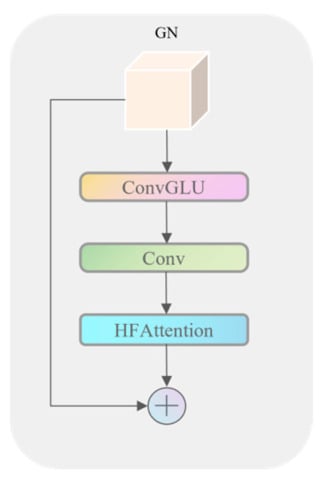
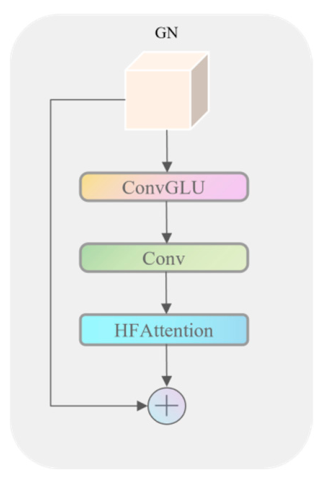
Illustrated in Figure 9, the TextureBlock constitutes the core module for micro-texture recovery in WMGNet. It leverages feature gating for signal filtration, high-frequency attention for precise detail localization, and residual connections to ensure uninterrupted feature transmission.
Figure 9.
Architecture of the TextureBlock.
3.2.1. Feature Gating Module (ConvGLU)
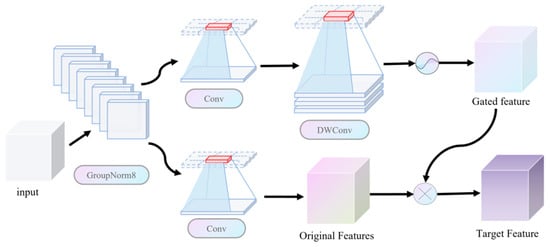
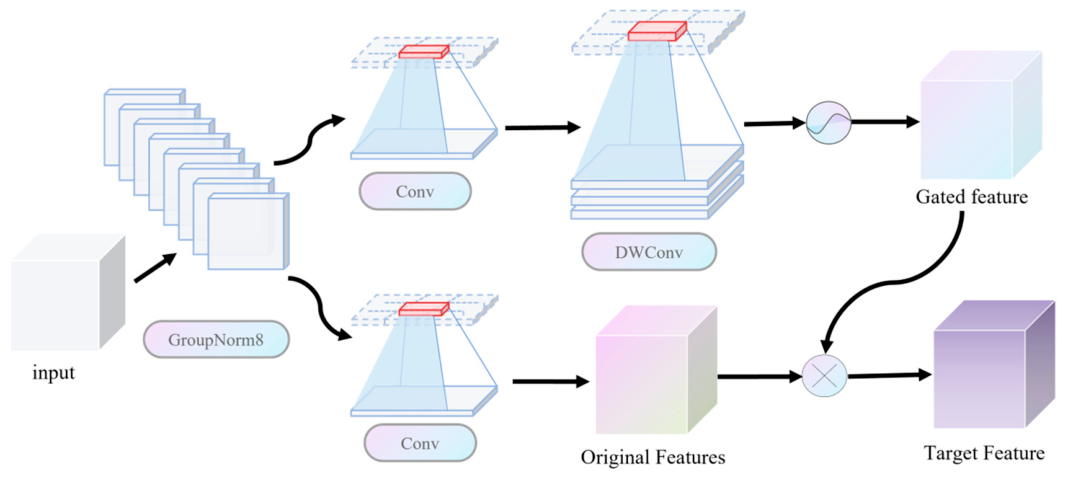
Conventional convolutions apply uniform channel weights, failing to decouple valid textures from redundant backscatter. This indiscriminate extraction introduces interference, bottlenecking subsequent high-frequency localization. To overcome this, we design the ConvGLU module (Figure 10). Through a progressive pipeline—normalization, branch decomposition, gating weight generation, and feature screening—it adaptively amplifies salient features while precisely suppressing residual scattering.
Figure 10.
Architecture of the ConvGLU module.
Input features X undergo Group Normalization (G = 8), ensuring distribution stability by bypassing BatchNorm limitations typical in small-batch training. Parallel 1 × 1 convolutions then decouple these features. The primary branch X1 preserves core channel semantics, whereas the gating branch X2 captures local spatial correlations via a 3 × 3 depthwise convolution (DWConv) and applies a GELU activation to yield adaptive gating weights. Feature screening is executed through this gating mechanism, formulated as:
where Conv1 and Conv2 denote the parallel 1 × 1 convolutions. Via element-wise multiplication, the gating weights adaptively modulate the primary branch X1. This mechanism strictly retains texture-relevant features while suppressing redundant backscatter, yielding the refined target representation.
3.2.2. High-Frequency Attention Mechanism (HFAttention)
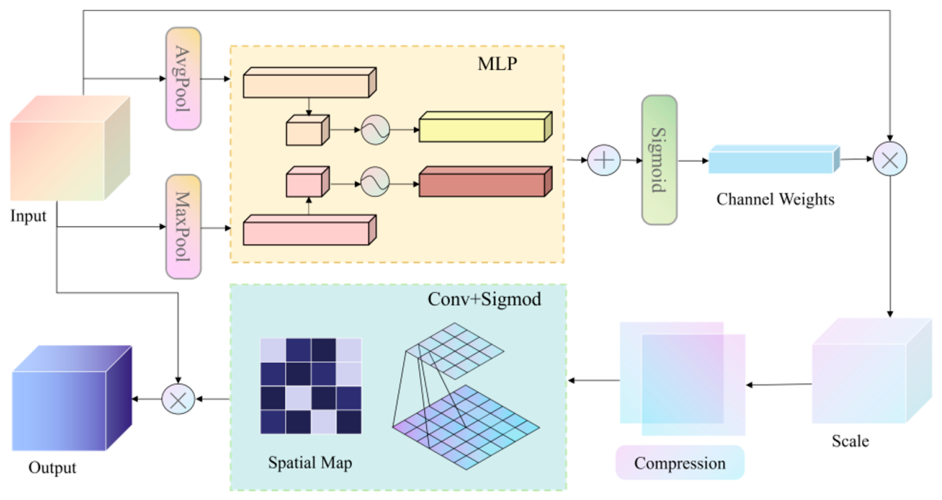
In range-gated imagery, both valid micro-textures and scattering interference manifest as high-frequency signals, necessitating a robust mechanism to explicitly decouple them. The HFAttention module (Figure 11) addresses this via a synergistic dual-branch channel and spatial attention architecture. This framework precisely localizes structural high frequencies while actively suppressing scattering noise, operating as follows:
Figure 11.
Architecture of the HFAttention module.
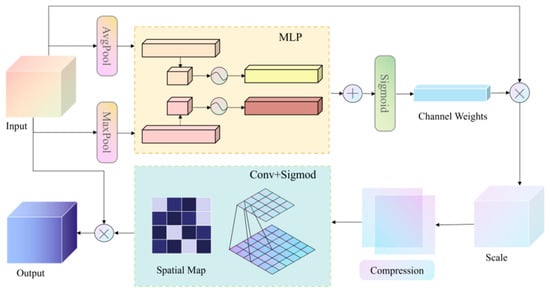
Channel attention branch: The input feature map undergoes spatial compression via parallel adaptive average and maximum pooling. This operation captures global statistics along the channel dimension, resulting in two 1 × 1 spatial descriptors. A shared multi-layer perceptron (MLP), built with two convolutional layers, processes these descriptors to model non-linear cross-channel dependencies. A Sigmoid activation is then applied to generate the channel weight vector Wc, expressed as:
where denotes the Sigmoid function. The generated weight vector adaptively amplifies channel responses corresponding to texture details and attenuates those dominated by scattering noise, achieving channel-wise feature screening.
Spatial attention branch: Applying mean and max operations along the channel dimension of the channel-weighted feature map yields two single-channel spatial maps. Concatenating these maps fuses the spatial statistics. A 7 × 7 convolutional layer then processes the fused representation, extracting features to capture spatial correlations across texture-dense regions. Then, Sigmoid activation produces the spatial weight, Ws, formulated as:
The spatial weight, , targets texture-dense regions and suppresses the random spatial distribution of scattering noise, facilitating spatial feature enhancement.
HFAttention performs dual-weighting optimization by multiplying the input feature map element-wise with both the channel and spatial weights. This combined operation yields a refined feature map that highlights high-frequency textures and mitigates scattering interference. The overall expression is formulated as:
3.2.3. Overall Workflow of the TextureBlock
The TextureBlock executes its complete forward propagation as follows:
The input feature initially undergoes Group Normalization, followed by ConvGLU to screen valid representations. To overcome the lack of cross-position interaction in the element-wise GLU, a zero-initialized 3 × 3 convolution is inserted to integrate spatial neighborhoods. Subsequently, HFAttention specifically refines high-frequency textures within this integrated tensor. Finally, merging the output with the original input via a residual connection ensures stable feature transmission while achieving precise enhancement of fine details.
3.3. Ground-Truth-Guided Attention Module (GGAM)
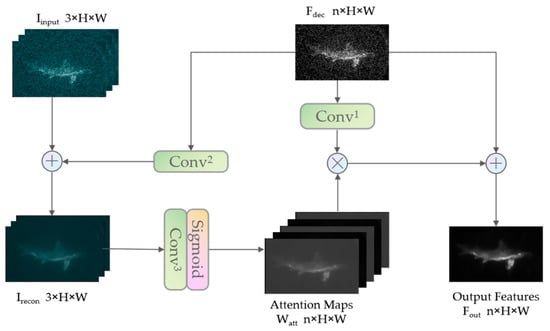
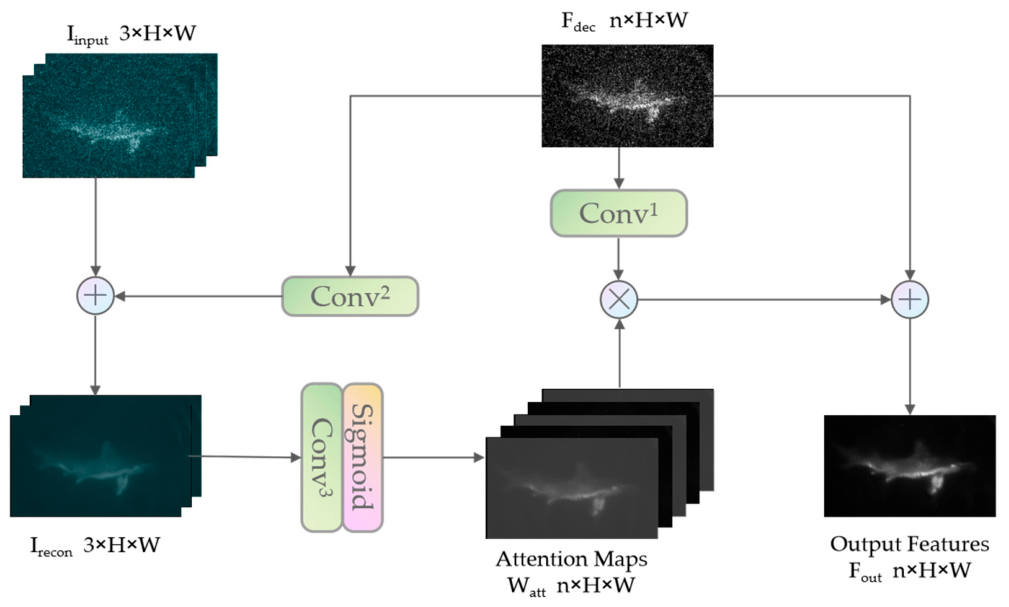
Features extracted across various enhancement stages exhibit inherent disparities in scale and information dimensions, making direct concatenation prone to misaligned or suboptimal fusion. To address this limitation, we introduce a ground-truth-guided attention module (GGAM, Figure 12). By leveraging the ground-truth image for explicit pixel-wise supervision, this module facilitates the precise integration of multi-stage features to drive the final image reconstruction.
Figure 12.
Architecture of the GGAM module.
GGAM projects the previous decoder output into a 3-channel image space via a 1 × 1 convolution. By introducing a 3-channel information bottleneck via this intermediate reconstruction (), the module forces the attention weights to ground on visually interpretable image-level priors (e.g., edges and textures) before expanding back to the n-channel space via . Concurrently, the parallel branch linearly transforms the input features, effectively decoupling ‘what information to extract’ from ‘where to focus’, thereby enabling more flexible feature selection than directly gating the raw decoder features. Element-wise multiplication of the resulting attention weights with the transformed input features amplifies valid textures while attenuating scattering noise. A residual connection then incorporates the original features to prevent gradient vanishing. Embedded at the end of the first and second stages, GGAM calibrates and propagates the enhanced features to the subsequent modules. This structural placement guarantees inter-stage consistency and complementarity, driving a coarse-to-fine progressive restoration formulated as:
Here, n = nfeat = 80 denotes the number of feature channels, and all convolutional operations (Conv) utilize a kernel size of 1. Specifically, acts as the feature transform convolution to perform non-linear mapping on the decoder features. serves as the feature-to-image projection convolution, which compresses the high-dimensional features into the RGB image space. Subsequently, functions as the image-to-feature remapping convolution; crucially, this operation resolves the channel dimension mismatch by expanding the 3-channel intermediate reconstruction back into an n-channel attention map. Finally, represents the Sigmoid activation function, and denotes element-wise multiplication.
3.4. Multi-Dimensional Loss Function Design
To balance numerical accuracy and visual quality, WMGNet optimizes a multi-dimensional composite loss combining pixel, gradient, wavelet frequency domain, and perceptual constraints, formulated as:
Here, , , , and denote the tunable loss weights. Based on empirical validation, the loss weights are set as: α = 0.7 (pixel), β = 1.5 (gradient), γ = 1.0 (wavelet), and δ = 0.3 (perceptual). The gradient term receives the highest weight (β = 1.5) to prioritize edge preservation against scattering-induced blur, as gradient consistency is most critical for recovering structural details in gated imagery. The wavelet term (γ = 1.0) serves as the baseline reference weight for frequency domain consistency. The pixel term (α = 0.7) ensures fundamental numerical fidelity, while the perceptual term is weighted lowest (δ = 0.3) to provide soft visual quality guidance without dominating pixel-level optimization.
3.4.1. Pixel Loss
To avoid backpropagation instability inherent to the Charbonnier penalty’s square root, we employ loss for fundamental pixel-wise supervision:
where , denote the enhanced and reference pixels, respectively, and is the total pixel count. This objective ensures pixel-wise fidelity and robust numerical stability, facilitating early-stage gradient convergence.
3.4.2. Gradient Loss
To mitigate scattering-induced edge blur, we enforce structural consistency using 3 × 3 Sobel kernels (Kx, Ky) to extract horizontal and vertical gradients:
where denotes convolution, formulating the gradient loss as:
where x and y denote the enhanced and reference images (N total pixels), with and representing the horizontal and vertical gradient maps. By merging channel and batch dimensions for the i-th pixels and , this objective explicitly preserves edge gradients to eradicate structural blur.
3.4.3. Wavelet Domain Loss
To enforce frequency domain texture consistency, we compute the L1 penalty between the DWT decompositions of the enhanced and reference images across both low-frequency (LL) and high-frequency (HL, LH, HH) sub-bands:
where , yLL and , yhigh denote the low-frequency and concatenated high-frequency (HL, LH, HH) DWT components, respectively, comprising and total pixels. This objective explicitly isolates high-frequency texture restoration while suppressing scattering-induced noise.
3.4.4. Perceptual Loss
To transcend the visual limitations of pixel-wise objectives, we leverage a pretrained VGG19 network to enforce high-level semantic consistency. Inputs are normalized to the VGG19 distribution prior to feature extraction:
where and denote feature maps extracted from three distinct VGG19 layers (2nd, 7th, 12th), with representing the k-th layer’s pixel count. This penalty explicitly aligns the reconstruction with human visual perception, eradicating the quantitative–perceptual discrepancy.
4. Experiments
4.1. Dataset Description
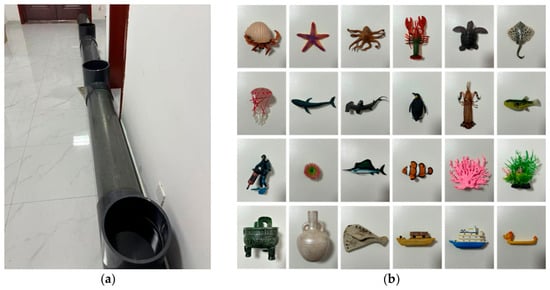
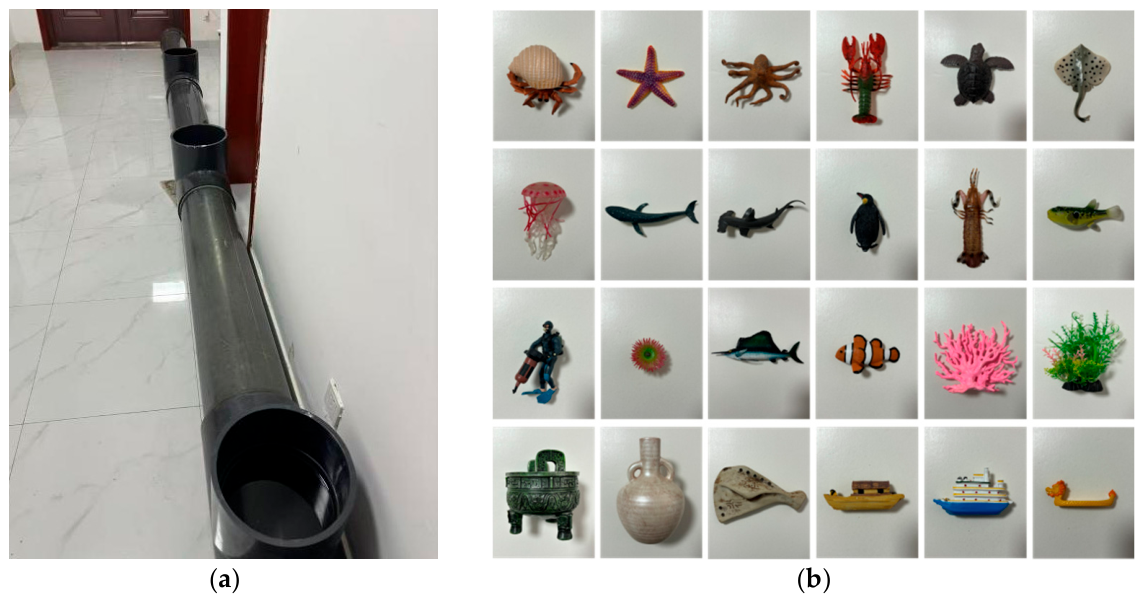
The present section elaborates on our bespoke underwater laser-gated imaging corpus constructed to train as well as evaluate the proposed Wavelet-guided Multi-stage Gated Enhancement Network. To ensure data stability and consistency across diverse realistic targets, we engineered a dedicated laboratory-based tubular testing platform possessing a longitudinal span of 16 m and a cross-section of 20 cm. Over a continuous three-month period, the imaging system acquired 1300 single-frame gated images featuring marine life, vessels, and artifact models. This independently collected dataset provides the essential empirical foundation for supervised network training, as illustrated in Figure 13 alongside the experimental setup.
Figure 13.
(a) Experimental pipeline; (b) underwater dataset.
To construct a high-fidelity dataset for robust model optimization, we deployed a stationary imaging paradigm with a constant-delay mechanism. The operating parameters were strictly defined: a 10 ms integration time, a 20 ns gating interval, and a laser emission rate of 100 kHz. By tightly coupling the laser trigger with the optical receiver, the system isolated specific echo signatures and heavily suppressed background interference.
Across all experimental sessions, the system acquired a total of 1300 raw single-shot frames. After rigorous quality screening—removing 250 frames exhibiting shutter synchronization errors, severe motion blur from water flow disturbances, or laser pulse dropout—1050 valid frames were retained, yielding a pass rate of 80.8%. Each retained raw capture was then mapped to its corresponding pristine reference (ground-truth) under matched conditions. To generate these high-fidelity references, we utilized an adaptive accumulation scheme where temporal frame integration was dynamically scaled from 20 to 100 consecutive iterations based on object albedo. This adaptive temporal averaging effectively navigated the compromise between detail preservation and artifact suppression, ultimately producing a comprehensive dataset of 1050 paired samples for rigorous network training and assessment.
4.2. Quantitative Analysis
To comprehensively evaluate WMGNet on underwater range-gated image restoration, we utilize four metrics tailored to its specific degradation: MAE, PSNR, SSIM [39], and LPIPS [40]. These assess pixel-level errors, structural fidelity, and perceptual quality against clear ground truths, averaged across the test set to guarantee statistical objectivity. Ensuring a fair comparison, WMGNet and selected classical and state-of-the-art baselines were trained and tested under identical hardware and dataset settings. Table 1 and Table 2 present the comparative and ablation outcomes, highlighting the best and second-best mean scores in red and blue.
Table 1.
Quantitative comparison of competing methods.
Table 2.
Quantitative ablation results.
4.3. Implementation Details
Optimized via AdamW, WMGNet was trained across 300 epochs on multiple GPUs with a batch size of 6. To stabilize convergence and prevent oscillation, the learning rate linearly warmed up to 2 × 10⁻⁴ over the first 3 epochs before cosine-decaying to 1 × 10⁻⁶. The composite loss function integrates L1 (pixel precision), gradient (edge sharpness), wavelet (assigning a 5-fold weight to high frequencies for texture enhancement), and VGG19 perceptual losses. Training data underwent CLAHE contrast enhancement, random 256 × 256 cropping, and spatial flipping. Finally, optimal network weights were saved based on peak validation PSNR.
4.4. Comparison with State-of-the-Art Methods
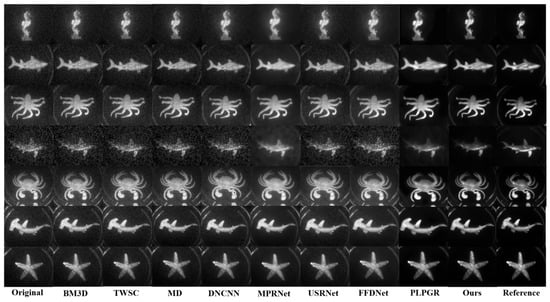
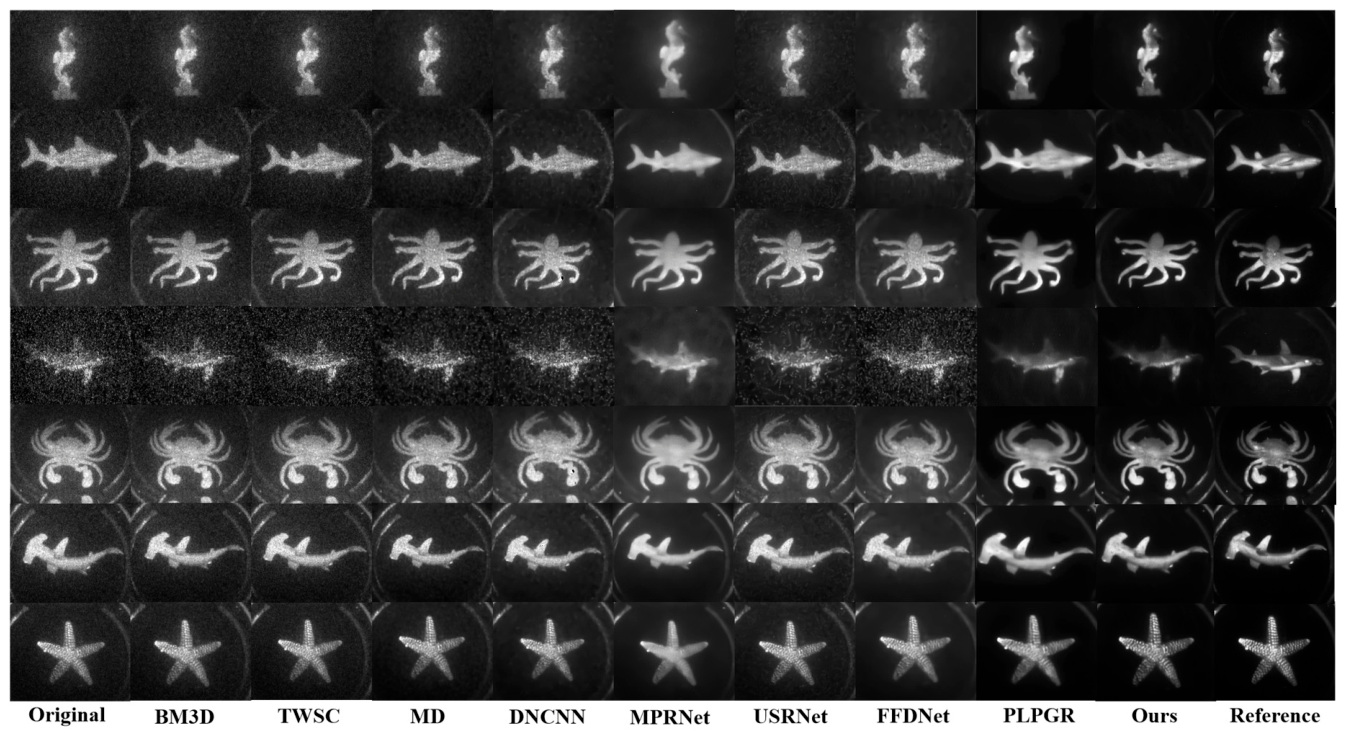
For a rigorous evaluation of WMGNet, we benchmark it against seven representative algorithms: traditional non-data-driven methods (BM3D [41], TWSC [42]) and deep learning models spanning classical denoising (DnCNN [43], FFDNet [44]), masked (MD [45]), multi-stage (MPRNet [46]), super-resolution (USRNet [47]) and physically guided underwater restoration (PLPGR-Net [24]) architectures. Ensuring strict fairness, all deep networks were trained from scratch to convergence on an identical 8:1:1 (train/validation/test) dataset split, whereas the training-free BM3D and TWSC were evaluated directly on the test set. The ensuing qualitative (Figure 14) and quantitative (Table 1) analyses evaluate performance across three core dimensions: target-noise decoupling, texture preservation, and contrast enhancement.
Figure 14.
Qualitative comparison with SOTA methods.
WMGNet achieves state-of-the-art performance across all metrics (PSNR: 36.31 dB, SSIM: 0.921, MAE: 2.672, LPIPS: 0.060), outperforming the second-best PLPGR by 9.20% in PSNR and 50.69% in MAE. This superiority stems from resolving three core bottlenecks. First, in target-noise decoupling, traditional (BM3D) and deep baselines (DnCNN) fail to isolate scattering, causing signal loss or noise retention, whereas MaskedDeno’s rigid masks struggle with non-uniform distributions. Although PLPGR improves decoupling via physical guidance, WMGNet leverages wavelet decomposition and feature gating to more adaptively isolate noise, minimizing MAE to 2.672. Second, regarding texture preservation, methods like TWSC and USRNet severely blur micro-textures (SSIM ≤ 0.503). While PLPGR retains better structures (SSIM: 0.806), WMGNet’s TextureBlock explicitly captures these details, which GGAM fuses to prevent dilution, yielding an optimal SSIM of 0.921 and LPIPS of 0.060. Third, for contrast enhancement, competitors either compress dynamic ranges (BM3D) or induce spatial discontinuities (MaskedDeno). WMGNet dynamically harmonizes global luminance and local contrast, eliminating artifacts to reach 36.31 dB PSNR. Boasting superior overall image restoration performance, WMGNet provides a highly deployable real-time solution for embedded underwater imaging.
4.5. Ablation Study
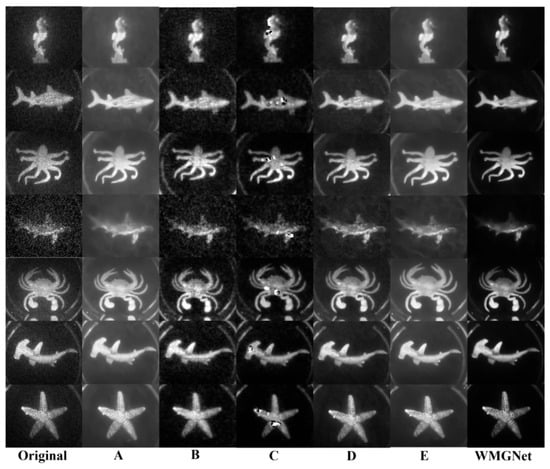
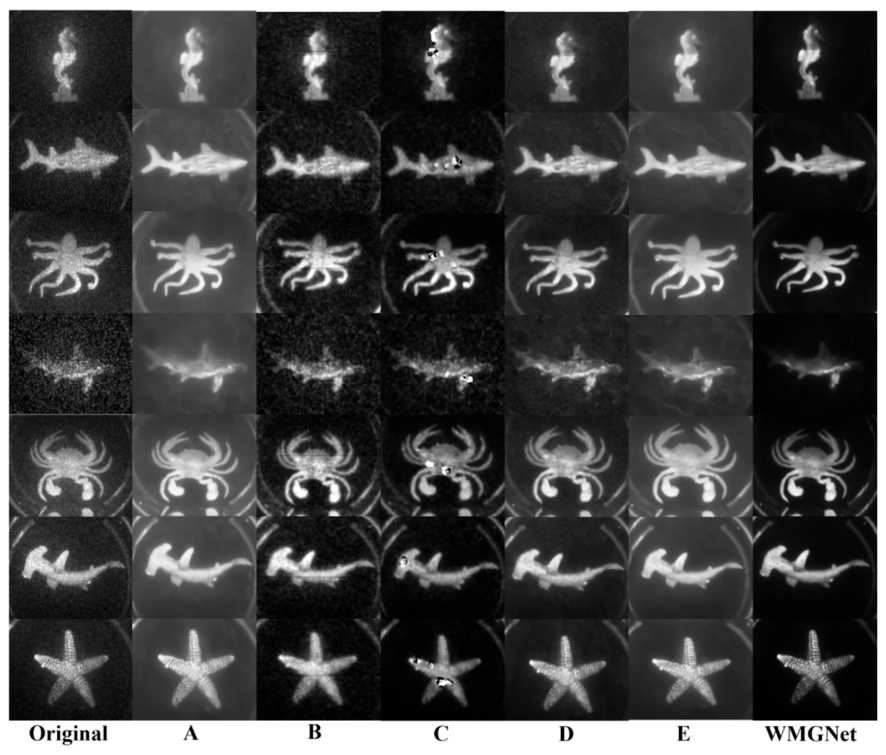
To investigate the contributions of WMGNet’s core modules, we performed an ablation study on our custom dataset using the full network as the baseline. Five variants were established: Model A (replacing D-IWT with standard convolutional downsampling), Model B (replacing ConvGLU with standard convolutions), and Models C, D, and E (omitting HFAttention, GGAM, and MFFNet, respectively). Trained under identical settings, their impacts on pixel precision, structural similarity, and perceptual quality are analyzed both qualitatively (Figure 15) and quantitatively (Table 2).
Figure 15.
Qualitative ablation results.
As detailed in Table 2, the full WMGNet achieves optimal performance, yielding substantial improvements across all metrics against any single ablated variant. Specifically, compared to the strongest variant Model C, WMGNet achieves improvements of 30.0% in MAE, 23.5% in PSNR, 64.3% in LPIPS, and 6.2% in SSIM. First, replacing D-IWT with spatial convolutions (Model A) triggers the sharpest degradation, dropping PSNR to 15.48 dB and SSIM to 0.213, while inflating MAE to 40.19—a 14-fold error increase. The removal of either DWT or IWT, let alone both, completely severs the frequency domain processing pathway. This reduces the network to a conventional spatial-only architecture, thereby rendering it incapable of exploiting the frequency-specific degradation patterns inherent to gated imagery. This confirms that frequency domain decomposition fundamentally decouples scattering noise from targets, avoiding the severe aliasing and high-frequency loss inherent to spatial-only downsampling. Second, omitting ConvGLU (Model B) or HFAttention (Model C) reduces PSNR to 24.86 dB and 29.39 dB, and SSIM to 0.609 and 0.867, respectively. This demonstrates their necessity for texture extraction: ConvGLU adaptively suppresses invalid noise, while HFAttention explicitly recovers sparse-photon micro-textures. Third, removing GGAM (Model D) or MFFNet (Model E) disrupts multi-stage fusion, plummeting PSNR to 22.88 dB and 18.18 dB, and SSIM to 0.442 and 0.277. GGAM calibrates features to prevent inter-stage noise accumulation, whereas MFFNet minimizes information loss during multi-resolution reconstruction. Notably, Model D outperforms Model E, indicating that supervised attention dominates inter-stage optimization. Finally, LPIPS trends mirror these objective declines. The full model (0.060) vastly outperforms all variants (0.168–0.292), with the absence of wavelet decomposition (Model A, 0.292) or feature gating (Model B, 0.272) most severely degrading human visual perception. Ultimately, these five modules form a cohesive, synergistic pipeline—from frequency domain noise isolation to multi-stage texture fusion—proving structurally indispensable for underwater gated image restoration.
4.6. Generalization to Underwater Color Images
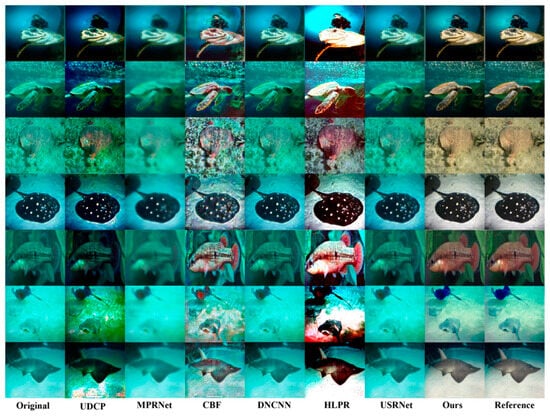
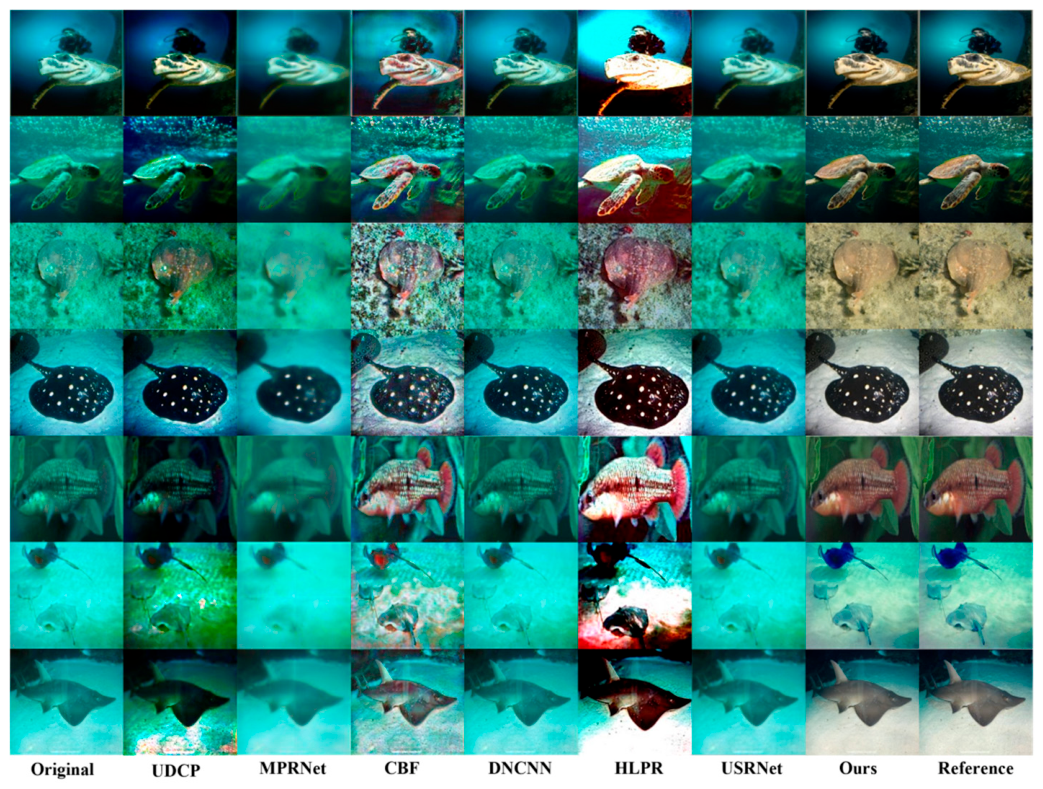
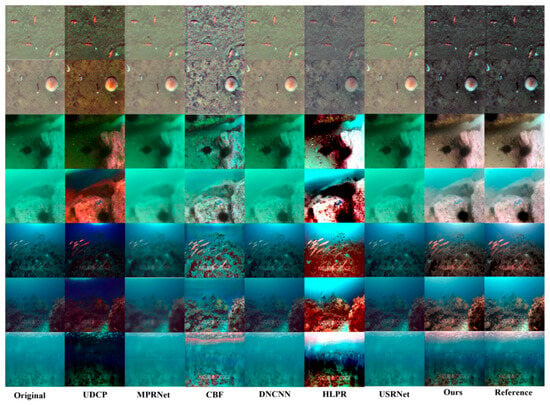
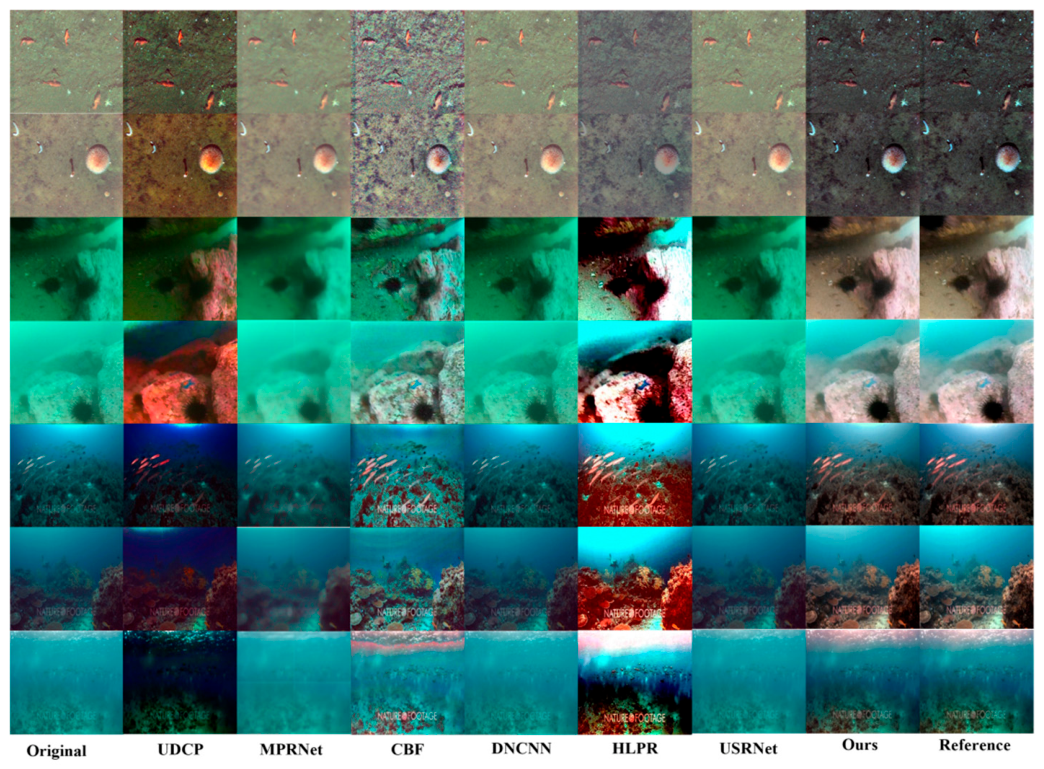
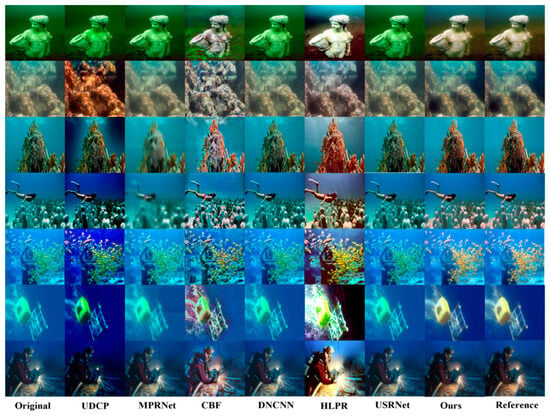
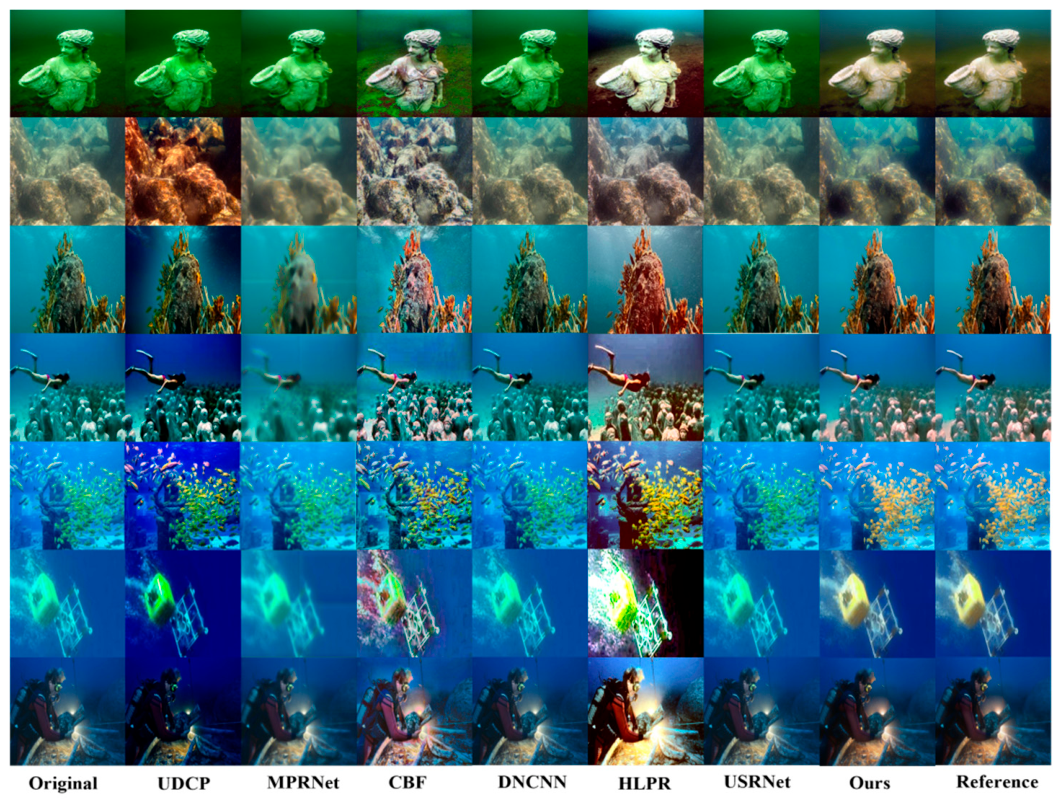
Beyond gated imagery, WMGNet inherently generalizes to underwater color image restoration. Its wavelet-driven frequency decomposition and progressive three-stage architecture harmonize local color cast correction with global color consistency. Within this framework, HFAttention and the ground-truth-guided GGAM adaptively recalibrate multi-channel features to balance color fidelity and detail retention, while the embedded TextureBlock (incorporating ConvGLU and GroupNorm) explicitly preserves high-frequency textures. A multi-constraint loss function further prevents local optima. To validate this cross-scene adaptability, we benchmarked WMGNet against six baselines (UDCP, MPRNet, CBF, DnCNN, HLRP, USRNet) across three public datasets (EUVP, LSUI, UIEB). Trained under identical configurations, evaluations using PSNR, SSIM, UIQM, and UCIQE (Table 3, Table 4 and Table 5, highlighting top-two scores in red and blue) alongside visual comparisons (Figure 16, Figure 17 and Figure 18) confirm the network’s robust generalization in eradicating scattering-induced color and texture degradation.
Table 3.
Quantitative comparison on the EUVP dataset.
Table 4.
Quantitative comparison on the LSUI dataset.
Table 5.
Quantitative comparison on the UIEB dataset.
Figure 16.
Qualitative comparison on the EUVP dataset.
Figure 17.
Qualitative comparison on the LSUI dataset.
Figure 18.
Qualitative comparison on the UIEB dataset.
Quantitative data confirms WMGNet’s superiority across all three public datasets, achieving PSNR values of 33.22 dB, 31.59 dB, and 32.06 dB on EUVP, LSUI, and UIEB, respectively. These results significantly surpass second-best baselines, reflecting high-fidelity reconstruction capabilities across diverse underwater scenarios. SSIM scores also reach 0.92, 0.98, and 0.89, demonstrating exceptional structural similarity and texture consistency. Regarding subjective visual quality, WMGNet attains peak UIQM values (5.64, 5.29, and 5.83) and competitive UCIQE scores, indicating effective contrast optimization and color fidelity. Collectively, these comprehensive evaluations validate the model’s robust cross-scene adaptability and generalization. The wavelet-guided multi-stage mechanism proves universally effective at decoupling scattering and recovering textures regardless of imaging conditions, offering a reliable solution for general underwater enhancement tasks. By successfully migrating from gated imaging to diverse color datasets, WMGNet demonstrates its broad applicability in advancing high-resolution underwater perception.
5. Conclusions
Addressing signal–noise coupling, texture loss, and low contrast, this paper proposes the Wavelet-guided Multi-stage Gated Enhancement Network (WMGNet). The architecture leverages multi-scale frequency decomposition for precise noise-target decoupling, utilizing TextureBlocks to restore fine structural details and GGAM for pixel-wise feature calibration. The quantitative and ablation results confirm that WMGNet significantly outperforms state-of-the-art baselines on our custom dataset and generalizes effectively to public color datasets, validating its modular design. Future efforts will focus on two directions. Algorithmically, we aim to develop lightweight architectures and integrate optical physical priors to enhance adaptability in complex environments. Practically, we will pursue hardware integration for real-world maritime operations—such as ROV inspection and archaeology—while jointly optimizing WMGNet with downstream tasks to establish a comprehensive underwater intelligent perception paradigm.
Author Contributions
Conceptualization, Q.T., Z.Z. and Q.Y.; Methodology, Y.L.; Software, Y.L.; Validation, Y.L.; Formal analysis, Q.T., Z.Z. and Q.Y.; Resources, Q.T., Z.Z. and Q.Y.; Data curation, Y.L.; Writing—original draft, Y.L.; Writing—review & editing, Q.T. and Z.Z.; Visualization, Y.L.; Supervision, Q.T., Z.Z. and Q.Y.; Project administration, Q.T. and Q.Y.; Funding acquisition, Q.Y. All authors have read and agreed to the published version of the manuscript.
Funding
This research received no external funding.
Data Availability Statement
The datasets supporting the conclusions of this article comprise publicly available datasets (EVUP, LSUI and UIEB) and a custom dataset acquired via our self-developed underwater laser range-gated imaging system, which is available from the corresponding author upon reasonable request due to its strict hardware and environmental dependencies.
Acknowledgments
The authors would like to express profound gratitude to the reviewers and editors who contributed their time and expertise to ensure the quality of this work.
Conflicts of Interest
The authors declare no conflict of interest.
References
- Bowers, D.G.; Braithwaite, K.M.; Nimmo-Smith, W.A.M.; Graham, G.W. Light scattering by particles suspended in the sea: The role of particle size and density. Cont. Shelf Res. 2009, 29, 1748–1755. [Google Scholar] [CrossRef] [Scilit]
- Bystrov, A.; Hoare, E.; Gashinova, M.; Cherniakov, M.; Tran, T. Underwater optical imaging for automotive wading. Sensors 2018, 18, 4476. [Google Scholar] [CrossRef] [Scilit] [PubMed]
- Mariani, P.; Quincoces, I.; Haugholt, K.H.; Chardard, Y.; Visser, A.W.; Yates, C.; Piccinno, G.; Reali, G.; Risholm, P.; Thielemann, J.T. Range-gated imaging system for underwater monitoring in ocean environment. Sustainability 2018, 11, 162. [Google Scholar] [CrossRef] [Scilit]
- Shen, Y.; Zhao, C.; Liu, Y.; Wang, S.; Huang, F. Underwater optical imaging: Key technologies and applications review. IEEE Access 2021, 9, 85500–85514. [Google Scholar] [CrossRef] [Scilit]
- Lin, H.; Han, H.; Ma, L.; Ding, Z.; Jin, D.; Zhang, X. Range Intensity Profiles of Multi-Slice Integration for Pulsed Laser Range-Gated Imaging System. Photonics 2022, 9, 505. [Google Scholar]
- Blanksby, A.J.; Loinaz, M.J. Performance analysis of a color CMOS photogate image sensor. IEEE Trans. Electron Devices 2002, 47, 55–64. [Google Scholar]
- Peng, Y.T.; Cao, K.; Cosman, P.C. Generalization of the dark channel prior for single image restoration. IEEE Trans. Image Process. 2018, 27, 2856–2868. [Google Scholar] [CrossRef] [Scilit] [PubMed]
- Akkaynak, D.; Treibitz, T. Sea-thru: A method for removing water from underwater images. In Proceedings of the IEEE/CVF Conference on Computer Vision and Pattern Recognition, Long Beach, CA, USA, 15–20 June 2019; pp. 1682–1691. [Google Scholar]
- Yang, J.; Huang, H.; Lin, F.; Gao, X.; Jin, J.; Zhang, B. Underwater image enhancement fusion method guided by salient region detection. J. Mar. Sci. Eng. 2024, 12, 1383. [Google Scholar] [CrossRef] [Scilit]
- Gao, P.; Qu, Q.; Xiang, D.; Liang, N.; Ling, J. Scene-aware atmospheric light estimation and superpixel transmission model for underwater image restoration. Opt. Laser Technol. 2025, 190, 113195. [Google Scholar] [CrossRef] [Scilit]
- Zhang, L.; Liu, T.; Shi, Q.; Chen, F. Underwater image enhancement based on depth and light attenuation estimation. IET Image Process. 2025, 19, e70037. [Google Scholar] [CrossRef] [Scilit]
- Wang, Z.; Shen, L.; Zhu, Q.; Liu, P.; Yu, M. UMPAN: Multipriors Aggregation Network for Single Underwater Image Enhancement. IEEE J. Ocean. Eng. 2025, 50, 2581–2604. [Google Scholar] [CrossRef] [Scilit]
- Zhou, J.; Zhang, D.; Zhang, W. Underwater image enhancement method via multi-feature prior fusion: Underwater image enhancement method via multi-feature prior fusion. Appl. Intell. 2022, 52, 16435–16457. [Google Scholar]
- Zhou, J.; Sun, J.; Zhang, W.; Lin, Z. Multi-view underwater image enhancement method via embedded fusion mechanism. Eng. Appl. Artif. Intell. 2023, 121, 105946. [Google Scholar] [CrossRef] [Scilit]
- Zhang, D.; He, Z.; Zhang, X.; Wang, Z.; Ge, W.; Shi, T.; Lin, Y. Underwater image enhancement via multi-scale fusion and adaptive color-gamma correction in low-light conditions. Eng. Appl. Artif. Intell. 2023, 126, 106972. [Google Scholar]
- Zhou, J.; Pang, L.; Zhang, D.; Zhang, W. Underwater image enhancement method via multi-interval subhistogram perspective equalization. IEEE J. Ocean. Eng. 2023, 48, 474–488. [Google Scholar] [CrossRef] [Scilit]
- Wu, S.; Luo, T.; Jiang, G.; Yu, M.; Xu, H.; Zhu, Z.; Song, Y. A two-stage underwater enhancement network based on structure decomposition and characteristics of underwater imaging. IEEE J. Ocean. Eng. 2021, 46, 1213–1227. [Google Scholar] [CrossRef] [Scilit]
- Li, J.; Wang, J.; Li, B.; Li, Y. SER-GAN: Underwater image enhancement via spatially enhanced residual blocks and generative adversarial network: J. Li et al. J. Supercomput. 2025, 81, 885. [Google Scholar]
- Zaidi, S.; Singh, P.; Guha, P. Designing a U-Net Architecture for Underwater Image Enhancement. In Proceedings of the 2024 National Conference on Communications (NCC); IEEE: New York, NY, USA, 2024; pp. 1–6. [Google Scholar]
- Xiang, D.; Yang, W.; Zhou, Z.; Zhang, J.; Li, J.; Ouyang, J.; Ling, J. DPMFformer: An underwater image enhancement network based on deep pooling and multi-scale fusion transformer. Earth Sci. Inform. 2025, 18, 61. [Google Scholar]
- Guan, F.; Guo, T.; Zhang, Y. Underwater Image Enhancement via HSV-CS Representation and Perception-Driven Adaptive Fusion. Remote Sens. 2026, 18, 986. [Google Scholar]
- Chao, D.; Li, Z.; Zhu, W.; Li, H.; Zheng, B.; Zhang, Z.; Fu, W. AMSMC-UGAN: Adaptive multi-scale multi-color space underwater image enhancement with GAN-physics fusion. Mathematics 2024, 12, 1551. [Google Scholar]
- Liu, P.; Chen, S.; He, W.; Wang, J.; Chen, L.; Tan, Y.; Luo, D.; Chen, W.; Jiao, G. Enhanced U-net for underwater laser range-gated image restoration: Boosting underwater target recognition. J. Mar. Sci. Eng. 2025, 13, 803. [Google Scholar]
- Tian, Q.; Hu, L.; Zhang, Z.; Yang, Q. PLPGR-Net: Photon-Level Physically Guided Restoration Network for Underwater Laser Range-Gated Image. J. Mar. Sci. Eng. 2025, 13, 2217. [Google Scholar]
- Zhao, G.; Wu, Y.; Song, J.; Zhang, K. DGCL-UIE: Degradation-guided collaborative learning for all-in-one underwater image enhancement. Opt. Laser Technol. 2026, 199, 115038. [Google Scholar]
- Jiang, J.; Bai, J.; Liu, Y.; Yin, J.; Chen, S.; Ye, T.; Chen, E. Rsfdm-net: Real-time spatial and frequency domains modulation network for underwater image enhancement. In Proceedings of the 2023 IEEE International Conference on Image Processing (ICIP); IEEE: New York, NY, USA, 2023; pp. 2560–2564. [Google Scholar]
- Wei, Y.; Zheng, Z.; Jia, X. UHD underwater image enhancement via frequency-spatial domain aware network. In Proceedings of the Asian Conference on Computer Vision, Macao, China, 4–8 December 2022; pp. 299–314. [Google Scholar]
- Zhao, C.; Cai, W.; Dong, C.; Hu, C. Wavelet-based fourier information interaction with frequency diffusion adjustment for underwater image restoration. In Proceedings of the IEEE/CVF Conference on Computer Vision and Pattern Recognition, Seattle, WA, USA, 17–21 June 2024; pp. 8281–8291. [Google Scholar]
- Liu, S.; Fan, H.; Wang, Q.; Han, Z.; Guan, Y.; Tang, Y. Wavelet–pixel domain progressive fusion network for underwater image enhancement. Knowl.-Based Syst. 2024, 299, 112049. [Google Scholar] [CrossRef] [Scilit]
- Liu, W.; He, S.; Xu, J.; Chen, Y.; Li, W.; Shu, H.; Duan, P.; Zhu, F. Underwater image enhancement based on adaptive information transfer and weighted stationary wavelet perception fusion. Opt. Laser Technol. 2025, 192, 113625. [Google Scholar] [CrossRef] [Scilit]
- Zhang, W.; Liu, Q.; Lu, H.; Wang, J.; Liang, J. Underwater image enhancement via wavelet decomposition fusion of advantage contrast. IEEE Trans. Circuits Syst. Video Technol. 2025, 35, 7807–7820. [Google Scholar] [CrossRef] [Scilit]
- Wang, Y.; Hu, S.; Yin, S.; Deng, Z.; Yang, Y.H. A multi-level wavelet-based underwater image enhancement network with color compensation prior. Expert Syst. Appl. 2024, 242, 122710. [Google Scholar]
- Jian, B.; Peng, T.; Tian, X. Recovering the Images Distorted by Surface Waves using An Efficient Multi-stage Image Reconstruction Strategy. IEEE Access 2025, 13, 118281–118292. [Google Scholar] [CrossRef] [Scilit]
- Wu, J.; Liu, X.; Qin, N.; Lu, Q.; Zhu, X. Two-stage progressive underwater image enhancement. IEEE Trans. Instrum. Meas. 2024, 73, 1–18. [Google Scholar] [CrossRef] [Scilit]
- Liu, Y.; Jiang, Q.; Wang, X.; Luo, T.; Zhou, J. Underwater image enhancement with cascaded contrastive learning. IEEE Trans. Multimed. 2024, 27, 1512–1525. [Google Scholar] [CrossRef] [Scilit]
- Sun, K.; Meng, F.; Tian, Y. Progressive multi-branch embedding fusion network for underwater image enhancement. J. Vis. Commun. Image Represent. 2022, 87, 103587. [Google Scholar] [CrossRef] [Scilit]
- Jia, H.; Xiao, Y.; Wang, Q.; Chen, X.; Han, Z.; Tang, Y. Underwater image enhancement network based on dual layers regression. Electronics 2024, 13, 196. [Google Scholar] [CrossRef] [Scilit]
- Liu, J.; Liu, Z.; Wei, Y.; Ouyang, W. Recovery for underwater image degradation with multi-stage progressive enhancement. Opt. Express 2022, 30, 11704–11725. [Google Scholar] [CrossRef] [Scilit] [PubMed]
- Wang, Z.; Bovik, A.C.; Sheikh, H.R.; Simoncelli, E.P. Image quality assessment: From error visibility to structural similarity. IEEE Trans. Image Process. 2004, 13, 600–612. [Google Scholar] [CrossRef] [Scilit] [PubMed]
- Zhang, R.; Isola, P.; Efros, A.A.; Shechtman, E.; Wang, O. The unreasonable effectiveness of deep features as a perceptual metric. In Proceedings of the IEEE Conference on Computer Vision and Pattern Recognition, Salt Lake City, UT, USA, 18–23 June 2018; pp. 586–595. [Google Scholar]
- Dabov, K.; Foi, A.; Katkovnik, V.; Egiazarian, K. Image denoising by sparse 3-D transform-domain collaborative filtering. IEEE Trans. Image Process. 2007, 16, 2080–2095. [Google Scholar] [CrossRef] [Scilit] [PubMed]
- Xu, J.; Zhang, L.; Zhang, D. A trilateral weighted sparse coding scheme for real-world image denoising. In Proceedings of the European Conference on Computer Vision (ECCV); Computer Vision Foundation: New York, NY, USA, 2018; pp. 20–36. [Google Scholar]
- Zhang, K.; Zuo, W.; Chen, Y.; Meng, D.; Zhang, L. Beyond a gaussian denoiser: Residual learning of deep cnn for image denoising. IEEE Trans. Image Process. 2017, 26, 3142–3155. [Google Scholar] [CrossRef] [Scilit] [PubMed]
- Zhang, K.; Zuo, W.; Zhang, L. FFDNet: Toward a fast and flexible solution for CNN-based image denoising. IEEE Trans. Image Process. 2018, 27, 4608–4622. [Google Scholar] [CrossRef] [Scilit]
- Chen, H.; Gu, J.; Liu, Y.; Magid, S.A.; Dong, C.; Wang, Q.; Pfister, H.; Zhu, L. Masked image training for generalizable deep image denoising. In Proceedings of the IEEE/CVF Conference on Computer Vision and Pattern Recognition; Computer Vision Foundation: New York, NY, USA, 2023; pp. 1692–1703. [Google Scholar]
- Zamir, S.W.; Arora, A.; Khan, S.; Hayat, M.; Khan, F.S.; Yang, M.; Shao, L. Multi-stage progressive image restoration. In Proceedings of the IEEE/CVF Conference on Computer Vision and Pattern Recognition; Computer Vision Foundation: New York, NY, USA, 2021; pp. 14821–14831. [Google Scholar]
- Zhang, K.; Gool, L.V.; Timofte, R. Deep unfolding network for image super-resolution. In Proceedings of the IEEE/CVF Conference on Computer Vision and Pattern Recognition; Computer Vision Foundation: New York, NY, USA, 2020; pp. 3217–3226. [Google Scholar]

Disclaimer/Publisher’s Note: The statements, opinions and data contained in all publications are solely those of the individual author(s) and contributor(s) and not of MDPI and/or the editor(s). MDPI and/or the editor(s) disclaim responsibility for any injury to people or property resulting from any ideas, methods, instructions or products referred to in the content. |
© 2026 by the authors. Licensee MDPI, Basel, Switzerland. This article is an open access article distributed under the terms and conditions of the Creative Commons Attribution (CC BY) license.