


Abstract
We investigate the dynamical stability of traveling-wave solutions in a scalar, age-structured model that incorporates nonlocal dispersal. By combining a comparison argument with a weighted-energy framework tailored to the convolution-type operator, we prove that traveling waves of non-critical speed are exponentially stable under appropriately weighted perturbations after integration over age. Numerical experiments illustrate the qualitative content of the decay result and the structure of the resulting rate bound.
Keywords:
stability; traveling wave; weighted-energy method; age-structured model; nonlocal dispersal MSC:
37M05; 76D33; 34K20
1. Introduction
Traveling waves are a fundamental solution concept in reaction–diffusion theory, and they have long been used to describe coherent invasion fronts and propagation phenomena in population genetics, ecological spread, and epidemic dynamics [1,2]. In many of these settings, the assumption of a homogeneous population is not realistic: demographic or infection processes depend strongly on individual age. Age structure therefore enters naturally, because survival, fertility, and transmission (or susceptibility) typically vary across the life cycle [3]. General age-structured epidemic models and their qualitative dynamics have been studied extensively [4], and traveling waves for age-structured models with local diffusion have been developed in several works [5,6].
A representative example is the simplified scalar age-structured epidemic framework considered in [5], where the existence of traveling waves connecting disease-free and endemic equilibria was established under local diffusion. Beyond existence, stability is essential if traveling waves are to be interpreted as observable long-time patterns. For the same local-diffusion setting, Zhang et al. [7] recently proved exponential stability of non-critical (non-minimal-speed) waves by combining a comparison argument with a weighted-energy method. While nonlinear stability of traveling fronts is well developed for several reaction–diffusion equations with local diffusion [8,9], corresponding results for age-structured models are comparatively scarce, with [7] being a notable step.
In parallel, nonlocal dispersal has become a standard modeling choice when movement cannot be captured by short-range diffusion. A common formulation replaces the Laplacian by a convolution-type operator of the form , which represents long-range interactions such as seed dispersal over distance or human mobility via travel [10,11]. Compared with local diffusion, nonlocal dispersal can modify both the admissible wave speeds and the qualitative spreading behavior, including acceleration effects [12]. For age-structured equations with nonlocal dispersal, the existence of traveling waves and spreading speeds has been addressed in several directions: for instance, the authors in [13] treated an age-structured Fisher–KPP-type model, ref. [14] studied traveling waves and spreading speeds for a closely related scalar equation, and the study in. Ref. [15] analyzed traveling waves in an age-structured nonlocal SIRS model.
Despite this progress, the stability theory for traveling waves in scalar age-structured models with nonlocal dispersal remains largely undeveloped, especially when one seeks exponential convergence without introducing extra delay structure. Existing stability results for nonlocal dispersal fronts are predominantly for models without age structure [16,17] or for delayed systems. Moreover, although weighted-energy techniques have been successfully adapted to certain nonlocal equations (in non-age-structured contexts) [18], their systematic use in age-structured nonlocal models has not been established.
Very recently, the authors in [19] proved exponential stability of traveling-wave solutions for a scalar age-structured model with nonlocal dispersal, building on the existence and spreading-speed framework in [14]. The present work is the SI epidemic formulation of [5], in which the logistic nonlinearity is directly coupled to the renewal boundary condition through , and our analysis yields an explicit, directly computable bound on the decay rate in terms of the kernel exponential moment and the model parameters.
Motivated by the strategy in [7,9], the goal of this paper is to prove exponential stability of non-critical traveling waves for a scalar age-structured equation with nonlocal dispersal. The nonlocal operator introduces technical difficulties absent in the local-diffusion case, including:
- The lack of a standard maximum principle in the convolution setting, which complicates comparison-based arguments;
- Spectral and coercivity features of the linearized nonlocal operator that differ from those of the Laplacian, affecting decay estimates in weighted spaces;
- The need to choose a spatial weight that is compatible with the kernel J, balancing spatial decay against the interaction range encoded by J.
By combining a comparison principle with a weighted-energy framework tailored to the nonlocal term, we show that perturbations (after integration over age) decay exponentially to the traveling-wave profile for speeds above the critical threshold.
The remainder of the paper is organized as follows. Section 2 introduces the model, recalls existence results for traveling waves, and states the main exponential-stability theorem. Section 3 develops the comparison and weighted-energy estimates that yield the decay result. Section 4 presents numerical simulations illustrating the theoretical conclusions.
2. Preliminaries and Main Result
2.1. Definitions
Throughout, denotes a generic constant whose value may change from line to line. For an interval , we write for the usual square-integrable space and () for the Sobolev space of functions whose weak derivatives up to order k belong to .
Fix a weight . Define
and the weighted Sobolev space
For a kernel and a function , convolution in z is written
2.2. Model and Assumptions
Let be the maximal age and let denote the age density at time , age and position . We consider
Here is continuous on , is bounded on , and we set . We assume the normalization , so that and are equilibria of (1); these are the states connected by the wave. We work with bounded mild solutions (cf. [3]) and take ; the order interval is then invariant by Lemma 2, so for all .
The dispersal kernel J satisfies:
- and J is even;
- and ;
- There exists such that .
For , the exponential moment of J is
We use the bounds
We seek traveling waves moving with speed in the form , . The profile satisfies
(convolution in (3) is with respect to z.) For closely related scalar age-structured equations with nonlocal dispersal, the existence of a critical speed and of a monotone traveling-wave profile with for every has been established in [13,14]. Since the nonlinearity and the renewal condition in (3) differ from the precise forms treated there, we take the existence of such a monotone profile , with the limits attained uniformly in , as a standing hypothesis of Theorem 1.
For a function , define the age integral operator
In the co-moving frame we equip the spatial variable with the exponential weight
ω(z) := e−ηz, η > 0 (chosen sufficiently small, see (6)).
Here decays as and grows as , the natural choice for a front joining the unstable state 0 at to the endemic state 1 at .
Theorem 1 (Exponential stability).
Let and assume that there exists such that the speed condition
holds, where is the exponential moment defined in (2) and . If the initial perturbation obeys
and as , uniformly in τ, then the Cauchy problem (1) admits a unique global solution and
Moreover, there exist constants and such that
One may take any decay rate σ satisfying
where , provided .
Remark 1.
The two rates have distinct interpretations. The rate is produced by the weighted-energy estimate and combines (i) the transport contribution from the wave speed and the weight, (ii) the dispersive contribution from the kernel’s exponential moment, and (iii) the reaction–renewal contribution from the logistic term and the renewal boundary condition. The rate is produced by the age-asymptotic argument at and measures the net contraction at the endemic state: the maximum renewal flux is offset by the minimum loss rate acting through the logistic damping. The positivity assumption thus expresses that the loss mechanism dominates the renewal mechanism at the endemic equilibrium. For age-independent one has with (Section 2.2), so the formula reads ; this reduction fails for variable , where is the correct form. The condition is restrictive but holds when loss dominates renewal at the endemic state; the example of Section 4 has .
3. Proof of Exponential Stability
Lemma 1.
If , then any bounded solution of (1) remains non-negative for all , , .
Proof.
Apply Lemma 2 below with and the trivial subsolution . At and both inequalities hold by assumption on and by the positivity of the renewal kernel g, and the right-hand side of (1) vanishes at . Hence . □
Lemma 2 (Comparison principle).
Assume that and are bounded functions satisfying
Then for all , , .
Proof of Lemma 2.
Because the operator is nonlocal, the classical pointwise maximum principle for the Laplacian is not directly applicable; we therefore provide a self-contained argument.
Set . The hypotheses give and . Using the factorisation , subtracting the two inequalities in (9) yields
where . As and u are bounded by hypothesis and p is continuous, B is bounded; set . (We do not use here to avoid circularity with the bound the comparison principle establishes.)
Fix and set . Then , , and
where .
Define
We claim for all . Since , we have . Suppose for contradiction that for some , and let
By continuity, . For , there exists a sequence with .
Nonlocal estimate. Since and , and since pointwise,
This is the analog of the minimum-point property of the Laplacian: the convolution operator automatically “sees” the global minimum because J is a positive probability kernel. Hence
Reaction term. Since and :
Integrating backward along the characteristic through over , for small with :
Choosing , so that , (16) shows , contradicting the minimality of . This contradiction establishes , hence . □
Remark 2.
When the infimum in is not attained, the argument is made rigorous by first working on a truncated domain with Neumann boundary conditions (where compactness ensures attainment) and then passing to the limit using the spatial decay of φ inherited from the weighted initial data.
Let be a traveling wave with speed . Define the upper and lower envelopes of the initial datum:
Let and be the solutions of (1) with initial data and , respectively. By Lemma 2,
Shift to the co-moving frame and introduce
Lemma 3.
Proof.
From the equations for and ,
where we used the factorisation together with the bound . The solution evolves from the non-negative datum in (17), so by Lemma 1, while the traveling-wave profile satisfies ; hence and therefore . Since by (19), multiplying the inequality by the non-negative factor preserves its direction and yields .
Multiply (22) by and integrate over . For the transport term, integration by parts together with gives
so that
For the nonlocal term, Young’s inequality applied to , , together with the change in variables and the symmetry , gives
where we used the translation identity (by the substitution and ), the symmetry of J to write , and the definition . In effect the weight turns the convolution into multiplication by the moment: the shift rescales the weighted norm by , and averaging against J yields . Inserting (24) into (23):
Hence
For any , since on , the Sobolev embedding gives
We first record a two-sided bound. Since and are equilibria of (1) and , the comparison principle (Lemma 2) gives ; as , this yields
Because uniformly in , the squeeze shows that as , uniformly in and ; in particular as for each t.
To obtain the decay rate on the tail we use the sharper form of the reaction near the endemic state. Fix with , which is possible because . Since uniformly, choose so large that for all and . Then on , so there; using this in the exact identity for (whose reaction is , before the bound leading to (21)), we obtain on
Integrating over , using and the renewal bound , yields
Lemma 4.
Under the assumptions of Theorem 1,
for any .
Proof.
Define the lower perturbation and its age integral:
A direct computation using the factorisation together with , which gives and hence , shows that satisfies the same inequality (21) as . Consequently satisfies (22), and Steps 1–4 of the proof of Lemma 3 apply verbatim to . Unlike , the lower envelope is not automatically near 1 at ; here the hypothesis as gives there, and comparison with the spatially homogeneous endemic dynamics (whose equilibrium 1 is attracting when ) yields as , uniformly in t. Thus on , so and the sharp-reaction estimate of Step 5 applies to as well. This gives , which is exactly (30). □
Lemma 5
(Convergence to the traveling wave). Under the assumptions of Theorem 1,
for any .
Proof.
From the two-sided ordering (18) and the triangle inequality,
Applying Lemmas 3 and 4 to each term gives (32). □
Lemma 5 completes the proof of Theorem 1.
4. Numerical Simulations
In this section, we utilize numerical simulations to illustrate the stability of traveling waves of the nonlocal age-structured model (1). The parameter values are selected as follows: , , on and zero elsewhere, so that satisfies with . The dispersal kernel is , for which for , and we fix and wave speed . With these choices, the speed condition (6) is satisfied since , where . The decay-rate bounds in (8) evaluate to
so that the conclusion of Theorem 1 holds with any . To better perform numerical simulations, we set and use a fourth-order Runge–Kutta scheme with , , on ; the convolution is evaluated by FFT on each age row.
We construct solutions of (1) with and , corresponding to and , and set the non-monotone initial data
lifted uniformly in age as , so that and .
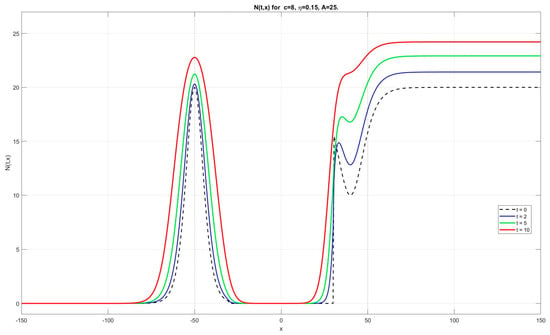
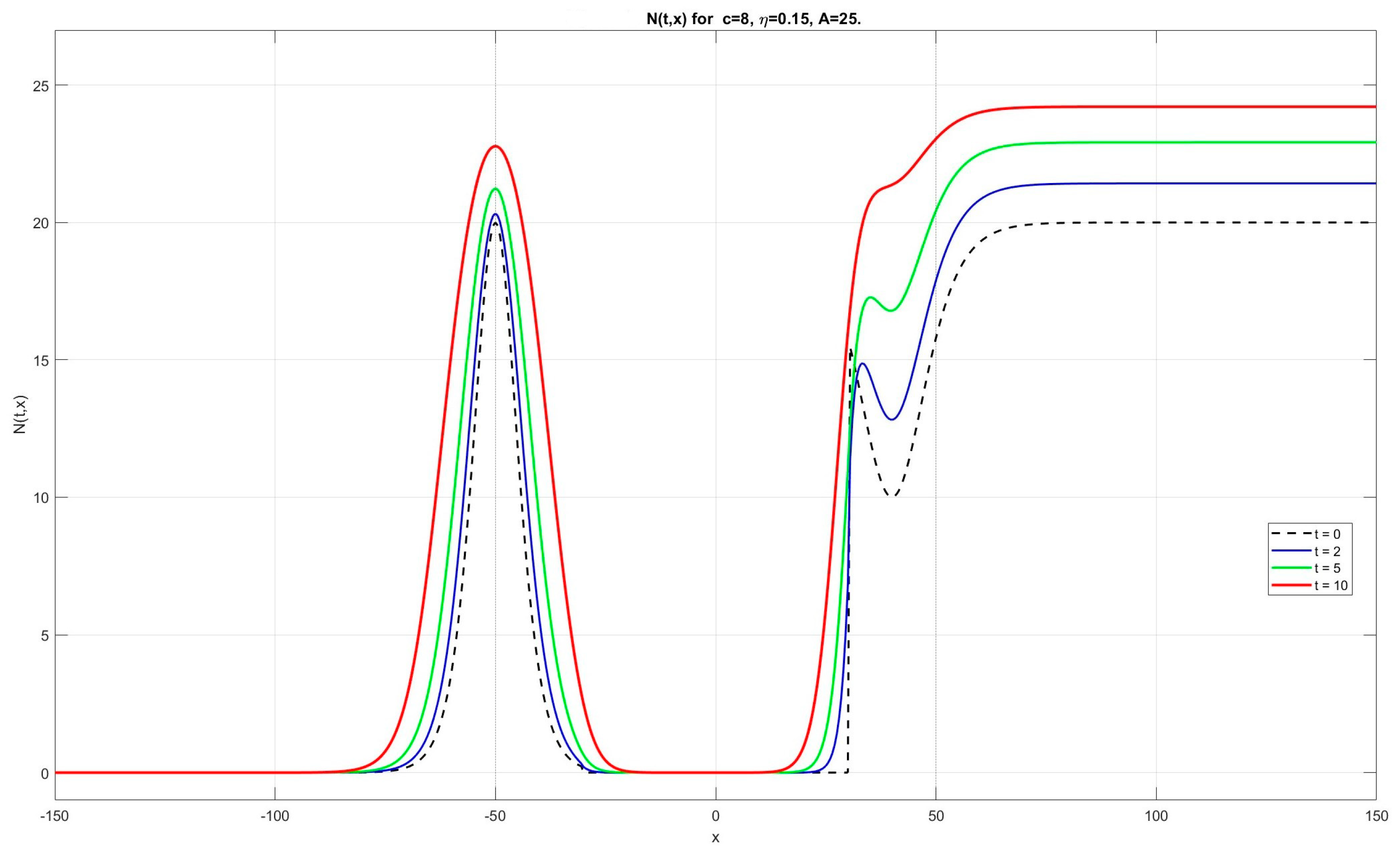
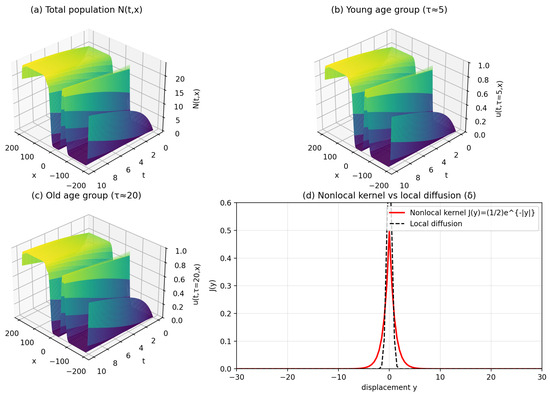
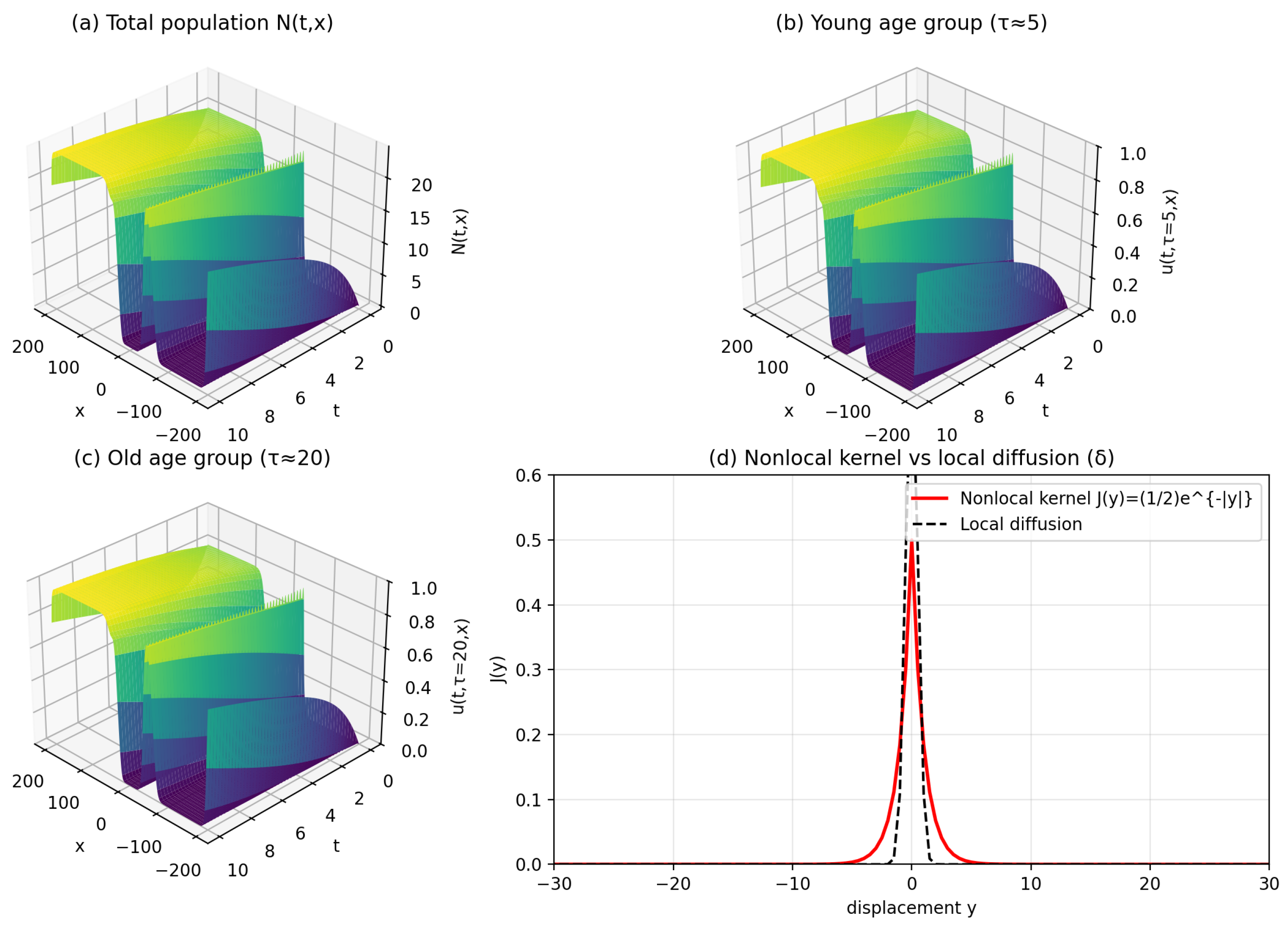
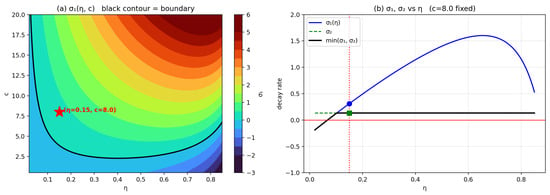
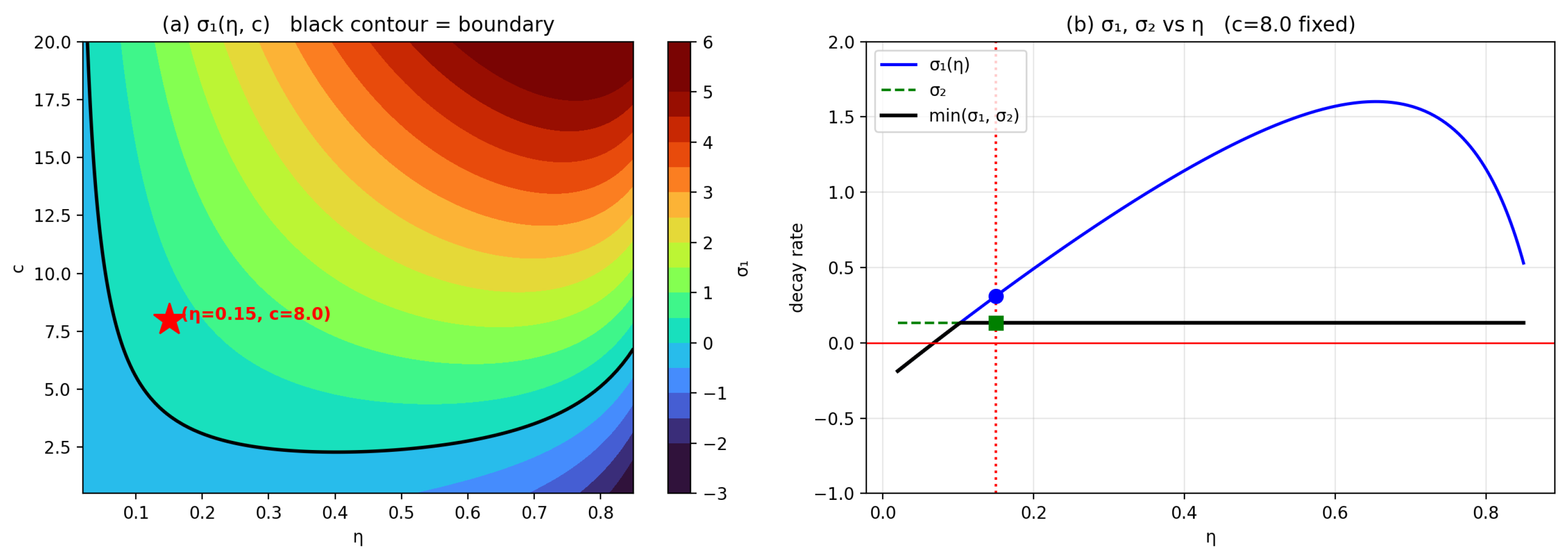
By Theorem 1, since the speed condition (6) is satisfied for our parameter choice, any initial perturbation of the traveling wave in the weighted space decays at a rate . The simulations below illustrate the qualitative content of this result. Figure 1 shows that the two-bump initial datum (34) evolves toward the endemic state as t increases; by each bump has grown to and the profile is monotonised in x, in qualitative agreement with the decay estimate (7). Figure 2 displays the full spacetime evolution of in Figure 2a and of the age slices and in Figure 2b,c. The spatial shape of the solution is essentially the same across ages, consistent with the -uniform structure of the profile used in the proof. Figure 2d contrasts the fat-tailed kernel with a Dirac-like local diffusion: the unbounded support of J is the structural feature behind the loss of a pointwise maximum principle handled by Lemma 2. Figure 3 illustrates how the decay bound depends on the model parameters: Figure 3a plots the contours of on the -plane together with the boundary of the admissible region defined by (6); Figure 3b compares , and their minimum at fixed . The bound is controlled by for small and by otherwise, separating the contribution of nonlocal dispersal from that of the age-renewal mechanism.
Figure 1.
Snapshots of subject to the initial data (34) at . The two-bump profile grows toward the endemic state and becomes monotonised in x, illustrating the qualitative content of Theorem 1.
Figure 2.
Spacetime structure of the solution. (a) Age-integrated population . (b) Young age-slice (interior of ). (c) Old age-slice (endpoint of ). The two age slices share the same spatial shape, illustrating the -uniformity of . (d) Kernel compared with a Dirac-like local diffusion.
5. Conclusions
In this paper, we have established the exponential stability of non-critical traveling waves for a scalar age-structured equation with nonlocal dispersal. The main result, Theorem 1, asserts that for every admissible weight exponent and wave speed c satisfying the condition , every initial perturbation generates a unique global solution whose age integral decays in time at any rate , with and given explicitly by (8).
The proof combines a comparison argument with a weighted-energy framework tailored to the nonlocal operator . The standard pointwise maximum principle is unavailable in this setting, and a self-contained comparison principle is therefore established from first principles in Lemma 2 through an exponential rescaling combined with a characteristic argument. The two-sided envelope ordering provided by this comparison principle is then propagated by a weighted-energy estimate, which yields the rate from the spatial-decay structure, and by an age-asymptotic argument at , which yields the complementary rate from the renewal mechanism. The effective bound thus reflects the joint contribution of nonlocal dispersal and age structure to the stability rate.
Numerical experiments illustrate these conclusions: the two-bump configuration (34) evolves toward the endemic state with monotonising profiles, the age slices share the same spatial shape (in agreement with the -uniformity of ), and the parameter-space analysis identifies the regimes in which the decay bound is governed by or . Possible extensions of the framework developed here include multi-group epidemic models, kernels with heterogeneous coefficients, and stability of critical waves at the threshold , which we leave to future work.
Author Contributions
Conceptualization, M.I.U. and Q.T.A.; Methodology, Q.T.A.; Software, M.I.U. and Q.T.A.; Validation, Q.T.A.; Writing—original draft, M.I.U.; Writing—review and editing, Q.T.A.; Visualization, M.I.U. and Q.T.A.; Funding acquisition, Q.T.A. All authors have read and agreed to the published version of the manuscript.
Funding
This research is supported by Guangdong Basic and Applied Basic Research Foundation (Grant Number 2025A1515010491).
Data Availability Statement
The original contributions presented in this study are included in the article. Further inquiries can be directed to the corresponding author.
Acknowledgments
We thank Guangdong Basic and Applied Basic Research Foundation (Grant Number 2025A1515010491) for supporting this research.
Conflicts of Interest
The authors declare no conflicts of interest.
References
- Fisher, R.A. The wave of advance of advantageous genes. Ann. Eugen. 1937, 7, 355–369. [Google Scholar] [CrossRef] [Scilit]
- Sandstede, B. Stability of travelling waves. In Handbook of Dynamical Systems; Elsevier Science: Amsterdam, The Netherlands, 2002; Volume 2, pp. 983–1055. Available online: https://www.sciencedirect.com/handbook/handbook-of-dynamical-systems/vol/2/suppl/C (accessed on 2 March 2026).
- Webb, G.F. Theory of Nonlinear Age-Dependent Population Dynamics; CRC Press: Boca Raton, FL, USA, 1985; Available online: https://books.google.com/books?hl=en&lr=&id=TlUI-vSkqKAC&oi=fnd&pg=PA1&ots=W0bWZraXmX&sig=ypNxInGxp_LTCk28AxCwJDp0Wmg#v=onepage&q&f=false (accessed on 5 March 2026).
- Iannelli, M.; Thieme, H.; Busenberg, S. Global behavior of an age-structured epidemic model. Siam J. Math. Anal. 1991, 22, 1065–1080. [Google Scholar] [CrossRef] [Scilit]
- Ducrot, A. Travelling wave solutions for a scalar age-structured equation. Discret. Contin. Dyn. Syst.-B 2006, 7, 251–273. [Google Scholar] [CrossRef] [Scilit]
- Ducrot, A.; Magal, P.; Ruan, S. Travelling wave solutions in multigroup age-structured epidemic models. Arch. Ration. Mech. Anal. 2010, 195, 311–331. [Google Scholar] [CrossRef] [Scilit]
- Zhang, Y.; Wu, X.; Ma, Z. Exponential stability of traveling waves for a scalar age-structured equation. Appl. Math. Lett. 2025, 175, 109842. [Google Scholar] [CrossRef] [Scilit]
- Mei, M.; So, J.W.H.; Li, M.Y.; Shen, S.S. Asymptotic stability of travelling waves for Nicholson’s blowflies equation with diffusion. Proc. R. Soc. Edinb. Sect. A Math. 2004, 134, 579–594. [Google Scholar] [CrossRef] [Scilit]
- Li, G.; Mei, M.; Wong, Y.S. Nonlinear stability of traveling wavefronts in an age-structured reaction-diffusion population model. Math. Biosci. Eng. 2008, 5, 85. [Google Scholar] [CrossRef] [Scilit] [PubMed]
- Bates, P. On some nonlocal evolution equations arising in materials science. Nonlinear Dyn. Evol. Equ. 2006. [Google Scholar] [CrossRef] [Scilit]
- Coville, J.; Dupaigne, L. On a non-local equation arising in population dynamics. Proc. R. Soc. Edinb. Sect. A Math. 2007, 137, 727–755. [Google Scholar] [CrossRef] [Scilit]
- Medlock, J.; Kot, M. Spreading disease: Integro-differential equations old and new. Math. Biosci. 2003, 184, 201–222. [Google Scholar] [CrossRef] [Scilit] [PubMed]
- Tian, X.; Guo, S. Traveling wave solutions for nonlocal dispersal Fisher–KPP model with age structure. Appl. Math. Lett. 2022, 123, 107593. [Google Scholar] [CrossRef] [Scilit]
- Ducrot, A.; Kang, H. Travelling wave solutions and spreading speeds for a scalar age-structured equation with nonlocal diffusion. Eur. J. Appl. Math. 2025, 36, 856–878. [Google Scholar] [CrossRef] [Scilit]
- Jing, S.; Lian, H.; Tang, Y.; Ma, Z. Traveling waves for a nonlocal dispersal SIRS epidemic model with age structure. AIMS Math. 2024, 9, 8001–8019. [Google Scholar] [CrossRef] [Scilit]
- He, J.; Zhang, G.B. Traveling Waves for a Sign-Changing Nonlocal Evolution Equation with Delayed Nonlocal Response. Bull. Malays. Math. Sci. Soc. 2024, 47, 42. [Google Scholar] [CrossRef] [Scilit]
- Wu, S.L.; Li, W.T.; Liu, S.Y. Asymptotic stability of traveling wave fronts in nonlocal reaction–diffusion equations with delay. J. Math. Anal. Appl. 2009, 360, 439–458. [Google Scholar] [CrossRef] [Scilit]
- Wu, X.; Ma, Z. Exponential stability of traveling waves for a nonlocal dispersal SIR model with delay. Open Math. 2022, 20, 1451–1469. [Google Scholar] [CrossRef] [Scilit]
- Sun, D.; Li, W.T.; Xin, M.Z. Propagation dynamics for a scalar age-structured model. Z. Angew. Math. Phys. 2026, 77, 106. [Google Scholar] [CrossRef] [Scilit]
Disclaimer/Publisher’s Note: The statements, opinions and data contained in all publications are solely those of the individual author(s) and contributor(s) and not of MDPI and/or the editor(s). MDPI and/or the editor(s) disclaim responsibility for any injury to people or property resulting from any ideas, methods, instructions or products referred to in the content. |
© 2026 by the authors. Licensee MDPI, Basel, Switzerland. This article is an open access article distributed under the terms and conditions of the Creative Commons Attribution (CC BY) license.