


Abstract
This paper investigates the problem of exponential synchronization for a class of quaternion-valued inertial neural networks with mixed time delays under aperiodic intermittent control. First, a neural network model incorporating both discrete and distributed delays is established. To overcome the limitations of conventional approaches, a novel quaternion-based controller is proposed, which operates without relying on model order reduction or quaternion decomposition techniques, thereby achieving global exponential synchronization of the system. Furthermore, by constructing an appropriate Lyapunov function and combining the algebraic properties of quaternions with inequality techniques, sufficient conditions for synchronization are rigorously derived within the Lyapunov stability framework. Numerical simulations are conducted to demonstrate the effectiveness of the proposed control strategy and validate the theoretical results. Finally, an image encryption application is developed to further corroborate the practical viability of the proposed scheme, wherein the original image is encrypted into a noise-like pattern without information leakage and perfectly recovered upon synchronization, with quantitative error analysis confirming high-precision exponential synchronization.
MSC:
34D06; 93C23; 93D15; 93D20
1. Introduction
Neural networks, as machine learning models that simulate the connections and interactions of neurons in the human brain, have been widely applied in domains such as image classification, face recognition, and disease diagnosis [1,2,3]. These networks are capable of learning intricate patterns from data through training algorithms such as backpropagation, making them powerful tools for both supervised and unsupervised tasks. To further enhance the capability to process dynamic and non-stationary data, inertial neural networks (INNs) have been developed by incorporating an inertial term that simulates the memory characteristics and dynamic behavior of biological neurons, thereby significantly improving convergence speed, function approximation capability, system robustness, and fault tolerance. The dynamic properties and synchronization behavior of INNs have become a focus of current research [4,5,6]. On this basis, quaternion inertial neural networks (QINNs) have been proposed, integrating the dual advantages of quaternion algebra and the inertial mechanism. Quaternion operations enable structured modeling of rotations and transformations in three-dimensional space, providing a natural mathematical representation for complex tasks such as pose estimation and 3D vision [7]. Meanwhile, the inertial term enhances the system’s memory capacity for dynamic processes and its resistance to time delays, allowing QINNs to exhibit outstanding anti-interference ability and fault tolerance in applications such as attitude control in aerospace [8], 3D image processing [9], and dynamic trajectory tracking in robotics. Furthermore, the parameter-sharing mechanism and distributed storage characteristics of QINNs contribute to improved computational efficiency and model stability, making them an effective framework for handling multi-modal high-dimensional dynamic data [10,11,12,13], a direction that aligns with recent advances in multi-modal neurosymbolic reasoning [14].
Time delay, as a phenomenon where the output lags behind the input, arises from factors including physical constraints in signal transmission, computational bottlenecks, environmental interference, and inherent characteristics of biological cognition. It can severely degrade system performance: the magnitude of delay is positively correlated with control difficulty and is prone to inducing oscillations, instability, or even chaos, thereby directly threatening system stability [15,16,17]. Consequently, functional differential equations are required for the study of delayed INNs. The mixed-delay model, which synergistically integrates discrete, proportional, and distributed delays, provides a dynamic system modeling framework that more closely approximates practical scenarios. It holds key value in enhancing robustness, improving control flexibility, and extending theoretical universality [18,19,20]. However, existing studies [21,22] have established stability and synchronization control criteria for real-valued or complex-valued inertial neural networks with mixed delays, but their extension to the quaternion domain is extremely limited. Therefore, the dynamical analysis of mixed-delay quaternion-valued inertial neural networks incorporating discrete, proportional, and distributed delays still remains a significant research gap, and there is an urgent need to construct a new analytical framework.
Synchronization, as an important class of dynamical behavior in neural networks, has garnered sustained academic attention due to its broad applications in complex system control, secure communication, information processing, and multi-robot coordination. Based on the time scale of state convergence, synchronization can be categorized into finite-time synchronization [19,23] and infinite-time synchronization [22,24]. Commonly used analytical methods for inertial neural networks (INNs) include the variable transformation method [25,26], the matrix measure method [27], and the non-reduced-order method [28]. However, although the variable transformation method simplifies the dynamic order by reducing the system order, it fails to fully preserve the original inertial terms and increases the system dimension, thereby raising the theoretical analysis difficulty and computational burden. In contrast, the non-reduced-order method fully retains inertial characteristics while reducing theoretical complexity and has thus become a mainstream approach. For quaternion-valued neural networks (QNNs), analytical methods are divided into decomposition and non-decomposition approaches. The decomposition approach decomposes the quaternion-valued system into two complex-valued or four real-valued subsystems. For instance, studies such as [23,29] decompose the quaternion-valued network into four real-valued subsystems, based on which controllers and synchronization criteria are derived. Although theoretically feasible, this method significantly increases system dimensionality, imposes a heavier computational burden, and complicates controller design and condition derivation. Therefore, non-separation control strategies that directly utilize quaternion algebra have gradually emerged as an important research direction in QINN synchronization [13,24,30,31,32].
Compared to traditional linear control and feedback control methods, aperiodic intermittent control [33,34,35] abandons the constraints of continuous or periodic execution, allowing the controller to activate intermittently over non-uniform time intervals. This method not only significantly reduces system energy consumption and computational overhead but also demonstrates stronger adaptability and robustness against non-ideal communication conditions such as timing jitter and data packet loss. It thus provides a more practical and efficient solution for the control of complex dynamic systems. As a result, it has been widely applied in neural networks [36,37] in recent years.
Based on the above discussion, this paper directly addresses the exponential synchronization problem for a class of quaternion-valued inertial neural networks with mixed delays, without resorting to system order reduction or quaternion decomposition, and establishes synchronization criteria under aperiodic intermittent control. The main contributions of this work are summarized as the following four aspects, and related work is presented in Table 1.
Table 1.
Related work.
- 1.
- A novel class of quaternion-valued inertial neural networks with mixed delays is proposed. By constructing new Lyapunov functionals and combining inequality techniques, exponential synchronization criteria for the system are established, with numerical simulations further validating the effectiveness and feasibility of the theoretical results.
- 2.
- A non-reduction and non-decomposition analytical framework is developed to directly address synchronization problems in high-dimensional quaternion systems, preserving the non-commutative structure and inertial dynamics.
- 3.
- An aperiodic intermittent control strategy is designed, which not only ensures global exponential synchronization of the system but also significantly reduces control costs.
- 4.
- An image encryption application is developed to validate the proposed scheme. The original image is encrypted into a noise-like pattern without information leakage and perfectly recovered after synchronization. Quantitative error analysis confirms the high-precision exponential synchronization.
Notations:
In this paper, , and and denote the sets of all real numbers and quaternions, respectively. For any quaternion , its conjugate is , where with , , , and . The norm of u is given by . represents the n dimensional vector space of quaternions. For any , let denote its conjugate transpose and define its norm as .
2. Model and Preliminaries
Consider the following class of QINNs with mixed time delays:
where denotes the state vector of the p- neuron at time t, and the second-order derivative represents the inertial term of system (1). The coefficients , are called the damping coefficient and self-inhibition coefficient, respectively; , and denote the connection weights; denotes the activation function of the q- neuron; and are discrete and distributed delays satisfying , , , ; and is the external input.
The initial values of system (1) are
in which , , and are continuous.
Remark 1.
When the distributed delay term , model (1) reduces to the inertial neural networks with discrete delays studied in [24,31,32]:
Compared with the discrete-delay model, the mixed-delay model is more realistic: discrete delays represent fixed synaptic latencies, while distributed delays capture dendritic integration and heterogeneous conduction velocities. From an engineering perspective, mixed delays enable high-dimensional hyperchaos, which provides strong resistance to phase-space reconstruction attacks and is therefore essential for secure communication and image encryption. In terms of implementation, the distributed part is approximated by low-order IIR filters, and the discrete part is realized by shift registers. This architecture offers clear guidance for the hardware design of image encryption.
If system (1) is the drive system, the corresponding response system is given as follows:
where denotes the state of the p- neuron in the response system, is the intermittent controller, and the definitions of the other symbols are the same as those in system (1).
System (2) is subject to the following initial values:
where , and are continuous.
Consider the following intermittent feedback controller:
where , and are called control gains, and and denote the working interval and the resting interval of the - time sequence, respectively.
Remark 2.
Unlike continuous feedback, adaptive control, periodic intermittent control, our aperiodic scheme applies nonzero input only during adjustable-length control intervals. This reduces energy/updates and adapts to time-varying networks. Compared with continuous feedback, it lowers control cost; compared with adaptive control, it avoids online estimation and extra dynamics; and compared with periodic intermittent control, it uses an average control rate (not a fixed duty cycle) and does not require each control interval to satisfy local decay, thus achieving lower conservatism.
Define as the synchronization error. Then, it follows from systems (1) and (2) and controller (3) that the error system can be expressed as
in which , .
Assumption 1.
For any s, , there exists such that the quaternion-valued activation function satisfies
Definition 1.
Lemma 1
([41]). Let and denote the total working time and total resting time in the interval , respectively. Suppose there exist constants , and such that
then there exist constants and such that for all ,
Proof.
From , one has
By this condition, there exists such that for all sufficiently small and for all , . Substituting this inequality yields
Since , we have . Choose sufficiently small so that . Then, the desired inequality holds for all . □
Remark 3.
Lemma 1 is an adaptation of the result in [41] to the inequality that arises from the exponentially weighted Lyapunov functional used in this paper. The corresponding average control rate condition becomes . A short, direct proof is provided for completeness.
Lemma 2
([24]). For any x, y and , the following inequalities hold:
and
where with
3. Main Results
In this section, the exponential synchronization of QINNs (1) and (2) with mixed delays is investigated under the periodically intermittent controller (3) via directly constructing a Lyapunov functional.
Theorem 1.
Proof.
Construct the following Lyapunov functional:
where
In the case where , it follows directly that
Based on Lemma 2, the following four relations hold:
and
From Assumption 1 and Lemma 2, it follows that
and
Similarly, one has
and
Furthermore, by Assumption 1, we obtain
and
The derivatives of and are given respectively by
and
Furthermore, this implies
When , similarly,
where and . Therefore,
A mathematical induction is employed to prove that for every and every ,
where denotes the total resting time on .
Base case . For , applying the differential inequality (21) on the working interval gives , with and . For , using the resting-interval differential inequality, together with the estimate at the end of the control interval, yields
where and . Thus, (24) holds for all .
Induction hypothesis. Assume that (24) holds for all . In particular, at the node , we have
Induction step. We now prove that (24) also holds for . When , from (21) and the induction hypothesis,
where and . When , using (23) and the induction hypothesis,
where , and . Thus, (24) is valid for all . By mathematical induction, inequality (24) holds for every .
For any , from the Lyapunov functional (5), Lemma 1, and (24), we obtain
where . By the boundedness of on and the initial amplification property of the Lyapunov functional, there exists a constant such that
Thus, exponential synchronization is achieved under the aperiodically intermittent quantized control (3). □
Remark 4.
Unlike the traditional reduced-order plus decomposition approach [38], our direct non-reduced-order and non-decomposition method avoids dimension doubling, subsystem coupling, and decomposition/reconstruction overhead. Specifically, per-step assignment operations drop from to zero, memory access becomes contiguous, and asymptotic complexity remains with a smaller constant factor, offering higher efficiency and scalability, especially for large-scale or real-time control applications.
4. Numerical Simulations
The effectiveness of the theoretical results will next be verified through the following quaternion-valued inertial neural networks model:
in which, the activation function is defined as for ; the time-varying delay is given by ; and the distributed delay kernel follows an exponentially decaying form. The system parameters are specified as , , and
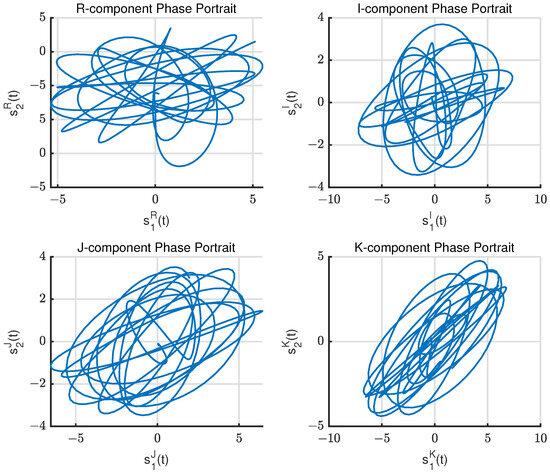
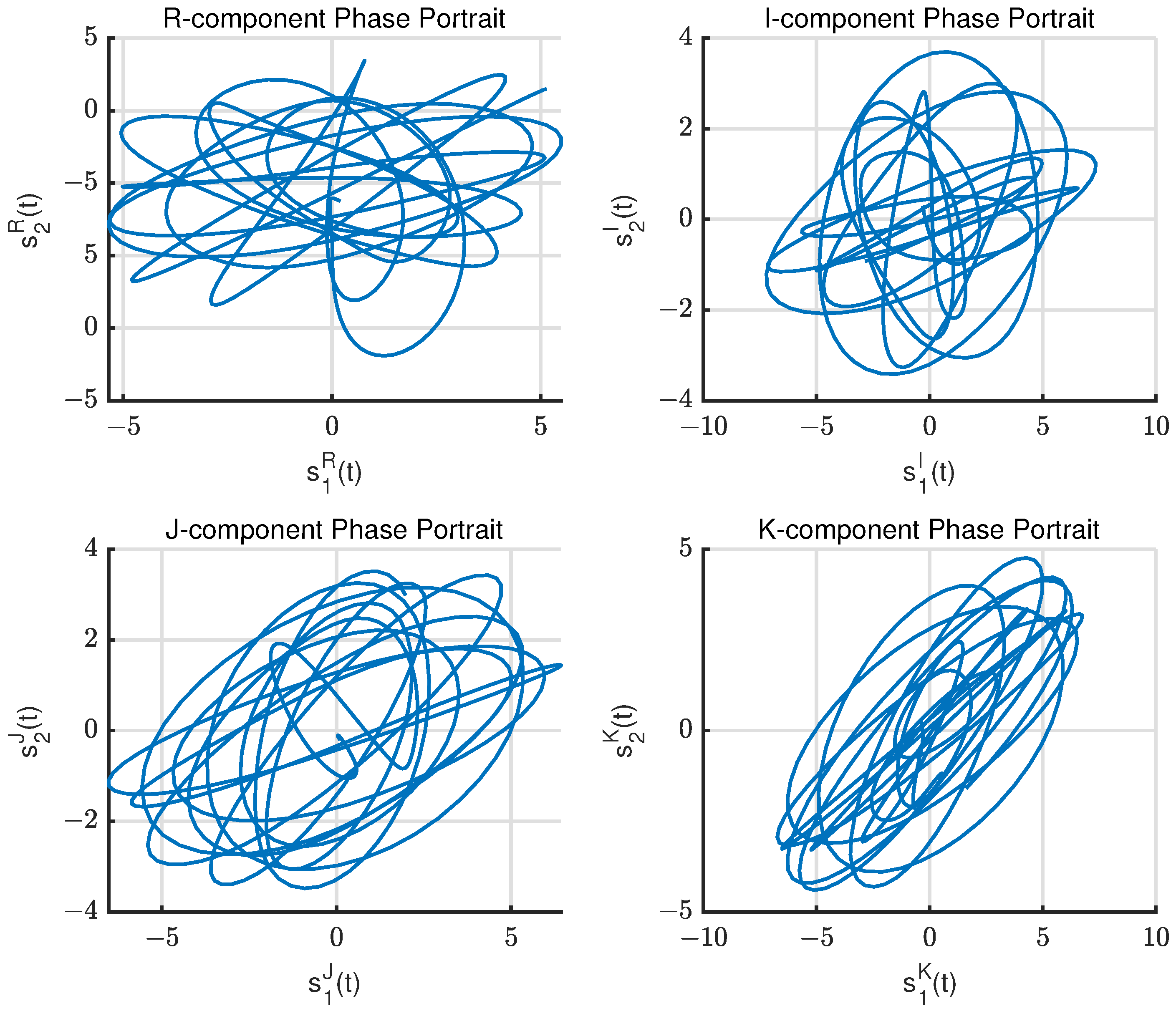
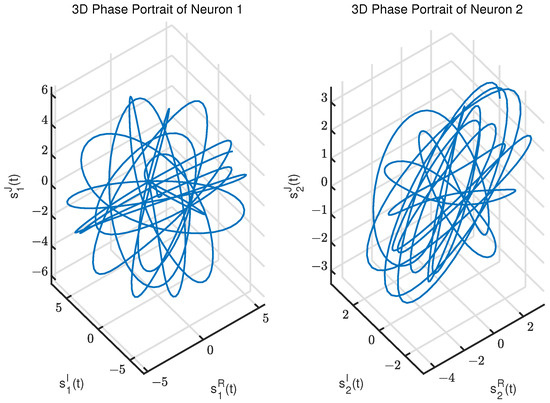
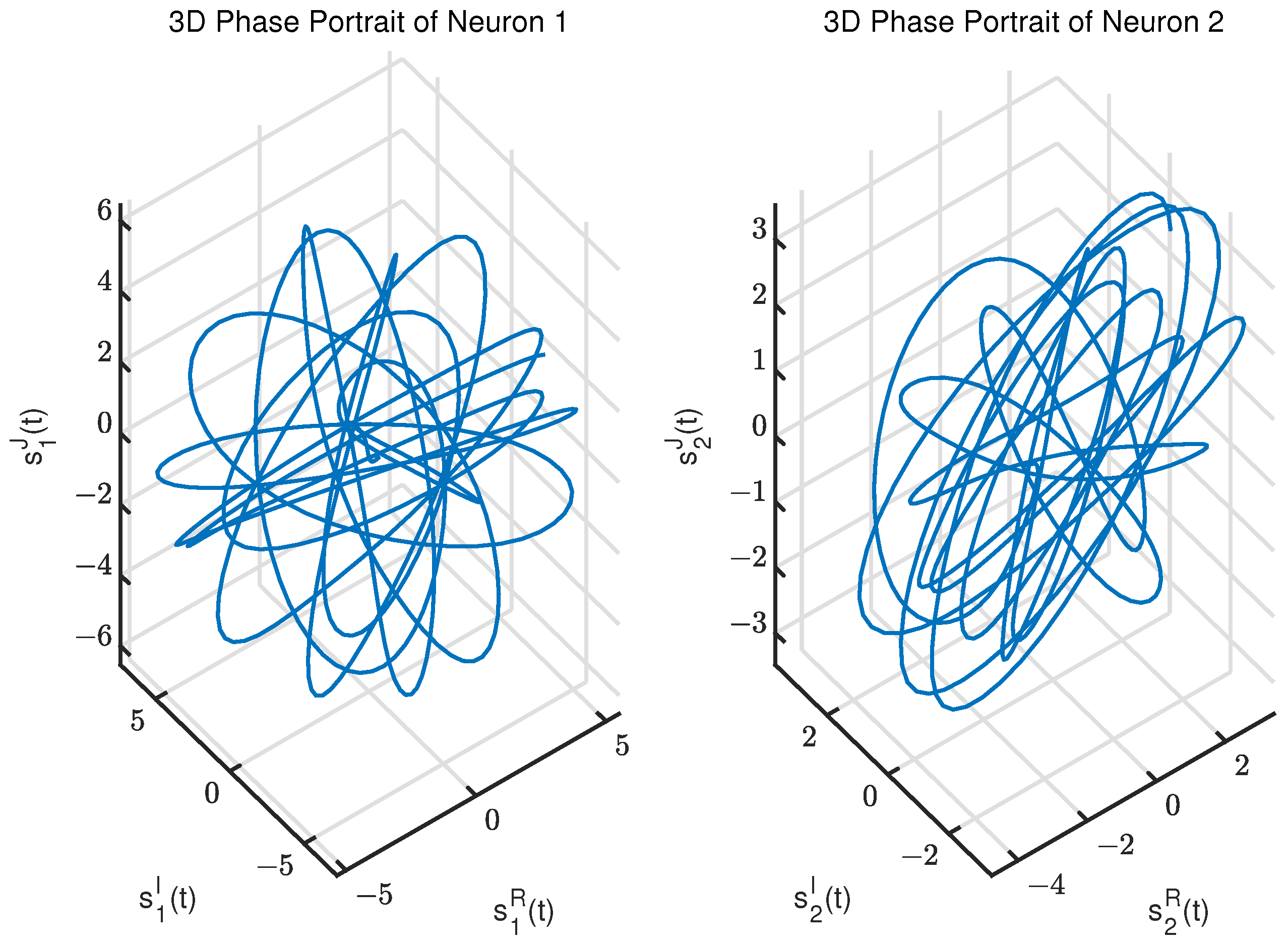
The chaotic attractor phase portraits of system (26) are displayed in Figure 1 and Figure 2, in which , , , for .
Figure 1.
Quaternion chaotic attractor phase plane projections.
Figure 2.
Chaotic attractor of neuron 1/2 in the R-I-J subspace.
Remark 5.
Figure 1 shows two-dimensional phase portraits on the four component planes, revealing chaotic synchronization between the two neurons per component, while the three-dimensional visualization of chaotic attractors in the R-I-J subspace (Figure 2) corroborates the theoretical existence of complex dynamics and demonstrates that quaternion-valued inertial neural networks can capture multi-dimensional interactions among components . This capability surpasses real-valued or complex-valued networks, offering a natural framework for modeling high-dimensional chaotic systems.
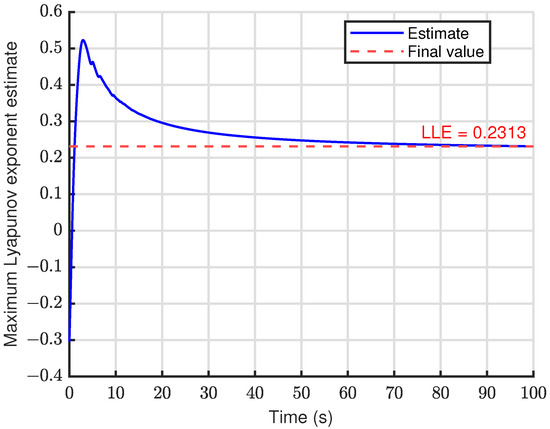
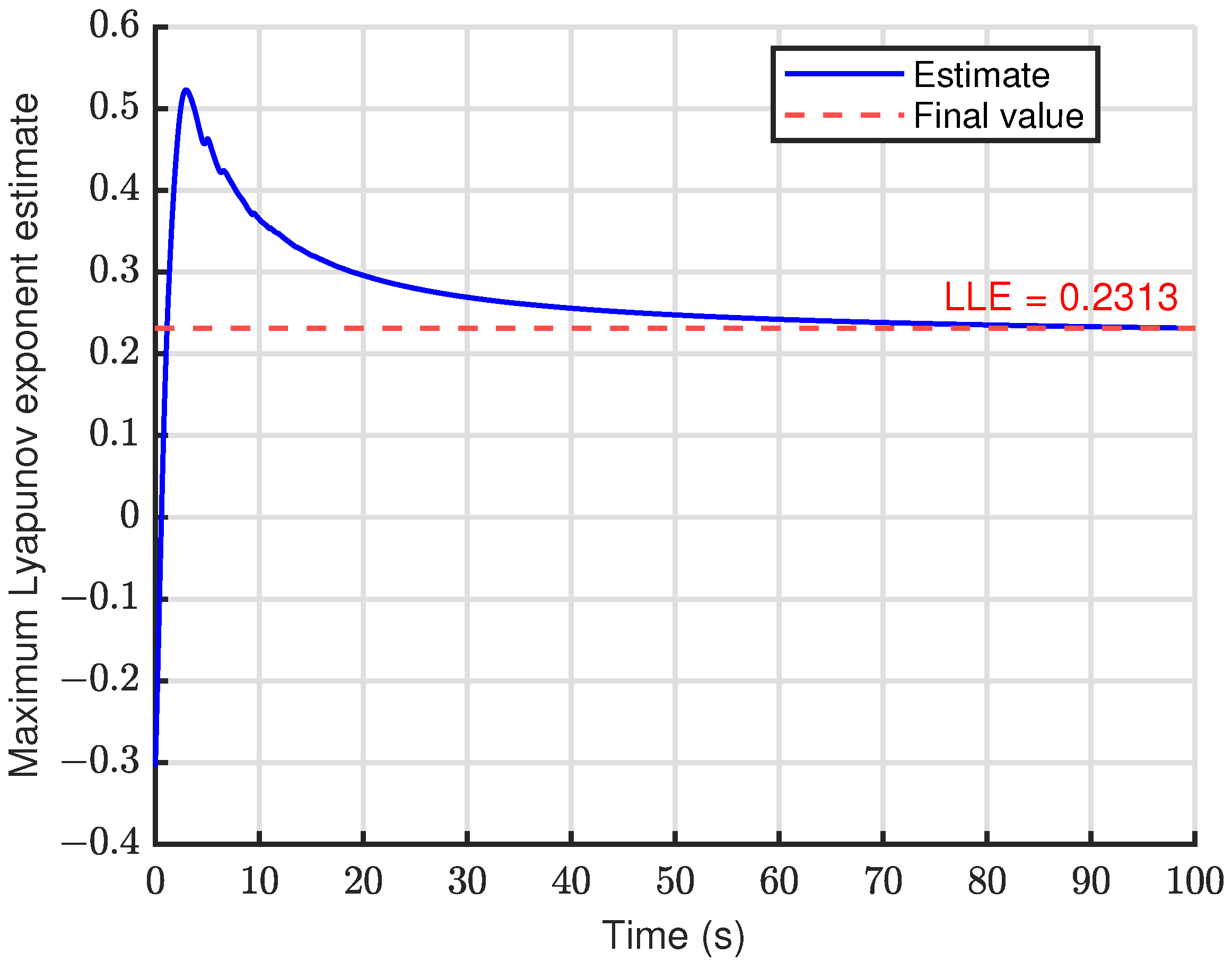
As shown in Figure 3, the convergence curve is obtained using the Benettin perturbation method. The blue solid curve represents the estimated LLE over time, and the red dashed line indicates the final converged value (LLE ≈ 0.2313). After about 80 seconds, the estimate stabilizes at a positive value, indicating the chaotic behavior of the system (1).
Figure 3.
Convergence of maximum Lyapunov exponent.
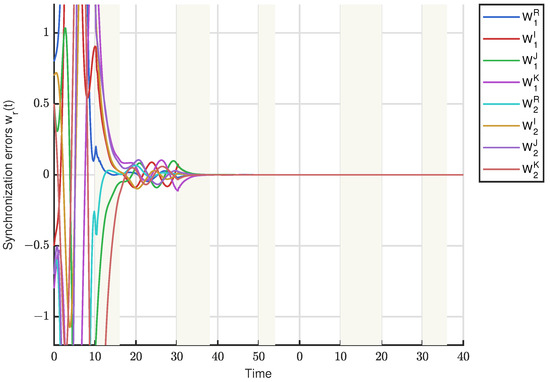
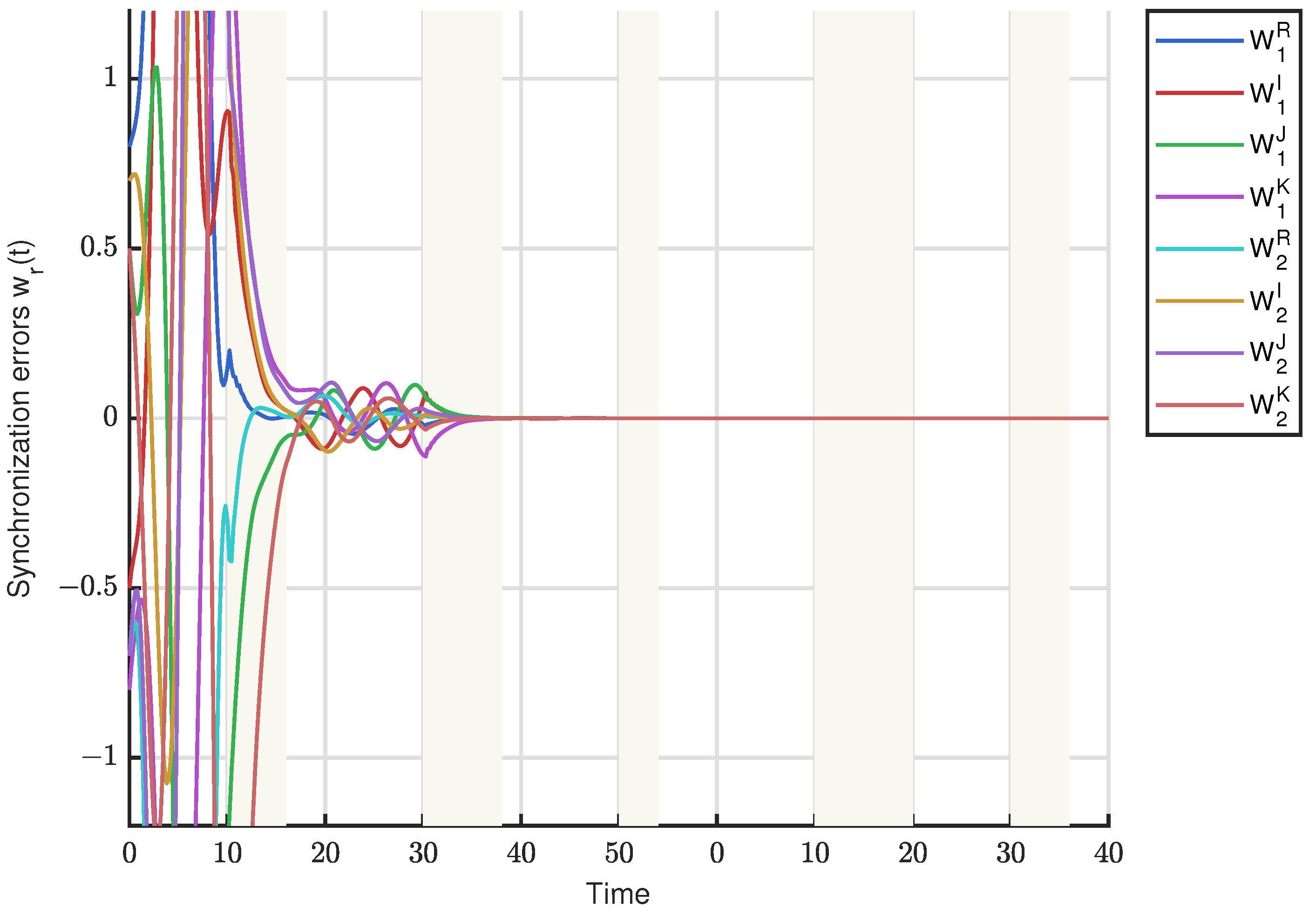
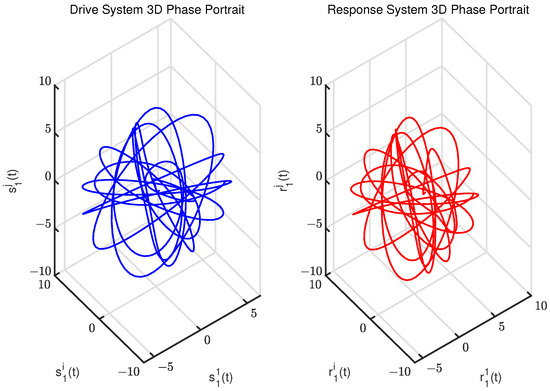
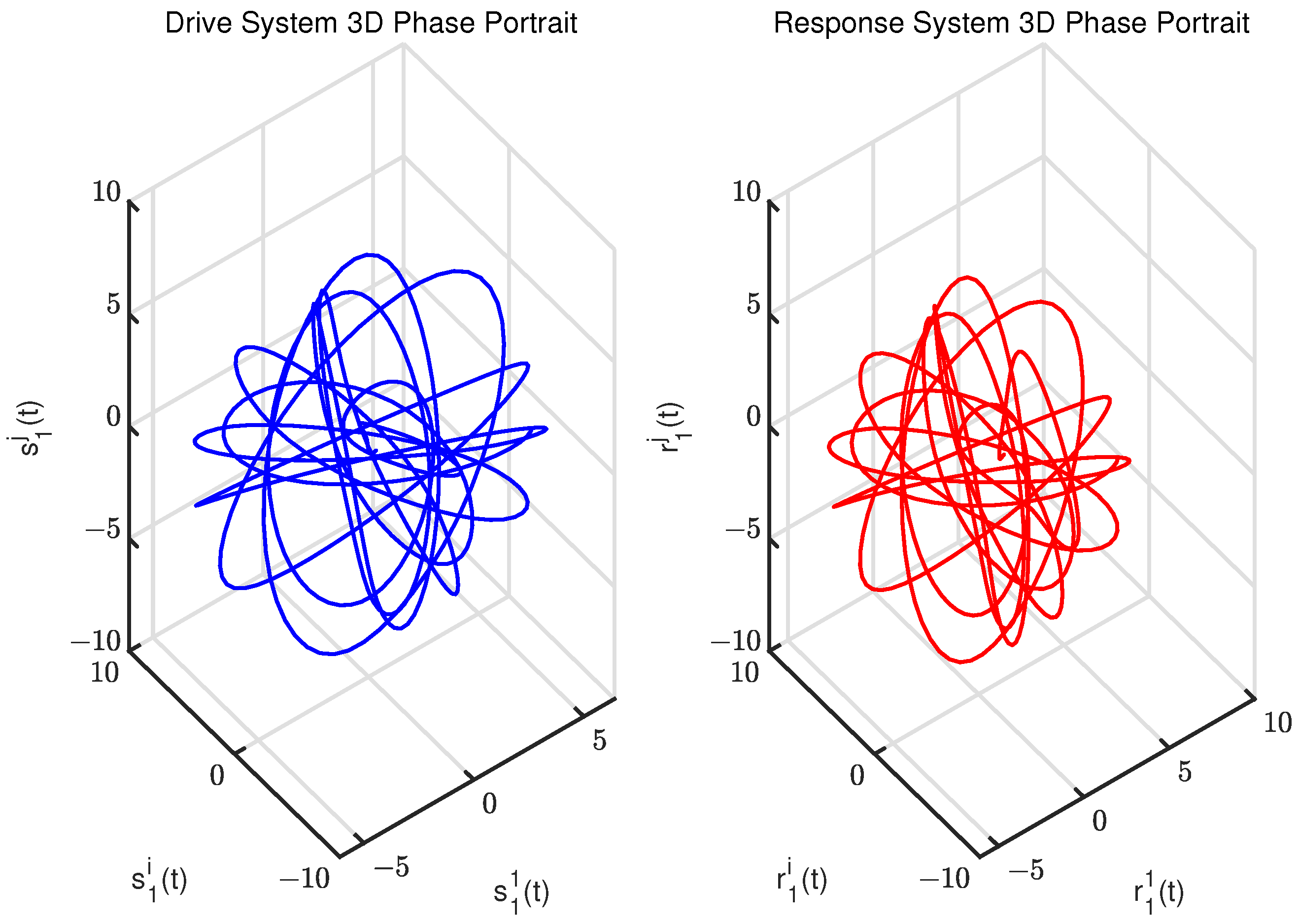
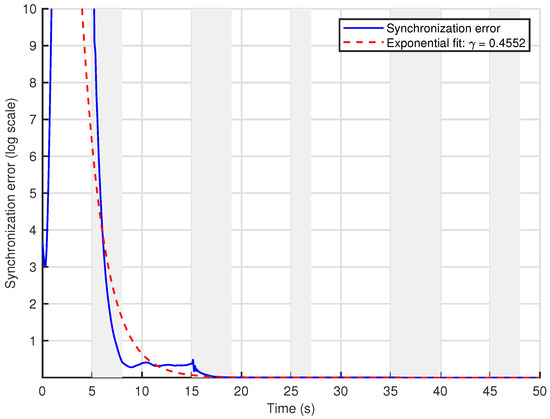
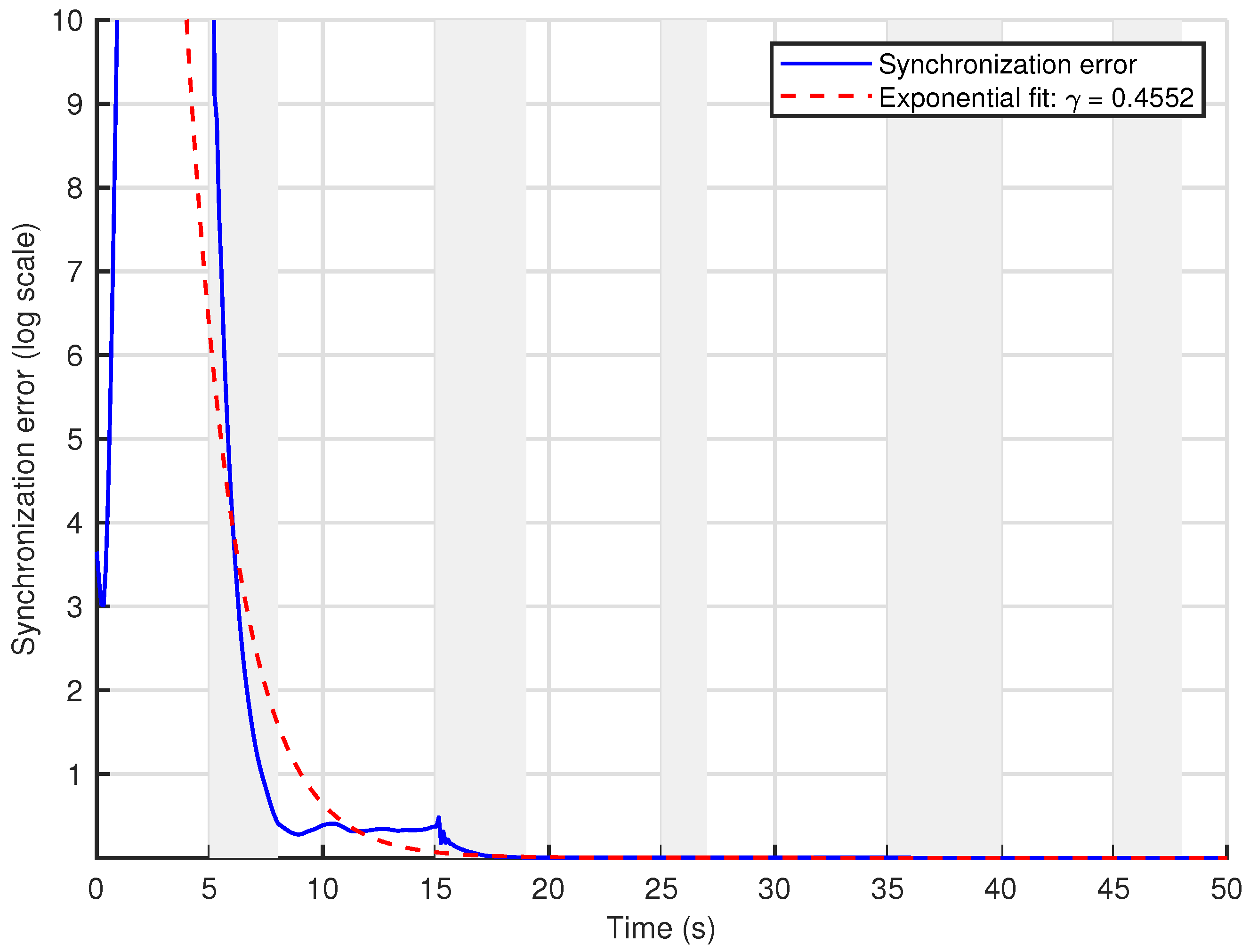
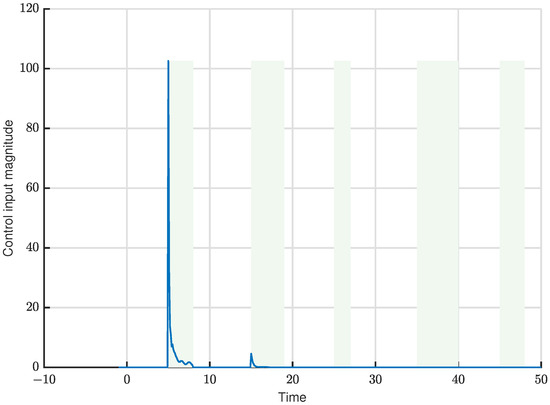
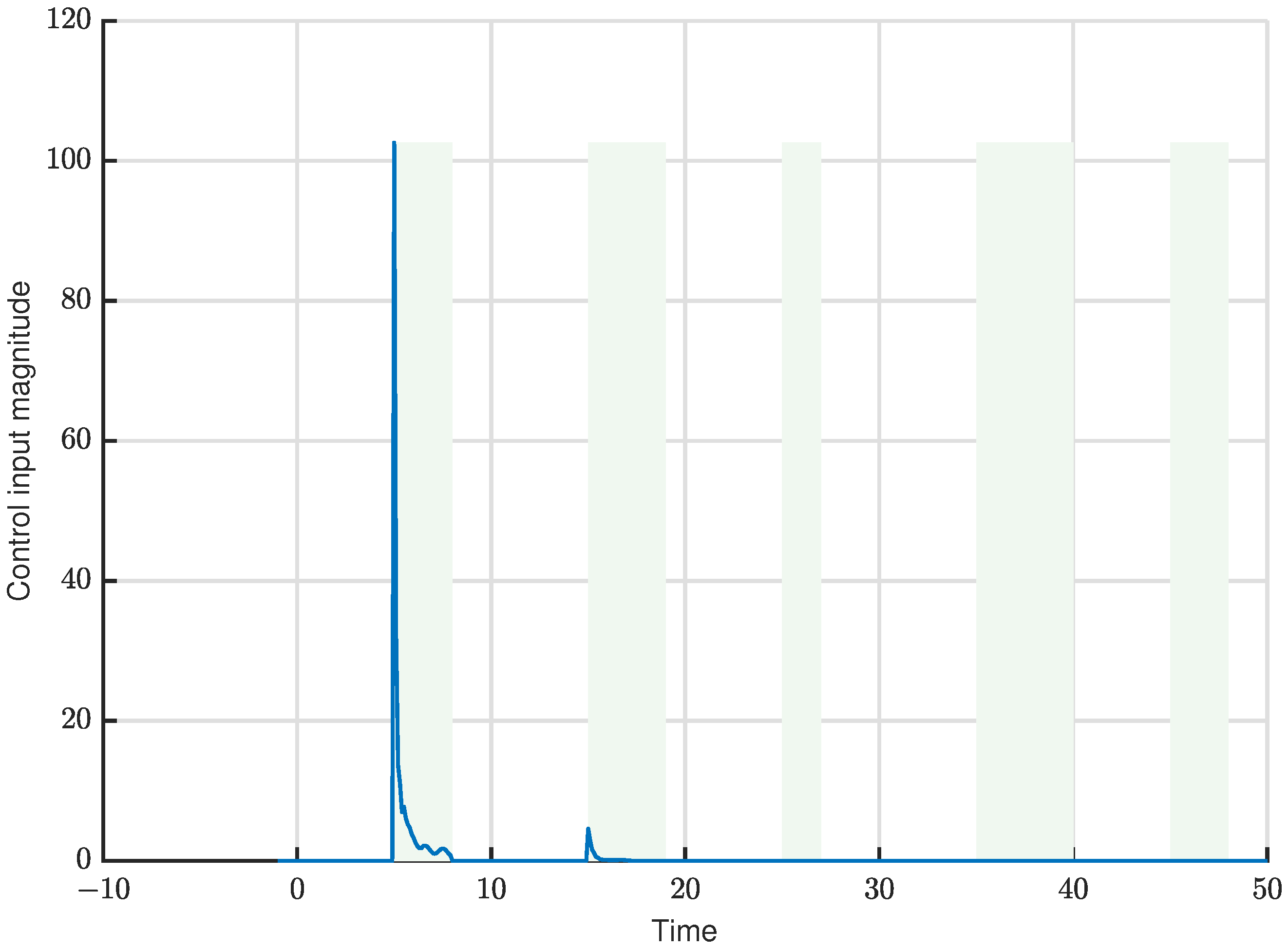
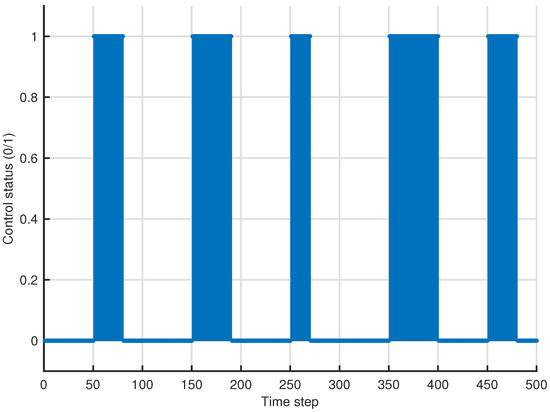
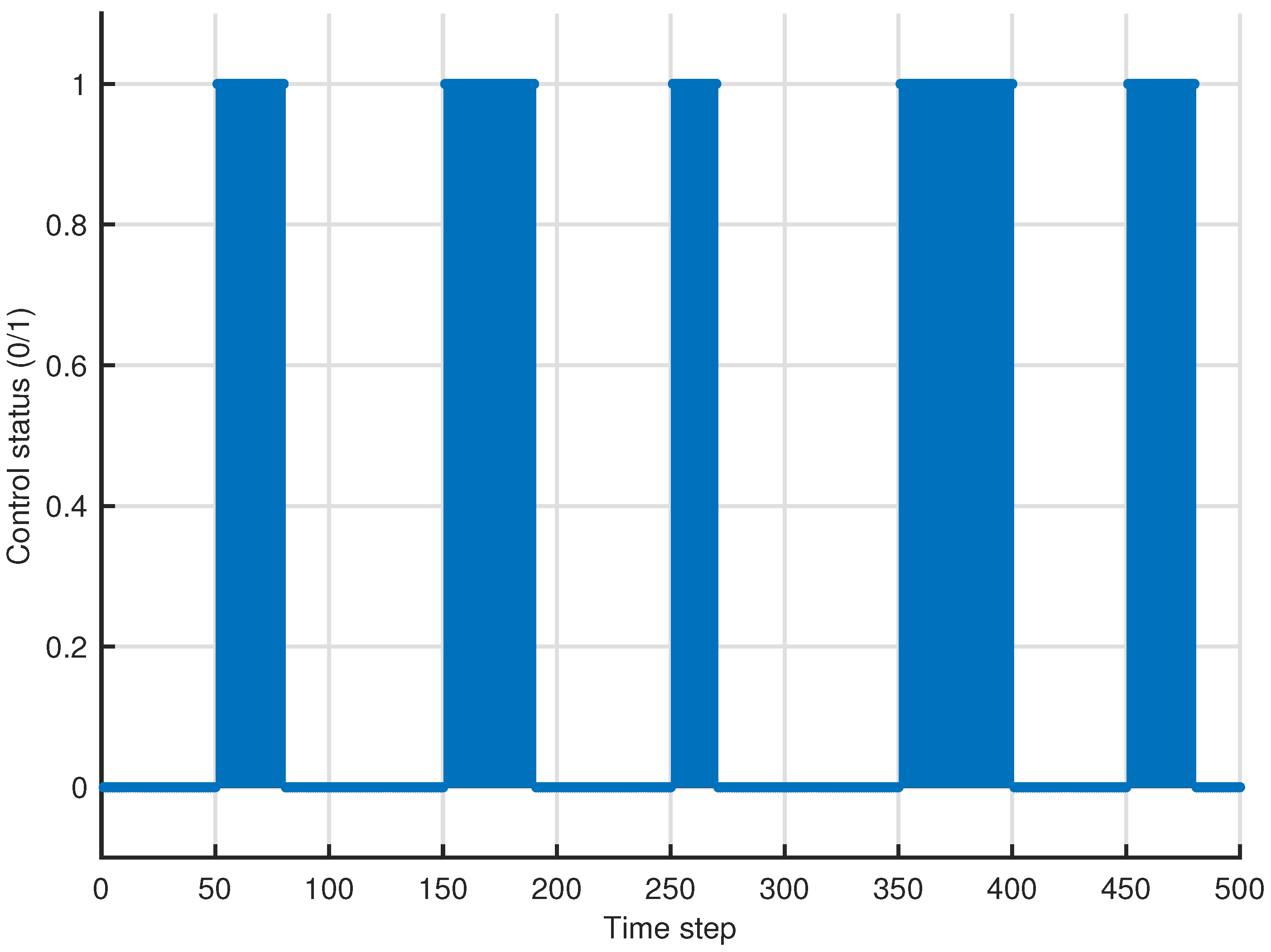
Global exponential synchronization of the master–slave systems (26) and (27) is established using the aperiodic intermittent control strategy given in (3). With the parameter values chosen as , , and , the corresponding control gains are obtained from the numerical implementation as and . Under Theorem 1, the neural networks described by (26) and (27) are guaranteed to achieve global exponential synchronization. The numerical simulations in Figure 4, Figure 5, Figure 6, Figure 7 and Figure 8 validate the above theoretical results and systematically illustrate the synchronization process under aperiodic intermittent control, including error evolution, phase portraits, exponential convergence, control input magnitude, and activation status.
Figure 4.
Evolution of synchronization error components.
Figure 5.
Phase portraits of drive and response systems.
Figure 6.
Exponential convergence of synchronization error under intermittent control.
Figure 7.
Control input magnitude under intermittent control.
Figure 8.
Control activation status.
Remark 6.
While the left part of Figure 2 represents the autonomous chaotic dynamics of the drive system, the right part shows how the response system—through intermittent control interventions—successfully reproduces the identical dynamical pattern. The morphological similarity between the two attractors, particularly in their folding structures and occupied regions of the state space, offers strong evidence that complete synchronization has been attained in the quaternion domain, encompassing all four components of the neural states.
To quantitatively evaluate the exponential synchronization performance, Figure 6 presents a semi-logarithmic plot of the total error (blue curve) together with its exponential fit (red dashed curve). The error decays exponentially with rate and a goodness-of-fit (coefficient of determination) of . The final error at s is , and the settling time (error ) is s. Compared with the control-off intervals, the control reduces the average error by . All these quantitative indicators fully support the theoretical claim that the proposed non-periodic intermittent control achieves exponential synchronization.
Figure 7 and Figure 8 illustrate the intermittent control strategy. Figure 7 shows the control input magnitude, which exhibits a distinct on–off pattern—nonzero only during active control intervals and zero otherwise—demonstrating the energy-saving feature of intermittent control. Complementing Figure 7, Figure 8 presents the binary state (1: active, 0: inactive) at each time step, clearly visualizing the duty cycle and activation schedule, thereby revealing the timing of the control interventions.
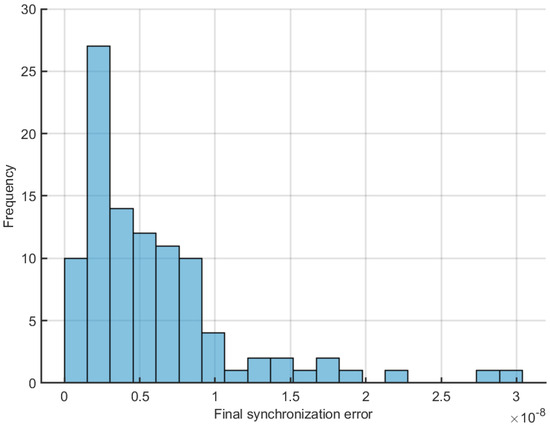
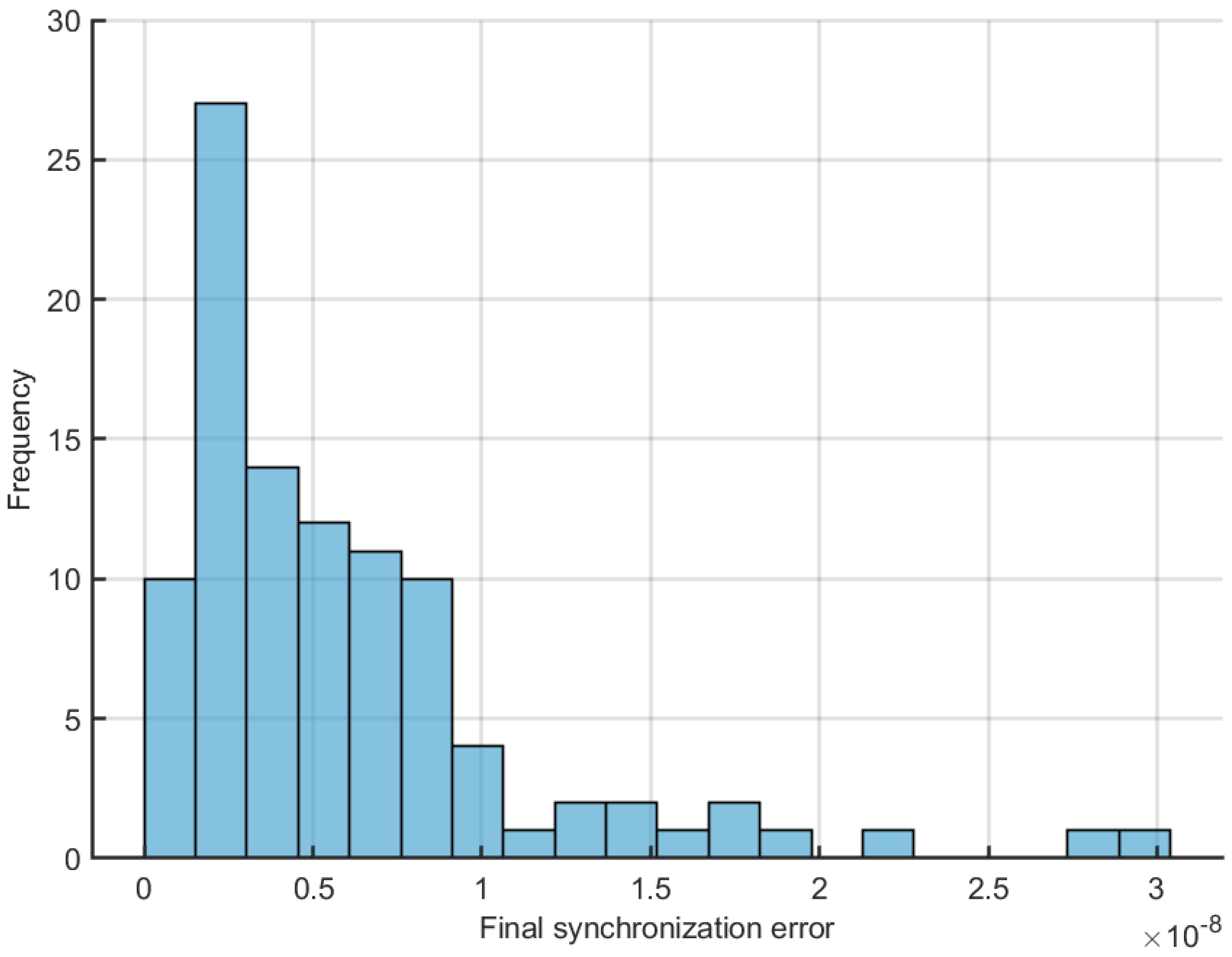
Figure 9 verifies the impact of perturbing connection weight matrices by on synchronization, using 100 Monte Carlo runs. All final errors at s are below , with mean and standard deviation . These values are far below the typical engineering tolerance of , confirming that the proposed intermittent control is highly robust to parameter perturbations and that the nominal parameters do not compromise exponential synchronization stability.
Figure 9.
Histogram of synchronization errors under parameter perturbations.
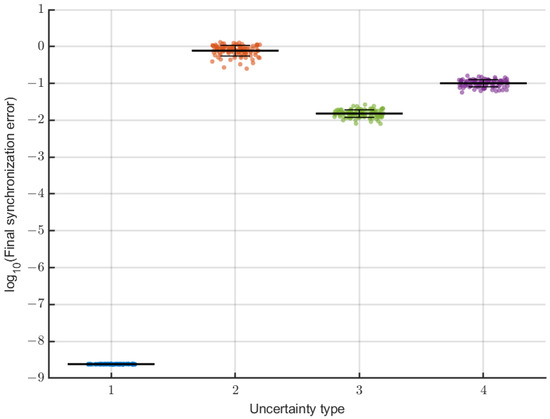
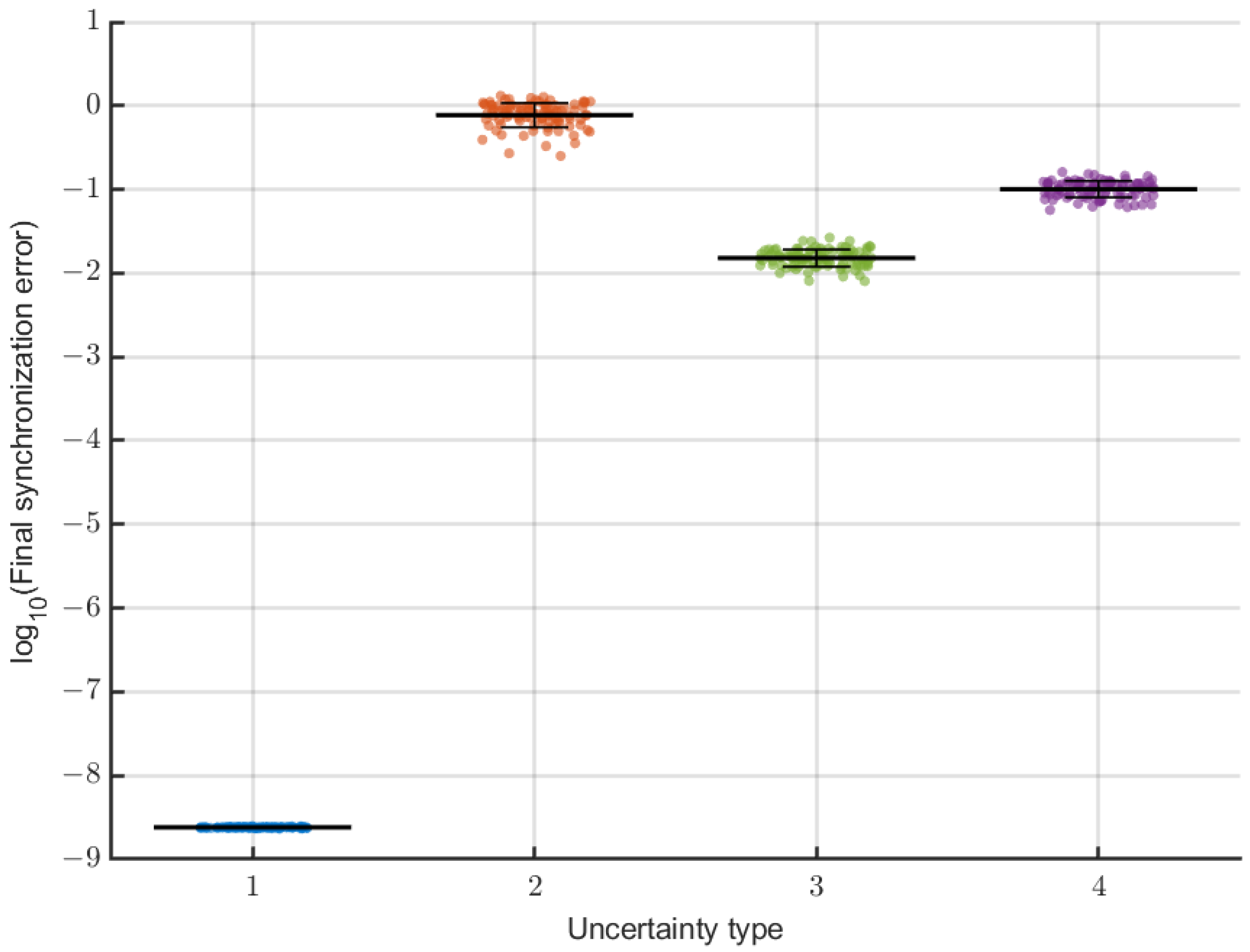
Figure 10 presents robustness under four uncertainties (delay, mismatch, perturbation, noisy channel). Final errors ( scale): parameter mismatch yields largest (mean ), followed by noisy channel () and perturbation (); delay fluctuation is negligible (). Results confirm robustness against mismatch and channel noise.
Figure 10.
Logarithmic boxplots of synchronization errors under four uncertainties.
5. Image Encryption Verification
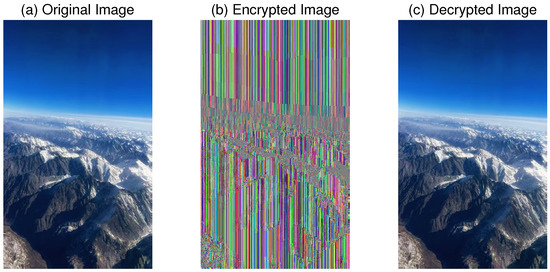
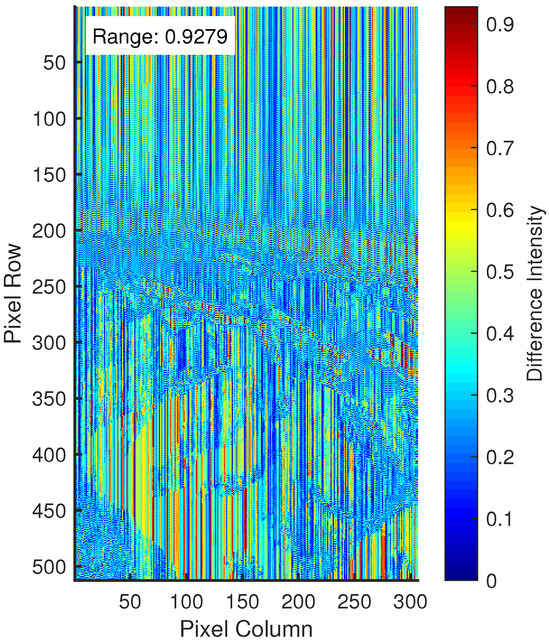
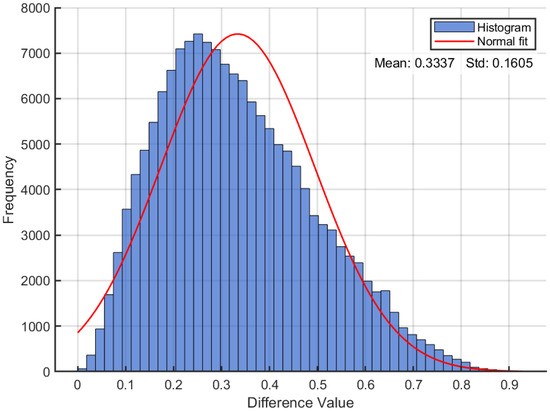
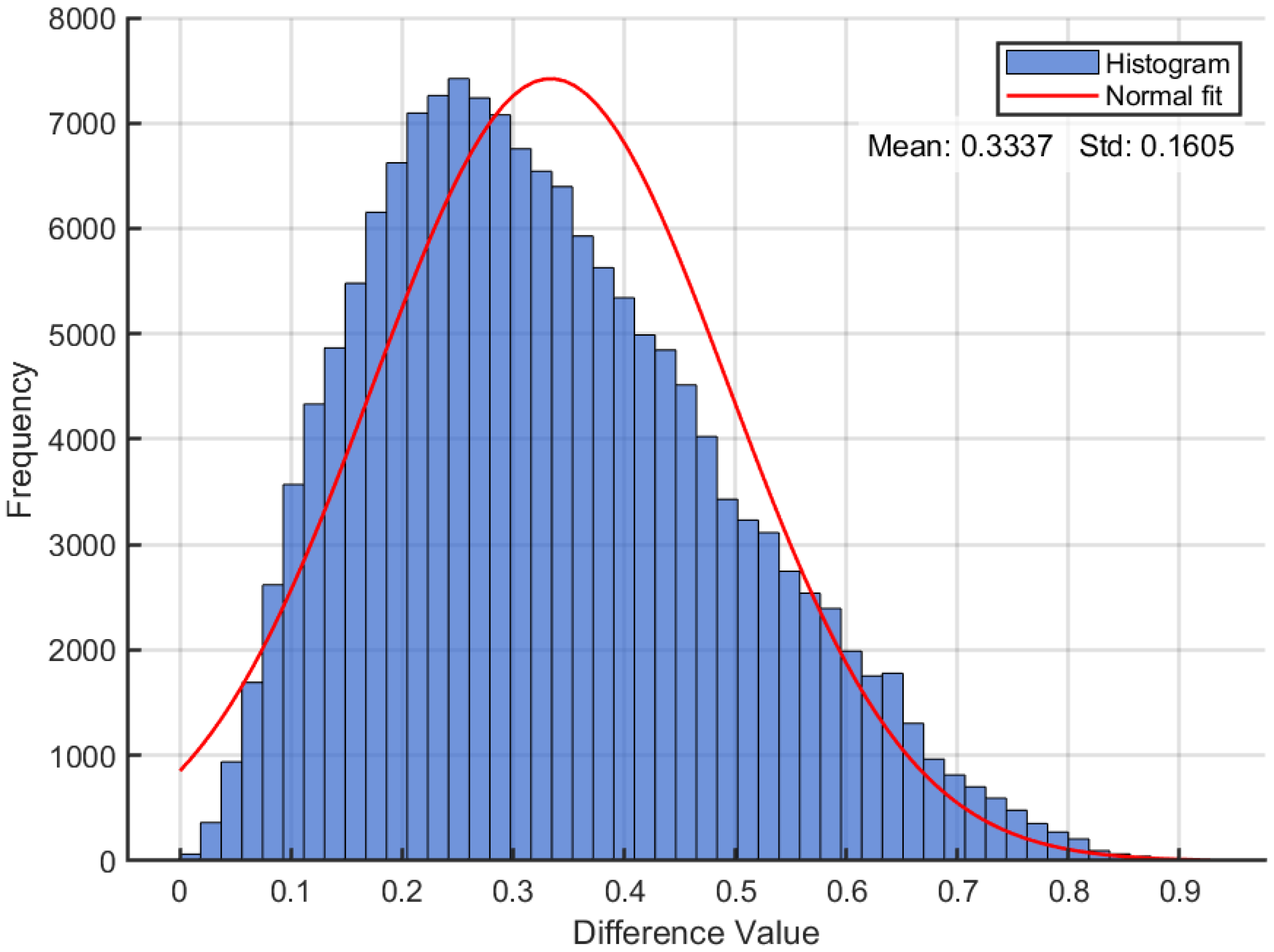
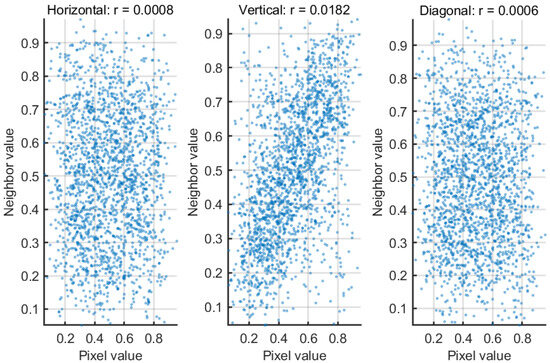
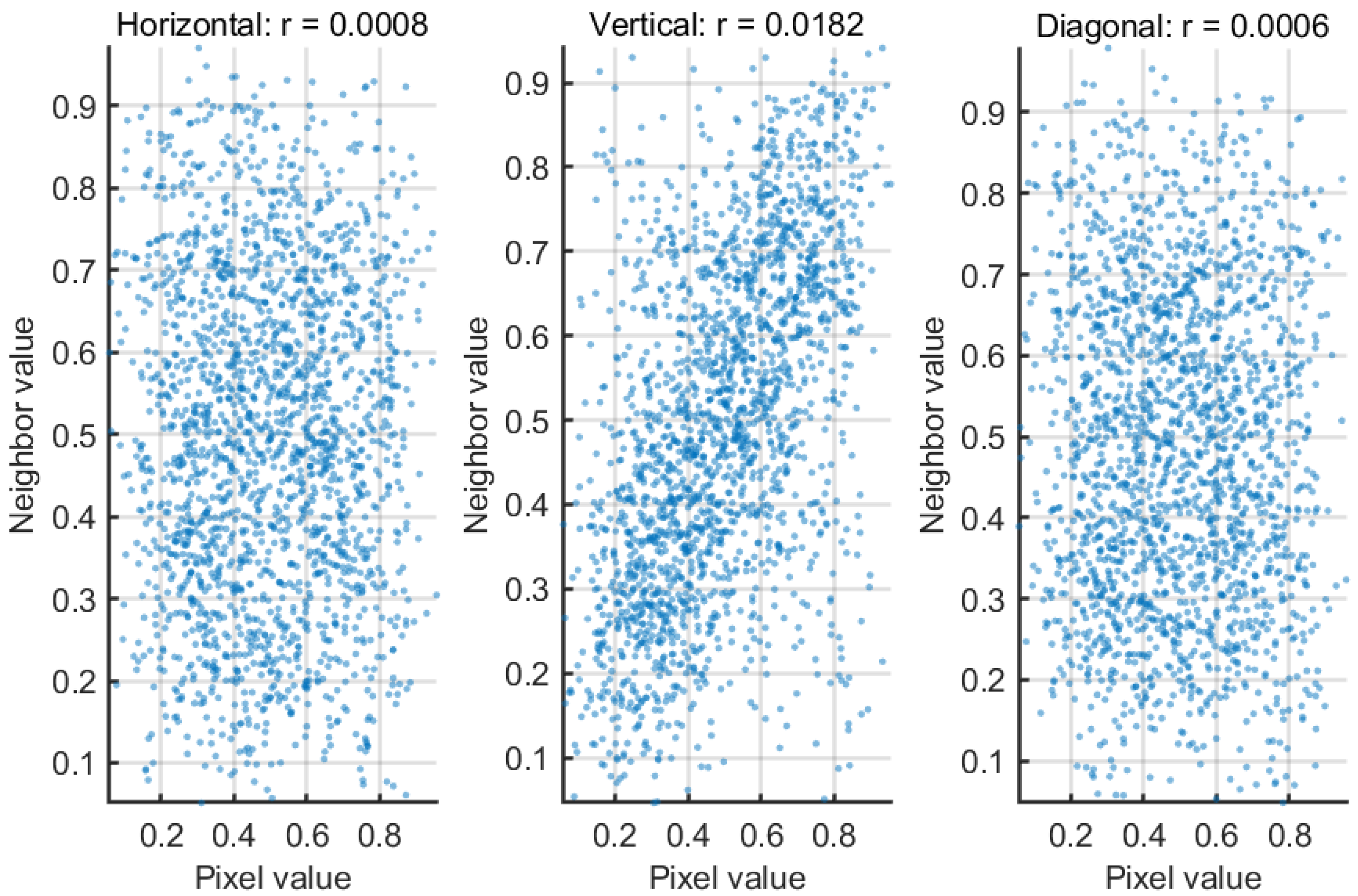
The proposed method resizes the image to no more than 512 pixels and uses the QINN model (Equation (1), , , ) to generate an RGB keystream and permutation index. Encryption performs permutation, XOR, and diffusion; decryption is the inverse (Figure 11). Figure 12, Figure 13, and Figure 14 validate the randomness and low correlation through various heatmaps, histograms, and scatter plots.
Figure 11.
Original, encrypted, and decrypted images.
Figure 12.
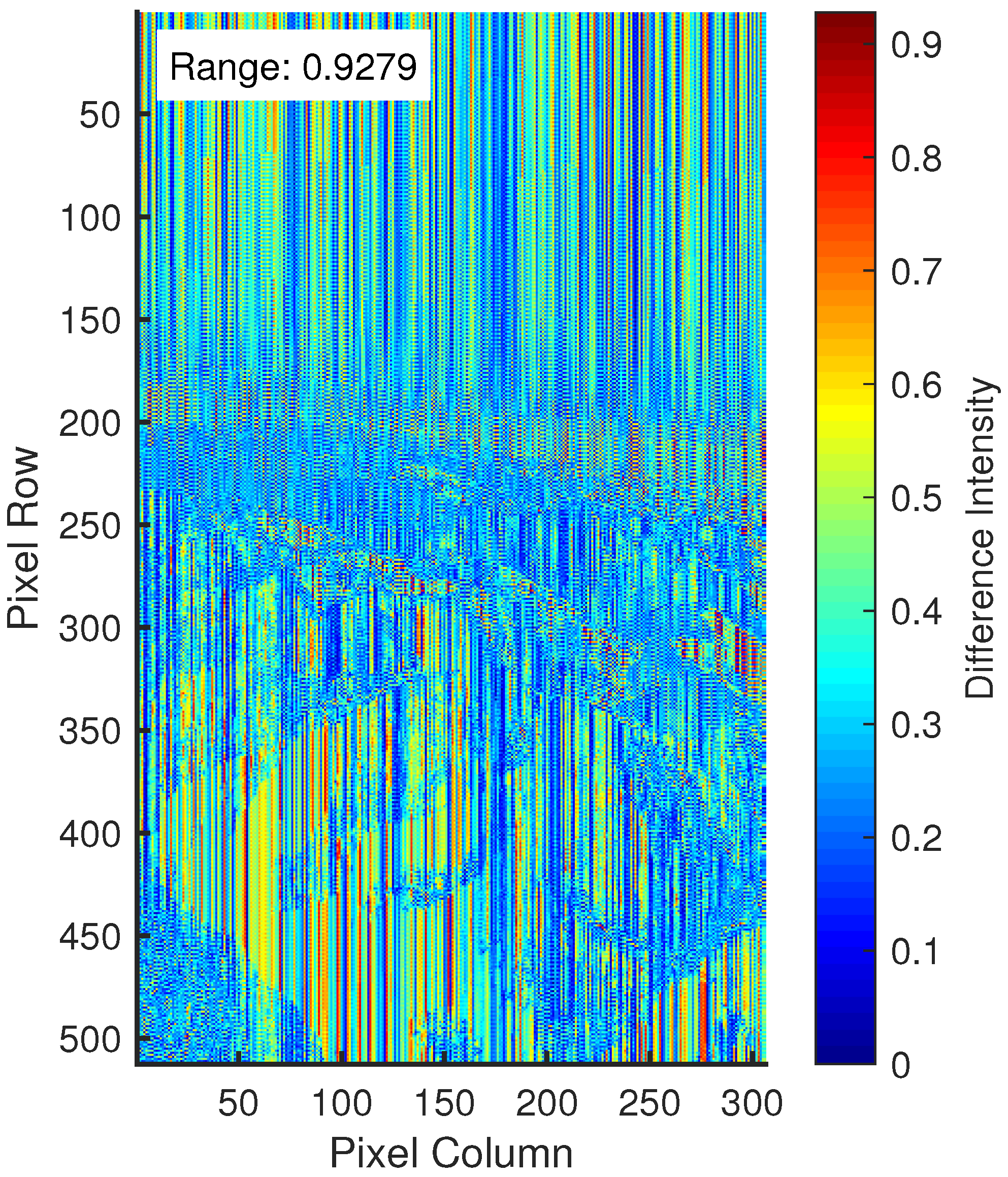
Difference heatmap between original and encrypted images.
Figure 13.
Histogram of pixel difference values with normal distribution fitting.
Figure 14.
Scatter plots of adjacent pixel correlations for the encrypted image.
Figure 11 illustrates the visual results of image encryption and decryption. The original image is a clear grayscale image, while the encrypted image appears as an irregular noise-like pattern with no discernible information. The decrypted image is virtually identical to the original. Quantitative metrics show that the encryption entropy reaches , the NPCR is , the PSNR with the correct key is dB, and the PSNR with a wrong key is dB, demonstrating effective confusion, strong resistance to differential attacks, nearly lossless decryption performance, and extreme sensitivity to the key.
Finally, Figure 14 shows the scatter plots of adjacent pixel correlations in the encrypted image for the horizontal, vertical, and diagonal directions. The correlation coefficients are (horizontal), (vertical), and (diagonal), all close to 0, indicating that the encryption algorithm effectively destroys the statistical structure of the plaintext image, further ensuring the security of the scheme.
6. Conclusions
This paper investigates the exponential synchronization problem for a class of quaternion-valued inertial neural networks with mixed time delays under aperiodic intermittent quantized control. Unlike conventional reduced-order or quaternion decomposition approaches, a novel quaternion-based controller is proposed that operates directly on the original second-order dynamics. This direct analysis method significantly simplifies the theoretical derivation while preserving the complete algebraic structure of quaternion-valued systems. By constructing an appropriate Lyapunov–Krasovskii functional and leveraging the algebraic properties of quaternions together with standard inequality techniques, sufficient conditions for achieving global exponential synchronization were rigorously derived. The obtained criteria were presented in terms of matrix inequalities, which were convenient to verify in practice. Numerical simulations were carried out to demonstrate the effectiveness of the proposed control strategy and to validate the theoretical results.
To further corroborate the practical viability of the proposed synchronization scheme, an image encryption application was developed. As shown in the experimental results, the original image was encrypted into a noise-like pattern without any discernible information leakage and was perfectly recovered after synchronization. Quantitative analysis revealed that the encryption entropy reached 7.6372, the NPCR reached 99.74%, the PSNR with the correct key reached 156.54 dB, and the PSNR with a wrong key was 7.73 dB, confirming the high-precision exponential synchronization achieved by the proposed aperiodic intermittent quantized control scheme.
Future work will focus on extending the proposed method to fixed-time synchronization, incorporating impulsive effects or stochastic disturbances, and developing more sophisticated encryption schemes for real-time secure communication applications—for instance, by integrating PDE-based image preprocessing techniques [42]—to further enhance the overall performance of the encryption system.
Author Contributions
J.H.: Writing—Original Draft, Formal Analysis; L.W.: Investigation, Validation; Z.Y.: Visualization, Data Curation; Y.Y.: Writing—Review and Editing, Validation; Q.J.: Funding Acquisition, Writing—Review and Editing, Methodology. All authors have read and agreed to the published version of the manuscript.
Funding
This research was funded by the Open Research Project of the Key Laboratory of Tarim University (Grant No. TOlab2025Z01), supported by the President’s Fund of the Huyang Talent Cultivation Research Initiation Project (Grant No. 2026133); the Tarim University First-Class Course Construction Project (Mathematical Modeling) (Grant No. TDYLKC202430); and the President’s Fund Project of Tarim University (Grant No. TDZKSS202443).
Data Availability Statement
The raw data supporting the conclusions of this article will be made available by the authors on request.
Conflicts of Interest
The authors declare that they have no known competing financial interests or personal relationships that could have appeared to influence the work reported in this paper.
References
- Chen, G.; Chen, Q.; Long, S.; Zhu, W.; Yuan, Z.; Wu, Y. Quantum convolutional neural network for image classification. Pattern Anal. Appl. 2020, 26, 655–667. [Google Scholar] [CrossRef] [Scilit]
- Pilataxi, J.I.; Perez, J.P.; Perez, C.A.; Bowyer, K.W. Neuroevolutionary convolutional neural network design for low-resolution face recognition. IEEE Access 2025, 13, 75911–75923. [Google Scholar] [CrossRef] [Scilit]
- Hong, P.; Luo, X.; Bao, L. Crop disease diagnosis and prediction using two-stream hybrid convolutional neural networks. Crop Prot. 2024, 184, 106867. [Google Scholar] [CrossRef] [Scilit]
- Zhang, M.; Wang, D. Robust dissipativity analysis for delayed memristor-based inertial neural network. Neurocomputing 2019, 366, 340–351. [Google Scholar] [CrossRef] [Scilit]
- Yang, J.; Jian, J. Dissipativity analysis of memristive inertial competitive neural networks with mixed delays. Neural Process. Lett. 2024, 56, 151. [Google Scholar] [CrossRef] [Scilit]
- Wang, W.; Zeng, W.; Chen, W. New sufficient conditions on the global exponential stability of delayed inertial neural networks. Neurocomputing 2025, 622, 129301. [Google Scholar] [CrossRef] [Scilit]
- García-Retuerta, D.; Casado-Vara, R.; Martin-del Rey, A.; De la Prieta, F.; Prieto, J.; Corchado, J.M. Quaternion neural networks: State-of-the-art and research challenges. In Proceedings of the 21st International Conference on Intelligent Data Engineering and Automated Learning (IDEAL 2020), Guimaraes, Portugal, 4–6 November 2020; Springer International Publishing: Cham, Switzerland, 2020; pp. 456–467. [Google Scholar]
- Zou, A.M.; Kumar, K.D.; Hou, Z.G. Quaternion-based adaptive output feedback attitude control of spacecraft using Chebyshev neural networks. IEEE Trans. Neural Netw. 2010, 21, 1457–1471. [Google Scholar]
- Bayro-Corrochano, E.; Lechuga-Gutiérrez, M.; Garza-Burgos, M. Geometric techniques for robotics and HMI: Interpolation and haptics in conformal geometric algebra and control using quaternion spike neural networks. Robot. Auton. Syst. 2018, 104, 72–84. [Google Scholar] [CrossRef] [Scilit]
- Li, R.; Cao, J. Exponential stabilization of inertial quaternion-valued Cohen–Grossberg neural networks: Lexicographical order method. Int. J. Robust Nonlinear Control 2020, 30, 5205–5220. [Google Scholar] [CrossRef] [Scilit]
- Bi, W.; Cheng, D.; Liu, W.; Kou, K.I. A robust color edge detection algorithm based on the quaternion hardy filter. Acta Math. Sci. 2022, 42, 1021–1038. [Google Scholar] [CrossRef] [Scilit]
- Xiao, L.; Liu, S.; Wang, X.; He, Y.; Jia, L.; Xu, Y. Zeroing neural networks for dynamic quaternion-valued matrix inversion. IEEE Trans. Ind. Inform. 2021, 18, 1562–1571. [Google Scholar] [CrossRef] [Scilit]
- Zhao, R.; Wang, B.; Jian, J. Lagrange stability of BAM quaternion-valued inertial neural networks via auxiliary function-based integral inequalities. Neural Process. Lett. 2022, 54, 1351–1369. [Google Scholar] [CrossRef] [Scilit]
- Zhang, H.W.; Zhang, R.F.; Liu, Q.R. A novel multi-modal method for the (3+1)-dimensional Boiti-Leon-Manna-Pempinelli equation. Chin. Phys. Lett. 2025, 42, 100002. [Google Scholar]
- Li, X.; Pal, N.R.; Li, H.; Huang, T. Intermittent event-triggered exponential stabilization for state-dependent switched fuzzy neural networks with mixed delays. IEEE Trans. Fuzzy Syst. 2022, 30, 3312–3321. [Google Scholar] [CrossRef] [Scilit]
- Li, N.; Zheng, W.X. Bipartite synchronization for inertia memristor-based neural networks on coopetition networks. Neural Netw. 2020, 125, 50–62. [Google Scholar] [CrossRef] [Scilit] [PubMed]
- Zhu, J.; Sun, J. Stability of Quaternion-Valued Neural Networks with Mixed Delays. Neural Process. Lett. 2018, 48, 1123–1138. [Google Scholar] [CrossRef] [Scilit]
- Won, S.; Bae, S.H.; Kim, S.T. Effects of mixed sample data augmentation on interpretability of neural networks. Neural Netw. 2025, 190, 107611. [Google Scholar] [CrossRef] [Scilit] [PubMed]
- Aouiti, C.; Assali, E.A. Finite-Time and Fixed-Time Synchronization of Inertial Neural Networks with Mixed Delays. J. Syst. Sci. Complex. 2021, 34, 206–235. [Google Scholar]
- Li, W.; Gao, X.; Li, R. Stability and synchronization control of inertial neural networks with mixed delays. Appl. Math. Comput. 2020, 367, 124779. [Google Scholar] [CrossRef] [Scilit]
- Guo, R.; Xu, S. Observer-based sliding mode synchronization control of complex-valued neural networks with inertial term and mixed time-varying delays. Appl. Math. Comput. 2023, 442, 127761. [Google Scholar] [CrossRef] [Scilit]
- Hui, J.; Hu, C.; Yu, J.; Jiang, H. Intermittent control based exponential synchronization of inertial neural networks with mixed delays. Neural Process. Lett. 2021, 53, 3965–3979. [Google Scholar] [CrossRef] [Scilit]
- Shukla, V.K.; Joshi, M.C.; Mishra, P.K.; Mousavi, Y.; Zadeh, M.R.; Fekih, A. Predefined synchronization of mixed and leakage-delayed quaternion-valued neural network. Int. J. Dyn. Control 2025, 13, 51. [Google Scholar] [CrossRef] [Scilit]
- Xiong, K.; Hu, C.; Yu, J. Direct approach-based synchronization of fully quaternion-valued neural networks with inertial term and time-varying delay. Chaos Solitons Fractals 2023, 172, 113556. [Google Scholar] [CrossRef] [Scilit]
- Liu, L.; Bao, H.; Cao, J. Adaptive finite-time synchronization of quaternion-valued inertial neural networks with mixed delays under quantized event-triggered impulsive strategy. J. Frankl. Inst. 2024, 361, 107020. [Google Scholar] [CrossRef] [Scilit]
- Wei, H.; Wu, B.; Tu, Z. Exponential synchronization and state estimation of inertial quaternion-valued Cohen-Grossberg neural networks: Lexicographical order method. Int. J. Robust Nonlinear Control 2020, 30, 2171–2185. [Google Scholar] [CrossRef] [Scilit]
- Chen, X.; Cheng, G.; Xiao, W. Matrix measure strategies for stabilization of delayed inertial neural networks via intermittent control. IEEE Access 2021, 9, 155601–155610. [Google Scholar] [CrossRef] [Scilit]
- Jiang, Y.; Zhu, S.; Liu, X.; Wen, S.; Mu, C. Input-to-state stability of delayed memristor-based inertial neural networks via non-reduced order method. Neural Netw. 2024, 178, 106545. [Google Scholar] [CrossRef] [Scilit] [PubMed]
- Wang, H.; Tan, J.; Wen, S. Exponential stability analysis of mixed delayed quaternion-valued neural networks via decomposed approach. IEEE Access 2020, 8, 88482–88490. [Google Scholar] [CrossRef] [Scilit]
- Singh, S.; Das, S.; Chouhan, S.S.; Cao, J. Anti-synchronization of inertial neural networks with quaternion-valued and unbounded delays: Non-reduction and non-separation approach. Knowl.-Based Syst. 2023, 278, 110903. [Google Scholar] [CrossRef] [Scilit]
- Fei, J.; Ren, S.; Zheng, C.; Yu, J.; Hu, C. Aperiodically intermittent quantized control-based exponential synchronization of quaternion-valued inertial neural networks. Neural Netw. 2024, 180, 106669. [Google Scholar] [CrossRef] [Scilit] [PubMed]
- Huang, Q.; Yue, Y.; Cao, J. Projective synchronization of inertial quaternion-valued neural networks via non-reduced order approach. Neural Process. Lett. 2024, 56, 21. [Google Scholar] [CrossRef] [Scilit]
- Liang, Z.; Ding, S.; Jing, Y.; Xie, X. Aperiodic intermittent event-triggered synchronization control for discrete-time complex dynamical networks. Expert Syst. Appl. 2024, 237, 121500. [Google Scholar] [CrossRef] [Scilit]
- Zhang, J.; Liu, S.; Jiang, H.; Abudurahman, A. Deep neural networks-based and output relied nonperiodic intermittent control for high-order nonstrict-feedback nonlinear systems. J. Frankl. Inst. 2025, 362, 107878. [Google Scholar] [CrossRef] [Scilit]
- Fu, X.; Wang, J. Non-periodic intermittent stochastic control for SVIQR epidemic model on complex network with saturation incidence rate. Chaos Solitons Fractals 2025, 199, 116671. [Google Scholar] [CrossRef] [Scilit]
- Cheng, L.; Tang, F.; Shi, X.; Chen, X.; Qiu, J. Finite-time and fixed-time synchronization of delayed memristive neural networks via adaptive aperiodically intermittent adjustment strategy. IEEE Trans. Neural Netw. Learn. Syst. 2023, 34, 8516–8530. [Google Scholar] [CrossRef] [Scilit]
- Liu, D.; Ye, D. Exponential Stabilization of Delayed Inertial Memristive Neural Networks via Aperiodically Intermittent Control Strategy. IEEE Trans. Syst. Man Cybern. Syst. 2022, 52, 448–458. [Google Scholar] [CrossRef] [Scilit]
- Abdelaziz, M.; Chérif, F. Finite-Time Synchronization and Exponential lag synchronization of quaternion-valued inertial fuzzy Cohen–Grossberg neural networks with impulsives and mixed delays. Chaos Solitons Fractals 2024, 180, 114520. [Google Scholar] [CrossRef] [Scilit]
- Liu, J.; Jian, J.G.; Wang, B.X. Stability analysis for BAM quaternion-valued inertial neural networks with time delay via nonlinear measure approach. Math. Comput. Simul. 2020, 174, 134–152. [Google Scholar] [CrossRef] [Scilit]
- Meng, X.; Li, Z.; Cao, J. Image encryption via sliding mode synchronization of fractional-order quaternion-valued T-S fuzzy neural networks with uncertain parameters. IEEE Trans. Fuzzy Syst. 2026, 34, 483–497. [Google Scholar] [CrossRef] [Scilit]
- Liu, X.W.; Chen, T.P. Synchronization of linearly coupled networks with delays via aperiodically intermittent pinning control. IEEE Trans. Neural Netw. Learn. Syst. 2015, 26, 2396–2407. [Google Scholar] [CrossRef] [Scilit]
- Tian, C.; Chen, Y.G. Image segmentation and denoising algorithm based on partial differential equations. IEEE Sens. J. 2020, 20, 11935–11942. [Google Scholar] [CrossRef] [Scilit]

Disclaimer/Publisher’s Note: The statements, opinions and data contained in all publications are solely those of the individual author(s) and contributor(s) and not of MDPI and/or the editor(s). MDPI and/or the editor(s) disclaim responsibility for any injury to people or property resulting from any ideas, methods, instructions or products referred to in the content. |
© 2026 by the authors. Licensee MDPI, Basel, Switzerland. This article is an open access article distributed under the terms and conditions of the Creative Commons Attribution (CC BY) license.