


Abstract
Topological indices are numerical parameters that provide a way to quantify the structural features of molecules using their graph representations. In chemical graph theory, these indices have been effectively employed to predict various physico-chemical properties of molecules. Among these, the Randić index stands out as a classical and widely used molecular descriptor in chemistry and pharmacology. The Randić index for a given graph G is defined as , where represents the degree of vertex and is the set of edges in the graph G. Given the Randić index’s strong discrimination ability in describing molecular structures, a variant known as the exponential Randić index was recently introduced. The exponential Randić index for a graph G is defined as . This paper further explores and fully characterizes the minimal molecular trees in relation to the exponential Randić index. Moreover, the chemical relevance of the exponential Randić index is also investigated.
MSC:
05C90; 05C07; 05C35
1. Introduction
In theoretical organic chemistry, understanding the relationship between molecular structures and their physico-chemical properties is of fundamental importance. Graph theory provides a powerful framework for this, where molecules are modeled as graphs, with atoms represented by vertices and chemical bonds by edges. To quantify the structural characteristics of organic molecules and predict their specific physico-chemical properties, several graph-based indices have been developed. Among these, the Randić index is one of the most prominent and widely used. Introduced by Milan Randić in 1975, the Randić index (R) [1] quantifies molecular branching by considering the degrees of a graph’s vertices. Given a graph G with a vertex set and an edge set , the Randić index is defined as:
where represents the degree of a vertex in G. Randić observed that this index correlates remarkably well with various physico-chemical properties of alkanes, making it a valuable tool in chemical research. Since its introduction, the Randić index has found numerous applications in both chemistry and pharmacology, particularly in the study of molecular structures.
Building upon the original Randić index, researchers later introduced the generalized Randić index to broaden its applicability. The generalized Randić index is defined as:
where is a real number that can be adjusted to modify the index’s sensitivity to different structural features. This generalization provides a more flexible approach, allowing for the exploration of new correlations between molecular structure and properties across a wider range of chemical compounds.
Numerous researchers have thoroughly examined the mathematical properties of both R and for various class of graphs. Bollobás and Erdos [2] demonstrated that, among all connected graphs, the star graph achieves the lowest value for R. Caporossi et al. [3] found that, among all trees, the path graph has the highest value with respect to R. Hu and Li [4,5] further identified the trees with the smallest and highest values for . For additional findings on R and , see references [6,7,8,9,10,11,12,13,14,15,16,17,18,19,20]. In 2019, a significant development was made when degree-based indices were enhanced to their exponential forms, increasing their discriminative power [21]. Following this advancement, numerous studies explored the implications and applications of these exponential indices [22,23,24,25,26,27,28,29]. This paper focuses specifically on the exponential Randić index introduced by Rada [21]. The exponential Randić index () for a graph G is defined as:
Let us consider a function:
Then, we have:
Cruz et al. [30] showed that, among all trees, the path graph attains the highest value for . Cruz and Rada [23] also established that the star graph achieves the lowest value of among all trees. Further work by Qiu et al. [31] examined the extremal values of for quasi-tree graphs and described the specific graphs that reached these values. Lin and Zhu [32] extended this research to unicyclic graphs, determining their extreme values of and identifying the graphs that achieved these extreme values.
Identifying extremal graphs across various classes plays a crucial role in mathematical chemistry. A particularly important class is that of molecular trees’ acyclic connected graphs with a maximum degree of 4. Zhong [33] investigated the extremal values of the harmonic index for molecular trees and characterized those that achieved these values. Gutman et al. [34] determined the extreme values of R for molecular trees and described the specific trees attaining these values. Zhou and Trinajstíc [35] identified the molecular trees with the lowest, second-lowest, and third-lowest sum-connectivity indices. Deng et al. [36] analyzed the molecular trees to determine which ones have the lowest and highest values of the Sombor index. In [37], the authors characterized the extremal molecular trees for the exponential augmented Zagreb index. For more results in this direction, see references [38,39,40,41,42,43,44].
The classical Randić index is useful for predicting molecular properties, but it may not always distinguish between similar structures. To address this, the exponential Randić index () was introduced. This study aims to enhance the understanding of the index by identifying molecular trees with lowest values, contributing to the broader knowledge of extremal graph structures. Additionally, we explore the chemical relevance of the index to demonstrate its potential in predicting important molecular properties, which could enhance its application in chemistry and pharmacology.
In this paper, we characterize the molecular trees with lowest values and investigate the chemical relevance of the index.
2. Main Result
This section discusses the minimum value of for molecular trees and identifies the extremal trees. For this purpose, we define the following notations.
Let T be a molecular tree with n vertices. The number of vertices in T with degree j is denoted by , while represents the number of edges in T that connect vertices of degrees i and j. The neighborhood of a vertex in T is indicated by . Let represent the set of all molecular trees with n vertices, and denote the subset of molecular trees within that achieve the lowest index.
The values of for various edges in the molecular tree T are as follows:
We begin with the following result.
Lemma 1.
Let . If , then .
Proof.
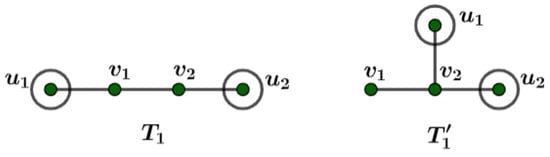
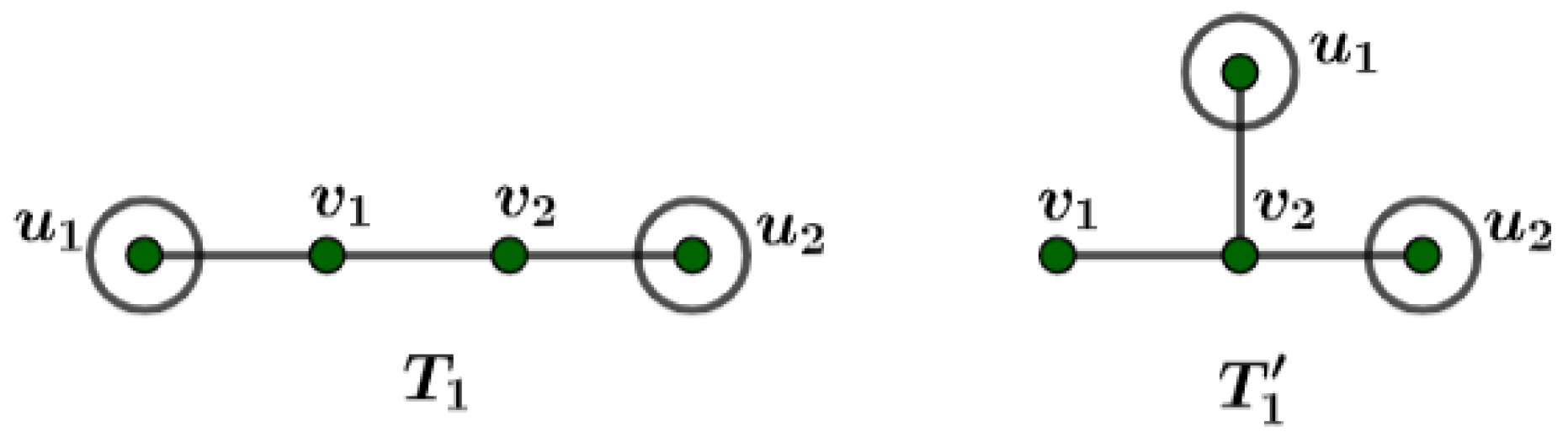
Assume to the contrary that with . Therefore, there exists an edge with and . Suppose , , and , . Without loss of generality, we can assume that . Now we transform the tree into a new tree (see, Figure 1) by deleting the edge and adding the edge , that is, .
Figure 1.
Two molecular trees and .
By (1), we obtain:
Table 1 displays the values of for various combinations of and .
Table 1.
Approximate values for the expression on the right side of Equation (2).
Lemma 2.
Let . If , then .
Proof.
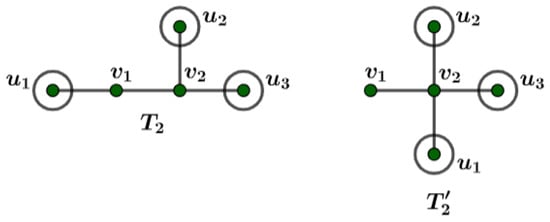
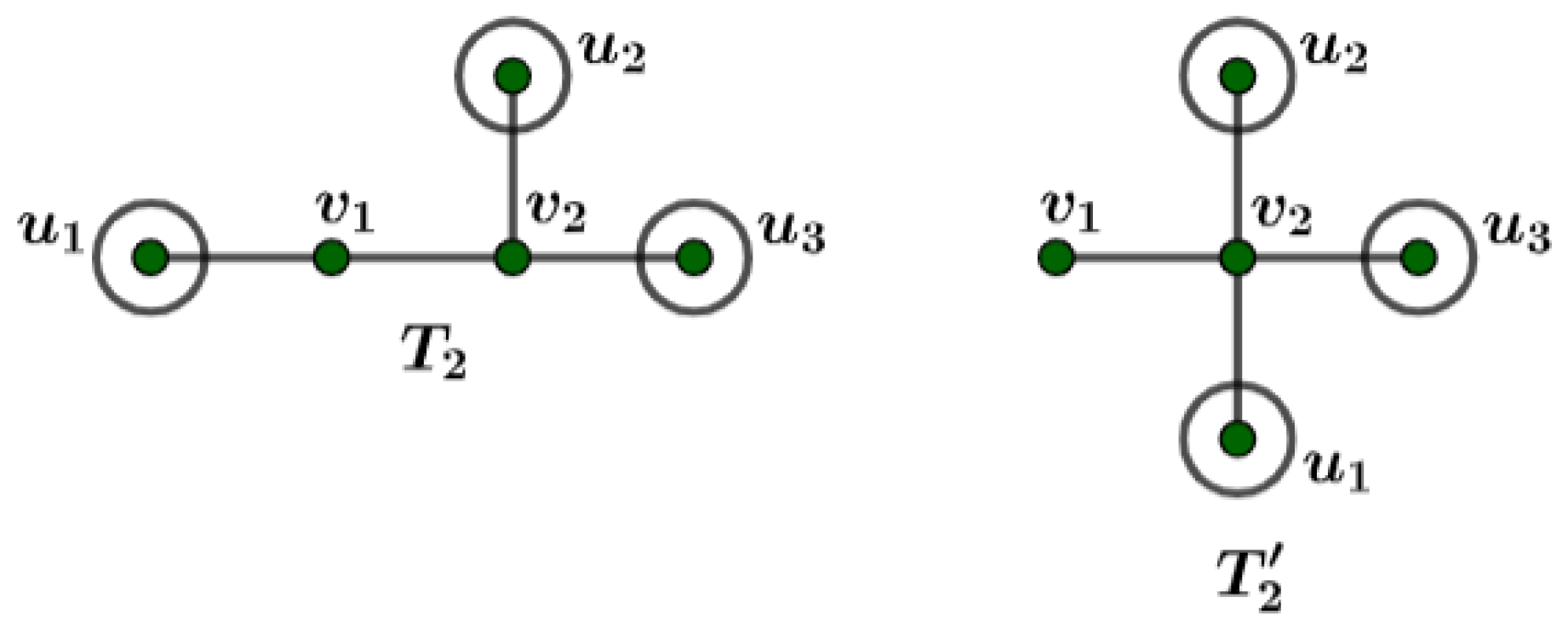
Assume to the contrary that such that with and . Suppose and . By Lemma 1, we have , and hence, as and . Thus, we have . Without loss of generality, we can assume that . Now we transform to , where , as illustrated in Figure 2. By (1), we obtain:
Figure 2.
Two molecular trees and .
Table 2 presents the values of for all possible combinations of , , and .
Table 2.
Approximate values for the expression on the right side of (3).
Lemma 3.
Let . If , then .
Proof.
Assume to the contrary that with . So there exists an edge , where degree of is 3 and degree of is 3. Suppose the neighbors of , other than , are and and the neighbors of , other than , are and . Based on Lemma 2, we can say that for . Without loss of generality, we can assume that and . We consider a set:
Now we consider the following four cases.
- Case 1. .
We transform the tree into a new tree , as shown in Figure 3.
Figure 3.
Two molecular trees and .
Table 3 lists the values of for all possible combinations of , , , and .
Table 3.
Approximate values for the expression on the right side of (4).
By (1), we obtain:
From the above with Table 3, we obtain , which leads to a contradiction.
Using (1), we obtain:
Table 4 highlights the values of for all possible combinations of , , , and .
Table 4.
Approximate values for the expression given on the right side of (5).
- Case 3. .
The tree is illustrated as in Figure 5, with and . By Lemma 2, it is evident that and . Without loss of generality, we can assume that . Now we transform the tree into a new tree , as shown in Figure 5. Using (1), we obtain:
Figure 5.
Two molecular trees and .
Table 5 presents the values of for different pairs of and .
Table 5.
Approximate values for the expression given on the right side of Equation (6).
Thus, from relation (1), we get:
The values of for four cases of are displayed in Table 6.
Table 6.
Approximate values for the expression on the right side of (7).
Using Table 6 in (7), we obtain for , leading to a contradiction. Let us consider . In this instance, we display the tree as in Figure 7. Now we transform the tree into a tree , where , as illustrated in Figure 7. Using (1), we obtain:
Figure 7.
Two molecular trees and .
From the above, we obtain , which contradicts our assumption. Thus, the proof is finished. □
Lemma 4.
Let . If , then .
Proof.
Assume to the contrary that such that with and . Suppose that . Since , we have . According to Lemmas 2 and 3, for . Without loss of generality, we can assume that . Since is a molecular tree, using the above results, we obtain or .
Thus, applying (1), we obtain:
If , then , and hence, , a contradiction as . Otherwise, . The values of for three cases of are shown in Table 7.
Table 7.
Approximate values for the expression on the right side of (8).
- Case 2. . The tree is illustrated as in Figure 9, where and . As , . Thus, for at least one . Without loss of generality, we can assume that . Now the following three subcases may arise.Figure 9. The molecular tree .
Thus, applying (1), we get:
which is a contradiction.
Thus, applying (1), we get:
which is a contradiction. Thus, the proof is finished. □
Lemma 5.
Let . If , then .
Proof.
Assume to the contrary that such that with and . Suppose that . Since , so . According to Lemmas 1 and 2, , and hence, as is a molecular tree. We display the tree as in Figure 13, with . Without loss of generality, we can assume that . Now we transform the tree into a tree (see, Figure 13) by deleting the edges , and adding the edges , . By applying (1), we get from Figure 13 that:
Figure 13.
Two molecular trees and .
If , then , and hence, , a contradiction as . Otherwise, . The values of for three cases of are shown in Table 8.
Table 8.
Approximate values for the expression on the right side of (9).
Lemma 6.
Let . If , then .
Proof.
Assume to the contrary that with . There exist vertices , in , where the degree of is 2 and the degree of is 2. By Lemma 1, we have . Suppose that and . Based on Lemmas 1, 2, and 5, one can easily see that for . Hence, for . We express the tree as in Figure 14, with , , , and . Now we transform to , where , as illustrated in Figure 14. Thus, applying (1), we get:
which contradicts our assumption. Thus, the proof is finished. □
Figure 14.
Two molecular trees and .
Lemma 7.
Let . If , then .
Proof.
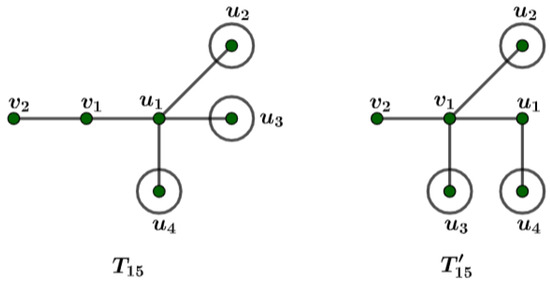
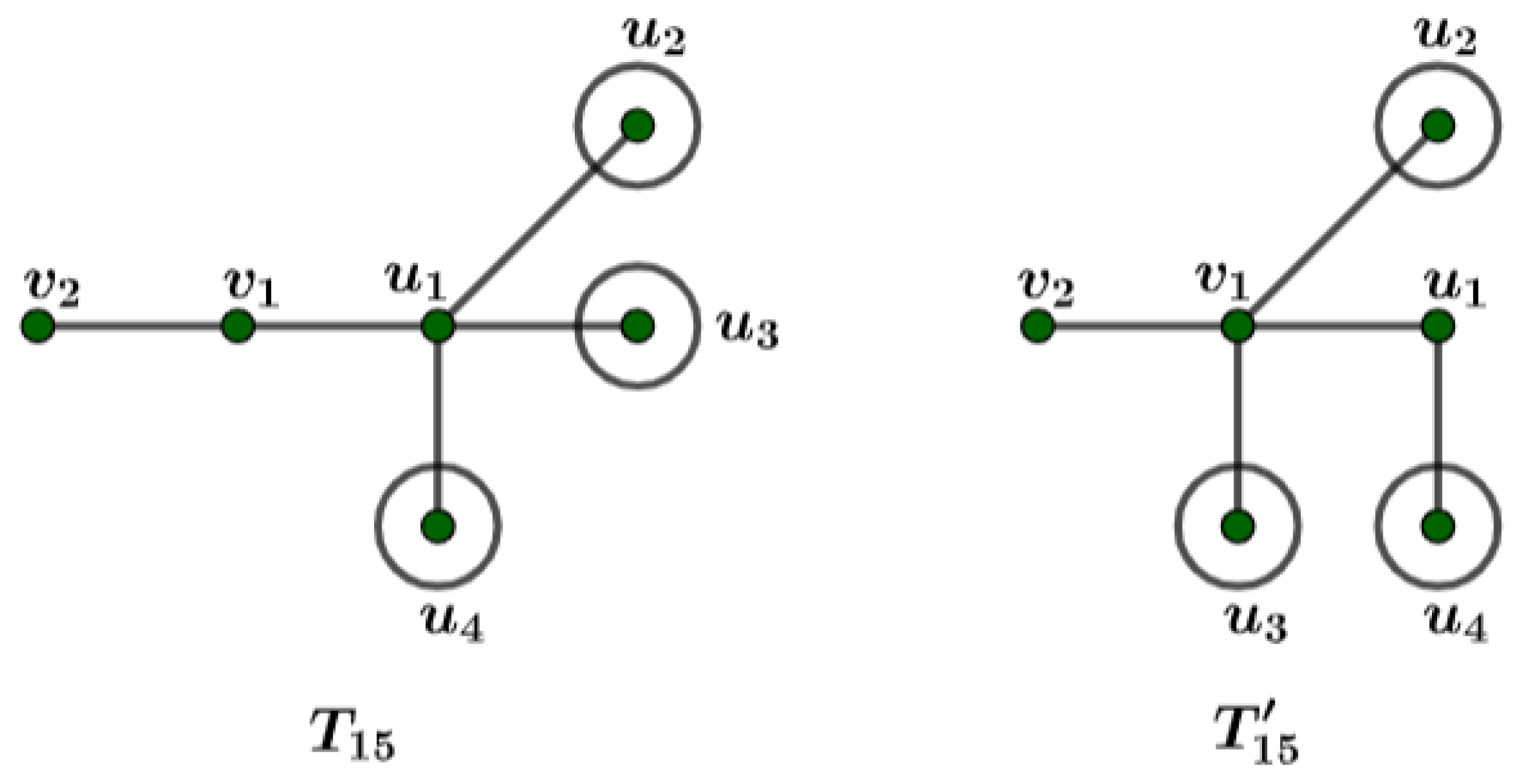
Assume to the contrary that with . Consider with and . By Lemma 3, we have . Suppose that and . By Lemmas 2–4, we obtain for . So, for . We represent the tree as in Figure 15, with , , , , , and . Now we transform to , where , as shown in Figure 15. Thus, from (1), we obtain:
which contradicts our assumption. Thus, the proof is finished. □
Figure 15.
Two molecular trees and .
Lemma 8.
Let . If , then or or .
Proof.
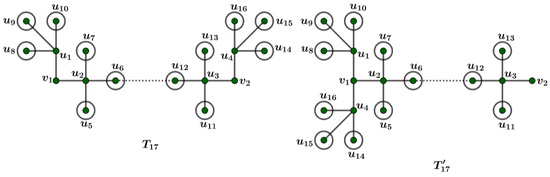
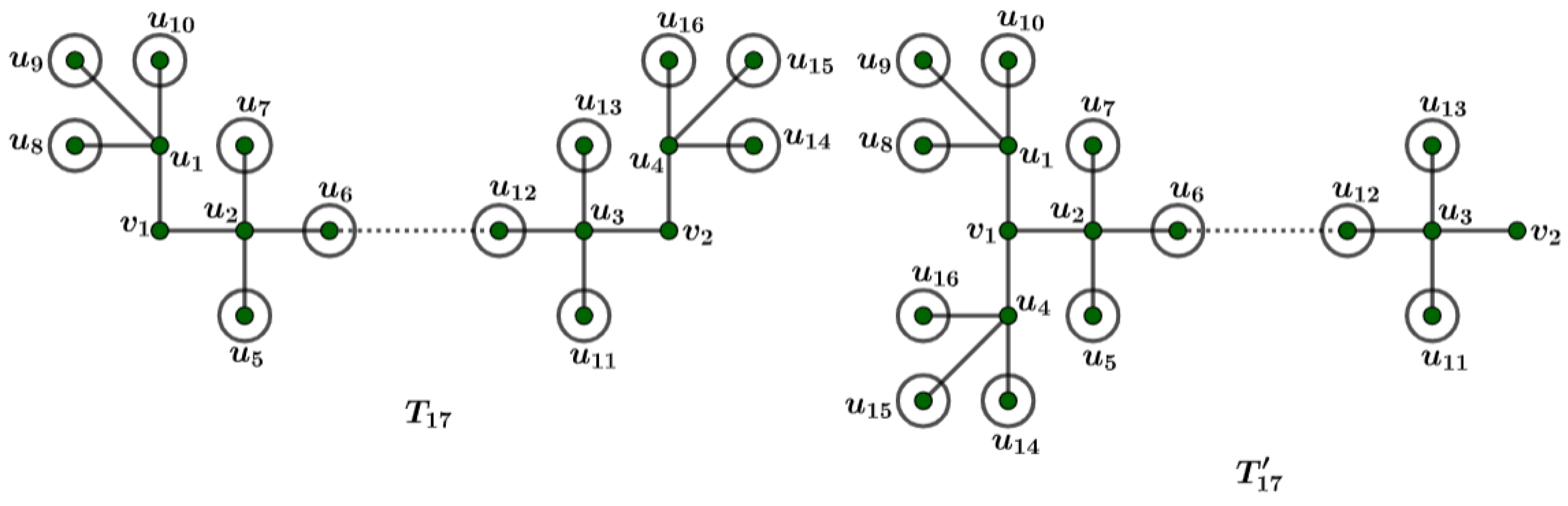
Assume to the contrary that with and . There exist vertices in , where the degree of is 3 and the degree of is 2. By Lemma 2, we have . Suppose that and . According to Lemmas 1–5, it is evident that for . Thus, for . We display the tree as in Figure 16, with , , , , and . Now we transform to , where , as displayed in Figure 16.
Figure 16.
Two molecular trees and .
By applying (1), we get:
which contradicts our assumption. This completes the proof. □
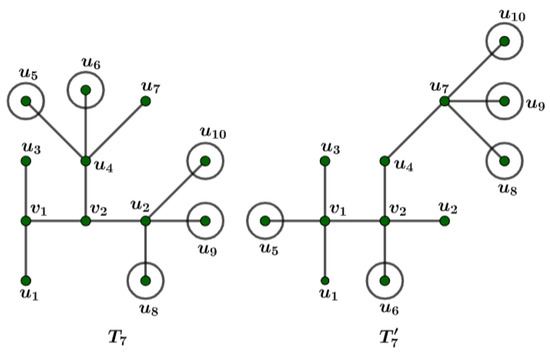
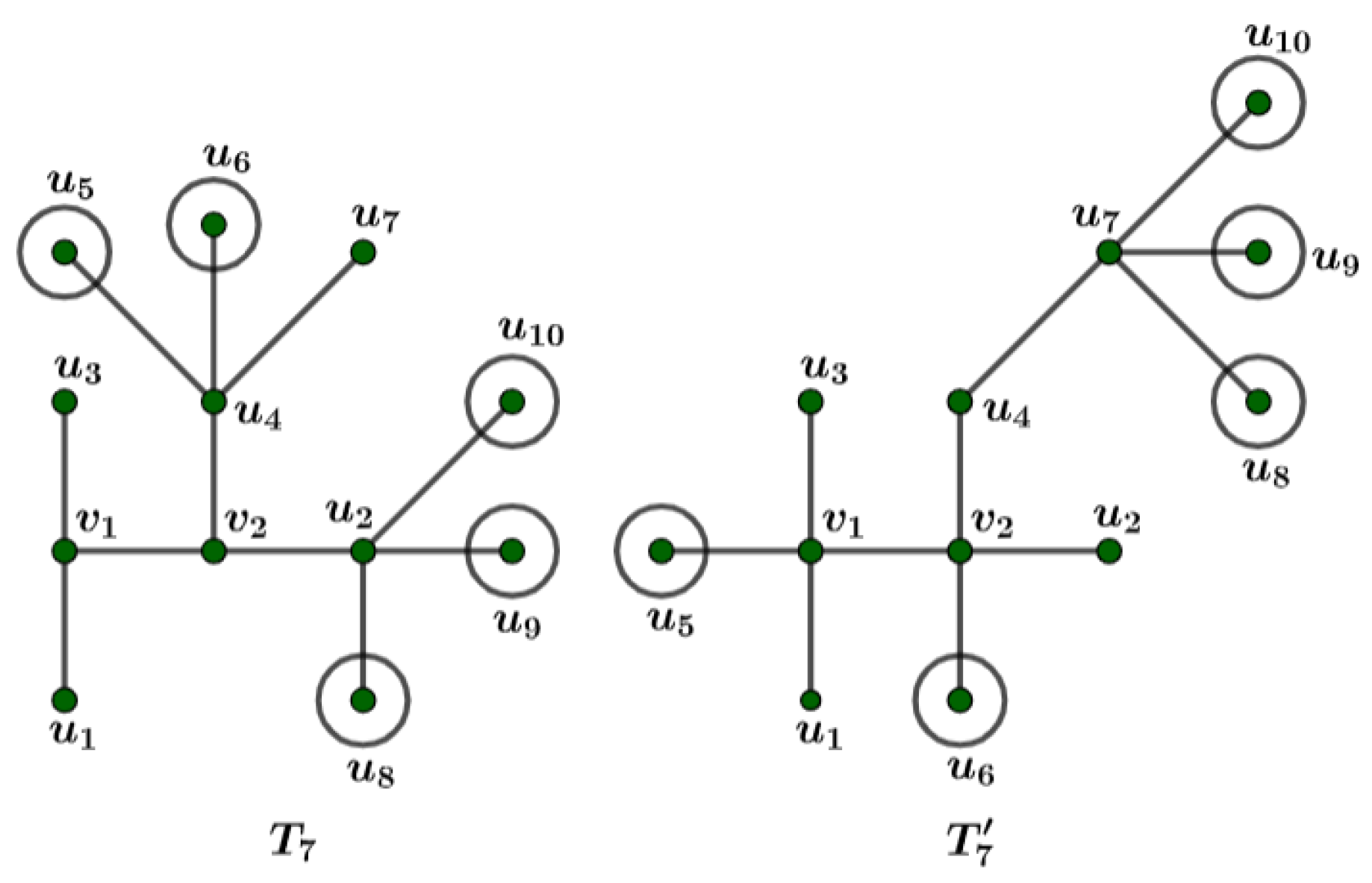
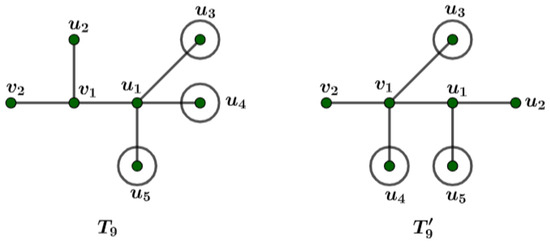
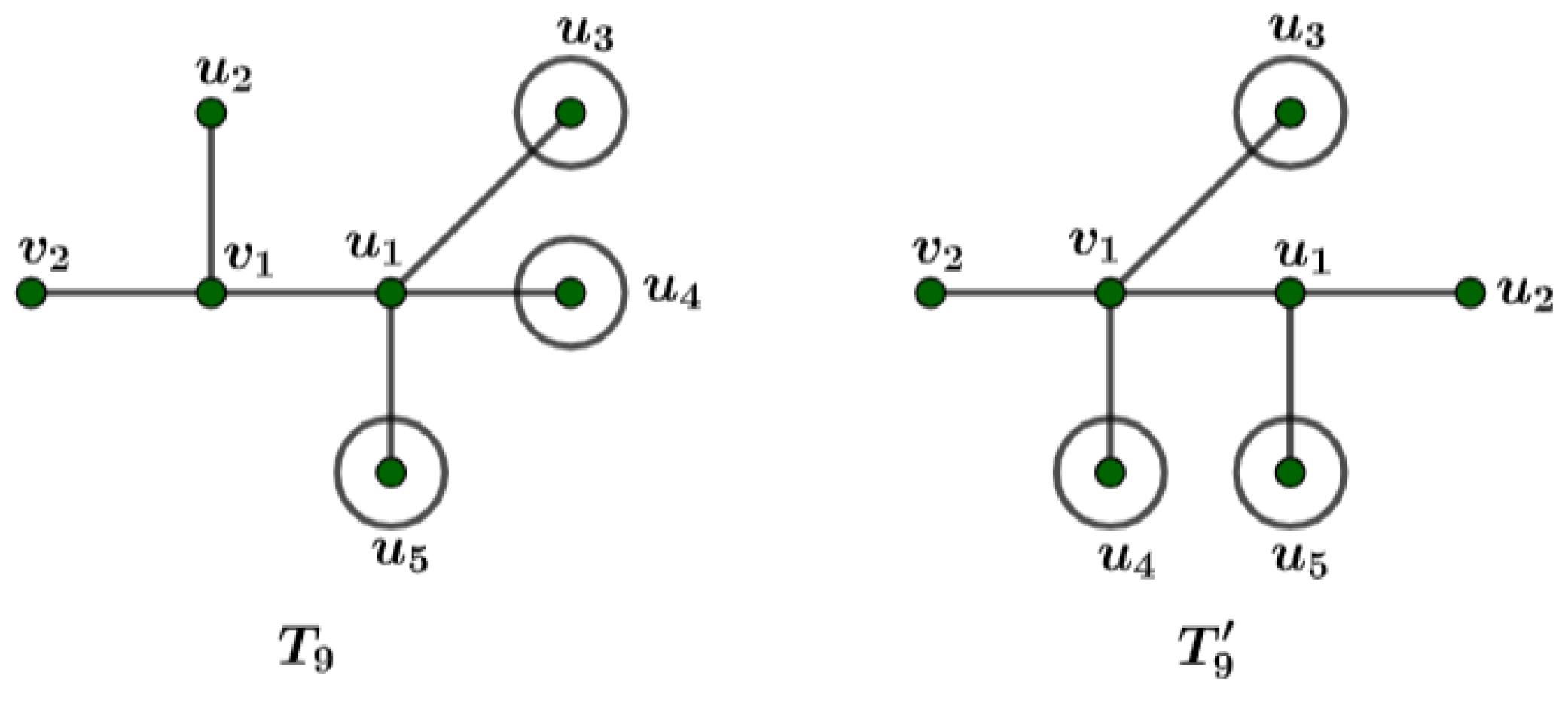
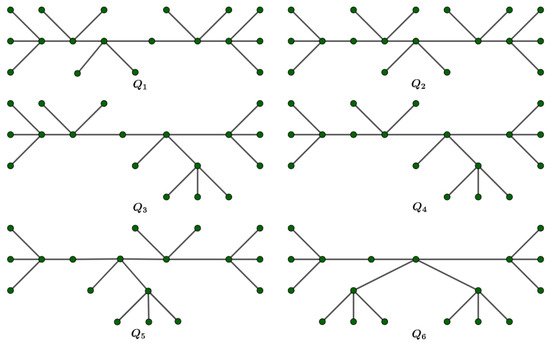
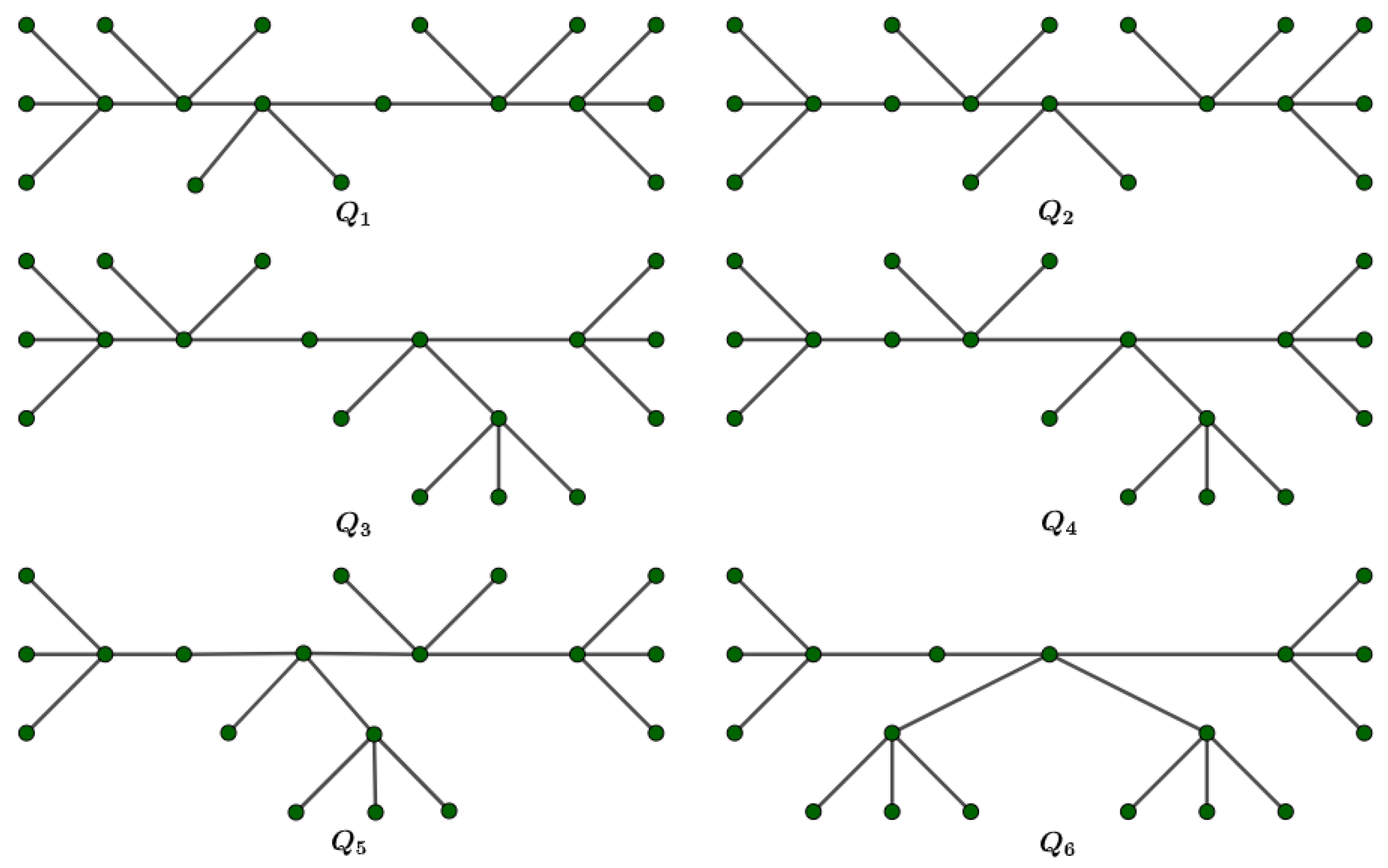
We define a class of molecular trees as follows:
Figure 17 presents examples of all molecular trees in for . For , we obtain:
Figure 17.
Molecular trees , and in for .
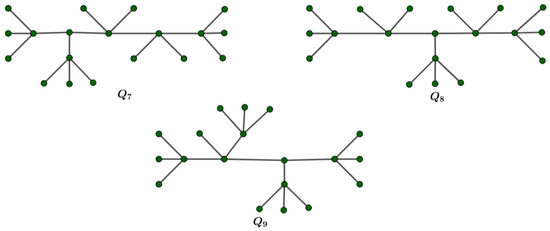
We define a class of molecular trees as follows:
Figure 18 presents examples of all molecular trees in for . For , we obtain:
Figure 18.
Molecular trees , and in for .
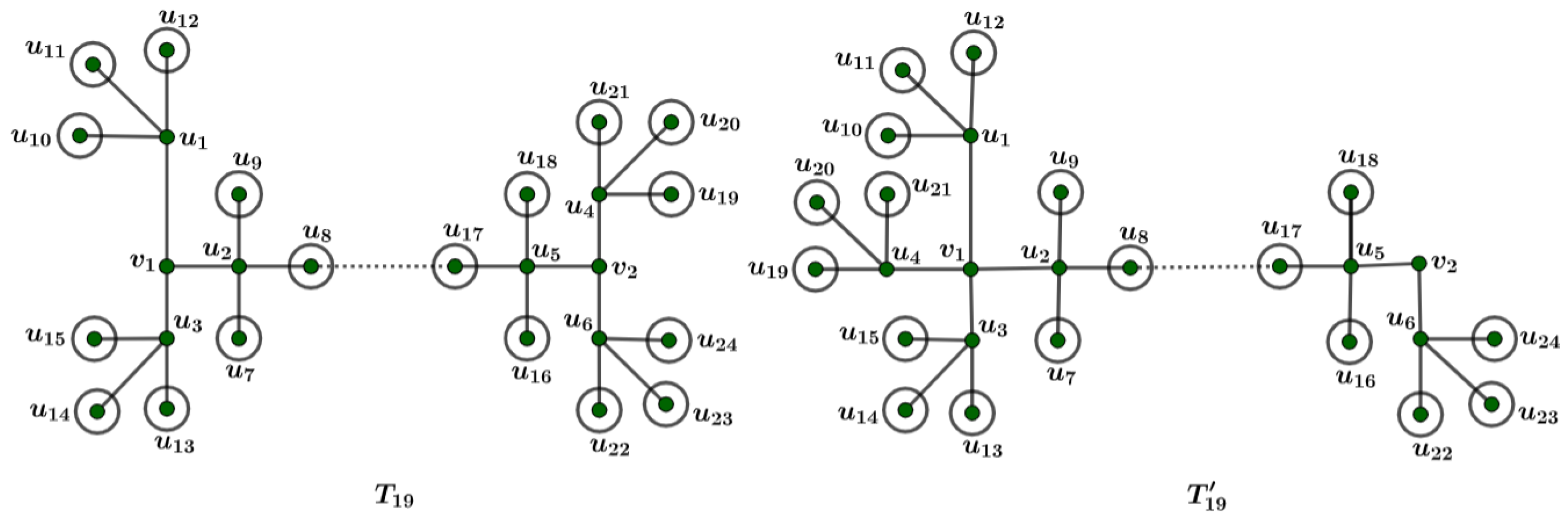
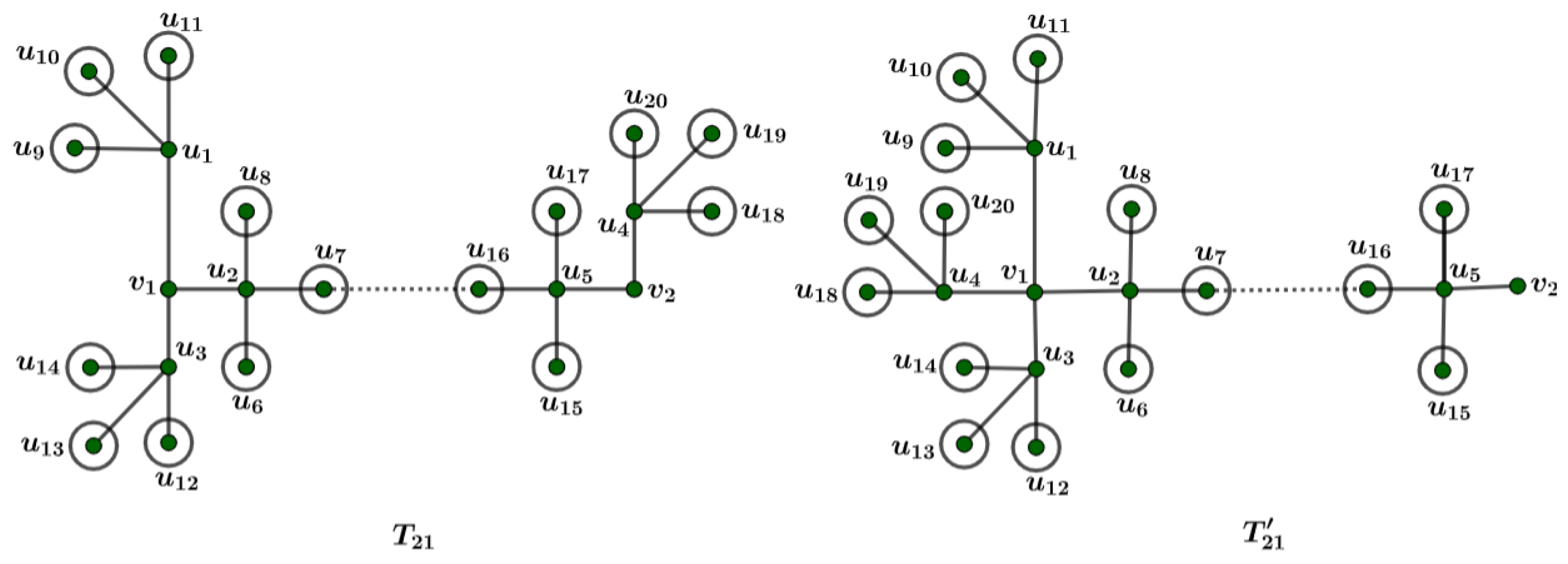
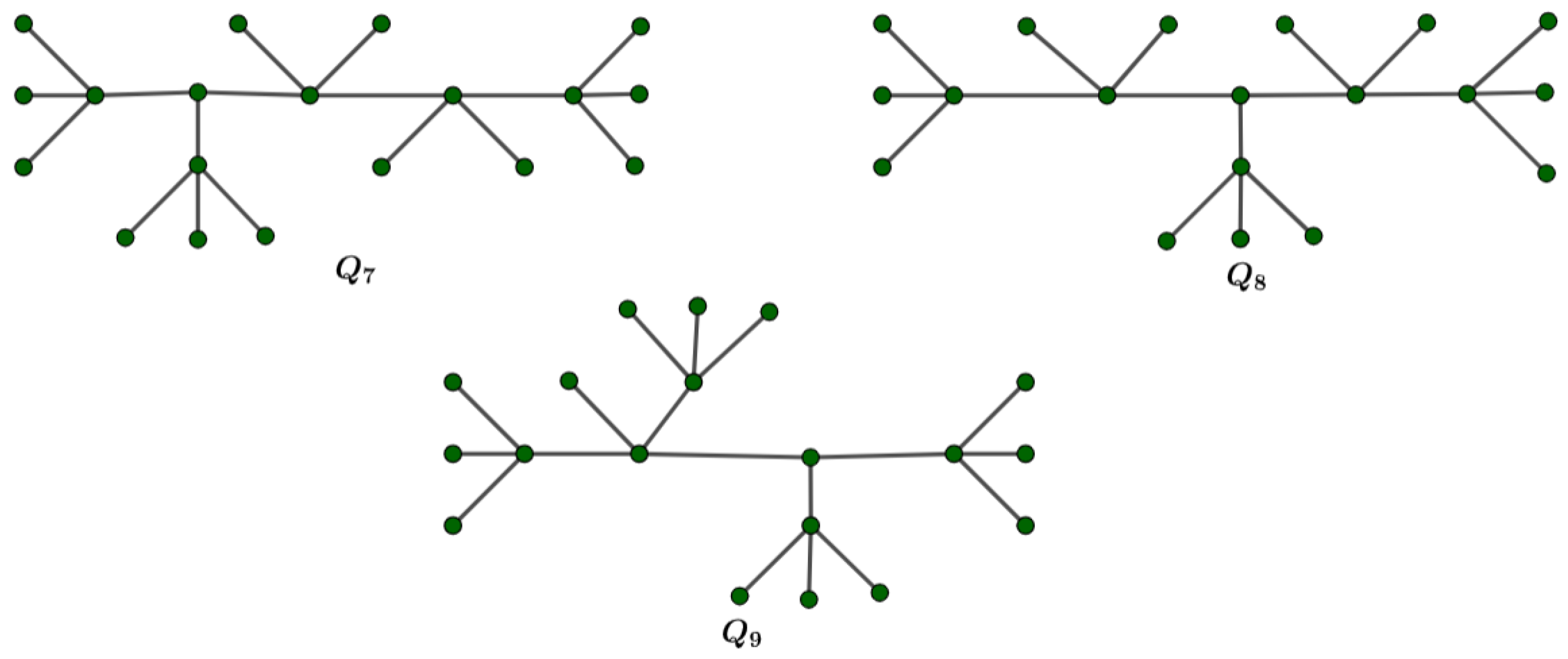
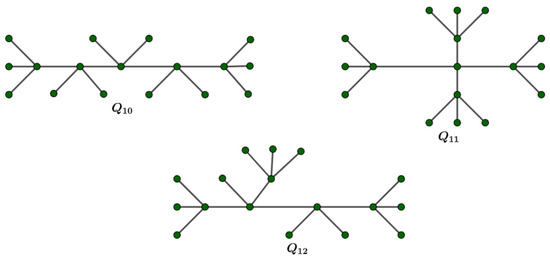
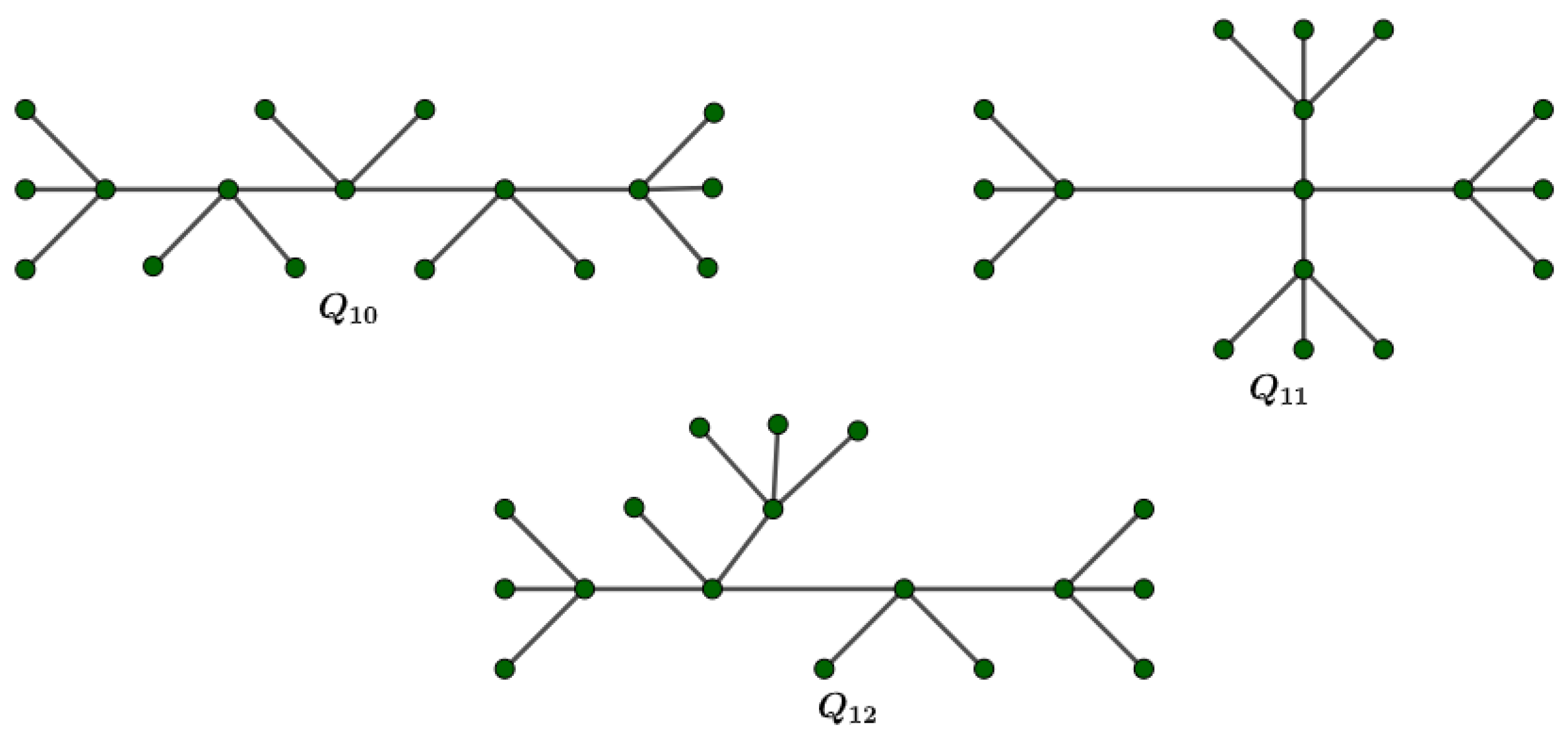
We define a class of molecular trees as follows:
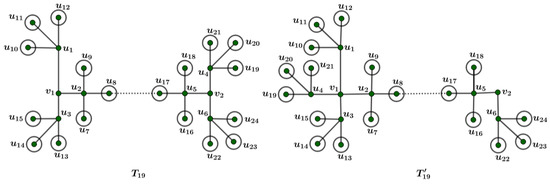
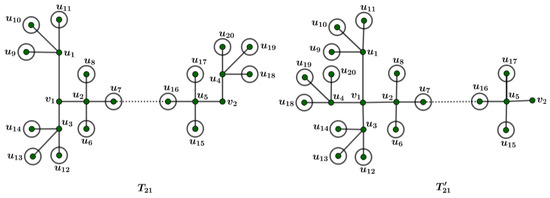
Figure 19 presents examples of all molecular trees in for . For , we obtain:
Figure 19.
Molecular trees , and in for .
We now present the minimal value of the for molecular trees and identify the trees that attain this extremal value.
Theorem 1.
For a positive integer n, the minimum value of over is achieved as follows:
- (i)
- When , the minimum value is achieved in with the value:
- (ii)
- When , the minimum value is achieved in with the value:
- (iii)
- When , the minimum value is achieved in with the value:
Proof.
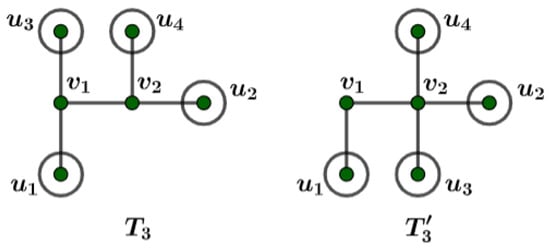
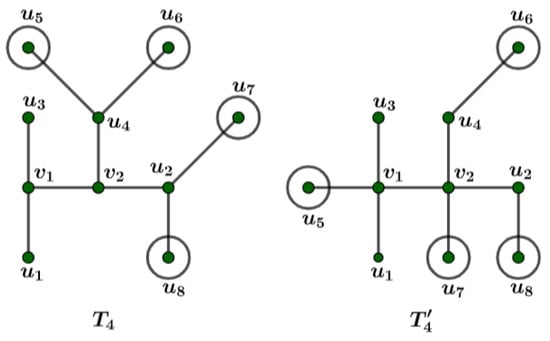
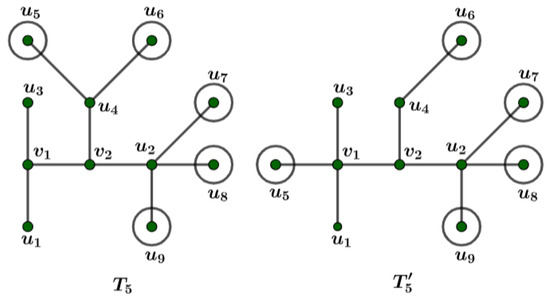
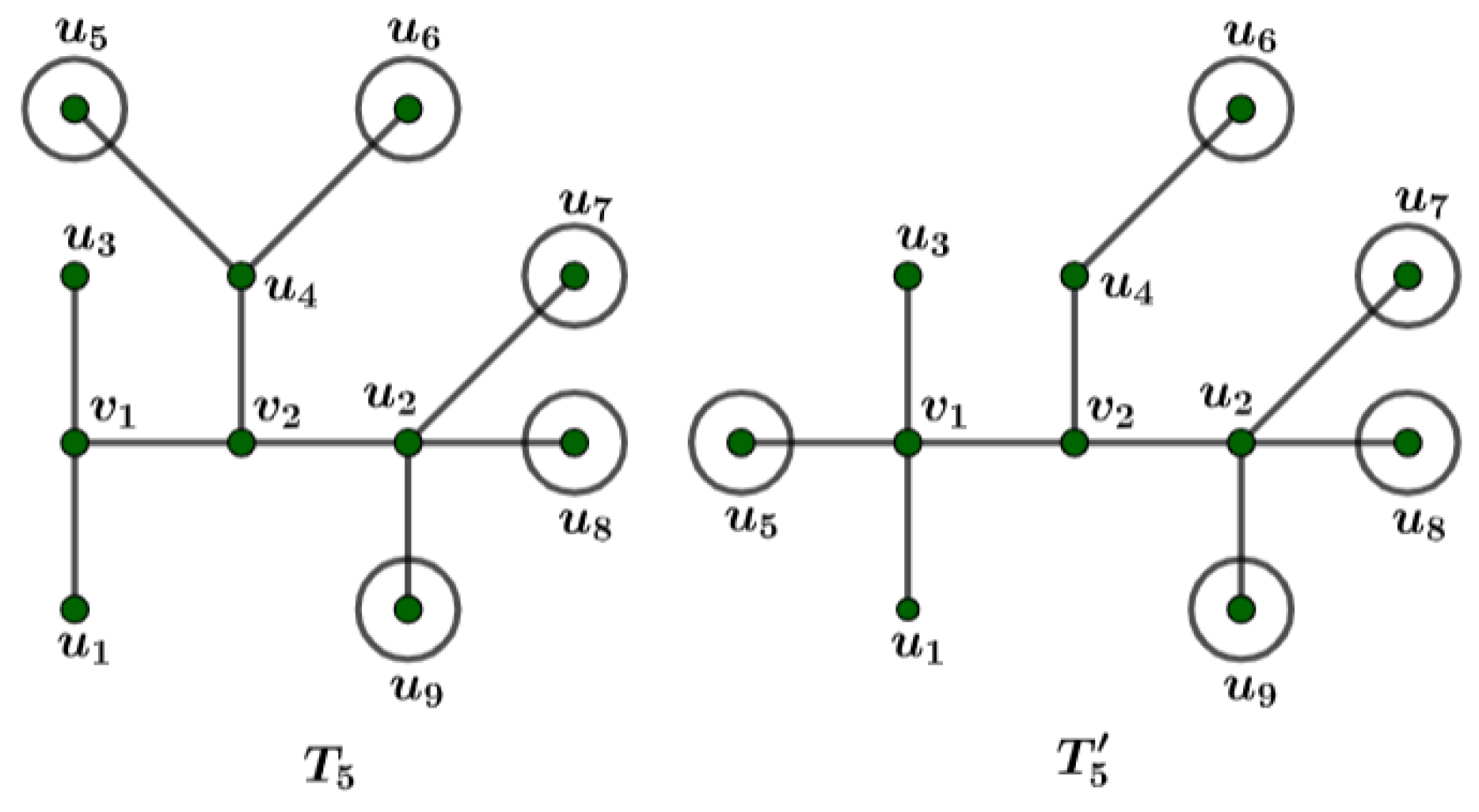
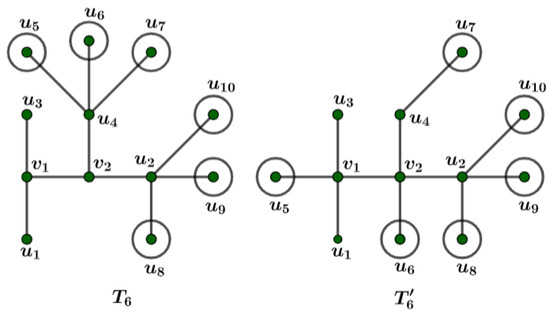
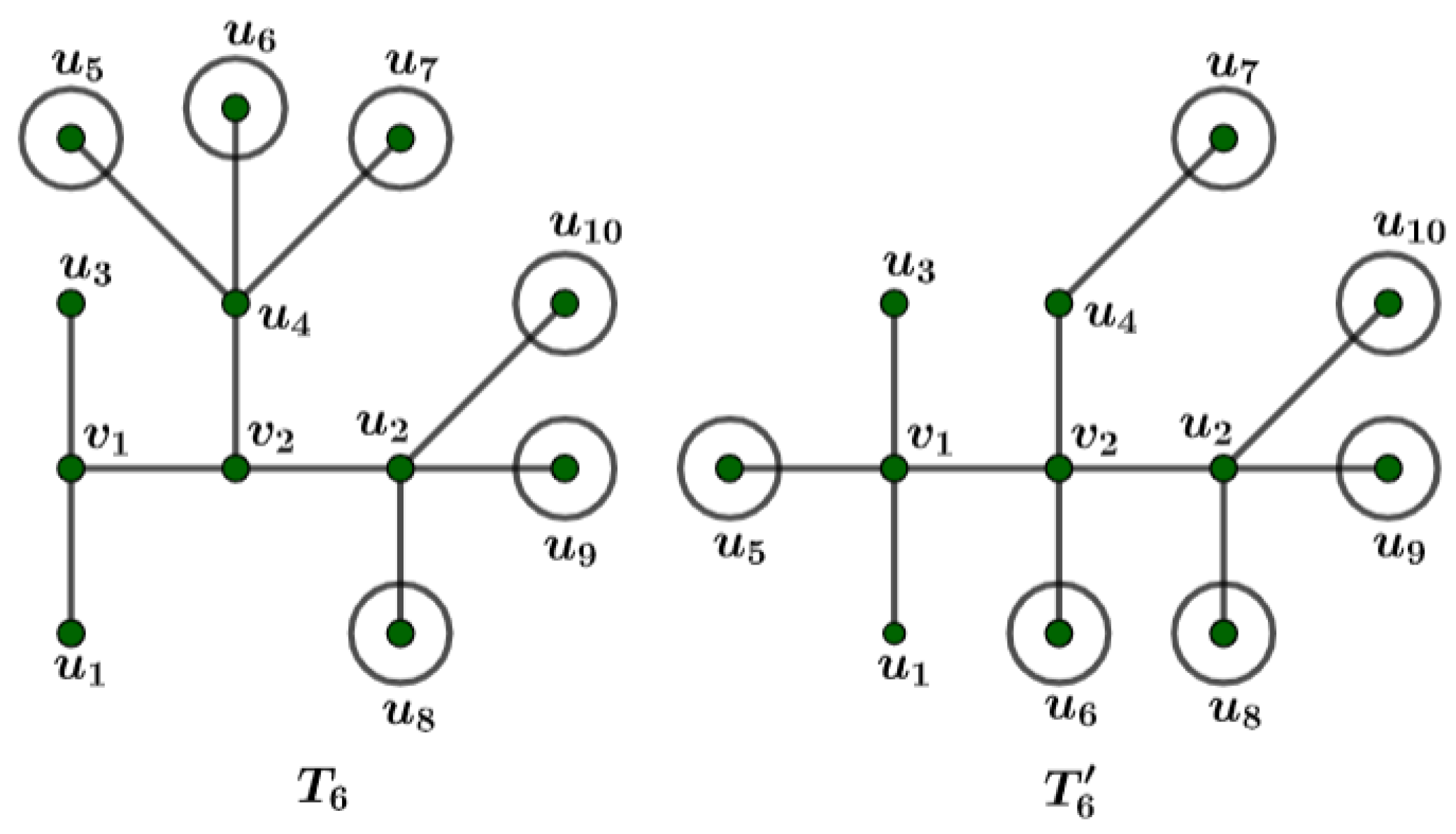
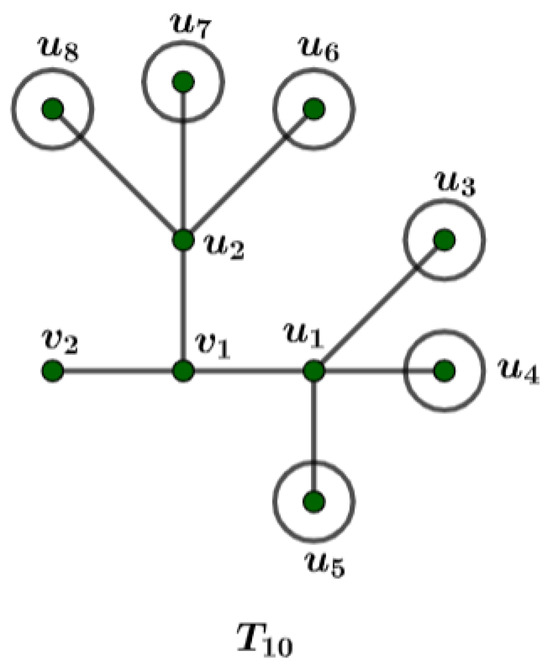
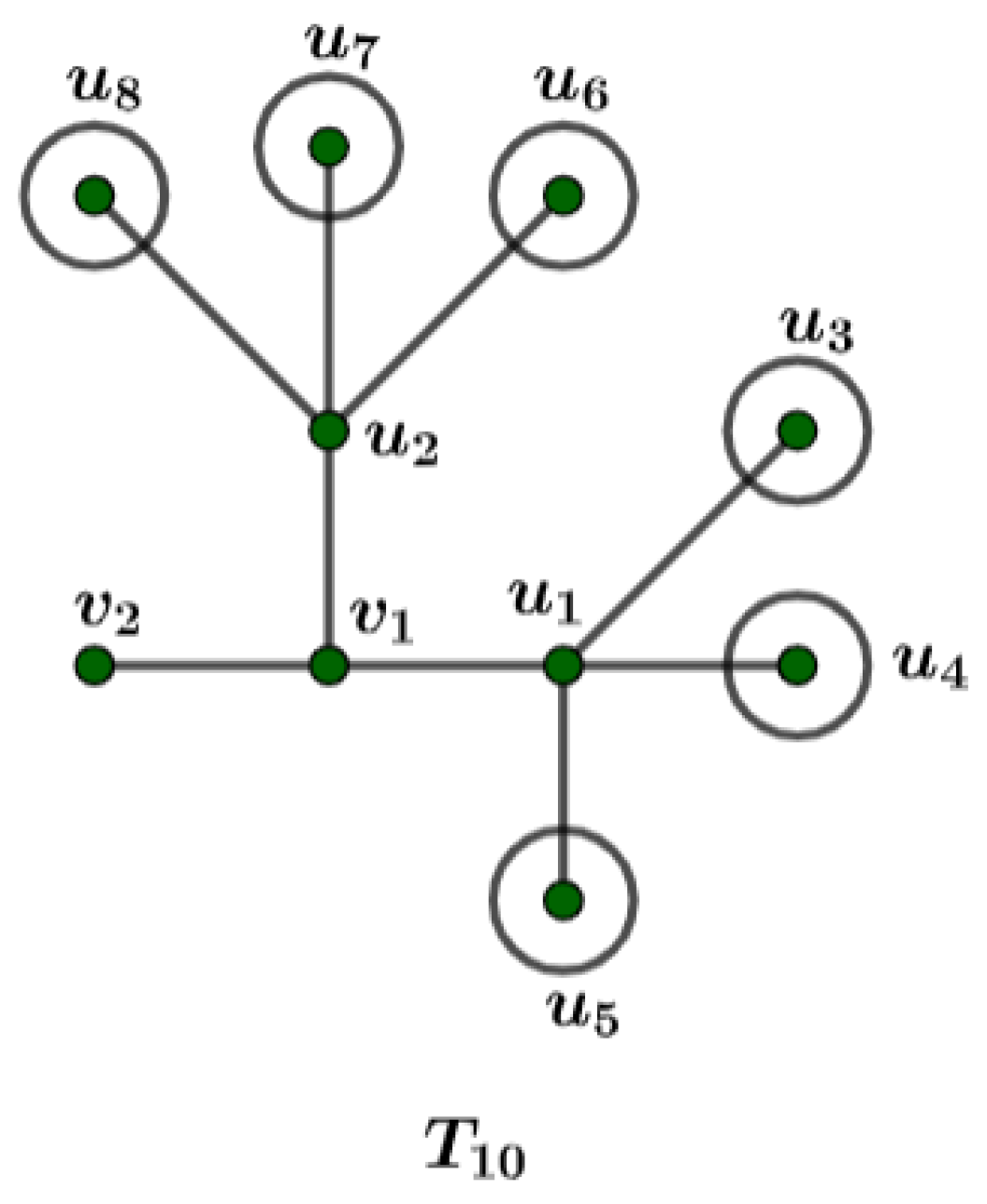
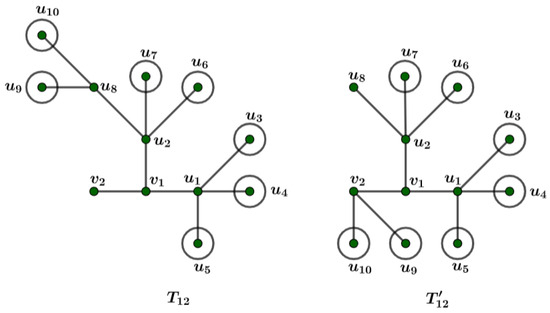
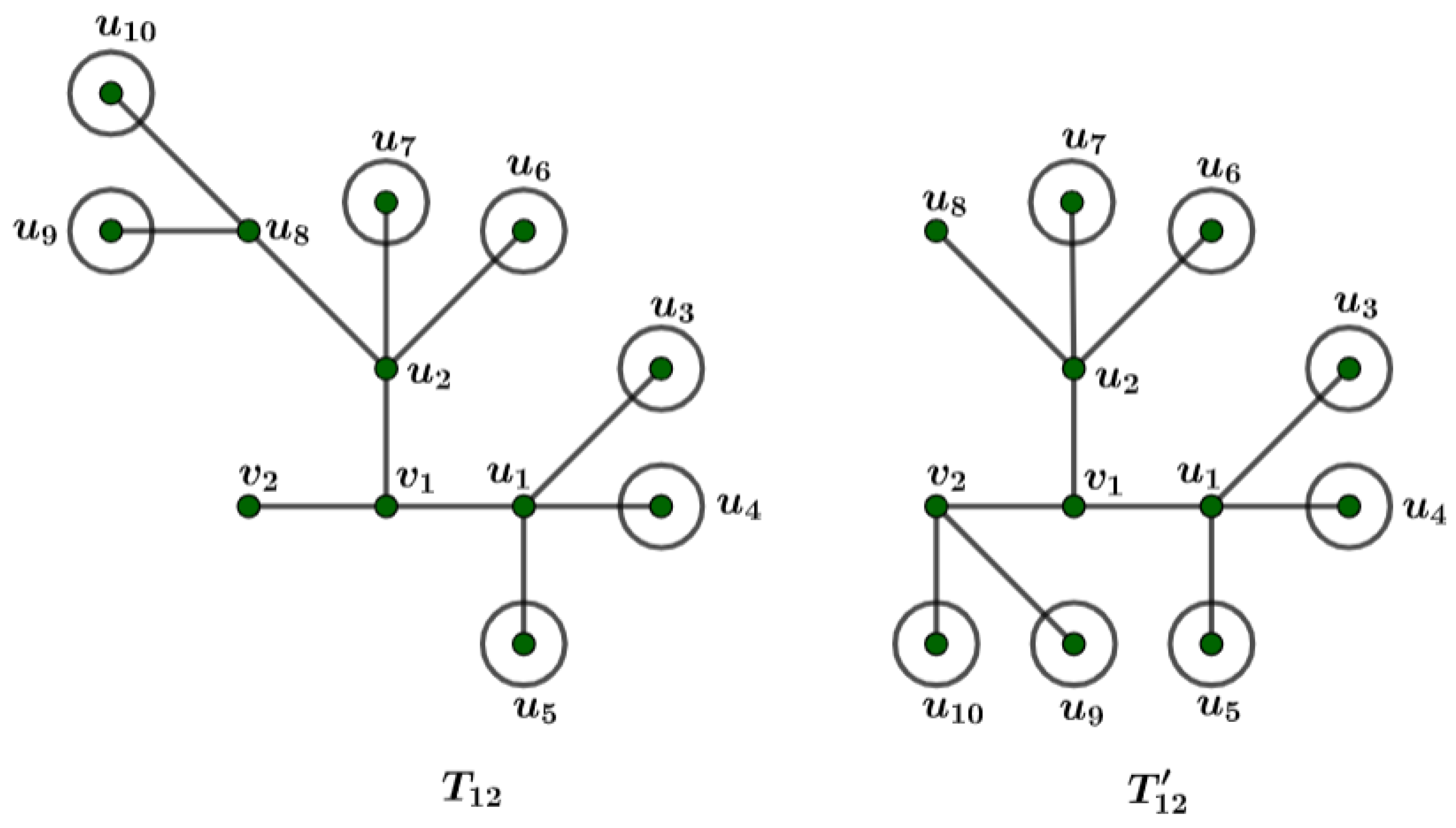
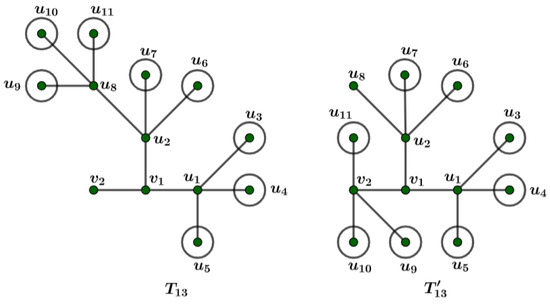
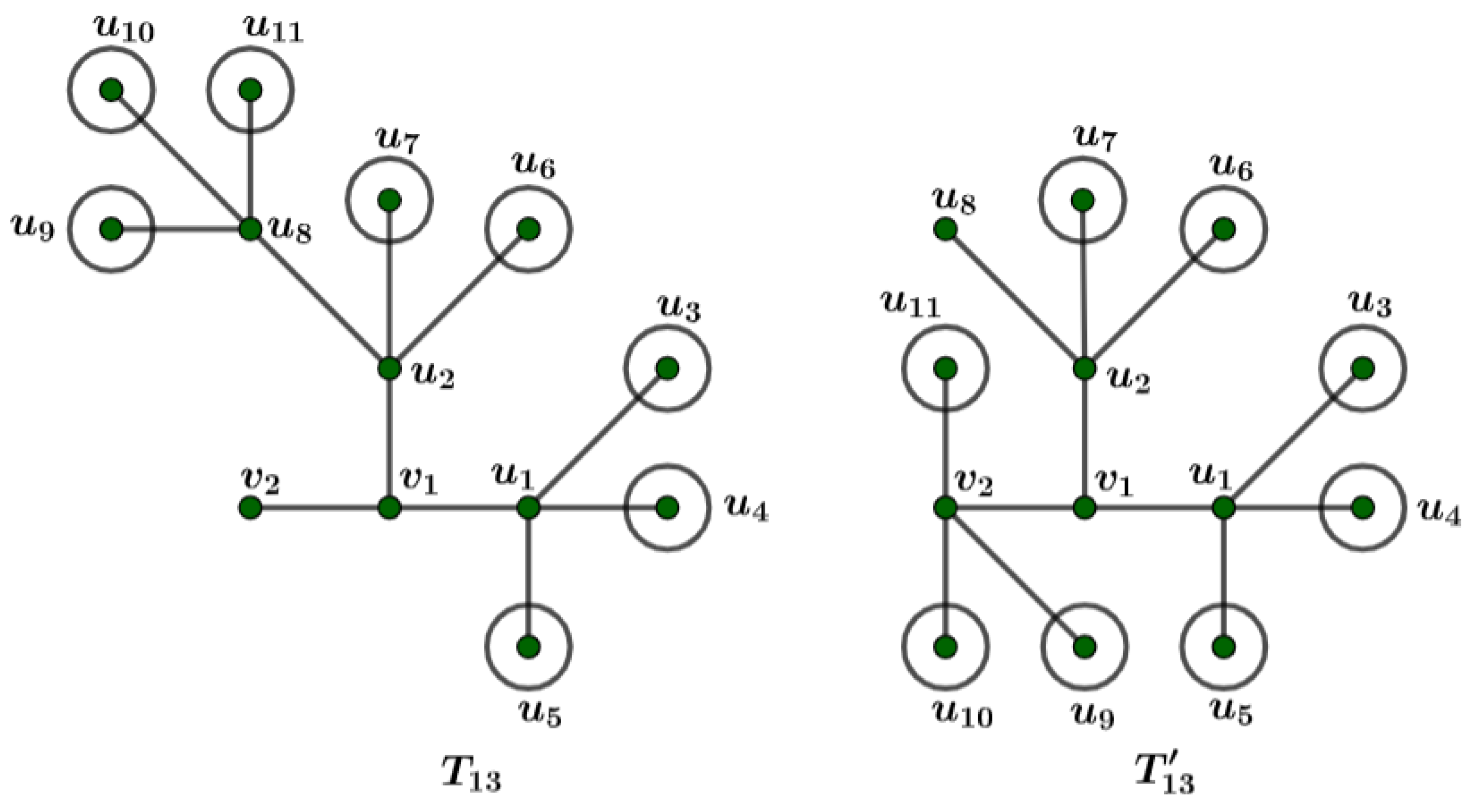
By Sage [45], we obtain the minimal molecular trees with for , with for , and with for (see Figure 20).
Figure 20.
The molecular trees , , and for , respectively.
Now we consider . For any molecular tree with n vertices, the following conditions must be satisfied:
From (10), (11) we get:
Let . Then, applying Lemmas 1–5, we get from (12)–(15):
We now continue the proof for the following three cases.
- Case 1. . Since , in this case for some positive integer . From (16), we obtain , that is, . Combining this result with Lemmas 6–8, we must have and for . Using these results with (10) and (18), we obtain , , and hence, . From (16), we have , and then from (10), . Using (17)–(20), we obtain and that is, Thus, we obtain:
- Case 3. . In this case for some positive integer . By (16), we obtain . Applying Lemmas 6–8, it follows that , that is, . Hence . Similar to Case 1, we obtain , , and . Thus, we obtain:
This completes the proof of the theorem. □
Remark 1.
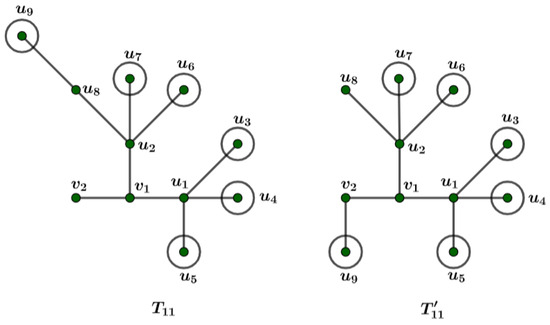
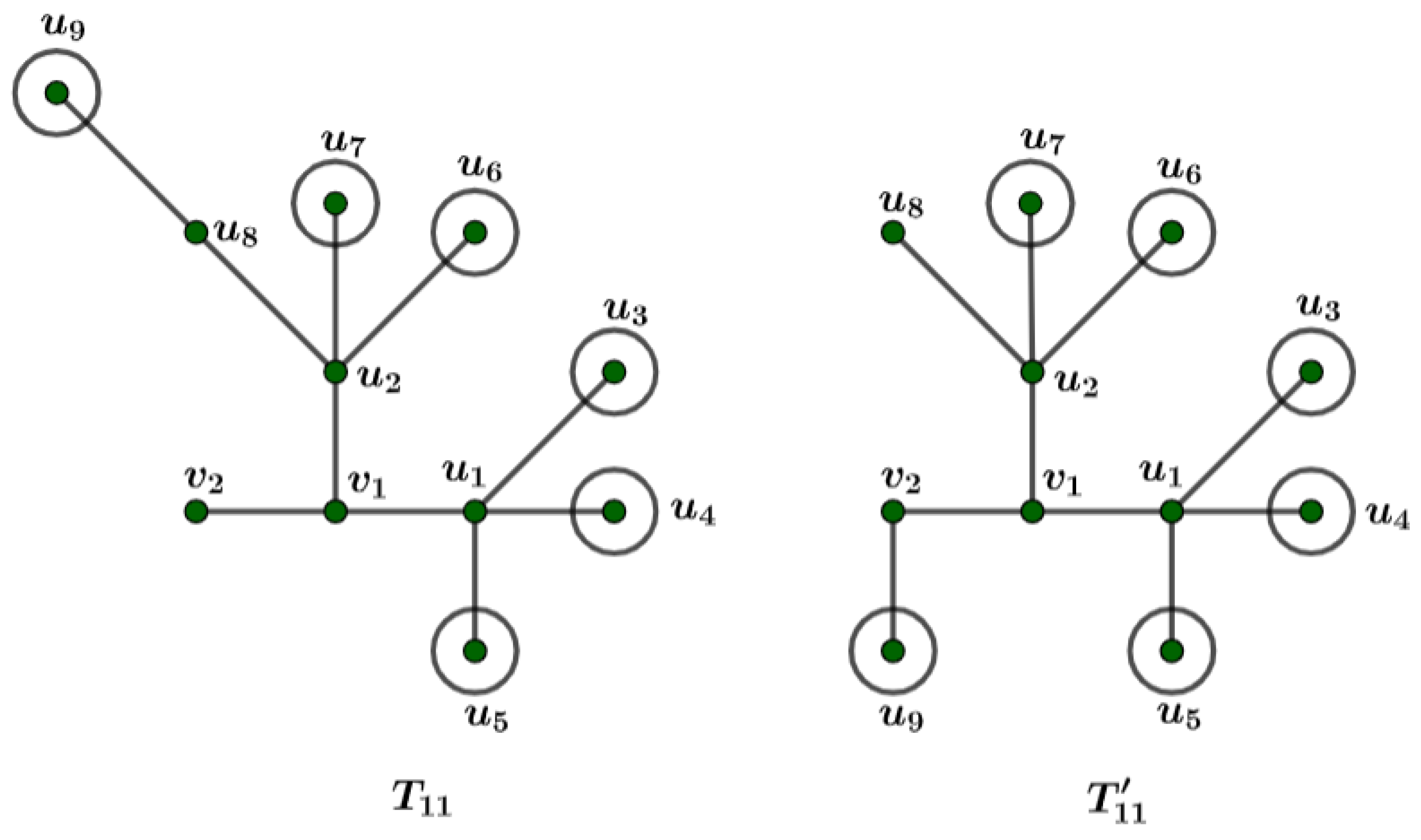
Theorem 1 does not generate Minimal molecular trees of for . For these values, Figure 21 shows the minimal molecular trees.
Figure 21.
Minimal molecular trees , , , and of for , respectively.
3. Chemical Relevance
In this section, we examine the chemical relevance of the exponential Randić () index, a key topological index. Following the methodology suggested by Randić and Trinajstić [46], we assess the chemical significance of the index by correlating it with experimental properties of octane isomers. We observed that the index demonstrates strong correlations with key molecular properties, such as enthalpy of vaporization (HVAP) and standard enthalpy of vaporization (DHVAP) for octanes. The correlation coefficient between HVAP and is 0.935, and that between DHVAP and is 0.945. Based on these findings, we conclude that the index effectively explains HVAP and DHVAP of octane isomers. Thus, we can state that the index is chemically significant.
4. Concluding Remarks
The exponential Randić index is an important topological index with growing interest. In this study, we identified the lowest values of the index for molecular trees and determined the structures that achieved these values through various graph transformations. Additionally, we explored the chemical relevance of the index, showing its strong correlation with properties like standard enthalpy of vaporization (DHVAP) and enthalpy of vaporization (HVAP) for octane isomers. These findings extend the applicability of the index beyond theoretical graph analysis and suggest its potential for practical use in chemistry and pharmacology. Future research should explore more complex molecular structures to build on these findings and focus on identifying extremal graphs within various families of graphs for the index.
Author Contributions
Conceptualization: J.B. and K.C.D.; investigation: J.B. and K.C.D.; writing—original draft preparation: J.B. and K.C.D.; writing—review and editing: J.B. and K.C.D. All authors have read and agreed to the published version of the manuscript.
Funding
This research received no external funding.
Institutional Review Board Statement
Not applicable.
Informed Consent Statement
Not applicable.
Data Availability Statement
No new data were created or analyzed in this study.
Conflicts of Interest
The authors declare no conflicts of interest.
References
- Randić, M. On characterization of molecular branching. J. Am. Chem. Soc. 1975, 97, 6609–6615. [Google Scholar] [CrossRef] [Scilit]
- Bollobás, B.; Erdos, P. Graphs of extremal weights. Ars Combin. 1998, 50, 225–233. [Google Scholar] [CrossRef] [Scilit]
- Caporossi, G.; Gutman, I.; Hansen, P.; Pavlović, L. Graphs with maximum connectivity index. Comput. Biol. Chem. 2003, 27, 85–90. [Google Scholar] [CrossRef] [Scilit]
- Hu, Y.; Li, X.; Yuan, Y. Trees with minimum general Randić index. MATCH Commun. Math. Comput. Chem. 2004, 52, 119–128. [Google Scholar]
- Hu, Y.; Li, X.; Yuan, Y. Trees with maximum general Randić index. MATCH Commun. Math. Comput. Chem. 2004, 52, 129–146. [Google Scholar]
- Altassan, A.; Imran, M. Generalized quasi trees with respect to degree-based topological indices and their applications to COVID-19 drugs. Mathematics 2023, 11, 647. [Google Scholar] [CrossRef] [Scilit]
- Altassan, A.; Imran, M. General Randić index of unicyclic graphs and its applications to drugs. Symmetry 2024, 16, 113. [Google Scholar] [CrossRef] [Scilit]
- Aouchiche, M.; Hansen, P. On a conjecture about Randić index. Discrete Math. 2007, 307, 262–265. [Google Scholar] [CrossRef] [Scilit]
- Delorme, C.; Favaron, O.; Rautenbach, D. On the Randić index. Discrete Math. 2002, 257, 29–38. [Google Scholar] [CrossRef] [Scilit]
- Du, Z.; Zhou, B. On Randić indices of trees, unicyclic graphs, and bicyclic graphs. Int. J. Quantum Chem. 2011, 111, 2760–2770. [Google Scholar] [CrossRef] [Scilit]
- Ismailescu, D.; Stefanica, D. Minimizer graphs for a class of extremal problems. J. Graph Theory 2002, 39, 230–240. [Google Scholar] [CrossRef] [Scilit]
- Jamil, M.K.; Tomescu, I.; Imran, M.; Javed, A. Some bounds on zeroth-order general Randić index. Mathematics 2020, 8, 98. [Google Scholar] [CrossRef] [Scilit]
- Jamri, A.A.S.A.; Movahedi, F.; Hasni, R.; Gobithaasan, R.U.; Akhbari, M.H. Minimum Randić Index of Trees with Fixed Total Domination Number. Mathematics 2022, 10, 3729. [Google Scholar] [CrossRef] [Scilit]
- Li, X.; Shi, Y. A survey on the Randić index. MATCH Commun. Math. Comput. Chem. 2008, 59, 127–156. [Google Scholar]
- Li, X.; Shi, Y.; Xu, T. Unicyclic graphs with maximum general Randić index for α>0. MATCH Commun. Math. Comput. Chem. 2006, 56, 557–570. [Google Scholar]
- Li, X.; Wang, L.; Zhang, Y. Complete solution for unicyclic graphs with minimum general Randić index. MATCH Commun. Math. Comput. Chem. 2006, 55, 391–408. [Google Scholar]
- Li, X.; Yuan, Y. Sharp bounds for the general Randić index. MATCH Commun. Math. Comput. Chem. 2004, 51, 155–166. [Google Scholar]
- Liu, H.; Lu, M.; Tian, F. Trees of extremal connectivity index. Discrete Appl. Math. 2005, 151, 106–119. [Google Scholar] [CrossRef] [Scilit]
- Swartz, E.; Vetrík, T. Survey on the general Randić index: Extremal results and bounds. Rocky Mt. J. Math. 2022, 52, 1177–1203. [Google Scholar] [CrossRef] [Scilit]
- Zhang, J.; Wu, B. Randić index of a line graph. Axioms 2022, 11, 210. [Google Scholar] [CrossRef] [Scilit]
- Rada, J. Exponential vertex-degree-based topological indices and discrimination. MATCH Commun. Math. Comput. Chem. 2019, 82, 29–41. [Google Scholar]
- Cruz, R.; Monsalve, J.; Rada, J. The balanced double star has maximum exponential second Zagreb index. J. Combin. Optim. 2021, 41, 544–552. [Google Scholar] [CrossRef] [Scilit]
- Cruz, R.; Rada, J. The path and the star as extremal values of vertex-degree-based topological indices among trees. MATCH Commun. Math. Comput. Chem. 2019, 82, 715–732. [Google Scholar]
- Das, K.C.; Elumalai, S.; Balachandran, S. Open problems on the exponential vertex-degree-based topological indices of graphs. Discrete Appl. Math. 2021, 293, 38–49. [Google Scholar] [CrossRef] [Scilit]
- Das, K.C.; Mondal, S. On exponential geometric-arithmetic index of graphs. J. Math. Chem. 2024, 62, 2740–2760. [Google Scholar] [CrossRef] [Scilit]
- Das, K.C.; Mondal, S. On EAZ index of unicyclic and bicyclic graphs, general graphs in terms of the number of cut edges. J. Appl. Math. Comput. 2024, 70, 2995–3010. [Google Scholar] [CrossRef] [Scilit]
- Das, K.C.; Mondal, S.; Huh, D. On the exponential augmented Zagreb index of graphs. J. Appl. Math. Comput. 2024, 70, 839–865. [Google Scholar] [CrossRef] [Scilit]
- Das, K.C.; Mondal, S.; Huh, D. Open problem on the maximum exponential augmented Zagreb index of unicyclic graphs. Comput. Appl. Math. 2024, 43, 317. [Google Scholar] [CrossRef] [Scilit]
- Jahanbani, A.; Cancan, M.; Motamedi, R. Extremal trees for the exponential of forgotten topological index. J. Math. 2022, 2022, 7455701. [Google Scholar] [CrossRef] [Scilit]
- Cruz, R.; Monsalve, J.; Rada, J. Trees with maximum exponential Randić index. Discrete Appl. Math. 2020, 283, 634–643. [Google Scholar] [CrossRef] [Scilit]
- Qiu, L.; Ruan, X.J.; Zhu, Y. The maximum and minimum value of exponential Randić indices of Quasi-Tree graph. J. Appl. Math. Phys. 2024, 12, 1804–1818. [Google Scholar] [CrossRef]
- Lin, Q.; Zhu, Y. Unicyclic graphs with extremal exponential Randić index. Math. Model. Control 2021, 1, 164–171. [Google Scholar] [CrossRef] [Scilit]
- Zhong, L. Molecular trees with extremal harmonic indices. Optoelectron. Adv.-Mater.-Rapid Commun. 2014, 8, 96–99. [Google Scholar]
- Gutman, I.; Miljković, O.; Caporossi, G.; Hansen, P. Alkanes with small and large Randić connectivity indices. Chem. Phys. Lett. 1999, 306, 366–372. [Google Scholar] [CrossRef] [Scilit]
- Zhou, B.; Trinajstić, N. On a novel connectivity index. J. Math. Chem. 2009, 46, 1252–1270. [Google Scholar] [CrossRef] [Scilit]
- Deng, H.Y.; Tang, Z.K.; Wu, R.F. Molecular trees with extremal values of Sombor indices. Int. J. Quantum Chem. 2021, 121, e26622. [Google Scholar] [CrossRef] [Scilit]
- Mondal, S.; Das, K.C. Complete solution to open problems on exponential augmented Zagreb index of chemical trees. Appl. Math. Comput. 2024, 482, 128983. [Google Scholar] [CrossRef] [Scilit]
- Albalahi, A.M.; Ali, A.; Du, Z.; Bhatti, A.A.; Alraqad, T.; Iqbal, N.; Hamza, A.E. On bond incident degree indices of chemical graphs. Mathematics 2023, 11, 27. [Google Scholar] [CrossRef] [Scilit]
- Ali, A.; Noureen, S.; Moeed, A.; Iqbal, N.; Hassan, T.S. Fixed-order chemical trees with given segments and their maximum multiplicative sum Zagreb index. Mathematics 2024, 12, 1259. [Google Scholar] [CrossRef] [Scilit]
- Balachandran, S.; Vetrík, T. Exponential second Zagreb index of chemical trees. Trans. Combin. 2021, 10, 97–106. [Google Scholar]
- Du, Z.; Ali, A.; Rafee, R.; Raza, Z.; Jamil, M.K. On the first two extremum Zagreb indices and coindices of chemical trees. Int. J. Quantum Chem. 2021, 121, e26547. [Google Scholar] [CrossRef] [Scilit]
- Mondal, S.; Das, K.C.; Huh, D. The minimal chemical tree for the difference between geometric-arithmetic and Randić indices. Int. J. Quantum Chem. 2024, 124, e27336. [Google Scholar] [CrossRef] [Scilit]
- Shiu, W.C.; Zhang, L.Z. The maximum Randić index of chemical trees with k pendants. Discrete Math. 2009, 309, 4409–4416. [Google Scholar] [CrossRef] [Scilit]
- Wang, F.; Wu, B. The reduced Sombor index and the exponential reduced Sombor index of a molecular tree. J. Math. Anal. Appl. 2022, 515, 126442. [Google Scholar] [CrossRef] [Scilit]
- Stein, W.A. Sage Mathematics Software, Version 6.8; The Sage Development Team. 2015. Available online: http://www.sagemath.org (accessed on 17 October 2024).
- Randić, M.; Trinajstić, N. In search for graph invariants of chemical interes. J. Mol. Struc. 1993, 300, 551–571. [Google Scholar] [CrossRef] [Scilit]





Disclaimer/Publisher’s Note: The statements, opinions and data contained in all publications are solely those of the individual author(s) and contributor(s) and not of MDPI and/or the editor(s). MDPI and/or the editor(s) disclaim responsibility for any injury to people or property resulting from any ideas, methods, instructions or products referred to in the content. |
© 2024 by the authors. Licensee MDPI, Basel, Switzerland. This article is an open access article distributed under the terms and conditions of the Creative Commons Attribution (CC BY) license (https://creativecommons.org/licenses/by/4.0/).