


Abstract
The objective of this paper is to describe the concept of intuitionistic fuzzy metric-like spaces. This space is an extension of metric-like spaces and fuzzy metric spaces, and intuitionistic fuzzy metric spaces. We discuss convergence sequences, contractive mapping and some fixed-point theorems in intuitionistic fuzzy metric-like space. We also give explanations, examples and counterexamples to validate the superiority of these results. Our results provide a substantial extension of several important results from fuzzy metric-like spaces.
Keywords:
intuitionistic fuzzy set; metric-like spaces; intuitionistic fuzzy metric-like spaces; fixed-point theory MSC:
03B52; 47H10; 54H25
1. Introduction
Metric spaces, obtained with the help of a metric function defined on a set, are prominent spaces in mathematics, especially in topology. They provide a powerful tool for generalizing some properties on arbitrary sets. Metric spaces were studied originally on classical sets by Maurice Frechet in 1906. Later, many generalizations of the concept of metric spaces were made on the different types of sets. In addition, different metric functions have been attained. It would not be wrong to separate these concepts as a set and metric functions. One of these generalizations about sets was constructed on fuzzy sets. The notion of fuzzy sets was first introduced by computer scientist Zadeh [1] in 1965 to introduce a new definition of approach to uncertain data. The main difference between a classical set and fuzzy set is that a fuzzy set allows the gradual assessment of the membership of the elements in a set. This approach has made a prominent improvement in dealing with situations that have fields such as engineering and natural sciences involving uncertainty and undesirability. After that, another generalization was obtained by combining fuzzy sets and metric concepts, called a fuzzy metric space [2]. George and Veeramani ([3,4]) modified the concept of fuzzy metric spaces in the sense of Kramosil and Michálek by using continuous t-norms, and they obtained a stronger version of the fuzzy metric space. They obtained a Hausdorff topology and the first countable topology on modified fuzzy metric spaces. Grabiec [5] defined the fuzzy version of the Banach contraction principle in fuzzy metric spaces given by Kramosil and Michalek. Gregori et al. [6] gave some examples and applications for fuzzy metric. Although the concept of the fuzzy set was initially sufficient to cope with uncertainty, modelling the problems of the world we live in with fuzzy sets has started to be insufficient. The study that fills this gap in the literature was resolved by Atanassov [7] in 1986. Atanassov introduced the intuitionistic fuzzy sets. These sets compared with fuzzy sets provide more flexible study possibilities for dealing with uncertain situations since an intuitionistic fuzzy set includes both membership degrees and non-membership degrees of the element that belongs in a set. Later, Park [8] introduced the concept of intuitionistic fuzzy metric spaces inspired by the idea of Atanassov’s intuitionistic fuzzy sets. Many developments have been studied on fuzzy metric spaces, such as fixed-point theorems ([9,10,11,12,13]) and convergence ([14,15,16]). Same structures also have been investigated on intuitionistic fuzzy metric spaces ([17,18,19,20,21]). Furthermore, we see in recent papers that studies on these structures will preserve popularity ([22,23,24,25,26,27]).
Matthews [28] introduced the notion of a partial metric space and Harandi [29] introduced metric-like space as a generalization of a partial metric space and metric space. Harandi also studied some fixed-point results in such spaces. Both of these metrics are presented on classical sets. By a metric-like space, we mean a pair , where X is a nonempty set and satisfies all conditions of a metric except that may be different from zero for . In 2014, Shukla et al. [30] introduced the fuzzy version of the metric-like space in the literature. Thus, this notion generalized the concept of fuzzy metric spaces given by George and Veeramani. They proved some fixed-point results for fuzzy contractive mappings on fuzzy metric-like spaces. Such concepts may form a future frame for extending the already established fixed-point results of the fuzzy metric to the metric-like structure.
This paper aims to present the concept of "intuitionistic fuzzy metric-like space" by using the approach in [29] and study fixed-point theorems for contractive mappings in intuitionistic fuzzy metric-like spaces. Intuitionistic fuzzy metric spaces and intuitionistic fuzzy metric-like spaces are two different mathematical frameworks. Both of them can be used to model distances and measure similarity or dissimilarity between objects, depending on the nature and degree of uncertainty or ambiguity in data. The results obtained in both approaches provide accurate results in their own nature. When the results in the intuitionistic fuzzy metric spaces obtained with the metric structure are changed with the metric-like structure, we attain a more flexible working environment due to the metric-like structure’s feature because in these spaces, even if the objects are the same, it is taken into account that the distance between them can be different when they are evaluated according to a certain parameter. For this reason, we aim to fill this gap in the literature by combining these structures which are compatible with existing approaches in the literature.
The structure of the paper is as follows. After the preliminaries, in Section 3, the concept of intuitionistic fuzzy metric-like space is defined and this notion is explained with the help of intelligible examples. In addition, the concept of the convergent sequence is given in intuitionistic fuzzy metric-like spaces and all these definitions, theorems and examples are presented in detail. Section 4 concerns the constructing and proving of common fixed-point theorems in intuitionistic fuzzy metric-like space. The obtained results are compatible with existing approaches in the literature.
2. Preliminaries
In this section, we give some basic definitions and notions to explain the main results. Throughout the paper, by ∞ we mean ; IR and IN will denote the set of all real numbers and the set of all positive integer numbers, respectively.
Definition 1
([29]). Let . A mapping is called metric-like on X if the following hold:
(ML1) ;
(ML2) ;
(ML3) .
The pair is called a metric-like space on X.
Definition 2
([7]). An intuitionistic fuzzy set A is defined by where and denote membership and non-membership functions, respectively. and are membership and non-membership degrees of each element to the intuitionistic fuzzy set A and for each .
Definition 3
([31]). A binary operation is called a continuous t-norm if ∗ satisfies the following:
- (1)
- ;
- (2)
- and ;
- (3)
- If and , then ;
- (4)
- ∗ is continuous.
Definition 4
([31]). A binary operation is called a continuous t-conorm if ⋄ satisfies the following:
- (1)
- ;
- (2)
- and ;
- (3)
- If , then ;
- (4)
- ⋄ is continuous.
Note that , , and are basic examples of continuous t-norms and continuous t-conorms for all .
From the previous two definitions, we see that if , then there exist such that and .
Definition 5
([3]). Let . Assume a triplet where ∗ is a continuous t-norm and M is a fuzzy set on . If satisfies the following conditions for all and ;
(FM1) ,
(FM2) if and only if ,
(FM3) ,
(FM4) ,
(FM5) is continuous,
Then is called fuzzy metric space. M with ∗ is called fuzzy metric on X.
Definition 6
([30]). Let . A triplet is called fuzzy metric-like space (for short, FMLS) if ∗ is a continuous t-norm and F is a fuzzy set on satisfy the following conditions for all and ;
(FML1) ,
(FML2) ,
(FML3) ,
(FML4) ,
(FML5) is continuous.
Definition 7
([8]). Let M and N be fuzzy sets on , ∗ be a continuous t-norm, ⋄ be a continuous t-conorm. If M and N satisfy the following conditions, we say that is intuitionistic fuzzy metric on X:
(IFM1) ,
(IFM2) ,
(IFM3) if and only if ,
(IFM4) ,
(IFM5) ,
(IFM6) is continuous,
(IFM7) ,
(IFMF8) if and only if ,
(IFM9) ,
(IFM10) ,
(IFM11) is continuous.
A five-tuple is called intuitionistic fuzzy metric space (for short, IFMS).
The functions and denote the degree of nearness and the degree of non-nearness between x and y with respect to t, respectively.
Remark 1.
Let be an intuitionistic fuzzy metric space, then is a fuzzy metric space. Conversely, if is a fuzzy metric space, then is an intuitionistic fuzzy metric space, where , .
Definition 8
([8]). Let be an intuitionistic fuzzy metric space and , and . The set is said to be an open ball with center x, radius r with respect to t.
generates a topology called the (M,N) topology.
Definition 9
([8]). Let be an intuitionistic fuzzy metric space and be a sequence.
- (i)
- is called convergent to x if for all and there exists such that , for all . ( and as for each ).It is denoted by as .
- (ii)
- is called Cauchy sequence if for and , there exists such that , for all .
- (iii)
- is called (M,N)-complete if every Cauchy sequence is convergent.
3. Intuitionistic Fuzzy Metric-like Space
In this section, we introduce the intuitionistic fuzzy metric-like spaces and study some properties of them to support the structure. We give detailed examples and also define convergent sequences in intuitionistic fuzzy metric-like spaces.
Definition 10.
A five-tuple is called intuitionistic fuzzy metric-like space (for short, IFMLS) if X is an arbitrary set, ∗ is a continuous t-norm, ⋄ is a continuous t-conorm and are fuzzy sets on satisfying the following conditions, for all and ;
(IFML1) ,
(IFML2) ,
(IFML3) ,
(IFML4) ,
(IFML5) ,
(IFML6) is continuous,
(IFML7) ,
(IFML8) ,
(IFML9) ,
(IFML10) ,
(IFML11) is continuous.
F and G are called an intuitionistic fuzzy metric-like on X with ∗ and ⋄.
If we compared the definition of IFMS and IFMLS according to the condition (IFML3) and (IFML8), we observe that in an IFMLS, may be less than from 1 and may be greater than from 0.
Every IFMS is IFMLS with unit self distance, that is, with and for all , .
In the conditions (IFM3) and (IFM8), we see that when , the degrees of nearness and the degree of non-nearness of x and y are 1 and 0, respectively. However, the conditions (IFML3) and (IFML8) indicate that when , the value of may be less than ‘1’ and the value of may be greater than ‘0’.
Definition 11.
Let be an IFMLS. For , we define the open ball with center x, radius r with respect to t like .
Therefore, is a topology on X.
Remark 2.
- (1)
- If is an IFMLS, then is an FMLS in the sense of Shukra et al. [30].
- (2)
- Every FMLS is an IFMLS of the form , where for all .
Lemma 1.
Let be a metric-like space and . The following inequality holds , for all .
Proof.
We separate three cases:
- (1)
- ;
- (2)
- ;
- (3)
- and .
The inequality is obvious in cases (1) and (2). Assume (3) is satisfied. Then, . Without loss of generality we can suppose that . Since , there exist such that . Then, we get . Hence, the inequality in Lemma 1 becomes
and we need to show that . To do this, consider the functions and which are decreasing and increasing, respectively. The largest value of is that is taken when where . Then, implies .
If , then there exists such that . Moreover, and imply and .
Therefore, from the above case, we obtain which implies . □
Proposition 1.
Let be any metric-like space. Then, the five-tuple is an IFMLS, where and for all and are given by , for all , , where .
Proof.
(IFML1)–(IFML4) are clear. For (IFML5), let , and . By the Lemma 1, we have
For (IFML6), , so F is continuous.
(IFML7)–(IFML9) and (IFML11) are clear. Now, we need to show that , i.e.,
By the Lemma 1, we have
□
Remark 3.
Proposition 1 holds even with the t-norm and .
Remark 4.
By the above proposition, we see that every metric-like space induces an IFMLS. For , the induced intuitionistic fuzzy metric-like space is called the standard intuitionistic fuzzy metric-like space, where , for all , .
Example 1.
Let , and . Let and for all . Define the fuzzy sets F and G in by and for all and .
We know that is metric-like on X for all . Hence, is an IFMLS by Remark 3, but it is not an intuitionistic fuzzy metric space, as and for all and .
Proposition 2.
Let be any metric-like space on X. Then, the five-tuple is an IFMLS, where and for all and the fuzzy sets are defined by , for all , , where .
Remark 5.
The proposition 2 holds even with the t-norm and the t-conorm .
Example 2.
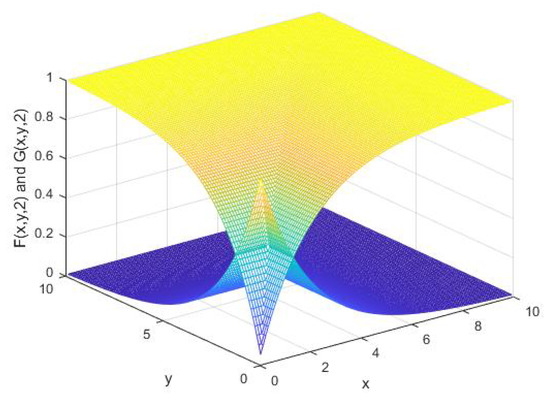
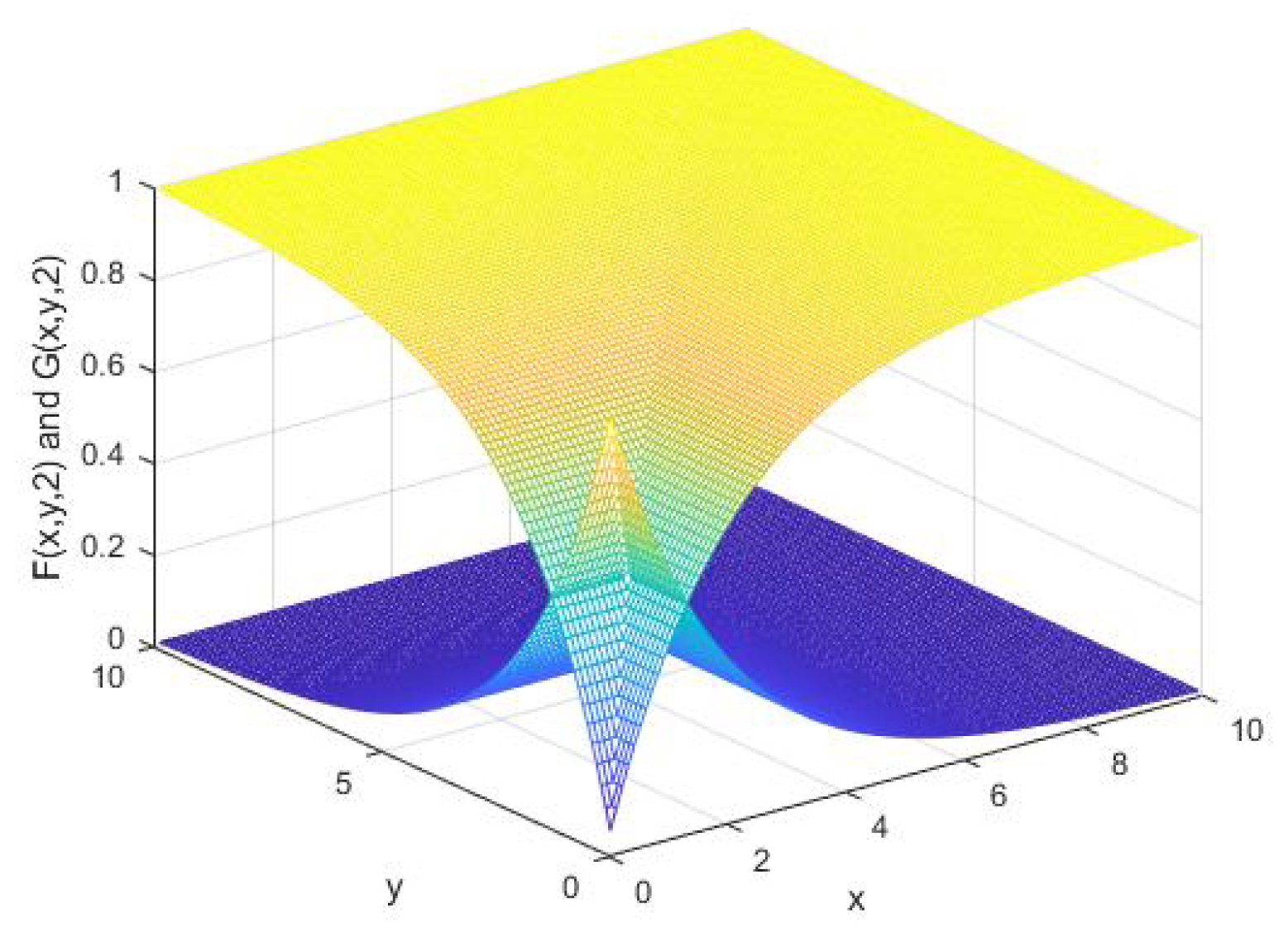
Let , and . Define the fuzzy sets F and G in by and for all and Figure 1.
Figure 1.
The graphical behavior of the F and G with and in which the blue color depicts behavior of F and the yellow color depicts behavior of G.
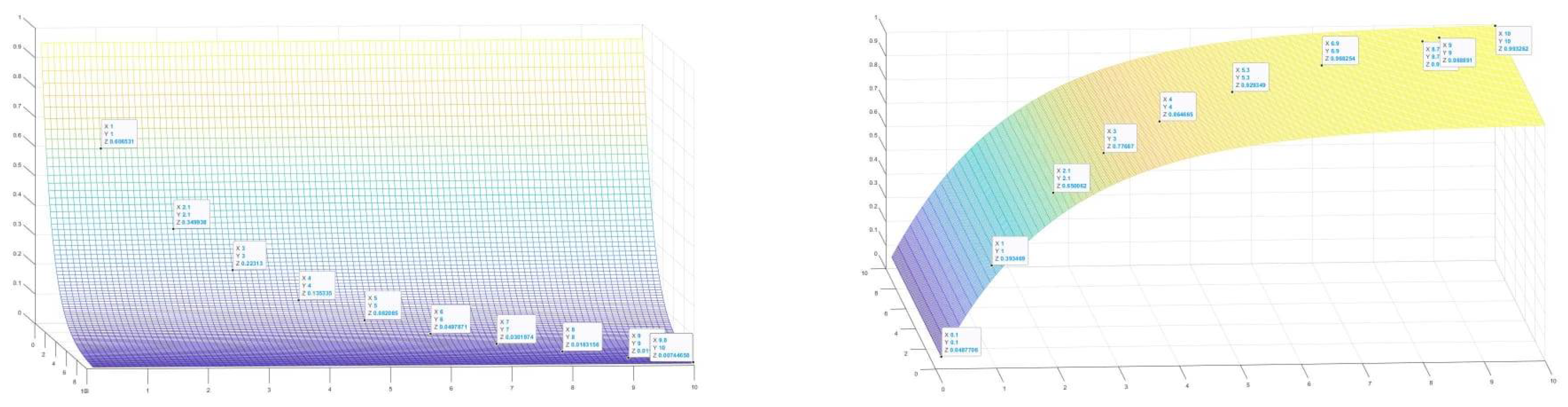
We know that is a metric-like on X for all . Hence, is an IFMLS by Remark 3, but it is not an intuitionistic fuzzy metric space as , for all and Figure 2.
Figure 2.
The graphical behavior of the and , respectively.
Example 3.
Let , and . Define the fuzzy sets F and G in by
for all .
Then, is an IFMLS, but it is not IFMS as and for all , . Now, let it show that is an IFMLS:
(IFML1)–(IFML4) are clear.
(IFML5) Let and suppose , then . We obtain the same condition for other cases.
(IFML6) Let it show that is continuous. Let and .
If , then and
If , then .
(IFML7) We have , then . Since , we obtain .
(IFML8) Let .
If , then , so .
If , then , so .
(IFML9) Obvious.
(IFML10) Let and suppose . If the t-conorm is 1, we get the result. If the t-conorm is the other part, then we have .
Hence, .
We obtain the same condition for other cases.
(IFML11) Obvious.
Remark 6.
In the above example, if we define ∗ by and ⋄ by , then we get IFMLS again, but if we define ∗ by and ⋄ by , is not IFML.
Definition 12.
Let be an IFMLS.
- (a)
- A sequence in X is called convergent to if and for all .
- (b)
- A sequence in X is called Cauchy sequence if andexist and finite for all .
- (c)
- is called complete if every Cauchy sequence in X converges to some such thatandfor all .
Remark 7.
In an IFMLS, the limit of a convergent sequence may not be unique. Consider Example 1 with . Define a sequence in X by for all .
If , then and for all . Hence, the sequence converges to all with .
Remark 8.
In IFMLS, a convergent sequence may not be a Cauchy sequence. Again consider Example 1 with . Define a sequence in X by for all .
If , then and for all . Hence, a sequence converges to all with , but it is not a Cauchy sequence as and do not exist.
4. Fixed-Point Results
In this section, we first describe the contraction mappings in IFMLS and provide some supporting examples.
Definition 13.
Let be an IFMLS. A mapping is called an intuitionistic fuzzy contractive if there exists such that and for all and . Here, λ is called the intuitionistic fuzzy constant of T.
Theorem 1.
Let be a complete intuitionistic fuzzy metric-like space and an intuitionistic fuzzy contractive mapping with intuitionistic fuzzy contractive constant λ, then T has a unique fixed point and for all .
Proof.
For an arbitrary , define a sequence by , , …, for all . If for some , then is a fixed point of T. Now, assume that for all . For and ; we get following from Definition 13:
Take and , then we have that for all .
Continuing in the above inequality, we get
then, we obtain for all .
Now, for and , we get
| ≥ | ||
| ≥ | ||
| ≥ | ||
| ∗ | ||
| = |
By using (1) in the above inequality, we obtain
| ≥ | ||
| ≥ | . |
Here, , using the properties of continuous t-norm we have from the above expression that for all .
For any and , similarly we obtain from Definition 13 that . Then, .
Setting, and , it follows from the above inequality that .
From the applications of the above inequality, we have
Then, we get for all , .
Now, for and , we get
| ≤ | ||
| ≤ | ||
| ≤ | ||
| ⋄ | . |
Using (2) in the above inequality, we have
| ≤ | ||
| ≤ | ||
| ⋄ | . |
Here, , using the properties of continuous t-conorm, we obtain from the above expression that for all .
Therefore, since and for all , , is Cauchy sequence in .
Since is a complete intuitionistic fuzzy metric-like space, there exists such that
and
Now, we prove that a is a fixed point for T. For this, we obtain from Definition 13 that , and .
Using the above inequalities, we obtain
and
| ≥ | ||
| = | ||
| ≥ | . |
| ≤ | ||
| = | ||
| ≤ | . |
Taking limit as and using (3) and (4) in the above inequalities, we get and , that is . Hence, a is a fixed point of T and and for all .
We investigate the uniqueness of the fixed point a of T. Let b be another fixed point of T, such that and for some ; it follows from the Definition 13 that and , a contradiction.
Hence, we must have and for all and therefore, . □
Example 4.
Let . ∗ and ⋄ respectively defined as and by and intuitionistic fuzzy sets in given as , for all . Then, is a complete IFMLS.
If is given by
Then, we have nine cases:
Case 1: If , then .
Case 2: If and , then .
Case 3: If and , then .
Case 4: If and , then .
Case 5: If and , then .
Case 6: If and , then .
Case 7: If and , then .
Case 8: If and , then .
Case 9: If and , then .
All the above cases hold the intuitionistic fuzzy contractive given in the Definition 13. Therefore, T is an intuitionistic contractive mapping with . So, the conditions of Theorem 1 hold. Moreover, 0 is the unique fixed point of T and and for all .
If we take an intuitionistic fuzzy metric like on X as follows: and for all , then T is not an intuitionistic fuzzy contractive mapping with respect to this contractive mapping. Here, is a classical metric space and is metric-like on X for all . Let and , hence ⇒ ⇒ ⇒ ⇒ , there is no satisfying the above inequality.
Corollary 1.
Let be a complete IFMLS and be a mapping that satisfies the following inequalities; and for some positive integer n and for all , where . Then, T has a unique fixed point and for all .
Proof.
is the unique fixed point of and for all from Theorem 4.1. Since , is also a fixed point of and therefore, the fixed point of T is unique. □
Theorem 2.
Let be an IFMLS and be a intuitionistic fuzzy contractive mapping with contractive constant λ. Suppose that there exists such that and for all and , then a becomes a unique fixed point of T and for all .
Proof.
Let and for all and . By hypothesis, and for all and . We suggest that and for all .
In fact, if and for some , then by Definition 13, we get
and similarly .
| = | ||
| ≤ | ||
| = | ||
| < | . |
Hence, , a contradiction.
Then, we obtain and for all , so . By a similar way in the proof of Theorem 1, we can see that the fixed point of T is unique. If and for some , by the Definition 13 we get and , a contradiction.
Hence, . □
Example 5.
Let and define continuous t-norm and continuous t-conorm as and , respectively. In addition, the fuzzy sets are defined as and for all . Then, is an IFMLS, but it is not complete.
Define as
then, T is an intuitionistic fuzzy contractive mapping with intuitionistic fuzzy constant . Here, and for all . Hence, all conditions of Theorem 2 are satisfied and 0 is the unique fixed point of T.
We have eight cases:
Case 1: If , then .
Case 2: If , then .
Case 3: If , then .
Case 4: If , then .
Case 5: If , then .
Case 6: If , then .
Case 7: If , then .
Case 8: If , then .
All the above cases satisfy the IFMLS contraction in Definition 13. Hence, T is an intuitionistic fuzzy contractive mapping with contractive constant .
Moreover, and for all is satisfied and “0” is the unique fixed point of T and for all .
Theorem 3.
Let be a complete IFMLS such that and for all and a mapping satisfying the conditions and for all where . Then, T has a unique fixed point and for all .
Proof.
Let be a complete IFMLS. For an arbitrary , define a sequence in X by , , …, for all .
If for some , then is a fixed point of T. We suppose that for all . For and , we have from conditions in the hypothesis that and for all and .
Let and and apply the above expression repeatedly; then, we deduce that
So .
And similarly for all and .
If and , then we get
and
| ≤ | ||
| ≤ | ||
| ≤ | ||
| ⋄ | ||
| = | . |
By using (5) and (6) in the above inequality, we get and .
Since , and for all and by the properties of continuous t-norm and t-conorm we obtain from the above expression that and for all .
Hence, is a Cauchy sequence in . Since, is a complete IFMLS, there exists such that
Now, we derive that is a fixed point of T. To demonstrate this, we continue as below for all and ; we obtain from the hypothesis that
and
| ≥ | ||
| = | ||
| ≥ |
| ≤ | ||
| = | ||
| ≤ | . |
Now, limit as and by (7) and (8), we get and . Hence, a is a fixed point of T and and , .
To show the uniqueness of the fixed point, let b be another fixed point of T. Using the conditions of the hypothesis, we get
That is, and , for all .
Since the above inequality holds for all , we get and , for all .
Now, take the limit as and use , for all ; we obtain , and so . Hence, the fixed point is unique. □
With the following example, we see that the conditions , , for all in Theorem 3 are essential. If we do not have these conditions, we lose the unique fixed point of T.
Example 6.
Let and be a fixed natural number.
Define ∗ by and ⋄ by and the fuzzy sets in by , and , .
Then, is a complete intuitionistic fuzzy metric-like space. Let be a mapping defined by . Hence, all the conditions Theorem 3, except and for all , are satisfied with arbitrary . Therefore, T has no fixed point in X.
5. Conclusions and Future Works
In this paper, we presented the concept of intuitionistic fuzzy metric-like space and gave the results of the fixed-point theory, which is an important issue in applications. This study is the extended form of fuzzy metric-like spaces [30]. Because the result of the paper allows further development of the theory and practice of fuzzy mathematics, our study is useful and interesting as a theoretical aspect. This study can be used to solve the problems of uncertainty. Our results may provide a new motivation to researchers to develop the area of fixed-point theory in this new setting. This study can be extended in different structures such as intuitionistic fuzzy b-metric like spaces, etc. Furthermore, one can study whether versions of fixed-point results already established in (intuitionistic) fuzzy metrics remain valid in the intuitionistic fuzzy metric-like context.
For future applied works, these obtained results can provide a deeper understanding of the structure of intuitionistic fuzzy metric spaces. Moreover, these results can open up new opportunities and provide new approaches for their applications in various fields such as mathematical modelling, decision making, pattern recognition, image processing and data analysis, which are developing. In this way, researchers could engage with papers [32,33], obtain more profound predictive models and discuss their results.
Author Contributions
Conceptualization, B.P.V.; Software, B.P.V.; Formal analysis, Ş.O.; Investigation, Ş.O.; Resources, Ş.O.; Data curation, Ş.O.; Writing—original draft, B.P.V.; Supervision, B.P.V.; Project administration, B.P.V. All authors contributed equally in writing this article. All authors have read and agreed to the published version of the manuscript.
Funding
This research received no external funding.
Data Availability Statement
The experimental data used to support the findings of this study are available from the corresponding author upon request.
Conflicts of Interest
The authors declare no conflict of interest.
References
- Zadeh, L.A. Fuzzy sets. Inform Control 1965, 8, 338–353. [Google Scholar] [CrossRef] [Scilit]
- Kramosil, O.; Michalek, J. Fuzzy metric and statistical metric spaces. Kybernetika 1975, 11, 326–334. [Google Scholar]
- George, A.; Veeramani, P. On some result in fuzzy metric spaces. Fuzzy Sets Syst. 1994, 64, 395–399. [Google Scholar] [CrossRef] [Scilit]
- George, A.; Veeramani, P. Some theorems in fuzzy metric spaces. J. Fuzzy Math. 1995, 3, 933–940. [Google Scholar]
- Grabiec, M. Fixed points in fuzzy metric spaces. Fuzzy Sets Syst. 1988, 27, 385–389. [Google Scholar] [CrossRef] [Scilit]
- Gregori, V.; Morillas, S.; Sapena, A. Examples of fuzzy metrics and applications. Fuzzy Sets Syst. 2011, 170, 95–111. [Google Scholar] [CrossRef] [Scilit]
- Atanassov, K.T. Intuitionistic fuzzy sets. Fuzzy Sets Syst. 1986, 20, 87–96. [Google Scholar] [CrossRef] [Scilit]
- Park, J.H. Intuitionistic fuzzy metric spaces. Chaos Solitons Fractals 2004, 22, 1039–1046. [Google Scholar] [CrossRef] [Scilit]
- Debnath, P.; Konwar, N.; Radenović, S. Metric Fixed Point Theory, Applications in Science, Engineering and Behavioral Sciences; Springer: Berlin/Heidelberg, Germany, 2021. [Google Scholar]
- Gregori, V.; Miñana, J.; Miravet, D. Extended Fuzzy Metrics and Fixed Point Theorems. Mathematics 2019, 7, 303. [Google Scholar] [CrossRef] [Scilit]
- Shukla, S. Fixed points of Presic-Ciric type fuzzy operators. J. Nonlinear Funct. Anal. 2019, 2019, 35. [Google Scholar]
- Shukla, S.; Gopal, D.; Sintunavarat, W. A new class of fuzzy contractive mappings and fixed point theorems. Fuzzy Sets Syst. 2018, 350, 85–94. [Google Scholar] [CrossRef] [Scilit]
- Vasuki, R.; Veeramani, P. Fixed point theorems and Cauchy sequences in fuzzy metric spaces. Fuzzy Sets Syst. 2003, 135, 415–417. [Google Scholar] [CrossRef] [Scilit]
- Li, C.; Zhang, Y.; Zhang, J. On statistical convergence in fuzzy metric spaces. J. Intell. Fuzzy Syst. 2020, 39, 3987–3993. [Google Scholar]
- Gregori, V.; Miñana, J. Strong Convergence in Fuzzy Metric Spaces. Filomat 2017, 31, 1619–1625. [Google Scholar] [CrossRef] [Scilit]
- Gregori, V.; Lopez-Crevillen, A.; Morillas, S.; Sapena, A. On convergence in fuzzy metic spaces. Topol. Its Appl. 2009, 156, 3002–3006. [Google Scholar] [CrossRef] [Scilit]
- Pazar Varol, B. Statistically Convergent Sequences in Intuitionistic Fuzzy Metric Spaces. Axioms 2022, 11, 159. [Google Scholar] [CrossRef] [Scilit]
- Rafi, M.; Noorani, M.S.M. Fixed theorems on intuitionistic fuzzy metric space. Iran. J. Fuzzy Syst. 2006, 3, 23–29. [Google Scholar]
- Alaca, C.; Turkoglu, D.; Yildiz, C. Fixed points in intuitionistic fuzzy metric spaces. Chaos Solitons Fractals 2006, 29, 1073–1078. [Google Scholar] [CrossRef] [Scilit]
- Sintunavarat, W.; Kumam, P. Fixed point theorems for a generalized intuitionistic fuzzy contraction in intuitionistic fuzzy metric spaces. Thai J. Math. 2012, 10, 123–135. [Google Scholar]
- Turkoglu, D.; Alaca, C.; Cho, Y.J.; Yıldız, C. Common fixed point theorems in intuiitonistic fuzzy metric space. J. Appl. Math. Comput. 2006, 22, 411–424. [Google Scholar] [CrossRef] [Scilit]
- Aygün, H.; Güner, E.; Minona, J.; Valero, O. Fuzzy partial metric spaces and fixed point theorems. Mathematics 2022, 10, 3092. [Google Scholar] [CrossRef] [Scilit]
- Azam, A.; Kanwel, S. Introduction to intuitionistic fuzzy b-metric spaces and fixed point results. Thai J. Math. 2022, 20, 141–163. [Google Scholar]
- Javed, K.; Uddin, F.; Aydi, H.; Arshad, M.; Ishtiaq, U.; Alsamir, H. On fuzzy b-metric-like spaces. J. Funct. Spaces 2021, 2021, 6615976. [Google Scholar] [CrossRef] [Scilit]
- Öner, T.; Shostak, A. Some remarks on fuzzy sb-metric spaces. Mathematics 2020, 8, 2123. [Google Scholar] [CrossRef] [Scilit]
- Reich, S.; Zaslavski, A.J. Fixed points and convergence results for a class of contractive mappings. J. Nonlinear Var. Anal. 2021, 5, 665–671. [Google Scholar]
- Wu, Y. On partial fuzzy k-(pseudo-) metric spaces. AIMS Math. 2021, 6, 11642–11654. [Google Scholar] [CrossRef] [Scilit]
- Matthews, S.G. Partial metric topology. Ann. N. Y. Acad. Sci. 1994, 728, 183–197. [Google Scholar] [CrossRef] [Scilit]
- Harandi, A.A. Metric-like spaces, partial metric spaces and fixed points. Fixed Point Theory Appl. 2012, 204, 1–10. [Google Scholar]
- Shukla, S.; Abbas, M. Fixed point results in fuzzy metric-like spaces. Iran. J. Fuzzy Syst. 2014, 11, 81–92. [Google Scholar]
- Schweizer, B.; Sklar, V. Statistical metric spaces. Pac. J. Math. 1960, 10, 313–334. [Google Scholar] [CrossRef] [Scilit]
- Orazbayev, B.B.; Orazbayeva, K.N.; Utenova, B.E. Development of Mathematical Models and Modeling of Chemical Engineering Systems under Uncertainty. Theor. Found. Chem. Eng. 2014, 48, 138–147. [Google Scholar] [CrossRef] [Scilit]
- Ospanov, Y.A.; Orazbayev, B.B.; Orazbayeva, K.N.; Mukataev, N.S.; Demyanenko, A.I. Mathematical Modeling and Decision-making on Controlling Modes of Technological Objects. In Proceedings of the Fuzzy Environment, World Congress on Intelligent Control and Automation (WCICA), Guilin, China, 12–15 June 2016. [Google Scholar]
Disclaimer/Publisher’s Note: The statements, opinions and data contained in all publications are solely those of the individual author(s) and contributor(s) and not of MDPI and/or the editor(s). MDPI and/or the editor(s) disclaim responsibility for any injury to people or property resulting from any ideas, methods, instructions or products referred to in the content. |
© 2023 by the authors. Licensee MDPI, Basel, Switzerland. This article is an open access article distributed under the terms and conditions of the Creative Commons Attribution (CC BY) license (https://creativecommons.org/licenses/by/4.0/).