


Abstract
Let be a lattice. The annihilating-ideal graph of is a simple graph whose vertex set is the set of all nontrivial ideals of and whose two distinct vertices I and J are adjacent if and only if . In this paper, crosscap two annihilating-ideal graphs of lattices with at most four atoms are characterized. These characterizations provide the classes of multipartite graphs, which are embedded in the Klein bottle.
MSC:
05C75; 05C25; 05C10; 06A07; 06B99
1. Introduction
According to the well-known theorem of Kuratowski and Wagner, a graph is planar if and only if it does not contain either of the two forbidden graphs and . The Graph Minor Theorem of Robertson and Seymour [1] can be considered a powerful generalization of Kuratowski’s Theorem. In particular, their theorem, which is the “deepest” and “most important” result in the arena of graph theory [2], implies that each graph property, no matter what, is characterized by a corresponding finite list of graphs. Thus, for surfaces (both orientable and non-orientable) in general, it is known that the set of forbidden minors is finite [3]. An analogous characterization for the embedding of graphs on surfaces is known for the crosscap one surface (Möbius strip) where 103 forbidden subgraphs (equivalently 35 forbidden minors) are characterized [4,5]. So, an open problem is to determine the several forbidden subgraphs for crosscap two surfaces (the Klein bottle). In this sequel, finding a family of graphs that has a crosscap two is an interesting one. Note that most of the 103 graphs contain a subgraph that is homeomorphic to , and multipartite graphs play a vital role in finding these 103 forbidden subgraphs for the projective plane. It is worth mentioning that the crosscap value of bipartite and tripartite graphs are well known (refer to Proposition 1). The main goal of this paper is to identify a large class of crosscap two r-partite graphs where .
Let us introduce the concept of the annihilating-ideal graph of a lattice, a type of multipartite graph. Note that the annihilating-ideal graph is an extension of the concept of the zero-divisor graph. The idea of the zero-divisor graph of a ring structure is due to Beck [6]. In 2009, Halaš et al. [7] introduced the zero-divisor graph for a partially ordered set, and, in 2012, Estaji et al. [8] extended the concept of the zero-divisor graph to an arbitrary finite bounded lattice. For a clear exposition of the work completed in the area of zero-divisor graphs and their related areas, the reader is referred to the book by Anderson et al. [9]. In 2011, Behboodi et al. [10] defined and investigated the ideal theoretic version of the zero-divisor graph, called the annihilating-ideal graph of a ring, and, thereafter, many facts about zero-divisors were expressed in the language of ideals. The concept of an annihilating-ideal graph of a ring was extended to an arbitrary lattice by Afkhami et al. [11] in 2015. The annihilating-ideal graph of a lattice , denoted by , is defined to be a simple graph whose vertex set is the set of all non-trivial ideals of , and whose two distinct vertices I and J are adjacent if and only if . The hope when studying the annihilating-ideal graph of a lattice is that the graph theoretic properties of the graph from the lattice will help us to better understand the lattice theoretic properties of the lattice.
One of the most important topological properties of a graph is its genus, which can be orientable or non-orientable (crosscap). The genus of graphs associated with algebraic structures has been studied by many authors (see [12,13,14,15,16,17]). The planar zero-divisor graph was first explicitly characterized by Smith [18], and the characterization of commutative rings with projective zero-divisor graphs was obtained by Chiang-Hsieh [15]. In 2019, Asir et al. [12] enumerated all commutative rings whose zero-divisor graph has a crosscap two. The planar and crosscap one annihilating-ideal graph of lattices were characterized by Shahsavar [19] and Parsapour et al. [20], respectively. Additionally, whether the line graph associated with the annihilating-ideal graph of a lattice is planar or projective was characterized by Parsapour et al. [21]. Moreover, the authors of [22] characterized all lattices whose line graph of is toroidal.
Now, this paper aims to classify lattices with a number of atoms less than or equal to four whose annihilating-ideal graph can be embedded in the non-orientable surfaces of crosscap two. The main results of this paper are Theorems 2, 3, and 5, in which we have obtained our classifications. As a result, this classification provides a large class of r-partite graphs that can be embedded in the Klein bottle. Further, in the proof of the main theorems, we have shown several minimal r-partite graphs that cannot be embedded in the Klein bottle. Possibly, these graphs may be realized as forbidden subgraphs for crosscap two surfaces (refer to Example 1). Further, in order to cover the missing cases in the proof of Theorem 2.6 [20], which affects the statement of the corresponding theorem, the modified version is included as Theorem 4.
2. Preliminaries
In this section, we present the definitions and results needed to prove the main results in the subsequent sections. First, we recall some definitions and notations on lattices. A lattice is an algebra , where ∧ and ∨ are the binary operations, satisfying the following conditions: for all
- 1.
- ,
- 2.
- ,
- 3.
- ; ;
- 4.
- .
According to [23] (Theorem 2.1), we can define an order ≤ on as follows: for any , we set if and only if . Then is an ordered set in which every pair of elements has the greatest lower bound () and the least upper bound (). Conversely, let P be an ordered set such that, for every pair , and belong to P. For each a and b in P, we define and . Then is a lattice. A lattice is said to be bounded if there are the elements 0 and 1 in such that and , for all Clearly, every finite lattice is bounded. Let be a lattice with a least element 0 and I be a non-empty subset of . Then I is said to be the ideal of , denoted by ,
- 1.
- For all
- 2.
- If and then
In a lattice with a least element 0, an element a is called an atom if , and, for an element , the relation implies that either or We denote the set of all atoms of by . For basic facts about lattices, we refer the reader to [24].
Next, we recall the following terms regarding graph embedding. For the non-negative integers ℓ and k, let denote the sphere with ℓ handles, and denote a sphere with k crosscaps attached to it. Note that every connected compact surface is homeomorphic to or for some non-negative integers ℓ and k. The genus of a simple graph G is the minimum ℓ such that G can be embedded in . Similarly, crosscap number (non-orientable genus) is the minimum k such that G can be embedded in . Note that the projective space is of crosscap one and the Klein bottle is of crosscap two. If , then the contraction of e in G, denoted as is the graph obtained from by identifying vertices x and y to create a new vertex z incident with all edges of G that were incident with either x or y. We say H is a minor of G, if H can be obtained from G by deleting vertices, edges, and/or contracting edges. For a graph G, we denote for the subgraph where , and we call this graph the reduction of G. For details on the notion of the embedding of graphs in a surface, we recommend reading [25].
The following three results on the non-orientable embedding of graphs are used frequently in this paper. In what follows, we denote the complete graph with p vertices by , the complete bipartite graph with parts of sizes p and q by , the complete tripartite graph with parts of sizes , and r by , and the complete four-partite graph with parts of sizes , and s by .
Proposition 1
([25,26]). Let , and s be positive integers greater than or equal to two. Then
- (a)
- (b)
- .
- (c)
- except for and . Further, and
- (d).
- If , thenIf , then .
Proposition 2
(([16] Theorem 1.3) (Euler formula)). Let be a two-cell embedding of a connected graph G to the non-orientable surface . Then , where , and are the number of vertices, edges, and faces that has, respectively, and k is the crosscap of .
The following is an easy observation that will be used in the proof of the main theorem.
Observation 1.
Let G be a simple graph with edges embedded with faces. Then where denotes the length of the shortest cycle in G.
3. Basic Results and Notations
Before going into the classifications, we need to be familiar with the following notations and observations given by Parsapour and Javaheri in [20].
Notation: ([20]) Let be a lattice and be the set of all atoms. Let be integers with . The notation stands for the following set:
The next result provides the structure of .
Proposition 3.
Let be a lattice with n atoms. Then is a -partite graph.
Proof.
Let . For and , if the index sets and of and respectively, are distinct, then . Clearly, . Therefore, for , the set forms a partition of Since belongs to every ideal in , no pair of distinct vertices in are adjacent in . Note that the number of distinct s is . This, together with the fact that every vertex in is isolated in , implies that is a -partite graph. □
According to the abovementioned result regarding the structure of , in order to identify the crosscap two r-partite graph or to classify the forbidden r-partite graphs of a non-orientable surface of order two for some , one may be interested in finding all crosscap two annihilating-ideal graphs. This is the main objective of this paper.
We shall also need the following notations:
Notations: Before proving our main results, the following points are assumed for convenience in notations and clarity in proofs. Let us take .
- To avoid repetition, we assume .
- We denote the vertices of the set by .
- For an integer an integer different from p will be denoted by .
- For the sake of convenience, we shall denote where and the notation exists only when .
- The edge between the two vertices I and J is denoted by .
- The notations and denote the number of faces and number of i-gons in an embedding of G in , respectively.
- There may be sets such that each vertex of is isolated, ends, or is adjacent to exactly two ends of an edge in . In such places, the vertices of do not affect the crosscap number of , which leads to ignoring the set from the corresponding embedding. This fact is used throughout the article and is sometimes not explicitly pointed out.
- For convenience in any drawing, we provide a particular type of -embedding of . This means that instead of drawing graphs for the case with , we assume and in figures. Additionally, the notation ⋯ is used to denote the possibility of embedding any number of vertices.
We show a few simple, but useful, properties of a crosscap on We now state and prove the following lemma, which provides a subgraph and super-graph structure of .
Lemma 1.
Let be a lattice, , and . Let , for all . Then
- (a).
- is a subgraph of .
- (b).
- is a super-graph of .
Proof.
Let H be the induced subgraph of induced by the vertex subset . It is clear that no two distinct vertices in are adjacent, and every vertex in is adjacent to all of the vertices of for in . Thus .
The second part follows from the facts that ; the number of vertex subsets , except , in is ; and . □
We are now in the position to provide a lower bound for the crosscap of . Applying Proposition 1c,d in the first part of the above lemma, we obtain the following result.
Theorem 1.
Let be a lattice, , and .
- (a).
- If , then Moreover, the equality holds whenever for all
- (b).
- If , then
We now enter into the core part of the paper. We first observe that is totally disconnected when , and contains as a subgraph when . Further, according to Proposition 1a, the crosscap of is three. Thus, one obtains the following result, which provides a bound for the number of atoms in lattice with .
Proposition 4.
Let be a lattice. If the crosscap of the annihilating-ideal graph is two, then .
We start the characterization by analyzing the simple case that If , then Theorem 2.6 [20] implies that , and so
whenever . Now, a simple calculation has yielded the following result, which characterized lattice with a crosscap two in the case of .
Theorem 2.
Let be a lattice and Then if and only if or and where with .
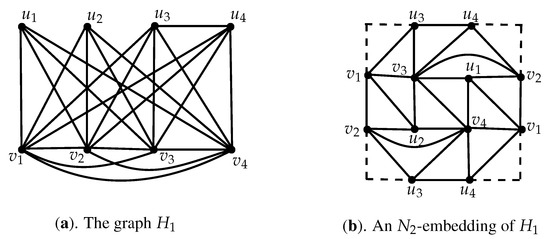
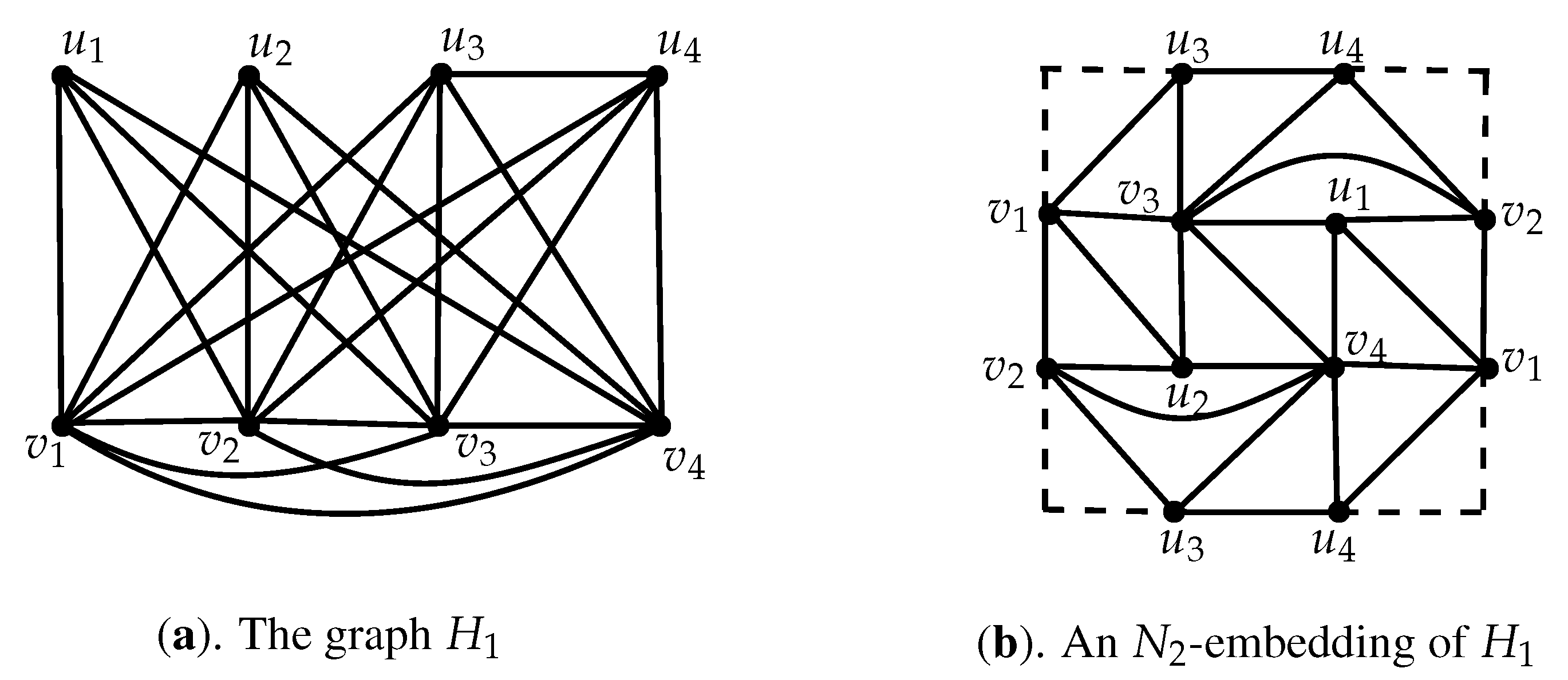
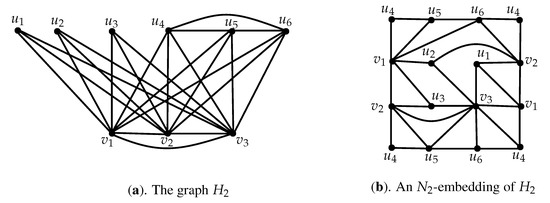
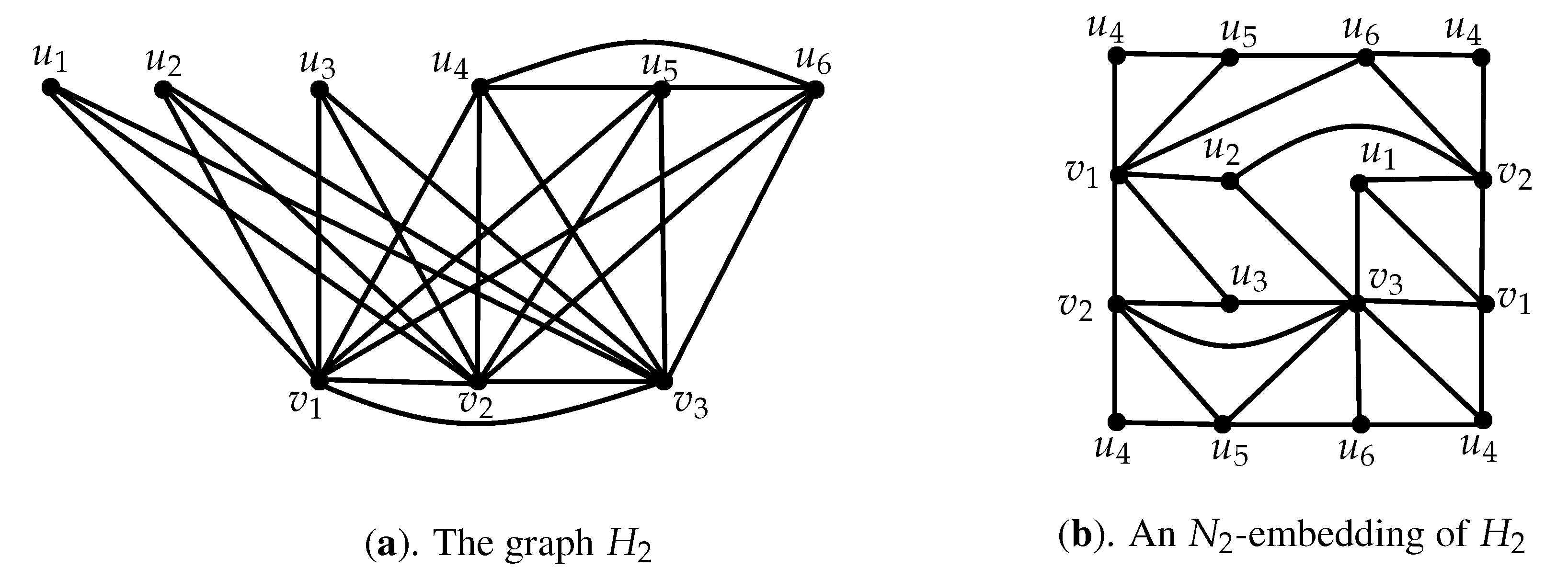
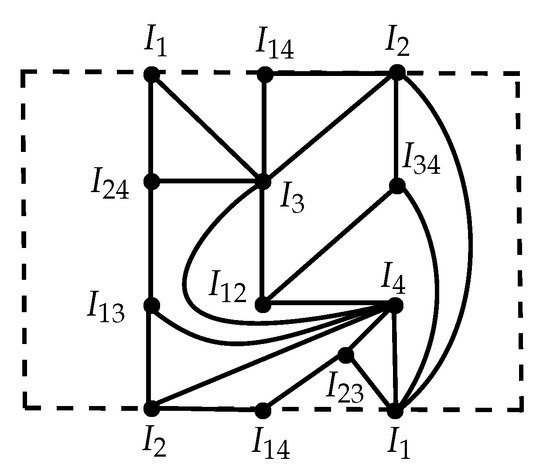
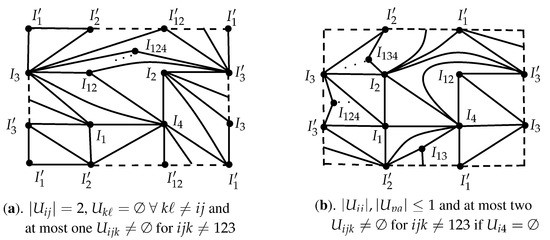
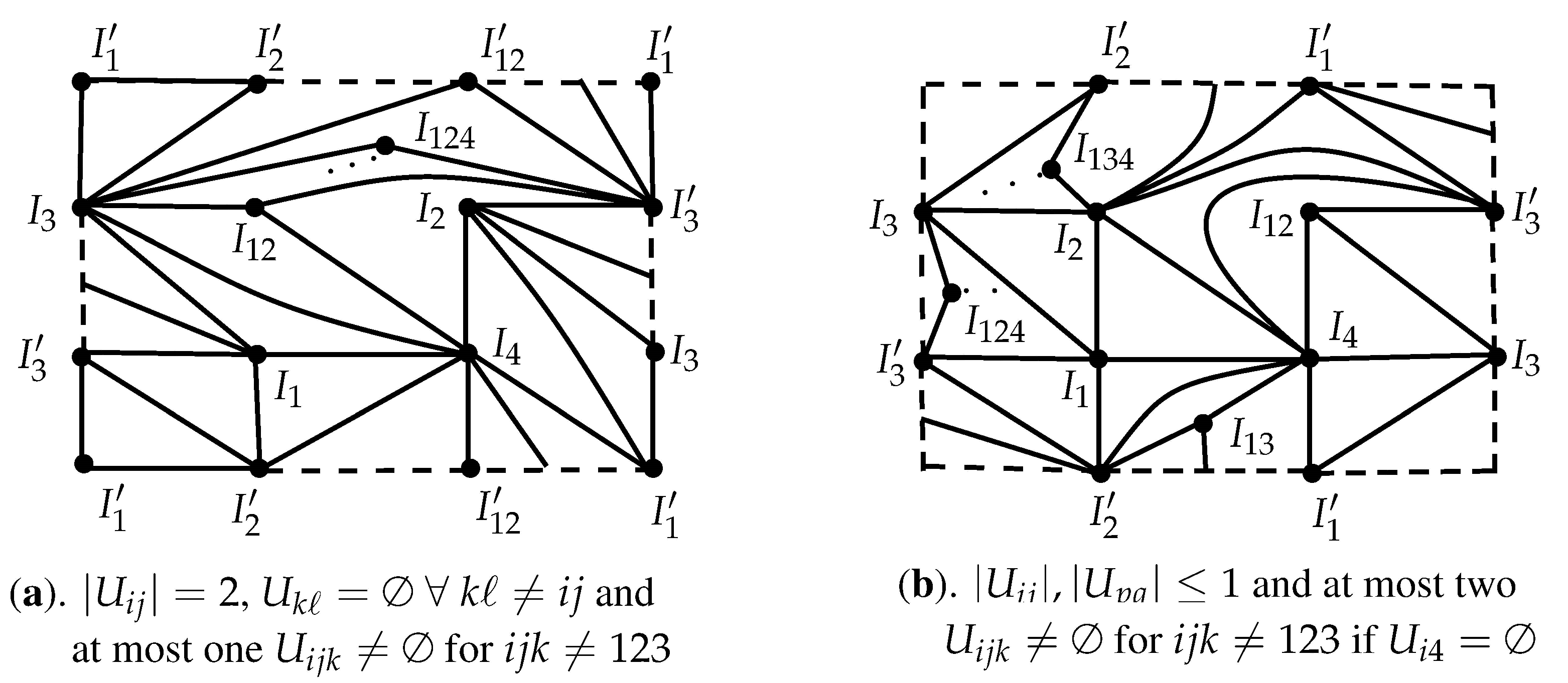
To finish this section we show two results that will be used to prove the main results. The graphs given in Figure 1 and Figure 2 play a vital role in characterizing a lattice with crosscap two annihilating-ideal graphs, and, therefore, we draw the graph with its embedding in the first result.
Figure 1.
The graph and its -embedding.
Figure 2.
The graph and its -embedding.
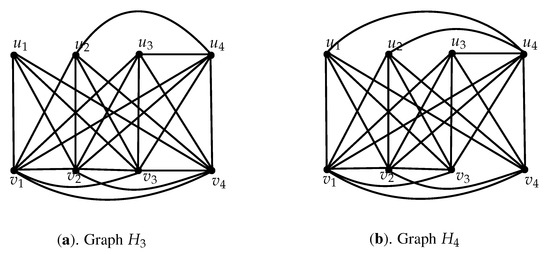
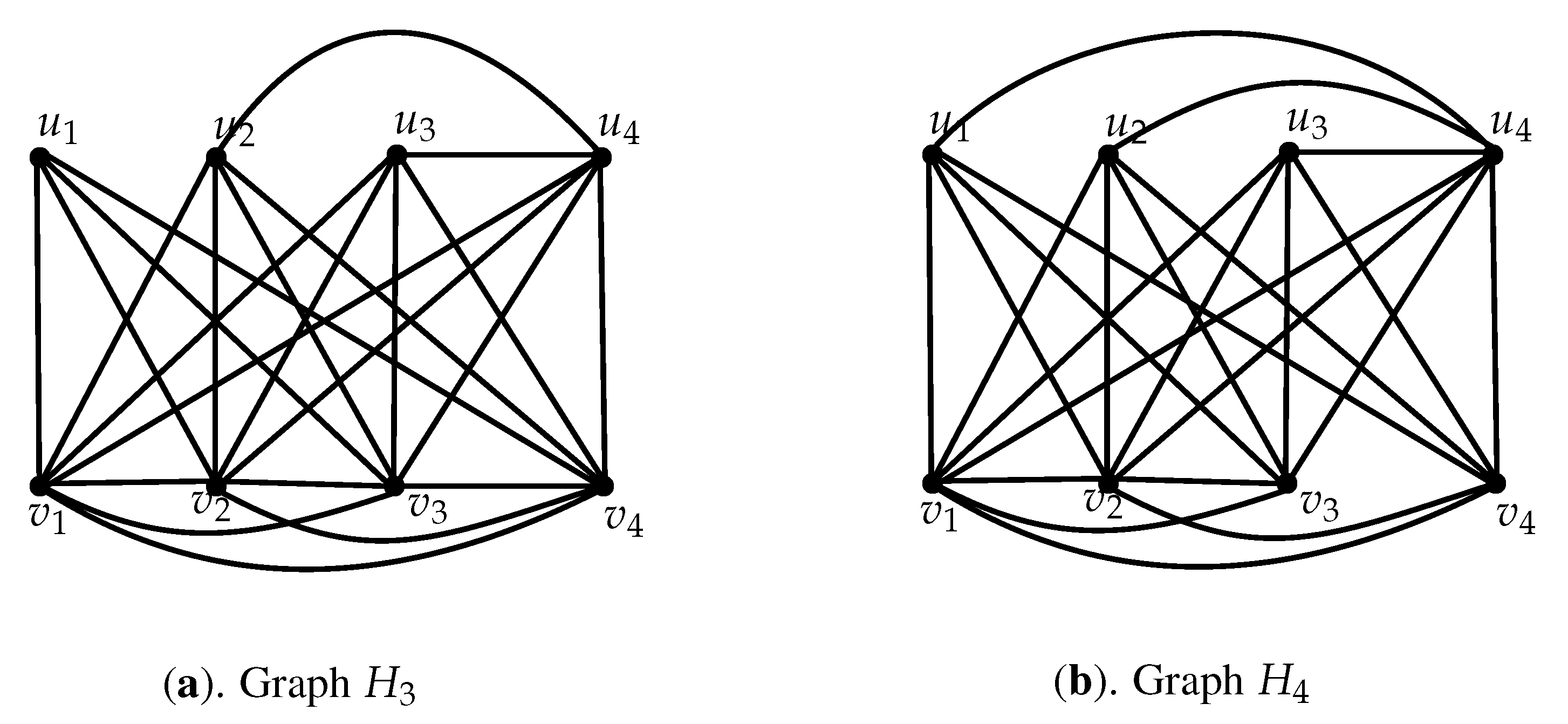
The graphs and given in Figure 3 play a vital role in our main theorems.
Figure 3.
The graphs and .
Lemma 3.
For the graphs and , as shown in Figure 3, we have and .
Proof.
(a). Consider the subgraph . Clearly where , and there are 13 faces in any -embedding of of which 12 are triangular, and 1 is rectangular. Now, we try to recover an -embedding of by inserting with its edges. Since is adjacent to four vertices of , should be inserted into the rectangular face of . However, all vertices of are adjacent to each other, except for and , so the rectangular face of must contain either or , which is in contradiction to and not belonging to the neighborhood set of . Therefore, .
(b). Apply a similar argument as in (a) for the subgraph . Here, notice that the largest face in any -embedding of is a unique pentagon, and is adjacent to the five vertices , and . □
4. The Case When
Let us start the classification result with a lattice containing exactly three atoms. Note that the following theorem provides a class of multipartite graphs, which are embedded in the Klein bottle (refer to Example 1 for an illustration).
Theorem 3.
Let be a lattice with , and let Then if and only if one of the following conditions hold:
- (i).
- ; there is with and .
- (ii).
- , and one of the following cases is satisfied:
- [a]
- There is with and .
- [b]
- There exist and such that and with
- [c]
- There exist and such that and with
- [d]
- There exist and such that with
- (iii).
- , and one of the following cases is satisfied:
- [a]
- There is with and
- [b]
- There exist and such that with either and or and
- [c]
- There exist and such that , with . Further, if , then either or and, if , then .
- (iv).
- , and one of the following cases is satisfied:
- [a]
- There is with and
- [b]
- There is with and
- (v).
- ; there is with and
Proof.
Assume that First of all, if , then is planar (see [19]). Suppose . If , then by Theorem 1 we have , which is a contradiction. Suppose . Then . Note that every vertex in , , and is adjacent to all of the vertices of , , and , respectively. So, if , then clearly is planar. If not, the vertices in are adjacent to all of the vertices of . Since , is a subgraph of that has a crosscap of more than three, refer to Proposition 1a. Thus,
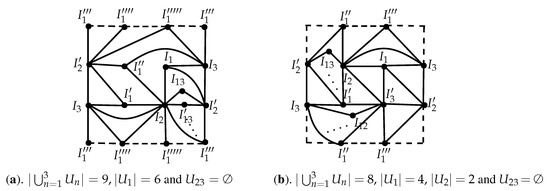
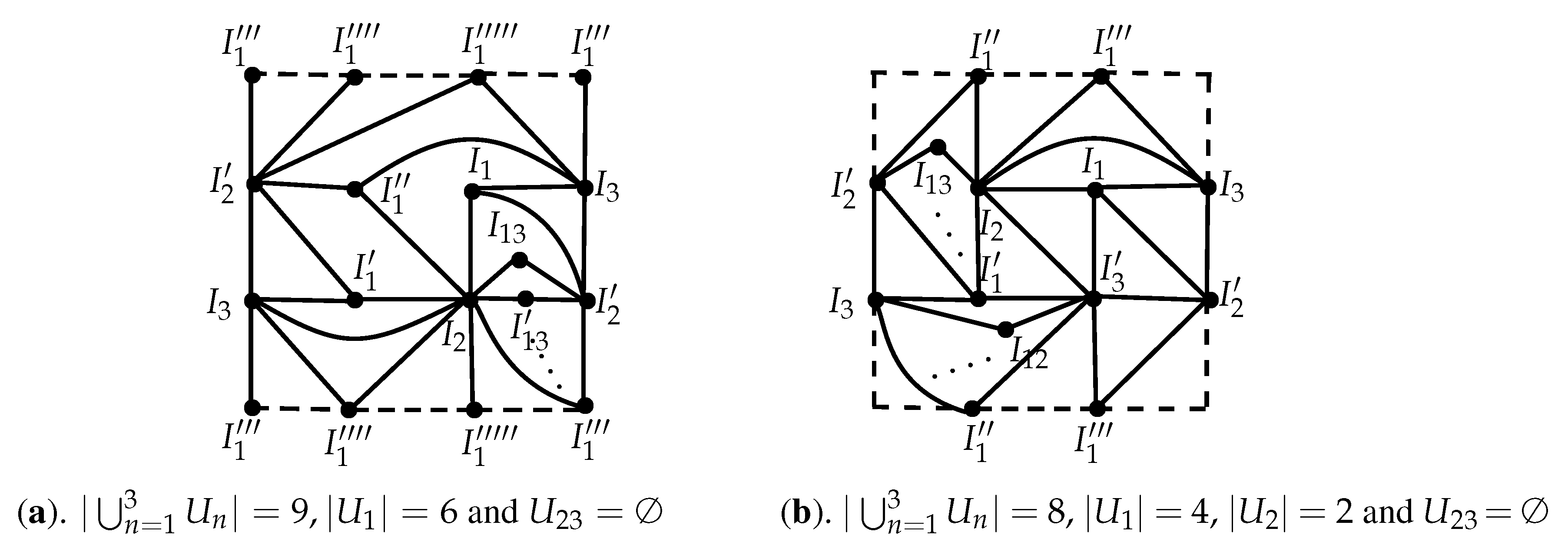
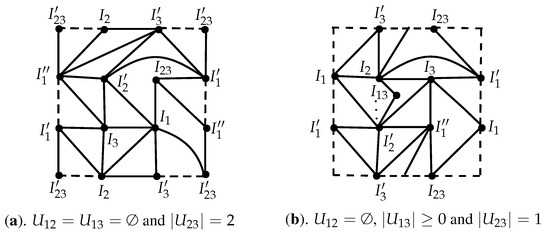
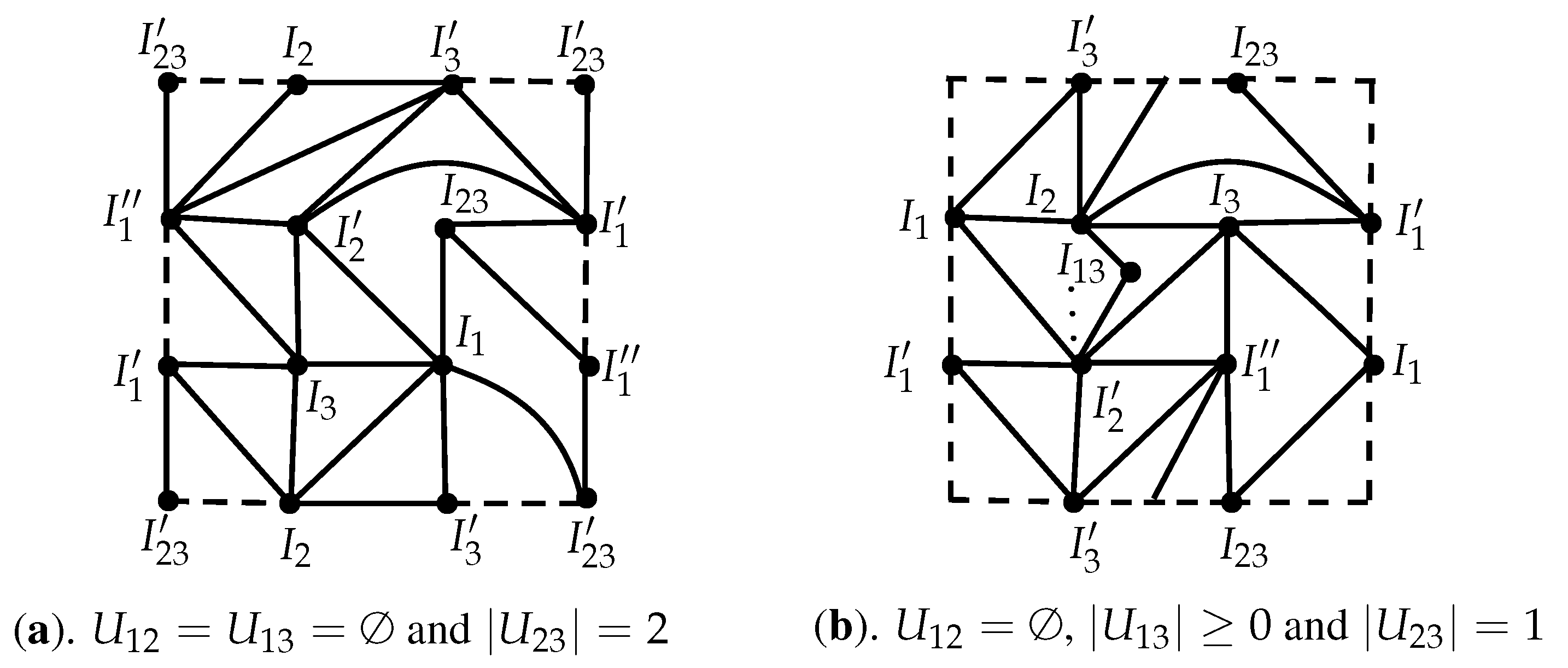
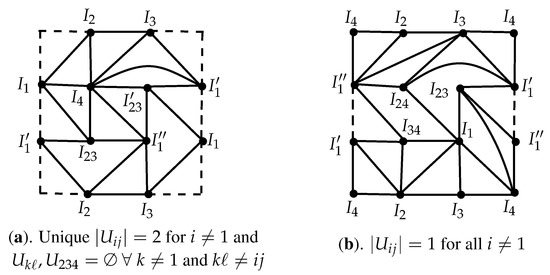
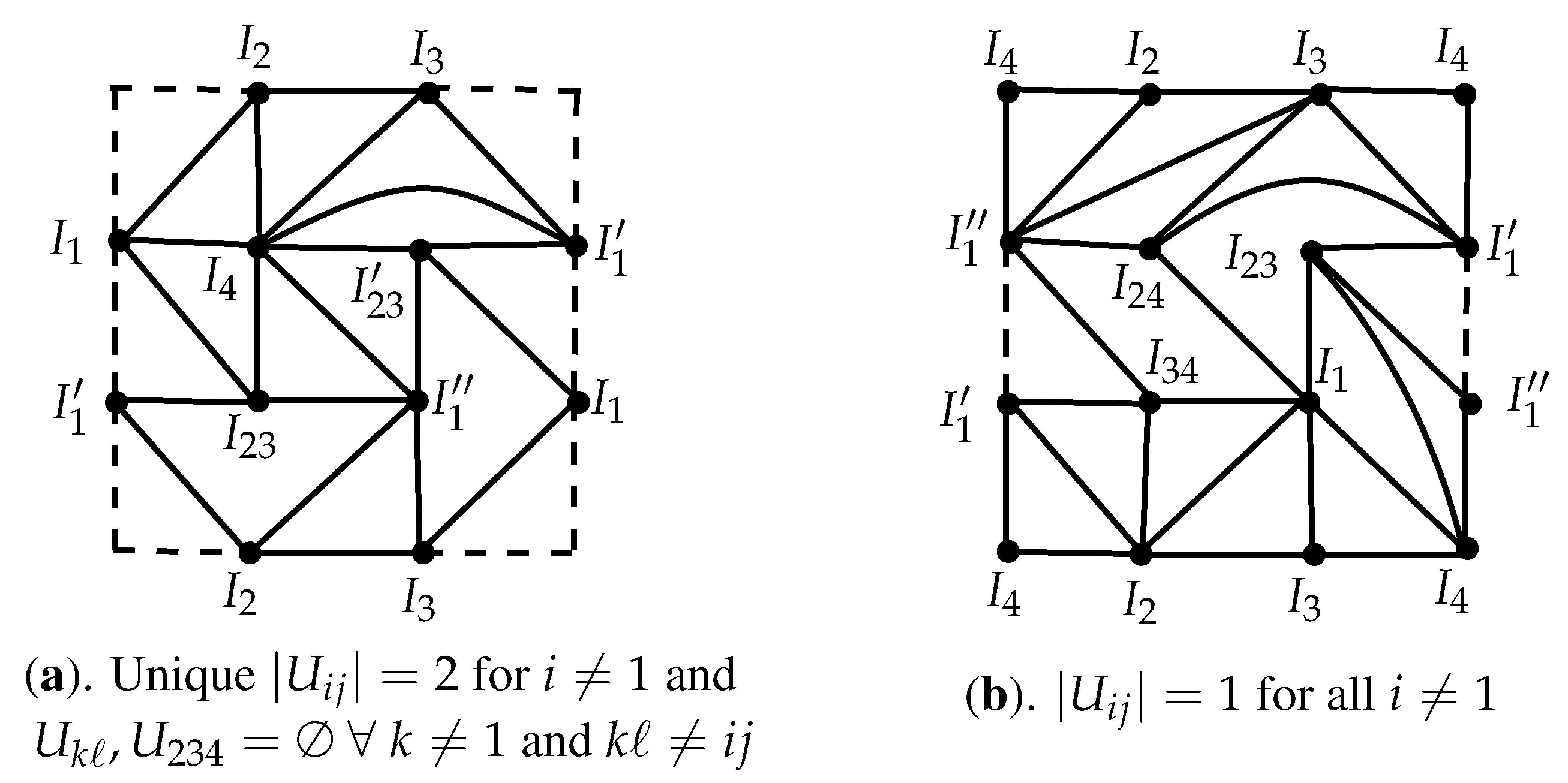
Case 1 Let Then, clearly, . If , then a slight modification to the discussion made in the above paragraph would show that is planar whenever and the graph contains as a subgraph when . If , then and . Now, if , then contains as a subgraph, which is a contradiction. So, . Here, all of the vertices in are adjacent to a single vertex of , and, therefore, the vertices in do not affect the crosscap. In Figure 4a, we provide the canonical representation of the embedding of the resulting graph in so that, in this case, . Next, if or 4, then , and so, by Theorem 1a, we obtain . Thus, , and, therefore, . Here, is a subgraph of , and, therefore, according to Proposition 1c, we have .
Figure 4.
-embedding of .
Case 2 Let
If , then Clearly, by [19], is planar in the case that is empty. If , then the partite sets and form as a subgraph in , which is a contradiction. Therefore, . In this case, the vertices in are all end vertices, and, therefore, it does not affect the crosscap. Thus, the resulting graph is , which is a subgraph of a graph given in Figure 2a, and, therefore,
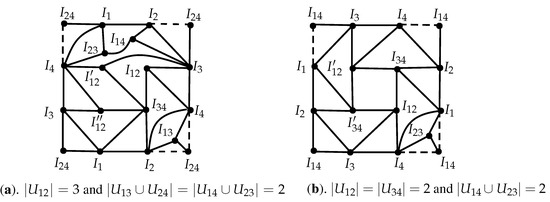
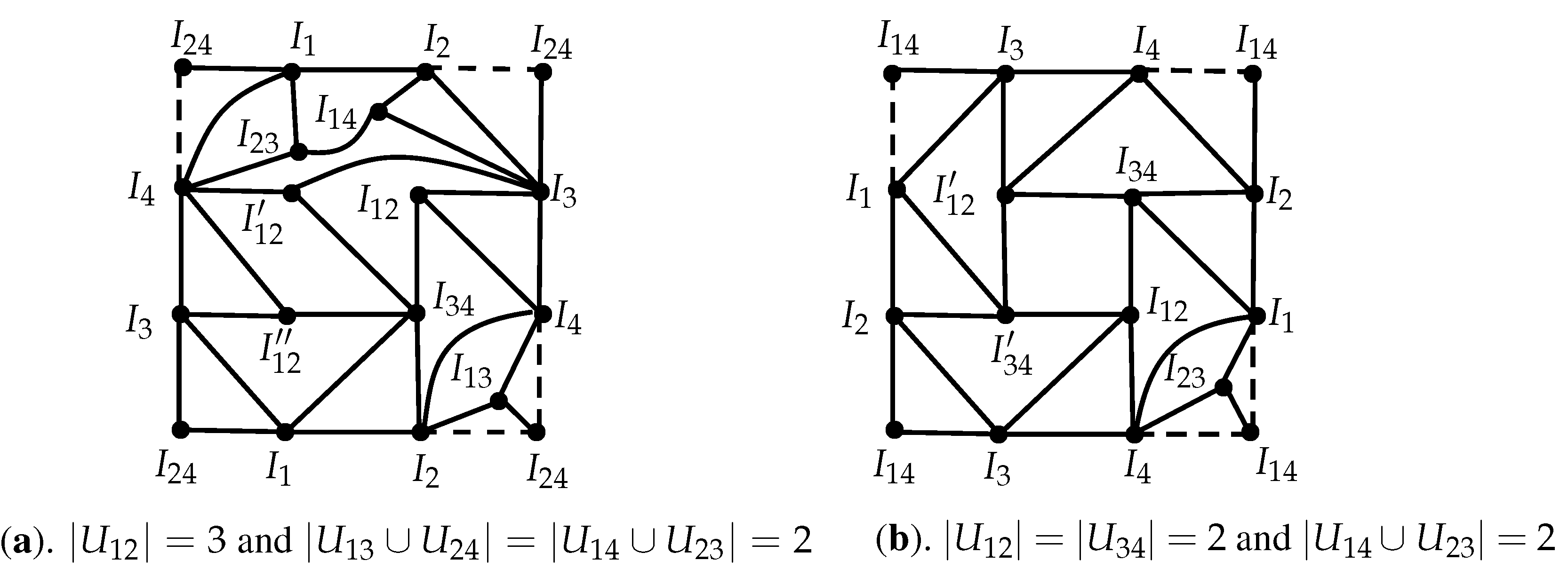
Suppose . Then, according to Theorem 1a, we have . If , then the sets and form as a subgraph of , and so . Therefore, . Let , and . For the embedding of in , in the case of , we can obtain help from Figure 4a because the number of vertices and edges of is less than that of in Figure 4a. Further, Figure 4b provides an -embedding of in the case of Here, notice that the open neighborhood of each vertex in is , and, in Figure 4a,b, there is a face in an -embedding of that contains both and so that every vertex of can be embedded in no matter what its cardinality may be. Let . This implies that . If (recall that ), then is a subgraph of the graph in Figure 1, and, therefore, according to Lemma 2, . If not, consider that the subgraph contains . By Euler’s formula, any embedding of in has nine faces. Further, by solving the equations and , we have all the faces as rectangular faces in any -embedding of . Now we try to recover the embedding of by inserting all edges into the embedding of . Since , the vertex is in the boundary of three rectangular faces of any -embedding of . In addition, note that, at the maximum, each rectangular face can adopt one edge incident with . So, we cannot insert all four edges of into without crossing, which is a contradiction. Thus,
Suppose . If for all , then, by Proposition 1c, we have . Next, our claim is that for all
Assume that Then the minor subgraph is
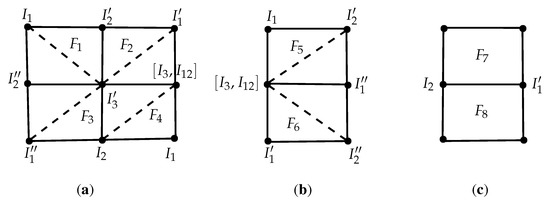
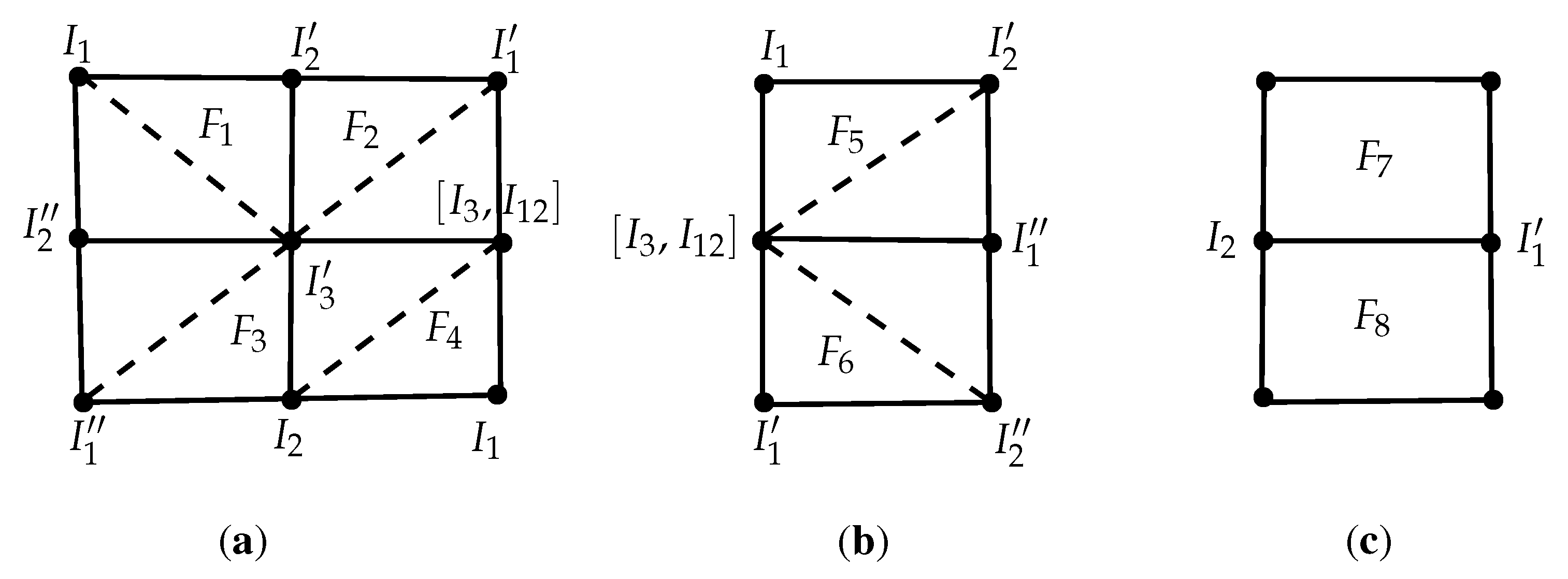
with the partite sets and . By Euler’s formula, any -embedding of has eight rectangular faces. Next, we attempt to obtain an -embedding of from any -embedding of . For this, we try to embed the six omitted edges of into an arbitrary -embedding of . First, to embed the three edges , and , three rectangular faces are required, denoted as , and , all of which contains (refer to Figure 5a). Since exactly one more face should have ; it is denoted as Intentionally, we label the diagonals of as the vertices and because can adopt one diagonal edge that can be used to embed the fourth edge . Finally, to embed the rest of the two edges and , two distinct faces are required, denoted by and , which should have the vertex . Note that, in any -embedding, every edge of a graph is in exactly two faces. Since the edge is in and the edge is in , the common edge between and must be Now, the choice for the unlabelled vertex of and is either or . Without a loss of generality, we label for and for (refer to Figure 5b). Since any -embedding of has eight faces, there are two more faces, lets say and , that have to be formed using all of the remaining vertices and edges of . Notice that, in any -embedding of , each vertex is present in exactly four faces, and each edge is present in exactly two faces. Since the vertices and are used twice in the faces , the faces and must share the edge (refer to Figure 5c). Now, the choices for the third and fourth vertices of and are and , respectively. Clearly, we have to select distinct vertices for and , in which one is from and the other is from . A contradiction to this fact is that the edges and are used twice in the faces .
Figure 5.
Representation of faces of -embedding of .
Assume that for some . Then, the subgraph contains with the partite sets and where and . By Proposition 2, any -embedding of has one hexagonal and six rectangular faces. Note that the hexagonal face should have either or , and the vertex is adjacent to . So, with its edges must be inserted into the hexagonal face, which implies that is in the hexagonal face. Since exactly two rectangular faces contain in which it is not possible to embed all of the three edges , and , which is a contradiction. Thus, for all .
Case 3 Let
Suppose . Clearly, is either planar or projective when (refer to [19,20]), and is a subgraph of the contraction of when . Therefore, will be one. Then, is a subgraph of the graph given in Figure 4a when , and is a subgraph of the graph given in Figure 4b when so that .
Assume that . Then, is projective when for all , and the graph contains as a subgraph when for some . Suppose and . Now, the graph is isomorphic to with the bipartite sets and where . Note that , and there are seven faces in any -embedding of , of which six are rectangular, and one is hexagonal. Since and every face in any -embedding of is rectangular, the hexagonal face of any -embedding of must have the vertices and Now, we try to recover an -embedding of from an -embedding of by inserting with its edges. Here, is adjacent to the six vertices , and . However, the hexagonal face of does not contain two of them so that . Therefore, either or . Now, with the help of Figure 6, we have when for a unique .
Figure 6.
with and .
Assume that and . If , then contains as a subgraph, and, if then, by Theorem 2.4iii [20], is projective. Suppose . If for or 3, then consider a subgraph where , and . Clearly, contains with the partite sets and . Note that any -embedding of has one hexagonal and six rectangular faces. Now, we try to recover an -embedding of from any -embedding of . Since is adjacent to all three vertices of X, the embedding of requires the hexagonal face of to have , and . Notice that each rectangular face may adopt at most one edge into it. So, to insert s, for , into any -embedding of , four rectangular faces with diagonals as the end vertices of each are required. At last, to insert , a rectangular face with the diagonals and for is required. Therefore, it requires one hexagonal face with five rectangular faces containing the vertices , and in at least three different faces. Since the degree of , and in is three, all four vertices are placed in exactly three faces of any -embedding of . So, the sixth rectangular face of could not be formed using the only left-out vertex in X (namely ), which is a contradiction. Thus, , and an -embedding of for this case is provided in Figure 7a.
Figure 7.
with and .
Suppose . If for and 3, then the minor subgraph is
with the bipartite sets and where , , , and . Note that any -embedding of has six rectangular faces and a hexagonal face, and the hexagonal face must have the vertices and . Let us denote the six rectangular faces by and the hexagonal face by . Now, let us try to recover an -embedding of by inserting the vertex and the edges for all . If we embed the edge , the edge , or the vertex together with its edges into , then we cannot insert the edges , , or into . Since the vertex is in exactly three faces of an -embedding of . So, in such cases, the edges and cannot be embedded in two rectangular faces which contains . Therefore we have to add at least one of the edges or into . For the best possibility, say and are embedded in . Then, has to be embedded into one of the two rectangular faces that contains , for example, . Notice that there are two rectangular faces, say and , that contain , in which one should not embed any of , , or with its edges. So, the edges and have to be embedded into different rectangular faces, say and , respectively. Therefore, after embedding the edges from to nicely, we are left with the single rectangular face that could not be formed using the diagonal vertices and . Thus, . Hence, either or . In this case, with the help of Figure 7b, we obtain .
Case 4 Let Suppose If , then is contained in , and if , then is projective. Therefore . Clearly, (except for the end vertices) is a subgraph of the graph given in Figure 1a, and so Lemma 2 implies
Suppose Then contains when , and is projective when . Thus, . Then, is a subgraph of the graph (see Figure 2a), so that Note that every vertex in is adjacent to exactly two vertices of in . Therefore, replace the labels and with and , respectively, in the -embedding of provided in Figure 2b, and then label all of the other vertices accordingly. Now, we can insert any number of vertices of into a face that contains both and so that .
Moreover, if , then is either planar or projective (refer to [19,20]).
Case 5 Let Then is planar or projective when . This implies that . If , then contains , and, if , then is projective. Thus, or 4. Then, clearly, is a subgraph of the graph , as in Figure 2a, so that □
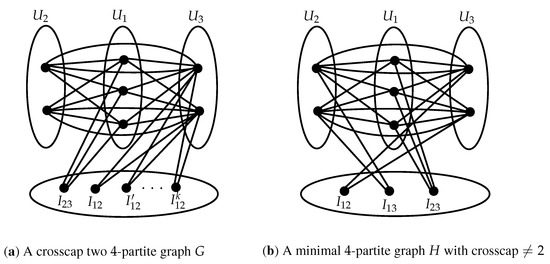
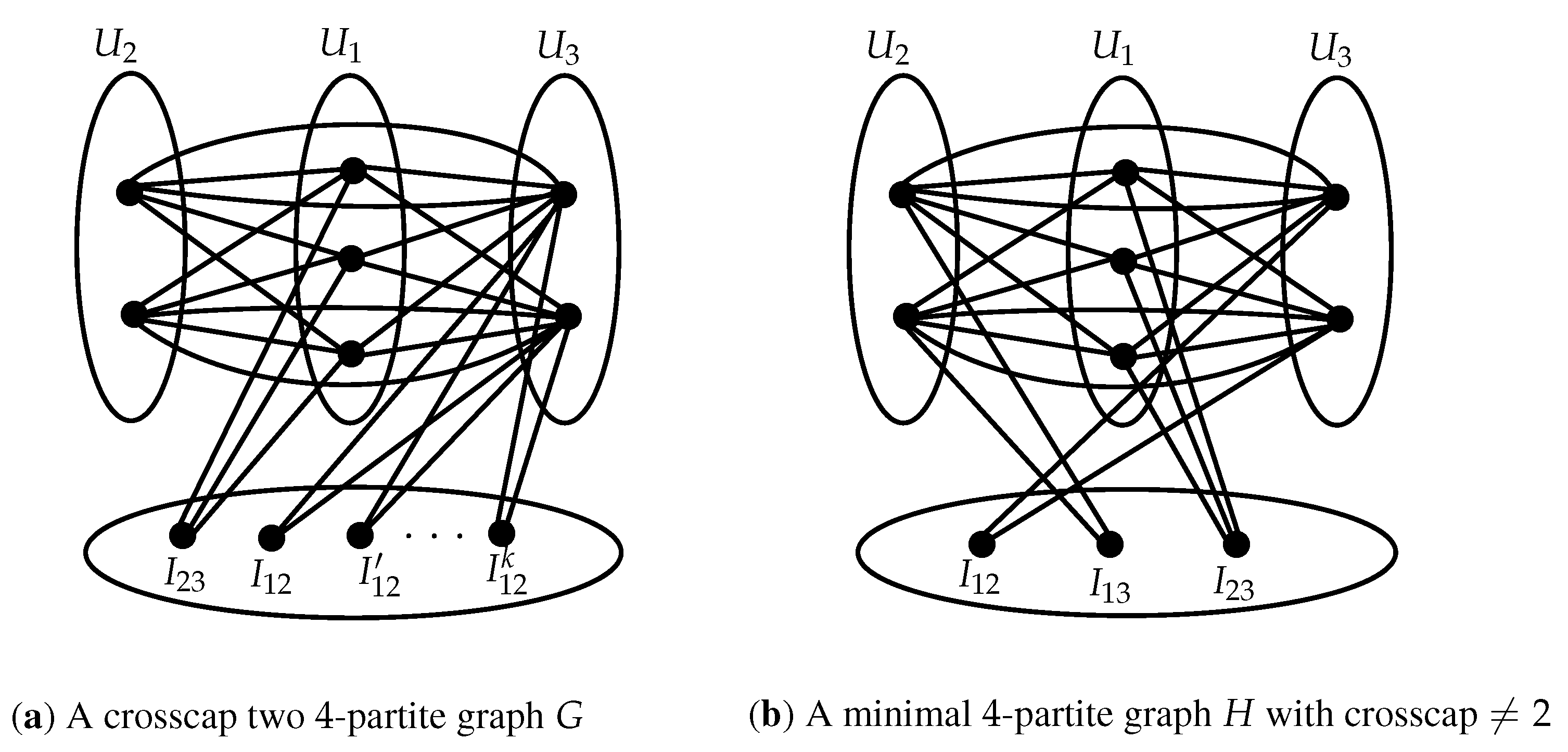
All of the results proved in this paper have a similar structure to that of those given in the statement of Theorem 3. To familiarize readers with the connection between the multipartite graph and the statement of Theorem 3, we illustrate two four-partite graphs, G and H, with and , respectively, in the following example.
Example 1.
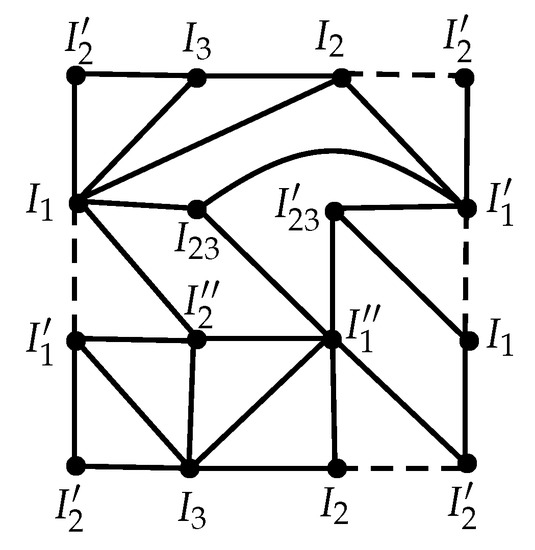
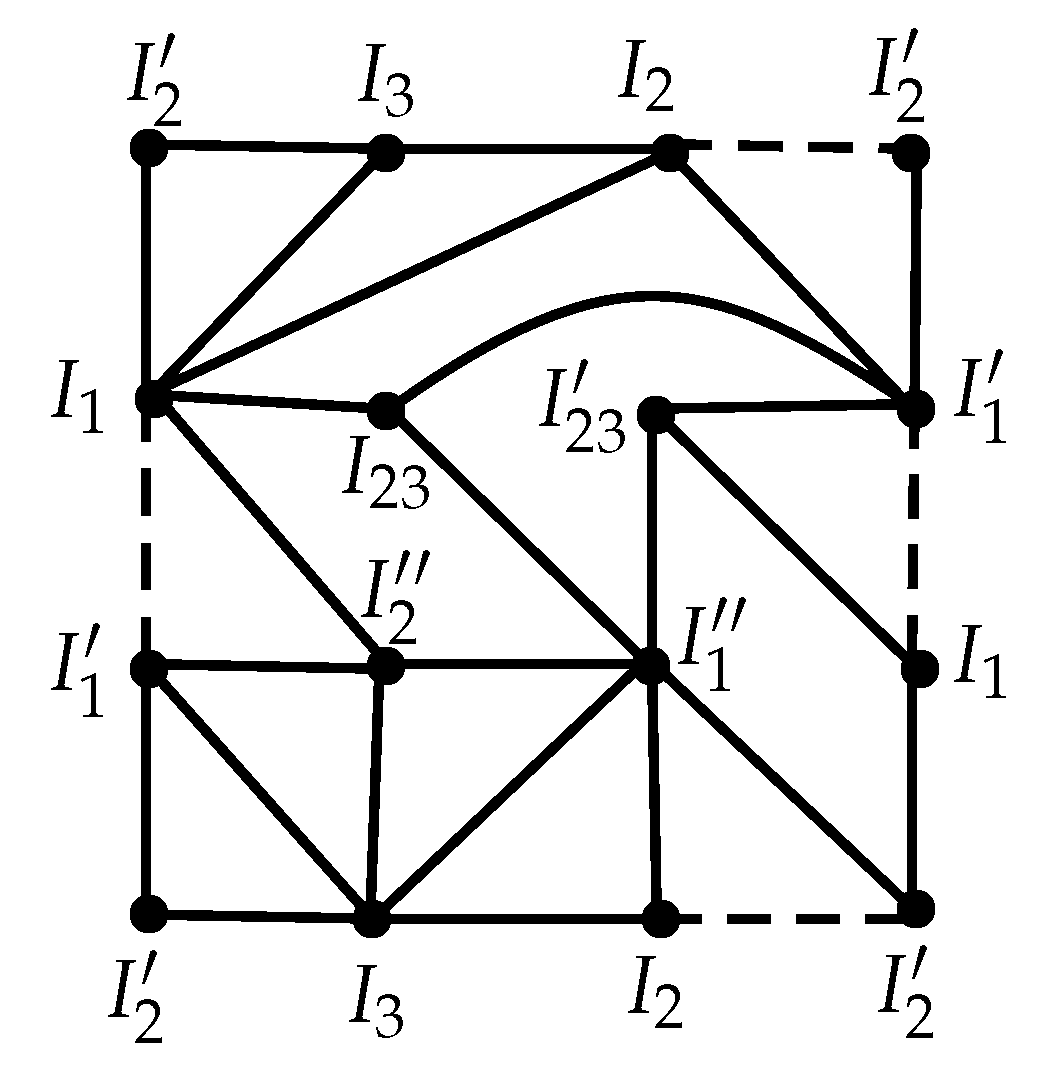
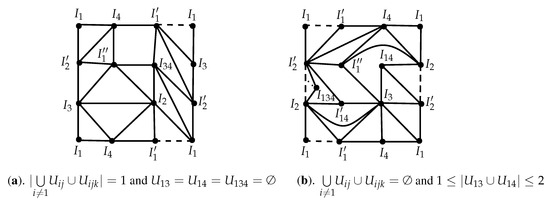
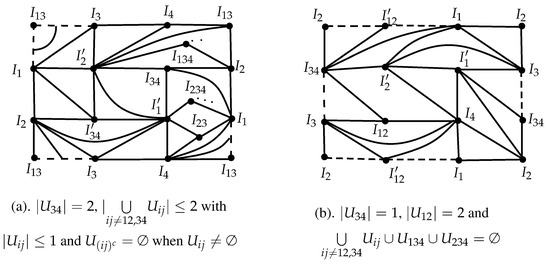
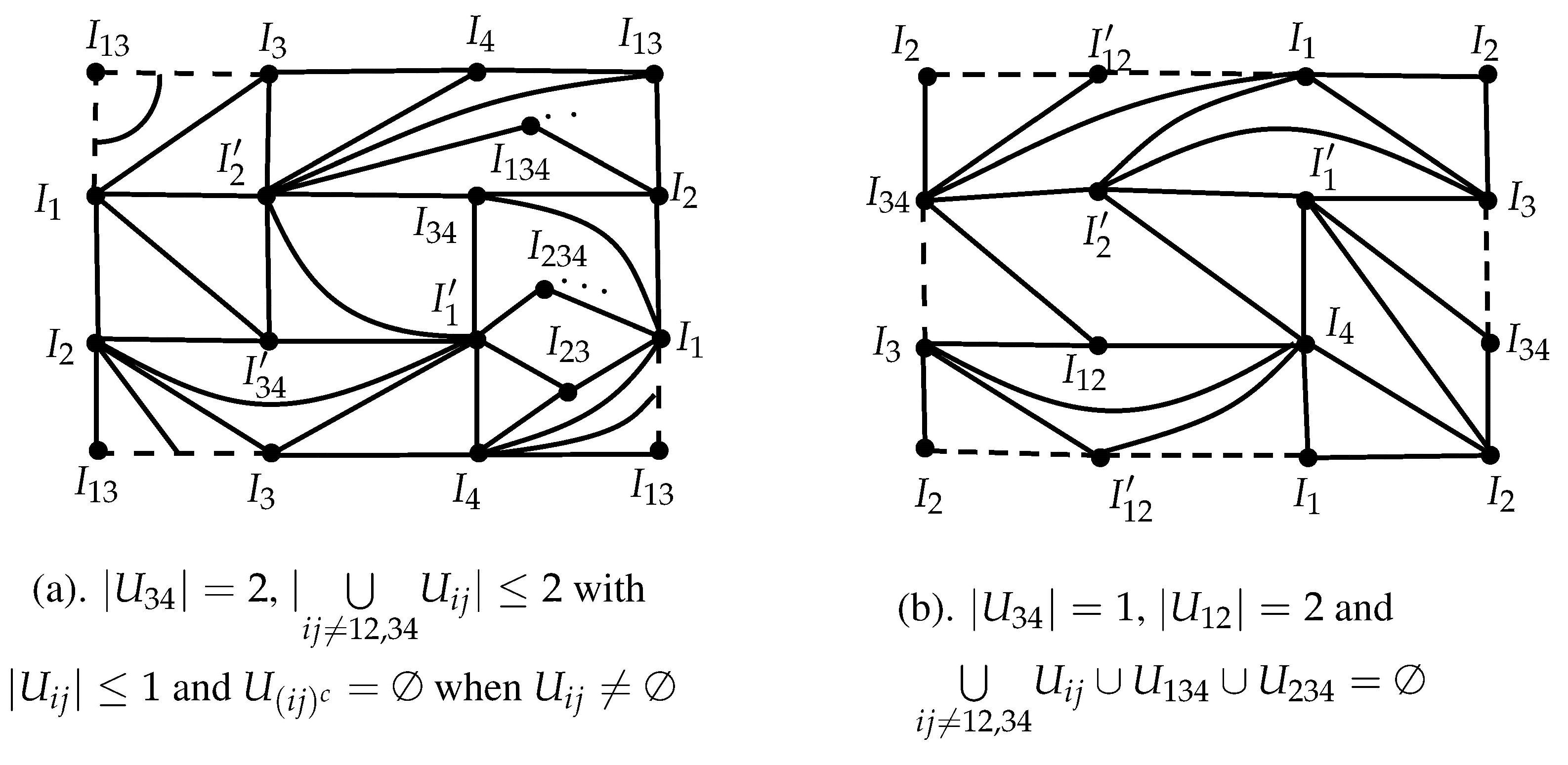
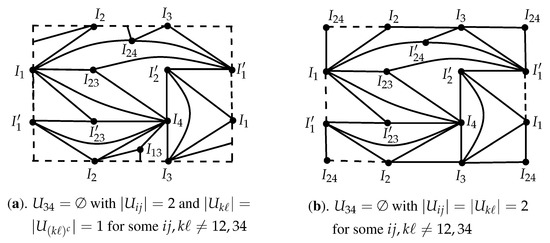
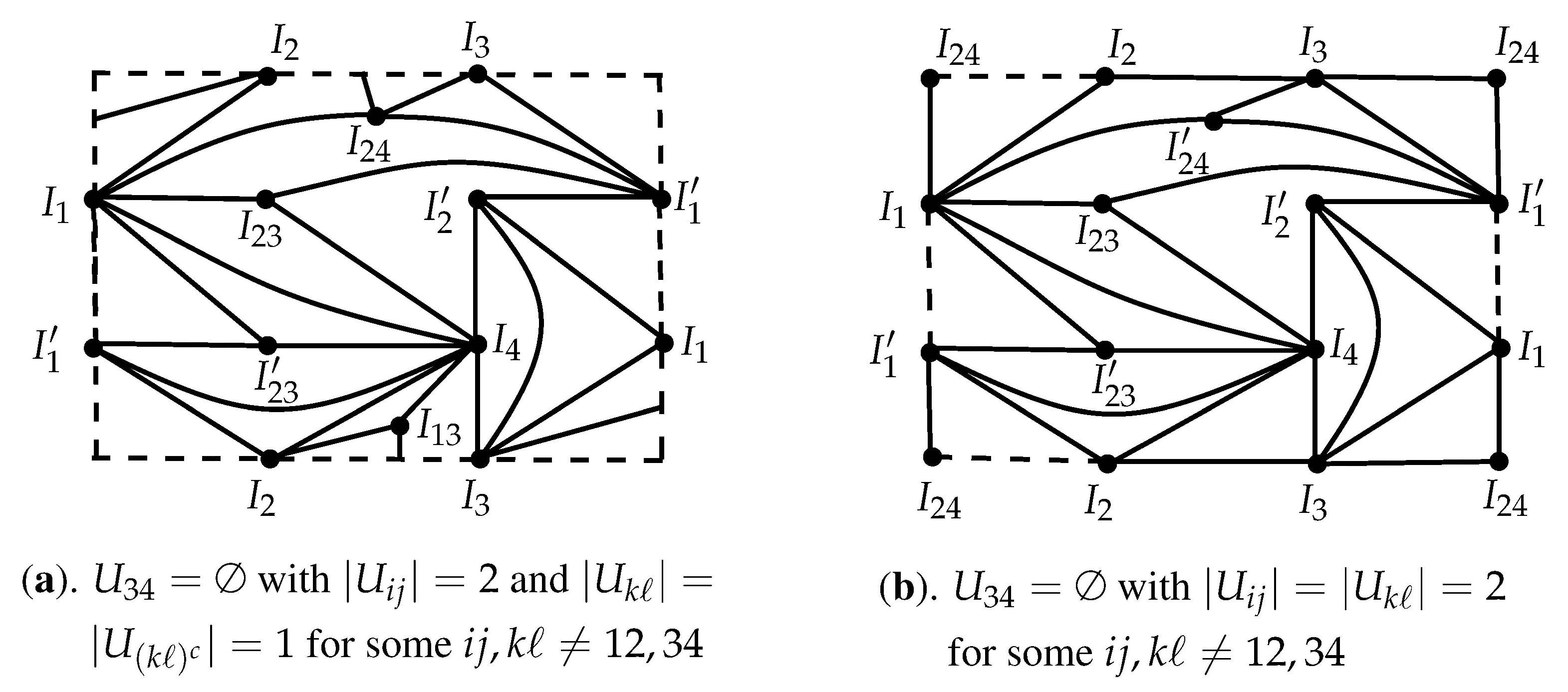
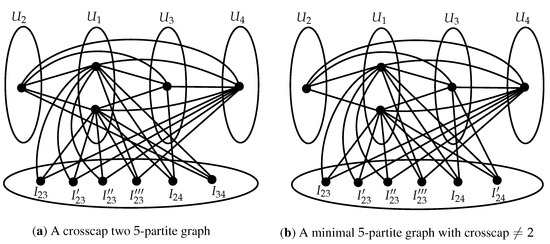
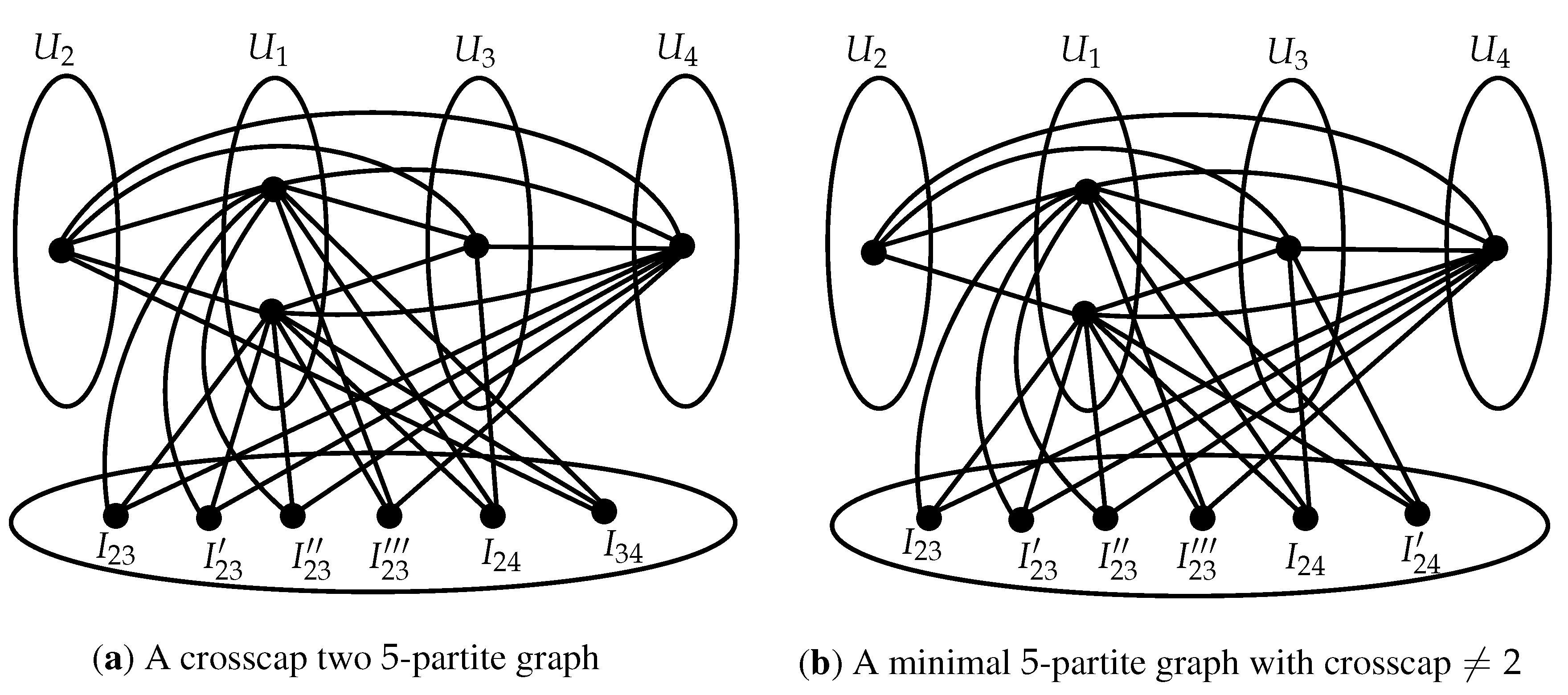
Consider Case (iii)[c] in Theorem 3. Let , and . If and , then the corresponding four-partite graph G is a crosscap two, which is given in Figure 8a. Additionally, if and , then the crosscap of the corresponding four-partite graph H, given in Figure 8b, is not equal to two. It is worth mentioning that the four-partite graph H in Figure 8b is minimal with respect to that is, there exists an edge e in H such that . Further, the graph H may be realized as one of the forbidden subgraphs for a crosscap two surface.
Figure 8.
Four-partite graphs.
By using the proof of Theorem 3, we establish the following points, which will be used in the subsequent results.
Remark 1.
If a graph G is isomorphic to or where e is an edge, then .
5. The Case When
Next, we fix the number of atoms as four. As mentioned in the introduction, for , we denote where , and the notation exists only when . Before going into the characterization of the crosscap two with , we provide modifications for Theorem 2.6 [20]. To be precise, the missing cases and the corresponding conditions for the projectiveness of are given below.
(i) First of all, consider the missing case Then, for all . Clearly, is planar whenever Therefore, If with , then the subgraph induced by the sets and contains or as a subgraph. This implies . Therefore, if for .
Suppose for some with . If for , then the subgraph contains with the partite sets and . Note that Now, we try to embed all of the vertices of with their edges in any -embedding of Since , either or . Without a loss of generality, let . Since the vertex is adjacent to , all of the three vertices , and must be embedded into a single face of the -embedding of denoted as . Now, draw the path into and then draw the edges , and where . Now, the edges and cannot be embedded into . Therefore, . Thus,
Suppose for all with . Then, Figure 9 guarantees that
Figure 9.
with for all .
(ii) Let Then, for some , and the condition for the projectiveness of given in Theorem 2.6i [20] is that or 2, in which at most one of the s has exactly two elements for . However, if with , then the sets and , where , contain in so that we obtain In fact, if for some , then Otherwise, the sets and , where , form , so we can conclude that . Further, if for all , then For if , then the sets and , where , form , and, if for some with , then the sets and form in where .
(iii) Let If there exists for some , then the statement of ([20] Theorem 2.6(ii)(a)) says that if for , , and at most one of the s has exactly one element, then is projective. However, for instance, if with , then the partite sets and contain as a subgraph of so that Therefore, the condition has to be added to the statement of ([20] Theorem 2.6iia).
As a result of the above remarks (i), (ii), and (iii), we modify the statement of ([20] Theorem 2.6) as follows.
Theorem 4.
Let be a lattice with . Let and . Then if and only if one of the following conditions hold:
- (i).
- ; there exist two non-empty sets and such that . Moreover, if , then
- (ii).
- ; there is with , in which at most one of the s has a maximum of two elements, and . Moreover, if , then , and, if , then .
- (iii).
- , and one of the following is satisfied:[a] There is with . If , then and if , then . Moreover, whenever .[b] There exist and such that with . Additionally, whenever . Moreover, if or , then . Furthermore, if or , then .
- (iv).
- and one of the following is satisfied:[a] There is with and[b] There exist and such that and . Additionally, , and whenever .
We are now in the position to state and prove the second result which classifies all lattices with four atoms whose has a crosscap two.
Theorem 5.
Let be a lattice with . Let and . Then if and only if one of the following conditions hold:
- (i).
- ; there is with and
- (ii).
- , and one of the following cases is satisfied:
- [a]
- There is with and
- [b]
- There exist and such that and .
- [c]
- There exist and such that and .
- [d]
- There exist , and such that , and for
- (iii).
- , and one of the following cases is satisfied:[a] There is with and . Moreover, whenever for[b] There exist and such that and . Moreover, if then and , and if , then[c] There exist , and such that with , in which at most one of the s has exactly one element, and, also, at most two distinct sets’ s are non-empty for all . Moreover, if or for , then at most one of the s is non-empty.
- (iv).
- , and one of the following cases is satisfied:
- [a]
- There is with , in which , and . Moreover, if with then
- [b]
- There exist and such that and with . Additionally, if , then and , and, if , then and . Moreover, in the case of , one of the following hold:
- [b1]
- If then in which and .
- [b2]
- If then with where and
- [b3]
- If then in which at most three s are non-empty. Furthermore, if , then .
- (v).
- ; there exists such that and in which . Moreover,
- [a]
- Ifthen, , and .
- [b]
- If then , and whenever .
- [c]
- In the case of one of the following holds
- [c1]
- If , then .
- [c2]
- If , then . In addition, whenever in which exactly two s are non-empty.
- [c3]
- If , then either with or with .
- [d]
- If for all , then in which at most two distinct s are non-empty.
- (vi).
- ; there exist two non-empty sets and such that , and one of the following cases is satisfied:
- [a]
- There is with , in which , and . Moreover, if with then
- [b]
- If, then eitheror. Further,.
- [c]
- If, then whenever for . Further, if , then at most one pair of is nonempty for all . [c] If , then whenever for . Further, if for and , then with .
Proof.
Assume that Then, by Theorem 1b, we have . So,
Case 1 Let Then, by Theorem 1b, implies If or for some , then the sets and contain , which has a crosscap four. So, for all . Here, remember that every vertex in is an end vertex, and every vertex in is of degree two. Let be the induced subgraph of induced by the vertex subset . It is clear that , and is a subgraph of the graph given in Figure 2a with the labels (for ), , and . By Figure 2b, the -embedding of contains three different faces with vertices ; , and , respectively. So, any number of vertices in can be embedded into the -embedding of without edge-crossing. Thus, .
Case 2 Let
Case 2.1 Suppose If or for some , then contains as a subgraph, which is a contradiction. Therefore, and for all . Now, if , then is a subgraph of the annihilating-ideal graph in Case 1 with so that . Suppose Here, . If , then contains a copy of where the partite sets are and so that . If for some , then contains as a subgraph with the partition sets and so that, by Remark 1, we have . Therefore, and . In this case, one can retrieve an -embedding of from Figure 4b by changing the label to and its related edges such that .
Case 2.2 Suppose . Let . If or for , then contains , which is a contradiction. Therefore, and for all . In this case, the crosscap of is same as the crosscap of so that . Let and .
- In the case that for , the contraction of induced by the partite sets and , where , forms a copy of .
- In the case that for , the graph contains with the partite sets and where .
- In the case that , the contraction of induced by forms where ℓ is the least integer in .
Thus, , and, so, the crosscap of is the crosscap of , which is two.
Case 2.3 Suppose . Then, is a subgraph of . Suppose . Then, by Euler’s formula, the number of faces in an embedding of is 16 so that all the faces are triangular, which contradicts the fact that has no triangular embedding (see [27]). Thus, .
Case 3 Let
Case 3.1 Suppose If , then contains with one partite set , and, so, . Further, by Theorem 4iv, is projective whenever for all . Therefore, , and let . Now, if for all , then it is easy to verify that is isomorphic to a subgraph of the graph (see Figure 1a). Therefore, by Lemma 2, we have . So, let for some . Suppose for . Here, the open neighbor of each vertex in is and in . Let be the induced subgraph of induced by the vertex subset . Clearly, is a subgraph of the graph given in Figure 1a with the labels (for ), , and . Since , any number of vertices in (for ) can be embedded in the -embedding of without edge-crossing, and, therefore, . Now, take for . Note that the set is nothing but the singleton set . Now, consider the subgraph , which is isomorphic to with the partition sets and . Note that any -embedding of has eight rectangular faces so that each face shares exactly two vertices from X and Y. In , the vertex is adjacent to three vertices of Y, namely , and I. Therefore, one cannot insert with its edges into without crossing, which is a contradiction.
Case 3.2 Suppose Then, . If , then it is easy to check that the contraction of contains either or as a subgraph, and, so, by Remark 1, we have . Therefore, .
Assume If , then ; otherwise, the graph induced by the partition sets and form in so that Further, if , then consider the graph with the bipartite sets and where , and . Now, a similar argument given for (refer to Equation 1) leads to . Therefore, with . In this case, with the help of Figure 10a, we obtain . Notice that in Figure 10a, we take
Figure 10.
with .
Assume . If for some , then the sets and , where form . So, for . Suppose Let and for Then, the subgraph contains with the partite sets and . Since , is contained in exactly three rectangular faces in any -embedding of Since , to embed the edges , and , the vertices , and on the diagonals of the three rectangular faces that contain , respectively, are required. Now, after embedding the three edges, is in exactly six triangular faces, all of which were formed by using two vertices from Y and one vertex from Therefore, the vertex cannot be embedded because it is adjacent to as well as two vertices from So, . However, is projective if Thus, Now, one can obtain help from Figure 10b to say that
Case 3.3 Suppose .
Claim A: At most two distinct s are non-empty in which at most one is non-empty for . Additionally, at most two distinct s are non-empty for
Assume on the contrary that at least three s are non-empty for ; say, and are non-empty. Let and If r exists, then the minor subgraph induced by the vertices , and forms in , which is a contradiction. If r does not exist, then take r as and form a minor of with the partite sets and , which is isomorphic to either or , as in Figure 3. So, by Lemma 3, we have . Therefore, only at most two distinct s can be non-empty for Further, if for some , then the subgraph induced by the sets and , where or n, form which has a crosscap of at least three.
Note that all the vertices in are end vertices in . If , and are non-empty for , then the minor subgraph induced by is , which is a contradiction. Therefore, at most two distinct s are non-empty for
Claim B: and for all
If for some , then contains as a subgraph with the partite sets and where . Additionally, if for some , then contains as a subgraph with the partite sets and where . Thus, and for all
Assume for some . Suppose for some and . Let us take . Then, contains with the partite sets and where . So, by Remark 1, . Therefore, . In this case, the number of cannot be more than one because here contains . For the remaining cases, by Figure 11a, we obtain .
Figure 11.
with .
Assume for all . Suppose for some . If there are two s that are non-empty for , then it is not hard to verify that contains a subgraph similar to the structure of , which has a crosscap of at least three. For all the remaining cases, that is with unique or and with at most two s that are non-empty for and , one can use Figure 11b to obtain .
Case 4 Let
Case 4.1 Suppose . Note that each vertex of for is adjacent to exactly two vertices and for and , so we do not want to bother about and for all . If for some , then contains as a subgraph with the partite sets and where , which is a contradiction. So, for all
((i). Assume for some . If then the sets and form in , and, if for some with or , then contains so that . If not, that is for all with , then by Figure 12a, we have .
Figure 12.
with .
(ii). Assume for all . If and for some and then the sets and , where , contains in . Additionally, if , then the sets and , where , form in , which is a contradiction. So, at most one of the sets is non-empty with
Let . If , then the sets and , where , form so that, by Remark 1, . Therefore, . For this case, readers can verify the -embedding of
Let . If with , then the sets form . Therefore,
Let . Then, by Theorem 4iii[a], is projective if If then is a subgraph of with the partite sets and . So, in the case of , whenever with (refer to Figure 12b).
Case 4.2 Suppose . Then, and . If , then the partite sets and form as a subgraph in , which is a contradiction.
Case 4.2.1 Assume . Then, for all ; otherwise, the sets and form in . In particular,
If for some and , then the subgraph contains with the partite sets and where and . Note that any -embedding of has one hexagonal and six rectangular faces, and the vertices and are adjacent to and . So, to insert and into an -embedding of , we require two faces, say and , which contains , and . If either or is hexagonal, then the corresponding face may adopt one of the edges or . Let us take that the edge is embedded. Now, to insert an edge , a rectangular face containing and as diagonals is required. However, no such rectangular face exists because the edges and have been used twice in and , which is a contradiction.
For all of the remaining cases, that is with and when for , we have (refer to Figure 13a).
Figure 13.
with .
Case 4.2.2 Assume that . Let us take .
Let , then the subgraph of induced by the sets and contains so that . Thus, .
Let . If , then contains , so that, by Remark 1, . Therefore, , and in this case, by Figure 13b, we obtain .
Let . If , then the partite sets and where and form a minor subgraph in so that, by Remark 1, . If for where , then the partite sets and where form . A slight modification of the proof for in Lemma 3 yields . Further, minor changes to the labels in Figure 13a give whenever .
Let . Then for all ; otherwise, contains , which is isomorphic to , so Lemma 3 gives us . If , then the partite sets and where and contain in , which is a contradiction. Suppose . If for some where then the subgraph contains with the partite sets and where . Note that any -embedding of has one hexagonal and six rectangular faces. Further, in , is adjacent to , and, also, are adjacent to . So, to embed the vertices , and one hexagonal and two rectangular faces containing both and are required. In such a case, one cannot find two rectangular faces with the diagonal vertices and . So, either the edge or cannot be drawn without crossing, which is a contradiction. Thus, we obtain the result as in the statement-(iv)[b2].
Case 4.2.3 Suppose .
If for some , then the sets and where form a complete bipartite graph whose crosscap is more than two.
Let for some . Then, clearly, must be empty. Let . If then the sets and where and form and, by Remark 1, . Therefore, Now, there are at most three possibilities:
- (i).
- and ; this case is pictured in Figure 14.Figure 14. with .
- (ii).
- and ; this case is pictured in Figure 15a.Figure 15. with .
- (iii).
- ; this case is pictured in Figure 15b.
Thus, in all these cases, we have
Let for all . Then, at least one for . Otherwise, the graph induced by forms in . Clearly, because the number of faces in the -embedding of is 17, which contradicts the well-known fact that must be greater than the girth value (refer to Observation 1). Therefore, . Thus, by [20], we have whenever .
Case 5 Let Then, . If for all , then . Observe that we do not want to consider the sets for whenever because every vertex in is adjacent to and . If for some , then the sets and where form in , which is a contradiction.
Case 5.1 Assume for some . Then, whenever ; otherwise, the sets and where form as a minor of . Similarly, ; otherwise is a minor of . If for some and , then the subgraph contains with the partition sets and where . Since , let . Clearly, . Note that each face in any -embedding of is rectangular, and the vertices are adjacent to and . Therefore, to insert and , two rectangular faces that contain and are required. Next, to insert the edge , a rectangular face with the diagonals and is required. However, the edges and have been used twice to form the first two rectangular faces. So, one cannot construct another rectangular face that contains and with a single left-out vertex of which is a contradiction.
Therefore, for the remaining case, that is, for all and with whenever , by using Figure 16a, one can have .
Figure 16.
with .
Case 5.2 Assume for some . Let . Clearly, ; otherwise, the sets and form .
If for some and , then the subgraph has a similar structure of with the partite sets and , and so . Suppose for and . Let Then, has with the partite sets and . Any -embedding of has one hexagonal and six rectangular faces. Notice that are adjacent to , and are adjacent to . So, to embed , and one hexagonal and two rectangular faces containing both and are required. However, the edge cannot be drawn without crossing, which is a contradiction. Therefore, and .
Suppose . Since for all and we have and for some and Next, we claim that If then by letting , can be formed by the sets and . If then has a similar structure to , so that
Suppose . As mentioned, when for and Suppose and . Then, , has with the partite sets and . Note that any -embedding of has one hexagonal and six rectangular faces, is adjacent to , and are adjacent to . So, the three vertices together with the edges cannot be embedded, and, also, . Therefore, Further, if for and , then contains , which is a contradiction.
Thus, an -embedding of can be retrieved from Figure 16a for with if .
Case 5.3 Assume for some . Clearly, ; otherwise, the sets and where form .
If for and , then . Further, an -embedding of in the case of is given in Figure 16b so that .
Suppose for and . If , then the sets and where form in so that, by Remark 1, we have . Further, since , we have . Therefore, Suppose say . Then, ; otherwise, and where form in . So, Suppose not, that is, then ; otherwise, with the partite sets and where is a similar structure to which has a crosscap of at least three. So,
Suppose for and . Then, by Theorem 4(ii), provided with or with or or with .
Hence, whenever with or with and a unique or with .
Case 5.4 Assume for all . Then, ; otherwise, the sets and where form .
Suppose for and . If , then the sets and form as a minor of , which is a contradiction. Assume that . If , then contains with the partite sets and and any -embedding of has nine rectangular faces. Here, it is not hard to verify that all the left-out vertices and edges cannot be embedded into the nine rectangular faces so that . Therefore, . Here, the graph is a subgraph of the graph in Figure 2a, and the suitable labels in Figure 2b give two different faces in the -embedding of that contains the vertices and so that . Assume . If , then the subgraph has a similar structure to so that we have . Additionally, by Theorem 4ii, is projective when . For all of the remaining cases, can be verified by drawing the -embedding. Thus, when with at least one of the sets’ .
Suppose and for and . If and , then the subgraph has a similar structure to , and, if , then the subgraph has a similar structure to so that Further, is projective if . Thus, whenever
Suppose for and . Then, whenever
Case 6 Let Then, by Theorem 4(i), for some Further, if with , then the subgraph induced by the sets and contains one of the graph’s , , or as a subgraph so that . Therefore, for some
(i) Suppose for . If either or , then the sets and form , which is a contradiction. So, either or . With no loss of generality, assume that . If for , then clearly and where . So, let us take and This implies that . Then, the subgraph contains with the partite sets and . Now, the path has to be embedded into a single face of any -embedding of . Further, the vertices and are adjacent to and So, after embedding these four edges, the edge cannot be embeded, which means . Therefore, when for all , and, in such cases, .
(ii) Suppose for . If for , then the subgraph contains a crosscap two graph or with the partite sets and . Since , we can take . Notice that the path together with the edges , and should be embedded into a single face of an -embedding of . Thereafter, the face cannot adopt the edges and where , which implies that . Therefore, for all with and .
If , then, by Figure 17a, we obtain . If not, then . Suppose for with . Then, the subgraph contains with the partite sets and , where . Note that every face of any -embedding of is rectangular, and the vertices and are adjacent to the four vertices , and . So, to embed the vertices and , two distinct rectangular faces with boundaries , and are required, which is a contradiction. Therefore, at least one when for and . In this case, an -embedding of is given in Figure 17b.
Figure 17.
with .
(iii) Suppose for all with . Then, by Theorem 4i, there exists such that with and
Suppose for all . That is, . Without a loss of generality, we let . Now, consider the bipartite graph with the partite sets and . Note that and the faces of any -embedding of have one of the following possibilities:
- Nine rectangular and two hexagonal faces;
- Ten rectangular faces and one octagonal face.
Since, in , the only common neighbor for and in X is , no rectangular face has both and . Therefore, the edge should be embedded in a face of a length of more than four; so the edges are and . Thus, we have to embed the three mutually disjoint edges of in either two hexagonal faces or one octagonal face. However, in any case, the faces may adopt at most two mutually disjoint edges of , and, so, . For the remaining cases, we have □
Remark 2.
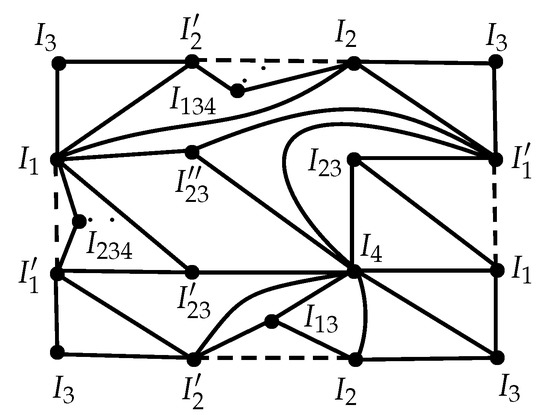
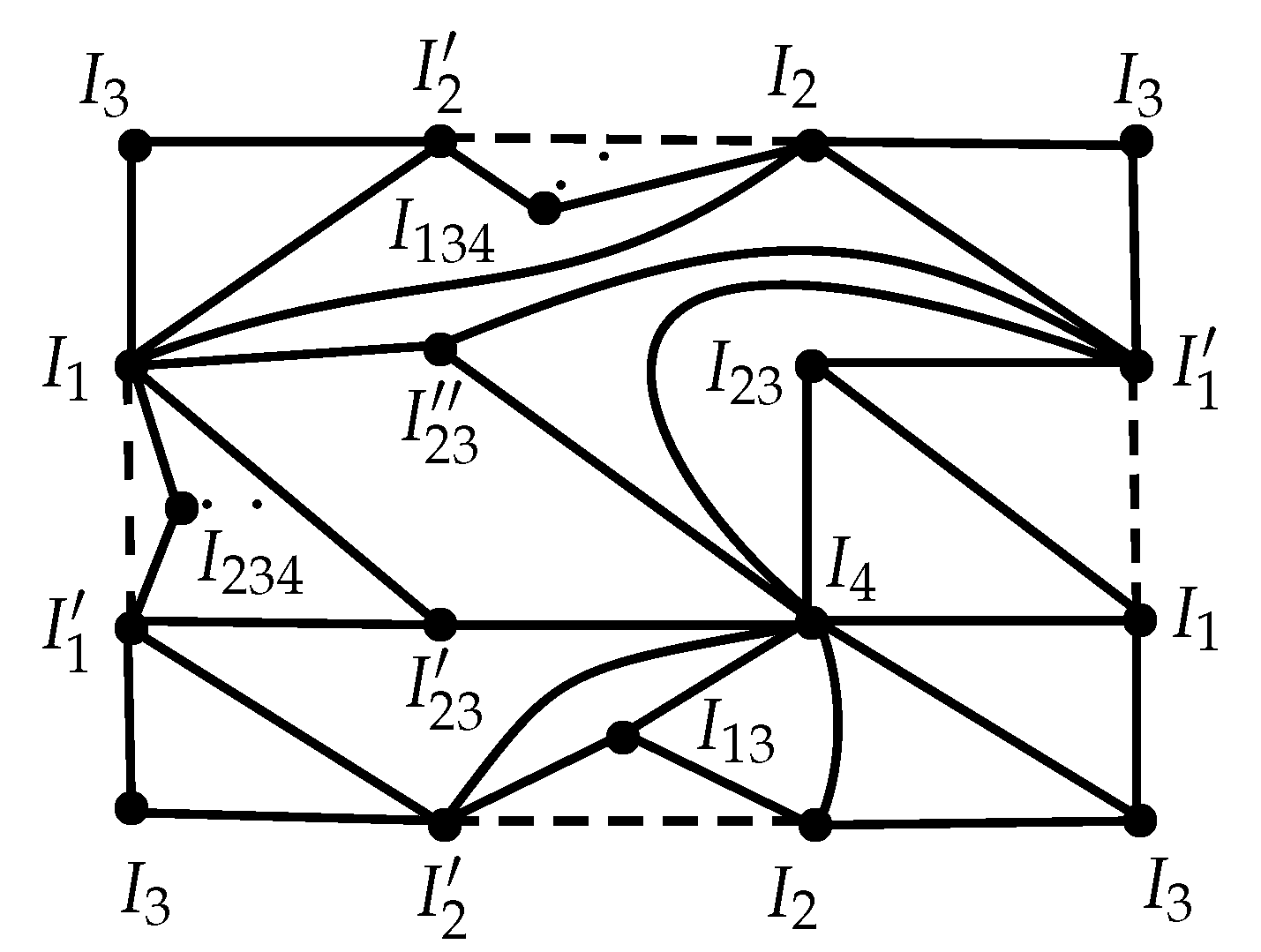
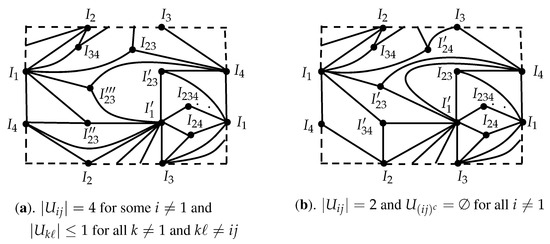
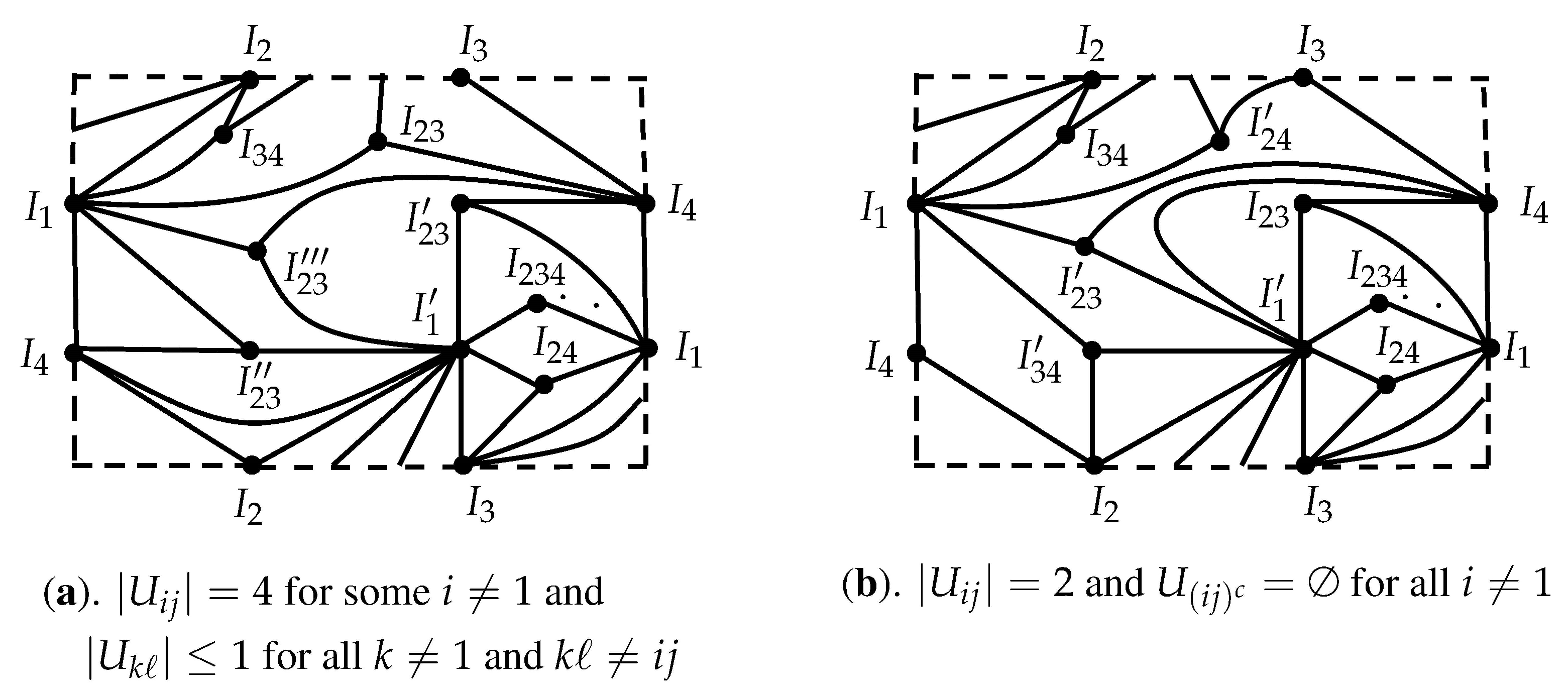
As an illustration, we consider the case (v)[a] in Theorem 5. Let and . If , then the corresponding five-partite graph, as in Figure 18a, has a crosscap two. Additionally, if , then the crosscap of the corresponding five-partite graph, given in Figure 18b, is not equal to two. Moreover, the five-partite graph G in Figure 18b is minimal with respect to
Figure 18.
Five-partite graphs.
6. Conclusions
The forbidden subgraphs for a crosscap two surface (a Klein bottle) are not known yet. In this regard, an open problem will be to determine a family of graphs that has a crosscap number two. This paper provides a class of r-partite graphs, where , that can be both embedded and not embedded in a crosscap two surface. This was completed by using the classification of all lattices with at most four atoms whose annihilating-ideal graph has a crosscap two.
Author Contributions
Conceptualization, T.A.; methodology, T.A.; investigation, K.M.; writing—original draft preparation, T.A. and K.M.; writing—review and editing, J.A.A.-B. and W.M.F.; project administration, J.A.A.-B.; funding acquisition, W.M.F. All authors have read and agreed to the published version of the manuscript.
Funding
This research project was funded by the Deanship of Scientific Research (DSR) at King Abdulaziz University, under grant no. KEP–44–130–42. The first, third, and fourth authors, therefore, acknowledge the DSR for its technical and financial support.
Institutional Review Board Statement
Not applicable.
Informed Consent Statement
Not applicable.
Acknowledgments
The The authors gratefully thank to the referees for the constructive comments and recommendations which definitely help to improve the readability of the paper.
Conflicts of Interest
The authors declare no conflict of interest.
References
- Robertson, N.; Seymour, P. Graph minors. XX. Wagners conjecture. J. Comb. Theory Ser. B 2004, 92, 325–357. [Google Scholar] [CrossRef] [Scilit]
- Kawarabayashi, K.; Mohar, B. Some recent progress and applications in graph minor theory. Graphs Combin. 2007, 23, 1–46. [Google Scholar] [CrossRef] [Scilit]
- Thomassen, C. A simpler proof of the excluded minor theorem for higher surfaces. J. Comb. Theory Ser. B 1997, 70, 306–311. [Google Scholar] [CrossRef] [Scilit]
- Archdeacon, D. A Kuratowski Theorem for the Projective Plane. Ph.D. Thesis, The Ohio State University, Columbus, OH, USA, 1980. [Google Scholar]
- Glover, H.; Huneke, J.P.; Wang, C.S. 103 graphs that are irreducible for the projective plane. J. Comb. Theory Ser. B 1979, 27, 332–370. [Google Scholar] [CrossRef] [Scilit]
- Beck, I. Coloring of commutative rings. J. Algebra 1988, 116, 208–226. [Google Scholar] [CrossRef] [Scilit]
- Halaš, R.; Jukl, M. On Beck’s coloring of posets. Discrete Math. 2009, 309, 4584–4589. [Google Scholar] [CrossRef] [Scilit]
- Estaji, E.; Khashyarmanesh, K. The zero-divisor graph of a lattice. Results Math. 2012, 61, 1–11. [Google Scholar] [CrossRef] [Scilit]
- Anderson, D.F.; Asir, T.; Tamizh Chelvam, T.; Badawi, A. Graphs from Rings, 1st ed.; Springer International Publishing: New York, NY, USA, 2021. [Google Scholar]
- Behboodi, M.; Rakeei, Z. The annihilating-ideal graph of commutative rings I. J. Algebra Appl. 2011, 10, 727–739. [Google Scholar] [CrossRef] [Scilit]
- Afkhami, M.; Bahrami, S.; Khashyarmanesh, K.; Shahsavar, F. The annihilating-ideal graph of a lattice. Georgian Math. J. 2016, 23, 1–7. [Google Scholar] [CrossRef] [Scilit]
- Asir, T.; Mano, K. Classification of rings with crosscap two class of graphs. Discrete Appl. Math. 2019, 256, 13–21. [Google Scholar] [CrossRef] [Scilit]
- Asir, T. The genus two class of graphs arising from rings. J. Algebra Appl. 2018, 17, 1850193. [Google Scholar] [CrossRef] [Scilit]
- Asir, T.; Mano, K. Classification of non-local rings with genus two zero-divisor graphs. Soft Comput. 2020, 24, 237–245. [Google Scholar] [CrossRef] [Scilit]
- Chiang-Hsieh, H.-J. Classification of rings with projective zero-divisor graphs. J. Algebra. 2008, 319, 2789–2802. [Google Scholar] [CrossRef] [Scilit]
- Chiang-Hsieh, H.-J.; Smith, N.O.; Wang, H.-J. Commutative rings with toroidal zero-divisor graphs. Houston J. Math. 2010, 36, 1–31. [Google Scholar]
- Pucanović, Z.S.; Petrović, Z.Z. Toroidality of intersection graphs of ideals of commutative rings. Graphs Combin. 2014, 30, 707–716. [Google Scholar] [CrossRef] [Scilit]
- Smith, N.O. Planar zero-divisor graphs. Int. J. Commut. Rings 2003, 2, 177–188. [Google Scholar]
- Shahsavar, F. On the planar and outer planar annihilating-ideal graphs of a lattice. Algebras Groups Geom. 2015, 32, 479–494. [Google Scholar]
- Parsapour, A.; Ahmad Javaheri, K. The embedding of annihilating-ideal graphs associated to lattices in the projective plane. Bull. Malays. Math. Sci. Soc. 2019, 42, 1625–1638. [Google Scholar] [CrossRef] [Scilit]
- Parsapour, A.; Ahmad Javaheri, K. When a line graph associated to annihilating-ideal graph of a lattice is planar or projective. Czech. Math. J. 2018, 68, 19–34. [Google Scholar] [CrossRef] [Scilit]
- Parsapour, A.; Ahmad Javaheri, K. Line graphs associated to annihilating-ideal graph attached to lattices of genus one. Trans. Comb. 2023, 12, 175–190. [Google Scholar]
- Nation, J.B. Notes on Lattice Theory; University of Hawaii: Honolulu, HI, USA, 1998; pp. 1–143. [Google Scholar]
- Davey, B.A.; Priestley, H.A. Introduction to Lattices and Order; Cambridge University Press: Cambridge, MA, USA, 2002. [Google Scholar]
- White, A.T. Graphs, Groups and Surfaces; Elsevier: Amsterdam, The Netherlands, 1973. [Google Scholar]
- Ellingham, M.N.; Stephens, C.; Zhab, X. The nonorientable genus of complete tripartite graphs. J. Comb. Theory Ser. B 2006, 96, 529–559. [Google Scholar] [CrossRef] [Scilit]
- Jungerman, M. The non-orientable genus of the symmetric quadripartite graph. J. Comb. Theory Ser. B 1979, 26, 154–158. [Google Scholar] [CrossRef] [Scilit]
Disclaimer/Publisher’s Note: The statements, opinions and data contained in all publications are solely those of the individual author(s) and contributor(s) and not of MDPI and/or the editor(s). MDPI and/or the editor(s) disclaim responsibility for any injury to people or property resulting from any ideas, methods, instructions or products referred to in the content. |
© 2023 by the authors. Licensee MDPI, Basel, Switzerland. This article is an open access article distributed under the terms and conditions of the Creative Commons Attribution (CC BY) license (https://creativecommons.org/licenses/by/4.0/).