1. Introduction
Let
be a finite commutative ring with multiplicative identity
. A non-zero element denoted as
is referred to as a
zero-divisor of
if there exists an element
distinct from zero (
) such that
. The collection of these zero-divisors within the ring
is denoted as
, and
. The notation
represents the ring of integers modulo
for a given positive integer
. Many researchers have looked closely at zero-divisor graphs related to rings. This information can be found in past studies mentioned in the references [
1,
2,
3].
We consider only connected, undirected, simple and finite graphs throughout this paper. We can represent the graph
as
, where
represents the set of vertices and
e is the set of edges of
. If there is a connection between vertices
and
in the graph
, it is denoted as
. The set of vertices connected to a particular vertex
is formally known as the
neighborhood of
, denoted as
. The number of edges adjacent to a specific vertex
in the vertex set
V is called the
degree of that vertex, denoted as
. A graph
is called
-regular if every vertex
in
V has a degree
. The complete graph with vertices
is denoted as
, and the complete bipartite graph with two sets of vertices of sizes
is written as
. Also, it is important to mention that the references [
4,
5,
6] might have more symbols and words that we have not explained in this text.
Consider any square matrix
having distinct eigenvalues
with algebraic multiplicity
, respectively. In this context, the collection of these eigenvalues is referred to as the
spectrum of the matrix
, denoted as
, represented as follows:
Let
be a natural number. The
-dimensional square matrix, known as the
adjacency matrix of the graph
, is denoted as
. This matrix is defined as follows:
The matrices
and
are known as the Laplacian and signless Laplacian matrices of graph
, respectively. Here,
represents the diagonal matrix of vertex degrees, which is given by
, where each
denotes the degree of vertex
for
. We refer the reader to [
7,
8,
9] for a more in-depth understanding of adjacency and the Laplacian spectra.
The normalized Laplacian spectra of zero-divisor graphs were discussed in [
10,
11]. Also, the normalized Laplacian spectra of power graphs associated with finite cyclic groups were discussed in [
12]. Different spectra of zero-divisor graphs have been examined in prior works [
13,
14,
15]. Also, some works on a space–time spectral order, a predictor–corrector compact difference, an implicit robust numerical scheme and an efficient ADI difference scheme are found in [
16,
17,
18,
19].
In this paper, we continue the study of spectral analysis of a weakly zero-divisor graph. The weakly zero-divisor graph of
was introduced by Nikmehr et al. [
20] and denoted as
. It is a simple undirected graph having vertex set as set of non-zero zero-divisors of
, and two distinct vertices
and
are adjacent if and only if there exist elements
and
satisfying the condition
. It is easy to observe that the zero-divisor graph of a ring is a spanning sub-graph of the weakly zero-divisor graph. More information about the weakly zero-divisor graphs can be found in [
21,
22].
This article begins with an introduction that outlines the motivation and objectives, followed by a review of the relevant literature. In
Section 2, fundamental concepts of zero-divisors and commutative rings are established. We then explore the structural properties of weakly zero-divisor graphs and their connection to zero-divisor graphs. In
Section 3, we detail the approach and techniques used in our analysis, including the computation of the normalized Laplacian spectra of the weakly zero-divisor graphs. In
Section 4, we obtain the normalized Laplacian spectra of the weakly zero-divisor graph
for some values of
, where
,
and
are prime numbers with
, and
is a positive integer. Also, we find the normalized Laplacian spectra of
, for
, where
’s and
’s are distinct primes. We conclude this work with a conclusion in
Section 5.
We have used the computational software Wolfram Mathematica version 13.2 to determine approximations of eigenvalues and characteristic polynomials for different matrices.
2. Preliminaries
We initiate by presenting the essential definitions and certain pre-existing findings that will be employed in establishing the principal conclusions.
Definition 1. Consider the graph of order having vertex set and be disjoint graphs of order , . The graph is formed by taking the graphs and joining each vertex of to every vertex of whenever and are adjacent in .
The operation denoted as
is also known as a generalized join graph operation [
23] and
-join operation. If
, then the
-join is the usual join operation.
Let us consider that the set of integers modulo
, denoted as
, is of order
, where
is the
Euler totient function. Let
be the proper divisors of
. For each integer
r satisfying
, let us consider the collections of elements given by
where
denotes the largest common divisor between the values
x and
. Also, we see that
whenever
. This fact implies that the sets
are pairwise disjoint and partition the vertex set of
as
The subsequent lemma provides insight into the size of
.
Lemma 1 ([
6]).
, for . Lemma 2 ([
21]).
Consider the set of proper divisors of denoted as . And, let n be expressed as , where , and . If , then the induced sub-graph of by is . Corollary 1 ([
21]).
Consider a proper divisor of the positive integer . The following statements are true:(i) The induced sub-graph of , formed by the vertices in the set , takes one of two forms: either or , where .
(ii) When , for , a vertex within is connected to either all or none of the vertices in in the graph .
The Corollary 1 mentioned above demonstrates that the sub-graphs formed within the structure of can be categorized as either complete graphs or empty graphs. The subsequent lemma asserts that can be characterized as a composite structure involving complete graphs and their corresponding complementary graphs. We introduce the graph , which is constructed as a complete graph using the set of all proper divisors of denoted as .
Lemma 3 ([
21]).
Consider the induced sub-graph of formed by the vertices in the set , where . Then, Theorem 1 ([
24]).
Consider a graph with a vertex set . Let ’s represent -regular graphs with an order of . If , then the normalized Laplacian spectra of is given bywhereand A graph represented as is classified as a normalized Laplacian integral graph if all its normalized Laplacian eigenvalues are integers. The subsequent statement establishes a condition for a -join graph to possess this integral property, and the proof of this condition can be easily deduced from Theorem 1.
Proposition 1. The -join graph, denoted as is normalized Laplacian integral if and only if and matrix is integral.
From Theorem 1, we can deduce that when is isomorphic to , two conditions hold: and . In this scenario, the graph possesses a normalized Laplacian integral property if and only if the matrix is integral.
3. Methodology
Graph theory research is highly active, representing an applied science that shares a concrete connection with the realms of pure and discrete mathematics. In our work, our methodology and strategies are conventional, revolving around utilizing existing literature in the field to formulate and investigate new problems.
The utilization of linear algebra and matrix theory holds great importance in this context. Spectral graph theory, in particular, stands out as a formidable tool for visualizing and gaining a deeper understanding of the principles underlying graph theory.
The central objective of our research is to conduct a comprehensive analysis of the normalized Laplacian spectra of the weakly zero-divisor graph for a finite commutative ring
across various values of
. To achieve this, we use the concept of the normalized Laplacian spectra on the H-join operation of graphs, which was introduced by Wu et al. [
24].
Pirzada et al. [
10] investigated the normalized Laplacian spectra of the zero-divisor graph of the ring
. They provided evidence that the zero-divisor graph
is a normalized Laplacian integral. We continue the study of spectral analysis of a weakly zero-divisor graph.
4. Normalized Laplacian Spectra of
In this section, we compute the normalized Laplacian spectra of
for arbitrary
. Let
be the proper divisors of
. For
, we assign the weight
to the vertex
of the graph
.
denotes the
order weighted normalized Laplacian matrix of
defined in Theorem 1, which is given by
where
For and .
The matrix denoted as is referred to as the weighted normalized Laplacian matrix associated with . When we observe the similarity between the matrices and , we can make an important observation.
Remark 1. The primary outcome of this research article is the presentation and demonstration of the normalized Laplacian spectra for the weakly zero-divisor graph of .
Theorem 2. Let the proper divisors of be . Then, the normalized Laplacian spectra of is given bywhere are -regular graph and represents that is added to each element of multiset Proof. Based on Lemma 3, we can observe that This implies that by utilizing the relationship and utilizing the implications of Theorem 1, the outcome is established. □
Recall that the complete graph
and its complement
on
vertices with multiplicity have known normalized Laplacian spectra. Indeed,
By Corollary 1,
is isomorphic to either
or
. Consequently, as stated in Theorem 2, there are a total of
normalized Laplacian spectra associated with
. Among these,
has already been determined. The rest of the
t normalized Laplacian spectra of
are obtained from the roots of the characteristic polynomial of the matrix
, as illustrated in Equation (
2).
By applying Theorem 2, we can analyze the provided diagram below to calculate the normalized Laplacian spectra.
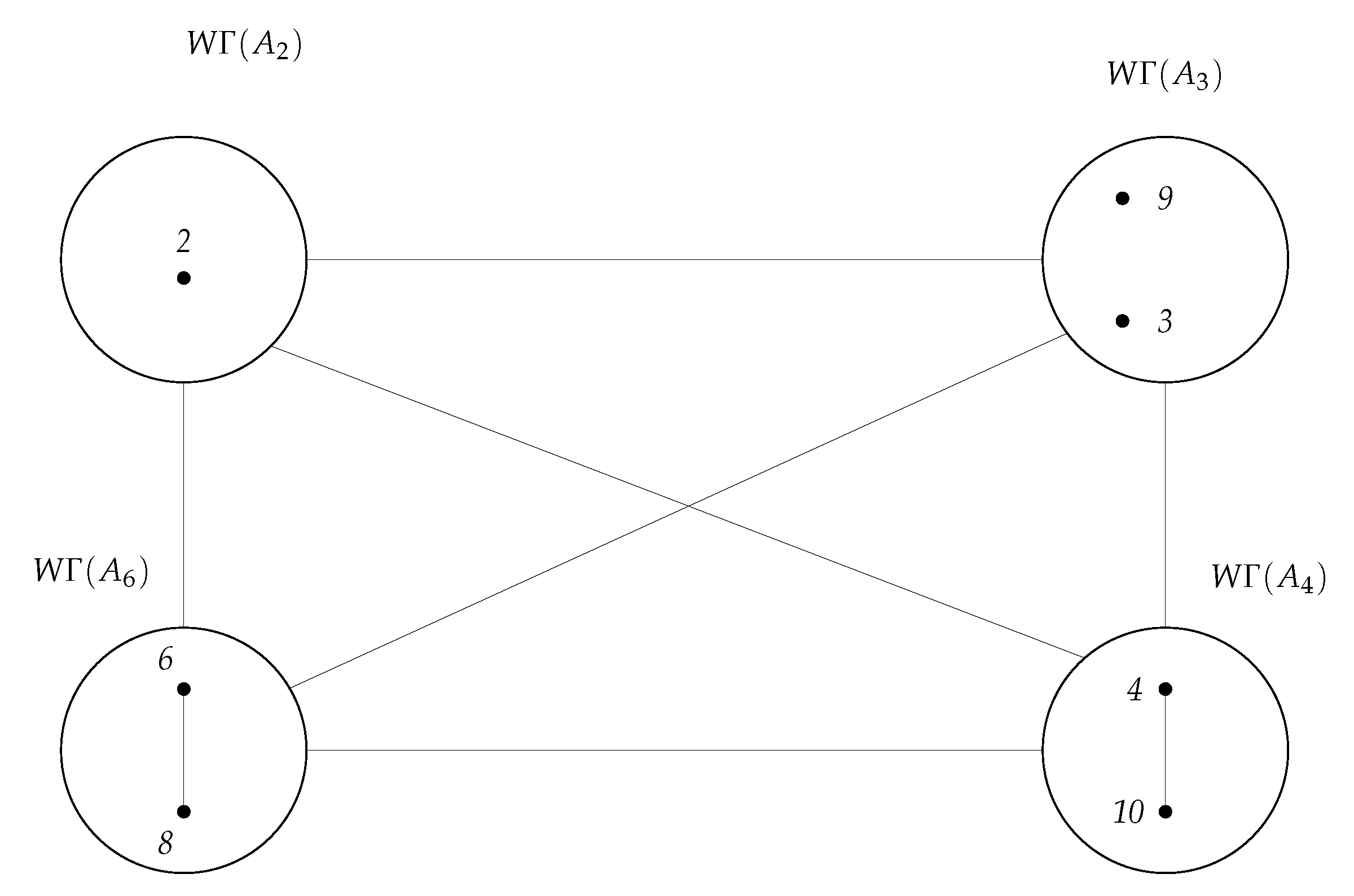
Example 1. The normalized Laplacian spectra of the weakly zero-divisor graph (Figure 1). Let . First, we observe that is the complete graph on 4 vertices, i.e., Then, by using Lemma 3, we haveBy using Lemma 2, we can also observe that The cardinality of the vertex set V of is given by . It follows that Also, we see that and . Therefore, by Theorem 2, the normalized Laplacian spectra of is The remaining normalized Laplacian eigenvalues are the eigenvalues of the matrix The approximated eigenvalues of the above matrix are Now, we investigate the normalized Laplacian spectra of for different values of : when and , where , and are distinct prime numbers with and is a positive integer.
Proposition 2. The normalized Laplacian spectra of for is given by Proof. Let
, where
and
are distinct primes. First, we observe that
is the complete graph on two vertices so that
is
. Since
and
, by Theorem 2, the normalized Laplacian spectra of
consist of the eigenvalue 1 with multiplicity
and the remaining two eigenvalues are given by the matrix
□
Proposition 3. The normalized Laplacian spectra of for is given bywhere and are the non-zero zeros of the characteristic polynomial of the below matrix (3) and V is the vertex set of . Proof. Let
, where
and
are distinct primes. First, we can observe that
is the complete graph on four vertices
and
. Then, by using Lemma 3, we have
By using Lemma 2, we can also observe that
The cardinality
of the vertex set
V of
is given by
. It follows that
and
. Also, we have
and
Therefore, by Theorem 2, the normalized Laplacian spectra of
is
Thus, the remaining normalized Laplacian eigenvalues are the eigenvalues of the matrix
where
and
□
Proposition 4. The normalized Laplacian spectra of , for , with and are distinct primes is given by where V is the vertex set of . The roots of the characteristic polynomial of the below matrix (4) are the other normalized Laplacian eigenvalues of . Proof. Let
. First, we observe that
is the complete graph on six vertices, i.e.,
and
. Then, by using Lemma 3, we have
By using Lemma 2, we can observe that
The cardinality
of the vertex set
V of
is given by
. It follows that
and
. Also, we see that
and
and
. Therefore, by Theorem 2, the normalized Laplacian spectra of
is
Thus, the remaining normalized Laplacian eigenvalues are the eigenvalues of the matrix
□
Theorem 3. The normalized Laplacian spectra of , for (, and are distinct primes) is given bywhere V is the vertex set of . The roots of the characteristic polynomial of the below matrix (4) are the other normalized Laplacian eigenvalues of . Proof. Let
. The vertex set of the graph
comprises the elements from the set
Then, by using Lemma 3, we have
By using Lemma 2, also we can observe that
The cardinality
of the vertex set
V of
is given by
. It follows that
,
Also,
and
Therefore, by Theorem 2, the normalized Laplacian spectra of
is given by
The rest of the normalized Laplacian eigenvalues are the eigenvalues of the matrix
□
Theorem 4. Let , where ’s and ’s are distinct primes. Suppose is the set of all proper divisors of . Then, the normalized Laplacian spectra of is given bywhere V is the vertex set of . The roots of the characteristic polynomial of the below matrix
(4) are the other normalized Laplacian eigenvalues of . Proof. Suppose that
, where
’s and
’s are distinct primes. Let
, then by using Theorem 2, the normalized Laplacian spectra of
is
Using Lemma 1, Lemma 2 and Corollary 1, we can derive the following results: for each
, we have
and for
, we have
. It can be noted that the size, denoted as
, of the vertex set
V in the graph
is equal to the sum of
for
i ranging from 1 to
, i.e.,
. Also, note that for
, we have
Also,
for
and
for
. Thus, we obtain
Thus, the remaining normalized Laplacian eigenvalues are the eigenvalues of the matrix
□
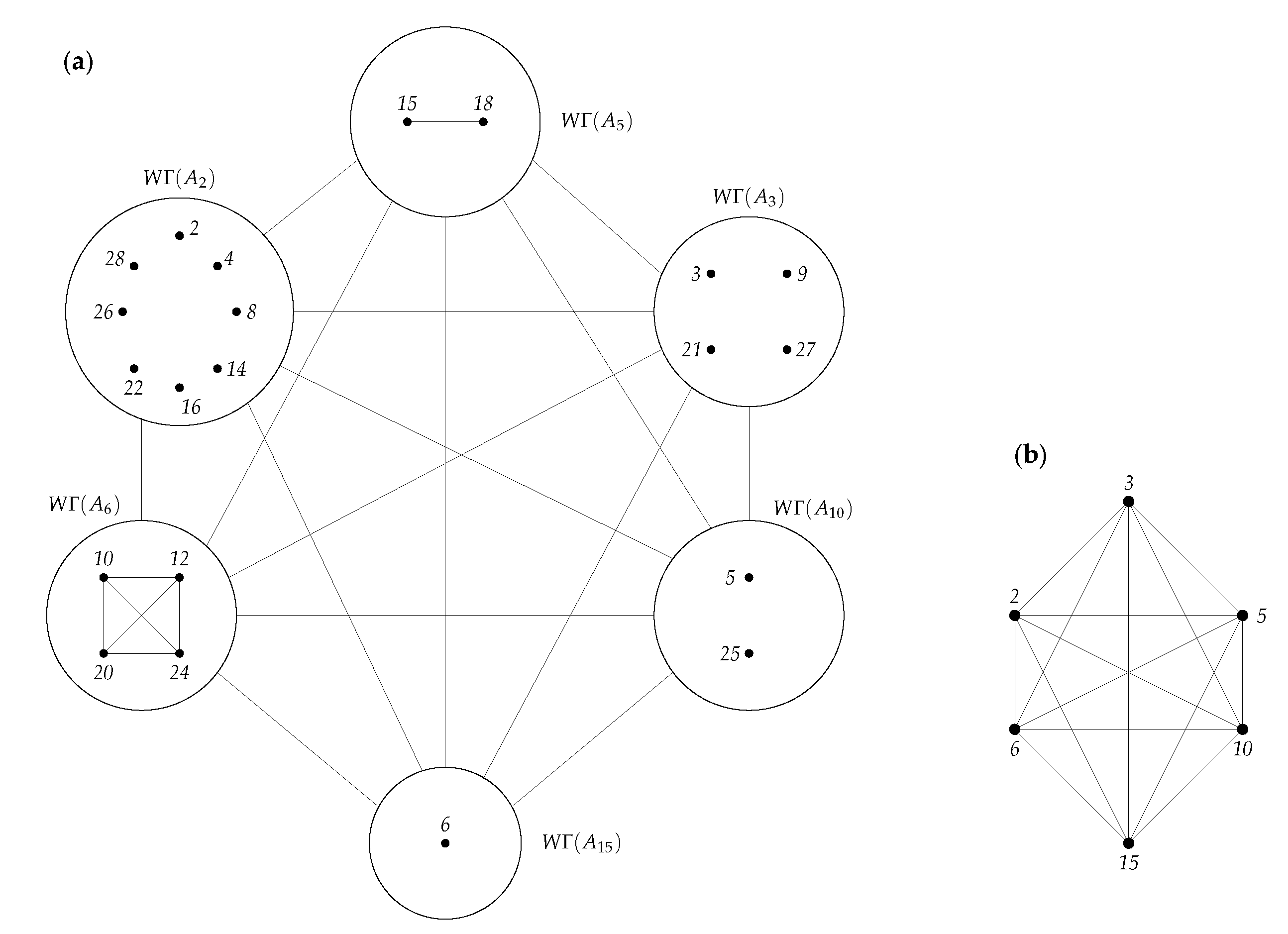
Example 2. The normalized Laplacian spectra of weakly zero-divisor graph (Figure 2a,b). Let . First, we observe that is the complete graph on six vertices, i.e., Then, by using Lemma 3, we haveBy using Lemma 2, we can also observe thatThe cardinality of the vertex set V of is given by . It follows that and . Also, we see that and . Therefore, by Theorem 2, the normalized Laplacian spectra of The remaining normalized Laplacian eigenvalues are the eigenvalues of the matrix The approximated eigenvalues of the above matrix are The major innovation of this paper lies in its exploration of the normalized Laplacian spectra of the weakly zero-divisor graph
for finite commutative rings
with
. While previous research has investigated zero-divisor graphs, our work introduces a novel perspective by focusing on the weaker condition of weakly zero-divisors and employing spectral graph theory techniques. Specifically, we introduce the use of the normalized Laplacian spectra in conjunction with the H-join operation graphs, as introduced by Wu et al. [
24] to unveil previously uncharted spectral characteristics of these graphs. This innovative approach not only provides a deeper understanding of the underlying algebraic structures but also opens up new avenues for research at the intersection of algebra and graph theory. Furthermore, our investigation extends to the special case of
for various values of
, offering a comprehensive analysis that adds substantial value to the field.
5. Conclusions
This paper centers on the exploration of an algebraic graph theory problem. We provide a solid foundation by offering background information and a comprehensive survey of relevant literature. The structure and presentation of this paper adhere to conventional norms and practices. Our study has delved into the normalized Laplacian spectra of weakly zero-divisor graphs in the context of finite commutative rings with non-zero identities. We focused our investigation on the weakly zero-divisor graph denoted as , where represents such a ring. We established that the weakly zero-divisor graph is a valuable construct for understanding the structural properties of finite commutative rings. By exploring the normalized Laplacian spectra of these graphs, we gained insights into their spectral characteristics, shedding light on their algebraic and combinatorial properties.
Notably, our research extended to various finite commutative rings represented by , where took on different values. Through this extensive exploration, we observed how the spectral properties of the weakly zero-divisor graph varied with changes in the underlying ring structure. The findings from this study not only contribute to the field of algebraic graph theory but also have practical implications in areas such as network analysis and design. Understanding the spectral behavior of weakly zero-divisor graphs can aid in optimizing communication networks and other systems where graph theory plays a role.