


Abstract
AI writing tools like ChatGPT, QuillBot, and Grammarly have reshaped university writing workflows. Controlled studies show gains in grammatical accuracy, student engagement, and self-efficacy, but none of the intervention studies retained in this review directly measured critical thinking or other higher-order outcomes, leaving concerns about overreliance largely untested rather than resolved. Synthesising 68 references published between 2008 and 2025, including 42 empirical studies, this narrative review examines how students utilise generative AI, its influence on core learning outcomes, and necessary institutional adaptations for policy and assessment. To address these shifts, the paper synthesises empirical findings across diverse study designs and proposes a seven-dimension AI literacy framework alongside practical design principles for effectively integrating AI tools into modern writing instruction.
1. Introduction
AI writing tools have advanced at an unprecedented pace. Their adoption was initially confined largely to early users, but students across disciplines now routinely employ tools such as ChatGPT and Grammarly in academic work. Universities are consequently still developing adequate institutional responses.
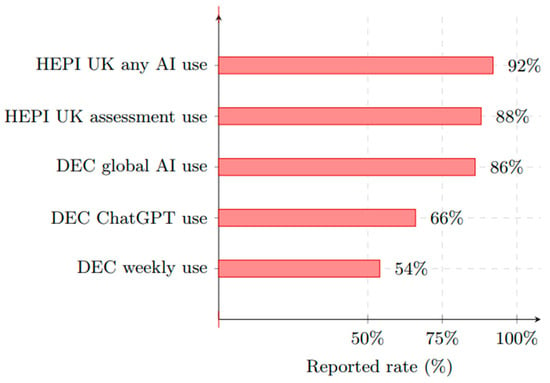
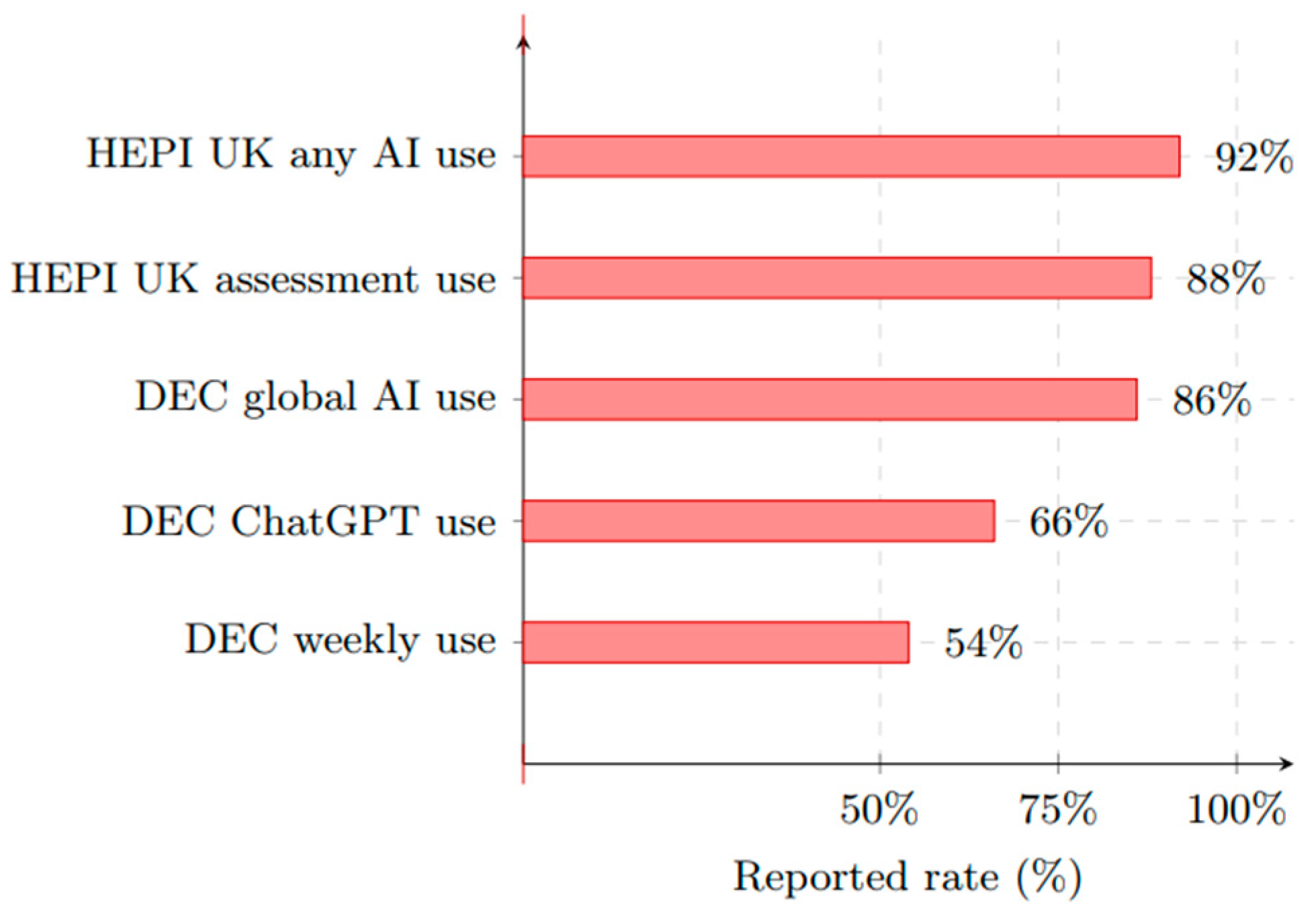
Adoption of these tools in higher education has been rapid and widespread. In the United Kingdom, the proportion of undergraduates using generative AI for assessed work rose from 53% in 2024 to 88% in 2025 in a sample of 1041 students; 92% reported using at least one AI tool, primarily to save time and improve writing quality (Freeman, 2025). A survey of 23,218 students in 109 countries found that ChatGPT was used for brainstorming, summarisation, source retrieval, and writing support during its first year of public availability (Ravšelj et al., 2025). In a survey spanning 16 countries, 86% of students reported using AI for academic work, and more than half used it weekly (Digital Education Council, 2024). The 2026 Student Academic Experience Survey (Neves et al., 2026) is cited later only as contextual evidence and is not the source of the 92% figure.
Early research examined how generative AI might affect research practices and library services (Lund & Wang, 2023), while concerns about academic integrity also increased. During the 2023–2024 academic year, UK universities reported thousands of AI-related academic-misconduct cases, with the total approaching the number recorded for traditional plagiarism (Weale, 2025). Regulatory bodies such as Australia’s TEQSA have acted against commercial essay mills, whereas generative AI tools remain readily accessible to students (Tertiary Education Quality and Standards Agency, 2025). Because AI-assisted writing is difficult to distinguish reliably from unaided writing, universities need to review policies on authorship, originality, and academic integrity (Bellini et al., 2024; Lund et al., 2025; Sadasivan et al., 2024).
The literature presents a mixed account of these technologies. AI tools can improve linguistic accuracy and engagement, particularly for second-language writers (Chen & Cheng, 2008; Cotos, 2014; Nazari et al., 2021). However, their use is also associated with superficial editing, and students may rely on automated output instead of exercising their own judgement (Cheng et al., 2025; Deep & Chen, 2025; Farhat, 2024; Kasneci et al., 2023). Their educational effects therefore depend on how institutions and instructors govern and implement AI-supported writing.
Currently, universities, instructors, and students use AI writing tools without comprehensive guidance, and effective practices for integrating these tools into education are still limited. To address this issue, this paper reviews and analyses research on AI writing tools in higher education, with a particular focus on applications that support academic writing. The review is guided by three primary research questions:
- How are AI writing tools used by students, and what patterns define their adoption across varying institutional, disciplinary, and socioeconomic contexts?
- What is the existing experimental evidence regarding how these tools impact learning outcomes? Specifically, how do they affect writing quality, critical thinking, self-efficacy, and academic engagement?
- What are the general effects on teaching and testing? How should university rules change? Finally, what are the goals for future research?
Several recent reviews have already looked at generative AI and AI writing tools in education. Chiu et al. (2023) catalogue opportunities and challenges for AI in education broadly, without a specific focus on writing outcomes or institutional policy. Zawacki-Richter et al. (2019) give an earlier, pre-generative-AI systematic review of AI applications in higher education, focused on educator perspectives. Kasneci et al. (2023) discuss opportunities and challenges of large language models for education at a conceptual level, without a systematic empirical synthesis of writing-specific outcomes. Ding and Zou (2024) review automated writing evaluation systems specifically, but they do not look at global usage patterns, discipline-specific policy, or AI literacy frameworks. Other recent reviews include one on ChatGPT specifically in academic writing (Alharthi, 2024) and a broader systematic review of AI in education (Garzón et al., 2025); neither covers the discipline-differentiated policy analysis or AI literacy framework developed here. This review differs from these in three ways that, as far as we know, have not been brought together before in one synthesis for writing specifically: a narrative synthesis of controlled-study evidence on writing-related learning outcomes; a mapping of global usage patterns and disciplinary variation grounded in the available evidence; and a discipline-differentiated policy analysis linked to a seven-dimension AI literacy framework. The four-theory integrative model and the discipline-specific policy matrix) are, as far as we know, new conceptual contributions not found in the four prior reviews above. They are offered as a synthesis to guide future research, not as something derived through formal empirical validation against the reviewed studies.
The remainder of the paper is organised as follows. Section 2 outlines the methodology, and Section 3 provides a taxonomy of current tools. Section 4 discusses the relevant theoretical frameworks. Section 5, Section 6 and Section 7 analyse usage patterns, learning outcomes, equity, and AI literacy. Section 8 evaluates academic-integrity and policy developments, and Section 9 presents principles for assessment design. Section 10 and Section 11 synthesise the implications and identify priorities for future research.
2. Review Methodology
This study is a structured narrative review rather than a PRISMA-compliant systematic review. The search and screening records do not support reconstruction of de-duplication, independent-reviewer decisions, conflict resolution, or full-text exclusion reasons at the level required for a PRISMA flow diagram; accordingly, no PRISMA claim or checklist is made. Findings are synthesised narratively. Where controlled or pre–post studies report comparable outcomes, individual study estimates are presented side by side for descriptive purposes (Section 6); no statistical pooling was undertaken, for the reasons explained in Section 2.3.
2.1. Search Strategy and Inclusion Criteria
We searched Scopus, Web of Science, ERIC, Google Scholar, PsycINFO, and the ACM Digital Library between January and March 2025. Searches combined terms including “AI writing assistant”, “automated writing evaluation”, “generative AI higher education”, “ChatGPT academic writing”, “Grammarly university”, “AI academic integrity”, “large language models writing instruction”, “AI-assisted writing”, and “intelligent tutoring writing”. Reference lists were examined through backward and forward citation chaining. A targeted contextual update search was completed on 29 August 2026 to identify major policy, product, and survey developments published after the original search window. Sources located in that update are identified as contextual citations and were not added to the 68-source evidence corpus or its synthesis counts.
Eligible primary studies examined students, instructors, or institutions in higher education; evaluated exposure to or use of an AI-enabled writing, feedback, editing, or text-generation tool; and reported outcomes related to writing performance, engagement, self-efficacy, behaviour, access, assessment, or institutional practice. Eligible designs included controlled and pre–post interventions, surveys, qualitative studies, and observational or system-evaluation studies published in English between 2008 and March 2025. Secondary reviews were retained to contextualise the primary evidence. Policy documents, technical documentation, and news reports were treated as contextual or grey literature rather than as primary evidence. Studies focused exclusively on K–12 education, software programming without a writing outcome, or non-higher-education settings were excluded.
The initial search yielded 847 records, of which 312 remained after title-and-abstract screening. The final evidence corpus comprised 68 non-overlapping sources: 42 primary empirical studies (3 controlled or pre–post interventions, 28 surveys, and 11 qualitative, observational, or system-evaluation studies), 8 reviews or meta-analyses, 6 policy or grey-literature sources, and 12 background sources used for historical or conceptual context. Table in Section 6 presents 11 selected primary studies plus 3 secondary syntheses included for context; it should not be read as a list of 14 primary empirical studies. The bibliography contains 73 entries because five citations found later or in another context fall outside the 68-source evidence corpus.
2.2. Data Extraction and Quality Assessment
For primary studies, a structured extraction sheet recorded location, population and sample size, AI tool or exposure, study design, outcome measures, effect-size metric, and principal findings. One reviewer completed the initial extraction, and extracted fields used in Tables in Section 6 were checked against the source reports during manuscript revision. Formal duplicate extraction and an obtaining an inter-rater agreement statistic were not undertaken; this is a limitation of the review. Missing or unclear values were reported as unavailable rather than inferred, except where an author-derived calculation is explicitly labelled and its formula is stated.
Study quality was considered narratively in relation to design, sample size, comparator, outcome measurement, and reporting completeness. Formal study-level MERSQI or CASP scores were not retained in a reproducible form and are therefore not claimed or reported. This limits the review’s ability to weight conclusions by risk of bias, particularly because the multidisciplinary evidence base extends beyond the settings for which MERSQI was developed.
For quantitative outcomes, effect sizes were retained in the metric reported by each source and compared descriptively. The controlled and pre–post studies differed substantially in design, population, sample size, and outcome measurement. We therefore did not undertake formal statistical pooling, calculate a pooled summary effect or I2 statistic, assign study weights, or test publication bias. The estimates in Tables and Figures are individual study values and must not be interpreted as a pooled meta-analytic effect.
2.3. Scope and Limitations
The evidence search was conducted between January and March 2025. A targeted contextual update was completed on 29 August 2026; post-search sources were used only to describe later survey, policy, or product developments and were excluded from the evidence-selection counts and intervention synthesis. The evidence base may therefore omit recent empirical studies, and periodic updates will be necessary.
The search was limited to English-language databases and search terms. So the country-level adoption figures in Table 4 should be read as illustrative estimates from the available English-language survey literature, not as precise, uniformly derived cross-country statistics. Regions and countries where scholarship is published mainly in other languages are probably under-represented, and this limits how strong any equity conclusions about non-English-speaking contexts can be.
The retained intervention studies differed substantially in design, population, sample size, and outcome measurement, so statistical pooling was not appropriate. Section 6 therefore reports individual study estimates, without a pooled effect, heterogeneity statistic, or publication-bias test. Only three intervention studies with verifiable effect-size information are detailed in Table 6. None directly measured critical thinking or another higher-order learning outcome, so the intervention evidence cannot support a causal claim about those outcomes. Evidence of markedly different strength, such as a 12-participant pre–post study and a 23,218-student survey, is synthesised separately by evidence type and should not be interpreted as carrying equal inferential weight.
3. Defining AI Writing Assistants: A Comparative Analysis
AI writing programmes are a type of application that is used to assist students in their academic writing through artificial intelligence. There have been a number of changes to this type of software in the past three decades. Initially, this was only a piece of technology that checked grammar.
Early writing tools from the 1990s and 2000s mostly used rule-based methods to find grammar errors. In the 2010s, advances in statistical natural language processing and word embeddings let tools understand sentence and paragraph meaning better. Since 2022, transformer-based large language models such as GPT-3.5, GPT-4, Claude, and Gemini have expanded what AI writing tools can do by a large margin. These systems do more than correct grammar or spelling. They can generate, organise, summarise, and revise complete documents (Chiu et al., 2023; Godwin-Jones, 2022; Nazari et al., 2021).
Several studies have examined this shift. Chiu et al. (2023) distinguish automated writing evaluation (AWE), automated essay scoring (AES), automated written corrective feedback (AWCF), and generative AI assistance. Ekizer’s (2025) meta-analysis of AI in English-language teaching reported an overall positive effect on language-learning outcomes, while also identifying variation by tool, outcome, and learner context. In addition, a study of postgraduate students using English as a second language found that a mobile AWE application improved writing quality and learner confidence (Nazari et al., 2021).
Modern AI tools no longer fit into single categories because their functions often overlap. For example, Grammarly started as a tool for grammar checking but now creates content, changes tone, and rewrites text (Grammarly, 2024). In the same way, AWE platforms do not just give scores; they also fix grammar, help with citations, and improve argument logic using neural networks (Ding & Zou, 2024; Wang et al., 2024).
In this paper, AI writing tools are categorised into applications domains, such as grammar checking, paraphrasing tools, generative chatbots, feedback systems and AI detection systems:
- Grammar and style checkers: These detect errors at the sentence level and provide content suggestions using large language models (LLMs).
- AWE and feedback systems: These provide overall scores and specific feedback to each user based on established rubrics.
- Paraphrasing and summarisation tools: Programmes such as QuillBot (2024) and Wordtune rewrite or shorten text in various modes.
- Generative chatbots: Tools like ChatGPT, Claude, and Gemini assist with brainstorming, outlines, first drafts, and text revision.
- AI detection tools: Services such as Turnitin and Copyleaks identify text that originates from AI systems.
- AI in educational platforms: These provide AI assistance directly within digital textbooks and learning management systems, such as Kortext’s AI study assistant (Kortext, 2024).
The main difference for education is how much of the final work is performed by the AI tool. Grammar checkers work on text students write themselves and give suggestions the student can accept, change, or reject. Generative chatbots, on the other hand, can produce whole drafts that students may use with little or no editing. This difference is a key issue in discussions of academic integrity.
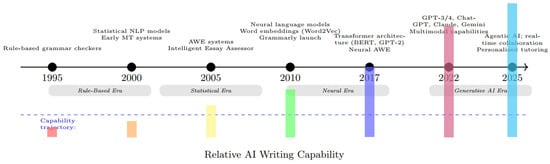
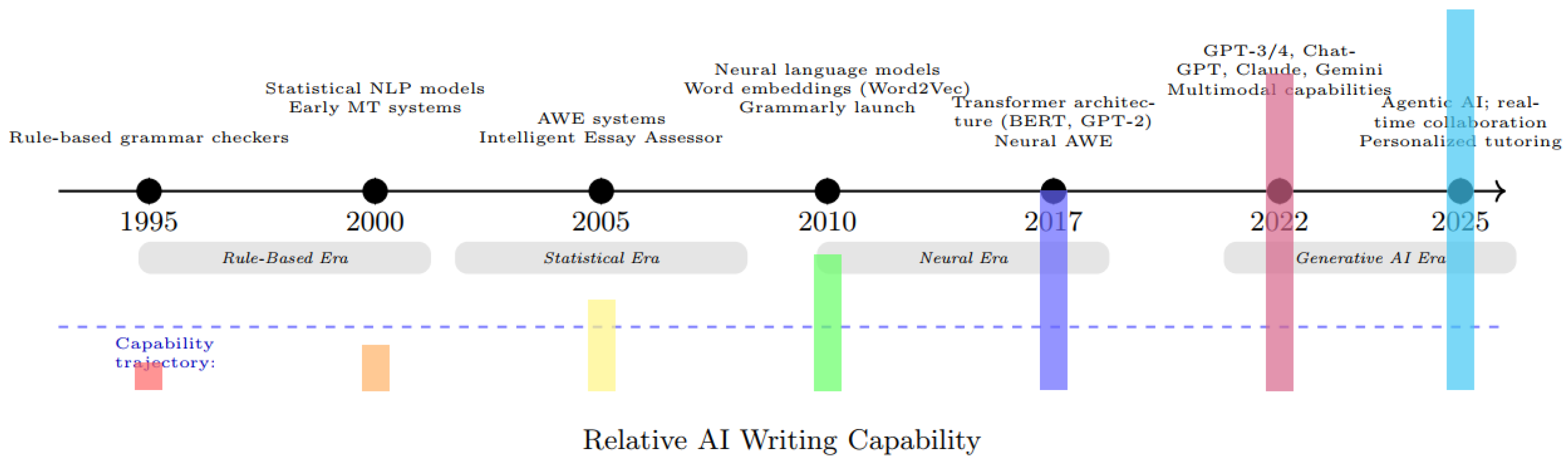
Table 1 provides a function-based comparison of popular applications. It reports whether a function is a principal feature, a limited or secondary feature, or not a principal function; it does not rank output quality. Capabilities are version-sensitive and should be checked against current product documentation. “Multimodal” refers to the ability to process or generate more than one modality, such as text, images, or audio. Figure 1 illustrates the historical development of these tools. Since 2022, capabilities have changed rapidly, with substantial updates sometimes occurring within months.
Table 1.
Comparative analysis of major AI writing tools utilised in higher-education contexts.
Figure 1.
Evolution timeline of AI writing assistance technologies from 1995 to present, illustrating the progression from rule-based systems to contemporary large language models with multimodal and agentic capabilities. The capability trajectory illustrates exponential growth in functional sophistication over three decades.
Figure 2 reports verified headline adoption indicators from recent higher-education surveys. These values should not be read as a uniform cross-country comparison, because the surveys behind them use different sampling frames and measures (Section 2.3).
Figure 2.
Verified AI writing tool adoption indicators from recent higher-education surveys (2024–2025). Values come directly from the HEPI UK undergraduate survey and the Digital Education Council global student survey, not from interpolated regional estimates. Data from Digital Education Council (2024) and Freeman (2025).
4. Theoretical Frameworks for Understanding AI-Mediated Writing
Simple input–output frameworks are insufficient for understanding the effects of AI writing tools on learning. This section presents four theoretical perspectives—sociocultural mediation theory, cognitive load theory, self-regulated learning, and technology acceptance models—and synthesises them into an integrative model. Sociocultural mediation theory sees AI as a tool that changes how people interact and learn together. Cognitive load theory looks at how these tools help manage the mental effort needed for hard tasks. Self-regulated learning looks at how students plan, monitor, and control their own study habits when using AI, and technology acceptance models explain why students and instructors choose to use or avoid new AI software.
4.1. Sociocultural Perspectives: AI as a Mediating Artefact
Writing is an activity that happens through social means which define how people think (Vygotsky, 1978). The AI writing tool serves as the mediator between the skills that a student can develop independently and those which can be developed with some assistance, thus being the zone of proximal development. When the AI gives feedback in accordance with the level of the student’s skills, development is possible without making the task too easy for the student (Wood et al., 1976).
First, AI-supported writing may alter both the quality of the final product and the cognitive demands of composing. These changes may affect a student’s relationship with the text and the development of writing skills (Engeström, 1987).
The issue brought up by the sociocultural theory is whether or not students utilise the technology in such a manner that effective assistance diminishes as a student gains knowledge and becomes more independent (Wood et al., 1976). The idea behind the sociocultural theory of education is that a student should become less dependent on the tutor as he or she acquires more skills. In the case of AI providing constant assistance which does not lessen over time, the student could get too dependent on the technology and delegate all thinking to it.
4.2. Cognitive Load Theory and AI Assistance
Cognitive load theory distinguishes three load types: intrinsic load (task complexity), extraneous load (ineffective instructional or interface design), and germane load (productive cognitive effort for schema formation) (Sweller et al., 2011, 2023). AI tools that manage low-level tasks such as error detection may free cognitive capacity for higher-order analytical work. However, this outcome is not automatic. Poorly designed interfaces impose additional extraneous load, and excessive AI support may reduce germane load below the threshold required for deep learning.
Table 2 shows how specific AI writing functions affect each load type. Not all types of AI help support learning in the same way. Reducing extraneous load is usually helpful because it removes unnecessary distractions. However, reducing germane load is only useful if the student uses that extra mental energy for deeper analysis instead of simply avoiding the work.
Table 2.
Analysis of AI writing assistant functions and their potential effects on cognitive load components.
4.3. Self-Regulated Learning and AI Feedback
Self-regulated learning (SRL) concerns how students plan, monitor, and evaluate their learning activities (Zimmerman, 2002). AI tools may support monitoring and evaluation by providing feedback on strategy use (Winne & Hadwin, 1998). However, they may also inhibit the development of independent standards for judging progress, particularly when the tools are unavailable.
The Winne and Hadwin SRL model consists of four stages; among them are definition of the assignment, goal setting, performance of the task, and adjustment (Winne & Hadwin, 1998). Each of these stages can be supported by AI technology, as it can explain the task, provide tips on organisation of the work, give assistance in doing the task, and make suggestions for revision. In order to increase the skill of self-regulation, the student has to reflect upon the feedback provided and take advantage of it to improve their work.
4.4. Technology Acceptance and Adoption
The technology acceptance model (TAM) provides a framework to explain why students choose to use or avoid AI writing tools (Davis, 1989; Venkatesh et al., 2003). Generally, students believe these tools are useful for saving time and improving the quality of their work. However, how easy a tool is to use varies depending on the specific software and the digital skills of the student (Imran & Almusharraf, 2023; Abd Hadi et al., 2024). Understanding the factors that lead to the adoption of these tools can help improve software design. This knowledge also helps teachers create strategies that encourage students to use AI for meaningful learning instead of simple or superficial tasks.
4.5. An Integrative Framework for AI-Mediated Academic Writing
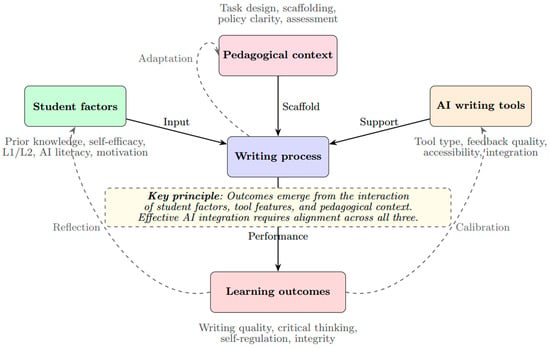
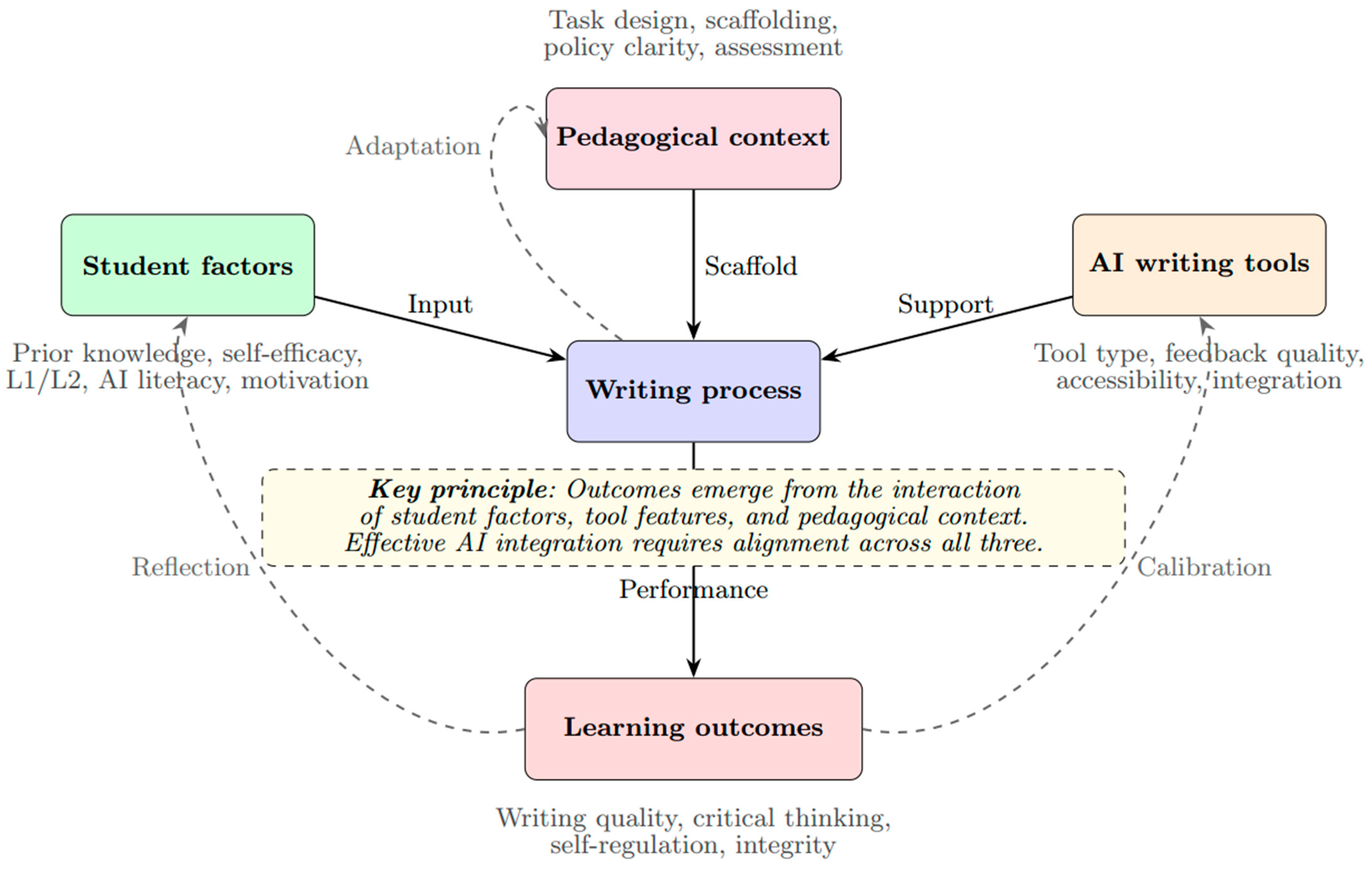
Figure 3 proposes that learning outcomes emerge from interactions among student characteristics, tool features, pedagogical context, and reciprocal self-regulatory feedback. This relationship is a theory-informed hypothesis, not an established causal result. The model identifies variables and interactions for future study and can help educators consider where guidance may be needed—for example, when students evaluate AI feedback or when tool use risks displacing productive cognitive effort.
Figure 3.
Integrative framework for AI-mediated academic writing, illustrating dynamic relationships among student factors, AI tools, pedagogical context, and learning outcomes, with feedback loops representing self-regulatory processes. This is a conceptual synthesis of the four theories discussed in this section, meant to organise future research and practice; it has not been empirically validated or systematically mapped against the studies reviewed here.
5. How University Students Use AI Writing Assistants Globally
Between 2022 and 2025, AI writing tools moved rapidly from limited use to widespread adoption in higher education. At a selective US institution, more than 80% of students reported using generative AI for academic purposes within two years of ChatGPT’s release (Contractor & Reyes, 2025). Practitioner reports on graduate writing have also described efficiency and quality gains, although this is institutional reporting rather than peer-reviewed evidence (Carnegie Mellon University, Human-Computer Interaction Institute, 2024). In a 109-country survey of 23,218 students, the most common uses were idea generation, summarisation, and source retrieval rather than full-draft composition (Ravšelj et al., 2025).
The UK HEPI 2025 survey found that 92% of undergraduates had used at least one AI tool, with 88% reporting generative AI use for assessed work (Freeman, 2025). Text generation was the most frequently cited purpose (47%), followed by editing tools such as Grammarly (44%) and AI-enhanced textbooks (41%) (Freeman, 2025). Furthermore, many students use multiple tools across different stages of the writing process, thereby constructing personal AI-assisted workflows.
A survey of 277 US students (Lund et al., 2025) showed that students are very aware of AI tools and university rules. However, the study found that students often do not understand what those rules actually mean. Students use AI for many tasks, such as fixing grammar, coming up with ideas, writing long sections of text, or rewriting sentences to avoid AI detection software (Parker et al., 2023). In fields such as engineering, business, and health sciences, students often treat AI as a normal tool, like a calculator, using it as a routine study aid without thinking much about how it might change traditional patterns of learning and academic integrity (Imran & Almusharraf, 2023; Schei et al., 2024).
Table 3 offers a qualitative synthesis of where students appear to use AI across the writing process, drawing on six surveys (Imran & Almusharraf, 2023; Freeman, 2025; Gasaymeh et al., 2024; Lund et al., 2025; Ravšelj et al., 2025; Abd Hadi et al., 2024). Because the surveys used different questions and sampling frames, the categories indicate broad patterns rather than numerical task-by-stage prevalence. The available evidence suggests more frequent use for brainstorming and final editing than for composing or substantively revising complete texts.
Table 3.
Author-derived qualitative synthesis of student AI-use patterns by writing task and process stage. Frequency categories are interpretive judgements based on the cited surveys (Imran & Almusharraf, 2023; Freeman, 2025; Gasaymeh et al., 2024; Lund et al., 2025; Ravšelj et al., 2025; Abd Hadi et al., 2024), which used different measures; they are not measured task-by-stage percentages.
Table 4 provides an author-derived regional illustration based on heterogeneous surveys (Imran & Almusharraf, 2023; Digital Education Council, 2024; Freeman, 2025; Gasaymeh et al., 2024; Ravšelj et al., 2025). The sources do not support precise or uniformly comparable country-level adoption and weekly use estimates. The labels therefore indicate tentative patterns only; policy descriptions also require interpretation in light of changing national and institutional guidance.
Table 4.
Author-derived, qualitative regional illustration based on heterogeneous English-language surveys. Labels are interpretive rather than measured cross-country rates; cited surveys did not provide comparable country-by-country samples, years, and measures for every row.
5.1. Motivations and Perceived Benefits
The survey and interview evidence suggests four principal reasons why students use AI writing tools.
Time saving (Saving time) is one of the main reasons behind the use of AI writing tools: 51% of students selected this reason for using such tools in the HEPI survey; at the same time, 50% pointed out that these tools allowed them to improve the quality of their work (Freeman, 2025). Using such tools saves time spent on the writing process and makes editing easier.
The second factor is linguistic precision, which is particularly important for students writing in a non-native language. Participants report that AI can compensate for gaps in vocabulary and grammar and reduce anxiety about penalties for language errors (Imran & Almusharraf, 2023; Fatimah & Jamilah, 2025; Gasaymeh et al., 2024; Nazari et al., 2021). Some students may also find automated feedback less intimidating than criticism from an instructor or peer. For bilingual students, AI can provide support for participating in English-medium academic discourse, although this interpretation requires attention to individual and contextual variation.
Third, students use AI for content comprehension. They submit queries to AI that they may hesitate to raise with a lecturer—due to time constraints, social anxiety, or reluctance to appear underprepared (Kasneci et al., 2023; Ravšelj et al., 2025; Schei et al., 2024). The capacity to receive explanations at varying levels of complexity, with worked examples available on demand, makes AI useful as a study resource that extends beyond writing support.
The fourth factor is equitable access. Professional editing can be costly, and writing centres may have limited capacity. AI tools may therefore extend access to immediate writing support, but that possibility should not be assumed to eliminate inequity: premium subscriptions, connectivity, language coverage, accessibility, and institutional guidance remain uneven. The examples of late-night use in demanding programmes and use as a substitute for understaffed writing centres should be treated as plausible applications requiring direct empirical study, not as established usage patterns.
5.2. Concerns and Self-Reported Risks
Studies keep showing the same concerns among students, and academic integrity is the biggest one. Most students consider that using AI to write a full assignment is a form of misconduct, even if some individuals still do so (Chan, 2024; Lund et al., 2025).
The more difficult questions arise in the context-dependent middle ground. No universal boundary separates legitimate from illegitimate AI assistance; expectations vary by institution, discipline, instructor, and jurisdiction. Students also report concerns about unclear policies and false accusations arising from unreliable detection tools (Bellini et al., 2024; Perkins & Roe, 2023), which may discourage legitimate use.
False AI information is a significant practical challenge in education. It happens when students encounter fabrications such as citations, quotes, and explanations that are professional in tone (Cheng et al., 2025; Deep & Chen, 2025). First, the risk lies in the fact that AI may provide false statements with a considerable level of assurance. Second, students lack sufficient subject matter expertise to detect false information (Williams et al., 2025). Several studies have shown a typical scenario where students accept AI-made statements as factual ones and do not verify them independently.
Another big concern is the loss of writing skills when students rely on AI for writing and editing; the ability to write on their own may decline over time (Farhat, 2024). Both students and instructors worry that this dependence makes students less willing to face “productive struggle”. This refers to the hard work needed to learn a new skill (Deep & Chen, 2025; Kasneci et al., 2023). Right now, there is no long-term research to confirm whether this loss of skill actually happens.
6. Empirical Evidence, Disciplinary Variation, and Equity Considerations
The following synthesis encompasses three distinct but connected sets of evidence concerning the use of artificial intelligence writing assistants in higher education, namely, (1) empirical research results concerning learning outcomes; (2) differences in tool implementation and usage within different disciplines; and (3) questions of equity and access. All three mentioned dimensions together form the basis for the following policy and pedagogical recommendations elaborated further in other sections.
The available evidence provides insight into AI writing assistance in higher education, but its interpretation depends on study design. The synthesis therefore distinguishes three connected evidence streams: intervention findings on measured learning outcomes; survey and qualitative evidence on adoption, experience, and academic integrity; and policy or conceptual sources concerning implementation, equity, and disciplinary variation.
The use of artificial intelligence in higher education has been empirically studied and is represented in the form of a table below. There are three general themes that can be identified based on Table 5. First, the AI application offers initial advantages by enhancing student involvement and linguistic accuracy when performing certain activities. Second, students make active use of AI and consider it to be very beneficial for their everyday academic activities. Third, there is an existing tension between AI usage and concerns regarding academic integrity.
Table 5.
Selected evidence on AI writing assistants: eleven primary studies and three secondary syntheses are included for context.
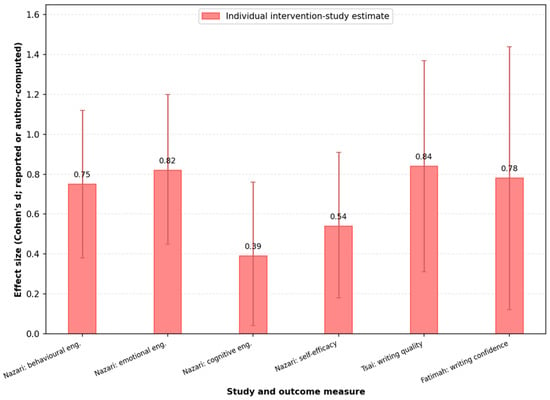
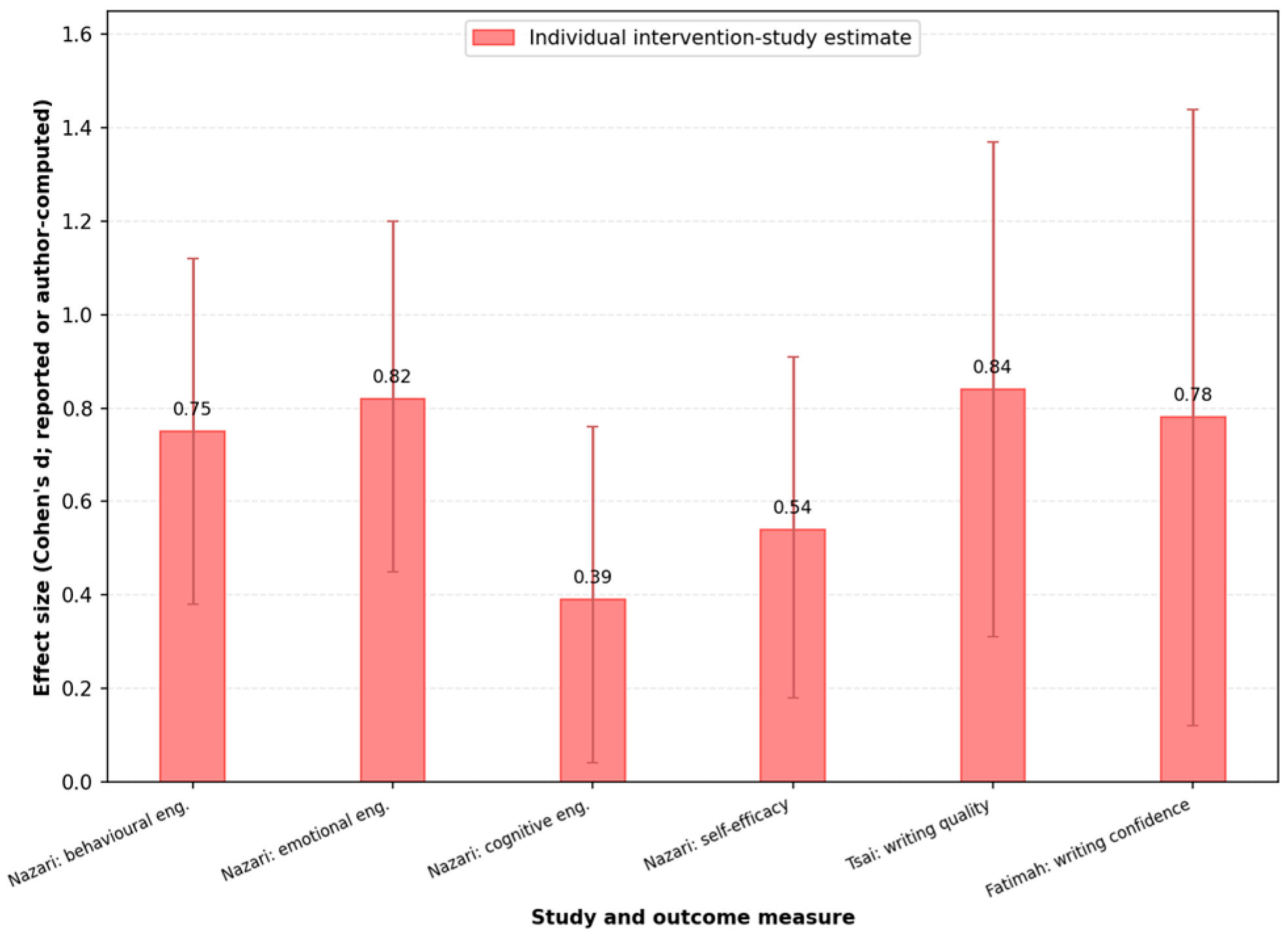
Figure 4 displays six individual outcome estimates from the retained intervention studies. The Nazari et al. estimates compare an AI-assisted group with a control group; the Tsai et al. and Fatimah and Jamilah estimates describe pre–post change. These designs support different levels of inference and are shown together only for descriptive comparison, not pooling. The pattern is positive for the measured writing, engagement, self-efficacy, and confidence outcomes, but none of the studies directly measured critical thinking or another higher-order outcome.
Figure 4.
Six individual outcome estimates reported or derived from the intervention studies retained in Table 6. No statistical pooling was undertaken. Error bars show 95% confidence intervals; the Fatimah and Jamilah estimate is author-computed from the reported paired-sample statistics. The figure is descriptive and is not a forest plot of a pooled meta-analytic effect.
Table 6 gives effect sizes from the primary intervention studies kept after source verification. Across these studies, reported effect sizes for engagement, self-efficacy, writing quality, and writing confidence fall in the small-to-large range (0.39–0.84); none of them measured critical thinking or other higher-order cognitive outcomes. These values are not pooled and should not be read as a single summary effect.
Table 6.
Effect sizes from primary intervention studies on AI writing interventions in higher education, kept here where the source values could be checked against accessible source information.
6.1. Disciplinary Variation in AI Writing Tool Impact
AI writing tools do not affect all academic disciplines in the same way. Writing conventions, assessment practices, epistemic standards, and professional applications differ substantially across fields. Policies that treat all disciplines identically fail to account for this variation. Table 7 summarises how benefits, concerns, and recommended approaches differ by discipline.
Table 7.
Authors’ proposed discipline-sensitive heuristic for AI writing assistant use. Recommendations are provisional design considerations informed by the reviewed literature and must be adapted to applicable professional standards and local policy.
Approaches that are effective in a business communication course may not be appropriate in a law school or a creative writing programme. Discipline-specific guidance is therefore more effective than institution-wide policies that do not account for such variation.
6.2. Equity, Access, and Global Justice
AI writing tools have the potential to reduce inequalities in access to writing support. Alternatively, they may amplify existing disparities. The direction of this effect depends on implementation decisions.
Digital Divide and Access Disparities
Access to AI tools is already unequal. Students at well-resourced institutions benefit from institutional licences, premium features, and technical support. Students at less-resourced institutions, by contrast, are limited to free-tier versions with restricted functionality (Digital Education Council, 2024; Nazari et al., 2021). The gap in AI access therefore mirrors broader patterns of institutional resource inequality.
Geographic factors make these gaps even worse. Poor internet connectivity, restrictive network policies, and national regulatory restrictions stop some students from accessing the same tools as their peers. In academic environments that compete globally, this is a real disadvantage.
Language is another dimension of inequity. AI tools have gotten better at multilingual support, but capabilities are still spread unevenly. English-dominant tools work better for native English speakers than for students who write in a second or third language. This is a bit of a paradox, since multilingual students are often the ones who would benefit most from such tools. This same English-language gap, discussed as a limitation in Section 2.3, also limits the global adoption claims made elsewhere in this review.
Table 8 maps the equity dimensions and their corresponding mitigation strategies. These issues require deliberate design and policy decisions, not merely institutional awareness. Without proactive action, AI tools are likely to amplify existing inequalities.
Table 8.
Equity considerations in AI writing assistant implementation.
7. Student AI Literacy: A Critical Competency Framework
As AI writing tools become standard in higher education, AI literacy has emerged as an educational outcome in its own right. Functional knowledge of how to operate a tool is insufficient. Students must also evaluate AI-generated output, understand the limitations of these systems, and make informed decisions about when and how to use them.
The present framework builds on and adapts existing AI literacy frameworks (Long & Magerko, 2020; Ng et al., 2021) for the context of academic writing, and is broadly consistent with the competency areas identified in UNESCO’s AI competency framework for policymakers (Miao et al., 2021), which addresses AI literacy at the level of national education systems rather than the academic-writing-specific context developed here. Seven dimensions are proposed as foundational to responsible AI use.
The first dimension is functional literacy: understanding the proper use of the tool. This entails mastering the navigation of the platform, creating appropriate prompts, understanding the feedback, and choosing the appropriate tool to achieve your goals.
The second dimension is critical literacy: evaluating content produced by AI. This involves verifying the claims made by AI, detecting hallucinations and fictitious references, and remembering that AI is biased because it is trained on data sets and algorithms. Critical literacy is perhaps the most pressing dimension, because students have a tendency to accept AI’s results without verifying them.
The third dimension is rhetorical literacy: realising that AI is not an impartial tool. It directs your writing in certain ways, homogenises your style, and can silence your voice. Students must determine whether AI advice serves their purposes and audiences, or if it merely makes their writing less distinctive.
The fourth dimension is ethical literacy, which involves being familiar with academic integrity guidelines, understanding the requirement of attribution, and making well-justified disclosure decisions. In addition, ethical literacy requires thinking beyond, considering such things as the use of AI technologies in terms of authorship and originality as well as professional development as a writer.
The fifth dimension is technical literacy, which is basically a conceptual grasp of how AI writing technologies work. This does not require any programming skills but requires sufficient knowledge of how the AI system makes text predictions based on statistics and not reason, how the training data influence the knowledge of the system and its biases, and why confidence does not necessarily mean accuracy.
The sixth dimension is metacognitive literacy, which is being able to monitor the process of developing as a writer and evaluate honestly whether the use of AI technologies contributes to this development or takes its place. This is about being aware of dependency patterns, deliberate choice of tasks for performing independently, and so on.
Dimension seven is called adaptive literacy, which means the ability to remain competent with the evolving technology that is used in artificial intelligence. The software that a student uses when they start out could be completely different from the one they use after completing their studies. Adaptive literacy requires being willing to learn new technologies and being ready for new capabilities. It is not about the specific software but about the professional development process itself.
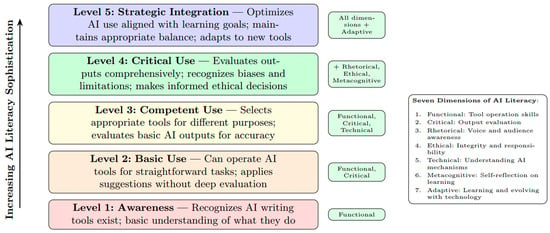
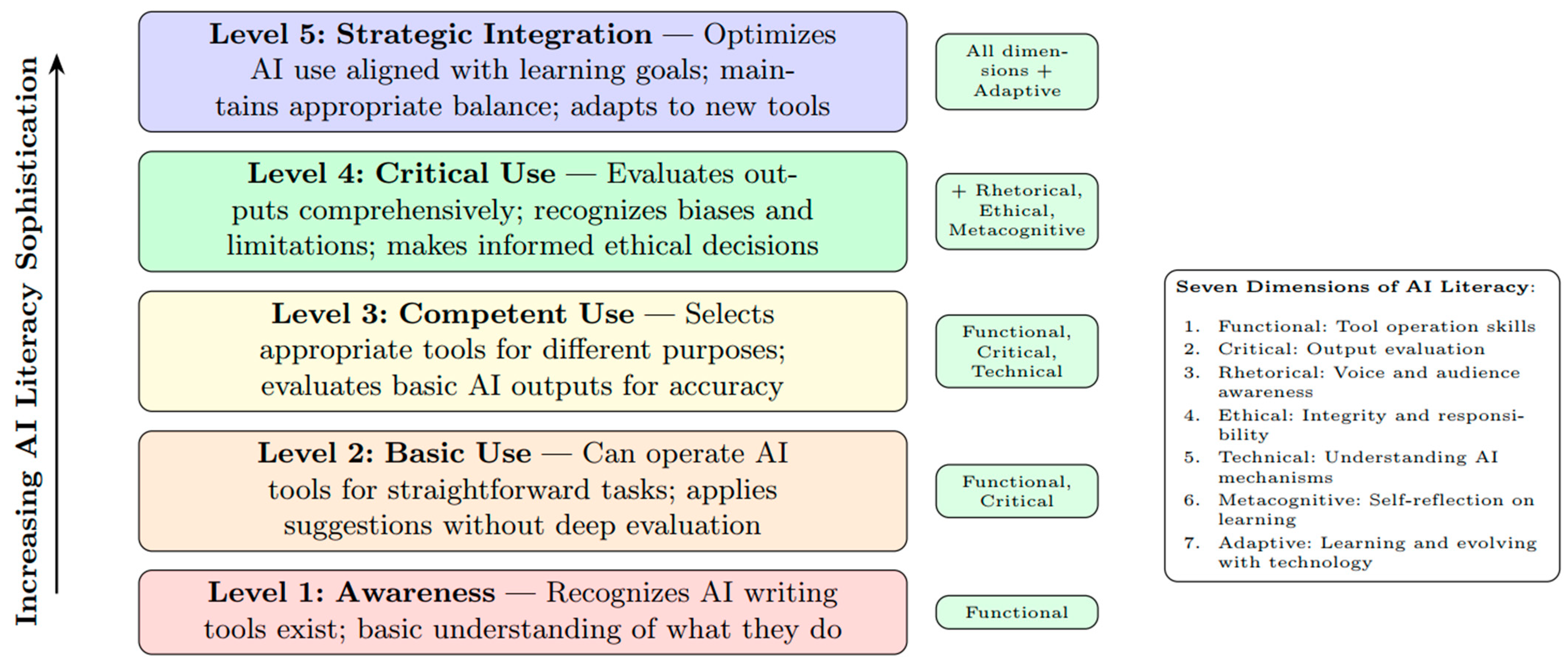
Figure 5 presents five proposed developmental levels, from awareness to strategic integration. Seven competency dimensions cut across these levels and may develop in parallel; they are not a seven-step sequence. The architecture is a conceptual proposal and has not been empirically validated.
Figure 5.
Developmental framework of AI literacy for academic writing, illustrating the progression from basic awareness through strategic integration, with the seven interconnected competency dimensions that build at each level. The framework emphasises that higher levels incorporate and extend lower-level competencies while adding new dimensions. The five-level progression is an original conceptual synthesis proposed by the authors of this review, built as a graded progression (rather than a flat, seven-dimension competency list), similar to stage models used in other skill-acquisition frameworks. It adapts and extends, but is not directly taken from, the seven dimensions of Long and Magerko (2020) and Ng et al. (2021), and it has not been empirically validated against the studies reviewed here.
8. Academic Integrity, Authorship, and Ethics: A Comparative Policy Analysis
AI writing tools have made academic integrity more complicated than before. Older misconduct research looked at copying peer work, plagiarism from online sources, and cheating on exams (Bowers, 1964; Hughes & McCabe, 2006; McCabe et al., 2012), and cross-cultural and belief-based accounts of why students cheat add more to this literature (Biagioli et al., 2019; Hard et al., 2006; Makarova, 2019; Miles et al., 2022; Perkins et al., 2020; Perry, 2010). The 2010s brought contract cheating and commercial essay mills, which led to new regulatory responses (Eaton, 2024; Parnther, 2020; Tertiary Education Quality and Standards Agency, 2025).
Generative AI is a different kind of challenge. It produces text that sounds right and fits the context, which is hard to tell apart from human writing, and it can be customised with simple prompts and gives a different output every time. Because of this, older plagiarism detection methods no longer work well (Fyfe, 2023).
Students have somewhat clearly defined intuitions concerning the limits of AI usage. According to the survey by Lund et al. (2025), participants were very wary of the idea of writing essays with AI, but AI writing help on the level of Grammarly was not regarded as something equally critical. The key problem is the grey area that lies between these extremes—namely, extensive paraphrasing, content creation at the paragraph level, and collaborative essay drafting.
Figure 6 offers an illustrative qualitative synthesis rather than a claim of universal consensus. Practices at either end may attract lower or higher concern, while decisions across the continuum depend on institutional policy, disciplinary norms, assessment purpose, and instructor expectations.
Figure 6.
Author-generated, illustrative continuum of AI-use practices in academic writing, ranging from lower-concern uses (green), through context-dependent uses (yellow), to higher-concern uses (red). Placement reflects the policy and integrity literature reviewed here but is not a universal rule; acceptability depends on institutional, disciplinary, and assessment context.
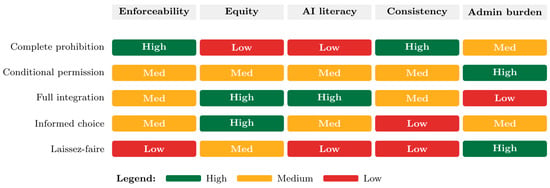
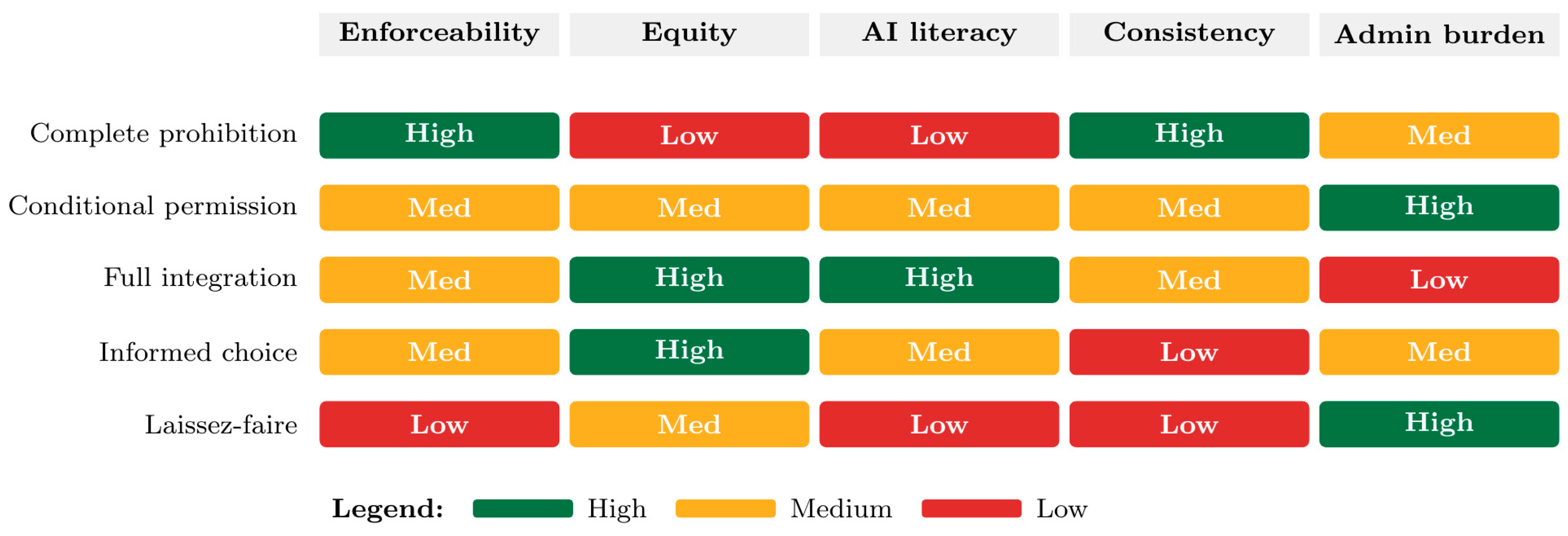
Table 9 and Figure 7 contrast the different policies used by the institutions in five categories. Each approach has its own advantages and disadvantages.
Table 9.
Comparison of institutional approaches to AI writing assistant policies in higher education.
Figure 7.
Authors’ qualitative comparison of institutional AI-policy approaches across five dimensions. High/medium/low labels are heuristic judgements based on the advantages and disadvantages summarised in Table 9, not validated scores.
AI detection tools are a controversial way for schools to respond to generative AI. Research shows these tools are not reliable (Bellini et al., 2024; Weber-Wulff et al., 2023). They often give wrong results and are biased against students who are not native English speakers or those from lower-income backgrounds (Oravec, 2023; Sadasivan et al., 2024). Relying on these tools risks falsely accusing students and creating a negative, untrusting relationship between teachers and students. This gets more complicated because of an ongoing arms race between detection programmes and ways to get around them: Turnitin, for example, has reported both overall detection activity (Turnitin, 2024) and updates aimed at AI “bypasser” tools and adversarial evasion techniques (Turnitin, 2025), which shows how hard it is to treat detection as a stable, long-term solution.
The growing consensus among academic integrity researchers favours a shift from detection toward prevention, education, and cultural change (Eaton, 2024; Parnther, 2020). In practice, this requires a redesign of assessments to foreground process and in-class performance, explicit instruction in AI literacy, and the development of policies that are sufficiently specific to provide students with genuine guidance (Carnegie Mellon University, 2024; Rudolph et al., 2023; Susnjak, 2022).
9. Design Principles for AI-Inclusive Pedagogy and Assessment
The empirical findings and theoretical frameworks presented above inform six design principles for AI-inclusive pedagogy and assessment.
- Make AI use explicit and transparent: Syllabi should state explicitly which AI tools are permitted, for what purposes, and under what conditions acknowledgment is required. Illustrative scenarios should be provided to distinguish acceptable, borderline, and unacceptable uses. AI usage statements that foster metacognitive reflection should be required.
- Emphasise process and metacognition: AI should be integrated into iterative writing processes rather than used as a single-pass corrective tool. Draft submissions should be requested alongside AI feedback histories. Reflective prompts regarding what students learned from AI suggestions should be incorporated.
- Align AI use with learning outcomes: Assignments should be categorised according to whether AI assistance is pedagogically appropriate (e.g., grammar practice) or whether it would undermine the intended learning goal (e.g., independent analysis). A guiding question for this determination is: what is the student meant to learn that AI should not perform on their behalf?
- Support equity and accessibility: Equitable access to AI tools should be ensured through institutional licencing or the provision of alternative recommendations. Policies should be reviewed to avoid inadvertent disadvantage for students with learning differences or to those who use AI tools for accessibility support.
- Design for authentic assessment: Greater weight should be assigned to process portfolios, oral examinations, and in-class writing. Assignments should be designed to require personal reflection, local data, or iterative drafting in ways that resist AI substitution. Assessments should be systematically tested against current AI tools.
- Foster critical AI literacy: Students should be taught to evaluate AI outputs for accuracy, bias, and contextual appropriateness. Verification skills and metacognitive awareness of AI’s role in learning should be explicitly developed. Instruction should specifically address the gap between functional operation and critical evaluation.
Table 10 lists concrete assessment strategies, rated by how difficult they are for AI to game, with the learning outcomes each one addresses.
Table 10.
Tentative assessment-design considerations. The final column presents authors’ judgements about potential authorship-verification value, not validated measures of AI resistance.
10. Implications for Practice and Policy
Implications differ for various stakeholder groups, since the benefits and risks of AI writing tools depend heavily on each group’s role and responsibilities. Educators, students, administrators, policymakers, and AI developers each face distinct decisions about how to integrate these tools responsibly. The following sections outline what the evidence means for each group in practice.
For educators, AI may support students who experience writing anxiety or lack language confidence, given the reported gains in engagement and self-efficacy. However, none of the intervention studies retained in this review directly measured higher-order skill development. Instruction should therefore preserve productive cognitive challenge, use AI where benefits are supported by evidence, and align permitted tool use with the learning outcome being assessed.
For students, those who approach AI use openly and strategically—in other words, who use it as additional thinking tool and not a replacement for their work—are likely to benefit from using it. Students understand what acceptable use of AI implies. Nevertheless, they should receive clear guidance on how they are expected to use AI. Institutions should not provide policy statements that leave room for interpretation.
Administrators need to understand that a ban policy would not be an effective strategy. AI tools are already widespread and will become common tools in most workplaces. Policies that provide consistency on an institutional level and flexibility within disciplines would be more successful. Ensuring equal access to AI tools and faculty training could be realistic policies for institutions.
Policymakers should focus on prevention and education rather than on strategies based on detection since detection policies have proven to be ineffective and biased. Institutional autonomy should be encouraged, while at the same time establishing some minimum standards for transparency, equity, and academic integrity is also necessary.
AI developers should view AI hallucination as an educational safety problem. Students showed their tendency to blindly trust AI tools for generating citations without independently checking them. It is necessary to incorporate features such as uncertainty notification, citation validation, and educational scaffolding and fading mechanisms.
11. Future Directions and Conclusions
The evidence base has several significant gaps that limit firm conclusions about the long-term impact of AI writing tools. Most existing studies are short-term, narrow in scope, or focused on surface-level outcomes rather than deeper cognitive skills. The following research priorities stand out as the most pressing directions for future work.
Longitudinal studies. Virtually all current studies are based on one single course or semester. The influence of AI support on writing development over time is not known. Longitudinal studies following the same students from their entry into the university until graduation and into professional work will provide evidence about whether the skill degradation issue from Section 5 is really a cause for concern.
Experimental studies of higher-order skills. Effect sizes of the results for surface-level writing outcomes from intervention studies retained in this review are generally positive. Evidence for the influence on higher-order skills like critical thinking and argumentation quality, however, is very limited and inconclusive in causal terms. RCTs with validated tests for discipline-specific writing ability are required.
Cross-disciplinary, cross-institutional, cross-student-population and cross-national/linguistic comparative research (including non-English-language publications). This is a critical aspect of the question under consideration. Comparative research covering various disciplines, different institutional contexts, diverse populations of students, and even different linguistic and national contexts would identify factors that modify the influence of AI applications and address the issue of English-language publication bias that limits this review (Section 2.3).
Design-based research. AI-guided instructional approaches should be developed and tested in actual classroom settings.
This review indicates that AI writing tools are influencing higher education across diverse settings, although the English-language evidence is heterogeneous and cannot establish a uniform global effect. Controlled and pre–post studies suggest benefits for selected writing-related outcomes, engagement, and confidence. None of the retained intervention studies directly measured complex higher-order learning outcomes. Cognitive outsourcing therefore remains a plausible concern that requires longitudinal and controlled testing rather than an effect demonstrated by the present evidence.
Considering that AI tools are already fully integrated into the work of students, it is impossible to forbid the use of such tools in an effective way. In conclusion, universities should reconsider their integrity policies and develop special AI literacy programmes to encourage the proper use of such tools. Instead of using AI to escape from writing, one should develop assignments in such a way that would allow students to use technology as a framework for their learning process.
Author Contributions
Conceptualization, O.E. and Y.M.; methodology, O.E.; software, Y.M.; validation, M.N., E.B. and O.E.; formal analysis, E.B.; investigation, M.N.; resources, Y.M.; data curation, O.E.; writing—original draft preparation, O.E. and Y.M.; writing—review and editing, O.E., Y.M., M.N. and E.B.; visualization, O.E.; supervision, E.B.; project administration, O.E. and E.B. All authors have read and agreed to the published version of the manuscript.
Funding
This research received no external funding.
Institutional Review Board Statement
Not applicable.
Informed Consent Statement
Not applicable.
Data Availability Statement
Data sharing is not applicable. No new data were created or analyzed in this study. And the study is based on the existing published papers.
Acknowledgments
Claude Sonnet 5 (Anthropic) was used during the preparation of this manuscript. The tool was used to (i) generate some of the figures included in this article and (ii) check the manuscript text for grammatical and typographical errors. All AI-assisted output was reviewed, verified, and edited by the authors, who take full responsibility for the content, accuracy, and integrity of the final published article.
Conflicts of Interest
The authors declare no conflicts of interest. A competing (or conflicting) interest exists when a financial, personal, or professional relationship could be perceived to influence, or could actually influence, the objectivity or impartiality of the research reported in this article.
References
- Abd Hadi, N. A., Mohamad, F., Md Johar, E., & Abdul Kadir, Z. (2024). Exploring the acceptance of ChatGPT as an assisting tool in academic writing among ESL undergraduate students. International Journal of Research and Innovation in Social Science, 8(10), 2886–2901. [Google Scholar] [CrossRef] [Scilit]
- Alharthi, A. (2024). The use of ChatGPT in academic writing: A systematic literature review of EFL and higher education contexts. Education and Linguistics Research, 12(1), 92–120. [Google Scholar] [CrossRef] [Scilit]
- Bailey, D. R., & Lee, A. R. (2025). Writing support with Grammarly: Examining confidence, help-seeking behaviour, and user perceptions in higher education. Turkish Online Journal of Educational Technology, 24(1), 90–105. [Google Scholar]
- Bellini, V., Semeraro, F., Montomoli, J., Cascella, M., & Bignami, E. (2024). Between human and AI: Assessing the reliability of AI text detection tools. Current Medical Research and Opinion, 40(3), 353–358. [Google Scholar] [CrossRef] [Scilit] [PubMed]
- Biagioli, M., Kenney, M., Martin, B. R., & Walsh, J. P. (2019). Academic misconduct, misrepresentation and gaming: A reassessment. Research Policy, 48(2), 401–413. [Google Scholar] [CrossRef] [Scilit]
- Bowers, W. J. (1964). Student dishonesty and its control in college. Bureau of Applied Social Research, Columbia University. [Google Scholar]
- Carnegie Mellon University. (2024). Examples of possible academic integrity policies that address student use of generative AI tools. Teaching & Learning Resource. [Google Scholar]
- Carnegie Mellon University, Human-Computer Interaction Institute. (2024). Generative AI boosts graduate student writing efficiency and quality. CMU Research News. [Google Scholar]
- Chan, C. (2024). Students’ perceptions of “AI-giarism”: Investigating changes in understandings of academic misconduct. Education and Information Technologies, 30(6), 8087–8108. [Google Scholar] [CrossRef] [Scilit]
- Chen, C.-F. E., & Cheng, W.-Y. E. C. (2008). Beyond the design of automated writing evaluation: Pedagogical practices and perceived learning effectiveness in EFL writing classes. Language Learning & Technology, 12(2), 94–112. [Google Scholar] [CrossRef] [Scilit]
- Cheng, A., Calhoun, A., & Reedy, G. (2025). Artificial intelligence-assisted academic writing: Recommendations for ethical use. Advances in Simulation, 10, 22. [Google Scholar] [CrossRef] [Scilit] [PubMed]
- Chiu, T. K. F., Xia, Q., Zhou, X., Chai, C. S., & Cheng, M. (2023). Systematic literature review on opportunities, challenges, and future research recommendations of artificial intelligence in education. Computers and Education: Artificial Intelligence, 4, 100118. [Google Scholar] [CrossRef] [Scilit]
- Contractor, Z., & Reyes, G. (2025). Generative AI in higher education: Evidence from an elite college. arXiv. [Google Scholar] [CrossRef] [Scilit]
- Cotos, E. (2014). Genre-based automated writing evaluation for L2 research writing: From design to evaluation and enhancement. Springer. [Google Scholar] [CrossRef] [Scilit]
- Davis, F. D. (1989). Perceived usefulness, perceived ease of use, and user acceptance of information technology. MIS Quarterly, 13(3), 319–340. [Google Scholar] [CrossRef] [Scilit] [PubMed]
- Deep, P. D., & Chen, Y. (2025). The role of AI in academic writing: Impacts on writing skills, critical thinking, and integrity in higher education. Societies, 15(9), 247. [Google Scholar] [CrossRef] [Scilit]
- Digital Education Council. (2024). What students want: Key results from DEC global AI student survey 2024. Available online: https://www.digitaleducationcouncil.com/newsroom/what-students-want-key-results-from-dec-global-ai-student-survey-2024 (accessed on 1 September 2026).
- Ding, L., & Zou, D. (2024). Automated writing evaluation systems: A systematic review of Grammarly, Pigai, and Criterion with a perspective on future directions in the age of generative artificial intelligence. Education and Information Technologies, 29(11), 14151–14203. [Google Scholar] [CrossRef] [Scilit]
- Eaton, S. E. (Ed.). (2024). Second handbook of academic integrity. Springer. [Google Scholar] [CrossRef] [Scilit]
- Ekizer, F. N. (2025). Exploring the impact of artificial intelligence on English language teaching: A meta-analysis. Acta Psychologica, 260, 105649. [Google Scholar] [CrossRef] [Scilit] [PubMed]
- Engeström, Y. (1987). Learning by expanding: An activity-theoretical approach to developmental research. Orienta-Konsultit. [Google Scholar]
- Farhat, S. (2024). The role of artificial intelligence in scientific writing. International Journal of Scientific and Health Research, 9(4), 153–155. [Google Scholar] [CrossRef] [Scilit]
- Fatimah, M., & Jamilah, J. (2025). The influence of Grammarly on university students’ writing skills and writing confidence. International Journal of Multicultural and Multireligious Understanding, 12(12), 284–293. [Google Scholar]
- Freeman, J. (2025). Student generative AI survey 2025. Higher Education Policy Institute. Available online: https://www.hepi.ac.uk/reports/student-generative-ai-survey-2025/ (accessed on 1 September 2026).
- Fyfe, P. (2023). How to cheat on your final paper: Assigning AI for student writing. AI & Society, 38(4), 1395–1405. [Google Scholar] [CrossRef] [Scilit]
- Garzón, J., Patiño, J., & Marulanda, D. (2025). Systematic review of artificial intelligence in education: Trends, benefits and challenges. Multimodal Technologies and Interaction, 9(8), 84. [Google Scholar] [CrossRef] [Scilit]
- Gasaymeh, A.-M. M., Beirat, M. A., & Abu Qbeita, A. A. (2024). University students’ insights of generative artificial intelligence (AI) writing tools. Education Sciences, 14(10), 1062. [Google Scholar] [CrossRef] [Scilit]
- Godwin-Jones, R. (2022). Partnering with AI: Intelligent writing assistance and instructed language learning. Language Learning & Technology, 26(2), 5–24. [Google Scholar] [CrossRef] [Scilit]
- Grammarly. (2024). Grammarly for education: Generative AI features and enterprise solutions. Grammarly. [Google Scholar]
- Hard, S. F., Conway, J. M., & Moran, A. C. (2006). Faculty and college student beliefs about the frequency of student academic misconduct. The Journal of Higher Education, 77(6), 1058–1080. [Google Scholar] [CrossRef] [Scilit]
- Hughes, J. M., & McCabe, D. L. (2006). Understanding academic misconduct. Canadian Journal of Higher Education, 36(1), 49–63. [Google Scholar] [CrossRef] [Scilit]
- Imran, M., & Almusharraf, N. (2023). Analyzing the role of ChatGPT as a writing assistant at higher education level: A systematic review of the literature. Contemporary Educational Technology, 15(4), ep464. [Google Scholar] [CrossRef] [Scilit] [PubMed]
- Kasneci, E., Sessler, K., Küchemann, S., Bannert, M., Dementieva, D., Fischer, F., Gasser, U., Groh, G., Günnemann, S., Hüllermeier, E., Krusche, S., Kutyniok, G., Michaeli, T., Nerdel, C., Pfeffer, J., Poquet, O., Sailer, M., Schmidt, A., Seidel, T., … Kasneci, G. (2023). ChatGPT for good? On opportunities and challenges of large language models for education. Learning and Individual Differences, 103, 102274. [Google Scholar] [CrossRef] [Scilit]
- Kortext. (2024). Kortext AI study assistant: Generative AI in digital textbooks and learning platforms. Kortext. [Google Scholar]
- Long, D., & Magerko, B. (2020). What is AI literacy? Competencies and design considerations. In Proceedings of the 2020 CHI conference on human factors in computing systems (pp. 1–16). Association for Computing Machinery. [Google Scholar] [CrossRef] [Scilit]
- Lund, B. D., Lee, T. H., Mannuru, N. R., & Arutla, N. (2025). AI and academic integrity: Exploring student perceptions and implications for higher education. Journal of Academic Ethics, 23, 1545–1565. [Google Scholar] [CrossRef] [Scilit]
- Lund, B. D., & Wang, T. (2023). Chatting about ChatGPT: How may AI and GPT impact academia and libraries? Library Hi Tech News, 40(3), 26–29. [Google Scholar] [CrossRef] [Scilit]
- Makarova, M. (2019). Factors of academic misconduct in a cross-cultural perspective and the role of integrity systems. Journal of Academic Ethics, 17, 51–71. [Google Scholar] [CrossRef] [Scilit]
- McCabe, D. L., Butterfield, K. D., & Treviño, L. K. (2012). Cheating in college: Why students do it and what educators can do about it. Johns Hopkins University Press. [Google Scholar] [CrossRef] [Scilit]
- Miao, F., Holmes, W., Huang, R., & Zhang, H. (2021). AI and education: Guidance for policy-makers. UNESCO. [Google Scholar] [CrossRef] [Scilit]
- Miles, P. J., Campbell, M., & Ruxton, G. D. (2022). Why students cheat and how understanding this can help reduce the frequency of academic misconduct in higher education: A literature review. Journal of Undergraduate Neuroscience Education, 20(2), A150–A160. [Google Scholar] [CrossRef] [Scilit] [PubMed]
- Nazari, N., Shabbir, M. S., & Setiawan, R. (2021). Application of artificial intelligence powered digital writing assistant in higher education: Randomized controlled trial. Heliyon, 7(5), e07014. [Google Scholar] [CrossRef] [Scilit] [PubMed]
- Neves, J., Stephenson, R., & Armstrong, C. (2026). The student academic experience survey 2026. HEPI/Advance HE. Available online: https://www.hepi.ac.uk/reports/the-student-academic-experience-survey-2026/ (accessed on 1 September 2026).
- Ng, D. T. K., Leung, J. K. L., Chu, S. K. W., & Qiao, M. S. (2021). Conceptualizing AI literacy: An exploratory review. Computers and Education: Artificial Intelligence, 2, 100041. [Google Scholar] [CrossRef] [Scilit]
- Oravec, J. A. (2023). Artificial intelligence implications for academic cheating: Expanding the dimensions of responsible human–AI collaboration with ChatGPT and Bard. Journal of Interactive Learning Research, 34(2), 213–237. [Google Scholar] [CrossRef] [Scilit]
- Parker, L., Carter, C., Karakas, A., Loper, A. J., & Sokkar, A. (2023). Ethics and improvement: Undergraduate students’ use of artificial intelligence in academic endeavours. International Journal of Intelligent Computing Research, 14(1), 1187–1194. [Google Scholar] [CrossRef] [Scilit]
- Parnther, C. (2020). Academic misconduct in higher education: A comprehensive review. Journal of Higher Education Policy and Leadership Studies, 1(1), 25–45. [Google Scholar] [CrossRef] [Scilit]
- Perkins, M., Gezgin, U., & Roe, J. (2020). Reducing plagiarism through academic misconduct education. International Journal for Educational Integrity, 16, 3. [Google Scholar] [CrossRef] [Scilit]
- Perkins, M., & Roe, J. (2023). Decoding academic integrity policies: A corpus linguistics investigation of AI and other technological threats. Higher Education Policy, 37(3), 633–653. [Google Scholar] [CrossRef] [Scilit]
- Perry, B. (2010). Exploring academic misconduct: Some insights into student behaviour. Active Learning in Higher Education, 11(2), 97–108. [Google Scholar] [CrossRef] [Scilit]
- QuillBot. (2024). QuillBot: AI-powered writing tool. Available online: https://quillbot.com (accessed on 1 September 2026).
- Ranalli, J., & Yamashita, T. (2022). Automated written corrective feedback for L2 writers: Error-correction performance and timing of delivery. Language Learning & Technology, 26(1), 1–25. [Google Scholar] [CrossRef] [Scilit]
- Ravšelj, D., Keržič, D., Tomaževič, N., Umek, L., Brezovar, N., Iahad, N. A., Abdulla, A. A., Akopyan, A., Aldana Segura, M. W., AlHumaid, J., Allam, M. F., Alló, M., Andoh, R. P. K., Andronic, O., Arthur, Y. D., Aydın, F., Badran, A., Balbontín-Alvarado, R., Ben Saad, H., … Aristovnik, A. (2025). Higher education students’ perceptions of ChatGPT: A global study of early reactions. PLoS ONE, 20(2), e0315011. [Google Scholar] [CrossRef] [Scilit] [PubMed]
- Rudolph, J., Tan, S., & Tan, S. (2023). ChatGPT: Bullshit spewer or the end of traditional assessments in higher education? Journal of Applied Learning & Teaching, 6(1), 342–363. [Google Scholar] [CrossRef] [Scilit]
- Sadasivan, V. S., Kumar, A., Balasubramanian, S., Wang, W., & Feizi, S. (2024). Can AI-generated text be reliably detected? Nature Human Behaviour, 8(9), 1756–1765. [Google Scholar] [CrossRef] [Scilit]
- Schei, O. M., Møgelvang, A., & Ludvigsen, K. (2024). Perceptions and use of AI chatbots among students in higher education: A scoping review of empirical studies. Education Sciences, 14(8), 922. [Google Scholar] [CrossRef] [Scilit]
- Susnjak, T. (2022). ChatGPT: The end of online exam integrity? arXiv. [Google Scholar] [CrossRef] [Scilit]
- Sweller, J., Ayres, P., & Kalyuga, S. (2011). Cognitive load theory. Springer. [Google Scholar]
- Sweller, J., Ayres, P., Kalyuga, S., & Leach, C. (2023). Cognitive load theory: A festschrift for John Sweller. Springer. [Google Scholar]
- Tertiary Education Quality and Standards Agency. (2025). TEQSA blocks more cheating websites. Tertiary Education Quality and Standards Agency. [Google Scholar]
- Tsai, C.-Y., Lin, Y.-T., & Brown, I. K. (2024). Impacts of ChatGPT-assisted writing for EFL English majors: Feasibility and challenges. Education and Information Technologies, 29, 22427–22445. [Google Scholar] [CrossRef] [Scilit]
- Turnitin. (2024). Turnitin wrapped 2024: The year in academic integrity. Turnitin. [Google Scholar]
- Turnitin. (2025). AI detection updates: Identifying AI bypasser tools and adversarial techniques. Turnitin. [Google Scholar]
- Venkatesh, V., Morris, M. G., Davis, G. B., & Davis, F. D. (2003). User acceptance of information technology: Toward a unified view. MIS Quarterly, 27(3), 425–478. [Google Scholar] [CrossRef] [Scilit]
- Vygotsky, L. S. (1978). Mind in society: The development of higher psychological processes. Harvard University Press. [Google Scholar] [CrossRef] [Scilit]
- Wang, I. X., Wu, X., Coates, E., Zeng, M., Kuang, J., Liu, S., Qiu, M., & Park, J. (2024). Neural automated writing evaluation with corrective feedback. arXiv. [Google Scholar] [CrossRef] [Scilit]
- Weale, S. (2025, June 15). Thousands of UK university students caught cheating using AI. The Guardian.
- Weber-Wulff, D., Anohina-Naumeca, A., Bjelobaba, S., Foltýnek, T., Guerrero-Dib, J., Popoola, O., Šigut, P., & Waddington, L. (2023). Testing of detection tools for AI-generated text. International Journal for Educational Integrity, 19, 26. [Google Scholar] [CrossRef] [Scilit]
- Williams, A., Smith, H., & Raja, S. (2025). Artificial intelligence in academic writing: Opportunities and risks from planning to publication. Journal of the Best Available Evidence in Medicine, 1(1), 26–32. [Google Scholar] [CrossRef] [Scilit]
- Winne, P. H., & Hadwin, A. F. (1998). Studying as self-regulated learning. In D. J. Hacker, J. Dunlosky, & A. C. Graesser (Eds.), Metacognition in educational theory and practice (pp. 277–304). Lawrence Erlbaum. [Google Scholar]
- Wood, D., Bruner, J. S., & Ross, G. (1976). The role of tutoring in problem solving. Journal of Child Psychology and Psychiatry, 17(2), 89–100. [Google Scholar] [CrossRef] [Scilit] [PubMed]
- Zawacki-Richter, O., Marín, V. I., Bond, M., & Gouverneur, F. (2019). Systematic review of research on artificial intelligence applications in higher education—Where are the educators? International Journal of Educational Technology in Higher Education, 16, 39. [Google Scholar] [CrossRef] [Scilit]
- Zimmerman, B. J. (2002). Becoming a self-regulated learner: An overview. Theory into Practice, 41(2), 64–70. [Google Scholar] [CrossRef] [Scilit] [PubMed]



Disclaimer/Publisher’s Note: The statements, opinions and data contained in all publications are solely those of the individual author(s) and contributor(s) and not of MDPI and/or the editor(s). MDPI and/or the editor(s) disclaim responsibility for any injury to people or property resulting from any ideas, methods, instructions or products referred to in the content. |
© 2026 by the authors. Licensee MDPI, Basel, Switzerland. This article is an open access article distributed under the terms and conditions of the Creative Commons Attribution (CC BY) license.