


Abstract
Universal Design for Learning (UDL) has advanced inclusive education by positioning learner variability as an anticipated condition of instructional design and emphasizing the proactive reduction of barriers. Yet, structural accessibility alone does not fully explain how learners and educators experience belonging, construct identity, exercise agency, or translate lived experience into pedagogical decision-making. This study examines how these interpretive dimensions of learning may extend existing approaches to inclusive educational design. Using a Phase I exploratory Design-Based Research methodology, the study investigated the reflexive and pedagogical experiences of 20 leaders of learning working across educator preparation, professional learning, and school-based instructional contexts in the United States. Participants included 12 faculty leaders facilitating graduate-level or professional learning experiences and 8 teacher leaders engaged in school-based instructional practice. The inquiry was designed for conceptual development rather than intervention validation, examining how authentic professional experiences could inform the emergence of an identity-responsive framework for inclusive educational design. Prototypical Narration Surfacing and Synthesis served as the interpretive methodology through which lived experience was surfaced, interpreted, and synthesized across participant narratives, instructional artifacts, observation records, coaching documentation, and portfolio evidence. Narrative inquiry, thematic analysis, iterative coding, and cross-context interpretation supported the identification of recurring developmental patterns. Findings indicated that professional growth extended beyond the acquisition of discrete instructional competencies and was experienced as an interconnected process of identity development, belonging, self-efficacy, professional agency, and pedagogical reasoning. Across faculty leaders and teacher leaders, reflexive interpretation increasingly informed intentional instructional decision-making and more responsive approaches to learner variability. Cross-context synthesis further revealed recurring developmental orientations related to challenge, agency, belonging, identity, and transformation. These patterns contributed to the emergence of Archetypal Inquiry as a provisional, anti-reductionist interpretive lens rather than a predetermined participant classification system. The iterative synthesis of: (a) structural accessibility, (b) lived experience, (c) reflexive interpretation, (d) pedagogical reasoning, and (e) contextual responsiveness, subsequently informed Universal Access by Design, an emerging Phase I conceptual framework for identity-responsive inclusive education. The study suggests that inclusive educational design may be strengthened when UDL’s structural commitments are complemented by attention to how learners and leaders interpret experience, construct identity, and continually redesign educational environments in response to emerging evidence. Universal Access by Design is therefore offered not as a replacement for UDL or as a validated intervention, but as a provisional framework and foundation for continued Design-Based Research, implementation, and empirical refinement across diverse educational settings.
1. Introduction
Universal Design for Learning (UDL) has long offered one of the most generative frameworks for reimagining educational access through proactive rather than reactive design. By anticipating learner variability and providing multiple means of engagement, representation, and action and expression, UDL shifts difference away from the margins of instructional planning and positions it as an expected condition of learning itself (Meyer et al., 2014). This orientation remains essential to inclusive practice. Yet, access to a learning environment, resource, or instructional pathway does not necessarily ensure that learners experience themselves as belonging within that environment or as capable of exercising meaningful agency within it.
This distinction reveals an enduring tension within inclusive education. Structural access creates the conditions for participation, but it does not, by itself, determine how participation is experienced. Learners may be physically present, formally accommodated, or offered multiple pathways into a task while still encountering systems that leave their identities, histories, aspirations, and ways of making meaning insufficiently recognized. Contemporary inclusive pedagogy therefore requires more than the removal of barriers. It requires attention to how learners understand themselves within educational spaces, how they interpret challenge and possibility, and how institutional conditions either expand or constrain their capacity to contribute, grow, and become (Florian & Black-Hawkins, 2011; Moriña, 2022).
This need is particularly visible within educator preparation and professional learning, where educators occupy the layered position of both leaders and learners. Faculty members and teacher leaders are asked to design meaningful learning experiences for others while simultaneously developing their own pedagogical identities, professional judgment, and capacity for responsive practice. Their work is shaped not only by knowledge of instructional strategies, standards, and inclusive frameworks, but also by how they interpret their lived experiences, understand their professional agency, and locate themselves within the systems in which they teach and lead. Yet, professional learning structures frequently emphasize competency, implementation, and performance without creating equally intentional space for educators to examine how identity, context, power, and experience inform the decisions they make.
Narrative identity and reflexive practice provide important conceptual pathways for addressing this gap. Narrative perspectives position identity as neither static nor singular, but as continuously constructed through the interpretation of lived experience across time, context, and possibility (Clandinin & Connelly, 2000; McAdams, 2001). Within teacher education, professional identity similarly emerges through the interaction of personal histories, institutional expectations, relationships, and evolving understandings of practice (Beauchamp & Thomas, 2009). Reflexivity deepens this process by extending beyond reflection as a retrospective consideration of what occurred. It calls learners and leaders to interrogate the assumptions, positionalities, relational dynamics, and systemic conditions that shape both their interpretations and their actions.
Reflection, however, does not automatically become design. Without structures that support the translation of lived experience into pedagogical decision-making, reflexive work may remain descriptive rather than transformative. At the same time, instructional frameworks may remain procedurally inclusive while leaving unexamined the identities, beliefs, and interpretive patterns that shape how those frameworks are enacted. The work of inclusion therefore requires an intentional bridge between narrative understanding and pedagogical action: a process through which experience is surfaced, interpreted, and translated into more responsive forms of planning, facilitation, assessment, and systems design.
This study enters that space through a Phase I exploratory Design-Based Research inquiry into the reflexive and pedagogical experiences of faculty leaders and teacher leaders (see Figure 1). The study is grounded in Prototypical Narration Surfacing and Synthesis, a methodological orientation that positions lived experience as an origin-centered source of knowledge rather than as supplementary reflection or evidence offered only in opposition to dominant narratives (R. Lubin, 2024; Flake & Lubin, 2024). Within this orientation, narration surfaces experiences of challenge, belonging, constraint, capability, and transformation. Synthesis then considers how the patterns carried within those experiences may inform pedagogical reasoning, professional identity development, and systems redesign.
Figure 1.
Conceptual progression of the study.
The study further explores the development of Universal Access by Design, a provisional framework that brings structural accessibility into conversation with identity-responsive interpretation and reflexive pedagogical action. Universal Access by Design does not seek to replace UDL. Rather, it builds from UDL’s structural foundation while attending more explicitly to the developmental and interpretive dimensions of learning. UDL helps educators anticipate variability and reduce barriers. Reflexive and narrative processes create opportunities to examine how those barriers are experienced, why particular design choices matter within context, and how learners and leaders understand themselves in relation to the systems being designed.
Within the present study, Archetypal Inquiry emerged as part of that interpretive process. It was not introduced to participants as an intervention, typology, or participant-facing classification system. Instead, it developed through researcher-led analysis of recurring patterns within participants’ narratives and pedagogical evidence. These patterns included experiences of uncertainty, resilience, constraint, mastery, agency, and professional transformation. Archetypal Inquiry is therefore positioned here as a provisional and anti-reductionist lens through which developmental patterns may be interpreted without fixing individuals within predetermined categories. Archetypal positions are understood as fluid, contextual, and responsive to shifts in environment, relationship, challenge, and development.
This distinction is central to the framework. The purpose of Archetypal Inquiry is not to determine what type of learner or leader a person is. Its purpose is to create language for considering how an individual may be navigating a particular developmental moment, what energies or orientations appear to shape that navigation, and under what conditions those positions may evolve. In this way, Archetypal Inquiry seeks to preserve the complexity of identity while still allowing meaningful patterns in experience to surface.
The present study makes three related contributions. First, it examines how faculty leaders and teacher leaders narrated professional identity, belonging, self-efficacy, and agency through structured reflexive processes. Second, it analyzes patterns in inclusive planning, pedagogical reasoning, and the quality of professional evidence generated through participant artifacts, coaching documentation, and observation records. Third, it considers how those patterns informed the development of Archetypal Inquiry, Reflexive Design, and the broader Universal Access by Design framework.
This inquiry is intentionally exploratory. It does not claim that reflexive or archetypal approaches independently caused measurable changes in belonging, self-efficacy, or instructional performance. Archetypal Inquiry was not implemented as a formal intervention, and the study did not administer standardized measures of identity-related constructs. Instead, the analysis examines how participants described their experiences, how their pedagogical reasoning was represented across multiple sources of evidence, and how recurring patterns within those sources contributed to the development of a provisional conceptual and practical model.
The study included 20 leaders of learning working across educator preparation, professional learning, and school-based instructional contexts in the United States during the 2025–2026 academic year. Participants included 12 faculty leaders facilitating graduate-level or professional learning experiences for adults and 8 teacher leaders engaged in school-based instructional practice. The study drew upon reflexive artifacts, open narrative responses, coaching documentation, observation records, and pedagogical evidence to examine patterns across conceptual and applied contexts.
Guided by this purpose, the study addresses the following research questions:
- How did faculty leaders and teacher leaders describe professional identity, belonging, self-efficacy, and agency within reflexive narrative artifacts generated during the Phase I Design-Based Research process?
- What patterns in inclusive planning, pedagogical reasoning, and professional evidence were identified across participant artifacts, coaching documentation, and observation records?
- How did cross-context analysis of these patterns inform the development of Archetypal Inquiry, Reflexive Design, and the provisional Universal Access by Design framework?
Through these questions, the study positions inclusive practice as both a structural and interpretive design responsibility. Access remains foundational, but the work of inclusion also requires attention to how learners and leaders experience themselves within systems, how they construct meaning from those experiences, and how that meaning may shape subsequent action. Universal Access by Design is therefore presented not as a completed or universally validated model, but as a Phase I synthesis emerging from the examination of lived experience, professional reasoning, and inclusive design practice. At its center is a broader proposition: learning environments become more responsive when they are designed not only around what learners need to access, but with an understanding of who learners and leaders are becoming.
2. Theoretical Framework
2.1. Universal Design for Learning and the Limits of Structural Inclusion
Universal Design for Learning (UDL) has fundamentally reshaped contemporary conversations about inclusive education by repositioning learner variability as a design consideration rather than an instructional exception. Rooted in the architectural principles of universal design and advanced through the work of CAST, UDL encourages educators to anticipate differences in how learners engage with information, process ideas, and demonstrate understanding through the proactive design of flexible learning environments (Meyer et al., 2014). Rather than adapting instruction only after barriers emerge, UDL challenges educators to design for variability from the outset, expanding opportunities for participation through multiple means of engagement, representation, and action and expression. In doing so, UDL shifted inclusive education away from deficit-oriented assumptions toward a strengths-based understanding of human variability.
Over the past two decades, UDL has become one of the most influential frameworks for operationalizing equity within educational settings. Across K–12 education, higher education, and professional learning environments, researchers have demonstrated that proactive instructional flexibility increases access to curriculum, supports differentiated participation, and encourages educators to consider learner diversity as an anticipated dimension of planning rather than an exception requiring accommodation (Rao et al., 2018; Capp, 2020). Equally important, UDL has contributed to a broader philosophical shift within inclusive education by emphasizing that barriers often reside within instructional environments rather than within learners themselves. This systems-oriented perspective represents one of UDL’s most enduring contributions, challenging educators to redesign environments before attempting to remediate individuals.
Yet the evolution of inclusive education over the past decade suggests that structural flexibility alone may not fully account for the complexity of human learning. Educational systems increasingly recognize that access involves more than participation in instructional activities or the availability of multiple pathways through content. Learners also navigate questions of identity, belonging, agency, and self-efficacy as they interpret their experiences within educational environments. These dimensions influence not only whether learning opportunities are available, but how those opportunities are experienced, internalized, and transformed into meaningful participation.
This distinction reflects an important conceptual shift within the broader literature on inclusive pedagogy. Florian and Black-Hawkins (2011) argue that inclusive practice extends beyond the provision of differentiated supports to encompass pedagogical approaches that position every learner as a legitimate participant within shared learning experiences. Similarly, Moriña (2022) emphasizes that meaningful inclusion within higher education depends upon relational practices, institutional responsiveness, and learning environments that cultivate recognition, belonging, and participation rather than merely ensuring physical or procedural access (UNESCO, 2020). Together, these perspectives suggest that educational equity is experienced not solely through the removal of barriers, but through the ways learners come to understand themselves within the environments those barriers shape.
This emerging emphasis on identity and participation does not diminish the significance of UDL; rather, it reveals an opportunity to extend its foundational principles. UDL provides educators with an architecture for anticipating learner variability and reducing barriers before they arise. It offers powerful guidance for designing accessible learning experiences, yet provides comparatively less direction regarding how learners interpret those experiences, construct meaning from them, or develop a sense of agency within them. Questions of identity formation, professional becoming, narrative interpretation, and developmental meaning-making remain largely outside the explanatory scope of structural design frameworks, even though they frequently shape how inclusive environments are ultimately experienced.
The present study begins from the premise that these perspectives are complementary rather than competing. Structural accessibility remains an indispensable condition for equitable education. However, if inclusive systems are also intended to cultivate belonging, professional agency, and long-term human development, then educational design may benefit from additional frameworks capable of illuminating the interpretive dimensions of learning. The question is therefore not whether Universal Design for Learning remains necessary—it unquestionably does—but what becomes possible once access has been intentionally designed.
This question serves as the conceptual point of departure for the present inquiry. Rather than replacing UDL, this study explores how structural accessibility may be enriched through approaches that examine how learners and leaders construct meaning from their experiences, interpret their identities within educational systems, and translate those interpretations into more responsive forms of pedagogical design. In doing so, the discussion naturally turns toward scholarship on narrative identity and reflexive practice, both of which offer important theoretical foundations for understanding how lived experience itself becomes a source of educational knowledge.
2.2. Narrative Identity and Reflexive Practice
If Universal Design for Learning provides an essential architecture for designing accessible educational environments, a complementary question remains: How do learners and leaders make meaning of those environments once they are experienced? Structural design can anticipate variability and reduce barriers, yet the educational experience itself is never interpreted solely through instructional design. Individuals enter learning spaces with histories, identities, aspirations, relationships, and evolving understandings of themselves that shape how opportunities for participation are perceived and enacted. Consequently, understanding inclusion requires attention not only to the environments that are designed, but also to the interpretive processes through which those environments become meaningful.
Narrative scholarship offers an important foundation for understanding this interpretive dimension of learning. Rather than viewing identity as a fixed collection of personal characteristics, narrative theorists conceptualize identity as an evolving process through which individuals organize lived experiences into coherent understandings of who they have been, who they are becoming, and how they position themselves within the world (McAdams, 2001; Clandinin & Connelly, 2000). Experiences, therefore, do not exist as isolated events. They acquire educational significance through interpretation, as learners continually construct and reconstruct meaning across changing contexts, relationships, and developmental moments.
Within educator preparation, this perspective is particularly consequential. Teaching is not merely the application of pedagogical knowledge or instructional technique; it is an ongoing process of professional identity formation. Beauchamp and Thomas (2009) argue that teacher identity emerges through the continuous interaction of personal experience, institutional expectations, relationships, and professional practice. As educators encounter new learners, unfamiliar contexts, successes, failures, and moments of uncertainty, they are simultaneously developing their understandings of what it means to teach, to lead, and to belong within educational communities. Professional growth therefore involves more than acquiring additional competencies. It also involves the continual reconstruction of professional identity through lived experience.
This perspective reframes experience itself as a legitimate source of educational knowledge. Rather than treating reflection as an activity that occurs after learning has concluded, narrative approaches position experience as an ongoing site of inquiry through which educators interpret instructional decisions, examine assumptions, and develop increasingly sophisticated understandings of practice. In this sense, identity is not simply an outcome of learning; it also becomes part of the evidence through which learning can be understood.
Reflection has long occupied an important place within this process. Schön’s (1983) work on the reflective practitioner challenged technical models of professional expertise by arguing that practitioners continually learn through examining their actions both during and after practice. Reflection encourages educators to revisit experiences, consider alternative responses, and refine future action. Across teacher education, reflective journals, lesson analyses, and professional portfolios have therefore become common mechanisms for supporting instructional growth.
Yet reflection alone may not fully account for the complexity of educational decision-making. Reflective activities often emphasize what occurred, what worked, or what might be improved. While these questions are valuable, they may not sufficiently examine the assumptions, identities, positionalities, and contextual forces that shaped those experiences in the first place. Two educators may encounter nearly identical instructional situations while interpreting those experiences in fundamentally different ways because they bring different histories, values, relationships, and understandings of themselves to the interaction. Consequently, improving instructional practice may require more than revisiting experience; it may require interrogating the interpretive processes through which experience itself becomes meaningful.
This distinction gives rise to reflexivity. Whereas reflection primarily revisits experience, reflexivity examines the relationship between the individual and the experience being interpreted. Reflexive practice invites learners and leaders to consider how identity, positionality, prior experience, institutional context, power, and relational dynamics shape both perception and action. It asks not only “What happened?”, but also “Why did I understand this experience in this way?”, “What assumptions informed my response?”, and “How might alternative interpretations lead to different pedagogical possibilities?” Reflexivity therefore expands professional learning beyond technical refinement toward deeper examination of the conditions that shape educational decision-making.
Importantly, the distinction between reflection and reflexivity should not be understood as hierarchical. Reflection remains an indispensable component of professional learning. Rather, reflexivity extends reflection by situating experience within broader developmental, relational, and systemic contexts. This extension becomes particularly important within inclusive education, where instructional decisions are continually influenced by educators’ understandings of learner variability, cultural context, institutional expectations, and their own evolving professional identities. Inclusive practice therefore requires not only thoughtfully designed environments, but also thoughtful interpretation of how those environments are experienced by everyone who participates within them (R. C. Lubin, 2022).
The present study builds upon this theoretical foundation by approaching participant narratives as more than retrospective accounts of professional practice. Instead, narratives are understood as developmental evidence that reveals how educators make meaning of challenge, belonging, uncertainty, confidence, and instructional decision-making across evolving contexts. Through this perspective, lived experience becomes a source of inquiry capable of informing not only individual growth, but also broader questions of pedagogical and systems design.
This orientation provides the conceptual bridge to the next section because if narrative identity explains how experience becomes meaningful, the remaining question becomes how those interpreted experiences can be translated into more intentional educational design. Addressing that question requires moving beyond reflection and reflexivity as individual practices toward a broader conception of Reflexive Design as a mechanism for transforming interpreted experience into inclusive pedagogical action.
2.3. From Reflection to Reflexive Design
The progression from structural inclusion to narrative interpretation raises an important question for educational design: How should educators act upon the meanings they construct through experience? If Universal Design for Learning provides a structure for anticipating learner variability, and narrative identity explains how individuals make meaning of educational experiences, then an additional process is needed to connect interpretation with pedagogical action. Reflection and reflexivity illuminate experience, but inclusive education ultimately requires educators to translate those insights into intentional decisions about learning environments, instructional relationships, assessment, and systems design. This translational space forms the basis of what is conceptualized in the present study as Reflexive Design.
Reflexive Design is not proposed as another instructional framework to be implemented alongside existing models of inclusive practice. Rather, it is advanced as a design orientation—a way of approaching educational decision-making that positions interpretation as an integral component of design itself. It begins from the premise that educational environments are never created from a position of complete neutrality. Every decision regarding curriculum, facilitation, assessment, feedback, grouping, pacing, participation, or accessibility reflects underlying assumptions about learners, learning, knowledge, and human development. Designing for inclusion therefore requires more than selecting appropriate instructional strategies; it also requires ongoing examination of the assumptions through which those strategies are conceived, interpreted, and enacted.
This distinction extends traditional understandings of reflective practice. Reflection often asks educators to examine instructional experiences retrospectively by considering questions such as “What happened?”, “What worked?”, or “What might I change next time?” Reflexivity moves beyond these questions by examining the relationship between the individual and the experience itself. It asks educators to consider how identity, positionality, prior experiences, institutional conditions, and relationships shaped both their interpretations and their instructional decisions. Reflexive Design represents a further developmental step. Rather than ending with interpretation, it asks how those interpretations should reshape the environments educators create.
In this orientation, design becomes an ongoing conversation between experience and action. Interpretation informs design, design generates new experiences, and those experiences invite further interpretation. Educational planning therefore becomes iterative rather than linear. Rather than viewing lesson design, assessment construction, or facilitation planning as fixed products developed before instruction begins, Reflexive Design conceptualizes them as evolving responses to continuously emerging understandings of learners, contexts, and relationships. Inclusive practice is strengthened not because educators possess complete knowledge of learner needs in advance, but because they continually revise instructional decisions as their understanding of those needs deepens.
This perspective aligns naturally with the recursive logic of Design-Based Research. DBR assumes that educational innovation develops through iterative cycles of implementation, observation, analysis, and redesign rather than through the linear application of predetermined solutions (Reeves, 2006; McKenney & Reeves, 2018). Reflexive Design extends this recursive orientation by emphasizing that each iteration involves not only modifications to instructional practices, but also refinements in how educators interpret the experiences informing those practices. As understanding evolves, so too does design. In this sense, learning environments become sites of ongoing inquiry rather than completed instructional products.
Importantly, Reflexive Design should not be understood as replacing Universal Design for Learning. The relationship between the two is complementary. UDL provides an essential structural architecture for anticipating learner variability through flexible pathways of engagement, representation, and action and expression. Reflexive Design, by contrast, focuses on the interpretive processes through which educators determine why particular design decisions matter within specific developmental, relational, and cultural contexts. Structural accessibility and reflexive interpretation therefore operate in partnership. One expands opportunities for participation; the other deepens educators’ capacity to understand how participation is experienced.
This distinction also broadens the scope of inclusive practice beyond technical implementation. Decisions about accessibility are rarely neutral in the sphere of value. They are shaped by educators’ beliefs about capability, normalcy, participation, assessment, success, and human potential. Reflexive Design therefore asks educators to continually examine not only whether instructional barriers have been removed, but also whether the environments they create recognize learners as developing individuals whose identities, aspirations, and experiences remain central to educational design. Inclusive environments are strengthened when instructional decisions emerge through dialogue with lived experience rather than solely through procedural compliance or technical expertise.
Viewed in this way, Reflexive Design serves as the conceptual bridge between interpretation and transformation. Narrative experiences do not remain isolated reflections, nor are they treated simply as evidence of individual growth. Instead, they become resources for redesigning learning environments, institutional practices, and professional decision-making. Experience is therefore not merely documented; it becomes generative. Through systematic interpretation, lived experience contributes directly to the ongoing refinement of educational systems.
The present study adopts Reflexive Design as the conceptual orientation through which participant narratives were examined during the Phase I Design-Based Research process.
However, a design orientation alone does not explain how lived experience is systematically surfaced, organized, and interpreted across individuals and contexts. A methodological process is required to move from individual narratives toward broader conceptual understanding. Prototypical Narration Surfacing and Synthesis is that methodological bridge.
2.4. Prototypical Narration Surfacing and Synthesis: An Interpretive Methodology
If Reflexive Design provides the conceptual orientation through which interpreted experience informs educational decision-making, an additional question remains: How does lived experience become educational knowledge capable of informing design? Reflection and reflexivity illuminate experience, yet educational design requires an interpretive process through which individual experiences can be systematically surfaced, examined, interpreted, and synthesized into insights that extend beyond a single learner, educator, or context. The present study advances Prototypical Narration Surfacing and Synthesis as an interpretive methodology for educational inquiry—one that offers a systematic approach for understanding how lived experience may inform pedagogical reasoning, inclusive practice, and systems design.
As an interpretive methodology, Prototypical Narration Surfacing and Synthesis begins from the premise that lived experience constitutes a legitimate source of educational knowledge. Although educational research has long recognized the value of narrative inquiry for understanding identity, learning, and professional experience (Clandinin & Connelly, 2000), participant narratives have frequently been positioned primarily as descriptive accounts that illuminate individual perspectives or document personal reflection. Prototypical Narration Surfacing and Synthesis extends this tradition by proposing that lived experience is not simply something to be understood; it is also something from which educational design may learn. Within this orientation, participant narratives become interpretive evidence through which developmental patterns, pedagogical reasoning, and systems-level insights may emerge (R. C. Lubin, 2022).
Accordingly, narration is understood as more than storytelling or retrospective reflection. It is the intentional articulation of lived experience through which learners and leaders make visible their encounters with challenge, belonging, uncertainty, capability, transformation, and growth across educational contexts. Narratives reveal more than sequences of events; they illuminate how participants construct meaning around those experiences. They expose assumptions, relationships, contextual influences, and evolving understandings of identity that frequently remain invisible within conventional indicators of instructional effectiveness or procedural implementation. Narration therefore functions as an interpretive act through which educational experience becomes available for systematic inquiry.
Rather than prescribing a sequence of analytic procedures, Prototypical Narration Surfacing and Synthesis is guided by three interrelated methodological commitments: narration, surfacing, and synthesis. These commitments are not discrete steps, but complementary principles that shape how lived experience is approached throughout the inquiry.
The first commitment, narration, recognizes that individuals understand themselves and their educational experiences through the stories they construct. Narration therefore serves as the methodological entry point through which participants articulate not only what occurred, but how they interpreted those experiences, negotiated moments of uncertainty or success, and understood their own ongoing development. Within this methodology, narratives are valued not because they offer objective representations of reality, but because they reveal how individuals construct educational meaning within particular relational, institutional, and developmental contexts.
The second commitment, surfacing, privileges emergence over predetermined categorization. Rather than reducing narratives to isolated themes or imposing predefined conceptual frameworks upon participant experiences, surfacing seeks to identify the recurring developmental tensions, questions, and orientations that become visible across multiple narratives while preserving the complexity of each participant’s lived experience. The objective is not classification, but recognition. Developmental patterns are understood as provisional, contextual, and evolving expressions of human experience rather than fixed descriptions of who individuals are.
The third commitment, synthesis, extends beyond thematic aggregation toward educational design. Traditional qualitative synthesis often concludes with the identification of recurring concepts or themes. Prototypical Narration Surfacing and Synthesis instead asks what those recurring patterns make possible for educational practice. Through synthesis, individual narratives are interpreted collectively to illuminate broader relationships among identity, context, pedagogical reasoning, and inclusive design. The goal is not merely to understand participant experiences more deeply, but to consider how those experiences might inform more responsive learning environments, instructional practices, professional learning systems, and institutional decision-making.
Taken together, these methodological commitments position Prototypical Narration Surfacing and Synthesis as a bridge between narrative inquiry and educational design. Experience remains deeply personal because it reflects the situated realities of individual learners and leaders. At the same time, systematic interpretation across participants and contexts allows recurring developmental insights to inform broader questions of educational practice. In this way, lived experience becomes both the subject of inquiry and a source of design knowledge capable of informing more inclusive educational systems.
This distinction is particularly significant within inclusive education. Efforts to improve educational access frequently rely upon predefined learner classifications, demographic categories, or diagnostic labels. While such classifications often serve important legal, administrative, and instructional purposes, they cannot fully capture the fluid ways individuals experience identity, belonging, challenge, agency, or growth across changing educational contexts. Prototypical Narration Surfacing and Synthesis intentionally redirects attention away from static classifications and toward developmental patterns emerging through lived experience. Rather than beginning with assumptions about who learners are, the methodology begins by examining how learners and leaders describe becoming.
Importantly, Prototypical Narration Surfacing and Synthesis does not seek to replace established qualitative traditions. It draws from narrative inquiry, reflexive scholarship, thematic analysis, and interpretive qualitative research while extending each toward a design-oriented purpose. Its distinctive contribution lies in repositioning participant narratives not only as sources of understanding, but also as sources of educational innovation. Through systematic narration, surfacing, and synthesis, lived experience informs the ongoing refinement of learning environments that are increasingly responsive to identity, context, and human development.
Within the present study, Prototypical Narration Surfacing and Synthesis served as the interpretive methodology through which participant narratives, coaching documentation, observation records, and pedagogical artifacts were examined during the Phase I Design-Based Research process. The methodology guided how lived experiences were interpreted across faculty leaders and teacher leaders, while thematic analysis and iterative coding procedures provided the analytic techniques through which recurring patterns were identified (Braun & Clarke, 2006; Saldaña, 2021). Importantly, these analyses did not begin with predetermined archetypal categories or fixed developmental typologies. Instead, the interpretive work of narration, surfacing, and synthesis created the conditions under which broader developmental orientations could emerge inductively across contexts.
This final methodological commitment provides the conceptual bridge to the next section. As recurring developmental orientations became increasingly visible across participant narratives, a new interpretive lens became necessary—one capable of recognizing meaningful patterns without reducing individuals to fixed classifications. The following section introduces Archetypal Inquiry as that emergent interpretive lens, developed through the interpretive methodology rather than imposed upon it.
2.5. Archetypal Inquiry as an Emergent Interpretive Lens
The interpretive methodology of Prototypical Narration Surfacing and Synthesis creates opportunities for recurring developmental patterns to emerge across individual narratives. Yet, the emergence of such patterns introduces an important methodological and theoretical challenge: How can researchers recognize meaningful regularities across lived experiences without reducing individuals to static categories or predetermined identities? Educational research has long wrestled with this tension. The search for coherence across participants often risks oversimplifying the complexity of human development, while preserving complete individuality may limit opportunities to understand broader patterns capable of informing educational design. The present study addresses this tension through the development of Archetypal Inquiry, an emergent interpretive lens designed to recognize recurring developmental orientations while preserving the contextual and evolving nature of human experience.
Importantly, Archetypal Inquiry did not precede the study, nor was it introduced to participants as a participant-facing framework, intervention, assessment, or classification system. Rather, it emerged during the iterative interpretation of participant narratives, coaching documentation, observation records, and pedagogical artifacts conducted through Prototypical Narration Surfacing and Synthesis. As recurring developmental orientations became increasingly visible across faculty leaders and teacher leaders, existing descriptive language proved insufficient for interpreting the relationships among identity, agency, uncertainty, challenge, resilience, and pedagogical decision-making. Archetypal Inquiry therefore developed as a researcher-generated interpretive lens for understanding those recurring orientations without collapsing participants into fixed developmental types.
Although the language of archetypes has historical roots within Jungian psychology, the present study intentionally departs from essentialist or universalist interpretations of archetypal theory. Traditional archetypal models have often been criticized for assuming stable psychological categories or universal developmental trajectories that may overlook the influence of culture, context, history, and power. Such critiques are particularly important within educational research, where static classifications have too often contributed to deficit-oriented understandings of learners and educators. The present study therefore adopts neither a psychological typology nor a deterministic theory of identity. Instead, archetypal inquiry is reconceptualized as a contextual and ecological approach to interpreting developmental movement.
Within this study, archetypes are understood not as descriptions of who individuals are, but as provisional expressions of how individuals appear to be navigating particular developmental moments. They represent recurring orientations toward challenge, possibility, learning, leadership, uncertainty, and transformation that emerge within specific educational contexts and remain open to continual revision. Individuals may embody multiple orientations simultaneously, move among orientations over time, or demonstrate different developmental patterns across relationships, institutions, or learning experiences. Archetypal Inquiry therefore privileges fluidity over permanence and developmental movement over categorical identity.
This distinction is essential to the anti-reductionist commitments underlying the present study. Inclusive education has increasingly challenged educational systems to move beyond fixed notions of ability, disability, readiness, achievement, and learner potential. Yet, many educational structures continue to rely upon classifications that unintentionally narrow how individuals are understood. Archetypal Inquiry seeks to offer an alternative interpretive possibility. Rather than asking, What type of learner is this? it asks, What developmental orientation appears to be emerging within this learner’s present experience? Rather than locating identity within static categories, it considers how identity is continually negotiated through interaction among the individual, the environment, and the developmental challenges encountered within that environment.
Because Archetypal Inquiry emerged inductively through the interpretive methodology employed in this study, it should be understood as provisional rather than definitive. Its purpose is not to establish a finalized taxonomy of archetypes, nor to prescribe universal developmental pathways. Instead, it offers a conceptual vocabulary through which recurring developmental patterns may be interpreted while preserving the complexity, contextuality, and individuality of lived experience. Future research may refine, expand, challenge, or reorganize these interpretive orientations as additional evidence emerges across diverse educational settings.
Thus, Archetypal Inquiry extends the broader commitments of Prototypical Narration Surfacing and Synthesis. If the interpretive methodology of Prototypical Narration Surfacing and Synthesis explains how lived experience becomes educational knowledge, Archetypal Inquiry offers one possible way of interpreting the developmental patterns that become visible through that methodology. It therefore occupies a distinct but complementary role within the conceptual architecture of the present study. Prototypical Narration Surfacing and Synthesis provides the interpretive methodology; Archetypal Inquiry provides the emergent interpretive lens developed through that methodology.
Together, these theoretical perspectives establish the conceptual foundation guiding the present inquiry. Universal Design for Learning provides the structural architecture through which learner variability is anticipated and educational access is designed. Narrative identity and reflexive practice illuminate how learners and leaders construct meaning from educational experiences. Reflexive Design positions that meaning making as an ongoing influence on pedagogical and systems design, while the addition of Prototypical Narration Surfacing and Synthesis offers an interpretive methodology for systematically surfacing, interpreting, and synthesizing lived experience into educational knowledge. Through this interpretive methodology, Archetypal Inquiry emerged as a provisional interpretive lens for recognizing recurring developmental orientations without reducing individuals to fixed classifications.
Collectively, these perspectives suggest that inclusive educational design extends beyond the proactive removal of barriers to include thoughtful interpretation of how learners and leaders directly experience identity, agency, belonging, and development within educational systems. Guided by this conceptual foundation, the present study employed a Phase I Design-Based Research methodology to examine how lived experience, interpreted through Prototypical Narration Surfacing and Synthesis, informed the iterative development of Universal Access by Design as an emerging identity-responsive framework for inclusive educational design.
3. Methodology
3.1. Investigating the Development of Universal Access by Design
The theoretical framework presented advances a developmental understanding of inclusive educational design. Rather than positioning inclusion as the endpoint of structural accessibility, the framework proposes that educational design evolves through an ongoing relationship among access, lived experience, reflexive interpretation, pedagogical reasoning, and systems refinement. Investigating such a developmental progression required a methodology capable of examining educational innovation as it emerged rather than evaluating it only after completion. Consequently, this inquiry was designed not to test a finished framework, but to study the iterative process through which an identity-responsive framework for inclusive educational design could be developed.
Therefore, this describes the methodological architecture through which Universal Access by Design emerged during a Phase I exploratory Design-Based Research study. Consistent with the developmental progression advanced throughout this manuscript, the exploration moves from the broader research methodology guiding the inquiry, to the educational contexts in which evidence was generated, to the interpretive methodology through which participant experience was examined, and finally to the analytic procedures through which recurring developmental patterns informed conceptual refinement. This component presents each methodological decision as a response to the conceptual questions established thus far.
Figure 2 illustrates the methodological architecture guiding the present study. Each component builds upon the one preceding it, reflecting the developmental logic that underpins both the theoretical framework and the research design. Design-Based Research provided the overarching methodology through which conceptual refinement occurred across iterative cycles of inquiry (Anderson & Shattuck, 2012). Within this broader methodology, Prototypical Narration Surfacing and Synthesis functioned as the interpretive methodology through which lived experience was systematically surfaced, interpreted, and synthesized into educational knowledge. Narrative inquiry, thematic analysis, iterative coding, and cross-context comparison operationalized this interpretive methodology, supporting the emergence of Archetypal Inquiry as an interpretive lens and Universal Access by Design as the resulting Phase I conceptual framework.
Figure 2.
Developmental architecture of the research design.
3.2. Research Design
Educational innovation rarely develops through a linear sequence of theory followed by implementation. Rather, meaningful educational frameworks often emerge through ongoing interaction among conceptual inquiry, professional practice, iterative interpretation, and continuous refinement. This reciprocal relationship between theory and practice forms the foundation of Design-Based Research (DBR), a research methodology developed to investigate educational innovation within authentic learning environments while simultaneously contributing to theoretical advancement (Reeves, 2006; McKenney & Reeves, 2018).
Design-Based Research was selected because the purpose of the present inquiry extended beyond describing educational practice, evaluating an existing intervention, or testing predetermined hypotheses. Instead, the study sought to examine how recurring patterns across faculty leaders’ and teacher leaders’ lived experiences could inform the development of an identity-responsive framework for inclusive educational design. Such an objective required a methodology capable of supporting both educational inquiry and conceptual refinement as understanding evolved. Design-Based Research provided this capacity by positioning educational theory and educational practice as mutually informing rather than sequential endeavors.
Importantly, the present study adopts Design-Based Research not simply as a strategy for improving instructional practice, but as a methodology for understanding how educational frameworks themselves emerge through iterative engagement with practice. Rather than beginning with a finalized model requiring validation, the inquiry acknowledged that Universal Access by Design remained under development throughout the study. Consequently, theoretical refinement occurred alongside participant engagement, allowing conceptual understandings to evolve in response to recurring patterns identified across authentic educational contexts.
Analysis proceeded iteratively across narrative artifacts, instructional evidence, observation records, coaching documentation, and portfolio materials. Initial coding surfaced recurring meanings that were subsequently organized around patterns related to identity, belonging, agency, challenge, pedagogical reasoning, and learner responsiveness. Codes and emerging patterns were compared within and across participant groups, with recurring relationships examined through successive cycles of interpretation. Patterns demonstrating convergence across multiple evidence sources and educational contexts informed the developmental orientations subsequently interpreted through Archetypal Inquiry and synthesized within Universal Access by Design. Archetypal categories were not predetermined or used to classify participants at the outset of analysis.
This orientation aligns closely with the developmental perspective advanced throughout thus far. Just as inclusive educational design is understood as an evolving relationship among access, identity, interpretation, and pedagogical action, the research methodology similarly recognizes conceptual development as an iterative process rather than a fixed sequence of implementation and evaluation. Educational theory and educational practice therefore remained in continual dialogue throughout the study.
3.3. Phase I Design-Based Research
Recognizing Design-Based Research as an iterative methodology naturally raises an additional question: What stage of framework development was the present study intended to investigate? Universal Access by Design had not yet been established as a validated educational framework at the outset of the inquiry. Accordingly, the study was intentionally designed as a Phase I exploratory investigation, focusing on conceptual development rather than intervention evaluation.
The primary purpose of Phase I was to examine whether recurring developmental patterns emerging across authentic educational contexts could inform the construction of a more comprehensive identity-responsive approach to inclusive educational design. Rather than measuring participant outcomes following implementation of a predetermined framework, Phase I investigated how faculty leaders’ and teacher leaders’ lived experiences, pedagogical reasoning, and inclusive design practices contributed to the iterative refinement of the conceptual model itself.
Consequently, participants were not introduced to Universal Access by Design or Archetypal Inquiry as instructional interventions. Nor were they evaluated according to predetermined developmental categories. Instead, participants engaged in authentic professional activities already situated within their educational contexts, including instructional planning, facilitation, observation, coaching conversations, portfolio development, and structured reflexive narration. These naturally occurring professional experiences generated the educational evidence through which conceptual refinement became possible.
Successive cycles of interpretation allowed emerging understandings to inform subsequent conceptual development. Early analyses refined researcher interpretations, observation protocols, and reflexive prompts. Later analyses revealed increasingly coherent developmental patterns across participants and contexts, contributing to the emergence of Archetypal Inquiry as an interpretive lens and Universal Access by Design as the resulting Phase I conceptual framework. Rather than validating an existing theory, Phase I therefore investigated the developmental conditions through which theory itself could emerge.
4. Findings
4.1. Findings Related to Research Question One
Identity Development, Belonging, and Professional Agency
Research Question One asked how leaders of learning described identity development, belonging, self-efficacy, and professional agency through reflexive narrative artifacts generated during the Phase I Design-Based Research process (see Table 1). Across faculty leaders’ conceptual reflexive artifacts and teacher leaders’ applied reflexive artifacts, participants consistently described professional growth not as the acquisition of isolated instructional competencies, but as an evolving process of identity formation. Rather than separating belonging, confidence, and instructional decision-making into discrete constructs, participants increasingly articulated these experiences as interconnected dimensions of becoming. Reflexive narrative prompting supported participants in naming their pedagogical identities, interpreting professional challenges, and developing greater confidence in their capacity to design learning experiences that responded intentionally to learner variability.
Table 1.
Findings Related to Research Question One.
Importantly, these findings suggest that identity development functioned not as an ancillary outcome of professional learning, but as the interpretive foundation through which participants made sense of their pedagogical practice. Across both educational contexts, participants demonstrated increasing capacity to connect personal experience, instructional reasoning, and professional purpose. As a result, identity, belonging, and agency emerged as mutually reinforcing developmental processes rather than independent psychological variables.
4.2. Faculty Leaders: Developing Pedagogical Identity Through Reflexive Interpretation
Faculty leaders consistently demonstrated increased precision in articulating their pedagogical stance as they engaged in structured reflexive inquiry. Early narrative artifacts often emphasized broad instructional goals or generalized descriptions of effective teaching. Across iterative cycles of reflection, coaching, and pedagogical refinement, however, participants increasingly described their instructional practice using more nuanced language related to facilitation, learner variability, professional identity, and inclusive decision-making.
Rather than describing themselves simply as instructors responsible for content delivery, faculty leaders increasingly positioned themselves as designers of learning experiences whose instructional decisions were shaped by learner context, relational awareness, and evolving pedagogical purpose. Narrative artifacts demonstrated greater intentionality in connecting instructional moves to learner engagement, cultural responsiveness, and inclusive facilitation practices. Participants also became increasingly explicit in describing the reasoning underlying their pedagogical choices, suggesting that reflexive narrative structures strengthened both professional identity and instructional coherence.
These shifts were evident not only in participants’ written reflections, but also across coaching conversations and observation documentation, where faculty leaders demonstrated greater confidence in articulating how inclusive pedagogical decisions aligned with broader educational goals. Collectively, these findings indicate that reflexive inquiry strengthened participants’ capacity to interpret themselves as intentional leaders of learning rather than solely as facilitators of instruction.
4.3. Teacher Leaders: From Instructional Uncertainty to Professional Agency
Teacher leaders demonstrated a similarly developmental progression, although their narratives more frequently centered on classroom implementation, instructional confidence, and emerging professional agency. Participants consistently described movement from uncertainty toward increasingly confident instructional decision-making as they reflected upon authentic teaching experiences within their respective educational settings.
For example, one teacher leader navigating significant systemic instability described an evolving sense of professional readiness that emerged through continued reflection on instructional practice rather than through external validation alone. Another participant shifted from narratives characterized by uncertainty and self-doubt toward reflections emphasizing developmental awareness, observable student growth, and growing confidence in instructional judgment. Across participants, reflexive narrative structures appeared to support the reinterpretation of professional challenges as opportunities for continued learning rather than evidence of personal inadequacy.
Importantly, teacher leaders increasingly described themselves not simply as novice educators acquiring technical competencies, but as developing leaders capable of making intentional pedagogical decisions responsive to learner needs. This shift from performance-oriented thinking toward professional agency suggests that reflexive inquiry supported participants in authoring more coherent professional identities grounded in adaptive expertise rather than procedural compliance.
4.4. Belonging as Contextual Alignment Rather than Institutional Membership
Across both participant groups, belonging emerged as a more complex construct than institutional acceptance or organizational fit. Rather than describing belonging primarily in relation to external validation, participants increasingly framed belonging as the alignment among self-understanding, professional purpose, contextual awareness, and instructional agency.
Structured reflexive prompts created opportunities for participants to examine developmental tensions, reinterpret moments of challenge, and recognize patterns of professional growth that might otherwise have remained implicit. Through these interpretive processes, belonging became associated with participants’ capacity to locate themselves meaningfully within evolving educational contexts while simultaneously recognizing their influence on those contexts. In this way, belonging functioned as an interpretive experience of coherence between identity and practice rather than as a fixed characteristic of educational environments.
This finding extends prevailing understandings of belonging within inclusive education by suggesting that identity-responsive professional learning may strengthen belonging not solely through community participation, but through opportunities for reflexive interpretation that allow learners and leaders to author increasingly coherent narratives of professional becoming.
4.5. Synthesis of Related Findings
Collectively, the findings related to Research Question One suggest that identity development, belonging, self-efficacy, and professional agency are best understood as interconnected developmental processes rather than independent outcomes of professional learning. Across both faculty leaders and teacher leaders, reflexive narrative inquiry supported participants in moving beyond descriptions of instructional performance toward increasingly coherent interpretations of who they were becoming as educators.
These findings establish the interpretive foundation for the analyses that follow. If reflexive inquiry strengthened participants’ understanding of themselves as leaders of learning, the next question becomes whether these shifts in identity were also reflected in observable changes in pedagogical reasoning and inclusive instructional design.
The following section therefore examines how strengthened identity awareness translated into increasingly intentional planning, facilitation, assessment, and evidence of inclusive practice.
4.6. Findings Related to Research Question Two
Pedagogical Reasoning and Inclusive Design
Research Question Two examined how leaders of learning translated reflexive identity development into observable pedagogical reasoning and inclusive instructional design across authentic educational contexts (see Table 2). While the findings related to Research Question One demonstrated that participants increasingly understood themselves as intentional educators, the second research question explored whether these evolving professional identities were reflected in the ways participants planned, facilitated, assessed, and refined learning experiences.
Table 2.
Findings Related to Research Question Two.
Across faculty leaders and teacher leaders, the evidence suggests that reflexive growth did not remain confined to participants’ written narratives. Instead, increasingly sophisticated pedagogical reasoning became visible across instructional planning artifacts, Danielson-informed observations, coaching conversations, portfolio submissions, and iterative revisions to instructional practice. Participants demonstrated a growing capacity to justify instructional decisions, anticipate learner variability, and align pedagogical choices with broader goals of equitable participation and inclusive learning.
Importantly, these findings indicate that pedagogical reasoning developed through an iterative relationship between reflection and practice rather than through the acquisition of isolated instructional techniques. Participants increasingly described—and demonstrated—instructional decision-making as a process of continuous interpretation, adaptation, and refinement. This progression reflects the central premise of Reflexive Design: that educational design evolves through ongoing dialogue between lived experience and instructional action.
4.7. Pedagogical Reasoning as an Iterative Process
Across both participant groups, pedagogical reasoning became increasingly intentional over successive cycles of planning, implementation, observation, coaching, and revision. Early instructional artifacts frequently emphasized lesson completion, procedural implementation, or curriculum coverage. As participants engaged in structured coaching and reflexive inquiry, however, instructional plans demonstrated greater attention to learner variability, equitable participation, purposeful scaffolding, and evidence-informed instructional decision-making.
Rather than viewing lesson planning as a static document prepared before instruction, participants increasingly approached planning as a dynamic process responsive to student experience and classroom context. Narrative reflections frequently described how observations of learner engagement prompted revisions to instructional pacing, questioning strategies, grouping structures, and opportunities for student voice. These iterative adjustments suggest that participants were not simply applying instructional strategies but were developing increasingly sophisticated pedagogical reasoning grounded in continuous interpretation of educational experience.
4.8. Inclusive Design Through Intentional Instructional Decision-Making
A second finding centered on participants’ evolving understanding of inclusive design. Across observations, coaching documentation, and portfolio artifacts, instructional decisions increasingly reflected intentional consideration of learner variability rather than generalized notions of differentiation or accommodation.
Faculty leaders demonstrated growing attention to designing professional learning experiences that anticipated participant variability through multiple avenues for engagement, representation, and reflection. Similarly, teacher leaders increasingly described instructional decisions that considered learner strengths, contextual influences, and opportunities for meaningful participation before selecting specific instructional strategies.
Importantly, participants did not describe inclusion primarily as compliance with procedural expectations. Instead, inclusion became associated with designing learning environments that recognized learners as active contributors whose identities, experiences, and ways of knowing influenced instructional planning. This conceptual shift represents movement beyond implementing isolated inclusive practices toward engaging in inclusive design as an ongoing pedagogical orientation.
4.9. Observation Evidence and Danielson-Informed Pedagogical Indicators
Observation records provided an additional source of evidence demonstrating changes in pedagogical reasoning across the study. Danielson-informed facilitation indicators documented increasingly coherent instructional organization, clearer facilitation moves, more purposeful questioning, and stronger alignment between instructional objectives and participant engagement.
These observational data complemented participants’ reflexive narratives by demonstrating that evolving pedagogical reasoning was observable within instructional practice rather than remaining solely within written reflection. Coaching documentation further illustrated how observation feedback functioned as a catalyst for continued instructional refinement. Participants frequently referenced observation evidence when explaining subsequent revisions to lesson planning, facilitation strategies, and assessment design, suggesting an increasingly integrated relationship between observation, interpretation, and instructional improvement.
4.10. Portfolio Artifacts as Evidence of Professional Learning
Portfolio artifacts provided longitudinal evidence of participants’ developing pedagogical reasoning by capturing how instructional decisions evolved across the duration of the study. Unlike single observations or isolated reflections, portfolio submissions documented participants’ capacity to synthesize multiple sources of evidence into coherent explanations of instructional practice.
Across both faculty leaders and teacher leaders, portfolios demonstrated increasingly sophisticated connections among instructional goals, learner needs, evidence of learning, and future instructional planning. Participants moved beyond describing what occurred during instruction to explaining why particular pedagogical choices were made, how those decisions were informed by evidence, and what subsequent refinements would better support learner participation and success.
Viewed collectively, the portfolios suggest that professional growth was characterized less by mastery of discrete instructional techniques than by the development of increasingly reflexive pedagogical judgment. Participants demonstrated greater capacity to interpret evidence, justify instructional decisions, and adapt practice in response to learner experience—hallmarks of the identity-responsive approach to educational design proposed throughout this study.
Figure 3 illustrates how multiple forms of educational evidence converged to support interpretations of participants’ evolving pedagogical reasoning. Rather than relying on any single data source, findings emerged through iterative interpretation across planning artifacts, observations, coaching documentation, portfolio evidence, and reflexive narratives.
Figure 3.
Convergence of Evidence Supporting Pedagogical Reasoning.
4.11. Synthesis of Findings Related to Research Question Two
Collectively, the findings related to Research Question Two demonstrate that participants’ evolving professional identities were accompanied by increasingly sophisticated pedagogical reasoning and more intentional approaches to inclusive educational design. Across faculty leaders and teacher leaders, instructional decisions became progressively more responsive to learner variability, contextual complexity, and evidence gathered through authentic educational practice.
Importantly, these findings suggest that reflexive interpretation did not simply deepen participants’ understanding of themselves as educators; it also reshaped how they designed learning environments. The convergence of narrative, observational, coaching, and portfolio evidence indicates that identity development and pedagogical reasoning evolved together through iterative cycles of inquiry and refinement.
This progression naturally raises the final research question. If recurring developmental patterns became visible across participant identities and pedagogical practice, how were those patterns interpreted collectively, and how did they contribute to the emergence of Archetypal Inquiry and, ultimately, Universal Access by Design as the Phase I conceptual framework? The following section addresses this question through cross-context synthesis guided by Prototypical Narration Surfacing and Synthesis.
4.12. Findings Related to Research Question Three
Cross-Context Interpretation and the Emergence of Universal Access by Design
Research Question Three examined how recurring developmental patterns identified across participant narratives, pedagogical artifacts, observations, coaching documentation, and portfolio evidence contributed to the emergence of an identity-responsive framework for inclusive educational design (see Table 3). Building upon the findings related to identity development and pedagogical reasoning, this phase of the analysis shifted from understanding individual participant experiences toward examining recurring interpretive patterns across educational contexts. Guided by Prototypical Narration Surfacing and Synthesis, the purpose of this stage was not to aggregate themes for descriptive purposes alone, but to determine whether recurring developmental orientations could inform broader principles of educational design.
Table 3.
Cross-Context Developmental Patterns Informing Framework Development.
Importantly, this stage of the inquiry represented a transition in analytic focus. Earlier analyses centered on understanding participants’ individual experiences of professional growth, belonging, agency, and pedagogical reasoning. Research Question Three instead asked how those individual experiences, when interpreted collectively, might illuminate recurring developmental relationships capable of informing educational theory. Consequently, the analytic emphasis shifted from describing participant experience to interpreting the educational significance of patterns emerging across contexts.
4.13. From Individual Narratives to Cross-Context Developmental Patterns
Across both faculty leaders and teacher leaders, iterative analysis revealed that participants’ experiences were connected by recurring developmental relationships rather than identical instructional practices. While participants occupied different professional roles and educational settings, they consistently described movement through similar processes of identity formation, reflexive interpretation, pedagogical refinement, and increasingly intentional approaches to inclusive educational design.
These developmental relationships became visible through repeated cycles of interpretation conducted using Prototypical Narration Surfacing and Synthesis. Rather than reducing participant experiences to predetermined categories or isolated themes, the interpretive methodology allowed recurring orientations to emerge across narratives while preserving the contextual uniqueness of each participant’s experience. Patterns were therefore understood not as evidence of fixed developmental stages, but as recurring ways participants interpreted challenge, growth, instructional decision-making, and professional becoming.
A notable finding was that participants rarely described professional growth as linear or sequential. Instead, narratives reflected ongoing movement among uncertainty, confidence, adaptation, reflection, and renewed instructional experimentation. Faculty leaders and teacher leaders frequently revisited earlier understandings in light of new instructional experiences, suggesting that development was recursive rather than progressive in a traditional sense. This recursive movement closely paralleled the iterative logic of Design-Based Research itself, reinforcing the conceptual alignment among participants’ developmental experiences, the interpretive methodology, and the broader research design.
4.14. The Emergence of Archetypal Inquiry as an Interpretive Lens
As recurring developmental orientations became increasingly visible across participant narratives, the research team encountered an interpretive challenge. Existing descriptive language adequately captured individual themes such as identity, belonging, confidence, and pedagogical reasoning, yet proved less effective for explaining how these developmental relationships interacted across contexts without reducing participants to fixed classifications.
Rather than imposing an external theoretical framework upon the data, Archetypal Inquiry emerged inductively as a provisional interpretive lens through which recurring developmental orientations could be understood. This emergence was not anticipated at the outset of the study and did not form part of the original research design. Instead, Archetypal Inquiry developed through continued engagement with participant narratives interpreted using Prototypical Narration Surfacing and Synthesis.
Importantly, the archetypal orientations identified during analysis were not understood as personality types, developmental stages, or stable participant characteristics. Rather, they represented recurring ways participants appeared to navigate educational experience, instructional uncertainty, professional agency, and identity development within particular contexts. Participants frequently demonstrated movement among multiple orientations across different instructional situations, reinforcing the interpretation that archetypes functioned as dynamic developmental patterns rather than categorical identities.
This distinction proved essential to maintaining the anti-reductionist commitments of the study. Rather than asking what kind of educator participants were, the analysis increasingly focused on how educators were making meaning of their experiences and how those interpretive processes informed subsequent pedagogical decisions. In this way, Archetypal Inquiry became an interpretive language for understanding developmental movement rather than a system for classifying individuals.
Figure 4 illustrates the emergence of Archetypal Inquiry through iterative interpretation using Prototypical Narration Surfacing and Synthesis. Rather than functioning as a predetermined analytic framework, Archetypal Inquiry developed inductively in response to recurring developmental orientations identified across participant experiences.
Figure 4.
Emergence of Archetypal Inquiry Through Prototypical Narration Surfacing and Synthesis.
4.15. From Developmental Patterns to Framework Development
The emergence of Archetypal Inquiry represented an important interpretive milestone, but it did not constitute the primary contribution of the study. Rather, the interpretive lens created the conceptual conditions necessary for a broader synthesis of inclusive educational design. As developmental orientations became increasingly coherent across participant experiences, analysis shifted from interpreting patterns to examining what those patterns suggested about the design of educational systems themselves.
As outlined in Table 3, across participant groups, recurring developmental relationships consistently highlighted the interconnected roles of structural accessibility, identity development, reflexive interpretation, pedagogical reasoning, and contextual responsiveness. These relationships extended beyond individual instructional decisions and suggested a broader conceptual architecture through which inclusive educational environments might be designed.
Importantly, these conceptual relationships did not emerge through deductive application of existing theory. Instead, they developed through iterative engagement among participant evidence, reflexive interpretation, and successive cycles of Design-Based Research. The resulting framework therefore represents a synthesis grounded in authentic educational practice rather than a conceptual model imposed upon participant experience.
4.16. Emergence of Universal Access by Design as a Phase I Conceptual Framework
Taken together, the findings related to Research Question Three demonstrate that Universal Access by Design did not emerge as a predetermined conceptual model. Rather, it developed through iterative interpretation of participant narratives, pedagogical artifacts, observation records, coaching documentation, and portfolio evidence situated within authentic educational contexts. Guided by Prototypical Narration Surfacing and Synthesis, recurring developmental relationships became increasingly visible across participants, creating the need for an interpretive lens capable of recognizing meaningful patterns without reducing individuals to fixed classifications. Archetypal Inquiry fulfilled this interpretive function and, in doing so, enabled a broader synthesis of inclusive educational design.
Universal Access by Design therefore represents the Phase I design synthesis of this inquiry. It is not presented as a finalized instructional model or validated intervention. Instead, it is advanced as an emerging conceptual framework that integrates structural accessibility, identity development, reflexive interpretation, pedagogical reasoning, and contextual responsiveness into a more comprehensive understanding of inclusive educational design. As a Phase I contribution, the framework remains intentionally provisional, inviting further refinement, implementation, and empirical examination through subsequent cycles of Design-Based Research.
4.17. Transition to Cross-Context Synthesis
While Research Question Three focused on the emergence of recurring developmental patterns across the complete corpus of evidence, differences also became evident in how faculty leaders and teacher leaders experienced and enacted these developmental processes. Examining these similarities and distinctions provides additional insight into the contextual flexibility of Universal Access by Design and informs consideration of the framework’s broader applicability across educational settings. The following section therefore presents a cross-context synthesis comparing developmental patterns across participant groups.
4.18. Cross-Context Synthesis
Comparing Developmental Patterns Across Educational Contexts
The findings presented in response to the three research questions demonstrate that identity development, pedagogical reasoning, and inclusive educational design evolved through recurring developmental relationships across the study. Although faculty leaders and teacher leaders occupied distinct professional roles and educational contexts, examining their experiences collectively revealed important similarities as well as meaningful contextual distinctions. Rather than seeking uniformity across participant groups, this cross-context synthesis considered how common developmental orientations manifested differently while contributing to the same emerging conceptual framework.
Across both participant groups, participants consistently described professional growth as an iterative process shaped by reflexive interpretation rather than the accumulation of isolated competencies. Faculty leaders frequently articulated this development through evolving understandings of facilitation, instructional leadership, and professional identity within higher education contexts. Teacher leaders more often described similar developmental movement through classroom implementation, instructional decision-making, and direct engagement with learner variability in K–12 settings. Despite these contextual differences, both groups increasingly interpreted educational practice as an intentional design activity grounded in responsiveness to learners rather than procedural implementation alone.
A second point of convergence involved the relationship between identity and instructional reasoning. Across contexts, participants demonstrated that professional identity and pedagogical practice developed reciprocally. Greater clarity regarding instructional purpose strengthened pedagogical decision-making, while continued engagement with instructional practice prompted renewed reflection on professional identity. Rather than functioning as separate domains of professional learning, identity and pedagogy evolved together through repeated cycles of interpretation and refinement. This reciprocal relationship provides additional support for the central proposition advanced throughout the present study: inclusive educational design develops through the continual interaction of lived experience, reflexive interpretation, and pedagogical action.
Contextual differences nevertheless remained important. Faculty leaders frequently approached inclusive design from the perspective of facilitating adult learning, emphasizing professional discourse, instructional coaching, and graduate-level pedagogical reasoning. Teacher leaders more frequently framed inclusive design in relation to classroom responsiveness, learner engagement, differentiation, and equitable instructional participation. These contextual distinctions should not be interpreted as contradictory findings. Rather, they illustrate the flexibility of the emerging framework across multiple educational environments. Universal Access by Design therefore appears responsive not to a single instructional setting, but to the broader developmental processes through which educators interpret and respond to learner variability across contexts.
Collectively, these cross-context findings provide preliminary support for the potential transferability of the Phase I conceptual framework. While specific instructional practices differed according to professional context, the developmental relationships among identity, reflexive interpretation, pedagogical reasoning, and inclusive design remained remarkably consistent. These recurring relationships suggest that Universal Access by Design may possess conceptual relevance across diverse educational environments while remaining sufficiently flexible to accommodate contextual variation.
These cross-context findings complete the empirical analyses presented in response to the three research questions. The following section synthesizes these findings into the Phase I conceptual framework that emerged through the iterative Design-Based Research process.
4.19. Phase I Design Synthesis
Emergence of Universal Access by Design
The preceding findings collectively illustrate how participant narratives, pedagogical artifacts, observation records, coaching documentation, and portfolio evidence converged through iterative interpretation to inform the development of Universal Access by Design. Importantly, this framework did not exist at the outset of the study. Nor did the research seek to validate a predetermined model of inclusive educational design. Instead, Universal Access by Design emerged through successive cycles of Design-Based Research as recurring developmental relationships became increasingly visible across participant experiences.
The progression described throughout this chapter reflects more than the accumulation of qualitative themes. Rather, it demonstrates a developmental process through which individual experiences informed broader educational understanding. Participants first articulated evolving professional identities through reflexive narration. These evolving identities became increasingly evident within pedagogical reasoning and instructional decision-making. Cross-context interpretation subsequently revealed recurring developmental orientations that could not be fully explained through existing conceptual language alone, leading to the emergence of Archetypal Inquiry as an interpretive lens. Together, these interpretive developments contributed to the synthesis of Universal Access by Design as the Phase I conceptual framework generated through the present inquiry.
Universal Access by Design therefore advances a broader understanding of inclusion than structural accessibility alone. Consistent with Universal Design for Learning, the framework affirms the necessity of proactively reducing barriers to learning and participation. However, the findings presented throughout this chapter suggest that inclusive educational design also requires sustained attention to how learners and leaders interpret educational experience, construct professional identity, exercise agency, and participate meaningfully within learning communities. Structural accessibility establishes the conditions for participation; identity-responsive design shapes how participation is experienced.
The resulting framework should therefore be understood as developmental rather than prescriptive. It does not propose a sequence of instructional steps, nor does it classify learners or educators into fixed developmental categories. Instead, Universal Access by Design offers a conceptual orientation through which educational design may become increasingly responsive to the dynamic relationships among identity, context, pedagogy, and human development. As a Phase I design synthesis, the framework remains intentionally provisional, providing a foundation for subsequent cycles of implementation, refinement, and empirical investigation.
Figure 5 presents Universal Access by Design as the Phase I conceptual framework emerging from the present study. The framework integrates structural accessibility, identity development, reflexive design, pedagogical reasoning, and contextual responsiveness into a systems-oriented understanding of inclusive educational design. Rather than representing a prescriptive instructional model, the framework illustrates the interconnected developmental relationships identified through iterative Design-Based Research and interpreted through Prototypical Narration Surfacing and Synthesis.
Figure 5.
Universal Access by Design: Phase I Conceptual Framework.
The findings presented throughout this chapter demonstrate that Universal Access by Design emerged through iterative engagement with participant experience rather than through the implementation of a predetermined theoretical model. Guided by Phase I Design-Based Research and interpreted through Prototypical Narration Surfacing and Synthesis, participant narratives, pedagogical artifacts, observations, coaching documentation, and portfolio evidence revealed recurring developmental relationships that extended beyond existing conceptualizations of structural inclusion. Archetypal Inquiry emerged as a provisional interpretive lens capable of recognizing these developmental orientations without reducing participants to fixed classifications, enabling the synthesis of Universal Access by Design as an identity-responsive framework for inclusive educational design.
The following discussion considers the broader implications of these findings for educational theory, inclusive practice, Design-Based Research, and future scholarship. Particular attention is given to how Universal Access by Design extends existing understandings of inclusive educational design, contributes a new interpretive methodology for educational inquiry, and establishes directions for future cycles of design, implementation, and empirical refinement.
5. Discussion
5.1. Interpreting the Findings
The findings of this Phase I exploratory Design-Based Research study suggest that inclusive educational design extends beyond the proactive reduction of instructional barriers to encompass the interpretive processes through which learners and leaders construct identity, exercise agency, and make meaning of educational experience. While Universal Design for Learning has significantly advanced inclusive education by emphasizing flexibility, accessibility, and learner variability (CAST, 2024), the present findings indicate that structural accessibility alone does not fully explain how inclusion is experienced or how educators develop increasingly responsive approaches to instructional design. Across participant narratives, pedagogical artifacts, observations, coaching documentation, and portfolio evidence, a consistent developmental relationship emerged among identity formation, reflexive interpretation, pedagogical reasoning, and inclusive educational practice.
Importantly, the findings do not suggest that identity development and instructional practice operate as separate dimensions of professional learning. Rather, they demonstrate that participants’ evolving understandings of themselves as educators directly influenced how they interpreted learner variability, justified instructional decisions, and refined educational environments. Faculty leaders increasingly described their facilitation as an intentional process of designing learning experiences responsive to adult learners, while teacher leaders articulated growing confidence in adapting instruction to meet the diverse needs of students within authentic classroom contexts. Although these professional settings differed substantially, both groups demonstrated a similar developmental progression in which reflexive interpretation strengthened pedagogical reasoning and, in turn, informed increasingly intentional approaches to inclusive design.
This developmental relationship extends prevailing conversations surrounding inclusive education. Much of the existing literature appropriately emphasizes equitable access, differentiated instruction, culturally responsive pedagogy, and Universal Design for Learning as essential components of inclusive practice. The present findings do not challenge these contributions; rather, they suggest that such approaches may be further strengthened when educators intentionally engage with the interpretive dimensions of educational experience. Participants consistently demonstrated that meaningful instructional adaptation emerged not simply from applying inclusive strategies, but from developing greater awareness of how personal experience, professional identity, contextual understanding, and learner relationships shaped pedagogical decision-making. Inclusive design therefore appeared to evolve through a reciprocal process in which educators continually interpreted educational experience while simultaneously redesigning learning environments in response to those interpretations.
The findings also reinforce the iterative assumptions underlying Design-Based Research. Rather than progressing through a linear sequence of implementation and evaluation, participants repeatedly revisited earlier understandings as new instructional experiences generated additional opportunities for reflection and refinement. This recursive movement was evident across narrative artifacts, coaching conversations, observation records, and portfolio submissions, where participants frequently reconsidered previous assumptions in light of emerging evidence. Professional learning therefore appeared less as a process of mastering predetermined competencies and more as an ongoing cycle of interpretation, adaptation, and redesign. This recursive pattern mirrors the conceptual relationship advanced throughout the theoretical framework, in which identity, pedagogical reasoning, and educational design remain in continual dialogue rather than developing independently.
Perhaps the most significant finding emerging from this study is that recurring developmental relationships became increasingly visible across educational contexts despite substantial differences in participants’ professional roles and instructional responsibilities. Faculty leaders working within graduate education and teacher leaders working within K–12 classrooms did not demonstrate identical instructional practices, nor would such similarity be expected. Instead, they demonstrated remarkably similar developmental processes through which reflexive interpretation informed pedagogical reasoning, strengthened professional agency, and supported increasingly responsive approaches to educational design. This convergence suggests that the developmental architecture identified through the present inquiry may possess broader conceptual relevance than any individual instructional strategy or educational setting.
Collectively, these findings suggest that inclusion is experienced not solely through structural access but through the dynamic interaction among access, identity, interpretation, pedagogy, and context. Universal Design for Learning establishes essential conditions through which learners may participate more fully within educational environments. The present findings suggest that sustaining meaningful participation requires an additional interpretive dimension—one that recognizes how learners and leaders continuously construct meaning from educational experiences and how those interpretations subsequently shape educational design. Inclusive education therefore becomes not only a question of reducing barriers, but also a process of understanding how educational experiences contribute to human development and how those understandings inform increasingly responsive educational systems.
This interpretation provides the foundation for the broader scholarly contributions advanced by the present study. The findings extend beyond describing participant experiences to suggest new possibilities for theorizing inclusive educational design, understanding educational innovation, and conducting interpretive educational inquiry. The following section considers these contributions through the development of Universal Access by Design, Reflexive Design, Prototypical Narration Surfacing and Synthesis, and Archetypal Inquiry, positioning each as an interconnected contribution to inclusive educational scholarship rather than as independent conceptual advances.
5.2. Contributions to Theory and Methodology
The findings of the present study contribute to scholarship by advancing a developmental understanding of inclusive educational design that integrates educational theory, design theory, interpretive methodology, and educational inquiry into a coherent conceptual architecture. Rather than introducing a single instructional framework or methodological innovation, the study suggests that meaningful educational inclusion develops through an interconnected relationship among structural accessibility, lived experience, reflexive interpretation, pedagogical reasoning, and systems design. Viewed collectively, these contributions extend existing scholarship while remaining grounded in the empirical evidence generated through the Phase I Design-Based Research process. Within this conceptual architecture, Universal Access by Design serves as the overarching framework; Reflexive Design describes the design orientation through which interpretation informs action; Prototypical Narration Surfacing and Synthesis functions as the interpretive methodology; and Archetypal Inquiry serves as the emergent interpretive lens.
The most immediate contribution is the emergence of Universal Access by Design as an identity-responsive framework for inclusive educational design. Universal Design for Learning has fundamentally reshaped conversations surrounding accessibility by encouraging educators to anticipate learner variability through flexible pathways of engagement, representation, and action and expression. The present findings affirm the importance of this structural foundation while suggesting that accessibility alone does not fully explain how inclusion is experienced or how educators develop increasingly responsive instructional practices. Across participant narratives and pedagogical evidence, inclusion consistently emerged not only through the removal of barriers, but through participants’ evolving capacity to interpret identity, context, belonging, agency, and learner variability as interconnected dimensions of educational design. Universal Access by Design therefore extends existing conversations surrounding inclusion by positioning interpretive responsiveness alongside structural accessibility as an essential component of equitable educational environments.
This theoretical extension naturally gives rise to a second contribution: Reflexive Design as a theory of educational design. Reflection has long been recognized as an important component of professional learning, encouraging educators to examine instructional experiences and consider future improvements. The findings of the present study suggest that educational design requires a deeper orientation than reflection alone. Across both faculty leaders and teacher leaders, instructional adaptation emerged not simply through retrospective evaluation of teaching, but through continual interpretation of lived experience and its influence on pedagogical reasoning. Educational design became increasingly responsive as participants examined how identity, relationships, contextual understanding, and professional purpose shaped instructional decisions. Reflexive Design therefore extends traditional conceptions of reflective practice by positioning interpretation itself as an integral component of educational design rather than a separate activity occurring before or after instruction.
If Reflexive Design explains how educational interpretation informs pedagogical action, the findings further suggest the need for an interpretive methodology capable of systematically examining lived experience as educational evidence. This need is addressed through Prototypical Narration Surfacing and Synthesis, advanced in the present study as an interpretive methodology rather than a procedural analytic technique. Existing qualitative traditions have demonstrated the value of narrative inquiry for understanding experience, identity, and meaning-making. The findings presented here suggest that participant narratives also possess significant design value when interpreted systematically across contexts. Through Prototypical Narration Surfacing and Synthesis, lived experience became more than descriptive evidence of participant growth; it became interpretive evidence capable of informing educational theory, instructional reasoning, and framework development. In this way, the methodology contributes a structured yet flexible approach for translating educational experience into design knowledge while remaining responsive to contextual complexity and human variability.
The iterative application of Prototypical Narration Surfacing and Synthesis ultimately contributed to the emergence of Archetypal Inquiry as a provisional interpretive lens for educational research. Importantly, Archetypal Inquiry was neither predetermined nor introduced as an analytic framework before the study began. Rather, it emerged through repeated engagement with recurring developmental relationships identified across participant narratives, pedagogical artifacts, observations, coaching documentation, and portfolio evidence. The findings suggest that traditional descriptive language was increasingly insufficient for interpreting these recurring orientations while preserving the complexity and contextual nature of participants’ experiences. Archetypal Inquiry therefore represents an interpretive response to the evidence rather than an external theoretical framework imposed upon it. Reconceptualized in this way, archetypes function not as fixed psychological categories, but as dynamic developmental orientations through which recurring patterns of educational becoming may be understood without reducing individuals to static classifications.
Although each of these contributions can be considered independently, their greatest significance lies in their collective relationship. Universal Access by Design provides the overarching theoretical framework. Reflexive Design explains the educational processes through which identity and interpretation influence instructional decision-making. Prototypical Narration Surfacing and Synthesis provides the interpretive methodology through which lived experience becomes educational evidence, while Archetypal Inquiry offers an emergent interpretive lens for understanding recurring developmental patterns revealed through that methodology. Together, these contributions establish a developmental architecture for inclusive educational scholarship that is simultaneously theoretical, methodological, and practical.
5.3. A Practical Model for Universal Access
Building from the findings of this study, the following practical implementation model translates Prototypical Narration Surfacing and Synthesis (R. Lubin, 2024; Flake & Lubin, 2024), Reflexive Design, and Archetypal Inquiry into an actionable framework for leaders of learning, educators, instructional designers, and institutions seeking to operationalize Universal Access by Design. Importantly, this model reflects the developmental order surfaced through the study: identity-responsive design begins not with categorization, but with narrative meaning-making. Archetypal interpretation is therefore positioned as an interpretive layer that emerges after narrative surfacing and reflexive analysis rather than as an imposed entry point.
The first phase centers the learner’s or leader’s lived experience as valid evidence for pedagogical and developmental understanding. Through structured narrative prompts, participants surface moments of challenge, belonging, capability, constraint, or transformation. The purpose of this stage is to elicit prototypical narratives that reveal how individuals understand themselves within learning systems.
5.4. Implementation Strategies for Practical Model Operation
- Open narrative reflections;
- Coaching reflection memos;
- Identity-centered discussion boards;
- Portfolio prefaces;
- Course entry/exit reflections.
| Sample Prompt |
| Describe a moment in your teaching or learning experience when you felt especially capable, constrained, or transformed. What internal and external factors shaped that experience? |
At this stage, the emphasis is on surfacing authentic developmental evidence before analysis or intervention.
5.5. Reflexive Analysis
Once narratives are surfaced, participants engage in reflexive analysis to critically examine the assumptions, systems, contexts, and relational dynamics shaping those experiences. This stage moves beyond descriptive reflection by asking participants to interrogate why experiences unfolded as they did and how identity, environment, and systemic structures interacted.
5.6. Implementation Strategies for Reflexive Analysis
- Guided assumption analysis;
- Identity-context mapping;
- Coaching debrief protocols;
- Positionality reflection;
- Systems interrogation frameworks.
| Sample Prompt |
| What beliefs, systems, relationships, or instructional structures influenced this experience? Which factors expanded your agency, and which constrained it? |
This phase strengthens metacognition and creates the conditions necessary for more sophisticated pedagogical and developmental reasoning.
5.7. Archetypal Interpretation
Following narrative surfacing and reflexive analysis, participants may then engage in Archetypal Interpretation as a developmental meaning-making process. Here, individuals examine recurring patterns within their narratives to identify contextual archetypal positions they may currently embody (e.g., navigating uncertainty, demonstrating resilience, seeking mastery, leading transformation). Rather than assigning fixed labels, this process supports learners and leaders in recognizing developmental energies, adaptive strengths, and emerging needs.
5.8. Implementation Strategies for Archetypal Interpretation
- Pattern recognition protocols;
- Archetypal reflection guides;
- Facilitator-supported identity mapping;
- Developmental role analysis;
- Learner energy continua.
| Sample Prompt |
| What recurring role do you appear to occupy in this experience (e.g., navigator, builder, challenger, healer, visionary)? How does this role shape your decision-making, strengths, and growth edges? Under what conditions might this role evolve? |
This process transforms archetypes from static typologies into fluid developmental tools that support adaptive expertise, self-awareness, and identity fluidity.
5.9. Inclusive Design Translation
Insights from narrative, reflexive, and archetypal inquiry are then translated into instructional and systems design. At this stage, participants use identity-responsive insights to strengthen UDL alignment, lesson planning, differentiation, assessment structures, and broader pedagogical choices.
5.10. Implementation Strategies for Inclusive Design Translation
- UDL checkpoint integration;
- Lesson plan annotation;
- Portfolio revision;
- Assignment redesign;
- Coaching action plans.
| Sample Design Shift |
| Because learners in this context may be navigating uncertainty or variable confidence, I incorporated multiple means of engagement through collaborative discourse, scaffolded modeling, and flexible demonstration options to strengthen both access and agency. |
This phase ensures that identity interpretation informs actionable design rather than remaining abstract.
5.11. Feedback, Evidence, and Iteration
The final phase recognizes that learning, identity, and inclusive practice are developmental and iterative. Participants revisit new experiences, reflect on outcomes, assess growth, and continue refining design through additional narrative surfacing and reflexive cycles.
5.12. Implementation Strategies for Iterative Feedback
- Observation feedback;
- Portfolio assessment;
- Rubric scoring;
- Peer discourse;
- Coaching conferences.
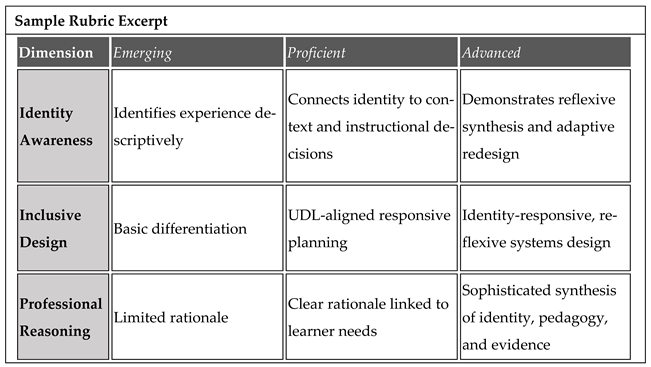
5.13. Practical Significance
This model transforms Universal Access by Design from theoretical framework into practical application as illustrated in Figure 6. By beginning with narrative truth, deepening through reflexive systems analysis, extending into archetypal developmental interpretation, and translating into inclusive action, this framework offers scalable implementation across graduate teacher education, clinical supervision, professional learning, and institutional design.
Figure 6.
From narrative surfacing to inclusive design: a practical model for universal access.
In practice, this model positions inclusion not as a singular strategy, but as a reflexive, identity-responsive process through which learners and leaders continuously interpret, design, and redesign themselves and their systems. In doing so, it offers a usable pathway for moving from lived experience to adaptive transformation—bridging belonging, identity, pedagogy, and equity into a coherent framework for enriched learner experience.
Collectively, these contributions suggest that inclusive educational design may be strengthened when structural accessibility is considered alongside the interpretive processes through which learners and leaders understand themselves, their relationships, and their educational environments. The findings invite a broader conception of inclusion—one that recognizes educational design as both a structural and developmental endeavor, informed by iterative interpretation, responsive pedagogy, and continual systems refinement. While the present study represents a Phase I conceptual investigation, the resulting architecture establishes a foundation for subsequent cycles of implementation, empirical refinement, and theoretical expansion across diverse educational settings.
5.14. Implications for Research and Practice
The findings of the present study suggest several implications for educational practice, professional learning, and future research. While the framework of Universal Access by Design emerged through a Phase I exploratory investigation and therefore remains intentionally provisional, the developmental relationships identified across participant experiences provide important considerations for educators, instructional leaders, and researchers seeking to advance more identity-responsive approaches to inclusive educational design.
5.15. Implications for Teacher Preparation and Professional Learning
One implication of the present findings concerns the design of educator preparation and ongoing professional learning. Across both faculty leaders and teacher leaders, participants demonstrated that meaningful professional growth extended beyond the acquisition of instructional strategies to include opportunities for reflexive interpretation of educational experience. Professional learning became increasingly impactful when participants examined how identity, relationships, context, and lived experience informed their pedagogical reasoning rather than focusing exclusively on the implementation of instructional techniques.
These findings suggest that educator preparation programs may benefit from integrating structured opportunities for reflexive inquiry alongside instruction in evidence-based pedagogical practices. While competency-based professional learning remains essential, the findings indicate that educators also benefit from intentional opportunities to examine how professional identity, learner variability, and contextual understanding influence instructional decision-making. Such an approach positions professional learning as an ongoing developmental process through which educators continually refine both their pedagogical knowledge and their understanding of themselves as designers of learning.
5.16. Implications for Educational Leadership and Systems Design
The findings also have implications for educational leadership and organizational learning. Across educational contexts, participants increasingly interpreted inclusive design as a systems-level responsibility rather than an individual instructional task. Inclusive educational environments were strengthened not simply through the implementation of isolated accommodations or differentiated instructional strategies, but through organizational cultures that supported iterative reflection, collaborative inquiry, coaching, and continuous refinement of practice.
This finding suggests that educational leaders may strengthen inclusive systems by designing professional learning structures that encourage ongoing interpretation of educational evidence rather than emphasizing compliance with predetermined instructional procedures alone. Coaching conversations, collaborative planning, instructional observations, and reflective portfolio development emerged as complementary mechanisms through which participants connected lived experience with increasingly intentional pedagogical decision-making. Consequently, the findings support leadership approaches that view educational improvement as a developmental process grounded in continuous learning rather than episodic evaluation.
Importantly, the framework proposed in this study is not intended to replace established approaches such as Universal Design for Learning or culturally responsive pedagogy. Instead, Universal Access by Design offers educational leaders an additional interpretive orientation through which structural accessibility, professional learning, and organizational improvement may be understood as interconnected dimensions of inclusive educational systems.
5.17. Implications for Future Research
Finally, the present study establishes several directions for future inquiry. As a Phase I Design-Based Research investigation, the purpose of this study was conceptual development rather than framework validation. Future research should therefore examine the implementation and refinement of Universal Access by Design across diverse educational settings, learner populations, institutional contexts, and professional learning environments.
Additional research is also needed to further examine Prototypical Narration Surfacing and Synthesis as an interpretive methodology. While the present study demonstrates its usefulness for interpreting participant narratives and informing educational design, subsequent investigations should explore its application across additional qualitative research traditions, educational contexts, and interdisciplinary fields. Such work may further clarify the methodological conditions under which lived experience contributes most effectively to educational innovation.
Similarly, Archetypal Inquiry should be understood as an emerging interpretive lens requiring continued refinement rather than a finalized conceptual model. Future Design-Based Research cycles may expand, modify, or challenge the developmental orientations identified in the present study as additional evidence becomes available. Such iterative refinement is consistent with both the recursive assumptions of Design-Based Research and the developmental orientation advanced throughout this manuscript.
Collectively, these implications suggest that advancing inclusive education requires continued attention not only to improving educational access, but also to strengthening the interpretive processes through which educators understand learner variability, construct professional knowledge, and design increasingly responsive educational environments. The present study therefore represents a beginning rather than an endpoint, providing a conceptual and methodological foundation upon which future scholarship and practice may continue to build.
5.18. Limitations and Future Direction
As with all exploratory Design-Based Research, the findings presented in this study should be interpreted within the context of the study’s purpose and scope. The primary objective of this Phase I investigation was not to validate Universal Access by Design as a finalized instructional framework, nor to establish causal relationships between specific educational interventions and participant outcomes. Rather, the study sought to investigate how lived experience, interpreted through Prototypical Narration Surfacing and Synthesis, could inform the iterative development of an identity-responsive approach to inclusive educational design. Consequently, the findings are best understood as an initial conceptual contribution that establishes a foundation for continued refinement rather than a definitive model for implementation.
Several limitations should therefore be acknowledged. First, the study examined the experiences of faculty leaders and teacher leaders situated within specific professional learning contexts. Although these participants represented diverse educational roles and contributed rich evidence through narrative artifacts, observations, coaching documentation, instructional planning, and portfolio submissions, the findings may not fully represent the experiences of educators working in different institutional, cultural, or international contexts. Future investigations involving broader participant populations will be essential for examining the transferability and adaptability of the conceptual framework across diverse educational environments.
Second, Universal Access by Design emerged through a Phase I exploratory investigation emphasizing conceptual development rather than empirical validation. While the iterative Design-Based Research process supported the refinement of the framework through successive cycles of interpretation, additional phases of research are necessary to examine how the framework functions within implementation, instructional design, professional learning, and educational leadership across varied settings. Such investigations will provide opportunities to further examine the practical utility, adaptability, and long-term impact of the framework while continuing its iterative refinement.
Similarly, Prototypical Narration Surfacing and Synthesis is introduced in this study as an interpretive methodology developed within the context of this investigation. Although the findings demonstrate its capacity to systematically surface, interpret, and synthesize lived experience into educational design knowledge, additional research is needed to examine its application across other qualitative methodologies, disciplinary contexts, and forms of educational inquiry. Continued refinement of the interpretive methodology may further illuminate its strengths, boundaries, and potential contributions beyond the present study.
The emergence of Archetypal Inquiry should likewise be understood as provisional. Rather than representing a finalized taxonomy of developmental orientations, Archetypal Inquiry emerged inductively through repeated engagement with participant evidence interpreted using Prototypical Narration Surfacing and Synthesis. Future cycles of inquiry may refine, expand, reorganize, or challenge the interpretive orientations identified in this study as additional evidence becomes available. Such refinement is not viewed as a limitation of the framework, but as a natural extension of the recursive assumptions underlying Design-Based Research itself.
These limitations point directly toward future directions for scholarship. Future research should investigate Universal Access by Design across additional educational settings, including K–12 classrooms, higher education, educator preparation programs, district-level professional learning systems, and community-based educational environments. Comparative studies examining implementation across cultural and international contexts may further clarify how identity-responsive educational design interacts with local educational traditions, learner populations, and institutional structures. Longitudinal investigations may also provide insight into how educators’ developmental orientations evolve over time and how sustained engagement with reflexive design influences instructional decision-making and learner outcomes.
Future research should also continue exploring the methodological and theoretical contributions introduced in the present study. Additional Design-Based Research cycles may further refine Reflexive Design as a theory of educational design, expand the application of Prototypical Narration Surfacing and Synthesis across qualitative educational research, and examine the continued development of Archetypal Inquiry as an emergent interpretive lens. Collectively, these investigations have the potential to strengthen understanding of how lived experience contributes not only to educational reflection, but to educational innovation.
6. Conclusions
Ultimately, the present study invites a broader reconsideration of what it means to design for inclusion. Contemporary conversations surrounding inclusive education have appropriately emphasized accessibility, equity, participation, and learner variability as essential foundations for educational justice. The findings presented here suggest that these commitments may be further strengthened when educational design also attends to the interpretive dimensions of learning through which individuals construct identity, develop agency, experience belonging, and continually negotiate their relationships with educational environments.
Universal Access by Design therefore should not be understood as a replacement for existing inclusive frameworks, but as an extension of them. Building upon the structural foundations established through Universal Design for Learning, the framework advances an identity-responsive orientation that recognizes inclusion as both a structural and developmental endeavor. Through this perspective, educational access becomes not simply a matter of removing barriers, but of designing environments that remain responsive to the evolving experiences, identities, and aspirations of those who learn within them.
More broadly, this study contributes to an emerging vision of educational scholarship in which theory, methodology, and practice develop recursively through authentic engagement with lived experience. Reflexive Design expands how educational design may be understood. Prototypical Narration Surfacing and Synthesis offers an interpretive methodology for translating lived experience into educational knowledge. Archetypal Inquiry provides a provisional interpretive lens for recognizing recurring developmental orientations without reducing individuals to fixed classifications. Together, these contributions culminate in Universal Access by Design, establishing a Phase I conceptual framework that invites continued inquiry, implementation, and refinement.
Rather than representing the conclusion of this work, the present study marks the beginning of a broader research agenda. As educators continue to confront increasingly complex questions surrounding inclusion, equity, identity, and human development, the findings suggest that the future of inclusive educational design may depend not only on expanding access, but also on deepening our collective capacity to understand how educational experiences shape who learners and leaders become (United Nations, 2015). It is within this ongoing relationship among access, interpretation, design, and human development that Universal Access by Design finds its purpose—not as a finished framework, but as an invitation to continue designing educational systems that honor both the diversity of learners and the complexity of becoming.
Funding
This research received no external funding.
Data Availability Statement
The data presented in this study are available on request from the corresponding author due to privacy and ethical restrictions.
Conflicts of Interest
The authors declare no conflict of interest.
References
- Anderson, T., & Shattuck, J. (2012). Design-based research: A decade of progress in education research? Educational Researcher, 41(1), 16–25. [Google Scholar] [CrossRef] [Scilit]
- Beauchamp, C., & Thomas, L. (2009). Understanding teacher identity: An overview of issues in the literature and implications for teacher education. Cambridge Journal of Education, 39(2), 175–189. [Google Scholar] [CrossRef] [Scilit]
- Braun, V., & Clarke, V. (2006). Using thematic analysis in psychology. Qualitative Research in Psychology, 3(2), 77–101. [Google Scholar] [CrossRef] [Scilit]
- Capp, M. J. (2020). Teacher confidence to implement the principles, guidelines, and checkpoints of universal design for learning. International Journal of Inclusive Education, 24(7), 706–720. [Google Scholar] [CrossRef] [Scilit]
- CAST. (2024). Universal design for learning guidelines version 3.0 [Graphic organizer]. Available online: https://udlguidelines.cast.org (accessed on 10 October 2025).
- Clandinin, D. J., & Connelly, F. M. (2000). Narrative inquiry: Experience and story in qualitative research. Jossey-Bass. [Google Scholar]
- Flake, S., & Lubin, R. (2024). Proto-narrative: A critical exploration of the cultural identities held by black women in STEM. Journal of Ethnic and Cultural Studies, 11(5), 178–192. [Google Scholar] [CrossRef] [Scilit] [PubMed]
- Florian, L., & Black-Hawkins, K. (2011). Exploring inclusive pedagogy. British Educational Research Journal, 37(5), 813–828. [Google Scholar] [CrossRef] [Scilit]
- Lubin, R. (2024, May 20). Brilliant state of mind: The methods for unveiling archetypes and aspirations [Conference presentation]. Wallace Research Symposium on Talent Development, Lawrence D. McHugh Hall, Room MCHU 205, Philadelphia, PA, USA. [Google Scholar]
- Lubin, R. C. (2022). Gifted state of mind: The critical exploration of leadership perspectives on elementary gifted education pedagogy (Publication No. 29331209) [Doctoral dissertation, Drexel University]. Drexel University Libraries. [Google Scholar] [CrossRef] [Scilit]
- McAdams, D. P. (2001). The psychology of life stories. Review of General Psychology, 5(2), 100–122. [Google Scholar] [CrossRef]
- McKenney, S., & Reeves, T. C. (2018). Conducting educational design research (2nd ed.). Routledge. [Google Scholar]
- Meyer, A., Rose, D. H., & Gordon, D. (2014). Universal design for learning: Theory and practice. CAST Professional Publishing. [Google Scholar]
- Moriña, A. (2022). Faculty members who engage in inclusive pedagogy: Methodological and relational strategies for teaching in higher education. Teaching in Higher Education, 27(3), 311–325. [Google Scholar] [CrossRef] [Scilit]
- Rao, K., Ok, M. W., & Bryant, B. R. (2018). Universal design for learning reporting criteria. UDL Implementation and Research Network. [Google Scholar]
- Reeves, T. C. (2006). Design research from a technology perspective. In J. van den Akker, K. Gravemeijer, S. McKenney, & N. Nieveen (Eds.), Educational design research (pp. 52–66). Routledge. [Google Scholar]
- Saldaña, J. (2021). The coding manual for qualitative researchers (4th ed.). SAGE. [Google Scholar]
- Schön, D. A. (1983). The reflective practitioner: How professionals think in action. Basic Books. [Google Scholar]
- United Nations. (2015). Transforming our world: The 2030 agenda for sustainable development. Available online: https://sdgs.un.org/2030agenda (accessed on 10 October 2025).
- United Nations Educational, Scientific and Cultural Organization. (2020). Inclusion and education: All means all (Global Education Monitoring Report). UNESCO. [Google Scholar]
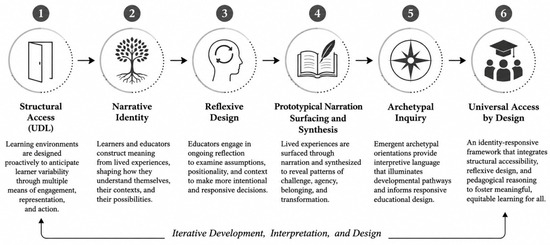
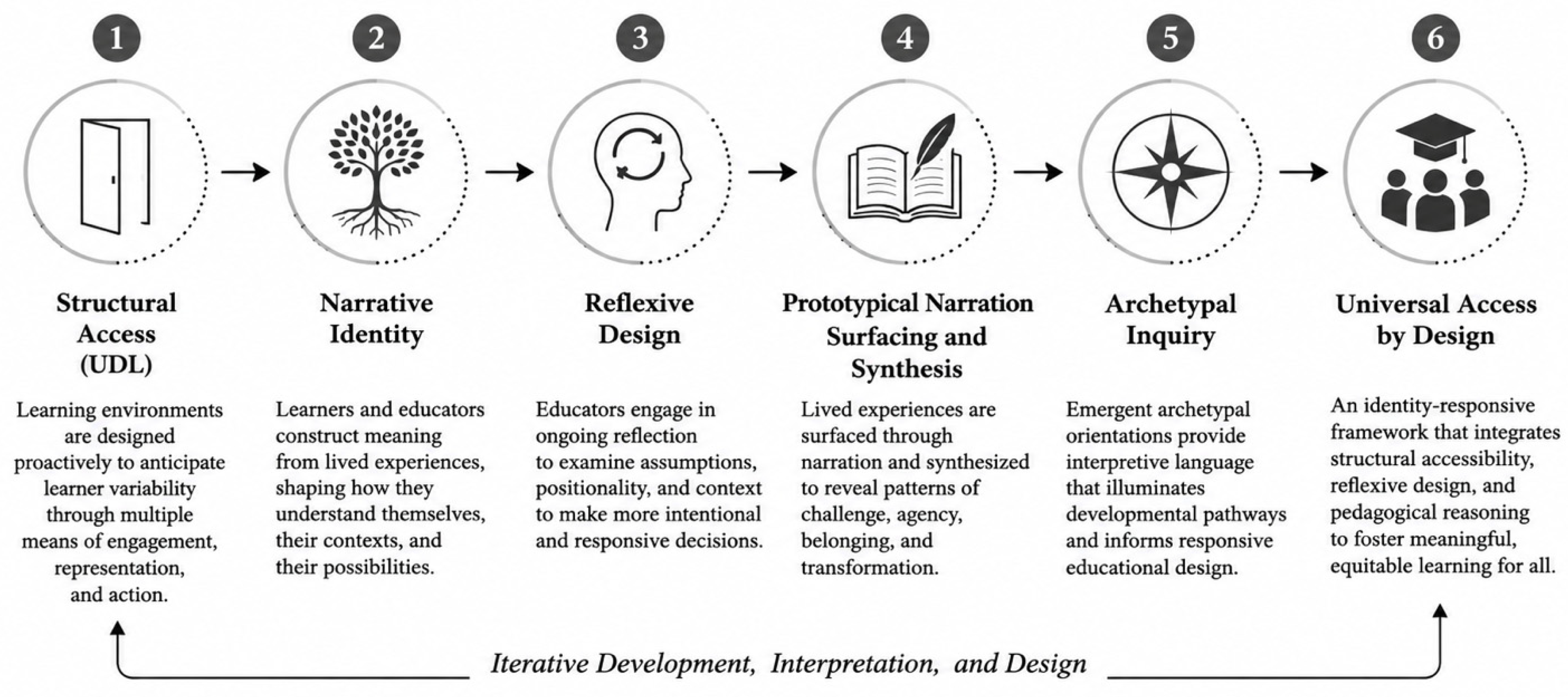
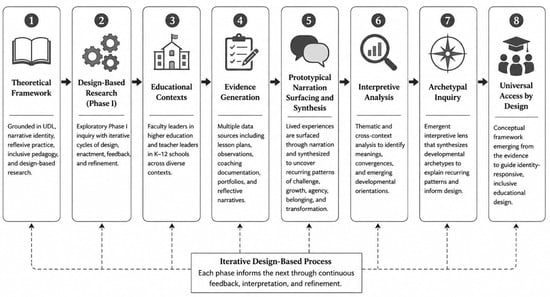
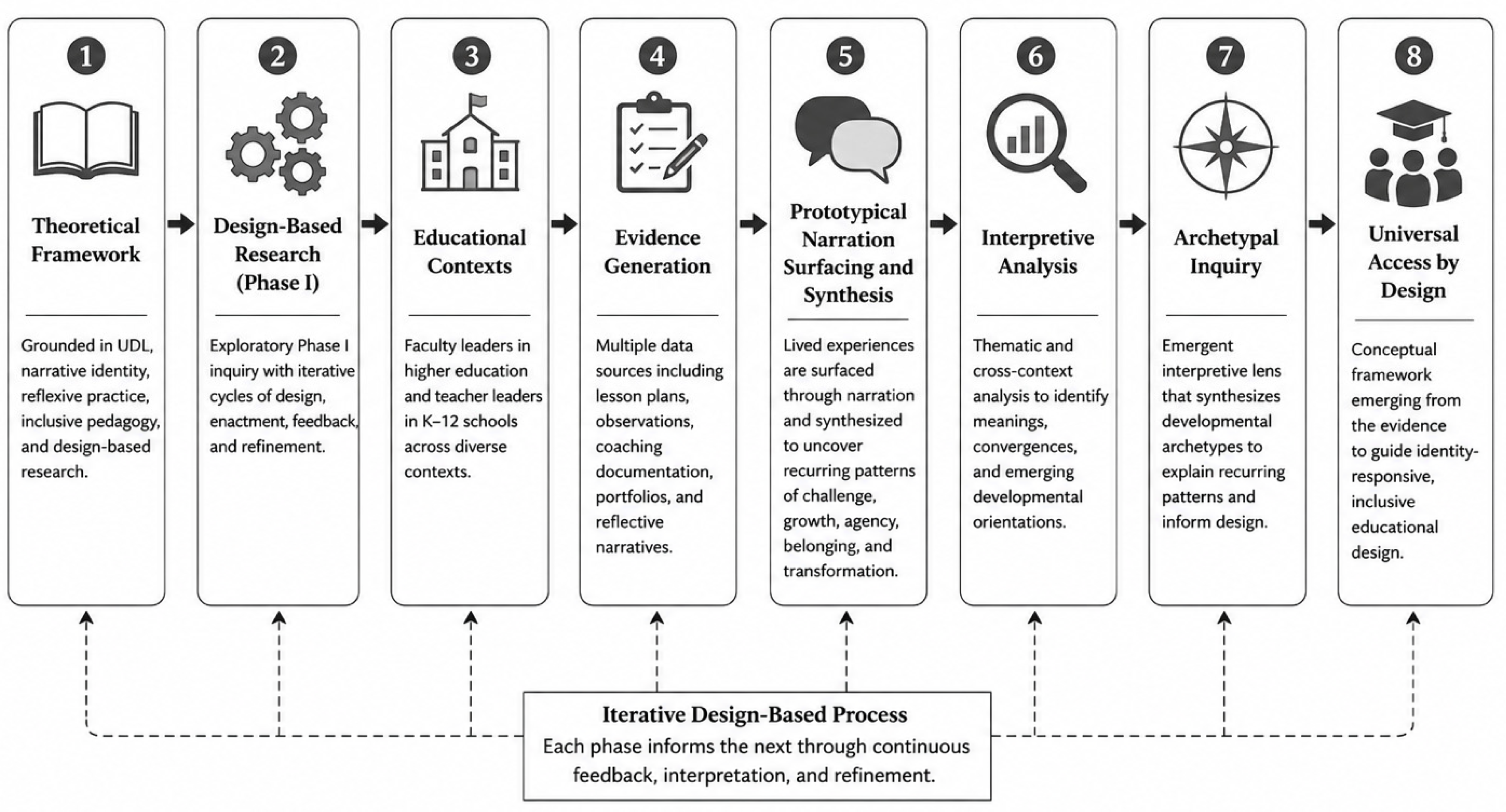
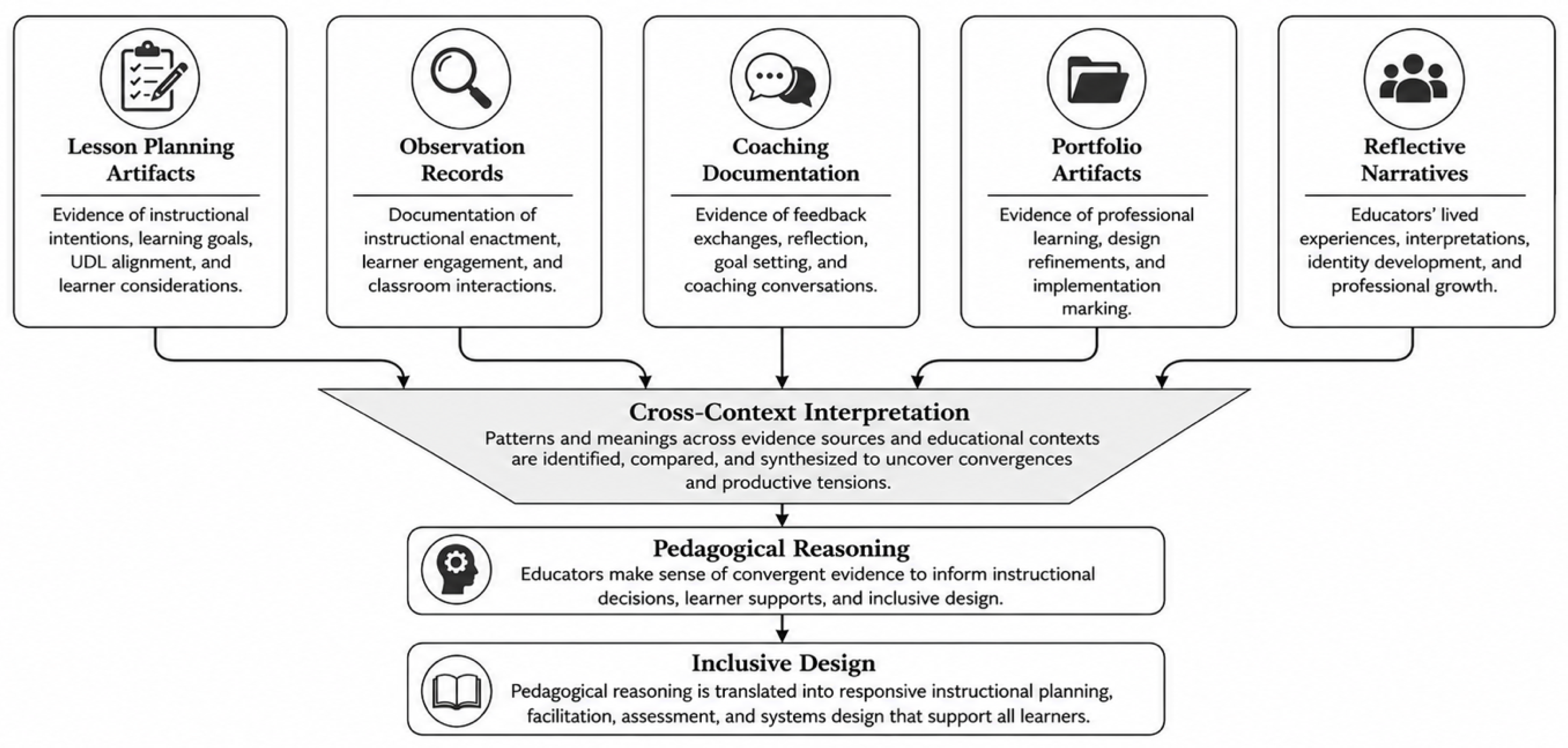
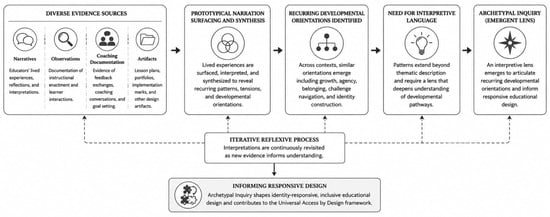
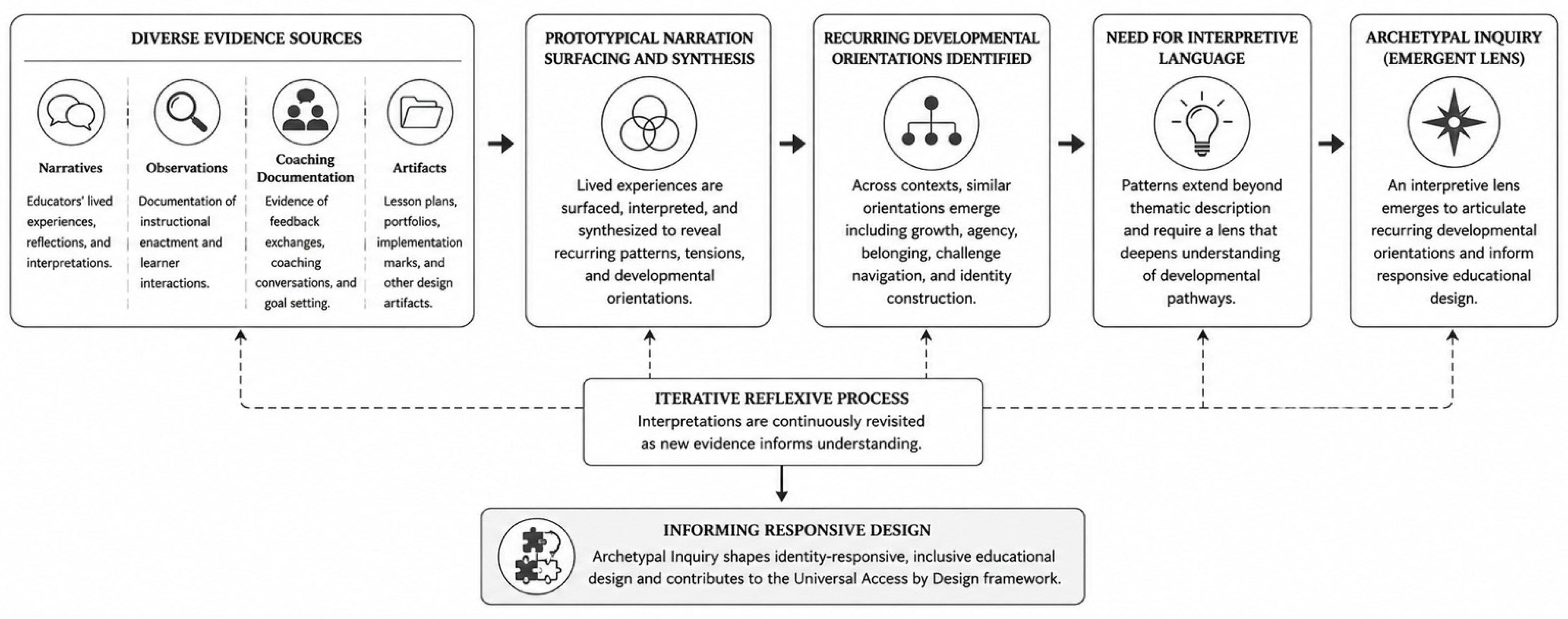
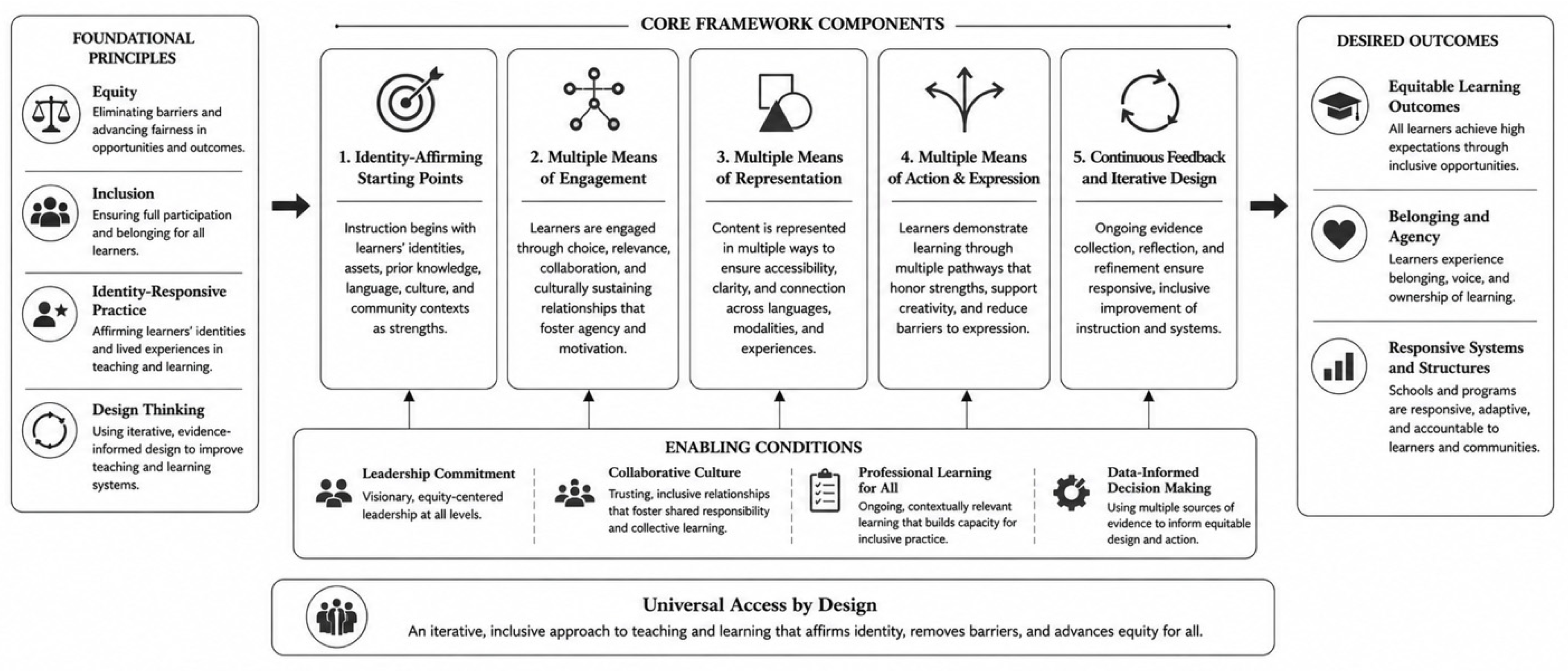
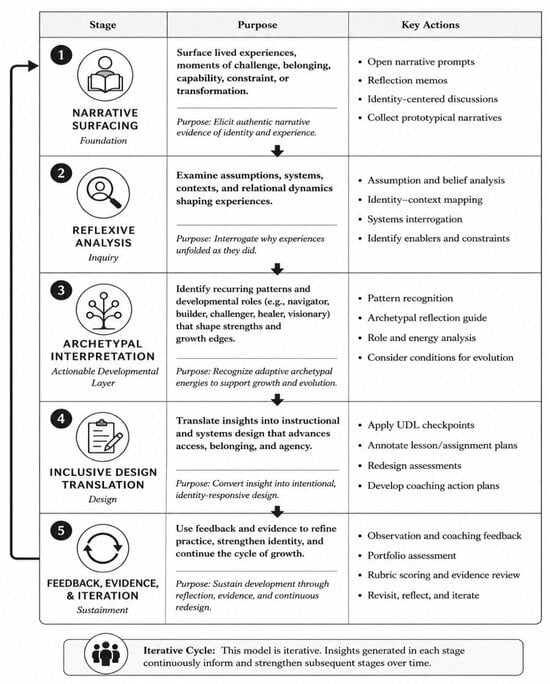
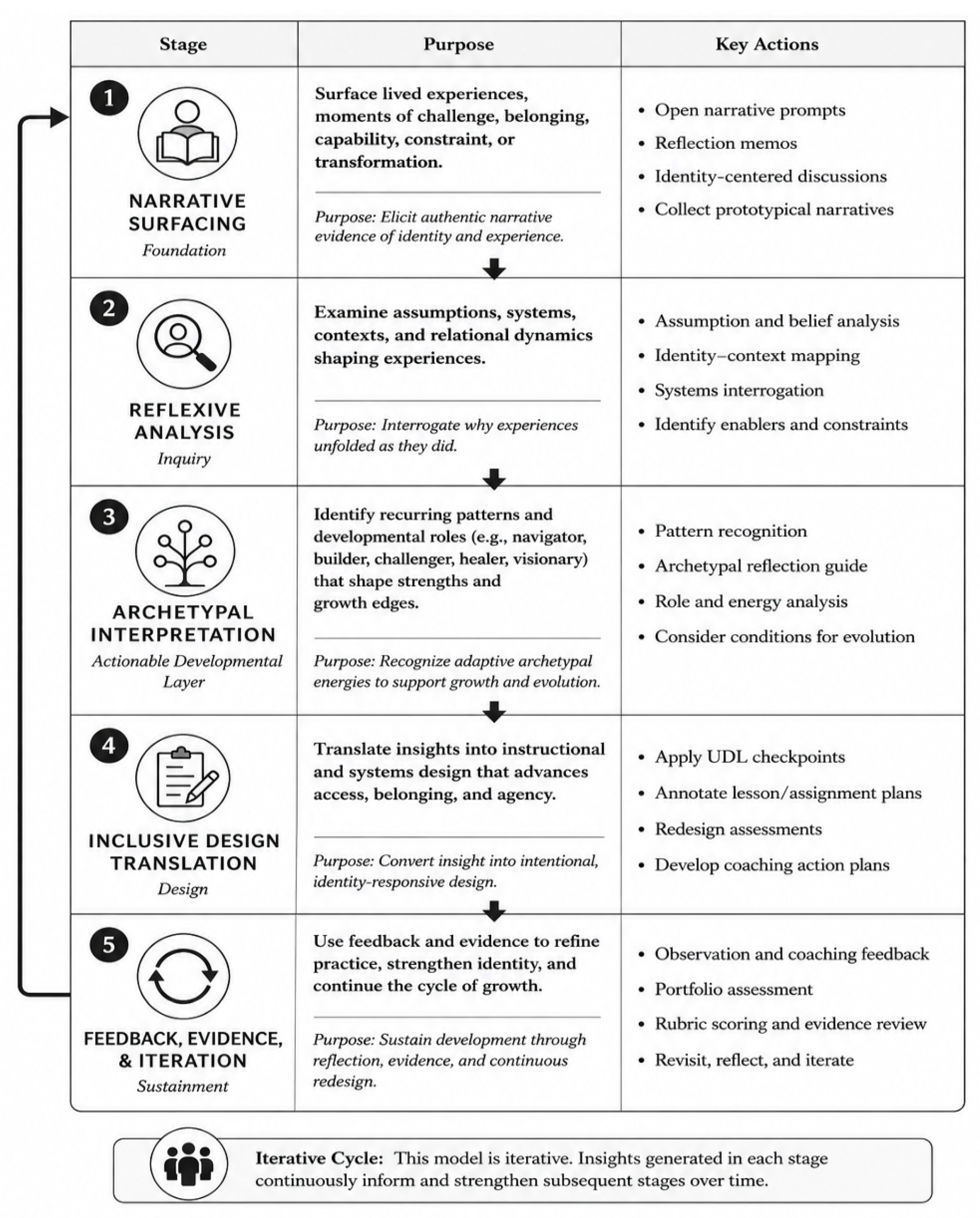

Disclaimer/Publisher’s Note: The statements, opinions and data contained in all publications are solely those of the individual author(s) and contributor(s) and not of MDPI and/or the editor(s). MDPI and/or the editor(s) disclaim responsibility for any injury to people or property resulting from any ideas, methods, instructions or products referred to in the content. |
© 2026 by the author. Licensee MDPI, Basel, Switzerland. This article is an open access article distributed under the terms and conditions of the Creative Commons Attribution (CC BY) license.