


Abstract
Teacher professional learning increasingly depends on situated collaborative practices that emerge in the everyday work of schools. In educational contexts characterized by diverse career paths and the coexistence of different generations of teachers, it is important to understand how professional knowledge circulates and is reinterpreted among teachers with varying levels of experience. From this perspective, Intergenerational Teacher Learning (ITL) is understood as a process of reciprocal knowledge and practice exchange among teachers from different generations. This study analyzes how ITL takes shape through the everyday working relationships among teachers of different generations in Chilean schools, adopting a qualitative paradigm grounded in constructivist grounded theory. To this end, fifteen semi-structured interviews were conducted with practicing teachers at different career stages. Based on the initial, focused, and theoretical coding of the data, an inductive, situated explanatory model of ITL was constructed, organized into five dimensions. The results show that age and professional experience are associated with teachers’ assessments of their peers’ competencies, and that ITL manifests primarily through traditional mentoring, reverse mentoring, and peer learning. Furthermore, novice teachers in particular contribute to knowledge related to the use of technology and innovation, while experienced teachers contribute knowledge related to school culture and pedagogical management, which is especially relevant to the professional integration of novice teachers.
1. Introduction
In contemporary educational systems, teacher professional learning increasingly depends on collaborative practices that emerge through everyday interactions among teachers with diverse trajectories, experiences, and perspectives. The demographic changes currently affecting the teaching profession—such as the aging of the teaching workforce, delayed retirement, and the coexistence of multiple generations within schools—have intensified the need to understand how knowledge and professional expertise circulate among teachers of different ages and stages of professional development (Batista et al., 2024; Geeraerts et al., 2018). In this context, intergenerational relationships acquire particular relevance as a dimension of professional learning that enables the exchange, negotiation, and reconstruction of pedagogical knowledge within school communities.
The literature has highlighted the importance of mentoring, communities of practice, and collaborative work dynamics as mechanisms that foster teacher professional development (Hargreaves & O’Connor, 2018; Wenger, 1998). In particular, mentoring and induction programs have been promoted across different educational systems as strategies aimed at facilitating the professional integration of novice teachers and strengthening situated learning within schools. However, recent research suggests that a significant part of teacher learning extends beyond formal settings and is also shaped through informal, spontaneous, and reciprocal interactions among colleagues (Brücknerová & Novotný, 2017; Geeraerts et al., 2018).
From this perspective, Intergenerational Teacher Learning (ITL) emerges as a relevant concept for understanding the processes of bidirectional exchange of knowledge, experiences, competencies, and professional meanings among teachers from different generations (Batista et al., 2024; Geeraerts et al., 2018). Unlike approaches focused exclusively on formal mentoring relationships, ITL broadens the understanding of professional learning toward more horizontal, situated, and context-sensitive forms of teacher collaboration. It also recognizes that professional knowledge is not only transferred, but also negotiated, legitimized, and re-signified within the everyday life of schools.
Studies on ITL have shown that younger teachers tend to contribute knowledge related to pedagogical innovation and the use of technology, while experienced teachers contribute knowledge associated with classroom management, school culture, and accumulated professional experience (Polat & Çiçek, 2015; Šindić et al., 2022). Similarly, the literature has identified mechanisms such as traditional mentoring, reverse mentoring, and peer learning as relevant forms of intergenerational knowledge circulation (Geeraerts et al., 2016; Brücknerová & Novotný, 2017). However, tensions associated with age-based biases, forms of exclusion, and unequal recognition of professional knowledge across generations of teachers have also been identified (Geeraerts et al., 2021; Kazak & Polat, 2018).
In Latin America, research on ITL remains limited and has focused primarily on mentoring experiences or programs associated with active aging and the education of older adults (Sarti, 2009; Sá et al., 2024). In the Chilean context, although studies exist on mentoring, teacher collaboration, and professional support (Ávalos-Bevan & Flores, 2022; Sablo Sutton et al., 2022), there is still limited understanding of how intergenerational relationships are configured in everyday school life, what forms of knowledge circulate among teachers with different professional trajectories, and through which mechanisms these learning processes are sustained.
The relevance of this study stems from the scarcity of available evidence and the centrality of collaborative work as an explicit pillar of teacher policy in Chile. Within this framework, the law establishing the Teacher Professional Development System (MINEDUC, 2016) institutionalized mentoring and induction as formal support mechanisms. However, these mechanisms rely on interactions that effectively support professional learning within the school. Understanding how knowledge circulates among teachers with different career trajectories is particularly relevant in a context of an aging teaching workforce and high rates of early attrition among novice teachers (Ávalos & Valenzuela, 2016). This creates a risk that accumulated experience will be lost and that professional integration will often be contingent on the specific conditions of each school. Within this framework, ITL does not involve the incorporation of additional resources, but rather the recognition and organization of an exchange that already occurs in the everyday work of schools.
In response to this gap, this research aims to analyze how ITL takes shape in the day-to-day working relationships between teachers of different generations in Chilean schools, based on semi-structured interviews with practicing teachers at three different career stages. To this end, the following research questions are posed:
- What types of intergenerational relationships emerge among teachers with different career trajectories in the day-to-day school environment?
- What professional knowledge circulates within these relationships, and through what mechanisms?
- What factors facilitate or hinder these processes, and what professional learning outcomes are associated with them?
The explanatory model presented in this article was not predefined but was constructed based on an analysis of the corpus using the coding procedures of constructivist grounded theory. This process linked the sensitizing concepts derived from the literature with the emerging categories generated during the coding process.
2. Theoretical Framework
2.1. Generations of Teachers: Scope of the Concept
Professional relationships among teachers are influenced by various factors, including age and generational differences, which have gained particular relevance as an emerging field of study in light of the demographic changes currently affecting the teaching profession, such as delayed retirement and increased life expectancy (Batista et al., 2024).
These changes have intensified the heterogeneity of ages and professional experiences among practicing teachers in schools and have given rise to new dynamics of coexistence among different generations of teachers. This, in turn, has influenced the ways teachers interact in their daily work and engage in professional learning—a phenomenon the literature has termed ITL (Nieto Cano et al., 2024).
Understanding ITL first requires clarifying how the concept of generation—of sociological origin (Mannheim, 1952)—is understood. In general terms, Novikova (2024) defines a generation as a group of individuals who share similarities in values, behaviors, and worldviews shaped by common historical events and comparable ages. Furthermore, this shared framework of values, beliefs, and knowledge provides a certain degree of homogeneity to age cohorts (Portela Pruaño et al., 2022). In educational settings, this perspective allows a teaching generation to be understood as a group of teachers of similar ages who have collectively experienced educational reforms, methodological innovations, and shifts in conceptions of education.
Within the educational field, chronological age has been considered a relevant criterion for analyzing intergenerational relationships among teachers due to its correlation with variables such as professional experience and educational attainment (Richter et al., 2011). However, authors such as Batista et al. (2024) and Brücknerová and Novotný (2017) argue that this criterion should be complemented by other factors, including level of teaching specialization, individuals’ life trajectories—which encompass particular experiences and subjectivities—and especially stages of professional development. The latter is understood as a dynamic process that shapes differentiated trajectories, forms of knowledge, and professional positions within the teaching career.
One of the main difficulties in studies on teacher generations is the lack of consensus regarding the boundaries of each cohort (Lyons et al., 2019). Consequently, research on ITL has adopted different classification criteria, including age (Geeraerts et al., 2018; Mikušková, 2023; Ramírez et al., 2022); age combined with professional experience (Portela Pruaño et al., 2022; Marrero et al., 2023); and the use of classic generational labels—such as Baby Boomers and Millennials—particularly in quantitative studies (Kalashnikova & Hrabovets, 2020). However, the use of these categories may be reductionist and insufficient for capturing the complexity of each cohort.
In light of the above, although the category of generation may be useful for identifying patterns of professional socialization, its application requires theoretical caution, since a rigid understanding may lead to essentialist interpretations that attribute homogeneous characteristics to teachers based solely on age or cohort membership. For this reason, this study approaches generation from a chronological perspective while also incorporating interpretive factors such as professional experience, institutional culture, and educational specialization, among others (Batista et al., 2024; Brücknerová & Novotný, 2017), in order to provide a more situated understanding of intergenerational teacher relationships within schools.
2.2. ITL: Definitions and Scope
ITL is defined as a bidirectional exchange of skills, knowledge, values, and professional practices among teachers from different generations (Batista et al., 2024; Geeraerts et al., 2018). Its current relevance stems from demographic trends such as population aging, delayed retirement, and increased life expectancy, all of which intensify intergenerational coexistence and make shared learning between novice and experienced teachers necessary (Comellas i Carbó et al., 2024).
The specialized literature highlights that ITL contributes both to pedagogical innovation and to the preservation of professional knowledge, and that it typically unfolds through everyday spaces of interaction, such as informal collaboration, mentoring, and communities of practice (Brücknerová & Novotný, 2017; Portela Pruaño et al., 2022). However, unlike approaches focused exclusively on formal mentoring relationships, ITL emphasizes the circulation of knowledge among teachers from different generations, recognizing that these exchanges are often tacit, unplanned, and situated within the concrete experience of school work (Polat & Kazak, 2015). Consequently, several authors underscore the importance of promoting opportunities for intergenerational dialogue that enable the sharing, mobilization, and re-signification of professional knowledge (Geeraerts et al., 2018).
Based on this review, the present study understands ITL, from a sociocultural perspective, as a situated practice emerging from the everyday relationships among teachers who share common spaces, roles, and responsibilities. In this sense, ITL aligns with the concept of a community of practice (Wenger, 1998), insofar as professional learning occurs through concrete experiences of observation, dialogue, support, and shared reflection on teaching practice. However, the specific focus of ITL lies in the intergenerational dimension of these exchanges—that is, in how differences in age and professional trajectory shape particular forms of knowledge circulation, recognition, and construction within schools.
From this perspective, the contribution of ITL lies not only in the reciprocal circulation of knowledge among different generations of teachers, but also in the collective construction of meanings and interpretations negotiated through teachers’ everyday experiences within their specific school contexts. Intergenerational relationships thus constitute a source of reciprocal learning that fosters the recognition, circulation, and re-signification of professional knowledge constructed through both experience and teacher education.
2.3. How Teachers Learn Through ITL
From a global perspective, studies on ITL—primarily conducted in Europe—show consistent patterns, such as the predominance of informal spaces for intergenerational exchange (Brücknerová & Novotný, 2017; Geeraerts et al., 2018). These spaces tend to facilitate spontaneous communication among teachers from different generations, thereby fostering the mutual learning of knowledge and skills. In this regard, the exchange of knowledge tends to be differentiated: younger teachers often contribute greater familiarity with innovative methodologies, emerging approaches, and the use of technology (Šindić et al., 2022), whereas older teachers tend to stand out for their expertise in practical knowledge, classroom management, and relationships with families (Polat & Çiçek, 2015).
Research on ITL also highlights several factors that facilitate this form of learning, including in-service learning opportunities among teachers from different generations (Brücknerová & Novotný, 2017; Geeraerts et al., 2018), classroom observations accompanied by pedagogical dialogue between experienced and novice teachers (Pardy & Reimer, 2018; Santoro et al., 2012), and collaborative activities oriented toward mutual learning (Geeraerts et al., 2016; Polat & Kazak, 2015).
However, the literature also identifies factors that hinder ITL, such as limited communication between teachers from different cohorts, often associated with age-related stereotypes (Geeraerts et al., 2021; Kazak & Polat, 2018). Likewise, younger teachers tend to show greater affinity with colleagues from their own age group, whereas more experienced teachers are generally more open to interacting with colleagues from different generations (Geeraerts et al., 2017).
In Latin America, research on ITL has focused primarily on mentoring experiences and programs for older adults, particularly in Brazil (Sarti, 2009; Sá et al., 2024). In Chile, existing evidence has centered on mentoring, teacher collaboration, and peer tutoring among students (Sablo Sutton et al., 2022; Ávalos-Bevan & Flores, 2022; Véliz & Navarrete, 2025). Nevertheless, an empirical gap persists regarding how this form of learning is configured through the everyday relationships among practicing teachers in Chilean schools (Batista et al., 2024). This lack of evidence concerning everyday intergenerational relationships among teachers in Chilean schools highlights the need to investigate how these dynamics take shape, what forms of knowledge circulate through them, and what tensions underlie their development.
3. Materials and Methods
3.1. Research Design
This study adopted a qualitative constructivist Grounded Theory design (Charmaz, 2014) aimed at developing a substantive theory regarding the dynamics of intergenerational professional collaboration in Chilean schools. This perspective is particularly appropriate given that ITL remains a scarcely theorized phenomenon in the Latin American context, thus justifying an inductive design capable of generating emerging conceptual categories based on the meanings teachers themselves attribute to their experiences of intergenerational exchange.
In line with this design, the existing literature on ITL was examined using “sensitizing concepts” as defined by Charmaz (2014); that is, as starting points that guided the initial examination of the phenomenon without predetermining the results of the analysis. This distinction is relevant because some notions documented in the international literature (such as traditional mentoring, peer learning, age- and profession-related prejudices, and exclusionary practices) were identified in the corpus but were not used as fixed deductive categories. Their properties, specific manifestations, and relationships with other categories were clarified through constant comparison of the data. Likewise, during the coding process, phenomena not anticipated in the initial framework also emerged, including the absence of formal mentoring, punitive supervision, and fear of making mistakes.
The grounded theory approach adopted in this study is as follows. We follow Charmaz’s (2014) constructivist variant, which posits that data are constructed through the interaction between the researcher and participants, in contrast to the classical and procedural versions (Glaser & Strauss, 1967; Strauss & Corbin, 1998). The unit of analysis focuses on the processes of knowledge exchange among teachers with different career trajectories, rather than on teachers or knowledge considered in isolation. Data collection and analysis were conducted concurrently, which allowed theoretical sampling decisions to be made based on the emerging categories. The analysis involved constant comparison among incidents, codes, and categories across the three coding phases detailed below. The fieldwork was concluded based on theoretical saturation. The outcome of this process is a substantive theory, limited to the context studied, rather than a formal theory of general applicability.
3.2. Participants
Teachers were selected through a two-stage sampling process. First, an initial purposive sampling strategy was conducted with the aim of maximizing the theoretical variation in the corpus (Strauss & Corbin, 1998), resulting in the formation of three generational groups defined according to age and years of professional experience. This decision was grounded in the need to ensure, from the outset of the fieldwork, sufficient diversity in teachers’ professional trajectories and perspectives regarding ITL, thereby enabling the comparison of contrasting experiences and enriching the development of analytical categories. Participants were required to hold a teaching degree, work in primary or secondary schools in any region of Chile, and have at least one year of professional experience. Individuals in administrative positions or undertaking teaching practicums were excluded.
A second stage of sampling was carried out during the iterative analysis of the corpus through theoretical sampling procedures (Charmaz, 2014). This process informed decisions regarding the inclusion of specific participant profiles within the generational groups, intentionally seeking cases that would allow the analytical categories to be densified, contrasted, or refined.
The generational groups were organized as follows, in accordance with the theoretical positioning of this study, which understands generation not as a rigid category but as a relational variable that incorporates accumulated experience and professional trajectory (Batista et al., 2024; Brücknerová & Novotný, 2017):
- (a)
- Novice teachers: professionals in the initial stage of their careers, with up to 5 years of teaching experience and between 23 and 30 years of age.
- (b)
- Mid-career teachers: professionals in the intermediate stage of their professional trajectory, with between 6 and 15 years of teaching experience and between 31 and 45 years of age.
- (c)
- Experienced teachers: professionals in the mature stage of their careers, with between 16 and 40 years of teaching experience and between 46 and 65 years of age.
The final number of participants was determined according to the criterion of theoretical saturation. In other words, data collection concluded when the final interviews no longer contributed substantively new insights to the developing analytical categories and instead began to confirm, nuance, or deepen relationships already identified among situational conditions, professional knowledge, learning mechanisms, and mediating factors associated with ITL (Flick, 2015).
Table 1 presents the demographic and professional characteristics of the teachers who participated in this study.
Table 1.
Demographic characteristics of the participating teachers.
3.3. Data Collection Instruments and Interview Protocol
Data collection was conducted through semi-structured interviews, a technique suitable for identifying, based on individuals’ experiences, the processes and conditions that shape ITL, with the flexibility to allow for in-depth exploration of emerging themes during fieldwork (Kvale, 2011; Simons, 2011).
The interview guide was developed based on a review of the specialized literature on ITL (Batista et al., 2024; Brücknerová & Novotný, 2017; Geeraerts et al., 2018; Portela Pruaño et al., 2022). This review identified four thematic areas—intergenerational beliefs, professional interactions and knowledge flows, institutional culture, and teacher professional development—which were broken down into eleven subcategories, from which the questions were formulated. The interview guide was reviewed jointly by both researchers, a process that led to adjustments in the formulation of the questions, the elimination of redundancies, and the reorganization of the sequence of areas.
It is important to note that the status of these areas in the design served as sensitizing concepts that guided the conversation (Charmaz, 2014) rather than as a closed coding system. Their function was to ensure thematic coverage of the interview, while the analytical organization of the corpus was determined during the coding process, as detailed in the analysis section. The semi-structured nature of the interview guide allowed for changes in the order of questions, the incorporation of follow-up questions, and the exploration of unforeseen topics that participants introduced in their narratives.
In all cases, the interview began with an introductory question about the participant’s academic and professional background, aimed at establishing a climate of trust and situating their experience within the context of their teaching career. Table 2 presents the domains, subcategories, and sample questions associated with each.
Table 2.
Structure of the semi-structured interview guide and its alignment with the dimensions of the model.
The interviews were conducted between December 2025 and February 2026, either in person or virtually according to each participant’s availability, with each lasting approximately 60 min. All interviews were audio- or video-recorded with prior consent and transcribed verbatim (Simons, 2011). The resulting corpus comprised 85,052 words, with an average of 5670 words per interview (range: 3272–9685).
Ethical safeguards were ensured through the informed consent process, which explicitly outlined the study’s objectives, the anonymization of personal and institutional information, and the exclusively academic use of the information. Pseudonyms were used, and all identifying references in the corpus were anonymized.
3.4. Data Analysis
Each interview was recorded and then transcribed so that the resulting text could be analyzed using the coding procedures characteristic of constructivist grounded theory (Charmaz, 2014), which were organized into three main stages. First, the initial coding involved segmenting the corpus into line-by-line units of information to identify the actions, processes, and meanings that the teachers attributed to their intergenerational relationships. The resulting codes adopted a brief conceptual formulation, closely aligned with the participants’ own language, in order to preserve the reference to the experience described without prematurely limiting its interpretation. Second, focused coding was used to select the most frequent and significant initial codes to organize and group the data into categories with greater conceptual abstraction. Finally, theoretical coding guided the identification of relationships between categories, contributing to the development of the ITL explanatory model presented in Section 4.
The initial coding process generated 89 codes, applied to 283 fragments of the corpus through 419 coding assignments. Of the total codes, 44 corresponded to concepts anticipated within the thematic areas that guided the interview, while 45 emerged during the coding process without having been anticipated (among them, practices of exclusion, the absence of formal mentoring, punitive supervision, and fear of making mistakes), and several of these proved central to the final configuration of the model. These codes were regrouped into twelve focused clusters, one of which brings together the emerging codes that could not be subsumed under the previous ones. Subsequently, during the theoretical coding phase, this set of codes was organized into the five dimensions that make up the model. Throughout the process, the method of constant comparison between incidents, codes, and categories was applied. Table 3 presents an example of the analytic traceability, showing the path from a fragment of an interview to the final category for each of the five dimensions of the model.
Table 3.
Analytic traceability: from the interview excerpt to the model dimension.
3.5. Rigor and Reliability of the Study
To ensure the rigor and quality of this qualitative study, the criteria of credibility, transferability, dependability, and confirmability proposed by Lincoln and Guba (1985) were adopted. To ensure credibility, three procedures were implemented: (a) sustained review of the data throughout the entire analytical process; (b) independent coding by two researchers, which contributed to identifying convergences and reaching consensus in cases of disagreement (O’Connor & Joffe, 2020); and (c) reflective scrutiny maintained by the research team regarding its prior assumptions, explicitly articulating the theoretical frameworks used to approach the phenomenon and testing them against the corpus during joint coding sessions.
The research team consisted of two academics involved in initial teacher education at Chilean universities, both with prior experience working in the school system: one researcher had 7 years of experience teaching in Chilean public schools; the second researcher had taught for 8 years in both public and private schools. This background entailed familiarity with the dynamics of collegial work, which was considered both an interpretive resource and a risk of over-identification with the participants’ narratives. To manage this tension, coding was conducted independently, and interpretive discrepancies were resolved through direct comparison with the original excerpts.
With regard to transferability—that is, the possibility that the findings of this study may be applicable to other contextually similar situations—a detailed description of the participants—characterized by gender, title, level, age, years of experience, and generational group—as well as of the school contexts in which they work is provided below. Finally, dependability was ensured by documenting all decisions made regarding the coding process, changes to the analytical categories, and agreements reached by the researchers in cases of discrepancies (Lincoln & Guba, 1985). These actions also supported the confirmability of this study by facilitating the traceability of interpretive decisions and the verification of emerging categories against the corpus. This work was conducted using the qualitative analysis software Atlas.ti version 9.26.1.
4. Results
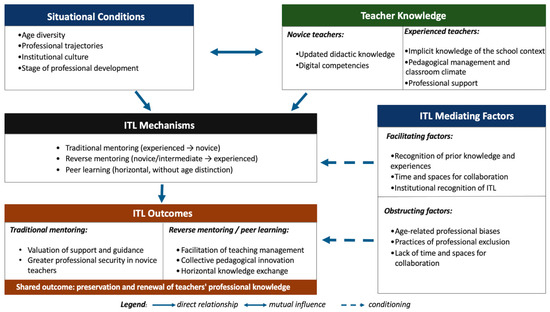
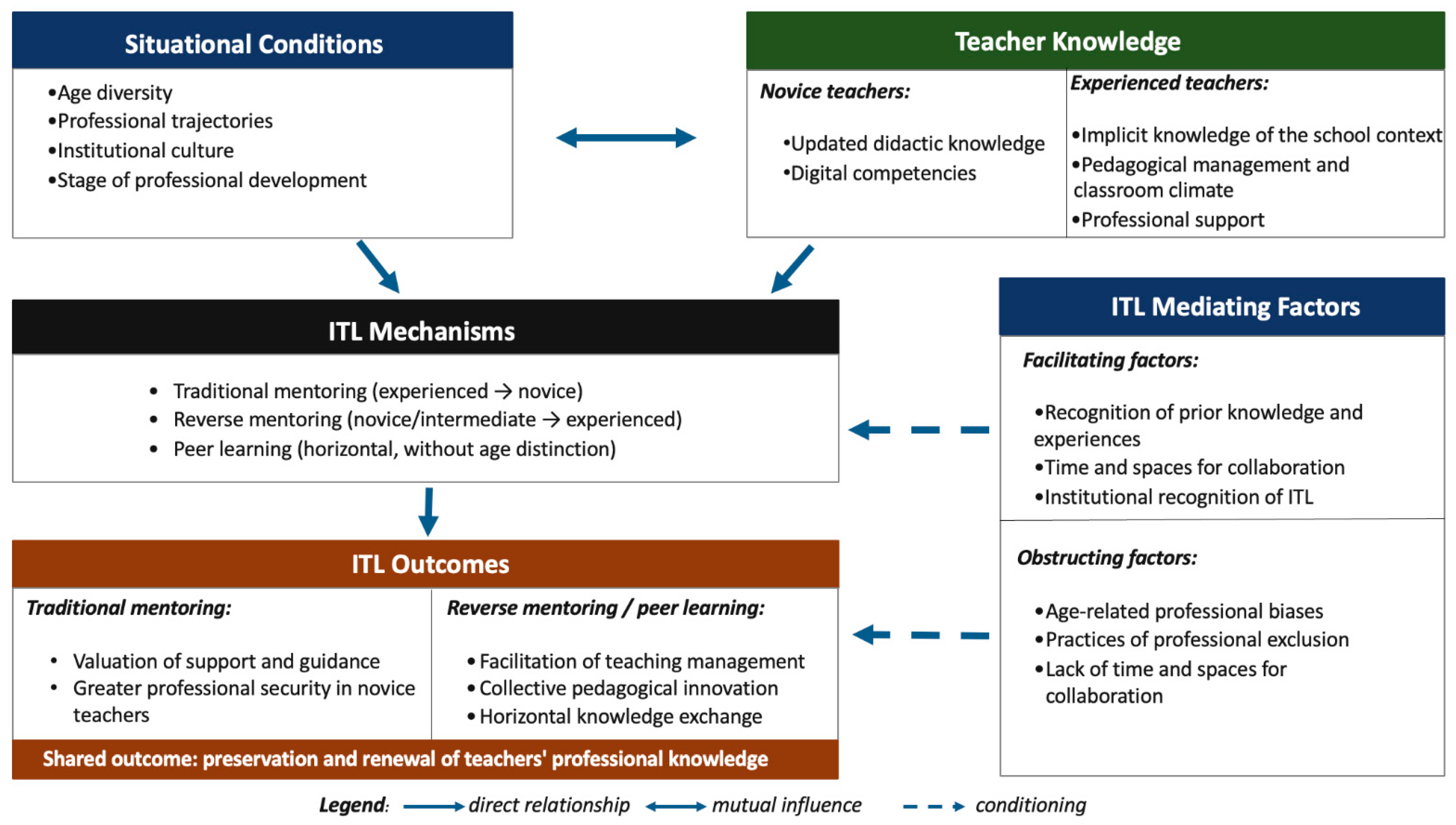
The analysis of the corpus made it possible to address the three research questions posed and, on the basis of these answers, to construct an explanatory model of ITL in schools. The intergenerational relationships identified (Question 1) were organized under the dimension of situational conditions; the knowledge in circulation and its pathways of transmission (Question 2) were organized into the dimensions of teachers’ knowledge and learning mechanisms; and the conditions that facilitate or constrain these processes, along with the associated learning outcomes (Question 3), were organized into the dimensions of mediating factors and ITL outcomes. The articulation of these five dimensions—situational conditions, teachers’ knowledge, learning mechanisms, mediating factors, and ITL outcomes—which emerged from the coding process is summarized in Figure 1.
Figure 1.
An Explanatory Model of ITL. Note. Teachers’ knowledge is presented according to career stage. Mediating factors condition both the mechanisms and the outcomes of ITL. Source: Authors’ own elaboration.
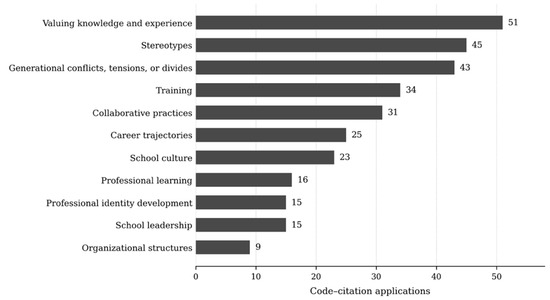
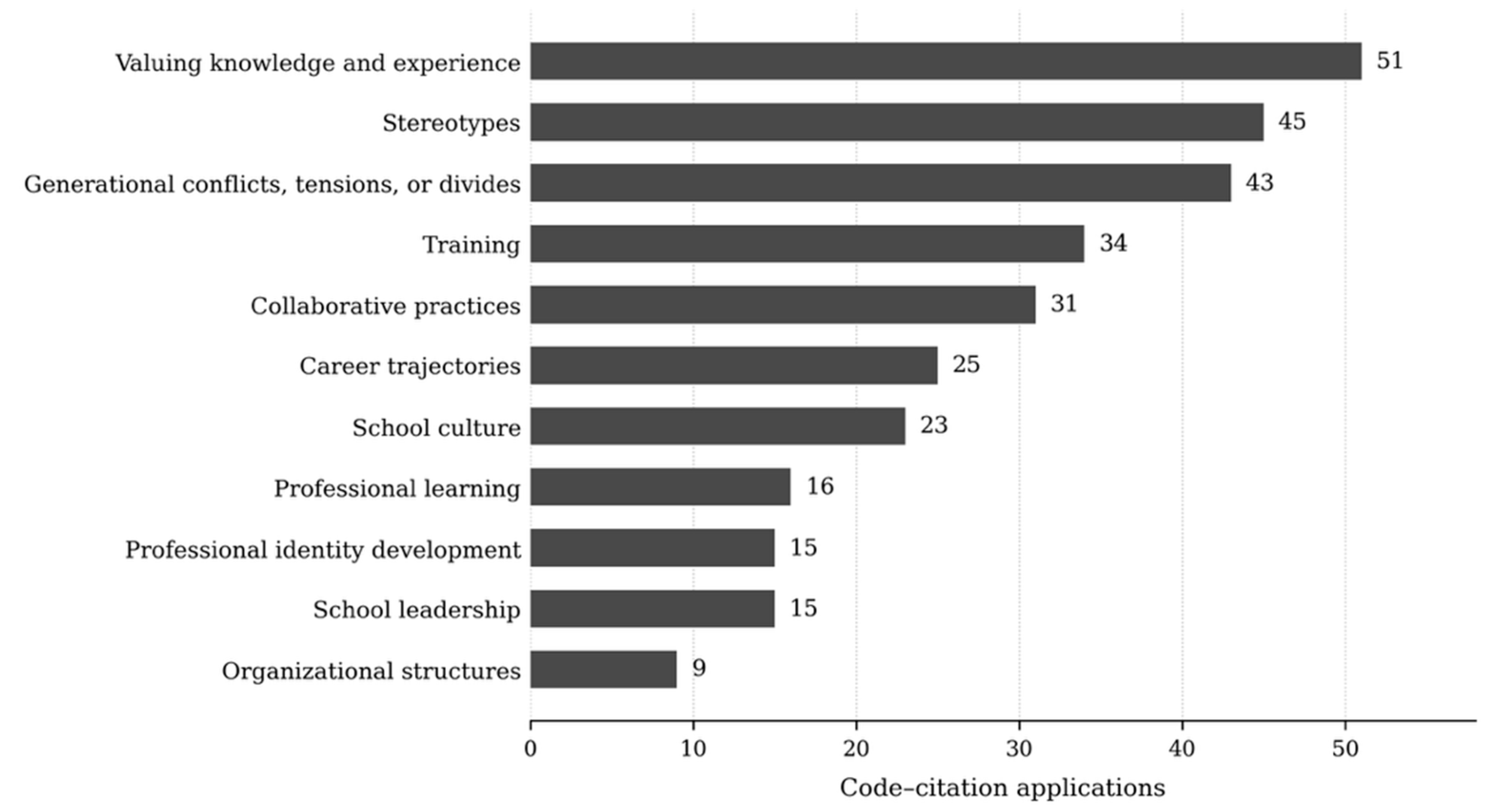
Figure 2 presents the coding density of the thematic clusters in the corpus. The figure shows that intergenerational exchanges appear in the narratives as closely linked to the valuation of professional knowledge and age-related tensions, which have the highest density of references.
Figure 2.
Coding density by thematic cluster. The graph presents the number of code-citation applications by thematic cluster (n = 307 out of a total of 419; the remainder corresponds to emerging codes not subsumed under these clusters). The frequencies are descriptive in nature and do not reflect the analytical relevance of the categories, which was established through constant comparison and theoretical coding. Author’s own elaboration.
Situational conditions enable an understanding of the institutional and interpersonal dynamics that shape professional learning within schools, including teachers’ career trajectories, professional experience, and the organizational contexts of interaction, institutional characteristics, and the nature of teachers’ knowledge. The model recognizes the existence of divergent professional trajectories, whose complementarity between consolidated expertise and pedagogical innovation constitutes the core of professional learning. These interactions are operationalized through mechanisms such as traditional and reverse mentoring, as well as peer learning, all of which differ in scope regarding their contribution to ITL outcomes.
Finally, the outcomes of these dynamics depend on both facilitating and hindering factors. Among the elements that promote ITL, the mutual recognition of professional capital and the intentional provision of time and space for collaborative work stand out. Conversely, this form of learning is significantly constrained by the presence of age- and profession-related biases, the lack of opportunities dedicated to teacher reflection, and the persistence of exclusionary practices—factors that condition the sustainability of these pedagogical collaboration networks.
4.1. Situational Conditions
Situational conditions are defined as the set of institutional configurations and interpersonal dynamics that facilitate professional learning, characterized by the interaction between teachers’ professional experience and chronological age (Hattie, 2015; Polat & Çiçek, 2015; Darling-Hammond et al., 2017; Geeraerts et al., 2018).
The interviews conducted in school settings reveal intergenerational interactions among participants ranging in age from 25 to 65 years. In their narratives, teachers describe diverse professional trajectories and adopt different positions regarding institutional pedagogical dynamics.
In this sense, novice or less experienced teachers undergo a process of induction associated with learning both the explicit practices and the tacit norms of the institution. For this group, professional integration necessarily entails questioning whether to assimilate into or distance themselves from the prevailing institutional culture. This tension is reflected in the following excerpt:
Or maybe it’s somewhere in between, because there is an issue with teachers not caring about anything beyond their own class. […] And obviously, I would not want to become that kind of dehumanized teacher. […] I feel that, for me, the most important thing is that students are doing well and that they are learning.(Francisco, novice teacher)
By contrast, for teachers with more extensive professional trajectories, institutional practices and underlying norms have already been incorporated into their repertoire of professional knowledge. Consequently, these teachers have developed more defined positions—whether affirmative or critical—regarding the ways in which they identify with and navigate school culture. The interviews provide evidence of this, as illustrated in the following example of institutional identification:
We define ourselves as a democratic school, and based on that, our teaching practice is grounded in living democracy in its fullest sense (…) We always see ourselves as part of a larger system that functions because all of us contribute to it.(Violeta, experienced teacher).
Taken together, these findings reinforce the understanding of situational conditions as a network of experiences, practices, norms, and institutional relationships that shape and mediate professional learning throughout teachers’ careers.
4.2. Teacher Knowledge
Teaching knowledge constitutes a distinct construct that extends beyond formal academic knowledge to include experiential and professional forms of knowledge reflected in the mastery of disciplinary and pedagogical content, school routines, traditions, and classroom climate management. It also encompasses cross-cutting forms of knowledge, such as managing uncertainty, as well as the sociohistorical and subjective dimensions of the teaching profession (Opfer & Pedder, 2011; Hargreaves & O’Connor, 2018; König et al., 2022).
Teachers’ perceptions of their own knowledge and competencies reveal distinctive nuances across the interviews. In this regard, novice and mid-career teachers position themselves as professionals who integrate updated pedagogical knowledge—derived from their recent university training—together with digital competencies understood as tools that support teaching and learning processes. However, these forms of knowledge coexist with the recognition of certain limitations, such as insufficient mastery of professional routines and difficulties in defining the teacher’s role in emerging or non-standard school situations. This tension is reflected in the following excerpt: “I think older teachers always have that classroom experience, and I’ve learned a lot from that too… I mean, for example, how to respond in certain situations or when dealing with, I don’t know, a disruptive student”. (Pablo, mid-career teacher)
Experienced teachers, by contrast, express greater confidence in their knowledge of school traditions and practices, pedagogical expertise, and effective classroom climate management. They also demonstrate a sociohistorical understanding of the teaching profession shaped by their professional experience, which influences their perception of the precarious nature of the teaching profession and the lack of motivation and commitment among younger generations toward teaching. This perspective, marked by a sense of institutional devaluation, is reinforced in the following account:
The way the system values you as an older teacher with educational experience… they don’t value you—your experience is not valued. So, in that sense, it’s better to say goodbye. And that’s why I insist: I worry about those who today have five or ten years of experience and still have twenty more years ahead of them—or even more in some cases. What is going to happen to them?(Rodrigo, experienced teacher).
4.3. Learning Mechanisms
The mechanisms of intergenerational learning among teachers were identified in the interviews as teaching and support practices developed among colleagues in response to recognized professional learning needs (Parr et al., 2023; Mwesigwa & Nakato, 2025; Khasawneh et al., 2023). These dynamics were categorized into three main modalities: traditional mentoring, reverse mentoring, and peer learning.
In cases of traditional mentoring, teachers with greater professional experience assume the role of mentors and support the occupational and professional induction of novice teachers through a variety of strategies. Experienced teachers guide their novice or mid-career colleagues either through verbal guidance or through the modeling of practices related to key aspects of school life, such as classroom climate management, strategies for deep learning, management of the class register, employment-related procedures, relationships with the school community, and the ethical dimension of teaching. This transfer of professional knowledge is illustrated in the following excerpt:
She taught me things back then, like how to use the class register, how to plan certain things, certain activities, certain lessons. (…) I truly felt that she guided me. And whenever I had questions or doubts, she always answered me and guided me very well.(Marina, mid-career teacher).
Reverse mentoring, in turn, refers to situations in which novice or mid-career teachers assume the role of mentors by leading learning processes directed toward their colleagues. These processes focus primarily on digital literacy and, to a lesser extent, on specific pedagogical strategies. In this regard, experienced teachers consistently value the transfer of digital competencies positively. However, perceptions differ in relation to pedagogy, since familiarity with updated theories and teaching strategies does not necessarily imply their relevance or applicability within specific school contexts. The following excerpt illustrates this point:
I think the greatest support I’ve received from other teachers has been related to access to technology and the use of technology—that’s probably the most relevant aspect. And in some cases, though much less frequently, some teachers surprise me with ideas related to their subject area, such as new concepts, new approaches, or different ways of addressing certain topics.(Pedro, experienced teacher)
Finally, peer learning emerges through collaborative work practices in which shared pedagogical projects are developed and age becomes less relevant than horizontal professional collaboration. These dynamics take place both in formal spaces—such as curriculum planning sessions and the design of instructional adaptations—and in informal interactions. As one participant explained:
We all get together because we belong to the same English department. So we work together, and also during departmental meetings, since there’s more than one teacher in our subject area at the school. We come from different generations, but we work side by side, each contributing from their own perspective.(Daniela, mid-career teacher)
Break times provide opportunities for spontaneous exchange, where ideas emerge that sometimes lead to collective educational projects. During formal school hours, teachers develop curriculum plans, adaptations, and pedagogical projects in collaboration with their colleagues; however, there are also instances where teachers’ break times serve as the starting point for collective educational projects, which may vary in their degree of development. Following this line of thought, we can cite an example of a more informal way of working:
During breaks, for example—the first two breaks last 25 min—so we have more time to have breakfast, talk with colleagues, and that’s also where a lot of ideas emerge. In those more informal spaces, ideas for projects, interdisciplinary collaboration, and more collective initiatives start to take shape.(Pablo, mid-career teacher).
These modalities are sustained by institutional contexts that promote collaboration, trust, and the circulation of professional knowledge, as well as by support networks that facilitate both the transfer of experience and pedagogical innovation.
4.4. Mediating Factors
Intergenerational relationships among teachers produce outcomes of varying degrees, which are mediated by facilitating or hindering factors associated both with teachers’ beliefs and with the school’s organizational dynamics.
The factors that mediate intergenerational learning are internal and external variables that shape the intensity and effectiveness of peer collaboration among teachers (Opfer & Pedder, 2011; Batista et al., 2024). These may operate at the level of beliefs, as reflected in openness to change, willingness to exchange ideas, and appreciation of others’ experience (Hargreaves, 2019; Lepičnik Vodopivec et al., 2022); and at the level of organizational dynamics, through the availability of institutional time for meetings, the existence of physical or virtual spaces for collaboration, the flexibility of curriculum design to allow innovation, and the quality of pedagogical leadership in promoting group cohesion (Vangrieken et al., 2017; Velazco et al., 2020). Among the factors that foster these processes are the recognition of teachers’ prior knowledge and experience and the establishment of time and space for collaborative work among teachers.
Recognizing teachers’ prior knowledge and experience (whether experienced or novice) involves explicitly valuing the cultural and professional capital that each teacher contributes, regardless of years of service. These forms of recognition are expressed, for example, as follows:
I really value, for example, experience, obviously; I admire that tremendously. I mean, the mere fact that they have spent 30 years in the classroom is, to me, incredibly admirable. (…) And also the experience that has already been proven. They have methodologies and strategies that have consistently produced results.(Tamara, novice teacher).
Likewise, another important factor is the establishment of time and space for collaborative work among teachers, which involves the formal and strategic creation of opportunities for teachers to interact beyond their teaching duties. These intentional spaces—such as joint planning sessions, the development of teaching materials, or pedagogical projects—are essential to ensure that the exchange of practices is not left to chance, but instead becomes an institutional structure that sustains pedagogical continuity.
It should be noted that the use of break times does not contradict this finding but rather confirms it: teachers turn to informal settings because institutional ones prove insufficient. The distinction lies not in the availability of time itself, but in whether that time is protected: recesses facilitate spontaneous exchange but not sustained and systematic pedagogical reflection or for the follow-up of processes that have been initiated.
A third facilitating factor is the institutional recognition of ITL, understood as the formal legitimization by the administrative team of the exchange of knowledge between teachers from different professional backgrounds as a practice inherent to school work. Unlike the allocation of time, which operates at the level of material conditions, this recognition affects the status of the exchange: it transforms it into an institutionally valued activity rather than an individual and informal initiative. Its presence is evident in the following account:
The administrators—that’s where the idea came from—and most of them took to it well, because it’s like: “Hey, I do this, and if it works, go ahead and use it.” Or the other way around: “Hey, yeah, I want to see how you do it, and if it works for me, I’ll copy it.” So this is the only thing that’s been institutionalized during my nine years here. Before, nothing like that ever existed—in the sense of a teacher sharing their experience or demonstrating certain ideas or ways of handling situations (Pedro, experienced teacher).
Its absence, however, leaves knowledge exchange dependent on individual initiative, as illustrated by the case of an experienced teacher who offered to train his colleagues but received no institutional response, despite having submitted the proposal to his school’s principal.
On the other hand, intergenerational learning is significantly constrained by factors such as age-related professional prejudice, the absence of time and space for collaborative work among teachers, and exclusionary practices.
Age-related professional prejudice refers to negative and unfounded attitudes toward members of a group based on stereotypes that associate teaching quality with a teacher’s age or professional trajectory. Consequently, individuals who hold such beliefs attribute negative attitudinal characteristics to their peers and undervalue their teaching competencies. This idea is reflected in the following example:
There are teachers who are waiting for their retirement bonus and are already over 65 years old, and in those cases the teacher really becomes a burden on the system because they no longer have the energy, the resources, or the patience. Sometimes they do not even know how to fill out the digital gradebook, because now everything is digital, and everything becomes a problem for them.(Daniela, mid-career teacher)
Likewise, the absence of time and space for collaborative work among teachers often results in teacher isolation, where each teacher addresses pedagogical challenges individually, or in collaborative practices characterized by limited preparation and reflection. This idea is illustrated below: “Look, there’s very little time. It’s already very scarce. We’re assigned an hour for what we call department meetings or pedagogical sessions. But in forty-five minutes, in an hour, you just can’t do it.” (Rodrigo, experienced teacher)
Finally, these barriers may be further exacerbated when exclusionary practices marginalize certain actors from decision-making processes or pedagogical support networks. These practices may manifest through the formation of closed age-based groups, the intentional withholding of relevant information, the invalidation of peers’ opinions, and the assignment of less significant tasks. This is illustrated in the following example:
It’s very noticeable in the teachers’ lounge. There’s even a table where only the older teachers sit, both in terms of age and years at the school, while the younger teachers sit at another table. They may still interact with some older teachers, but the separation is very marked.(Catalina, novice teacher).
Taken together, these internal and external conditions strongly shape how, and to what extent, knowledge is shared, co-produced, and applied among teachers with different career trajectories over the course of their professional lives.
4.5. ITL Outcomes
Teaching and mentoring practices among teachers generate learning outcomes of varying scope, including attitudes, teaching competencies, and the development of professional communities (Geeraerts et al., 2018; Aroca et al., 2022).
In the interviews, participants involved in traditional mentoring valued the support provided by more experienced teachers and expressed greater confidence in their teaching performance. This trend is illustrated by the following statement: “Well, I think I’ve learned a great deal from more experienced teachers in many different areas, and it’s been quite useful—that’s true.” (Carlos, mid-career teacher).
In contrast, within reverse mentoring processes, more experienced teachers highlighted that learning about new technologies facilitates the management of teaching processes that are sometimes carried out in more traditional ways—an area in which less experienced teachers demonstrate strong competence. Likewise, more experienced teachers mention that they have learned new teaching methods from novice and mid-career teachers: “I have also learned new teaching methods and new perspectives on my own practice from younger teachers.” (Simona, experienced teacher).
The findings highlight the bidirectional nature of knowledge exchange: traditional mentoring facilitates novice teachers’ professional integration, whereas reverse mentoring promotes the digital and pedagogical development of experienced teachers, thereby strengthening collective professional capital. Taken together, these forms of exchange point to a shared outcome: the preservation and renewal of teachers’ professional knowledge within the school, sustained over time as long as the conditions that enable it are maintained.
5. Discussion
The findings of this study allow ITL to be understood as a complex, situated process mediated by multiple dimensions that extend beyond the formal induction and mentoring frameworks promoted by Chilean educational policy. In this regard, the findings show that the actual dynamics of learning among teachers are more complex than formal structures suggest and are also shaped within everyday and informal spaces, thereby broadening the centrality attributed to formal institutional mechanisms. This coexistence of formal and informal forms of support in professional induction has also been documented in other contexts (Diab & Green, 2024).
In line with the international literature, the findings suggest that, in the contexts examined, intergenerational learning often occurs through spontaneous and unplanned interactions among teachers (Brücknerová & Novotný, 2017; Geeraerts et al., 2018), in which differentiated forms of knowledge linked to distinct professional trajectories are mobilized. Notably, in this study, a significant portion of ITL appears to occur precisely in the absence of fully formalized institutional conditions for systematizing the exchange of knowledge among teachers.
In particular, the findings converge with previous studies in showing that novice teachers tend to contribute knowledge related to pedagogical innovation and the use of technology, while experienced teachers contribute practical knowledge associated with classroom management, school culture, and pedagogical decision-making (Polat & Çiçek, 2015; Šindić et al., 2022). However, the present study expands this understanding by demonstrating that these exchanges involve not only knowledge transfer, but also processes of symbolic negotiation regarding the valuation of teaching knowledge. This introduces a cognitive and relational dimension of ITL that has been less explored in the literature. This finding is consistent with recent international evidence on reverse mentoring in teacher education, showing that the reversal of roles not only facilitates the transfer of competencies but also reconfigures positions of professional authority between mentors and mentees (Raberger et al., 2024).
Indeed, the findings regarding intergenerational relationships reveal the existence of age-related professional prejudices, consistent with research highlighting the persistence of stereotypes among teachers from different generations (Geeraerts et al., 2021; Kazak & Polat, 2018). However, this study offers a more situated perspective by suggesting that, in the contexts examined, these beliefs may shape teachers’ willingness to learn from peers and their valuation of others’ knowledge. In this sense, the recognition of each teacher’s professional capital emerges as a key factor in the effective development of ITL, suggesting that collaborative dynamics depend not only on the coexistence of different generations, but also on the beliefs of the actors involved and the organizational conditions that enable exchange.
From a theoretical perspective, one of the main contributions of this study lies in the construction of an explanatory model of ITL that integrates five interrelated dimensions: situational conditions, teacher knowledge, learning mechanisms, mediating factors, and outcomes. This model makes it possible to understand intergenerational learning not as a linear phenomenon, but as a non-linear relational system in which institutional and organizational conditions, diverse professional trajectories, and teachers’ beliefs interact. In this sense, ITL is configured as a situated practice that emerges from interactions among actors who negotiate meanings, (de)legitimize knowledge, and construct professional knowledge within specific contexts. This perspective resonates with Wenger’s (1998) notion of communities of practice, while explicitly incorporating the intergenerational dimension as the model’s articulating axis.
In practical terms, these findings have important implications for teacher professional development in the Chilean context. In particular, they suggest the need to broaden the understanding of teacher collaboration beyond formal mentoring mechanisms by incorporating the value of informal spaces and everyday interactions as legitimate forms of professional learning. Likewise, the findings highlight the importance of schools creating organizational conditions that foster intergenerational interaction, such as providing protected time for collaborative work, promoting school cultures grounded in trust and mutual recognition, and implementing strategies aimed at reducing biases associated with age and professional experience. This finding is consistent with recent studies documenting, in Chilean schools, the lack of institutional support structures for sustaining teacher collaboration (Gomez Zaccarelli et al., 2026).
At the educational policy level, the model identifies three strategic areas that any school system may address: the allocation of protected time for interaction among teachers with different professional trajectories; the institutional recognition of informal exchange as a legitimate form of professional learning; and interventions aimed at addressing biases associated with age and experience. Its relevance extends beyond the Chilean context, since demographic phenomena such as the ageing of the teaching workforce and the coexistence of generations have been documented in European education systems and in other regions (Batista et al., 2024; Geeraerts et al., 2018; Portela Pruaño et al., 2022). The model does not, however, constitute a framework that can be transferred without adaptation, but rather an interpretive structure that other systems may use to examine their own institutional conditions.
These findings show how ITL benefits the professional development of novice teachers across the five dimensions of the model. In terms of situational conditions, their integration involves mastering both the explicit practices and the tacit norms that are not covered by formal induction. With regard to teacher knowledge, novice teachers contribute up-to-date pedagogical knowledge and digital competencies, although they display gaps in professional routines and in their understanding of everyday school dynamics.
The mechanisms operate differently: traditional mentoring concentrates on classroom management, the class register, and relationships with the community, whereas reverse mentoring and peer learning legitimise novice teachers as holders of knowledge (Diab & Green, 2024). As an outcome, novice teachers’ confidence increases and a less subordinate professional identity takes shape. In terms of mediating factors, this process depends on the recognition of their professional capital and is constrained by age- and profession-related biases and exclusion. Chilean induction policy would therefore need to complement the assignment of a mentor with interventions addressing the organisational conditions and the beliefs that shape the recognition of novice teachers’ knowledge.
6. Conclusions
The research supports the claim that ITL consists mainly of informal and unplanned interactions that extend beyond the formal induction and mentoring mechanisms promoted by Chilean educational policy. Knowledge flows in both directions, although in distinct ways: novice teachers contribute updated pedagogical knowledge and digital competencies, while experienced teachers contribute tacit knowledge of school culture, pedagogical practices, and classroom management. For novice teachers in particular, this process affects both their integration into school culture and the recognition of their own professional knowledge.
The circulation of these forms of knowledge takes place through three mechanisms—traditional mentoring, reverse mentoring, and peer learning—whose effects depend not merely on the coexistence of generations but on the mediating factors that facilitate or constrain them. Factors that strengthen ITL include the mutual recognition of professional knowledge, the availability of time and space, and the institutional legitimisation of exchange. Conversely, age- and profession-related biases and exclusionary practices limit and constrain it. When these conditions are present, ITL leads to a shared outcome: the preservation and renewal of teachers’ professional knowledge within the school.
The model developed responds to the questions that guided the study: situational conditions and teacher knowledge account for the intergenerational relationships that take shape in schools and for the knowledge that circulates between generations; the mechanisms identified explain the pathways of this circulation; and the mediating factors make it possible to understand why similar processes lead to different outcomes across schools. This is, however, a situated substantive theory: it emerges from a specific context of data production and is not presented as a universal model, but rather as an interpretive framework that may be contrasted with, expanded upon, or challenged by future research. Its contribution lies in highlighting the situated, relational, and intergenerational character of the construction of professional knowledge in schools, and in showing that ITL does not depend on the mere coexistence of generations, but on the reciprocal recognition of professional capital and on the organisational conditions that enable its circulation.
Viewed over time, these findings make it possible to anticipate the benefits of sustaining intergenerational exchange in schools. In a context of accelerated generational turnover within the teaching profession, ITL functions as a mechanism of continuity: it preserves the tacit knowledge about school culture that would otherwise be lost through retirements, while simultaneously incorporating the updated teaching practices and digital knowledge contributed by each cohort of novice teachers. These effects could contribute to teacher retention, since novice teachers who receive recognition and support report greater professional confidence. In this respect, the review by Batista et al. (2024) explicitly notes the absence of a prospective dimension in research on intergenerational learning. The proposed model contributes to addressing this gap by identifying the conditions that must be maintained for these benefits to materialise.
Nevertheless, this study presents certain limitations that should be considered when interpreting its findings. First, the sample size prevents the generalization of the results to the Chilean educational system as a whole. Second, the research focuses on practicing teachers, thereby excluding other relevant actors, such as school leaders and educational policymakers. It is important to note that the aim of this study is not statistical generalization, but rather the construction of a situated substantive theory that enables an understanding of the dynamics of ITL within specific school contexts.
In this regard, future lines of research may include the development of quantitative studies aimed at examining the structure of the model and the relationships among its dimensions, as well as investigations exploring ITL across different educational settings, such as rural schools, highly vulnerable schools, or institutions with distinct organizational cultures. Likewise, it would be relevant to deepen the analysis of teacher collaboration networks from a relational perspective in order to gain a more precise understanding of how knowledge flows are configured among teachers from different generations.
Author Contributions
Conceptualization, M.D.-D. and M.L.G.-D.; methodology, M.D.-D.; software, M.D.-D. and M.L.G.-D.; validation, M.D.-D. and M.L.G.-D.; formal analysis, M.D.-D. and M.L.G.-D.; investigation, M.D.-D. and M.L.G.-D.; resources, M.D.-D. and M.L.G.-D.; data curation, M.D.-D. and M.L.G.-D.; writing—original draft preparation, M.D.-D.; writing—review and editing, M.D.-D.; visualization, M.D.-D. and M.L.G.-D.; supervision, M.D.-D.; funding acquisition, M.D.-D. and M.L.G.-D. All authors have read and agreed to the published version of the manuscript.
Funding
This research received no external funding.
Institutional Review Board Statement
Ethical review and approval were not required for this study because it involved exclusively voluntary semi-structured interviews with adult in-service teachers. The research did not include biomedical or clinical procedures, physical or psychological interventions, vulnerable populations, minors, biological samples, or the collection of sensitive personal data and therefore fell outside the scope of formal ethical oversight applicable to biomedical and clinical research in the Chilean context. Nevertheless, the study adhered to established ethical principles regarding voluntary participation, confidentiality, anonymity, the right to withdraw, and the protection of personal data in accordance with Chilean regulations.
Informed Consent Statement
Informed consent was obtained from all participants. Participants were informed about the purpose of the research, the voluntary nature of their participation, the academic use of the information collected, confidentiality procedures, and their right to withdraw from the study at any time.
Data Availability Statement
The data supporting the findings of this study are available from the corresponding author upon reasonable request. The data are not publicly available due to privacy and ethical considerations related to participant confidentiality.
Acknowledgments
During the preparation of this manuscript, the authors used ChatGPT-5.6 Sol (OpenAI) for final text editing and image editing purposes. The authors reviewed and edited all AI-generated content and take full responsibility for the content of this publication.
Conflicts of Interest
The authors declare no conflicts of interest.
References
- Aroca, J., Abellán, P., & De Miguel López, S. (2022). Teachers’ professional development and intelligent ways of coping with it: A systematic review in elementary and middle school education. Journal of Intelligence, 11, 1. [Google Scholar] [CrossRef] [Scilit]
- Ávalos, B., & Valenzuela, J. P. (2016). Education for all and attrition/retention of new teachers: A trajectory study in Chile. International Journal of Educational Development, 49, 279–290. [Google Scholar] [CrossRef] [Scilit]
- Ávalos-Bevan, B., & Flores, M. A. (2022). School-based teacher collaboration in Chile and Portugal. Compare: A Journal of Comparative and International Education, 52(8), 1222–1240. [Google Scholar] [CrossRef] [Scilit]
- Batista, P., Mouraz, A., Viana, I., & Graça, A. (2024). Intergenerational learning among teachers’ professional development and lifelong learning: An integrative review of primary research. European Journal of Educational Research, 13(3), 1275–1290. [Google Scholar] [CrossRef] [Scilit]
- Brücknerová, K., & Novotný, P. (2017). Intergenerational learning among teachers: Overt and covert forms of continuing professional development. Professional Development in Education, 43(3), 397–415. [Google Scholar] [CrossRef] [Scilit]
- Charmaz, K. (2014). Constructing grounded theory (2nd ed.). Sage. [Google Scholar]
- Comellas i Carbó, M. J., Gairín Sallán, J., & Castro Ceacero, D. (2024). Escenarios e implicaciones de las relaciones intergeneracionales. In D. Castro Ceacero, & D. Rodríguez-Gómez (Eds.), Relaciones y aprendizaje intergeneracionales: Un reto para la universidad (pp. 17–30). Octaedro. [Google Scholar]
- Darling-Hammond, L., Hyler, M. E., & Gardner, M. (2017). Effective teacher professional development (Research Brief). Learning Policy Institute. [Google Scholar] [CrossRef] [Scilit]
- Diab, A., & Green, E. (2024). Cultivating resilience and success: Support systems for novice teachers in diverse contexts. Education Sciences, 14(7), 711. [Google Scholar] [CrossRef] [Scilit]
- Flick, U. (2015). El diseño de investigación cualitativa. Ediciones Morata S.L. [Google Scholar]
- Geeraerts, K., Tynjälä, P., & Heikkinen, H. L. T. (2018). Inter-generational learning of teachers: What and how do teachers learn from older and younger colleagues? European Journal of Teacher Education, 41(4), 479–495. [Google Scholar] [CrossRef] [Scilit]
- Geeraerts, K., Van den Bossche, P., Vanhoof, J., & Moolenaar, N. (2017). Intergenerational professional relationships in elementary school teams: A social network approach. Frontline Learning Research, 5(2), 78–98. [Google Scholar] [CrossRef] [Scilit]
- Geeraerts, K., Vanhoof, J., & Van den Bossche, P. (2016). Teachers’ perceptions of intergenerational knowledge flows. Teaching and Teacher Education, 56, 150–161. [Google Scholar] [CrossRef] [Scilit]
- Geeraerts, K., Vanhoof, J., & Van Den Bossche, P. (2021). Flemish teachers’ age-related stereotypes: Investigating generational differences. Journal of Intergenerational Relationships, 19(2), 179–195. [Google Scholar] [CrossRef] [Scilit]
- Glaser, B. G., & Strauss, A. L. (1967). The discovery of grounded theory: Strategies for qualitative research. Aldine. [Google Scholar]
- Gomez Zaccarelli, F., Rojas-Avilez, L., & Guerrero Morales, P. (2026). School-university partnership in teacher education: The role of collaboration in constructing teacher identity during practicum. Teacher Development, 30(3), 613–632. [Google Scholar] [CrossRef] [Scilit]
- Hargreaves, A. (2019). Teacher collaboration: 30 years of research on its nature, forms, limitations and effects. Teachers and Teaching, 25(5), 603–621. [Google Scholar] [CrossRef] [Scilit]
- Hargreaves, A., & O’Connor, M. T. (2018). Collaborative professionalism: Teaching together means learning for all. SAGE Company. [Google Scholar]
- Hattie, J. (2015). What works best in education: The politics of collaborative expertise. Pearson. [Google Scholar]
- Kalashnikova, L., & Hrabovets, I. (2020). Motivation of modern Ukrainian teachers’ professional activities: Generation archetypes. E3S Web of Conferences, 166, 10002. [Google Scholar] [CrossRef] [Scilit]
- Kazak, E., & Polat, S. (2018). School administrators’ instructional leadership behaviors, intergenerational atmosphere, and intergenerational learning in schools: Research. Journal of Intergenerational Relationships, 16(4), 441–462. [Google Scholar] [CrossRef] [Scilit]
- Khasawneh, Y. J. A., Alsarayreh, R., Ajlouni, A. A. A., Eyadat, H. M., Ayasrah, M. N., & Khasawneh, M. A. S. (2023). An examination of teacher collaboration in professional learning communities and collaborative teaching practices. Journal of Education and E-Learning Research, 10(3), 446–452. [Google Scholar] [CrossRef] [Scilit]
- König, J., Hanke, P., Glutsch, N., Jäger-Biela, D., Pohl, T., Becker-Mrotzek, M., Schabmann, A., & Waschewski, T. (2022). Teachers’ professional knowledge for teaching early literacy: Conceptualization, measurement, and validation. Educational Assessment, Evaluation and Accountability, 34, 483–507. [Google Scholar] [CrossRef] [Scilit]
- Kvale, S. (2011). Las entrevistas en investigación cualitativa. Ediciones Morata S.L. [Google Scholar]
- Lepičnik Vodopivec, J., Partalo, D., & Sindic, A. (2022). Intergenerational learning and cooperation: A perspective of preschool teachers. Cypriot Journal of Educational Sciences, 17(8), 2877–2887. [Google Scholar] [CrossRef] [Scilit]
- Lincoln, Y. S., & Guba, E. G. (1985). Naturalistic inquiry. Sage Publications. [Google Scholar]
- Lyons, S. T., Schweitzer, L., Urick, M. J., & Kuron, L. (2019). A dynamic social-ecological model of generational identity in the workplace: Research. Journal of Intergenerational Relationships, 17(1), 1–24. [Google Scholar] [CrossRef] [Scilit]
- Mannheim, K. (1952). Essays on the sociology of knowledge. Routledge & Kegan Paul. [Google Scholar]
- Marrero, J., Negrín, M., Bernárdez-Gómez, A., & Portela, A. (2023). The impact of the first millennial teachers on education: Views held by different generations of teachers. Education and Information Technologies, 28, 14805–14826. [Google Scholar] [CrossRef] [Scilit]
- Mikušková, E. B. (2023). Generational differences in teachers’ professional competencies. European Journal of Educational Research, 12(4), 1657–1665. [Google Scholar] [CrossRef] [Scilit]
- MINEDUC. (2016). Law No. 20,903. Establishes the teacher professional development system and amends other regulations. Chilean Ministry of Education.
- Mwesigwa, F., & Nakato, N. (2025). Mentorship in teacher education programs: A review of practices, outcomes, and challenges. Acta Pedagogia Asiana, 5(1), 15–29. [Google Scholar] [CrossRef] [Scilit]
- Nieto Cano, J. M., Vallejo, M., Torres, A., & Bernárdez, A. (2024). Influencia de la diversidad generacional en las relaciones entre docentes. Profesorado, Revista de Currículum y Formación del Profesorado, 28(1), 171–191. [Google Scholar] [CrossRef] [Scilit]
- Novikova, V. S. (2024). Theoretical and methodological approaches to the study of generations: A comparative analysis. Vestnik Majkopskogo Gosudarstvennogo Tehnologiceskogo Universiteta, 16(4), 128–143. [Google Scholar] [CrossRef] [Scilit]
- O’Connor, C., & Joffe, H. (2020). Intercoder reliability in qualitative research: Debates and practical guidelines. International Journal of Qualitative Methods, 19, 1609406919899220. [Google Scholar] [CrossRef] [Scilit]
- Opfer, V. D., & Pedder, D. (2011). Conceptualizing teacher professional learning. Review of Educational Research, 81(3), 376–407. [Google Scholar] [CrossRef] [Scilit]
- Pardy, J., & Reimer, K. (2018). Generations of learning: A professional learning experience. In A. Fitzgerald, G. Parr, & J. Williams (Eds.), Re-imagining professional experience in initial teacher education (pp. 107–122). Springer. [Google Scholar] [CrossRef] [Scilit]
- Parr, J., Myhill, D., & Jesson, R. (2023). Chapter 7 Implementing interventions in authentic classroom contexts: Researching with professional communities through building practice partnerships. In Conceptualizing, designing, implementing, and evaluating writing interventions. Brill. [Google Scholar] [CrossRef] [Scilit]
- Polat, S., & Çiçek, H. (2015). Intergenerational learning among primary and lower secondary schools. Journal of Human Sciences, 12(2), 1649–1661. [Google Scholar] [CrossRef] [Scilit]
- Polat, S., & Kazak, E. (2015). Primary school teachers’ views on intergenerational learning. Educational Sciences: Theory & Practice, 15(5), 1189–1203. [Google Scholar] [CrossRef] [Scilit]
- Portela Pruaño, A., Bernárdez Gómez, A., Marrero Galván, J. J., & Nieto Cano, J. M. (2022). Intergenerational professional development and learning of teachers: A mixed methods study. International Journal of Qualitative Methods, 21, 16094069221133233. [Google Scholar] [CrossRef] [Scilit]
- Raberger, J., Gkaravelas, K., & Froehlich, D. E. (2024). Empowering educators: The impact of reverse mentoring on developing a scientific mindset and research skills. Education Sciences, 14(9), 993. [Google Scholar] [CrossRef] [Scilit]
- Ramírez, J., De Oca, G., & Caraballo, C. (2022). Teaching strategies based on generational teacher cohorts. International Journal on Integrating Technology in Education, 11(4), 1–13. [Google Scholar] [CrossRef] [Scilit]
- Richter, D., Kunter, M., Klusmann, U., Lüdtke, O., & Baumert, J. (2011). Professional development across the teaching career: Teachers’ uptake of formal and informal learning opportunities. Teaching and Teacher Education, 27(1), 116–126. [Google Scholar] [CrossRef] [Scilit]
- Sablo Sutton, S., Cuéllar, C., González, M. P., & Espinosa, M. J. (2022). Pedagogical mentoring in Chilean schools: An innovative approach to teachers’ professional learning. International Journal of Mentoring and Coaching in Education, 11(1), 69–88. [Google Scholar] [CrossRef] [Scilit]
- Santoro, N., Pietsch, M., & Borg, T. (2012). The passion of teaching: Learning from an older generation of teachers. Journal of Education for Teaching, 38(5), 585–595. [Google Scholar] [CrossRef] [Scilit]
- Sarti, F. M. (2009). Parceria intergeracional e formação docente. Educação em Revista, 25(2), 133–152. [Google Scholar] [CrossRef] [Scilit][Green Version]
- Sá, F. A. d. S., Osório, N. B., Neto, L. S. S., Brito, M. S. d. O., Oliveira, N. P. B., Almeida, F. d. S., Santana, L. S. B., Costa, S. d. S., & do Nascimento, J. S. (2024). Conexões intergeracionais no ambiente escolar: Reflexões sobre o desenvolvimento de competências para o século XXI. Aracê, 6(3), 9512–9524. [Google Scholar] [CrossRef] [Scilit]
- Simons, H. (2011). El estudio de caso: Teoría y práctica. Ediciones Morata. [Google Scholar]
- Strauss, A., & Corbin, J. (1998). Basics of qualitative research: Techniques and procedures for developing grounded theory (2nd ed.). SAGE Publications. [Google Scholar]
- Šindić, A., Partalo, D., & Ličen, N. (2022). Preschool teachers’ perspective on factors of intergenerational learning important for professional development. Metodički Ogledi, 29(1), 125–142. [Google Scholar] [CrossRef] [Scilit]
- Vangrieken, K., Meredith, C., Packer, T., & Kyndt, E. (2017). Teacher communities as a context for professional development: A systematic review. Teaching and Teacher Education, 61, 47–59. [Google Scholar] [CrossRef] [Scilit]
- Velazco, D., Martínez, M., Cejas, M., Hinostroza, E., & Pinos, K. (2020). La eficacia pedagógica en la cultura organizativa escolar y la comunidad profesional de aprendizaje. Uniciencia, 35, 1–15. [Google Scholar] [CrossRef] [Scilit]
- Véliz, C., & Navarrete, O. (2025). Peer tutoring programmes: Comprehensive training and generic competences from the experience of tutors in a Chilean university. Tuning Journal for Higher Education, 12(1), 163–189. [Google Scholar] [CrossRef] [Scilit]
- Wenger, E. (1998). Communities of practice: Learning, meaning and identity. Cambridge University Press. [Google Scholar]

Disclaimer/Publisher’s Note: The statements, opinions and data contained in all publications are solely those of the individual author(s) and contributor(s) and not of MDPI and/or the editor(s). MDPI and/or the editor(s) disclaim responsibility for any injury to people or property resulting from any ideas, methods, instructions or products referred to in the content. |
© 2026 by the authors. Licensee MDPI, Basel, Switzerland. This article is an open access article distributed under the terms and conditions of the Creative Commons Attribution (CC BY) license.