


Abstract
This study investigates the role of metacognitive awareness in shaping students’ adoption of artificial intelligence (AI) tools for learning within the framework of the Technology Acceptance Model (TAM). Data were collected from 236 students at the University of Ha’il, and structural equation modeling (SEM) was employed to examine the relationships among metacognitive awareness, perceived usefulness (PU), perceived ease of use (PEU), and behavioral intention (BI). The findings indicate that metacognitive awareness has significant positive effects on both PU and PEU. In turn, PU and PEU significantly influence students’ BI to use AI tools for learning, with PU emerging as the stronger predictor. However, metacognitive awareness does not have a significant direct effect on BI. These results suggest that students’ intention to use AI tools is primarily driven by their perceptions of usefulness and ease of use, while metacognitive awareness plays an important role in shaping these perceptions. The study extends the Technology Acceptance Model by positioning metacognitive awareness as an upstream cognitive factor that enhances students’ evaluation of AI technologies in educational contexts. The findings offer practical implications for higher education institutions, emphasizing the importance of developing students’ metacognitive skills to improve their engagement with AI tools. By fostering students’ ability to reflect on and regulate their learning processes, educators can enhance the perceived value and usability of AI technologies, thereby supporting their effective integration into learning environments.
1. Introduction
The rapid integration of AI into higher education has precipitated a paradigm shift in the educational landscape (Adamakis & Rachiotis, 2025; Kurtz et al., 2024). Systems like large language models and research AI have become a part of the higher education experience for instructors and students alike (Baha et al., 2024; Sanz-Tejeda et al., 2026). These programs provide significant potential for improving the educational experience for students and enhancing educational outcomes (Kurtz et al., 2024; Z. Zhao et al., 2025). Furthermore, as AI continues to evolve and become increasingly incorporated into higher education and its learning management systems, it presents students and instructors with the potential for personalization and efficiency in the educational experience that was previously unavailable (Vieriu & Petrea, 2025; Z. Zhao et al., 2025).
However, the widespread adoption of AI tools also brings significant challenges to the educational environment. Many researchers have noted that students increasingly utilize these tools in a superficial manner, skipping over the essential learning process required to effectively utilize these tools (Atchley et al., 2024; Sallai et al., 2024). Without regulatory frameworks being established for their use by students, it is likely that students will become reliant upon these AI tools, which can reduce their critical thinking and learning skills (Beckman et al., 2025; Sallai et al., 2024). This gap in learning agency suggests that students may use these AI tools very frequently but may not necessarily use them in ways that improve their learning or maintain the integrity of their academic work (Hughes et al., 2025). Consequently, it is essential to go beyond investigating how students access and utilize these AI tools and to investigate the cognitive aspects of how they interact with and accept these AI systems within the classroom (Adamakis & Rachiotis, 2025; Schmidt et al., 2025).
Of the existing models of intention to use technology in education, the Technology Acceptance Model (TAM) remains the predominant model in use today (Alshammari et al., 2025; Z. Zhao et al., 2025). The model suggests that two variables determine an individual’s intention to utilize a new technology within a process: PU of the technology and the perceived ease with which that technology can be used (Abdalla, 2024; Kavitha & Joshith, 2025; Widodo et al., 2024). While TAM enjoys high validity in the measurement of the intention to utilize various digital technologies, there are limitations to the model, particularly in the age of generative AI technologies (Mogaji et al., 2024; Z. Zhao et al., 2025). As noted by several scholars in the field, the model does not consider the higher-order cognitive processes that are necessary to interact with AI technologies (Mogaji et al., 2024). Instead, the model considers only if an AI technology is easy to use and useful, factors that may not sufficiently encompass the more complex interactions between students and AI technologies (Hughes et al., 2025; Lemke et al., 2023).
Another factor that may help to address these theoretical limitations is metacognitive awareness. Metacognitive awareness is the understanding of one’s own learning processes, and is a factor that is essential in the use of AI systems to complete tasks (Atchley et al., 2024; Mazari, 2025). Students who are metacognitively aware can evaluate the logic behind the responses that emerge from AI systems, can reject those ideas as “hallucinations,” and can adjust their communicative prompts to the AI according to their goals for their communication (Knoth et al., 2024; Mazari, 2025). Furthermore, metacognitive skills can help students to understand factors like the value of using a tool like AI within their digital environments (Atchley et al., 2024; Dahri et al., 2024). Overall, then, students can use their metacognitive skills to transform AI from a tool that they use to simply complete their tasks to one that they use to enhance their learning of specific concepts (Atchley et al., 2024; Mazari, 2025).
Despite the theoretical significance of metacognition, there is a research gap in the existing empirical literature on the topic (Dahri et al., 2024; Z. Zhao et al., 2025). Studies on AI literacy and its impact on AI adoption are only beginning to emerge in the literature (Alshammari et al., 2025; Dahri et al., 2024; Z. Zhao et al., 2025). Most studies that examine the antecedents to AI tool adoption focus on aspects like institutional support or the self-efficacy of the individual in utilizing those tools (Delcker et al., 2024; Sudaryanto et al., 2023; Z. Zhao et al., 2025). Furthermore, there is no empirical literature that models the effects of metacognitive knowledge on technology acceptance among students (Dahri et al., 2024; Kavitha & Joshith, 2025). A critical gap in the literature exists because universities are attempting to create curricula that improve the AI literacy of students while also encouraging metacognitive knowledge to promote responsible usage of these AI tools (Adamakis & Rachiotis, 2025; Kurtz et al., 2024).
The study also makes a contribution to the existing literature by proposing the extension of the TAM framework to include the consideration of metacognitive awareness as a key factor that can help to indicate the likelihood of the adoption of AI learning tools by students (Dahri et al., 2024; Mazari, 2025). The novelty of this study is in its consideration of the effects of metacognitive awareness on AI tool adoption for learning tools both directly and indirectly (Yu, 2018; Z. Zhao et al., 2025). The integration of these two concepts is vital to the consideration of AI learning tools, as it can help to enable a more holistic consideration of the human-in-the-loop aspects of modern research and learning experiences (Jin et al., 2025; Ranade et al., 2025).
The aim of this study is to investigate the role of metacognitive awareness in the adoption of AI tools by students. More specifically, the study intends to determine whether metacognitive awareness positively influences students’ perceptions of the usefulness and ease-of-use of AI tools, and, as a result, leads to increased intention to adopt these technologies by college students.
2. Literature Review
2.1. AI in Higher Education and Technology Adoption
Since the early 2020s, generative artificial intelligence (AI) tools have become a significant part of higher education (Adamakis & Rachiotis, 2025; Kurtz et al., 2024). Tools such as ChatGPT, intelligent tutoring systems, and AI-assisted research tools are a part of the learning processes of students within higher education institutions (Baha et al., 2024; Sanz-Tejeda et al., 2026). These AI technologies assist with different learning tasks, such as locating the literature in a field of study, generating ideas for research projects, and problem solving (Kurtz et al., 2024; Sanz-Tejeda et al., 2026). Although there is much of the literature discussing the potential of AI to improve learning outcomes and enable personal learning for students within higher education, few investigations have studied how many students have begun to adopt these technologies (Kurtz et al., 2024; Z. Zhao et al., 2025).
The growing adoption of AI technologies within higher education has created challenges for students in the way they engage with their studies (Beckman et al., 2025; Sallai et al., 2024). Many students exhibit an agency gap when utilizing AI technologies; they may complete assignments with the technology but do not engage with the learning process that is required for deep learning (Sallai et al., 2024). As a result, students tend to develop an over-reliance on these technologies for their work, exhibit shallow learning, and do not challenge the accuracy or ethics of the work that is created by the AI technology (Beckman et al., 2025; Sallai et al., 2024). Beyond finding ways to address the issues that have emerged due to the adoption of these technologies, it is also important for universities to gain an understanding of the cognitive skills and knowledge that are necessary to enable students to utilize these technologies in a purposeful and critical manner (Adamakis & Rachiotis, 2025; Hughes et al., 2025; Schmidt et al., 2025).
2.2. TAM in AI Contexts
As a model of technological acceptance, TAM has stood the test of time as the predominant theoretical model for understanding and explaining the acceptance of new technologies (Alshammari et al., 2025). Within the context of education and the implementation of learning tools based upon artificial intelligence, the model posits that the perception of the usefulness of that tool and the ease of use of that tool are the variables that impact a student’s intention to utilize such a tool (Abdalla, 2024; Kavitha & Joshith, 2025; Widodo et al., 2024). Within this model, the usefulness of a tool is thought to be related to the belief of the students that its use will improve their grades (Dahri et al., 2024; Widodo et al., 2024), while the ease of use is thought to relate to the perceived effort that is required to utilize the tool effectively. Studies that have applied this model to tools based upon artificial intelligence have indicated its applicability to the age of generative agents (Mogaji et al., 2024; Z. Zhao et al., 2025).
Despite these findings, though, the model is often criticized for its inability to explain the cognitive interactions that are required of the students when utilizing AI tools (Mogaji et al., 2024; Z. Zhao et al., 2025). AI tools require some form of interaction with the non-deterministic responses that are emitted by the artificial intelligence (Knoth et al., 2024). As such, the perception that an artificial intelligence will be useful or easy to use is believed to have cognitive antecedents to those perceptions of usefulness and ease of use (Ke et al., 2025; Mogaji et al., 2024). Thus, there is a gap within existing literature on the model in explaining the cognitive processes behind the students’ perceptions of AI usefulness and ease of use, as well as in explaining why some students utilize AI in deep and meaningful ways to improve their learning yet other students utilize AI in more superficial ways (Kavitha & Joshith, 2025; Mogaji et al., 2024; Z. Zhao et al., 2025).
Although generative AI differs from many technologies traditionally examined through TAM, PU, PEU, and BI remain relevant for understanding students’ evaluations of AI as a learning technology. Generative AI tools are increasingly accessible and may require relatively little technical effort for initial use; however, accessibility or prior experience does not necessarily indicate that students perceive these tools as useful, manageable, or worth continuing to use for learning purposes. In the present study, therefore, acceptance refers specifically to students’ perceptions of the usefulness and ease of using AI tools for learning and their behavioral intention to use such tools in future learning activities. Behavioral intention is treated as an attitudinal and motivational outcome rather than as evidence of actual adoption or effective use. Accordingly, BI in this study does not capture the frequency, quality, appropriateness, or effectiveness of students’ AI use, nor does it demonstrate successful integration of AI into learning. This distinction is particularly important because students may already have experience with generative AI while differing substantially in whether they perceive it as educationally valuable and intend to use it for future learning.
Metacognitive Awareness in AI-Supported Learning. Metacognitive awareness is the ability to reflect on and regulate one’s thinking processes (Atchley et al., 2024; Mazari, 2025). Such awareness is an essential component of utilizing the human-in-the-loop interactions with artificial intelligence systems (Jin et al., 2025; Ranade et al., 2025). Metacognitive awareness comprises two interrelated components: knowledge of cognition and regulation of cognition (Dahri et al., 2024; Mazari, 2025). Although knowledge of cognition and regulation of cognition represent distinct components of metacognitive awareness, they are treated in this study as interrelated dimensions of the broader metacognitive awareness construct. Accordingly, the present study focuses on overall metacognitive awareness rather than examining the two components separately. Students who are aware of their cognition can monitor the responses from AI systems for potential instances of hallucinations (Mazari, 2025).
Furthermore, the concept of prompt engineering has become an essential skill within the 21st century (Kim et al., 2025; Federiakin et al., 2024). Students who possess high levels of metacognitive awareness can better formulate the right prompts to receive the desired responses from AI systems (Kim et al., 2025; Knoth et al., 2024; López-Galisteo & Borrás-Gené, 2025). More importantly, the relationship between the value that students place upon utilizing AI technologies and the metacognitive awareness that they have is closely linked (Atchley et al., 2024; Dahri et al., 2024). Thus, metacognitive awareness is a vital component of the regulation of AI within scholarly research projects, as it prevents the over-reliance upon those AI technologies and ensures their adoption into research projects in a more sophisticated manner (Jin et al., 2025; Kim et al., 2025; Wang & Gao, 2025).
Importantly, the relevance of metacognitive awareness to AI-supported learning extends beyond students’ ability to formulate prompts or evaluate individual AI-generated responses. Metacognitive awareness enables learners to recognize what they know, identify gaps in their understanding, determine the requirements of a learning task, and evaluate whether a particular learning strategy is helping them achieve their goals. These processes are especially relevant when interacting with generative AI because students must continuously make judgments about when AI assistance is appropriate, what type of assistance is needed, whether the generated information corresponds to their learning objectives, and whether their interaction strategy should be modified. In this sense, knowledge about cognition enables students to recognize their learning needs and limitations, whereas regulation of cognition enables them to plan, monitor, evaluate, and adjust their interactions with AI. Metacognitive awareness is therefore theoretically meaningful in AI-supported learning because it provides students with a cognitive basis for evaluating AI in relation to their own learning requirements rather than merely interacting with the technology at a functional level.
This perspective provides a theoretical mechanism connecting metacognitive awareness with perceived usefulness (PU) and perceived ease of use (PEU). Regarding PU, students who are more aware of their learning needs, strengths, limitations, and progress may be better able to determine whether AI-generated explanations, feedback, or assistance provide meaningful value for accomplishing a particular learning objective. Metacognitive awareness may therefore shape PU by enabling students to evaluate the instrumental value of AI in relation to their learning needs. Regarding PEU, students who can regulate their cognition through planning, monitoring, evaluating, and adjusting their strategies may be better able to manage the cognitive demands involved in interacting with AI. For example, when an AI-generated response is inadequate, such students may be better positioned to identify the problem, reformulate a prompt, or modify their interaction strategy. This capacity may increase students’ perceived control over the interaction and make AI-supported learning tasks appear more manageable. Accordingly, the present study does not assume that metacognitive awareness is the only determinant of PU, PEU, or BI, as these perceptions may also be influenced by technological, experiential, social, institutional, and other individual factors. Rather, metacognitive awareness is positioned as an upstream cognitive antecedent that may help explain how students form perceptions of the usefulness and ease of using AI tools for learning.
Beyond technology perceptions, metacognitive awareness is also associated with learning in general. Students who are metacognitively aware are able to use regulatory processes to plan their learning, monitor their learning, evaluate their learning, and take steps to adjust their learning processes in response to any difficulties they may experience during learning. These processes are related to the concept of learning engagement in that learning engagement requires students to actively participate in the learning process. Research with university students, for instance, has found a relationship between metacognition and learning engagement, as well as relationships with learning strategies and learning behaviors (An et al., 2024). While learning engagement was not directly measured in this study, the concept is still related to metacognitive awareness in the context of AI-supported learning; students need to be engaged in the learning process to effectively utilize AI systems to support their learning.
2.3. Hypotheses Development
2.3.1. Metacognitive Awareness and PU
It is hypothesized that having a metacognitive awareness will lead to an enhanced perception of the usefulness of the AI tool. Students who are highly aware of their metacognitive skills can more accurately identify the ways in which an AI assistant can assist with their learning (Dahri et al., 2024; Mazari, 2025). Furthermore, those who are aware of their metacognitive abilities have an understanding of the ways in which AI tools can assist with their learning, which increases their perception of the usefulness of those tools to achieve specific learning objectives (Atchley et al., 2024; Mazari, 2025). Thus, the metacognitive skills that can be learned through the use of these AI tools will lead to enhanced recognition of their usefulness in the learning process.
H1.
Metacognitive awareness has a significant positive effect on PU.
2.3.2. Metacognitive Awareness and PEU
Metacognitive awareness is also expected to influence the ease of use of AI by decreasing the cognitive effort that is required to interact with the AI system (Knoth et al., 2024; Federiakin et al., 2024). Students with strong metacognitive skills can use the AI system in a more efficient way as they are less likely to experience frustrations similar to those that other students experience while interacting with the AI applications (Kim et al., 2025; Knoth et al., 2024). Due to these students’ abilities to regulate their interactions with the AI applications and to independently troubleshoot any difficulties that they may experience with the AI applications, they will find the AI applications to be more intuitive and easily manageable (Obadă et al., 2026; Ren et al., 2025). Overall, the metacognitive skills of students will act as a means of reducing the complexity of interacting with the AI systems and making the technology appear easier to navigate for the students (Knoth et al., 2024; Z. Zhao et al., 2025).
H2.
Metacognitive awareness has a significant positive effect on PEU.
2.3.3. Metacognitive Awareness and BI
Metacognitive awareness may also directly impact the decision to use AI tools as the level of cognitive confidence that each student feels in their abilities to control and utilize these tools effectively (Dahri et al., 2024). Students who feel that they are capable of effectively utilizing these tools will be more likely to adopt and utilize these tools as permanent components of their students’ academic toolkit (Dahri et al., 2024; Z. Zhao et al., 2025). Furthermore, these students may be more likely to exhibit these behaviors due to their general tendency towards self-regulation in their classrooms and in their education in general (Dahri et al., 2024; Mazari, 2025). These students are likely to make voluntary and intentional decisions to utilize these technologies to aid in their educational pursuits (Jin et al., 2025; Sallai et al., 2024).
H3.
Metacognitive awareness has a significant positive effect on BI to use AI tools.
2.3.4. PU and BI
Similar to the original TAM, the perception of the utility of the AI tool is recognized as one of the main factors that contributes to the decision of students to adopt and use that tool (Alshammari et al., 2025; Yakubu et al., 2025). If students believe that the AI tool will contribute to their efficiency, quality, or understanding in relation to their research and assignments, they are more likely to exhibit the intention to use such a tool (Garcia, 2025; Yakubu et al., 2025). Furthermore, various research studies have indicated that AI tools actually do exhibit benefits in the performance of students’ academic assignments and projects (Abdalla, 2024; Alshammari et al., 2025).
H4.
PU has a significant positive effect on BI to use AI tools.
2.3.5. PEU and BI
Finally, the next critical predictor of the intention to use AI tools is the PEU of these tools (Alshammari et al., 2025; Wahdah et al., 2025). Despite the advanced nature of AI technologies available today, the easier the experience of using these tools for their intended purpose, the more likely that individuals will adopt and use these tools (Alshammari et al., 2025; Z. Zhao et al., 2025). For students within the university, the ease of use might be linked to their metacognitive abilities (Lemke et al., 2023; Sudaryanto et al., 2023).
H5.
PEU has a significant positive effect on BI to use AI tools.
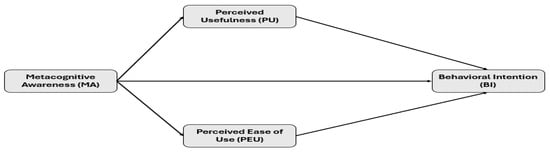
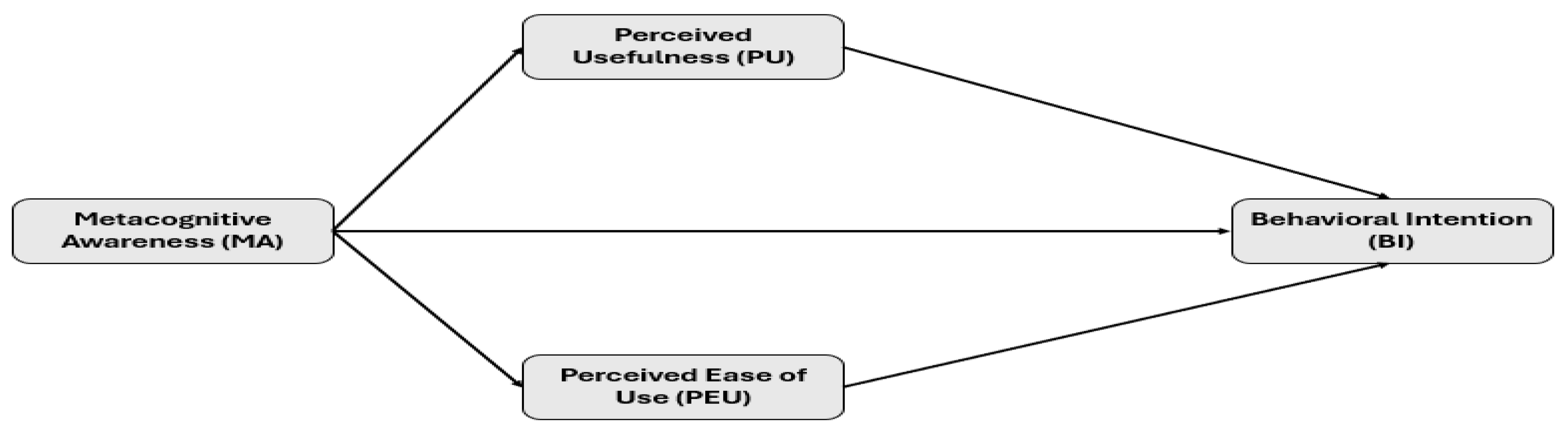
Based on the discussion above, a model of TAM can be further extended by incorporating the notion of metacognitive awareness as the primary antecedent of the model. By integrating the notion of metacognitive awareness into the TAM, the model can shift from a focus on the functional aspects of AI tools to those aspects related to self-regulation in the context of employing those tools for learning (Dahri et al., 2024; Mazari, 2025; Z. Zhao et al., 2025). Overall, then, the integration of metacognitive awareness into the TAM model helps to provide a better understanding of AI tool adoption in higher education in particular, which helps to lead to the model that will be tested in this research. The proposed research model for this study is depicted in Figure 1 below:
Figure 1.
Proposed Research Model.
3. Methodology
3.1. Research Design
The study utilized a quantitative research design based on a cross-sectional survey to assess the relationships between metacognitive awareness, technology usefulness, technology ease of use, and the BI to use AI tools for learning. The research model and hypotheses were tested through the use of structural equation modeling (SEM). SEM was performed with IBM SPSS AMOS software (version 26.0), which is a statistical analysis tool that allows for the analysis of the relationships between latent variables and variables that are measured in research. SEM is an appropriate statistical analysis tool to utilize in the research that was performed.
3.2. Participants and Data Collection
Data were collected from 236 students enrolled at the University of Ha’il. All participants were taking the course “Introduction to Artificial Intelligence,” which provided them with exposure to AI-related concepts. Enrollment in the course was intended to increase the likelihood that participants were familiar with AI; however, it was not assumed to indicate that all participants had prior practical experience using generative AI tools. Accordingly, the sample included students with varying levels of prior AI experience.
Data were collected using an online questionnaire distributed through Google Forms. The questionnaire link was distributed through the Blackboard learning management system and through the email accounts of students enrolled in the course. Participation was voluntary, and students were informed about the purpose of the study. They were also informed that their responses would remain anonymous and confidential. Initial screening of the data indicated no substantial problems with missing data affecting the variables included in the analysis.
All study constructs were measured using self-reported responses collected from the same participants through a single questionnaire administered at one point in time. Consequently, the study design may be susceptible to common method variance arising from the use of a single source, measurement instrument, and administration occasion. This potential source of bias was considered when interpreting the relationships among the constructs.
3.3. Measures
All constructs were measured using validated measurement instruments that had been previously used to assess aspects of AI tools for learning. All instruments utilized a five-point Likert scale ranging from 1 to 5 to indicate the level to which participants agreed with each item within the survey instrument. Constructs of usefulness and ease of use were each measured with four items that had been adapted from those used by Davis (1989), and the construct of intention to use AI tools for learning was measured with three items from the same study. Finally, metacognitive awareness was measured with ten items that had been adapted from those used by Tuononen et al. (2023) to measure knowledge and regulation of cognitive processes. The 10 items were used collectively to measure overall metacognitive awareness, which was modeled as a single latent construct in the present study.
Each item within these scales was slightly modified to ensure that they related to the context of AI tools for learning. However, the meaning of each item remained the same as the items from the original studies. Thus, these scales have been adapted to ensure validity in relation to the study objectives.
3.4. Data Analysis Procedure
The analysis was performed in two stages using covariance-based structural equation modeling (CB-SEM) with maximum likelihood estimation in IBM SPSS AMOS. In the first stage, confirmatory factor analysis (CFA) was performed to assess the measurement model. The measurement model was assessed for reliability, convergent validity, and discriminant validity. Discriminant validity was assessed using the heterotrait–monotrait ratio (HTMT). Model fit was assessed using the chi-square to degrees of freedom ratio (χ2/df), the comparative fit index (CFI), the Tucker–Lewis index (TLI), the incremental fit index (IFI), and the root mean square error of approximation (RMSEA). These indices were considered collectively in the overall assessment of model fit.
In the second stage, the structural model was evaluated to test the hypothesized relationships among the latent constructs. The structural paths were assessed using the estimated path coefficients and their statistical significance. In addition, indirect effects were examined using bootstrapping with 5000 resamples and bias-corrected confidence intervals.
3.5. Sample Size Adequacy
The sample size of 236 participants was deemed to be adequate for the SEM analysis. According to methodological guidelines, a minimum sample size of 200 participants is generally considered to be sufficient for covariance-based SEM analyses (Hair et al., 2019; Kline, 2023). Furthermore, a recommended sample size should be in a certain ratio to the complexity of the model being tested, with a minimum ratio of 5 to 1 and a maximum ratio of 10 to 1 (Bentler & Chou, 1987). Such a ratio is met by the sample size utilized in the proposed study.
Moreover, simulation studies have demonstrated that sample sizes of 200 or more participants are appropriate to utilize with models of moderate complexity when utilizing methods like maximum likelihood estimation, which was utilized in the analysis software IBM SPSS AMOS (Boomsma, 1982; Wolf et al., 2013). Therefore, based on the complexity of the model that is to be tested and the indicated recommendations for sample size, the size of the current sample is again deemed to be sufficient to perform SEM analysis with validity and reliability.
3.6. Ethical Considerations
This study was conducted in accordance with relevant guidelines and regulations and adhered to the ethical standards of the institutional research committee and the 1964 Helsinki Declaration and its later amendments. The research protocol was reviewed and approved by the Research Ethics Committee (REC) at the University of Ha’il (Approval No.: H-2026-132; dated 28 April 2026). Informed consent was obtained from all participants prior to their participation in the study.
4. Results
4.1. Demographic Information
Table 1 presents the demographic and background characteristics of the 236 students enrolled in this study. With respect to gender, 135 of the participants were male students (57.2%), while 101 were female students (42.8%). Thus, there is a relatively even distribution of students of each gender, yet with a moderate predominance of male students within the group.
Table 1.
Participant Demographic Characteristics.
Regarding academic level, 186 of the students were bachelor’s degree students (78.8%), 47 of whom were pursuing postgraduate degrees (19.9%), and only three of whom were pursuing diploma programs (1.3%). Thus, the majority of the students represented in this study were bachelor’s students, though some postgraduate students were included as well.
In relation to the college from which the students were enrolled, participants represented a variety of academic disciplines. The majority of the students were from the College of Education (n = 86; 36.4%), followed by students enrolled in Arts and Letters (n = 54; 22.9%), Computer Science and Engineering (n = 43; 18.2%), and the Science Department (n = 42; 17.8%). Smaller groups of students were enrolled in Business Administration (n = 7; 3.0%) and health-related colleges (n = 4; 1.7%). Thus, the students represented a variety of academic disciplines.
With respect to experience using artificial intelligence (AI) tools, 205 of the students (86.9%) reported having previous experience using these types of tools, while 31 students (13.1%) indicated that they did not have previous experience with AI tools. Thus, most students in the study were familiar with AI tools.
Finally, in regard to the length of their experience using AI tools, 101 students (42.8%) reported using such tools for more than six months, 55 students (23.3%) used such tools for less than one month, 45 students (19.1%) used those tools for periods between one and three months, and 35 students (14.8%) used those tools for periods between four and six months. Thus, the majority of students have used AI tools for extended periods, though there are also students who are new to using such tools.
Overall, the participants represented a diverse group of students with varying levels of prior experience with AI tools. Most participants reported previous experience using ChatGPT for learning purposes, although a smaller proportion reported no prior experience. Therefore, the sample predominantly, but not exclusively, represented students with prior exposure to generative AI tools.
The demographic variables were collected to characterize the study sample and were not included as predictors or control variables in the structural model. The SEM analysis focused specifically on the hypothesized relationships among MA, PU, PEU, and BI in accordance with the proposed theoretical model.
CFA
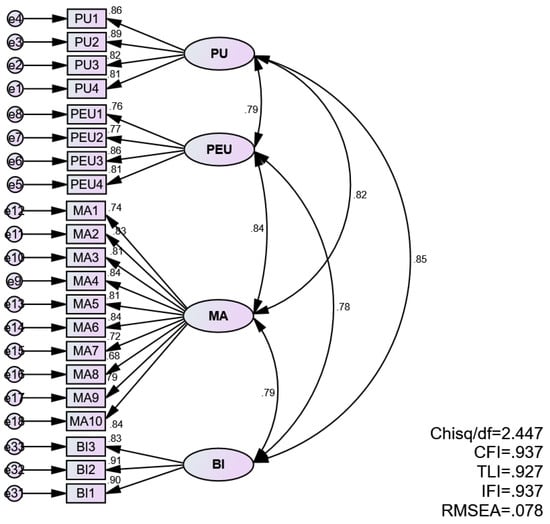
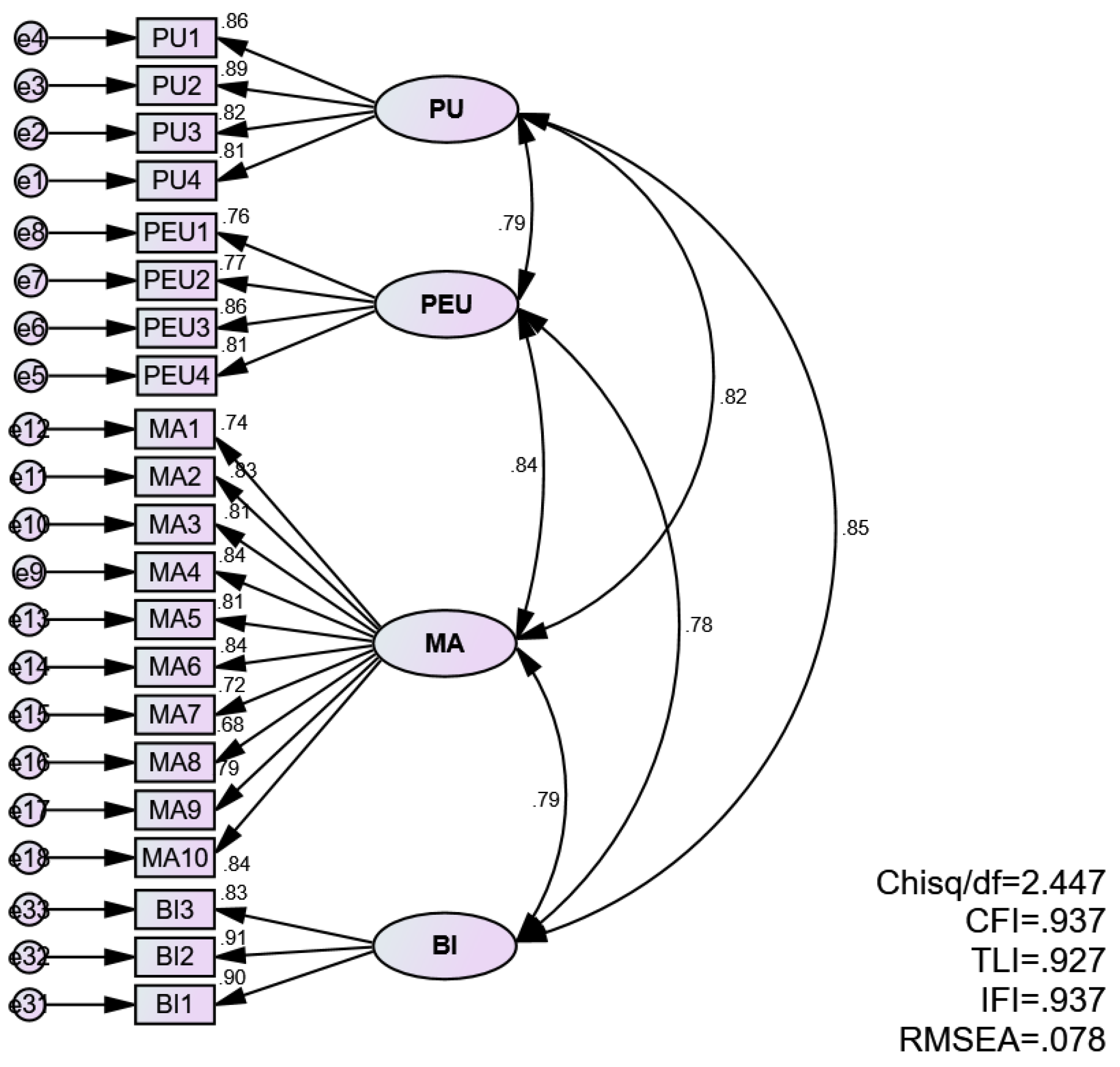
Figure 2 presents the results of the CFA for the proposed model. The measurement model demonstrated an acceptable overall fit to the data. Specifically, the chi-square to degrees of freedom ratio was 2.447, which is below the recommended threshold of 3.00 (Awang, 2015). The comparative fit index (CFI = 0.937), Tucker–Lewis index (TLI = 0.927), and incremental fit index (IFI = 0.937) were all above the recommended threshold of 0.90 (Hair et al., 2019). The root mean square error of approximation (RMSEA) was 0.078. Although this value falls within the commonly used 0.08 criterion (Awang, 2015; Hair et al., 2019), it is more appropriately interpreted as indicating acceptable rather than close or good fit. Taken together, the fit indices indicate an acceptable overall fit of the measurement model to the data.
Figure 2.
CFA Output.
Furthermore, each of the factor loadings for the latent variables was above the recommended value of 0.60, indicating that each observed variable appropriately represented each construct (Awang, 2015). The correlations between each of the constructs were positive and substantial, ranging from 0.78 to 0.85 (each is within acceptable limits for representing the concept of each construct) (Awang, 2015).
Therefore, because all fit indices indicated a good fit for the model, the validity of the model’s constructs was established. Thus, the model was suitable for proceeding to test the relationships between the constructs.
Then, the convergent validity of the study was determined by assessing the values of composite reliability (CR) and average variance extracted (AVE) for each construct. Table 2 presents the values of CR and AVE for each of the constructs within the current study. The values of CR for each construct were all between 0.876 and 0.944, each of which is above the recommended value of 0.70 for such measures (Hair et al., 2019).
Table 2.
CR and AVE Results.
In addition, each of the values of AVE were between 0.628 and 0.771 for each of the constructs, all of which are above the recommended value of 0.50 for such measures (Fornell & Larcker, 1981; Hair et al., 2019). These values indicate that the measurement model for this study has acceptable levels of both reliability and convergent validity. Thus, convergent validity is confirmed.
Then, discriminant validity was assessed using the heterotrait–monotrait ratio (HTMT). The HTMT values ranged from 0.776 to 0.856. All values were below the 0.90 criterion, although the PU–BI value (0.856) marginally exceeded the more conservative 0.85 threshold (Henseler et al., 2015; Hair et al., 2019). Thus, the HTMT results generally support the empirical distinctiveness of the constructs, while the relatively high PU–BI value indicates that the distinction between perceived usefulness and behavioral intention should be interpreted cautiously. The heterotrait–monotrait (HTMT) ratios are presented in Table 3.
Table 3.
Heterotrait–Monotrait Ratios.
4.2. Standardized Estimate
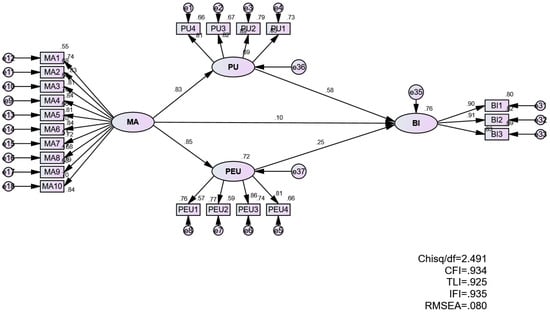
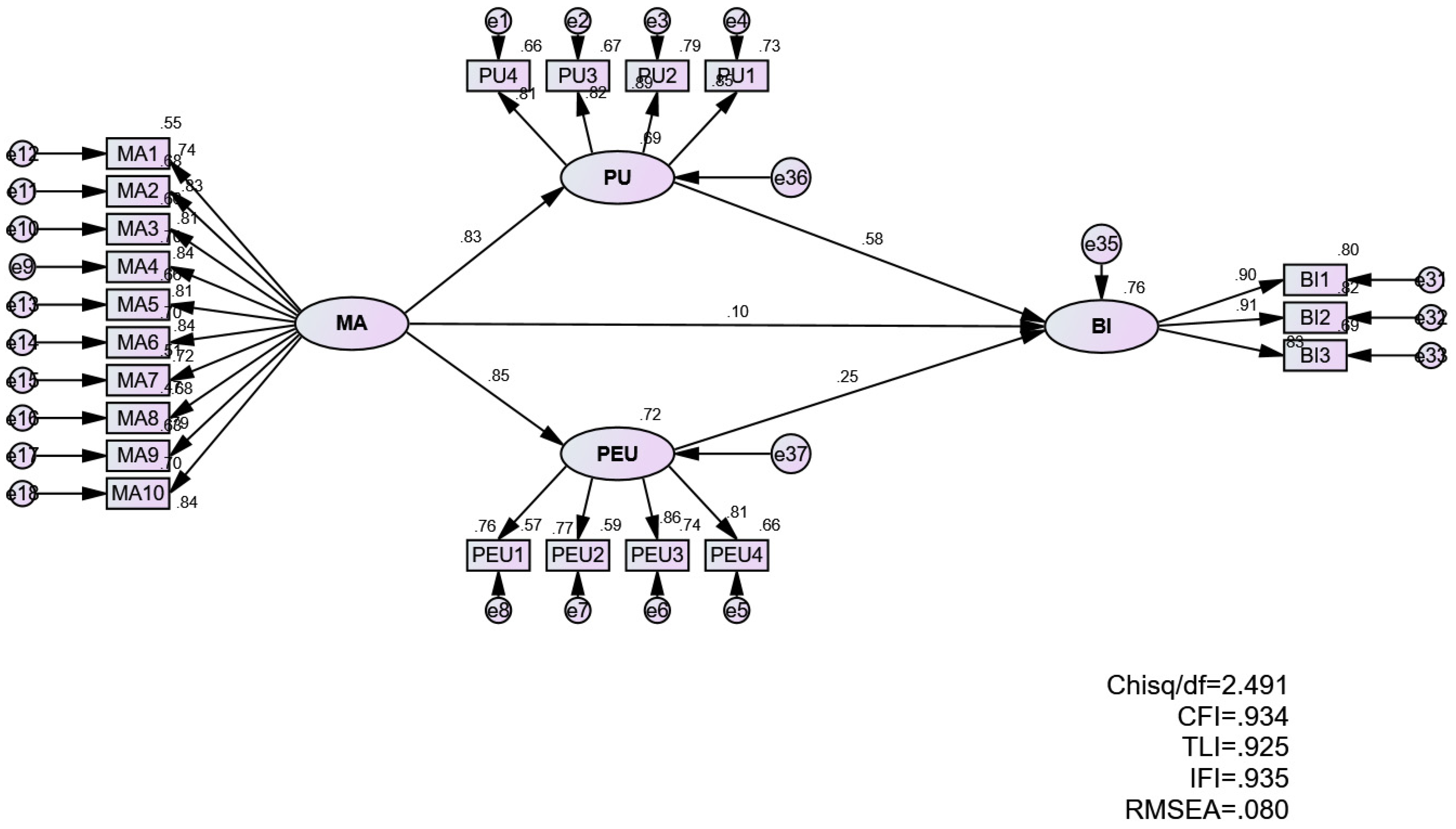
Figure 3 presents the standardized estimates of the structural model. Such estimates are commonly utilized to determine the relative effect of the variables on the model, including the effect of each variable on the others, and the explanatory power of each variable within the model through the use of the squared multiple correlations of each variable (Awang, 2015).
Figure 3.
Structural Model Results (Standardized Estimates).
Regarding the measurement model, all of the loadings were found to be satisfactory, indicating that the items were good representations of the constructs that they represented. According to Awang (2015), the higher the loading of each item to the constructs, the stronger the contribution that the items make to the constructs.
Regarding the structural model, metacognitive awareness was found to have strong positive relationships with both PU (β = 0.83) and PEU (β = 0.85). PU had a stronger positive relationship with BI (β = 0.58), while PEU also had a positive relationship with BI (β = 0.25). The direct relationship between metacognitive awareness and BI was small and statistically nonsignificant (β = 0.10), whereas the subsequent mediation analysis indicated a significant indirect relationship through PU and PEU.
The squared multiple correlation (R2) for BI was 0.76, indicating that 76% of the variance in students’ behavioral intention to use AI tools was explained by MA, PU, and PEU. Although this represents substantial explained variance, the magnitude of R2 should be interpreted cautiously in light of the relatively strong association between PU and BI. As reported in the discriminant validity assessment, the PU–BI HTMT value (0.856) was below the 0.90 criterion but marginally exceeded the more conservative 0.85 threshold. Therefore, the high proportion of explained variance may partly reflect the conceptual and empirical proximity between PU and BI rather than solely the explanatory strength of the structural model.
Overall, the structural model indicates that students’ metacognitive awareness is positively associated with their perceived usefulness and perceived ease of use of AI tools, while PU and PEU are positively associated with behavioral intention to use these tools for learning. The nonsignificant direct relationship between MA and BI further suggests that the role of metacognitive awareness in behavioral intention is primarily indirect through students’ technology perceptions.
4.3. Unstandardized Estimate
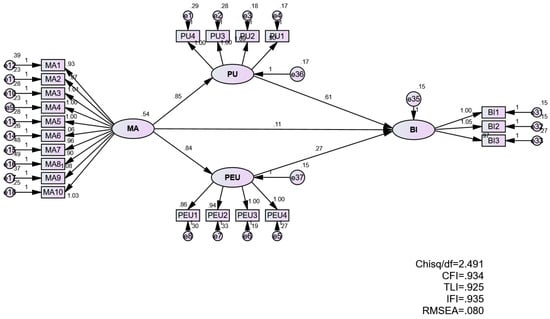
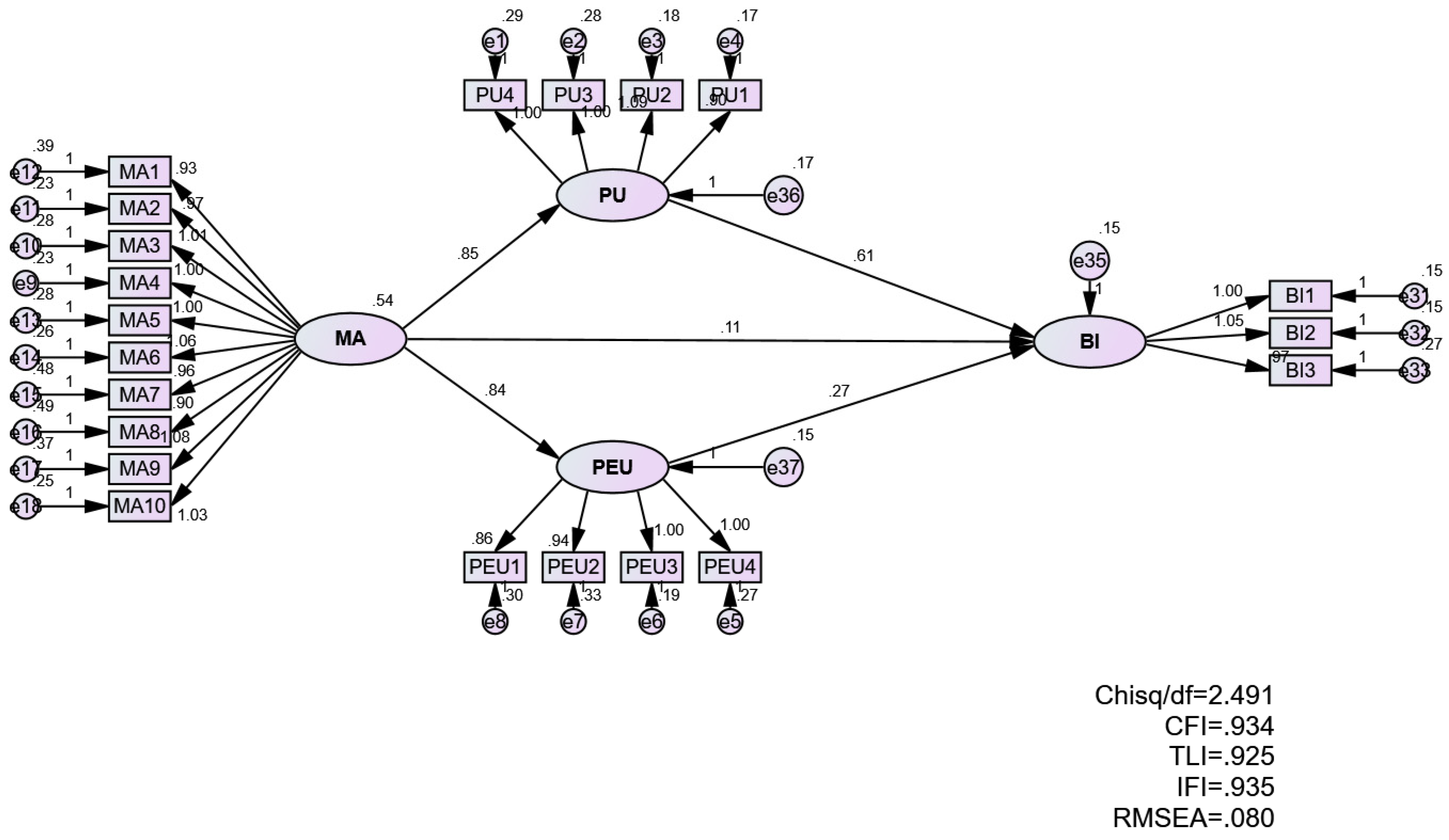
Figure 4 presents the unstandardized estimates of the structural model. The unstandardized estimates (B coefficients) represent the actual regression coefficients for the variables in the model. These coefficients are used in conjunction with the standard error (S.E.) for each variable to calculate the critical ratio (C.R.). The critical ratio is calculated by dividing the estimate (B coefficient) by the standard error (S.E.). The critical ratio is used to determine the statistical significance of each of the hypothesized relationships within the model. If the critical ratio for any given variable is greater than ±1.96, then it is significant at the 0.05 level of statistical significance (Awang, 2015).
Figure 4.
Unstandardized Estimates.
Structural Model Results and Mediation Analysis
Panel A: Direct Effects (Unstandardized estimates)
As shown in Table 4, the results revealed that metacognitive awareness had a significant positive effect upon the PU of AI tools (B = 0.854, C.R. = 12.395, p < 0.001), supporting Hypothesis 1. Such findings indicate that students who exhibit higher levels of metacognitive awareness tend to exhibit a perception of the usefulness of AI tools in the learning process.
Table 4.
Structural Model Results and Hypothesis Testing (Unstandardized Estimates).
Similar findings were also obtained in relation to the effect of metacognitive awareness upon the students’ perceptions of the ease of utilizing AI tools. The ease of using AI tools was found to be significantly influenced by the level of metacognitive awareness of the students (B = 0.843, C.R. = 12.510, p < 0.001), supporting Hypothesis 2. These findings suggest that students with higher levels of metacognitive awareness are also more likely to exhibit perceptions of AI tools as being easy to use.
However, metacognitive awareness was not significantly directly linked to students’ BI to utilize such AI tools. Instead, perceptions of the usefulness of AI tools were found to be significantly positively related to students’ BI to use such tools (B = 0.606, C.R. = 6.271, p < 0.001), supporting Hypothesis 4. These findings indicate that students exhibit higher levels of willingness to adopt AI tools into their learning processes if they believe in the usefulness of those tools.
Likewise, though to a lesser extent, the findings also suggest that PEU of those AI tools is positively related to the BI of students to utilize those tools (B = 0.268, C.R. = 2.594, p = 0.009), supporting Hypothesis 5. Thus, while students intend to utilize AI tools due to their ease of use, such an influence upon BI is less strong than that of the influence of the perception of usefulness of those tools upon such intention.
However, no significant relationship was found between the metacognitive awareness of students and their BI to utilize AI tools for learning. The calculated value of the C.R. for this relationship was less than 1.96, and the p-value for such a calculation was more than 0.05, indicating that Hypothesis 3 was not supported by the research findings. Thus, these results suggest that whereas metacognitive awareness influences the students’ perceptions of AI tools, such awareness has no direct influence upon the students’ intention to utilize those AI tools.
Overall, then, four of the five hypotheses were supported by the findings of the research study. The study’s findings suggest that metacognitive awareness has an important influence upon students’ perceptions of AI tools to be utilized in the classroom for learning purposes, but that other factors, such as the students’ perception of the usefulness and ease of use of those AI tools, also have significant influence upon the students’ BI to utilize such tools.
Panel B: Indirect Effects (Bootstrapping, Bias-Corrected)
4.4. Mediation Analysis
Panel B illustrates the indirect effects obtained through bootstrapping with confidence intervals. Bootstrapping helps to assess the indirect effects in mediation models and is often recommended for SEM models as it does not make assumptions of the normality of the data (Hair et al., 2019; Preacher & Hayes, 2008).
The results for Panel B demonstrate a significant indirect relationship between metacognitive awareness and BI through PU and PEU (B = 0.744, p < 0.001). The 95% bias-corrected confidence interval for the unstandardized indirect effect ranged from 0.510 to 1.076. Because the confidence interval did not include zero, the indirect effect was statistically significant.
Furthermore, because the direct relationship between metacognitive awareness and BI was not statistically significant, whereas the indirect relationship was significant, the findings are consistent with an indirect-only mediation pattern (X. Zhao et al., 2010). This pattern suggests that the relationship between metacognitive awareness and students’ behavioral intention to use AI tools operates primarily through their perceptions of the usefulness and ease of use of these tools.
However, these findings support the notion that the PU and ease of use of AI learning tools to enhance the educational experience play an important intermediary role in the relationship between metacognitive awareness and students’ intention to utilize these tools. Thus, these findings support the extension of the TAM with the inclusion of metacognitive awareness as a significant predictor of students’ BI to use these AI learning tools. Table 5 presents the results of the Indirect Effects.
Table 5.
Indirect Effects and Mediation Analysis (Bootstrapping, Bias-Corrected Confidence Intervals).
Overall, the findings indicate that metacognitive awareness is significantly related to students’ perceptions of the usefulness and ease of use of AI tools. Although metacognitive awareness was not directly associated with BI, it showed a significant indirect relationship with BI through PU and PEU.
5. Discussion
The study proposed and validated an extended TAM with the intention of investigating the influence of metacognitive awareness on the adoption of artificial intelligence (AI) tools by university students. Through the analysis of data from 236 participants who utilized structural equation modeling, the researchers were able to determine the cognitive factors that impact the BI of students to utilize AI tools in their education in the current age of generative AI. The results of this study indicate that metacognitive awareness was significantly associated with both PU of AI tools by students (B = 0.854, p < 0.001) and with PEU of those AI tools (B = 0.843, p < 0.001). Furthermore, as is typical of the TAM, it was also determined that both PU (B = 0.606, p < 0.001) and PEU (B = 0.268, p = 0.009) were significantly associated with students’ intentions to exhibit the behavior of adopting these AI tools. Overall, however, awareness was not found to have a direct effect on students’ intentions to adopt those AI tools (B = 0.110, p = 0.408), but did have a significant indirect effect upon such intentions (B = 0.744, p < 0.001). Thus, these results indicate that metacognitive awareness of AI tools by students fully mediates (though not directly) the relationship between these variables; metacognitive awareness does not directly impact students’ intentions to adopt AI tools, but instead influences those students’ perceptions of the usefulness and ease of use of those tools, leading to adoption of those artificial intelligence tools (Dahri et al., 2024; Kavitha & Joshith, 2025; Z. Zhao et al., 2025).
The strong influence of metacognitive awareness on both the PU and ease of use of AI tools suggests that metacognitive awareness is a primary “cognitive enabler” in human-AI interactions (Atchley et al., 2024; Mazari, 2025). Students with high levels of metacognitive awareness are able to recognize their learning needs and evaluate the capabilities of AI tools in relation to their learning needs and goals (Dahri et al., 2024; Mazari, 2025). Such awareness has been found to lead to an increase in the PU of those AI tools (Dahri et al., 2024; Sallai et al., 2024). Furthermore, the high coefficient of the path from metacognitive awareness to the variable of PEU indicates that metacognitively aware students are able to recognize the strategies that will minimize the perceived friction in using AI tools (Kim et al., 2025; Knoth et al., 2024; Federiakin et al., 2024). These students’ ability to effectively use strategies to plan their interactions with the AI systems and to monitor those interactions for effectiveness suggests that they find such complex systems to be easier to use and to require less mental effort to interact with (Kim et al., 2025; Knoth et al., 2024; Ren et al., 2025).
The fact that the direct effect of metacognitive awareness on BI is not significant also provides some insight into the nature of technology adoption. The results indicate that having high metacognitive awareness does not, on its own, lead to the intention to use AI technology (Dahri et al., 2024; Z. Zhao et al., 2025). While students may be aware of their cognitive processes and the potential power of AI tools, they will not adopt such technology if they do not believe in its usefulness for the specific task that they are performing, or if they do not believe in the benefit of utilizing such technologies relative to the effort that they must invest to use the technology (Alshammari et al., 2025; Z. Zhao et al., 2025). Thus, these findings help to support the “agency gap” among those who are tested in these studies (Jin et al., 2025; Sallai et al., 2024). Furthermore, these findings help to indicate the relationship between the two constructs altogether; while awareness of cognitive processes does not directly impact intention to use AI technology, intention is still dependent upon the constructs within TAM (Dahri et al., 2024; Kavitha & Joshith, 2025). Thus, this finding is significant in that it helps to separate the two constructs altogether and to indicate which is the source of the other (Mogaji et al., 2024; Z. Zhao et al., 2025).
The identification of full (indirect-only) mediation demonstrates how TAM can be extended from a model based upon perceptions to one that considers the cognitive processes that must occur within students before they make any decisions regarding using AI tools (Dahri et al., 2024; Mogaji et al., 2024; Z. Zhao et al., 2025). The internal regulatory pathway indicated in the model is the path that students use to decide whether or not to utilize AI (Dahri et al., 2024; Mazari, 2025). Furthermore, metacognition is the explanation for the intention of students to utilize AI tools for their research projects; it is the “how” and “why” behind their perceptions of the usefulness of and the ease of using such tools (Mazari, 2025). In research that utilizes AI tools with which the students are not yet familiar, metacognitive skills are the skills that students employ when evaluating the utility of those AI tools and their outputs (Atchley et al., 2024; Mazari, 2025). Thus, it is evident that the decision of students to utilize AI tools is based upon this internal self-regulatory process within themselves, which creates the perceptions of the usefulness and ease of using those AI tools (Jin et al., 2025; Ranade et al., 2025; Wang & Gao, 2025).
Regarding the traditional TAM relationships, it is evident from the results that the factor of PU has a stronger influence on the factor of BI than the factor of PEU (Alshammari et al., 2025; Yakubu et al., 2025). The coefficient for the influence of the factor of PU on the factor of BI was found to be (B = 0.606), while the coefficient for the influence of the factor of PEU on the factor of BI was (B = 0.268). Furthermore, these results are in agreement with previous studies during the 2020–2025 time period, which have indicated that students are more likely to exhibit utility-driven behaviors towards the adoption of generative AI systems (Knoth et al., 2024; Federiakin et al., 2024). Thus, students are willing to accept the difficulties and drawbacks of learning how to utilize these AI systems effectively, such as learning how to properly formulate questions or prompts for the AI to effectively understand and provide appropriate responses to their questions, as they value the utility of the knowledge that they can obtain from these systems themselves (Arroyo-Machado et al., 2025; Garcia, 2025).
6. Theoretical Implications
The present study also makes several important contributions to the existing literature on TAM and AI-enabled learning. First, the study helps to extend TAM by incorporating metacognition as a higher-order cognitive determinant that helps to extend TAM itself. While various extensions of TAM have focused upon aspects like affect, incentives, and social influence, this study helps to demonstrate that cognitive factors are also influential in the decision to adopt AI technologies.
Second, the identification of full (indirect-only) mediation contributes to the literature regarding TAM in that it helps to indicate the specific way in which cognitive factors impact the decision to adopt AI technologies. More specifically, the findings help to suggest that it is not the cognitive factors’ impact upon behavioral intentions that is important in the decision to adopt AI technologies, but instead the way that those cognitive factors impact the individual’s perceptions of the technology.
Third, the study also helps to contribute to the growing literature regarding AI and human interaction. AI technologies require the users to interact with the technology in ways that are different from most digital technologies; they must interact with the AI system in ways that are strategic and based upon the understanding of the possible interactions of those technologies with the AI itself. Thus, this study helps to find that the adoption of AI technologies is actually based upon the users’ ability to cognitively interact with those systems.
7. Practical Implications
The findings of this research have implications for higher education. For instance, these findings suggest that the metacognitive skills that students employ may be relevant to their perceptions of the usefulness and ease of use of AI tools. Therefore, universities may wish to incorporate discussions of metacognitive skills as part of their efforts to increase AI literacy among students. Such recommendations, however, are made without investigating whether developing these metacognitive skills would lead to improvements in the way that students use AI tools or learn from the information that those tools provide.
Second, the significant relationships between PU, PEU, and BI indicate that students’ perceptions regarding the usefulness and ease of use of AI tools for education are significantly associated with their behavioral intention to use these tools for educational tasks. Higher education institutions can aid students by exposing them to the educational value of these tools and by showing students how to interact with them, as MA was found to be significantly associated with both PU and PEU, which were subsequently associated with BI.
Furthermore, because PU was more strongly related to BI than PEU, the findings indicate that students’ perceptions of the educational value of AI tools may be more strongly associated with their intention to use these tools in their education than their perceptions of the ease of using these tools. Therefore, when higher education institutions introduce AI tools for education, they should consider the relevance of these tools to students’ education when seeking to encourage students’ acceptance of them.
Finally, these implications relate only to students’ perceptions of AI tools and their behavioral intention to use them rather than to the quality of students’ use of these tools. This study did not examine relationships between metacognitive awareness and the responsible and ethical use of AI tools, or between students’ perceptions of AI and the effectiveness with which they integrate AI tools into their educational tasks. Thus, further research is required regarding students’ actual use of AI tools and the quality and effectiveness of their use in educational tasks.
8. Limitations and Future Research
Despite the contributions of this study, there are several limitations to consider. The first limitation relates to the data collection site being limited to a single institution only. Thus, the findings of this study may not be generalizable outside of this particular institution. Future studies should aim to replicate the presented model with other universities from different countries.
A second limitation is the cross-sectional nature of this study. The cross-sectional design does not allow causal or temporal relationships among the constructs to be established. Future studies should employ longitudinal designs to examine how the relationships among metacognitive awareness, technology perceptions, and behavioral intention develop over time.
A third limitation concerns the use of self-reported data and the potential for common method bias. All constructs were measured using responses obtained from the same participants through a single questionnaire administered at one point in time. The use of a common source, measurement instrument, and administration occasion may have contributed to the relatively strong associations observed among some constructs. Therefore, common method variance cannot be ruled out as a potential influence on the observed relationships. Future research should address this limitation by using multiple data sources, temporally separated measurements, or behavioral measures of AI use alongside self-reported measures.
A fourth limitation relates to the focus of this study on metacognitive awareness as the cognitive antecedent. While the insights provided by focusing on this specific antecedent are helpful and valuable, other cognitive antecedents may also be considered for inclusion in future studies to provide a more comprehensive model of AI adoption.
Finally, the study operationalized AI acceptance through PU, PEU, and BI rather than through observed AI-use behavior. Although these constructs capture students’ perceptions of AI and their intentions to use it for learning, they do not indicate how frequently students actually use AI or whether such use is appropriate, effective, or meaningfully integrated into their learning. Consequently, the findings should not be interpreted as evidence of the frequency, quality, appropriateness, or effectiveness of students’ AI use. Future research should complement TAM-based acceptance measures with behavioral indicators of actual AI use and measures that capture the quality and effectiveness of AI integration into learning.
9. Conclusions
This study examined the role of metacognitive awareness in students’ acceptance of AI tools by extending the Technology Acceptance Model (TAM). The findings indicate that students’ behavioral intention to use AI tools is directly associated with their perceptions of the usefulness and ease of use of these tools. Perceived usefulness showed a stronger relationship with behavioral intention (β = 0.58), followed by perceived ease of use (β = 0.25), whereas the direct relationship between metacognitive awareness and behavioral intention was not statistically significant (β = 0.10). Metacognitive awareness was instead strongly and positively associated with perceived usefulness and perceived ease of use and showed a significant indirect relationship with behavioral intention through these technology perceptions.
Overall, the findings of this study show that metacognitive awareness is associated with students’ perceptions of AI technology rather than being directly associated with students’ intention to use AI for learning. Thus, the study helps to highlight how both the cognitive characteristics of students and their perceptions of AI technology are related to students’ intentions to use AI as a learning tool. Accordingly, by incorporating metacognitive awareness into the TAM, this research contributes to the existing literature on AI acceptance within higher education and provides a basis upon which future research can investigate the relationships among these various factors and students’ intentions to utilize generative AI within their learning contexts.
Author Contributions
Conceptualization, S.H.A., K.F.A. and E.J.A.-S.; Methodology, S.H.A. and K.F.A.; Software, S.H.A.; Validation, S.H.A.; Formal analysis, S.H.A., K.F.A. and E.J.A.-S.; Investigation, S.H.A. and E.J.A.-S.; Resources, S.H.A., K.F.A. and E.J.A.-S.; Data curation, K.F.A. and E.J.A.-S.; Writing—original draft, S.H.A., K.F.A. and E.J.A.-S.; Writing—review & editing, S.H.A. and K.F.A.; Visualization, S.H.A.; Supervision, S.H.A.; Project administration, S.H.A., K.F.A. and E.J.A.-S.; Funding acquisition, S.H.A. All authors have read and agreed to the published version of the manuscript.
Funding
This research received no external funding.
Institutional Review Board Statement
This study was conducted in accordance with relevant guidelines and regulations and adhered to the ethical standards of the institutional research committee and the 1964 Helsinki Declaration and its later amendments. The re-search protocol was reviewed and approved by the Research Ethics Committee (REC) at the University of Ha’il (Approval No.: H-2026-132; dated 28 April 2026).
Informed Consent Statement
Informed consent was obtained from all subjects involved in the study.
Data Availability Statement
The data that support the findings of this study are available from the corresponding author upon reasonable request.
Acknowledgments
The authors declare that no generative AI was used in the preparation of this manuscript.
Conflicts of Interest
The authors declare no conflicts of interest. The authors declare that they have no known competing financial interests or personal relationships that could have appeared to influence the work reported in this paper.
References
- Abdalla, R. A. (2024). Examining awareness, social influence, and perceived enjoyment in the TAM framework as determinants of ChatGPT personalization as a moderator. Journal of Open Innovation: Technology, Market, and Complexity, 10(3), 100327. [Google Scholar] [CrossRef] [Scilit]
- Adamakis, M., & Rachiotis, T. (2025). Artificial intelligence in higher education: A state-of-the-art overview of pedagogical integrity, artificial intelligence literacy, and policy integration. Encyclopedia, 5(4), 180. [Google Scholar] [CrossRef] [Scilit]
- Alshammari, S. H., Alrashidi, M. E., Alshammari, M. H., Alshammari, A. E. A., & Alkhwaldi, A. F. (2025). Determinants of student adoption of artificial intelligence applications in higher education. Scientific Reports, 15(1), 35921. [Google Scholar] [CrossRef] [Scilit] [PubMed]
- An, D., Ye, C., & Liu, S. (2024). The influence of metacognition on learning engagement the mediating effect of learning strategy and learning behavior. Current Psychology, 43(40), 31241–31253. [Google Scholar] [CrossRef] [Scilit]
- Arroyo-Machado, W., Ma, J., Chen, T., Johnson, T. P., Islam, S., Michalegko, L., & Welch, E. (2025). Generative AI and academic scientists in US universities: Perception, experience, and adoption intentions. PLoS ONE, 20(8), e0330416. [Google Scholar] [CrossRef] [Scilit] [PubMed]
- Atchley, P., Pannell, H., Wofford, K., Hopkins, M., & Atchley, R. A. (2024). Human and AI collaboration in the higher education environment: Opportunities and concerns. Cognitive Research: Principles and Implications, 9(1), 20. [Google Scholar] [CrossRef] [Scilit] [PubMed]
- Awang, P. (2015). SEM made simple: A gentle approach to learning structural equation modeling. MPWS Rich Publication. [Google Scholar]
- Baha, T., El Hajji, M., Es-Saady, Y., & Fadili, H. (2024). The impact of educational chatbot on student learning experience. Education and Information Technologies, 29(8), 10153–10176. [Google Scholar] [CrossRef] [Scilit]
- Beckman, K., Apps, T., Howard, S. K., Rogerson, C., Rogerson, A., & Tondeur, J. (2025). The GenAI divide among university students: A call for action. The Internet and Higher Education, 67, 101036. [Google Scholar] [CrossRef] [Scilit]
- Bentler, P. M., & Chou, C. P. (1987). Practical issues in structural modeling. Sociological Methods & Research, 16(1), 78–117. [Google Scholar] [CrossRef] [Scilit]
- Boomsma, A. (1982). The robustness of LISREL against small sample sizes in factor analysis models. In Systems under indirect observation: Causality, structure, prediction (pp. 149–173). North-Holland. [Google Scholar]
- Dahri, N. A., Yahaya, N., Al-Rahmi, W. M., Aldraiweesh, A., Alturki, U., Almutairy, S., Shutaleva, A., & Soomro, R. B. (2024). Extended TAM based acceptance of AI-powered ChatGPT for supporting metacognitive self-regulated learning in education: A mixed-methods study. Heliyon, 10(8), e29317. [Google Scholar] [CrossRef] [Scilit] [PubMed]
- Davis, F. D. (1989). Perceived usefulness, perceived ease of use, and user acceptance of information technology. MIS Quarterly, 13(3), 319–340. [Google Scholar] [CrossRef] [Scilit] [PubMed]
- Delcker, J., Heil, J., Ifenthaler, D., Seufert, S., & Spirgi, L. (2024). First-year students’ AI competence as a predictor for intended and de facto use of AI tools for supporting learning processes in higher education. International Journal of Educational Technology in Higher Education, 21(1), 18. [Google Scholar] [CrossRef] [Scilit]
- Federiakin, D., Molerov, D., Zlatkin-Troitschanskaia, O., & Maur, A. (2024). Prompt engineering as a new 21st century skill. In Frontiers in education (Vol. 9, p. 1366434). Frontiers. [Google Scholar]
- Fornell, C., & Larcker, D. F. (1981). Evaluating structural equation models with unobservable variables and measurement error. Journal of Marketing Research, 18(1), 39–50. [Google Scholar] [CrossRef] [Scilit]
- Garcia, M. B. (2025). ChatGPT as an academic writing tool: Factors influencing researchers’ intention to write manuscripts using generative artificial intelligence. International Journal of Human–Computer Interaction, 41(24), 15514–15528. [Google Scholar] [CrossRef] [Scilit]
- Hair, J. F., Babin, B. J., Anderson, R. E., & Black, W. C. (2019). Multivariate data analysis (8th ed.). Pearson. [Google Scholar]
- Henseler, J., Ringle, C. M., & Sarstedt, M. (2015). A new criterion for assessing discriminant validity in variance-based structural equation modeling. Journal of the Academy of Marketing Science, 43(1), 115–135. [Google Scholar] [CrossRef] [Scilit]
- Hughes, L., Malik, T., Dettmer, S., Al-Busaidi, A. S., & Dwivedi, Y. K. (2025). Reimagining higher education: Navigating the challenges of generative AI adoption. Information Systems Frontiers, 1–23. [Google Scholar] [CrossRef] [Scilit]
- Jin, Y., Yang, K., Martinez-Maldonado, R., Gašević, D., & Yan, L. (2025). The agency gap: How generative AI literacy shapes independent writing after AI support. arXiv, arXiv:2507.04398. [Google Scholar]
- Kavitha, K., & Joshith, V. P. (2025). Artificial intelligence-powered pedagogy: Unveiling higher educators. Journal of University Teaching and Learning Practice, 21(8), 1–34. [Google Scholar] [CrossRef] [Scilit]
- Ke, Q., Gong, Y., & Ke, C. (2025). Bridging AI literacy and UTAUT constructs: Structural equation modeling of AI adoption among Chinese university students. Humanities and Social Sciences Communications, 12(1), 1–13. [Google Scholar] [CrossRef] [Scilit]
- Kim, J., Yu, S., Lee, S. S., & Detrick, R. (2025). Students’ prompt patterns and its effects in AI-assisted academic writing: Focusing on students’ level of AI literacy. Journal of Research on Technology in Education, 58(3), 638–655. [Google Scholar]
- Kline, R. B. (2023). Principles and practice of structural equation modeling. Guilford Publications. [Google Scholar]
- Knoth, N., Tolzin, A., Janson, A., & Leimeister, J. M. (2024). AI literacy and its implications for prompt engineering strategies. Computers and Education: Artificial Intelligence, 6, 100225. [Google Scholar] [CrossRef] [Scilit]
- Kurtz, G., Amzalag, M., Shaked, N., Zaguri, Y., Kohen-Vacs, D., Gal, E., Zailer, G., & Barak-Medina, E. (2024). Strategies for integrating generative AI into higher education: Navigating challenges and leveraging opportunities. Education Sciences, 14(5), 503. [Google Scholar] [CrossRef] [Scilit]
- Lemke, C., Kirchner, K., Anandarajah, L., & Herfurth, F. N. (2023). Exploring the student perspective: Assessing technology readiness and acceptance for adopting large language models in higher education. In Proceedings of the 22nd European conference on e-learning (ECEL 2023). Academic Conferences and Publishing Limited. [Google Scholar]
- López-Galisteo, A. J., & Borrás-Gené, O. (2025). The creation and evaluation of an AI assistant (GPT) for educational experience design. Information, 16(2), 117. [Google Scholar] [CrossRef] [Scilit]
- Mazari, N. (2025). Building metacognitive skills using AI tools to help higher education students reflect on their learning process. Revista Humanismo y Sociedad, 13(1), 2. [Google Scholar] [CrossRef] [Scilit]
- Mogaji, E., Viglia, G., Srivastava, P., & Dwivedi, Y. K. (2024). Is it the end of the technology acceptance model in the era of generative artificial intelligence? International Journal of Contemporary Hospitality Management, 36(10), 3324–3339. [Google Scholar] [CrossRef] [Scilit]
- Obadă, D. R., Gradinaru, C., & Gradinaru, I. A. (2026). From understanding to influence: The interplay of AI literacy, self-efficacy, and trust in predicting communication students’ AI adoption and word-of-mouth. Frontiers in Communication, 10, 1722464. [Google Scholar] [CrossRef] [Scilit]
- Preacher, K. J., & Hayes, A. F. (2008). Asymptotic and resampling strategies for assessing and comparing indirect effects in multiple mediator models. Behavior Research Methods, 40(3), 879–891. [Google Scholar] [CrossRef] [Scilit] [PubMed]
- Ranade, N., Saravia, M., & Johri, A. (2025). Using rhetorical strategies to design prompts: A human-in-the-loop approach to make AI useful. AI & Society, 40(2), 711–732. [Google Scholar] [CrossRef] [Scilit]
- Ren, J., Guo, J., & Li, H. (2025). Linking digital competence, self-efficacy, and digital stress to perceived interactivity in AI-supported learning contexts. Scientific Reports, 15(1), 33182. [Google Scholar] [CrossRef] [Scilit] [PubMed]
- Sallai, D., Cardoso-Silva, J., Barreto, M., Panero, F., Berrada, G., & Luxmoore, S. (2024). Approach generative AI tools proactively or risk bypassing the learning process in higher education. LSE Public Policy Review, 3(3), 108. [Google Scholar] [CrossRef] [Scilit]
- Sanz-Tejeda, A., Domínguez-Oller, J. C., Baldaquí-Escandell, J. M., Gómez-Díaz, R., & García-Rodríguez, A. (2026). The impact of generative AI on academic reading and writing: A synthesis of recent evidence (2023–2025). Frontiers in Education, 10, 1711718. [Google Scholar] [CrossRef] [Scilit]
- Schmidt, D. A., AlBloushi, B., Thomas, A., & Magalhaes, R. (2025). Integrating artificial intelligence in higher education: Perceptions, challenges, and strategies for academic innovation. Computers and Education Open, 9, 100274. [Google Scholar] [CrossRef] [Scilit]
- Sudaryanto, M. R., Hendrawan, M. A., & Andrian, T. (2023). The effect of technology readiness, digital competence, perceived usefulness, and ease of use on accounting students artificial intelligence technology adoption. In E3S web of conferences (Vol. 388, p. 04055). EDP Sciences. [Google Scholar]
- Tuononen, T., Hyytinen, H., Räisänen, M., Hailikari, T., & Parpala, A. (2023). Metacognitive awareness in relation to university students’ learning profiles. Metacognition and Learning, 18(1), 37–54. [Google Scholar] [CrossRef] [Scilit]
- Vieriu, A. M., & Petrea, G. (2025). The impact of artificial intelligence (AI) on students’ academic development. Education Sciences, 15(3), 343. [Google Scholar] [CrossRef] [Scilit]
- Wahdah, S. I., Kurniawan, R. Y., & Irawan, N. (2025). Adoption of ChatGPT in higher education: Insights from the Unified Theory of Acceptance and Use of Technology model. Indonesian Journal on Learning and Advanced Education, 7, 312–327. [Google Scholar] [CrossRef] [Scilit]
- Wang, H., & Gao, C. (2025). AI utilization, enjoyment, trust and instructor competence as predictors of intercultural communication competence among Chinese students. Scientific Reports, 15(1), 45117. [Google Scholar] [CrossRef] [Scilit] [PubMed]
- Widodo, D. S., Rachmawati, D., Wijaya, H., Maghfuriyah, A., & Udriya, U. (2024). AI adoption in higher education institution: An integrated TAM and TOE model. Dinasti International Journal of Education Management & Social Science, 6(2), 1029–1039. [Google Scholar] [CrossRef] [Scilit]
- Wolf, E. J., Harrington, K. M., Clark, S. L., & Miller, M. W. (2013). Sample size requirements for structural equation models: An evaluation of power, bias, and solution propriety. Educational and Psychological Measurement, 73(6), 913–934. [Google Scholar]
- Yakubu, M. N., David, N., & Abubakar, N. H. (2025). Students’ behavioural intention to use content generative AI for learning and research: A UTAUT theoretical perspective. Education and Information Technologies, 30(13), 17969–17994. [Google Scholar] [CrossRef] [Scilit]
- Yu, T. (2018). Examining construct validity of the student online learning readiness (SOLR) instrument using confirmatory factor analysis. Online Learning, 22(4), 277–288. [Google Scholar] [CrossRef] [Scilit]
- Zhao, X., Lynch, J. G., Jr., & Chen, Q. (2010). Reconsidering Baron and Kenny: Myths and truths about mediation analysis. Journal of Consumer Research, 37(2), 197–206. [Google Scholar] [CrossRef] [Scilit]
- Zhao, Z., An, Q., & Liu, J. (2025). Exploring AI tool adoption in higher education: Evidence from a PLS-SEM model integrating multimodal literacy, self-efficacy, and university support. Frontiers in Psychology, 16, 1619391. [Google Scholar] [CrossRef] [Scilit] [PubMed]

Disclaimer/Publisher’s Note: The statements, opinions and data contained in all publications are solely those of the individual author(s) and contributor(s) and not of MDPI and/or the editor(s). MDPI and/or the editor(s) disclaim responsibility for any injury to people or property resulting from any ideas, methods, instructions or products referred to in the content. |
© 2026 by the authors. Licensee MDPI, Basel, Switzerland. This article is an open access article distributed under the terms and conditions of the Creative Commons Attribution (CC BY) license.