


Abstract
This study explores pre-service teacher (PST) wellbeing and resilience as they transition into their first year in a university-based initial teacher education (ITE) programme, with a focus on how institutional, pedagogical, and relational supports facilitate this transition. Using a mixed-methods approach, data were collected from the 2024 cohort of PSTs through the Hua Oranga and Cantril wellbeing scales, the Professional Quality of Life Scale (ProQOL-5), Ego-resiliency Scale (ER89), and focus group interviews. PSTs reported a strong sense of wellbeing, resilience, and belonging, particularly in relation to culturally grounded frameworks, peer and academic relationships, and university support services. Three themes emerged from the qualitative analysis: (1) intentional programme design supporting wellbeing; (2) practicum as a source of stress and resilience; and (3) pedagogical and peer relational elements of the Higher Education (HE) experience. The findings suggest that a value-based approach to programme design and the use of relational pedagogies may foster resilience as PSTs manage institutional expectations and challenges.
1. Introduction
Transitioning into Higher Education (HE) is challenging and creates a significant change in the lives, images, and learning of undergraduate pre-service teachers (PSTs) (Milliken et al., 2021). This transition is often accompanied by academic, cultural, and professional shocks. Many students enter teacher education without prior knowledge of, or identification with, teaching as a profession and they experience stress due to the competing demands of family and work. Understanding how to support the wellbeing of PSTs during this crucial transitional time can help inform programme design, specific teaching approaches that support student–teacher relationships, and institutional supports. The literature highlights the importance of such approaches in promoting care, supporting learning, and strengthening PSTs’ relationships during this critical period of transition (Gravett & Winstone, 2020).
2. Literature Review
2.1. Wellbeing and Resilience
Wellbeing is widely recognised as a dynamic and multidimensional construct that encompasses an individual’s physical, mental, and psychological states, as well as capacity to balance life’s challenges with available resources (Squires et al., 2022). More recently, the concept of resilience has been highlighted in relation to wellbeing, particularly considering its potential benefits for teacher wellbeing (Hascher et al., 2021).
Resilience is understood as the capacity to draw upon internal and external resources, psychological strengths, coping strategies, and supportive networks to adapt positively in the face of adversity (Jin et al., 2025). Mansfield et al. (2016) consider resilience as an important strength of PSTs, and defined resilience as the capacity to sustain positive attributes, professional commitment, and ongoing growth while navigating the challenges, pressures, and demands inherent in the daily responsibilities of teaching.
The capacity to maintain wellbeing and respond resiliently to professional challenges is considered a significant attribute for PSTs, particularly when they face adversity (Mansfield et al., 2016). Resilience skills can be developed through emotional regulation, nurturing supportive relationships, and engaging in practices that promote reflective thinking. Research suggests that PSTs who demonstrate resilience are more likely to endure challenging circumstances, adapt more effectively to change, and are ultimately less likely to consider leaving the profession (Olsen, 2017).
2.2. Transition to Higher Education
The process of transitioning into HE is a period of change between two relatively stable educational phases. It represents a significant shift in a student’s life, self-image, and learning as it represents a movement from one level of comprehension, growth, and maturity to another (Milliken et al., 2021). This change is often seen as significant by those involved in students’ educational journeys. Yong et al. (2026) identified four key factors that support new students’ sense of belonging and wellbeing: academic, social, environmental, and personal space. Framing transition to HE through these localised factors shifts the understanding from a neutral academic adjustment to a complex psychosocial process shaped by students’ cumulative emotional and environmental stressors. Students navigating cultural transitions may be especially vulnerable as they reconcile differing values and norms. In the context of New Zealand, these transitions have been intensified by ongoing disruptive events such as earthquakes (2011), mass shooting incidents (2019), COVID-19 pandemic restrictions and lockdown (2020–2022), and more recent political movements such as the national hikoi [political demonstration] in response to the New Zealand Parliament’s Principles of the Treaty of Waitangi Bill (2024, 94-1). Indeed, these events may well have significant impact on the transition to HE for the cohort of PSTs in this study.
Transitions to HE can be managed through self-care and balancing personal resources and challenges. Felby and Ashwin (2026) indicate the need for orientation programmes, early academic interventions, and advising new-to-HE students to adjust successfully. The assumption of this wellbeing approach is that the students must adjust to the institution, without suggesting that the institution should create an environment that does not diminish a student’s wellbeing. While effective support systems can alleviate some of the stress to wellbeing, this study is also interested in what we can do programmatically to proactively mitigate that stress.
3. Methods
This mixed-methods study draws on social constructionist and post-structuralist theoretical perspectives. Recognising that “learning and understanding are regarded as inherently social; and cultural activities and tools (ranging from symbol systems to artefacts to language) are regarded as integral to conceptual development” (Palincsar, 1998, p. 348), our theoretical positioning calls for interpretation of PSTs’ experiences.
Situated within the bicultural context of Aotearoa New Zealand, this study is guided by the Hua Oranga theoretical framework (McLachlan, 2022). The selection of Hua Oranga reflects the Māori principles that informed the co-construction of our ITE programme (Fickel et al., 2018) and aligns with the cultural values underpinning our teaching practice. Derived from the Māori model of wellbeing, Te Whare Tapa Whā (Durie, 1994), Hua Oranga conceptualises wellbeing holistically through four interconnected dimensions: taha wairua (spiritual), taha hinengaro (mental and emotional), taha tinana (physical), and taha whānau (family and social wellbeing). This framework emphasises balance among these dimensions, making it appropriate for this study’s holistic understanding of wellbeing within a distinctly Aotearoa New Zealand context.
The focus of this article is to understand the nature of, and supports for, PST wellbeing and resilience during their transition to university by posing the following research questions:
- How do PSTs perceive their wellbeing and resilience within their initial teacher education (ITE) programme?
- What strategies do PSTs employ to maintain their wellbeing?
- In what ways can the university intentionally mitigate the stress that jeopardises PSTs’ wellbeing?
3.1. The Context of the Study and Participants
This study was administered at a large, campus-based metropolitan university in New Zealand. A convergent mixed-methods design guided data collection (Creswell & Creswell, 2023). This study reports the results of the Educational Resilience and Wellbeing Survey and focus group interviews conducted in semester two of the first year of the degree for the 2024 cohort. Ethics approval for the study was granted by the Educational Research Human Ethics Committee (2023/116/ERHEC). All PSTs in the cohort were invited to participate, and those who did provided informed consent. To ensure confidentiality, all data were anonymised and pseudonyms were used in reporting.
3.2. Data Collection and Analysis
3.2.1. Educational Resilience and Wellbeing Survey
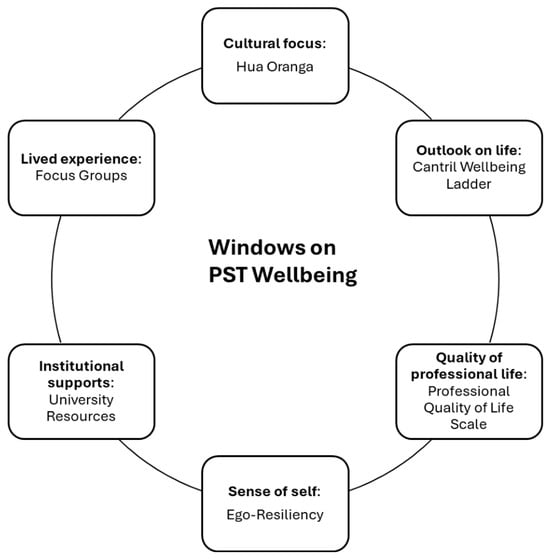
This survey consisted of six sections: (1) demographics; (2) Hua Oranga wellbeing; (3) Cantril wellbeing; (4) Professional Quality of Life (ProQOL-5); (5) Ego-resiliency (ER89); and (6) Supports for wellbeing at the university. Figure 1 shows how the data collection protocol creates a comprehensive approach to examining the cultural, life outlook, professional, sense of self, institutional, and lived experience aspects of the PSTs’ wellbeing. The survey was administered using Qualtrics, a secure online platform. Participants accessed the survey via a unique link and responses were recorded anonymously to maintain confidentiality.
Figure 1.
Windows on PST wellbeing.
3.2.2. Demographics and Representativeness
To assess the representativeness of the participant subsample relative to the full 2024 PST cohort, a chi-square test of independence was conducted across key demographic variables: ethnicity, gender, age, enrolment status, programme enrolled in, and study option at the time of the survey. No statistically significant differences were found: χ2 (1, N = 185) = 0.060, p = 0.807. Due to low expected cell counts, Fisher’s Exact Test was also applied, confirming no significant association (p = 0.730 (two-sided)). These results indicate that the participant subsample is statistically comparable to the full cohort. Most participants were domestic, female, aged 18–21, enrolled in the primary endorsement, studying on campus, and identified as New Zealand European (Table 1).
Table 1.
Demographics of the survey population and the full cohort.
3.2.3. Hua Oranga Wellbeing
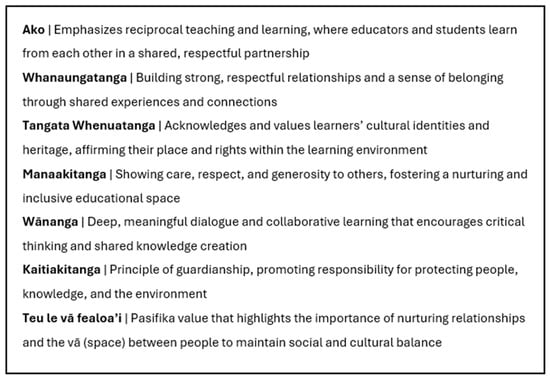
As teacher educators in New Zealand, our work is grounded in the bicultural context of our nation. Accordingly, our ITE programme was co-constructed using Māori principles (Fickel et al., 2018). To align with this foundation, we selected Hua Oranga (McLachlan, 2022) as a wellbeing instrument that reflects cultural values embedded within our teaching practice (Figure 2).
Figure 2.
Cultural values of the ITE programme.
Hua Oranga is a culturally grounded tool widely used in New Zealand health contexts (e.g., Harwood et al., 2012; McLachlan, 2022). Based on a Māori model of health and wellbeing, it assesses four interrelated taha [dimensions]: Taha Tinana (physical); Taha Wairua (spiritual); Taha Hinengaro (mental and emotional) and Taha Whānau (social). Each taha comprises four items, rated on a five-point Likert scale from (1) strongly disagree to (5) strongly agree. Subscale scores for each taha range from 4 to 20 and are categorised as: very low (4–8), low (9–12), high (13–16), or very high (17–20). The overall Hua Oranga score, calculated by summing all four taha, results in an overall wellbeing scale: very low (16–32), low (33–48), high (49–64) and very high (65–80), with higher scores indicating more positive wellbeing.
3.2.4. Cantril Wellbeing Ladder Scale
Cantril’s Self-Anchoring Striving Scale (Cantril, 1965) is a widely used two-item visual tool for assessing life satisfaction, anchored by participants’ perceptions of their best and worst possible life circumstances (Bjørnskov, 2010). Used in over 140 countries via the Gallup World Poll (Nilsson et al., 2024), participants view a ladder representing life from 0 (worst) to 10 (best) and indicate their current position and expected position in five years. These scores form the Life Evaluation Index (Marken, 2021), categorising individuals as: (1) thriving where current life is rated at 7 or above and their future life at 8 or above, indicating strong, consistent and improving wellbeing; (2) suffering where current and future life is rated at 4 or below, suggesting significant risk to wellbeing; and (3) struggling where all other score combinations fall into this category, reflecting moderate or inconsistent wellbeing, with neutral or uncertain perspectives on current and future life.
3.2.5. Professional Quality of Life Scale (ProQOL-5)
ProQOL-5 is a 30-item self-report instrument designed to assess the positive and negative perceptions of quality of life experienced in professional roles (Stamm, 2010). In the context of this study, the focus is the work of PSTs. The ProQOL-5 is a widely used and validated measure, with strong structural validity and extensive reporting in the peer-reviewed literature (Stamm, 2010, 2016).
The instrument evaluates two overarching dimensions of professional wellbeing: the positive aspect as compassion satisfaction (CS), and the negative aspect as compassion fatigue (CF). Compassion fatigue is further divided into two components: secondary traumatic stress (STS) and burnout (BO). The survey comprises three subscales for CS, STS, and BO, each consisting of 10 items rated on a 5-point Likert scale. Stamm (2010) defines CS as the pleasure derived from performing one’s job well and making a positive impact in the workplace and society. STS refers to the emotional impact of exposure to others’ trauma, which may result in preoccupation with thoughts of people you have helped. BO reflects the negative consequences of sustained caring, including feelings of hopelessness, detachment, and diminished sense of accomplishment. The total score for each subscale indicates the level of risk value. A score of ≤22 indicates low level; 23–41 indicates medium level, and ≥42–90 indicates high level.
3.2.6. Ego-Resiliency (ER89) Scale
The Ego-resiliency (ER89) scale, developed by Block and Kremen (1996), is a 14-item self-report instrument designed to measure ego-resiliency in community contexts. This survey examines the dynamic ability of individuals to maintain a stable sense of self while adapting to changing environments and managing stress and trauma. Each item is rated on a 4-point Likert scale, ranging from 1 (does not apply at all), to 4 (applies very strongly), with higher scores indicating greater levels of ego-resiliency. The ER89 has become a well-established and widely used measure of psychological resilience with strong construct validity (Windle et al., 2011) and good internal reliability (Prince-Embury et al., 2015).
3.2.7. University Supports for Wellbeing
The survey presented participants with a list of 22 supports or services at the university. These were grouped into three categories: academic supports (e.g., student advisors, lecturers, library, ICT services); emotional supports (e.g., Medical Centre, Student Care, class representatives); and social supports (e.g., Students Association, Recreational Centre). Participants were asked to rate the effectiveness of each service using a 6-point Likert scale from (1) not effective to (5) strongly effective, or (6) does not apply to me.
3.3. Focus Group Interviews
PSTs were invited to participate in small (≤6 participants), one-hour semi-structured focus groups conducted either face-to-face or via Zoom, grouped by programme endorsement to encourage peer interaction and shared reflection. This design allowed participants’ perspectives to emerge through dialogue (Billups, 2021) with the interviewer facilitating and adapting the process as needed. In total, 16 focus groups were conducted with a total of 49 PSTs.
Interviews began with introductions and a reminder that the space was confidential and respectful. The facilitator allowed participants to engage in conversation about their experience in the programme. Questions focused on three areas: values embedded in the programme, identity development, and perspectives on resilience and wellbeing. For the latter, participants were asked to reflect on a challenging moment during their studies, how they managed their wellbeing, and how peers supported their wellbeing and teacher identity.
Each interview was recorded, transcribed verbatim, and anonymised. Transcripts were analysed using a reflexive thematic analysis (RTA) (Braun & Clarke, 2019) supported by NVivo 15. Inductive coding was guided by the research questions and informed by the researcher’s contextual knowledge. This RTA approach (Braun & Clarke, 2019) requires theoretical awareness and transparency throughout the analytic process. In this study, the researcher who coded the interview data engaged in a reflective and iterative coding process, informed by their understanding of institutional structures, programme design, and the relational dynamics between PSTs and their learning environments.
4. Results
4.1. Survey Analysis
4.1.1. Hua Oranga
PST scores across the Hua Oranga measure revealed most participants reported high (scores of 13–16) and very high (scores of 17–20) levels of wellbeing across all four taha (Table 2). The overall Hua Oranga score indicates that 88% of PSTs report high and very high wellbeing. As the data were not normally distributed (Shapiro–Wilk test), the Kruskal–Wallis test was used to determine any statistical differences between the four elements of the survey and programme endorsement, campus location, gender, ethnicity and age. No statistically significant differences were identified between these groups at the p < 0.05 level.
Table 2.
Hua Oranga self-evaluation.
4.1.2. Cantril Wellbeing Ladder
The average positioning on the Cantril scale was 7.5 (SD = 1.6, n = 40) and projecting to five years’ time the average step was 9.3 (SD = 1.4, n = 40) indicating PSTs were thriving and had high hopes for their future and wellbeing. This result is very similar to the reported result for New Zealand at 7.3 from the Gallup World Poll data pooled from 2008 to 2017 (Blanchflower & Bryson, 2024).
One-way ANOVA was used to explore relationships between programme endorsement, campus location, gender, ethnicity, and age and participants’ Cantril wellbeing scores. There was no significant difference identified at the p < 0.05 level across the dependent variables. The PSTs’ outlook indicates a high degree of hope and correlates well with the views on being a teacher, for example the positive items from the ProQOL-5 survey, “I am happy that I chose to be a teacher” (M = 4.72, SD = 0.55) and “I believe I can make a difference through my work as an educator/teacher candidate” (M = 4.49, SD = 0.82). This view aligned with their perceptions about becoming a teacher, when students responded to the prompt “I feel excited about teaching in Aotearoa NZ” which was very highly scored (M = 3.72, SD = 0.51).
4.1.3. ProQOL-5 Survey
Table 3 shows that PSTs (n = 40) reported a high level of compassion satisfaction (CS; M = 41.33, SD = 5.69) and moderate to low compassion fatigue, reflected in burnout (BO; M = 22.18, SD = 4.11) and secondary traumatic stress (STS; M = 19.55, SD = 4.39). A high level of CS, accompanied by moderate to low levels of BO and STS, can be interpreted as the most positive result to expect on this instrument. This indicates that the PSTs receive positive reinforcement from their ITE experiences, with few reporting concerns about being hindered, or feeling ineffective in their work.
Table 3.
PSTs’ Scores on ProQOL-5 (n = 40).
A one-way ANOVA was used to examine the influence of programme endorsement, campus location, gender, ethnicity, and age of the participants on the ProQOL-5 scores. No significant differences were found across the dependent variables, except for burnout (BO), which differed significantly by campus location, F(1, 38) = 4.35, p = 0.044. The analysis indicated that students studying by distance reported higher BO scores than students located on campus. The effect size for BO was moderate to large ( = 0.103), suggesting that location accounted for a meaningful proportion of the variance in BO scores. However, relatively small group sizes warrant caution in interpreting this finding as they increase uncertainty about whether the effect is real. Further analysis of the questions within the BO subscales identified three statements that showed a significant difference between these two groups.
The first, “I am becoming the teacher I want to be” (F(1, 38) = 8.98, p = 0.005, reversed item), indicates that distance learners feel less often that they are becoming the teachers they want to be, suggesting distance learners may feel less supported or connected compared to campus learners. The second question, “I feel worn out because of my helping of others” (F(1, 37) = 4.70, p = 0.037), shows distance learners report higher scores suggesting greater emotional fatigue that may be reflective of distance study factors such as isolation, workload, or lack of immediate support. This was supported by a third question, “I feel trapped by my work as an educator/teacher candidate” (F(1, 38) = 3.26, p = 0.078), which although marginally significant, suggests the location of study (campus or distance) may influence BO with distance students reporting slightly higher scores.
4.1.4. Ego-Resiliency (ER89)
The scores for each of the ER89 items are presented in Table 4. The mean score was 41.38 (SD = 5.95) suggesting high resilience on this instrument. A one-way ANOVA was used to explore the relationships between ER89 scores and programme endorsement, campus location, gender, ethnicity, and age. No statistically significant differences were identified across these variables at the p < 0.05 level.
Table 4.
PSTs’ scores on ER89.
4.1.5. Intercorrelations
Intercorrelations (Table 5) show that the Hua Oranga subscales are strongly interrelated, supporting their use as a unified wellbeing measure and indicating that physical, spiritual, mental, and family wellbeing are deeply interconnected. This interconnectedness of the taha affirms the cultural relevance of the measure for PSTs within this ITE programme.
Table 5.
Scale intercorrelations.
Ego-resiliency is also positively correlated with all Hua Oranga subscales and positively correlated with compassion satisfaction (ProQOL-5), suggesting resilient individuals tend to report stronger wellbeing. From prior studies using ProQOL-5 (Stamm, 2010), we also know that resilient individuals may find more meaning in their work, even in challenging environments.
4.1.6. University Supports
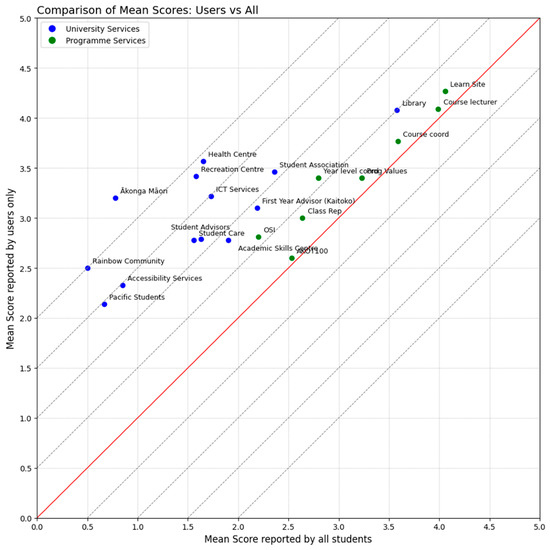
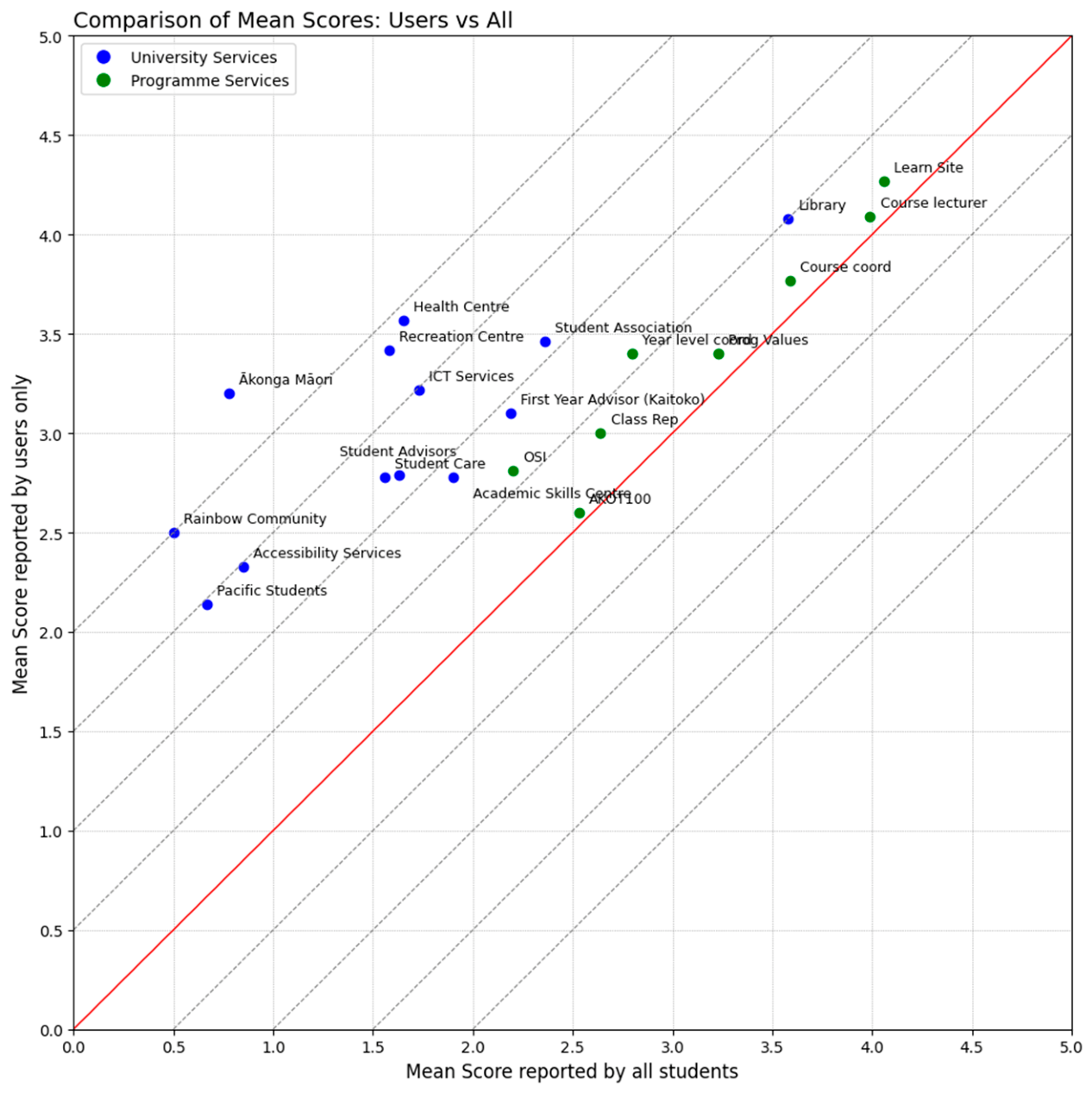
To assess the direct and indirect value of various university supports, a weighted usefulness score was calculated for each, comparing user ratings with those of the full student cohort (Figure 3). In the scatter plot, the equality line represents equal perceived effectiveness by users and non-users. Services above this line are rated more highly by users, suggesting that direct experience increases perceived value. The vertical distance from the line indicates the gap between actual and perceived effectiveness, offering insight into the impact of support use.
Figure 3.
Comparison of weighted usefulness scores for university supports for users and non-users.
Several targeted supports (e.g., Ākonga Māori, Rainbow Community, Pacific Student, and Accessibility Services) received low overall scores due to limited engagement but were rated highly by users. This suggests under-representation rather than ineffectiveness. Students who used these services reported positive experiences. Notably, no service fell below the equality line, reinforcing that engagement with support services correlates with perceived effectiveness.
Programme-specific services such as course lecturers, the Moodle learning management platform, course coordinators, and programme values were consistently rated highly by users, reflecting their core role in academic support. Among university-wide services, only the library received similarly high ratings. Others, like the student association, first-year advisors, and academic skills centre, were seen as somewhat effective but had lower overall scores, suggesting under-use, possibly due to limited awareness or perceived relevance, with students only engaging these services primarily in response to specific needs.
4.2. Focus Group Analysis
In alignment with the convergent mixed-methods design (Creswell & Creswell, 2023), focus group data and questionnaire data were collected and analysed in parallel, with each dataset informing the other. The focus group data were analysed using an RTA approach in NVivo15. Three key themes emerged from this analysis, as shown in Table 6: Institutional Systems, Networks of Care, and Personal Wellbeing. Together, these themes illustrate complementary aspects of the PSTs’ wellbeing and resilience, with Networks of Care and Personal Wellbeing reflecting individual and relational dimensions of wellbeing within the broader context of their HE experiences (Institutional Systems).
Table 6.
Key themes from focus group analysis with corresponding challenge and strategy sub-codes.
The themes were constructed from a set of subthemes that emerged from the RTA. Frequencies and percentages of these subthemes are reported in Table 6 to illustrate the relative prominence of each subtheme. A coded reference represents an instance in which a participant discussed a topic during a focus group discussion. Subthemes were further coded in terms of how the PST talked about the theme in the focus groups, as either a challenge they faced or a strategy they used. Percentages were calculated as a proportion of all coded references within the challenge and strategy datasets, respectively. Each key theme is discussed in turn.
Data in the first theme, Institutional Systems, consistently made reference to how the university curriculum and assessment practices set expectations that the PST felt they needed to adjust to. Comments about managing workload, adjusting to academic demands, and balancing workload with personal life were the most frequently discussed challenges across the corpus of data in the focus groups. Participants commonly highlighted the academic demands that created periods of intense assessment work in short periods of time, as well as the need to adapt to teaching and learning environments that sometimes felt impersonal. These institutional factors were described as having a substantial influence on students’ wellbeing and learning experiences.
Given that the students in this study are entering the teaching profession, these institutional elements included the professional practice placements in schools, which created another set of learning environments and relationships that the PSTs needed to navigate. Table 6 shows that a good proportion (19%) of the challenges identified by the PSTs within this theme were related to professional practice placements. For example, Jackie said:
On our last placement I was feeling quite overwhelmed to the point where I was going to drop out. I was done. …But I think, after having conversations with my AT [Associate Teacher] and my PPL [university Professional Practice Lecturer], I was reassured that I’m still learning. I don’t have to be perfect and if I make a mistake, it’s that thing of reflecting and ‘how could I be better next time?’
This quote highlights the extreme set of emotions that accompany a feeling of being overwhelmed as well as how Jackie was able to draw on university supports (school and university staff) to regain her sense of wellbeing and reassure her that she is on the right track for successful learning.
Similarly, Charlotte said that she “found the placement quite stressful because of having to organise my life around it more than the actual placement … I stress[ed] about having to be there for like 40 h a week plus doing everything else that I’m having to do.” In both these examples, the PSTs felt the intensity of the dual role of being a student and a teacher in the professional work environment. These dual roles and sets of expectations create high learning demands on the students, and they seek support for not only coping with the expectations, but also for being successful as both students and teachers. From Table 6, we can see that strategies for coping with these institutional expectations came from both the programme design features such as relational learning opportunities through peer groups and mentoring as well as university services that offer academic skill development and other health and wellbeing management supports. As Figure 3 indicates, the survey results also show that programme-specific academic supports such as the availability of course lecturers, the learning management platform, and programme values are highly rated university support mechanisms for the PSTs’ quest for academic success.
The second key theme is Networks of Care. The PSTs reported that they managed the challenges they experienced through networks of care that they established through relationships with academic staff, peers, and in their personal relationships. Table 6 shows the coded references for this theme were weighted more heavily towards strategies rather than challenges, as we saw in the Institutional systems theme. Peer relationships are the most frequently noted strategic support for wellbeing and learning (29% of all coded references for strategy) with academic faculty being identified as the third most frequent support strategy (14%) identified in the overall focus group data.
The following quote from Talia illustrates the nature of the comments made by participants who discussed the important role of relationships in managing the wellbeing and resilience of the PSTs:
I couldn’t do it if I was just in it for me. No way. There are so many other people that stand behind what we’re doing. Whether that’s just our whānau [family], community, the children that we’re going in for. There’re so many people behind our decisions of education. …It’s that whole interactive thing we get from our lecturers. We all play a big role in each other’s lives in our cohort.
From Talia’s perspective, she is not alone in her academic endeavours to become a teacher. She sees herself as part of a larger ecosystem of people and communities, including the educational purposes of the work of a teacher. This dominance of the social dimensions of the HE transition is also represented in the Hua Oranga results (Table 2). The taha Whānau (Social wellbeing) scale, which includes elements of belonging within whānau and community, rates the highest (16.95) of the four taha.
Another example from the focus group data related to the network of care theme comes from Emma, a PST learning through distance study. Emma echoed Talia’s sentiment of a feeling of collective purpose while also amplifying the profound sense of connection that made a difference for her wellbeing:
I think, not just within my study group, but within the cohort, the relationships that we’ve built and the things that we’ve learned and, not just the things we learn from each other, but that we support each other is so important to actually get through it. … there’s just little things and big things that being able to have that connection while being a distance student has been so priceless, really.
Emma’s comment highlights the importance of programme’s intentional design, particularly the use of study groups as a mechanism for fostering peer learning and support. These forms of peer support are also reflected in the network of care strategy coding. Emma’s reflections illustrate how these relationships contribute to a sense of connection and belonging, despite the potential isolation associated with distance study. However, there may be another aspect to this form of support. In the ProQOL-5 survey results (Table 3 and Table 4), the Burnout factor for students studying more independently in the distance occurrence of the programme showed a significantly higher score than for the students who were studying on campus. Earlier, this result was interpreted in the context of responses to the question “I feel worn out because of my helping of others” which also had higher scores for distance students than for campus students. The additional support that students studying from a distance provide for each other may also be a source of burnout and fatigue, especially if they are relying on each other due to isolation and more limited access to lecturers in a face-to-face learning environment.
The third theme that emerged was related to the PSTs’ proactive stances toward their Personal Wellbeing. The sub-themes speak to health and emotional regulation and self-management and the coded references are stronger in the strategy category than in the challenge category. PSTs reported that their personal health (physical and emotional) was affected by academic and personal pressures, and they actively sought ways to manage these pressures. Olivia summed up this stance by saying:
…throughout the year I realised that it’s super important to put my wellbeing first, I do get really stressed about assignments there was probably one moment that in a class in one of our courses… I had a realisation that I can’t do a good job at anything else if I don’t prioritise how I’m feeling and prioritise doing things that make me happy… I think when I was in a pit I realised if I don’t go outside and I don’t do exercise and I don’t have good social interactions with people and I don’t eat well, …it’s reflected in everything and so I’ve realised how important it is to take care of myself.
This awareness of how her own wellbeing matters and clear knowledge of strategies for what she can do to self-manage is reflective of the strong scores on all four Hua Oranga wellbeing taha and their interconnectedness with one another. Olivia’s comment is also illustrative of the resiliency of the PST participants in this study, which is strongly correlated to the Hua Oranga elements (Table 5). The source of this resiliency may lie in this self-knowledge and ability to self-regulate.
5. Discussion
This multi-window analysis of PSTs’ wellbeing and resilience reveals consistently positive reports on the New Zealand cultural framework, on their outlook on life, on the quality of their professional life as teachers, on their sense of self and resiliency, and on how they access and use the institutional supports available through the university. These are comforting results, especially given this cohort’s shared history of trauma, including earthquakes, a terrorist attack, the pandemic, and socially divisive political issues such as the Treaty Principles Bill. Focus group insights on lived experience within the ITE programme add nuance, highlighting the lived challenges of transitioning into HE and managing wellbeing.
Three discussion themes emerge from these results: the intentionality of the programme design that supports student wellbeing, the PST practicum experience as a source of stress and resilience, and the pedagogical and peer relational elements of the HE experience during this time of transition. These themes shed light on our three research questions.
5.1. Intentionality of Programme Design
Intentionality is a dynamic process that reveals the values, beliefs, and principles associated with knowledge, learning, and disciplinary engagement as well as the broader cultural and political aims of HE. The ITE programme in which these PSTs were enrolled employed widely recommended strategies such as orientation programmes, early academic interventions, and targeted advising to support students’ transition into HE (Felby & Ashwin, 2026). Beyond academics, the university offered a broad range of student services addressing cultural, lifestyle, gender, and social needs, which likely contributed to positive wellbeing outcomes reported by PSTs. This holistic support is reflected in the finding that 88% of PSTs reported high wellbeing across all four taha of the Hua Oranga framework, suggesting that wellbeing was experienced across interconnected dimensions rather than in isolation. From this perspective, the programme’s intentional provision of academic, cultural, social, and relational support may have contributed to positive wellbeing across these dimensions.
The ITE programme was grounded in cultural values common to the New Zealand context (Figure 2). The literature highlights the role of programme values in shaping the future practice of PSTs when they become teachers (Sanger & Osguthorpe, 2011), and the intentional use of indigenous principles can serve to decolonise teacher education (Sanford et al., 2012). These values are not only expected to guide the practice of PSTs but are also embodied by the academic staff who teach within the programme. By taking a value-based approach to programme design, the PSTs may be experiencing a HE environment that is asking them to interrogate value structures that they bring to HE while promoting an environment that fosters a sense of belonging through shared experiences; recognition of their multiple identities; and inclusive, culturally balanced learning experiences. The implication for supporting students in their transition into HE is that intentional programme design should proactively nurture students’ wellbeing, not by expecting students to simply adjust and cope with the challenges, but by creating conditions that prevent unnecessary stress and promote wellbeing from the outset.
5.2. Navigating the PST Practicum Experience
The PSTs in this study identified the practicum as one of the most challenging parts of their HE transition, a time when managing their own wellbeing became essential. The ITE practicum is often regarded as an intense and demanding phase of the academic programme, frequently associated with declines in positive social relationships, perceived lack of competence, and an overall uncertainty of purpose. Engagement in the dynamic and complex activity of teaching can be stressful for PSTs and, in some cases, may lead to doubts about their suitability for the profession or even thoughts of leaving it altogether (Kim & Cho, 2014; Squires et al., 2022). Zito et al. (2024) identified that all key stakeholders—including PSTs, in-service teachers, school administrators, and directors of teacher preparation programmes—acknowledged the impact of emotional and physical demands on stress management and overall wellbeing during the practicum. It is not surprising that PSTs in this study experienced higher degrees of stress as they encountered the realities of teaching through their practicum experiences.
The PSTs were concerned with the workload they experienced while on practicum (i.e., the professional workload of being a teacher in addition to their university course expectations). And they reported that they experienced more illness during practicum due to exposure to large groups of children and youth. To manage these stresses, they turned to peers who were having similar experiences, seemingly to reassure themselves that they were not alone and to seek advice on what to do. This reliance on peer support aligns closely with the Hua Oranga framework, particularly taha whānau, which highlights the role of social connectedness in sustaining wellbeing and providing a protective resource during practicum stress. PSTs also reported that the programme curriculum provided a wellbeing framework, similar to the Hua Oranga survey tool, that they found useful to ensure that they were looking after their physical, emotional, spiritual, and community wellbeing. Further, explicitly addressing socio-emotional competencies, including relationship-building and self-regulation, could also support student wellbeing and resilience in ITE programmes (Mairitsch et al., 2021).
The conceptualisation of wellbeing as an interdependent concept may help in understanding how these PSTs managed their wellbeing during the most challenging moments of their programme. That is, wellbeing should not be only conceived as something that exists within the individual, but as a constructed set of interconnections between and among individuals. This mirrors the Hua Oranga model, which emphasises that wellbeing emerges through balance and reciprocity across the four taha; the strong intercorrelations found in the data reinforce that PSTs’ practicum experiences were shaped by this holistic, relational understanding of wellbeing. The implication is that intentional approaches to building strong interpersonal relationships within cohorts and alongside the individual capacity for self-management could foster a network of care grounded in common experiences, shared purpose, and professional resilience to support successful transitions.
5.3. Relational Pedagogies
The PSTs consistently reported a strong sense of relationship they felt to specific academic staff, to particular groups within courses, and to specific peer relationships. These relationships were more acute in the group of students who were studying via distance, and we saw their distinctiveness in the ProQOL-5 Survey results where this group had higher reports on the BO scale. The emphasis that the PSTs placed on the importance of relationships in helping them sustain their wellbeing and to be resilient in times of stress and challenge suggests that the programme could be re-examined for how these relational elements are intentionally positioned, supported, and drawn on. These relational dynamics reflect taha whānau within the cohort, where social connectedness supports wellbeing.
The concept of relational pedagogy can help to understand the implications for programme design that accounts for the relational dimensions of transitioning to HE. Relational pedagogies describe approaches to engaging and connecting with students through relationships grounded in care, rather than purely transactional interactions, and are considered fundamental to effective teaching and learning. Gravett et al.’s (2024) pedagogies of mattering relational framework extend relational pedagogies by conceptualising them through a post-humanist lens to include “broader ways of thinking about care, relationships, the affective, space, places, objects, bodies and matter within HE environments” (p. 394). This framework includes elements of the negotiated and socio-material elements of curriculum, the non-human objects that are part of the teaching and learning experience, and assessment practice that accounts for the learning journey and subjectivities of the learner. As such, it presents an opportunity for further programme development that carries relational pedagogy beyond the notions of maternal care and engagement (Jiménez et al., 2025) with implications for transformative change in how universities conceptualise teaching and learning relationships. When viewed through Hua Oranga, these relational and socio-material elements illustrate how wellbeing is co-constructed across multiple taha, reinforcing the idea that learning environments which nurture connection, identity, and emotional safety contribute directly to holistic wellbeing.
5.4. Study Limitations
Several limitations should be considered when interpreting these findings. Firstly, the demographic subgroup analysis for the measures evaluated in the study should be interpreted with caution, as some groups contained relatively small numbers of participants. Consequently, the limited statistical power of these analyses increased the risk in Type II errors, meaning genuine differences between demographic categories may not have been detected. Therefore, non-significant findings should not be interpreted as certainty that no differences exist. Future research is needed with larger and more balanced samples to provide reliable comparisons across demographic groups. Secondly, while the findings provide valuable insights into the wellbeing and resilience of PSTs, they are derived from a single ITE programme within the New Zealand context and may not be generalisable to all teacher education settings.
6. Conclusions
This study has offered an analysis of a collection of survey responses that create a multi-window examination of the wellbeing and resilience of a PST cohort as they transition to HE. In response to the first research question, the findings indicate that PSTs in this study possess a strong sense of wellbeing and employ a range of resilience strategies. However, data from both the survey measures and the focus groups suggest that they also experience challenges to wellbeing, primarily arising from institutional practices, including the professional practicum experience. While these findings are consistent with the existing research literature, they highlight opportunities for future research to explore intentional programme design features that support students’ adjustment to institutional expectations. Equally important is the need to examine how institutional practices themselves might be adapted to mitigate stress and promote wellbeing throughout the transition to HE.
In response to the second and third research questions, the PSTs in this study drew on two key strategies for maintaining their wellbeing. First, developing or participating in networks of care emerged from the focus group analysis as a key strategy for supporting wellbeing. These supportive relationships, primarily with peers and university staff, provided reassurance, a sense of belonging, a feeling of connectedness, and opportunities to seek and receive support. Survey data reinforced the importance of this collective dimension of wellbeing, highlighting strong connections to whānau and community as well as the sense of connectedness that one feels when engaged in a common endeavour such as education.
The second strategy centred on the intentionality of programme design and its underlying values. PSTs identified intentional peer grouping, relational support from university staff, and a strong connection to the holistic Hua Oranga wellbeing framework as important contributors to their wellbeing. The programme’s focus on physical, spiritual, whānau, and emotional wellbeing demonstrated a high degree of integration and was reflected in the survey responses. Future research could explore in greater depth the programme design elements that foster these dimensions of wellbeing and examine how they might be more effectively integrated into academic support systems.
While this study is situated within the New Zealand context and therefore has limitations in terms of generalisability, its findings have international relevance given the global challenge of teacher attrition associated with significant workload, stress, and burnout (Nguyen & Kremer, 2022). This study highlights the importance of intentional programme design and strategically implemented support mechanisms in enabling PSTs to navigate the complex transitions inherent in their professional journey successfully. Although workload and adjustment to new learning environments are common themes in research on HE transitions, this study’s focus on a holistic wellbeing framework offers ITE scholars an alternative lens through which to examine student wellbeing. The findings also shed light on the importance of relationships and networks from the student perspective, with implications for HE pedagogy, programme design and student support practices.
Author Contributions
Conceptualisation, C.A. and M.S.; methodology, C.A. and M.S.; formal analysis, C.A.; investigation, C.A., M.S., S.W.-L., B.O., R.C., B.R.-B. and K.T.; data curation, C.A., S.J., A.D. and B.O.; writing—original draft preparation, C.A., M.S. and S.J.; writing—review and editing, C.A., M.S., S.J., S.W.-L. and A.D.; supervision, M.S.; project administration, M.S. and B.O.; funding acquisition, M.S. All authors have read and agreed to the published version of the manuscript.
Funding
This research was funded by UNIVERSITY OF CANTERBURY, Faculty Wide Research Programme (FWRP) Initiative [2024].
Institutional Review Board Statement
The study was conducted in accordance with the Declaration of Helsinki, and approved by the Human Research Ethics Committee of UNIVERSITY OF CANTERBURY (HREC2023/116).
Informed Consent Statement
Informed consent was obtained from all subjects involved in the study.
Data Availability Statement
The original contributions presented in this study are included in the article. Further inquiries can be directed to the corresponding author.
Acknowledgments
The authors gratefully acknowledge the wider E ako ana ki te whakaako|Ako: Learning to Teach project team for their contributions, including Kay-Lee Jones and Taimalie Taulia Angeline (Angie) Malae. During the preparation of this manuscript/study, the authors used Microsoft 365 Copilot (Microsoft Corp., Redmond, WA, USA), GPT-5-based large language model for the purposes of generating graphics. The authors have reviewed and edited the output and take full responsibility for the content of this publication.
Conflicts of Interest
The authors declare no conflicts of interest.
References
- Billups, F. (2021). Interview protocols. In Qualitative data collection tools: Design, development, and applications (pp. 36–87). SAGE Publications, Inc. [Google Scholar]
- Bjørnskov, C. (2010). How comparable are the Gallup World Poll life satisfaction data? Journal of Happiness Studies, 11(1), 41–60. [Google Scholar] [CrossRef] [Scilit]
- Blanchflower, D. G., & Bryson, A. (2024). Wellbeing rankings. Social Indicators Research, 171(2), 513–565. [Google Scholar] [CrossRef] [Scilit]
- Block, J., & Kremen, A. M. (1996). IQ and ego-resiliency: Conceptual and empirical connections and separateness. Journal of Personality and Social Psychology, 70, 349–361. [Google Scholar] [CrossRef] [Scilit]
- Braun, V., & Clarke, V. (2019). Reflecting on reflexive thematic analysis. Qualitative Research in Sport, Exercise and Health, 11(4), 589–597. [Google Scholar] [CrossRef] [Scilit]
- Cantril, H. (1965). The pattern of human concern. Rutgers University Press. [Google Scholar]
- Creswell, J. W., & Creswell, J. D. (2023). Research design: Qualitative, quantitative, and mixed methods approaches (6th ed.). SAGE Publications, Inc. [Google Scholar]
- Durie, M. (1994). Whaiaora: Māori health development. Oxford University Press. [Google Scholar]
- Felby, L. C., & Ashwin, P. (2026). Reimagining the first year experience in higher education through a focus on knowledge engagement. Teaching in Higher Education, 31(1), 20–31. [Google Scholar] [CrossRef] [Scilit]
- Fickel, L., Abbiss, J., Brown, L., & Astall, C. (2018). The importance of community knowledge in learning to teach: Foregrounding Māori cultural knowledge to support preservice teachers’ development of culturally responsive practice. Peabody Journal of Education, 93(3), 285–294. [Google Scholar] [CrossRef] [Scilit]
- Gravett, K., Taylor, C. A., & Fairchild, N. (2024). Pedagogies of mattering: Re-conceptualising relational pedagogies in higher education. Teaching in Higher Education, 29(2), 388–403. [Google Scholar] [CrossRef] [Scilit]
- Gravett, K., & Winstone, N. E. (2020). Making connections: Authenticity and alienation within students’ relationships in higher education. Higher Education Research & Development, 41(2), 360–374. [Google Scholar] [CrossRef] [Scilit]
- Harwood, M., Weatherall, M., Talemaitoga, A., Barber, P., Gommans, J., Taylor, W., McPherson, K., & McNaughton, H. (2012). An assessment of the Hua Oranga outcome instrument and comparison to other outcome measures in an intervention study with Māori and Pacific people following stroke. New Zealand Medical Journal, 125(1364), 57–67. [Google Scholar]
- Hascher, T., Beltman, S., & Mansfield, C. (2021). Teacher wellbeing and resilience: Towards an integrative model. Educational Research, 63(4), 416–439. [Google Scholar] [CrossRef] [Scilit]
- Jiménez, J. P., Sato, M., Knaus, J., Shopa, A., & Smith-Peterson, M. (2025). Embodied knowing: Toward a teacher education pedagogy of relational witnessing. Teaching and Teacher Education, 155, 104909. [Google Scholar] [CrossRef] [Scilit]
- Jin, B. Y. P., Zalli, M. M. M., Jamil, M. R. M., & Quah, W. B. (2025). Resilience of novice teachers: A recent systematic literature review (2023–2024). Journal of Education and Learning (EduLearn), 19(4), 1954–1965. [Google Scholar] [CrossRef] [Scilit]
- Kim, H., & Cho, Y. (2014). Pre-service teachers’ motivation, sense of teaching efficacy, and expectation of reality shock. Asia-Pacific Journal of Teacher Education, 42(1), 67–81. [Google Scholar] [CrossRef] [Scilit]
- Mairitsch, A., Babic, S., Mercer, S., Sulis, G., Jin, J., & King, J. (2021). Being a student, becoming a teacher: The wellbeing of pre-service language teachers in Austria and the UK. Teaching and Teacher Education, 106, 103452. [Google Scholar] [CrossRef] [Scilit]
- Mansfield, C. F., Beltman, S., Broadley, T., & Weatherby-Fell, N. (2016). Building resilience in teacher education: An evidenced informed framework. Teaching and Teacher Education, 54, 77–87. [Google Scholar] [CrossRef] [Scilit]
- Marken, S. (2021). Ensuring a more equitable future: Exploring the relationship between wellbeing and postsecondary value. Postsecondary Value Commission. [Google Scholar]
- McLachlan, A. (2022). Whāngaihia te hua o oranga ki ō tatou whānau whānui: Ko te tikanga o te whakamahinga o Hua Oranga. Te Rau Ora. Available online: https://www.oradatabase.co.nz/ (accessed on 8 February 2024).
- Milliken, H., Dean, B., & Eady, M. J. (2021). The value of embedding work-integrated learning and other transitionary supports into the first year curriculum: Perspectives of first year subject coordinators. Journal of Teaching and Learning for Graduate Employability, 12(2), 51–64. [Google Scholar] [CrossRef] [Scilit]
- Nguyen, T. D., & Kremer, K. P. (2022). Burned out and dissatisfied?: The relationships between teacher dissatisfaction and burnout and their attrition behavior. The Elementary School Journal, 123(2), 203–227. [Google Scholar] [CrossRef] [Scilit]
- Nilsson, A. H., Eichstaedt, J. C., Lomas, T., Schwartz, A., & Kjell, O. (2024). The Cantril Ladder elicits thoughts about power and wealth. Scientific Reports, 14(1), 2642. [Google Scholar] [CrossRef] [Scilit]
- Olsen, S. T. (2017). How can a focus on teacher well-being in pre-service training promote the resilience of primary school student teachers? Journal of the European Teacher Education Network (JETEN), (12), 118–125. [Google Scholar]
- Palincsar, A. S. (1998). Social constructivist perspectives on teaching and learning. Annual Review of Psychology, 49(1), 345–375. [Google Scholar] [CrossRef] [Scilit]
- Prince-Embury, S., Saklofske, D. H., & Vesely, A. K. (2015). Measures of Resiliency. In G. J. Boyle, D. H. Saklofske, & G. Matthews (Eds.), Measures of personality and social psychological constructs (pp. 290–321). Academic Press. [Google Scholar]
- Principles of the Treaty of Waitangi Bill. (2024). (94-1). Available online: https://www.legislation.govt.nz/bill/government/2024/0094/latest/whole.html?search=ta_bill%40bill_P_bc%40bcur_an%40bn%40rn_25_a&p=1 (accessed on 8 February 2024).
- Sanford, K., Williams, L., Hopper, T., & McGregor, C. (2012). Indigenous principles decolonizing teacher education: What we have learned. In Education, 18(2), 18–33. [Google Scholar] [CrossRef] [Scilit]
- Sanger, M. N., & Osguthorpe, R. D. (2011). Teacher education, preservice teacher beliefs, and the moral work of teaching. Teaching and Teacher Education, 27(3), 569–578. [Google Scholar] [CrossRef] [Scilit]
- Squires, V., Walker, K., & Spurr, S. (2022). Understanding self-perceptions of wellbeing and resilience of preservice teachers. Teaching and Teacher Education, 118, 103828. [Google Scholar] [CrossRef] [Scilit]
- Stamm, B. H. (2010). The concise manual for the professional quality of life scale (2nd ed.). Available online: https://proqol.org/proqol-manual (accessed on 8 February 2024).
- Stamm, B. H. (2016). Comprehensive bibliography of documents specifically using the ProQOL measure. Available online: https://proqol.org/bibliographies (accessed on 8 February 2024).
- Windle, G., Bennett, K. M., & Noyes, J. (2011). A methodological review of resilience measurement scales. Health and Quality of Life Outcomes, 9, 8. [Google Scholar] [CrossRef] [Scilit]
- Yong, M. H., Chikwa, G., & Rehman, J. (2026). Factors affecting new students’ sense of belonging and wellbeing at university. Innovations in Education and Teaching International, 63(1), 39–52. [Google Scholar] [CrossRef] [Scilit]
- Zito, S., Petrovic, J., Böke, B. N., Sadowski, I., Carsley, D., & Heath, N. L. (2024). Exploring the stress management and well-being needs of pre-service teachers. Teaching and Teacher Education, 152, 104805. [Google Scholar] [CrossRef] [Scilit]

Disclaimer/Publisher’s Note: The statements, opinions and data contained in all publications are solely those of the individual author(s) and contributor(s) and not of MDPI and/or the editor(s). MDPI and/or the editor(s) disclaim responsibility for any injury to people or property resulting from any ideas, methods, instructions or products referred to in the content. |
© 2026 by the authors. Licensee MDPI, Basel, Switzerland. This article is an open access article distributed under the terms and conditions of the Creative Commons Attribution (CC BY) license.