


Abstract
Using a non-experimental quantitative approach and a longitudinal design, this study included 234 gifted children (Mage = 7.58) and 226 non-gifted children (Mage = 7.61). First, we examined whether gifted children in regular education settings differed from their non-gifted peers in peer support and emotional intelligence. We then used a parallel latent growth model to examine the longitudinal associations between the developmental trajectories of peer support and emotional intelligence among gifted children. The results showed that, in regular education settings, (1) gifted children did not differ significantly from their non-gifted peers in peer support or emotional intelligence, providing no support for Hypotheses 1 and 2; (2) the initial level of peer support is positively associated with the initial levels of all dimensions of emotional intelligence, partially supporting Hypothesis 3; and (3) the growth rate of peer support is positively associated with the growth rates of all dimensions of emotional intelligence, supporting Hypothesis 4. These findings suggest that both the early foundation of peer support and its later development should receive attention to promote the continuous improvement and healthy development of emotional intelligence among gifted children.
1. Introduction
Gifted children are those who show strong strengths and high ability in one or more areas, such as general intelligence, specific academic skills, or creative thinking. They are often viewed as having clear potential advantages (Zha, 1994; Gagné, 2004). Their development and education have become an important topic in both research and practice (Su & Shi, 2022; Olszewski-Kubilius, 2024; Sakar & Tan, 2025). With a growing understanding of giftedness, researchers have noted that the expression of gifted potential is shaped by multiple factors. It is therefore important to consider both cognitive and non-cognitive influences (L. Cheng et al., 2023). Emotional intelligence refers to the ability and tendency to perceive, understand, manage, and use one’s own emotions and the emotions of others (Petrides & Furnham, 2001). It plays an important role in gifted children’s self-understanding and social interaction, and it is a key factor in the development of their potential (Chan, 2005).
At present, many gifted children in China are not formally identified and are placed in regular education settings, where they study and live in regular classrooms with non-gifted peers (Lei, 2021). In such settings, gifted children interact closely with peers who may differ from them in ability levels and developmental characteristics, making peer relationships particularly relevant to their emotional intelligence. According to social cognitive theory (Bandura & National Inst of Mental Health, 1986; Bandura, 2001), individuals’ cognitive and non-cognitive abilities develop through continuous interactions with their social environment. In this process, positive peer support can provide gifted children with supportive social interactions and emotional experiences (L. Cheng et al., 2025) and may therefore serve as an important social resource for the development of emotional intelligence. However, previous research suggests that gifted children may face greater challenges in peer relationships when they are educated in regular classrooms. They may have difficulty integrating into peer groups, forming positive relationships, and gaining sufficient peer support (Verschueren et al., 2019; Unal & Sak, 2023). This may affect how they perceive peer support and may lead to negative emotional experiences such as loneliness and feelings of rejection (Ramos et al., 2024). Most previous studies have been conducted in non-Chinese cultural contexts, and it remains unclear whether their findings apply to gifted children in China. As children’s experiences of peer relationships and group belonging may vary across cultural contexts, more evidence is needed to understand the role of peer support in the emotional development of gifted children in Chinese regular education settings. Therefore, this study focuses on the quality of peer relationships among gifted children in regular education settings in China and further examines the longitudinal associations between peer support and the development of their emotional intelligence. The aim is to provide insights for promoting their social adjustment and healthy development.
2. Literature Review
2.1. Differences in Peer Support and Emotional Intelligence Between Gifted and Non-Gifted Children in Regular Education Settings
Gifted children in regular education settings may face greater challenges in developing peer relationships and may receive lower levels of peer support. Previous studies have shown that gifted children are sensitive to jealousy and rejection from their non-gifted peers. To reduce social pressure, they may hide their high ability or adjust their behavior to fit in with their peers (Cross et al., 2019). These strategies may make it more difficult for them to develop genuine and stable peer relationships. In addition, gifted children report lower-quality friendships than non-gifted children (Masden et al., 2015). Although they are often rated by teachers and classmates as being more popular than their non-gifted peers, their own perceptions of social acceptance are not significantly higher (Verschueren et al., 2019). This suggests that there may be a gap between others’ views and gifted children’s own social experiences. Based on these findings, the following hypothesis was proposed, Hypothesis 1: Gifted children perceive lower levels of peer support than their non-gifted peers.
Gifted children in regular education settings may also be more likely to experience emotional difficulties. Because their advanced cognitive development may not develop at the same pace as their social and emotional development, they may experience feelings of isolation and loneliness in interactions with peers, which may increase the risk of emotional adjustment problems (Blaas, 2014). Previous studies have found that, compared with non-gifted children, gifted children in regular education settings report lower levels of subjective well-being and experience negative emotions, such as sadness, more often (Casino-García et al., 2019). These negative emotional experiences are often reflected in feelings of loneliness and rejection, and some gifted children even describe themselves as “strangers” at school (Unal & Sak, 2023). In addition, peer bullying and peer rejection in regular education settings may further limit the development of gifted children’s social and emotional abilities and increase their difficulties in social and emotional adjustment (Ramos et al., 2024). Therefore, the following hypothesis was proposed, Hypothesis 2: Gifted children have lower levels of emotional intelligence than their non-gifted peers.
2.2. The Association Between Peer Support and Emotional Intelligence
Bronfenbrenner’s Process–Person–Context–Time (PPCT) model highlights the important role of the environment in children’s development. The model includes four key elements: process, person, context, and time (Tong & An, 2024). Process refers to the regular and lasting interactions between an individual and the people or objects in the immediate environment. Person refers to the individual’s characteristics, including personal resources, needs, and abilities. Context includes the environmental conditions and events that influence individual development or are influenced by it, including the microsystem, mesosystem, exosystem, and macrosystem. Time emphasizes that development takes place over time and may show different patterns at different stages. From the perspective of the PPCT model, peer support is an important environmental condition perceived by gifted children. Through ongoing interactions with peers over time, peer support may play an important role in the development of emotional intelligence. However, this theoretical assumption still needs to be tested with longitudinal research.
Previous studies of non-gifted children using different research designs have consistently shown that peer support is positively related to emotional intelligence. For example, a cross-sectional study based on data from 3619 primary and secondary school students in Suzhou, China, collected through the OECD Survey on Social and Emotional Skills (SSES), found that positive peer relationships are significantly associated with emotional regulation, optimism, and resilience (Sun, 2023). These findings suggest that peer support is positively associated with emotional intelligence and other non-cognitive characteristics. In addition, an experimental study found that peer assistance improved students’ academic emotions. Compared with other students, those who participated in peer assistance groups reported more positive emotions and fewer negative emotions, such as boredom and confusion (Tan & Gong, 2025). Another intervention study using a one-group pretest–posttest design found that peer support effectively promoted the development of emotional intelligence, providing stronger evidence for a causal relationship between the two variables (Raut & Gupta, 2019). A small number of longitudinal studies have also shown that peer support is positively associated with children’s self-worth and positive emotional experiences one year later (Forsblom et al., 2021), and these findings have been supported by other longitudinal studies (Z. X. Chen et al., 2020).
Taken together, previous studies provide strong evidence that peer support promotes the emotional intelligence of non-gifted children. Based on this literature, the following hypotheses were proposed: Hypothesis 3: The initial level of peer support is positively associated with both the initial levels and the growth rates of all dimensions of emotional intelligence among gifted children. Hypothesis 4: The growth rate of peer support is positively associated with the growth rates of all dimensions of emotional intelligence among gifted children.
Although gifted children often show advanced cognitive development, their social and emotional development may not progress at the same pace (Liu & Chen, 2021). This gap between cognitive and emotional development may make their peer relationships and emotional adjustment different from those of non-gifted children. In addition, gifted children are more sensitive to environmental information and may have a greater need for high levels of peer support (Gere et al., 2009). Previous cross-sectional research has also shown that peer support is more strongly associated with emotional intelligence among gifted children than among non-gifted children (L. Cheng et al., 2025). However, few studies have used longitudinal designs to examine the associations between peer support and the development of emotional intelligence in gifted children over time. As a result, the dynamic relationship between peer support and emotional intelligence remains unclear. To address this gap, the present study used a 1-year longitudinal design with data collected at three time points. We first examined whether gifted children in regular education settings reported lower levels of peer support and emotional intelligence than their non-gifted peers. We then examined the longitudinal association between the developmental trajectories of peer support and emotional intelligence among gifted children. The findings are expected to provide a better understanding of the relationship between these two variables and offer empirical evidence for creating supportive peer environments that promote the healthy development of emotional intelligence in gifted children.
3. Materials and Methods
3.1. Participants
Gifted identification was conducted among all 7- and 8-year-old students in three schools in northern China. Children aged 7 to 8 years were selected because this period is considered a sensitive stage of social development. During this stage, children learn to process emotional information from their social environment and gradually develop their patterns of interpersonal interaction (H. C. Chen, 1994). Examining how peer support relates to emotional intelligence among gifted children at this age may provide important insights into their social development and help promote their healthy development. Guided by Renzulli’s (1978) Three-Ring Conception of Giftedness, which defines giftedness as the combination of above-average intelligence, creativity, and task commitment, and informed by Gagné’s (2009) theory of giftedness, a standardized identification procedure was used. All 7- to 8-year-old students in the participating schools completed the Test of Nonverbal Intelligence, Second Edition (TONI-2), and the Alternative Uses Task (AUT). Classroom teachers also rated each student’s learning behaviors and daily performance. Children were identified as gifted if they met all three criteria: (a) an IQ score within the top 10% of their age group in Beijing, (b) a creativity score above the mean for their age group, and (c) a classroom teacher rating of good or excellent.
Based on the identification results, 234 gifted children (Mage = 7.58 years, SD = 0.50) were recruited at T1 (September 2022). At T2 (March 2023) and T3 (September 2023), 21 and 7 participants, respectively, were lost to follow-up because of illness, school transfer, or other reasons. The final sample included 206 gifted children who completed the assessments at all three time points (Mage = 7.56 years, SD = 0.50). Chi-square and independent-samples t-tests showed no significant differences between participants who remained in the study and those who dropped out in terms of gender, χ2(1) = 0.94, p > 0.05, or age, t(232/2) = 1.57, p > 0.05. These findings suggest that attrition was random and did not introduce systematic bias. To examine whether gifted children in regular educational settings receive less peer support and show lower levels of emotional intelligence than their non-gifted peers, 226 non-gifted children were randomly selected at T1 and matched to the gifted group by age and gender (Mage = 7.61 years, SD = 0.49). Chi-square and independent-samples t-tests showed no significant differences between the gifted and nongifted groups in gender, χ2(1) = 0.15, p > 0.05, or age, t(430/2) = −1.29, p > 0.05. Therefore, the two groups were comparable and were included in the subsequent analyses.
3.2. Measures
The Test of Nonverbal Intelligence, Second Edition (TONI-2), was used to assess children’s intellectual ability. The Chinese version of the TONI-2 was adapted by Y. Q. Zhang et al. (2003), who also developed local norms for children in Beijing. The TONI-2 is a nonverbal test that assesses abstract reasoning and problem-solving abilities through visual reasoning tasks. It consists of 63 items scored as either correct (1) or incorrect (0), with total scores ranging from 0 to 63. The test takes approximately 30 min to complete. For children and adolescents aged 6–18 years, the internal consistency coefficients ranged from 0.77 to 0.89, and the split-half reliability was 0.88.
The Alternative Uses Task (AUT) was used to assess children’s creativity. In this study, children were asked to think of and report novel, unusual, or nontraditional uses for an everyday object, “chopsticks.” Creativity was assessed in terms of three dimensions: fluency, flexibility, and originality. Fluency was scored as the number of valid responses. Flexibility was scored as the number of different categories represented by the valid responses. Originality was scored based on how rarely each response appeared in the total sample. Responses given by less than 1% of the sample received 3 points, those given by 1–3% received 2 points, and those given by 3–5% received 1 point. Responses given by more than 5% of the sample received 0 points. Repeated responses were not scored. Two graduate students who had received training in creativity assessment and had experience in scoring creativity tasks served as raters. First, 10% of the responses were randomly selected from the full sample and independently coded by both raters. The inter-rater agreement coefficient was 0.94, indicating good agreement. The two raters then independently coded the remaining responses. After the coding was completed, fluency, flexibility, and originality scores were calculated. The Cronbach’s alpha coefficients for the fluency, flexibility, and originality scores across the two raters were 0.95, 0.96, and 0.93, respectively, indicating high consistency. Finally, the mean of the scores given by the two raters was used as each participant’s score for fluency, flexibility, and originality.
Task commitment was assessed through teacher ratings (N. Zhang et al., 2023). Task commitment refers to the positive qualities that children show when completing tasks. The classroom teachers, who were familiar with the students’ learning and daily school life, were asked to rate each student’s learning behaviors and daily performance since school entry (L. Cheng et al., 2025). The ratings were divided into four levels: excellent, good, average, and poor. These ratings were used to assess each student’s level of task commitment.
Peer support was measured using the Peer Support subscale from the Perceptions of the Classroom Social Environment (PCSE; Patrick et al., 2007). The Chinese version revised by Cheng et al. was used in this study. This version has been used among Chinese primary and secondary school students (L. Cheng et al., 2025). The subscale includes 8 items and two dimensions: peer emotional support (4 items) and peer academic support (4 items). As the present study focused on children’s overall perceived support from peers rather than the distinct roles of these two forms of support, peer support was modeled as a global factor. A 5-point Likert scale was used, ranging from 1 (not at all true) to 5 (very true). The mean score of all items was calculated, with higher scores indicating higher levels of perceived peer support among gifted children. The scale showed good internal consistency at all three time points. Cronbach’s alpha was 0.93, 0.95, and 0.95, respectively.
Emotional intelligence was measured using the Self-Report Emotional Intelligence Scale (Schutte et al., 1998). The Chinese version revised by Wang and He (2002) was used in this study. This version has also been used with Chinese primary and secondary school students (Wang & He, 2002; L. Cheng et al., 2024, 2025). The scale contains 33 items and four dimensions: perception of emotion, understanding and reasoning about one’s own emotions, understanding and reasoning about others’ emotions, and use of emotion. A 5-point Likert scale was used, ranging from 1 (strongly disagree) to 5 (strongly agree). The mean score of all items was calculated, with higher scores indicating higher emotional intelligence. The scale showed good internal consistency at all three time points, with Cronbach’s alpha values of 0.93, 0.92, and 0.91, respectively.
3.3. Procedure
This study was approved by the Research Ethics Committee (Approval No. BNU 202106100016) and was conducted in accordance with ethical research guidelines. Gifted children were followed for one year, with data collected every six months, resulting in three waves of data collection. A six-month interval was chosen for two reasons. First, it is commonly used in longitudinal research and has been widely adopted to examine developmental changes over time (Y. H. Cheng et al., 2018). Second, a six-month interval is appropriate for the rapid developmental pace of gifted children (Zha, 1994). This interval allowed us to examine the longitudinal association between peer support and emotional intelligence while reducing the risk that a longer interval would miss important developmental changes.
An online questionnaire was developed using a web-based survey platform. Participants completed the questionnaires online in their school computer classrooms by class. Graduate students majoring in special education served as research assistants and received standardized training before data collection. At the beginning of the survey, the research assistants explained the instructions and response format to ensure that the children understood how to complete the questionnaires. During the survey, they provided reading support when needed and clarified the meaning of items when children had difficulty understanding them. All explanations followed the same guidelines and were limited to helping children understand the item content, without suggesting or guiding their responses. All participant information was kept confidential throughout the study.
3.4. Data Analysis
All items were administered through an online survey platform and were set as required. Therefore, there were no missing item responses or incomplete questionnaires. After data collection, the submitted questionnaires were manually checked using quality control items, such as attention-check items. Questionnaires that did not meet the quality criteria were excluded. Thus, there were no missing data in the final dataset, and no missing data imputation was needed. After data cleaning, the data were imported into SPSS 27.0 for statistical analysis. First, scores for each scale and its dimensions were calculated. Second, independent-samples t-tests were conducted to compare gifted and typically developing children on the study variables. Correlation analyses were also conducted to examine the relationships among the variables. Next, a parallel-process latent growth model was estimated in Mplus 8.3 to examine the longitudinal associations between peer support and the developmental trajectories of emotional intelligence among gifted children. Model parameters were estimated using the maximum likelihood estimator with robust standard errors (MLR).
4. Results
4.1. Longitudinal Measurement Invariance
Before the main analyses, longitudinal measurement invariance was tested to ensure that changes in peer support and emotional intelligence across the three time points reflected true developmental changes rather than changes in the measurement properties of the scales. For both peer support and emotional intelligence, four nested models were tested in sequence: the configural invariance model, metric invariance model, scalar invariance model, and residual invariance model. The model fit indices are presented in Table 1. As shown in Table 1, all models demonstrated good model fit. Comparisons of the fit indices further indicated that there were no significant differences between the nested models (Stenling et al., 2018). Therefore, longitudinal measurement invariance was supported for both peer support and emotional intelligence across the three time points, indicating that the measures were comparable over time and suitable for the subsequent analyses.
Table 1.
Model Fit Indices for the Longitudinal Measurement Invariance of Peer Support and Emotional Intelligence Among Gifted Children.
4.2. Descriptive Statistics
Independent-samples t-tests were conducted to compare gifted children and non-gifted children on peer support and emotional intelligence at T1. The results showed no significant group differences in peer support (t(458) = 0.955, p = 0.340, d = 0.089, 95% CI [−0.094, 0.272]); emotion perception (t(458) = 1.127, p = 0.260, d = 0.105, 95% CI [−0.078, 0.288]); understanding and reasoning about one’s own emotions (t(458) = 1.937, p = 0.053, d = 0.181, 95% CI [−0.003, 0.364]); understanding and reasoning about others’ emotions (t(458) = 0.831, p = 0.407, d = 0.077, 95% CI [−0.105, 0.260]); or use of emotion (t(458) = 1.352, p = 0.177, d = 0.126, 95% CI [−0.057, 0.309]). Because no significant differences were found between the two groups, the following analyses focused on gifted children only. Specifically, we used data from 206 gifted children collected at three time points to examine whether changes in peer support were associated with changes in emotional intelligence over time.
Pearson correlation analyses were then conducted to examine the relationships among peer support, emotion perception, understanding and reasoning about one’s own emotions, understanding and reasoning about others’ emotions, and the use of emotion among gifted children at the three time points. As shown in Table A1, peer support was positively correlated with emotion perception (r = 0.265–0.497, ps < 0.001), understanding and reasoning about one’s own emotions (r = 0.325–0.577, ps < 0.001), understanding and reasoning about others’ emotions (r = 0.366–0.639, ps < 0.001), and use of emotion (r = 0.298–0.574, ps < 0.001) at T1, T2, and T3. These results supported the subsequent longitudinal analyses.
4.3. Unconditional Latent Growth Model
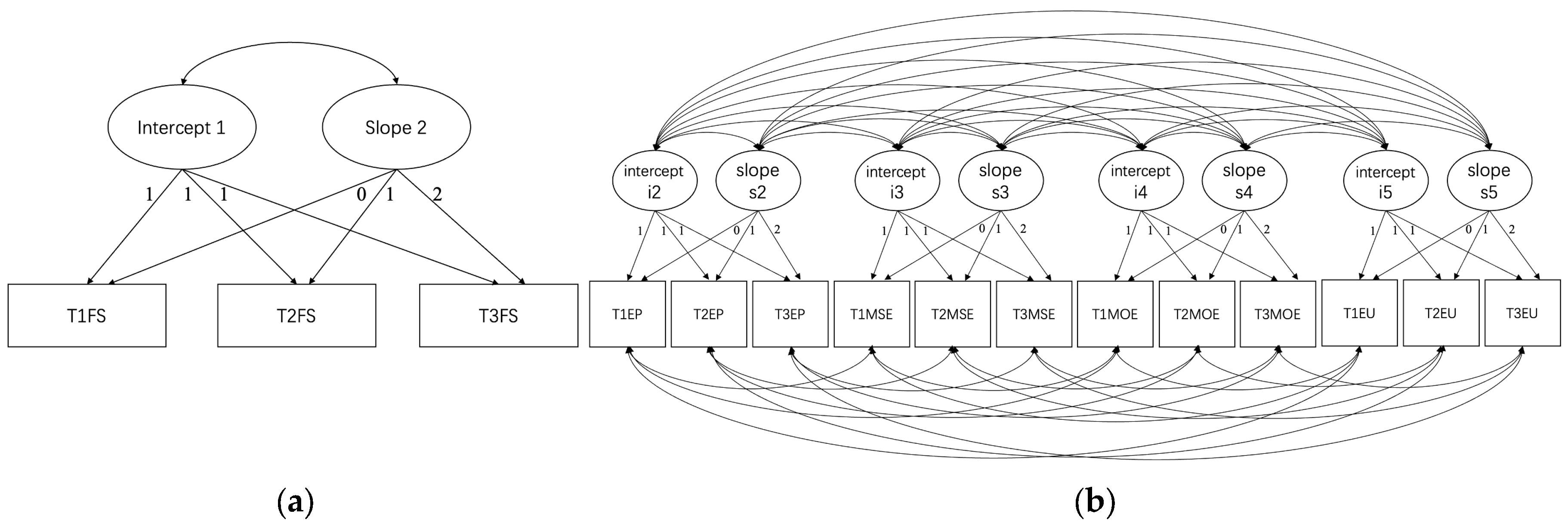
Unconditional latent growth models were used to examine the developmental trajectories of peer support and the four dimensions of emotional intelligence among gifted children. In the models, the intercept represented the initial level, with the factor loadings fixed at 1. The slope represented the rate of change, with the factor loadings fixed at 0, 1, and 2 across the three time points (see Figure A1). The model for peer support showed an acceptable overall fit, χ2/df = 2.839, CFI = 0.987, TLI = 0.960, RMSEA = 0.095, and SRMR = 0.027. The model for the four dimensions of emotional intelligence showed a good fit, χ2/df = 1.400, CFI = 0.995, TLI = 0.979, RMSEA = 0.045, and SRMR = 0.037.
As shown in Table 2, the mean of the intercept factor for peer support was 3.778 (p < 0.001), and its variance was significant (σ2 = 0.580, p < 0.001), indicating significant individual differences in the initial level of peer support. The mean of the slope factor for peer support was −0.039 (p = 0.265) and was not statistically significant, suggesting that peer support did not show a significant linear change over the three time points at the group level. However, the variance of the slope factor was significant (σ2 = 0.127, p = 0.027), indicating significant individual differences in the change in peer support over time. The covariance between the intercept and slope factors was −0.032 (p = 0.631) and was not significant, suggesting that the initial level of peer support was not significantly related to its subsequent linear change.
Table 2.
Parameter Estimates for the Unconditional Linear Latent Growth Model of Peer Support.
As shown in Table 3, the intercept factor means were 3.812 (p < 0.001) for emotion perception, 4.084 (p < 0.001) for understanding and reasoning about one’s own emotions, 3.951 (p < 0.001) for understanding and reasoning about others’ emotions, and 4.131 (p < 0.001) for use of emotion. The corresponding intercept variances were significant for emotion perception (σ2 = 0.243, p < 0.001), understanding and reasoning about one’s own emotions (σ2 = 0.216, p < 0.001), understanding and reasoning about others’ emotions (σ2 = 0.328, p < 0.001), and use of emotion (σ2 = 0.217, p = 0.002), indicating significant individual differences in their initial levels. The mean slopes were 0.089 (p < 0.001) for emotion perception and 0.051 (p = 0.023) for understanding and reasoning about one’s own emotions, indicating significant linear increases over time. In contrast, the mean slopes were −0.002 (p = 0.947) for understanding and reasoning about others’ emotions and −0.039 (p = 0.202) for use of emotion, indicating no significant linear change at the group level. The slope variances were significant for emotion perception (σ2 = 0.049, p = 0.014), understanding and reasoning about others’ emotions (σ2 = 0.077, p = 0.005), and use of emotion (σ2 = 0.088, p = 0.011), indicating significant individual differences in change over time. However, the slope variance was not significant for understanding and reasoning about one’s own emotions (σ2 = 0.045, p = 0.054). Finally, the intercept–slope covariances were negative and significant for emotion perception (Cov = −0.049, p = 0.033) and understanding and reasoning about others’ emotions (Cov = −0.077, p = 0.028), but were not significant for understanding and reasoning about one’s own emotions (Cov = −0.034, p = 0.166) or use of emotion (Cov = −0.047, p = 0.240).
Table 3.
Parameter Estimates for the Unconditional Latent Growth Model of Emotional Intelligence Dimensions.
4.4. Parallel Process Latent Growth Model
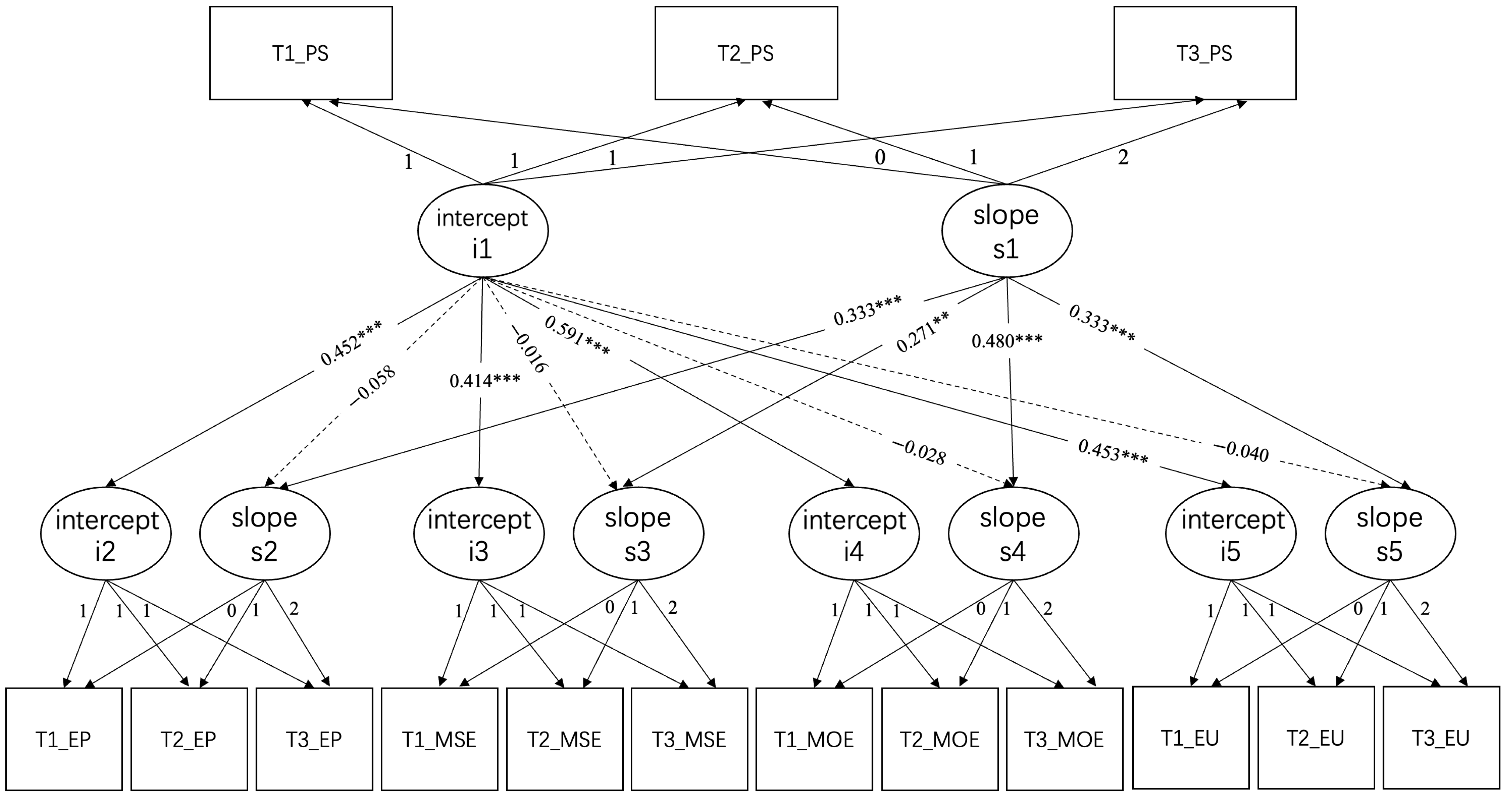
Based on the above results, a parallel process latent growth model was used to examine the longitudinal association between the developmental trajectories of peer support and emotional intelligence among gifted children. Peer support and emotional intelligence were modeled as two parallel developmental processes. The model showed a good fit to the data, χ2/df = 1.295, CFI = 0.995, TLI = 0.981, RMSEA = 0.038, and SRMR = 0.036.
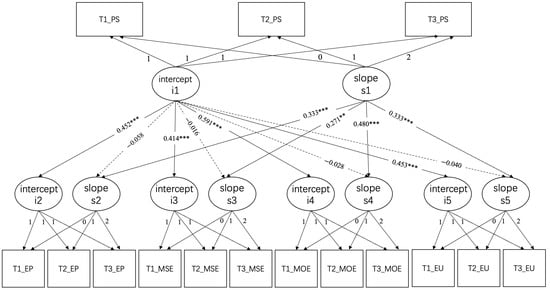
As shown in Figure 1, the intercept of peer support was positively associated with the intercepts of emotion perception (β = 0.452, SE = 0.072, p < 0.001, 95% CI [0.311, 0.593]), understanding and reasoning about one’s own emotions (β = 0.414, SE = 0.077, p < 0.001, 95% CI [0.263, 0.564]), understanding and reasoning about others’ emotions (β = 0.591, SE = 0.075, p < 0.001, 95% CI [0.444, 0.739]), and use of emotion (β = 0.453, SE = 0.083, p < 0.001, 95% CI [0.291, 0.616]). These results indicate that gifted children with higher initial levels of peer support also had higher initial levels of all four dimensions of emotional intelligence.
Figure 1.
Parallel Process Latent Growth Model of Peer Support and Emotional Intelligence Among Gifted Children. Note. Solid arrows represent statistically significant paths, whereas dashed arrows represent nonsignificant paths. ** p < 0.01, *** p < 0.001. Correlations among the variables are not shown to simplify the figure.
The slope of peer support was also positively associated with the slopes of emotion perception (β = 0.333, SE = 0.104, p = 0.001, 95% CI [0.130, 0.537]), understanding and reasoning about one’s own emotions (β = 0.271, SE = 0.102, p = 0.008, 95% CI [0.072, 0.471]), understanding and reasoning about others’ emotions (β = 0.480, SE = 0.099, p < 0.001, 95% CI [0.286, 0.674]), and use of emotion (β = 0.333, SE = 0.123, p = 0.007, 95% CI [0.093, 0.573]). In other words, gifted children who showed greater increases in peer support also tended to show greater increases in all four dimensions of emotional intelligence.
However, the intercept of peer support was not significantly associated with the slopes of emotion perception (β = −0.058, SE = 0.041, p = 0.162, 95% CI [−0.138, 0.023]), understanding and reasoning about one’s own emotions (β = −0.016, SE = 0.041, p = 0.698, 95% CI [−0.097, 0.065]), understanding and reasoning about others’ emotions (β = −0.028, SE = 0.044, p = 0.524, 95% CI [−0.114, 0.058]), or use of emotion (β = −0.040, SE = 0.051, p = 0.436, 95% CI [−0.139, 0.060]). These findings indicate that the initial level of peer support was not significantly associated with subsequent rates of change in any of the four dimensions of emotional intelligence among gifted children.
5. Discussion
Gifted children did not differ significantly from non-gifted children in peer support or emotional intelligence. Therefore, Hypotheses 1 and 2 were not supported. These findings are not consistent with previous studies conducted in Western countries. One possible interpretation may relate to differences in cultural and educational contexts. Western cultures tend to place greater emphasis on independence and self-expression (Yang & Zhang, 2007), which may make individual differences in ability, interests, or behavior more visible in peer interactions. Previous studies have suggested that such differences may be related to social difficulties experienced by some gifted children (Verschueren et al., 2019; Unal & Sak, 2023; Ramos et al., 2024). In contrast, Chinese educational contexts have often been described as placing greater emphasis on group belonging and shared norms (Li, 2022; Zhou et al., 2015). In this context, gifted children may be more likely to adjust their behavior to group expectations during classroom interactions, while a sense of group belonging may also promote mutual support and acceptance among peers (Zhou et al., 2015). Gifted and non-gifted children may therefore both show supportive behaviors in their daily interactions and gradually develop positive peer relationships. However, this interpretation remains speculative and is based on existing theory and previous research. Future studies should directly assess cultural values and related interaction processes to test this possibility. In addition, gifted and non-gifted children usually share the same school environment and experience similar social interactions and emotional challenges. Without specialized programs for emotional learning or differentiated educational support, the two groups are likely to have similar opportunities to develop emotional skills. As a result, differences in cognitive ability may not lead to differences in emotional intelligence.
The initial level of peer support is positively associated with the initial level of emotional intelligence among gifted children, partially supporting Hypothesis 3. This finding also supports social cognitive theory from the perspective of gifted children. Specifically, peer support may represent an important social resource associated with emotional intelligence in gifted children. From a developmental perspective, the initial levels of peer support and emotional intelligence may reflect children’s previous peer experiences and emotional development before the study began. According to the PPCT model (Tong & An, 2024), emotional development takes place within children’s social environments, and peer relationships provide an important setting for everyday emotional experiences (Denham, 2007). Gifted children with higher initial levels of peer support may have had more opportunities to experience acceptance, understanding, and positive responses from their peers. Such experiences may be related to lower social pressure and fewer feelings of isolation associated with asynchronous development or differences from classmates (Liu & Chen, 2021). Supportive peer relationships may also provide a greater sense of emotional security, which may be related to children’s ability to recognize, understand, and regulate emotions. These possible processes may help explain the observed association between the initial levels of peer support and emotional intelligence. However, they were not directly tested in the present study and should therefore be considered possible interpretations rather than causal mechanisms.
The growth rate of peer support is positively associated with the growth rate of emotional intelligence among gifted children, supporting Hypothesis 4. This finding further supports the PPCT model from the perspective of gifted children’s development. The PPCT model suggests that when individuals perceive increasing support from their environment, their development is also likely to accelerate (Xia et al., 2020). More specifically, faster growth in peer support means that gifted children receive more positive emotional cues and interaction feedback over time. This allows them to gain more experience in dealing with different emotional situations and increases their need to process emotional information. At the same time, to maintain and strengthen growing peer support, gifted children may need to better notice their own emotions and express them in appropriate ways. They may also adjust their emotion regulation strategies and behavioral responses over time (Forsblom et al., 2021). In addition, gifted children often show higher emotional sensitivity (Gere et al., 2009). As positive feedback and emotional responses from peers increase, gifted children may also pay greater attention to emotional information from others and gain more experience in understanding others’ emotions. In this way, growth in peer support may be accompanied by growth in both self-related and other-related emotional skills. These possible processes may help explain the observed longitudinal association between the developmental trajectories of peer support and emotional intelligence. However, these mechanisms were not directly tested in the present study and should therefore be regarded as possible interpretations rather than established causal processes.
The initial level of peer support was not significantly associated with the growth rate of emotional intelligence among gifted children. This finding suggests that later growth in emotional intelligence may depend more on continuous increases in peer support than on the initial level of peer support. As peer support increases over time, gifted children may continue to gain new emotional experiences and learn new ways to understand and manage emotions through ongoing social interactions. This finding is consistent with previous longitudinal research showing that early environmental factors may explain differences in the initial level of development but are less likely to explain differences in the rate of developmental change (Moilanen et al., 2010).
6. Limitations
This study has several limitations. First, the participants were recruited from only three schools, which may limit the representativeness and generalizability of the findings. In addition, children from the same classroom or school may share similar environments and experiences, and such clustering was not fully considered in the present study. Future research should recruit gifted children from more regions and different types of schools and consider the nested structure of the data. Second, peer support and emotional intelligence were assessed using self-report questionnaires. Self-reports may be affected by response bias and social desirability, especially among young children whose ability to understand and report their emotions and social experiences is still developing. Future studies should combine self-reports with multiple sources of information, such as teacher ratings, parent reports, and peer nominations, as well as assessments in different contexts. Third, although the longitudinal design and parallel latent growth model allowed us to examine developmental associations between peer support and emotional intelligence, unmeasured factors may have influenced both variables. Therefore, the findings should not be interpreted as evidence of causal relationships. Future research should include more individual, family, classroom, and school-level factors and use stronger research designs to further examine these associations.
7. Conclusions
This study examined the developmental association between peer support and emotional intelligence among gifted children. The findings showed that gifted children did not differ significantly from their non-gifted peers in peer support or emotional intelligence. Among gifted children, higher initial peer support was associated with higher initial levels of all dimensions of emotional intelligence. More importantly, increases in peer support over time were positively associated with increases in all dimensions of emotional intelligence. However, the initial level of peer support was not significantly associated with subsequent changes in emotional intelligence. Overall, these findings suggest that peer support and emotional intelligence are closely linked in their development among gifted children, highlighting the importance of considering changes in peer relationships when understanding their emotional development.
Author Contributions
Conceptualization, C.Z. and L.C.; Methodology, X.L.; Software, X.L.; Validation, X.L., C.Z. and L.C.; Formal analysis, X.L.; Investigation, X.L.; Resources, L.C.; Data curation, X.L.; Writing—original draft, X.L.; Writing—review and editing, C.Z. and L.C.; Visualization, X.L.; Supervision, L.C.; Project administration, L.C.; Funding acquisition, L.C. All authors have read and agreed to the published version of the manuscript.
Funding
This research was funded by the National Key R&D Program of China, grant number 2023YFC3341305.
Institutional Review Board Statement
This study was approved by the Research Ethics Committee (Approval No. BNU202106100016, 5 July 2021).
Informed Consent Statement
Informed consent was obtained from all subjects involved in the study.
Data Availability Statement
The data are currently not publicly available due to participant privacy, but they are available from the corresponding author upon reasonable request.
Conflicts of Interest
The authors declare no conflicts of interest.
Appendix A
Table A1.
Correlations Between Peer Support and Emotional Intelligence Among Gifted Children.
Figure A1.
Unconditional latent growth models. (a) Unconditional latent growth model for Peer Support; (b) Unconditional latent growth model for the four dimensions of Emotional Intelligence.
References
- Bandura, A. (2001). Social cognitive theory: An agentic perspective. Annual Review of Psychology, 52, 1–26. [Google Scholar] [CrossRef] [Scilit] [PubMed]
- Bandura, A., & National Inst of Mental Health. (1986). Social foundations of thought and action: A social cognitive theory. Prentice-Hall, Inc. [Google Scholar]
- Blaas, S. (2014). The Relationship between social-emotional difficulties and underachievement of gifted students. Australian Journal of Guidance and Counselling, 24(2), 243–255. [Google Scholar] [CrossRef] [Scilit]
- Casino-García, A. M., García-Pérez, J., & Llinares-Insa, L. I. (2019). Subjective emotional well-being, emotional intelligence, and mood of gifted vs. unidentified students: A relationship model. International Journal of Environmental Research and Public Health, 16(18), 3266. [Google Scholar] [CrossRef] [Scilit]
- Chan, D. W. (2005). Self-perceived creativity, family hardiness, and emotional intelligence of Chinese gifted students in Hong Kong. Journal of Advanced Academics, 16(2–3), 47–56. [Google Scholar] [CrossRef] [Scilit]
- Chen, H. C. (1994). Characteristics, influencing factors, and assessment of children’s social development: Final report of the project Social Development of Chinese Children Aged 3–9 Years. Psychological Development and Education, 10(4), 1–17. [Google Scholar] [CrossRef]
- Chen, Z. X., Wang, H., Feng, Y. X., & Liu, X. (2020). The effects of peer victimization on left-behind adolescents’ subjective well-being: The roles of self-esteem and social support. Psychological Development and Education, 36(5), 605–614. [Google Scholar] [CrossRef]
- Cheng, L., Chen, X. Y., Liu, Y. J., & Liu, X. M. (2023). The construction of the growth model of top-notch innovative talents in China. Chinese Journal of Distance Education, 43(12), 10–20. [Google Scholar] [CrossRef]
- Cheng, L., Chen, X. Y., & Liu, Y. Y. (2025). The relationship between teacher support, student support, resilience, and emotional intelligence: Comparison of gifted and nongifted children. Studies of Psychology and Behavior, 23(2), 185–192. [Google Scholar]
- Cheng, L., Liu, X., Liu, Y., & Wu, Y. (2024). The relationship between trait emotional intelligence and creative self-efficacy in gifted children: A cross-lagged and cross-temporal mediation analysis. Journal of Intelligence, 12(8), 71. [Google Scholar] [CrossRef] [Scilit]
- Cheng, Y. H., Wu, X. C., Liu, H. Y., & Li, H. (2018). The developmental trajectories of oral vocabulary knowledge and its influential factors in Chinese primary school students. Acta Psychologica Sinica, 50(2), 206–215. [Google Scholar] [CrossRef] [Scilit]
- Cross, J. R., Vaughn, C. T., Mammadov, S., Cross, T. L., Kim, M., O’Reilly, C., Spielhagen, F. R., Pereira da Costa, M., & Hymer, B. (2019). A cross-cultural study of the social experience of giftedness. Roeper Review, 41(4), 224–242. [Google Scholar] [CrossRef] [Scilit]
- Denham, S. A. (2007). Dealing with feelings: How children negotiate the worlds of emotions and social relationships. Cogniţie Creier Comportament, 11(1), 1–48. [Google Scholar]
- Forsblom, L., Peixoto, F., & Mata, L. (2021). Perceived classroom support: Longitudinal effects on students’ achievement emotions. Learning and Individual Differences, 85(3), 101959. [Google Scholar] [CrossRef] [Scilit]
- Gagné, F. (2004). Transforming gifts into talents: The DMGT as a developmental theory. High Ability Studies, 15(2), 119–147. [Google Scholar] [CrossRef] [Scilit]
- Gagné, F. (2009). Debating giftedness: Pronat vs. antinat. In L. V. Shavinina (Ed.), International handbook on giftedness (pp. 155–204). Springer. [Google Scholar] [CrossRef] [Scilit]
- Gere, D. R., Capps, S. C., Mitchell, D. W., & Grubbs, E. (2009). Sensory sensitivities of gifted children. American Journal of Occupational Therapy, 63(3), 288–295. [Google Scholar] [CrossRef] [Scilit]
- Lei, J. H. (2021). A Probe into deep teaching of gifted children oriented to deep learning under the concept of inclusive education. Chinese Journal of Special Education, (11), 63–67. [Google Scholar]
- Li, H. B. (2022). The relationship among teacher support, school belonging, and life satisfaction in secondary school students: The roles of individualism and collectivism [Master’s thesis, Southwest University]. [Google Scholar] [CrossRef]
- Liu, Z. K., & Chen, Y. R. (2021). Some basic issues in the education of gifted and talented children in China. Chinese Journal of Special Education, (9), 56–59+96. [Google Scholar]
- Masden, C. A., Leung, O. N., Shore, B. M., Schneider, B. H., & Udvari, S. J. (2015). Social-perspective coordination and gifted adolescents’ friendship quality. High Ability Studies, 26(1), 3–38. [Google Scholar] [CrossRef] [Scilit]
- Moilanen, K. L., Shaw, D. S., Dishion, T. J., Gardner, F., & Wilson, M. (2010). Predictors of longitudinal growth in inhibitory control in early childhood. Social Development, 19(2), 326–347. [Google Scholar] [CrossRef] [Scilit]
- Olszewski-Kubilius, P. (2024). Where are we now with the implementation of the talent development framework for gifted students and where do we go in the future? Education Sciences, 14(9), 932. [Google Scholar] [CrossRef] [Scilit]
- Patrick, H., Ryan, A. M., & Kaplan, A. (2007). Early adolescents’ perceptions of the classroom social environment, motivational beliefs, and engagement. Journal of Educational Psychology, 99(1), 83–98. [Google Scholar] [CrossRef] [Scilit]
- Petrides, K. V., & Furnham, A. (2001). Trait emotional intelligence: Psychometric investigation with reference to established trait taxonomies. European Journal of Personality, 15, 425–448. [Google Scholar] [CrossRef] [Scilit]
- Ramos, A., Steenberghs, N., Lavrijsen, J., Goossens, L., & Verschueren, K. (2024). Differences in loneliness experiences among high-ability students: Individual and social context predictors. Exceptional Children, 91(1), 93–113. [Google Scholar] [CrossRef] [Scilit]
- Raut, A. V., & Gupta, S. S. (2019). Reflection and peer feedback for augmenting emotional intelligence among undergraduate students: A quasi-experimental study from a rural medical college in central India. Education for Health, 32, 3–10. [Google Scholar] [CrossRef] [Scilit]
- Renzulli, J. S. (1978). What makes giftedness? Reexamining a definition. Phi Delta Kappan, 60(3), 180–184. [Google Scholar]
- Sakar, S., & Tan, S. (2025). Research topics and trends in gifted education: A structural topic model. Gifted Child Quarterly, 69(1), 68–84. [Google Scholar] [CrossRef] [Scilit]
- Schutte, N. S., Malouff, J. M., Hall, L. E., Haggerty, D. J., Cooper, J. T., Golden, C. J., & Dornheim, L. (1998). Development and validation of a measure of emotional intelligence. Personality & Individual Differences, 25(2), 167–177. [Google Scholar] [CrossRef] [Scilit]
- Stenling, A., Ivarsson, A., Lindwall, M., & Gucciardi, D. F. (2018). Exploring longitudinal measurement invariance and the continuum hypothesis in the Swedish version of the Behavioral Regulation in Sport Questionnaire (BRSQ): An exploratory structural equation modeling approach. Psychology of Sport and Exercise, 36, 187–196. [Google Scholar] [CrossRef] [Scilit]
- Su, J. Y., & Shi, S. (2022). Opportunities, challenges and strategies of supernormal education development in the 14th Five-Year Plan period in China. Chinese Journal of Special Education, (6), 3–8+59. [Google Scholar]
- Sun, W. Y. (2023). Interpersonal relationship in school and well-being in primary and secondary school students: The mediating role of emotional regulation. China Journal of Health Psychology, 31(1), 148–156. [Google Scholar] [CrossRef]
- Tan, L., & Gong, S. (2025, October 31). From one-way incentives to social interaction: How peer-assisted educational games simultaneously enhance learning emotions, motivation, and academic performance? Proceedings of the 26th National Conference of the Chinese Psychological Society (pp. 338–339). [Google Scholar] [CrossRef]
- Tong, P., & An, I. S. (2024). Review of studies applying Bronfenbrenner’s bioecological theory in international and intercultural education research. Frontiers in Psychology, 14, 1233925. [Google Scholar] [CrossRef] [Scilit]
- Unal, N. E., & Sak, U. (2023). Outlanders: Loneliness experience of gifted girls. High Ability Studies, 34(1), 61–86. [Google Scholar] [CrossRef] [Scilit]
- Verschueren, K., Lavrijsen, J., Weyns, T., Ramos, A., & De Fraine, B. (2019). Social acceptance of high-ability youth: Multiple perspectives and contextual influences. In R. F. Subotnik, S. G. Assouline, P. Olszewski-Kubilius, H. Stoeger, & A. Ziegler (Eds.), The future of research in talent development: Promising trends, evidence, and implications of innovative scholarship for policy and practice (pp. 27–46). New Directions for Child and Adolescent Development. [Google Scholar]
- Wang, C. K., & He, Z. W. (2002). The relationship among parenting styles, self-efficacy, and emotional intelligence in middle school students. Chinese Mental Health Journal, 16(11), 781–782, 785. [Google Scholar]
- Xia, M., Li, X., & Tudge, J. R. (2020). Operationalizing Urie Bronfenbrenner’s process-person-context-time model. Human Development, 64(1), 10–20. [Google Scholar] [CrossRef] [Scilit]
- Yang, M., & Zhang, W. (2007). Individualism: The core value of Western culture. Nanjing Journal of Social Sciences, (4), 38–44. [Google Scholar] [CrossRef]
- Zha, Z. X. (1994). Fifteen years of research on the psychology and education of gifted children. Acta Psychologica Sinica, 26(4), 337–346. [Google Scholar]
- Zhang, N., Tang, K. L., & Li, M. J. (2023). Constructing an identification system for gifted children: International experience and local reflections. Chinese Journal of Special Education, (2), 88–96. [Google Scholar]
- Zhang, Y. Q., Zha, Z. X., Gong, Z. X., Nianzu, C., & Pengzhi, L. (2003). Preliminary revision of the Test of Nonverbal Intelligence (TONI-2). Psychological Science, 26(2), 330–331, 333. [Google Scholar] [CrossRef]
- Zhou, Z. K., Sun, X. J., Zhao, D. M., Tian, Y., & Fan, C. Y. (2015). The development of peer relationship in childhood. Psychological Development and Education, 31(1), 62–70. [Google Scholar] [CrossRef]

Disclaimer/Publisher’s Note: The statements, opinions and data contained in all publications are solely those of the individual author(s) and contributor(s) and not of MDPI and/or the editor(s). MDPI and/or the editor(s) disclaim responsibility for any injury to people or property resulting from any ideas, methods, instructions or products referred to in the content. |
© 2026 by the authors. Licensee MDPI, Basel, Switzerland. This article is an open access article distributed under the terms and conditions of the Creative Commons Attribution (CC BY) license.