


Abstract
The rapid emergence of generative artificial intelligence (AI) tools has significantly transformed academic writing practices in higher education. While AI technologies offer potential support for language learners, they also raise concerns regarding academic integrity and the erosion of students’ critical thinking, particularly in English for Academic Purposes (EAP) classrooms where writing development and independent reasoning are core learning outcomes. This study explores Saudi TESOL teachers’ strategies for balancing AI use with academic integrity and critical thinking in Saudi higher education. Using a qualitative research design, semi-structured interviews were conducted with 12 EAP instructors at four Saudi universities. Data were analysed thematically to identify and interpret patterns of AI use and academic integrity challenges across participants’ responses. A tripartite framework integrating sociotechnical systems theory, academic integrity scholarship, and critical thinking pedagogy provides a theoretical lens for understanding teacher-mediated AI integration in TESOL contexts. Thematic findings revealed that teachers hold an optimistic yet cautious view of AI highlighting the critical role of guidance and reflection in AI-mediated environments. They employ an emergent, four-dimensional Connect–Guide–Reflect–Assess (CGRA) pedagogical framework to manage the tension between AI and integrity in language classrooms. They demand a shared responsibility between teachers and institutions through clear and consistent AI policies for curriculum, assessment and faculty professional development. This study contributes empirical, practitioner-generated evidence of how TESOL teachers in the Saudi context navigate AI in EAP classrooms. Grounded in participants’ accounts, the proposed CGRA framework offers language educators, curriculum designers, and institutional policymakers a replicable approach for navigating the AI era.
1. Introduction
The recent years have witnessed the introduction of artificial intelligence (AI) to educational settings followed by its swift integration and rapid transformation of language teaching and learning across the globe. Grammar and spelling checkers and translation tools have been in use in TESOL settings for many years. However, lately generative AI writing tools such as Chat GPT, Gemini, Copilot, Claude and many others have become available to language teachers and students alike (Akinsemolu & Onyeaka, 2025; Yeo, 2023). These platforms offer several benefits such as immediate and personalised feedback for individual learners, which gives way to learner autonomy through more opportunities for independent practice (Al-Smadi et al., 2024; Al-khresheh, 2024; Mohebbi, 2025). A study by Gruenhagen et al. (2024) shows that various psychosocial factors such as learning motivations, distress, or resilience are associated with students’ use of AI chatbots. However, an uncontrolled use of such tools has also raised serious concerns among practitioners and researchers regarding learners’ personal effort, critical thinking and academic integrity particularly in terms of assessment (Cotton et al., 2024; Ruskulis et al., 2026).
Although the debate about whether or not AI should be allowed in language learning still continues in some contexts, it has largely shifted to how it should be used responsibly and ethically (Cotton et al., 2024; Maleki, 2026; Yeo, 2023). The goal of learning a foreign or second language is not to produce grammatically perfect sentences. Instead, it is to cultivate reflective and analytical thinking abilities among language learners. Unbridled use of generative AI tools may produce excellent-looking texts at the cost of learners’ deep engagement with the form and function of the language they are learning. To preserve the true meaning of language education, teachers have a heavy responsibility of making crucial pedagogical decisions that may strike a balance between students’ use of AI and their academic integrity and critical thinking (Malik et al., 2023).
Despite the exponential increase in research on AI in education in recent years that highlights both the potential benefits and risks of AI in language education, the number of empirical studies that have particularly focused on TESOL teachers’ active decisions and strategies to maintain a balance between the two AIs—Artificial Intelligence and Academic Integrity—remains limited. This research gap is even more prominent in the MENA region where English is taught as a foreign language to Arabic-speaking students who have found a miracle in the form of generative AI applications to create perfect assignments in English. This study seeks to make a valuable contribution to fill this void by examining EFL/EAP teachers’ perspectives and practices with regards to AI use while ensuring criticality and upholding academic integrity. By foregrounding teachers’ lived experiences, the study aims to provide context-sensitive insights that can inform pedagogical decision-making, teacher training, and institutional policy development.
The study, thus, sought to address the following research questions:
- How do TESOL teachers in Saudi higher education institutions perceive the opportunities and challenges that generative AI tools present for EAP writing?
- What strategies do these teachers employ to preserve academic integrity in AI-mediated learning environments?
2. Literature Review
2.1. AI in EFL Teaching and Learning
Recent scholarship shows that AI has been playing an instrumental role in TESOL contexts by offering prompt responses to learners’ language-related queries, quick and automated feedback, and translation services, making language learning a more independent and personalised experience than ever before (Al-Smadi et al., 2024; Malik et al., 2023; Mohebbi, 2025). AI technologies are not only aiding learners in their language learning journeys but also assisting teachers by taking on some of their workload such as designing quizzes and worksheets and providing quick, tailored feedback to individual learners.
On the flip side, the excessive reliance on AI applications undermines the genuine effort, engagement with content, critical thinking and problem-solving skills of language learners. English language learning presents significant cognitive and linguistic challenges for foreign learners and heavy reliance on AI for quick solutions is likely to undermine deep learning and engagement with the complex linguistic forms and how they function in real communication. These concerns highlight the need for guided rather than unrestricted use of AI by English language learners. While AI tools offer clear benefits for language development, their growing use also raises questions about the cognitive processes they may bypass, particularly critical thinking, which is an integral component of language learning.
2.2. Critical Thinking and Criticality in Language Learning
One of the primary goals of all higher education including language education is the development of learners’ critical thinking and problem-solving abilities, which AI tools are increasingly making harder to achieve. Gerlich (2025) cautioned that over-reliance on such tools may paralyse students’ creative and critical abilities in applying knowledge. Readily accepting machine-generated answers can prove detrimental to both learner autonomy and ability to make independent linguistic choices in real-life contexts. Researchers like Du and Alm (2024) and Dahri et al. (2025) also noted that inexperienced language learners are more likely to accept AI-generated outputs without questioning their accuracy, contextual appropriateness or linguistic bias in the absence of critical literacy skills and active engagement in academic activities. Teachers can play a crucial role in guiding learners on how to use AI ethically, and by designing learning tasks that encourage them to critically analyse, reflect on and justify AI-assisted outputs rather than directly submitting for final evaluation (ElSayary, 2024; Rusandi et al., 2023). These concerns about critical thinking are closely tied to broader debates about academic integrity, as instructors struggle with distinguishing genuine engagement from AI-assisted output.
2.3. Academic Integrity in the Age of AI
Academic integrity has always been a major concern in all fields of education and scholarship. While it traditionally meant plagiarism and citation practices in academic writing, the nature of AI tools has made it more complex in terms of originality and authorship (Eaton, 2023). Large language models (LLMs) are trained to use data from multiple sources, thus AI-generated texts are not based on copying from a single source that may be easily detected.
In foreign language education contexts, learners rely heavily on AI tools due to their inherent lack of confidence in their linguistic abilities and their desires to produce perfect, error-free pieces of academic writing such as assignments and research projects (Chiu, 2023). While learners may view these tools as a legitimate support and a trusted partner in their learning. much the same as digital devices and the internet in general (Alawad et al., 2025; Ruskulis et al., 2026), teachers and institutions often count it as academic misconduct. This mismatch between learner perceptions, teaching practices and institutional policies creates confusion in the educational environment.
This uncertainty positions teachers at the centre of the stage as custodians of academic integrity and fair practices. Punishing learners for using tools that have become a natural part of their environment may no longer be a viable solution. Instead, scholars call for developing AI literacy and creating awareness among learners regarding ethical and transparent use of AI support tools. Scholars like Eaton (2023) and Kumar et al. (2024) have sought to reposition academic integrity in the age of AI, calling for a shift in teachers’ approaches to dealing with this complex issue. According to Kumar et al. (2024), the first stage, which they called the current stage, involves awareness. They predicted the second stage to focus on detection and support with an active role of the institutions, while the third stage would centre around teachers’ pedagogic strategies to either counter or integrate AI-supported writing as a part of students’ writing development. This involves open discussions between teachers and students regarding what counts as acceptable and unacceptable use of AI, designing activities and tasks that value process rather than the finished product, and assessment practices that ensure reduced chances of AI misuse. In response to these integrity concerns, researchers and institutions have proposed a range of pedagogical strategies that the next section focuses on.
2.4. Teachers’ Roles and Pedagogical Strategies
The role of teachers, particularly in language education, has been evolving alongside AI tools. Language teachers’ own beliefs and professional judgement of the status of AI play a crucial role in shaping their classroom and assessment practices. Cotton et al. (2024) suggest a range of strategies teachers may employ such as educating students, requiring drafts of assignments and using plagiarism detection tools. In a similar vein, others prescribe designing assessments that require originality and creativity (Kovari, 2025; Maleki, 2026), restricting the use of AI tools to in-class activities or assignments or allowing it under specific conditions or clear guidelines. These choices are often governed by multiple factors, including teachers’ own expertise in using AI tools, students’ language proficiency levels, and the nature of assessment and institutional policies. Maleki (2026) also emphasises the need to normalise disclosing the ethical use of AI in academic institutions and to encourage students to exercise their personal and moral agency while dealing with AI tools.
Pedagogical strategies teachers should increasingly employ may include process-oriented writing tasks in which AI tools can be used for scaffolding, adding reflections on AI’s contribution to the task, and evaluating AI-generated content in the class using a flipped learning model. Such strategies aim at balancing learner agency and autonomy with the realities of AI-mediated learning environments. Nevertheless, in the absence of clear institutional guidelines, teachers may face a conflict between innovative learning practices and locus of control.
Taken together, this body of literature illustrates that teachers occupy a mediating position between the opportunities AI tools offer and the pedagogical, ethical, and institutional tensions they introduce, yet it also reveals a lack of a unifying conceptual lens for understanding how teachers navigate this position in practice. To address this gap, the following section outlines the theoretical framework underpinning this study, which draws together perspectives on technology–human interaction, academic integrity, and critical thinking to situate teachers’ roles and strategies within a coherent conceptual foundation.
3. Materials and Methods
3.1. Theoretical Framework
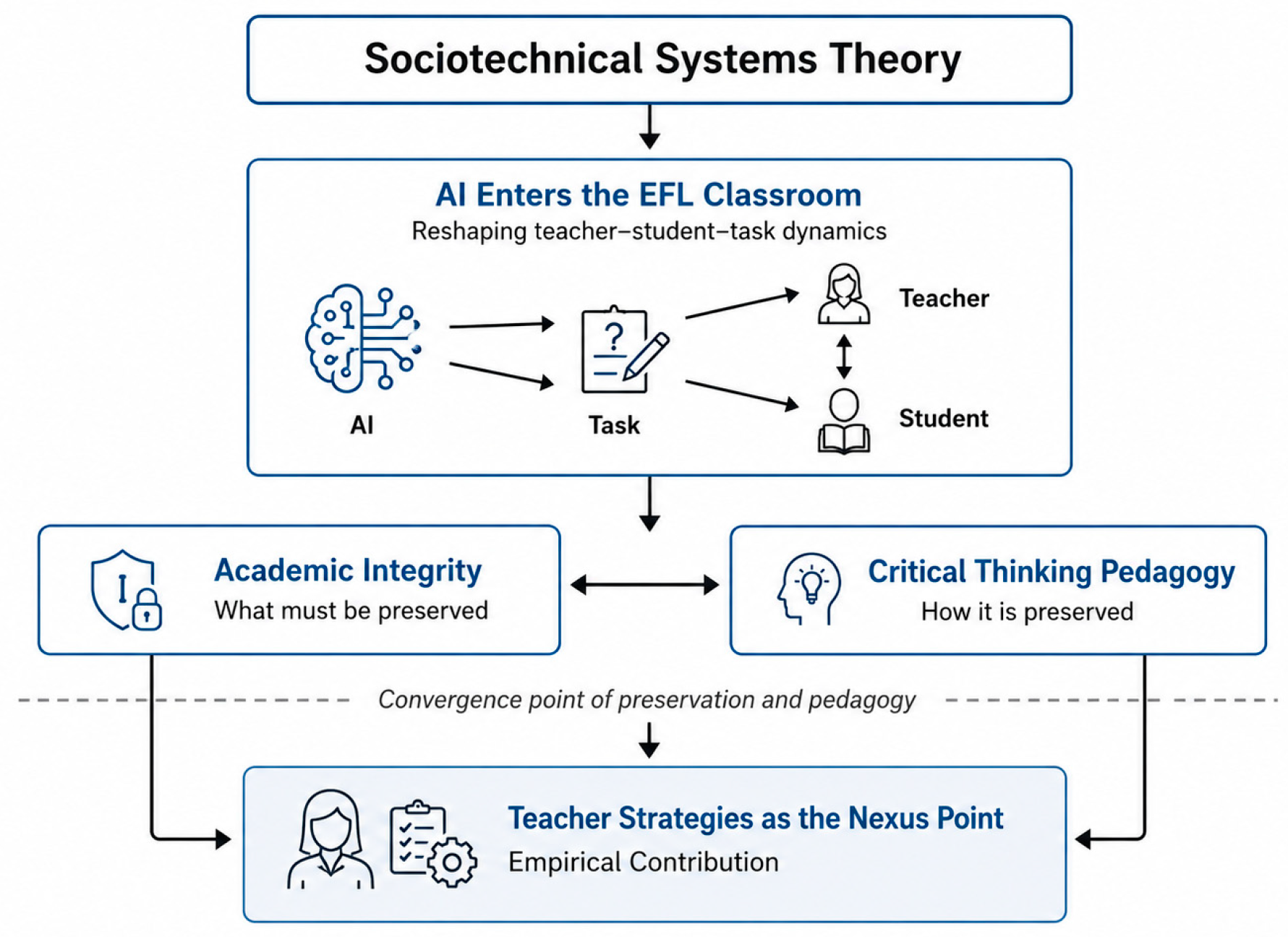
This study sits at the intersection of Sociotechnical Systems Theory by Bijker et al. (1987), Academic Integrity Framework by Bretag (2013) and advanced by Eaton (2023), and Critical Thinking Pedagogy rooted in Bloom’s Revised Taxonomy by Anderson and Krathwohl (2001).
Sociotechnical Systems Theory contends that technology and human actors co-shape one another. Technological tools do not enter classrooms neutrally nor sit passively—they redefine and restructure relationships, expectations, and practices. It frames two AIs, Artificial Intelligence and Academic Integrity, as two competing forces that require a mediator—teacher(s).
Bretag (2013) calls for a holistic and multi-stakeholder approach by education institutions to maintain academic integrity based on shared understanding and practices. Building on her work, Eaton (2023) proposed an ethical framework arguing for considering academic integrity as the foundation for all aspects of education by going beyond the notion of student conduct. A year later Kumar et al. (2024) explored the intersection of academic integrity and artificial intelligence, marking three stages:
- Stage 1 = awareness
- Stage 2 = detection and support with an important role for institutions
- Stage 3 = teachers adopting strategies to either directly counter plagiarism or integrate AI in student writing
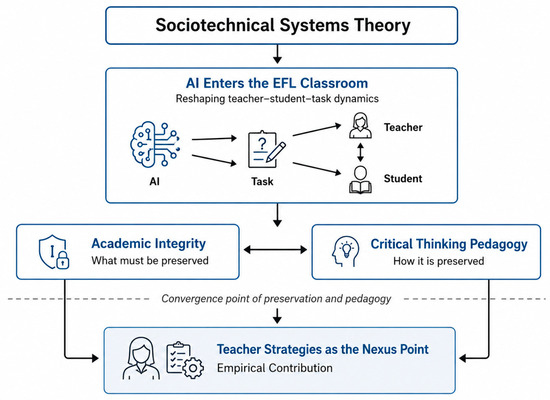
Anderson and Krathwohl’s (2001) Bloom’s Revised Taxonomy where they repositioned higher order thinking skills—analysis, evaluation, and creation—stands as the third pillar on which this study rests. Critical thinking serves as an antidote to uncritical AI dependency, particularly by foreign learners of English who are not confident about their own language proficiency and thus find refuge and comfort in generative AI tools for their writing tasks. Figure 1 illustrates how these three perspectives complement one another.
Figure 1.
A tripartite framework for understanding teacher-mediated AI and integrity in language classrooms.
Together, the three theoretical lenses argue that the TESOL classroom is a complex sociotechnical space wherein teachers act as negotiators between the affordances of AI and the demands of authentic learning and higher-order thinking. Thus, TESOL teachers’ pedagogical strategies are not merely random reactions to AI over-dependence and misuse, but well-thought-out pedagogical acts that reflect their deeper commitment to maintaining integrity through language learners’ critical intellectual development.
3.2. Research Design and Methodology
The study was designed following qualitative research conventions to gather a rich, in-depth understanding of teachers’ experiences regarding AI use in EFL/EAP classes and its implications for students’ critical thinking skills and academic integrity (Creswell & Poth, 2018). For this purpose, semi-structured interviews were conducted as the primary data collection method to offer an opportunity to the participants to freely and openly share their feelings, thoughts, experiences, practices and strategies regarding the topic under investigation.
3.2.1. Research Context
The research context was Saudi Higher Education where all universities offer EAP or foundation programmes to students of all disciplines to prepare them for their academic journeys where English is the medium of instruction. The researcher also works in the department of English language and literature at a Saudi public university.
The widespread presence and use of AI tools by university students, particularly for written assignments and tasks, has raised concerns as well as prompted action on part of teachers to understand this new phenomenon and adapt their teaching and assessment strategies accordingly to ensure students still use their critical thinking abilities and ensuring fair use of AI tools rather than a complete compromise of their academic integrity.
3.2.2. Participants
EAP instructors working at Saudi universities served as the population for this study. Purposive sampling was employed to select 12 participants from four different universities (Prince Sattam Bin Abdulaziz University, Prince Sultan University, Royal Commission of Jubail & Yanbu and King Abdulaziz University) located in different regions of the Kingdom. It was ensured that the selected participants had direct experience in teaching EAP writing courses at tertiary level in Saudi universities which are most affected areas after the universal availability of generative AI tools.
3.2.3. Ethical Considerations
To ensure compliance with ethical standards of human research, Institutional Review Board approval for human data collection was sought from the Standing Committee of Bioethics Research at Prince Sattam bin Abdulaziz University. The approval was granted through letter number SCBR-605/2025 on 2 December 2025. All participants were provided with the project brief and their rights as voluntary participants in this research. Informed consent forms were signed by all participants before data collection process commenced and all names have been replaced with pseudonyms.
3.2.4. Data Collection
Data were collected through semi-structured interviews conducted with participating instructors. The interview format allowed participants to discuss their experiences with AI-related challenges and the strategies they adopted to address them.
3.2.5. Data Transcription
Interviews were audio recorded with participants’ consent. Interviews with participants from within the host institution were conducted face-to-face while with participants from other institutions were arranged through Zoom. iPhone’s default voice recorder application was used for recording all interviews, which automatically transcribes audio to text. This transcription, however, is not flawless, especially when transcribing non-native speakers’ speech. All recordings were replayed and transcripts were thoroughly pruned, correcting all misinterpretations to ensure accuracy of the transcripts before data analysis began.
4. Data Analysis and Results
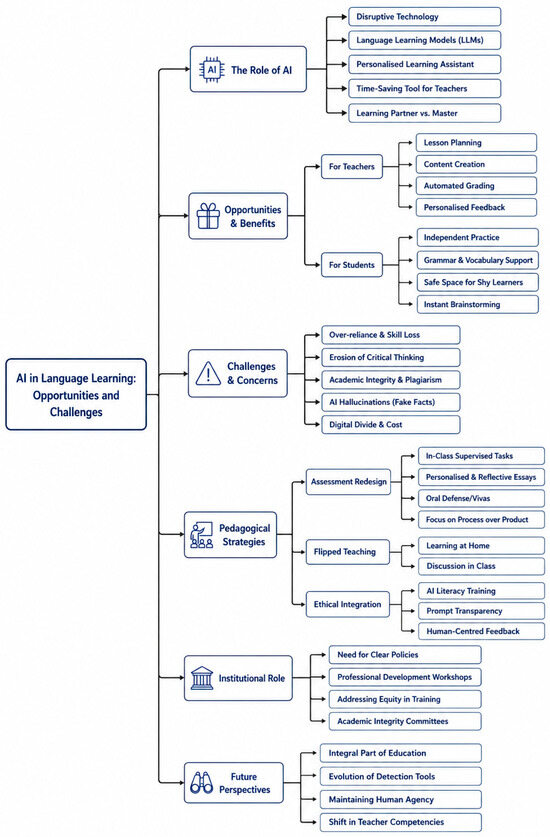
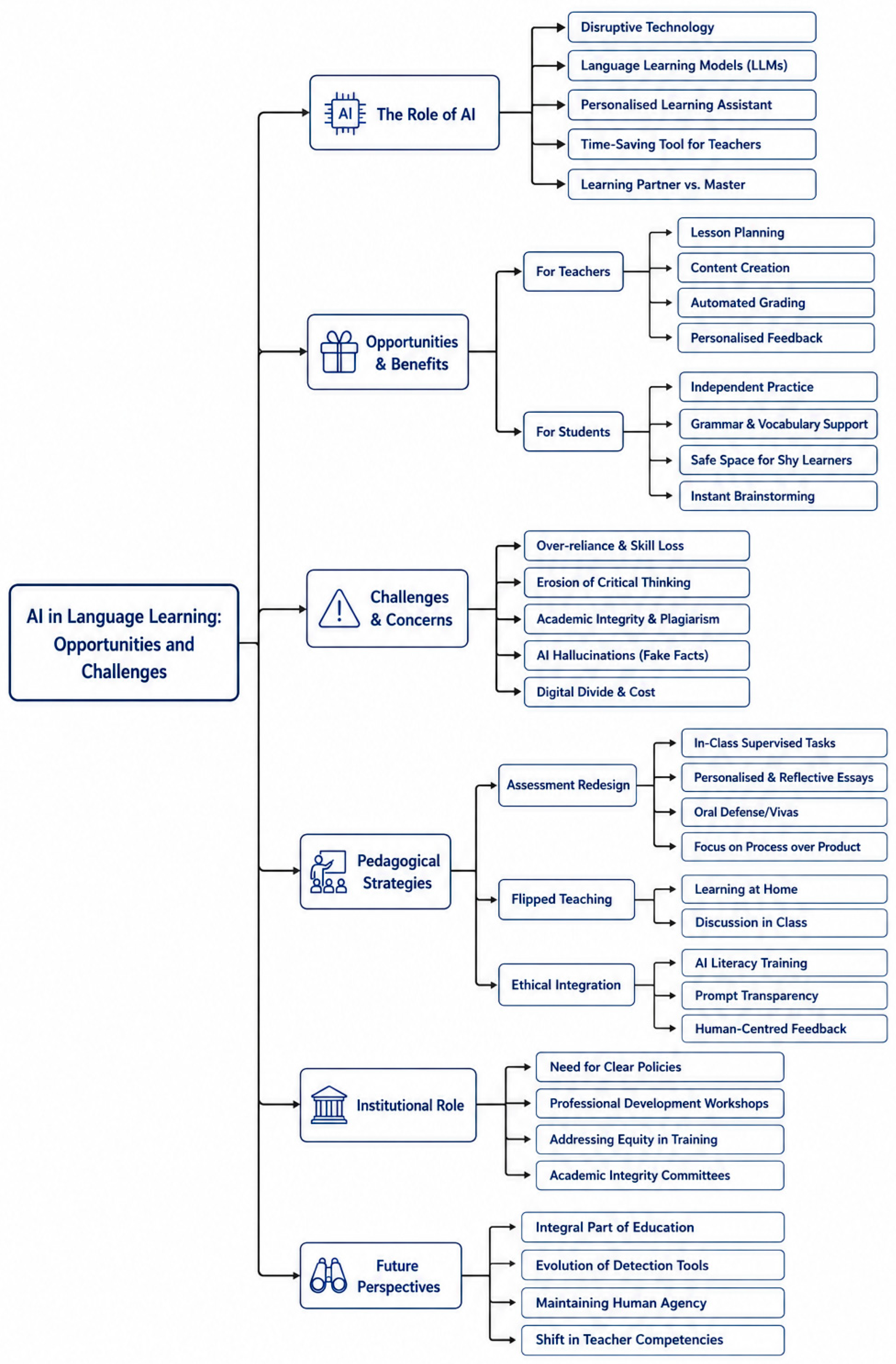
Following Braun and Clarke’s (2006, 2019) six-step framework of Reflexive Thematic Analysis, the data was coded to generate initial themes. In the initial phase, Google NotebookLM was employed to generate a set of candidate codes from the interview transcripts. However, the researcher maintained complete interpretive authority throughout by repeatedly going back to the raw data for confirmation. Figure 2 shows the initial themes that emerged from the data.
Figure 2.
Initial Themes and Sub-themes.
At the fifth stage of Braun and Clarke’s six-step thematic analysis framework, several candidate themes were merged, renamed or discarded. For instance, Opportunities and Benefits and Challenges and Concerns were merged into a single theme, AI in Language Education, with four sub-themes. Themes were then refined and named to capture their central organising concepts and findings were reported using illustrative verbatim extracts to corroborate them. Table 1 presents the final themes and sub-themes.
Table 1.
Main and sub-themes.
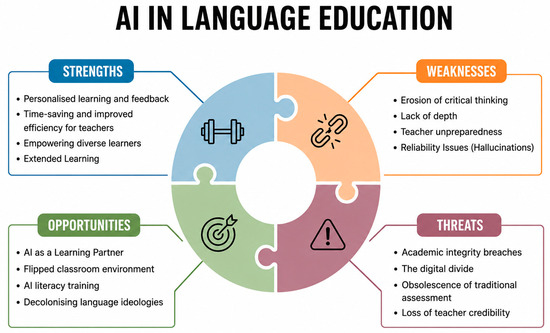
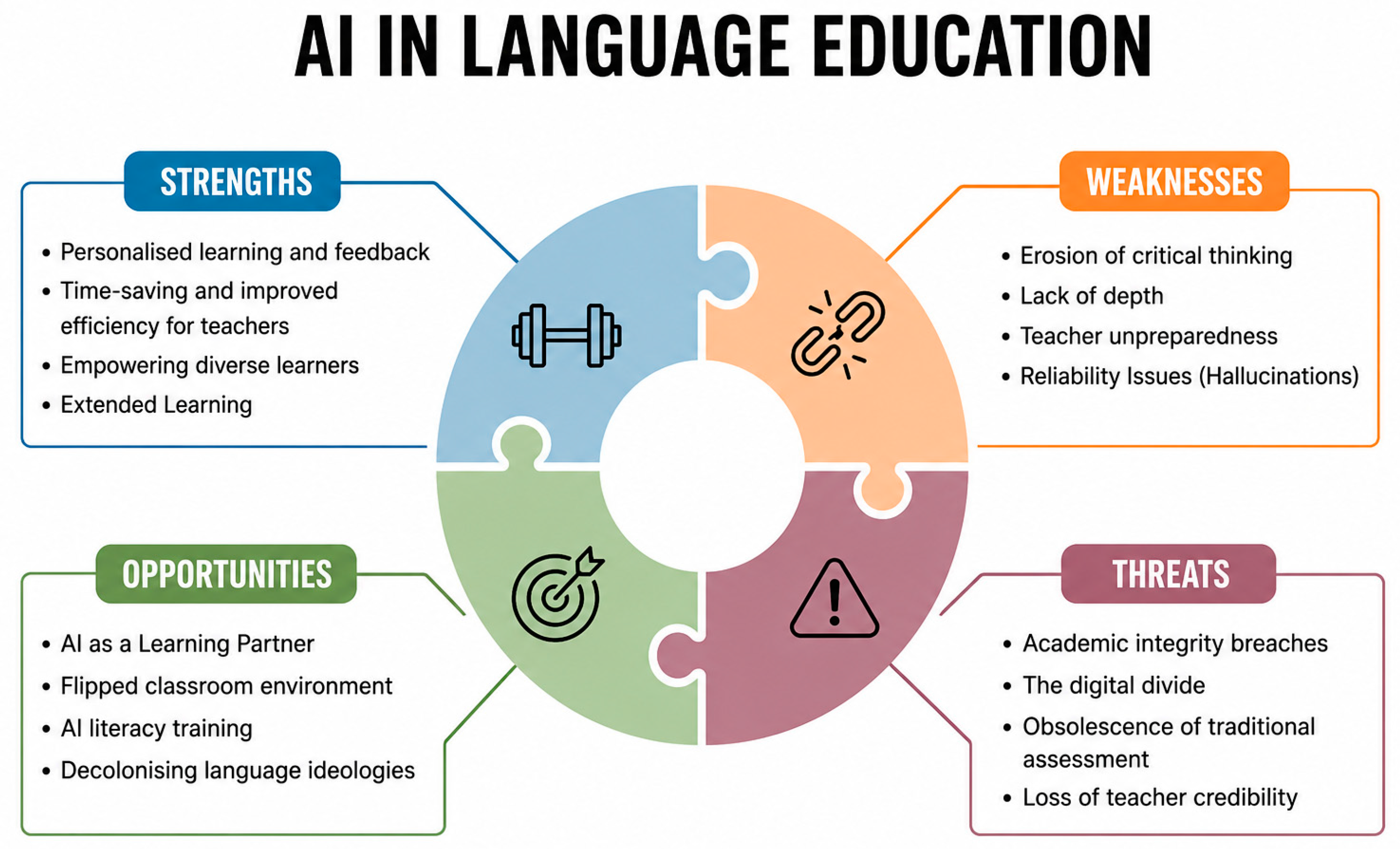
Teachers’ perceptions of AI reflected both optimism and concern, clustering around four interrelated dimensions—strengths, weaknesses, opportunities and threats. The familiar SWOT labels are used only as an organising device as they provide a balanced picture of how participants understood AI’s role in EAP teaching and learning (Figure 3).
Figure 3.
AI in language education.
4.1. TESOL Teachers’ Perceptions of AI in Language Teaching and Learning
4.1.1. Strengths
One of the biggest strengths AI has for language education, according to the participant teachers, is to offer “personalised instruction and feedback”, which has become or will become in the future “a very central and integral…supportive tool…. for very individual personalised language learning, and specifically for feedback”. AI allows students to learn at their “own pace” and provides a safe space for “shy or weak” students to repeatedly practice speaking and writing without the “fear of judgment” from peers or teachers. With AI by their side as a “learning partner”, students can also extend their learning and practice beyond the physical classroom.
…it gives a personalised learning experience, uh, because each student would obviously go through a different kind of experience, depends upon the kind of input that they, uh, that it gives to uh, the chatbot. There is obviously an immediate feedback. Uh, there are more language practises. Language learning experiences, I mean. Uh, greater independence.(Talal)
In addition to benefiting the students, AI also came to teachers’ “rescue” by “saving time” to “improve quality” in “lesson planning, creating content” for the class and for “grading assessments”.
For me, AI can save a significant amount of time and energy, especially after a hectic schedule. It can help me prepare to generate worksheets, create midterm questions, or even adjust materials for different purposes.(Asma)
4.1.2. Weaknesses
Erosion of learners’ critical thinking skills was reported among the top weaknesses by participant teachers. Ahmed believed “with AI, you know, critical thinking died, in a sense”, while Fatima was of the view that if students rely on it too much and are not properly guided then AI “can weaken their uh, thinking skills and independent problem-solving skills” because they will not “agitate their mind”.
According to Asma’s experience, “AI has a mixed impact on students’ critical thinking”. She observed that some students use it in a “positive” way such as for “checking only grammar, gathering ideas, or viewing examples” but many students start relying on it too much, and instead of thinking critically through tasks, they simply ask the AI to do the work for them.
Sara, on the other hand, considered AI as contributing to students’ lack of engagement with the content because assignments require “deploying higher order thinking skills and faculties” and those who depend on an AI prompt for producing an assignment “may never actually learn that concept”, hence she termed it a “loss of knowledge and skills simultaneously”.
While AI-generated assignments may display “academically strong language”, they often “lack depth” where students’ personal agency is lost and their voices become homogeneous because they all use the same tool.
Many teachers reported they are not “fully prepared for this change yet”, with many experiencing “anxiety fear”, and feel they are not “trained enough” or “professionally developed enough” to ethically integrate AI into their pedagogy or guide students on its responsible use.
4.1.3. Opportunities
According to the teachers, AI has presented itself as a “learning” and “a thinking partner, assignment partner, like maybe the way…. they take help from their elder siblings, … from any expert.”
Teachers also see AI offering a great opportunity to shift from product to process-oriented learning particularly in writing skills, which is the most affected area of language learning for students. Since AI is prone to giving ready-to-use/submit answers, teachers actually see this as an opportunity for them to bring in a pedagogic shift by making writing processes oriented specially through in-class activities where students may still be allowed to use AI tools but “it’s very important that the first attempt must be from the students”. They may brainstorm a few ideas and ask AI to add to those or help them choose the strongest points by giving reasons like “these are the five ideas I could generate. Can you add two more?”
Another major opportunity teachers unanimously attributed to AI is the “flipped” model of teaching and learning where learners complete tasks at home and they present it in the class next day and teachers ask reflective questions. Ahmed considers it useless to give a grade for a take-home assignment that the students have clearly completed using generative AI tools such as ChatGPT or Gemini.
But what if the next day they come and they do a presentation of that? … What if they come to the class [and] justify what they have … submitted or in groups discuss those ideas. Right?”(Hajar)
4.1.4. Threats
Lastly, the threats associated with the increasing use of AI included issues of academic integrity breaches, the digital divide among learners across the globe, obsolescence of traditional assessment practices and loss of teacher credibility.
Again, there emerged a unanimous agreement among participants that AI tools are creating an impression of “false competence” where all students are “coming up with the same language proficiency” and “claiming AI produced work as their own linguistic competence in writing”.
I’ve noticed that when students rely on AI for writing assignments or answering tasks, they often struggle to explain what they have submitted, and as a result, they become handicapped, overly reliant, and lack confidence in completing assignments independently.(Asma)
According to Sara, students might become “overly dependent on AI to bypass the challenging process of learning, especially a second/foreign language.”
Teachers also pointed out the threat of a digital divide that AI potentially amplifies. There are hundreds of AI tools available now but if there is no internet connectivity sometime or somewhere, which is a reality, all the tools become useless. Additionally, not only the availability but also the cost of these tools is contributing to widening the digital divide for learners across institutions and regions.
AI has also posed threats to the traditional formative assessment practices that many institutions are still relying on. Fahad highlighted the threat of students’ digital devices listening to the teachers assigning in-class tasks and providing students with answers before they even ask themselves.
4.2. Pedagogical Strategies to Balance AI Use with Critical Thinking and Academic Integrity
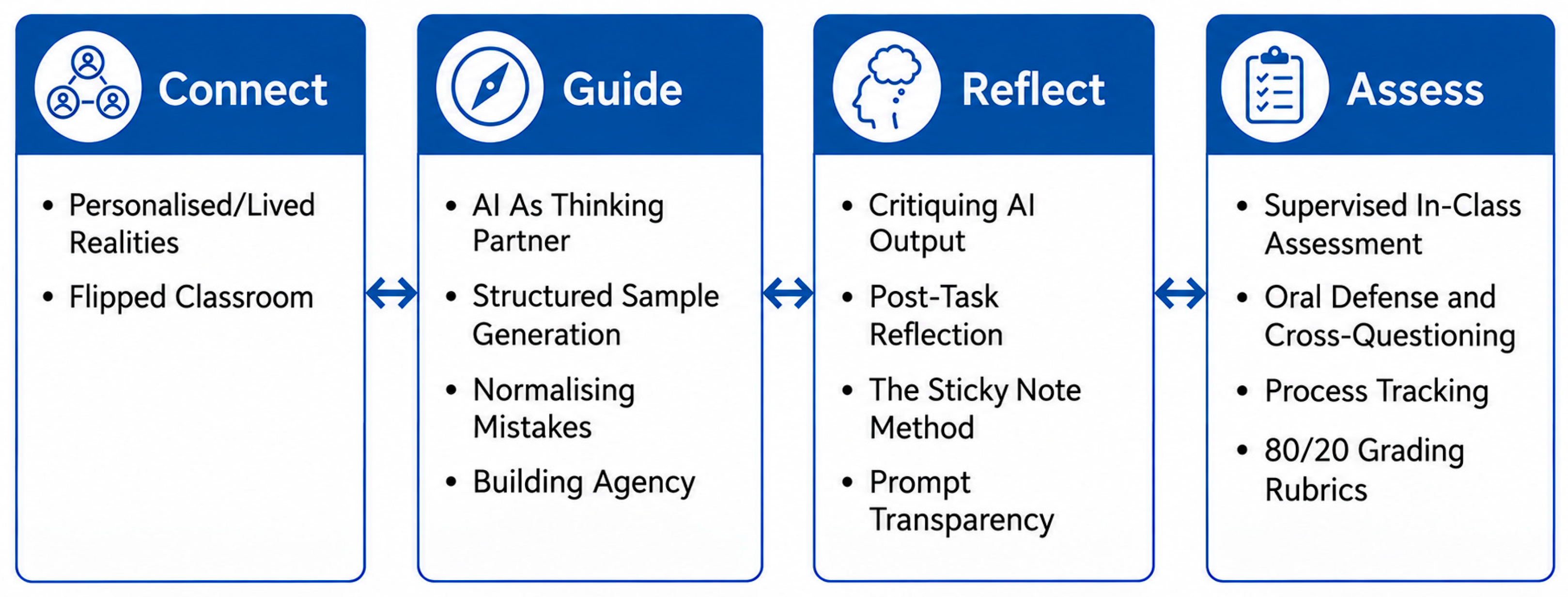
Teachers employ a diverse range of pedagogical strategies to integrate AI while safeguarding critical thinking and academic integrity. The Connect–Guide–Reflect–Assess model emerged inductively from the data through the iterative process of Reflexive Thematic Analysis described in the methodology section. Table 2 illustrates this trajectory, showing how initial codes—generated through a combination of AI-assisted preliminary coding and researcher-led interrogation of the raw data—were grouped into candidate themes and subsequently mapped onto the four final Connect–Guide–Reflect–Assess (CGRA) categories. Rather than representing a fixed sequence or hierarchy, these four dimensions are conceptualised as interconnected and often overlapping aspects of instructors’ practice that can co-occur or recur at different points depending on context. Representative participant quotes illustrating each category are provided for each code to document the trajectory from data to theme to category both in Table 2 below and in the findings sections that follow.
Table 2.
Illustrative Codes and Quotes for Each CGRA Category.
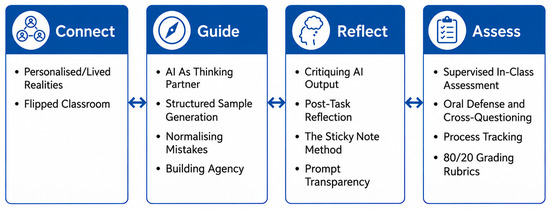
Building on this coding trajectory, Figure 4 presents the CGRA framework illustrating how the four categories interrelate as a cohesive pedagogical framework.
Figure 4.
Four-dimensional pedagogical framework of AI integration.
The Connect–Guide–Reflect–Assess (CGRA) framework should be understood as an evidence-informed pedagogical framework derived from participants’ experiences within this qualitative study rather than as a universally validated instructional model.
4.2.1. Connect
Within this sub-theme, two distinct types of connections emerged: (i) connecting learners with AI and (ii) connecting them with their own lived realities and personalised experiences outside of the virtual world. On the one hand, teachers advocated for the need to not only accept AI in language education, but to help students develop connections with it by allowing them to use the available tools and be transparent about it. On the other hand, there was also an emphasis on disconnecting them from the virtual world and actually enforcing a connection with their own physical world. Ahmed and Sara said they ensure that “rather than bringing in a generic type of assignment” they tailored assignments to some “exciting idea” that is unique and personalised, such as comparing human language to the communication of their own domestic pets or writing about their own family histories. At the same time, they also admitted that
It is still quite challenging to design assignments that aid in critical thinking and make students work on their own while they had personal assistant at hand that can come up with flawless work and earn them good grades.(Sara)
Nevertheless, by giving them such personalised assignments, they found “some level of interaction” on a personal level and the students actually “bring examples from their homes”.
Creating meaningful connections with AI tools appeared as most teachers’ priority. By bringing the flipped learning model into practice, they allow their students to use AI to collect information for their assignments, but “the next day they come and they do a presentation of that”, and they “justify what they have submitted or in groups discuss those ideas”. Many reported this strategy to be successful.
I told them to find information and then you’ll be asked questions about it. So most of them, I believe, 12 or 13 or 15 students, they came prepared.(Fahad)
4.2.2. Guide
Teachers collectively emphasised the urgent need to guide students properly and train them in AI literacy and using technology as a structured scaffold rather than a shortcut.
I think teachers need to be very clear and honest about what is allowed and what is not. Indeed, our students only need simple guidelines, which is our responsibility to provide them. We can teach them that AI can be used for brainstorming, or I can assign them a task to complete within the provided time in class. If students understand that relying too heavily on AI can weaken their learning and future abilities, they are more likely to use it responsibly.(Asma)
I think by being transparent, explaining what counts as acceptable. As far as the support is concerned and encouraging that they should disclose. I think by guiding them, that’s the best thing.(Fatima)
Talal mentioned his efforts to train his students on how to use AI tools constructively; he taught them to use CARS (Create a Research Space) model and the three moves it proposes to write the introduction of academic essays. After he explained the model to his students, he instructed them to
Now let’s use AI and just give them prompt that you need to write introduction on a particular topic using 3 moves of CARS model. And clearly explain, uh, clearly, separate each move so that we should understand how each move can be written on this particular topic.
Each student chose his own topic and gave a command to ChatGPT to write an introduction using the CARS model and they came with ‘wonderful samples”. Once they fully understood the model and its three moves through examples generated by AI, Talal told them:
Now it is your turn without using book, without using AI. You choose your own topic and start writing down short introduction using cars model and it’s 3 moves. And then they did it wonderfully.
He used the same technique in another EAP Writing class to teach the structure of a paragraph where the students need to understand the difference between topic sentence and supporting details followed by learners writing their own paragraphs on similar lines. He termed this “ethical and responsible use where the teachers can use AI as a partner”, for the writing task, to understand “the samples, to understand the concrete examples”.
An important step in guidance is making it clear to the learners to trust their own actual level of language proficiency.
AI actually gives them the language proficiency that aligns with the standard English norms. We need to help our students understand that English is something fluid…. once they free themselves…they will be able to trust their own English.(Talal)
AI tools have also been seen to promote “racial linguistics frameworks” by always using perfectly correct standard or native-speaker English, which makes non-native learners of the language believe their English is not good enough and AI can give them “better expressions” that will make their assignments appear more refined. Talal particularly stressed the need for de-colonising English and enabling non-native learners to feel confident about their own variety of English.
I always encourage my students to not worry about your language. If you’re writing something and you are using AI because you believe that it is giving you the good expressions or better expressions, I said, it is the native idea of English, so don’t just say it’s a good English. All English[es] are good. And don’t worry about this, uh, uh, discourse of a correctness, that I need to write correct English. So, correct, this is somehow, again, coming from this racial linguistic framework. So therefore, we need to [make them] understand that my own variety can be good. If there are some mistakes, for example, articles are preposition, that’s fine. We can always rectify through our own understanding of it and through how we use the language dynamically.(Talal)
Another dimension of guidance was shaped by the strong desire to preserve learner agency in the face of AI-assisted work. Ahmad believed that asking learners to use AI to generate two versions of the same task and choosing one based on their own understanding and choice can reinforce learner agency.
So, you ask ChatGPT to create two different versions of the same task. And you read both and choose the best. Right? I mean, at least by doing it, you’re interacting with it, right? Although they’re not yours, but you had a decision to make, at least some level of agency is there, right? At least you are controlling which one you choose. Right?(Ahmed)
The ultimately important element was encouraging and building a sense of learner agency and giving them the confidence that their own ideas and the language they produce are equally meaningful.
Encouraging students as many times as possible, that what they know, what they say, what they have is also meaningful.(Ahmed)
Ahmed also acknowledged that sometimes all these things “make no sense to the student, because he’s struggling with getting the full marks”. Yet he strongly believed and often told his colleagues also to “keep saying it. Even if it doesn’t make sense, the thing is that students’ agency must always be maintained”.
4.2.3. Reflect
Reflecting on the AI-produced outputs emerged as the most-desirable and critical strategy according to all teachers. While they did not show any anti-AI attitude, they were all in agreement that learners’ use AI tools must be followed by critical reflection to maintain critical thinking on their part. Asma and Fatima both practised demanding that their students share the process of how they reached at the final answer by sharing the prompts they used and the first drafts of their assignments focusing on the process rather than on the final product.
Sometimes I allow AI use, but I require students to show what prompts they used and to reflect on whether the AI answer was accurate or appropriate. This makes them analyse the content instead of copying it directly. I believe the best way to utilize AI is to treat it as a learning companion, rather than a shortcut. Students can use it for brainstorming, drafting, practicing conversations, or getting feedback, but they still need to demonstrate their thinking.(Asma)
When it is about promoting critical thinking, I focus on the process like, uh, for example, I ask students, um, like, why did, Uh, why did they make this particular choice? Or, or if I, if I catch them using AI, I, I ask them that why do you think AI, uh, I, I mean, AI gave this answer. Or sometimes I ask them to criticise, to do a critique on what AI suggested.(Fatima)
A post-task reflection strategy is used by many teachers where the students are asked to reflect on their written assignments or oral presentations, which they have often prepared with the help of AI-generated materials.
For example, we have a presentation. It used to be, they will write before, and then they will present. So, we have changed the style of it. So now they give a presentation and once they finish presentation, they take 20 to 30 min. There we give them a set of questions like, how did you do? What did you do well? What did you do wrong? What was your fears? So, I mean, all of those questions are put there and then they reflect on their own presentation. So, we changed the style a bit rather than they bring their, like, pre-produced work, and do it.(Fahad)
Asma used a similar strategy of asking her students to orally summarise and highlight key points in their written submissions. This, for her, proves a clear indicator of whether or not the written assignment is the student’s genuine work.
As an experienced teacher, I don’t immediately accuse the student; instead, I ask them to explain their work, summarise what they wrote, or discuss key points orally. If they can’t explain it, that’s a strong sign they didn’t produce it themselves.(Othman)
4.2.4. Assess
A significant shift in the post-AI language teaching and learning arena was seen in assessment practices. Some teachers reported that their institution has abandoned all take-home assessments as they have become “totally useless”.
Since last year, we have changed all the assignments. They’re all supervised in class. And then in the class, they have no chance. The devices are taken off, there are cameras, and then they have to, you know, even the watches, glasses, and everything they have to put in on the table. Yeah. And then they go and do the exams. So we have kind of brought this policy at the university. Only summative tasks, the assessment should be done in class, supervised, with no devices. And if they use a computer that’s locked, they can only use one screen.(Hassan)
Talal also shared about using only class-based assessments rather than take-home assignments where it is very difficult to ensure students’ academic integrity.
…secondary strategy, I did actually was to shift to class-based assessment, which is on the on the spot. I can give them some kind of, uh, quizzes, some test, other than writing tasks.(Talal)
Yet another strategy teachers reported using was changing the assessment rubric and shifting weightages for written content and its oral presentation.
They have the topic. They can do the preparation, but the marks for the content is like 20%. 80% marks are for the delivery. Okay. So even if they have, like, taken the content from AI, whatever resource, we don’t mind, we want them to stand in front of the class because the active presentation is to their facing the audience. They’re able to communicate, are able to answer the question. They have an eye contact, you know, and all of that. So, we don’t bother about the content because we’ve reduced the percentage or the weight of the content.(Fahad)
The four strands fully capture the range and variety of strategies participants in this study, in the Saudi TESOL context, are employing to both maximise the benefits and mitigate the challenges AI brings to language education.
4.3. Future of AI in Language Education
Most teachers seemed uncertain regarding the future and evolving nature of AI in education in general and language learning in particular. Some strongly believed that any opinion at this stage about AI is “bound to be inconclusive as we are in a phase of transition”.
For example, most teachers have been trained traditionally and students they are dealing with are living in the hay day of AI, hence there is this kind of mismatch already and a gulf due to not being able to relate with each other. To me, only time will tell which direction the future will take.(Yazeed)
Concerns regarding digital divides across global educational settings also surfaced in their discussions. One thing all of them agreed upon was the even more important and active role of teachers in creating a balance between AI integration and academic integrity.
4.3.1. Role of Teachers
While students simply submit the work done by AI tools as theirs, human teachers must “try to discuss”, “cross question”, and ask the students “to explain their work” to preserve “academic honesty” because “human judgement, human thinking and human problem-solving skills” are “central” to any learning process.
…basically, the teacher’s role as a guide to create awareness or to train the students how to use it as a partner rather than as a master is absolutely critical.(Maram)
To achieve this purpose, teachers should give tasks that require “more reasoning” focusing more on “process rather than product” adding more reflection than “mere reproduction of the knowledge”. Teachers can ensure this by “talking about it quite frankly and openly to help students formulate a well-thought-out relationship with AI”. Additionally, they need to be “very clear and honest about what is allowed and what is not”. Thus, teachers play a crucial role in developing a “critical awareness” and “critical literacy of the AI use” among students.
No participant cited significant professional training in integrating AI in their language classes so far. While Fatima openly said she is not “trained enough” to guide her students on “how much and to what extent they should be using AI”, Sara also reported “My knowledge and stance come from my readings and worldview. I would really appreciate more trainings.” Fahad, however, strongly suggested teachers work on their continuous professional development by attending online webinars, workshops and conferences if they do not have means to travel to attend in person, and peer learning by discussing with senior colleagues.
4.3.2. Role of Institutions
Two major issues that emerged from participants’ discussions regarding the institutional role in this scenario included a serious lack of clear AI policy guidelines and absence or lack of teacher support/training in integrating AI into language education. Most teachers are “learning by doing it” on their own with “a lack of resources and unclear guidelines” posing a serious hurdle.
Honestly speaking, we teachers are currently figuring out on our own how to maintain academic integrity. For me, there should be a policy of using AI within a certain limit, so that both students and teachers are well aware of the limits. First, institutions provide us with guidelines on how to use AI ethically, and then we teach our students. You know, it’s a chain of policymakers, stakeholders, educators, and institutions. It’s not the teacher who can be honest and promote honesty; rather, it’s the collective effort.(Mashael)
Some said their institutions claim to have AI policies but they are neither communicated to the faculty, nor implemented.
They claim they are there. But sometimes, you know, they’re too vague, not clear, and at times, not conveyed on time. And not really implemented, because having them on a piece of paper is not enough.(Hassan)
In the absence of clear policy guidelines and a will to implement them effectively, institutions are guilty of creating “clashes between students and teachers”. Given that instructors such as Talal and Mashael described their struggle to identify students’ AI-assisted work and maintain their academic integrity (see Section 4.2.4 and Section 4.3.2), findings from this study suggest that institutions may wish to reconsider their assessment standards, such as making AI detection reports compulsory alongside plagiarism reports or transitioning toward machine-based assessments.
5. Discussion
The findings of this study reveal a nuanced and multi-layered picture of how TESOL teachers in the Saudi context perceive and respond to the growing presence of artificial intelligence in language education, which helped answer the research questions. Taken together, the three themes also make it clear that the teachers not only show strong awareness, which Kumar et al. (2024) called the first and the current stage of development and evolution of AI-mediated writing technologies, but also go beyond to indicate that within a span of two years, teachers are describing practices consistent with Stage 3 where they are actively employing pedagogical strategies to counter plagiarism on the one hand and to integrate AI into language classrooms on the other. However, this interpretation is based on self-reported strategies from 12 instructors rather than a systematic assessment against Kumar et al.’s full Stage 3 criteria.
The SWOT analysis of TESOL teachers’ conceptions of artificial intelligence presents a very balanced view across the four dimensions of strengths, weaknesses, opportunities and threats that AI brings to language classrooms at present and in the future. The most significant strength of AI is the capacity for empowering learners through personalised learning and targeted feedback, which aligns with the principles of student-centred pedagogy and differentiated learning. The shy, weak or slow learners have found an untiring partner who remains with them for as long as they need it without fear of judgement, thereby extending their learning beyond the bounds of time and place. In addition to serving learners, AI is proving to be a time-saver for teachers also in preparing class materials and activities. Teachers also find AI’s presence an excellent opportunity to integrate the flipped learning model in their classes. On the flip side, the biggest threat AI poses to language learners is through erosion of their critical and creative abilities and academic integrity in the face of convenience. Teachers’ own credibility might also be at stake if they outsource their duties as teachers to AI or do not independently verify the information it generates.
The range and variety of strategies used by teachers—from building meaningful connections with both learners’ lived realities and AI, to guiding them to responsibly utilise its scaffolding potential to build and advance their learning journeys, to making them pause, reflect and explain the written work they submit to the teachers to changing the nature and weightages of assessments—suggest that the teachers show strong alignment with practices of the third stage of AI’s integration as predicted by Kumar et al. (2024). By encouraging students to value fluid English and their own linguistic varieties over a rigid “native speaker” model, teachers help reduce the inferiority complex that makes students over-reliant on AI for “language editing”.
Together, the findings construct an image of Saudi TESOL teachers as critically reflective, technologically aware, and pedagogically adaptive professionals who do not believe in the mere transmission of knowledge that AI can now deliver efficiently, but in the human dimensions of teaching that remain irreplaceable. This repositioning of teacher identity in the wake of technological innovations is consistent with what Bijker et al. (1987) contended through their Sociotechnical Systems Theory. As gatekeepers of academic integrity through critical reflection, analysis, evaluation, and finally leading to the creation of something on their own, teachers also fulfilled the roles rated by Anderson and Krathwohl (2001) as higher-order thinking skills.
However, the tension between pedagogical practice and institutional policy needs to be addressed. While teachers perceive AI clearly and strategise creatively, the findings from the third theme strongly suggest that they cannot sustain this work without concrete institutional support. The responsibility to create and maintain a balance between technological innovation and academic integrity is shared equally by educators and institutions but it is currently misaligned. While teachers are adapting in real time, institutions lack clear AI policies and faculty professional training—a pattern consistent with Cotton et al. (2024).
6. Conclusions
The findings of this study argue that the tension between artificial intelligence and academic integrity is real yet resolvable through teachers’ active and critical engagement with the language content and pedagogy. The proposed Connect–Guide–Reflect–Assess framework offers a lens for understanding and an adaptable guide to harness AI’s affordances without compromising authentic thinking and learning. However, teacher adaptability and commitment alone are insufficient. Consistent and coherent institutional policies, professional development, and AI-conscious curriculum and assessment design are prerequisites for any serious commitment to academic integrity in an AI-mediated language learning environment. These findings offer context-specific insights into how instructors in this setting are integrating AI pedagogically; whether similar patterns hold in other institutional or cultural contexts remains an open question for future research.
This study is not without limitations. The findings are drawn from 12 EAP instructors across four Saudi universities, and while purposive sampling ensured relevance and depth, the sample’s geographical and institutional specificity limits its transferability to other EFL contexts. The study relied exclusively on self-reported interview data, meaning the strategies teachers described were not observed in practice or verified against student outcomes. Future research would benefit from classroom observations and longitudinal designs that track the implementation and impact of strategies such as those comprising the CGRA model over time. Comparative studies across different Gulf or MENA contexts would further test the model’s replicability, while student-perspective studies would provide a fuller picture of how AI-mediated pedagogical strategies are experienced on the receiving end. As generative AI tools continue to evolve rapidly, the professional and institutional challenges documented here will require ongoing empirical attention.
This study also focused exclusively on TESOL teachers’ perspectives in order to develop an in-depth understanding of their strategies for balancing AI use with academic integrity. Consequently, the findings do not capture students’ experiences or perceptions. Future studies could adopt mixed-methods or multi-stakeholder designs incorporating both teachers and students to provide a more comprehensive understanding of AI-mediated teaching and learning.
Funding
This research was funded by the Deanship of Scientific Research at Prince Sattam bin Abdulaziz University under Grant PSAU/2025/02/35291.
Institutional Review Board Statement
The study was conducted in accordance with the Declaration of Helsinki and approved by the Standing Committee of Bioethics Research at Prince Sattam bin Abdulaziz University. The approval was granted through letter number SCBR-605/2025 on 2 December 2025.
Informed Consent Statement
Informed consent was obtained from all participants involved in the study. The consent form for participation was distributed to all participants and signed.
Data Availability Statement
The original data presented in the study are openly available in FigShare at https://doi.org/10.6084/m9.figshare.32077581.
Acknowledgments
The author extends her appreciation to Prince Sattam bin Abdulaziz University for funding this research work through the project number PSAU/2025/02/35291. During the preparation of this manuscript/study, the author used Notebook LM for initial code generation from the qualitative data. The author has reviewed and edited the output, completed the detailed thematic analysis and takes full responsibility for the content of this publication.
Conflicts of Interest
The author declares no conflicts of interest. The funders had no role in the design of the study; in the collection, analyses, or interpretation of data; in the writing of the manuscript; or in the decision to publish the results.
References
- Akinsemolu, A. A., & Onyeaka, H. (2025). The role of artificial intelligence in transforming language learning: Opportunities and ethical considerations. Journal of Language and Education, 11(1), 148–152. [Google Scholar] [CrossRef] [Scilit]
- Alawad, E. A., Ayadi, H. H., & Alhinai, A. A. (2025). Guarding integrity: A case study on tackling AI-generated content and plagiarism in academic writing. Theory and Practice in Language Studies, 15(6), 1730–1742. [Google Scholar] [CrossRef] [Scilit]
- Al-khresheh, M. H. (2024). The future of artificial intelligence in English language teaching: Pros and cons of ChatGPT implementation through a systematic review. Language Teaching Research Quarterly, 43, 54–80. [Google Scholar] [CrossRef] [Scilit]
- Al-Smadi, O. A., Rashid, R. A., Saad, H., Zrekat, Y. H., Kamal, S. S. L. A., & Uktamovich, G. I. (2024). Artificial intelligence for English language learning and teaching: Advancing sustainable development goals. Journal of Language Teaching and Research, 15(6), 1835–1844. [Google Scholar] [CrossRef] [Scilit]
- Anderson, L. W., & Krathwohl, D. R. (2001). A taxonomy for learning, teaching and assessing: A revision of bloom’s taxonomy of educational objectives. Longman. [Google Scholar]
- Bijker, W., Hughes, T., & Pinch, T. (Eds.). (1987). The social construction of technological systems. MIT Press. [Google Scholar]
- Braun, V., & Clarke, V. (2006). Using thematic analysis in psychology. Qualitative Research in Psychology, 3(2), 77–101. [Google Scholar] [CrossRef] [Scilit]
- Braun, V., & Clarke, V. (2019). Reflecting on reflexive thematic analysis. Qualitative Research in Sport, Exercise and Health, 11(4), 589–597. [Google Scholar] [CrossRef] [Scilit]
- Bretag, T. (2013). Challenges in addressing plagiarism in education. PLoS Medicine, 10(12), e1001574. [Google Scholar] [CrossRef] [Scilit] [PubMed]
- Chiu, T. K. F. (2023). The impact of generative AI (GenAI) on practices, policies and research direction in education: A case of ChatGPT and midjourney. Interactive Learning Environments, 32(10), 6187–6203. [Google Scholar] [CrossRef] [Scilit]
- Cotton, D. R. E., Cotton, P. A., & Shipway, J. R. (2024). Chatting and cheating: Ensuring academic integrity in the era of ChatGPT. Innovations in Education and Teaching International, 61(2), 228–239. [Google Scholar] [CrossRef] [Scilit]
- Creswell, J. W., & Poth, C. N. (2018). Qualitative inquiry and research design choosing among five approaches. SAGE Publications, Inc. [Google Scholar]
- Dahri, N. A., Yahaya, N., & Al-Rahmi, W. M. (2025). Exploring the influence of ChatGPT on student academic success and career readiness. Education and Information Technologies, 30(7), 8877–8921. [Google Scholar] [CrossRef] [Scilit]
- Du, J., & Alm, A. (2024). The impact of ChatGPT on English for academic purposes (EAP) students’ language learning experience: A self-determination theory perspective. Education Sciences, 14(7), 726. [Google Scholar] [CrossRef] [Scilit]
- Eaton, S. E. (2023). Comprehensive academic integrity (CAI): An ethical framework for educational contexts. In S. E. Eaton (Ed.), Handbook of academic integrity. Springer. [Google Scholar] [CrossRef] [Scilit]
- ElSayary, A. (2024). An investigation of teachers’ perceptions of using ChatGPT as a supporting tool for teaching and learning in the digital era. Journal of Computer Assisted Learning, 40(3), 931–945. [Google Scholar] [CrossRef] [Scilit]
- Gerlich, M. (2025). AI tools in society: Impacts on cognitive offloading and the future of critical thinking. Societies, 15(1), 6. [Google Scholar] [CrossRef] [Scilit]
- Gruenhagen, J. H., Sinclair, P. M., Carroll, J.-A., Baker, P. R. A., Wilson, A., & Demant, D. (2024). The rapid rise of generative AI and its implications for academic integrity: Students’ perceptions and use of chatbots for assistance with assessments. Computers and Education: Artificial Intelligence, 7, 100273. [Google Scholar] [CrossRef] [Scilit]
- Kovari, A. (2025). Ethical use of ChatGPT in education—Best practices to combat AI-induced plagiarism. Frontiers in Education, 9, 1465703. [Google Scholar] [CrossRef] [Scilit]
- Kumar, R., Eaton, S. E., Mindzak, M., & Morrison, R. (2024). Academic Integrity and Artificial Intelligence: An Overview. In S. E. Eaton (Ed.), Second handbook of academic integrity. Springer international handbooks of education. Springer. [Google Scholar] [CrossRef] [Scilit]
- Maleki, A. (2026). Rethinking ethical academic integrity ecosystems in higher education in the age of artificial intelligence. Discover Artificial Intelligence, 6(1), 145. [Google Scholar] [CrossRef] [Scilit]
- Malik, A. R., Pratiwi, Y., Andajani, K., Numertayasa, I. W., Suharti, S., Darwis, A., & Marzuki. (2023). Exploring artificial intelligence in academic essay: Higher education student’s perspective. International Journal of Educational Research Open, 5, 100296. [Google Scholar] [CrossRef] [Scilit]
- Mohebbi, A. (2025). Enabling learner independence and self-regulation in language education using AI tools: A systematic review. Cogent Education, 12(1), 2433814. [Google Scholar] [CrossRef] [Scilit]
- Rusandi, M. A., Ahman, Saripah, I., Khairun, D. Y., & Mutmainnah. (2023). No worries with ChatGPT: Building bridges between artificial intelligence and education with critical thinking soft skills. Journal of Public Health, 45(3), e602–e603. [Google Scholar] [CrossRef] [Scilit]
- Ruskulis, L., Maiboroda, R., Popova, O., Rodionova, I., Olecsuk, O., & Ababilova, N. (2026). An academic text: The balance between academic integrity and artificial intelligence. Journal of Teaching and Learning, 20(1), 137–151. [Google Scholar] [CrossRef] [Scilit]
- Yeo, M. A. (2023). Academic integrity in the age of artificial intelligence (AI) authoring apps. TESOL Journal, 14(3), e716. [Google Scholar] [CrossRef] [Scilit]

Disclaimer/Publisher’s Note: The statements, opinions and data contained in all publications are solely those of the individual author(s) and contributor(s) and not of MDPI and/or the editor(s). MDPI and/or the editor(s) disclaim responsibility for any injury to people or property resulting from any ideas, methods, instructions or products referred to in the content. |
© 2026 by the author. Licensee MDPI, Basel, Switzerland. This article is an open access article distributed under the terms and conditions of the Creative Commons Attribution (CC BY) license.