


Abstract
Debate over the role of generative artificial intelligence in formal education is marked by sharply divergent claims about its effects on student learning. Much of this disagreement reflects a failure to distinguish AI-supported performance from durable learning. This conceptual article aims to address a central gap in the literature by focusing on when and how students should be guided to rely on AI. It introduces the Gradual Release of AI Technology (GRAIT) model, extending Pearson and Gallagher’s gradual release of responsibility to the staged use of generative AI technologies in K-12 education. The model distinguishes gradual release of responsibility, which concerns who performs the cognitive work, from gradual release of AI technology, which concerns when and how that work may be scaffolded, augmented, or offloaded to AI. Three phases are proposed: independent cognition, where foundational knowledge and skills are developed without AI; shared cognition, where AI is introduced through teacher-guided interaction; and offloaded and reallocated cognition, where learners strategically delegate and reallocate aspects of thinking while retaining evaluative judgement. Progression depends on demonstrated knowledge, skill proficiency, epistemic understanding, and AI literacy. The central question thus addresses when and how AI use should be staged according to learner readiness.
1. Introduction
Research on generative AI in education currently presents sharply divergent claims. Some reviews and experimental studies report gains in performance, motivation, and perceived learning (e.g., Deng et al., 2025; Kestin et al., 2025; Wu et al., 2026), whereas others report reduced independent performance, critical thinking, metacognitive monitoring, and retention once AI support is removed (e.g., Bastani et al., 2025; Fan et al., 2025; Gerlich, 2025; Kosmyna et al., 2025). This leaves educators with a genuine problem. The research community is informing teachers that AI enhances learning while simultaneously warning that it may erode the very learning it appears to support (Table 1). For evidence-conscious educators, the problem is not a lack of evidentiary claims per se, but a lack of clarity about which are most credible and instructionally beneficial.
Table 1.
Contradictory Claims About the Impact of AI on Learning.
These contradictions may be just as much a reflection of an incoherent evidence base as they are of incoherent questions. Asking whether AI helps or harms learning invites dichotomous thinking and needlessly blunt answers to a fundamentally conditional pedagogical problem. AI may improve productivity, fluency, and immediate performance in the short term without strengthening the knowledge, schemas, and judgement required for robust learning in the long term. The central question is therefore to what extent there is potential for sustained educative benefits in using AI, and thus whether students should be permitted to rely on it for a given task, when, for whom, under what conditions, and whether safeguards are needed to curb foreseeable learning losses.
The primary aim of this article is practical in that it seeks to develop a conceptual framework for guiding educators in the use and application of AI in formal learning contexts. It does so by giving explicit direction on when and how learners may benefit from using AI by extending Pearson and Gallagher’s (1983) Gradual Release of Responsibility (GRR) model to contemporary AI-supported learning environments. The model posited, hereafter referred to as the Gradual Release of AI Technology (GRAIT) model, offers a distinct extension of the original gradual release model to the use of cognitively substantive AI technologies and complements broader notions of scaffolding, cognitive load, and cognitive offloading/reallocation rather than replacing them. The central premise is that access to AI should progress through stages based on learning milestones, rather than being assumed and accessed all at once.
Pearson and Gallagher’s (1983) gradual release of responsibility framework describes a staged transfer of cognitive responsibility from teacher modelling, through guided practice, to independent learner performance. Popularized as “I do it, We do it, You do it alone,” and later expanded by Fisher and Frey (2021) to include “You do it together”, the model addresses who performs the cognitive work. Despite its popularity among educators, only a small number of studies directly evaluate the efficacy of the gradual release model, albeit favourably (e.g., Eide et al., 2025; Kaya et al., 2026). Stronger evidence comes from studies that investigate its underlying principles, including broader notions of scaffolding through contingency, fading, and progressive transfer of responsibility (van de Pol et al., 2010), with complementary findings from research into explicit instruction and cognitive load theory (Rosenshine, 2012; van Gog et al., 2010). AI introduces a relatively unprecedented problem because independent performance may involve substantial delegation to technology. Gradual release of responsibility therefore remains necessary but insufficient in an AI era. What educators now need is a complementary framework specifying when and how cognitive work may be scaffolded, augmented, or offloaded to AI so that learning can be maximized.
A secondary aim of this article is to respond to calls for more robust frameworks to guide the educational use of AI. Raman et al. (2026) identified more than 100 theories used in generative AI research, including technology acceptance, self-determination, constructivist learning, cognitive load, social cognitive, innovation diffusion, activity, and pedagogical design frameworks. These approaches explain AI adoption, motivation, interaction, curriculum integration, and institutional readiness. Others commonly emphasize AI literacy, including the knowledge and competencies required to understand, evaluate, and use AI responsibly (e.g., Allen & Kendeou, 2024; Zhang et al., 2025). Seldom do they explicitly determine when cognitively substantive AI should be restricted, guided, or expanded according to demonstrated learner readiness. Consequently, AI-supported learning remains hampered by “the absence of robust frameworks guiding teachers in effectively harnessing these tools” (Chiu, 2025, p. 4189). When AI itself is the object of instruction, its use may be necessary from the outset. When AI supports learning in non-AI domains, however, its educational value depends on who uses it, as well as how, why, and when it is used.
The GRAIT model addresses this distinction by providing a decision framework for staging AI use in non-AI subject matter, such as mathematics, chemistry, or essay writing. Its scope is therefore limited to learning with, without, and from AI, rather than learning about AI as a distinct domain of knowledge (see Wang & Cheng, 2022). It complements AI literacy frameworks by using demonstrated knowledge, skill proficiency, epistemic understanding, and AI literacy to determine when and how learners should engage with AI.
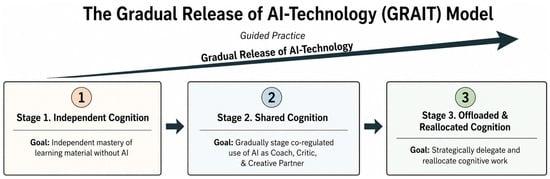
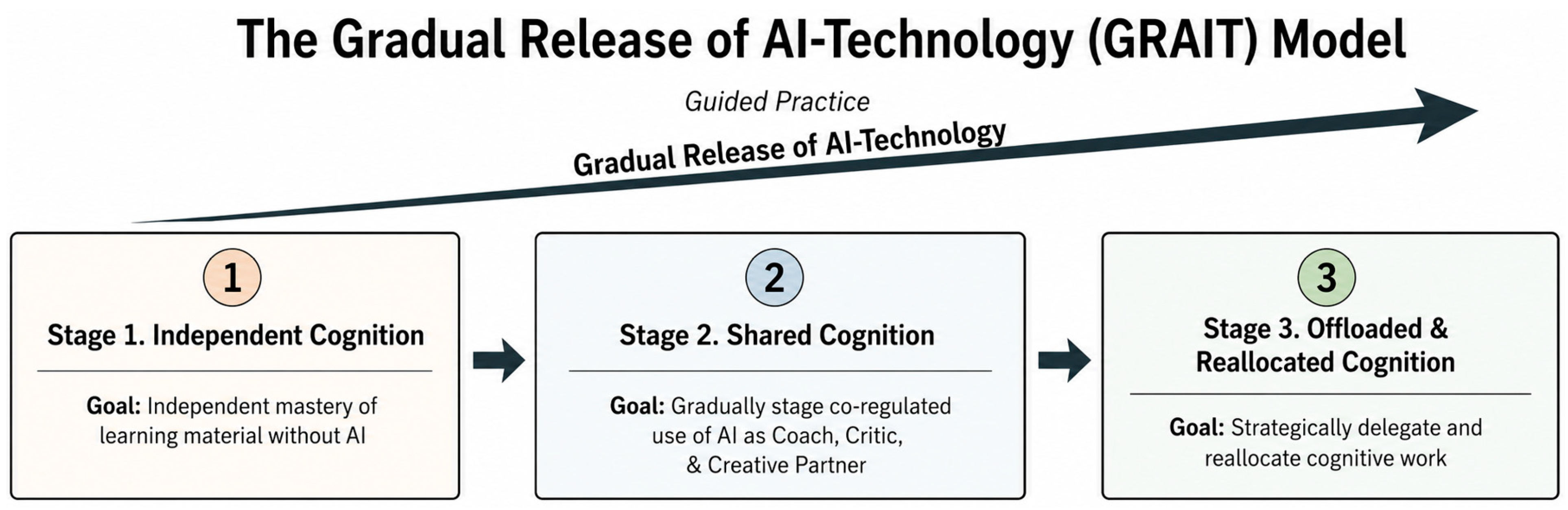
GRAIT comprises three overlapping stages that map onto key phases of learning (Figure 1): Independent Cognition, in which AI substitution is strategically restricted to support foundational learning; Shared Cognition, in which AI is introduced in constrained, teacher-regulated ways; and Offloaded and Reallocated Cognition, in which strategic delegation and reallocation of cognitive effort become appropriate once learners can use AI without sacrificing essential learning. The sections that follow develop the conceptual, research-based, and practical case for this model.
Figure 1.
The Gradual Release of AI technology Model: Three Overlapping Stages of AI use to Improve Learning.
2. The Conceptual Case for the Gradual Release of AI Technology
The conceptual case for the gradual release of AI technology rests on the premise that the emergence of generative AI does not require educators to reinvent what decades of learning science have established. This section therefore draws heavily on complementary theories of learning and performance from the learning sciences, including knowledge generation and retrieval, cognitive load and offloading, expertise development, and metacognitive judgement. While not an exhaustive or systematic review, sources are selected for the purpose of informing the cognitive conditions under which substantive intellectual work should remain independent, be shared with AI, or be strategically offloaded and reallocated. Together, this literature is integrated abductively by prioritizing findings that examine the convergent implications for the timing and regulation of AI use in educative settings.
A central distinction in the present argument is the difference between learning and performance. Learning refers to relatively durable changes in mental models of the world, reflected in growth of knowledge and skills, that support reasoned thinking, retention, and transfer; whereas performance refers to what learners can produce as a one-off event, during or immediately after instruction (Soderstrom & Bjork, 2015). According to Yan et al. (2025) this “fundamental distinction is underexamined in emerging research on generative AI in education.” AI may improve fluency, speed, and apparent competence during performance without strengthening the knowledge, skills, and epistemic cognitions necessary for later learning independent of AI. Research on desirable difficulties similarly shows that conditions that feel harder in the moment, such as retrieval, spacing, and generation, often produce stronger long-term learning than conditions that make performance feel easy (Bjork & Bjork, 2011). AI can create a pedagogical hazard by inducing a temporary sense of fluency among learners—improving the product while bypassing the effortful processes through which durable learning is forged.
This problem is compounded by miscalibrated metacognitive judgement, which Koriat and Bjork (2005) describe as illusions of competence. Learners mistake current ease of processing for future competence, particularly when performance depends on support that will later be removed. In AI-supported contexts, this creates a predictable risk that learners may overestimate what they know because they fail to discount the assistance embedded in the task itself.
Overlooking such important distinctions has contributed to a misleading reading of the AI-in-education literature. Deng et al. (2025), for example, reported meta-analytic estimates that aggregated effects across broad outcome categories without explicitly separating AI-supported performance from later performance independent of AI. A reanalysis found the studies included in Deng et al. “failed to meet even minimal standards for experimental rigor” (Lawson et al., 2026, p. 13). A randomized controlled trial by Kestin et al. (2025) comparing AI tutoring with active classroom teaching methods in STEM instruction found that results favoured the AI tutoring experience; yet the study did not adequately separate AI-supported assessment performance from later performance independent of AI, nor did they equate time on task across conditions. Much like a student’s performance in multiplication can be bolstered by using a calculator, this tells us little about whether a technology, such as AI, can lead to incremental and lasting gains in learning once the technology is removed. As we will discover in the next section, studies that properly account for these potential confounds tend to see AI and non-AI performances shift in opposite directions (‘performance paradox’), with students performing better during AI-assisted practice but worse on a subsequent unassisted exam performance when AI is removed (e.g., Bastani et al., 2025).
Premature AI reliance may also reduce opportunities for self-generation. The generation effect suggests that learners remember target information better when they generate it themselves compared to when they have it passively generated by another or, in this case, by AI (Slamecka & Graf, 1978). In educational settings, for instance, self-questioning has a moderate to large benefit compared to having questions generated by others (Rosenshine et al., 1996). Likewise, a meta-analysis by Schroeder et al. (2018) found the benefits of concept maps for learning increased from g = 0.58 to 0.72 when students constructed maps themselves, a gain of Δg = 0.29. If learners ask AI to produce summaries, questions, explanations, or concept maps for them, the output may appear impressive while the generative work through which understanding is encoded, prior knowledge linked, and schemas enriched is bypassed.
Cognitive load theory lends further support to this argument. Accordingly, the quality of instruction depends in large part on how readily educators accommodate the inherent biological constraints of working memory during learning (Sweller, 2011). This requires intentionally altering the balance among intrinsic (inherent task complexity), extraneous (information that distracts from learning), and germane cognitive load (integrating long-term memory and working memory to enrich schemas). In principle, AI may help when it reduces unproductive extraneous demands. The concern is that it may also reduce germane cognitive load by performing too much of the effortful sense-making, generation, inference, and evaluation required for schema development.
This phenomenon has been characterized as ‘cognitive offloading’, where external devices are used “to alter the information processing requirements of a task so as to reduce cognitive demand” (Risko & Gilbert, 2016, p. 676). Wilson (2002) helpfully distinguishes offloading that may lead to benefits by using the environment as a kind of archive to alleviate constraints on long-term memory versus offloading that may undermine learning by alleviating constraints on working memory and bypassing encoding information altogether. Sparrow et al. (2011) prominently highlighted risks in offloading to technology when they found that independent recall of target information suffers as the frequency of search engine use increases (the so-called “Google Effect”). Similar learning opportunity losses have been demonstrated when offloading to digital GPS at the expense of self-guided navigation (Dahmani & Bohbot, 2020) or when students engage in premature, excessive, or uncritical use of calculators at the expense of basic mathematical reasoning (LaCour et al., 2019). Offloading may therefore be educationally useful when it frees working-memory resources for learning, but harmful when it displaces the cognitive activity required to construct durable knowledge (Sweller, 2020).
Recent reviews attempt to identify educative opportunities when the learner strategically offloads certain tasks to AI. Giannakos et al. (2024), for example, argue that generative AI has the potential to improve adaptive access to knowledge, metacognitive and self-regulated learning, intelligent tutoring, content generation, learning design, assessment, and feedback. The issue, however, is not whether such benefits exist in principle, but whether their use in practice preserves the cognitive conditions under which robust learning is likely to occur. The effects of AI are therefore likely to depend on the learner, task, timing, context, and form of cognitive support. Whether AI could improve learning in principle is secondary to whether it does so under these conditions. The GRAIT model responds to this by treating AI not as a universal benefit or a universal threat, but as a provisional support whose use should be conditionally staged according to learner readiness.
3. The Research-Based Case for the Gradual Release of AI Technology
The empirical literature on AI and learning remains immature and methodologically uneven, owing partly to the previously discussed issue of researchers failing to properly distinguish AI-supported performance from later independent learning. Compounding this problem, researchers may be motivated to see the benefits and overlook the drawbacks of AI in educational settings (Weidlich et al., 2025). Zawacki-Richter et al. (2019) lamented that the most stunning result of their systematic review into AI’s role in education was a “dramatic lack of critical reflection of the pedagogical and ethical implications as well as risks of implementing AI applications in higher education” (p. 21). While their central concern related to non-generative AI, the widespread uptake of generative AI has renewed the need for robust and human-centred theories of AI-supported learning (Chiu, 2025; Vieriu & Petrea, 2025; Yan et al., 2024). In light of the preponderance of positive yet undertheorized findings, Horvath (2025) anticipates that research supporting the benefits of AI in learning will eventually experience a decline effect, where premature excitement that inflated early results will experience a dramatic decline as more robust, independent, and sceptical voices enter the debate—a trend seen more broadly among the psychological and behavioural sciences (e.g., also see Pietschnig et al., 2019; Steininger et al., 2026).
There are nevertheless some evidentiary ‘green shoots’ that withstand due caution. These studies point to a mosaic of results that, taken together, converge on a more nuanced picture where the use of AI tends to be most beneficial when gradually introduced after the learner has demonstrated a strong foundation of unassisted performance, metacognitive monitoring, and the cognitive activity associated with durable learning.
One suggestive, although preliminary, experimental example comes from the preprint by Kosmyna et al. (2025), which offers a cognitive neuroscientific lens on the role of AI in essay writing. They asked 54 students to complete an SAT 20 min essay-writing task after being randomly assigned to one of three technologically distinct conditions. In the no-tech condition, referred to as the brain-only group, students relied entirely on their own knowledge and remained offline throughout the task. In the low-tech condition, referred to as the search-engine group, students could use websites and Google Search to support their writing, but AI use was prohibited. In the high-tech condition, referred to as the LLM group, students used ChatGPT to support essay writing. Results showed a dose–response pattern where greater technological support was associated with lower brain connectivity, weaker recall, and poorer indicators of cognitive engagement.
Particularly revealing were the results of the follow-up condition swap. Students who began in the brain-only group and later wrote with AI support retained relatively strong essay quality and EEG activity, whereas those who began in the high-tech AI group and later wrote under brain-only conditions continued to struggle, showing poorer essay quality, weaker recall, and lower EEG connectivity. Kosmyna et al. (2025) interpreted these negative carry-over effects in the AI-to-brain-only condition as evidence of “cognitive debt,” reflecting the extent to which foundational cognitive work had been displaced during the initial phase of learning. However, findings should be interpreted somewhat cautiously because the results have not been independently replicated and the report has not undergone peer review at the time of writing.
Observational evidence also raises questions about how widespread language-model use may influence human expression. In one study, Yakura et al. (2024) analyzed 740,249 h of human discourse from 360,445 YouTube academic talks and 771,591 conversational podcast episodes across multiple disciplines, and found a concurrent rise in the use of words preferentially generated by ChatGPT after its release. Words like ‘delve’, ‘comprehend’, ‘boast’, ‘swift’, and ‘meticulous’ experienced growth in frequency of usage between 25% and 50% since the release of ChatGPT. Yakura et al. (2024) surmised that “machines trained on human culture are now generating cultural traits that humans adopt, effectively closing a cultural feedback loop” (p. 8). Such patterns have led some to suggest that the influence of AI is going beyond language and may in fact be ‘homogenizing our thoughts’ (Chayka, 2025). A common manifestation of this comes in the form of AI sycophancy where rather than challenging students’ misconceptions and correcting their mistakes, AI panders to their existing interests, beliefs, and views (see Cheng et al., 2026). The educational implications suggest that classrooms that give way to AI use too early and too often risk undermining the development of the learner’s essay-writing skills by stifling their authorial voice, diluting their unique writing style, derailing the need to develop self-evaluation skills, and ultimately forgoing the opportunity to fully develop their intellectual identity.
Gerlich (2025) likewise found a strong negative association between increased AI use and critical thinking skills, which was mediated by cognitive offloading. Gerlich concluded that “while AI tools offer undeniable benefits in terms of efficiency and accessibility, they may inadvertently diminish users’ engagement in deep, reflective thinking processes” (Gerlich, 2025, p. 24). However, the study was observational and relied partly on self-reported behaviour, so it cannot, in principle, establish a causal link between AI use and diminished critical thinking.
Similar concerns extend beyond formal education. In medical practice, Budzyń et al. (2025) found that routine exposure to AI-assisted colonoscopy was associated with reduced performance on subsequent non-AI-assisted procedures, suggesting a possible deskilling effect in a high-stakes professional domain. Although this was not a study of initial skill acquisition, and its observational design does not eliminate alternative explanations, it raises the possibility that routine AI support may weaken the foundations of previously acquired skills. Hasan (2025) offers commentary that routine reliance on AI may bypass neurological effort-reward circuits that make learning intellectually and motivationally reinforcing, “reducing the learner’s role to one of passive consumption” (p. 4693). Such conjectures should, however, be held in caution as many are yet to be directly tested in educational contexts.
Bastani et al. (2025) conducted a large field experiment with nearly 1000 secondary mathematics students assigned to one of three conditions: a control group using only books and notes, a standard GPT-4 chatbot, or a guarded GPT-4 tutor designed to provide hints rather than direct answers. Across four review sessions, AI-supported conditions produced large performance gains during assisted practice, but these gains disappeared, and in some cases reversed, on subsequent closed-book and closed-laptop exams. Compared with the control group, GPT Base increased formative performance by 48% but was followed by a 17% decline from baseline on the unassisted summative assessment. The GPT Tutor group improved formative performance more sharply (+127%), but this entire performance advantage disappeared once AI support was removed and was statistically indistinguishable from the baseline. Students in both AI conditions believed they had learned more, despite weaker independent performance, indicating a significant distortion of metacognitive judgements of learning (i.e., overconfidence).
Fan et al. (2025) help explain the divergence between perceived and actual learning at the process level. In a randomized study of 117 university students, ChatGPT improved essay task performance but did not improve learning through knowledge acquisition or transfer. More importantly, learners using AI engaged in less metacognitive monitoring and evaluation, relying instead on iterative consultation with the AI system. The authors describe this pattern as ‘metacognitive laziness’, that is, the AI-induced offloading of not only cognitive work but the metacognitive monitoring and regulation of that work itself. These findings corroborate those of Bastani et al. by showing how AI may inflate performance during its use but fail to build knowledge and skills when it is removed, while simultaneously weakening the metacognitive processes needed for the effective monitoring and regulation of learning (Fan et al., 2025).
Further experimental evidence is reported in a preprint by Liu et al. (2026), who conducted a series of large-scale randomized controlled trials (N = 1222) examining the effects of AI assistance on mathematical reasoning and reading comprehension tasks. Though AI access improved performance during assisted problem-solving, participants performed significantly worse and were more likely to disengage when the AI was removed, with effects emerging after as little as 10–15 min of use. The decline was most pronounced among those who used AI to obtain direct solutions rather than hints, suggesting that the nature of cognitive offloading is critical. Reasoning from these results, the authors concluded that “If brief exposure produces measurable erosion [to learning], the cumulative effects of daily AI use over months or years may be profound and difficult to reverse” (Liu et al., 2026, p. 9).
Overall, the research-based case presents a mixed picture of AI in educational settings. Several meta-analytic and experimental studies make strong claims about the benefits of AI for learning (e.g., Kestin et al., 2025; Wu et al., 2026). Upon closer examination, many of these studies lack adequate methodological controls for both AI and non-AI comparison conditions, and rarely directly test the performance paradox. The available evidence also highlights the need for greater attention to the metacognitive processes required for durable learning. Although chatbots can be configured to withhold direct answers that students might otherwise reproduce without understanding, it remains unclear whether outsourcing the identification, formulation, and generation of questions may itself compromise an essential metacognitive skill. This concern may apply even to dialogical chatbots designed to guide students through questioning rather than simply provide solutions. For these reasons, some scholars caution against the uncritical adoption of AI. Yet such recommendations remain largely aspirational and may offer limited practical guidance. What is needed is a framework that specifies the conditions under which AI is likely to support learning, the conditions under which it is likely to undermine it, and how educators might regulate these boundary conditions in real classroom contexts.
4. The Practical Case for the Gradual Release of AI Technology
The practical value of the Gradual Release of AI Technology lies in its capacity to translate complex and often contradictory evidence into a usable framework for classroom decision-making. Indeed, many studies advise against the haphazard and laissez-faire use of AI in classrooms, advocating instead to “supplement, not replace” human cognition (Fan et al., 2025, p. 507), for a “balanced approach to AI integration” (Vieriu & Petrea, 2025, p. 2), or asserting that “AI should act as a complement to, rather than a replacement for, human effort” (Hasan, 2025, p. 4694). But few studies provide explicit reference to actionable steps in achieving these goals, however widely endorsed they may be. It is unsurprising that some researchers have highlighted the “necessity of a structured framework for AI integration, supported by ethical guidelines, to maximize benefits while mitigating risks” (Vieriu & Petrea, 2025, p. 1).
The GRAIT model maps three stages of AI use onto corresponding teacher actions, student actions, and progression criteria. Progression is based on four related indicators: mastery of demonstrated knowledge, reflected in accurate retrieval, explanation, and application without AI; skill proficiency, reflected in increasingly fluent and reliable performance transfer across domains; epistemic understanding, reflected in the capacity to monitor and justify sources of knowledge, evaluate evidence, identify uncertainty, and make strategic judgements (Kuhn et al., 2000); and, where AI is introduced, sufficient AI literacy to recognize AI’s capabilities, limitations, and potential errors. These criteria should be applied to the specific learning objective and task rather than to a learner’s age, educational level, or general familiarity with AI. The same learner may require Independent Cognition for unfamiliar disciplinary content, Shared Cognition for a developing skill, and Offloaded and Reallocated Cognition for a component already mastered. In doing so, the GRAIT model shifts the focus from whether AI should be used at all to the more educationally meaningful question of when, how, for whom, and under what conditions it is appropriate.
4.1. Stage 1. Independent Cognition: Preserving the Conditions for Foundational Learning
In the initial stage of independent cognition, AI use is deliberately restricted where it substitutes for the cognitive processes required for deep and durable learning, including schema construction, encoding and retrieval strength, and procedural fluency (sometimes referred to as “automaticity”, e.g., Logan, 1985). This addresses the knowledge-validation problem created when students use AI before their AI-free understanding has been evaluated. Educators cannot know whether the demonstrated outcome reflects the student’s knowledge, AI assistance, or some mixture of both. This has serious implications, particularly in higher education, because if institutions cannot validate learning independent of technology, then both the value they add to student learning and the credibility of the credential they award may be called into question. At this point, learners are developing foundational knowledge and skills, and may lack the schemas necessary to both generate, evaluate, and meaningfully integrate AI-generated content. The practical implication is that educators must design tasks that preserve independent engagement with substantive cognitive work, particularly during initial instruction and early practice that focuses on foundational knowledge and skills. Importantly, these restrictions should not apply to assistive technologies (e.g., voice assistants, AI screen readers, and Natural Language Processing interfaces) that can improve learning by providing equitable access without performing the targeted cognitive work on the learner’s behalf (Perry et al., 2024).
This stage draws heavily on the work of Pearson and Gallagher (1983) and Fisher and Frey (2021), by gradually releasing responsibility to the learner as they demonstrate mastery over the content, coupled with a growing capacity to teach themselves and others. It might begin with higher levels of explicit instruction, which have been shown to have their largest impact on learning during the early stages of knowledge building (e.g., Clark et al., 2012; Kirschner et al., 2006; Sweller et al., 2024), and culminate in independent problem-solving, self-directed retrieval-based activities, and writing tasks completed in a relatively independent manner—without AI assistance (Table 2). Thus, a key milestone in having reached this level of expertise is a fuller responsibility for learning; that is, “when students become their own teachers” (Hattie, 2010, p. 22).
Table 2.
Independent cognition—actions for teachers and students.
Assessment in this phase should generally be AI-free so that observed performance reflects the learner’s underlying knowledge and skills, rather than external support. Exceptions may apply when students are learning about AI or developing AI and multimodal literacies as explicit curriculum outcomes (Allen & Kendeou, 2024; Zhang et al., 2025). Readiness to progress is demonstrated when students can accurately retrieve and explain essential knowledge, apply relevant skills with reasonable consistency, identify gaps or errors in their own understanding, and complete representative tasks without AI assistance. Restricting AI during this phase is therefore not a rejection of the technology, but a temporary instructional condition for establishing the knowledge and skill that later allow it to be used productively while minimizing risks to foundational learning.
4.2. Stage 2. Shared Cognition: Structuring Productive Human–AI Interaction
The second stage introduces AI in a constrained and deliberately structured manner, where cognition becomes shared between the learner and the technology. Gahrn-Andersen (2026) refers to this as ‘entangled cognition’ because AI does not merely allow us to extend our minds onto external devices, such as notebooks or computers; rather, AI provides the user with dynamic algorithms that afford the opportunity to interact with, reshape, and qualitatively transform human cognition. Used effectively in this stage, AI functions not as a substitute for thinking, but as an integrated scaffold that amplifies it. The teacher plays a central role in regulating this interaction, ensuring that structured tasks all but guarantee that AI is used in such a way as to challenge and transform, rather than diminish, the learner’s cognitive activity. It should be made clear to students that ongoing AI use is conditional on responsible use; in rare instances, teachers may deem it beneficial to remove AI use and revisit Stage 1 until the conditions of responsibility are met.
During this stage, the teacher’s and the student’s AI and broader critical literacies will come to bear upon the efficacy of its use (Mills & Gutierrez, 2026). A helpful heuristic involves framing AI support in one of three major roles in relation to the learner, including coach, critic, or creative partner (Table 3). For example, as a coach, AI may provide hints rather than full solutions, generate alternative explanations that students must evaluate, or act as a conversational partner that prompts elaboration and reflection. As a critic, AI can provide feedback on an initial draft of an essay, highlight missteps in solving an equation, or stress-test weaknesses in arguments. As a creative partner, AI can build upon ideas to improve their originality and usefulness—which are essential building blocks for creative thinking and doing (see Kaufman & Sternberg, 2006). Importantly, tasks should be designed so that learners are compelled to extend from lower- to higher-order thinking involving comparison, justification, and critique of AI inputs and outputs (Pallant et al., 2025). This maintains the learner’s active role in the construction of knowledge while leveraging the adaptive and responsive features of AI systems.
Table 3.
Shared Cognition—advancing human–AI interactions for learning.
The risks in this phase are subtle but significant. As emerging evidence suggests, learners may offload not only cognitive work but also metacognitive processes, leading to reduced monitoring and evaluation of their own understanding (e.g., see Fan et al., 2025 and “metacognitive laziness”). Without careful structuring, AI can create an illusion of competence, where fluent interaction is mistaken for genuine learning. The practical challenge for educators is therefore to ensure that AI use remains effortful, reflective, and cognitively engaging. If educators deem these to be at risk, their expert judgement should be respected and AI withdrawn from the activity. In an educative context, AI should increase the quality of thinking, not reduce the need for it.
Another important caveat, not to be ignored in this stage, is that decades of research overwhelmingly support the notion that learning has evolved to be a fundamentally social activity (Burkart & van Schaik, 2010; Cosmides & Tooby, 1992; Tomasello, 2014; Vygotsky, 1978). This was indeed one of the essential distinctions between the original and revised gradual release models, noting that Fisher and Frey (2021) added a fourth social dimension (“We do it together”) to complement Pearson and Gallagher’s (1983) tripartite model with due emphasis on cooperative learning. Therefore, educators should entertain the option of combining students into equally ready small groups to strategically integrate AI use into their cooperative learning activities; AI use at this stage need not be antisocial (excepting that AI does not yet offer sufficient agency to be deemed a cooperative ‘peer’).
4.3. Stage 3. Offloaded and Reallocated Cognition: Strategic Delegation and Reallocation
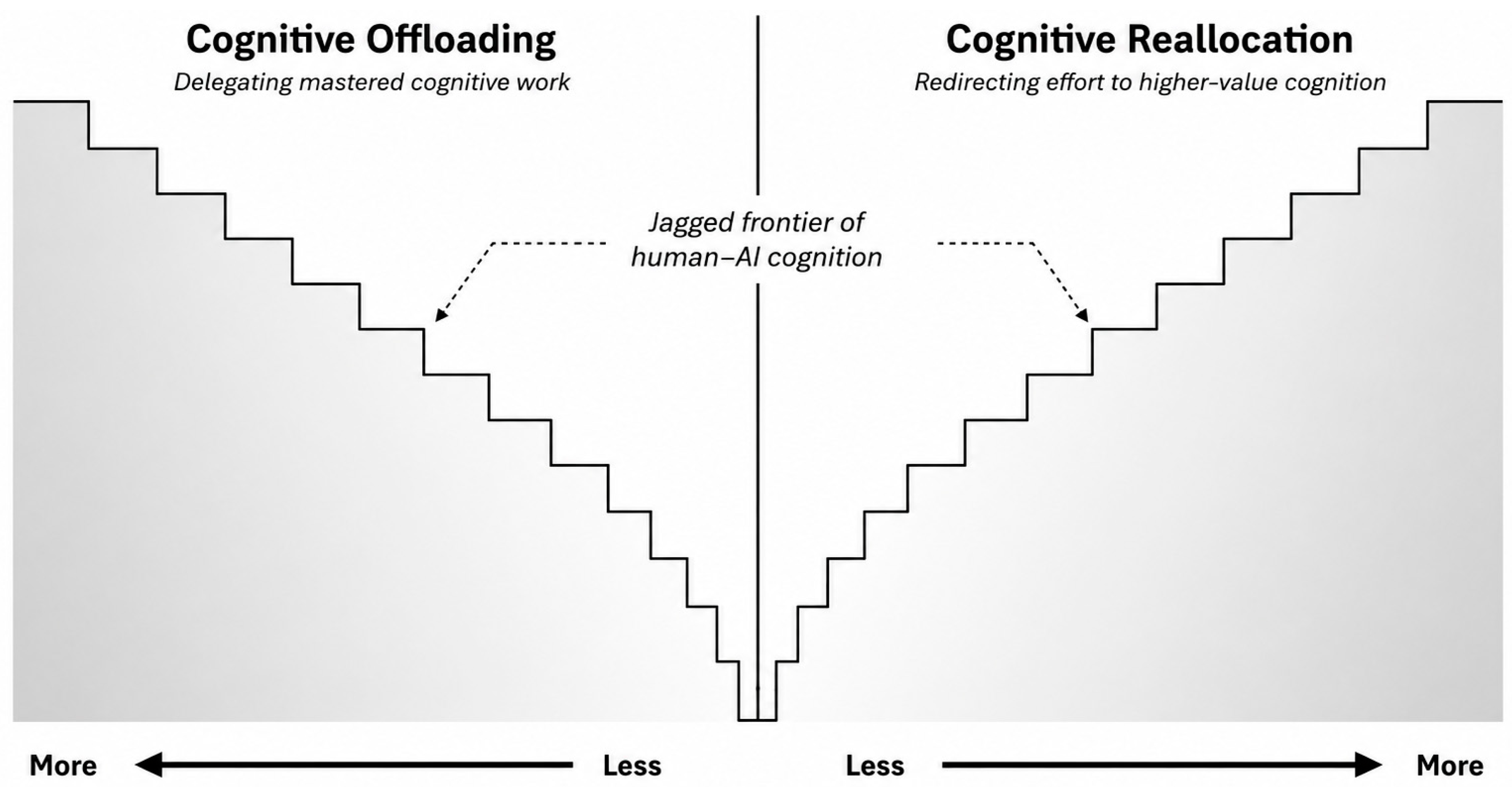
In the final stage, learners have demonstrated sufficient readiness to strategically offload aspects of cognitive work to AI without compromising their underlying knowledge and skills. This stage is characterized by AI-augmented thinking, where the learner retains epistemic control and uses AI to extend, optimize, and, for tasks that students have clearly automatized and mastered, strategically offload to allow for reallocation of effort toward more meaningful learning tasks (Figure 2). Crucially, this stage is appropriate only once learners have demonstrated sufficient mastery of the target material for teachers to judge that strategic offloading presents minimal risk to key learning goals. The learner may also require sufficient AI literacy, marked by the capacity to evaluate the accuracy, relevance, and limitations of AI-generated outputs (Zhang et al., 2025).
Figure 2.
Opportunities for cognitive offloading and cognitive reallocation. Note. Once learning material has been thoroughly mastered, cognitive work may be offloaded to AI and effort strategically reallocated toward more meaningful learning tasks. Decisions apply to specific knowledge, skills, or task components rather than the learner’s general educational or developmental level and require teacher and learner judgement.
The practical application of this stage involves offloading mastered, routine, or lower-order components so that cognitive resources can be reallocated toward higher-order learning. For example, a student might use AI to generate a visual, organize disparate information, or explore alternative explanations (i.e., ‘steel-manning’), while redirecting effort toward evaluation, synthesis, augmentation, and refinement. This reallocation is beneficial only when the offloaded component is not itself the learning objective. Learners must continue to justify, critique, and take responsibility for AI outputs, revising or overriding them where necessary. The defining feature is the learner’s capacity to use AI judiciously to extend thinking beyond what could be achieved without AI support.
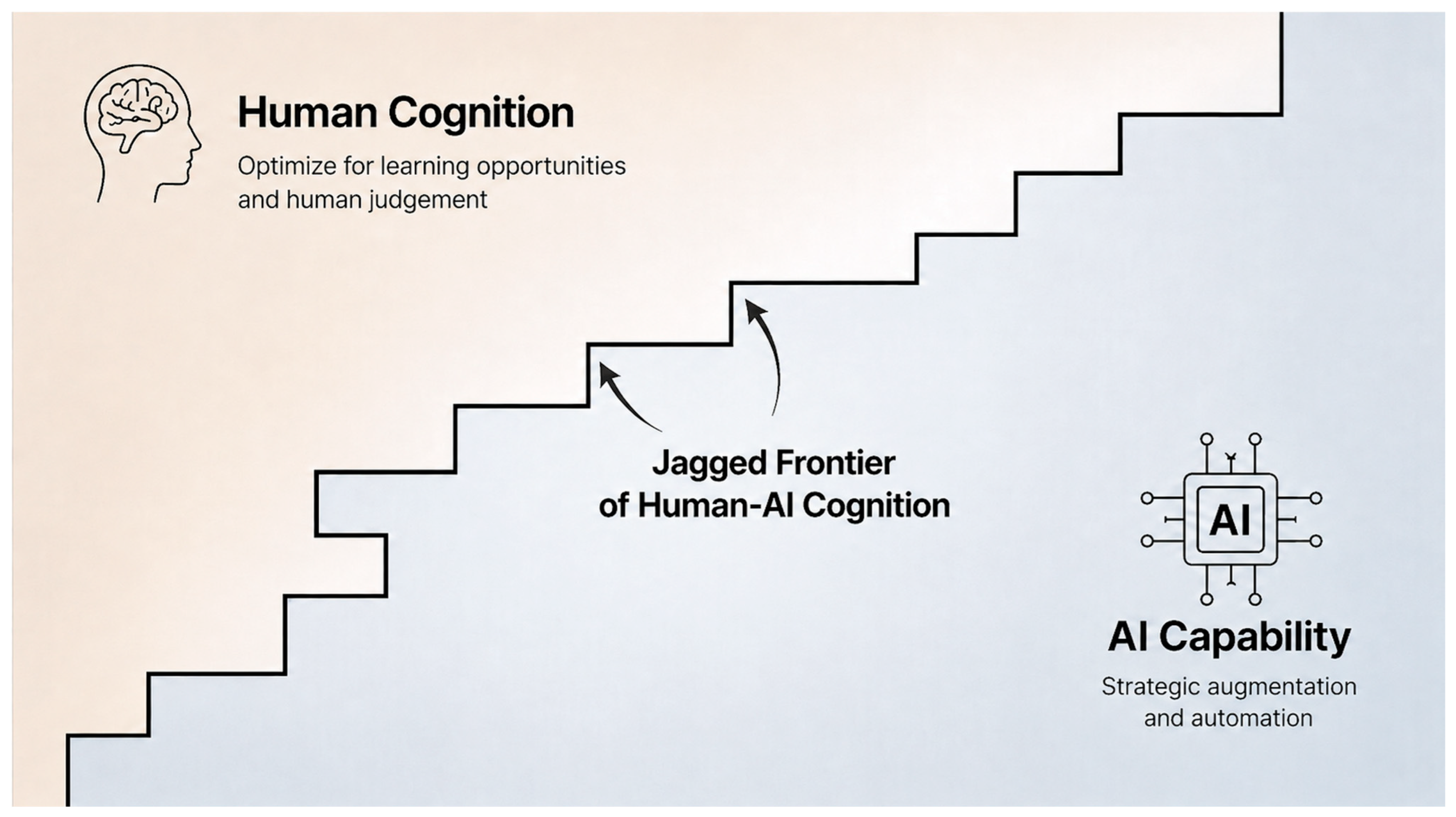
When these conditions are met, the advantage may shift toward AI-augmented learning, particularly when previously mastered components of performance can be offloaded without undermining underlying knowledge and skill. However, the benefits of offloading are not uniform. They depend on the interaction between learner readiness, task demands, and context. This variability reflects what E. Mollick (2024) describes as a jagged frontier of human–AI cognition, in which the value of offloading is experienced unevenly and must be continuously evaluated. Within this frontier, cognitive work is progressively offloaded where learning benefits are minimal and reallocated to where learning benefits are maximal, within a broader context in which learners have demonstrated their capacity to supervise, evaluate, and override AI outputs (Figure 3).
Figure 3.
The jagged frontier of human–AI cognition. Note. The extent to which human cognitions can be successfully augmented by AI depends on a range of variables, including learner readiness and expertise, education and disciplinary knowledge, task demands, AI performance, consequences of error, situational judgement, and learning context.
If introduced prematurely, this phase may carry substantial risks. Learners may incur cognitive debt and learning losses, become dependent on AI, distort metacognitive judgement, and adopt homogenized patterns of thinking shaped by the outputs of various AI models. In contrast, when reached through demonstrated mastery, strategically offloaded and reallocated cognition can enhance productivity without eroding learning (Table 4).
Table 4.
Cognitive offloading and cognitive reallocation.
4.4. Progression as a Function of Readiness
Across all three stages of the GRAIT model, progression depends on demonstrated mastery of a targeted body of knowledge and skills, alongside, where appropriate, sufficient AI literacy. It is not determined by time, age, access to technology, presumed benefits, or student preference. Progression from Independent to Shared Cognition requires learners to demonstrate mastery of foundational knowledge and skills without AI, including accurate retrieval, explanation, application, and recognition of gaps or errors in understanding. Progression to Offloaded and Reallocated Cognition additionally requires learners to evaluate AI outputs against prior knowledge, identify uncertainty and plausible errors, justify revisions, and retain responsibility for final decisions. These criteria should be applied to the specific subject matter and task, because readiness in one context does not establish readiness in another.
In this respect, the Gradual Release of AI technology model complements, rather than replaces, the gradual release of responsibility. While the latter determines who performs the cognitive work (e.g., teacher vs. student), the former determines when and how that work may be strategically offloaded to or augmented by AI technology. Together, they preserve the instructional logic of the GRR model first proposed by Pearson and Gallagher (1983) and later updated by Fisher and Frey (2021), while supporting effective and responsive teaching in AI-rich environments.
4.5. Limitations of the GRAIT Model
The GRAIT model is not intended to impose a rigid prohibition on AI use at particular stages of learning, nor does it assume that early AI use is inherently detrimental. Rather, it rejects the false binary in which AI is framed as either universally beneficial or broadly harmful. The model adopts what Giannakos et al. (2024) refer to as “sceptical optimism” (p. 20); AI’s potential benefits are acknowledged but treated as conditional on whether it augments rather than replaces the cognitive processes required to meet the learning objectives.
The three stages should therefore not be interpreted as fixed categories but as dynamic instructional stages adapted to different phases of learning within a broader learning context. GRAIT is primarily intended for teacher-led formal learning environments, particularly K–12 classrooms, where educators can observe learner readiness and co-regulate AI use. Younger learners may nevertheless require greater teacher regulation and longer periods cultivating Independent Cognition because self-regulatory capacity is typically less developed (Vandenbroucke et al., 2018), although progression should still emphasize demonstrated readiness rather than age alone. Its principles may extend to higher education, but implementation will depend on class size, teacher–student interaction, institutional regulations, and assessment design. In large university courses, for example, individualized progression may be impractical, although GRAIT may still guide educative decisions within tutorials, units, or specific learning tasks. Readiness to progress thus resides in the interaction of the learner, the task, and the learning context.
The scope of GRAIT must also be delimited in relation to the domain of learning. The model primarily applies when AI is used to support learning with, without, or from AI in non-AI subject matter (Wang & Cheng, 2022). When learning about AI, where AI itself is the object of instruction, its use may be necessary from the outset. Disciplinary and task differences also constrain application. In mathematics, offloading a routine calculation may be appropriate after the underlying operation has been mastered with a high degree of fluency, whereas delegating problem formulation may remove the central learning opportunity and rarely merit offloading to AI. In writing, AI feedback on a student-generated draft may preserve authorship more effectively than revising a prose initially generated by AI and later revised with human insight. In sciences, the need to verify evidence and detect consequential errors may warrant prolonged Shared Cognition, even among otherwise advanced learners. Tasks involving safety, credentialing, or difficult-to-detect errors will generally require stronger evidence of independent competence and epistemic understanding than lower-stakes and/or readily verified tasks.
AI literacy is another important boundary condition. Tully et al. (2025) found that lower AI literacy predicts greater AI use, suggesting that those least prepared to evaluate its limitations may be especially inclined to rely on it. It stands to reason that access should therefore not be expanded merely because learners want to use AI or possess a rudimentary skillset in its use. Teachers must co-regulate such decisions, especially for novice learners, and consider whether students have sufficiently developed expertise manifest in their ability to identify uncertainty, verify claims against disciplinary knowledge, recognize when independent judgement is required, and retain responsibility for the final output.
A related objection to the GRAIT model is that AI may enhance learning at early stages by providing adaptive feedback, accelerating access to relevant information, or reducing extraneous cognitive load. Load Reduction Instruction, for example, positions AI as a source of scaffolding, structured practice, and feedback that may support progressive independence from the outset (Lodge & Loble, 2026). AI tutors might offer a preferable alternative compared to conventional pre-reading in flipped instruction (Kestin et al., 2025). GRAIT does not exclude such early support, but treats it as conditional. It asks whether AI use preserves generation, retrieval, explanation, and evaluation rather than performing these processes for the learner. Where it does, early AI use may remain consistent with Independent Cognition. However, GRAIT is also designed pragmatically. It is less concerned about whether AI can support learning in principle, under ideal conditions, than whether it is likely to do so in practice, under ordinary conditions—a distinction that supports greater emphasis on effectiveness over efficacy in research relating to AI and learning (see Gottfredson et al., 2015). Even where early AI support is justified, AI-free assessment may remain imperative to validate knowledge independently of AI.
A final counterview is the belief that AI systems may eventually surpass guidance from trained educators. Even if they do, setting aside the social consequences for the sake of argument, the fundamental human biological constraints of learning will remain. The need to overcome information and attention bottlenecks, for effortful development of internal knowledge structures, repeated practice, and the frequent exercise of evaluative judgement are likely to persist in the face of advances in AI. The GRAIT model has sufficient flexibility to accommodate these innovations while remaining fundamentally human-centred.
4.6. Conclusions
The GRAIT model should be understood as a provisional framework, grounded in established learning science. It requires empirical validation across educational levels, disciplines, tasks, and learner populations to specify the boundary conditions under which AI use is likely to support learning. It extends Pearson and Gallagher’s gradual release of responsibility into AI-rich learning environments by making guidance explicit about when and how cognitive effort should be scaffolded, augmented, or offloaded to AI. The model distinguishes stages of AI use that map onto distinct phases of learner cognition, retaining teacher and student agency over learning. Its central claim is that cognitive work should not be prematurely offloaded to AI before foundational knowledge and skills are developed, after which appropriately staged AI use is more likely to augment cognition and learning.
Funding
This research received no external funding.
Institutional Review Board Statement
Not applicable.
Informed Consent Statement
Not applicable.
Data Availability Statement
No new data were created or analyzed in this study. Data sharing is not applicable to this article.
Conflicts of Interest
The author declares no conflicts of interest.
Abbreviations
The following abbreviations are used in this manuscript:
| GRR | Gradual Release of Responsibility |
| GRAIT | Gradual Release of AI technology |
| Generative AI | AI systems that create new content, such as text, images, audio, or video, by learning patterns from data. |
| AI | Used broadly in this article to include cognitively substantive AI technologies that scaffold, direct, augment, or substitute learner cognition, including generative, predictive, recommender, adaptive, agentic, and automated functions. |
References
- Allen, L. K., & Kendeou, P. (2024). ED-AI lit: An interdisciplinary framework for AI literacy in education. Policy Insights from the Behavioral and Brain Sciences, 11(1), 3–10. [Google Scholar] [CrossRef] [Scilit]
- Bastani, H., Bastani, O., Sungu, A., Ge, H., Kabakcı, Ö., & Mariman, R. (2025). Generative AI without guardrails can harm learning: Evidence from high school mathematics. Proceedings of the National Academy of Sciences of the United States of America, 122(26), e2422633122. [Google Scholar] [CrossRef] [Scilit] [PubMed]
- Bjork, E. L., & Bjork, R. A. (2011). Making things hard on yourself, but in a good way: Creating desirable difficulties to enhance learning. In M. A. Gernsbacher, R. W. Pew, L. M. Hough, & J. R. Pomerantz (Eds.), Psychology and the real world: Essays illustrating fundamental contributions to society (pp. 56–64). Worth Publishers. [Google Scholar]
- Budzyń, K., Romańczyk, M., Kitala, D., Kołodziej, P., Bugajski, M., Adami, H. O., Blom, J., Buszkiewicz, M., Halvorsen, N., Hassan, C., Romańczyk, T., Holme, Ø., Jarus, K., Fielding, S., Kunar, M., Pellise, M., Pilonis, N., Kamiński, M. F., Kalager, M., … Mori, Y. (2025). Endoscopist deskilling risk after exposure to artificial intelligence in colonoscopy: A multicentre, observational study. The Lancet Gastroenterology & Hepatology, 10(10), 896–903. [Google Scholar] [CrossRef] [Scilit] [PubMed]
- Burkart, J. M., & van Schaik, C. P. (2010). Cognitive consequences of cooperative breeding in primates? Animal Cognition, 13(1), 1–19. [Google Scholar] [CrossRef] [Scilit] [PubMed]
- Chayka, K. (2025, June). A.I. is homogenizing our thoughts [News Media]. The New Yorker. Available online: https://www.newyorker.com/culture/infinite-scroll/ai-is-homogenizing-our-thoughts (accessed on 11 April 2026).
- Cheng, M., Lee, C., Khadpe, P., Yu, S., Han, D., & Jurafsky, D. (2026). Sycophantic AI decreases prosocial intentions and promotes dependence. Science, 391(6792), eaec8352. [Google Scholar] [CrossRef] [Scilit] [PubMed]
- Chiu, T. K. F. (2025). Developing intelligent-TPACK (I-TPACK) framework from unpacking AI literacy and competency: Implementation strategies and future research direction. Interactive Learning Environments, 33(7), 4189–4192. [Google Scholar] [CrossRef] [Scilit]
- Clark, R. E., Kirschner, P. A., & Sweller, J. (2012). Putting students on the path to learning: The case for fully guided instruction. American Educator, 36(1), 6–11. [Google Scholar]
- Cosmides, L., & Tooby, J. (1992). Cognitive adaptations for social exchange. In J. H. Barkow, L. Cosmides, & J. Tooby (Eds.), The adapted mind: Evolutionary psychology and the generation of culture (Vols. 163–228, pp. 163–228). Oxford University Press. [Google Scholar]
- Dahmani, L., & Bohbot, V. D. (2020). Habitual use of GPS negatively impacts spatial memory during self-guided navigation. Scientific Reports, 10(1), 6310. [Google Scholar] [CrossRef] [Scilit] [PubMed]
- Deng, R., Jiang, M., Yu, X., Lu, Y., & Liu, S. (2025). Does ChatGPT enhance student learning? A systematic review and meta-analysis of experimental studies. Computers & Education, 227, 105224. [Google Scholar] [CrossRef] [Scilit]
- Eide, T. W., Meyer, B. D., Azadani, E. N., Townsend, J. A., Fowler, S. M., & Gross, E. L. (2025). Use of a modified gradual release of responsibility pedagogy in student preparation for an objective structured clinical examination. Journal of Dental Education, 89(12), 1737–1742. [Google Scholar] [CrossRef] [Scilit] [PubMed]
- Fan, Y., Tang, L., Le, H., Shen, K., Tan, S., Zhao, Y., Shen, Y., Li, X., & Gašević, D. (2025). Beware of metacognitive laziness: Effects of generative artificial intelligence on learning motivation, processes, and performance. British Journal of Educational Technology, 56(2), 489–530. [Google Scholar] [CrossRef] [Scilit]
- Fisher, D., & Frey, N. (2021). Better learning through structured teaching: A framework for the gradual release of responsibility (3rd ed.). ASCD. [Google Scholar]
- Gahrn-Andersen, R. (2026). Entangled cognition: Algorithmic power and the limits of cognitive extension. Journal of Cultural Cognitive Science, 10, 199–210. [Google Scholar] [CrossRef] [Scilit]
- Gerlich, M. (2025). AI tools in society: Impacts on cognitive offloading and the future of critical thinking. Societies, 15(1), 6. [Google Scholar] [CrossRef] [Scilit]
- Giannakos, M., Azevedo, R., Brusilovsky, P., Cukurova, M., Dimitriadis, Y., Hernandez-Leo, D., Järvelä, S., Mavrikis, M., & Rienties, B. (2024). The promise and challenges of generative AI in education. Behaviour & Information Technology, 44(11), 2518–2544. [Google Scholar] [CrossRef] [Scilit]
- Gottfredson, D. C., Cook, T. D., Gardner, F. E. M., Gorman-Smith, D., Howe, G. W., Sandler, I. N., & Zafft, K. M. (2015). Standards of evidence for efficacy, effectiveness, and scale-up research in prevention science: Next generation. Prevention Science, 16(7), 893–926. [Google Scholar] [CrossRef] [Scilit] [PubMed]
- Hasan, M. K. (2025). How AI quietly undermines the joy and effort of learning: A call for rebalancing education in the digital age. Annals of Medicine and Surgery, 87(8), 4693–4694. [Google Scholar] [CrossRef] [Scilit] [PubMed]
- Hattie, J. (2010). Visible learning: A synthesis of over 800 meta-analyses relating to achievement (Reprinted). Routledge. [Google Scholar]
- Horvath, J. C. (2025). The digital delusion: How classroom technology harms our kids’ learning—And how to help them thrive again. LME Global. [Google Scholar]
- Kaufman, J. C., & Sternberg, R. J. (Eds.). (2006). The international handbook of creativity. Cambridge University Press. [Google Scholar] [CrossRef] [Scilit]
- Kaya, K., Kurudayıoğlu, M., Yıldırım, K., Galeza, A., & Rasinski, T. (2026). Evaluation of the gradual release of responsibility framework’s effectiveness on oral summarization skills in Turkish middle school classrooms: A mixed methods study. Evaluation and Program Planning, 114, 102720. [Google Scholar] [CrossRef] [Scilit] [PubMed]
- Kestin, G., Miller, K., Klales, A., Milbourne, T., & Ponti, G. (2025). AI tutoring outperforms in-class active learning: An RCT introducing a novel research-based design in an authentic educational setting. Scientific Reports, 15(1), 17458. [Google Scholar] [CrossRef] [Scilit] [PubMed]
- Kirschner, P. A., Sweller, J., & Clark, R. E. (2006). Why minimal guidance during instruction does not work: An analysis of the failure of constructivist, discovery, problem-based, experiential, and inquiry-based teaching. Educational Psychologist, 41(2), 75–86. [Google Scholar] [CrossRef] [Scilit] [PubMed]
- Koriat, A., & Bjork, R. A. (2005). Illusions of competence in monitoring one’s knowledge during study. Journal of Experimental Psychology: Learning, Memory, and Cognition, 31(2), 187–194. [Google Scholar] [CrossRef] [Scilit] [PubMed]
- Kosmyna, N., Hauptmann, E., Yuan, Y. T., Situ, J., Liao, X.-H., Beresnitzky, A. V., Braunstein, I., & Maes, P. (2025). Your brain on ChatGPT: Accumulation of cognitive debt when using an AI assistant for essay writing task. arXiv, arXiv:2506.08872. [Google Scholar] [CrossRef] [Scilit]
- Kuhn, D., Cheney, R., & Weinstock, M. (2000). The development of epistemological understanding. Cognitive Development, 15(3), 309–328. [Google Scholar] [CrossRef] [Scilit]
- LaCour, M., Cantú, N. G., & Davis, T. (2019). When calculators lie: A demonstration of uncritical calculator usage among college students and factors that improve performance. PLoS ONE, 14(10), e0223736. [Google Scholar] [CrossRef] [Scilit] [PubMed]
- Lawson, A. P., Martella, A. M., Weidlich, J., Mulders, M., & Buchner, J. (2026). Color me confounded: A critical analysis of media comparisons on ChatGPT in education. Computers & Education, 254, 105701. [Google Scholar] [CrossRef] [Scilit]
- Liu, G., Christian, B., Dumbalska, T., Bakker, M. A., & Dubey, R. (2026). AI assistance reduces persistence and hurts independent performance. arXiv, arXiv:2604.04721. [Google Scholar] [CrossRef] [Scilit]
- Lodge, J. M., & Loble, L. (2026). Artificial intelligence, cognitive offloading and implications for education (pp. 1–46). University of Technology Sydney. [Google Scholar] [CrossRef]
- Logan, G. D. (1985). Skill and automaticity: Relations, implications, and future directions. Canadian Journal of Psychology/Revue Canadienne de Psychologie, 39(2), 367–386. [Google Scholar] [CrossRef] [Scilit]
- Mills, K. A., & Gutierrez, A. (2026). Critical literacy in an AI world (1st ed.). Routledge. [Google Scholar]
- Mollick, E. (2024). Co-intelligence: Living and working with AI. Penguin. [Google Scholar]
- Mollick, E. R., & Mollick, L. (2023). Using AI to implement effective teaching strategies in classrooms: Five strategies, including prompts (SSRN Scholarly Paper No. 4391243). Social Science Research Network. [CrossRef] [Scilit]
- Mulyani, H., Istiaq, M. A., Shauki, E. R., Kurniati, F., & Arlinda, H. (2025). Transforming education: Exploring the influence of generative AI on teaching performance. Cogent Education, 12(1), 2448066. [Google Scholar] [CrossRef] [Scilit]
- Nagelhout, R. (2025). AI can add, not just subtract, from learning. Harvard Graduate School of Education. Available online: https://www.gse.harvard.edu/ideas/news/25/04/ai-can-add-not-just-subtract-learning (accessed on 3 April 2026).
- Pallant, J. L., Blijlevens, J., Campbell, A., & Jopp, R. (2025). Mastering knowledge: The impact of generative AI on student learning outcomes. Studies in Higher Education, 51(4), 714–735. [Google Scholar] [CrossRef] [Scilit]
- Pardos, Z. A., & Bhandari, S. (2024). ChatGPT-generated help produces learning gains equivalent to human tutor-authored help on mathematics skills. PLoS ONE, 19(5), e0304013. [Google Scholar] [CrossRef] [Scilit] [PubMed]
- Pearson, P. D., & Gallagher, M. C. (1983). The instruction of reading comprehension. Contemporary Educational Psychology, 8(3), 317–344. [Google Scholar] [CrossRef] [Scilit]
- Perry, N., Sun, C., Munro, M., Boulton, K. A., & Guastella, A. J. (2024). AI technology to support adaptive functioning in neurodevelopmental conditions in everyday environments: A systematic review. Npj Digital Medicine, 7(1), 370. [Google Scholar] [CrossRef] [Scilit] [PubMed]
- Pietschnig, J., Siegel, M., Eder, J. S. N., & Gittler, G. (2019). Effect declines are systematic, strong, and ubiquitous: A meta-meta-analysis of the decline effect in intelligence research. Frontiers in Psychology, 10, 2874. [Google Scholar] [CrossRef] [Scilit] [PubMed]
- Raman, R., Achuthan, K., & Nedungadi, P. (2026). Generative AI integration in education: Theoretical review and future directions informed by the ADO framework. Information, 17(3), 241. [Google Scholar] [CrossRef] [Scilit]
- Risko, E. F., & Gilbert, S. J. (2016). Cognitive Offloading. Trends in Cognitive Sciences, 20(9), 676–688. [Google Scholar] [CrossRef] [Scilit] [PubMed]
- Rosenshine, B. (2012). Principles of instruction: Research based strategies that all teachers should know. American Educator, 9. Available online: https://www.aft.org/sites/default/files/Rosenshine.pdf (accessed on 3 April 2026).
- Rosenshine, B., Meister, C., & Chapman, S. (1996). Teaching students to generate questions: A review of the intervention studies. Review of Educational Research, 66(2), 181–221. [Google Scholar] [CrossRef]
- Schroeder, N. L., Nesbit, J. C., Anguiano, C. J., & Adesope, O. O. (2018). Studying and constructing concept maps: A meta-analysis. Educational Psychology Review, 30(2), 431–455. [Google Scholar] [CrossRef] [Scilit]
- Slamecka, N. J., & Graf, P. (1978). The generation effect: Delineation of a phenomenon. Journal of Experimental Psychology, 4(6), 592–604. [Google Scholar] [CrossRef] [Scilit]
- Soderstrom, N. C., & Bjork, R. A. (2015). Learning versus performance: An integrative review. Perspectives on Psychological Science, 10(2), 176–199. [Google Scholar] [CrossRef] [Scilit] [PubMed]
- Sparrow, B., Liu, J., & Wegner, D. M. (2011). Google effects on memory: Cognitive consequences of having information at our fingertips. Science, 333(6043), 776–778. [Google Scholar] [CrossRef] [Scilit] [PubMed]
- Stadler, M., Bannert, M., & Sailer, M. (2024). Cognitive ease at a cost: LLMs reduce mental effort but compromise depth in student scientific inquiry. Computers in Human Behavior, 160, 108386. [Google Scholar] [CrossRef] [Scilit]
- Steininger, B., Siegel, M., Tran, U., Wicherts, J., Oberleiter, S., Voracek, M., & Pietschnig, J. (2026). The decline effect permeates not only intelligence research, but psychology as a whole: Meta-meta-analytic evidence from 648 meta-analyses. In Proceedings of the 1st international online conference on human intelligence. International Online Conference on Human Intelligence. Available online: https://sciforum.net/paper/view/29872 (accessed on 7 April 2026).
- Sweller, J. (2011). Cognitive load theory. In J. P. Mestre, & B. H. Ross (Eds.), Psychology of learning and motivation (Vol. 55, pp. 37–76). Academic Press. [Google Scholar] [CrossRef] [Scilit]
- Sweller, J. (2020). Cognitive load theory and educational technology. Educational Technology Research and Development, 68(1), 1–16. [Google Scholar] [CrossRef] [Scilit]
- Sweller, J., Zhang, L., Ashman, G., Cobern, W., & Kirschner, P. A. (2024). Response to De Jong et al.’s (2023) paper “Let’s talk evidence—The case for combining inquiry-based and direct instruction”. Educational Research Review, 42, 100584. [Google Scholar] [CrossRef] [Scilit]
- Tomasello, M. (2014). A natural history of human thinking. Harvard University Press. [Google Scholar]
- Tully, S. M., Longoni, C., & Appel, G. (2025). Lower artificial intelligence literacy predicts greater AI receptivity. Journal of Marketing, 89(5), 1–20. [Google Scholar] [CrossRef] [Scilit]
- Vandenbroucke, L., Spilt, J., Verschueren, K., Piccinin, C., & Baeyens, D. (2018). The classroom as a developmental context for cognitive development: A meta-analysis on the importance of teacher–student interactions for children’s executive functions. Review of Educational Research, 88(1), 125–164. [Google Scholar] [CrossRef] [Scilit]
- van de Pol, J., Volman, M., & Beishuizen, J. (2010). Scaffolding in teacher–student interaction: A decade of research. Educational Psychology Review, 22(3), 271–296. [Google Scholar] [CrossRef] [Scilit]
- van Gog, T., Paas, F., & Sweller, J. (2010). Cognitive load theory: Advances in research on worked examples, animations, and cognitive load measurement. Educational Psychology Review, 22(4), 375–378. [Google Scholar] [CrossRef] [Scilit]
- Vieriu, A. M., & Petrea, G. (2025). The impact of artificial intelligence (AI) on students’ academic development. Education Sciences, 15(3), 343. [Google Scholar] [CrossRef] [Scilit]
- Vygotsky, L. S. (1978). Mind in society: Development of higher psychological processes (M. Cole, V. Jolm-Steiner, S. Scribner, & E. Souberman, Eds.). Harvard University Press. [Google Scholar] [CrossRef] [Scilit]
- Wang, T., & Cheng, E. C. K. (2022). Towards a tripartite research agenda: A scoping review of artificial intelligence in education research. In E. C. K. Cheng, R. B. Koul, T. Wang, & X. Yu (Eds.), Artificial intelligence in education: Emerging technologies, models and applications (pp. 3–24). Springer Nature. [Google Scholar] [CrossRef] [Scilit]
- Weidlich, J., Gašević, D., Drachsler, H., & Kirschner, P. (2025). ChatGPT in education: An effect in search of a cause. Journal of Computer Assisted Learning, 41(5), e70105. [Google Scholar] [CrossRef] [Scilit]
- Wilson, M. (2002). Six views of embodied cognition. Psychonomic Bulletin & Review, 9(4), 625–636. [Google Scholar] [CrossRef] [Scilit] [PubMed]
- Wu, X., Zhu, P., Zhang, J., Yin, M., & Wang, Y. (2026). ChatGPT’s impact on student learning outcomes: A meta-analysis of 35 experimental studies. Humanities and Social Sciences Communications, 13(1), 684. [Google Scholar] [CrossRef] [Scilit]
- Yakura, H., Lopez-Lopez, E., Brinkmann, L., Serna, I., Gupta, P., Soraperra, I., & Rahwan, I. (2024). Empirical evidence of large language model’s influence on human spoken communication (Version 3). arXiv, arXiv:2409.01754. [Google Scholar] [CrossRef] [Scilit]
- Yan, L., Greiff, S., Lodge, J. M., & Gašević, D. (2025). Distinguishing performance gains from learning when using generative AI. Nature Reviews Psychology, 4(7), 435–436. [Google Scholar] [CrossRef] [Scilit]
- Yan, L., Greiff, S., Teuber, Z., & Gašević, D. (2024). Promises and challenges of generative artificial intelligence for human learning. Nature Human Behaviour, 8(10), 1839–1850. [Google Scholar] [CrossRef] [Scilit] [PubMed]
- Zawacki-Richter, O., Marín, V. I., Bond, M., & Gouverneur, F. (2019). Systematic review of research on artificial intelligence applications in higher education—Where are the educators? International Journal of Educational Technology in Higher Education, 16(1), 39. [Google Scholar] [CrossRef] [Scilit]
- Zhai, C., Wibowo, S., & Li, L. D. (2024). The effects of over-reliance on AI dialogue systems on students’ cognitive abilities: A systematic review. Smart Learning Environments, 11(1), 28. [Google Scholar] [CrossRef] [Scilit]
- Zhang, S., Ganapathy Prasad, P., & Schroeder, N. L. (2025). Learning about AI: A systematic review of reviews on AI literacy. Journal of Educational Computing Research, 63(5), 1292–1322. [Google Scholar] [CrossRef] [Scilit]

Disclaimer/Publisher’s Note: The statements, opinions and data contained in all publications are solely those of the individual author(s) and contributor(s) and not of MDPI and/or the editor(s). MDPI and/or the editor(s) disclaim responsibility for any injury to people or property resulting from any ideas, methods, instructions or products referred to in the content. |
© 2026 by the author. Licensee MDPI, Basel, Switzerland. This article is an open access article distributed under the terms and conditions of the Creative Commons Attribution (CC BY) license.