


Abstract
This exploratory, classroom-based mixed-methods study examined a five-phase, AI-supported multimodal literacy sequence implemented with 25 Grade 4 students over four weeks. The intervention combined interactive digital reading, collaborative narrative writing, AI-supported comic imagery, multimedia editing, and peer reflection. Quantitative analyses compared students’ baseline and post-intervention comprehension scores and summarized responses to a 12-item post-intervention questionnaire. Qualitative data from open-ended responses, classroom observations, and student artifacts were analyzed thematically. Students’ mean comprehension scores increased from 63.81 (SD = 9.70) at baseline to 75.37 (SD = 7.63) after the intervention, representing a significant within-group change, t(24) = 5.49, p < 0.001, dz = 1.10. Questionnaire responses were generally positive, particularly for original story writing, digital comic creation, and the addition of movement and sound. Three qualitative themes were identified: AI-supported representations as scaffolds for narrative comprehension, as catalysts for authorial identity and creative agency, and as mediators of collaborative meaning-making. Because the study used a single-group design and the comparability of the parallel assessment forms was supported through expert content review rather than large-scale psychometric equating, the findings should be interpreted as exploratory evidence of association rather than as causal effects of AI. The study nevertheless illustrates how developmentally appropriate, teacher-mediated AI activities may support multimodal literacy participation in primary education.
1. Introduction
Artificial intelligence (AI), algorithmic systems, and multimodal digital media increasingly shape how children encounter, interpret, and produce information. Educational policy frameworks therefore emphasize the development of digital, media, and multiliteracies that enable learners to participate critically and creatively in technology-rich environments (OECD, 2021; UNESCO, 2023). In literacy education, this shift extends reading and writing beyond print-based decoding and composition toward interaction with combinations of text, image, sound, animation, and AI-generated content.
Research on AI in education has expanded rapidly, but much of the empirical literature concerns secondary, tertiary, or STEM contexts (Chen et al., 2025; Holmes et al., 2019). Comparatively less is known about how primary-school learners experience AI-supported reading, writing, and multimodal authoring, or how such tools can be integrated without displacing teacher mediation, peer dialog, and student agency.
This gap is educationally important because the primary years are a formative period for comprehension, narrative reasoning, metacognitive awareness, and literacy identity (Alexander & Fox, 2018; Snow, 2020). Children also increasingly encounter AI-mediated content outside school, often without structured opportunities to examine how such systems generate, represent, and sometimes distort meaning. Classroom research is therefore needed to investigate pedagogically purposeful and developmentally appropriate uses of AI with younger learners (Kucirkova et al., 2024; Falloon et al., 2025).
AI-supported literacy environments may offer several affordances. Generated images can externalize narrative relations, prompts can support prediction and revision, and multimodal production can broaden the ways students communicate meaning. These affordances are not inherently educational, however. Their value depends on task design, instructional scaffolding, ethical safeguards, and opportunities for learners to question, revise, or reject AI-generated outputs (Chen et al., 2025; Kurt-Taspinar & Tikiz-Erturk, 2025).
The expectation that visual, interactive, and AI-generated resources can support comprehension is consistent with two decades of empirical research on digital and new literacies. Studies of online and digital reading show that comprehension in technology-rich environments is an active, strategic, and multimodal process in which readers coordinate textual and visual cues, generate predictions, and monitor coherence across representations (Coiro, 2021; Coiro & Dobler, 2007; Leu et al., 2017). Research in this tradition also demonstrates that well-designed digital environments can position young learners as active designers of meaning rather than passive recipients of content (Gee, 2003), while classroom-based work indicates that even technologically confident students require explicit instruction and sustained teacher guidance in order to read and compose digital, multimodal texts effectively (Karchmer-Klein & Shinas, 2012). These findings ground the premise of the present study that AI-generated representations are educationally valuable only when they are embedded in scaffolded, teacher-mediated literacy activity.
A small but growing body of empirical work has begun to examine AI specifically within elementary literacy instruction. Ng et al. (2022) found that digital story writing supported the development of AI literacy among primary students, and recent reviews of AI literacy education in primary schools indicate that story-based and creation-oriented activities are among the most developmentally appropriate entry points for young learners (Yim, 2024; Yim & Su, 2025). Design-oriented research further suggests that AI-supported environments can foster creativity and multimodal literacy when generative functions are combined with structured pedagogical tasks (Su & Yang, 2022; Wong et al., 2020), and that children can develop agency and creative capabilities when AI outputs are treated as objects of inquiry rather than as authoritative products (Kahila et al., 2024). Nevertheless, empirical evidence connecting AI-supported activity to reading-comprehension outcomes in the elementary grades remains scarce, and most existing studies are exploratory in scope. The present study responds to this gap by embedding generative AI within a comprehension-focused, teacher-mediated multimodal sequence and by examining both performance and experiential data.
Accordingly, this study conceptualizes AI not as an autonomous instructor but as a teacher-mediated representational resource within a broader literacy sequence. The intervention combined interactive reading, collaborative writing, generative imagery, multimedia composition, and peer reflection. The study examined both cognitive outcomes and students’ perceptions of the activities, while recognizing that the single-group classroom design does not permit strong causal attribution to AI alone.
The study aimed to contribute an empirically grounded account of how an AI-supported multimodal literacy sequence can be enacted in a Grade 4 classroom. Rather than testing the isolated effect of a single tool, it examined changes in comprehension performance and how students experienced AI-generated and multimodal resources during narrative understanding, authorship, and collaboration.
The study was guided by the following research questions:
- What changes occurred in students’ reading-comprehension scores following participation in the AI-supported multimodal literacy sequence?
- How did students evaluate the motivational, usability, and perceived learning dimensions of the intervention?
- How did students describe the role of AI-supported visual and multimodal resources in narrative comprehension, authorship, and collaboration?
By addressing these questions, the study offers preliminary evidence about the design and classroom enactment of AI-supported literacy activities in primary education. Its contribution lies principally in the integration of cognitive, motivational, social, and multimodal perspectives within an authentic classroom intervention, while maintaining a cautious distinction between observed change and demonstrated causal effect. Given the single-group design and the small sample, the study is best characterized as an exploratory study whose findings warrant confirmation through larger experimental or quasi-experimental research.
2. Theoretical Framework
No single established framework currently integrates AI-supported representation, primary literacy development, multimodal composition, and learner motivation. This study therefore uses an integrated conceptual lens drawing on constructivist learning theory, cognitive multimedia learning, multimodal and digital literacy, human–AI complementarity, and Self-Determination Theory. The purpose is not to validate a new comprehensive framework, but to specify complementary mechanisms through which the intervention may support learning and participation.
The conceptual model links intervention features to proposed mechanisms. Dialogic reading and collaborative writing are expected to support socially mediated meaning-making; integrated visual and verbal representations may support mental-model construction and coherence monitoring; multimodal authoring may broaden students’ semiotic resources; AI-generated outputs may serve as revisable prompts rather than authoritative answers; and choice, visible products, and peer sharing may support autonomy, competence, and relatedness.
2.1. Constructivist Perspectives on Literacy Learning
This intervention is grounded in constructivist learning theory, which posits that knowledge is actively constructed through meaningful interaction with the environment rather than passively received (Bruner, 1996; Vygotsky, 1978). In early literacy, this means children do more than decode text. They build meaning through prediction, inference, reflection, and social negotiation. Meaning making becomes a process shaped by prior knowledge, peer dialog, and contextual tools.
Within this view, technology functions not as a substitute for instruction but as a mediating artifact that can extend cognitive and social activity. In the present study, visual prompts, comprehension questions, and generated comic imagery provided external representations that students could inspect, discuss, revise, or reject. These features were intended to support prediction, narrative coherence, and reflection while preserving teacher guidance and learner agency.
2.2. Cognitive Theory of Multimedia Learning
In early literacy, where abstract reasoning is still developing, visual supports are not merely decorative; they are cognitively functional (Tomás-Llerena & Vásquez-Echeverría, 2025). Thus, it was important for the intervention to utilize Mayer’s (2005) Cognitive Theory of Multimedia Learning, which argues that learners develop a deeper understanding when verbal and visual information are presented in integrated, well-designed formats. This theory, grounded in cognitive load principles, posits that instruction is most effective when it reduces extraneous load and maximizes generative processing through dual-channel encoding. Therefore, the integration of visual cues, interactive prompts, and dynamic storyboards provided just-in-time support facilitated students’ ability to comprehend cause-and-effect relationships, construct mental imagery, and infer character intentions. This approach aligns with Mayer’s notion of instructional multimedia as a vehicle for deep learning, particularly when paired with feedback mechanisms and learner control over pacing.
2.3. Multimodal and Digital Literacy Frameworks
Contemporary literacy increasingly involves engaging with, interpreting, and producing content across multiple modes, including text, image, sound, movement, and space. Theories of multimodal literacy (New London Group, 1996; Kress, 2010; Bezemer & Jewitt, 2010) reframe literacy as a semiotic practice in which meaning making occurs through the orchestration of symbolic resources within digital environments. This intervention operationalized these theories by inviting students to become multimodal authors, transforming written narratives into animated digital comics using Canva. Students engaged in multimodal composition using images, color, animation, and voice, thereby expanding their representational repertoire and developing a sense of literacy identity as digital creators. The framework views digital literacy not only as operational fluency but also as critical design, where learners make intentional communicative choices tailored to their audiences and contexts. In doing so, the intervention bridges multimodal theory with AI-mediated personalization to foster both comprehension and expression.
2.4. AI as a Teacher-Mediated Pedagogical Resource in Early Literacy
A fourth strand of the framework draws on emerging perspectives from Artificial Intelligence in Education concerning human–AI complementarity and the teacher-mediated use of intelligent systems. This study contributes to a growing body of research that reconceptualizes AI not as a static instructional tool, but as a responsive pedagogical resource capable of supporting co-constructed learning experiences (Holstein & Aleven, 2022; Chiu, 2024). Within the intervention, AI-supported functions were used less as evaluative mechanisms and more as teacher-mediated representational resources, offering automated image suggestions and layout templates that scaffolded creative decision-making without constraining student agency. The goal was not automation but augmentation—to extend learners’ opportunities for responsive, multimodal interaction within a teacher-guided environment. This orientation is consistent with Vygotskian perspectives on mediated learning and highlights the relational and semiotic affordances of AI-supported resources in literacy instruction.
2.5. Motivation and Affective Engagement in AI-Enhanced Environments
The fifth theoretical pillar addresses affective engagement, drawing on Self-Determination Theory (Deci & Ryan, 2013), which identifies autonomy, competence, and relatedness as essential conditions for intrinsic motivation. These factors are especially relevant in early literacy, where positive dispositions toward reading and writing are formative for long-term development (Su & Yang, 2022).
In this study, students were offered meaningful choices in story direction, visual design, and collaboration, fulfilling the need for autonomy. Their multimodal products, shareable and visible, served as tangible evidence of competence. Finally, structured opportunities for peer sharing and collective feedback supported relatedness. The result was a learning environment where emotion, motivation, and cognition were deeply intertwined, amplified by the personalization and interactivity of AI-mediated tools.
2.6. Toward an Integrated Framework for AI-Enhanced Literacy
Taken together, these five theoretical perspectives point toward a shared view of AI as a learning partner that can respond to students’ cognitive needs while also supporting their emotional engagement. The intervention was intentionally designed around this synthesis. Constructivist principles informed the use of dialogic writing and guided narrative construction; multimedia learning theory guided the inclusion of visual supports and dual-coding strategies; multimodal literacy perspectives shaped the emphasis on digital authoring; AIED research informed how the AI tools were positioned as responsive supports; and motivational theory influenced the opportunities for student choice, feedback, and collaborative publishing.
When synthesized, the five perspectives yield a conceptual model that is more than the sum of its constituent theories. Individually, each theory addresses only one facet of AI-supported literacy: constructivism explains dialog and mediated activity but not the cognitive processing of multimedia; multimedia learning theory explains dual-channel processing but not social meaning-making or authorship; multimodal literacy explains semiotic design but not motivation; human–AI complementarity explains the epistemic status of generated outputs but not how children learn from them; and Self-Determination Theory explains engagement but not comprehension. Integrated, the perspectives converge on the emergent construct that organizes the present study: AI as a revisable, teacher-mediated representational partner. Within this model, AI-generated artifacts occupy a distinctive pedagogical position because they function simultaneously as (a) external representations that make children’s developing mental models inspectable (multimedia learning), (b) provisional semiotic material that invites redesign rather than acceptance (multimodal literacy and human–AI complementarity), (c) shared objects around which socially mediated negotiation occurs (constructivism), and (d) visible, personally owned products that support autonomy, competence, and relatedness (Self-Determination Theory). No single constituent theory predicts this fourfold function; it emerges only from their intersection.
This synthesized model directly informed the research design. The five instructional phases (Table 1) operationalize the model’s mechanisms in sequence: Phase 1 targets representation-supported comprehension monitoring; Phases 2 and 3 place generated artifacts at the center of collaborative authorship and revision; Phase 4 requires deliberate multimodal design decisions; and Phase 5 makes products visible for social recognition and reflection. The decision to collect both performance and experiential data reflects the model’s dual claim that AI-supported representation may influence what students can do (comprehension) and how they experience literacy participation (motivation, authorship, and collaboration). The three research questions accordingly address performance change, perceptions, and the experienced role of AI-supported resources, respectively.
Table 1.
Theoretical Framework and Design.
The model also informed the data analysis. The initial coding categories used in the thematic analysis—comprehension support, visual representation, narrative revision, authorship, collaboration, and affect—were derived deductively from the mechanisms specified in the model and were then refined inductively against the data (see Section 3.7.3). Similarly, the joint display used to integrate the quantitative and qualitative strands (Table 2) is organized around the proposed mechanisms, allowing the analysis to examine where students’ performance and experiences converged with, complicated, or remained silent about each mechanism. The model therefore functioned as a sensitizing framework for design and interpretation rather than as a fixed theory subjected to confirmatory testing. It provides an integrated conceptual lens rather than a validated theory of AI-enhanced literacy, and the study avoids claims that any single mechanism was isolated experimentally.
Table 2.
Joint Display Integrating Quantitative and Qualitative Findings.
3. Materials and Methods
3.1. Research Design
An embedded mixed-methods intervention design was used (Creswell & Plano Clark, 2018). Quantitative data comprised baseline and post-intervention comprehension scores and item-level questionnaire responses. Qualitative data comprised open-ended questionnaire responses, classroom observations, and student-generated narratives, comics, and multimedia products. The strands were analyzed separately and then integrated during interpretation to examine where performance patterns converged with, expanded, or differed from students’ reported experiences.
3.2. Context and Participants
The study was conducted in one Grade 4 classroom in a public primary school located in an urban area of a European country. Grade 4 was selected because students typically possess foundational reading fluency while continuing to develop inferencing, coherence monitoring, and narrative reasoning.
The school had prior experience with educational technology initiatives and provided networked laptops, a smartboard, and reliable internet access. This technologically supportive context facilitated implementation but may limit transferability to schools with fewer resources or less prior experience.
The intact class included 25 students (13 girls and 12 boys) aged 9–10. Students varied in language proficiency but were able to engage with narrative texts and multimedia tools independently or with limited support. None had prior experience with the specific interactive text or Canva-based generative comic activities used in the study. The classroom teacher co-facilitated the intervention and had prior professional development in digital literacy.
During the intervention period, the class continued to follow the standard national Grade 4 language arts curriculum, which included regular instruction in reading, text comprehension, grammar, vocabulary, and writing using conventional, predominantly print-based materials. The eight intervention sessions were scheduled within the class’s existing language and literacy program, and no other comprehension-focused intervention, tutoring program, or test-preparation activity took place in the classroom during the four-week period. Because ordinary curricular literacy instruction continued during these weeks, regular classroom teaching—alongside the intervention itself—remains a plausible contributor to any observed change in comprehension performance; this issue is considered further in the limitations (Section 5.1).
3.3. Ethical Considerations
Written parental or guardian consent and student assent were obtained for all participants. Data were anonymized during analysis, and pseudonyms were used in qualitative excerpts and any presentation of student work. Digital products were stored on a secure, password-protected platform accessible only to the research team. No directly identifying information was entered into third-party AI tools. Students were informed that the output generated could be inaccurate or unsuitable and that they could reject or revise them with teacher support.
3.4. Intervention Design
The AI-enhanced literacy intervention was carefully structured into a sequence of five interdependent instructional phases, each aligned with specific pedagogical goals informed by the study’s broader theoretical framework. These phases were designed not as isolated activities, but as a cumulative learning trajectory intended to scaffold students’ reading comprehension, narrative construction, and multimodal expression over time.
The full intervention spanned four weeks and was implemented through eight sessions (two per week), each approximately 80 min in duration. To ensure ecological validity and minimize instructional disruption, all sessions were embedded within the class’s existing language and literacy curriculum.
The intervention balanced structured guidance with learner choice. Teacher modeling and guided discussion were strongest during the early reading and planning activities. As students gained familiarity with the task, they assumed greater responsibility for narrative, visual, and multimedia decisions. AI-generated outputs were treated as provisional representations for evaluation and revision rather than as authoritative answers.
An in-depth explanation of the Five-Phase AI-Enhanced Literacy Intervention is presented in Table 1.
- Phase 1: Individual Exploration of an Interactive Digital Story. Students began by individually engaging with an AI-supported digital story interface. Using personal computers, they viewed animated sequences and made predictions about plot development and character actions. With interactive pens, they annotated visual elements to record assumptions and insights. After reading the complete text, students responded to embedded comprehension questions designed to assess narrative understanding and inference-making.
- Phase 2: Collaborative Narrative Creation. Students were grouped into small teams (2–4 members) and collaboratively authored original fictional narratives inspired by the digital text. Emphasis was placed on preserving coherent story structure, integrating descriptive language, and composing dialog. This phase targeted both narrative literacy and creative writing, fostering collaborative meaning-making and authorship.
- Phase 3: AI-Generated Comic Imagery. Once the stories were finalized, students uploaded their texts into Canva’s AI-powered design platform. Using generative features, they produced visual comic adaptations of their narratives—initially without any accompanying text. To extend comprehension, students then participated in an individual quiz in which they matched untitled peer-generated comic sequences with potential story titles, promoting visual interpretation and inferential reasoning.
- Phase 4: Scriptwriting and Multimedia Editing. Returning to their original groups, students enriched their comics by integrating multimodal elements. They added dialog (via speech bubbles and captions), narration, sound effects, and animation. This phase involved revisiting their narratives to align textual and visual components, ultimately transforming static visuals into dynamic, multimedia story movies.
- Phase 5: Peer Sharing and Reflection. In the final phase, each group presented its completed comic movies to the class. This served as both a culminating showcase and a peer feedback opportunity, encouraging reflection, discussion, and metacognitive insight into narrative choices and design decisions.
Each phase combined teacher modeling, guided discussion, peer collaboration, and selected digital or AI-supported functions. Because the intervention bundled several components, the study does not isolate the independent contribution of AI, multimedia composition, collaboration, teacher support, or additional time on task.
3.5. Research Materials
3.5.1. Interactive Digital Text
The initial activity used the interactive digital story Friends Forever through a web-based platform supporting multimedia presentation, annotation, and embedded comprehension questions. Students used the story to make predictions, identify narrative cues, and respond to questions.
3.5.2. Canva AI Environment
During the authoring phases, students used Canva to create visual adaptations of their narratives. Generative image features were used to produce candidate comic imagery, while conventional editing functions were used to add text, layout, animation, and sound. Students and teachers evaluated whether generated images matched the intended sequence, character emotions, and narrative meaning.
3.5.3. Interactive Visual Quiz
During Phase 3, students also completed a visual interpretation activity in which they matched untitled peer-generated comic sequences with possible story titles. This task was used as an instructional and formative activity focused on plot coherence and visual inference; it was not treated as an independent standardized outcome measure.
3.5.4. Observations and Student Artifacts
To support triangulation and provide a fuller picture of student learning, qualitative data were collected through classroom observations and student-generated artifacts. These included written stories, AI-generated comic panels, and final digital story videos. Teacher field notes further contributed to the interpretive analysis of classroom dynamics, student engagement, and tool interaction.
3.6. Research Instruments
Three sources of evidence were used: comprehension assessments, a post-intervention questionnaire, and qualitative records from open-ended responses, observations, and student artifacts. The following subsections distinguish outcome measurement from instructional activities and identify information needed to establish measurement quality.
3.6.1. Pre-Intervention Reading-Comprehension Assessment
Before the intervention, students completed a paper-based reading-comprehension assessment based on the PIRLS framework. PIRLS is an international assessment administered by the International Association for the Evaluation of Educational Achievement to evaluate Grade 4 students’ ability to comprehend literary and informational texts. The assessment included multiple-choice and constructed-response items targeting literal comprehension, inference, interpretation, integration of information, and evaluation of narrative meaning.
The pre-intervention assessment was administered under standardized classroom conditions and without instructional assistance or feedback. Students’ scores were used to establish baseline reading-comprehension performance before participation in the AI-supported literacy intervention.
3.6.2. Parallel-Form Post-Intervention Reading-Comprehension Assessment
The original PIRLS assessment was not administered a second time because repeated exposure to the same text and items could have produced test–retest, recall, and practice effects. Such effects would have compromised the validity of the comparison by making it difficult to determine whether any improvement reflected increased reading comprehension or familiarity with the original assessment.
For this reason, a parallel-form reading-comprehension assessment was developed for post-intervention administration. The parallel form was designed to assess the same comprehension domains as the baseline assessment, including retrieval of explicitly stated information, inference-making, interpretation and integration of ideas, evaluation of narrative events, and understanding of character motives and causal relationships. It also followed a comparable structure by including multiple-choice and constructed-response items and was designed to be like the pre-test in text type, length, readability, item distribution, scoring range, and level of cognitive demand.
Students completed the parallel-form assessment independently and without instructional assistance, automated feedback, hints, or opportunities to revise their responses. The resulting scores therefore represented unaided post-intervention performance and were used for comparison with baseline comprehension scores. Two literacy-education experts independently reviewed the baseline and parallel assessment forms to evaluate their alignment with the targeted comprehension domains, text characteristics, item formats, scoring ranges, and levels of cognitive demand. Any differences in their judgments were discussed and resolved through consensus. This review provided evidence of content validity and supported the content and structural comparability of the two forms. Because no independent validation sample was available, however, the two forms were not statistically equated, and score comparability rests on the expert content review described above; the implications of this constraint for interpreting pre–post change are addressed in Section 4 and Section 5.
3.6.3. Post-Intervention Questionnaire
After the five-phase sequence, students completed a two-part questionnaire. Part A contained 12 items rated on a five-point scale and addressed interest, perceived comprehension support, enjoyment, usability, pride, and willingness to repeat the activity. Part B contained six open-ended questions about perceived support, challenges, and experiences of AI-supported multimodal authorship.
3.7. Data Analysis Procedures
Quantitative and qualitative analyses were conducted separately and integrated through question-by-question joint interpretation. Quantitative results described score changes and item-level perceptions. Qualitative analysis examined how students interpreted the role of generated representations and multimodal authoring. Integration focused on convergence, complementarity, and remaining uncertainty rather than using one strand merely to confirm the other.
3.7.1. Quantitative Analysis: Comprehension Assessments
Descriptive statistics were calculated for baseline and post-intervention comprehension scores. A paired-samples t-test evaluated the mean within-student difference. Before inferential analysis, the distribution of the difference scores was examined for substantial deviations from normality and influential outliers; no violations that would invalidate the paired-samples analysis were identified. The mean difference, 95% confidence interval, exact p value, and within-person standardized effect size (dz) were reported. Because there was no control group, the analysis estimates within-group change and does not establish that AI caused the change.
Using the reported statistics, the mean increase was 11.56 points, t(24) = 5.49, p < 0.001, dz = 1.10, with a 95% confidence interval for the mean difference of approximately [7.21, 15.91].
3.7.2. Quantitative Analysis: Post-Intervention Questionnaire (Part A)
For each questionnaire item, frequencies, means, and standard deviations were calculated. Given the small sample and the heterogeneous content of the items, interpretation emphasized broad response patterns rather than small differences between item means.
3.7.3. Qualitative Analysis: Open-Ended Responses and Observational Data (Part B)
The open-ended questionnaire responses, observation notes, and student-generated artifacts were analyzed using thematic analysis following Braun and Clarke’s (2006) six-phase procedure. Both researchers first familiarized themselves with the complete qualitative dataset. Initial semantic codes were generated for references to comprehension, visual representation, narrative revision, authorship, collaboration, affect, and difficulties. These initial categories were derived from the mechanisms specified in the study’s conceptual model (Section 2.6) and were subsequently refined inductively against the data. The researchers then compared and grouped related codes into candidate themes, which were reviewed against the coded extracts and the complete dataset. Differences in interpretation were discussed until an agreed thematic structure was reached. Attention was given to responses that diverged from the dominant patterns. The final themes were defined and named before representative excerpts were selected. Evidence from questionnaire responses, observations, and artifacts was compared to identifying convergence and complementarity across data sources.
3.7.4. Inter-Rater Reliability
The constructed-response items in both the pre-intervention and post-intervention reading-comprehension assessments were scored independently by two raters. Each response was assigned a numerical score based on its accuracy, completeness, and evidence of comprehension and inferential reasoning.
Inter-rater reliability was assessed using a two-way random-effects, absolute-agreement intraclass correlation coefficient. Because the final score was calculated as the mean of the two raters’ scores, the average-measures coefficient, ICC(2,2), was reported.
Inter-rater agreement was excellent for both assessments. For the pre-intervention assessment, the intraclass correlation coefficient was ICC(2,2) = 0.96, 95% CI [0.91, 0.98]. For the parallel-form post-intervention assessment, the coefficient was ICC(2,2) = 0.95, 95% CI [0.89, 0.98]. Any initial scoring disagreements were discussed by the two raters and resolved through consensus before the final scores were entered into the dataset.
4. Results
Results are organized by the three research questions. Quantitative findings describe within-group score changes and item-level perceptions, while qualitative findings describe students’ reported and observed experiences of AI-supported and multimodal activities. The parallel assessment forms were designed to target the same comprehension domains and were reviewed by two literacy experts for content and structural comparability. Because the forms were not psychometrically equated using an independent validation sample and the study lacked a comparison group, the results are interpreted as exploratory.
4.1. Changes in Reading Comprehension Scores
Students’ mean comprehension score increased from 63.81 (SD = 9.70) at baseline to 75.37 (SD = 7.63) after the intervention (see Table 3). The mean within-student difference, calculated as post-intervention minus pre-intervention, was 11.56 points, t(24) = 5.49, p < 0.001, dz = 1.10, 95% CI [7.21, 15.91]. This represents a large standardized within-group change. It should not, however, be interpreted as an AI-specific causal effect because the design included no control group and combined multiple instructional components. The observed gain is therefore best interpreted as an association between participation in the multicomponent sequence and improved performance. Plausible alternative explanations—including maturation, increased familiarity with the assessment format, the concurrent regular literacy curriculum, novelty effects, and the multimodal instructional sequence itself—cannot be ruled out. Although expert review supported the content and structural comparability of the parallel forms, they were not psychometrically equated using an independent validation sample.
Table 3.
Comparing Pre-Test and Post-Test Reading Comprehension Scores.
Observation records suggested that students increasingly discussed sequence, character motivation, and consistency between written events and generated images as the intervention progressed. These observations provide contextual evidence of developing narrative talk but do not constitute an independently scored measure of narrative skill. Accordingly, the study does not claim that students’ narrative-construction skills improved.
4.2. Motivation and Engagement
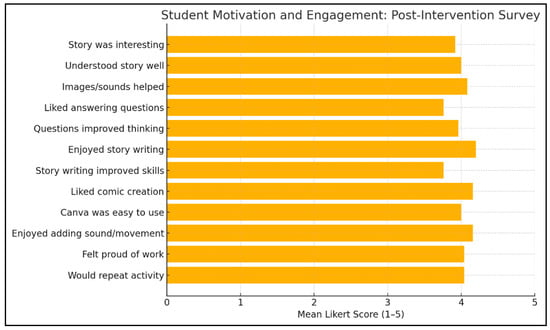
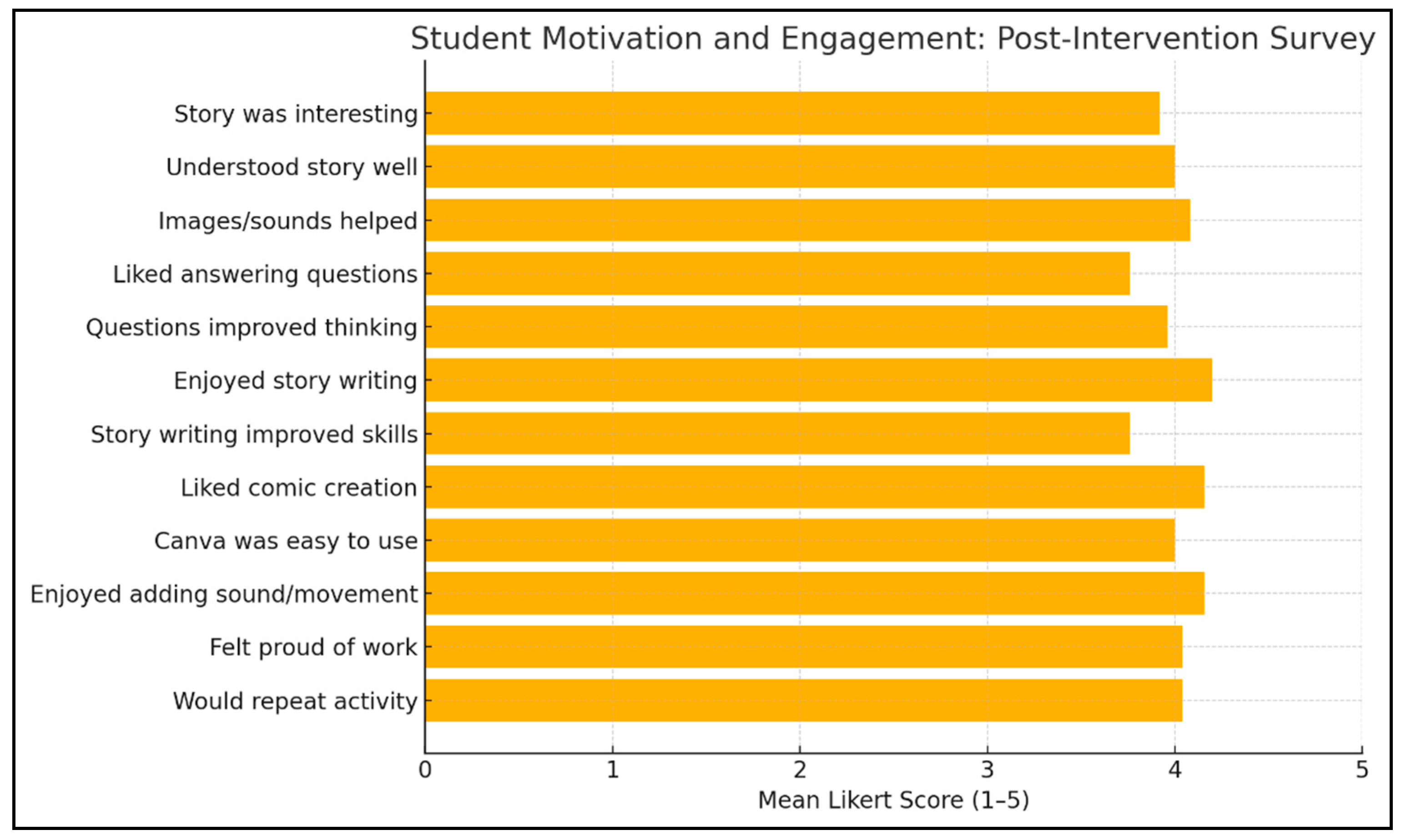
Questionnaire responses were generally positive for the 12 items, with means ranging from 3.76 to 4.20 on the five-point scale (see Table 4). The highest mean concerned writing an original story based on the digital text (M = 4.20, SD = 0.82). Creating a multimodal comic (M = 4.16, SD = 0.85) and adding movement and sound (M = 4.16, SD = 0.80) were also highly rated. These descriptive patterns suggest that students particularly valued activities involving creative production and visible transformation of their ideas.
Table 4.
Descriptive Statistics for Post-Intervention Likert-Scale Questionnaire.
Items concerning the digital story, perceived comprehension support, usability, pride, and willingness to repeat the activity were also rated above the midpoint. The lowest means, although still positive, concerned enjoyment of answering embedded questions and the perception that story writing helped students learn new things (both M = 3.76). Given the small sample and the absence of a validated unidimensional scale, small differences among item means should not be overinterpreted.
Students reported that images and sounds supported understanding (M = 4.08, SD = 0.87), that Canva was relatively easy to use (M = 4.00, SD = 0.89), and that they felt proud of their work (M = 4.04, SD = 0.93). These are perceptions rather than direct measures of comprehension, usability, or competence, but they provide useful contextual evidence about how the activities were experienced.
Figure 1 summarizes item means and shows the broadly positive response pattern, with the highest values concentrated in original story writing and multimodal production.
Figure 1.
Student motivation and engagement ratings (post-intervention).
The item-level pattern indicates that students responded especially positively to phases involving creative decision-making, visual design, and multimodal enhancement. Traditional comprehension questioning was also positively received but was less strongly endorsed. This descriptive distinction is consistent with the intervention’s emphasis on student authorship, although it should not be interpreted as evidence that one phase was statistically superior to another.
Students’ perceived ease of using Canva (M = 4.00, SD = 0.89) suggests that the interface did not create major barriers for most participants in this technologically supportive classroom. Transferability to students with less digital experience or to less well-resourced settings remains uncertain.
Students also perceived the multimodal features as cognitively useful. Ratings for images and sounds (M = 4.08, SD = 0.87) and guiding questions (M = 3.96, SD = 0.84) suggest that students experienced these supports as more than entertainment. Nevertheless, self-reported helpfulness should be distinguished from demonstrated causal contribution to comprehension.
Pride in the final products (M = 4.04, SD = 0.93) and willingness to repeat the activity (M = 4.04, SD = 0.88) indicate positive affective investment. These responses are consistent with the autonomy, competence, and relatedness mechanisms proposed in Self-Determination Theory, but the study did not directly test those mechanisms.
Overall, the questionnaire results suggest that creative ownership and multimodal transformation were salient features of students’ experiences. The item-level means indicate broadly positive perceptions, while the small sample and heterogeneous item content warrant cautious interpretation.
4.3. Student Perceptions of AI-Supported Literacy Activities: Thematic Analysis
Thematic analysis of open-ended responses, observation records, and student artifacts generated three related themes:
- AI as a scaffold for narrative comprehension;
- AI as a catalyst for authorial identity and creative agency;
- AI as a mediator of collaborative meaning-making.
The themes indicate that students experienced generated visual outputs and multimodal tools as resources for inspecting narrative meaning, developing a sense of authorship, and negotiating decisions with peers. They do not imply that students attributed all benefits specifically to AI rather than to the broader combination of collaboration, teacher mediation, and multimedia production.
- Theme 1: AI-Supported Representations as Scaffolds for Narrative Comprehension. Students frequently described generated images as helping them inspect whether events followed logically and whether the visual sequence matched the intended story. One student explained, “The pictures helped me understand the story better because I could see if everything matched,” while another noted, “When I saw the picture, I understood if my story was making sense.” A third stated, “The pictures showed me what I forgot in the story.”
These comments suggest that visual output functioned as external feedback for coherence monitoring. Observation notes similarly indicated that groups returned to earlier scenes after viewing generated panels and discussed event order, missing information, or mismatches between the text and image. Because these data are interpretive and self-reported, the theme is best understood as evidence of perceived support rather than proof of improved comprehension.
The theme complements questionnaire responses indicating that images and sounds were perceived as helpful (Item 3: M = 4.08, SD = 0.87) and that guiding questions supported deeper thinking (Item 5: M = 3.96, SD = 0.84). Together, the strands suggest that externalized representations gave students concrete objects for checking and discussing narrative coherence.
- Theme 2: AI-Supported Multimodal Production as a Catalyst for Authorial Identity and Creative Agency. Many students described the comic-production phase as the point at which their stories became personally meaningful and visibly their own. Selecting images, arranging panels, writing dialog, and animating scenes positioned students as designers rather than solely as respondents to a text.
One student stated, “I liked it when my characters moved and talked. It made my story real,” while another commented, “I felt like a real author because my story became a comic.” A third student explained, “It was better because I made the story the way I imagined it.” Several students also explicitly identified themselves as “real authors” or “comic makers,” indicating that multimodal transformation fostered an emergent sense of authorship.
These responses indicate that the activity expanded how students experienced their role in literacy production. The pattern converges with the high ratings for writing an original story, transforming it into a digital comic, and adding movement and sound. However, the study did not use a validated measure of authorial identity, so the theme should be interpreted as an experiential pattern rather than a quantified change in self-concept.
- Theme 3: AI-Generated Artifacts as Mediators of Collaborative Meaning-Making. Generated images and evolving comics became shared objects around which students negotiated visual choices, dialog, sequence, and emotional expression. The AI output was therefore pedagogically relevant not because it supplied a final answer, but because it created material that groups could evaluate and revise.
One student commented during group work, “We changed the picture because it did not look like the story,” while another stated, “We didn’t like it because the face did not show the feeling.” A third student explained, “The dialogue had to change because it did not match the picture.” These statements show that students were jointly evaluating how the text and image related, rather than working individually in parallel.
Observation records suggested that these exchanges often involved substantive literacy reasoning, including whether a scene appeared in the correct position, whether a character’s reaction was understandable, and whether visual details communicated the intended mood. Some discussions arose without direct teacher prompting. Divergent and less positive responses were also reviewed during theme development to avoid representing only the dominant pattern.
This theme indicates that participation was socially distributed across the activity. AI-generated artifacts served as mediating resources for joint attention and revision, but the collaborative benefits cannot be separated experimentally from the group-work structure itself.
Across the three themes, the strongest integrated interpretation is that students valued the intervention when generated and multimodal representations remained open to human judgment. Images became resources for checking meaning; multimedia production supported visible authorship; and shared artifacts prompted collaborative reasoning. Table 4 presents the integration of quantitative and qualitative findings across the three research questions and identifies the principal remaining uncertainties.
5. Discussion
This study examined a four-week AI-supported multimodal literacy sequence in one Grade 4 classroom. Students showed higher comprehension scores after the intervention and reported generally positive experiences, particularly during original story writing and multimodal comic production. Qualitative findings suggested that generated representations were used to inspect narrative coherence, develop visible authorship, and support collaborative discussion. These findings are promising but preliminary: the design does not isolate the contribution of AI from teacher scaffolding, peer collaboration, multimedia composition, repeated practice, novelty, or time on task.
The discussion is organized around the three research questions rather than post hoc hypotheses.
5.1. Interpreting the Findings
The increase in comprehension scores represents substantial within-group change, but it cannot be interpreted as a causal effect of AI. A single-group pre–post design is vulnerable to maturation, practice, instrumentation, teacher effects, regression to the mean, and other concurrent influences. The pre–post difference should consequently be read as evidence of association rather than causation (Creswell & Plano Clark, 2018): the concurrent regular literacy curriculum (Section 3.2), increased familiarity with the assessment format, and the multimodal instructional sequence itself all constitute credible rival explanations for part or all of the observed gain. Moreover, the interpretation depends on the equivalence of the baseline and post-intervention assessments. Subject to these qualifications, the observational and qualitative data offer a plausible account of how the intervention may have supported literacy activity. Generated imagery externalized narrative relations, enabling students to inspect sequence, omissions, and emotional consistency, consistent with multimedia learning accounts of integrated verbal–visual processing (Mayer, 2005) and with research showing that digital reading involves coherence monitoring across multiple representations (Coiro, 2021; Coiro & Dobler, 2007). Multimedia authoring also required students to coordinate text, image, sound, and movement, a process consistent with multimodal literacy and generative-processing perspectives (Kress, 2010; Mayer, 2005; New London Group, 1996). These mechanisms remain interpretive because they were not isolated experimentally.
The motivational findings were strongest for activities involving choice, production, and visible completion. Students’ reported pride and willingness to repeat the activity are consistent with the autonomy, competence, and relatedness dimensions of Self-Determination Theory (Deci & Ryan, 2013). The study did not directly measure these constructs, however, and therefore uses the theory as an interpretive lens rather than as a tested mediation model.
The qualitative themes further suggest that AI was most educationally useful when treated as fallible and revisable. Students did not simply accept generated images; they compared them with their intended narratives, rejected mismatches, and negotiated revisions. This human-in-the-loop pattern is more accurately described as complementarity than as autonomous AI instruction (Chiu, 2024; Holstein & Aleven, 2022), and it parallels findings that children benefit from treating AI outputs as objects of inquiry rather than as finished products (Kahila et al., 2024). More broadly, the present findings are consistent with prior empirical work indicating that story-creation and multimodal production activities are productive contexts for introducing AI in the elementary grades (Ng et al., 2022; Yim & Su, 2025) and with design research showing that AI-supported environments can support creativity and multimodal literacy when generative functions are embedded in structured tasks (Su & Yang, 2022; Wong et al., 2020). At the same time, the study extends this literature by documenting how Grade 4 students used generated imagery specifically for coherence monitoring during narrative comprehension and composition, an aspect that has received little direct empirical attention (Coiro, 2021).
The study has several limitations. The small, intact-class sample and single-school setting limit generalizability. The absence of a comparison group prevents causal attribution and leaves the findings vulnerable to maturation, practice, teacher, novelty, and time-on-task effects. Although expert review supported the content and structural comparability of the parallel comprehension forms, the forms were not psychometrically equated using an independent validation sample. The questionnaire was used descriptively and was not treated as a validated unidimensional scale. The qualitative findings are based on student self-reports, observations, and artifacts and may be affected by social-desirability and researcher-interpretation biases. The study also did not include a delayed retention measure, an objective rubric for narrative quality, or an intervention-fidelity index. Finally, because the intervention combined AI-generated imagery, multimedia authoring, collaboration, teacher scaffolding, and additional instructional time, the contribution of each component cannot be isolated. Taken together, these constraints mean that the study should be viewed as exploratory providing preliminary evidence of association rather than definitive conclusions. Determining the specific contribution of AI to the observed learning gains will require randomized controlled trials or well-designed quasi-experimental studies with substantially larger and more diverse samples, ideally conducted across multiple schools and educational contexts to strengthen external validity.
5.2. Implications for Teaching, Curriculum, and Policy
For teachers, the study illustrates a structured approach in which AI-generated outputs are embedded within literacy goals and remain subject to teacher and student judgment. The pedagogical value appears to lie less in automation than in creating inspectable representations that stimulate explanation, revision, and discussion.
For curriculum developers, multimodal authoring can be positioned as a core literacy practice rather than an optional enrichment activity. However, AI-supported production should be paired with explicit instruction in critical evaluation, representational bias, attribution, copyright, privacy, and the limits of generated content.
For school leaders and policymakers, adoption should be contingent on teacher preparation, age-appropriate platform safeguards, data-protection review, equitable access, and alignment with curriculum objectives. Potential risks include stereotypes or representational mismatch in generated images, overreliance on external tools, reduced productive struggle, commercial platform dependency, and unequal prompting support.
5.3. Theoretical Contribution and Future Research
The study’s theoretical contribution is an integrated conceptual account of how teacher-mediated AI-supported representations may intersect with constructivist, multimedia, multimodal, and motivational processes. It does not validate a new comprehensive framework. Future studies should test the proposed mechanisms using larger samples, randomized or quasi-experimental comparison conditions, equivalent outcome measures, preregistered analyses, and delayed assessments. Component comparisons could distinguish the effects of generative imagery from non-AI illustration, collaboration, or conventional multimedia authoring.
Future research should also score narrative products systematically, examine differences across multilingual and under-resourced settings, document teacher–AI orchestration, and investigate how students learn to evaluate inaccurate, biased, or unsuitable outputs. Longitudinal work is needed to determine whether short-term engagement develops into sustained comprehension, critical AI literacy, or changes in literacy identity.
Real-time personalization may be a productive direction, but it should be investigated cautiously and transparently. Adaptive scaffolding must be evaluated not only for performance benefits but also for explainability, fairness, learner dependence, privacy, and the preservation of teacher agency.
A stronger mixed-methods program of research would combine standardized parallel-form assessments, process data, artifact rubrics, classroom discourse analysis, and student interviews. Such designs could identify when AI-generated representations genuinely extend learning and when comparable outcomes can be achieved through less complex or less data-intensive resources.
Ultimately, the educational question is not whether AI should be added to literacy instruction, but under what pedagogical, developmental, and ethical conditions generated resources help children interpret, compose, question, and share meaning.
6. Conclusions
This exploratory mixed-methods study examined an AI-supported multimodal literacy sequence involving interactive reading, collaborative writing, generated comic imagery, multimedia editing, and peer reflection. Students obtained higher comprehension scores after the intervention and reported positive experiences, particularly for creative authorship and multimodal production.
Qualitative findings suggested that generated representations functioned as objects for coherence checking, revision, and collaborative discussion. These patterns support a view of AI as a fallible, teacher-mediated representational resource rather than an autonomous instructor.
The findings do not establish that AI caused the observed score change. Stronger conclusions require randomized or quasi-experimental comparison conditions, substantially larger and more diverse samples, independently validated parallel assessments, additional validated instruments, fuller process measures, and longer-term follow-up. The present study’s principal contribution is therefore pedagogical and exploratory: it demonstrates one structured way of integrating AI-supported representation into authentic primary literacy activity while preserving student agency and teacher guidance.
Taken together, the findings provide a credible foundation for further research on AI-supported multimodal literacy in primary education while underscoring the need for cautious interpretation, transparent assessment procedures, and ethically grounded classroom implementation.
Author Contributions
Conceptualization, P.H.D. and C.A.; methodology, P.H.D. and C.A.; investigation, P.H.D. and C.A.; formal analysis, P.H.D. and C.A.; data curation, P.H.D. and C.A.; writing—original draft preparation, P.H.D. and C.A.; writing—review and editing, P.H.D. and C.A.; visualization, P.H.D. and C.A.; supervision, C.A. Both authors contributed equally to the work. All authors have read and agreed to the published version of the manuscript.
Funding
This research received no external funding.
Institutional Review Board Statement
The study was carried out in accordance with established ethical principles for research involving children. Permission to conduct the study was obtained from the participating school, written informed consent was obtained from the parents or legal guardians of all participating students, and assent was obtained from the students. Participation was voluntary, all data were anonymized, no personally identifiable information was entered into third-party AI tools, and participants could withdraw from the study without penalty.
Informed Consent Statement
Written informed consent was obtained from the parents or legal guardians of all participants, and assent was obtained from all participating students.
Data Availability Statement
The datasets generated and analyzed during the study are not publicly available because they contain data obtained from minor participants and are subject to ethical and privacy restrictions. De-identified aggregate data may be made available by the corresponding author upon reasonable request, subject to institutional approval and the conditions of the original participant consent.
Conflicts of Interest
The authors declare no conflicts of interest.
References
- Alexander, P. A., & Fox, E. (2018). Reading research and practice over the decades: A historical analysis. In D. E. Alvermann, N. J. Unrau, M. Sailors, & R. B. Ruddell (Eds.), Theoretical models and processes of literacy (7th ed., pp. 35–64). Routledge. [Google Scholar]
- Bezemer, J., & Jewitt, C. (2010). Multimodal analysis: Key issues. In L. Litosseliti (Ed.), Research methods in linguistics (pp. 180–197). Continuum. [Google Scholar]
- Braun, V., & Clarke, V. (2006). Using thematic analysis in psychology. Qualitative Research in Psychology, 3(2), 77–101. [Google Scholar] [CrossRef] [Scilit]
- Bruner, J. (1996). The culture of education. Harvard University Press. [Google Scholar]
- Chen, X., Hu, Z., Li, Y., & Wang, C. (2025). The journey of challenges and triumphs: A systematic literature review of the dynamic evolution of human-centered artificial intelligence in education. Interactive Learning Environments, 33(8), 4906–4931. [Google Scholar] [CrossRef] [Scilit]
- Chiu, T. K. F. (2024). Empowering K-12 education with AI: Preparing for the future of education and work (1st ed.). Routledge. [Google Scholar] [CrossRef] [Scilit]
- Coiro, J. (2021). Toward a multifaceted heuristic of digital reading to inform assessment, research, practice, and policy. Reading Research Quarterly, 56(1), 9–31. [Google Scholar] [CrossRef] [Scilit]
- Coiro, J., & Dobler, E. (2007). Exploring the online reading comprehension strategies used by sixth-grade skilled readers to search for and locate information on the Internet. Reading Research Quarterly, 42(2), 214–257. [Google Scholar] [CrossRef] [Scilit]
- Creswell, J. W., & Plano Clark, V. L. (2018). Designing and conducting mixed methods research (3rd ed.). SAGE. [Google Scholar]
- Deci, E. L., & Ryan, R. M. (2013). Intrinsic motivation and self-determination in human behavior. Springer. [Google Scholar]
- Falloon, G., Adlington, R., Unsworth, L., Hanham, J., & Woo, K. (2025). Students as multimodal designers and authors. In Creative technologies education (pp. 76–92). Routledge. [Google Scholar]
- Gee, J. P. (2003). What video games have to teach us about learning and literacy. Palgrave Macmillan. [Google Scholar]
- Holmes, W., Bialik, M., & Fadel, C. (2019). Artificial intelligence in education: Promises and implications for teaching and learning. Center for Curriculum Redesign. [Google Scholar]
- Holstein, K., & Aleven, V. (2022). Designing for human–AI complementarity in K–12 education. AI Magazine, 43(2), 239–248. [Google Scholar] [CrossRef] [Scilit]
- Kahila, J., Vartiainen, H., Tedre, M., Arkko, E., Lin, A., Pope, N., Jormanainen, I., & Valtonen, T. (2024). Pedagogical framework for cultivating children’s data agency and creative abilities in the age of AI. Informatics in Education, 23(2), 323–360. [Google Scholar] [CrossRef] [Scilit]
- Karchmer-Klein, R., & Shinas, V. H. (2012). Guiding principles for supporting new literacies in your classroom. The Reading Teacher, 65(5), 288–293. [Google Scholar] [CrossRef] [Scilit]
- Kress, G. (2010). Multimodality: A social semiotic approach to contemporary communication. Routledge. [Google Scholar]
- Kucirkova, N., Livingstone, S., & Radesky, J. (2024). Advancing the understanding of children’s digital engagement: Responsive methodologies and ethical considerations in psychological research. Frontiers in Psychology, 15, 1285302. [Google Scholar] [CrossRef] [Scilit] [PubMed]
- Kurt-Taspinar, H., & Tikiz-Erturk, G. (2025). The future classroom: Leveraging technology for enhanced educational practices. In Challenges in teacher education: Pedagogy, management, and materials (pp. 31–72). IGI Global Scientific Publishing. [Google Scholar]
- Leu, D. J., Kinzer, C. K., Coiro, J., Castek, J., & Henry, L. A. (2017). New literacies: A dual-level theory of the changing nature of literacy, instruction, and assessment. Journal of Education, 197(2), 1–18. [Google Scholar] [CrossRef] [Scilit]
- Mayer, R. E. (Ed.). (2005). The Cambridge handbook of multimedia learning. Cambridge University Press. [Google Scholar] [CrossRef] [Scilit]
- New London Group. (1996). A pedagogy of multiliteracies: Designing social futures. Harvard Educational Review, 66(1), 60–92. [Google Scholar] [CrossRef] [Scilit]
- Ng, D. T. K., Luo, W., Chan, H. M. Y., & Chu, S. K. W. (2022). Using digital story writing as a pedagogy to develop AI literacy among primary students. Computers and Education: Artificial Intelligence, 3, 100064. [Google Scholar] [CrossRef] [Scilit]
- OECD. (2021). 21st-Century readers: Developing literacy skills in a digital world. OECD Publishing. [Google Scholar] [CrossRef] [Scilit]
- Snow, C. E. (2020). The long game: Why we must sustain support for comprehension instruction. The Reading Teacher, 74(2), 143–150. [Google Scholar] [CrossRef] [Scilit]
- Su, C.-Y., & Yang, C.-C. (2022). Designing AI-supported learning environments to foster creativity and multimodal literacy. British Journal of Educational Technology, 53(4), 899–917. [Google Scholar] [CrossRef] [Scilit] [PubMed]
- Tomás-Llerena, C., & Vásquez-Echeverría, A. (2025). Self-projection in early childhood: A study on the congruence between episodic memory, episodic future thinking, theory of mind, and visual perspective taking. Revista de Psicología (PUCP), 43(2), 1125–1155. [Google Scholar] [CrossRef] [Scilit]
- UNESCO. (2023). Guidance for generative AI in education and research. Available online: https://unesdoc.unesco.org/ark:/48223/pf0000386350 (accessed on 30 June 2026).
- Vygotsky, L. S. (1978). Mind in society: The development of higher psychological processes. Harvard University Press. [Google Scholar]
- Wong, L.-H., Chai, C. S., & Aw, G. P. (2020). Toward a design framework for mobile-assisted AI-supported collaborative learning. British Journal of Educational Technology, 51(6), 2155–2170. [Google Scholar] [CrossRef] [Scilit]
- Yim, I. H. Y. (2024). A critical review of teaching and learning artificial intelligence (AI) literacy: Developing an intelligence-based AI literacy framework for primary school education. Computers and Education: Artificial Intelligence, 5, 100134. [Google Scholar]
- Yim, I. H. Y., & Su, J. (2025). Artificial intelligence literacy education in primary schools: A review. International Journal of Technology and Design Education, 35, 2175–2204. [Google Scholar]

Disclaimer/Publisher’s Note: The statements, opinions and data contained in all publications are solely those of the individual author(s) and contributor(s) and not of MDPI and/or the editor(s). MDPI and/or the editor(s) disclaim responsibility for any injury to people or property resulting from any ideas, methods, instructions or products referred to in the content. |
© 2026 by the authors. Licensee MDPI, Basel, Switzerland. This article is an open access article distributed under the terms and conditions of the Creative Commons Attribution (CC BY) license.