1. Introduction
Educational games are often interchangeably named as gamification, serious games or game-based learning tools. However, these concepts refer to different approaches. Gamification consists of the implementation of gameful features into non-game contexts (
Deterding et al., 2011), whereas serious games are complete game experiences designed for purposes beyond entertainment, such as education or training (
Corti, 2006;
Susi et al., 2007). Educational games and game-based learning tools specifically aim to support learning processes (
Prensky, 2001;
Shaffer et al., 2005).
When these educational game experiences are delivered through digital technologies and place learning objectives at their core, they are commonly referred to as digital game-based learning (DGBL) tools (
Rieber, 2005). Therefore, DGBL can be considered a specific category of educational games, while some DGBL applications may also be classified as serious games when they pursue educational goals beyond entertainment. Despite these distinctions, all of these approaches share the broader objective of promoting engagement and fostering learning-related change. The majority of them are devoted to children or young people. Although this focus is understandable given the developmental relevance of socio-emotional competencies during childhood and adolescence, teachers also represent a strategic target population, as their emotional competencies directly influence both their own professional wellbeing and students’ learning experiences (
Jennings & Greenberg, 2009).
In the past fifteen years, much research covered how empathy and emotional intelligence can be supported through gamified learning (
Atherton & Cross, 2021;
Guilbaud et al., 2022;
Mitsea et al., 2023). Such studies presented the concept of digital game-based learning (DGBL) to emphasize their educational vocation especially to develop emotional intelligence in young and neurodivergent learners (
Doulou et al., 2025;
López-Faican & Jaen, 2020;
Papoutsi et al., 2024). As far as we are aware, evidence of DGBL in the emotional intelligence of adults is less frequent (
Shaheen et al., 2023), and even less has been done to support the emotional development of teachers. Although research on DGBL for adults is expanding, empirical evidence specifically addressing the development of teachers’ emotional intelligence remains comparatively limited (
Fang et al., 2025). Recent contributions have begun to explore the potential of DGBL to foster teachers’ wellbeing (e.g.,
Cavioni et al., 2024). Given teachers’ central role in educating future generations, their wellbeing and emotional skills are crucial, as social–emotional competencies influence burnout, self-efficacy, and classroom functioning, as well as their future citizenship (
Tian & Zhao, 2023). Moreover, emotional intelligence has strategic importance for teachers, as it supports effective emotion regulation, strengthens teacher–student relationships, and contributes to improved instructional effectiveness and pedagogical goal attainment (
Brackett et al., 2010;
Sutton & Wheatley, 2003;
Yin et al., 2019). Accordingly, at least two objectives of teachers’ are affected by their communication style: helping students to become emotionally intelligent and providing them abilities to further develop their emotional intelligence (
Safina et al., 2020). Nevertheless, to our knowledge, little effort has been made to involve teachers in DGBL training about emotional intelligence, as evidenced by a scarcity of research in the recent literature on game-based training for teachers’ emotional competencies (
Fang et al., 2025;
Ragni et al., 2023). In fact, the most relevant review in this field (
Fang et al., 2025) highlights how game-based interventions for teachers tend to focus primarily either on students’ wellbeing and behavioral outcomes (
Martins et al., 2024;
Pozo-Rico & Sandoval, 2020;
Radley et al., 2024) or on specific teacher-related dimensions such as stress reduction (
Radley et al., 2024), self-efficacy (
Jiménez-Valverde et al., 2024) or general wellbeing (
Cavioni et al., 2024). Comprehensive interventions grounded in multidimensional models of emotional intelligence and aimed at systematically fostering teachers’ emotional competences remain comparatively scarce. This highlights a specific gap in the literature: while DGBL interventions for teachers are increasingly being explored, few studies have focused explicitly on the development of teachers’ emotional intelligence through comprehensive, theory-driven approaches. Furthermore, existing studies have predominantly examined the effectiveness of game-based interventions, whereas considerably less attention has been devoted to understanding teachers’ experience, perceived engagement, and acceptance during early-stage DGBL implementation.
The present work aims to address this gap through the development of Empathy Quest, a novel DGBL tool aimed to provoke teachers’ reflection on emotional intelligence, support their interest in the topic, and arouse refinement of emotional skills. By focusing specifically on emotional intelligence as both personal and professional teacher competences, this study contributes to the emerging literature on DGBL-based emotional training for educators. In this paper we report the results of the first exploratory testing to assess Empathy Quest’s feasibility and the perceptions that accompany the game experience, with particular attention to teachers’ perceptions of its user experience and its potential to stimulate reflection on emotional intelligence.
2. Literature Background
In western tradition, emotions are often considered opposite or even an obstacle to reason. A famous example is
Descartes’ (
1649) distinction between rational mind/reason (res cogitas) and body/emotions (res extensa). This perspective has influenced pedagogical frameworks for a long time, excluding emotions in favor of exclusively rational processes. However, this strict separation has been progressively challenged and recently been called into question.
Damasio (
1994) suggested that emotions have a role in reason’s network in both positive and negative ways, as certain emotions guide morals and personal relationships decision making processes. Indeed, emotional intelligence emerged as an attempt to redefine emotional competencies’ utility and rationality. Mayer and Salovey conceptualized the first version of their emotional intelligence framework in 1990, stating that emotions revolve around many sub-systems, such as physiological, cognitive, motivational and experiential systems. The mental processes involved were: appraising and expressing emotions, regulating emotions and using emotions. The first two involved not only one’s own emotions but also others’. Emotional intelligence has been defined by
Mayer et al. (
2001) as “the ability to recognize the meanings of emotions and their relationships and to use them as basis in reasoning and problem solving” (p. 234). Moreover, emotional intelligence skills consist of four dimensions: (i) the perception of emotions, (ii) the harnessing of emotions to facilitate cognitive processes, (iii) the understanding of emotions’ meaning, and (iv) the management of emotions to support social relationships and personal development (
Mayer et al., 2001). This framework has been revised and updated over the years, until 2016 (
Mayer et al., 2016) which is the latest version. The implementation of the most recent four-branched model to
Empathy Quest’s game design has been addressed in the paragraph
Theoretical grounding of the game.
Giving its increasing scientific robustness and widespread adoption, educational interventions have progressively been used to develop emotional skills in learners. The growing recognition of emotional intelligence as a trainable competence has also stimulated the search for innovative educational approaches capable of fostering these skills across different educational contexts. Indeed, emotional intelligence is usually intended as a developable skill that can demonstrably be supported by dedicated training (
Hodzic et al., 2018;
Mattingly & Kraiger, 2019).
Goleman (
1995) stressed how emotions such as anxiety, rage or deep sadness can negatively influence students’ working memory, hindering learning and use of knowledge.
Over the years, many educational frameworks have been developed to promote emotional competencies.
Social–emotional learning is the process through which children and adults develop the skills, attitudes and values necessary to acquire social and emotional competence (
Elias et al., 1997, p. 2). Social–emotional learning (SEL) consists of educational aspects that refer to character education, service learning, citizen education and emotional intelligence (
Elias et al., 1997). According to the author, if SEL is applied to academic learning, it can help children to achieve the balance needed to support learning, be motivated and perform at their best. The SEL provides a theoretical background, which has been operationalized by CASEL—Collaborative for Academic, Social, and Emotional Learning (
CASEL, 2013,
2020)—into a structured and standardized model based on five areas of competence: self-awareness, self-management, social awareness, relationship skills, and responsible decision-making.
Durlak et al. (
2011) conducted a meta-analysis on 213 SEL programs conducted in schools from kindergarten to high school. The results highlighted a significant improvement in participants’ social and emotional competences and attitudes towards themselves, others and school; behaviors (increased prosocial behaviors to the detriment of problems of conduct and internalization); and academic performance (achievement tests and grades). In addition, SEL programs are effective in every school grade and do not require external school staff; in other words, they can be implemented in school routine.
Education has benefited from the development of technologies. In particular, digital games, as educational tools, can combine interactive entertainment with learning (
Prensky, 2001;
Anastasiadis et al., 2018). This also includes digital games developed to promote emotional and social skills. Indeed, emotional intelligence is a popular subject for educational programs based on digital educational games (
Mitsea et al., 2025;
Papoutsi et al., 2018).
Examples of educational games about emotional intelligence are numerous and well-documented. For example, EmoTIC (
de la Barrera et al., 2021) is a gamified training program addressed to adolescents that tackles emotion recognition and response. EmoTIC presents various activities such as emotion labeling, recognition of emotions in context, and the narration of emotional stories relatable to the target audience. Moreover, the
League of Emotions Learners game (
Santos et al., 2021),
The Park of Emotions (
Papoutsi et al., 2024), and
YoungRes (
Panizo-Lledot et al., 2022) are all DGBL tools aimed at developing the emotional skills of students and young people, through storytelling, interaction with Non-Playable Characters (NPCs), and facial emotion recognition. The existence of such a large number of educational programs about emotional intelligence inspired several reviews that investigated the effects of DGBL on emotional development. For instance, the systematic review from
Papoutsi et al. (
2022) demonstrated that gamified educational programs are particularly effective in supporting the development of emotional intelligence in neurotypical and neurodivergent children and people with dementia. Other reviews comprehensively reported on emotional intelligence training programs for children with ADHD (
Doulou et al., 2025), children with autism (
Atherton & Cross, 2021), and children with anxiety (
Mitsea et al., 2025). Furthermore, Torre and colleagues (
Torre et al., 2027) analyzed the impact of 13 DGBL tools pertaining to the development of emotional intelligence. The outcome of the literature review suggests that game mechanics such as feedback, emotion recognition through contextual cues and the inclusion of NPCs seem to be particularly effective in eliciting the intended feelings of interest, enjoyment and motivation to learn about emotional intelligence. Moreover, the literature review highlighted that the design of a DGBL is more effective when grounded in both game design theory and educational psychology and when they are designed by a multidisciplinary approach, combining experience from game design disciplines and educational psychology expertise (
Fernández Galeote et al., 2023;
Krath et al., 2021).
In synthesis, research on DGBL is mainly committed to design engaging games to develop the emotional skills of younger pupils. However, even if emotional intelligence programs are becoming increasingly relevant, a gap remains in educational games addressed to teachers (
Torres & Saenz-López, 2019). Addressing this gap is particularly important because teachers’ emotional competencies influence not only their own wellbeing but also the classroom climate, students’ socio-emotional development, and learning outcomes (
Jennings & Greenberg, 2009). Such research is also needed considering burnout in teachers’ growth due to a multitude of factors, from role confusion (
Richards et al., 2014;
Ritella et al., 2024) to lack of community support (
Wolgast & Fischer, 2017), and the overlapping of multiple stress factors (
Torre et al., 2025). Therefore, teachers would benefit greatly from strengthening their emotional intelligence, as it is fundamental for emotional and mental wellbeing (
Papoutsi et al., 2022). Moreover, emotionally intelligent teachers were proven to have positive effects on the relationship with students and their academic success (
Assali & Riskus, 2023).
3. Aims and Research Questions
As the emotional development of teachers is not yet sufficiently supported by DGBL solutions, and empirical evidence on teachers’ first experiences with DGBL tools for emotional intelligence remains limited, we aim to introduce a novel DGBL tool for exactly such an audience and goal. The present work sets multiple aims:
- (1)
To recount the steps that led to the design and implementation of Empathy Quest, a game to support learning of emotional intelligence;
- (2)
To describe the development of Empathy Quest and explore teachers’ perceived enjoyment, user experience, motivation toward DGBL, and interest in emotional intelligence following its first implementation;
- (3)
Ultimately, draw conclusions about the feasibility of Empathy Quest as an acceptable, viable, and appealing solution for teachers.
To meet these aims, it is necessary to preliminarily explore users’ first perception of the DGBL. Enjoyment, motivation and interest are widely recognized in the literature as key indicators for considering adopting DGBL interventions, particularly in early-stage implementations (
All et al., 2015;
Hassenzahl, 2010;
Hidi & Renninger, 2006). In particular, the DGBL Effectiveness Evaluation Framework proposed by
All et al. (
2015) suggests that DGBL should be evaluated on multiple criteria: learning performance, elicited interest in the subject matter, learning transfer, enjoyability, motivation towards DGBL and efficiency in terms of time and costs. While this framework informed the selection of the experimentation’s goals and instruments, the present study focuses on a subset of these criteria, given its exploratory nature as a first implementation, primarily aimed at assessing feasibility, acceptability, and users’ first experiential responses. Accordingly, the research questions focus on those experiential and motivational dimensions that are considered particularly informative during the early stages of DGBL evaluation, before investigating learning effectiveness in larger-scale studies.
In synthesis, the following research questions were formulated:
RQ1: How do teachers perceive Empathy Quest in terms of game enjoyment?
RQ2: How do teachers perceive Empathy Quest in terms of user experience?
RQ3: How do teachers perceive Empathy Quest in terms of motivation toward DGBL?
RQ4: How do teachers perceive Empathy Quest in terms of interest in emotional intelligence?
4. Game Design
In this section, the design and development of a DGBL tool about emotional intelligence dedicated to teachers will be described. The design of Empathy Quest followed a meticulous path that started from the definition of the theoretical grounds for game design and ended with the development by a multidisciplinary team. One of the necessary conditions to fulfill Empathy Quest was designed by a multidisciplinary team that will be described in detail later. The final product obtained is as a visual novel that harnesses the power of storytelling and immersion. The storyline, mechanics and learning goals were conceived to be based on the precepts of game design and the foundations of educational sciences. The following section will recount the steps that finally led to the first testing of Empathy Quest.
4.1. Theoretical Grounding of the Game
The Experiential Learning Theory (ELT;
Kolb, 1984) was considered as grounding for the learning objectives of the game. In particular, ELT was gamified by
Alsaqqaf and Li (
2022), who proposed to connect its four steps—concrete learning, reflective observation, abstract conceptualization, and active experimentation—to negative and positive feedback loops, within the game economy. In other words, the ELT steps are constantly presented and repeated depending on the actions of the player. Concrete learning happens when a new storyline or challenge is presented, and reflective observation is caused by the awareness of successful actions based on positive or negative feedback. In this context, the repetition of actions and feedback allows the user to experiment with behaviors and generalize knowledge, therefore leading to the third stage of abstract conceptualization. In the final stage of active experimentation, the player engages in a new experience derived from the synthesized ideas and plans developed in the preceding stages. The player can proceed in the game with the acquired awareness of the actions needed to yield the desired results in the game.
As a game design model, the one-sheet, also called the one-pager, and the ten-pager structure were chosen for their ability to efficiently project and present a game design. The one-pager is a brief design document that helps shape the main beats of a game, starting from its title to the target, storyline, gameplay and innovative characteristics (
Berger, 2019;
Rogers, 2012). The ten-pager delves deeper into the game flow, game mechanics, obstacles and characters (
Cobos & Borja, 2021;
Hira et al., 2016). Pairing the game design model with the gamified ELT model helped to shape the DGBL pedagogy model and to embed it into the game format.
Our DGBL learning objectives were defined in accordance with the emotional intelligence definition provided
Salovey and Mayer (
1990), “
the subset of social intelligence that involves the ability to monitor one’s own and others’ feelings and emotions, to discriminate among them and to use this information to guide one’s thinking and actions” (p. 189).
Table 1 illustrates the operationalization of
Salovey and Mayer’s (
1990) model of emotional intelligence within
Empathy Quest. For each core emotional intelligence skill, the table identifies the corresponding learning goals, the game mechanics designed to support their development, and the empirical evidence informing their inclusion. The table also reports the in-game indicators associated with each mechanic, showing how players’ interactions and choices are used to provide feedback and monitor progression throughout the game.
4.2. Game Development
To account both for game design and educational aspects of the DGBL tool, both professional game designers and educational experts were involved. The team collaborated to translate concepts from educational psychology into game mechanics. The following skills were encompassed: computer scientists, visual communication, psychology of emotions, teaching and teacher training experience, and technology-supported learning. The first author of the present study—an educational psychologist expert on DGBL—wrote the storyline for the main plot and branching scenarios, while a media-literacy expert reviewed the script to ensure readability and efficacy. Then, the script was revised by two teachers to ensure the relatability of the story. The two teachers provided suggestions to capture the experience of interacting with colleagues and students in a school, such as adjustments to make the storyline and the dialogue more realistic.
Following the approbation of the storyline and dialogue script, the team’s game designer, together with educational experts, designed the main game mechanics to be inserted in the game. After the embedding of the branching scenario system into the storyline, the game mechanic of emotion recognition was implemented, based on Plutchik’s emotion wheel (
Plutchik, 1980). The wheel comprises eight basic emotions—joy, anger, sadness, fear, trust, disgust, anticipation and surprise—that are further subdivided based on three levels of intensity. For instance, sadness is further divided into growing levels of activation such as thoughtfulness, sadness and grief. Every segment between the main emotions represents mixed emotions that are the emotions resulting from the combination of two main emotions. For example, between the joy and trust segments there is the love section, and contempt can be found between anger and disgust. The wheel is organized to have opposite emotions on the opposite sides of the wheel. The original version of the wheel was translated into Italian through a back-translation process. The first author of this study translated every emotion into Italian, and the third author translated back into English. The original English version was compared to the back-translated English version, and the process of back-translation was repeated until a satisfying match was reached.
The educational purpose of the wheel is manifold. Firstly, the emotion wheel is meant to expand the player’s emotional vocabulary by presenting a multitude of emotions and their variants based on the level of activation. Overall, the emotion wheel presents 32 emotion labels. Secondly, the player is always invited to reflect on each emotion before choosing one. When the emotion recognition task starts, the player examines each emotion, contemplates its meaning and expression, and compares their previous experience of that emotion with the narrative situation reported in the DGBL. Finally, the interaction with the emotion wheel determines the game’s outcome, the player’s performance and final feedback.
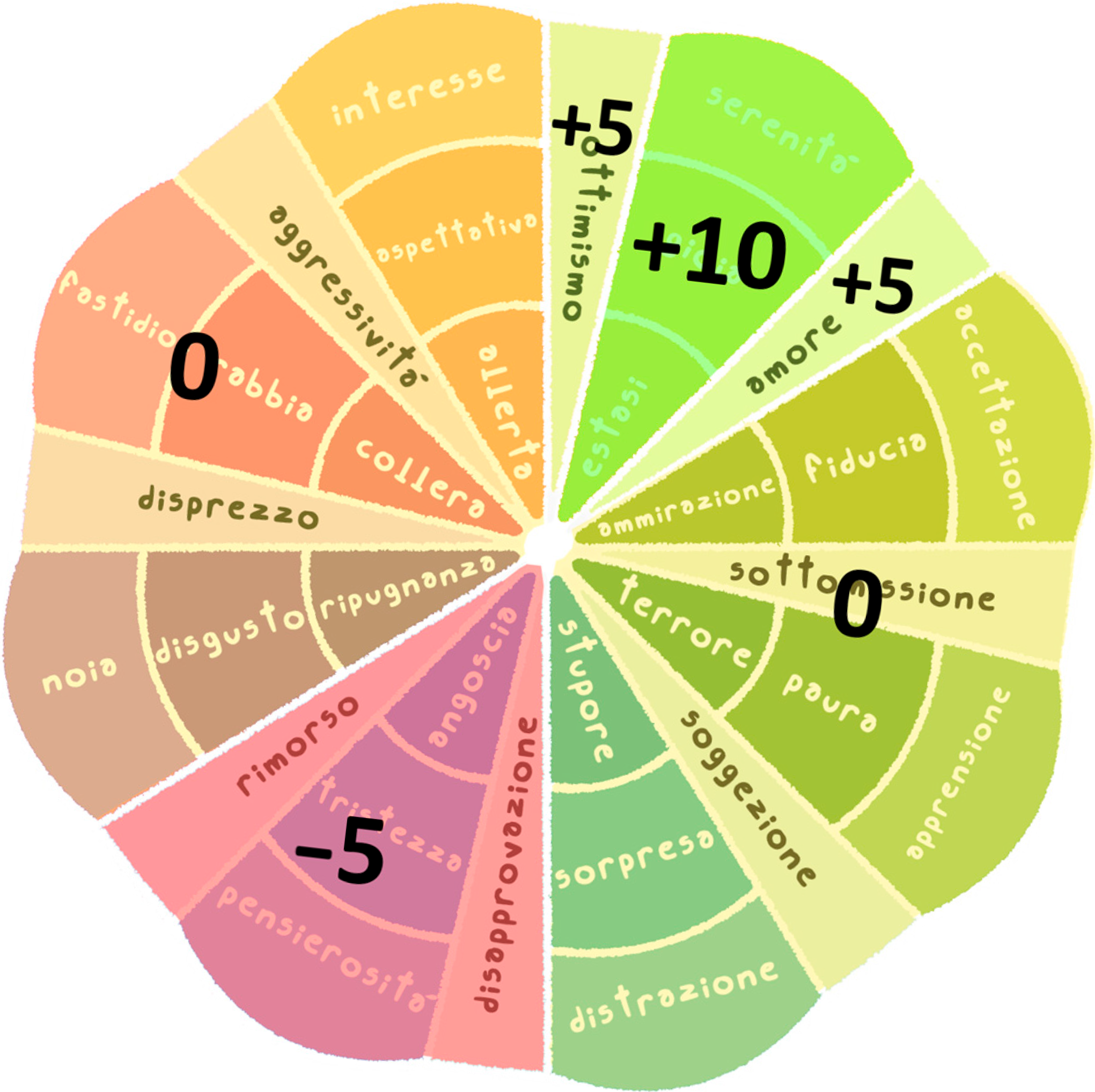
A score system was developed to match the structure of the emotion wheel and the storyline. Every beat of the storyline presents a character that is experiencing an emotion. If the player correctly identifies the emotion, 10 points are attributed. When the choice of emotion falls in the segments immediately neighboring the correct one, five points are attributed. When the player chooses the opposite emotion from the one intended, five points are detracted. If the chosen emotion falls into every other section of the wheel, no points are assigned.
Figure 1 presents an example of the score system for clarity.
In the case presented in
Figure 1, the correct choice is joy, which grants the player ten points. The neighboring emotions grant five points, and the opposite emotion—the whole sadness spectrum—detracts five points. Every other choice is not rewarded with points. This system is employed for every emotion identification throughout the game, and the player has to identify the correct emotion experienced by the NPCs multiple times across the story. In other words, every interaction that involves identifying emotional states is crucial for the score involving the specific NPC.
To recognize the correct emotion, the player must rely on the facial expression and dialogue lines of the NPC. The facial expression was drawn by a professional artist using as a reference
Yu et al. (
2019),
Martin et al. (
2006), and
Qi et al. (
2019). As an additional source of reference, the dataset of basic and complex emotion expressions from
Benda and Scherf (
2020) was accessed from Databrary, a Complex Emotion Expression Database with 480 pictures of eight actors recreating six basic emotions and nine complex emotions through facial expressions. In addition, the Tactile Images inventory was employed. Tactile Images provides a catalogue of facial expressions which comprehends the definition of the emotion, a picture of the associated facial expression, the explanation of facial traits, and muscles involved in the process. However, it is also important to consider that facial expressions are not the only elements giving clues about people’s emotional state. In fact, as Le Mau and colleagues (
Le Mau et al., 2021) affirm, the context in which the emotion is elicited can significantly influence emotion inference. For this reason, the storyline unfolds in several main events that allow the player to consider contextual information. In addition, the storyline also aims to promote the player’s immersion into the game and empathy toward the NPCs, as they all express their emotions, troubles and expectations. Moreover, storytelling is proven to elicit learners’ engagement and motivation (
Foelske, 2014;
Spanjaard et al., 2023).
Beta testing of the game was conducted by the second, fifth and sixth authors of the present study, during which bugs, mistakes in the dialogue, and programming flaws were reported.
In the following section we will describe the methods and procedures we used to finally answer our research questions: What are the preliminary perceptions of Empathy Quest on teachers’ game enjoyment, user experience, motivation toward DGBL, and interest in emotional intelligence?
5. Materials and Methods
In this section we will describe the participants that agreed to play Empathy Quest, the instruments used to test it, and the procedure through which the data was collected.
5.1. Participants
We proposed Empathy Quest to teachers enrolled in an online Italian university called “ECampus” during their traineeship sessions. These teachers were already in service and they were attending a traineeship program accessible only to teachers with at least three years of teaching experience who were specializing as support teachers. A total of 314 teachers accessed and played the game. Participation in this study was entirely voluntary and teachers were invited to provide feedback by compiling an online survey. Eighty-three (26.4% of those who played the game) provided informed consent and completed the survey. Consequently, the study relied on a self-selected sample, as participants chose whether to complete the survey after their gameplay experience. This sampling strategy was considered appropriate for an exploratory feasibility study, whose primary objective was to collect initial user feedback on the prototype rather than to estimate population parameters.
Because only 83 of the 314 teachers who played the game completed the questionnaire, the findings should be interpreted with caution. The voluntary nature of participation introduces the possibility of self-selection bias, whereby respondents may differ systematically from non-respondents. For example, teachers who found the game particularly engaging, had stronger opinions (either positive or negative), or were generally more interested in digital game-based learning may have been more likely to complete the survey. As a result, the sample may not be fully representative of all teachers who experienced the game, limiting the generalizability of the findings. Since no demographic or attitudinal data were collected from non-respondents, it was not possible to assess whether respondents differed systematically from those who chose not to complete the questionnaire. Consequently, the direction and magnitude of any self-selection bias cannot be determined.
The sample consisted of 74 women (89.2%), 8 men (9.6%), and only 1 participant (1.2%) who preferred not to specify their gender. The average age of participants was 46.11 years (SD = 7.09). Participants were distributed across Italy, with 7 participants from the south (8.54%), 7 (8.54%) from the center, 43 (52.44%) from the north, and 25 (30.49%) from the two Italian Islands (Sicily and Sardinia).
Participants’ educational level was distributed as follows: 29 participants (34.9%) held a master’s degree, 18 participants (21.7%) held a high school diploma, 16 participants (19.3%) held an integrated master’s degree, 11 participants (13.3%) held a bachelor’s degree, and 9 participants (10.8%) held other undergraduate or postgraduate qualifications.
When they were asked if they had any prior experience with digital games for learning, 26 participants (31.71%) answered that they had prior experience, 48 participants (58.54%) never had such experiences, and 8 participants (9.76%) were not sure.
This is a deliberately very heterogeneous sample, even in terms of teaching discipline, as the DGBL is not—at the moment—designed for a specific subject. The inclusion of teachers from different educational backgrounds was intended to evaluate the perceived applicability of Empathy Quest across diverse educational contexts during this initial feasibility phase. Indeed, the scenes depicted in the games were purposely conceived as transversal, not concerning any specific subject; rather the scenes describe situations that could occur at any school level.
5.2. Instruments
In this section we present the tests and questionnaires employed to evaluate
Empathy Quest. The choice of instruments was guided by the DGBL Effectiveness Evaluation Framework proposed by
All et al. (
2015), which identifies a range of outcomes relevant for the evaluation of DGBL interventions. Accordingly, the selected measures were intended to operationalize each research question through validated instruments assessing the main experiential dimensions identified as relevant for early-stage DGBL evaluation. Given the exploratory nature of the study and its focus on participants’ perceptions, we selected measures addressing enjoyment, user experience, motivation, and interest in the learning topic (emotional intelligence, in our case). More specifically, each instrument was chosen to address each one of the research questions guiding the study. RQ1 (teachers’ perceptions of game enjoyment) was investigated through measures of enjoyment and intrinsic engagement; RQ2 (teachers’ perceptions of user experience) through the assessment of usability and user experience dimensions; RQ3 (teachers’ perceptions of motivation toward DGBL) through measures of situational motivation; and RQ4 (teachers’ perceptions of interest in emotional intelligence) through measures of individual interest and ad hoc items related to the game topic. Taken together, these instruments provide a coherent assessment of the experiential and motivational dimensions identified as relevant by the DGBL Effectiveness Evaluation Framework and aligned with the objectives of the present study. This clear alignment between research questions and measurement instruments was intended to ensure conceptual coherence throughout the study design. The final survey included sections addressing interest in emotional intelligence, motivation and enjoyment while playing, and user experience. A process of back-translation from English to Italian was employed for all instruments that were originally in English.
The following sections describe the employed instruments.
5.2.1. Enjoyment Subscale, Intrinsic Motivation Inventory—IMI
Game enjoyment was investigated with the Intrinsic Motivation Inventory—IMI (
Ryan, n.d.). Originally, the IMI was created to measure intrinsic motivation in laboratory experiments. However, the interest–enjoyment subscale could be used in broader contexts. In fact, Ryan and colleagues (
Ryan et al., 2006) used a shorter version (four items) of the interest–enjoyment subscale to investigate the role of game enjoyment in the motivation for computer gameplay. The IMI had 22 items divided into seven subscales: interest/enjoyment, perceived competence, effort, value/usefulness, perceived pressure/tension, perceived choice and relatedness. We administered only the original seven items of the interest–enjoyment subscale. The IMI follows a seven-step Likert scale, from 1 “not at all true” to 7 “very true”. The enjoyment subscale demonstrated strong internal consistency in the study sample, with Cronbach’s α = 0.95 (
Ryan et al., 2006).
5.2.2. User Experience Questionnaire—UEQ
We investigated user experience through the user experience questionnaire—UEQ (
Laugwitz et al., 2008)—which was already available in Italian by Zenoni (
Schrepp et al., n.d.). The UEQ (
Schrepp, n.d.) consists of 26 items divided into six subscales, that is attractiveness, perspicuity, efficiency, dependability, stimulation and novelty. Attractiveness refers to users’ impression of the game. Perspicuity corresponds to ease and familiarization with the game. Efficiency is the necessary effort from gamers. Dependability is the user’s perceived control, game security and predictability. Stimulation refers to game enjoyment and motivation to play it. Novelty is the game’s ability to catch players’ interest through the innovativeness of the game. Participants must choose between opposite pairs of adjectives following a seven-point semantic differential scale. For example, the attractiveness subscale requires evaluating
Empathy Quest on a differential scale where the worst score is represented by the adjective “annoying” and the most positive evaluation is represented by the adjective “enjoyable”. To analyze the results, the benchmark set by the UEQ handbook (
Schrepp, 2023) was employed. The proposed benchmark is based on the evaluation of 468 studies on established products which help to set a baseline of user experience. Therefore, the benchmark enables researchers to compare their product to a large dataset and classify the user experience as excellent (in the top 10% best results), good (below the best 10% of results, but above 75% of results), above average (below 25% of best results, but above 50% worst results), below average (below 50% best results, but above 25% worst results), and bad results (among the 25% worst results). The benchmark is updated yearly with more and more studies to constantly provide a revised benchmark. All six subscales demonstrated acceptable-to-good internal consistency. Cronbach’s α values reported by
Laugwitz et al. (
2008) ranged between 0.65 (dependability) and 0.89 (attractiveness). For the present study, the 2025 benchmark was employed, which is available on the official UEQ website (
Hinderks et al., 2024). The comparison with the UEQ benchmark supports contextualization of participants’ evaluations of the prototype within a broader reference framework derived from a large dataset of established interactive products. Although
Empathy Quest is an educational prototype rather than a commercial product, this comparison allows for an initial interpretative positioning of its user experience outcomes in relation to validated external standards. For this reason, benchmark comparisons should be interpreted as descriptive rather than normative indicators of user experience.
5.2.3. Situational Motivation Scale—SIMS
To investigate the motivation for using DGBL, we administered the Situational Motivation Scale—SIMS (
Guay et al., 2000). The SIMS was developed to analyze situational motivation, connected to a specific task in which the participant is currently engaged. The self-determination theory—SDT (
Deci & Ryan, 2000)—is the pillar of the SIMS. Consistent with the motivation continuum defined by the SDT, the SIMS presents sixteen items divided into four subscales: intrinsic motivation, identified regulation, external regulation and lack of motivation. The questions were contextualized by explicitly referring to
Empathy Quest, instead of inquiring in general about their motivation towards DGBL, as in the original questionnaire. The SIMS follows a seven-step Likert scale, which goes from 1, “not at all in agreement”, to 7, “completely in agreement”. The internal consistency of the four subscales was found to be adequate in the original validation study (
Guay et al., 2000), with Cronbach’s α values ranging from 0.77 (amotivation) to 0.95 (intrinsic motivation) in the educational context.
5.2.4. Individual Interest Questionnaire—IIQ
To analyze the interest in the game subject, we administered the individual interest questionnaire—IIQ (
Rotgans, 2015). Although the IIQ was developed for school subjects, we believe that it is a valid instrument to investigate the interest in emotional intelligence, considered as an improvable skill. The IIQ measures trainee teachers’ predisposition, willingness to engage and (re)engage and affection for the chosen school subject. The IIQ has seven items following a five-step Likert scale and requires the researcher to decline them in relation to their teaching subject. To confirm the IIQ’s dependability,
Rotgans (
2015) adopted Hancock’s H coefficient, which is thought to be more suitable for scales with a latent factor structure. The values found in the validation samples were all much higher than the suggested threshold of 0.70, ranging from 0.81 to 0.87.
5.2.5. Ad Hoc Questionnaire
Together with the IIQ, SIMS, IMI and UEQ, some ad hoc items were created to further explore interest and motivation towards DGBL. These ad hoc items were not intended to constitute a psychometric scale; rather, they were included as complementary descriptive indicators to capture aspects of participants’ perceptions that were not directly addressed by the standardized questionnaires. The ad hoc items investigate how the interest in emotional intelligence changed specifically because of Empathy Quest. As the IIQ, the ad hoc items followed a five-step Likert scale, where 1 meant “I totally disagree” and 5 meant “I totally agree”. Our six additional items explored motivation towards DGBL by investigating participants’ future willingness to learn through DGBL methods. Similarly to SIMS, these items presented a seven-step Likert scale, which goes from 1, “not at all in agreement”, to 7, “completely in agreement”.
Table 2 presents the ad hoc items, their main topic and the relevant characteristics.
The final section of the survey asked participants to write perceptions, suggestions and critiques that might not be addressed by the survey. The final open question aimed to investigate what players liked or disliked, what feelings they experienced during the gameplay, and general feedback about the game experience. The final open question asked: “Do you think there is a topic we haven’t covered? Would you like to provide additional feedback or to ask a question? You can add a comment below”.
5.3. Procedure
Empathy Quest was presented during an online session of traineeship of the online university “eCampus”. The professor started the lecture by presenting the concept of educational games as a strategy to engage learners into the development of soft skills. Participants were given the option to abstain from trying the game and skip the session or stay and experience the game. Out of 314 teachers, all of them decided to try Empathy Quest. The link to download Empathy Quest was shared, together with the instructions to install it on personal devices, namely computers, smartphones, or tablets. Participants were allowed to play how many times they wished during a 30 min session. Allowing participants to freely interact with the prototype was intended to approximate a naturalistic first-use experience while ensuring that all participants had sufficient time to complete the game. At the end of the session, participants were required to leave their contact information in a Google Form to be contacted later. Only those that agreed to be contacted were invited a couple of days later to answer an online questionnaire through Google Forms, which contained the scales described in the Instruments Section. The questionnaire was announced at the start of the session but actually administered later on to allow participants to reflect upon their experience and respond individually in a private setting, outside the classroom context and without the presence of instructors or researchers. Empathy Quest was presented as a tool in its exploratory phase; therefore, a reflexive attitude was encouraged and teachers were required to contribute with their answers to the improvement of the game. All of these elements were intended to reduce potential social desirability and contextual influence biases by allowing participants to complete the questionnaire independently and outside the instructional setting. Overall, the procedure was designed to obtain an initial evaluation of the feasibility, acceptability, and perceived user experience of Empathy Quest, rather than to test its effectiveness in improving emotional intelligence.
5.4. Game Description
In
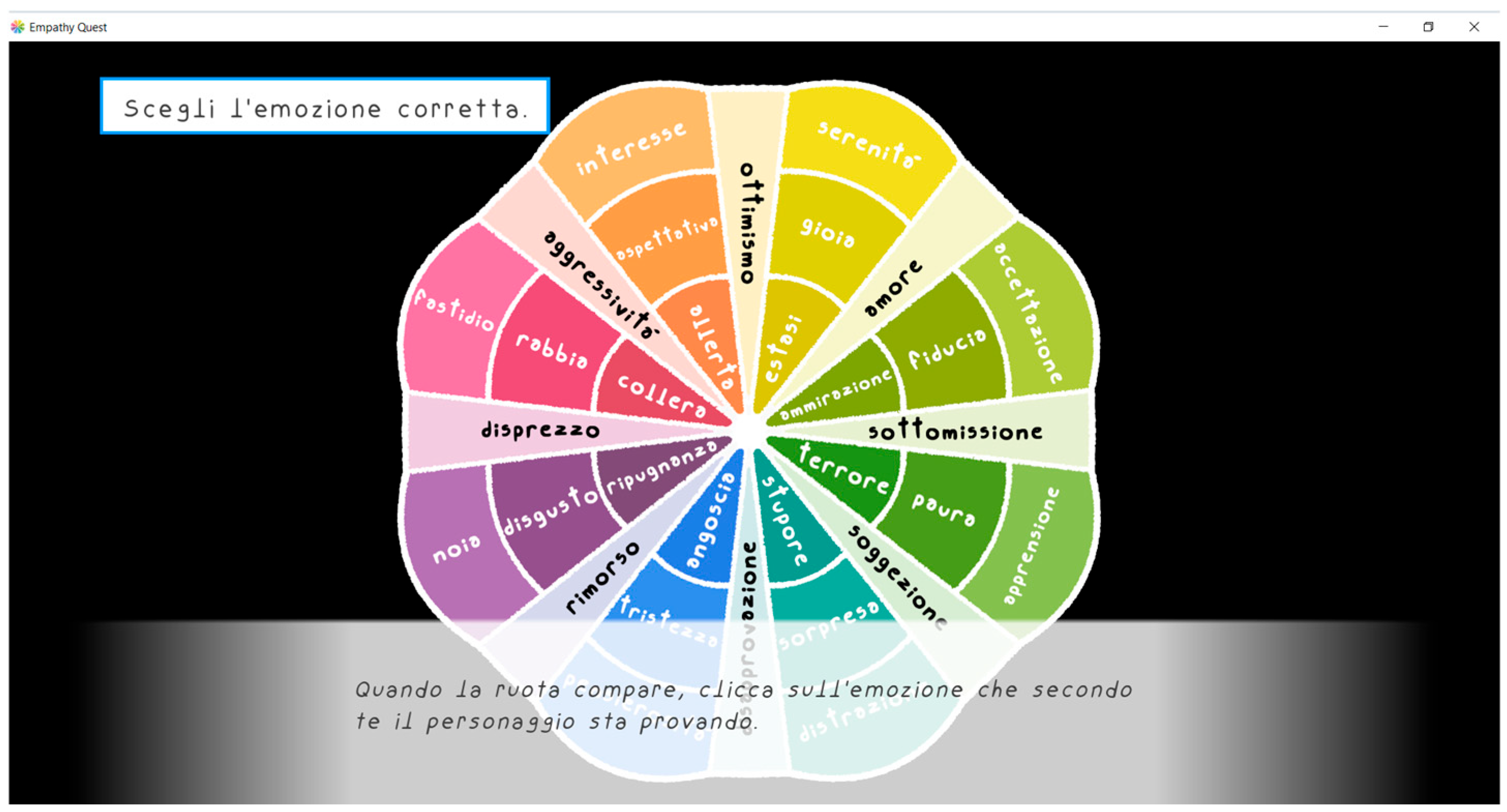
Empathy Quest the player takes on the role of a teacher who lives a normal workday, interacting with colleagues and students. At the beginning of the game, the player is introduced to the wheel of emotions and to the main game mechanics and then is instructed to interact with the wheel of emotions by clicking one of the emotions, as displayed in
Figure 2.
In
Figure 2, the screen caption reads: “
When the wheel appears, click on the emotion that you think the character is feeling”. The player is instructed to arbitrarily choose an emotion on the wheel, just to sense how the interaction with the wheel works. In
Figure 2, the emotions wheel is displayed on a black screen to signal to the player that the main story has not started yet. Then, the caption explains that the wheel will appear many times during the gameplay, and that it will help the player to reflect on the emotion experienced by the current NPC.
After the introduction to the wheel of emotions is completed, the story starts. The main character has no name, gender or physical representation. The NPCs refer to the protagonist with neutral titles (for example, “colleague”). In the DGBL a first-person perspective game mode is used, so the player does not see the main character’s body or just some small part of it which does not reveal the gender, for example, an arm or a leg. The first-person perspective could promote game experience immersion (
Deng et al., 2024), so that anyone could identify with the situations.
The workday starts in the school atrium, and the main character is optimistic and ready to start their activities. The player then interacts with two colleagues: Sandra, who seems to have great news; and Tonio, who is struggling with a broken printer in the staffroom. Once this situation is over, the game is placed in one of the teachers’ classrooms and the teacher player has to announce a mandatory surprise quiz to their students. At the end of the lesson, one of the students, Andrea, is worried about his test performance, so he wants to discuss the situation with the teacher. Later that day, the protagonist returns to the staffroom, where the printer is still broken. The player can now decide who—among the previously introduced characters—to get help from. The workday ends with the teacher’s final considerations about the whole experience.
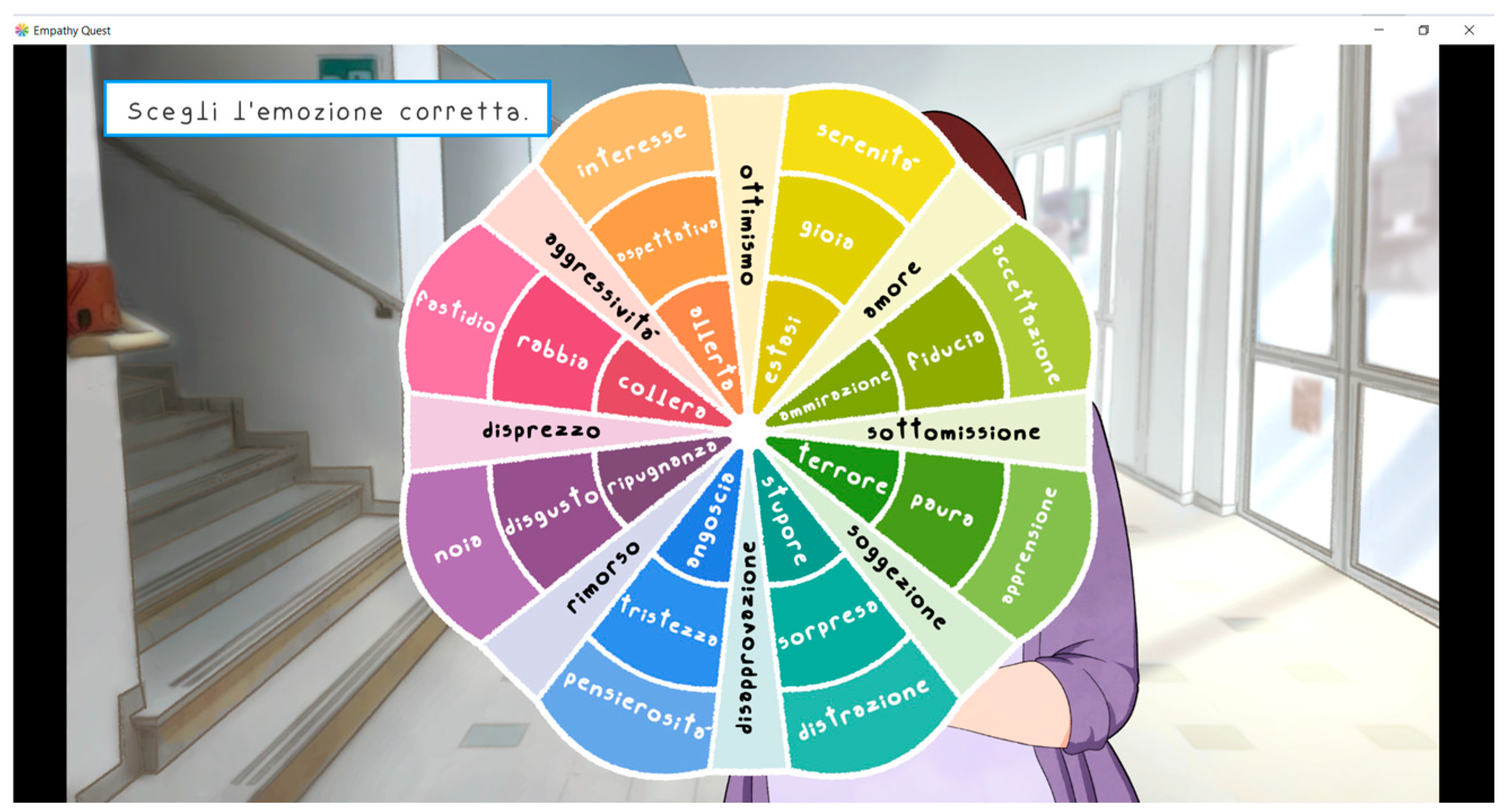
In
Figure 3, the wheel is shown in the context of the storyline. The player is invited to choose an emotion based on how the interaction with the NPC unfolded and the facial emotion the NPC displayed. The face of the NPC is hidden by the wheel to avoid the player relying too much on their facial expression and neglecting the story causing that expression.
In
Figure 4, a typical multi-choice option for dialogue is presented. The options presented are: “
Do you want to talk to me about something?”, “—
I wait for Andrea to start talking—”, “
I don’t have time to talk now. I have to go.”, “
If you want to talk about the test, I can’t.” The player is asked to choose one of these answers.
During the gameplay, the players receive subtle feedback about their performance. NPCs interact with the player’s dialogue choices by changing their facial expression or communication style. However, in this game phase, the player has no external information or points system to rely on, so they should understand if they are playing well by observing characters’ reactions. The player first receives feedback on the interactions with each character and what happened in the staffroom and at the end of the session there will be more general feedback.
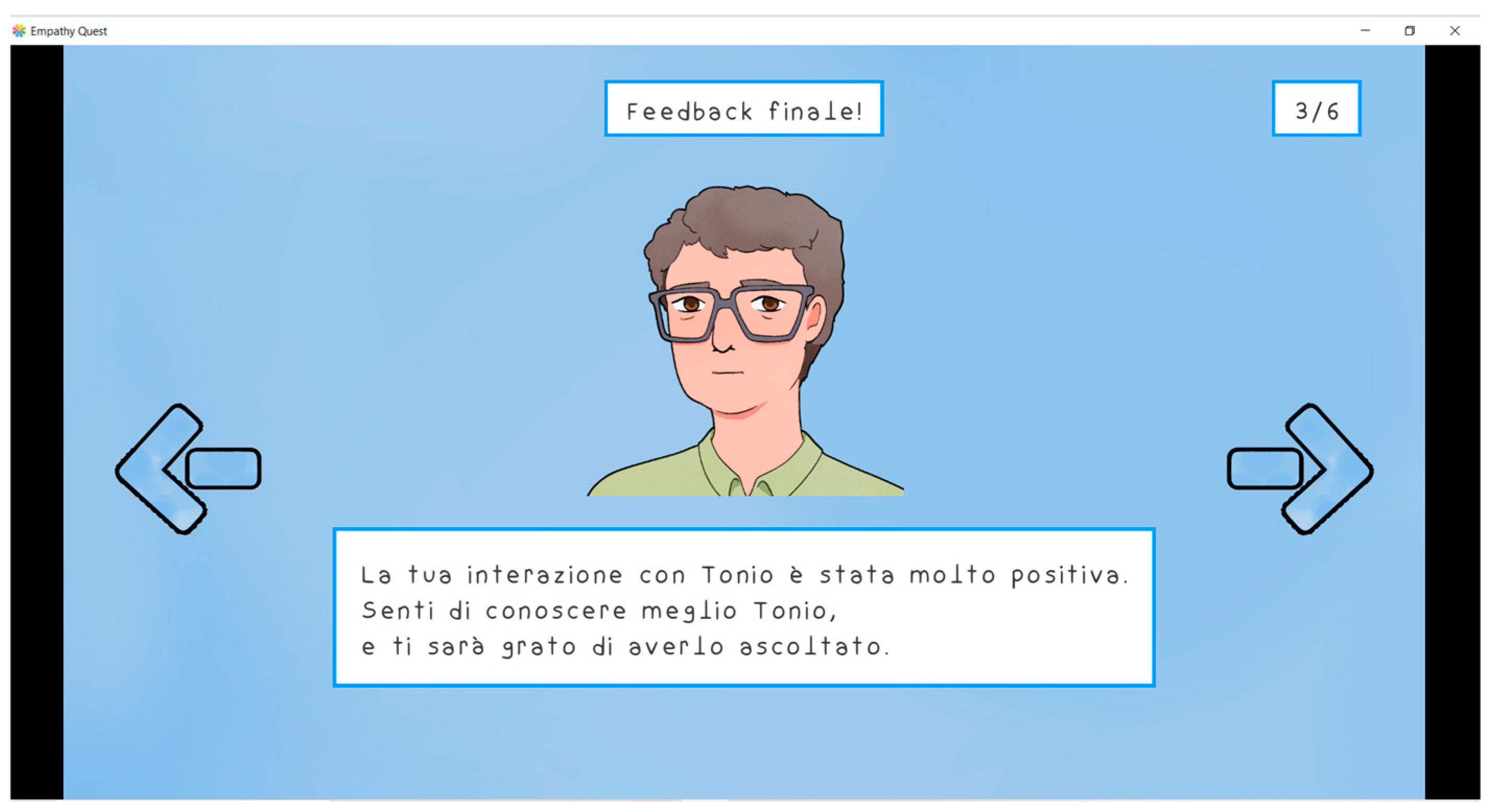
At the end of the session, the following text appears on the screen: “Final feedback! Thank you for playing! Now you can read about the result of your actions to better understand them and reflect. At the end of the report, you can also find your score for emotion recognition! If you want to improve (or fail) you can play again and try different choices”.
At the end of the session, the player receives two outcomes: (a) about the interactions with each NPC; (b) about the score for the emotion recognition through the wheel.
Thus, the player receives feedback on the overall ability to recognize emotions, accompanied by the specific scores referring to the recognition of each NPC’s emotions together with the overall score.
In
Figure 5, the screen caption reads “
Final feedback! Your interaction with Tonio was very positive. You feel you know Tonio better, and he will be grateful that you listened to him”.
Finally, all of the answers to each character are assessed and a short final feedback is provided to the player, as in
Figure 5. This time, the outcome does not depend on the emotion recognition from the emotions wheel, but on the quality of the answers chosen. Users are encouraged to play again and try out alternative answers and different styles of communication and experience the impact.
Replayability is considered as one of the aspects enhancing educational games sustainability. According to
Silveira (
2016), learners are not so motivated to play educational games because they usually address specific learning requirements and once they are fulfilled, learners quit playing. Furthermore, educational games are often diversified by age group, so if the players do not fall into the expected range, the games could be perceived as not meant for them.
Empathy Quest, maintaining a generic user profile, may engage a wide range of users regardless of their age.
6. Results
6.1. Game Enjoyment
To answer the first research question—How do teachers perceive Empathy Quest in terms of game enjoyment?—the results of the subscale of interest/enjoyment of the IMI were analyzed. Overall, participants reported a very high level of enjoyment while playing Empathy Quest. Since the subscale has seven items on a seven-step Likert scale, the scores could range from a minimum of 7 to a maximum of 49. The lowest score was 20, and the highest was 49. The mean score observed was 6.07 out of 7 (SD = 0.95). This score indicates that participants generally experienced the game as enjoyable and intrinsically engaging during the first implementation.
6.2. User Experience
To answer the second research question—How do teachers perceive
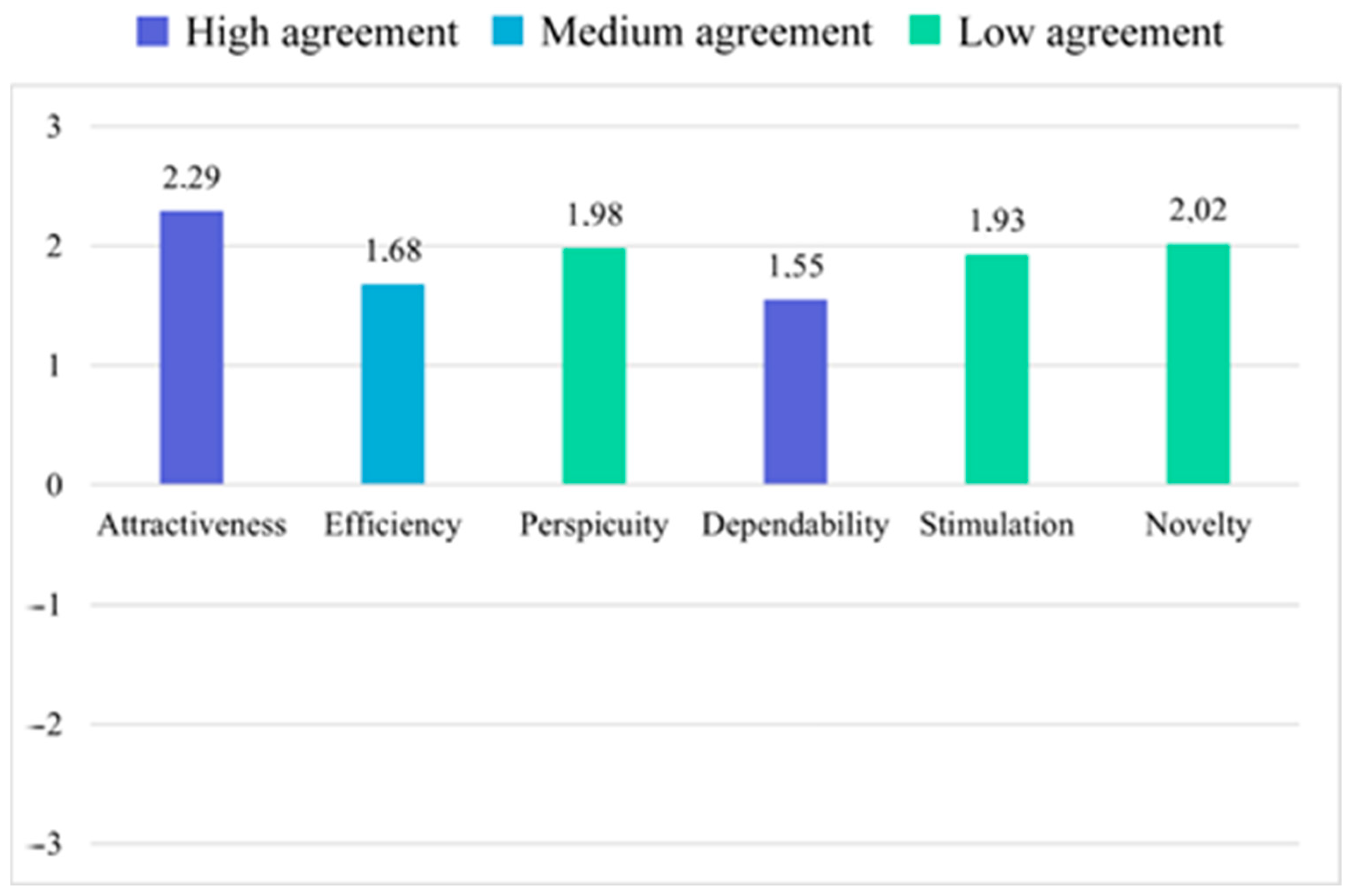
Empathy Quest in terms of user experience?—the results of the UEQ were analyzed. To analyze the results, the scores must be converted into a scale ranging from −3 to +3. The results of this conversion are shown in
Figure 6. Overall, user experience ratings were consistently positive across all UEQ dimensions, with particularly high evaluations for attractiveness, novelty, and stimulation.
In
Figure 6, the mean results are presented together with the classification of agreement based on the value of each subscale’s results in standard deviation (SD). In fact, the results of the UEQ can be classified through the scale of agreement based on the value of each subscale SD. The UEQ handbook defines SD values as in high agreement within participants when the value is below 0.83, medium agreement when the SD is between 0.83 and 1.01, and low agreement when it is above 1.01. The acceptable score ranges from −3 to +3. Even in this case where the negative section is empty, it was included in the figure because the lack of negative scores is a relevant result for this scale.
All six UEQ dimensions obtained clearly positive mean scores, suggesting a favorable overall evaluation of the prototype. The higher result is observed in the attractiveness subscale (2.29; SD = 0.81). As the SD score in the attractiveness subscale is below 0.83, the agreement is classified as high following the UEQ handbook. The second-best mean score is achieved by the novelty subscale (2.02; SD = 1.02). As the SD score of the novelty subscale is above 1.01, the agreement is considered low. Then, perspicuity gained a mean score of 1.98, with SD = 0.80, which is considered a high agreement among the participants following the instructions of the UEQ handbook. The stimulation subscale resulted in a mean score of 1.93 points. The stimulation subscale agreement among participants is considered low following the UEQ handbook, because the SD = 1.08. The efficiency subscale presents a mean score of 1.68, with an SD equaling 0.84, which means that the agreement is medium. Finally, the lowest medium score was obtained by the dependability subscale (1.55; SD = 1.08). As the SD score of the dependability subscale is above 1.01, the agreement among participants is classified as low. We also compared these results to the 2025 benchmark (
Hinderks et al., 2024) set by the UEQ handbook (
Schrepp, 2023). Based on the comparison with the benchmarks, the scores on the attractiveness, stimulation, and novelty subscales were classified as excellent, placing the game in the range of the top 10% best results in the benchmark. The subscales of perspicuity, efficiency and dependability were classified as good, placing below the top 10% of products but above 75% of products. Taken together, these findings indicate that participants perceived
Empathy Quest as providing a highly positive user experience despite its current status as an exploratory prototype.
6.3. Motivation for Using DGBL
The results of every subscale of the SIMS were analyzed to answer the third research question—How do teachers perceive Empathy Quest in terms of motivation toward DGBL?
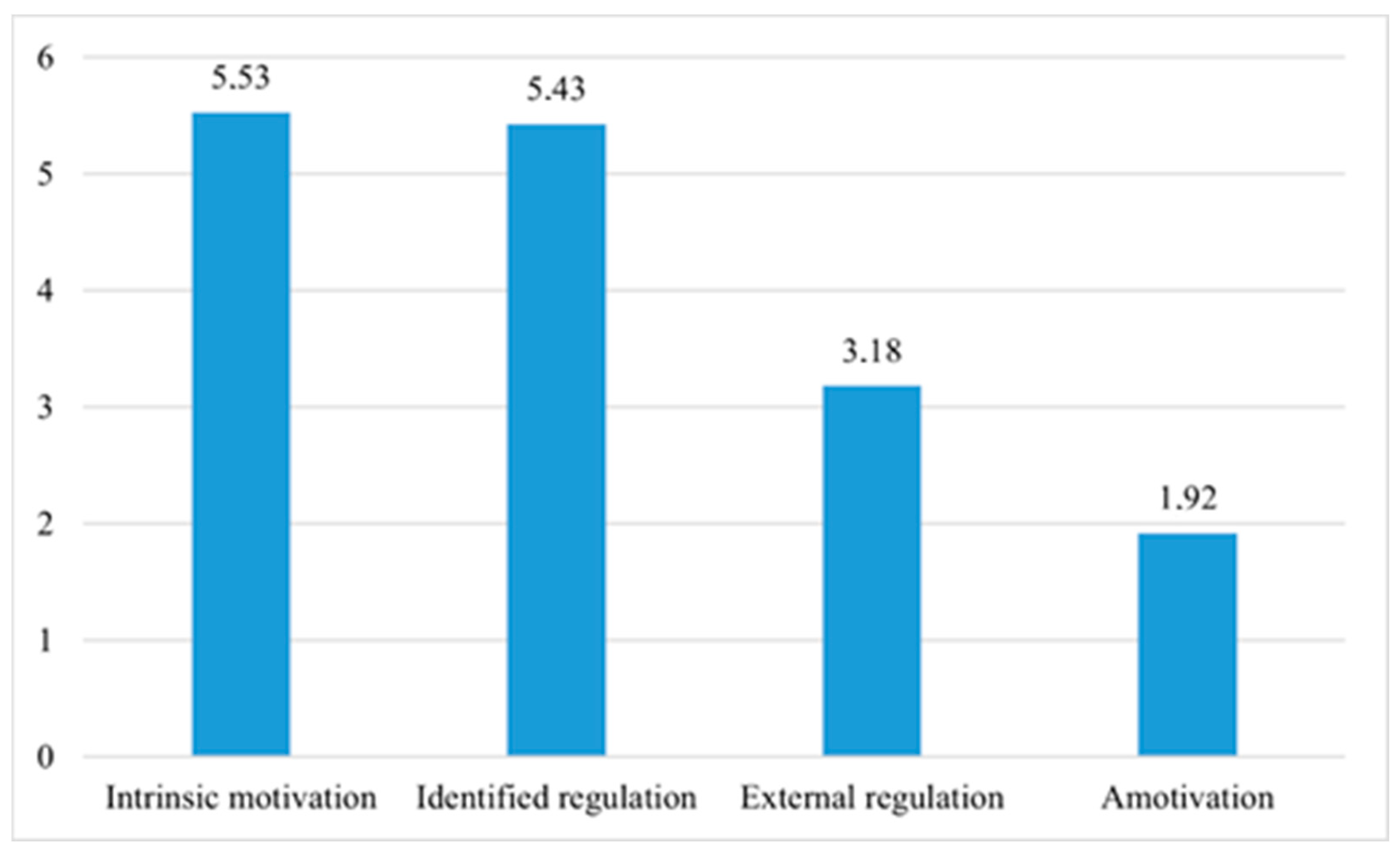
Overall, participants reported high autonomous motivation to engage with DGBL, whereas controlled motivation and amotivation remained comparatively low. The intrinsic motivation subscale obtained a mean score of 5.53 out of 7 (SD = 1.27). The identified regulation subscale gathered a mean score of 5.43 out of 7 (SD = 1.31), while the external regulation subscale resulted in a mean score of 3.18 out of 7 (SD = 1.4). Finally, the amotivation subscale presented a mean score of 1.92 out of 7 (SD = 1.28).
Figure 7 summarizes the results of the SIMS. The pattern of scores suggests that participants engaged with the game primarily because they found it personally valuable and enjoyable rather than because of external pressures.
Figure 7 shows the results of the SIMS in a descending order, with the intrinsic motivation subscale leading for its higher mean score, identified regulation following right after, and external regulation and amotivation last, with the lowest mean scores.
Furthermore, the answers to the ad hoc items were examined to further investigate how
Empathy Quest motivated further use of educational games. The results are reported in
Table 3. The ad hoc items further supported these findings by indicating positive attitudes toward future use of DGBL following the gameplay experience.
Overall, these responses suggest that the experience with Empathy Quest was associated with favorable perceptions of DGBL and intentions for future educational use.
6.4. Interest in Game Subject
To answer the fourth and final research question—How do teachers perceive
Empathy Quest in terms of interest in emotional intelligence?—the results of the IIQ were analyzed. Participants reported a moderately high level of interest in emotional intelligence, together with indications that the game further stimulated this interest. Since the IIQ consists of seven items in a five-step Likert scale, the score ranges from a minimum of 7 to a maximum of 35. In our study, the lower observed score was 10 and the highest was 35. The mean score in the IIQ scale was 3.42 out of 5 (SD = 0.81). Furthermore, the mean score for the ad hoc items about situational interest was calculated. The items and corresponding mean scores are reported in
Table 4.
From the mean scores of the items in the ad hoc questionnaire about situational interest, we can gather that participants were overall interested in emotional intelligence before playing Empathy Quest (mean score = 1.94 out of five; SD = 1.19). However, the score to the second item, that is if Empathy Quest inspired participants to increase their knowledge about emotional intelligence, is quite high (3.74 out of five; SD = 1.12). When participants were asked whether Empathy Quest had influenced their interest in emotional intelligence, the mean score was 3.12 out of 5 (SD = 1.25), suggesting that participants perceived the game as having a positive, although moderate, influence on their interest in the topic.
6.5. Open-Ended Question
Together with the close-end questionnaires, we also administered an open-ended question which asked: “Do you think that there is something that we didn’t ask? Would you like to give extra feedback, or answer a question? You can add a comment below”. In total, 27 participants chose to leave an answer to the open-ended question and, despite the limited number of responses, some themes were detected. Although qualitative findings are not intended to be generalized, they provide useful contextual information that complements the questionnaire results.
The responses were analyzed through a descriptive content categorization procedure. First, all responses were reviewed and coded according to their main topic. Subsequently, similar responses were grouped into four categories. Answers were classified as: (i) neutral/appreciation feedback; (ii) identification with the situations; (iii) improvements requests; (iv) suggestions. Overall, participants’ comments reflected a predominantly positive perception of the game while also identifying several opportunities for refinement.
By looking at the content of the answers, we found that, overall, our participants seemed to enjoy Empathy Quest, as two participants described it as interesting, two participants found it useful, and two participants described it as aesthetically pleasant. Notably, two participants expressed gratitude for the experience, as one stated: “Good luck, and thank you for what you’re doing!” and the other wrote “Thank you for your work, it’s very useful!”. Five participants stated that they felt strongly identified with the situation; for example, one of them stated: “I responded as I would have responded in those situations” and “I felt an emotion that arose from the situation imagined by the game”. Moreover, three participants declared that they felt inspired to reflect on their relationships or relationships in general in the school context; for example, one participant wrote that “I found it very interesting because, in addition to teacher–student relationships, there are a whole series of relationships between teachers that are very important for creating a peaceful and collaborative atmosphere within a school, which would also benefit the students”.
Alongside these positive perceptions, participants also provided constructive suggestions that highlighted aspects of the prototype requiring further refinement. In fact, participants gave important feedback and suggestions to improve the game experience. Two participants believed that some dialogue options were “stern” and “very harsh”. A participant commented, in particular, about the story of the exam in the classroom. This participant believed that too much emphasis was put on the test paper’s marks, instead of reassuring students about the surprise exam and its possible consequences. Also, they suggested taking care of Andrea’s emotional issues, rather than his preoccupation with the exam mark. Two participants would also like additional information about the main character’s emotional state, the NPC characters and the relationship with them, as “the protagonist’s mood is not considered” and we “should add a brief description of the characters”.
Three participants who played via smartphone reported that reading the text was hard because of the size of the font. One of these comments states that “I find the response options on my cell phone difficult to read”, which signals that playing on mobile phones should be optimized for readability. One participant suggested making the character’s facial expression visible while choosing the emotion from the wheel. Three participants would have liked extra information about the score, as it lacked a numerical range or just wanted additional information about final feedback.
To three participants, the game already felt complete; in particular, a participant seemed satisfied with the game features, stating that adding more would “jeopardize the game originality”. Four participants suggested adding additional scenarios, with other teachers or younger students. A participant suggested adding increasingly stressful situations and additional school staff other than teachers, such as principals and education assistants. One participant suggested adapting the game to other work environments such as private companies, while two participants would like Empathy Quest to be adapted for kindergarten and elementary school students.
Six participants shared their screen, allowing them to experience Empathy Quest collectively. Interestingly, all six participants evaluated this shared experience positively, suggesting that the game may also have potential to stimulate collaborative reflection and discussion.
7. Discussion
The present study aimed to explore teachers’ perception of Empathy Quest, a DGBL targeting emotional intelligence. Our research questions are:
RQ1: How do teachers perceive Empathy Quest in terms of game enjoyment?
RQ2: How do teachers perceive Empathy Quest in terms of user experience?
RQ3: How do teachers perceive Empathy Quest in terms of motivation toward DGBL?
RQ4: How do teachers perceive Empathy Quest in terms of interest in emotional intelligence?
Several standardized ad hoc tools were administered to gather a nuanced account of teachers’ gaming experience. Overall, the findings consistently suggest that Empathy Quest was positively received across all the dimensions explored, providing initial support for its feasibility as a DGBL tool for teachers’ emotional intelligence.
The first research question inquires about the perceived enjoyment of the DGBL. The enjoyment score reached a mean of 6.07 out of 7, denoting
Empathy Quest as an enjoyable experience. This outcome is consistent with other DGBL tools about emotional intelligence which were evaluated as enjoyable experiences (
López-Faican & Jaen, 2020;
Santos et al., 2021;
Shaheen et al., 2023). Enjoyability is a key aspect of DGBL, as the gamified activities are supposed to make learning a pleasant activity—even if fun should not be considered as a sole parameter for the success of a DGBL (
Pattemore & Gilabert, 2025;
Wu, 2023). Nevertheless, high enjoyment represents an important prerequisite for sustained engagement with educational games, particularly during the early stages of adoption.
The quality of the gameplay experience is further confirmed by the outcomes of the user experience questionnaire, which helps to answer the second research question about the perceptions of
Empathy Quest in terms of user experience. A high agreement among participants was reached in evaluating
Empathy Quest as highly attractive, which appeared as the most distinctive property of the game. Moreover,
Empathy Quest was perceived as particularly stimulating and novel, and the scores reached in the perspicuity, efficiency and dependability areas were evaluated as high in reference to the benchmark. Overall,
Empathy Quest was perceived as an engaging experience, enjoyable and characterized as distinctly attractive, stimulating, and novel, while also demonstrating strong clarity, efficiency and reliability. A good user experience (UX) is not merely a cosmetic factor but improves users’ motivation, engagement and learning (
Álvarez-Xochihua et al., 2017;
Guo et al., 2020). These findings are particularly encouraging considering that participants evaluated an exploratory prototype rather than a fully developed commercial product.
Moreover, the evaluation of the UX through the UEQ helps to detect hedonic issues that might encumber cognitive load and prevent learning gains (
Guo et al., 2020;
Schrepp, n.d.). In this case, dependability emerged as a potential issue for
Empathy Quest, as the score is lower than others, with a high agreement from participants. Therefore,
Empathy Quest can be improved in terms of predictability and perceived control. Such an outcome could be dependent on a specific design choice—for instance, presenting feedback at the end of the game. While delayed feedback can improve enduring understanding and higher-order thinking skills (
Almalki & Elfeky, 2022;
Qun, 2025), it is not learners’ preference (
Lefevre & Cox, 2017;
Mullet et al., 2014). Moreover, the issues of font readability reported in the open-ended answers might have influenced this result (see
Section 6.5). These findings also illustrate the usefulness of combining standardized questionnaires with qualitative feedback, as participants’ comments helped to identify concrete design aspects that may explain the quantitative results.
Overall, results from the SIMS were analyzed to investigate the third research question, which ponders teachers’ perceptions of motivation towards DGBL. The motivation scale indicated higher scores on the intrinsic motivation and identified regulation subscales, suggesting that
Empathy Quest fostered autonomous and integrated forms of motivation described by Self-Determination Theory (
Deci & Ryan, 2000). Moreover, participants would eagerly play again in the future and they would recommend games for learning to others. A similar perception was achieved by other games about emotional intelligence (
Raybourn, 2011;
Shaheen et al., 2023), where participants declared to be motivated to learn through games in the future. Building on these previous studies, our research suggests that
Empathy Quest not only motivates users to engage with DGBL in the future but also elicits self-determined forms of motivation. This is particularly advantageous because self-determined motivation predicts persistent and effective learning, as proven by previous studies (
Ryan et al., 2019;
Domínguez et al., 2013). Taken together, these findings suggest that
Empathy Quest has the potential not only to be appreciated as a learning experience but also to encourage teachers’ willingness to engage with DGBL more broadly.
Finally, the fourth research question—regarding the perception of interest towards emotional intelligence—was addressed through analysis of the IIQ.
Empathy Quest was considered interesting by participants, as the IIQ presented a score of 3.42 out of 5. However, the absence of established cutoff values or population benchmarks for the IIQ limits the extent to which this result can be meaningfully interpreted or compared. Some additional insight can be extracted from the questionnaire when the mean score of each item is computed. One item stands out for its particularly low score compared to the others; that is the item “I watch a lot of programs about emotional intelligence”, which had a score 2.64 out of 5, whereas other items ranged from a 3.19 to a 4.54. Thus, this item might not be relevant for participants, as TV programs may not be the most prominent entertainment and informational source in everyday life anymore (
AGCOM, 2025).
More insight can be gained from the ad hoc questionnaire about interest in emotional intelligence. The mean score of the first ad hoc item reads “
Before playing Empathy Quest, I was not interested in emotional intelligence”, and it had a pretty low agreement score (see
Table 2). However, participants agreed that
Empathy Quest inspired them to pursue their interest in emotional intelligence (see
Table 2). Together, these items depict a keen interest in emotional intelligence and suggest that
Empathy Quest might have a role in supporting this interest. One possible explanation is that participants’ prior interest in emotional intelligence may be related to their specialization in support teaching and attendance in a Psychology course, where emotional intelligence represents a relevant educational topic. Psychology students tend to be more emotionally intelligent (
Mathew, 2023) and emotional intelligence is part of the educational curriculum.
This is not an isolated result since other games about emotional intelligence succeeded to elicit interest in the subject, as it is the case for
YoungRes (
Panizo-Lledot et al., 2022) and the game from
Raybourn’s (
2011) research.
Empathy Quest shares with these DGBLs the involvement of NPCs and contextual emotion recognition as game mechanics. This commonality might suggest that NPCs and contextual emotion recognition are responsible for eliciting situational interest. However, only an empirical evaluation of such game mechanics could conclusively prove this connection. Future studies adopting experimental designs could investigate the specific contribution of these individual game mechanics to learning and motivational outcomes.
Nevertheless, our results differ from those reported by
Panizo-Lledot et al. (
2022) and
Raybourn (
2011), as these earlier studies assessed whether participants found the game interesting. In contrast, our study examined participants’ interest in emotional intelligence, yielding encouraging findings. This distinction represents a relevant contribution of the present study, as fostering interest in emotional intelligence itself may constitute an important preliminary condition for subsequent emotional learning.
Taken together, the results obtained across the four research questions converge in suggesting that Empathy Quest represents a promising DGBL approach for supporting teachers’ engagement with emotional intelligence. While the present exploratory study was not designed to evaluate learning effectiveness, the positive findings regarding enjoyment, user experience, motivation, and interest provide encouraging evidence of the prototype’s feasibility and support its further refinement and evaluation through larger-scale effectiveness studies.
8. Conclusions
The development process for
Empathy Quest illustrates the value of integrating educational psychology with game design practices. The findings provide preliminary evidence that
Empathy Quest was positively perceived by participants in terms of enjoyment, user experience, and motivation. However, further studies using pre–post measures, control groups, and direct indicators of emotional intelligence are needed to determine its educational effectiveness. Moreover, the findings showing intrinsic motivation contribute to our understanding of the role of DGBL in supporting self-determined motivation (
Deci & Ryan, 2000). Finally, the presented outcomes contribute to the emerging evidence about the importance for DGBL about emotional intelligence of specific game mechanics—that is, NPC interaction and contextual emotion recognition. These game features play a role in determining interest towards the subject of emotional intelligence.
The present work suggests insights into the future interdisciplinary developments of DGBL. Hopefully, future practitioners will capitalize on this experience to harness the skills of game designers and developers with the pedagogical know-how of educators. Moreover, the lower dependability scores indicate a need to improve user control and predictability of the interface. Given the evidence that a strong UX supports learning effectiveness and engagement (
Álvarez-Xochihua et al., 2017;
Guo et al., 2020), improved dependability should be a priority for future iterations. That being said, after ensuring an optimized UX and once all the conditions for an engaging learning environment are satisfied, the goal for
Empathy Quest could be to verify learning effectiveness. In this context, learning outcomes might include adequate research design and data collection about declarative knowledge on emotional intelligence, improvement of emotional competence or impact on learners’ lives. Pursuing the goal of effectiveness assessment is fundamental to advancing the impact of DGBL on emotional intelligence. Furthermore, to assess
Empathy Quest’s learning impact, it should be administered in different contexts, such as the classrooms or during teachers’ meetings.
As for the limitations, it should be noticed that not all effective game mechanics found in the literature were implemented into
Empathy Quest. For instance, journaling and instructional content were not included even if they have been proven as effective in previous studies (
de la Barrera et al., 2021;
Sturgill et al., 2021). This limitation is due to resource constraints, which induced the development team to prioritize a streamlined narrative game style. However, future iterations of
Empathy Quest are planned to harmonize instructional content in a seamless way with the main storyline. Additionally, a journaling feature is planned to foster critical thinking and self-reflection while playing. These additions to the game, as well as the game in its final stage, are scheduled for formal validation.
In regards to methodological limitations, the lack of a comparison tool hinders the interpretation of outcomes. Although the present research fits the scope of an exploratory study to assess its feasibility, the employment of a control group or pre- and post-measurement would provide conclusive proof of efficacy. Future studies are planned to compare the impact of Empathy Quest to traditional and non-gamified educational programs about emotional intelligence. A further limitation of this exploratory study concerns the lack of detailed professional background information (e.g., teaching experience, school level, and type of institution). While the study was designed to involve a heterogeneous group of teachers in training rather than to test hypotheses related to specific participant characteristics, the collection of biographic dimensions could support more fine-grained analyses in future research. In addition, out of 314 teachers that experienced the game, only 83 participants completed the questionnaires. The findings should be interpreted with caution, as participants who completed the process may systematically differ from the one who did not provide feedback. In this sense, our findings may not represent the perceptions of the whole group.



 ,
,