Article

Do Executive Function Skills Moderate the Effect of Spanish Early Reading Skills on English Reading Trajectory

1
School of Education, Johns Hopkins University, Baltimore, MD 21218, USA
2
Department of Counseling and Educational Studies, Johns Hopkins University, Baltimore, MD 21218, USA
3
Center for Research and Reform in Education, School of Education, Johns Hopkins University, Baltimore, MD 21218, USA
*
Author to whom correspondence should be addressed.
Educ. Sci. 2026, 16(8), 1243; https://doi.org/10.3390/educsci16081243
Submission received: 9 June 2026 / Revised: 30 July 2026 / Accepted: 31 July 2026 / Published: 6 August 2026

Abstract

Spanish–English emergent bilingual children show substantial variability in English reading development, yet less is known about how early Spanish literacy and executive function jointly explain this variability. We first examined whether Spanish early reading skills and executive function skills (working memory, cognitive flexibility, and inhibitory control) predicted children’s initial English reading levels and reading growth. We also investigated whether these executive function skills moderated the association between Spanish early reading skills and English reading. Latent growth curve analyses were conducted to examine these relations among 308 Spanish–English emergent bilingual children. Results showed that inhibitory control predicted bilingual children’s initial English reading levels, whereas Spanish early reading skills predicted English reading growth. Importantly, our moderation analyses showed that inhibitory control moderated the cross-language relation between Spanish early reading skills and English reading growth, with Spanish early reading skills more strongly related to reading growth among children with lower inhibitory control. Findings suggest that Spanish early reading skills and inhibitory control play distinct but interactive roles in bilingual children’s English reading development.

1. Introduction

Spanish–English emergent bilingual (EB) children are students who are developing their home language while also acquiring a new language, English; they tend to demonstrate substantial variability in their English reading development across elementary school (Shen & Goodrich, 2024). Understanding the sources of this heterogeneity is critical for both academic and equity reasons. Early reading trajectories during the primary grades are strongly associated with students’ long-term academic achievement (Lee, 2010). Differences in these trajectories may therefore contribute to later educational disparities. This issue is especially important for Spanish–English EBs, who account for about 76.4% of the EB population (Irwin et al., 2024; National Center for Education Statistics [NCES], 2024). Their reading trajectories may be influenced by multiple factors, including linguistic and cognitive skills (Shen, 2025a; Swanson et al., 2017), as well as ecological factors (X. Chen et al., 2012). For example, early Spanish reading skills play an important role in shaping Spanish–English EBs’ English reading development during the elementary years (Relyea & Amendum, 2020; Shen, 2025b).
Beyond linguistic skills, children’s executive function (EF), a set of higher-order cognitive processes that support goal-directed behavior, has been increasingly recognized as an important contributor to differences in reading development (Butterfuss & Kendeou, 2018; Ober et al., 2020; Spencer et al., 2020; Welsh et al., 2010). These processes may be particularly relevant for emergent bilinguals, who must manage linguistic information across two languages during learning (Abedi, 2002; Lee Swanson et al., 2015; Relyea, 2025; Shen, 2025c). While prior research has linked both early literacy skills and EF to children’s reading outcomes (Taboada Barber et al., 2021; Weaver & Kieffer, 2022), less is known about how these factors jointly shape bilingual children’s reading development over time. In particular, EF may not only independently predict reading trajectories but also influence the extent to which early Spanish reading skills support the development of English reading (Shen, 2025c). The present study therefore examines the extent to which early Spanish reading skills and EF predict Spanish–English EBs’ initial levels and growth in English reading and whether EF moderates the relation between early Spanish reading skills and children’s reading trajectories.

1.1. Cross-Language Transfer: The Role of Spanish Early Reading Skills in English Reading

Cross-language transfer refers to the process by which language and literacy knowledge developed in one language supports performance in another language (Cummins, 1979; Chung et al., 2019). This idea is grounded in Cummins’s developmental interdependence hypothesis, which suggests that second language (L2) development depends in part on competence established in the first language (L1; Cummins, 1979). In the context of bilingual reading development, this framework helps explain why literacy skills in a child’s L1 may contribute to reading in an L2 (Cummins, 1979; Proctor et al., 2010). This relation has been widely documented in Spanish–English EB children, whose two languages both rely on alphabetic writing systems. Prior studies have shown that Spanish phonological awareness, decoding, print knowledge, and early reading skills are related to later English word reading, decoding, and reading comprehension (Goodrich et al., 2013; Giguere et al., 2024; Language and Reading Research Consortium [LARRC] et al., 2021; Relyea & Amendum, 2020). As such, Spanish early reading skills serve as an important foundation for English reading development among Spanish–English EB children.
Although the developmental interdependence hypothesis provides an important theoretical foundation of cross-language transfer, later research has clarified that L1 literacy does not transfer to the same extent. Instead, cross-language relations vary depending on factors such as the specific literacy skill being examined and the learner’s level of L2 competence (Bernhardt & Kamil, 1995; Chung et al., 2019; Cummins, 1979; Proctor et al., 2010). Skills that rely on shared alphabetic processes, such as phonological awareness and decoding, tend to show clearer cross-language relations than skills that depend more heavily on language-specific knowledge, such as vocabulary (Chung et al., 2019; Giguere et al., 2024; Proctor et al., 2006). For Spanish–English EB children, this means that Spanish literacy may support English reading when the skill involves overlapping print or sound structures across the two languages.
Within this framework, Spanish early reading skills are theoretically important as early literacy resources that may shape English reading development over time. Indeed, Relyea and Amendum (2020) showed that stronger Spanish reading skills in kindergarten predicted English reading levels and growth through Grade 4 among Spanish–English EBs, but this relation varied by English oral proficiency, with stronger cross-linguistic associations observed among children who had higher English oral proficiency at school entry. This suggests that the effect of Spanish early reading depends in part on children’s English-language resources. Likewise, the Language and Reading Research Consortium [LARRC] et al. (2021) followed Spanish–English EB children from prekindergarten to third grade and found that Spanish oral language, memory, and broader language proficiency contributed to later English reading comprehension both directly and indirectly through English oral language and word reading.

1.2. The Role of Executive Function (EF) in English Reading

EF refers to a set of related but distinguishable cognitive processes that support goal-oriented behavior and self-regulation (Friedman & Miyake, 2017), generally including working memory (WM), inhibitory control (IC), and cognitive flexibility (CF; Diamond, 2013; Miyake et al., 2000). WM involves holding and manipulating information, IC involves suppressing irrelevant or competing responses, and CF involves shifting between rules, strategies, or mental representations (Diamond, 2013; Miyake et al., 2000). In bilingual contexts, reading and language development often involves the simultaneous activation of two languages, which can create competition between linguistic systems and increase demands on cognitive control processes such as suppressing interferences and maintaining task goals; for EBs specifically, they also navigate content acquisition while learning a new language. This makes EF especially relevant for understanding why EB children may follow different reading trajectories (P. Chen et al., 2017; Green & Abutalebi, 2013). Extant literature supports this relation. Meta-analytic studies have found moderate associations between EF and academic achievement, including reading-related outcomes (Follmer, 2018; Jacob & Parkinson, 2015; Spiegel et al., 2021). Evidence on specific EF components also shows that WM is consistently related to reading, while IC and CF appear to depend more on children’s developmental stage and the specific literacy demands involved (Allan et al., 2014; Peng et al., 2018; Yeniad et al., 2013).
From a theory-driven perspective, EF may function as a coordinating mechanism within reading processes rather than simply an additional predictor of reading outcomes (Butterfuss & Kendeou, 2018; Duke & Cartwright, 2021; Kim, 2017). Specifically, EF supports how different reading-related processes work together during comprehension. It allows readers to maintain task-relevant information, suppress distractions or competing responses, and shift flexibly across processes such as word recognition, language comprehension, and meaning integration as reading unfolds (Butterfuss & Kendeou, 2018; Hwang et al., 2024). This view aligns with the Active View of Reading, which emphasizes active self-regulation and bridging processes in reading, and with the Direct and Indirect Effects Model of Reading, which places cognitive skills such as WM within a broader system of direct and indirect relations among reading-related component skills (Duke & Cartwright, 2021; Kim, 2017).
Recent empirical evidence supports this interpretation by showing that EF operates through both direct and indirect pathways. In Grades 1 and 2, EF contributes to reading comprehension both directly and indirectly through word recognition and language comprehension, indicating a role in both component skills and the real-time management of these skills during reading (Hwang et al., 2024). In addition, Taboada Barber et al. (2021) found that WM and CF both contributed to reading comprehension indirectly through decoding and language comprehension, with stronger indirect effects of CF through language comprehension among EBs than English monolinguals. Similarly, Kim (2023) and Hwang et al. (2024) further showed that EF explains shared variance among word reading, listening comprehension, and reading comprehension, which supports viewing EF as a coordinating process that helps organize multiple reading-related skills rather than a standalone predictor.
Longitudinal research with Spanish–English bilingual children provides more direct support that specific EF components may relate differently to English reading levels and later growth (Alfonso & Lonigan, 2021; Kieffer et al., 2021; Swanson et al., 2017). Alfonso and Lonigan (2021) found that preschool WM was more strongly associated with English code-related skills in kindergarten, whereas preschool IC was more strongly associated with English language-related skills. This pattern suggests that different EF components may support different aspects of initial English reading development. Evidence from first-grade bilingual children also points to a distinct role for CF. Relyea et al. (2023) found that, after controlling for kindergarten English reading and demographic factors, children with stronger EF profiles showed higher English reading achievement, whereas those in the very low CF group showed the weakest reading outcomes. Related neurocognitive evidence has also linked CF to academic outcomes among EBs, including reading and mathematics, which points to its relevance for managing changing academic demands (Nugiel et al., 2023). Findings from later grades suggest differentiated relations with growth as well. Among Spanish–English bilingual students, Grade 6 EF measuring attention, CF, and IC predicted growth in English reading comprehension across Grades 6 to 8, while WM did not show the same longitudinal relation (Kieffer et al., 2021). Similarly, Shen (2025b) found that the relative importance of EF skills for English reading achievement changed across the primary grades, with IC remaining relatively stable, CF being more impactful in earlier grades, and WM becoming important in later grades. Kilim and Prior (2025) also found that IC predicted reading comprehension for bilingual third graders, indicating that IC may be more important when children have had less exposure to the societal language.
Although existing research links EF to English reading, several gaps remain. Prior studies have often treated EF as a broad predictor of reading achievement, making it difficult to determine whether WM, IC, and CF relate differently to initial reading levels and subsequent reading growth. Moreover, relatively little work has focused specifically on Spanish–English EB children, who are developing English reading while navigating two language systems. Most importantly, previous research has rarely tested whether specific EF components shape the strength of the association between Spanish early reading skills and English reading trajectories. To address these gaps, the present study adopts a developmental perspective by examining English reading as growth over time and by considering specific EF components as potential moderators of Spanish-to-English reading relations.

1.3. The Potential Moderating Role of EF in the Cross-Language Transfer

EF may play a moderating role in cross-language transfer when transfer is viewed as more than a simple carryover of skills across languages. Genesee et al. (2006) argued that cross-language relations are better understood within a broader framework that includes transfer, home language influences, interlanguage processes, and common underlying cognitive abilities. In their view, transfer may be better understood as a form of preparedness for future learning rather than as an automatic consequence of prior knowledge (Genesee et al., 2006). For instance, for Spanish–English bilingual children, they may differ not only in the Spanish literacy skills they bring to school, but also in the cognitive resources they can draw on when applying Spanish skills in English. This distinction is important because it separates what children know in Spanish from how effectively they can use, manage, and adapt that knowledge when reading in English. Earlier work by Geva and Ryan (1993) showed that WM and nonverbal cognitive skills are involved in reading performance across L1 and L2. In addition, meta-analytic evidence indicates that cross-language correlations are not equally strong across domains, which leaves room for common underlying cognitive abilities to shape when and how cross-language support is realized (Melby-Lervåg & Lervåg, 2011). From this perspective, EF may shape how effectively children leverage Spanish early reading skills when they encounter new linguistic and academic demands in English.
This interpretation aligns with a facilitative view of cross-language transfer (Chung et al., 2019; Genesee et al., 2006). Instead of directly affecting cross-language transfer, EF helps children access and apply Spanish literacy knowledge when academic learning through English requires them to negotiate and coordinate two language systems (Incera et al., 2025; Linck et al., 2020; Kaushanskaya & Crespo, 2019). Evidence from bilingual language processing research supports this moderated view. In trilingual language switching, IC and WM linked differently to switch costs depending on the language context, indicating that EF effects vary with the specific cross-language demand (Linck et al., 2020). Similar evidence with Spanish–English bilingual children showed that WM moderated the association between exposure to code-switching and language performance, with greater exposure associated with stronger language outcomes for children with higher WM but weaker outcomes for those with lower WM (Kaushanskaya & Crespo, 2019). These studies show that EF can influence whether bilingual experience functions as a support or a constraint although they did not examine English reading trajectories directly.
Recent work with Spanish–English EBs provides more direct support for the current study. In a nationally representative sample, Shen (2025c) found that the association between early Spanish reading and later academic growth differed across WM trajectory profiles. Specifically, stronger early Spanish reading was more beneficial for children with higher initial WM capacity than for peers in lower-baseline WM groups. In the context of the present study, this pattern suggests that WM may strengthen Spanish-to-English transfer by helping children hold relevant literacy information in mind, connect Spanish literacy knowledge to English reading tasks, and manage the additional processing demands of learning to read in English. In a separate latent profile analysis, Shen (2025a) also showed that children with both strong Spanish literacy and high EF, especially WM, displayed the strongest English reading outcomes. This finding is compatible with an interaction perspective, suggesting that Spanish early reading and EF may work jointly in influencing later English reading performance, which strengthens the rationale for an explicit moderation test in the current study.

1.4. The Current Study

The current study examines how Spanish early reading skills and EF skills, as well as their interactions, predict Spanish–English EB children’s initial English reading levels and subsequent growth from kindergarten through Grade 5. We first examine whether early Spanish reading and EF independently predict the initial skills and growth rates of English reading across primary years. Second, we explore how EF moderates the association between Spanish early reading skills and English reading trajectories to clarify for whom cross-linguistic transfer is most strongly associated with long-term English reading. By integrating EF into longitudinal models of bilingual literacy development, we aim to explore how cognitive mechanisms help explain variability in cross-language transfer among emergent bilingual children. As such, this study is guided by two research questions. (1) To what extent do early Spanish reading skills and specific EF components predict the initial skills and growth rate of English reading among Spanish–English emergent bilinguals? And (2) To what extent do EF components moderate the associations between early Spanish reading skills and the initial skills and growth rate of English reading?

2. Methods

2.1. Data Source

This study used data from the 2010–2011 kindergarten cohort of the Early Childhood Longitudinal Study (ECLS-K:2011; Tourangeau et al., 2015). Conducted by the National Center for Education Statistics within the U.S., ECLS-K:2011 followed a nationally representative sample of children from kindergarten entry through fifth grade, from 2010 to 2016. The dataset includes information collected from several sources, including direct assessments of children, interviews with parents, and questionnaires completed by classroom teachers and school administrators. Our analytical sample was limited to Spanish–English emergent bilingual children who met the following criteria: (1) had valid scores on the Spanish Early Reading Skills assessment (SERS) and (2) had at least one available score of English reading achievement. After applying these criteria, the final analytical sample comprised 308 Spanish–English emergent bilinguals. At kindergarten entry, the average age of the children was 66.17 months old (SD = 4.17). In the sample for this study, Hispanic students accounted for the vast majority (99.7%), with females making up slightly more than half (51%) of the group. Regarding parental educational background, a significant number of parents had low levels of formal education: 36.7% had an eighth-grade education or less, 19.2% had some high school education, and 23.4% had completed high school or held an equivalent qualification. In contrast, the proportion of parents with higher education was notably low: 1.6% had received technical or career training, 4.2% had attended college without graduating, and only 1.3% held a bachelor’s degree. The majority of families (60.0%) reported annual household incomes of $30,000 or less, with 8.2% earning between $30,000 and $75,000, and only 1.9% of households having incomes ranging from $75,001 to $200,000 annually.

2.2. Measures

2.2.1. English Reading Achievement

English reading achievement was measured via the ECLS-K:2011 direct reading assessment. It was designed to assess children in the following aspects: basic reading, vocabulary, and reading comprehension. The present study used the Item Response Theory (IRT) scale score as the measure of English reading achievement. The IRT scale score was calculated by using each child’s estimated reading ability to predict the probability of a correct response for each reading item and then summing those probabilities across the reading item pool. Higher scores indicate stronger English reading achievement. From kindergarten entry through Grade 5, the IRT scale scores showed internal consistency reliability estimates ranging between 0.86 and 0.95 (Tourangeau et al., 2019).

2.2.2. Spanish Early Reading Skills

The Spanish Early Reading Skills (SERS) assessment was administered to kindergarten children in the fall. It assessed all Spanish–English emergent bilingual children’s foundational early literacy skills and vocabulary in Spanish. The assessment included 31 items measuring letter identification, phonological awareness, sight word recognition, understanding of print conventions, and vocabulary knowledge. The present study used the SERS raw score, with higher scores indicating stronger Spanish early reading skills. The results demonstrated excellent internal consistency reliability (α = 0.99; Tourangeau et al., 2015).

2.2.3. Working Memory

Working memory was assessed using the Spanish version of the Numbers Reversed task from the Woodcock-Johnson III Tests of Cognitive Abilities (Woodcock et al., 2001), since all Spanish–English emergent bilingual children completed the Spanish administration. It assessed children’s working memory by asking them to repeat orally presented number sequences in reverse order. The sequence length increased gradually to a maximum of eight digits, requiring children to store and process information in mind and manipulate it before responding. Each response was scored as correct or incorrect based on whether the child accurately repeated the number sequence in reverse order. The present study used the Numbers Reversed W-Ability score to indicate working memory, with higher W scores representing better working memory performance. The measure demonstrated very high reliability in the fall kindergarten wave (Cronbach’s α = 0.996; Tourangeau et al., 2015).

2.2.4. Cognitive Flexibility

The Dimensional Change Card Sort task (DCCS; Zelazo, 2006) is used to assess children’s cognitive flexibility. During the task, children were asked to sort cards into one of two trays according to changing rules. The cards showed either a red rabbit or a blue boat, with or without a black border. The two sorting trays displayed either a red boat or a blue rabbit. The sorting rules of tasks differ by game. In the Color Game, children sorted the cards by matching the color of the card to the color shown on the tray. In the Shape Game, they sorted the cards by matching the shape. Children who successfully sorted at least four out of six cards in both games were allowed to proceed to the Border Game. In this game, children should sort cards with a black border by color, and cards without a black border by shape. A combined cognitive flexibility score was created based on children’s performance during the post-switch phase and the Border Game, with higher scores indicating stronger cognitive flexibility abilities. The fall-kindergarten reliability estimate for this measure was 0.98 (Tourangeau et al., 2015).

2.2.5. Inhibitory Control

Inhibitory control was assessed through teachers’ ratings on the Children’s Behavior Questionnaire (CBQ; Putnam & Rothbart, 2006). For kindergarten children, teachers evaluated how well each child could manage impulses and stop behaviors that were not appropriate for a given situation. The measure included six teacher-rated items. Teachers rated each item on a 7-point scale, from “extremely untrue” to “extremely true,” and they could mark an item as not applicable when the situation did not fit the child. The final inhibitory control score was based on the average of the available item ratings, if the teacher answered enough items to create a valid score. Higher values reflect stronger inhibitory control abilities. Because this measure was based on teacher reports rather than a direct cognitive task, it may also capture children’s classroom-based self-regulation, observable behavioral adjustment, and teachers’ perceptions of children’s participation and language-related behavior. The fall-kindergarten reliability estimate for this measure was 0.87 (Tourangeau et al., 2015).

2.2.6. Control Variables

English Oral Proficiency. English oral proficiency was measured using the Preschool Language Assessment Scale English language screener (preLAS 2000; S. E. Duncan & De Avila, 1998) at the fall kindergarten assessment. The Simon Says subtest consisted of 10 items. The goal was to evaluate the ability to process and respond to oral instructions. The Art Show subtest also consisted of 10 items designed to evaluate children’s ability to produce and use vocabulary. The English oral proficiency score was based on the total number of correct responses across the two subtests, with higher scores indicating stronger basic English oral proficiency. The fall-kindergarten reliability estimate for this measure was 0.91 (Tourangeau et al., 2019).
Child Characteristics. Three child-level covariates were included in the model: age, sex, and family socioeconomic status (SES). Child age was measured in months at the time of the fall kindergarten assessment. Child sex was based on the ECLS-K:2011 composite sex variable, which was created using information from school records and parent reports. For the regression models, sex was coded as a binary indicator, with female coded as 1 and male coded as 0. Family socioeconomic status was indicated by the ECLS-K:2011 household SES composite. This composite was based on five indicators: the education levels of both parents or guardians, the occupational prestige scores of both parents or guardians, and total household income. To create comparable measures, the ECLS-K team standardized each available SES component as a z score, with a mean of 0 and a standard deviation of 1, and then averaged the standardized components to produce an overall household SES score.

2.3. Analytical Approach

Latent Growth Curve Analysis

To examine the reading growth trajectory of Spanish–English emergent bilingual children, we first specified an unconditional growth curve model, using English reading achievement scores from spring kindergarten through Grade 5. Given previous studies showing nonlinear growth trajectories of reading (Farnia & Geva, 2013; Shen & Goodrich, 2024; Shen & Wang, 2024; Wei et al., 2015), we fixed slope loadings for the first and last time points for model identification and freely estimated slope loadings for all other middle time points (T. E. Duncan et al., 2013). In the unconditional growth curve model, no covariates were included. A sampling weight was included to handle the complex survey design. To retain more students in the current analysis, we used a kindergarten full sample weight. The full information maximum likelihood (FIML) method was used to handle missing data.
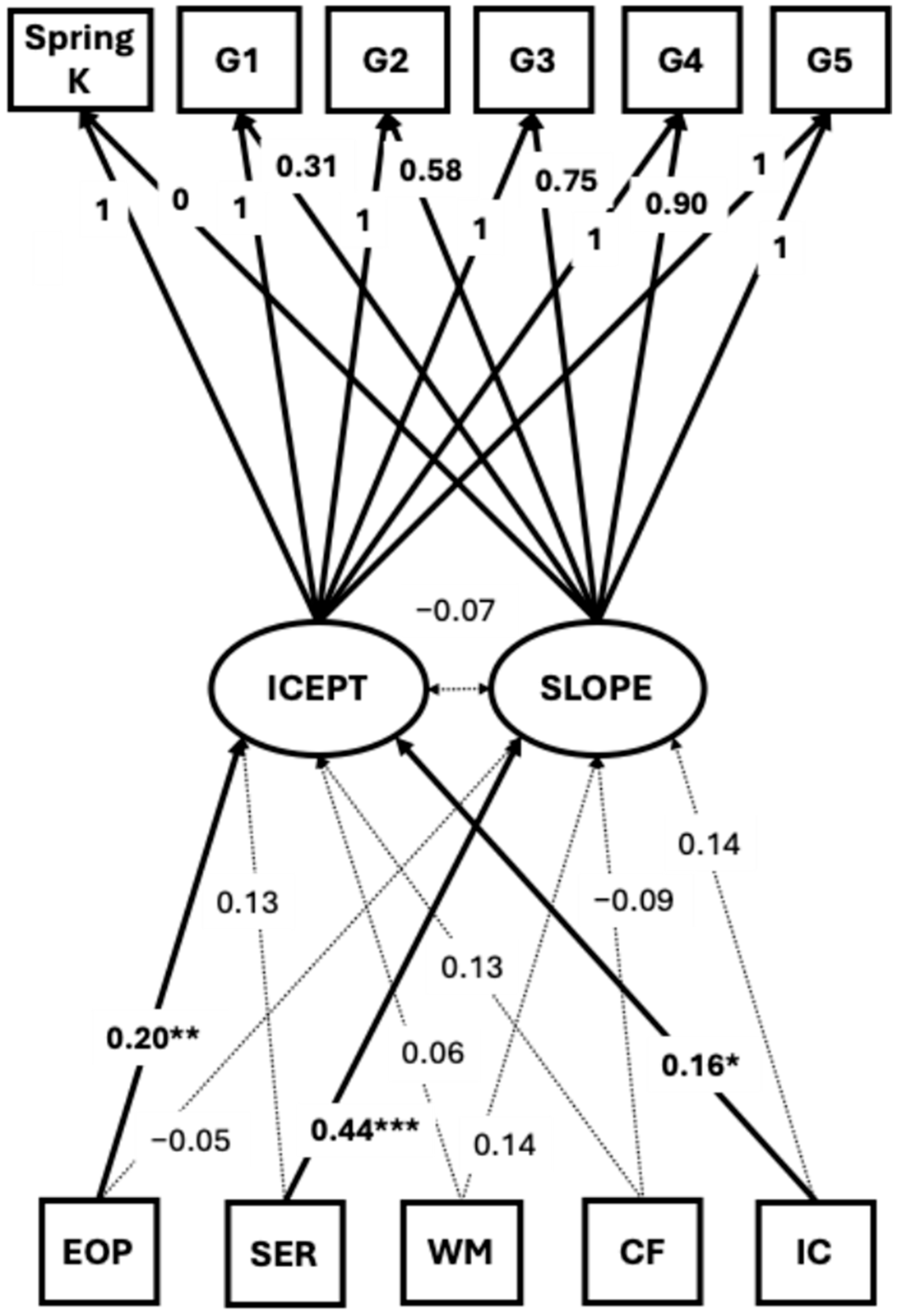
Second, we conducted two additional conditional growth curve models to (1) estimate the effects of early Spanish reading and EF (working memory, cognitive flexibility, and inhibitory control) skills on children’s initial skills and growth rate in reading achievement, and (2) investigate the interactions among early Spanish reading and EF skills. As such, Model 1 included Spanish early reading skills and EF skills (working memory, cognitive flexibility, and inhibitory control) as predictors. In Model 2, we further added the interactions among all these EF predictors and Spanish early reading skills to Model 1. In both models, English oral proficiency, age, sex, and SES were all included as control variables.
All growth curve models were constructed in Mplus 8.11 (Muthén & Muthén, 2024). Model fit of all models was evaluated using the following guidelines: the comparative fit index (CFI) should be greater than 0.90 (Hu & Bentler, 1999) and the root-mean-square error of approximation (RMSEA) should be less than 0.08 (Browne & Cudeck, 1993).

3. Results

Table 1 presents the descriptive statistics and Table 2 displays the correlational matrix of all study variables. Results showed that all reading skills were significantly correlated with each other across kindergarten through Grade 5. Spanish early reading skills and three indicators of EF skills were all significantly correlated with reading skills throughout elementary years, except that working memory was not correlated with spring kindergarten reading skills. This suggests that children having higher Spanish early reading and EF skills tended to score higher in reading. Further, in terms of control variables, English oral proficiency was significantly correlated with reading skills in the first three years; age was significantly correlated with reading skills at all grade levels except in kindergarten or Grade 3; female was significantly correlated with reading skills at all grade levels; SES was significantly correlated with Grade 4 reading.

3.1. Unconditional Growth Curve Model

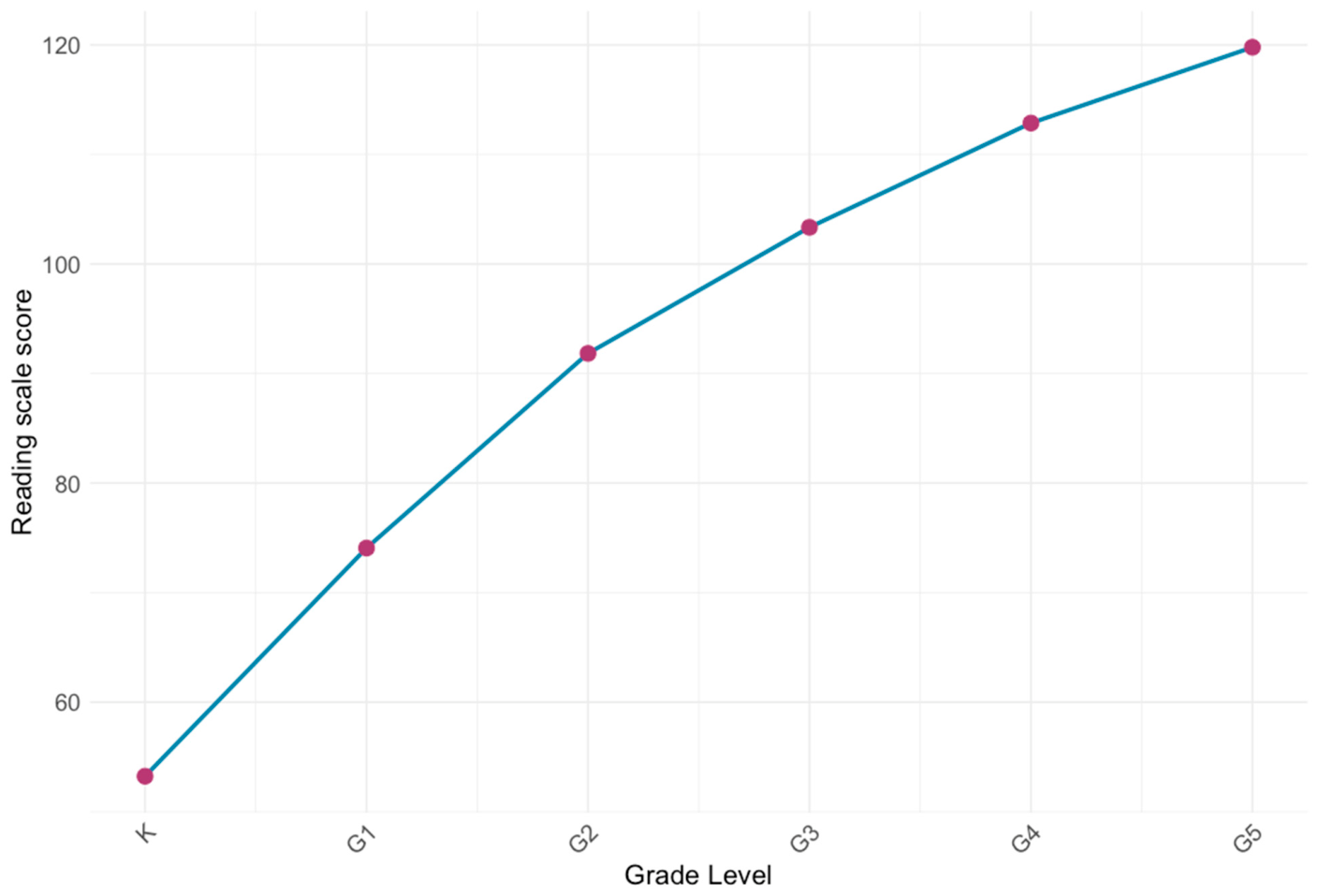
The unconditional growth curve model fits well to the data, χ2(10) = 36.543, p < 0.001, CFI = 0.977, except that the RMSEA (i.e., 0.093) is slightly higher than the standard cutoff. Although the RMSEA exceeds the conventional 0.08 threshold, this index is known to be sensitive to model degrees of freedom and can appear inflated in growth models with few time points. Given the strong comparative fit (CFI = 0.977) and the model’s theoretical plausibility, we deemed the overall fit acceptable and retained the free-slope unconditional growth curve model for subsequent interpretation. Figure 1 shows the growth trajectory of children’s reading achievement. Results from the unconditional growth curve model showed that in the fall of kindergarten, the mean scale score of reading was 53.24; over primary years, children’s average reading scale score increased significantly by 66.55 points in scale score. Using slope loadings, we estimated children’s annual growth between each year. Children grew in their reading by 20.83 points from spring of kindergarten to spring of Grade 1, 17.77 points from spring Grade 1 to Grade 2, and 11.51, 9.51, and 6.92 scale score points between each year from spring Grade 2 through spring Grade 5. This suggests that children had more accelerated growth rates in early grades and their growth decelerated in upper elementary grades. Intercept and slope were not significantly correlated (p = 0.301).

3.2. The Roles of Early Literacy and EF Skills

Model 1 (Figure 2) including predictors and control variables fits well to the data, χ2(42) = 64.750, p = 0.014, CFI = 0.984, RMSEA = 0.042. Results showed that kindergarten English oral proficiency (β = 0.20, p = 0.002) and inhibitory control (β = 0.17, p = 0.017) significantly predicted the intercept (i.e., initial skills) of English reading in kindergarten. Spanish early reading skills significantly predicted the slope (i.e., growth rate) of Spanish–English emergent bilingual children’s reading skills from kindergarten through Grade 5 (β = 0.44, p < 0.001). In terms of control variables, being female significantly predicted the intercept (β = 0.14, p = 0.042). None of the other predictors showed significant associations with reading intercept or slope.
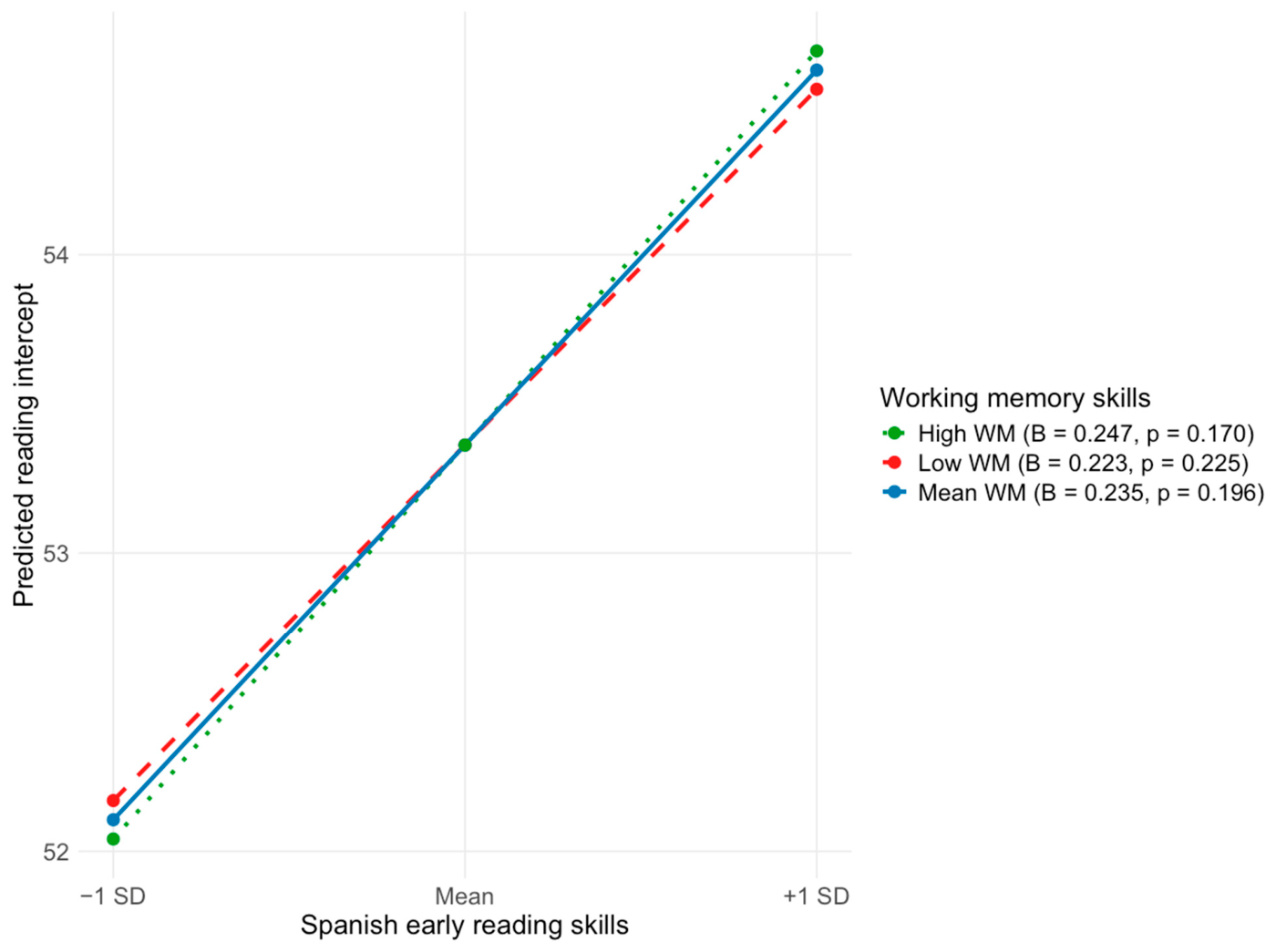
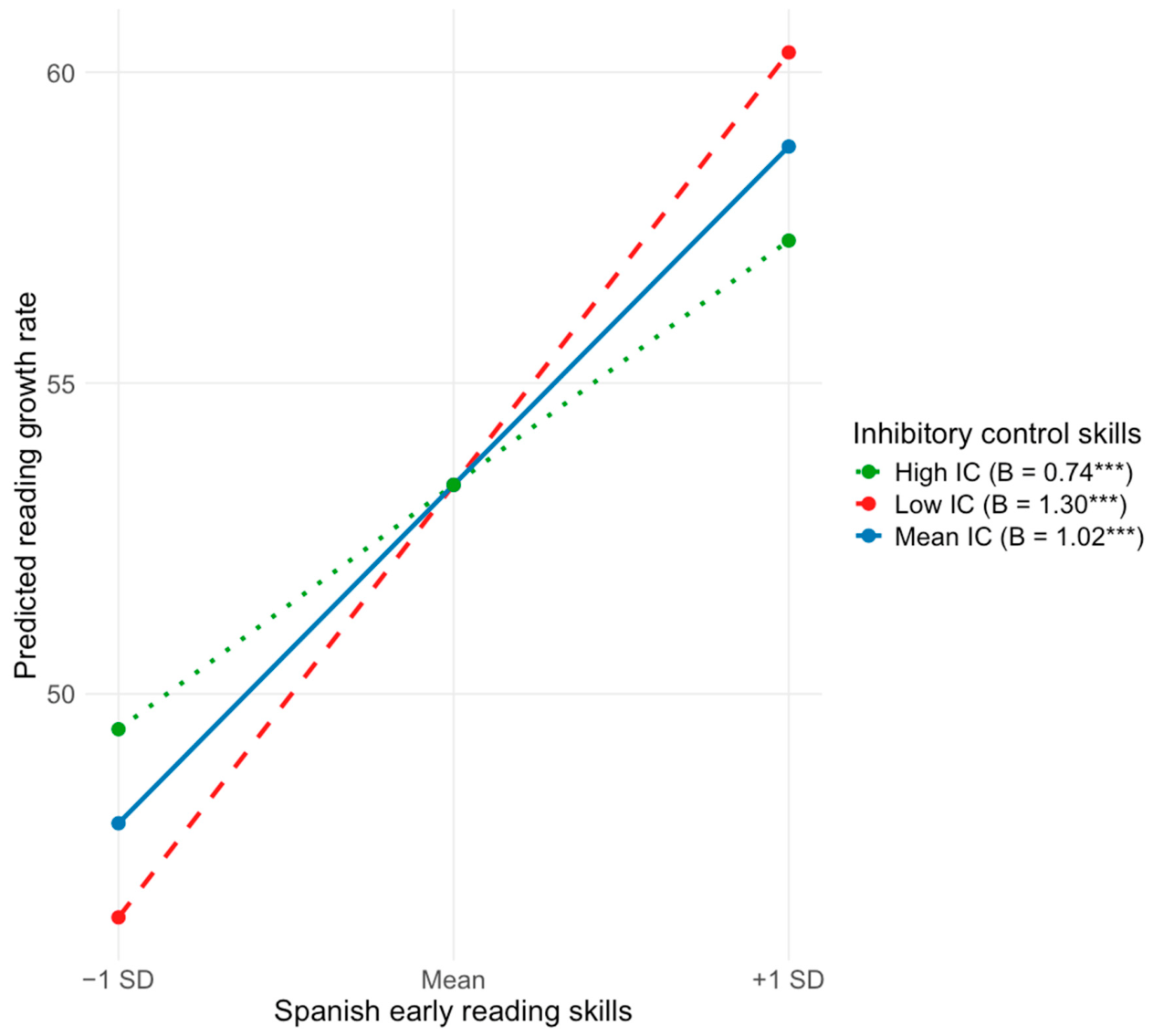
Model 2 including predictors, interactions among predictors, and control variables fits well to the data, χ2(54) = 84.091, p = 0.005, CFI = 0.979, RMSEA = 0.043. Results revealed two significant interactions. First, Spanish early reading skills interacted with working memory in the prediction of Spring kindergarten reading skills (B = 0.01, p = 0.045). Second, Spanish early reading skills interacted with inhibitory control in the prediction of the growth rate of English reading achievement (B = −0.28, p = 0.018). We further probed those interactions using simple slope analyses. The simple slope analysis for the working memory interaction revealed minimal practical differences across working memory levels (Figure 3). The effect of Spanish early reading skills on kindergarten reading skills was non-significant at all levels of initial working memory skills (low working memory skills [1 SD below the mean]: B = 0.22, p = 0.225; mean working memory skills: B = 0.24, p = 0.196; high working memory skills [1 SD above the mean]: B = 0.25, p = 0.170). The simple slope analysis of inhibitory control revealed significant conditional effects of Spanish early reading skills on reading growth slope at all levels of inhibitory control (Figure 4). When inhibitory control was low (−1 SD), the effect of Spanish early reading skills on reading growth slope was the strongest (B = 1.30, p < 0.001). At mean levels of inhibitory control, Spanish early reading skills continued to have a significant positive effect on reading growth (B = 1.02, p < 0.001). When inhibitory control was high (+1 SD), the effect of Spanish early reading skills on reading growth slope remained significant but was notably weaker (B = 0.74, p < 0.001). These results indicate that Spanish early reading skills are most predictive of reading growth among children with lower inhibitory control abilities. Children who already possess strong inhibitory control show a weaker association between their Spanish early reading skills and subsequent reading growth, a pattern that may be consistent with reduced reliance on early Spanish reading proficiency. Conversely, the stronger association among children with lower inhibitory control may suggest that foundational Spanish reading skills are particularly important for supporting their reading growth.

4. Discussion

This study examined the relations between early Spanish reading skills, EF, and English reading development among Spanish–English EB children, with particular focus on the moderating role of EF skills in the relation between early Spanish reading skills and English reading trajectories. Overall, the findings indicate that Spanish–English EB children’s English reading development followed a nonlinear growth pattern from kindergarten through Grade 5, with faster growth in the earlier grades and slower growth in the later grades. Early Spanish reading skills predicted children’s later English reading growth, while IC predicted their initial English reading skills. In addition, IC moderated the association between early Spanish reading skills and English reading growth, with early Spanish reading showing a stronger relation to later English reading growth among children with lower IC. These findings contribute to existing research on bilingual reading development by highlighting the joint roles of Spanish literacy and EF skills in shaping English reading trajectories. Findings also provide practical implications for screening and supporting this growing population of Spanish–English EB learners.

4.1. Distinct Developmental Resources for Initial English Reading and Later Growth

Our first research question focused on whether early Spanish reading skills and EF skills predicted different initial English reading and growth rate among Spanish–English EB children. Results showed that children’s initial English reading level and later English reading growth were associated with different developmental resources. Specifically, kindergarten English oral proficiency and IC predicted children’s English reading skills at kindergarten entry, whereas early Spanish reading skills predicted their English reading growth from kindergarten through Grade 5. Bilingual children’s early English reading performance appears to depend more on the skills they can use directly during English reading tasks, including their English oral language skills and their ability to regulate attention during reading-related tasks. In contrast, English reading growth across primary years appears to draw more strongly on the literacy foundation children had already developed in their home language (Spanish) before school entry.
The role of early Spanish reading skills in predicting English reading growth is consistent with cross-language transfer perspectives, which argue that literacy knowledge developed in one language can support literacy development in another language when children have opportunities to apply shared reading-related skills across languages (Cummins, 1979; Relyea & Amendum, 2020). In the present study, early Spanish reading skills did not predict children’s initial English reading level, which may mean that children’s Spanish literacy knowledge was not yet fully transferrable to support bilinguals’ English reading performance at kindergarten entry. However, as children gained more exposure to English reading instruction, Spanish reading skills, such as print knowledge and early decoding skills, may have become increasingly transferrable for English reading growth. This interpretation is aligned with prior longitudinal work showing that stronger kindergarten Spanish reading skills are linked to greater English reading growth among Spanish-speaking bilingual students (e.g., Relyea & Amendum, 2020).
By comparison, kindergarten English oral proficiency and IC predicted Spanish–English EBs’ initial English reading level. The important role of English oral proficiency in English reading found in our study is consistent with both theoretical models of reading (Hoover & Gough, 1990; Hoover & Tunmer, 2022) and empirical studies (e.g., Wagley et al., 2022). In terms of IC, it may support reading from a cognitive and regulatory dimension perspective, which is also consistent with reading models that place self-regulation and executive processes within reading development (Duke & Cartwright, 2021; Kim, 2020). However, English oral proficiency at kindergarten entry may not be sufficient to support rapid growth in English reading across primary years, which is consistent with previous studies on Spanish–English bilinguals (Mancilla-Martinez et al., 2011; Shen & Goodrich, 2024). Similarly, early IC may matter for early reading performance, but its role in long-term growth may be more complex. This distinction sets the foundation for the second research question, which examines whether EF functions as a conditional factor influencing the association between early Spanish reading skills and English reading growth among Spanish–English EBs.

4.2. EF as a Moderator in Cross-Language Transfer

We found that IC moderated the relation between early Spanish reading skills and English reading growth, suggesting that early IC may be more important as a conditional factor affecting the cross-language relation between early Spanish reading and English reading growth, instead of serving as a direct predictor of reading growth. In other words, although IC did not directly predict later English reading growth, it influenced how strongly children’s Spanish literacy foundation was associated with their English reading development over time. Because IC is closely related to attention control and the suppression of competing information, it may matter when children need to stay focused on English print while drawing on literacy knowledge developed across two languages (Diamond, 2013). In this way, IC may help explain why children with similar Spanish early reading skills may follow different English reading trajectories. Specifically, we found that the association between early Spanish reading skills and English reading growth was stronger for Spanish–English EB children with lower IC than for their peers with higher IC, which may reflect a compensatory pattern. For children with relatively lower IC, Spanish reading skills may have served as a more important resource to support cross-language transfer because it gave them an established literacy foundation that could support learning in a new instructional language. When bilingual children face challenges with attention regulation during reading tasks, stronger Spanish early reading skills may provide shared foundational literacy knowledge for engaging with English reading instruction. Comparatively, children with higher IC may be more likely to rely on their high EF skills as a cognitive resource that supports them in leveraging limited cross-language knowledge, thereby facilitating English reading development when Spanish reading skills are less well developed.
By comparison, the moderating role of WM was less clear. Although the interaction between early Spanish reading skills and WM significantly predicted the English reading intercept, the simple slope analyses were not significant at low, mean, or high levels of WM. This pattern suggests limited practical differentiation across WM levels and should therefore be interpreted cautiously. One possible explanation is that WM may become more relevant in later grades or in more comprehension-intensive reading tasks, when readers must maintain and integrate information across multiple reading processes (Butterfuss & Kendeou, 2018; Hwang et al., 2024; Shen, 2025b). Accordingly, the present findings do not provide evidence of a robust conditional role of WM in initial English reading performance.
Our findings converge with prior work (Shen, 2025c) in highlighting the joint role of cognitive and linguistic factors in bilingual reading development. However, the pattern of interaction differs. Shen found that early Spanish reading skills were especially beneficial for children with high initial WM capacity. In the present study, the Spanish-to-English reading link was stronger among children with lower IC. Shen (2025c) examined the interaction between early Spanish reading and latent class growth trajectories of WM in predicting later academic outcomes, capturing how heterogeneity in cognitive development shapes long-term English reading. In contrast, the present study directly predicts English reading growth, providing a more immediate test of cross-language transfer processes. This difference in analytic approach may partly explain the divergent interaction patterns observed, with prior findings indicating a complementary effect and the current results being consistent with a compensatory interpretation.
Theoretically, our finding refines cross-language transfer theory by showing that the extent of cross-language transfer may vary across learners with different levels of EF skills. Prior work has established that L1 literacy can support L2 reading (Cummins, 1979; Genesee et al., 2006), but the present study adds a cognitive-regulatory dimension by highlighting that transfer is not solely a function of linguistic knowledge. Instead, it depends on how well children can control their responses during English reading tasks, especially when they need to select task-relevant print or language information and filter out less relevant cues. In this way, IC helps define the conditions under which cross-language transfer may be more or less strongly associated with English reading growth. This perspective is consistent with meta-analytic evidence showing that cross-language relations vary across learner characteristics and contexts, suggesting that domain-general processes such as EF may shape the strength of Spanish-to-English reading connections (Melby-Lervåg & Lervåg, 2011).
Practically, these findings suggest that early reading instruction for Spanish–English EB children should position Spanish literacy as an active resource, particularly for children with lower IC. Teachers can make cross-language connections more explicit by drawing attention to shared print concepts, letter-sound correspondences, cognates, decoding strategies, and morphological patterns. For example, teachers may compare Spanish and English letter-sound correspondences using paired words, highlight cognates during vocabulary instruction, and explicitly demonstrate how Spanish print knowledge can be applied when decoding English words. For children who need additional support with attention regulation, these connections may be most effective when embedded within structured instructional routines, including short task steps, visual supports, guided practice, and small-group instruction. Teachers might use brief step-by-step decoding routines, bilingual word charts, or visual cues to help children maintain attention while moving from Spanish print knowledge to English reading tasks. Assessment can also be more asset-oriented by documenting children’s Spanish literacy strengths alongside their English reading performance and EF-related learning needs. Together, these approaches can support Spanish–English EB children in leveraging the literacy knowledge they already bring while providing the structure needed to more effectively engage with English reading instruction.

4.3. Limitations and Future Directions

The current study should be interpreted considering several limitations. First, this study relied on secondary data from ECLS-K:2011, which was not designed specifically to examine how executive function moderates cross-language relations between Spanish early reading skills and English reading growth. As a result, the selection, timing, and measurement of key variables were constrained by the existing dataset. In addition, ECLS-K:2011 followed children who entered kindergarten in the 2010–2011 school year, and the educational and sociolinguistic contexts for Spanish–English emergent bilingual children may have changed since then. These contextual changes may limit the direct generalization of the findings to current bilingual instructional settings. However, the present study focuses on foundational developmental associations between early linguistic and cognitive skills and later reading growth rather than on current educational policies or instructional practices. Therefore, the findings should be interpreted as evidence of associations within a specific cohort and historical context. Future research should use more recent and purposefully designed longitudinal studies to examine whether similar patterns appear in contemporary bilingual instructional settings.
Second, although the present study used longitudinal English reading data from kindergarten through Grade 5, the measurement of key predictors was concentrated at kindergarten entry. Early reading skills, executive function skills, and English oral proficiency were primarily assessed in the fall of kindergarten and were used to predict subsequent English reading trajectories. This design allowed the study to examine how early linguistic and cognitive resources were associated with later reading development, but it did not capture how these resources changed across the elementary years or how such changes were dynamically related to English reading growth. Future research should include repeated measures of Spanish literacy, English oral proficiency, and executive function to examine how growth in these skills co-develops with English reading trajectories.
Third, several measurement limitations should be noted. Inhibitory control was measured through teacher ratings, whereas working memory and cognitive flexibility were assessed through direct child assessments. Although teacher reports can provide useful information about children’s self-regulation in classroom contexts, they may also be influenced by teachers’ subjective perceptions of children’s classroom behavior, language proficiency, participation, and culturally shaped behavioral expectations. In addition, both the Spanish early reading measure and the English reading outcome were based on composite scores, which prevented the study from examining whether specific component skills, such as phonological awareness, letter recognition, print knowledge, vocabulary, or decoding, played different roles in English reading growth. Future studies should use multiple measures of inhibitory control and more targeted assessments of specific literacy skills to better clarify the cognitive and literacy processes underlying bilingual reading development.
Fourth, the study had limited information about children’s bilingual, family, and ecological experiences. Spanish–English emergent bilingual children were treated as a relatively homogeneous group, although they may differ substantially in Spanish exposure, English exposure, home language use, code-switching experience, age of English exposure, and opportunities to develop literacy in both languages. In addition, although family socioeconomic status was included as a control variable, the SES composite score may not fully capture meaningful variation in children’s home and community learning environments, such as parents’ English proficiency, availability of English and Spanish books at home, family literacy practices, access to libraries, and opportunities for language-rich interactions. Future research should include more detailed measures of bilingual language experience, home literacy resources, classroom language practices, and instructional contexts to better understand how children’s linguistic and ecological environments shape cross-language transfer and English reading development.
Finally, the moderation findings should be interpreted with caution. The finding that Spanish early reading skills were more strongly associated with English reading growth among children with lower inhibitory control may reflect a compensatory pattern, but the present study could not directly test the mechanisms underlying this association. In addition, although the sample was drawn from a large-scale national dataset, the final analytic sample was relatively modest for testing interaction effects, and moderation effects may be sensitive to sample size. Missing data and potential attrition across longitudinal waves may also have influenced estimates of reading growth, even though full information maximum likelihood was used to handle missing data. Future research should replicate these findings in larger samples and examine potential mediating pathways, such as decoding, vocabulary learning, attention regulation, classroom engagement, or reading motivation, to clarify how inhibitory control shapes the role of Spanish literacy in English reading development.

5. Conclusions

The present study contributes to research on Spanish–English EB children by showing how early Spanish literacy and EF are connected to English reading development across the elementary years. By following English reading trajectories from kindergarten through Grade 5, we found that children’s initial English reading performance and later reading growth were associated with different developmental resources. IC was related to initial English reading performance, while Spanish early reading skills were related to growth in English reading over time. We also revealed that IC altered the strength of cross-language transfer, with Spanish early reading skills showing the strongest association with English reading growth among children with lower IC, a pattern that is consistent with a compensatory interpretation. This pattern points to the importance of viewing Spanish literacy as a meaningful resource in bilingual children’s reading development, especially for students who experience greater demands in regulating attention during English reading tasks. Our study also underscores the value of considering both linguistic and cognitive-regulatory skills when identifying and supporting Spanish–English EB children’s long-term reading development.

Author Contributions

Conceptualization, Y.S.; Methodology, Y.S.; Formal analysis, Y.S.; Writing—original draft, Z.Z., L.Y. and Y.S.; Writing—review & editing, Z.Z., L.Y. and Y.S.; Supervision, Y.S.; Project administration, Z.Z. All authors have read and agreed to the published version of the manuscript.

Funding

This research received no external funding.

Institutional Review Board Statement

Not applicable.

Informed Consent Statement

Not applicable.

Data Availability Statement

The original data presented in the study are from the Early Childhood Longitudinal Study, Kindergarten Class of 2010–2011 (ECLS-K:2011), which is openly available in National Center for Education Statistics (NCES) at https://nces.ed.gov/ecls/kindergarten2011.asp (accessed on 9 June 2026).

Acknowledgments

During the preparation of this manuscript, the authors used ChatGPT (GPT-5.3 Instant, OpenAI) for language refinement and grammar checking. The authors have written, reviewed, and edited the manuscript, and take full responsibility for the content of this publication.

Conflicts of Interest

The authors declare no conflicts of interest.

Abbreviations

The following abbreviations are used in this manuscript:
EBEmergent Bilingual
EFExecutive Function
WMWorking Memory
ICInhibitory Control
CFCognitive Flexibility
ECLS-K:2011Early Childhood Longitudinal Study, Kindergarten Class of 2010–2011
NCESNational Center for Education Statistics
L1First Language
L2Second Language
SESSocioeconomic Status
FIMLFull Information Maximum Likelihood

References

  1. Abedi, J. (2002). Standardized achievement tests and English language learners: Psychometrics issues. Educational Assessment, 8(3), 231–257. [Google Scholar] [CrossRef] [PubMed]
  2. Alfonso, S. V., & Lonigan, C. J. (2021). Executive function, language dominance and literacy skills in Spanish-speaking language-minority children: A longitudinal study. Early Childhood Research Quarterly, 57, 228–238. [Google Scholar] [CrossRef] [PubMed]
  3. Allan, N. P., Hume, L. E., Allan, D. M., Farrington, A. L., & Lonigan, C. J. (2014). Relations between inhibitory control and the development of academic skills in preschool and kindergarten: A meta-analysis. Developmental Psychology, 50(10), 2368–2379. [Google Scholar] [CrossRef] [PubMed]
  4. Bernhardt, E. B., & Kamil, M. L. (1995). Interpreting relationships between L1 and L2 reading: Consolidating the linguistic threshold and the linguistic interdependence hypotheses. Applied Linguistics, 16(1), 15–34. [Google Scholar] [CrossRef]
  5. Browne, M. W., & Cudeck, R. (1993). Alternative ways of assessing model fit. In K. A. Bollen, & J. S. Long (Eds.), Testing structural equation models (pp. 136–162). Sage Publications. [Google Scholar]
  6. Butterfuss, R., & Kendeou, P. (2018). The role of executive functions in reading comprehension. Educational Psychology Review, 30(3), 801–826. [Google Scholar] [CrossRef]
  7. Chen, P., Bobb, S. C., Hoshino, N., & Marian, V. (2017). Neural signatures of language co-activation and control in bilingual spoken word comprehension. Brain Research, 1665, 50–64. [Google Scholar] [CrossRef] [PubMed]
  8. Chen, X., Ramirez, G., Luo, Y. C., Geva, E., & Ku, Y.-M. (2012). Comparing vocabulary development in Spanish- and Chinese-speaking ELLs: The effects of metalinguistic and sociocultural factors. Reading and Writing, 25(8), 1991–2020. [Google Scholar] [CrossRef]
  9. Chung, S. C., Chen, X., & Geva, E. (2019). Deconstructing and reconstructing cross-language transfer in bilingual reading development: An interactive framework. Journal of Neurolinguistics, 50, 149–161. [Google Scholar] [CrossRef]
  10. Cummins, J. (1979). Linguistic interdependence and the educational development of bilingual children. Review of Educational Research, 49(2), 222–251. [Google Scholar] [CrossRef]
  11. Diamond, A. (2013). Executive functions. Annual Review of Psychology, 64(1), 135–168. [Google Scholar] [CrossRef] [PubMed]
  12. Duke, N. K., & Cartwright, K. B. (2021). The science of reading progresses: Communicating advances beyond the simple view of reading. Reading Research Quarterly, 56(S1), S25–S44. [Google Scholar] [CrossRef]
  13. Duncan, S. E., & De Avila, E. A. (1998). Pre-school language assessment scale (Pre-LAS 2000–English). CTB/McGraw-Hill. [Google Scholar]
  14. Duncan, T. E., Duncan, S. C., & Strycker, L. A. (2013). An introduction to latent variable growth curve modeling: Concepts, issues, and applications (2nd ed.). Routledge. [Google Scholar] [CrossRef]
  15. Farnia, F., & Geva, E. (2013). Growth and predictors of change in English language learners’ reading comprehension. Journal of Research in Reading, 36(4), 389–421. [Google Scholar] [CrossRef]
  16. Follmer, D. J. (2018). Executive function and reading comprehension: A meta-analytic review. Educational Psychologist, 53(1), 42–60. [Google Scholar] [CrossRef]
  17. Friedman, N. P., & Miyake, A. (2017). Unity and diversity of executive functions: Individual differences as a window on cognitive structure. Cortex, 86, 186–204. [Google Scholar] [CrossRef] [PubMed]
  18. Genesee, F., Geva, E., Dressler, C., & Kamil, M. (2006). Synthesis: Cross-linguistic relationships. In Developing literacy in second-language learners: Report of the national literacy panel on language-minority children and youth. Lawrence Erlbaum Associates. Available online: https://www.researchgate.net/publication/292697786_Synthesis_Cross-linguistic_relationships (accessed on 9 June 2026).
  19. Geva, E., & Ryan, E. B. (1993). Linguistic and cognitive correlates of academic skills in first and second languages. Language Learning, 43(1), 5–42. [Google Scholar] [CrossRef]
  20. Giguere, D., Tulloch, M. K., Core, C., & Hoff, E. (2024). Early skills that predict English reading ability: A longitudinal study of bilingual children from 5 to 10 years. Journal of Experimental Child Psychology, 246, 105993. [Google Scholar] [CrossRef] [PubMed]
  21. Goodrich, J. M., Lonigan, C. J., & Farver, J. M. (2013). Do early literacy skills in children’s first language promote development of skills in their second language? An experimental evaluation of transfer. Journal of Educational Psychology, 105(2), 414–426. [Google Scholar] [CrossRef] [PubMed]
  22. Green, D. W., & Abutalebi, J. (2013). Language control in bilinguals: The adaptive control hypothesis. Journal of Cognitive Psychology, 25(5), 515–530. [Google Scholar] [CrossRef] [PubMed]
  23. Hoover, W. A., & Gough, P. B. (1990). The simple view of reading. Reading and Writing, 2(2), 127–160. [Google Scholar] [CrossRef]
  24. Hoover, W. A., & Tunmer, W. E. (2022). The primacy of science in communicating advances in the science of reading. Reading Research Quarterly, 57(2), 399–408. [Google Scholar] [CrossRef]
  25. Hu, L., & Bentler, P. M. (1999). Cutoff criteria for fit indexes in covariance structure analysis: Conventional criteria versus new alternatives. Structural Equation Modeling: A Multidisciplinary Journal, 6(1), 1–55. [Google Scholar] [CrossRef]
  26. Hwang, H., Choi, S., Guha, M., McMaster, K., Harsch, R., & Kendeou, P. (2024). Indirect and direct contributions of executive functions to reading comprehension. Journal of Experimental Child Psychology, 243, 105925. [Google Scholar] [CrossRef] [PubMed]
  27. Incera, S., Martín, I. E., & Suárez-Coalla, P. (2025). The effects of attentional control and educational experience on reading ability in bilingual children. Revista de Logopedia, Foniatría y Audiología, 45(3), 100525. [Google Scholar] [CrossRef]
  28. Irwin, V., Wang, K., Jung, J., Kessler, E., Tezil, T., Alhassani, S., Filbey, A., Dilig, R., Mann, F. B., Barnett, M., Purcell, S., & Nachazel, T. (2024). Report on the condition of education 2024 (NCES 2024-144). U.S. Department of Education, National Center for Education Statistics. Available online: https://nces.ed.gov/pubsearch/pubsinfo.asp?pubid=2024144 (accessed on 9 June 2026).
  29. Jacob, R., & Parkinson, J. (2015). The potential for school-based interventions that target executive function to improve academic achievement: A review. Review of Educational Research, 85(4), 512–552. [Google Scholar] [CrossRef]
  30. Kaushanskaya, M., & Crespo, K. (2019). Does exposure to code-switching influence language performance in bilingual children? Child Development, 90(3), 708–718. [Google Scholar] [CrossRef] [PubMed]
  31. Kieffer, M. J., Mancilla-Martinez, J., & Logan, J. K. (2021). Executive functions and English reading comprehension growth in Spanish–English bilingual adolescents. Journal of Applied Developmental Psychology, 73, 101238. [Google Scholar] [CrossRef]
  32. Kilim, L., & Prior, A. (2025). Contribution of executive functions to reading comprehension in bilingual and monolingual 3rd grade children. Journal of Experimental Child Psychology, 260, 106333. [Google Scholar] [CrossRef] [PubMed]
  33. Kim, Y.-S. G. (2017). Why the simple view of reading is not simplistic: Unpacking component skills of reading using a direct and indirect effect model of reading (DIER). Scientific Studies of Reading, 21(4), 310–333. [Google Scholar] [CrossRef]
  34. Kim, Y.-S. G. (2020). Toward integrative reading science: The direct and indirect effects model of reading. Journal of Learning Disabilities, 53(6), 469–491. [Google Scholar] [CrossRef] [PubMed]
  35. Kim, Y.-S. G. (2023). Executive functions and morphological awareness explain the shared variance between word reading and listening comprehension. Scientific Studies of Reading, 27(5), 451–474. [Google Scholar] [CrossRef] [PubMed]
  36. Language and Reading Research Consortium (LARRC), Mesa, C., & Yeomans-Maldonado, G. (2021). English and Spanish predictors of grade 3 reading comprehension in bilingual children. Journal of Speech, Language, and Hearing Research, 64(3), 1–20. [Google Scholar] [CrossRef] [PubMed]
  37. Lee, J. (2010). Tripartite growth trajectories of reading and math achievement: Tracking national academic progress at primary, middle, and high school levels. American Educational Research Journal, 47(4), 800–832. [Google Scholar] [CrossRef]
  38. Lee Swanson, H., Orosco, M. J., & Lussier, C. M. (2015). Growth in literacy, cognition, and working memory in English language learners. Journal of Experimental Child Psychology, 132, 155–188. [Google Scholar] [CrossRef] [PubMed]
  39. Linck, J. A., Schwieter, J. W., & Sunderman, G. (2020). The differential role of executive functions in the cognitive control of language switching. Languages, 5(2), 19. [Google Scholar] [CrossRef]
  40. Mancilla-Martinez, J., Kieffer, M. J., Biancarosa, G., Christodoulou, J. A., & Snow, C. E. (2011). Investigating English reading comprehension growth in adolescent language minority learners: Some insights from the simple view. Reading and Writing, 24(3), 339–354. [Google Scholar] [CrossRef]
  41. Melby-Lervåg, M., & Lervåg, A. (2011). Cross-linguistic transfer of oral language, decoding, phonological awareness and reading comprehension: A meta-analysis of the correlational evidence. Journal of Research in Reading, 34(1), 114–135. [Google Scholar] [CrossRef]
  42. Miyake, A., Friedman, N. P., Emerson, M. J., Witzki, A. H., Howerter, A., & Wager, T. D. (2000). The unity and diversity of executive functions and their contributions to complex “frontal lobe” tasks: A latent variable analysis. Cognitive Psychology, 41(1), 49–100. [Google Scholar] [CrossRef] [PubMed]
  43. Muthén, L. K., & Muthén, B. O. (2024). Mplus (Version 8.11) [Computer software]. Muthén & Muthén. [Google Scholar]
  44. National Center for Education Statistics (NCES). (2024). English learners in public schools [The Condition of Education 2024]. U.S. Department of Education, Institute of Education Sciences. Available online: https://nces.ed.gov/programs/coe/indicator/cgf (accessed on 9 June 2026).
  45. Nugiel, T., Mitchell, M. E., Demeter, D. V., Garza, A., Cirino, P. T., Hernandez, A. E., Juranek, J., & Church, J. A. (2023). Brain engagement during a cognitive flexibility task relates to academic performance in English learners. Mind, Brain, and Education, 17(2), 149–160. [Google Scholar] [CrossRef] [PubMed]
  46. Ober, T. M., Brooks, P. J., Homer, B. D., & Rindskopf, D. (2020). Executive functions and decoding in children and adolescents: A meta-analytic investigation. Educational Psychology Review, 32(3), 735–763. [Google Scholar] [CrossRef]
  47. Peng, P., Barnes, M., Wang, C., Wang, W., Li, S., Swanson, H. L., Dardick, W., & Tao, S. (2018). A meta-analysis on the relation between reading and working memory. Psychological Bulletin, 144(1), 48–76. [Google Scholar] [CrossRef] [PubMed]
  48. Proctor, C. P., August, D., Carlo, M. S., & Snow, C. (2006). The intriguing role of Spanish language vocabulary knowledge in predicting English reading comprehension. Journal of Educational Psychology, 98(1), 159–169. [Google Scholar] [CrossRef]
  49. Proctor, C. P., August, D., Snow, C., & Barr, C. D. (2010). The interdependence continuum: A perspective on the nature of Spanish–English bilingual reading comprehension. Bilingual Research Journal, 33(1), 5–20. [Google Scholar] [CrossRef]
  50. Putnam, S. P., & Rothbart, M. K. (2006). Development of short and very short forms of the children’s behavior questionnaire. Journal of Personality Assessment, 87(1), 102–112. [Google Scholar] [CrossRef] [PubMed]
  51. Relyea, J. E. (2025). Unpacking heterogeneity: Executive function and reading development in U.S. multilingual children from kindergarten to third grade. Learning and Individual Differences, 120, 102690. [Google Scholar] [CrossRef]
  52. Relyea, J. E., & Amendum, S. J. (2020). English reading growth in Spanish-speaking bilingual students: Moderating effect of English proficiency on cross-linguistic influence. Child Development, 91(4), 1150–1165. [Google Scholar] [CrossRef] [PubMed]
  53. Relyea, J. E., Cho, E., & Zagata, E. (2023). First-grade multilingual students’ executive function profiles and links to English reading achievement and difficulties: A person-centered latent profile analysis. Annals of Dyslexia, 73(1), 29–52. [Google Scholar] [CrossRef] [PubMed]
  54. Shen, Y. (2025a). Early literacy and executive function profiles in Spanish–English emergent bilinguals. Learning and Individual Differences, 123, 102775. [Google Scholar] [CrossRef]
  55. Shen, Y. (2025b). Relative importance of early literacy and executive function skills on Spanish–English emergent bilinguals’ English reading achievement across primary years. Journal of Educational Psychology, 117(5), 701–716. [Google Scholar] [CrossRef]
  56. Shen, Y. (2025c). Working memory growth and early Spanish reading interact to shape reading and math gains for Spanish–English emergent bilinguals. Contemporary Educational Psychology, 81, 102366. [Google Scholar] [CrossRef]
  57. Shen, Y., & Goodrich, J. M. (2024). Cross-linguistic influence of early Spanish reading on English reading trajectories among Spanish–English emergent bilinguals: A latent class growth analysis. Journal of Educational Psychology, 116(1), 139–152. [Google Scholar] [CrossRef]
  58. Shen, Y., & Wang, R. (2024). Different roles of family socioeconomic status in academic trajectories between emergent bilinguals and their peers across primary years. Journal of Educational Psychology, 116(7), 1250–1266. [Google Scholar] [CrossRef]
  59. Spencer, M., Richmond, M. C., & Cutting, L. E. (2020). Considering the role of executive function in reading comprehension: A structural equation modeling approach. Scientific Studies of Reading, 24(3), 179–199. [Google Scholar] [CrossRef] [PubMed]
  60. Spiegel, J. A., Goodrich, J. M., Morris, B. M., Osborne, C. M., & Lonigan, C. J. (2021). Relations between executive functions and academic outcomes in elementary school children: A meta-analysis. Psychological Bulletin, 147(4), 329–351. [Google Scholar] [CrossRef] [PubMed]
  61. Swanson, H. L., Orosco, M. J., & Kudo, M. (2017). Does growth in the executive system of working memory underlie growth in literacy for bilingual children with and without reading disabilities? Journal of Learning Disabilities, 50(4), 386–407. [Google Scholar] [CrossRef] [PubMed]
  62. Taboada Barber, A., Cartwright, K. B., Hancock, G. R., & Klauda, S. L. (2021). Beyond the simple view of reading: The role of executive functions in emergent bilinguals’ and English monolinguals’ reading comprehension. Reading Research Quarterly, 56(S1), S45–S64. [Google Scholar] [CrossRef]
  63. Tourangeau, K., Nord, C., Lê, T., Sorongon, A. G., Hagedorn, M. C., Daly, P., & Najarian, M. (2015). Early childhood longitudinal study, Kindergarten class of 2010–11 (ECLS-K:2011): User’s manual for the ECLS-K:2011 kindergarten data file and electronic codebook, public version (NCES 2015-074). National Center for Education Statistics. Available online: https://files.eric.ed.gov/fulltext/ED566378.pdf (accessed on 9 June 2026).
  64. Tourangeau, K., Nord, C., Lê, T., Wallner-Allen, K., Vaden-Kiernan, N., Blaker, L., & Najarian, M. (2019). Early childhood longitudinal study, Kindergarten class of 2010–11 (ECLS-K:2011): User’s manual for the ECLS-K:2011 kindergarten–fifth grade data file and electronic codebook, public version (NCES 2019-051). National Center for Education Statistics. [Google Scholar]
  65. Wagley, N., Marks, R. A., Bedore, L. M., & Kovelman, I. (2022). Contributions of bilingual home environment and language proficiency on children’s Spanish–English reading outcomes. Child Development, 93(4), 881–899. [Google Scholar] [CrossRef] [PubMed]
  66. Weaver, A., & Kieffer, M. J. (2022). Exploring the English language comprehension, reading fluency, and executive functions of Spanish–English bilingual adolescents with reading difficulties. Reading & Writing Quarterly, 38(3), 233–252. [Google Scholar] [CrossRef]
  67. Wei, T., Liu, X., & Barnard-Brak, L. (2015). Gender differences in mathematics and reading trajectories among children from kindergarten to eighth grade. Research in Education, 93(1), 77–89. [Google Scholar] [CrossRef]
  68. Welsh, J. A., Nix, R. L., Blair, C., Bierman, K. L., & Nelson, K. E. (2010). The development of cognitive skills and gains in academic school readiness for children from low-income families. Journal of Educational Psychology, 102(1), 43–53. [Google Scholar] [CrossRef] [PubMed]
  69. Woodcock, R. W., McGrew, K. S., & Mather, N. (2001). Woodcock-Johnson III tests of achievement. Riverside Publishing. [Google Scholar]
  70. Yeniad, N., Malda, M., Mesman, J., Van IJzendoorn, M. H., & Pieper, S. (2013). Shifting ability predicts math and reading performance in children: A meta-analytical study. Learning and Individual Differences, 23, 1–9. [Google Scholar] [CrossRef]
  71. Zelazo, P. D. (2006). The dimensional change card sort (DCCS): A method of assessing executive function in children. Nature Protocols, 1(1), 297–301. [Google Scholar] [CrossRef] [PubMed]
Figure 1. Reading Growth Trajectory. Note. K = kindergarten; G = Grade.
Education 16 01243 g001
Figure 2. Conditional Growth Curve Model (Model 1). Note. K = kindergarten, G = grade, ICEPT = intercept, EOP = English oral proficiency, SER = Spanish early reading skills, WM = working memory, CF = cognitive flexibility, IC = inhibitory control. Single-headed arrows indicate regression paths or factor loadings, whereas double-headed arrows indicate covariances among latent factors or predictors. * p < 0.05, ** p < 0.01, *** p < 0.001. Coefficients from the predictors are standardized coefficients.
Education 16 01243 g002
Figure 3. Interaction Plot Between Spanish Early Reading Skills and Working Memory. Note. WM = working memory, SD = standard deviation.
Education 16 01243 g003
Figure 4. Interaction Plot Between Spanish Early Reading Skills and Inhibitory Control. Note. IC = inhibitory control, SD = standard deviation. *** p < 0.001.
Education 16 01243 g004
Table 1. Descriptive Statistics.
VariableMinimumMaximumMissingness %MeanSD
K reading32.5886.152.27%53.3610.47
G1 reading32.77114.326.82%74.0715.25
G2 reading45.91137.809.09%91.9016.22
G3 reading65.55144.2311.36%103.5915.53
G4 reading76.62149.0713.64%113.7615.43
G5 reading73.63157.3514.29%120.4616.02
Spanish early reading skills2.8329.120.00%12.805.35
Working memory393.00494.000.32%401.0419.14
Cognitive flexibility0.0018.000.32%11.084.48
Inhibitory control1.007.0010.71%4.651.32
English oral proficiency0.0011.000.00%4.693.31
Age57.5781.930.65%66.144.27
Female0.001.000.65%0.510.50
SES−2.330.4013.64%−1.080.38
Table 2. Correlational Matrix.
1234567891011121314
1. K reading1
2. G1 reading0.64 ***1
3. G2 reading0.59 ***0.83 ***1
4. G3 reading0.53 ***0.72 ***0.85 ***1
5. G4 reading0.54 ***0.74 ***0.82 ***0.84 ***1
6. G5 reading0.49 ***0.70 ***0.78 ***0.83 ***0.84 ***1
7. Spanish early reading skills0.22 **0.43 ***0.44 ***0.44 ***0.46 ***0.51 ***1
8. Working memory0.140.29 ***0.31 ***0.33 ***0.30 ***0.36 ***0.50 ***1
9. Cognitive flexibility0.21 **0.28 ***0.25 ***0.19 **0.22 ***0.20 ***0.31 ***0.21 ***1
10. Inhibitory control0.24 ***0.30 ***0.33 ***0.33 ***0.32 ***0.30 ***0.24 ***0.15 *0.26 ***1
11. English oral proficiency0.20 **0.16 *0.16 *0.110.110.100.07−0.020.090.061
12. Age0.110.15 ***0.20 **0.110.13 *0.14 *0.39 ***0.23 ***0.25 ***0.110.111
13. Female0.20 **0.22 ***0.24 ***0.23 ***0.21 **0.22 ***0.24 ***0.060.14 *0.27 ***0.030.091
14. SES0.090.120.100.080.12 *0.130.14 *0.14 *0.050.040.00−0.030.011
Note. * p < 0.05, ** p < 0.01, *** p < 0.001.
Disclaimer/Publisher’s Note: The statements, opinions and data contained in all publications are solely those of the individual author(s) and contributor(s) and not of MDPI and/or the editor(s). MDPI and/or the editor(s) disclaim responsibility for any injury to people or property resulting from any ideas, methods, instructions or products referred to in the content.