1. Introduction
Amidst international discussions about teacher shortages and the persistent challenges of retaining quality educators, there is also recognition of the complex mix of demographic realities (
Marín Blanco et al., 2023). With the sustainability of Australia’s teaching workforce under growing scrutiny, factors underpinning teacher attrition and turnover warrant closer examination (
Rahimi & Arnold, 2025). Additionally, when staffing schools, principals prefer more experienced and “good fit” candidates because they are more likely to take up leadership positions in the future (
Blackmore et al., 2024). For Australian regional, rural, and remote schools (RRR), staffing shortages and challenges are amplified. In RRR contexts, there is a call for situating
Place as the centre of teaching and learning practices, staffing policies, and structural choices (
Iorio & Hamm, 2025;
Thiele et al., 2023).
School principals are required to be strategic thinkers, effective communicators, and instructional leaders who can create positive learning environments, support teacher professional growth, and balance the expectations of their communities. This is all while managing the ever-present demand of building and sustaining a teacher pipeline (
Blackmore et al., 2024;
Lee & Mao, 2023). Yet, beneath the tangible and visible managing and functioning of schools lies an equally significant set of relational qualities that are central to school leadership work (
Lasater & Pijanowski, 2025). Leadership is more than what happens in a school setting (
Iorio & Hamm, 2025)—it is the relational, place-conscious, and dispositional work that contemporary leaders do to shape whether a teacher pipeline becomes a sustainable reality or remains an aspiration.
School leadership demands competencies in managing the affective demands of the job and establishing school environments that are guided by an ethos of relational care and compassion for others (
Lasater & Pijanowski, 2025). Additionally,
Lasater and Pijanowski (
2025) note that current and aspiring school leaders are rarely provided with the types of learning experiences needed to practice and refine these intra- and interpersonal skills, nor are they provided with explicit learning opportunities to build their emotional competencies, nourish their personal well-being, and reorient them toward the humanistic aspects of schooling. The apprenticeship model of the past—learning through observation, experience, and mentorship—is important, but not sufficient in preparing school leaders for educational contexts today, particularly Australian RRR school contexts.
Leading schools requires a diverse range of varying types of knowledge, training, and professional experiences (
Casey, 2022). Cultivating caring, compassionate relationships in schools is neither easy nor intuitive (
Lasater & Pijanowski, 2025), but there appears to be an expectation that contemporary school leaders will somehow come by these qualities through hope and incidental acquisition. Understanding what leadership intentionality and visioning look like, sound like, and feel like is an educational imperative. Visioning is viewed as an essential discipline of strategic thinking and defines a future that is meaningful and causes substantial positive change (
Watkins et al., 2019, p. 88).
If caring, compassionate relationships must be deliberately cultivated in school leaders rather than assumed, and if visioning is itself a discipline requiring intentional development, then what school leaders need is not simply a vision for the future, but a structured practice of becoming—one that this paper terms Visioning Forward. Visioning Forward is a mode of collective sense-making in which participants cultivate their capacity to perceive emergent futures—not by projecting current assumptions forward, but by developing the quality of attention needed to recognise what is becoming possible, necessary, or at risk before it is fully realised. It is less a plan than a practice, less about destination than about noticing context, and in the context of RRR Australia, this involves enveloping the sense of place consciousness.
This paper reports on a group of Australian RRR school leaders’ (principals and deputy principals) dispositional strengths and innovative actions as they negotiate the current workforce landscape despite the deficit discourse too commonly associated with RRR schooling (
Guenther et al., 2023). We investigate the actions and dispositions of school leaders as they navigate the multifaceted dimensions of leading schools in RRR contexts from two overarching research questions. Firstly, what leadership skills would you like to develop to expand and consolidate the teacher supply pipeline in your region? And secondly, how can school principals’ and deputy principals’ leadership skills be developed to encourage future teachers to be employed in the region? The data analysis reveals that school principals and deputy principals adopt intentional leadership dispositions and employ targeted actions to expand and consolidate the teacher supply pipeline in their region. Secondly, it illustrates how these approaches—grounded in intentionality, place consciousness, trust, and peer-supported collaboration—reflect a fundamental shift away from centralised recruitment orthodoxies and toward relationship-driven, contextually responsive recruitment.
The findings are not prescriptive, nor do they claim to offer universal solutions to staffing Australian (or international) RRR schools. Rather, they foreground how intentional leadership skill development, situated within the specific contexts, contributes to navigating a multidimensional strategy for attracting and retaining quality teachers to RRR Australian schools.
3. Findings
Analysis of school leaders’ responses to the research questions revealed five interconnected themes. The findings centre on Visioning Forward, whereby strategic networking, place-based advocacy, and managing cognitive complexity reflect a collective desire to transition from mechanistic administrative processing to relationship-oriented leadership. Specifically, this leadership is founded on trust, reciprocity, and a deep emotional connection to community. Each of the five themes is presented below with representative participant data.
3.1. Visioning Forward—Relational and Knowing Schools as Organisations
Proactively co-constructing a future-oriented problem-solving approach to recruitment was evident across all the school leaders’ responses. There was a common view that structural, anticipatory decisions and practices treated recruitment as a long-term strategy founded on relationality and relationships. Additionally, this was a dimension that a centralised system was not able to manage, detect, or achieve in the time required. Consistent with Complexity Theory, this reflects recruitment processes in which elements of the system interact and can trigger unexpected and unpredictable events. In other words, a centralized system that is designed for discrete and linear tasks does not account for the human interconnectedness of these highly complex social systems (
Uhl-Bien, 2021).
We’re telling them (centralised HR) to make them the offer and three days later, they might get around to it. And guess what, they’ve been snapped up elsewhere… so it is a huge bugbear of mine.
(Participant G)
Consequently, school leaders proactively employed different practices to overcome these barriers. Two such strategies are to (1) deliberately overstaff to buffer against ongoing attrition, and (2) prioritising experienced or early career teachers who had approached principals directly. These strategies were perceived by leaders as more responsive to their specific contextual needs than formal recruitment processes alone.
Organisational knowledge is an active and ongoing set of practices. These practices are not fixed understandings but dynamic and attended to in an ongoing manner. School leaders communicated the value of having someone that has a passion for the region and understands HR and schools (Participant A). This is because:
I don’t have the capability to phone up TRACER (Teacher Relief and Contract Employment Register) and I need a contract teacher for two weeks. It just doesn’t happen. I have to replace internally. I’m also a firm believer in making sure that it’s got to be somebody who still knows how the school operates. And the best way to do that is not having them sit outside of a school, they need to see what it’s like to be a classroom teacher with your five lessons and then have to supervise, pre service teacher on top of that, and have yard duty and have bus duty and have extra curriculum, as well as have a family outside of work, hopefully.
(Participant F)
These school leaders demonstrate that organisational knowledge in RRR school contexts is fundamentally relational and not held within the systems or structures, but in the observations, conversations and artefacts encountered when working alongside people. It is this quality of knowing that school leaders identified as irreplaceable in those who support them.
Consistent with the Australian Professional Standard for Principals (
AITSL, 2014), the school leaders identified a need to continuously improve their networking and influencing skills. This involves moving beyond local school leadership to build intentional partnerships with metropolitan schools, universities, and regional peers—brokering relationships that facilitate a steady and sustained flow of teachers into RRR communities. Most importantly, these leaders stressed building relationships on trust. However, they must first reckon with the residue of previous leadership failures or ruptures. For example, Participant E pointed out by sharing that
some historical things that have really, I guess, affected the trust between our leadership. At the same time, a lack of trust permeates the processes for
Visioning Forward. Trust between leaders is not simply interpersonal but is grounded in a shared philosophy and shared intent. Instability and structural unreliability destabilises
Visioning Forward because:
… depending on who’s in charge, it those types of positions tend to, you know, they shuffle the deck chairs on the boat, all the time, constantly, there’s just constant change, and you can’t ever have faith that a position is going to remain. And when we’re talking about, particularly staff shortages, we can’t afford those deck chairs to be constantly changing.
(Participant F)
When leadership is in constant flux, structural instability actively erodes the trust necessary for Visioning Forward, compelling school leaders to look for innovative and flexible approaches that compensate for what they perceive as a system that can no longer reliably provide.
Successful RRR leaders do not rely on serendipity; their strategies are based on Visioning Forward (and planning) in highly intentional and relational ways. Rather than waiting for centralised systems to act, these leaders actively cultivated partnerships. These extended beyond the school organisation and also included other RRR schools and universities. Working and collaborating alongside one another was a deliberate intent to create a continuous pipeline of quality teachers into the region. This included investing time, effort, and energy into ensuring that preservice teachers (PST) were not merely placed in schools but were prepared contextually before and during their appointment. Participant G noted that this had been successful when they stated we’ve been commended for our beginning teacher’s program.
3.2. Working with Strategic Flexibility
Leaders identified a need for skills and dispositions that help them manage uncertain and complex staffing situations. Specifically, they benefit from facilitated discussions designed to increase their strategic flexibility and comfort with ambiguous situations, enabling them to view recruitment problems from multiple perspectives rather than relying on centralised, one-size-fits-all human resource processes. School leaders identified the importance of investing deliberately in human resources, committing funds to enable dedicated personnel to coordinate the processes required. This included school programs that facilitate targeted professional development (
Thiele et al., 2024). Specifically, masterclasses were offered on RRR topics addressing behaviour management, trauma-informed practices, and navigating professional experience bursaries such as the Queensland-based grant Beyond the Range (
Thiele et al., 2024), which works to negate financial barriers to placement in RRR schools.
These school leaders shared examples of distributed investment as strategic flexibility (
Thiele et al., 2024), in its most practical form: the ability to see multiple pathways to an outcome and to choose the one most suited to the specific conditions of their school. This refers to the task-oriented dimension of Contingency Leadership Theory, applied not to a single decision but to the ongoing decision making of school resources. In this instance, it was a
significant investment in professional development, each one of those lead and highly accomplished teachers have had so much professional development, but the best part about them is that then they could, they brought it back and applied it in their classroom (Participant E). Strategic flexibility, in this sense, is not just about managing current staffing—it is about building the organisational conditions that make the school a place people want to come to, and stay in. One approach the leaders suggested was to encourage
ways to be flexible around staffing options, and flexible in supporting people, you actually have to support schools with additional mechanisms to do that (Participant D).
3.3. Intentional Advocacy and Place Consciousness
Leaders recognised the need to act as intentional advocates for their specific school and community. This involves place-conscious leadership, the skill of showcasing the unique cultural and contextual identity of their region to light the fire of interest in preservice teachers and actively dispel the negative deficit discourses that can deter graduates from considering RRR placements. Rather than presenting RRR postings as a sacrifice or a stepping stone, these leaders foregrounded the opportunities, community identity, and professional richness of their contexts. This advocacy work highlights Situational Leadership Theory’s emphasis on adapting approaches to the specific needs and readiness of individual preservice teachers, rather than applying a uniform recruitment message.
School leaders emphasised the importance of navigating deficit perceptions of their contexts.
And that’s the danger that we have to just avoid is that perception, and it’s, it is nine times out of 10 is just a perception (Participant E). This is not a quick fix and one that requires
continual understanding of context that needs to be given time and attention (Participant E). This relational work is foundational to how a school will be experienced and imagined by outsiders. These leaders reject mechanistic processing in favour of personal, relational connections that have the capacity to generate genuine interest and fit. This reflects what
Iorio and Hamm (
2025) describe as leadership that is more than what happens in a setting—it is the deliberate, sustained work of knowing one’s school and community deeply enough to represent it authentically to those who have not yet experienced it.
3.4. Adaptive Leadership and Contingency Planning
While Contingency Leadership Theory (
Fiedler, 1993) provides a useful starting point, the findings of this study suggest that adaptive leadership more accurately captures the dispositions and actions of effective RRR school leaders. The role of a RRR leader is characterised by high levels of cognitive complexity because recruitment, community links, and instructional leadership do not exist as discrete entities. Leaders in this study sought to strengthen their capacity to balance these myriad complex tasks while maintaining the personal qualities, social and interpersonal skills—including empathy and resilience—identified in the Australian Professional Standard for Principals (
AITSL, 2014). Recognising that relocating to a remote area is an emotional decision for a graduate teacher, leaders responded with empathy rather than mechanistic processing: personally calling or video-conferencing preservice teachers weeks before their arrival to discuss career goals and expectations, coordinating peer-shared accommodation to reduce isolation, and providing community-specific information to help preservice teachers establish a sense of belonging. This is a choice born out of a disposition that sees conversations as more insightful than a resume alone. As one leader said,
“you can read people, you can read people over the phone, you just can do that” (Participant D).
Rather than viewing recruitment as a solo task, the leaders developed skills in partnership-powered and peer-supported leadership. This means working as a regional collective where principals talk to other principals, sharing information about quality graduates across school boundaries to ensure the best fit for the entire region. Treating preservice teachers as valued members of the teaching staff from day one—welcoming them in staff meetings and providing designated office space—reflects the relational, adaptive orientation that characterises leadership and that contingency models alone do not capture. While these theoretical models explain the initial balancing of task and relationship orientation, the relational, adaptive dispositions evident here, i.e., treating preservice teachers as staff from day one, demonstrate what this study terms Visioning Forward. Visioning Forward in this context is not a strategic abstraction but a relational commitment and adaptive leadership that begins with people: I’m a big advocate—you take care of your staff—results will come. That’s what we do. It’s that simple (Participant A).
3.5. Working with Social and Cognitive Complexity
Recognising the invisible and visible costs of the staffing component for an RRR school leader’s workload is characterised by high levels of complexity because recruitment, community links, and instructional leadership do not exist as discrete entities. Leaders identified the challenges of recruiting and retaining staff, specifically when the problem is, is that if you don’t have someone with the same, you know, outlook and understanding of what the end product is we’re trying to achieve, it could go haywire really quickly (Participant A).
Partnerships with other schools and universities were viewed as valuable because school leaders know that that leg work is already done, and it just alleviates that workload for me as well. So that’s one of the really keen advantages for me… to make sure that we’re getting the right fit in the right schools (Participant F). Yet communication with different people with different roles adds to the social and cognitive complexity in the busyness of the day-to-day work. Participants shared their concerns in communicating the limits that we have (Participant C) with each other, whilst still maintaining good relationships. Undertaking multiple roles takes a toll on the energy, effort and attention of individuals. As one leader put it;
I was doing all the HR work for semester one. So, all beginning teachers, all the staffing all the everything to do with staff, I’m also rehab officer… the HR component of a school is significant. There’s no acknowledgement of requirements; of what it means or the complexity of the school that you work in (Participant D). Another leader stated if you’ve got someone that can do that process, in a school setting, that is huge, I can’t do that at (school name). But (name) can do it because she’s right next door to a uni.
(Participant A)
These accounts suggest that the social and cognitive complexity are embedded within the leadership work of recruitment. More specifically, the relational and the administrative are inseparable and where the capacity to sustain both simultaneously is itself an unacknowledged form of expertise. Complexity Theory acknowledges this inseparability but additionally needs to recognise the social and cognitive complexity of these interactions (
Casey, 2022). This leaves individuals absorbing costs, to themselves and to their school contexts. Partnerships are important and can partially redistribute these costs, but never fully dissolve the complexity that is intrinsic to leading schools as deeply human organisations.
4. Discussion
The findings of this study extend this layered framework. Whilst Situational and Contingency Leadership Theories (
Fiedler, 1993;
Fluckiger et al., 2014) explain how leaders balance task- and relationship-oriented action to suit individual preservice teachers, data reveals a further systemic dimension, consistent with Complexity Theory, that these theories alone do not capture. What emerges is a more nuanced, responsive leadership disposition, grounded in reciprocity and trust. We term this orientation
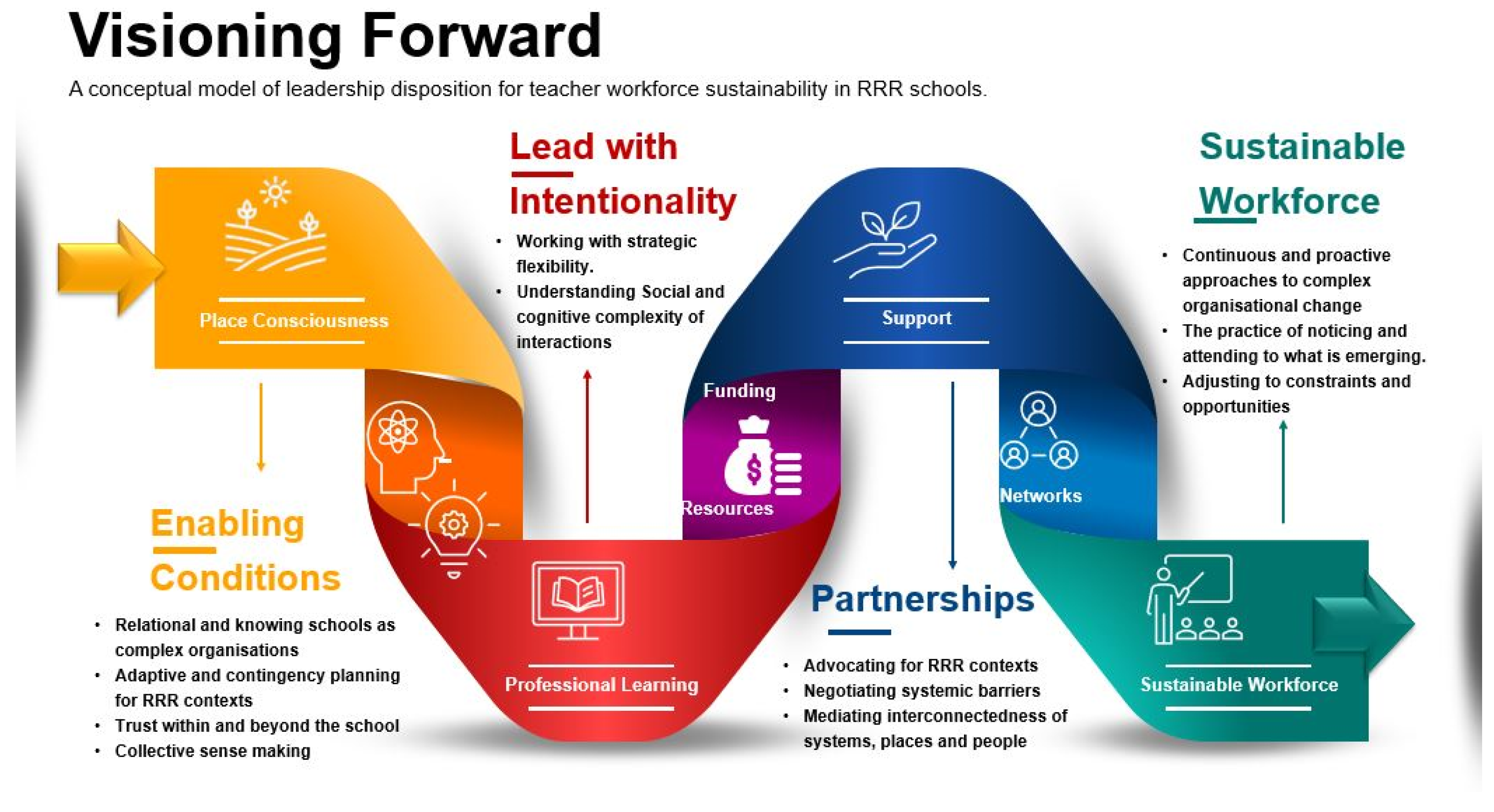
Visioning Forward: the practice through which leaders enact the capacity to perceive emergent futures introduced above. Therefore, it is a proactive, intentional orientation toward long-term teacher supply, in which leaders broker (advocate, negotiate and mediate) relational partnerships across schools and universities rather than relying on centralized systems or serendipity. This relationship between disposition, enabling conditions, and outcome is synthesised in
Figure 2. The reliance on relational brokering is not simply a stylistic preference; it reflects a critical response to the demonstrated limitations of centralized systems. Participants described distinct failures—offers were delayed by up to three days, resulting in prospective teachers being “snapped up elsewhere” (Participant G), and an inability to secure short-term relief staff through centralized registers such as TRACER (Participant F). Framed this way, leaders’ networking is less an innovative leadership choice than a necessary workaround for a system that cannot operate at the speed or specificity of RRR recruitment demands.
Visioning Forward differs from visionary or strategic leadership, which typically centers on a leader’s articulated future goals. It also differs from adaptive or future-orientated leadership more broadly, in that Visioning Forward is grounded specifically in sustained, responsive, relational, trust-based practice, rather than reacting to change as it arises. Connections between school leaders, universities, and preservice teachers are founded on a mutual obligation to act in each other’s interests. Trust functions as a form of quality assurance: leaders trust university partners to provide well-prepared graduates, and graduates trust school leaders to support them in a new and often unfamiliar environment. This relational trust, however, does not exist in isolation from the institutional context surrounding it. Participants also described a deeper distrust of the systems and structures meant to support them: Participant E pointed to “historical things” that had eroded trust between leadership levels, while Participant F described the constant turnover of senior positions as “shuffling the deck chairs on the boat”—a structural instability that undermines confidence that any given system or role will remain reliable. Trust, in this sense, operates at two distinct levels: leaders actively cultivate it relationally, at the local level of partnership and practice, precisely because it cannot be assumed institutionally. Visioning Forward’s reliance on relational trust is therefore not simply additive to institutional trust but substitutes for its absence.
Substitutions of this nature come at a cost—significant and largely unacknowledged (
Tiwari, 2025). Where centralised systems and institutional trust are absent, leaders themselves absorb the resulting administrative and emotional labour. One participant described undertaking the entirety of a school’s HR function alongside their substantive role—“I was doing all the HR work for semester one… I’m also rehab officer… There’s no acknowledgement of requirements; of what it means or the complexity of the school that you work in” (Participant D). This is not incidental to
Visioning Forward but constitutive of it: the relational, adaptive labour that enables recruitment and retention in RRR contexts is simultaneously invisible within formal workload models and system-level planning. Framed through Complexity Theory, this reflects the inseparability of relational and administrative work identified in the findings—a form of expertise that is exercised continuously, yet rarely named, resourced, or recognised as work in its own right.
Place consciousness emerges as a distinctive conceptual contribution. Leaders who move beyond positioning RRR areas as merely “different” or “deficit” and instead foreground the opportunities, identity, and community strengths of their specific context are better positioned to attract and retain quality teachers. This disposition, combined with emotional intelligence and empathy toward the personal and professional decisions of preservice teachers, reflects alignment with the Australian Professional Standard for Principals (
AITSL, 2014) and points to the need for leadership preparation programs to explicitly cultivate these qualities. This place-conscious advocacy, however, should not be read as evidence that RRR leadership is without significant strain. The same leaders who foreground opportunity and community strength also described the grinding reality of the roles they were recruiting into—a teacher expected to manage “five lessons and then have to supervise, preservice teacher on top of that, and have yard duty and have bus duty and have extra curriculum, as well as have a family outside of work” (Participant F). Place consciousness is therefore best understood as a necessary complement to structural reform, not a substitute for it: advocacy can shift how RRR communities are perceived, but it does not, on its own, address the workload and resourcing pressures that continue to drive attrition.
A further contribution of this study is its challenge to the deficit discourse that commonly frames RRR schooling as a difficult, isolating, or professionally limiting career move. The leaders in this study actively and intentionally reframed their communities as sites of opportunity, rich identity, and professional growth. Rather than minimising the challenges of geographic distance, cultural complexity, or resource constraints, they foregrounded the unique strengths of their contexts to “light the fire” of interest in prospective teachers. This place-conscious leadership disposition, combined with other intentional partnerships, suggests that shifting deficit discourse requires both individual leadership agency and institutional support.
This study’s findings align with international scholarship recognising that rural school leadership is distinct from urban leadership in its roles, practices and demands (
Echazarra & Radinger, 2019;
Pendola & Liu, 2025). While international research has established links between leadership behaviour and student learning outcomes more broadly (
Kemethofer et al., 2023;
Ozdemir et al., 2024), the specific intersection of rurality, leadership behaviour, and learning has received limited attention, with comparative studies remaining particularly scarce (
Pendola & Liu, 2025).
Pendola and Liu’s (
2025) comparison of rural leadership between behaviours across China and the United States represents a rare exception, underscoring how little cross-national work exists in this space.
Visioning Forward offers a context-specific contribution to this underexplored context, extending existing understandings of rural leadership distinctiveness into the specific domain of teacher supply and retention, and adding an Australian RRR perspective to the small body of comparative literature that currently exists (
Rhinesmith et al., 2023). Consistent with
Pendola and Liu’s (
2025) finding that successful rural leadership is embedded in context rather than transcendent of cultural boundaries, we do not claim
Visioning Forward as a universal model. Rather, its underlying disposition—anticipatory, relational, trust-based practice—may offer a transferable orientation for RRR leadership internationally, even as its specific enactment remains shaped by local systems, geography, and culture.
Figure 2 (adapted from
Thiele et al., 2022) synthesises these relationships, illustrating how Visioning Forward is enabled through place consciousness and trust, sustained through professional learning, support, and partnerships, and oriented toward a sustainable RRR teaching workforce.
Implications for policy, leadership preparation programs, and Initial Teacher Education provider partnerships are considered in the conclusions that follow.
5. Conclusions
Navigating multidimensional leadership to develop teacher pipelines in contemporary Australian regional, rural, and remote (RRR) schools requires a shift from centralised, “one-size-fits-all” recruitment to intentional, place-conscious, and relationship-driven strategies. This study’s central contribution is Visioning Forward: a disposition through which RRR school leaders proactively broker (advocate, negotiate and mediate) relationships to sustain teacher supply, extending existing leadership theory beyond situational and contingency-based models of balancing task and relationship binaries. Rather than relying solely on centralised human resource systems to fill vacancies, effective RRR school leaders actively broker, negotiate and navigate relationships with stakeholders across their communities and beyond.
More importantly, these school leaders acknowledge that place consciousness is not merely a personal disposition but a range of practiced and deliberate leadership actions that can be cultivated through targeted professional learning. At the same time, leaders recognised that this advocacy work carries invisible costs: the staffing component of a school leader’s workload often amounts to several weeks of a deputy principal’s time per recruitment cycle, work that is largely unacknowledged in workload models and system-level planning.
This study’s findings should be read in light of several limitations. The sample size (N = 10) was purposively bounded to school leaders directly responsible for recruitment within an existing regional network, providing an information rich but necessarily limited account; broader or comparative samples may bring forth additional variation in leadership practice. The findings are further shaped by the specific geographical, cultural and institutional conditions of Far North Queensland, and transferability to other RRR (within Australia or internationally) contexts should be assessed accordingly.
Future research might extend this work longitudinally, tracking how
Visioning Forward as a disposition relates to sustained recruitment and retention outcomes over time. More specifically, consistent with calls to expand both the concept and measurement of leadership practices cross-nationally (
Pendola & Liu, 2025), explorations of applicability across education systems and national RRR contexts could also be investigated.
These findings carry implications across four areas. For policymakers, the workload and system-failure evidence presented herein (e.g., delays in centralized HR processing, gaps in relief-staffing systems such as TRACER) point to a need for resourcing adaptive recruitment support systems for RRR schools, rather than leaving leaders to informally absorb this function. It is important to note, however, that additional systems can add further layers of complexity rather than resolve it.
Borragán et al. (
2017) argue that cognitive fatigue originates not from the number of items to be processed in a given time interval, but from the time available to process them. Applied here, this suggests that policy responses should prioritise reducing the time pressure school leaders face in recruitment decision-making, rather than simply introducing additional systems or reporting requirements that leaders must also absorb.
For leadership preparation programs, the dispositions identified in this study, place consciousness, relational trust-building, and Visioning Forward, should be explicitly cultivated as core leadership capabilities, rather than assumed to develop informally through experience. For teacher education providers, the tripartite partnership model evidenced in this study (schools, universities, and a coordinating body) offers a transferable structure for supporting preservice teacher placement in RRR contexts more broadly. Finally, for recruitment initiatives, the informal strategies leaders described—including overstaffing as a retention buffer and direct-approach recruitment—suggest scope for formalising these practices into supported, resourced pathways rather than leaving them as leader-dependent workarounds.