


Abstract
Education plays a crucial role in addressing the challenges of the Anthropocene. Schools are therefore called upon to empower students to actively participate in sustainable social and ecological transformation. Building on the pedagogical concept of “Bildsamkeit” (malleability), which emphasizes the openness of human development in relational contexts, this paper examines how education for sustainable development (ESD) can promote transformative learning and sustainable action. A conceptual triad of knowledge and strategies, transformative learning processes, and action is presented as a framework for designing learning environments that support the sustainable development of students’ potential. We argue that transformative learning involves critical reflection on existing structures of meaning, leading to lasting changes in perspective, self-understanding, and capacity for action. Sustainable entrepreneurship education, particularly through the design thinking concept, is presented as an effective pedagogical approach to enabling such transformative experiences. The “Start-up Schools: Sustainable Entrepreneurship in Schools” project, which is being implemented in German schools, serves as a clear example. Initial insights into student portfolios suggest that this project could foster experiences of self-efficacy, critical thinking, and ethical awareness in the context of sustainability challenges. These exemplary excerpts suggest that learner-centered, participatory, and action-oriented educational formats can promote individual potential and support social change. To achieve this, a conscious departure from established teaching and learning scenarios would be helpful, a concept that can also be described as “exnovation.” This paper seeks to demonstrate that integrating sustainable entrepreneurship into school education could be a promising way to foster the transformative skills necessary for shaping a sustainable future.
1. Introduction
The pedagogical and anthropological model assumes that education is possible and meaningful because humans are not completely predetermined in their development but rather have open developmental potential. In German-speaking countries, this assumption is particularly represented by the term “Bildsamkeit,” which cannot be translated congruently into English (Kivelä, 2023). “Formbarkeit” (malleability) or “Plastizität” (plasticity) are possible translations, but they do not sufficiently capture the role of human subjectivity in encountering the world (ibid.). This role illustrates not only that human development is passively malleable but also that there is a fundamental openness in educational processes in which people’s learning and development abilities have an individual influence, considering their physical and psychological potential as well as social and cultural conditions. In this sense, “Bildsamkeit” must always be thought of in relational terms (Tenorth, 2024): it is realized in the interaction of the individual, the environment, and pedagogical action. A detailed account of the historical development of the concept of malleability lies beyond the scope of this paper, although pedagogical perspectives such as Humboldtian humanism remain subjects of ongoing scholarly debate. More recent debates (e.g., Benner, 1988, Giesinger, 2022; Czejkowska, 2023) refer more strongly to the multidimensionality of “formability.” Cognitive, moral, social, and esthetic dimensions are always embedded in social structures, which means that malleability is not only an expression of an individual’s ability but also the result of institutional and cultural conditions. Further consideration concerns the normative purpose of malleability, which bears relevance for education for sustainable development.
“[…] in today’s Anthropocene, in which humans are increasingly determining the fate of the entire planet, questions about humans and their formation through education are becoming even more important. Due to the productive and destructive possibilities of humans with regard to shaping the future of the planet, there is a need for education that also incorporates these dimensions into its self-image.”(Wulf, 2020; p. 7, own translation)
The perspective of a sustainably living human being, the “Homo Sustiens” (Siebenhüner, 2000), could represent a corresponding purpose of education, which would focus on the development of a specific image of humanity. However, establishing sustainability as a normative model for human action raises various questions. For example, is there a consensus on what sustainable action means in the classic “social, economic, and environmental” dimensions (Kropp, 2019)? Can this concept therefore become the subject of education? The UN Agenda 2030 (United Nations [UN], n.d.) provides some initial answers to these questions, as the Sustainable Development Goals set out important milestones for global sustainable development. The principles of action in five areas, namely, the 5 Ps (People, Planet, Prosperity, Peace, and Partnership) for human action (Emde et al., 2017; Antweiler, 2024), can also be used to derive educational perspectives for education for sustainable development (United Nations Educational, Scientific and Cultural Organization [UNESCO], 2017). In this regard, education for sustainable development has the task of empowering people, and in the school context specifically, students, to actively contribute to the achievement of the sustainability goals in accordance with the 5 Ps (Vare et al., 2022). At the same time, sustainable development must be characterized by an open, democratic process in which, for example, discourses on sustainability dimensions are conducted in a collegial and inclusive manner. It follows that the corresponding educational processes must enable people to participate in these discourses and act with a high degree of openness to possible present perspectives and futures in the sense of future competence (United Nations Educational, Scientific and Cultural Organization [UNESCO], 2021; Leinfelder, 2023). The critical discussion about education for sustainable development therefore necessarily engages with the tension between the extent to which education or ESD can, may, or should fulfill normative framework conditions and expectations regarding the transformation into sustainable action (Koller, 2016; Jickling & Sterling, 2017; Giesinger, 2022). Education that empowers and encourages people to make decisions and take action requires more than just the transmission of knowledge. Not least, this calls for a pedagogical perspective that, in the constructivist sense, assumes the “malleability” of all participants—both teachers and learners—and fosters emancipatory, transformative processes (Wiesner & Prieler, 2020). Against this backdrop, appropriate learning arrangements must be created in schools that provide spaces for experience and self-development where individual potential can be developed and realized (Öhman & Sund, 2021).
Schools need support to develop such learning arrangements. To this end, it is crucial to examine practice-oriented concepts and the conditions for their success in fostering transformative learning processes. The first fundamental question is what or how transformative learning processes can be observed. This article first addresses, at a conceptual level, a learning arrangement designed to promote transformative learning processes and then examines specific observations that demonstrate such processes. The design of the learning arrangement is based on a triad of sustainable learning and sustainable action, which is explained in the following section.
2. Triad for Sustainable Learning and Sustainable Action
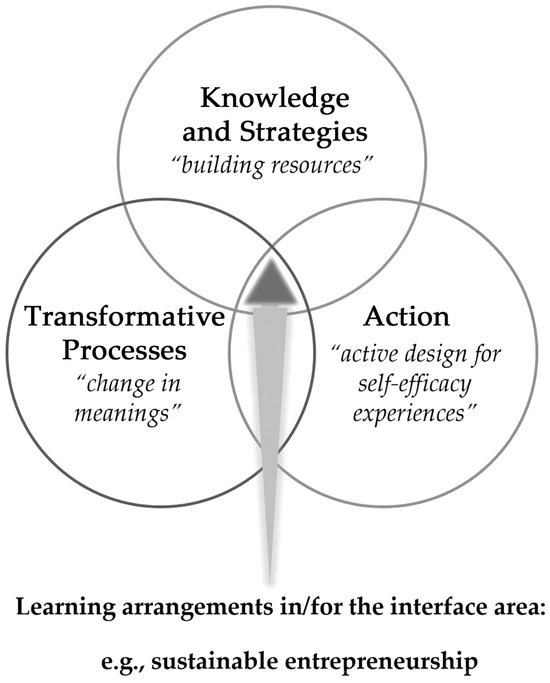
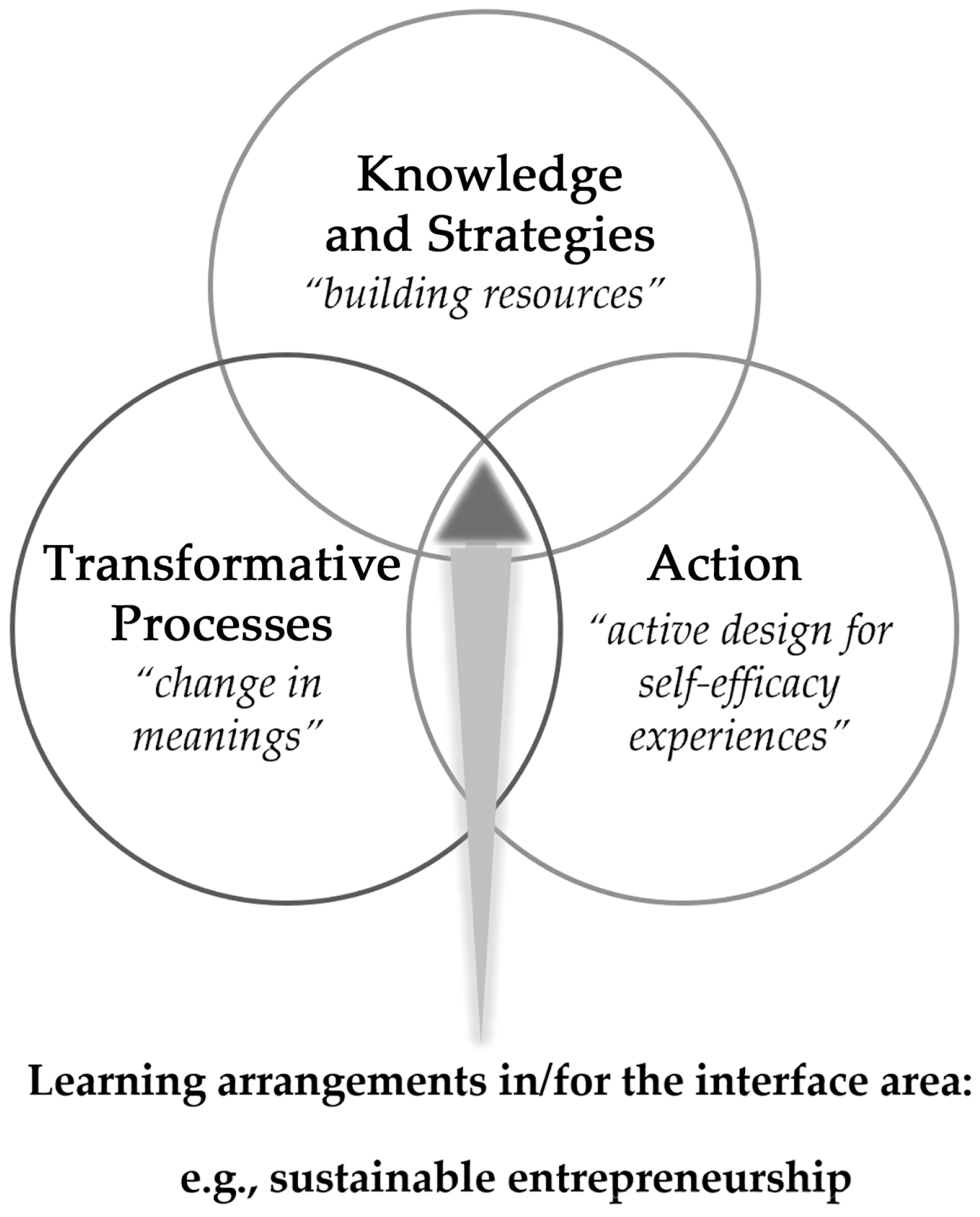
To illustrate the triad, Figure 1 shows that school education must focus on promoting different learning processes and action processes. This involves complex pedagogical action, as the individual components of the triad are manifested and developed differently in everyone.
Figure 1.
Triad for sustainable learning and sustainable action.
- Knowledge and Strategies
Promoting learning processes to acquire and expand knowledge also forms an important basis for understanding in the context of sustainability, as knowledge of various dimensions of sustainability is an essential prerequisite for recognizing synergies for sustainable action or contradictions between sustainability goals. Above all, self-regulated learning (Fischer & Fischer-Ontrup, 2026), combined with learning strategies, represents an important opportunity to acquire knowledge and skills individually and autonomously to be able to make sustainable decisions and take sustainable action (Gresch et al., 2017).
- Transformative processes and transformative learning
However, knowledge alone is often not enough to promote sustainable action and commitment to sustainability (cf. Diedrich et al., 2022; Gehrau et al., 2025).
Overcoming a knowledge–doing gap (Vongalis-Macrow, 2008) or knowledge–action gap (Räsänen et al., 2024) requires a second learning perspective, namely, transformative learning. This encompasses learning processes in which ideas about the world but also beliefs about oneself change in a lasting way, so that new orientations for action can become effective (Mezirow, 2009; Singer-Brodowski, 2016). Mezirow (2009, pp. 7–8) defines the diverse levels of meaning of the transformation process as follows:
“we transform our taken-for-granted frames of reference (meaning perspectives, habits of mind, mind-sets) to make them more inclusive, discriminating, open, emotionally capable of change, and reflective so that they may generate beliefs and opinions that will prove more true or justified to guide action.”
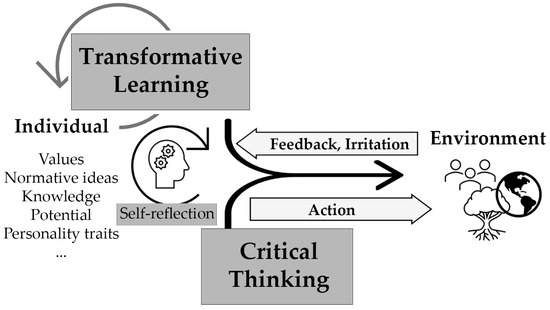
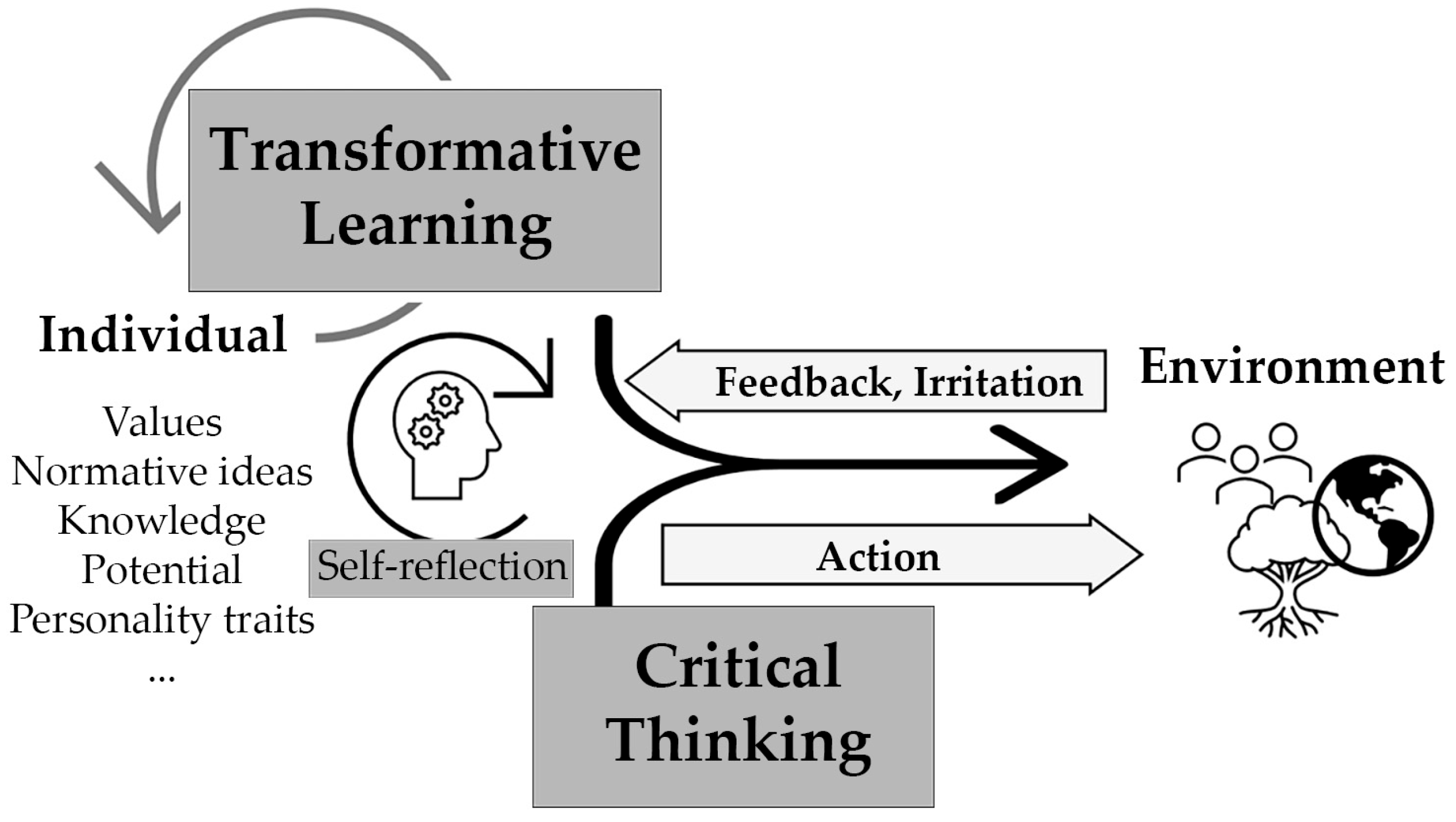
Critical thinking is an effective component of these transformation processes, as changes only become apparent in performance with others and the environment. The following figure illustrates the interactions and similarities between transformative learning and critical thinking (Figure 2).
Figure 2.
Relationship between transformative learning and critical thinking (modified according to: Kohnen & Rott, 2025).
Even though transformative learning processes are difficult to plan didactically, they require open, authentic, and holistic spaces for experience (Taylor, 2009) in which learners interact with others based on their own experiences and put their own structures of meaning up for discussion. Lastly, this process can contribute significantly to personality development (Illeris, 2014).
- Action
The third circle of the triad explicitly highlights action as a necessary condition for experiences of self-efficacy. Experiences of self-efficacy encompass not only positively valenced experiences but also resistance and experiences of failure. The importance of experiences of self-efficacy in the context of ESD (Redman et al., 2018) and their facilitation in the school context is linked to questions of participation (Simon, 2019; Rieckmann, 2021) and situational interest for students (Bergmüller, 2019).
As Hartley and Knell (2022) note, truly transformative educational spaces require not only the adoption of innovative approaches but also a conscious and deliberate break with traditional notions and established practices. This article builds on this premise by incorporating the concept of exnovation and applying it to the design of transformative learning environments. Exnovation refers to the conscious, controlled process of abandoning or transforming outdated practices, structures, routines, and bodies of knowledge. As such, it forms the conceptual counterpart to innovation: While innovation is oriented toward the new, exnovation focuses on what must be actively abandoned so that the new can take root and develop (Noëth & Moons, 2024). The concept has its origins in, among other fields, innovation and sustainability research (Kimberly, 1981) and is directly relevant to the field of education, where many systemic processes can be observed: once introduced, teaching formats, assessment frameworks, and curriculum structures tend to persist even when their effectiveness has become questionable. Exnovation refers to the necessity of consciously breaking such path dependencies, thereby providing an approach to addressing institutional inertia, which is often overlooked in purely innovation-oriented measures. While innovation in schools emphasizes the introduction of new, additive pedagogical or institutional frameworks, exnovation serves the complementary process of the targeted termination of old structures or practices. The coexistence of new and old practices within the same institutional environment can lead to contradictions that undermine the effectiveness of change processes. However, breaking with established teaching practices and introducing new, different ones can also entail risks, as, for example, innovative approaches do not necessarily lead to more successful learning outcomes (Hartley & Knell, 2022). One of the benefits of the exnovation perspective lies in its ability to transparently identify risks and to engage in careful, well-founded deliberations regarding which practices should be abandoned, under what conditions, and with what form of professional and institutional support. It thus introduces a necessary reflexivity into change processes. The implications of exnovation extend not only to the institutional level but also to the level of individual learning processes. At this level, exnovation overlaps with the concept of unlearning, which refers to the active overcoming of entrenched assumptions, habitual thought patterns, and established modes of action. Learners are not only expected to acquire new knowledge or skills, but also to identify and dissolve previous cognitive frameworks that no longer serve their epistemic or practical needs. Given the focus on the individual learner, there is a high degree of alignment between exnovation and transformative learning, as defined by Mezirow (2008). From a learning theory perspective, this is a demanding process and requires, for example, metacognitive skills. If transformative experiences can arise from processes of action and if new knowledge can motivate further actions, then learning environments must be designed as dynamic spaces in which the relationships between experience, knowledge, and action are continuously renegotiated. The common interface of these three areas is particularly desirable from an educational perspective, and innovative ways to realize this in the school context should be actively sought. The design of learning environments that particularly foster the dynamic relationships between knowledge, experience, and action is characterized by the interfaces in the triadic model. These interfaces also present a specific pedagogical challenge, as the extent of overlap between the three domains will vary from learner to learner.
3. Sustainable Development of Potential
Against this background, pedagogically designed learning arrangements in transformative education for sustainable development always aim at the sustainable development of young people’s potential (Fischer & Fischer-Ontrup, 2023). The focus is on potential that is relevant for the sustainable development of society regarding future skills or futures literacy; at the same time, the sustainable development of individual potential across the lifespan is addressed. In this context, the concept of transformational giftedness is relevant; it addresses the transformation of the individual in the sense of transformative learning (e.g., Mezirow, 2008) and the transformation of society toward more equitable and sustainable conditions (Sternberg et al., 2021). Closely related to this is Sternberg’s (2024) T-ACCEL model (Transformational Active Concerned Citizenship and Ethical Leadership), which aims to take responsibility for shaping a sustainable future. This requires transformational giftedness (e.g., critical–analytical thinking, creativity, common sense, wisdom, ethics, and passion) (Sternberg, 2017), which is important for finding innovative solutions to global problems (Ambrose & Sternberg, 2016). This also addresses future skills or futures literacy in the sense of the capability to adapt to the future and shape the future (Bauer et al., 2025; United Nations Educational, Scientific and Cultural Organization [UNESCO], 2021), which are equally important for personal and social transformation.
This addresses the central goals of the Promoting Excellence in School Education (LemaS) funding initiative for the individual support of gifted and talented students in the state of North Rhine-Westphalia in Germany, especially since transformation and sustainability are also central dimensions of the desired challenge and support outside of regular classroom instruction. The LemaS funding initiative follows Sternberg et al.’s (2021) transformational understanding of giftedness, which is also anchored in the transformative model of giftedness and talent development (Fischer et al., 2024). Accordingly, the LemaS support formats focus on taking responsibility for one’s own learning processes in the sense of self-regulated inquiry-based learning and on taking responsibility for shaping a sustainable future within the framework of transformative problem-based learning. The latter adaptive teaching and learning formats are implemented in schools and scientifically monitored by the State Competence Center for Individual Support NRW at the University of Münster within the framework of transformative future learning (Kohnen et al., 2025) with various emphases (sustainable future design, phenomenon-based learning, and sustainable entrepreneurship). This links the experiences of self-efficacy of students and teachers regarding personal and social transformation, not least regarding the necessary transformation of the education system in a changing world.
4. Sustainable Entrepreneurship
From an economic perspective, sustainable entrepreneurship is defined as “the process of discovering, evaluating, and exploiting economic opportunities arising from market failures that affect sustainability, including those relevant to the environment” (Dean & McMullen, 2007). Although the economic perspective often occupies a comparatively secondary position in ESD frameworks, both approaches pursue the same goal. Sustainable entrepreneurship can thus be understood as an approach to implementing ESD in the above sense, which also provides a process structure, motivation, and its own methodological repertoire for designing learning opportunities in the context of ESD (Macagno et al., 2024). This premise also builds a bridge between ESD and entrepreneurship education. Entrepreneurship education has gained enormous importance in recent years due to its social significance (Fayolle, 2018) and has evolved pedagogically from a predominantly instructional, technical discipline to a strongly learner-centered, action-oriented, and interdisciplinary direction (Hägg & Gabrielsson, 2019) in the school context, primarily in the sense of “teaching for entrepreneurship” (Sirelkhatim & Gangi, 2015) or “learning to become an entrepreneurial person” (Fayolle, 2008). Entrepreneurship education now has a large pool of methods for innovation and project development from which ESD can benefit. However, the trajectory of entrepreneurship education remains contested, especially against the backdrop of the debate about the goals and competence concepts of the respective approach to entrepreneurship education (Sirelkhatim & Gangi, 2015). For the present approach, the concept of transformative learning forms the central framework under which ESD, sustainable entrepreneurship, and entrepreneurship education can be united.
As explained at the beginning, spaces for transformative learning can be opened through methods of sustainable entrepreneurship, e.g., in the form of design thinking as “a methodology that imbues the full spectrum of innovation activities” (Brown, 2008). At the same time, sustainable entrepreneurship broadens the economic perspective of these methods to include social, ethical, and ecological issues (Shepherd & Patzelt, 2011), which, based on the transformative learning experience of the individual, can ultimately also aim at the transformation of others (Sternberg et al., 2021; Sternberg, 2023).
Given that entrepreneurial education remains insufficiently integrated into the curriculum and teaching practices across much of the German school system (Hüchtermann & Röhl, 2020) and considering the educational requirement outlined at the outset to promote transformative learning experiences in teaching–learning scenarios, the following “Start-up Schools” approach exemplifies how such teaching–learning scenarios may be designed, and demonstrates, through self-reflective student documentation, how transformative learning experiences can be empirically identified.
4.1. Project “Start-Up Schools: Sustainable Entrepreneurship in Schools”
- Project framework
The project “Start-up Schools: Sustainable Entrepreneurship in Schools” is a collaborative project that has been running at the University of Münster since 2021 and is supported by the State Competence Center for Individual Support (lif) and the REACH Euregio Start-up Center. Since then, it has been further developed in various school networks and is now offered in North Rhine-Westphalia as part of the federal initiative “Leistung macht Schule” (Weigand et al., 2022). The aim of the project is to anchor innovative methods of entrepreneurial education in the school learning environment in a sustainable manner by integrating them specifically into curricular free spaces and expanding them beyond selective interventions (Lindner, 2015). The organizational formats are not fixed; i.e., fixed courses in upper secondary school, working groups, elective courses, or support models for particularly gifted students can be implemented.
The course concept “Start-up Schools: Sustainable Entrepreneurship in Schools” forms the characteristic implementation format in all variants and can also be linked to competition participation and external start-up consulting.
- Course concept
The methodological basis of the course is the design thinking approach, which is understood as an iterative innovation process and enables consistent user-centered problem solving (Brown, 2008; Micheli et al., 2019; Uebernickel et al., 2015). Design thinking is described in the literature as a six-phase, iterative process (Micheli et al., 2019). Brown (2008, p. 1) defines it as “a methodology that permeates the entire spectrum of innovation activities with a human-centered design ethos”. The goal of design thinking is to develop creative solutions to problems that can be applied to products and services, as well as to initiatives that are not primarily economically oriented. This approach contrasts with the analytical–rational approaches that are common in many educational institutions (Uebernickel et al., 2015). Design thinking is considered a key method in entrepreneurship education and forms the methodological core of the program presented here (Zumholte & Fischer, 2026). In the design thinking process, project groups work on design challenges that are problem-oriented. The search for solutions is preceded by phases of intensive problem exploration, the aim of which is to gain a deeper understanding of the problem and the people affected, as well as potential users (Grots & Pratschke, 2009). This includes qualitative research and the use of empathy-based methods, such as the development of personas (Grots & Pratschke, 2009; Lewrick et al., 2020). The information obtained is condensed to formulate a user-centered perspective that enables creative and needs-oriented solution development (Lewrick et al., 2020). This consistent user-centered approach is a central feature of design thinking (Uebernickel et al., 2015, p. 18). The idea generation phase is followed by the prototyping phase, in which initial solutions are implemented. Early prototypes do not have to be fully functional but serve primarily to gather feedback from potential users (Uebernickel et al., 2015). This feedback is incorporated into an iterative improvement process, in which several prototypes are often developed in parallel or alternatively. A characteristic feature is the early and provisional presentation of the prototypes to involve users in the development process from the outset. This results in a culture of error in which errors are understood as a fundamental part of innovation processes (Uebernickel et al., 2015, p. 18). Implementation can only take place after several cycles of prototyping, testing, and optimization.
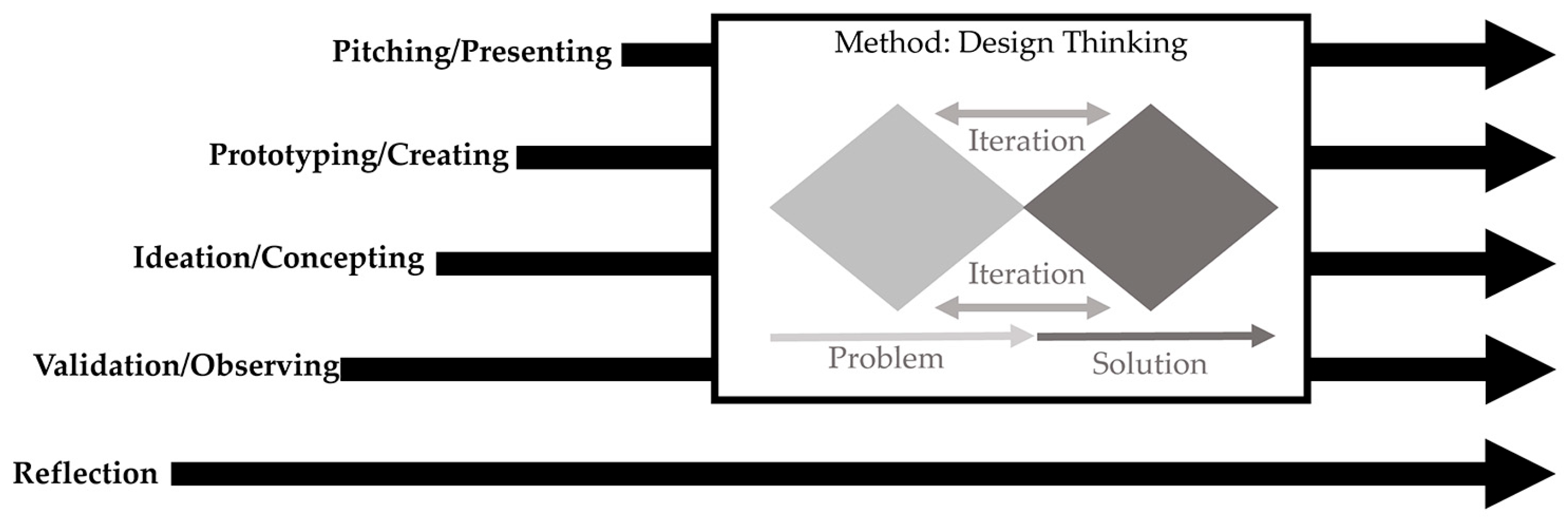
The project work is not organized linearly (not only because of the embedded design thinking approach) but is divided into parallel task areas (reflection, validation, brainstorming, prototyping, and pitching), which are weighted differently depending on the project status, as illustrated in Figure 3. Accordingly, the role of the teacher shifts from instructive teaching to an advisory and supportive function in the sense of a scaffolding process (Wood et al., 1976; Reusser, 1995). This learning organization has clear links to concepts of deeper learning (Hilbert et al., 2025; Sliwka & Beigel, 2025).
Figure 3.
Integration of design thinking as a core method across the different content dimensions of the course concept.
A key structural feature of the project is the systematic involvement of external partners, in particular start-up centers, which offer workshops, provide access to authentic learning environments, and facilitate the transition to real start-up contexts. In addition, the project can be linked to established competition formats such as “StartupTeens” or “Jugend gründet” (Youth Start-ups), which offer coaching, mentoring, and feedback in addition to recognition (Lechler, 2020; Metzbaur, 2020). The skills acquired in the project correspond to the so-called “future hot skills,” which are also highly relevant outside the school context (Weiß et al., 2017).
Performance assessment is multidimensional and focuses primarily on the students’ learning and reflection process. In addition to a written problem analysis and a final pitch, a portfolio forms the central assessment element, documenting learning paths, decisions, and reflections. The developed product itself is only a secondary object of grading; its technical evaluation is primarily carried out by external experts, juries, and partners. This enables the teacher to provide process-oriented support to the project groups while at the same time appropriately recognizing individual learning progress.
4.2. Examples of Transformative Learning Experiences Based on Students’ Project Portfolios
Participants document their own project and learning processes using portfolios. These portfolios focus on work and learning outcomes selected by the learners themselves, which they reflect on from their own perspective. This also includes obvious failures, such as abandoned projects or ideas that were not pursued further. In their reflections, students are also expected to justify the decisions they made during the projects. Thus, these portfolios offer initial insights into the participants’ learning experiences and form the basis for a more in-depth qualitative content analysis, which is addressed here only illustratively and as an example. Based on the analysis of learning experiences, initial categories emerge that enable a more nuanced examination of the portfolio excerpts with regard to transformative learning processes (see Hoggan, 2016). Table 1 lists three examples of categories through which transformative learning can manifest itself and how these are operationalized.
Table 1.
Analytical criteria for identifying transformative learning processes.
For the purposes of this article, we present several excerpts from the portfolios as examples that illustrate how transformative learning processes can be identified within the framework of the project.
The first excerpts are taken from the portfolio of a student whose idea for the subproject “Start-up Schools: Sustainable Entrepreneurship in Schools” was to launch a fashion label. Accordingly, the student reflects on his progress in the project process in his portfolio:
“Over the course of time, my ‘crazy idea at 2 a.m.’ developed into a concept that could one day be launched on the market. While working on my project, I also developed as a person. Not only was I able to expand my interests, but I also learned how to analyse and solve problems. Overall, I was able to grow along with my idea.”(p. 3)
Several points become clear from this excerpt:
- The student appears to perceive a development in their personality during this process, perhaps even in the sense of a “self-transformation” (Sternberg et al., 2021).
- The student attempts to contribute ideas and interests to the course, which could presumably lead to a strong identification with the course material and thus represent an example of an authentic learning experience (see Sliwka & Beigel, 2025).
- The student indicates that their learning experience can also be applied in other contexts (category: INWT).
- This learning experience is particularly important for problem-solving, as the student is not only able to analyze problems but is also firmly convinced that they can find solutions (categories: INWT and CIB).
This excerpt also highlights the three pillars of sustainable learning and action. It is not just about solving a specific problem, but also about believing in one’s own ability to tackle a wide range of problems and take action in the future. Upon closer examination, the student demonstrates an even more nuanced understanding of the learning process:
“After I had created my prototype and presented my project in class, one question remained in my mind. ‘Why should I buy YOUR product?’ [My teacher] question had a certain validity. I realized that I thought my ideas were better than those of other fashion brands. Even if that is true, how can I get people to see it that way? In my problem analysis, I realized that there is a lot of injustice in the world. This is rarely addressed in fashion, because as a designer, you are part of the problem yourself. To improve myself and my brand, there needs to be a change. I want to give fashion a certain meaning.”(p. 12)
This excerpt shows the following:
- Independent exploration of a topic of interest can lead to different perspectives, as the student discovers here while researching fashion production (keyword: injustices).
- Interaction and exchange with others provide students with important impulses (here, for example, the teacher’s question) for their approach (action), which, according to the model (see above), seems to encourage them to question their own assumptions (category: INWT/ICB).
- The task leads to adopting different perspectives, for example, to assess various target audiences for their project product (category: INWT).
Changes in meanings and structures of meaning (Mezirow, 2008) appear to be emerging. A decisive factor here could be the possibility of acting in an area where changeable structures of meaning exist (Kegan, 2018). Thus, the action could contribute to transformative learning experiences, as the third excerpt exemplifies:
“I made a few mistakes while sewing, which is why the hem doesn’t look particularly good in some places. However, this is only the prototype. The positive thing about it is that I made everything myself. It gave me an insight into the work of a textile worker. Even though I enjoyed it because it’s my own project, I can’t imagine doing this for more than 8 h a day.”(p. 11)
In this excerpt, the student learns and experiences the following:
- The garments he designs must also be manufactured, and the conditions under which this takes place are often unsustainable (Category: INWT).
- Through the “doing,” he likely learns about himself that this type of work (“seamstress”) may not be suitable for him (Category: MFA).
Student learning is embodied here in a unique way: through the physical act of sewing—with its associated mistakes, exertion, and signs of fatigue—the conditions of textile production are made cognitively and emotionally tangible. This would align with what Kolb (1984) refers to as concrete experience in the experiential learning cycle and underscores the relevance of exnovation. For sustainable change, unsustainable practices must be structurally overcome, not merely supplemented. In particular, exposing students to factory-like working conditions may indicate that an affective foundation for this type of structural critique is being established here. This could contribute to the realization that the joy of working on one’s own project and the inability to endure the same activity as alienating wage labor are not merely personal preferences, but point to a structural contradiction in the organization of fashion production.
Crucially, however, this is an emerging rather than a fully formed realization. The student has arrived at an empathetic awareness of structural injustice. It remains to be seen, however, whether this awareness will form a new, established framework of orientation for the student.
In sum, the statement suggests that for the student participating in this project, the topic of fashion no longer encompasses merely esthetic or economic aspects; rather, a shift in the student’s thinking toward ecological and ethical considerations in the context of the common good is becoming apparent. He reflects these perspectives in his view of the globalized world and simultaneously considers what implications they have for his own actions. The portfolio excerpts presented here are merely illustrative samples and are therefore limited in their generalizability. The extent to which further evidence of transformative learning experiences emerges will be revealed in an ongoing study of the project, which is designed with an adequate number of participants and aims to systematically identify the facets of transformative learning through a qualitative content analysis (Kuckartz & Rädiker, 2023) of the students’ reflective work.
5. Discussion
The integration of entrepreneurship education and education for sustainable development represents an innovative approach. The use of design thinking and project-based learning formats also offers immense potential for promoting self-directed learning and individual talent development. Nevertheless, the link between entrepreneurship and sustainability is not without its challenges, as a one-sided economic view of entrepreneurship would traditionally be oriented toward market-based principles such as competition, innovation, and profitability. This logic can potentially conflict with the goals of sustainable development, particularly when different dimensions of sustainability compete with one another. A shift toward exnovation means that traditional orientations such as “profit maximization” are no longer the primary focus, creating space for new experiences. On the other hand, it is precisely the tension between different premises of sustainability that offers potential for creative solutions. These can arise, for example, when shifts in perspective occur. In this context, exnovation would imply that the goal of such tensions should not always be compromised. Therefore, in the school context, entrepreneurship could open scope for action in the sense of the triad model presented to authentically combine cognitive, affective, and action-related dimensions of learning. In particular, the emphasis on experiences of self-efficacy is a key factor for sustainable engagement. The potential of these learning arrangements, which utilize entrepreneurship education methods to facilitate authentic and effective learning experiences, is already evident in the students’ statements presented here as examples. They provide a space for experience within which students perceive themselves not only as self-effective but also as acting responsibly. As this example shows, this can give rise to an opportunity for a process of reflection that can be described as both transformative and exnovative—and which is therefore likely to be worth further exploration.
Education should therefore focus more on learning processes than on learning outcomes, since it is through such processes that educational goals—such as critical thinking and personal development—can take shape and become firmly established. The inherent tension in the concept of sustainable entrepreneurship is exacerbated by the tension between education as an open developmental process—that is, understood as a process that cannot be fully controlled—and education as a goal-oriented instrument of transformation—that is, explicitly conceived as a means of promoting sustainable transformation.
Author Contributions
Conceptualization, M.K., S.Z. and C.F.; methodology, S.Z. and M.K.; formal analysis, S.Z. and M.K.; data curation, S.Z.; writing—original draft preparation, M.K. and S.Z.; writing—review and editing, M.K., S.Z. and C.F.; supervision, C.F. All authors have read and agreed to the published version of the manuscript.
Funding
This research was supported by the Ministerium für Schule und Bildung, North Rhine-Westphalia, and the Stiftung Westfalen-Initiative für Eigenverantwortung und Gemeinwohl, North Rhine-Westphalia.
Institutional Review Board Statement
The study was approved and conducted in accordance with the guidelines for scientific research and surveys in schools pursuant to § 120(4) SchulG (BASS NRW, School Act).
Informed Consent Statement
Informed consent was obtained from all subjects involved in the study. All participants in the study gave their consent.
Data Availability Statement
Restrictions apply to the datasets. The datasets presented in this article are not readily available because the data are part of an ongoing study. Requests to access the datasets should be directed to S. Zumholte.
Conflicts of Interest
The authors declare that there are no conflicts of interest. The funders had no influence on the design of the study, the collection, analysis, or interpretation of data, the writing of the manuscript, or the decision to publish the results.
References
- Ambrose, D., & Sternberg, R. J. (Eds.). (2016). Giftedness and talent in the 21st Century: Adapting to the turbulence of globalization. Sense Publishers. [Google Scholar]
- Antweiler, C. (2024). Anthropozän—Ein begriffliches Erdbeben. Grundlagen, begriffsvarianten und gesellschaftliche Relevanz. In F. Wobser (Ed.), Anthropozän. Interdisziplinäre Perspektiven und philosophische Bildung (pp. 21–44). Campus Verlag. [Google Scholar]
- Bauer, S., Albiez, M., & Scherz, C. (2025). Konzepte der Zukunftsbefähigung: Zwischen Future Skills und Transformation Litercay. In T. von Wirth, T. Vogel, & P. Jansen (Eds.), Kompass für den Wandel (pp. 28–50). Oekom Verlag. [Google Scholar]
- Benner, D. (1988). Bildsamkeit und Bestimmung. Zu Fragestellung und Ansatz nicht-affirmativer Bildungstheorie. Neue Sammlung, 28, 460–473. [Google Scholar]
- Bergmüller, C. (2019). Transformative Bildung im Kontext Schule. In G. Lang-Wojtasik (Ed.), Bildung für eine Welt in Transformation (pp. 75–88). Barbara Budrich. [Google Scholar]
- Brown, T. (2008). Design thinking. Harvard Business Review, 86(6), 84. [Google Scholar] [PubMed]
- Czejkowska, A. (2023). Bildsamkeit. In M. Huber, & M. Döll (Eds.), Bildungswissenschaft in Begriffen, Theorien und Diskursen (pp. 51–58). Springer VS. [Google Scholar] [CrossRef] [Scilit]
- Dean, T. J., & McMullen, J. S. (2007). Toward a theory of sustainable entrepreneurship: Reducing environmental degradation through entrepreneurial action. Journal of Business Venturing, 22(1), 50–76. [Google Scholar] [CrossRef] [Scilit]
- Diedrich, J., Mang, J., Patzl, S., Seßler, S., Martin, M., & Lewalter, D. (2022). Klimabewusstsein fünfzehnjähriger in Deutschland. Vom Wissen und Können übers Wollen und Zutrauen zum Tun. Waxmann. [Google Scholar]
- Emde, O., Jakubczyk, B., & Overwien, B. (2017). Mit Bildung die Welt verändern?! In O. Emde, U. Jakubczyk, B. Kappes, & B. Overwien (Eds.), Mit Bildung die Welt verändern? Globales lernen für eine nachhaltige Entwicklung (pp. 9–20). Schriftenreihe Ökologie und Erziehungswissenschaft der Kommission Bildung für nachhaltige Entwicklung der DGfE. Verlag Barbara Budrich. [Google Scholar]
- Fayolle, A. (2008). Three types of learning processes in entrepreneurship education. International Journal of Business and Globalization, 2(2), 198. [Google Scholar] [CrossRef] [Scilit]
- Fayolle, A. (2018). Personal views on the future of entrepreneurship education. In A. Fayolle (Ed.), A Research agenda for entrepreneurship education. Edward Elgar Publishing. [Google Scholar] [CrossRef] [Scilit]
- Fischer, C., & Fischer-Ontrup, C. (2023). Transformative Begabungsforschung und nachhaltige Potenzialentwicklung. In C. Fischer, C. Fischer-Ontrup, F. Käpnick, N. Neuber, & C. Reintjes (Eds.), Potenziale erkennen—Talente entwickeln—Bildung nachhaltig gestalten. Beiträge aus der Begabungsforschung (pp. 331–343). Waxmann. [Google Scholar] [CrossRef] [Scilit]
- Fischer, C., & Fischer-Ontrup, C. (2026). Self-regulated learning in gifted education. Strategies of self-regulated learning in gifted education and talent development. In L. Hoogeveen, E. Kroesbergen, C. O’Reilly, & K. Verschueren (Eds.), European handbook of giftedness and talent development. Routledge. [Google Scholar]
- Fischer, C., Fischer-Ontrup, C., Hallet, W., Käpnick, F., Perleth, C., & Weigand, G. (2024). Das transformative Modell der Begabungs- und Leistungsentwicklung (TMBL). In G. Weigand, C. Fischer, F. Käpnick, W. Hallet, C. Perleth, F. Preckel, M. Vock, & H.-W. Wollersheim (Eds.), Wege der Begabungsförderung in Schule und Unterricht: Transformative Impulse aus Wissenschaft und Praxis (Vol. 3, pp. 317–343). aus Leistung macht Schule. wbv Publikation. [Google Scholar] [CrossRef] [Scilit]
- Gehrau, V., Morgenstern, I., Grunschel, C., Könemann, J., Nührenbörger, M., Schwering, A., & Fischer, C. (2025). Competences enabling young Germans to engage in activities for climate protection and global health. International Journal of Environmental Research and Public Health, 22(7), 1111. [Google Scholar] [CrossRef] [Scilit] [PubMed]
- Giesinger, J. (2022). Transformation und Normativität. Zur Pädagogisierung des Bildungsbegriffs. In D. Yaeck (Ed.), Bildung und Transformation (pp. 29–42). J.B. Metzler. [Google Scholar]
- Gresch, H., Hasselhorn, M., & Bögeholz, S. (2017). Enhancing decision-making in STSE education by inducing reflection and self-regulated learning. Research in Science Education, 47, 95–118. [Google Scholar]
- Grots, A., & Pratschke, M. (2009). Design thinking—Kreativität als Methode. Marketing Review St. Gallen, 26(2), 18–23. [Google Scholar] [CrossRef] [Scilit]
- Hartley, J., & Knell, L. (2022). Innovation, exnovation and intelligent failure. Public Money & Management, 42(1), 40–48. [Google Scholar] [CrossRef] [Scilit]
- Hägg, G., & Gabrielsson, J. (2019). A systematic literature review of the evolution of pedagogy in entrepreneurial education research. International Journal of Entrepreneurial Behavior & Research, 26(5), 829–861. [Google Scholar] [CrossRef] [Scilit]
- Hilbert, D., Kobl, T., & Spitta, M.-L. (2025). Die Rollenverschiebung der Lehrkraft. Pädagogik, 2025(4), 19–23. [Google Scholar] [CrossRef] [Scilit]
- Hoggan, C. (2016). A typology of transformation: Reviewing the transformative learning literature. Studies in the Education of Adults, 48(1), 65–82. [Google Scholar] [CrossRef] [Scilit]
- Hüchtermann, M., & Röhl, K.-H. (2020). Entrepreneurship education in deutschen Schulen: Wege zur Stärkung einer Gründungskultur. In A. Ternès von Hattburg, & M. Schäfer (Eds.), Digitalpakt—Was nun? Ideen und Konzepte für zukunftsorientiertes lernen (pp. 159–164). Springer Fachmedien. [Google Scholar] [CrossRef] [Scilit]
- Illeris, K. (2014). Transformative learning and identity. Journal of Transformative Education, 12(2), 148–163. [Google Scholar] [CrossRef] [Scilit]
- Jickling, B., & Sterling, S. (2017). Post-sustainability and environmental education: Framing issues. In B. Jickling, & S. Sterling (Eds.), Post-sustainability and environmental education (pp. 1–11). Palgrave Studies in Education and the Environment. Palgrave Macmillan. [Google Scholar]
- Kegan, R. (2018). What “form” transforms? In K. Illeris (Ed.), Contemporary theories of learning (pp. 29–45). Routledge. [Google Scholar] [CrossRef] [Scilit]
- Kimberly, J. R. (1981). Managerial innovation. In P. C. Nystrom, & W. H. Starbuck (Eds.), Handbook of organizational design (Vol. 1, pp. 84–104). Oxford University Press. [Google Scholar]
- Kivelä, A. (2023). Varieties of Bildsamkeit. Global Education Review, 10(1–2), 50–65. [Google Scholar]
- Kohnen, M., & Rott, D. (2025). Müssen wir für eine Welt von heute und morgen kritische Denkerinnen und Denker sein? Eine dialektische Betrachtung des kritischen Denkens und seine Relation zum transformativen Lernen. In T. von Wirth, T. Vogel, & P. Jansen (Eds.), Kompass für den Wandel (pp. 77–90). Oekom Verlag. [Google Scholar]
- Kohnen, M., Rott, D., Ullrich, C., Zumholte, S., Busch, C., Kesting, D., Quandt, K., Schulte ter Hardt, S., Abbenhaus, C., Krasselt, S., Strübbe, F., Zumbrock, C., & Fischer, C. (2025). Transformatives Lernen in Projekten—Praxismodell und Praxisbeispiele. In G. Schauer, & A.-K. Dittrich (Eds.), Transformation im schulischen Kontext (pp. 209–222). Verlag Julius Klinkhardt. [Google Scholar]
- Kolb, D. A. (1984). Experiential learning: Experience as the source of learning and development. Prentice Hall. [Google Scholar]
- Koller, H. C. (2016). Ist jede Transformation als Bildungsprozess zu begreifen? In D. Verständig, J. Holze, & R. Biermann (Eds.), Von der Bildung zur Medienbildung. Medienbildung und Gesellschaft (Vol. 31, pp. 149–161). Springer VS. [Google Scholar]
- Kropp, A. (2019). Die Dimensionen der Nachhaltigkeit. In Grundlagen der nachhaltigen Entwicklung (pp. 11–12). Springer Gabler. [Google Scholar] [CrossRef] [Scilit]
- Kuckartz, U., & Rädiker, S. (2023). Qualitative content analysis: A guide to methods, practice and using software (2nd ed.). SAGE. [Google Scholar]
- Lechler, S. (2020). Entrepreneurship Education und Nachhaltigkeit. In S. Genders (Ed.), CSR und Institutionen (pp. 231–241). Springer. [Google Scholar] [CrossRef] [Scilit]
- Leinfelder, R. (2023). Die Zukunft als Skalen- und Perspektivproblem. In C. Sippl, G. Brandhofer, & E. Rauscher (Eds.), Futures literacy (pp. 35–60). Zukunft lernen und lehren. Studienverlag. [Google Scholar]
- Lewrick, M., Link, P., & Leifer, L. (2020). Das design thinking toolbook: Die besten Werkzeuge & Methoden. Versus Verlag. [Google Scholar]
- Lindner, J. (2015). Entrepreneurship Education für jugendliche. GW-Unterricht, 140(4), 39–49. [Google Scholar] [CrossRef] [Scilit]
- Macagno, T., Nguyen-Quoc, A., & Jarvis, S. P. (2024). Nurturing Sustainability Changemakers through Transformative Learning Using Design Thinking: Evidence from an Exploratory Qualitative Study. Sustainability, 16, 1243. [Google Scholar] [CrossRef] [Scilit]
- Metzbaur, F. (2020). Jugend gründet. In Digitalpakt–was nun? (p. 445). Springer. [Google Scholar]
- Mezirow, J. (2008). An overview on transformative learning. In Lifelong learning (pp. 40–54). Routledge. [Google Scholar]
- Mezirow, J. (2009). Transformative learning theory. In J. Mezirow, & E. W. Taylor (Eds.), Transformative learning in practice—Insights from community workplace and higher education. Jossey-Bass. [Google Scholar]
- Micheli, P., Wilner, S. J. S., Bhatti, S. H., Mura, M., & Beverland, M. B. (2019). Doing design thinking: Conceptual review, synthesis, and research agenda. Journal of Product Innovation Management, 36(2), 124–148. [Google Scholar] [CrossRef] [Scilit]
- Noëth, E., & Moons, S. (2024). The power of doing less: The concept of exnovation in transition design through a multi-lens perspective. In C. Gray, P. Hekkert, L. Forlano, & P. Ciuccarelli (Eds.), DRS2024: Boston, 23–28 June. The Design Research Society. [Google Scholar] [CrossRef] [Scilit]
- Öhman, J., & Sund, L. (2021). A didactic model of sustainability commitment. Sustainability, 13(6), 3083. [Google Scholar] [CrossRef] [Scilit]
- Räsänen, A., Sarkki, S., Haanpää, O., Isolahti, M., Kekkonen, H., Kikuchi, K., Koukkari, V., Kärkkäinen, K., Miettinen, J., Mäntymaa, E., Nieminen, M., Rahkila, R., Ruohonen, A., Sarkkola, S., Välimäki, M., Yliperttula, K., & Heikkinen, H. I. (2024). Bridging the knowledge-action gap: A framework for co-producing actionable knowledge. Environmental Science & Policy, 162, 103929. [Google Scholar] [CrossRef] [Scilit]
- Redman, E., Wiek, A., & Redman, A. (2018). Continuing professional development in sustainability education for K-12 teachers: Principles, programme, applications, outlook. Journal of Education for Sustainable Development, 12(1), 59–80. [Google Scholar] [CrossRef] [Scilit]
- Reusser, K. (1995). Lehr-Lernkultur im Wandel: Zur Neuorientierung in der kognitiven Lernforschung. Dialog Wissenschaft und Praxis. Berufsbildungstage St. Gallen, 23, 164–190. [Google Scholar]
- Rieckmann, M. (2021). Bildung für nachhaltige Entwicklung. Ziele, didaktische Prinzipien und Methoden. Medien + Erziehung, 65(4), 12–19. [Google Scholar] [CrossRef] [Scilit]
- Shepherd, D. A., & Patzelt, H. (2011). The new field of sustainable entrepreneurship: Studying entrepreneurial action linking “what is to be sustained” with “what is to be developed”. Entrepreneurship Theory and Practice, 35(1), 137–163. [Google Scholar] [CrossRef] [Scilit]
- Siebenhüner, B. (2000). Homo sustinens—Towards a new conception of humans for the science of sustainability. Ecological Economics, 32(1), 15–25. [Google Scholar]
- Simon, T. (2019). Partizipation als Ziel und Voraussetzung von BNE. Viel gefordert aber auch gewollt? Participation as Aim and Requirement of ESD. Much Demanded but Also Intended? Transfer Forschung ↔ Schule, 5(5), 71–84. [Google Scholar] [CrossRef]
- Singer-Brodowski, M. (2016). Transformative Bildung durch transformatives lernen. Zur Notwendigkeit der erziehungswissenschaftlichen Fundierung einer neuen Idee. ZEP, 39(1), 13–17. [Google Scholar]
- Sirelkhatim, F., & Gangi, Y. (2015). Entrepreneurship Education: A systematic literature review of curricula contents and teaching methods. Cogent Business & Management, 2(1), 1052034. [Google Scholar] [CrossRef] [Scilit]
- Sliwka, A., & Beigel, J. (2025). Wenn Schüler: Innen über sich hinauswachsen. Pädagogik, 2025(4), 9–13. [Google Scholar] [CrossRef] [Scilit]
- Sternberg, R. J. (2017). ACCEL: A new model for identifying the gifted. Roeper Review, 39(3), 152–169. [Google Scholar] [CrossRef] [Scilit]
- Sternberg, R. J. (2023). Transformative Begabung. Wer besitzt sie und wer besitzt sie nicht? In Potenziale erkennen–Talente entwickeln–Bildung nachhaltig gestalten (pp. 285–302). Waxmann. [Google Scholar]
- Sternberg, R. J. (2024). A new model of giftedness for transformational active concerned citizenship and ethical leadership. Gifted Education International, 40(2), 166–195. [Google Scholar] [CrossRef] [Scilit]
- Sternberg, R. J., Chowkase, A., Desmet, O., Karami, S., Landy, J., & Lu, J. (2021). Beyond transformational giftedness. Education Sciences, 11(5), 192. [Google Scholar] [CrossRef] [Scilit]
- Taylor, E. W. (2009). Fostering transformative learning. In Transformative learning in practice: Insights from community, workplace, and higher education (pp. 3–17). Jossey-Bass. [Google Scholar]
- Tenorth, H.-E. (2024). Bildsamkeit—Der “Grundbegriff der Pädagogik” zwischen Disziplin und Profession, Inspiration und Deformation. In K. Ammann, F. Emmenegger, R. Gerstgrasser, O. Ibrahim, T. Rucker, & G. Welti (Eds.), Bildsamkeit—Komplexität—Werteorientierung (pp. 256–275). Beiträge zur erziehungswissenschaftlichen Grundlagenforschung. Verlag Julius Klinkhardt. [Google Scholar]
- Uebernickel, F., Brenner, W., Pukall, B., Naef, T., & Schindlholzer, B. (2015). Design thinking: Das Handbuch (1st ed.). Frankfurter Societäts-Medien GmbH. [Google Scholar]
- United Nations Educational, Scientific and Cultural Organization [UNESCO]. (2017). Education for sustainable development goals. Learning Objectives. UNESCO. Available online: https://www.unesco.de/sites/default/files/2018-08/unesco_education_for_sustainable_development_goals.pdf (accessed on 4 May 2025).
- United Nations Educational, Scientific and Cultural Organization [UNESCO]. (2021). Futures literacy. Available online: https://en.unesco.org/futuresliteracy/about (accessed on 20 April 2025).
- United Nations [UN]. (n.d.). Sustainable development goals. Available online: https://sdgs.un.org/goals (accessed on 4 May 2025).
- Vare, P., Rieckmann, M., & Lausselet, N. (2022). Introduction. In P. Vare, N. Lausselet, & M. Rieckmann (Eds.), Competences in education for sustainable development (pp. 3–10). Sustainable Development Goals Series. Springer. [Google Scholar] [CrossRef] [Scilit]
- Vongalis-Macrow, A. (2008). The knowledge-doing gap: How organizational and healthstudies help understanding of the knowledge-doing gap in sustainability education. Transnational Curriculum Inquiry, 5(1), 49–57. [Google Scholar] [CrossRef] [Scilit] [PubMed]
- Weigand, G., Preckel, F., & Fischer, C. (2022). Personorientierte Begabungsentwicklung in Lernumwelten als interdisziplinäre Grundlage von LemaS. In G. Weigand, C. Fischer, F. Käpnick, C. Perleth, F. Preckel, M. Vock, & H.-W. Wollersheim (Eds.), Dimensionen der Begabungs- und Begabtenförderung in der Schule: Zwischenstand zum Projekt Leistung macht Schule (LemaS) (Leistung macht Schule, 2) (pp. 19–37). wbv. [Google Scholar]
- Weiß, Y. M.-Y., Brunner, T., Kaiser, J., & Wagner, D. J. (2017). Erfolgskritische Kompetenzen im digitalen Zeitalter: Was sind die “future hot skills?” (Vol. 67, pp. 2–15). Technische Hochschule Nürnberg Georg Simon Ohm. [Google Scholar]
- Wiesner, C., & Prieler, T. (2020). Das transformative Lernen in der Lehrerinnenbildung: Pädagogische Professionalität und Entwicklung des Lehrerhabitus. R&E-SOURCE: Tag der Forschung, S21, 1–18. [Google Scholar] [CrossRef]
- Wood, D., Bruner, J. S., & Ross, G. (1976). The role of tutoring in problem solving. Journal of Child Psychology and Psychiatry, 17(2), 89–100. [Google Scholar] [CrossRef] [Scilit] [PubMed]
- Wulf, C. (2020). Bildung als Wissen vom Menschen im Anthropozän. Beltz Verlag. [Google Scholar]
- Zumholte, S., & Fischer, C. (2026). Design Thinking als Katalysator transformativen Lernens bei Schüler: Innen. In J.-M. Geiger, I. Ebbers, J. Krüger, D. Bartsch, B. Halbfas, & S. Spitzner (Eds.), Entrepreneurship Education—Plurale Erscheinungsformen und fächerverbindende Perspektiven in der Bildungslandschaft. Springer. [Google Scholar]

Disclaimer/Publisher’s Note: The statements, opinions and data contained in all publications are solely those of the individual author(s) and contributor(s) and not of MDPI and/or the editor(s). MDPI and/or the editor(s) disclaim responsibility for any injury to people or property resulting from any ideas, methods, instructions or products referred to in the content. |
© 2026 by the authors. Licensee MDPI, Basel, Switzerland. This article is an open access article distributed under the terms and conditions of the Creative Commons Attribution (CC BY) license.