


Abstract
Psychotherapy is a central part of the undergraduate clinical psychology curriculum, with a high degree of clinical practice, which is the most prominent issue lacking in traditional teaching. Case-based learning (CBL) is an instructional approach in which instructors select representative cases that align with learning objectives and use them to organize activities that may not only impart theoretical knowledge but also practical skills to undergraduates in clinical psychology. The objective of the present study was to explore the impact of CBL teaching on clinical psychology undergraduate learning outcomes. This quasi-experimental post-test study compared 13 traditional teaching students (2024 cohort) and 8 CBL students (2025 cohort). Over one term, the CBL group undertook student-centered, case-based learning under faculty guidance, while the traditional group received teacher-led, lecture-based instruction. Variables measured included teaching evaluation (Dimensions of Teaching Evaluation, Perceived Skill Improvement, Course Teaching Satisfaction) and quiz scores (formative/final tests, case item 1/2 scores). The CBL group showed significantly higher scores in selected satisfaction items, perceived skill improvement, and case item scores (all p < 0.005). CBL teaching was associated with higher learning outcomes and student satisfaction compared to traditional lectures. Findings highlight the value of active methodologies in higher education, while underscoring the need for long-term, broader studies.
1. Introduction
In the contemporary socio-cultural context, characterized by a perpetual tempo of accelerating life activity, there exists an augmented public demand for an expanded array of psychological necessities to receive meticulous consideration from the general populace. According to the WHO World Mental Health Report, nearly one billion people globally were living with a mental disorder in 2019, including 14% of adolescents. In low- and middle-income countries, however, more than 75% of people with mental health conditions did not receive any treatment (Fan, 2025; Freeman, 2022). This really highlights the huge gap in treatment that still exists all over the world. As stated in the Lancet (GBD 2019 Mental Disorders Collaborators, 2022), a systematic analysis of 204 countries was conducted to assess the prevalence and burden estimates of 12 mental disorders. This analysis concluded that mental disorders are increasingly recognized as leading causes of disease burden. Between 1990 and 2019, the global number of disability-adjusted life-years (DALYs) due to mental disorders increased from 80.8 million to 125.3 million, and the proportion of global DALYs attributed to mental disorders increased from 3.1% to 4.9%. According to the latest research (Luo et al., 2026), the global disease burden of five major mental disorders (schizophrenia, depressive disorders, bipolar disorder, anxiety disorders, and eating disorders) has risen among adults aged 20–64 years from 1990 to 2021, with age-standardized rates increasing notably after 2019. It has been demonstrated that there is an increasing demand among the general public for services in the field of mental health. The cultivation of a professional faculty to meet this demand is of paramount importance. Clinical psychology undergraduate students are prepared to become a vital component of future mental healthcare services (American Psychological Association, 2017). They are well-positioned to make significant contributions to the field, particularly in areas related to clinical psychology. The integration of theoretical and practical training in clinical psychology is instrumental in preparing them for the responsibilities of their future roles. Specifically, the implementation of innovative teaching methodologies has been instrumental in empowering students to apply psychotherapy theories to clinical practice, thereby ensuring optimal therapeutic efficacy (Zhang, 2024).
Psychotherapy courses face challenges in terms of implementation, with the most prominent issue being a lack of practical application in traditional teaching methods (Dwyer, 2020). Furthermore, based on years of our experiences teaching psychotherapy, it is evident that most clinical psychology students desire a deeper understanding of and ability to apply psychotherapy fundamentals and basic skills through real-life examples or clinical cases (O’Brien et al., 2024). Analysis of exams also reveals that, while most students can demonstrate foundational knowledge, they struggle to apply skills and methodologies (Heinze et al., 2024). This perpetuates a passive ‘I have to learn’ approach rather than fostering active exploration based on the desire to learn (Collard, 2024). Drawing on constructivist theory, instructors can effectively encourage students to take the initiative by organizing information resources and extending the classroom beyond its physical boundaries through online teaching (Choi et al., 2024).
Case-based learning (CBL) is an instructional approach in which instructors select representative cases that align with learning objectives and use them to organize activities (Wu et al., 2023; Harvard Business School, 2022). CBL guides students in self-directed study and discussion, enhancing their understanding and mastery of fundamental knowledge and skills while improving their problem-solving abilities (Alizadeh et al., 2024). The core of this teaching model lies in the case-driven, problem-based, student-centered and instructor-guided teaching methodology (Harvard Business School, 2022; Kim et al., 2006). When employed in teaching reform practices across other clinical departments, this approach has demonstrated strong effectiveness in terms of heuristic value, visual clarity, and practical applicability (Al-bedaery et al., 2024; Topperzer et al., 2022). It enables students to rapidly acquire foundational theories and techniques (Mayo, 2004; Wu et al., 2023). This improvement is evident in higher post-class exam scores and tangible shifts in student attitudes and skill development (Thistlethwaite et al., 2012; Zhang, 2024).
The integration of clinical case studies into the psychotherapy course has been demonstrated to enhance its practical orientation (Wu et al., 2023). Given its clinical nature, the ultimate goal of psychotherapy is to apply the theoretical principles of these disciplines to resolve issues within psychological disorders. Consequently, the establishment of a clinical case repository that is aligned with the course framework furnishes a substantial resource for the application of psychological knowledge to address clinical challenges. This repository serves as a conduit between the theoretical underpinnings of medical psychology and their practical application, thereby facilitating the integration and internalization of relevant concepts among students of medical psychology (Topperzer et al., 2022; Zhang, 2024). The curriculum underscores the transfer of knowledge into skills, thereby cultivating undergraduates’ ability to apply theoretical principles to solve real-world clinical problems (Thistlethwaite et al., 2012; Wu et al., 2023).
The reforming of the case-based teaching model enables the integration of diverse instructional approaches (Kassirer, 2010; Kim et al., 2006). The conceptual framework underpinning our approach is the educational psychology concept of the zone of proximal development, which posits that teaching should precede learning (Karimi-Aghdam, 2017). In accordance with this framework, we are establishing a standardized clinical teaching case repository. This objective is realized through the implementation of meticulously structured, systematically progressive teaching designs that methodically integrate curriculum standards’ knowledge points into problem-based scenarios across the curriculum. When utilizing this repository for instruction, educators can integrate diverse pedagogical approaches such as case-based teaching, problem-centered learning, seminar-style instruction, and experiential learning (Topperzer et al., 2022; Zhang, 2024). Consequently, the reform of the case-based teaching model provides substantive support for diversifying practical teaching formats.
Given the proven efficacy of case-based teaching in facilitating the transfer of knowledge into practical skills, this instructional approach is particularly valuable for psychotherapy courses, which require a high level of clinical competency. However, while case-based teaching has been widely applied in clinical medicine (Zhou et al., 2026; Tang et al., 2026)—such as the instruction of urology and medical biochemistry—it remains underexplored in psychotherapy education. This gap is particularly notable in small-enrollment classes. Implementing small-group, case-based teaching reform could significantly improve students’ ability to apply psychological counseling and therapy concepts as well as to master corresponding clinical skills. Through analysis of authentic clinical cases, students can ground their understanding of psychotherapeutic theories in real-world contexts, cultivate skills in case conceptualization, and learn appropriate treatment strategies. Thus, this approach is conducive to enhancing their future professional competence and adaptability in clinical practice.
Based on these findings, this study adopted case-based teaching as a reform approach in the psychotherapy course. We enriched and compiled standardized psychotherapy cases as foundational teaching materials, established a systematic clinical case repository for the psychotherapy course, and explored corresponding case-based teaching reform models. This study hypothesizes that, compared with traditional teaching methods, the application of case-based learning in a small class of undergraduates on psychotherapy courses can effectively improve students’ academic performance and course satisfaction.
2. Materials and Methods
2.1. Participants
We recruited medical psychology undergraduate students from a medical university in Chongqing using cluster sampling. Eight 2021 cohort medical psychology undergraduate students were selected as the experimental group, and 132,020 cohort medical psychology undergraduate students were selected as the traditional group. The teaching reform will be implemented from September 2024 to September 2025. In accordance with the course schedule, the 2020 undergraduate cohort (who enrolled in 2020) will receive traditional teaching of the psychotherapy course during their senior year in 2024, whereas the 2021 cohort (who enrolled in 2021) will be taught via the case-based learning approach for the same course in their senior year in 2025. Both groups were full-time medical psychology undergraduates admitted via the national unified examination, were taught by the same group of instructors, and had completed core courses such as General Psychology, Developmental Psychology, Social Psychology, Psychological Testing, and Experimental Psychology. They thus had a similar theoretical foundation. Furthermore, an informal baseline check using a free-response item revealed that neither group had prior exposure to counseling theories nor relevant practical experience. This suggests comparable starting points regarding this specific knowledge, though we acknowledge the limitation of using a single item as a partial and informal indicator of initial similarity regarding theoretical foundation.
The experimental group used the CBL method. This involved distributing learning materials and cases online in advance and conducting offline case discussions. The traditional group primarily used the lecture method, with only a teaching outline provided online to guide independent previewing. This study obtained informed consent from all participants.
2.2. Study Design
2.2.1. Construction of Psychotherapy Cases
The clinical case repository for psychotherapy is closely aligned with the teaching objectives of psychotherapy. It is organized into six content modules covering group therapy, psychological crisis intervention, behavior therapy, cognitive behavior therapy, person-centered therapy, and music therapy; within each sub-structure, knowledge points are designed and guided by a problem-oriented approach to shape the content. The following criteria must be met when constructing psychotherapy case studies:
Firstly, emphasize the typicality of clinical cases. Case selection should focus on representative scenarios that medical psychology students will encounter in their future clinical practices. These scenarios should fully encapsulate the knowledge and skills covered in the corresponding chapters. Consequently, cases must be developed using authentic clinical material that is closely aligned with real-world scenarios, prioritizing contextual relevance. Only then can students effectively apply theoretical knowledge to clinical practice, preventing the disconnection between academic learning and professional application.
Secondly, emphasis should be placed on the comprehensive nature of the content design. The logical progression of psychotherapeutic knowledge should be reflected in the selection of clinical cases, and the practical application of psychotherapeutic skills should be demonstrated, thereby embodying the systematic and comprehensive characteristics of a compilation of psychotherapy case studies.
Thirdly, interactivity in teaching implementation is emphasized by case construction. When developing the case repository, it is necessary to take into account the relevance of the medical knowledge that current medical psychology students have acquired in medical psychology programs. In addition, it is necessary to analyze the psychophysiological developmental characteristics of the learners and select cases based on their developmental stage and knowledge structure. When compiling cases, teaching scenarios suited to students are created, incorporating interactive segments for key learning points and prioritizing multidimensional teacher–student engagement and classroom interaction. This approach demonstrates the flexibility and appeal of using an application case repository for teaching.
Fourthly, case construction embodies the practicality of skill transfer. The case repository is not merely for the purpose of memorizing psychotherapeutic knowledge. More importantly, it provides authentic clinical scenarios that enable trainees to analyze, understand, and apply what they have learned. Through teaching methods centered on the case repository, such as seminars, simulations, role-playing, and experiential scenarios, trainees can achieve the transfer of knowledge into skill. This lays the foundation for mastering these competencies.
Fifthly, the configuration of cases ought to mirror the operational essence of teaching assessment. When establishing the case repository, it is necessary to consider the assessment formats and optimal solutions for medical psychology students. Moreover, corresponding quantifiable evaluation criteria should be established. Additionally, in accordance with the course standards for psychotherapy, appropriate phased assessment methods and indicators should be designed. This approach aims to minimize subjective human factors in evaluating medical students and achieve quantifiable assessment standards.
Sixthly, the configuration of cases accentuates the digitalization of case-based pedagogy. Building upon the establishment of a digital case repository, it leverages digital platforms, such as Yuke Classroom, and multimedia resources to integrate case-based teaching with digital teaching equipment. By publishing preparatory materials online, including course discussion questions, teaching content, knowledge points, and mind maps, students can make full preparations in advance. Combined with instructors’ case-based classroom teaching and post-class role-playing exercises, this approach incorporates digital teaching elements into both online and offline learning environments.
2.2.2. Implementation of CBL
According to the Analyze–Design–Develop–Implement–Evaluate (ADDIE) model, the instructor incorporated well-constructed cases into the teaching of psychotherapy courses. The CBL method in this study is operationally defined as a small-group teaching method that uses short clinical vignettes (200–500 words or equivalent video clips) as core teaching material, applies pre-structured question chains to frame group discussions and aims to facilitate learners’ clinical reasoning ability in psychotherapeutic decision-making. Its key characteristics are as follows: (1) case materials centered on specific therapeutic micro-moments (e.g., crisis assessment, automatic thought identification, empathic responding); (2) groups consisting of 3–6 graduate students; and (3) instructors facilitating discussions via predefined questions listed in Appendix A rather than lecturing on theoretical content. This intervention is specifically designed for introductory skill training in psychotherapy courses and is not intended to be generalized to all case-based teaching contexts. The implementation phase was divided into the following five stages:
Stage One: Online Case Presentation—Reading Comprehension Phase. First, the instructor clarified the lesson’s content and objectives by selecting appropriate cases (including conversations and videos between therapists and patients) and videos (an introduction to the main components of the therapy) to present to students. Students acquired the theoretical and operational essentials of psychotherapy and watched approximately 10 min of video materials on psychotherapy. Each student was required to review these materials independently during their extracurricular free time. In this stage, students were instructed to read the complete descriptions (the first column of Appendix A Table A1) of all six cases. They were also required to review the corresponding learning objectives (the third column of Appendix A Table A1) to clarify the target knowledge and skills to be mastered.
Stage Two: Formulating Complex Questions—Individual Inquiry Phase. The instructor posed questions of varying levels and depths regarding the cases. These questions aligned with the lesson’s content and objectives. The goal was to encourage students to engage in independent thought and research. The questions assigned by the instructor were directly extracted from the “Problem Setting/Discussion Topic” column of Appendix A Table A1 for each case. For example, in the Psychological Crisis Intervention case, students independently completed Questions 1–3 (e.g., “Is University Student X experiencing depression, normal psychological functioning, or a psychological crisis?”). This phase was finished individually by all students without group discussion, so as to ensure independent reasoning before collaborative learning.
Stage Three: Organizing Group Discussions—Collaborative Inquiry Phase. After students gained a preliminary understanding of the case study and formed initial impressions, the instructor organized them into discussion groups. This allowed students to explore relevant issues in greater depth through collaborative inquiry. Depending on the number of students in the class, they were divided into groups of three. Group composition was diverse to increase opportunities for different viewpoints to be expressed during the preparation and discussion process, thereby enabling a more profound understanding of the case study. In this stage, each group focused on the remaining questions from the “Problem Setting/Discussion Topic” column of Appendix A Table A1 that were not addressed in Stage Two. Specifically for the Psychological Crisis Intervention case, groups discussed Questions 4–7 (e.g., “How to assess Student X’s psychological crisis?”, “A psychological crisis intervention report must be prepared …”). Each group was required to document their collaborative answers, with particular attention paid to the final task common to all cases: preparing a psychotherapy report that includes (a) a case conceptualization, (b) a description of the therapeutic process, and (c) a list of therapeutic techniques/methods employed.
Stage Four: Organizing Classroom Discussions—Complementary Self-Directed Learning Phase. After group discussions, each group summarizes its findings and consensus. Then, each group elects one representative to present their analysis and proposes solutions for the case study in class. Presentations should generally be limited to two to three minutes. Afterwards, the group representative must be prepared to answer questions from the instructor. Other members of the presenting group may then step in to answer questions on behalf of the representative. This broadens and deepens students’ understanding of the case study, enabling them to gain a more profound understanding of the teaching content. During in-class presentations, each group shared their responses to the “Problem Setting/Discussion Topic” questions from Appendix A Table A1, with particular focus on the final psychotherapy report (the last bullet point under each case). The instructor raised follow-up questions to prompt students to explicitly connect their answers to the learning objectives (third column of Appendix A Table A1) and to justify their clinical reasoning based on the theoretical frameworks listed in the Knowledge Content (second column of Appendix A Table A1). Relevant examples included psychological crisis assessment and psychological crisis intervention models.
Stage Five: summary and evaluation-competency enhancement phase. After group and class discussions, the instructor should promptly analyze cases and require students to write summaries to improve their problem-solving skills. At the same time, the instructor should reflect on their teaching practices based on student learning outcomes and evaluations. They should promptly rectify and supplement shortcomings in the classroom application of case-based teaching to refine instructional cases. Students submitted final written reports in compliance with the case requirements outlined in Appendix A Table A1. These reports contained three components: a case conceptualization based on relevant theoretical frameworks (e.g., cognitive conceptualization for CBT cases and behavioral functional analysis for behavioral therapy cases); a description of the therapeutic process aligned with the procedural models presented in the learning objectives, including the SAFER-R model for crisis intervention and the five steps of music therapy; and a compilation of therapeutic techniques extracted from the “Fundamental Techniques” and “Primary Techniques” sections in the Knowledge Content of Appendix A Table A1. The instructor graded the reports using a standardized rubric, which evaluated three criteria: (a) the accuracy of theoretical application to case materials, (b) the completeness of therapeutic process descriptions, and (c) the appropriateness and justification of the selected techniques.
The traditional group was as follows: before the class, students were instructed to preview the course instead of extensively watching videos or reading materials. The students were taught the same content using the traditional teaching method in which instructor-led teaching was the predominant approach. That is, the instructor provided a thorough explanation of the theoretical knowledge within the official framework instead of dividing the class into small groups to discuss cases. No case-based learning materials from Appendix A Table A1 were used in the traditional group.
2.3. Research Method
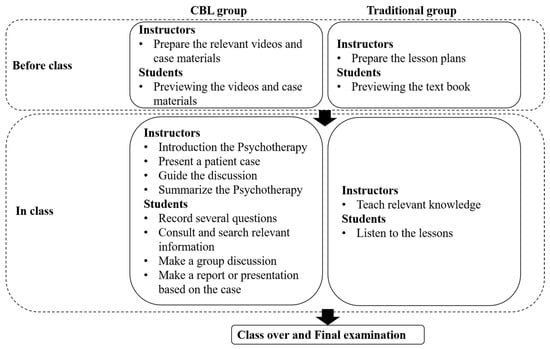
A quasi-experimental design was employed in this study. Given the educational research context, this design compared an experimental group and a traditional group recruited from pre-existing intact classes without random assignment. Pre-test and post-test measures were used to evaluate the effectiveness of the intervention (Figure 1). The teaching reform was implemented from September 2024 to September 2025. The case-based learning approach was applied to the psychotherapy course, and data were collected by the course director and a teaching assistant who hold doctoral degrees in psychology and professional qualifications in psychotherapy.
Figure 1.
Overview of the study design.
2.4. Instruments and Evaluation
To evaluate the effectiveness of case-based teaching, standardized assessment papers comprising case-based multiple-choice, fill-in-the-blank, true/false, definition, short-answer, and case analysis questions were administered to both the case and traditional groups. The total possible score was 100 points.
To gauge students’ subjective perceptions of the pedagogical reform, a self-developed case-based course evaluation survey including three parts was also employed.
- (1)
- Dimensions of Teaching Evaluation
This part consisted of 9 items measuring student satisfaction across distinct dimensions including teaching objectives, content delivery, instructional methods, and teaching quality. All items were rated on a 5-point scale, where 1 indicates “completely dissatisfied” and 5 indicates “very satisfied”. Given that these items reflect distinct conceptual dimensions, they were analyzed separately instead of being aggregated into a single composite score.
- (2)
- Perceived Skill Improvement
The second part was a 5-item scale assessing the perceived skill improvement. The 5 items were rated on a 5-point scale, and covered five aspect improvement: knowledge acquisition, skill enhancement, cognitive enhancement, emotional capability, and practical application. The skill improvement score was the mean score of the 5 items, and higher scores indicate a stronger perception of skill improvement. The scale was reviewed and revised by three psychology experts. The Cronbach’s alpha coefficient for the five items was 0.75, indicating acceptable internal consistency.
- (3)
- Course Teaching Satisfaction
The third part was a 14-item scale on a 5-point scale assessing teaching satisfaction, which was designed to evaluate students’ satisfaction with classroom teaching in each specific chapter of the course. The teaching satisfaction score was the mean of the 14 items, and higher scores indicate greater satisfaction. This scale was reviewed and revised by three psychology experts and exhibited good internal consistency, with a Cronbach’s alpha coefficient of 0.92.
2.5. Statistical Analysis
Independent sample t-tests were conducted to examine group differences, first for students’ evaluation of teaching and subsequently for quiz scores. To account for potential variance heterogeneity, Welch’s t-tests were adopted. To control the family-wise error rate arising from multiple comparisons, the significance level was adjusted via the Bonferroni correction and set at 0.005. A two-tailed p-value below 0.005 was regarded as indicating a statistically significant difference between the traditional and experimental groups.
3. Results
3.1. Construction of Psychotherapy Cases
We gathered clinical case scripts consistent with the content of the teaching clinical case repository for psychotherapy from teaching clinical hospitals. The teaching team then further standardized case writing by refining aspects such as clinical typicality, content comprehensiveness, interactivity in teaching implementation, skill transferability, and practical operability. This process yielded high-quality teaching practice cases (Appendix A).
3.2. Basic Characteristics and Information
All 13 participants in the traditional group and 8 participants in the experimental group completed the study. The traditional group consisted of nine males and four females, with a mean age of 22.85 years (SD = 0.69). The experimental group included five males and three females, with a mean age of 22.50 years (SD = 0.54). No significant between-group differences were observed in age or gender (ps > 0.05).
3.3. Student Evaluation of Teaching Analysis
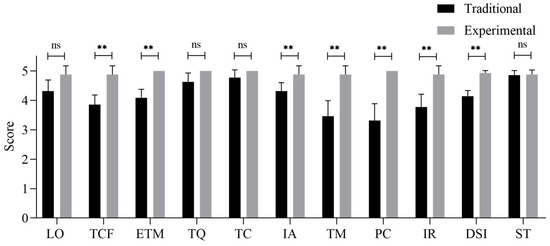
Independent sample t-tests were performed to compare student evaluation outcomes between the CBL and traditional groups, as presented in Table 1 and Figure 2. The results revealed that the experimental group achieved significantly higher scores than the traditional group in the following aspects: rationality of teaching content framework (t(18.93) = 5.19, p < 0.001), effectiveness of teaching methods (t(12) = 6.74, p < 0.001), satisfaction with teaching materials (t(17.13) = 5.17, p < 0.001), satisfaction with practical conditions (t(12) = 6.44, p < 0.001), satisfaction with information resources (t(18.37) = 4.67, p < 0.001), and degree of skill improvement (t(15.65) = 8.19, p < 0.001). These findings suggest that the CBL teaching method is associated with better overall teaching quality than the traditional teaching methods.
Table 1.
Comparison of mean scores between experimental and traditional groups on course evaluation variables.
Figure 2.
Mean scores of experimental and traditional groups on course evaluation variables. Error bars represent 95% confidence intervals; significance levels are based on Bonferroni correction; * p < 0.005, ** p < 0.001; ns = not significant (p ≥ 0.005).
3.4. The Comparison of Quiz Scores Between the Experimental and Traditional Groups
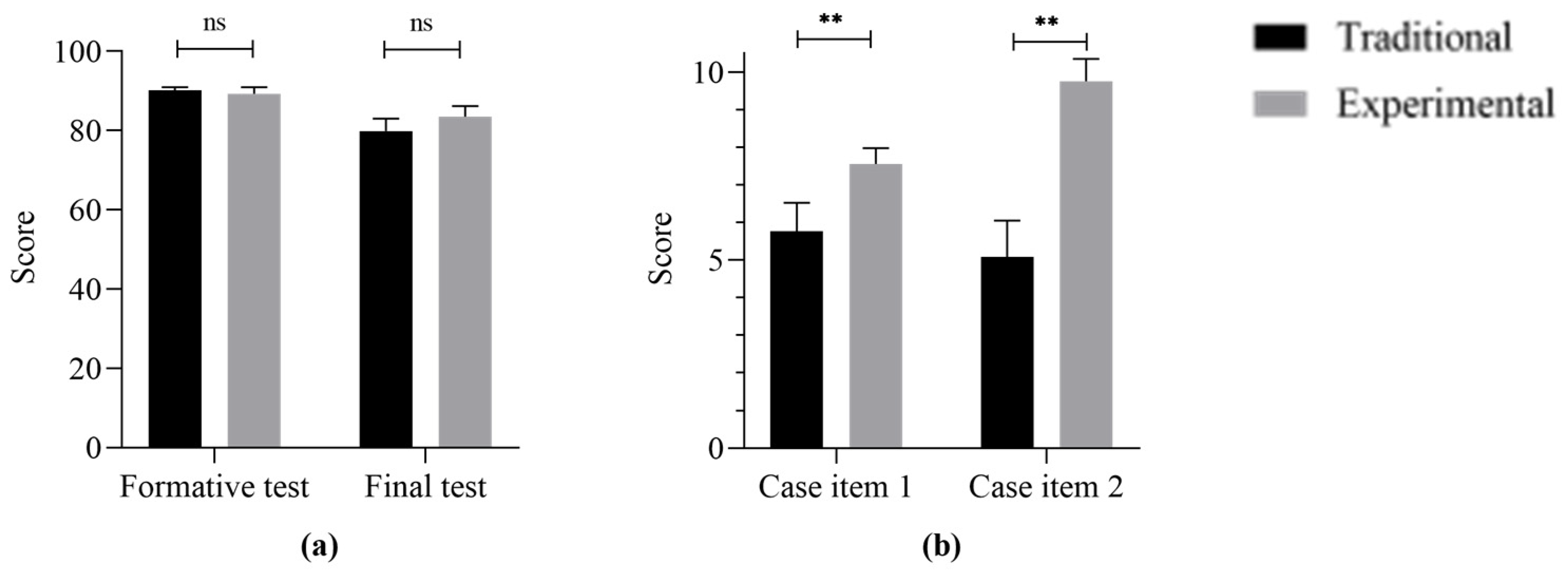
Independent sample t-tests were performed to compare formative and final exam scores between the experimental and traditional groups. As illustrated in Figure 3, no significant between-group differences were found in formative scores or final exam scores (p > 0.005). However, the experimental group significantly outperformed the traditional group on two case analysis items designed to assess practical and application competencies. Specifically, for Item 1, the experimental group (M = 7.56, SD = 0.50) attained significantly higher scores than the traditional group ((M = 5.77, SD = 1.24), t(17.09) = 4.66, p < 0.001, Cohen’s d = 1.75, 95% CI = [0.69, 2.77], post hoc power = 0.75). Similarly, a significant difference was observed for Item 2. The experimental group (M = 9.75, SD = 0.71) achieved higher scores than the traditional group ((M = 5.08, SD = 1.61), t(17.74) = 9.15, p < 0.001, Cohen’s d = 3.47, 95% CI = [2.05, 4.86], post hoc power > 0.99).
Figure 3.
Comparison of quiz scores between traditional and experimental groups. (a) Scores on the formative test (left) and final test (right). (b) Scores on Case Item 1 and Case Item 2 (case analysis questions). Error bars represent 95% confidence intervals; significance levels are based on Bonferroni correction; * p < 0.005, ** p < 0.001; ns = not significant (p ≥ 0.005).
4. Discussion
This study conducted a field experiment to compare the differences in teaching effectiveness between the CBL teaching method and traditional teaching method. It revealed that the CBL method was associated with pedagogical advantages over the traditional approach. These findings align with the constructivist learning theory, situated cognition theory and experiential learning cycle model (Atreya et al., 2023; Mukhalalati & Taylor, 2019; Villarroel Henríquez et al., 2025).
Firstly, from the perspective of constructivist learning theory, knowledge is not passively received but rather actively constructed by learners within specific contexts (Atreya et al., 2023; Xie et al., 2022). Traditional, lecture-based teaching often emphasizes the one-way transmission of school-specific theories and diagnostic criteria (Mayo, 2004). It leaves students prone to the predicament of “knowing the what but not the why” (Stockley & Forbes, 2014). However, clinical cases present complex, unstructured real-world scenarios that compel students to apply existing cognitive schemata (Kim et al., 2006). This forces students to actively reconstruct their conceptualization, assessment, and intervention strategies for each case. By analyzing the uniqueness of each client, students cease to be mere receptacles of theory but become active constructors of meaning (Karantalis & Koukopoulos, 2022). This deep processing significantly enhances knowledge retention and transferability (Zhang, 2024).
Moreover, clinical, case-based teaching seamlessly aligns with Kolb’s experiential learning cycle: concrete experience, reflective observation, abstract conceptualization, and active experimentation (Davitadze et al., 2022; Villarroel Henríquez et al., 2025; Wijnen-Meijer et al., 2022). Cases provide the “concrete experience”; classroom discussions facilitate “reflective observation”; and the theory integration guided by instructors achieves “abstract conceptualization” (Kim et al., 2006; Wu et al., 2023). Role-playing or devising new interventions constitutes “active experimentation” (Abdel-Wahed et al., 2024; Yan et al., 2023). In high-risk areas such as ethical decision-making and crisis intervention, case-based teaching allows students to engage in trial and error and reflection without harming actual clients (Alizadeh et al., 2024; Topperzer et al., 2022). This accumulation of “vicarious experience” surpasses purely theoretical learning and significantly reduces the trial-and-error costs in future clinical practice (Thistlethwaite et al., 2012; Wan Yunus et al., 2022).
As for the subjective teaching effectiveness, students who experienced the CBL method reported perceptions of a more logical course framework and more effective teaching strategies (Wu et al., 2023; Yan et al., 2023). They also expressed significantly higher satisfaction with the teaching experience. These outcomes reflect the core tenets of constructivist theory, which posits that knowledge is actively constructed through contextualization, collaboration, and interaction (Atreya et al., 2023; Thomas et al., 2014). In this study, the experimental group engaged in case-based learning and experiential activities rooted in real-world scenarios, which were designed to enhance their motivation and clarified the intrinsic logic of learning goals (Chytas et al., 2021; Liu et al., 2018). In contrast, the traditional group relied on passive self-directed pre-class preparation devoid of contextual relevance, resulting in lower ratings for content framework satisfaction. This highlights how case-based teaching effectively operationalizes the constructivist emphasis on situated learning (Choi et al., 2024).
Constructivism also advocates for instructors to act as facilitators rather than knowledge transmitters (Choi et al., 2024; Thomas et al., 2014). The CBL method, by integrating online and offline modalities, promoted instructor–student interactions and peer collaboration, addressing students’ demands for pedagogical innovation and practical learning conditions (Monahan & Yew, 2002). The blended approach, combining online resources, case analyses, and immersive experiences, created a richer sensory learning environment compared to the traditional lecture-based model (Sümen & Adibelli, 2024; Zhao et al., 2020). Students perceived greater support in terms of practical resources, access to information, and encouragement for creativity, contributing to their heightened satisfaction (Wu et al., 2023; Zhang, 2024). Additionally, the experimental group reported greater improvement in psychotherapy skills, suggesting that CBL’s structure—pre-class self-directed online learning coupled with in-person case discussions and collaborative tasks—facilitated deeper understanding and problem-solving abilities beyond superficial memorization (Alizadeh et al., 2024; Zhang, 2024).
More importantly, the experimental group’s superior case analysis performance aligns with evidence that active, contextualized learning enhances clinical reasoning and knowledge application better than passive lectures (Alizadeh et al., 2024; Dong et al., 2022; Wijnen-Meijer et al., 2022; Wu et al., 2023). By bridging theory and practice through collaborative problem-solving, CBL fosters the higher-order thinking skills essential for analyzing complex scenarios (Thistlethwaite et al., 2012; Zhang, 2024). The necessity of CBL is further demonstrated by the way it cultivates critical thinking. Real-life cases rarely align with textbook-style symptomatic patterns and often present comorbidities and contradictory information (Gillissen et al., 2022). When confronted with such cases, students must learn to question established assumptions, integrate diverse information, and formulate personalized treatment plans. This cognitive training is a core competency for psychotherapists and is indispensable for addressing the increasingly complex demands of mental health (Stefan & Sabine, 2025; Ravitz et al., 2019).
Contrary to the research hypotheses, no significant between-group differences were observed in the clarity of learning objectives, satisfaction with teaching quality/competence, overall course satisfaction, or formative and final exam scores. First, there is no significant difference between the two groups in the score of clarity of learning objectives. Beyond the potential influence of limited statistical power, this finding also suggests that although CBL alters the instructional format, it sustains a comparable level of learning objective clarity relative to traditional teaching method by both groups. Second, the comparable teaching satisfaction scores (TQ, TC, and CST) can be explained by the fact that the same instructors taught both groups. This indicates that students’ evaluations were likely shaped by the instructors’ consistent professional persona and teaching style. This also implies that a “Hawthorne effect”—where students’ awareness of being observed in an educational study might have temporarily boosted their engagement and satisfaction—was not a significant factor. Therefore, the advantages observed are more reasonably attributed to the specific pedagogical enhancements, such as the quality of teaching materials, practical conditions, and information resources. Third, no significant differences emerged between the groups in formative and final exam scores. This suggests that CBL is non-inferior to traditional teaching in promoting students’ mastery of foundational knowledge. Traditional exams generally emphasize factual memorization, an outcome that lecture-based teaching achieves effectively. The advantage of CBL appears domain-specific. It is probable that CBL is positively associated with students’ applied competencies and critical thinking abilities, as reflected in the experimental group’s significantly higher scores on the case analysis items.
In summary, the CBL method is an indispensable core element of psychotherapy education, rather than an optional embellishment. Grounded in solid pedagogical theory, it transforms dull theory into vivid human narratives. This approach resolves the persistent disconnect between theory and practice and comprehensively shapes future psychotherapists’ cognitive, affective, and skill-based dimensions. As educators, we must continuously seek high-quality case studies and refine case-based teaching methodologies to cultivate professional talents with both theoretical depth and practical warmth.
5. Conclusions and Limitations
The findings suggest that the CBL method reflects the application of constructivist principles in practice—contextualized learning, collaborative engagement, and active participation. The blended online–offline approach proved particularly effective in enhancing student involvement and autonomy. To further optimize teaching outcomes, educators could enhance interactive online resources by integrating real-time feedback systems and generative AI-powered virtual simulation cases (Meinlschmidt et al., 2025; Wagner & Schwind, 2025; Wei et al., 2025). It is also recommended to adopt diversified assessment methods, such as collaborative projects, to reduce overreliance on exam-based evaluations (Chan & Ahn, 2023; Wlodarczyk et al., 2021). Priority should be given to conducting instructor training and providing technical support to enable instructors to acquire blended teaching competencies and ensure the smooth integration of digital tools.
There are several limitations in this study. First, the small sample size may have limited the detection of statistically significant differences in the final exam performance. Second, the evaluation of teaching effectiveness focused solely on short-term outcomes post-intervention, neglecting long-term impacts on students’ competencies and cognitive transformations. Third, although the two groups were comparable in demographic characteristics and academic backgrounds, no formal baseline assessment of prior psychotherapy knowledge was performed. Fourth, the quasi-experimental design constrains causal inference. Specifically, the absence of a formally validated pre-test means that potential initial differences and unobserved cohort confounding could not be strictly controlled, meaning the findings reflect associations rather than causal links between teaching methods and learning outcomes. Future studies should incorporate larger samples, conduct longitudinal follow-up, and employ standardized pre-test tools and robust experimental approaches to further clarify the causal link between teaching methods and learning outcomes.
Author Contributions
Conceptualization, J.W. and H.-P.L.; methodology, C.B. and J.-X.Z.; data analysis, D.-Y.S., J.-Y.L., Y.-C.Z. and M.-Y.Z.; investigation, L.-L.W., F.-F.W., J.J. and Y.-T.X.; project administration, Y.H. and G.-Y.Y. All authors have read and agreed to the published version of the manuscript.
Funding
This research was funded by Project of the Higher Education Psychology Specialty Teaching Guidance Committee of the Ministry of Education and Research Project on Educational Reform of the Army Medical University (2025B25).
Institutional Review Board Statement
This study was conducted in accordance with the Declaration of Helsinki and approved by the ethics committee of the Army Medical University on 24 January 2023.
Informed Consent Statement
Informed consent was obtained from all subjects involved in the study.
Data Availability Statement
The original contributions presented in this study are included in the article. Further inquiries can be directed to the corresponding author.
Conflicts of Interest
The authors declare no conflicts of interest.
Abbreviations
The following abbreviations are used in this manuscript:
| CBL | Case-Based Learning |
| IDDIE | Analyze–Design–Develop–Implement–Evaluate |
Appendix A
The appendix is an optional section that can contain details and data supplemental to the main text—for example, explanations of experimental details that would disrupt the flow of the main text but nonetheless remain crucial to understanding and reproducing the research shown; figures of replicates for experiments of which representative data is shown in the main text can be added here if brief, or as Supplementary data. Mathematical proofs of results not central to the paper can be added as an appendix.
Table A1.
Construction of psychotherapy cases.
References
- Abdel-Wahed, N., Badahdah, A., Qutob, A. F., Bahanan, L., & Bukhary, S. M. N. (2024). The effectiveness of integrating role play into case-based learning in dental education: Enhancing critical thinking and teamwork skills. BMC Medical Education, 24(1), 1531. [Google Scholar] [CrossRef] [Scilit]
- Al-bedaery, R., Baig, S., Khare, Y., & Sullivan-Mchale, J. (2024). Humanising case-based learning. Medical Teacher, 46(10), 1348–1355. [Google Scholar] [CrossRef] [Scilit]
- Alizadeh, M., Saramad, A., Rafiepoor, H., Taghvaei, A., Rayati, R., Sibevei, S., Seyyedlar, Z. S., Peighambardoust, S., Zomorrodi, A., & Taghavi, A. A. (2024). Effect of virtual case-based learning (CBL) using the flipped class and peer instruction on the motivation to learn basic sciences. BMC Medical Education, 24(1), 1230. [Google Scholar] [CrossRef] [Scilit]
- American Psychological Association. (2017). Ethical principles of psychologists and code of conduct (2002, amended effective June 1, 2010, and January 1, 2017). Available online: https://www.apa.org/ethics/code (accessed on 24 May 2026).
- Atreya, S., Datta, S. S., & Salins, N. (2023). Using social constructivist learning theory to unpack general practitioners’ learning preferences of end-of-life care: A systematically constructed narrative review. Indian Journal of Palliative Care, 29, 368–374. [Google Scholar] [CrossRef] [Scilit]
- Chan, J. C. K., & Ahn, D. (2023). Unproctored online exams provide meaningful assessment of student learning. Proceedings of the National Academy of Sciences, 120(31), e2302020120. [Google Scholar] [CrossRef] [Scilit]
- Choi, Y.-R., Lee, Y.-N., Kwon, D. Y., Kim, D., Park, W. H., & Chang, S. O. (2024). The development and effects of a social constructivist approach in an interprofessional discomfort care online education program. BMC Medical Education, 24(1), 1363. [Google Scholar] [CrossRef] [Scilit] [PubMed]
- Chytas, D., Mitrousias, V., Raoulis, V., Banios, K., Fyllos, A., & Zibis, A. H. (2021). A review of the outcomes of the implementation of case-based anatomy learning. Cureus, 13, e19179. [Google Scholar] [CrossRef] [Scilit]
- Collard, J. (2024). Use of self-practice/self-reflection (SP/SR) exercises for competency-based training and assessment in CBT. The Cognitive Behaviour Therapist, 17, e1. [Google Scholar] [CrossRef] [Scilit]
- Davitadze, M., Ooi, E., Ng, C. Y., Zhou, D., Thomas, L., Hanania, T., Blaggan, P., Evans, N., Chen, W., Melson, E., Arlt, W., & Kempegowda, P. (2022). SIMBA: Using Kolb’s learning theory in simulation-based learning to improve participants’ confidence. BMC Medical Education, 22(1), 116. [Google Scholar] [CrossRef] [Scilit] [PubMed]
- Dong, H., Guo, C., Zhou, L., Zhao, J., Wu, X., Zhang, X., & Zhang, X. (2022). Effectiveness of case-based learning in Chinese dental education: A systematic review and meta-analysis. BMJ Open, 12(2), e048497. [Google Scholar] [CrossRef] [Scilit] [PubMed]
- Dwyer, S. C. (2020). The Impact of ESL discussion groups in an undergraduate counselling psychology course. International Dialogues on Education: Past and Present, 7(1), 149–155. [Google Scholar] [CrossRef] [Scilit]
- Fan, Y. Y. (2025). Global burden of mental disorders in 204 countries and territories, 1990–2021: Results from the global burden of disease study 2021. BMC Psychiatry, 12(25), 486. [Google Scholar] [CrossRef] [Scilit]
- Freeman, M. (2022). World mental health report: Transforming mental health for all. World Psychiatry: Official Journal of the World Psychiatric Association (WPA), 21(3), 391–392. [Google Scholar] [CrossRef] [Scilit]
- GBD 2019 Mental Disorders Collaborators. (2022). Global, regional, and national burden of 12 mental disorders in 204 countries and territories, 1990–2019: A systematic analysis for the global burden of disease study 2019. The Lancet Psychiatry, 9(2), 137–150. [Google Scholar] [CrossRef] [Scilit] [PubMed]
- Gillissen, A., Kochanek, T., Zupanic, M., & Ehlers, J. P. (2022). Millennial medical students’ motivation towards key aspects of medical professionalism: A mixed-methods study. Advances in Medical Education and Practice, 13, 1305–1318. [Google Scholar] [CrossRef] [Scilit] [PubMed]
- Harvard Business School. (2022). What is the case method? Available online: https://www.hbs.edu/case-method-project/about/Pages/case-method-teaching.aspx (accessed on 24 May 2026).
- Heinze, P. E., Koneke, V., Weck, F., & Bartling, A. (2024). The relation between knowledge and skills assessments in psychotherapy training. Training and Education in Professional Psychology, 18(2), 162–167. [Google Scholar] [CrossRef] [Scilit]
- Karantalis, N., & Koukopoulos, D. (2022). Utilizing digital storytelling as a tool for teaching literature through constructivist learning theory. SN Social Sciences, 2(7), 109. [Google Scholar] [CrossRef] [Scilit]
- Karimi-Aghdam, S. (2017). Zone of proximal development (ZPD) as an emergent system: A dynamic systems theory perspective. Integrative Psychological & Behavioral Science, 51(1), 76–93. [Google Scholar] [CrossRef] [Scilit]
- Kassirer, J. P. (2010). Teaching clinical reasoning: Case-based and coached. Academic Medicine, 85(7), 1143–1145. [Google Scholar] [CrossRef] [Scilit]
- Kim, S., Phillips, W. R., Pinsky, L., Brock, D., Phillips, K., & Keary, J. (2006). A conceptual framework for developing teaching cases: A review and synthesis of the literature across disciplines. Medical Education, 40(9), 867–876. [Google Scholar] [CrossRef] [Scilit]
- Liu, A., Zhou, L. L., Lam, A., & Dahlke, E. (2018). Case-based learning in dermatology. Journal of Cutaneous Medicine and Surgery, 22(3), 273–279. [Google Scholar] [CrossRef] [Scilit]
- Luo, Z. Y., Zhu, L. Z., Shan, S. Y., Zhou, J. L., Ying, J. Y., & Song, P. G. (2026). Global, regional, and national burden of five major mental disorders in working-age population, 1990–2021: A systematic analysis for the global burden of disease Study 2021. Journal of Affective Disorders, 403, 121243. [Google Scholar] [CrossRef] [Scilit] [PubMed]
- Mayo, J. A. (2004). Using case-based instruction to bridge the gap between theory and practice in psychology of adjustment. Journal of Constructivist Psychology, 17(2), 137–146. [Google Scholar] [CrossRef] [Scilit]
- Meinlschmidt, G., Koc, S., Boerner, E., Tegethoff, M., Simacek, T., Schirmer, L., & Schneider, M. (2025). Enhancing professional communication training in higher education through artificial intelligence(AI)-integrated exercises: Study protocol for a randomised controlled tria. BMC Medical Education, 25(1), 804. [Google Scholar] [CrossRef] [Scilit]
- Monahan, C. M., & Yew, A. C. (2002). Adapting a case-based, cooperative learning strategy to a veterinary parasitology laboratory. Journal of Veterinary Medical Education, 29(3), 186–192. [Google Scholar] [CrossRef] [Scilit]
- Mukhalalati, B. A., & Taylor, A. (2019). Adult learning theories in context: A quick guide for healthcare professional educators. Journal of Medical Education and Curricular Development, 6, 2382120519840332. [Google Scholar] [CrossRef] [Scilit] [PubMed]
- O’Brien, R. T., Rijn, B., & Charura, D. (2024). Training, assessment and competence in counselling for depression: A qualitative study of trainee and trainer perspectives. Counselling and Psychotherapy Research, 24, 1670–1680. [Google Scholar] [CrossRef] [Scilit]
- Ravitz, P., Berkhout, S., Lawson, A., Kay, T., & Meikle, S. (2019). Integrating evidence-supported psychotherapy principles in mental health case management: A capacity-building pilot. Revue Canadienne de Psychiatrie [Canadian Journal of Psychiatry], 64(12), 855–862. [Google Scholar] [CrossRef] [Scilit]
- Stefan, B., & Sabine, S. L. (2025). Competence measurement in university psychotherapy training—A pilot study. Psychotherapie, Psychosomatik, Medizinische Psychologie, 75(5), 181–187. [Google Scholar] [CrossRef] [Scilit]
- Stockley, A. J., & Forbes, K. (2014). Medical professionalism in the formal curriculum: 5thyear medical students’ experiences. BMC Medical Education, 14(1), 259. [Google Scholar] [CrossRef] [Scilit]
- Sümen, A., & Adibelli, D. (2024). The effect of case-based teaching method on professional competence and clinical decision-making levels of public health nursing students: A sequential explanatory mixed-methods study. Public Health Nursing, 41(3), 446–457. [Google Scholar] [CrossRef] [Scilit] [PubMed]
- Tang, S., Deng, S., Tian, Y., Qiu, M., & Zhang, S. (2026). Integrating multidisciplinary team teaching with case-based learning in urology internship education. BMC Medical Education, 26(1), 541. [Google Scholar] [CrossRef] [Scilit]
- Thistlethwaite, J. E., Davies, D., Ekeocha, S., Kidd, J. M., MacDougall, C., Matthews, P., Purkis, J., & Clay, D. (2012). The effectiveness of case-based learning in health professional education. A BEME systematic review: BEME Guide No. 23. Medical Teacher, 34(6), e421–e444. [Google Scholar] [CrossRef] [Scilit]
- Thomas, A., Menon, A., Boruff, J., Rodriguez, A. M., & Ahmed, S. (2014). Applications of social constructivist learning theories in knowledge translation for healthcare professionals: A scoping review. Implementation Science, 9(1), 54. [Google Scholar] [CrossRef] [Scilit]
- Topperzer, M. K., Roug, L. I., Andrés-Jensen, L., Pontoppidan, P., Hoffmann, M., Larsen, H. B., Schmiegelow, K., & Sørensen, J. L. (2022). Twelve tips for postgraduate interprofessional case-based learning. Medical Teacher, 44(2), 130–137. [Google Scholar] [CrossRef] [Scilit]
- Villarroel Henríquez, V., Castillo Rabanal, I., & Santana Abásolo, J. (2025). Applying Kolb’s experiential learning cycle for deep learning: A systematic literature review. Social Sciences & Humanities Open, 12, 102096. [Google Scholar] [CrossRef] [Scilit]
- Wagner, J., & Schwind, A.-S. (2025). Investigating psychotherapists’ attitudes towards artificial intelligence in psychotherapy. BMC Psychology, 13(1), 719. [Google Scholar] [CrossRef] [Scilit]
- Wan Yunus, F., Romli, M. H., Mohd Rasdi, H. F., Harun, D., & Kadar, M. (2022). An innovation on clinical placement for occupational therapy mental health during the COVID-19: A mixed-methods feasibility study. Frontiers in Medicine, 9, 967511. [Google Scholar] [CrossRef] [Scilit] [PubMed]
- Wei, H., Dai, Y., Yuan, K., Li, K. Y., Hung, K. F., Hu, E. M., Lee, A. H. C., Chang, J. W. W., Zhang, C., & Li, X. (2025). AI-powered problem-and case-based learning in medical and dental education: A systematic review and meta-analysis. International Dental Journal, 75(4), 100858. [Google Scholar] [CrossRef] [Scilit]
- Wijnen-Meijer, M., Brandhuber, T., Schneider, A., & Berberat, P. O. (2022). Implementing Kolb’s experiential learning cycle by linking real experience, Case-based discussion and simulation. Journal of Medical Education and Curricular Development, 9, 23821205221091511. [Google Scholar] [CrossRef] [Scilit] [PubMed]
- Wlodarczyk, S., Muller-Juge, V., Hauer, K. E., Tong, M. S., Ransohoff, A., & Boscardin, C. (2021). Assessment to optimize learning strategies: A qualitative study of student and faculty perceptions. Teaching and Learning in Medicine, 33(3), 245–257. [Google Scholar] [CrossRef] [Scilit]
- Wu, F., Wang, T., Yin, D., Xu, X., Jin, C., Mu, N., & Tan, Q. (2023). Application of case-based learning in psychology teaching: A meta-analysis. BMC Medical Education, 23(1), 609. [Google Scholar] [CrossRef] [Scilit] [PubMed]
- Xie, Z., Ren, L., Zhan, Q., & Liu, Y. (2022). A constructivist ontology relation learning method. IEEE Transactions on Cybernetics, 52(7), 6434–6441. [Google Scholar] [CrossRef] [Scilit] [PubMed]
- Yan, Y., Zhang, Y., Jia, S., Huang, Y., Liu, Y., Liu, Y., Zhu, H., & Wen, H. (2023). Using case-based learning supported by role-playing situational teaching method in endocrine physiology education. Advances in Physiology Education, 48(3), 498–504. [Google Scholar] [CrossRef] [Scilit]
- Zhang, S.-L. (2024). Which novel teaching strategy is most recommended in medical education? A systematic review and network meta-analysis. BMC Medical Education, 24, 1342. [Google Scholar] [CrossRef] [Scilit]
- Zhao, W., He, L., Deng, W., Zhu, J., Su, A., & Zhang, Y. (2020). The effectiveness of the combined problem-based learning (PBL) and case-based learning (CBL) teaching method in the clinical practical teaching of thyroid disease. BMC Medical Education, 20(1), 381. [Google Scholar] [CrossRef] [Scilit]
- Zhou, T., Wang, H., & Jiang, X. (2026). Integrating case-based learning (CBL) and concept mapping (CM) enhances learning outcomes in medical biochemistry. BMC Medical Education, 26(1), 397. [Google Scholar] [CrossRef] [Scilit] [PubMed]

Disclaimer/Publisher’s Note: The statements, opinions and data contained in all publications are solely those of the individual author(s) and contributor(s) and not of MDPI and/or the editor(s). MDPI and/or the editor(s) disclaim responsibility for any injury to people or property resulting from any ideas, methods, instructions or products referred to in the content. |
© 2026 by the authors. Licensee MDPI, Basel, Switzerland. This article is an open access article distributed under the terms and conditions of the Creative Commons Attribution (CC BY) license.