


Abstract
This study examined how digital equity conditions and bundled professional development policies are associated with sustainable teacher learning, self-efficacy, and student engagement in Greek primary schools. A total of 460 in-service teachers from urban, suburban, and rural areas participated in the study. Data were collected through Likert-scale measures assessing information systems use, TPACK-aligned professional development outcomes, teacher self-efficacy, implementation challenges, and student engagement. The analysis included ANOVA, MANOVA, OLS regression with interaction terms, and theory-informed indirect-pathway models. The findings indicated that infrastructure funding alone was not significantly associated with teacher capacity or student engagement after the introduction of relevant controls. More consistent associations emerged when funding was combined with mandated and time-protected professional development, together with minimum connectivity standards. Teacher self-efficacy was consistent with a partial indirect pathway between information systems use and student engagement, while stronger indirect associations were observed among early-career teachers. In addition, a bundled governance index was associated with narrower urban–rural disparities in teacher capacity. The findings suggest that sustainable digital equity in primary education depends not only on access to resources but also on coherent professional support structures that are associated with teacher confidence, instructional continuity, and long-term engagement. Implications are discussed for the design of sustainable professional development policies in teacher education and primary schooling.
1. Introduction
Digital transformation in schools has reshaped not only classroom practices but also the ways in which teachers learn, are mentored, and engage in professional development. In the current phase of educational digitalization, this transformation is no longer limited to emergency technology adoption or the provision of devices. It increasingly involves platform-based instruction, digital assessment systems, student data infrastructures, communication tools, and emerging AI-supported educational resources. These developments require teachers to exercise pedagogical, ethical, and organizational judgment, because digital tools do not automatically produce equitable or pedagogically meaningful outcomes unless they are supported by coherent conditions of access, professional learning, and institutional governance (Ghanbaripour et al., 2024; UNESCO, 2023). In many education systems, large-scale investments in devices, platforms, and connectivity were rapidly followed by new initiatives in digital teacher professional development (TPD). Yet evidence from teacher education suggests that access to tools alone is insufficient when professional learning remains fragmented, voluntary, or weakly connected to classroom practice. For providers of preservice and in-service teacher education, the central question is no longer whether teachers use digital technologies, but under which governance and professional learning conditions such tools translate into sustained pedagogical change and more sustainable forms of digital equity.
The Greek primary education system offers a particularly relevant context for examining sustainable digital equity because it combines centralized policy direction with locally uneven implementation conditions. Although digital education policies, platform provision, and professional development initiatives are often designed or coordinated at the national level, their enactment depends on school-level factors such as internet connectivity, device availability, technical support, leadership routines, and teachers’ confidence in using digital tools pedagogically. These differences are especially important across urban, suburban, and rural primary schools, where access to reliable infrastructure and sustained professional learning opportunities may vary considerably. In this context, digital equity cannot be understood only as access to devices or platforms; it must also be examined as teachers’ capacity to use digital systems meaningfully, confidently, and consistently in everyday classroom practice.
In Greece, as elsewhere, the current challenge is no longer limited to whether schools have adopted digital technologies, but whether digital systems are supported by the professional, organizational, and infrastructural conditions required for meaningful use. Primary schools increasingly rely on learning platforms, digital content environments, student information systems, assessment tools, communication platforms, and emerging AI-supported resources. The expansion of emerging technologies in education has intensified the need to examine not only access, but also the pedagogical and organizational conditions under which digital tools support learning and engagement (Ghanbaripour et al., 2024). However, these tools do not automatically produce equitable or pedagogically valuable outcomes. Prior research has shown that teachers’ motivation, beliefs, and self-efficacy are central to technology use (Backfisch et al., 2021; Gebhardt et al., 2019; Georgiou et al., 2023), yet intention alone rarely translates into meaningful integration without enabling conditions such as reliable infrastructure, targeted TPD, and institutional support (UNESCO, 2023). Digital equity therefore depends not only on technological access, but also on whether teachers are supported to develop the confidence, competence, and pedagogical judgment needed to integrate digital systems into instruction.
In the present study, IS is defined broadly to include learning management systems (LMS), student information systems (SIS), assessment platforms, collaboration tools, and digital content environments. This broader definition is important because school technologies are no longer limited to administrative platforms or emergency remote teaching tools. Digital systems increasingly support lesson planning, formative assessment, feedback, communication with families, collaboration among teachers, data-informed instruction, and, more recently, AI-assisted forms of educational support. The focus is on how these systems are associated with changes in professional practice through collaboration, feedback, and adaptive instruction when supported by coherent policy and professional learning instruments. From a teacher education perspective, such systems become part of the learning environment through which teachers experience modeled digital pedagogy, receive feedback, and participate in communities of practice. However, the educational value of these systems depends on whether teachers have the professional knowledge, time, infrastructure, and institutional support required to use them critically and pedagogically. Evidence from recent digital education research indicates that digital environments can strengthen teacher capacity and agency, but such effects depend on systemic supports including training, monitoring, and resource adequacy (Eradze et al., 2023; Perry, 2023; Yang et al., 2024). These conditions are especially salient in rural schools, where infrastructure and PD opportunities often lag behind those in urban settings (Mustafa et al., 2024; Singh et al., 2021; Ventista et al., 2024a, 2024b).
Within the Greek primary education context, the implementation of educational IS is shaped by three core governance instruments: (a) resource allocation rules for devices and connectivity, including targeted grants and pooled procurement; (b) minimum service standards, such as device-to-student ratios, bandwidth thresholds, and platform availability, monitored by regional directorates; and (c) mandated TPD in digital pedagogy and assessment linked to classroom IS use. Together, these instruments define how schools and teacher professional learning are governed through funding formulas, standards and audits, and capacity-building requirements. This governance perspective is especially important in Greece because national-level policy design may appear coherent, while the actual capacity of schools to implement digital education depends on local conditions, including geographical location, school size, technical support, and teachers’ access to structured professional learning. For teacher education providers and school leaders, this policy bundle shapes the conditions under which digital TPD can be protected within school timetables, aligned with curricular expectations, and supported by adequate infrastructure.
Anchored in the governance of compulsory schooling, the present study treats IS funding, mandated and time-protected TPD, and minimum connectivity standards as policy instruments that structure digital teacher learning. The analysis focuses on in-service primary teachers as learners within a broader professional development system and asks when such policy levers enable them to build the TPACK necessary for technology-enhanced pedagogy. Gains in engagement are expected to emerge most clearly when funding is tied to accredited TPD and enforceable service standards. In addition, bundled governance arrangements combined with monitoring are expected to reduce rural–urban disparities by strengthening teacher self-efficacy. Thus, the study moves beyond access-based accounts of digital equity and examines whether coordinated governance arrangements can support teachers’ sustained digital capacity in an increasingly platform-based and AI-aware educational environment. The study therefore speaks both to education policymakers and to teacher educators responsible for designing digital professional development architectures.
Accordingly, the study addresses four research questions concerning the relationship between governance instruments and teacher education outcomes in Greek primary schools:
RQ1. How are the three governance levers—(a) infrastructure funding, (b) mandated and time-protected TPD, and (c) minimum connectivity/service standards—associated with teacher capacity (skills enhancement and collaboration) across urban, suburban, and rural schools?
RQ2. Are bundled configurations (Funding × TPD, Funding × Standards, TPD × Standards) associated with higher reported teacher capacity and engagement than single levers?
RQ3. Is teacher self-efficacy consistent with an indirect pathway between IS use and student engagement, and does this pathway vary by career stage (age/experience) and locale?
RQ4. What equity-related patterns emerge under different governance configurations, particularly with respect to rural–urban gaps in teacher capacity and student engagement?
By combining governance instruments with TPACK and Diffusion of Innovations, the study contributes to digital teacher education and digital equity research in three ways. First, it situates Greek primary schools as a theoretically meaningful case of centralized digital reform operating under locally uneven implementation conditions. Second, it shifts attention from access-oriented accounts of digital equity to the combined role of infrastructure, mandated and time-protected professional development, minimum service standards, and teacher self-efficacy. Third, it extends the discussion beyond post-COVID technology adoption by examining how contemporary digital transformation—including platform-based schooling, data-informed instruction, and emerging AI-related pressures—requires coherent governance bundles that support teachers’ sustained instructional capacity across diverse school contexts.
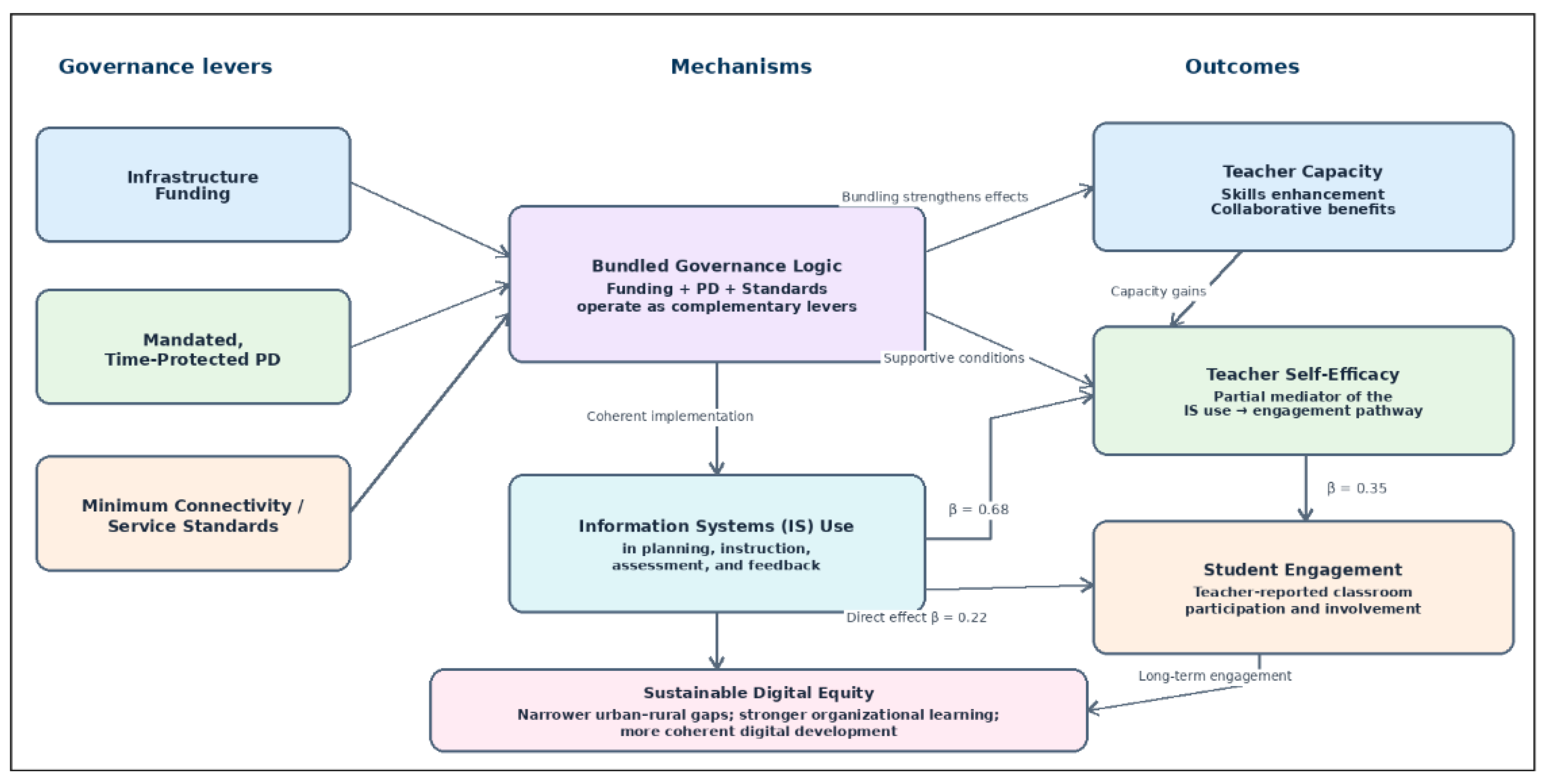
To clarify the conceptual and analytical structure of the study, Figure 1 presents the proposed relationships among the governance levers, information systems use, teacher self-efficacy, teacher capacity, student engagement, and sustainable digital equity. Figure 1 summarizes the central argument that infrastructure funding, mandated and time-protected professional development, and minimum connectivity/service standards are expected to be more strongly associated with teacher capacity when they operate as a coordinated policy bundle rather than as isolated measures. It also illustrates the mediating role of teacher self-efficacy and the expected contribution of bundled governance to reducing urban–rural disparities in teacher capacity and engagement.
Figure 1.
Conceptual and empirical model of sustainable digital equity, teacher self-efficacy, and student engagement in Greek primary schools. Colored boxes distinguish the main components of the model, including governance levers, mechanisms, teacher-related outcomes, student-related outcomes, and the overarching equity outcome.
As shown in Figure 1, the study is grounded in the assumption that sustainable digital equity is not produced by single policy instruments in isolation, but by the alignment of resources, standards, and professional learning conditions. In this framework, teacher self-efficacy is positioned as a key explanatory mechanism linking information systems use with student engagement, while bundled governance is expected to strengthen teacher capacity and narrow urban–rural gaps. The model also reflects the broader argument that digital equity in contemporary primary education must be understood as a sustainable governance issue rather than as a short-term response to emergency digitalization. The figure therefore provides an integrative overview of the model that guides the research questions, variable selection, and subsequent analyses.
2. Literature Review
Much of the educational technology literature has equated the success of information systems (IS) with individual-level adoption, treating teachers’ motivation, beliefs, and self-efficacy as the primary drivers of use (Backfisch et al., 2021; Gebhardt et al., 2019; Georgiou et al., 2023). Although these dispositions are important, this line of work often attributes too much explanatory weight to attitudinal measures derived from self-report surveys while underestimating the organizational and policy conditions that make sustained use possible. Two major limitations follow. First, an intention–behavior gap persists: positive attitudes rarely translate into routinized classroom practice when infrastructure, time, or targeted training are lacking (Al-Maroof et al., 2023; Mehta et al., 2019; Tondeur et al., 2018). Second, adoption studies rarely model the policy instruments—funding rules, minimum service standards, and mandated teacher professional development (TPD)—that shape whether digital tools produce measurable gains in teaching and learning. As a result, the field has not sufficiently shifted from asking who is willing to adopt technology to examining under which governance and professional learning conditions adoption leads to meaningful outcomes.
Recent digital education research increasingly shows that the central challenge is not technology adoption alone, but the sustainability, quality, and equity of digital use under ordinary school conditions. The expansion of learning platforms, digital assessment systems, student data infrastructures, communication tools, and AI-supported applications has increased the demands placed on teachers. These developments require not only technical access, but also pedagogical competence, ethical judgment, data awareness, and confidence in adapting digital tools to students’ needs. Evidence from teacher education and professional development research indicates that digital competence is strengthened when teachers receive structured, practice-oriented, and institutionally supported professional learning rather than isolated workshops or voluntary training opportunities (Budianto et al., 2023; Charania et al., 2023; Elmaadaway & Abouelenein, 2023; Philipsen et al., 2019). However, these enabling conditions are still often treated as background variables rather than as governance instruments whose separate and combined effects can be empirically examined.
A related limitation concerns the conceptual treatment of IS itself. Definitions often list platforms—learning management systems, student information systems, assessment tools, and collaboration environments—without distinguishing between administrative and instructional uses or clarifying the functional thresholds that make them educationally meaningful. This conceptual looseness introduces measurement ambiguity: increased SIS logins, for example, may reveal little about pedagogy, whereas assessment platforms may improve feedback only when connectivity and training exceed minimum operational thresholds. This ambiguity becomes even more important as schools adopt more data-rich and AI-adjacent digital systems, where the difference between superficial platform use and pedagogically meaningful use becomes increasingly consequential. A socio-technical perspective therefore suggests that the value of IS depends jointly on technical service standards and capacity building through structured, aligned TPD. From a teacher education perspective, this raises an important question: do isolated investments in funding or standards systematically underperform compared with coordinated policy bundles that protect time for learning, model digital pedagogy, and support follow-up coaching?
Although teacher factors remain necessary, they are not sufficient. Motivation and acceptance explain some variation in IS use (Backfisch et al., 2021; Gebhardt et al., 2019; Mbatha, 2024; Wu, 2019), but this literature is often constrained by mono-method designs, context under-specification, and the omission of capacity requirements and equity conditions as explanatory factors. These limitations become particularly important when digital inequality is considered. Beyond first-order access gaps, second-order digital divides—differences in the effective use of technology—persist even in comparatively well-resourced systems (Lebeničnik & Istenič Starčič, 2020; van Dijk, 2017). Rural schools, in particular, tend to face weaker infrastructure, fewer local PD opportunities, and higher participation costs (Mustafa et al., 2024; Singh et al., 2021; Ventista et al., 2024a, 2024b). Even so, many studies stop short of testing how policy design shapes the distribution of teacher learning opportunities across contexts. This gap is especially relevant for Greek primary education, where national digital education priorities may be centrally coordinated, but teachers’ actual opportunities to develop digital capacity are shaped by local infrastructure, school location, available support, and access to sustained professional learning.
Professional development is similarly under-theorized when viewed from a governance perspective. TPACK provides a robust framework for understanding how pedagogy, content, and technology must be aligned for effective instruction (Mishra & Koehler, 2006), and research has shown that online, adaptive, and practice-oriented PD can strengthen digital skills and collaborative teaching practice (Budianto et al., 2023; Charania et al., 2023; Elmaadaway & Abouelenein, 2023). Nevertheless, PD is frequently treated as a one-off intervention rather than as a structured capacity regime with designable properties such as time protection, curricular alignment, accountability, and conditionality. This limitation is increasingly problematic because contemporary digital teaching requires more than platform familiarity. Teachers are expected to select digital tools, interpret data, support students’ participation, respond to technical disruptions, communicate through digital channels, and make informed judgments about emerging AI-supported resources. The more consequential question for teacher education, therefore, is not simply whether TPD is available, but how mandated, time-protected, and digitally aligned PD interacts with funding and service standards to produce durable gains in teacher capacity and student engagement.
Claims regarding student engagement also require caution. IS are often assumed to enhance personalization, monitoring, and active participation (Popescu et al., 2022; Viberg et al., 2020), yet much of the evidence relies on teacher-reported engagement, which is vulnerable to expectancy effects and contextual bias. Retaining engagement as a teacher-reported outcome is still defensible when its limitations are acknowledged and when it is interpreted alongside related indicators, such as PD outcomes or observed classroom practice. In this respect, modeling teacher self-efficacy as a mediator between IS use and engagement offers a more theoretically grounded alternative to simplistic claims that technology directly causes engagement. Such a model helps connect digital governance, TPD design, and classroom-level processes in a more coherent way. It also reflects the possibility that digital tools influence classroom participation partly through teachers’ confidence in orchestrating digitally enriched instruction, rather than through the mere presence of technology itself.
The concept of bundled governance extends existing policy-mix and implementation-capacity perspectives by focusing specifically on how combinations of policy instruments condition teachers’ digital practice. Policy-mix approaches emphasize that instruments often operate in combination rather than isolation, while implementation-capacity frameworks highlight the organizational resources required to enact reforms. Bundled governance, as used in this study, connects these perspectives to teacher professional development and digital equity by examining whether infrastructure funding, mandated and time-protected TPD, and minimum service standards function as mutually reinforcing conditions. The concept therefore differs from a general policy-mix account because it is not concerned only with the coexistence of multiple instruments. Instead, it examines whether the alignment of resources, professional learning requirements, and service guarantees creates the conditions under which teachers can develop sustainable digital capacity.
Within the highly centralized but locally heterogeneous Greek primary education system, this perspective makes it possible to test whether allocation rules, minimum service standards, and mandated TPD operate as complements rather than substitutes, and whether bundled governance arrangements can narrow second-order digital divides, particularly for rural schools. The present study addresses this gap by examining how governance instruments, teacher self-efficacy, and IS use are jointly associated with teacher capacity, student engagement, and more sustainable forms of digital equity. By doing so, the study responds directly to a current digital education problem: how school systems can move beyond access provision toward coherent governance arrangements that support equitable, confident, and pedagogically meaningful digital practice in primary education.
3. Methodology
3.1. Research Design and Participants
This study employed a cross-sectional survey design to examine how governance conditions, information systems use, and professional development were associated with teacher capacity, self-efficacy, and student engagement in Greek primary schools. The target population consisted of in-service primary school teachers in Greece who had direct experience using information systems (IS) for professional and instructional purposes.
A stratified purposive sampling strategy was used to ensure representation across urban, suburban, and rural school contexts. This approach was considered appropriate because the study aimed to compare teachers working under different infrastructural and professional learning conditions rather than to produce a nationally representative random sample. Eligible participants were practicing primary school teachers employed in Greece and actively engaged in school-based instructional work involving digital platforms or information systems.
Data were collected online through a Google Forms questionnaire distributed to approximately 2000 teachers via regional school networks and professional mailing lists. Participation was voluntary, and responses were collected anonymously. A total of 460 teachers completed the questionnaire, yielding a response rate of approximately 23%. Table 1 summarizes the demographic characteristics of the sample.
Table 1.
Demographic characteristics of participants (n = 460).
The study was guided by two complementary theoretical frameworks that are central to digital learning in teacher education. The first was Technological Pedagogical Content Knowledge (TPACK) (Mishra & Koehler, 2006), which conceptualizes effective technology integration as the intersection of content, pedagogy, and technology. The second was Diffusion of Innovations (DoI) as discussed in Mbatha (2024), which explains how innovations spread within a social system as a function of perceived usefulness, ease of use, and contextual supports and constraints.
TPACK informed the construction of items related to IS use and professional development outcomes, particularly skills enhancement and collaborative benefits. By contrast, DoI informed the study’s focus on perceived usefulness, social influence, and contextual barriers across career stages and school locales. Together, these frameworks provided the conceptual basis for examining how governance conditions, professional development, and information systems use relate to teacher learning and engagement.
Table 2 summarizes how each framework was operationalized in the study.
Table 2.
Application of theoretical frameworks in the study.
3.2. Instruments and Measures
Data were collected through an online questionnaire consisting of six main subscales and three policy-lever indices, all rated on 5-point Likert-type scales (1 = strongly disagree, 5 = strongly agree), unless otherwise indicated.
Where possible, questionnaire items were adapted from established international instruments addressing teachers’ preparedness for digital technology use, technology-related self-efficacy, and online or blended professional development (e.g., Budianto et al., 2023; Georgiou et al., 2023; Philipsen et al., 2019; Popescu et al., 2022; Viberg et al., 2020; Zeng et al., 2022). New items were developed for the policy-lever measures, drawing on recent OECD and UNESCO guidance on digital education as well as national research on primary school digitization in Greece (OECD, 2023; UNESCO, 2023; Ventista et al., 2024a, 2024b). All items were reviewed by two experts in educational technology and teacher professional development and were piloted with a small group of primary school teachers prior to full administration.
The policy-lever items measured teachers’ perceived school-level exposure to governance conditions rather than objectively verified institutional policy records. Items concerning infrastructure funding, mandated and time-protected TPD, and minimum connectivity/service standards captured how teachers experienced these arrangements in their own school contexts. Because perceived governance exposure may differ from formal policy implementation, administrative documentation, or externally audited infrastructure provision, the findings are interpreted as associations between teachers’ perceived governance conditions and reported professional outcomes rather than as direct effects of objectively measured policy implementation.
The instrument assessed the following constructs:
- IS use: frequency and intensity of information systems use across lesson planning, instruction, assessment, and feedback.
- TPACK-aligned professional development outcomes:
- Skills enhancement: perceived improvement in the ability to design technology-rich lessons aligned with the curriculum.
- Collaborative benefits: perceived improvement in collegial collaboration, including the sharing of materials and participation in professional learning communities focused on digital practice.
- Digital teaching self-efficacy: perceived capability to design and manage digitally enriched instruction and respond effectively to technical difficulties.
- Motivation for digitally enriched instruction: willingness to experiment with and invest time in new digital tools for teaching.
- Perceived challenges: technical barriers, administrative burden, training gaps, and lack of support.
- Teacher-reported student outcomes: student engagement and student digital competence when IS are used in teaching.
- Policy-lever exposure: perceived school-level exposure to:
- infrastructure funding;
- mandated, time-protected professional development TPD;
- minimum connectivity and service standards.
The term “exposure” is used in a perceptual and school-experienced sense. It does not indicate that the study independently verified the amount of funding received by each school, the formal number of TPD hours mandated by authorities, or the technical compliance of each school with connectivity standards. Rather, it reflects whether teachers perceived these governance arrangements as present, accessible, and relevant to their professional practice.
Table 3 presents an overview of the constructs, number of items, and primary source base. The full English version of the questionnaire, including all items and their mapping to constructs and sources, is provided in Appendix A.
Table 3.
Questionnaire constructs, number of items, and main sources.
Content validity was supported in two ways. First, items were adapted, where possible, from established international instruments addressing teachers’ digital technology use, TPACK-oriented professional development, and technology-related self-efficacy and attitudes. Second, all items—including the policy-lever items developed for this study—were reviewed by two experts in educational technology and teacher professional development for clarity, relevance, and alignment with the intended constructs. During this review, particular attention was given to whether the policy-lever items clearly referred to teachers’ school-level experience of governance conditions rather than to formal policy compliance.
Construct validity was examined through exploratory factor analysis using principal-axis factoring with oblique rotation on the full set of questionnaire items. Sampling adequacy was good (KMO = 0.84), and Bartlett’s test of sphericity was significant (p < 0.001), indicating that the data were suitable for factor analysis. The extracted factors were consistent with the intended subscales, including IS use, professional development outcomes, self-efficacy and motivation, perceived challenges, teacher-reported outcomes, and the three policy levers. Factor loadings were strong on their primary dimensions, with minimal cross-loadings across constructs.
Internal consistency reliability was high. Cronbach’s alpha was 0.91 for the full instrument, and alpha coefficients for the individual subscales ranged from 0.85 to 0.89, indicating good to excellent reliability. Taken together, the clear factor structure and strong internal consistency support the psychometric adequacy of the questionnaire for use with in-service primary school teachers in digitally evolving educational contexts. Nevertheless, reliability and factor structure should be interpreted as evidence of internal measurement consistency, not as evidence that the governance variables corresponded directly to objectively verified institutional policy implementation. For transparency and potential reuse, the full item set is provided in Appendix A.
4. Data Analysis
Data were analyzed using IBM SPSS Statistics 24 and IBM SPSS AMOS 27. Descriptive statistics, including means, standard deviations, and percentages, were first computed for all study variables and subscales.
For RQ1, one-way analyses of variance (ANOVAs) were conducted to compare skills enhancement, collaborative benefits, and perceived challenges across school locales (urban, suburban, and rural). These analyses were followed by ordinary least squares (OLS) regression models with locale fixed effects and relevant controls, including gender, age, teaching experience, highest degree, and school size. Continuous predictors were standardized, and robust standard errors were applied. The control variables were selected on theoretical and empirical grounds because they may plausibly influence both teachers’ digital practices and the outcomes examined in the study. Gender, age, teaching experience, and highest degree were included because teachers’ technology use, self-efficacy, and professional development needs may vary across demographic and career-stage characteristics. School size was included because larger and smaller schools may differ in access to digital infrastructure, technical support, leadership capacity, and opportunities for collaboration. Including these controls reduced the risk that observed associations between governance conditions and teacher outcomes were confounded by individual teacher characteristics or basic school-level organizational differences.
For RQ2, interaction terms representing the hypothesized policy bundles (Funding × TPD, Funding × Standards, and TPD × Standards) were added to the OLS models. Changes in explained variance (ΔR2) were examined, and simple slopes were used to interpret significant interaction effects. Because the study was based on cross-sectional survey data, the interaction terms were interpreted as evidence of conditional associations rather than causal effects. In other words, significant interaction effects indicated that the association between one governance condition and the outcome varied depending on the level of another governance condition, not that one policy lever directly caused changes in teacher capacity or engagement.
For RQ3, a mediation model was estimated using structural equation modeling (SEM) in AMOS 27, with IS use specified as a predictor of teacher-reported student engagement both directly and indirectly through digital teaching self-efficacy. Indirect effects were tested using bias-corrected bootstrapping based on 5000 resamples. Model fit was evaluated using multiple indices and indicated good fit, χ2(51) = 87.32, p = 0.002, CFI = 0.96, TLI = 0.95, RMSEA = 0.046, and SRMR = 0.034. Given the cross-sectional nature of the data, the mediation analysis was interpreted as a theory-informed indirect association rather than evidence of causal mediation. Although the proposed ordering of IS use, teacher self-efficacy, and student engagement was grounded in TPACK, Diffusion of Innovations, and prior research on teacher self-efficacy, the design did not permit direct testing of temporal precedence. Therefore, the SEM results are reported as consistent with the hypothesized mediation model, not as definitive evidence that IS use causes changes in self-efficacy or student engagement.
For RQ4, a Bundled Governance Index (BGI) was created by standardizing and averaging the three policy-lever indices. Interaction regression models including BGI × locale were then estimated to derive predicted margins (means with 95% confidence intervals) for teacher skills. Effect sizes, including Cohen’s d, η2, and standardized β coefficients, were reported where appropriate. Statistical significance was set at p < 0.05. The BGI was used as a composite indicator of teachers’ perceived exposure to aligned governance conditions. It should therefore be interpreted as a perceived bundled-governance measure rather than as an externally verified index of formal policy implementation.
To strengthen the validity of the analyses, diagnostic and validation procedures were conducted before and after model estimation. Assumptions of normality, linearity, and multicollinearity were examined for the regression models, and robust standard errors were used to account for possible heteroscedasticity. For the SEM analysis, model adequacy was evaluated through multiple fit indices, while the indirect effect was validated through bias-corrected bootstrapping with 5000 resamples. The Bundled Governance Index was constructed from standardized policy-lever scores to enhance comparability and reduce scale-related distortion across components. Across all models, the results were interpreted as statistically adjusted associations based on teacher-reported data. This interpretive stance was adopted to avoid overstating causal claims from a cross-sectional self-report design.
5. Ethical Considerations
Participation in the study was voluntary and anonymous. Before completing the online questionnaire, participants were informed about the purpose of the study, the academic use of the data, and their right to withdraw at any time prior to submission. Completion of the questionnaire was taken to indicate informed consent. No personally identifiable information was collected, and all responses were analyzed in aggregate form to protect confidentiality. The study was conducted in accordance with standard ethical principles for educational research involving adult participants and was approved by the relevant institutional ethics committee.
6. Results
All analyses controlled for gender, age, teaching experience, highest degree, and school size. Continuous predictors were standardized, and robust standard errors were used throughout. Given the cross-sectional and teacher-reported nature of the data, the results are interpreted as adjusted associations rather than causal effects.
RQ1. Associations Between Governance Levers and Teacher Capacity.
Descriptive analyses indicated that urban teachers reported higher levels of skills enhancement and collaborative benefits than their suburban and rural counterparts, whereas rural teachers reported significantly greater technical barriers and training gaps. These patterns are consistent with uneven enabling conditions across school locales (see Table 4).
Table 4.
One-Way ANOVA Results for Skills Enhancement, Collaboration, and Challenges by School Locale.
In the multivariate OLS models, mandated, time-protected TPD and minimum connectivity/service standards were positively associated with both skills enhancement and collaborative benefits. By contrast, infrastructure funding alone was not significantly associated with either outcome once controls and the other governance levers were included. Model fit was substantial (R2 ≈ 0.36–0.38), indicating that the governance variables accounted for a meaningful proportion of variance in teacher capacity (see Table 5). Overall, teacher capacity was higher in settings where teachers reported mandated training and enforced connectivity standards, whereas funding without these complementary conditions was not reliably associated with stronger reported practice.
Table 5.
OLS associations between governance levers and teacher capacity.
RQ2. Complementarity (“Bundling”) of Governance Levers.
To examine whether the governance levers operated as complements, interaction terms among funding, mandated TPD, and standards were added to the regression models. These interaction blocks were associated with small but meaningful gains in explained variance (ΔR2 ≈ 0.03–0.04 for teacher capacity and ≈0.02 for student engagement; see Table 6).
Table 6.
Interaction (“bundling”) models estimating conditional associations with capacity and engagement.
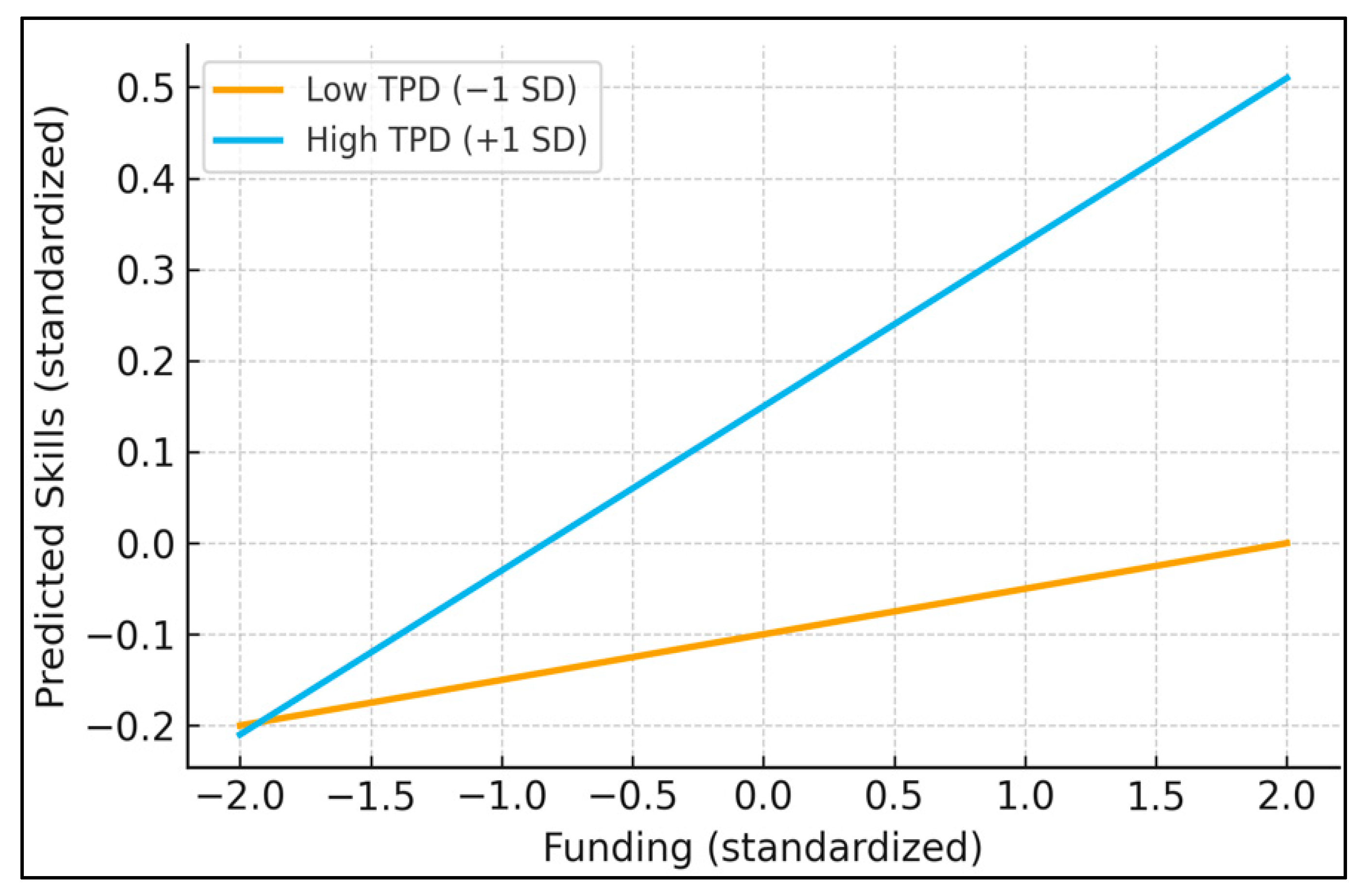
The strongest interaction patterns were observed for Funding × TPD and TPD × Standards. Funding was associated with higher reported levels of teacher skills and student engagement only when paired with high exposure to mandated, time-protected TPD, whereas collaboration was highest when TPD co-occurred with enforceable connectivity standards. As illustrated in Figure 2, the slope of funding was nearly flat at low levels of TPD exposure but clearly positive at high levels of TPD exposure. This pattern is consistent with the interpretation that resources alone are insufficient unless accompanied by structured professional development.
Figure 2.
Simple slopes of Funding × TPD predicting skills enhancement.
Figure 2 graphically depicts the interaction between infrastructure funding and mandated, time-protected TPD in relation to teacher skills enhancement, illustrating that the association between funding and skills was stronger under conditions of high TPD exposure.
Predicted skills enhancement (Likert 1–5) as a function of infrastructure funding at low (−1 SD) and high (+1 SD) levels of mandated, time-protected TPD, holding covariates at their means. The slope of funding is near-zero at low TPD and clearly positive at high TPD, illustrating the complementarity between funding and training.
Overall, these results are consistent with a bundled governance logic: policy instruments appear to operate more strongly in combination than in isolation.
RQ3. Mediation via teacher self-efficacy and heterogeneity.
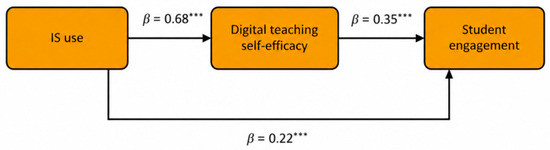
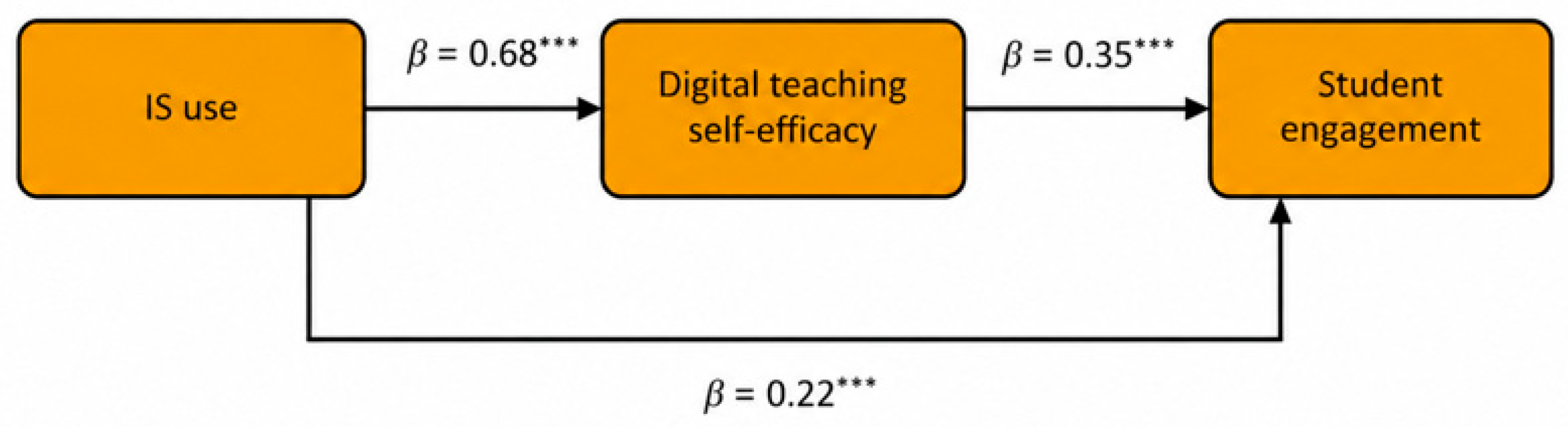
A path model was estimated to examine whether IS use was indirectly associated with student engagement through teacher self-efficacy (see Table 7). IS use was strongly associated with self-efficacy, self-efficacy was associated with engagement, and the direct association between IS use and engagement remained statistically significant. The bootstrapped indirect pathway was also significant, supporting a partial indirect association. This pattern suggests that IS use is associated with engagement both directly and indirectly through teachers’ confidence in managing digitally enriched instruction.
Table 7.
SEM coefficients for indirect-association model.
Multi-group analyses suggested that the indirect pathway was stronger among early-career teachers, whereas differences across school locales were negligible. This finding identifies self-efficacy as a theoretically relevant explanatory mechanism—particularly for teachers at earlier stages of their careers—through which IS use and related professional development may be linked to perceived student engagement.
Figure 3 presents the structural path model linking IS use to teacher-reported student engagement, highlighting both the direct association and the indirect pathway through digital teaching self-efficacy.
Figure 3.
Indirect-association model: IS use → Teacher self-efficacy → Student engagement. Note. Values indicate standardized regression coefficients. *** p < 0.001.
RQ4. Equity-Related Patterns Under Governance Configurations.
To quantify equity-related effects, a Bundled Governance Index (BGI) was created by combining standardized scores for infrastructure funding, mandated TPD, and connectivity/service standards. Interaction models including BGI × locale were then used to estimate predicted margins for teacher skills.
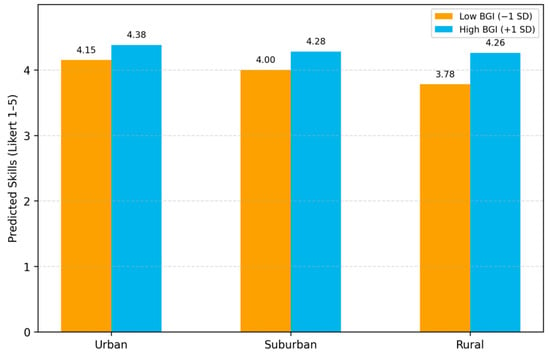
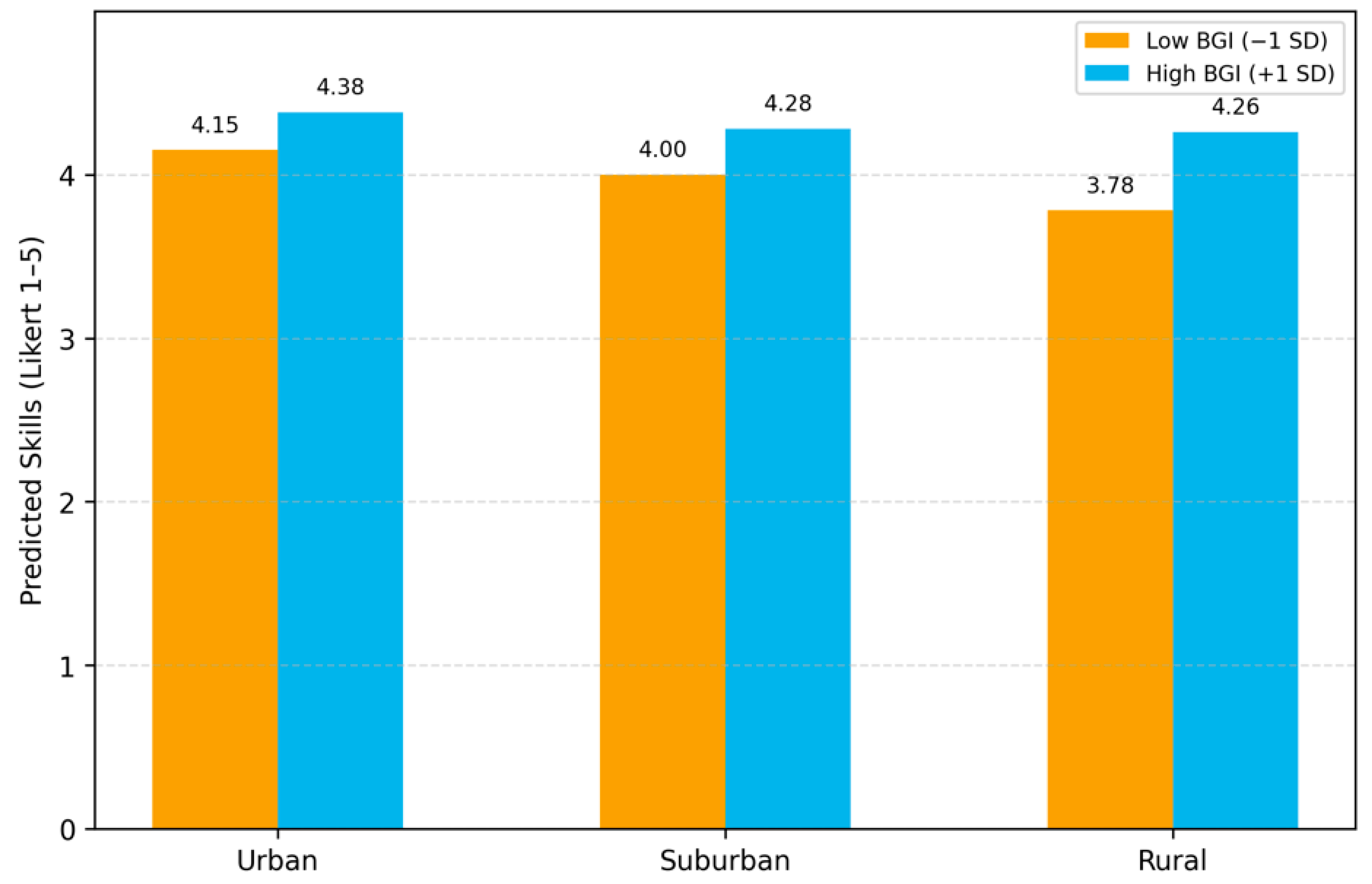
Under low bundling (BGI = −1 SD), the urban–rural gap in teacher skills was 0.37 Likert points in favor of urban schools. Under high bundling (BGI = +1 SD), this gap was 0.12, representing an approximately two-thirds smaller gap (see Table 8 and Figure 4). Suburban schools also moved closer to urban levels as reported bundling increased.
Table 8.
Equity-related patterns: Predicted margins for teacher skills by Bundled Governance Index and locale.
Figure 4.
Predicted margins: Bundled Governance × Locale → Skills.
Taken together, these findings suggest that coherent, bundled governance—linking funding, mandated TPD, and enforceable connectivity standards—was associated with stronger reported teacher capacity and engagement, as well as with smaller rural–urban disparities. This pattern is consistent with the view that aligned governance conditions may support a more equitable digital learning environment for teachers and students, although causal interpretation is not warranted.
Figure 4 shows the predicted mean levels of teacher skills across urban, suburban, and rural schools under low versus high levels of the BGI, making visible how stronger reported bundling was associated with a smaller urban–rural gap.
7. Discussion
This study examined how different configurations of information systems (IS) governance—namely infrastructure funding, mandated and time-protected teacher professional development (TPD), and minimum connectivity/service standards—relate to in-service primary teachers’ digital capacity and perceived student engagement. Across the analyses, a consistent pattern emerged: resources were associated with stronger reported classroom capacity only when they were embedded in coherent capacity-building arrangements, and teacher self-efficacy functioned as a proximal theory-informed explanatory mechanism linking IS use to engagement (Mishra & Koehler, 2006; Scherer et al., 2019; Zee & Koomen, 2016; Zeng et al., 2022). These findings are consistent with international calls to move beyond hardware-first approaches toward coordinated digital education strategies (Boeskens & Meyer, 2025; OECD, 2023; UNESCO, 2023). In this sense, digital equity is framed not as a temporary response to emergency digitalization, but as a long-term governance challenge involving infrastructure, teacher professional development, service standards, self-efficacy, and the capacity to respond to emerging technologies such as AI-supported educational tools.
The findings for RQ1 showed that mandated, time-protected TPD and enforceable connectivity standards were robust positive correlates of teachers’ reported skills enhancement and collaborative benefits, whereas funding alone lost significance once controls were introduced. From a teacher education perspective, this reinforces a central TPACK argument: sustainable technology integration depends on opportunities to align tools with pedagogy and content through structured, practice-proximal learning (Mishra & Koehler, 2006; Philipsen et al., 2019). Rather than confirming a simple technology-access model, the results suggest that digital tools become educationally consequential only when teachers have protected time, structured support, and reliable implementation conditions. The findings also echo broader educational technology research documenting an intention–behavior gap, in which positive attitudes toward digital tools do not automatically lead to routine classroom use in the absence of time, support, and reliable infrastructure (Al-Maroof et al., 2023; Georgiou et al., 2023; Mehta et al., 2019; Tondeur et al., 2018). For providers of in-service and blended programs, the results suggest that the institutional conditions under which PD is protected and resourced may matter as much as its instructional content.
The findings for RQ2 further indicated that the governance levers operated as complements rather than substitutes. Funding was associated with stronger gains in teacher skills and student engagement only when combined with high exposure to mandated TPD, whereas collaboration was highest when TPD co-occurred with minimum connectivity and service standards. These more-than-additive effects are consistent with policy-mix theory, which argues that coherent bundles of instruments are more effective than isolated measures (Howlett & del Río, 2015; Kern et al., 2019). They also align with school-level evidence showing that digital tools produce more meaningful instructional change when teachers have protected time, reliable platforms, and ongoing support (Perry, 2023; Timotheou et al., 2023). From a teacher education perspective, these results suggest that the impact of digital learning programs depends not only on pedagogical design, but also on the governance environment in which such programs are implemented—specifically, whether PD is mandatory, scheduled, practice-linked, and backed by minimum infrastructure guarantees. This finding is particularly important for Greek primary education, where nationally coordinated digital initiatives may produce uneven effects unless they are translated into locally usable forms of support for teachers in urban, suburban, and rural schools.
With respect to RQ3, the mediation analysis showed that IS use was associated with teacher-reported student engagement both directly and indirectly through teacher self-efficacy, with the indirect pathway appearing stronger among early-career teachers. This finding is consistent with prior syntheses linking teacher self-efficacy to classroom processes and technology adoption (Scherer et al., 2019; Zee & Koomen, 2016), as well as with evidence that TPACK and digital competence are strengthened when PD is sequenced, coached, and embedded in practice (Farjon et al., 2019; Huang et al., 2024; Philipsen et al., 2019). The implication is that digital learning initiatives for teachers should explicitly target self-efficacy through scaffolded experimentation, peer collaboration, and feedback, rather than focusing exclusively on technical skills or platform navigation. This is increasingly important in contemporary digital classrooms, where teachers are not only expected to operate platforms but also to interpret student data, manage digital communication, evaluate AI-supported resources, and make pedagogically responsible decisions about technology use. The stronger mediated pathway among early-career teachers further suggests that confidence-building may be especially important during the early stages of professional development. Because the data were cross-sectional, this indirect pathway should be interpreted as an association rather than causal mediation. The model is theoretically plausible, but it cannot establish temporal ordering among IS use, teacher self-efficacy, and student engagement.
The findings for RQ4 showed that higher levels of bundled governance were associated with substantially smaller urban–rural gaps in teacher skills. This result resonates with scholarship on first- and second-order digital divides and with broader arguments for context-sensitive support in underserved schools (Lebeničnik & Istenič Starčič, 2020; Mustafa et al., 2024; Singh et al., 2021; van Dijk, 2017; Walker et al., 2022). It also aligns with recent work on digital capacity in Greek primary schools (Ventista et al., 2024a, 2024b). For policymakers and teacher educators, the implication is clear: equity-oriented digital strategies should combine targeted PD for rural teachers with guaranteed connectivity, adequate devices, and accessible technical support, rather than assuming that generic online provision can compensate for structural constraints. This finding strengthens the argument that digital equity is not achieved when all schools are formally included in the same national reform, but when schools with different local capacities receive the differentiated support required to use digital systems effectively. Student engagement was teacher-reported rather than independently measured through student surveys, observations, or learning analytics. Therefore, the findings may reflect expectancy bias or shared-method variance and should be interpreted as perceived student engagement.
Several limitations should also be considered. First, the study relied on cross-sectional, teacher-reported data for both governance exposure and outcomes, raising the possibility of common-method bias and limiting causal inference. In addition, the governance variables captured teachers’ perceived exposure to funding, mandated TPD, and service standards rather than objectively verified policy implementation. Future research should triangulate teacher reports with administrative data, school-level documentation, infrastructure audits, and longitudinal measures. Perceived mandates and standards may also be associated with broader organizational conditions—such as leadership routines, scheduled collaboration, or local IT support—that were not directly measured (Burke et al., 2018; Escribano et al., 2020; Timotheou et al., 2023; Zheng et al., 2024). Second, strong mandates and audit regimes may encourage checklist-style compliance or increase workload if they are not accompanied by release time, coaching, and improvement-oriented accountability (Garcia & Lee, 2020; Perry, 2023). Third, the expansion of IS introduces data governance and privacy concerns (OECD, 2023; UNESCO, 2023), which may shape teachers’ willingness to experiment with digital tools in authentic instructional ways. These concerns become even more salient as schools begin to encounter AI-supported platforms and data-intensive educational systems, where questions of transparency, privacy, accountability, and teacher judgment are central to responsible implementation.
Future research could build on these findings in several ways. Longitudinal and quasi-experimental designs would help clarify how changes in governance bundles over time are associated with teacher capacity, self-efficacy, and student outcomes. Multi-source designs that combine survey responses with classroom observations, administrative data, and learning analytics would strengthen the evidence base and reduce reliance on single-informant measures. Further studies could also compare alternative PD architectures—such as micro-credential pathways, coaching-based models, and one-off workshops—under different policy conditions. Future work should also examine how teachers develop the professional judgment needed to evaluate and integrate emerging AI-supported tools within ordinary primary-school practice, especially in schools facing infrastructural or professional learning constraints. Such work would help clarify how teacher education design and governance arrangements can be aligned so that investments in digital tools, professional development, and infrastructure produce more sustainable and equitable improvements in teaching and learning.
8. Conclusions
This study examined how different configurations of information systems (IS) governance are associated with primary teachers’ digital capacity and perceived student engagement. The findings indicate that infrastructure funding alone was not significantly associated with stronger teacher capacity or student engagement; the most consistent positive associations emerged when funding was coupled with mandated, time-protected teacher professional development (TPD) and minimum connectivity/service standards. Within this policy bundle, teacher self-efficacy appeared to be a theoretically meaningful indirect pathway between IS use and engagement, underscoring the importance of professional development that supports teachers’ confidence and competence in digitally enriched pedagogy. The equity analyses further showed that stronger bundled governance was associated with narrower urban–rural gaps in teacher capacity, highlighting the potential of coordinated digital strategies to support teachers in underserved contexts. The study therefore responds to a contemporary digital education problem: how primary schools can move from uneven access to sustainable, confident, and pedagogically meaningful digital use in a period increasingly shaped by platform-based schooling, data-informed instruction, and AI-related technological change.
For teacher education and professional learning, these findings suggest that the effectiveness of digital initiatives depends not only on the quality of PD content, but also on the conditions under which teachers participate, including protected time, reliable infrastructure, and clear expectations for classroom use. Designing PD as part of a broader governance bundle, rather than as an isolated add-on, appears especially important for early-career teachers and for schools operating under structural constraints. This conclusion is particularly relevant for Greek primary education, where centralized digital policy initiatives must be translated into locally usable forms of professional support across urban, suburban, and rural schools.
At the same time, the conclusions should be interpreted with caution. The cross-sectional, teacher-reported design limits causal inference and may be influenced by unobserved organizational factors, while the Greek primary school context constrains broader generalizability. Future research should therefore combine longitudinal or quasi-experimental designs with multi-source data, including surveys, observations, and learning analytics, to examine how changes in governance arrangements over time shape teachers’ digital practices and student outcomes. Future studies should also examine how teachers develop the professional judgment required to evaluate and integrate AI-supported educational tools responsibly, especially in schools facing infrastructural or professional learning constraints. Even with these limitations, the practical implication is clear: meaningful digital learning requires attention not only to the provision of tools, but also to the governance conditions that enable teachers to use them effectively within a sustainable and equitable digital education system. Accordingly, the findings provide a theoretically grounded basis for further longitudinal and multi-source research on how governance arrangements support sustainable digital equity in primary education.
Author Contributions
Conceptualization, G.P., C.Z. and A.-S.A.; methodology, G.P., I.V. and A.-S.A.; validation, G.P., C.Z., I.V. and A.-S.A.; formal analysis, G.P. and C.Z.; investigation, G.P., I.V. and C.P.; resources, G.P. and A.-S.A.; data curation, G.P. and C.Z.; writing—original draft preparation, G.P., C.Z. and I.V.; writing—review and editing, A.-S.A. and C.P.; visualization, G.P. and C.Z.; supervision, A.-S.A. and G.P.; project administration, G.P. All authors have read and agreed to the published version of the manuscript.
Funding
This research received no external funding.
Institutional Review Board Statement
The study was conducted in accordance with the Declaration of Helsinki and approved by the Ethics Committee of the National and Kapodistrian University of Athens, Greece (Protocol No. 148; approval date: 16 January 2025).
Informed Consent Statement
Informed consent was obtained from all subjects involved in the study. Participation was voluntary and anonymous, and completion of the questionnaire was considered to indicate consent to participate.
Data Availability Statement
The data presented in this study are available on request from the corresponding author. The data are not publicly available due to ethical and privacy restrictions.
Conflicts of Interest
The authors declare no conflicts of interest.
Appendix A
Table A1.
Questionnaire items and response scale.
References
- Al-Maroof, R. S., Salloum, S. A., Hassanien, A. E., & Shaalan, K. (2023). Fear from COVID-19 and technology adoption: The impact of Google meet during coronavirus pandemic. Interactive Learning Environments, 31(3), 1293–1308. [Google Scholar] [CrossRef] [Scilit]
- Backfisch, I., Lachner, A., Stürmer, K., & Scheiter, K. (2021). Variability of teachers’ technology integration in the classroom: A matter of utility! Computers & Education, 166, 104159. [Google Scholar] [CrossRef] [Scilit]
- Boeskens, L., & Meyer, K. (2025). Policies for the digital transformation of school education: Evidence from the policy survey on school education in the digital age. [OECD Education Working Papers, No. 328]. OECD Publishing. [Google Scholar] [CrossRef] [Scilit]
- Budianto, L., Arifani, Y., Wardhono, A., & Poedjiastutie, D. (2023). The TPACK level of in-service EFL teacher online professional training: The perspectives of teachers, students, and trainers. Journal of Digital Learning in Teacher Education, 39(2), 87–101. [Google Scholar] [CrossRef] [Scilit]
- Burke, P. F., Schuck, S., Aubusson, P., Kearney, M., & Frischknecht, B. (2018). Exploring teacher pedagogy, stages of concern and accessibility as determinants of technology adoption. Technology, Pedagogy and Education, 27(2), 149–163. [Google Scholar] [CrossRef] [Scilit]
- Charania, A., Paltiwale, S., Sen, S., Sarkar, D., & Bakshani, U. (2023). Leading edge use of technology for teacher professional development in Indian schools. Education Sciences, 13(4), 386. [Google Scholar] [CrossRef] [Scilit]
- Elmaadaway, M. A. N., & Abouelenein, Y. A. M. (2023). In-service teachers’ TPACK development through an adaptive e-learning environment (ALE). Education and Information Technologies, 28(6), 8273–8298. [Google Scholar] [CrossRef] [Scilit] [PubMed]
- Eradze, M., De Martino, D., Tinterri, A., Albó, L., Bardone, E., Sunar, A. S., & Dipace, A. (2023). After the pandemic: Teacher professional development for digital educational innovation. Education Sciences, 13(5), 432. [Google Scholar] [CrossRef] [Scilit]
- Escribano, R., Treviño, E., Nussbaum, M., Torres Irribarra, D., & Carrasco, D. (2020). How much does the quality of teaching vary at under-performing schools? Evidence from classroom observations in Chile. International Journal of Educational Development, 72, 102125. [Google Scholar] [CrossRef] [Scilit]
- Farjon, D., Smits, A., & Voogt, J. (2019). Technology integration of preservice teachers explained by attitudes and beliefs, competency, access, and experience. Computers & Education, 130, 81–93. [Google Scholar] [CrossRef] [Scilit]
- Garcia, A., & Lee, C. H. (2020). Equity-centered approaches to educational technology. In M. J. Bishop, E. Boling, J. Elen, & V. Svihla (Eds.), Handbook of research in educational communications and technology (pp. 129–144). Springer. [Google Scholar] [CrossRef] [Scilit]
- Gebhardt, E., Thomson, S., Ainley, J., & Hillman, K. (2019). Teacher gender and ICT. In Gender differences in computer and information literacy (Vol. 8, pp. 53–68). IEA Research for Education. Springer. [Google Scholar] [CrossRef] [Scilit]
- Georgiou, D., Trikoili, A., & Kester, L. (2023). Rethinking determinants of primary school teachers’ technology acceptance during the COVID-19 pandemic. Computers & Education Open, 4, 100145. [Google Scholar] [CrossRef] [Scilit]
- Ghanbaripour, A. N., Talebian, N., Miller, D., Tumpa, R. J., Zhang, W., Golmoradi, M., & Skitmore, M. (2024). A systematic review of the impact of emerging technologies on student learning, engagement, and employability in built environment education. Buildings, 14(9), 2769. [Google Scholar] [CrossRef] [Scilit]
- Howlett, M., & del Río, P. (2015). The parameters of policy portfolios: Verticality and horizontality in design spaces and their consequences for policy mix formulation. Environment and Planning C: Government and Policy, 33(5), 1233–1245. [Google Scholar] [CrossRef] [Scilit]
- Huang, L., Liang, M., Xiong, Y., Wu, X., & Lim, C. P. (2024). A systematic review of technology-enabled teacher professional development during COVID-19 pandemic. Computers & Education, 223, 105168. [Google Scholar] [CrossRef] [Scilit]
- Kern, F., Rogge, K. S., & Howlett, M. (2019). Policy mixes for sustainability transitions: New approaches and insights through bridging innovation and policy studies. Research Policy, 48(10), 103832. [Google Scholar] [CrossRef] [Scilit]
- Lebeničnik, M., & Istenič Starčič, A. (2020). Examining the contemporary digital divide of university students with specific reference to students with special educational needs. British Journal of Educational Technology, 51(6), 2422–2441. [Google Scholar] [CrossRef] [Scilit]
- Mbatha, B. (2024). Diffusion of innovations: How adoption of new technology spreads in society. In D. Ocholla, O. B. Onyancha, & A. O. Adesina (Eds.), Information, knowledge, and technology for teaching and research in Africa (pp. 1–18). Springer. [Google Scholar] [CrossRef] [Scilit]
- Mehta, A., Morris, N. P., Swinnerton, B., & Homer, M. (2019). The influence of values on e-learning adoption. Computers & Education, 141, 103617. [Google Scholar] [CrossRef] [Scilit]
- Mishra, P., & Koehler, M. J. (2006). Technological pedagogical content knowledge: A framework for teacher knowledge. Teachers College Record, 108(6), 1017–1054. [Google Scholar] [CrossRef] [Scilit]
- Mustafa, F., Nguyen, H. T. M., & Gao, X. (2024). The challenges and solutions of technology integration in rural schools: A systematic literature review. International Journal of Educational Research, 126, 102380. [Google Scholar] [CrossRef] [Scilit]
- OECD. (2023). OECD digital education outlook 2023: Towards an effective digital education ecosystem. OECD Publishing. [Google Scholar] [CrossRef] [Scilit]
- Perry, E. (2023). Teacher professional development in changing circumstances: The impact of COVID-19 on schools’ approaches to professional development. Education Sciences, 13(1), 48. [Google Scholar] [CrossRef] [Scilit]
- Philipsen, B., Tondeur, J., Pareja Roblin, N., Vanslambrouck, S., & Zhu, C. (2019). Improving teacher professional development for online and blended learning: A systematic meta-aggregative review. Educational Technology Research and Development, 67(5), 1145–1174. [Google Scholar] [CrossRef] [Scilit]
- Popescu, D.-M., Aviana (Bojan), A.-E., & Halip, L. (2022). The importance of information technology in the activity and professional development of teachers. LUMEN Proceedings, 18, 168–175. [Google Scholar] [CrossRef] [Scilit]
- Scherer, R., Siddiq, F., & Tondeur, J. (2019). The technology acceptance model (TAM): A meta-analytic structural equation modeling approach to explaining teachers’ adoption of digital technology in education. Computers & Education, 128, 13–35. [Google Scholar] [CrossRef] [Scilit]
- Singh, A., Gupta, K., & Yadav, V. K. (2021). Adopting e-learning facilities during COVID-19: Exploring perspectives of teachers working in Indian public-funded elementary schools. Education 3-13, 51(1), 26–40. [Google Scholar] [CrossRef] [Scilit]
- Timotheou, S., Miliou, O., Dimitriadis, Y., Villagrá Sobrino, S., Giannoutsou, N., Cachia, R., Martínez Monés, A., & Ioannou, A. (2023). Impacts of digital technologies on education and factors influencing schools’ digital capacity and transformation: A literature review. Education and Information Technologies, 28, 6695–6726. [Google Scholar] [CrossRef] [Scilit]
- Tondeur, J., Aesaert, K., Prestridge, S., & Consuegra, E. (2018). A multilevel analysis of what matters in the training of pre-service teachers’ ICT competencies. Computers & Education, 122, 32–42. [Google Scholar] [CrossRef] [Scilit]
- UNESCO. (2023). Global education monitoring report 2023/4: Technology in education—A tool on whose terms? UNESCO Publishing. [Google Scholar] [CrossRef] [Scilit]
- van Dijk, J. (2017). Digital divide: Impact of access. In P. Rössler, C. A. Hoffner, & L. van Zoonen (Eds.), The international encyclopedia of media effects (pp. 1–11). John Wiley & Sons. [Google Scholar] [CrossRef] [Scilit]
- Ventista, O. M., Kolokitha, M., Tsani, P., Polydoros, G., & Arkoumanis, G. (2024a). Achieving digital education in primary schools: Success factors and policy recommendations. Policy Futures in Education, 22(8), 1794–1814. [Google Scholar] [CrossRef] [Scilit]
- Ventista, O. M., Tsani, P., Brown, C., Coe, R., & Polydoros, G. (2024b). Technology use and integration in state-funded primary schools: A structural equation model. Education 3-13, 54(3), 723–739. [Google Scholar] [CrossRef] [Scilit]
- Viberg, O., Mavroudi, A., Khalil, M., & Bälter, O. (2020). Validating an instrument to measure teachers’ preparedness to use digital technology in their teaching. Nordic Journal of Digital Literacy, 15(1), 38–54. [Google Scholar] [CrossRef] [Scilit]
- Walker, H., Hennessy, S., & Pimmer, C. (2022). Trialling open educational resources for technology-supported teacher professional development in rural Zimbabwe. Research Papers in Education, 38(4), 568–592. [Google Scholar] [CrossRef] [Scilit]
- Wu, C. H. (2019). Adoption of innovative ICT-enabled systems for analysis- and intuition-styled teachers in primary schools. In A. Tatnall (Ed.), Encyclopedia of education and information technologies. Springer. [Google Scholar] [CrossRef] [Scilit]
- Yang, Y.-F., Tseng, C. C., & Lai, S.-C. (2024). Enhancing teachers’ self efficacy beliefs in AI based technology integration into English speaking teaching through a professional development program. Teaching and Teacher Education, 144, 104582. [Google Scholar] [CrossRef] [Scilit]
- Zee, M., & Koomen, H. M. Y. (2016). Teacher self-efficacy and its effects on classroom processes, student academic adjustment, and teacher well-being: A synthesis of 40 years of research. Review of Educational Research, 86(4), 981–1015. [Google Scholar] [CrossRef] [Scilit]
- Zeng, Y., Wang, Y., & Li, S. (2022). The relationship between teachers’ information technology integration self-efficacy and TPACK: A meta-analysis. Frontiers in Psychology, 13, 1091017. [Google Scholar] [CrossRef] [Scilit] [PubMed]
- Zheng, L., Liu, T., Feng, Y., Gu, X., & Yu, M.-H. (2024). Dynamic teacher’s technology adoption during the COVID-19 pandemic. SAGE Open, 14(2), 21582440241237858. [Google Scholar] [CrossRef] [Scilit]

Disclaimer/Publisher’s Note: The statements, opinions and data contained in all publications are solely those of the individual author(s) and contributor(s) and not of MDPI and/or the editor(s). MDPI and/or the editor(s) disclaim responsibility for any injury to people or property resulting from any ideas, methods, instructions or products referred to in the content. |
© 2026 by the authors. Licensee MDPI, Basel, Switzerland. This article is an open access article distributed under the terms and conditions of the Creative Commons Attribution (CC BY) license.