Article

Teachers’ Representations of Their Relationships with Students: Associations with Their Emotional Expressiveness and Emotion Socialization Practices in the Context of Early Childhood Education


by
Pamela Watkins Garner
*,
Hideko Hamada Bassett
and
Julia Madeleine Shadur
School of Integrative Studies, George Mason University, Fairfax, VA 22030, USA
*
Author to whom correspondence should be addressed.
Educ. Sci. 2026, 16(6), 829; https://doi.org/10.3390/educsci16060829
Submission received: 5 April 2026 / Revised: 12 May 2026 / Accepted: 22 May 2026 / Published: 25 May 2026

Abstract

Positive teacher–student relationships in early childhood predict stronger academic and social–emotional outcomes, whereas conflictual or dependent relationships contribute to children’s stress and behavioral and academic difficulties. While prior research emphasizes teachers’ observable relational behaviors, fewer studies explore the internal emotional and cognitive processes that shape these relationships. This mixed-methods study examined how preschool teachers’ emotion socialization practices (i.e., emotion coaching and dismissing) and their classroom expressions of positive and negative emotions relate to their mental representations of their relationships with students. Quantitative analyses tested whether teachers’ emotional expressiveness moderated associations between their emotion socialization practices and relational representations. Complementing these analyses, qualitative narrative interviews with an independent teacher sample explored how educators described their emotional expressiveness, emotion-related practices, and perceived relationships with students. Informed by emotion socialization theory, attachment theory, and the prosocial classroom model, findings highlight the interplay of teachers’ emotional beliefs, regulation, and relational schemas in shaping classroom climate. Our integration of quantitative and qualitative insights provides a more comprehensive understanding of teachers’ emotional functioning and underscores the importance of supporting educators’ relational and emotional competencies to enhance classroom quality and student well-being.

1. Introduction

For students, teacher–student closeness in early childhood is positively related to later school readiness (Garner et al., 2021). Conversely, negative teacher–student relationships are a salient marker of relational stress in early childhood settings (Pianta, 2001). For example, negative relationships between teachers and their students are associated with low task persistence and cognitive and behavioral outcomes through eighth grade. Elevated levels of teacher–student conflict are also linked to greater behavioral difficulties and reduced emotional security in children (Davolyte et al., 2024; L. Li et al., 2022; Hamre & Pianta, 2001; O’Connor et al., 2012). Similarly, greater teacher–student dependency is associated with longer times on visual attention tasks for preschoolers (Rudasill et al., 2022). Importantly, teaching is a bidirectional process that depends on teachers’ relational skills (Curby et al., 2014). For instance, having positive, high-quality relationships with young students is associated with greater readiness to teach, whereas teacher–student conflict is linked to higher levels of teacher stress (H. Li et al., 2023; S. Li et al., 2026) and lower teacher expectations (Trang & Hansen, 2020). Teachers’ emotional competence is also associated positively with their perceptions of their relationships with their students as close, while low commitment to social–emotional learning (SEL) is related to less closeness and more relational conflict (Poulou & Garner, 2025).

1.1. Teachers’ Mental Representations of Teacher–Student Relationships

For the most part, Pianta’s (2001) Student–Teacher Relationship Scale (STRS) has been the measure of choice for assessing teachers’ perceptions of their relationships with individual students. This measure evaluates how teachers perceive, experience, and describe the emotional tone and quality of their relationships with specific children. These perceptions are captured through teachers’ conscious, self-reported evaluations and focus on observable relational qualities such as closeness, conflict, and dependency. Although the STRS provides valuable insight into explicit, observable aspects of teacher–student relationships, it does not fully capture the deeper, internalized processes that shape teachers’ relational experiences. Offering a complementary but distinct perspective, research on teachers’ mental representations emphasizes the implicit beliefs, expectations, and affective schemas that underlie their perceptions and behaviors. These mental representations, often accessed through narrative or interview-based methods, highlight the cognitive–emotional structures that guide how teachers interpret student behavior, respond to children’s emotional needs, and manage classroom interactions (Ahnert et al., 2012). According to Spilt et al. (2022), mental representations that encompass negative beliefs and emotions may be associated with biases in teachers’ perceptions of children’s behaviors and detract from their abilities to accurately interpret cues that can explain those behaviors. As evidence, Bosman et al. (2019) found that teachers reported high levels of positive affect and more sensitive practices when interacting with hyperactive children but experienced more anger when responding to children with conduct problems, suggesting that distinct forms of externalizing behavior may uniquely shape teachers’ mental representations of their relationships with students. Teachers’ mental representations differ from those of students, with teachers tending to underestimate the impact of their nonverbal behavior on students (Martikainen, 2019a, 2019b). Interestingly, the association between problematic student behavior and teachers’ affective responses is mediated by relational conflict, and this indirect effect is lessened by relational closeness (Evans et al., 2019). Despite valuable findings yielding from quantitative data on teacher–student relationships, few studies have examined the deeper mental representations that guide teachers’ relational thinking and behavior.
Employing a mixed-method approach, the quantitative aspect of the current study examined whether teachers’ positive and negative emotional expressiveness moderated the association between their emotion socialization practices (i.e., emotion coaching and emotion dismissing) and their mental representations of the quality of the relationships they develop with students. This is an important question because teachers’ conceptions of their relationships with students are influenced by emotional processes (Jennings & Greenberg, 2009). Teachers’ positive and negative emotional expressiveness may shape how their responses to children’s emotions are interpreted, potentially amplifying or attenuating the impact of coaching and dismissing emotion socialization strategies on their representations of relational quality in early childhood classrooms. The qualitative component of the study will provide complementary insight into hypothesized associations. We used narrative interviews with an independent set of teachers to offer a window into how teachers perceive their own emotional expressiveness, describe moments of emotion coaching or dismissing, and interpret the perceived impact of these practices on their relationships with students. This approach has the potential to enrich and contextualize quantitative findings within teachers lived experiences and highlight the meanings, tensions, and relational processes that may not be fully captured through quantitative measures alone. To better understand how teachers’ emotional processes shape their relationships with students, we review research on teachers’ emotion socialization practices and emotional expressiveness in early childhood classrooms in the sections below.

1.2. Teachers’ Emotional Expressiveness and Classroom Relational Processes

Teachers’ expression of emotion plays a central role in shaping the socioemotional climate of the classroom and may model for children how they should express emotions (Zinsser et al., 2015). Teachers’ emotional expressiveness in the classroom has important implications for students’ academic achievement, student engagement, cooperation, prosocial behavior and other forms of social competence, and teacher–student relationship quality (Boekaerts & Pekrun, 2016; Jennings & Greenberg, 2009; Poulou & Denham, 2023; Poulou et al., 2022). For example, teachers’ positive emotional expressiveness has been associated with greater student interest, engagement, and motivation to learn (Taxer & Frenzel, 2020). In addition, teachers’ self-reported positive emotional expressiveness is associated with ratings of the teacher as emotionally supportive in the face of challenging classroom behavior (Jennings, 2015). Conversely, children whose teachers frequently display negative emotions, experience difficulty regulating their emotions, and exhibit high levels of aggressive behavior (Mainhard et al., 2022). In terms of academic competence, teachers’ negative emotional expressions may signal to students that teachers perceive them as cognitively incapable and/or responsible for their school failures (Savina & Fulton, 2024). Teachers’ expressions of negative emotions may also contribute to classroom environments characterized by tension, disengagement, or behavioral problems (Denham et al., 2012; Hamre & Pianta, 2001). Research also supports the view that preschool teachers match their students’ expression of positive emotions (Kilic, 2015) and their expressions of negative emotions are more likely when children express negative emotions (Garner et al., 2019b). Preliminary research also suggests that early childhood teachers may be especially likely to engage in positive emotional exchanges with children when they are comfortable expressing their own emotions more broadly (Sutton, 2005).

1.3. Emotion Socialization in the Classroom: Coaching and Dismissing

Researchers have applied Gottman et al.’s (1997) meta-emotion philosophy to understand teachers’ emotion coaching and emotion dismissing practices in early childhood contexts. Emotion coaching encompasses teachers’ supportive responses to children’s emotions, including labeling, validating, and scaffolding regulation strategies (Denham & Kochanoff, 2002; Dunsmore & Karn, 2001; Morris et al., 2013). In contrast, emotion dismissing involves minimizing, ignoring, or punishing children’s emotional expressions (Denham et al., 2007). Teachers are frequently observed using a range of these practices in response to children’s emotional distress, with emotion coaching being most common (Ornaghi et al., 2021). Emotion coaching is related positively to children’s emotional, social, behavioral, and academic competence, as well as to attachment security and teachers’ emotional self-efficacy. On the other hand, an emotion dismissing classroom style correlates positively with children’s emotion dysregulation and behavioral problems (Arace et al., 2021; Lagacé-Séguin & Coplan, 2005; Ornaghi et al., 2018; Rose et al., 2015) and predicts slower growth in emotion regulation (L. Li et al., 2022). Although children taught in classrooms where teachers use high levels of responsive, emotion-coaching strategies often exhibit fewer aggressive conflicts and greater conflict resolution (Ulloa et al., 2010). Teachers also report using more coaching responses in classrooms characterized by high levels of negative behavior (Morris et al., 2013). Similarly, emotion coaching has been associated with steeper increases in social play and decreases in reticent behavior (Wilhelmsen et al., 2025). Teachers’ emotion coaching practices appear to be shaped by their beliefs about emotions and their capacity for viewing children as having their own thoughts, feelings, and intentions. Educators who hold more positive beliefs about emotions and use mind-related language tend to engage in more emotion coaching. On the other hand, teachers with negative emotion beliefs and who use less frequent use of mind-related terms are more likely to endorse a dismissing emotion socialization style (Ornaghi et al., 2020). Collectively, these studies indicate that teachers’ emotion coaching and dismissing practices not only reflect their beliefs about children’s emotions but also contribute to the emotional tone and relational quality of classroom interactions. However, even though associations linkages between these emotion socialization practices and children’s developmental outcomes are increasingly evident, less is known about the internal emotional processes that underlie teachers’ responses. In the section below, we turn to teachers’ emotional expressiveness as a potential moderator of the associations between coaching and dismissing emotion socialization practices and teachers’ perceptions of their relationships with students.

1.4. Theoretical Framework and Study Aims

This study is grounded in emotion socialization theory, attachment-informed models of caregiving, and the prosocial classroom model (Jennings & Greenberg, 2009). This tripartite conceptualization provides a rationale for how caregivers’ emotion-related beliefs and behaviors may interact to support sensitive caregiving. According to emotion socialization theory, caregivers play a critical role in shaping children’s emotional development through modeling emotion-related behaviors, responding sensitively to children’s emotional expressions, and talking explicitly about emotions (Eisenberg et al., 1998; Gottman et al., 1997). In parallel, attachment theory emphasizes the importance of sensitive and responsive caregiving for fostering positive relationships between caregivers and young children in their care (Ainsworth et al., 1978). Finally, we adopted the prosocial classroom model advanced by Jennings and Greenberg (2009), which posits that social–emotional competence can strengthen teachers’ capacity for positive responsiveness to students in ways that result in positive classroom interactions and relationships. The quantitative aspect of the study considers statistical associations among teachers’ emotion socialization practices, positive and negative emotional expressiveness, and their mental representations of their relationships with students.

1.5. Hypotheses

We hypothesize that:
H1: 
Negative associations between teachers’ emotion coaching practices and their negative mental representations of their relationships with students will be weaker for teachers high in positive expressiveness and stronger for teachers high in negative expressiveness.
H2: 
Positive associations between teachers’ emotion dismissing practices and their negative mental representations of their relationships with students will be stronger for teachers high in negative expressiveness and weaker when teachers reported low negative expressiveness.

1.6. Qualitative Research Questions

We used semi-structured interviews to explore how teachers describe their responses to children’s emotions (emotion coaching vs. dismissing) and their views about how emotions should be expressed and managed in the classroom, including their own (RQ1). We also explored teachers’ perceptions about how these emotional practices shape their perceived relationships with students (RQ2). The qualitative data were designed to complement quantitative analyses by illuminating the meanings, tensions, and relational mechanisms that shape the links among teachers’ emotion socialization practices, emotional expressiveness, and relational representations. These data also provided an in-depth exploration of how early childhood teachers conceptualize and enact emotional processes within classroom interactions and relationships with their students. The quantitative and qualitative data were analyzed separately and then integrated during interpretation. Thus, RQ3 examined how findings from the two data strands converged or diverged to offer a more comprehensive understanding of teachers’ emotion-related processes in relation to their mental representations of their classroom relationships. By combining these approaches, we provide a more comprehensive understanding of how teacher–student relationships operate in early childhood classrooms, illuminating both observable relational qualities and the implicit cognitive–emotional structures that may shape teachers’ responses and classroom interactions.

2. Method

This mixed-methods study combines both quantitative and qualitative data to provide a more comprehensive understanding of teachers’ emotional processes. Integrating these two strands of data allows for triangulation, enhancing the validity and depth of each set of findings. Quantitative analyses examine statistical associations among teachers’ emotion socialization practices, emotional expressiveness, and relational representations of their relationships with students. When examined alongside the quantitative findings, the qualitative narratives offer contextualized insights into how teachers interpret and enact these emotional processes in their everyday classroom interactions with their students. These complementary approaches strengthen the interpretation of results and illuminate the mechanisms linking teachers’ emotional functioning to their relationships with students.

2.1. Quantitative Study

2.1.1. Procedure

Once Institutional Review Board approval was obtained (Protocol ID 2196993-1), participants were recruited from a local community college, an early childhood education program, and a nearby university. Only early childhood teachers working in preschool environments were eligible to participate. Recruitment took place through program announcements and email invitations distributed by program administrators. Interested participants received two Qualtrics survey links via email, allowing them to access the research forms at their convenience. The first survey link contained the informed consent form, a demographic questionnaire, and the questionnaire that assessed emotion coaching and emotion dismissing emotion socialization practices. Approximately two weeks later, participants who completed the first survey and consent form received a second link, which included the Classroom Expressiveness Questionnaire that assessed teachers’ emotional expressiveness and instructions for completing the drawing task used to assess mental representations of relationships. Because responses to the second set of measures were influenced by the drawings, spacing the questionnaires over two weeks helped reduce participant fatigue.
Sample Characteristics. For the quantitative component of the study, the sample comprised 92 teachers (91 females; 30 Black, 23 Latina, 13 White, 13 Asian/Pacific Islander, 12 American Indian/Indigenous American, and one who was multiracial). All but four of the teachers reported that they had a college degree, a graduate degree, or some post-college education. It is important to note that teachers were asked to report on their highest education credential at the time of the study. Most teachers in our study described their family income as slightly above average. The majority (78%) had fewer than five years of preschool teaching experience, whereas 22% had been teaching for 10 years or more. Specifically, teachers’ years of experience were categorized as follows: (a) 0–1 year, (b) 2–5 years, (c) 6–10 years, (d) 11–20 years, and (e) more than 20 years. For quantitative analyses, these categories were coded on a six-point ordinal scale ranging from 1 (0–1 year) to 6 (more than 20 years). Of the 59 teachers who provided information about their educational background, 66% reported that they were working towards an associate’s degree and had or was working towards earning the Child Development Associate (CDA) credential. The CDA is a nationally recognized certification in the United States for early childhood educators awarded to individuals who demonstrate the ability to meet specific competency standards in caring for and teaching young children. Earning the CDA requires formal education, observation of teaching practice, a professional portfolio, and successful completion of a verification visit and exam (Council for Professional Recognition, 2022). Thirty-four percent of the reporting teachers indicated that they were working towards a bachelor’s degree in early childhood education or a related field. None of the teachers reported working with students who had identified or diagnosed developmental disabilities.

2.1.2. Measures

The constructs examined in this study include teachers’ emotion socialization tendencies, emotional expressiveness, and relational representations of their relationships with students. Because several of these constructs reflect teachers’ internal beliefs, dispositions, and response tendencies rather than observations of behavior at a specific point in time, self-report measures are commonly used in research on teachers’ internal emotional processes. Self-report measures allowed us to capture teachers’ interpretations of and emotional responses to young children’s behaviors in ways that may not be observed through classroom observation alone. Importantly, the present study also incorporated a drawing-based projective task and qualitative interviews to provide complimentary perspectives on teachers’ relational thinking and emotional practices and behaviors, thereby reducing reliance on a single measurement method.

2.1.3. Dependent Variables

Teachers’ mental representations of relationships with students. As a projective tool, the Draw-A-Teacher Task used here was adapted to assess teachers’ internal representations of their relationships with students. Unlike traditional uses of this task, which focus on children’s perceptions of teachers (Fury et al., 1997; Zee et al., 2020), this adaptation invites teachers themselves to visualize and externalize their relational beliefs through drawings. Drawing-based tasks have increasingly been used in teacher education research to examine educators’ beliefs, emotions, and mental models about teaching and learning. For example, Lin (2022) used a drawing task in which pre-service teachers illustrated themselves teaching mathematics to capture beliefs, knowledge, and affective orientations toward instruction, demonstrating that drawings can reveal “affect-laden” teacher knowledge that may not emerge through traditional surveys or interviews. Similarly, Sherwood (2020) used teacher drawings to examine in-service science teachers’ mental models of classroom practice, finding that drawings provided insight into teachers’ underlying conceptions of teacher and student roles. Earlier work by Moseley et al. (2010) likewise demonstrated that drawings can capture pre-service teachers’ mental models and beliefs about complex educational concepts. Thus, drawings can serve as meaningful representations of educators’ internal beliefs and relational understandings. Building on this literature, the present study adopts a drawing-based approach, traditionally used to examine children’s perceptions of teachers, to explore teachers’ representations of teacher–student interactions, offering a novel method for examining educators’ relational schemas and emotion-related classroom practices.
Specifically, teachers were asked to draw a picture of themselves teaching or interacting with their students. Minimal instructions were provided to avoid shaping their depictions, and participants were encouraged to represent their teaching environment and interactions as naturally as possible. Drawings were coded by trained researchers blind to teacher demographic information and their responses on the other study measures. Informed by methods from relationship representation research (Harrison et al., 2007; Bosman et al., 2019), coding focused on identifying patterns that reflected teachers’ representations of conflict (e.g., visual indicators of tension, frustration, or distance, constrained or aggressive imagery, exaggerated distances, negative facial cues, or dominance structures) and dependency (e.g., imagery reflecting perceptions of student neediness, over-reliance on the teacher, lack of student autonomy, small, vulnerable students clinging to the teacher, physical barriers, or disproportionate figures). Overall adjustment was concerned with global rating of the teacher’s relationship with their students, focusing on elements of their holistic drawings rather than on specific elements. High ratings reflected high levels of disharmony, sadness, or emotional alienation in the relationship, with elements such as complete lack of background characteristics, poor integration, or negative emotional expressions. By focusing on conflict and dependency and negative aspects of overall relational adjustment, we targeted relational aspects more directly tied to challenges in teacher–student interactions, which are particularly relevant for understanding emotion-related responses in the classroom. Projective tasks can offer valuable insights into teachers’ implicit relational schemas and serve as reflective windows into participants’ emotion-related beliefs and relational attitudes in ways that may not be fully accessible through traditional self-report measures. Following Zee et al. (2020), all dimensions were coded using 7-point Likert-type scales, where 1–2 indicated minimal or no evidence of the construct, 3–5 reflected moderate or mixed evidence, and 6–7 represented clear and consistent evidence of the construct within the drawing. Each drawing was independently rated by two trained research assistants and final scores consisted of the average of the two ratings of the research assistants. Reliability was assessed by averaging ratings of the coders for each dimension. Intraclass correlations ranged from 0.76 (for conflict) to 0.82 (for overall negative relational adjustment). Drawing-based methods are frequently used in research on representations because they allow participants to externalize implicit beliefs and affective schemas that may be difficult to articulate through direct questionnaire items. Because the drawings were coded by trained raters who were blind to teachers’ questionnaire responses, this measure also helps reduce concerns regarding shared method variance across variables.

2.1.4. Independent Variables and Covariates

Teachers’ emotion socialization practices. Teachers’ emotion coaching and dismissing emotion socialization practices were assessed with an adaptation of the Brief Short-Form Version of the Coping with Children’s Negative Emotions Scale (CCNES; King et al., 2023). The CCNES was originally developed for emotion socialization research with parents but has been adapted for use with teachers (Fabes et al., 2002). The teacher version of the measure includes 10 items (reduced from the 12-item original parent measure because two items were not appropriate for the classroom environment) evaluated on a 7-point response scale. The measure describes hypothetical situations in which a child in the classroom expresses a negative emotion. Teachers are asked to indicate their likelihood of response to six choices within each item, creating six subscales (i.e., distress reactions, punitive reactions, expressive encouragement, emotion-focused reactions, problem-focused reactions, and minimization reactions). We focused on emotion coaching and emotion dismissing as broader response styles rather than analyzing the six individual subscales separately. This decision was guided by Gottman et al.’s (1997) emotion coaching framework, which conceptualizes adult responses to children’s emotions along two primary dimensions: supportive strategies that promote emotional understanding and regulation (i.e., emotion coaching), and unsupportive strategies that dismiss or minimize emotional expression (i.e., emotion dismissing). Although the six CCNES-T subscales capture specific teacher responses, prior research (Fabes et al., 2002; Buettner et al., 2016) shows that these subscales cluster into two higher-order factors reflecting coaching versus dismissing profiles. Our focus on these composites aligns conceptually with Gottman’s model and we believe that doing so provides a more parsimonious approach to examining teachers’ general emotion socialization styles. Additionally, using the broader coaching and dismissing composites enhances interpretability for applied and intervention contexts, where educators are typically encouraged to adopt overarching emotion coaching approaches rather than discrete response strategies.
We adapted the 6-item brief short-form, which yields an emotion coaching subscale and an emotion dismissing subscale for parents. Adapting parent-based emotion socialization measures for teacher samples is common practice in classroom emotion research because teachers, like parents, serve as key emotion socialization agents in children’s daily environments. We used this measure to minimize teacher burden and support practical data collection in busy classroom settings. The measure has strong psychometric properties and was created using a calibration sample and cross-validated with a validation sample and provides viable, theoretically consistent alternatives to the original CCNES measure (King et al., 2023). Additionally, our focus on two composite scores: emotion coaching and emotion dismissing, instead of the six original subscales, supported the use of a shortened version. These composites capture broad patterns of teachers’ emotion-related responses, which align with Gottman et al.’s (1996) conceptual framework of adult emotion socialization. Using composite-level scores from abbreviated versions of the CCNES provides reliable and valid assessment of adult responses to children’s emotions, including in teacher samples (Fabes et al., 2002; Buettner et al., 2016). Thus, using a teacher version of King et al.’s (2023) brief form allowed us to assess teachers’ general emotion socialization tendencies efficiently, while maintaining theoretical alignment and measurement rigor of the original scale. Cronbach’s alphas were 0.73 for emotion coaching and 0.84 for emotion dismissing.
Teachers’ emotional expressiveness. Teachers’ classroom emotional expressiveness was evaluated using the 40-item Classroom Expressiveness Questionnaire (CEQ). The measure was adapted by Morris et al. (2013) and Mirabile and Kodluboy (2015) from the Family Expressiveness Questionnaire (FEQ; Halberstadt, 1986). Specifically, items were reworded to reflect classroom contexts rather than family interactions. Specifically, family-oriented language was replaced with references to classroom settings and teacher–student interactions. The CEQ items present a range of hypothetical situations in which teachers might express emotions in the classroom. Sample items include scenarios such as, “Expressing gratitude when a student helps you,” “Thanking someone in the class for something they have done,” and “Expressing anger when someone is careless.” Teachers rated the frequency of their expressiveness in each scenario using a 9-point Likert scale, ranging from 1 (not frequently in my classroom) to 9 (very frequently in my classroom). Exploratory factor analysis confirmed the established two-factor structure, identifying subscales for positive and negative expressiveness. Higher scores reflect greater self-reported frequency of emotional expression in each category. In the current sample, Cronbach’s alpha was 0.92 for positive expressiveness and 0.82 for negative expressiveness. Consistent with prior work (Mirabile & Kodluboy, 2015; Morris et al., 2013), the adapted CEQ demonstrated good construct validity. Teachers’ self-reported emotional expressiveness meaningfully predicts their behavioral and instructional classroom practices (Poulou et al., 2022) and children’s emotional understanding and self-regulation (Denham et al., 2020; Morris et al., 2013), supporting the use of the measure as a valid reliable measure of teachers’ emotional expressiveness within classroom environments.
Teaching experience was coded as (1 = 0 to 1 year; 2 = 2–5 years; 3 = 6–10 years; 4 = 11–20 years; 5 = 20 or more years). Years of early childhood teaching experience was included as a covariate, as prior research indicates that teaching experience is associated with differences in classroom practices, emotional support, and teacher–student interactions (Hamre et al., 2012; Pianta et al., 2008). Experienced educators may have greater confidence and skill in managing children’s emotions and applying emotion socialization strategies, potentially influencing study outcomes. Including teaching experience as a covariate in the analyses allowed us to account for variations in professional background that could affect teachers’ reported emotion-related classroom practices. Teacher education and race/ethnicity were not included as covariates due to missing data for a portion of the sample, which would have substantially reduced the analytic sample if listwise deletion procedures were used. Given our focus on moderational effects, we prioritized retaining the full sample rather than introducing additional covariates with substantial missingness.

3. Results

3.1. Quantitative Analyses

Analytic Strategy. We began by screening all variables for normality and outliers, confirming that values fell within acceptable cutoffs for skewness and kurtosis. We then examined descriptive statistics and bivariate correlations among study variables. To address our primary research questions, we used SPSS (Version 31) along with the PROCESS macro developed by Hayes (2018), which applies Ordinary Least Squares (OLS) regression-based analyses. Our analyses focused on whether teachers’ positive and negative emotional expressiveness moderated associations between teachers’ emotion coaching and emotion dismissing and their representations of their relationships with students. Specifically, we conducted a double moderation analysis using Model 2 of Hayes’s (2018) PROCESS macro. To enhance reliability of estimates, we applied a 95% bootstrap resampling procedure with 5000 samples. Regression coefficients for this analysis are unstandardized. However, syntax is available within PROCESS for generating standardized coefficients in mediation models. Unstandardized coefficients are yielded by the PROCESS macro for moderational and conditional models because the interpretation of interaction effects depends on the original metric of the variables and the scaling of predictors used to compute conditional effects and regions of significance. Because our analysis focused on examining moderational effects and probing conditional relationships, we retained the unstandardized coefficients produced by the PROCESS macro, consistent with common reported practices in studies using this analytic framework. Separate models were tested for each dependent variable: conflict, dependency, and overall negative relational adjustment, with teachers’ positive and negative emotional expressiveness entered as the independent variable in separate analyses. This approach helped reduce risks of multicollinearity and supported model parsimony and statistical power. If significant moderational effects emerged, we examined teachers’ positive and negative emotional expressiveness at three levels: low (−1 SD below the mean), average, and high (+1 SD above the mean). When significant interactions emerged, we conducted simple slopes analyses following procedures outlined by Holmbeck (2002) to interpret differences in slopes between low and high levels of positive and negative expressiveness. A post hoc power analysis was conducted using G*Power 3.1 (Faul et al., 2009) to estimate the sensitivity of the regression models. With an alpha level of 0.05, a total sample size of 92, and six predictors included in the model, the analysis indicated that the study was adequately powered (1 − β = 0.86) to detect medium-sized effects (f2 = 0.15) based on Cohen’s (1988) guidelines.
Descriptive Data. All study variables were screened for normality and none had high skewness or kurtosis as the absolute values (i.e., all values were ≤1), indicating that the data were normally distributed. We present means and standard deviations in Table 1.
Correlational analyses. Teachers’ representations of their conflict with students were positively associated with their representations of dependency and overall adjustment. Emotion coaching and emotion dismissing were negatively associated. Teachers’ reported use of emotion coaching in the classroom was negatively associated with overall negative relational adjustment. Teachers’ years of preschool classroom experience were associated positively with teachers’ representations of dependency in their relationships with students. All participants reported their years of teaching experience. Hence, we considered years of teaching experience to represent a more reliable indicator of professional background in this sample. Therefore, we included this variable as a covariate in our regression models as it captures key aspects of educators’ professional development relevant to the study’s outcomes (see Table 2).
Does Teachers’ Positive and Negative Emotional Expressiveness Moderate Associations Between Teachers’ Emotion Coaching and Their Mental Representations of their Relationships with Students?
Conflict representations. When conflict representations were considered, the model was not significant, F(6,85) = 1.62, p < 0.15, R2 = 0.10. As shown in Table 3, although the interaction effect of Emotion Coaching X Teachers’ Negative Expressiveness reached significance, it was not interpreted because the overall regression model was not significant.
Dependency representations. When dependency representations were considered, the model was significant, F(6,85) = 5.63, p < 0.0001, R2 = 0.28. However, years of teaching experience was the only significant predictor, t(85) = 2.92, p = 0.004 [(95% CI [−0.03, 0.16)].
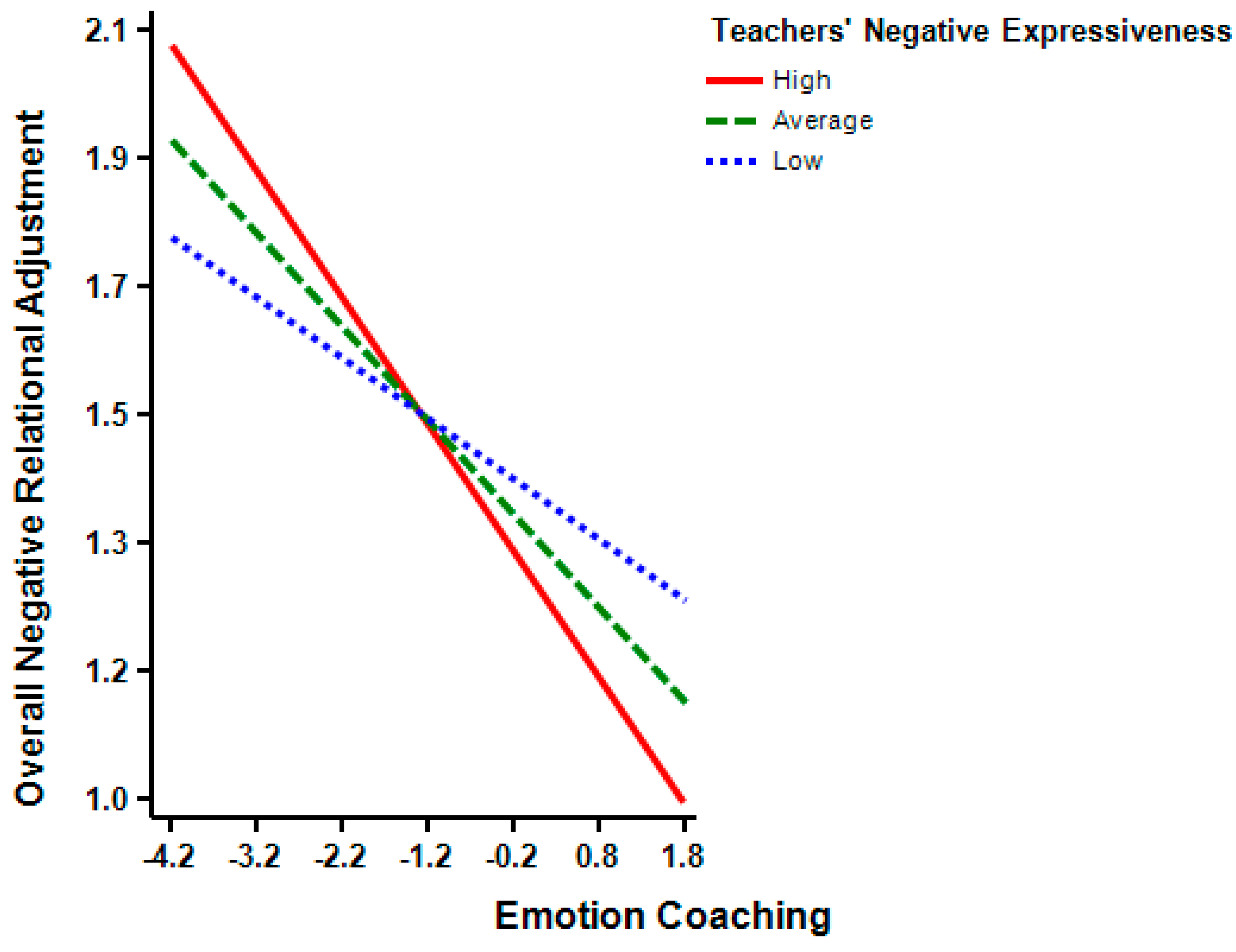
Overall negative relational adjustment. When overall negative relational adjustment was included as the dependent variable, the model was significant, F(6,85) = 7.97, p = 0.001, R2 = 0.36. Teachers’ positive emotional expressiveness was a negative predictor, t(85) = −2.99, p = 0.004 [(95% CI [−0.37, −0.08)]. The Emotion Coaching X Negative Expressiveness interaction was also significant, t(85) = −1.93, p < 0.05 [(95% CI[−0.11, 0.00)]. We probed this interaction with simple slopes analyses. The association between emotion coaching and overall negative relational adjustment was significant and negative for teachers across all levels of negative expressiveness (high, simple slope = −0.18, t(88) = −4.47, p = 0.001, CI = [−0.27, −0.10], average, simple slope = −0.13, t(88) = −4.46, p = 0.001, CI = [−0.19, −0.07], and low negative expressiveness simple slope = −0.09, t(88) = −0.13, t(88) = −2.80, p = 0.001, 95% CI = [−0.15, −0.02]). The association was strongest when teachers were high in negative expressiveness, suggesting that emotion coaching may buffer the potential relational harm that could come from teachers showing more negative classroom emotion. This analysis is summarized in Table 3 and graphed in Figure 1.
Does Teachers’ Positive and Negative Emotional Expressiveness Moderate Associations Between Teachers’ Emotion Dismissing and Their Mental Representations of their Relationships with Students?
Conflict representations. When conflict representations were considered, the model was not significant, F(6,85) = 1.20, p < 0.15, R2 = 0.08.
Dependency representations. When dependency representations were considered, the model was significant, F(6,85) = 3.84, p < 0.002, R2 = 0.21. Teachers’ negative expressiveness was positively related to teachers’ dependency representations, t(85) = 3.13, p = 0.002 [(95% CI [−0.13, 0.58)], whereas their self-reported expressiveness was a negative predictor, t(85) = −2.54, p = 0.01 [(95% CI [−0.32, −0.04)]. Years of teaching experience was significantly related to dependency representations, t(85) = 2.76, p = 0.01 [(95% CI [0.03, 0.17)].
Overall negative relational adjustment. When overall negative relational adjustment was included as the dependent variable, the model was significant, F(6,85) = 5.24, p < 0.0001, R2 = 0.27. Teachers’ positive emotional expressiveness was a negative predictor, t(85) = −3.29, p = 0.002 [(95% CI [−0.28, −0.07)]. See Table 4. Multicollinearity was not present for the models.

Qualitative Semi-Structured Interviews

Study Design and Methodology. Consistent with thematic analysis, the qualitative component of this study emerged from semi-structured interviews with teachers. We used individual interviews because talking about emotions can be sensitive. In one-on-one settings, participants may feel less pressure to conform to group norms and are more likely to share authentically about their emotional expressions and responsiveness to children’s emotions and emotion-related behaviors (see Gill et al., 2008). Additionally, individual interviews allowed the researchers to probe more deeply and meaningfully into teachers’ personal emotional experiences and unique emotional cues or narratives (Patton, 2015), which could be diluted in group settings. Participants were early childhood teachers working in preschool programs, recruited using a combination of convenience and snowball sampling. Initial participants were identified through local professional networks and invited to share study information with colleagues who met the eligibility criteria and were interested in participating.
To maintain the independence of the qualitative inquiry, none of these teachers had participated in the quantitative phase of the project. The sample included 12 teachers (6 White, 5 Black, and 1 Middle Eastern), all between 49 and 60 years of age. This approach allowed us to capture diverse perspectives from experienced educators while minimizing potential bias from prior study involvement. Teachers participated in individual, semi-structured interviews lasting approximately 30–45 min, beginning with basic demographic questions about their background and teaching experience. Ten of the teachers had master’s degrees in early childhood education or child development; one had a bachelor’s degree in psychology, and another had an associate’s degree in child development and working on a bachelor’s degree in human development. Ten had over 15 years of classroom experience and two others had between three and five years of experience. All but one reported having some formal training in SEL.
The interviews explored three domains: (1) teachers’ approaches to children’s emotions (e.g., “When students show strong emotions such as frustration or excitement, how do you usually respond?”, “Can you give an example from a typical day?”, “Does your response depend on the type of emotion?”); (2) teachers’ own emotional expressiveness (e.g., “How comfortable are you showing your own emotions in the classroom?”, “Are there certain emotions you avoid expressing?”, “Do you think emotional expression is part of your teaching?”); and (3) perceptions of classroom relational dynamics (e.g., “How do you see your relationship with your class as a whole?”, “Do you feel emotionally connected to your class?”, “What helps you feel ‘in sync’ with your students?”).

3.2. Qualitative Analyses

Author Characteristics. In qualitative research, it is important to disclose researcher demographics, as these characteristics may influence data interpretation and analysis. Our team was intentionally diverse in terms of expertise, cultural, and religious backgrounds. The first author is a Black woman and academic researcher who examines parental and teachers’ emotion socialization practices, SEL curricula and training, and emotion-related student outcomes. She brings extensive experience in applying qualitative methods to classroom data, with a particular focus on understanding how teachers’ emotions potentially influence children’s social–emotional development and emotion regulation among teachers working with high-risk populations. She contributes a strong understanding of how teachers manage their own emotions and scaffold emotional learning in challenging classroom contexts, adding depth to the interpretation of teacher responses related to emotion regulation and social–emotional support. Her professional perspective and cultural background enable her to interpret patterns in the data with attention to both SEL theory and the contextual influences of culture and identity. The second author is an Asian woman whose work focuses on teachers’ understanding of children’s emotions and their role in fostering emotion-related skills in the classroom. She brings a nuanced perspective on how teachers recognize, respond to, and support children’s emotional experiences, contributing expertise in emotion socialization practices to the analysis. The third author is a White woman who contributes expertise in the socialization of emotion in contexts of risk and adversity and with related expertise in mixed methods research. All authors contributed to data analysis and interpretation and manuscript preparation, with the first author serving as the master coder in collaboration with a graduate research assistant.
We used a thematic analysis approach to code and analyze the data (Braun & Clarke, 2006), which included reading and re-reading the narratives and making initial observations and generating initial codes. We used an open coding process in which each response in the data was labeled with as many categories of analysis as possible. Next, the two coders collaborated to review codes and merge them into similar categories by developing concepts and searching for themes that described important information about the data in relation to the research questions. Coders studied the narratives to ensure that saturation was reached and that there were no other unique themes (Guest et al., 2006). Themes were then reviewed for core subthemes to enable categorization. We next refined the specifics of each theme in relation to our qualitative research questions and generated definitions and labels for each theme, which were further defined, refined, and renamed as we continually delved into the data and through discussion. Data were then analyzed iteratively to identify key themes reflecting teachers’ beliefs about emotional expressiveness and socialization practices, and perceived emotional connection to their classes as a group within early childhood classroom contexts. In the last phase of the analysis process, we chose examples for each theme and conceptualized the relations between themes. When necessary, probes were used to follow up on participants’ responses to the initial interview questions, encouraging elaboration and deeper insight. Four themes (with subthemes) and sample quotes contributing to each theme emerged from the data. As described in Appendix A, the four core themes included: (a) Responding to Students’ Emotions: Coaching, Redirection, and Situational Flexibility, (b) Balancing Personal Emotional Expressiveness with Professional Boundaries, (c) Managing Classroom Emotions Through Emotion-Focused Teaching Practices, and (d) Constraints and Facilitators to Classroom Emotion Work. Reporting agreement statistics such as Cohen’s κ can be appropriate in qualitative studies that apply a fixed coding scheme to assess replicability across independent coders. However, our analysis followed a reflexive thematic approach in which codes were developed and refined collaboratively through an iterative analytic process rather than applied as a predetermined instrument. As noted by Braun and Clarke (2021), statistical agreement indices are not appropriate for reflexive thematic analysis because coding is interpretive and shaped through analytic discussion among researchers. Thus, we established rigor through investigator triangulation, consensus coding, reflexive memos, and careful documentation of analytic decisions. We further established trust and confidence in the data by including all the interview responses in our analyses. Co-authors reviewed the resulting themes to check the analyses and resulting interpretations of the data to consider how well the identified themes represented the data and to ensure that alternative possibilities had been explored (Bloomberg & Volpe, 2019). Our methodological approach employing two independent samples and subsequent interpretation and presentation of the two corresponding sets of results is grounded in evidence-based analytic integration methods. Specifically, Fetters et al. (2013) describes a range of recommended approaches for data integration, and our approach accordingly employs integration of results and themes through a contiguous narrative technique (see Fetters et al., for details). As such, in this approach to analytic integration, we report both quantitative and qualitative data in one manuscript but describe each set of results in separate distinct segments.

3.2.1. Theme 1: Responding to Students’ Emotions: Coaching, Redirection, and Situational Flexibility

This theme highlights three overlapping emotion socialization strategies. Coaching involves guiding students to recognize, understand, and manage their emotions. Teachers described supporting children in labeling feelings and modeling coping strategies. For example, one teacher explained, “I ask them to take a deep breath and tell me why they feel upset,” while another noted, “We talk about different ways to calm down and how to handle frustration next time.” Such practices illustrate teachers’ deliberate efforts to foster emotional literacy and self-regulation in young learners. Redirection refers to strategies aimed at shifting students’ attention or behavior when emotions interfere with learning or social interactions. Teachers reported using methods such as moving a child to a different table or assigning a task to help them regain focus, such as “If they’re having a tantrum, I might move them to a different table or give them a task to focus on,” and “Sometimes I suggest a physical activity to help a child to let off steam before coming back to the lesson.” These approaches demonstrate how teachers maintain classroom structure while remaining responsive to students’ emotional needs. Situational flexibility highlights teachers’ ability to adjust their responses based on context, student needs, and the intensity of emotions. One participant noted, “Some kids need space, some need me to sit with them. I try to read the situation before responding,” while another emphasized, “What works with one child won’t work with another, so I adjust my approach constantly.” This flexibility reflects teachers’ reliance on professional judgment, experience, and understanding of individual students to provide appropriate support. Analysis also revealed that teachers often blend coaching and redirection simultaneously, reflecting a nuanced understanding of emotional regulation and classroom management. Situational flexibility considers the importance of teacher judgment and individualized attention in shaping students’ emotional experiences. These three strategies support students’ SEL by promoting self-awareness, self-regulation, and social skills. Moreover, some teachers engaged in explicit reflection on the effectiveness of their interventions, demonstrating metacognitive awareness of how their own emotional responses influence students’ social and emotional development. Teachers also reported combining coaching and redirection, reflecting a nuanced understanding of emotion regulation and classroom management. Situational flexibility shows that teachers rely on professional judgment, experience, and knowledge of individual students to decide how best to respond.
Several teachers described efforts to “talk through” feelings with children, using tools such as feeling charts, questioning, or modeling emotion labels. For example, one teacher emphasized that “we need to feel all the feels” and reported intentionally balancing warmth with firmness after initially being “too lovey dovey.” Similarly, another teacher noted embedding emotion-teaching techniques in her classroom practices. Teachers also reported emphasizing the need to adapt responses based on individual children’s temperaments and behaviors. For instance, one teacher described how her “firmness scares” a particular child, requiring gentler teaching strategies, whereas others needed stricter boundaries. As one example, several teachers described circumstances in which they ignored, minimized, or redirected emotions, particularly during tantrums. One teacher reported sometimes ignoring behavior when she believed it was attention-seeking while another said she would “basically ignore” temper tantrums but use music or outdoor time as calming strategies. These statements highlight the individualized, relational nature of teachers’ emotion socialization practices. At the same time, teachers acknowledged moments when ignoring or redirecting were necessary. Across teachers, there was consensus that children’s emotions required some form of acknowledgment. However, they differed in how consistently they adopted coaching versus dismissing strategies.

3.2.2. Theme 2: Balancing Personal Emotional Expressiveness with Professional Boundaries

This theme captures how teachers navigate the tension between expressing their own emotions authentically and maintaining professional boundaries in the classroom. Teachers described being mindful of when and how to display emotions, particularly those that were negatively valanced while still modeling emotional regulation for their students. For example, one teacher reflected: “I am very comfortable showing positive emotions. I definitely have a problem expressing sad emotions. I want to stay positive all the time. Sometimes I show disappointment to a negative behavior, but I try to keep my personal feelings separate.”
Another teacher shared, “My mother got a cancer diagnosis yesterday and it was really hard not to show sadness, but I held it together for the kids. If the kids saw how I really felt, it would not be good.” Teachers also reported that expressing positive emotions, such as joy or encouragement, was generally aligned with classroom goals and supported students’ engagement and mood. Conversely, they described intentionally regulating or withholding negative emotions to prevent disruption or distress. As one teacher noted, “I show my excitement or happiness because it rubs off on them, but I rarely show frustration. I try to stay calm even when things are chaotic.” Teachers’ balancing of personal emotional expressiveness and professional boundaries involved several strategies, which included consciously choosing which emotions to express based on classroom context and student needs (i.e., selective sharing, modeling emotion regulation to demonstrate constructive coping strategies for students, and reflective awareness of how their emotional displays impacted classroom relationships and learning outcomes). Overall, this theme highlights the careful negotiation between authenticity and professionalism.

3.2.3. Theme 3: Managing Classroom Emotions Through Emotion-Focused Teaching Practices

This theme captures how teachers managed emotionally charged moments involving multiple children, illustrating the complex balancing act between supporting individual regulation and maintaining collective classroom harmony. Teachers described these moments as among the most challenging aspects of their emotional work in the classroom, requiring split-second decisions about whom to attend to and how. When several students became upset simultaneously, some teachers reported prioritizing the most visibly distressed child, acknowledging relying on intuitive assessments of urgency and need. As one teacher explained, “I just go by the needs, mostly individual… saying things like ‘your friend looks upset.’” Others leaned on group-based rituals, such as high-fives, songs, or talking circles to attempt to restore a sense of shared calm and connection across the group. These communal strategies served to restore emotional cohesion and signal to children that everyone’s feelings matter. Teachers also emphasized the importance of physical and spatial tools for managing collective emotion, including “calm corners,” bean bag areas, and reading nooks that allow individual children to self-regulate without disrupting their peers. One teacher described using these spaces to “give children room to breathe, but to still stay part of the group.” Across the narratives, teachers seemed to link their own emotional expressiveness to their ability to anchor group regulation. Those who felt comfortable showing emotions, such as warmth and enthusiasm, reported a stronger emotional connection with the class, describing their presence as a stabilizing force for the entire class.
Several teachers expressed frustration when emotional upsets spread through the group, noting that coaching multiple children simultaneously often felt untenable. In such cases, efficiency sometimes necessitated redirection or brief dismissal, returning to the theme of Responding to Students’ Emotions: Coaching, Redirection, and Situational Flexibility, when teachers indicated that they preferred to engage more deeply. As one teacher reflected, “You can’t have 10 emotional conversations at once. You just do your best to calm the room.” Several of the teachers described their classroom role using relational metaphors such as “anchor,” “coach,” or “guide,” signaling their understanding of themselves as emotional leaders responsible for the group’s collective affective tone. When multiple students were upset, teachers acknowledged the complexity of maintaining emotional balance across the group. They described moments when classroom emotions became “contagious,” spreading quickly from one child to another and demanding rapid, flexible responses. Teachers’ accounts highlighted three interrelated strategies for navigating these emotionally charged group moments: prioritizing individual needs, fostering collective calm, and using physical spaces to support regulation. This individualized triage reflects teachers’ sensitivity to emotional cues and their efforts to scaffold regulation in the moment. These self-descriptions illustrate how teachers view their emotions and reactions to students’ emotions as integral to the classroom’s “emotional ecosystem.” Their adaptive strategies give an impression of a relational commitment to students and a pragmatic understanding of classroom realities, balancing empathy, structure, and responsiveness when faced with simultaneous emotional demands.

3.2.4. Theme 4: Constraints and Facilitators to Classroom Emotion Work

This theme captures the structural and contextual factors that shaped teachers’ ability to engage in emotion coaching and responsive interactions with children. While teachers expressed clear intentions to support students’ emotional development, they frequently described barriers such as limited time, large class sizes, administrative demands, and emotional exhaustion that constrained these efforts. As one teacher explained, “I want to talk through every situation, but sometimes there’s just no time. When you have 18 kids and only one assistant, you’re just trying to keep things moving.” Another reflected, “It’s hard to stay patient and calm when you’re pulled in ten directions. I know what I should do, but sometimes I’m just too drained.” Teachers also identified contextual and institutional factors that may conflict with their emotional goals. One participant noted, “We get pressure to focus on academics and routines, so emotional conversations sometimes take a back seat.” Another added, “If a child is melting down and I have a schedule to keep, I can’t always give them what they need in the moment. It doesn’t feel good, but that’s the reality.” These accounts illustrate how systemic constraints can undermine even well-intentioned emotional practices. At the same time, teachers identified several facilitators that helped sustain emotional responsiveness. Supportive colleagues, smaller class sizes, and strong relationships with children were seen as protective factors that made emotional engagement possible. One teacher remarked, “When my co-teacher and I are in sync, we can tag-team emotional moments instead of getting overwhelmed.” Another shared, “Knowing my students well helps me anticipate when they’re about to lose control and step in before it escalates.”

4. Discussion

4.1. Overview of Findings

Teachers play a pivotal role in shaping the overall emotional climate of early learning environments. Beyond delivering academic content, they serve as key socializers of children’s emotional understanding, regulation, and behavior (e.g., Garner & Waajid, 2008). Emotionally responsive teachers help children navigate classroom stressors, build relationships, and develop core competencies for kindergarten preparedness and long-term success in educational settings (Fatahi et al., 2023; Garner et al., 2019a; Poulou & Denham, 2023). The teacher–student relationship is considered a secondary attachment bond, one that provides emotional security and models emotion self-regulation, which is a particularly critical element of early learning and school readiness (McKinnon & Blair, 2019). Despite growing recognition of teachers’ emotional labor in the classroom, less is known about how they manage these emotional demands in real time, particularly when multiple children experience negative emotions simultaneously. Understanding how teachers navigate such moments of collective emotion, balance individual and group needs, and draw upon their own emotional expressiveness is essential for illuminating the relational and regulatory processes that shape the classroom climate. The present mixed-methods study integrates quantitative and qualitative approaches to examine teachers’ emotion socialization practices, emotional expressiveness, and perceptions of classroom relationships. These complementary data sources provide insight into the emotional processes that underlie effective teaching and classroom connectedness.

4.2. Integrating Quantitative and Qualitative Insights

Across both strands of data, findings highlight linkages among teachers’ emotional expressiveness, emotion socialization practices, and perceptions of classroom relationships. Quantitative analyses indicated that teachers’ supportive emotion socialization practices were associated with more adaptive mental representations of teacher–student relationships. Teachers’ positive emotional expressiveness was inversely related to maladaptive relationship representations, whereas negative expressiveness was associated with greater dependency representations. Qualitative findings converged with and expanded upon these statistical patterns by illustrating how teachers intentionally use emotional expressiveness in their daily classroom interactions. Teachers described expressing warmth, enthusiasm, and encouragement as strategies for fostering classroom harmony and strengthening emotional connection with students, while deliberately limiting displays of negative emotion to maintain children’s sense of emotional security. Taken together, these findings suggest that teachers’ emotional expressiveness serves both relational and regulatory functions, shaping not only classroom interactions but also how teachers interpret their relationships with their young students. Qualitative findings also provided insight into the mechanisms underlying the quantitative interaction between teachers’ emotion coaching and emotional expressiveness. Quantitative results indicated that emotion coaching interacted with negative expressiveness to predict lower levels of overall negative relational adjustment. Teachers’ narratives illustrated how these practices unfold within the complexity of everyday classroom life. Teachers described using coaching, redirection, and situational flexibility to guide children’s emotional competence while simultaneously maintaining classroom order. For example, responses suggested that teachers prioritized supporting the most dysregulated child while employing broader strategies, such as modeling calmness or encouraging peers to provide comfort, to stabilize the group. These qualitative accounts may help explain the statistical interaction by demonstrating how emotion coaching operates within a dynamic system of classroom emotion regulation, where teachers must continually balance responsiveness to individual children with the emotional needs of all students.
Together, quantitative and quantitative data suggest that emotion socialization in classroom contexts is a relational process embedded within group dynamics, professional boundaries, and teachers’ own emotional capacities (Denham et al., 2012; Jennings & Greenberg, 2009). Additionally, the combined data suggested that structural factors, such as class size, administrative expectations, and time constraints, often limited their ability to provide individualized emotion coaching. These contextual realities may help explain why supportive emotion socialization practices were not always associated with more adaptive relationship representations in quantitative models. Even teachers who reportedly value emotion coaching described challenges implementing these strategies consistently in demanding classroom environments. Our findings are consistent with prior work highlighting the emotional labor inherent in teaching and the ways in which teachers understand how their own emotion regulation may support their ability to model and scaffold children’s emotions effectively (Sutton, 2005; see Jennings & Greenberg, 2009), suggesting that emotion socialization in early childhood classrooms may reflect teachers’ emotion-related beliefs and practices as well as the broader structural and relational conditions in which teaching occurs.
At the same time, several of our hypothesized associations were not statistically significant, and these null findings warrant consideration. One possibility is that emotion socialization practices may not operate independently but instead interact with teachers’ broader emotional communication styles and classroom conditions. In complex classroom environments, teachers often manage the emotional needs of multiple children simultaneously, which may limit the extent to which individual emotion socialization practices translate directly into maladaptive relationship representations. Teachers’ qualitative narratives support this interpretation, as many described balancing their emotion socialization practices with competing demands such as maintaining group regulation, adhering to instructional schedules, and managing classroom disruptions. Another possibility is that the drawing task we used to assess teachers’ relational representations may capture teachers’ global perceptions of classroom relational adjustment rather than more specific relational dimensions such as conflict or dependency. If so, associations between the emotion socialization variables and/or teachers’ emotional expressiveness and these more narrowly defined relational dimensions may be more difficult to detect. It could also be that teachers’ emotional expressiveness functions as a broader relational climate indicator rather than a predictor of specific classroom relationship characteristics. Finally, as discussed below, some outcome variables demonstrated restricted ranges, which may have attenuated variability and reduced the likelihood of detecting smaller effects. Together, these considerations suggest that the absence of significant associations should not necessarily be interpreted as evidence that teachers’ emotion socialization or emotional expressiveness are unrelated to teachers’ relational perceptions, but rather that these processes may operate within a broader system of classroom dynamics, measurement constraints, and structural demands. Although prior research has documented associations between teachers’ emotion socialization practices and children’s social–emotional outcomes, we extend this literature in several important ways. First, the current study focuses on teachers’ mental representations of classroom relationships, an internal cognitive–emotional process that has received relatively limited empirical attention in early childhood education research. Second, the findings highlight the moderating role of teachers’ emotional expressiveness, suggesting that the effectiveness of emotion coaching may depend, in part, on how teachers communicate emotions within everyday classroom interactions. Third, by integrating quantitative patterns with teachers’ narrative accounts, researchers may better understand how emotion socialization unfolds within the complex social ecology of early childhood classrooms, where teachers must simultaneously respond to individual children and regulate the emotional tone of the group.

4.3. Implications for Practice

Our findings suggest that teachers’ emotional expressiveness and emotion socialization are not discrete skill sets but interdependent components of their relational work in the classroom. Emotionally expressive teachers model self-regulation and empathy, which, in turn, has been shown to foster students’ emotional competence and social understanding (Poulou & Denham, 2023; Poulou et al., 2022). However, the emotional demands of teaching require institutional supports, such as professional development focused on emotional competence, reflective supervision, and manageable teacher–student ratios to sustain teachers’ capacity for responsive emotion work. These findings contribute to theories of teacher emotion socialization by emphasizing the relational ecology of emotional interactions in early learning settings. Emotion socialization does not occur solely within dyadic exchanges between teacher and child but rather within a dynamic “emotional ecosystem” that includes peers, group affect, and structural constraints. Teacher training and professional development programs should explicitly address the emotional dimensions of teaching and strive to equip educators with strategies for both self-regulation and group-level emotional management. Second, early childhood programs might consider structured reflection opportunities, such as collaborative discussions of their own and children’s emotions to help teachers align their emotion socialization goals with the realities of classroom life.

4.4. Limitations and Future Directions

Despite its strengths, this study has several limitations that suggest several avenues for future research. To begin, the study relied primarily on teachers’ self-reports and narrative accounts, which may be influenced by social desirability or discrepancies between reported beliefs and enacted practices. Moreover, the absence of direct classroom observations limits insight into how teachers’ emotional expressiveness and emotion socialization practices manifest in real-time interactions with children. In addition, our cross-sectional design, although informative, does not provide information about temporal dynamics among the study variables and precludes conclusions about the directionality of the associations we report. Because the teachers who participated in the narrative interviews were not the same individuals included in the quantitative analyses, we were unable to directly examine whether teachers’ reported emotion socialization practices and emotional expressiveness corresponded with their own relational narratives. As a result, the qualitative findings provide complementary insights rather than direct triangulation of the quantitative patterns. Future research could build upon these findings by integrating quantitative and qualitative data within the same teacher samples to allow for deeper triangulation between teachers’ reported practices and their relational narratives. Finally, the study focused primarily on teachers’ internal processes and did not account for child characteristics or broader contextual factors that may shape teacher–student relationships. Incorporating observational measures of teacher–student interactions would further clarify how teachers’ emotion socialization practices and emotional expressiveness manifest in classroom contexts. Longitudinal designs could also examine how teachers’ emotional functioning and relational representations evolve over time and influence children’s socioemotional experiences in the classroom across development. Additionally, future work should consider the role of child characteristics and broader contextual factors, such as teacher stress and workplace climate, in shaping teacher–student relationships. Finally, intervention studies aimed at strengthening teachers’ emotional awareness and emotion coaching practices may provide promising avenues for enhancing classroom relational quality and supporting young children’s development. Additionally, the participants were drawn primarily from programs in the mid-Atlantic region of the United States, and many of them had limited professional experience, with the majority reporting fewer than five years in the field. As a result, our findings may reflect the perspectives and practices of early career early childhood professionals working within a particular regional context that may differ from more experienced teachers or early educators working in other geographical regions or program types. Accordingly, caution is warranted when generalizing our findings to all early childhood teachers. Future research should replicate these analyses with more geographically diverse samples and teachers representing a wider range of professional experience to determine if similar patterns emerge across contexts. Finally, although the sample size was modest, a post hoc power analysis indicated that the study had adequate statistical power to detect medium-sized effects. Still, the sample may have been underpowered to detect small effects, which could have contributed to some nonsignificant findings. Relatedly, several dependent variables demonstrated restricted ranges (e.g., teacher–student conflict scores ranging from 1 to 3), which may have attenuated associations and reduced variability in some of the outcomes of interest. Future research incorporating larger samples could strengthen understanding of how teachers’ emotional processes relate to classroom relationships.

4.5. Conclusions

This mixed-methods study provides converging evidence that teachers’ emotional expressiveness and emotion socialization practices are deeply intertwined with their perceptions of teacher–student relationships and classroom climate. Teachers’ ability to express emotions positively, regulate negative affect, and respond flexibly to children’s emotional needs appears essential to fostering emotionally supportive learning environments. At the same time, their narratives reveal the systemic challenges that complicate this work. Findings highlight the need for professional learning environments that not only teach emotion coaching strategies but also support teachers’ own emotional well-being and capacity for relational attunement in the classroom. By integrating quantitative patterns with qualitative depth, this study enhances understanding of the emotional ecology of early childhood classrooms. Teachers’ emotion socialization practices emerge as dynamic, relational processes shaped by individual dispositions, classroom contexts, and collective emotional needs. Recognizing the emotional complexity of teachers’ work can inform more holistic approaches to supporting educators and promoting emotionally responsive early learning environments.

Author Contributions

Conceptualization, P.W.G.; methodology, P.W.G.; software, P.W.G.; validation, P.W.G., H.H.B., & J.M.S.; formal analysis, P.W.G.; investigation, P.W.G.; resources, P.W.G.; data curation, P.W.G.; writing—original draft preparation, P.W.G.; writing—review and editing, P.W.G., J.M.S., & H.H.B.; visualization, P.W.G.; supervision, P.W.G.; project administration, P.W.G. All authors have read and agreed to the published version of the manuscript.

Funding

This research received no external funding.

Institutional Review Board Statement

The study was conducted in accordance with the Declaration of Helsinki, and approved by George Mason’s Institutional Review Board (protocol code 2196993-1 and date of approval: 23 July 2024).

Informed Consent Statement

Informed consent was obtained from all subjects involved in the study.

Data Availability Statement

The datasets presented in this article are not readily available in order to protect participant confidentiality. Requests to access the datasets should be directed to Pamela Garner, Ph.D., at pgarner1@gmu.edu.

Conflicts of Interest

The authors declare no conflicts of interest.

Appendix A. Qualitative Themes, Subthemes, and Illustrative Quotes

ThemeSubthemeConceptExample Quote
Responding to Students’ Emotions: Coaching, Redirection, and Situational Flexibility Emotion coaching Supporting students in identifying and processing emotions“I help them name what they are feeling.”
Emotion dismissing Minimizing or ignoring student emotional expressions “I tell them to shake it off and move on”
Situational ShiftsVariability between coaching and dismissing based on context (e.g., group vs. individual, behavior severity) or stress.“It depends…if I am overwhelming, I just ignore it.”
Balancing Personal Emotional Expressiveness with Professional BoundariesComfort/discomfort with emotional expression Perceptions of professionalism tied to emotion control“I do not mind showing emotions when I am excited or happy.”; “I try not to let them see me when I am frustrated or upset.”
Perceived student reactions
Emotional modeling for students
Students’ responses to teachers’ emotions and teachers’ adjustments based on student reactions
Teachers perceiving themselves as emotional role models; descriptions of using their own expressiveness to teach emotion regulation
“They always notice when I am stressed or angry.”
“I want them to see how I handle being upset.”
Managing Classroom Emotions Through Emotion-Focused Teaching Practices Relational connection to the classDescriptions of the emotional bond (or lack thereof) with the class as a whole; “in sync” moments vs. feelings of disconnection from the group; group identity perceptions (e.g., cohesive, fragmented, cooperative, resistant)“I feel bonded to them like a little community.”; “My class is a solid team.”;
“My class feels heavy emotionally.”
Relational role framingHow teachers define their role in the classroom emotionally (e.g., leader, caregiver, coach); descriptions of managing group dynamics as relational work
Perceiving emotions as integral to classroom learning and community-building
“I see myself as the emotional anchor in the classroom.”;
“How I handle my emotions sets the tone.”
Perceived collective emotional toneEmotion dismissing linked to prioritizing control over connection
Perceptions of emotional practices as contributing (or not) to class cohesion.
“Sometimes, it’s about controlling behavior and learning and not feelings.”
“Helping students with their emotions helps build trust for the entire class.”
Constraints and Facilitators to Classroom Emotion Work Structural constraintsClass size, time pressures, administrative expectations limiting emotional work; stress and teacher burnout as barriers to emotion coaching.“I would talk more about emotions but I just do not have time.”
Personal facilitatorsTeacher beliefs about emotions, prior training, and personal emotional history influencing practices; emotional self-awareness and regulation as key to group relational management“My training in children’s social–emotional development helps me stay patient.”; I used to avoid emotions but now I see their importance.”

References

  1. Ahnert, L., Harwardt-Heinecke, E., Kappler, G., Eckstein-Madry, T., & Milatz, A. (2012). Student–teacher relationships and classroom climate in first grade: How do they relate to students’ stress regulation? Attachment & Human Development, 14(3), 249–263. [Google Scholar] [CrossRef] [PubMed]
  2. Ainsworth, M. D. S., Blehar, M., Waters, E., & Wall, S. (1978). Patterns of attachment. Behavioral and Brain Sciences, 1(3), 436–438. [Google Scholar] [CrossRef]
  3. Arace, A., Prino, L. E., & Scarzello, D. (2021). Emotional competence of early childhood educators and child socio-emotional wellbeing. International Journal of Environmental Research and Public Health, 18(14), 7633. [Google Scholar] [CrossRef] [PubMed]
  4. Bloomberg, L. D., & Volpe, M. (2019). Completing your qualitative dissertations: A road map from beginning to end (4th ed.). Sage. [Google Scholar]
  5. Boekaerts, M., & Pekrun, R. (2016). Emotions and emotion regulation in academic settings. In L. Corno, & E. M. Anderman (Eds.), Handbook of educational psychology (3rd ed., pp. 76–90). Routledge. [Google Scholar]
  6. Bosman, R. J., Zee, M., & Koomen, H. M. (2019). Do teachers have different mental representations of relationships with children in cases of hyperactivity versus conduct problems? School Psychology Review, 48(4), 333–347. [Google Scholar] [CrossRef]
  7. Braun, V., & Clarke, V. (2006). Using thematic analysis in psychology. Qualitative Research in Psychology, 3(2), 77–101. [Google Scholar] [CrossRef]
  8. Braun, V., & Clarke, V. (2021). One size fits all? What counts as quality practice in (reflexive) thematic analysis? Qualitative Research in Psychology, 18(3), 328–352. [Google Scholar] [CrossRef]
  9. Buettner, C. K., Jeon, L., Hur, E., & Garcia, R. E. (2016). Teachers’ social–emotional capacity: Factors associated with teachers’ responsiveness and professional commitment. Early Education and Development, 27(7), 1018–1039. [Google Scholar] [CrossRef]
  10. Cohen, J. (1988). Statistical power analysis for the behavioral sciences (2nd ed.). Erlbaum. [Google Scholar]
  11. Council for Professional Recognition. (2022). CDA competency standards book: Preschool edition. Council for Professional Recognition. Available online: https://www.cdacouncil.org (accessed on 11 May 2026).
  12. Curby, T. W., Downer, J. T., & Booren, L. M. (2014). Behavioral exchanges between teachers and children over the course of a typical preschool day: Testing bidirectional associations. Early Childhood Research Quarterly, 29(2), 193–204. [Google Scholar] [CrossRef]
  13. Davolyte, J., Kiuru, N., Raiziene, S., & Silinskas, G. (2024). Children’s task persistence in first grade: The role of parent-child and teacher-child relationships. Early Childhood Research Quarterly, 68(3), 135–147. [Google Scholar] [CrossRef]
  14. Denham, S. A., Bassett, H. H., & Wyatt, T. (2007). The socialization of emotional competence. In J. Grusec, & P. Hastings (Eds.), The handbook of socialization (pp. 614–637). Guilford Press. [Google Scholar]
  15. Denham, S. A., Bassett, H. H., & Zinsser, K. (2012). Early childhood teachers as socializers of young children’s emotional competence. Early Childhood Education Journal, 40, 137–143. [Google Scholar] [CrossRef]
  16. Denham, S. A., Ferrier, D. E., & Bassett, H. H. (2020). Preschool teachers’ socialization of emotion knowledge: Considering socioeconomic risk. Journal of Applied Developmental Psychology, 69, 101160. [Google Scholar] [CrossRef]
  17. Denham, S. A., & Kochanoff, A. T. (2002). Parental contribution to preschoolers’ understanding of emotion. Marriage & Family Review, 34(3–4), 311–343. [Google Scholar] [CrossRef]
  18. Dunsmore, J. C., & Karn, M. A. (2001). Mothers’ beliefs about feelings and children’s emotional understanding. Early Education and Development, 12(1), 117–138. [Google Scholar] [CrossRef]
  19. Eisenberg, N., Cumberland, A., & Spinrad, T. (1998). Parental socialization of emotion. Psychological Inquiry, 9(4), 241–273. [Google Scholar] [CrossRef] [PubMed]
  20. Evans, D., Butterworth, R., & Law, G. U. (2019). Understanding associations between perceptions of student behaviour, conflict representations in the teacher-student relationship and teachers’ emotional experiences. Teaching and Teacher Education, 82, 55–68. [Google Scholar] [CrossRef]
  21. Fabes, R. A., Poulin, R. E., Eisenberg, N., & Madden-Derdich, D. A. (2002). The Coping with Children’s Negative Emotions Scale (CCNES): Psychometric properties and relations with children’s emotional competence. Marriage & Family Review, 34(3–4), 285–310. [Google Scholar] [CrossRef]
  22. Fatahi, N., Park, C., Curby, T. W., Zinsser, K. M., Denham, S. A., Moberg, S., & Gordon, R. A. (2023). Promoting preschoolers’ social and emotional competencies through emotion-focused teaching. Early Education and Development, 34(8), 1729–1748. [Google Scholar] [CrossRef]
  23. Faul, F., Erdfelder, E., Buchner, A., & Lang, A. (2009). Statistical power analyses using G*Power 3.1: Tests for correlation and regression analyses. Behavior Research Methods, 41, 1149–1160. [Google Scholar] [CrossRef]
  24. Fetters, M. D., Curry, L. A., & Creswell, J. W. (2013). Achieving integration in mixed methods designs—Principles and practices. Health Services Research, 48(6), 2134–2156. [Google Scholar] [CrossRef] [PubMed]
  25. Fury, G., Carlson, E. A., & Sroufe, A. (1997). Children’s representations of attachment relationships in family drawings. Child Development, 68(6), 1154–1164. [Google Scholar] [CrossRef]
  26. Garner, P. W., Bolt, E., & Roth, A. N. (2019a). Emotion-focused curricula models and expressions of and talk about emotions between teachers and young children. Journal of Research in Childhood Education, 33(2), 180–193. [Google Scholar] [CrossRef]
  27. Garner, P. W., Parker, T. S., & Prigmore, S. B. (2019b). Caregivers’ emotional competence and behavioral responsiveness as correlates of early childcare workers’ relationships with children in their care. Infant Mental Health Journal, 40(4), 496–512. [Google Scholar] [CrossRef]
  28. Garner, P. W., Shadur, J. M., & Toney, T. (2021). The effects of teacher–child racial congruence, child race, and emotion situation knowledge on teacher–child relationships and school readiness. Psychology in the Schools, 58(10), 1995–2016. [Google Scholar] [CrossRef]
  29. Garner, P. W., & Waajid, B. (2008). The associations of emotion knowledge and teacher–child relationships to preschool children’s school-related developmental competence. Journal of Applied Developmental Psychology, 29(2), 89–100. [Google Scholar] [CrossRef]
  30. Gill, P., Stewart, K., Treasure, E., & Chadwick, B. (2008). Methods of data collection in qualitative research: Interviews and focus groups. British Dental Journal, 204(6), 291–295. [Google Scholar] [CrossRef]
  31. Gottman, J. M., Katz, I. F., & Hooven, C. (1997). Meta-emotion: How families communicate emotionally. Erlbaum. [Google Scholar]
  32. Gottman, J. M., Katz, L. F., & Hooven, C. (1996). Parental meta-emotion philosophy and the emotional life of families: Theoretical models and preliminary data. Journal of Family Psychology, 10(3), 243–268. [Google Scholar] [CrossRef]
  33. Guest, G., Bunce, A., & Johnson, L. (2006). How many interviews are enough? An experiment with data saturation and variability. Field Methods, 18(1), 59–82. [Google Scholar] [CrossRef]
  34. Halberstadt, A. G. (1986). Family socialization of emotional expression and nonverbal communication styles and skills. Journal of Personality and Social Psychology, 51(4), 827–836. [Google Scholar] [CrossRef]
  35. Hamre, B. K., & Pianta, R. C. (2001). Early teacher–child relationships and the trajectory of children’s school outcomes through eighth grade. Child Development, 72(2), 625–638. [Google Scholar] [CrossRef]
  36. Hamre, B. K., Pianta, R. C., Downer, J. T., & Mashburn, A. J. (2012). Teachers’ perceptions of conflict with young children: Looking beyond problem behaviors. Social Development, 21(1), 20–36. [Google Scholar] [CrossRef]
  37. Harrison, L. J., Clarke, L., & Ungerer, J. A. (2007). Children’s drawings provide a new perspective on teacher–child relationship quality and school adjustment. Early Childhood Research Quarterly, 22(1), 55–71. [Google Scholar] [CrossRef]
  38. Hayes, A. F. (2018). Partial, conditional, and moderated moderated mediation: Quantification, inference, and interpretation. Communication Monographs, 85(1), 4–40. [Google Scholar] [CrossRef]
  39. Holmbeck, G. N. (2002). Post-hoc probing of significant moderational and mediational effects in studies of pediatric populations. Journal of Pediatric Psychology, 27(1), 87–96. [Google Scholar] [CrossRef]
  40. Jennings, P. A. (2015). Early childhood teachers’ well-being, mindfulness, and self-compassion in relation to classroom quality and attitudes toward challenging students. Mindfulness, 6, 732–743. [Google Scholar] [CrossRef]
  41. Jennings, P. A., & Greenberg, M. T. (2009). The prosocial classroom: Teacher social and emotional competence in relation to student and classroom outcomes. Review of Educational Research, 79, 491–525. [Google Scholar] [CrossRef]
  42. Kilic, S. (2015). Preschool teachers’ emotional socialization responses to 4–6-year-old Turkish preschoolers’ emotional expressions. European Journal of Research on Education, 3(1), 53–63. [Google Scholar]
  43. King, G. L., Kehoe, C. E., Havighurst, S. S., Youssef, G. J., Macdonald, J. A., Dunsmore, J. C., Berkowitz, T. S., & Westrupp, E. M. (2023). Creation of a short-form and brief short-form version of the coping with children’s negative emotions scale. Assessment, 30(6), 1947–1968. [Google Scholar] [CrossRef] [PubMed]
  44. Lagacé-Séguin, D. G., & Coplan, R. J. (2005). Maternal emotional styles and child social adjustment: Assessment, correlates, outcomes and goodness of fit in early childhood. Social Development, 14(4), 613–636. [Google Scholar] [CrossRef]
  45. Li, H., Chen, W., He, H., & Luo, W. (2023). Chinese private preschool teachers’ teaching readiness and teacher–child relationships: The chain mediation effects of motivation to teach and self-efficacy. Behavioral Sciences, 13(11), 900. [Google Scholar] [CrossRef]
  46. Li, L., Valiente, C., Eisenberg, N., Spinrad, T. L., Johns, S. K., Berger, R. H., Thompson, M. S., Southworth, J., Pina, A. A., Hernández, M. M., & Gal-Szabo, D. E. (2022). Longitudinal associations among teacher–child relationship quality, behavioral engagement, and academic achievement. Early Childhood Research Quarterly, 61(4), 25–35. [Google Scholar] [CrossRef]
  47. Li, S., Zhao, X., & Jeon, L. (2026). Teacher–child relationships and perceived stress among head start teachers: Examining the moderating roles of emotion regulation and workplace support. Child & Youth Care Forum, 55, 441–465. [Google Scholar] [CrossRef]
  48. Lin, Y. C. (2022). Using a drawing method to investigate pre-service teachers’ beliefs, knowledge and emotions about mathematics teaching and learning. Asia-Pacific Journal of Teacher Education, 50(5), 474–497. [Google Scholar] [CrossRef]
  49. Mainhard, T., Donker, M. H., & vanGog, T. (2022). When closeness is effortful: Teachers’ physiological activation undermines positive effects of their closeness on student emotions. British Journal of Educational Psychology, 92, 1384–1402. [Google Scholar] [CrossRef]
  50. Martikainen, J. (2019a). Social representations of teachership based on cover images of Finnish Teacher magazine: A visual rhetoric approach. Journal of Social and Political Psychology, 7(2), 890–912. [Google Scholar] [CrossRef]
  51. Martikainen, J. (2019b). Social representations of teachership based on students’ and teachers’ drawings of a typical teacher. Social Psychology of Education, 22(3), 579–606. [Google Scholar] [CrossRef]
  52. McKinnon, R. D., & Blair, C. (2019). Bidirectional relations among executive function, teacher–child relationships, and early reading and math achievement: A cross-lagged panel analysis. Early Childhood Research Quarterly, 46(1), 152–165. [Google Scholar] [CrossRef]
  53. Mirabile, S., & Kodluboy, C. (2015). Description and validation of a teacher-report version of the Self-Expressiveness in the Family Questionnaire. European Journal of Developmental Psychology, 12(6), 678–687. [Google Scholar] [CrossRef]
  54. Morris, C. A., Denham, S. A., Bassett, H. H., & Curby, T. W. (2013). Relations among teachers’ emotion socialization beliefs and practices and preschoolers’ emotional competence. Early Education & Development, 24, 979–999. [Google Scholar] [CrossRef]
  55. Moseley, C., Desjean-Perrotta, B., & Utley, J. (2010). The Draw-An-Environment Test Rubric (DAET-R): Exploring pre-service teachers’ mental models of the environment. Environmental Education Research, 16(2), 189–208. [Google Scholar] [CrossRef]
  56. O’Connor, E. E., Collins, B. A., & Supplee, L. (2012). Behavior problems in late childhood: The roles of early maternal attachment and teacher–child relationship trajectories. Attachment & Human Development, 14(3), 265–288. [Google Scholar] [CrossRef]
  57. Ornaghi, V., Agliati, A., Pepe, A., & Gabola, P. (2020). Patterns of association between early childhood teachers’ emotion socialization styles, emotion beliefs and mind-mindedness. Early Education and Development, 31(1), 47–65. [Google Scholar] [CrossRef]
  58. Ornaghi, V., Agliati, A., Pepe, A., & Grazzani, I. (2018). The contribution of emotion knowledge, language ability, and maternal emotion socialization style to explaining toddlers’ emotion regulation. Social Development, 28(3), 581–598. [Google Scholar] [CrossRef]
  59. Ornaghi, V., Conte, E., Agliati, A., & Gandellini, S. (2021). Early-childhood teachers’ emotion socialization practices: A multi-method study. Early Child Development and Care, 192(10), 1608–1625. [Google Scholar] [CrossRef]
  60. Patton, M. Q. (2015). Qualitative research & evaluation methods (4th ed.). Sage. [Google Scholar]
  61. Pianta, R. C. (2001). Student-teacher relationships scale. PAR. Psychological Assessment Resources, Inc. [Google Scholar]
  62. Pianta, R. C., La Paro, K. M., & Hamre, B. K. (2008). CLASS: Classroom assessment scoring system manual: Pre-K. Paul H. Brookes Publishing Co. [Google Scholar]
  63. Poulou, M. S., & Denham, S. A. (2023). Teachers’ emotional expressiveness and coping reactions to students’ emotions: Associations with students’ social-emotional competences and school adjustment. Early Education and Development, 34(3), 607–625. [Google Scholar] [CrossRef]
  64. Poulou, M. S., & Garner, P. W. (2025). Teacher-student relationships: The roles of teachers’ emotional competence, social emotional learning beliefs, and burnout. Teachers and Teaching, 31(7), 1229–1250. [Google Scholar] [CrossRef]
  65. Poulou, M. S., Garner, P. W., & Bassett, H. H. (2022). Teachers’ emotional expressiveness and classroom management practices: Associations with young students’ social-emotional and behavioral competence. Psychology in the Schools, 59(3), 557–573. [Google Scholar] [CrossRef]
  66. Rose, J., McGuire-Snieckus, R., & Gilbert, L. (2015). Emotion coaching—A strategy for promoting behavioural self-regulation in children/young people in schools: A pilot study. European Journal of Social & Behavioural Sciences, 13(2), 130–157. [Google Scholar] [CrossRef]
  67. Rudasill, K. M., Acar, I., & Xu, Y. (2022). Early teacher–child relationships promote self-regulation development in prekindergarten. International Journal of Environmental Research and Public Health, 19(14), 8802. [Google Scholar] [CrossRef]
  68. Savina, E., & Fulton, C. (2024). Students’ and teachers’ emotions in the classroom: An ecological dynamic systems perspective. European Journal of the Psychology of Education, 39, 2763–2781. [Google Scholar] [CrossRef]
  69. Sherwood, C. A. (2020). “The goals remain elusive”: Using drawings to examine shifts in teachers’ mental models before and after an NGSS professional earning experience. Journal of Science Teacher Education, 31(5), 578–600. [Google Scholar] [CrossRef]
  70. Spilt, J. L., Verschueren, K., Van Minderhout, M. B. W. M., & Koomen, H. M. Y. (2022). Dyadic teacher-child relationships: Comparing theories, empirical evidence and implications for practice. Journal of Child Psychology and Psychiatry, 63(7), 724–733. [Google Scholar] [CrossRef]
  71. Sutton, R. E. (2005). Teachers’ emotions and classroom effectiveness: Implications from recent research. The Clearing House, 78, 229–234. Available online: https://www.jstor.org/stable/30189914 (accessed on 11 May 2026).
  72. Taxer, J. L., & Frenzel, A. C. (2020). The message behind teacher emotions. The Journal of Experimental Education, 88(4), 595–604. [Google Scholar] [CrossRef]
  73. Trang, K. T., & Hansen, D. M. (2020). The roles of teacher expectations and school composition on teacher-child relationship quality. Journal of Teacher Education, 72(2), 152–167. [Google Scholar] [CrossRef]
  74. Ulloa, M. L., Evans, I. M., & Parkes, F. (2010). Teaching to care: Emotional interactions between preschool children and their teachers. New Zealand Research in Early Childhood Education, 13, 145–156. [Google Scholar]
  75. Wilhelmsen, T., Lekhal, R., Rydland, V., & Coplan, R. J. (2025). Exploring the role of early childhood educators’ emotion socialization strategies in the development of young children’s social and non-social play behaviors. Early Childhood Research Quarterly, 73(4), 92–100. [Google Scholar] [CrossRef]
  76. Zee, M., Rudasill, K. M., & Roorda, D. L. (2020). “Draw Me a Picture” student-teacher relationship drawings by children displaying externalizing, internalizing, or prosocial behavior. The Elementary School Journal, 120(4), 636–666. [Google Scholar] [CrossRef]
  77. Zinsser, K. M., Denham, S. A., Curby, T. W., & Shewark, E. A. (2015). “Practice what you preach”: Teachers’ perceptions of emotional competence and emotionally supportive classroom practices. Early Education and Development, 26(7), 899–919. [Google Scholar] [CrossRef]
Figure 1. Teachers’ negative emotional expressiveness as a significant moderator of the association between emotion coaching and representations of overall negative relational adjustment.
Education 16 00829 g001
Table 1. Descriptive Statistics for Study Variables.
VariablesMSDRange
Conflict 1.280.271–3
Dependency 1.310.401–4
Overall negative relational adjustment1.340.321–3
Emotion coaching 5.231.051–7
Emotion dismissing1.490.891–7
Positive expressiveness6.610.984–9
Negative expressiveness3.020.651–5
Years of teaching experience2.121.111–5
Table 2. Correlations Among the Study Variables (N = 92).
Variables12345678
1. Conflict 0.22 *0.25 *0.03−0.080.170.130.08
2. Dependency −0.120.200.02−0.070.27 **0.28 **
3. Overall negative relational adjustment −0.40 **0.12−0.49 **−0.25 *−0.19
4. Emotion coaching −0.41 **0.38 **0.140.07
5. Emotion dismissing −0.19−0.090.01
6. Positive expressiveness 0.32 **0.17
7. Negative expressiveness 0.04
8. Teaching experience
Note. * p < 0.05. ** p < 0.01.
Table 3. Final Model Parameters for Main Effects Models and Moderation Models for Emotion Coaching.
ConflictDependencyOverall Negative Relational Adjustment
VariablesEffect(SE)p ValueEffect(SE)p ValueEffect(SE)p Value
Emotion Coaching (EC)−0.090.120.420.110.160.49−0.090.120.45
Teachers’ Positive Expressiveness 0.100.070.20−0.000.100.98−0.220.070.003 **
EC* Teachers’ Positive
Expressiveness
−0.010.010.31−0.030.020.12−0.030.010.08
Teachers’ Negative
Expressiveness
−0.310.160.05 *−0.140.210.500.230.160.15
EC* Teachers’ Negative
Expressiveness 1
0.070.030.02 *0.070.040.08−0.060.030.05 *
Teaching Experience0.010.030.790.100.030.00 *−0.030.030.32
Note. Effect = Unstandardized regression coefficient. SE = standard error. ** p < 0.01; * p < 0.05; 1 Although the interaction effect reached significance, it was not interpreted because the overall model was not significant.
Table 4. Final Model Parameters for Main Effects Models and Moderation Models for Emotion Dismissing.
ConflictDependencyOverall Negative Relational
Adjustment
VariablesEffect(SE)p ValueEffect(SE) p ValueEffect(SE)p Value
Emotion Dismissing (ED)−0.020.120.90−0.090.170.59−0.070.130.59
Teachers’ Positive
Expressiveness
−0.020.050.71−0.180.070.01−0.170.050.002 **
ED* Teachers’ Positive
Expressiveness
0.030.020.210.050.030.120.020.020.40
Teachers’ Negative
Expressiveness
0.160.080.060.350.110.002 **−0.020.090.82
ED* Teachers’ Negative
Expressiveness
−0.060.030.070.080.050.12−0.020.040.66
Teaching Experience0.010.030.770.100.040.007 **−0.040.030.20
Note. Effect = Unstandardized regression coefficient. SE = standard error. ** p < 0.01.
Disclaimer/Publisher’s Note: The statements, opinions and data contained in all publications are solely those of the individual author(s) and contributor(s) and not of MDPI and/or the editor(s). MDPI and/or the editor(s) disclaim responsibility for any injury to people or property resulting from any ideas, methods, instructions or products referred to in the content.