


Abstract
The rapid development of artificial intelligence (AI) and Generative AI (GenAI) based on large language models (LLMs) is reshaping teaching practices, assessment criteria, and ethical questions regarding authenticity, source reliability, and educational responsibility. Understanding teachers’ attitudes toward AI is crucial for identifying acceptance, resistance, and professional development needs. This study aimed to adapt and validate, for the Italian context, the questionnaire developed by Alsudairy and Eltantawy for assessing teachers’ attitudes toward AI in education, and to explore attitudinal differences according to selected socio-professional variables. A convenience sample of 682 in-service teachers from different school levels and Italian regions completed the 36-item questionnaire on a 3-point Likert scale. Exploratory factor analysis suggested an interpretable two-factor structure, although some items showed weak, non-salient, or cross-loadings. A confirmatory factor analysis conducted on a refined 32-item ordinal model supported a correlated two-factor solution with good global fit indices. However, the strong correlation between the two latent factors and the presence of selected weak indicators suggest that further refinement and cross-validation are needed. Educational attainment was the only socio-professional variable significantly associated with attitudes toward AI, although the effect size was small. Post hoc analyses showed a significant difference between teachers holding a postgraduate Master’s degree and those holding only a high school diploma, whereas other differences should be interpreted as descriptive trends. Taken together, these findings provide preliminary support for the Italian adaptation of the instrument and offer initial insight into the role of professional characteristics in shaping teachers’ attitudes toward AI in educational settings.
1. Introduction
1.1. Context and Definition
Artificial Intelligence (AI) is currently one of the most significant and controversial areas of inquiry. Located at the intersection of technological innovation, social transformation, and educational change, it raises complex ethical, social, and pedagogical questions. Within a debate that often tends to polarize between positions of explicit technophilia and marked technophobia, that is, between perspectives that emphasize the utopian potential of emerging technologies and those that foreground their dystopian implications and systemic risks, AI has progressively emerged as a central issue in the field of education. It has thus become not only an object of theoretical reflection, but also a concrete driver of change in educational practices, teaching methodologies, and pedagogical perspectives (Seldon & Abidoye, 2018).
The introduction of AI into educational settings is now a concrete reality. It requires the educational community to reflect critically on the meaning, scope, and conditions of its use. From this perspective, while AI is often regarded as an opportunity to personalize learning pathways, automate repetitive tasks, and broaden access to diverse educational resources, it also raises substantial concerns. These include the delegation of decision-making to algorithmic systems, the potential reduction in teachers’ mediating and instructional-design roles, the possible erosion of the relational dimension of teaching, and the risks associated with the opacity of computational processes and the expansion of educational surveillance (Holmes et al., 2019; Crawford, 2021).
The recent emergence of Generative Artificial Intelligence (GenAI), particularly the widespread diffusion of large language models (LLMs), has further accelerated these dynamics, highlighting the need for in-depth reflection on the ways in which education is structured, organized, and assessed. New-generation conversational tools such as ChatGPT, Google Gemini, and Copilot have introduced unprecedented forms of human–machine interaction, broadening the range of potential educational applications while simultaneously prompting critical reflection on the very meaning of learning, the authenticity of cognitive production, and the reliability of sources (Holmes & Tuomi, 2022).
Although these technologies may democratize access to complex content and support advanced cognitive processes, they also raise concerns about plagiarism, data manipulation, ethical compliance, and the preservation of learners’ centrality in educational experiences (Zawacki-Richter et al., 2019; Gökşel & Bozkurt, 2019). As a result, the adoption of AI and GenAI in education cannot be framed solely in terms of technological innovation; rather, it requires an epistemological and regulatory perspective able to account for the anthropological, relational, and cultural implications of teaching and learning in contexts mediated by intelligent systems. Within this framework, the scientific community engaged in Artificial Intelligence in Education (AIED) research is increasingly called upon to address both methodological and value-laden challenges, ranging from ethical-by-design approaches to the promotion of AI literacy capable of integrating technical competences, critical awareness, and an understanding of the socio-educational implications of emerging technologies (Miao & Shiohira, 2022). As Holmes (2024) has argued, it is essential to ask not only what these technologies can do, but, above all, what they ought to do considering principles such as dignity, autonomy, and the rights of those involved in educational processes.
1.2. Literature Review: Teachers’ Attitudes and Perceptions of AI
Within this debate, examining teachers’ perceptions and uses of AI is important because it helps identify their level of acceptance, frequency of use, instructional motivations, and possible forms of resistance. In turn, this can provide valuable indications for the design of teacher education policies and support mechanisms aimed at accompanying educational innovation (Ferrantino & Scarano, 2024; di Martino, 2024; Pellegrini & Sebastiani, 2024; Toci et al., 2025; Bruni & Murgia, 2025; Nirchi et al., 2024; Nazaretsky et al., 2022).
Perception, as Nirchi et al. (2024) argue, can be understood as a pedagogical category of instructional action, situated at the intersection of knowledge, professional experience, and pedagogical beliefs. As such, it functions as a filter through which innovations are interpreted and evaluated (Vrasidas & McIsaac, 2001; Ertmer, 2005): when a technology is perceived as overly complex or pedagogically inappropriate, it is more likely to generate resistance; conversely, when it is regarded as useful and compatible with existing teaching practices, it tends to foster greater acceptance. From this perspective, Tondeur et al. (2017) have shown that pedagogical beliefs not only predict the extent to which technology is used but also shape the ways in which it is integrated into teaching, confirming that teachers’ perceptions cannot be reduced to mere individual opinions. Rather, they constitute a crucial pedagogical dimension for the success of educational innovation, whose effectiveness depends largely on teachers’ active engagement and acceptance (Fullan, 2016).
Research on technology acceptance has also highlighted the persistence of skeptical attitudes, often associated with anxiety in interacting with complex tools, a preference for established instructional methods, and broader concerns about the possible replacement or marginalization of the teacher’s role (Istenic et al., 2021; Zimmerman, 2006; Tallvid, 2016).
It is important to emphasize that the transformative impact of AI on teaching can only be realized through its responsible and ethical integration, supported by adequate teacher education and professional development (Perla et al., 2025). From this perspective, AI assumes a dual role: it is both an object of learning and a tool for supporting teachers’ professional growth (di Martino, 2024). The international literature on the topic is both extensive and rapidly expanding. Within this body of work, attitudes toward AI are generally conceptualized as evaluative dispositions. Research has examined the extent to which these attitudes are associated, on the one hand, with levels of technological competence and familiarity (Pokrivcakova, 2023) and, on the other, with the propensity to develop and consolidate forms of AI literacy (Galindo-Domínguez et al., 2024; Özden et al., 2025). Accordingly, attitudes, competences, and AI literacy appear to be mutually interdependent. Competences may shape attitudes by reducing uncertainty and fear or by promoting more informed critical concerns. At the same time, attitudes may either facilitate or hinder the reflective adoption of AI and the development of a pedagogically grounded relationship with it (Çayak, 2024). In this sense, attitudes toward AI may be understood as multidimensional psychological dispositions encompassing cognitive components (knowledge and beliefs about AI), affective components (emotions such as interest, trust, or anxiety), and behavioural components (intentions of use and teaching practices), in line with the main socio-psychological models of action (Ajzen, 1991). In the international literature, several studies have shown that variables such as perceived usefulness, ease of use, and trust significantly influence teachers’ intention to adopt AI-based tools (Davis, 1989; Venkatesh et al., 2003; Liu, 2025; Ofem et al., 2025; Marsalek & Teplá, 2026), as do ethical and professional concerns, as well as issues related to the reliability of AI systems (Zawacki-Richter et al., 2019; Long & Magerko, 2020). Studies conducted in European contexts have further highlighted the role of digital competence and targeted training in fostering more positive attitudes and a greater willingness to use such technologies (Redecker, 2017; Montenegro-Rueda & Fernández-Batanero, 2022).
With regard to the Italian context, a growing body of research has examined teachers’ attitudes toward AI, revealing heterogeneous levels of knowledge and a generally favourable disposition toward its use, often accompanied, however, by unmet training needs and persistent uncertainty concerning the pedagogical and ethical implications of AI (Giannini & Gaebel, 2022; Borsini & Giaconi, 2025; Fiorucci & Bevilacqua, 2025; Isidori et al., 2024; Treglia & Tomassoni, 2024; Gravino et al., 2024; Perla et al., 2025).
From a methodological perspective, the assessment of teachers’ attitudes toward AI has relied predominantly on self-report measures, particularly structured questionnaires using Likert-type scales, which are widely employed in research on technology adoption in education. Many studies draw on established frameworks such as the Technology Acceptance Model (Davis, 1989) and the Unified Theory of Acceptance and Use of Technology (Venkatesh et al., 2003), adapting their core dimensions, including perceived usefulness, ease of use, and behavioural intention. More recently, AI-specific instruments have been developed, such as the General Attitudes toward Artificial Intelligence Scale (Schepman & Rodway, 2020), which captures both positive and negative dimensions of attitudes, as well as scales incorporating constructs such as trust, anxiety, and self-efficacy. However, the literature also reveals marked heterogeneity in the instruments employed, many of which have been developed ad hoc for single studies and are characterised by limited evidence of validity and reliability, as well as weak theoretical convergence in the definition of the underlying constructs (Zawacki-Richter et al., 2019). Significant gaps therefore remain, particularly the lack of standardized instruments specifically designed for educational settings and teacher populations. This underscores the need for psychometrically robust scales capable of capturing, in an integrated way, the pedagogical, ethical, and professional dimensions of attitudes toward AI.
This gap is not merely methodological, but also pedagogical: without validated instruments, it is difficult to distinguish between general optimism toward AI, trust in AI systems, perceived educational usefulness, and teachers’ readiness to integrate AI into instructional processes.
1.3. Aim and Research Questions
Against this background, investigating teachers’ attitudes toward AI is particularly relevant, as such attitudes may influence not only the acceptance of emerging technologies, but also the ways in which they are pedagogically interpreted and integrated into educational practice. Although the international literature has increasingly addressed teachers’ perceptions of AI, important gaps remain, especially regarding the availability of psychometrically robust instruments for educational settings and teacher populations. This issue is especially relevant in the Italian context, where interest in AI is growing, but validated tools for systematically assessing teachers’ attitudes are still limited.
In response to this gap, the present study has a twofold aim.
First, it aims to adapt and validate, for the Italian context, the questionnaire developed by Alsudairy and Eltantawy (2024) to assess teachers’ attitudes toward the use of artificial intelligence in educational settings. Specifically, the study examines whether the Italian version of the instrument retains a theoretically coherent multidimensional structure and shows adequate psychometric properties in terms of internal reliability. Accordingly, the first set of research questions is as follows: (a) Does the Italian version of the questionnaire display an interpretable and theoretically coherent multidimensional structure? (b) Is the exploratory two-factor structure supported by a confirmatory factor analysis of a refined ordinal measurement model? (c) Does the instrument show satisfactory psychometric reliability?
Second, the study explores whether attitudes toward AI vary according to selected professional and educational variables identified in the literature as relevant to the relationship between emerging technologies and teaching practices. More specifically, it addresses the following questions: (a) What attitudes do mainstream and support teachers hold toward the use of AI in education, and are there statistically significant differences between these groups? (b) Do attitudes toward AI vary according to length of teaching experience? (c) Do attitudes toward AI vary according to educational level or academic qualification?
2. Materials and Methods
This study employed a quantitative, cross-sectional survey design to examine teachers’ attitudes and perceptions toward the use of AI in educational practice. In response to the limited availability of validated instruments in the Italian context, the study had two main aims: to adapt and validate the questionnaire developed by Alsudairy and Eltantawy (2024), and to explore whether attitudes toward AI differ according to teaching role, length of service, and educational attainment.
2.1. Participants
A non-probability convenience sampling strategy was adopted, based on the voluntary participation of in-service teachers (Table 1). The sample comprised 682 teachers (99 males and 583 females); the marked predominance of women is consistent with the gender composition typically characterizing the educational and teaching professions. Participants were divided into mainstream teachers (47.5%, n = 324) and support teachers (52.5%, n = 358). This distinction reflects a specific feature of the Italian educational context, where, in the absence of special schools, both professional figures work within the same inclusive school settings, albeit with different roles and responsibilities. Support teachers receive additional specialist training in the field of inclusion. Distinguishing between these two groups therefore made it possible to explore the potential influence of different professional profiles on attitudes toward the use of AI in education. Geographically, the sample was drawn predominantly from Southern Italy (68.5%, n = 467), followed by Central Italy (22.9%, n = 156) and Northern Italy (8.7%, n = 59).
Table 1.
Sociodemographic Characteristics of Participants.
Regarding the sociodemographic characteristics (Table 1), the sample was composed mainly of teachers aged 40–49 years (39.6%, n = 270) and 50–59 years (29.2%, n = 199). Most participants held a master’s degree or equivalent second-cycle qualification (59.7%, n = 407) and reported relatively limited teaching experience, concentrated in the early career stages: 0–5 years (36.7%, n = 250) and 6–10 years (35.3%, n = 241). The distribution by school level showed a predominance of upper secondary school teachers (34.8%, n = 237), followed by primary school teachers (31.5%, n = 215), lower secondary school teachers (22.9%, n = 156), and preschool teachers (10.9%, n = 74).
2.2. Assessment Instrument
The instrument used in the present study was originally developed by Alsudairy and Eltantawy (2024) to assess special education teachers’ perceptions of the use of artificial intelligence (AI) in teaching students with disabilities. It represents one of the earliest systematic attempts to investigate teachers’ perceptions of AI integration in special education within the Saudi context. The questionnaire was developed through a multi-step process, including a review of the relevant literature on attitudes and perceptions toward AI. Its construction was informed by previously validated instruments, including the General Attitudes toward Artificial Intelligence Scale (GAAIS; Schepman & Rodway, 2020), Lezhnina and Kismihók’s (2020) work based on the Affinity for Technology Interaction (ATI), and a questionnaire measuring students’ knowledge of generative AI.
In its final version, the instrument comprises 36 items rated on a three-point Likert scale (“Disagree,” “Neutral,” “Agree”), scored from 1 to 3. The questionnaire is structured into two dimensions: general perceptions of AI (10 items), addressing basic understanding of AI, expectations about its future benefits, and trust in delegating complex decisions to machines; and perceptions of AI use in educational processes (26 items), focusing on the role of AI in personalizing learning, supporting inclusion, simplifying information, and diversifying instructional methods. Total scores range from 36 to 108, with higher scores indicating more positive attitudes toward AI.
From a theoretical perspective, these two dimensions may be interpreted as complementary components of teachers’ attitudes toward AI. The first dimension captures more general evaluative orientations toward AI, including beliefs about its usefulness, trustworthiness, and broader potential. The second dimension refers more specifically to the perceived pedagogical relevance of AI in educational processes, particularly in relation to personalization, support for inclusion, adaptation of teaching materials, and diversification of instructional strategies. Considered together, the two dimensions are consistent with the multidimensional view of attitudes outlined in the theoretical framework, according to which attitudes toward AI involve cognitive, affective, and behavioural components, as well as perceptions of usefulness, trust, and educational applicability. In this sense, the instrument does not measure isolated opinions about technology, but a broader attitudinal disposition toward the meaning and possible role of AI in educational practice.
According to the authors, preliminary analyses provided evidence of strong internal consistency and satisfactory psychometric robustness, supporting the use of the instrument in educational research. The questionnaire items used in the present study are reported in Appendix A in both the Italian adapted version and an English rendering for readers’ convenience.
It should be noted that this two-dimensional organization refers to the original theoretical structure of the questionnaire. The empirical structure of the Italian adaptation was subsequently examined through EFA and CFA, allowing for possible differences in item allocation across factors.
2.3. Instrument Adaptation and Translation Process
The original questionnaire developed by Alsudairy and Eltantawy (2024) was translated into Italian through a translation and expert-review procedure broadly consistent with the main guidelines for cross-cultural adaptation (Beaton et al., 2000), which typically recommend a five-step process: (1) forward translation by multiple bilingual translators; (2) synthesis of the translated versions; (3) back-translation into the source language to assess fidelity; (4) review by an expert committee to evaluate semantic, idiomatic, experiential, and conceptual equivalence; and (5) pre-testing with the target population to examine item comprehension and interpretation. This approach is widely used in the cross-cultural validation of self-report instruments because it supports semantic and conceptual comparability across contexts. More specifically, the Italian version used in the present study was developed through: (1) an initial translation from English into Italian carried out by an independent translator with expertise in the educational field; and (2) a critical review by three experts in Special Education, who assessed the clarity, relevance, and cultural appropriateness of the items. The expert review was guided by a set of predefined qualitative criteria. Specifically, the experts were asked to assess: (a) semantic equivalence with the original English version; (b) conceptual coherence with the construct of teachers’ attitudes toward AI; (c) clarity and readability of the Italian wording; (d) cultural appropriateness within the Italian school context; (e) relevance of each item for teachers working in inclusive educational settings; and (f) terminological consistency across the questionnaire.
Although a formal back-translation into English by independent native speakers blind to the original version was not performed, particular attention was paid to preserving the original meaning of each item.
A final revision of the instrument was then conducted based on the feedback received. The modifications were mainly lexical and contextual in nature and were intended to improve comprehensibility within the Italian educational context without altering the original meaning of the items. Overly literal translations were replaced with expressions more commonly used in Italian pedagogical discourse; terminology referring to school roles and inclusive educational settings was aligned with the Italian school system; and terms referring to artificial intelligence, AI systems, teaching practices, and educational processes were harmonized across the questionnaire. For example, expressions related to educational use were reformulated using wording more familiar to Italian teachers, such as references to teaching and learning processes, personalization, inclusive support, instructional strategies, and learning materials. The response options were also adapted to ensure naturalness and consistency in Italian. The number of items, the two-section structure, and the three-point response scale developed by the original authors were left unchanged. The present study examines the validity of the Italian adaptation of the original questionnaire by Alsudairy and Eltantawy (2024), while preserving the original number of items, two-dimensional structure, and three-point response scale.
2.4. Procedure
An online questionnaire was created using the Google Forms platform, accompanied by a brief introduction outlining the study’s objectives and the expected time commitment. Prior to participation, teachers were provided with an informed consent statement, which explained the purpose of the study, voluntary nature of participation, and the participants’ right to withdraw at any time without penalty. Participants were explicitly informed that their responses would be treated with strict confidentiality and anonymity, and that no personally identifiable information would be collected. The survey was anonymous, voluntary, and non-interventional, and the data were analysed only in aggregated form. Participants provided informed consent by voluntarily proceeding to complete the questionnaire. The research protocol included both the data collection procedures and the informed consent process.
Responses were automatically recorded through the Google Forms platform, thus ensuring data accuracy and integrity. The survey remained open for 4 months and was distributed remotely to allow flexibility and encourage broader participation. The questionnaire was disseminated through a multimodal recruitment strategy involving: (a) direct distribution to schools via institutional email, with a request that the survey be forwarded to teaching staff; (b) sharing through professional networks and subject-specific groups; and (c) publication on digital channels dedicated to teacher education and professional development. This approach made it possible to reach a large and diverse pool of potential respondents, although it did not allow the overall size of the contacted population to be determined precisely.
2.5. Data Analysis
Content validity was preliminarily assessed through expert review, focusing on item relevance, clarity, semantic equivalence, and cultural appropriateness within the Italian school context (Osterlind, 1989). Item properties were examined using descriptive statistics, including means, standard deviations, skewness, and kurtosis.
Construct validity was investigated through exploratory factor analysis (EFA) followed by confirmatory factor analysis (CFA). Given the three-point Likert response format and the presence of skewness and/or kurtosis values exceeding |1| for several items, the EFA was conducted on a polychoric correlation matrix, as recommended for ordinal items with asymmetric distributions or excess kurtosis (Muthén & Kaplan, 1985, 1992). The analysis was performed in FACTOR version 12.06.07 (Lorenzo-Seva & Ferrando, 2006), using Robust Diagonally Weighted Least Squares (RDWLS) extraction, bias-corrected and accelerated bootstrap confidence intervals based on 500 bootstrap samples, and Robust Promin oblique rotation, given the expected association between the latent dimensions.
The number of factors was evaluated using the optimal implementation of Parallel Analysis based on minimum rank factor analysis. Model fit was assessed through RMSEA, CFI, NNFI, and RMSR, together with the inspection of residual diagnostics. Internal consistency and factor score quality were examined using ORION reliability coefficients and the Factor Determinacy Index.
The CFA was performed in Jamovi (version 2.7.28) using a structural equation modelling approach for ordered categorical indicators (The Jamovi Project, 2024). The model was estimated with DWLS, robust standard errors, and correlated latent factors. The confirmatory model was specified on the refined 32-item solution derived from the EFA results, retaining items with theoretically interpretable and salient primary loadings and excluding items with non-salient loadings or problematic cross-loadings.
To examine differences according to professional and educational variables, descriptive statistics were calculated for the total score and for the two original subscale scores. Because the EFA and CFA suggested a partial reorganization of the original item structure, these group comparisons were considered exploratory and were interpreted with caution.
Differences between mainstream and support teachers were tested using Welch’s t-test, whereas differences by length of service and educational attainment were examined using Welch’s ANOVA. These robust procedures were adopted because of unequal group sizes and to reduce sensitivity to possible violations of homogeneity of variance. Effect sizes were reported using Hedges’ g for two-group comparisons and eta squared (η2) for omnibus analyses, with confidence intervals considered where appropriate.
Descriptive and comparative analyses were performed using SPSS 30.0 for Windows, whereas factorial analyses were conducted using FACTOR and Jamovi.
3. Results
3.1. Exploratory and Confirmatory Factor Analysis
The first part of the analysis was aimed at examining the psychometric properties of the Italian version of the questionnaire developed by Alsudairy and Eltantawy (2024).
We examined the factorial structure of the instrument, the theoretical coherence of the emerging dimensions, and internal reliability to assess whether the questionnaire, once adapted to the Italian context, retained adequate validity and usability for educational research.
In the following tables, labels V1–V36 correspond to the questionnaire items reported in Appendix A.
Before conducting the factorial analyses, univariate descriptive statistics were examined for all items (Table 2), following the procedure recommended by Schmider et al. (2010).
Table 2.
Univariate descriptive statistics.
Specifically, mean, standard deviation, skewness and kurtosis were calculated for each item. Inspection of the univariate distributions showed that no item exceeded the ±2.5 threshold for skewness, whereas only one item (V8) slightly exceeded this threshold for kurtosis (3.013) (George & Mallery, 2006). Since the overall pattern did not indicate severe univariate non-normality, no items were removed on this basis.
Preliminary data analysis did not indicate the need to remove any items. No missing data were observed; therefore, the missing-value procedure specified in FACTOR did not affect the results. MSA diagnostics also supported the adequacy of the item pool.
In line with the ordinal nature of the three-point Likert items, the exploratory factor analysis was re-run using a polychoric correlation matrix and Robust Diagonally Weighted Least Squares extraction. The analysis was conducted in FACTOR, with bias-corrected and accelerated bootstrap confidence intervals based on 500 bootstrap samples, LOSEFER empirical correction of the chi-square statistic, and Robust Promin oblique rotation. This approach was adopted to provide a more appropriate psychometric basis for examining the factorial structure of the Italian adaptation. The adequacy of the polychoric correlation matrix was supported by Bartlett’s test of sphericity, χ2 = 7692.6, df = 630, p < 0.001, and by a very good KMO value of 0.927. Mardia’s multivariate kurtosis was significant, further supporting the use of robust estimation procedures. The Solomon method split the sample into two equivalent subsamples, with a Ratio Communality Index of 0.996, suggesting a high degree of equivalence between the two subsamples. The SENECA estimate also indicated that the available sample size was adequate for the analysis, as the recommended sample size was 180 observations, whereas the present study included 682 participants.
Overall, the solution proved interpretable, with most items showing salient loadings on one of the two dimensions. However, the distribution of items across the two factors did not fully coincide with that reported in the original study by Alsudairy and Eltantawy (2024). This divergence, which is common in cross-linguistic and cross-cultural adaptation processes, suggests that structural validity should not be assessed solely in terms of exact replication of the original item composition, but rather on the basis of the theoretical and semantic coherence of the emerging dimensions. From this perspective, the two factors identified appear to reflect conceptually coherent domains within the broader construct of teachers’ attitudes toward AI in educational settings.
More specifically, the different distribution of items may reflect both linguistic-cultural adaptation effects and the different composition of the sample compared with the original study. The questionnaire had originally been developed for special education teachers, whereas in the present study it was administered to a broader and more heterogeneous sample of Italian teachers. This wider application context may have altered the relationships among items, leading to factor groupings that are more consistent with a more general representation of attitudes toward AI in educational processes.
The rotated factor loading matrix from the ordinal exploratory factor analysis is reported in Table 3.
Table 3.
Rotated factor loading matrix from the ordinal exploratory factor analysis.
Regarding reliability and factor score quality, the rotated solution showed high values. ORION reliability was 0.941 for Factor 1 and 0.957 for Factor 2, while the Factor Determinacy Index was 0.970 and 0.978, respectively (Table 4). These findings indicate that, despite some structural criticalities, the identified factors show strong internal coherence and good quality of factor score estimates, supporting the cautious use of the instrument in research settings.
Table 4.
Factor variance, ORION reliability, and Factor Determinacy Index.
Overall, the two-factor solution was theoretically interpretable, although it did not fully reproduce the original allocation of items proposed by Alsudairy and Eltantawy (2024). The first factor grouped items referring to general trust in AI, perceived usefulness, and the educational potential of AI, particularly in relation to students with disabilities. The second factor mainly included items concerning the operational and pedagogical implementation of AI, such as personalization, adaptation of materials, instructional support, assessment, motivation, and continuity of learning.
Some items require cautious interpretation. Items V9 and V16 did not show salient loadings above the |0.30| threshold. Items V19 and V20 showed cross-loadings, while V33 showed a positive loading on Factor 2 and a negative loading on Factor 1. These findings suggest that, although the two-factor solution is interpretable, the measurement model is not yet fully stabilized and should be further examined in future studies.
Robust fit indices indicated a good overall fit of the two-factor EFA solution: RMSEA = 0.037, CFI = 0.991, and NNFI = 0.989. However, the RMSR value was 0.0589, exceeding Kelley’s expected criterion of 0.0383. Residual diagnostics also indicated local areas of misfit, with standardized residuals ranging from −4.20 to 7.16. Therefore, the model appears adequate at the global level, but some item-level relationships require further refinement. This pattern supports the interpretability of the two-factor solution while suggesting that the item pool is not yet fully optimized.
Factor simplicity indices were favourable, supporting the interpretability of the rotated solution. The two factors were strongly correlated, r = 0.825, indicating that the two dimensions are analytically distinguishable but closely related. This high association suggests that general perceptions of AI and perceptions of AI-supported educational implementation should be interpreted as two closely connected facets of a broader evaluative orientation toward AI rather than as fully independent constructs.
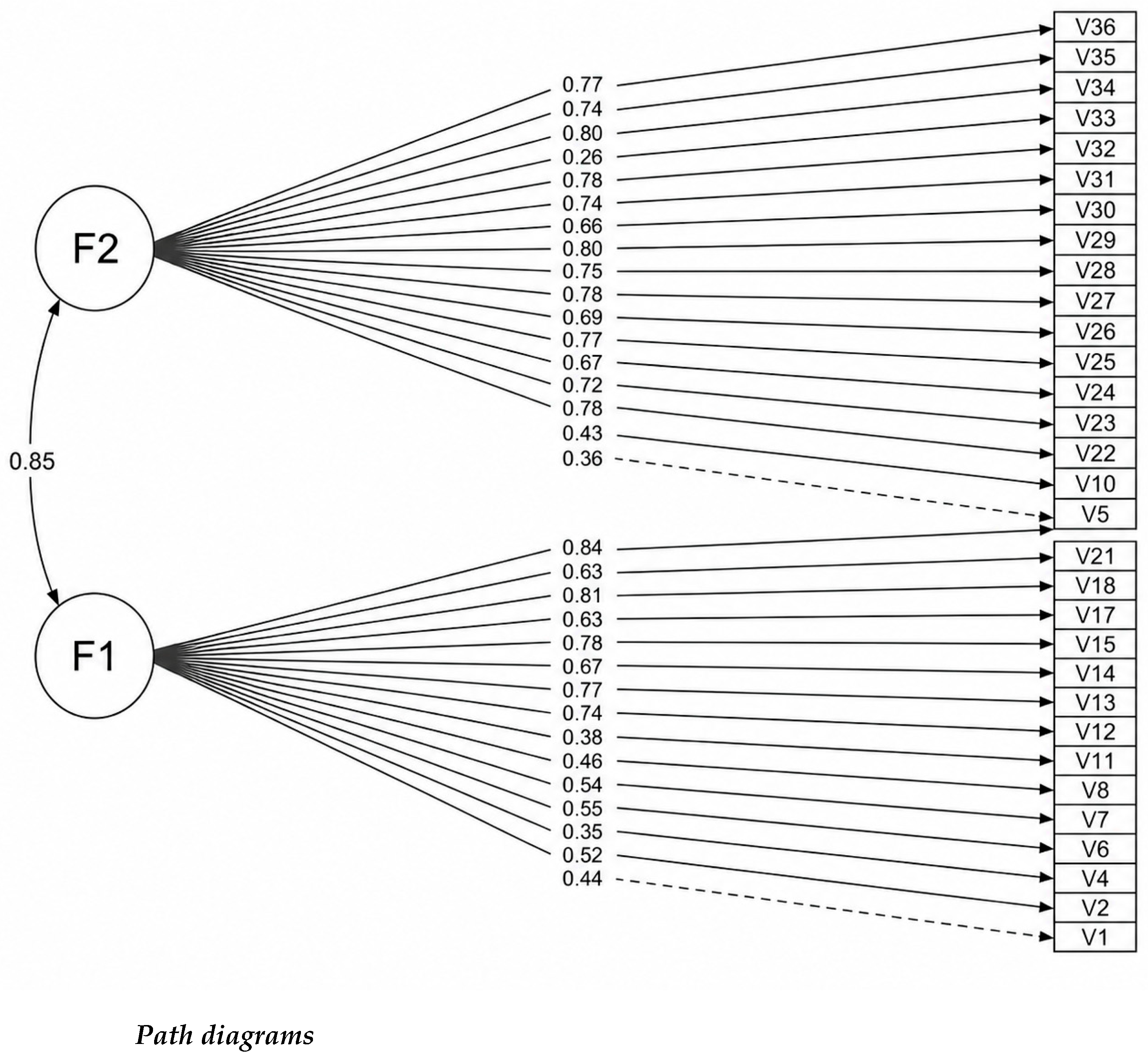
The CFA tested the refined two-factor structure derived from the EFA. The model included 32 items. Items V9 and V16 were excluded because they did not show salient loadings in the EFA, whereas items V19 and V20 were excluded because of cross-loadings. Contrary to the excluded items, V4 was retained because it loaded clearly on Factor 1 in the EFA and showed an acceptable standardized loading in the CFA.
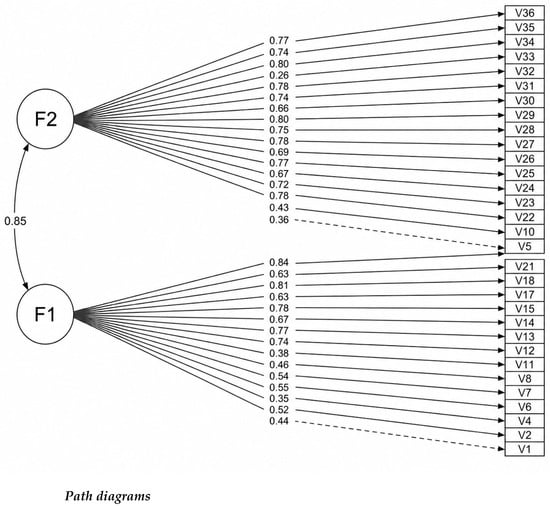
The final CFA model specified two correlated latent factors. Factor 1 included V1, V2, V3, V4, V6, V7, V8, V11, V12, V13, V14, V15, V17, V18, and V21. Factor 2 included V5, V10, V22, V23, V24, V25, V26, V27, V28, V29, V30, V31, V32, V33, V34, V35, and V36 (Figure 1).
Figure 1.
Confirmatory factor model of the refined 32-item two-factor solution.
The correlated two-factor ordinal model showed good global fit: χ2(463) = 1152, p < 0.001, RMSEA = 0.047, 95% CI [0.043, 0.050], SRMR = 0.064, CFI = 0.988, TLI = 0.987, and NNFI = 0.987. These indices indicate that the refined 32-item model provides a substantially better representation of the data than the previously considered 34-item specification (Table 5).
Table 5.
Fit indices for the refined 32-item CFA model.
The two latent factors were strongly correlated, φ = 0.848, 95% CI [0.818, 0.878], p < 0.001, indicating a large amount of shared variance. Therefore, the two dimensions should be interpreted as closely related facets of a broader attitude toward AI rather than as fully independent constructs (Table 6).
Table 6.
Correlation between latent factors in the CFA model.
Most standardized factor loadings were satisfactory. However, some indicators showed weak or modest loadings, especially V33 (β = 0.261), V3 (β = 0.352), V5 (β = 0.358), V8 (β = 0.384), V10 (β = 0.426), V1 (β = 0.444), and V7 (β = 0.458). These items should be retained only with caution and should be considered for revision or further testing in future validation studies (Table 7).
Table 7.
Standardized factor loadings of the refined CFA model.
Taken together, the CFA results support the adequacy of the refined 32-item two-factor model. At the same time, the high correlation between the two factors, the presence of selected weak indicators, and the need for independent cross-validation suggest that the factorial structure should be considered promising but not definitive.
In addition to structural validity, reliability was examined for the refined CFA model. Factor 1 showed acceptable to good reliability, with α = 0.846, ordinal α = 0.896, and ω = 0.856. Factor 2 showed good reliability, with α = 0.901, ordinal α = 0.933, and ω = 0.909. However, the average variance extracted was below the conventional 0.50 threshold for both factors, especially for Factor 1 (AVE = 0.393) and, to a lesser extent, Factor 2 (AVE = 0.483). These findings indicate that the two factors show satisfactory internal consistency, but convergent validity remains only partially supported. Therefore, reliability evidence is encouraging, although further refinement of weak indicators is needed.
3.2. Exploratory Analysis of Attitudes According to Professional and Educational Variables
The second part of the analysis explored the distribution of attitudes toward AI in relation to a set of professional and educational variables identified in the literature as potentially relevant, namely professional role, length of service, and level of education/training. Given that the EFA and CFA indicated a partial reorganization of the original item structure, the following group comparisons should be interpreted as exploratory. Because these analyses were based on the original total and subscale scores, they reflect the theoretical structure of the source instrument rather than the refined 32-item factorial structure supported by the Italian data.
Future analyses should therefore replicate these comparisons using factor scores or composite scores derived from the refined CFA model.
The aim was to examine whether these characteristics were associated with differentiated attitudinal profiles toward the use of AI in educational settings. From this perspective, the findings are not interpreted merely in descriptive terms, but also as indicators of the factors that may shape, albeit to different degrees, the acceptance and pedagogical interpretation of emerging technologies.
- Are there differences between mainstream teachers and support teachers?
On the total score, the two groups showed virtually overlapping means (Table 8).
Table 8.
Descriptive statistics by teaching role (M, SD).
Welch’s test did not reveal statistically significant differences (Table 9), with a negligible effect size (g ≈ −0.03).
Table 9.
Comparison between mainstream and support teachers (Welch’s t-test).
The same pattern was observed for both original subscales.
This finding suggests that professional role does not constitute a discriminating factor with respect to attitudes toward AI. One possible explanation lies in the specificity of the Italian school context, in which mainstream teachers and support teachers work within the same inclusive educational environments and share a substantial part of their organizational and teaching practices. Although their functions and levels of specialization differ, both groups appear to engage with AI from sufficiently similar professional conditions, which may explain the absence of significantly different orientations.
- Do attitudes vary according to length of service?
Mean scores across the different categories of teaching experience showed only limited variation (Table 10). Welch’s ANOVA on the total score was not statistically significant (p = 0.111; η2 = 0.009), and no robust differences emerged for the subscales either (Table 11). Only a slight tendency was observed for the “educational processes” subscale, with somewhat higher scores among teachers with 0–5 years of experience, although this difference did not reach statistical significance.
Table 10.
Descriptive statistics by length of service (M, SD).
Table 11.
Welch’s ANOVA by length of service.
Once again, length of service does not appear to be a sufficiently strong variable to account for systematic differences in attitudes toward AI. One possible interpretation is that AI, especially in its generative forms, represents a relatively recent innovation, with respect to which both more experienced and less experienced teachers are still in a phase of exploration and redefinition of their practices. In other words, accumulated professional experience does not appear to translate automatically into either greater or lesser openness toward these technologies.
- Do attitudes vary according to educational attainment/training?
Descriptive analyses indicated a moderate gradient, with higher scores observed among teachers holding a Postgraduate Master’s degree and, to a lesser extent, a Master’s/specialist degree (Table 12). The omnibus test was significant for the total score (p = 0.014; η2 = 0.019) and for the “educational processes” subscale (p = 0.019; η2 = 0.018), whereas it was not significant for the “general” subscale (Table 13). Unlike the other variables considered, educational attainment/training therefore showed a significant, although small, association with attitudes toward AI. This finding suggests that additional training may represent a more influential resource than professional role or length of service in fostering greater openness toward the use of AI in educational contexts.
Table 12.
Descriptive statistics by educational attainment (M, SD).
Table 13.
Welch’s ANOVA by educational attainment.
Post hoc analyses showed that the significant difference specifically concerned the comparison between teachers holding a postgraduate Master’s degree and those holding only a high school diploma (Table 14). This finding may be interpreted in light of the fact that more advanced educational pathways are likely to provide greater opportunities for engagement with debates on educational innovation, digital technologies, and professional reflection. What appears to emerge, therefore, is not simply a more favourable general attitude toward technology, but rather a stronger tendency to recognize the potential of AI in educational processes. At the same time, the small effect size calls for caution in interpreting this result, given that attitudes toward AI are likely shaped by a range of individual, educational, and contextual factors not directly examined in the present study.
Table 14.
Post hoc comparison on the total score (Holm): significant contrast.
4. Discussion
Overall, the findings outline a complex but coherent psychometric picture. The Italian version of the questionnaire showed an interpretable two-factor structure in the EFA and good global fit in the refined 32-item CFA model. Therefore, the main issue is not inadequate global fit, but rather the internal refinement of the measurement model. Specifically, some items showed non-salient loadings or cross-loadings in the EFA, while selected indicators showed weak standardized loadings in the CFA. In addition, the high correlation between the two latent factors indicates that the distinction between general attitudes toward AI and perceptions of AI-supported educational implementation is empirically weak. The two factors should therefore be interpreted as closely related facets of a broader general attitude toward AI rather than as clearly independent constructs. The present findings may also be read in relation to the Italian study by Borsini and Giaconi (2025), who investigated the perceptions of teachers in training for support teaching using the Italian translation of the questionnaire repurposed from Alsudairy and Eltantawy (2024). Their results documented a generally positive, though not uncritical, view of AI in inclusive education, especially regarding personalization, diversification of teaching strategies, and support for inclusive teaching-learning processes, while also emphasizing the need for specific pedagogical training for a reflective use of AI. In this respect, our findings are broadly convergent, as they likewise suggest that attitudes toward AI are linked not only to technology acceptance per se, but also to teachers’ educational interpretation of its pedagogical value. At the same time, the broader and more heterogeneous composition of our sample, together with the psychometric focus of the present study, extends that line of inquiry beyond the context of teachers in training.
This pattern differs, at least in part, from that reported in the original study by Alsudairy and Eltantawy (2024), in which the psychometric properties of the questionnaire were examined primarily through internal consistency analyses. More specifically, the authors assessed the correlation between each item and the total score of its corresponding dimension, reporting coefficients ranging from 0.407 to 0.728 for the first dimension and from 0.530 to 0.823 for the second, all statistically significant at the 0.01 level, thereby supporting the instrument’s internal coherence. In addition, questionnaire stability was examined using the split-half method, yielding an overall stability coefficient of 0.941 and a Spearman–Brown corrected coefficient of 0.968, both of which confirmed a high level of measurement stability. Against this background, the present study confirms the good overall reliability of the instrument but also reveals a more problematic picture regarding its latent structure. In other words, while the Italian data are consistent with the original study in terms of the instrument’s internal consistency, they suggest greater complexity in the factorial configuration, likely due both to the different analytical framework adopted and to differences in sample composition and application context. Indeed, the questionnaire was originally developed for special education teachers in Saudi Arabia, whereas in the present study it was administered to a broader and more heterogeneous sample of Italian teachers.
From this perspective, the present findings do not weaken the value of the instrument; rather, they suggest the need to reconsider it from a cross-cultural perspective, highlighting the importance of further investigation to achieve a fuller stabilization of the measurement model in the Italian context.
Regarding the professional dimension, the analyses provide a picture in which attitudes toward AI appear to be largely shared among teachers and only weakly differentiated according to role or length of service. In the sample considered, attitudes toward the use of AI in education were substantially overlapping between mainstream and support teachers, and no robust association emerged between attitudes toward AI and years of teaching experience.
Taken together, these findings suggest that the Italian adaptation retains the substantive core of the original construct, while also showing signs of empirical restructuring. This result is plausible because the original instrument was developed for a more specific professional group and was here administered to a broader and more heterogeneous sample of Italian teachers. The refined 32-item solution appears psychometrically stronger than the original allocation of items, but it should be considered preliminary. Further studies should test the stability of this structure in independent samples, compare one-factor, two-factor, three-factor, higher-order, and bifactor models, and examine measurement invariance across teaching role, school level, gender, and educational attainment.
These findings are consistent with part of the literature showing no significant differences in attitudes toward technology or in its classroom use as a function of age, gender, or years of experience (Gu et al., 2013; Islahi & Nasrin, 2019). At the same time, they do not align with other studies that have instead highlighted the role of age (O’Bannon & Thomas, 2014; Vadakkemulanjanal et al., 2021), gender (Bang & Luft, 2013), years of experience (Gu et al., 2013; Inan & Lowther, 2010), or disciplinary field (Guidry & BrckaLorenz, 2010; Mercader & Gairín, 2020) in shaping attitudes toward and practices of technology use. In this sense, the heterogeneity of findings in the literature suggests that technological attitudes and behaviours are likely to be influenced by sociocultural and organizational factors specific to different contexts (Kim & Lee, 2024).
By contrast, educational attainment showed a significant, albeit small, association with attitudes toward AI, with higher scores observed especially among teachers holding a postgraduate master’s degree and, to some extent, a Master’s/specialist degree, compared with those holding only a high school diploma. This result is in line with recent studies that found no significant differences in attitudes toward AI according to gender, length of professional experience, or school level, but did identify more positive attitudes and higher levels of AI literacy among teachers with postgraduate education (Tan et al., 2023).
The association between advanced training and more favourable attitudes toward AI is also supported by studies showing that higher levels of education are linked to greater technological awareness and closer attention to ongoing innovation, as well as to more frequent use of technology in educational processes (Güneş & Buluç, 2017).
Overall, these findings suggest that attitudes toward AI are only weakly associated with socio-professional variables. Educational attainment was the only variable showing a statistically significant association, but the effect size was small and should not be overinterpreted. The difference between teachers holding a postgraduate Master’s degree and those holding only a high school diploma may reflect greater exposure to advanced training, innovation-oriented professional development, or greater familiarity with digital and pedagogical debates. However, because the design is cross-sectional and the sample is non-probabilistic, this association should be interpreted as exploratory rather than causal (Tondeur et al., 2017; Scherer et al., 2019; di Martino, 2024).
This picture appears particularly meaningful when considered in light of evidence suggesting that future teachers belonging to Generation Z tend, in some studies, to display a greater predisposition toward AI than their teacher educators (di Martino, 2024; Chan & Lee, 2023). This further supports the idea that attitudes toward AI do not depend simply on accumulated experience, but rather on the type of cultural, educational, and professional exposure to emerging technologies.
5. Conclusions
This study provides preliminary evidence supporting the Italian adaptation of the questionnaire developed by Alsudairy and Eltantawy (2024) to investigate teachers’ attitudes toward AI in educational settings. The EFA suggested an interpretable two-factor structure, and the CFA supported a refined 32-item correlated two-factor model with good global fit. However, the factorial structure did not fully replicate the original allocation of items, and the strong correlation between the two latent factors suggests that the instrument captures two closely related facets of a broader evaluative orientation toward AI.
From a psychometric perspective, the instrument showed satisfactory reliability, especially when ordinal and omega coefficients were considered. Nevertheless, some indicators showed weak loadings, and the AVE values suggested only partial support for convergent validity. For this reason, the questionnaire should be used cautiously and primarily for research purposes until further validation studies confirm the stability of the refined model.
From a substantive perspective, attitudes toward AI were only weakly differentiated by professional role and length of service. Educational attainment showed a small but statistically significant association with more favourable attitudes, particularly among teachers holding a postgraduate Master’s degree compared with those holding only a high school diploma. This result should be interpreted as an exploratory indication of the possible role of advanced training and professional exposure to innovation.
Overall, the study highlights the need to strengthen AI literacy and teacher education initiatives in both pre-service and in-service contexts, with attention not only to technical skills but also to pedagogical, ethical, inclusive, and critical dimensions. Further research should refine the item pool, test alternative factorial models, use independent validation samples, and examine measurement invariance across relevant teacher subgroups.
6. Study Limitations
This study has several limitations. First, the sample was based on non-probability convenience sampling and was geographically unbalanced toward Southern Italy, which limits the generalizability of the findings. Second, the use of a self-report instrument may have introduced social desirability bias and perceptual distortions. Third, although the sample size was adequate, the EFA and CFA were conducted on the same overall dataset; therefore, the CFA should be interpreted as a confirmation of a refined structure within the same study rather than as an independent cross-validation. Fourth, the use of a three-point Likert scale may have reduced response variability and contributed to skewed distributions or ceiling/floor effects for selected items. Fifth, some psychometric issues remain, including weak loadings for selected indicators, cross-loadings in the EFA, high latent factor correlation, and AVE values below or close to the conventional threshold. Sixth, the group comparisons were exploratory and should be replicated using factor scores or composite scores derived from the refined CFA model. In addition, the cross-cultural adaptation process did not include a full back-translation procedure, which warrants caution in interpreting the stability of the Italian version. Finally, the cross-sectional design does not allow causal inferences or the examination of attitudinal change over time.
Future research should employ more representative and geographically balanced samples, use independent calibration and validation subsamples, and compare alternative model specifications, including one-factor, two-factor, three-factor, higher-order, and bifactor models. Further studies should also examine measurement invariance across teaching role, school level, gender, educational attainment, and previous AI training. Finally, future versions of the instrument should consider revising or removing weak or ambiguous items, especially those referring to delegation of complex decisions to AI, reduction of traditional teaching methods, and overly general statements about AI benefits.
Author Contributions
Conceptualization, A.F. and A.B.; methodology, A.F.; software, A.F.; validation, A.F. and A.B.; formal analysis, A.F.; investigation, A.F.; resources, A.B.; data curation, A.B.; writing—original draft preparation, A.F.; writing—review and editing, A.B.; visualization, A.B.; supervision, A.F.; project administration, A.F.; funding acquisition, A.F. All authors have read and agreed to the published version of the manuscript.
Funding
This research received no external funding.
Institutional Review Board Statement
This study was conducted in accordance with the Declaration of Helsinki and with European data protection regulations (Regulation (EU) 2016/679—GDPR). Under the applicable Italian regulatory framework, formal ethical approval was not required for the present anonymous, voluntary, non-interventional educational survey involving adult teachers. No personally identifiable or sensitive data were collected, and all data were analysed only in aggregated form. The study did not involve medical, biomedical, or epidemiological research. Anonymity, confidentiality, voluntary participation, and informed consent were fully ensured.
Informed Consent Statement
Informed consent was obtained from all subjects involved in the study.
Data Availability Statement
The data are available from the corresponding authors upon reasonable request.
Conflicts of Interest
The authors declare no conflicts of interest.
Abbreviations
The following abbreviations are used in this manuscript: AI, Artificial Intelligence; GenAI, Generative Artificial Intelligence; LLMs, Large Language Models; AIED, Artificial Intelligence in Education; GAAIS, General Attitudes toward Artificial Intelligence Scale; ATI, Affinity for Technology Interaction; EFA, Exploratory Factor Analysis; CFA, Confirmatory Factor Analysis; KMO, Kaiser–Meyer–Olkin; MSA, Measure of Sampling Adequacy; BCa, Bias-corrected and accelerated; RMSEA, Root Mean Square Error of Approximation; CFI, Comparative Fit Index; NNFI, Non-Normed Fit Index; TLI, Tucker–Lewis Index; RMSR, Root Mean Square Residual; SE, Standard Error; CI, Confidence Interval; SPSS, Statistical Package for the Social Sciences; GDPR, General Data Protection Regulation.
Appendix A. Questionnaire Structure and Content
The questionnaire used in the present study consisted of two sections. The first section collected participants’ socio-demographic and professional information (Table A1). The second section presents the Italian adaptation of the instrument developed by Alsudairy and Eltantawy (2024) (Table A2 and Table A3). The questionnaire was translated and validated in Italian. For the convenience of readers, the Table A2 of Appendix A includes both the Italian adapted version and an English translation. Any discrepancies were carefully addressed to preserve conceptual equivalence between the Italian version used in the study and the English version reported here.
Table A1.
Socio-demographic and professional variables.
Table A2.
Dimension 1: General perceptions of AI. Response options for all items/Opzioni di risposta per tutti gli item. 1 = Disagree/Non sono d’accordo. 2 = Neither agree nor disagree/Né d’accordo né in disaccordo. 3 = Agree/Sono d’accordo.
Table A3.
Dimension 2: Perceptions of AI use in educational processes/Seconda dimensione: percezione sull’uso dell’intelligenza artificiale. Response options for all items/Opzioni di risposta per tutti gli item. 1 = Disagree/Non sono d’accordo. 2 = Neither agree nor disagree/Né d’accordo né in disaccordo. 3 = Agree/Sono d’accordo.
References
- Ajzen, I. (1991). The theory of planned behavior. Organizational Behavior and Human Decision Processes, 50(2), 179–211. [Google Scholar] [CrossRef] [Scilit]
- Alsudairy, N. A., & Eltantawy, M. M. (2024). Special education teachers’ perceptions of using artificial intelligence in educating students with disabilities. Journal of Intellectual Disability-Diagnosis and Treatment, 12(2), 92–102. [Google Scholar] [CrossRef] [Scilit]
- Bang, E., & Luft, J. A. (2013). Secondary science teachers’ use of technology in the classroom during their first 5 years. Journal of Digital Learning in Teacher Education, 29(4), 118–126. [Google Scholar] [CrossRef] [Scilit]
- Beaton, D. E., Bombardier, C., Guillemin, F., & Ferraz, M. B. (2000). Guidelines for the process of cross-cultural adaptation of self-report measures. Spine, 25(24), 3186–3191. [Google Scholar] [CrossRef] [Scilit] [PubMed]
- Borsini, L., & Giaconi, C. (2025). Nuove sfide per la pedagogia e la didattica speciale: Uno studio sulle percezioni dei docenti in formazione sul ruolo dell’IA. Italian Journal of Special Education for Inclusion, 13(2), 34–46. Available online: https://ojs.pensamultimedia.it/index.php/sipes/article/view/7888/7057 (accessed on 2 March 2026).
- Bruni, F., & Murgia, E. (2025). Intelligenza artificiale e inclusione: La percezione di insegnanti in formazione su utilità e prospettive di adozione. Journal of Inclusive Methodology and Technology in Learning and Teaching, 5(1), 1–11. Available online: https://www.inclusiveteaching.it/index.php/inclusiveteaching/article/view/293/272 (accessed on 2 March 2026).
- Chan, C. K. Y., & Lee, K. K. (2023). The AI generation gap: Are Gen Z students more interested in adopting generative AI such as ChatGPT in teaching and learning than their Gen X and millennial generation teachers? Smart Learning Environments, 10(1), 60. [Google Scholar] [CrossRef] [Scilit]
- Crawford, K. (2021). Introduction. In The atlas of AI: Power, politics, and the planetary costs of artificial intelligence (pp. 1–21). Yale University Press. [Google Scholar] [CrossRef] [Scilit]
- Çayak, S. (2024). Investigating the relationship between teachers’ attitudes toward artificial intelligence and their artificial intelligence literacy. Journal of Educational Technology and Online Learning, 7(4), 367–383. [Google Scholar] [CrossRef] [Scilit]
- Davis, F. D. (1989). Perceived usefulness, perceived ease of use, and user acceptance of information technology. MIS Quarterly, 13(3), 319–340. [Google Scholar] [CrossRef] [Scilit]
- di Martino, V. (2024). L’intelligenza artificiale in ambito educativo: Percezioni dei docenti in formazione iniziale/artificial intelligence in education: Perceptions of teachers in initial training. Education Sciences & Society, 15(2), 88–104. [Google Scholar] [CrossRef] [Scilit]
- Ertmer, P. A. (2005). Teacher pedagogical beliefs: The final frontier in our quest for technology integration? Educational Technology Research and Development, 53(4), 25–39. [Google Scholar] [CrossRef] [Scilit]
- Ferrantino, C., & Scarano, R. (2024). Formare all’intelligenza artificiale: Un progetto-studio con docenti e futuri docenti/training in artificial intelligence: A project-study with teachers and future teachers. Education Sciences & Society, 15(2), 72–87. [Google Scholar] [CrossRef] [Scilit]
- Fiorucci, A., & Bevilacqua, A. (2025). Tra nodi aperti e riflessioni esitanti: Il tema dell’intelligenza artificiale nell’editoria pedagogica italiana. Una scoping review sui volumi pubblicati nell’ultimo decennio. Italian Journal of Special Education for Inclusion, 13(1), 23–33. [Google Scholar] [CrossRef]
- Fullan, M. (2016). The new meaning of educational change. Teachers College Press. [Google Scholar]
- Galindo-Domínguez, H., Delgado, N., Campo, L., & Losada, D. (2024). Relationship between teachers’ digital competence and attitudes towards artificial intelligence in education. International Journal of Educational Research, 126, 102381. [Google Scholar] [CrossRef] [Scilit]
- George, D., & Mallery, P. (2006). SPSS for windows step-by-step: A simple guide and reference. Allyn & Bacon. [Google Scholar]
- Giannini, S., & Gaebel, M. (2022). Artificial intelligence in higher education: Challenges and opportunities. UNESCO/European University Association. [Google Scholar]
- Gökşel, N., & Bozkurt, A. (2019). Artificial intelligence in education: Current insights and future perspectives. In S. Sisman-Uǧur, & G. Kurubacak (Eds.), Handbook of research on learning in the age of transhumanism (pp. 224–236). IGI Global. [Google Scholar] [CrossRef] [Scilit]
- Gravino, G., Di Palma, D., & Tafuri, M. G. (2024). L’uso dell’intelligenza artificiale nella scuola primaria: Le percezioni degli insegnanti. Italian Journal of Health Education, Sports and Inclusive Didactics, 8(2). [Google Scholar] [CrossRef]
- Gu, X., Zhu, Y., & Guo, X. (2013). Meeting the “digital natives”: Understanding the acceptance of technology in classrooms. Educational Technology & Society, 16(1), 392–402. [Google Scholar]
- Guidry, K. R., & BrckaLorenz, A. (2010). A comparison of student and faculty academic technology use across disciplines. EDUCAUSE Quarterly, 33(3), 1–13. [Google Scholar]
- Güneş, A. M., & Buluç, B. (2017). Sınıf öğretmenlerinin teknoloji kullanimlari ve öz yeterlilik inançlari arasindaki ilişkİ. TÜBAV Bilim Dergisi, 10(1), 94–113. [Google Scholar]
- Holmes, W. (2024). AIED coming of age? International Journal of Artificial Intelligence in Education, 34(1), 1–11. [Google Scholar] [CrossRef] [Scilit]
- Holmes, W., Bialik, M., & Fadel, C. (2019). Artificial intelligence in education promises and implications for teaching and learning. Center for Curriculum Redesign. [Google Scholar]
- Holmes, W., & Tuomi, I. (2022). State of the art and practice in AI in education. European Journal of Education, 57(4), 542–570. [Google Scholar] [CrossRef] [Scilit]
- Inan, F., & Lowther, D. (2010). Factors affecting technology integration in K-12 classrooms: A path model. Educational Technology Research and Development, 58(2), 137–154. [Google Scholar] [CrossRef] [Scilit]
- Isidori, M. V., Muccini, H., Santelli, A., & Evangelista, C. (2024). Education and training for sustainability. Towards artificial intelligence: An exploratory investigation on teachers. Form@re—Open Journal Per La Formazione in Rete, 24(1), 294–300. [Google Scholar] [CrossRef] [Scilit]
- Islahi, F., & Nasrin, D. (2019). Exploring teacher attitude toward information technology with a gender perspective. Contemporary Educational Technology, 10(1), 37–54. [Google Scholar] [CrossRef] [Scilit]
- Istenic, A., Bratko, I., & Rosanda, V. (2021). Are pre-service teachers disinclined to utilise embodied humanoid social robots in the classroom? British Journal of Educational Technology, 52(6), 2340–2358. [Google Scholar] [CrossRef] [Scilit]
- Kim, S. W., & Lee, Y. (2024). Investigation into the influence of socio-cultural factors on attitudes toward artificial intelligence. Education and Information Technologies, 29, 9907–9935. [Google Scholar] [CrossRef] [Scilit]
- Lezhnina, O., & Kismihók, G. (2020). A multi-method psychometric assessment of the affinity for technology interaction (ATI) scale. Computers in Human Behavior Reports, 1, 100004. [Google Scholar] [CrossRef] [Scilit]
- Liu, N. (2025). Exploring the factors influencing the adoption of artificial intelligence technology by university teachers: The mediating role of confidence and AI readiness. BMC Psychology, 13(1), 311. [Google Scholar] [CrossRef] [Scilit]
- Long, D., & Magerko, B. (2020). What is AI literacy? Competencies and design considerations. In Proceedings of the 2020 CHI conference on human factors in computing systems (pp. 1–16). Association for Computing Machinery. [Google Scholar] [CrossRef] [Scilit]
- Lorenzo-Seva, U., & Ferrando, P. J. (2006). FACTOR: A computer program to fit exploratory and semiconfirmatory factor analysis and IRT models. Behavior Research Methods, 38(1), 88–91. [Google Scholar] [CrossRef] [Scilit]
- Marsalek, R., & Teplá, M. (2026). “Is AI inevitable?” development of attitudes and practices of Czech teachers between 2023 and 2025. Education Sciences, 16(2), 335. [Google Scholar] [CrossRef] [Scilit]
- Mercader, C., & Gairín, J. (2020). University teachers’ perception of barriers to the use of digital technologies: The importance of the academic discipline. International Journal of Educational Technology in Higher Education, 17, 4. [Google Scholar] [CrossRef] [Scilit]
- Miao, F., & Shiohira, K. (2022). K-12 AI curricula. A mapping of government-endorsed AI curricula (Vol. 3, p. 60). UNESCO Publishing. [Google Scholar]
- Montenegro-Rueda, M., & Fernández-Batanero, J. M. (2022). Digital competence of special education teachers: Impact, challenges and opportunities. Australasian Journal of Special and Inclusive Education, 46(2), 178–192. [Google Scholar] [CrossRef] [Scilit]
- Muthén, B., & Kaplan, D. (1985). A comparison of some methodologies for the factor analysis of non-normal Likert variables. British Journal of Mathematical and Statistical Psychology, 38, 171–189. [Google Scholar] [CrossRef] [Scilit]
- Muthén, B., & Kaplan, D. (1992). A comparison of some methodologies for the factor analysis of non-normal Likert variables: A note on the size of the model. British Journal of Mathematical and Statistical Psychology, 45, 19–30. [Google Scholar] [CrossRef] [Scilit]
- Nazaretsky, T., Ariely, M., Cukurova, M., & Alexandron, G. (2022). Teachers’ trust in AI-powered educational technology and a professional development program to improve it. British Journal of Educational Technology, 53(4), 914–931. [Google Scholar] [CrossRef] [Scilit]
- Nirchi, S., Mangione, G. R. J., De Vincenzo, C., & Pettenati, M. C. (2024). Indagine esplorativa sulla percezione dei docenti neoassunti circa l’impiego dell’intelligenza artificiale nella didattica: Punti di forza, ostacoli e prospettive. Journal of Educational, Cultural and Psychological Studies (ECPS Journal), 2(30), 151–180. [Google Scholar] [CrossRef] [Scilit]
- O’Bannon, B. W., & Thomas, K. (2014). Teacher perceptions of using mobile phones in the classroom: Age matters! Computers & Education, 74, 15–25. [Google Scholar] [CrossRef] [Scilit]
- Ofem, U. J., Orim, F. S., Edam-Agbor, I. B., Amanso, E. O. I., Eni, E., Ukatu, J. O., Ovat, S. V., Osang, A. W., Dien, C., & Abuo, C. B. (2025). Teachers’ preparedness for the utilization of artificial intelligence in classroom assessment: The contributory effects of attitude toward technology, technological readiness, and pedagogical beliefs with perceived ease of use and perceived usefulness as mediators. Frontiers in Education, 10, 1568306. [Google Scholar] [CrossRef] [Scilit]
- Osterlind, S. J. (1989). Constructing test items: Multiple-choice, constructed-response, performance, and other formats. Kluwer-Nijhoff. [Google Scholar]
- Özden, M., Yaşar, F. Ö., & Meydan, E. (2025). The relationship between pre-service teachers’ attitude towards artificial intelligence (AI) and their AI literacy. Pegem Journal of Education and Instruction, 15(3), 121–131. [Google Scholar] [CrossRef] [Scilit]
- Pellegrini, S., & Sebastiani, R. (2024). L’integrazione di IA e tecnologia assistiva nella didattica speciale: Un cambio di paradigma nella formazione degli insegnanti e nel supporto agli studenti. Italian Journal of Special Education for Inclusion, 12(2), 146–157. [Google Scholar] [CrossRef]
- Perla, L., Agrati, L. S., & Beri, A. (2025). Post-teaching and professional learning: An investigation on teachers’ attitudes towards AI. Professional Development in Education, 51(3), 466–477. [Google Scholar] [CrossRef] [Scilit]
- Pokrivcakova, S. (2023). Pre-service teachers’ attitudes towards artificial intelligence and its integration into EFL teaching and learning. Journal of Language and Cultural Education, 11(3), 100–114. [Google Scholar] [CrossRef] [Scilit]
- Redecker, C. (2017). European framework for the digital competence of educators (DigCompEdu). European Commission. [Google Scholar] [CrossRef]
- Schepman, A., & Rodway, P. (2020). Initial validation of the general attitudes towards artificial intelligence scale. Computers in Human Behavior Reports, 1, 100014. [Google Scholar] [CrossRef] [Scilit]
- Scherer, R., Siddiq, F., & Tondeur, J. (2019). The technology acceptance model (TAM): A meta-analytic structural equation modeling approach to explaining teachers’ adoption of digital technology in education. Computers & Education, 128, 13–35. [Google Scholar] [CrossRef] [Scilit]
- Schmider, E., Ziegler, M., Danay, E., Beyer, L., & Bühner, M. (2010). Is it really robust? Reinvestigating the robustness of ANOVA against violations of the normal distribution assumption. Methodology, 6, 147–151. [Google Scholar] [CrossRef] [Scilit]
- Seldon, A., & Abidoye, O. (2018). The fourth education revolution. Legend Press Ltd. [Google Scholar]
- Tallvid, M. (2016). Understanding teachers’ reluctance to the pedagogical use of ICT in the 1:1 classroom. Education and Information Technologies, 21, 503–519. [Google Scholar] [CrossRef] [Scilit]
- Tan, Ç., Ceylan, Y., & Öztürk, O. (2023). Investigation of teachers’ attitudes towards artificial intelligence. The Journal of Social Sciences, 67(67), 72–83. [Google Scholar] [CrossRef] [Scilit]
- The Jamovi Project. (2024). Jamovi (Version 2.7.28) [Free and open source computer software]. The Jamovi Project.
- Toci, V., Nencioni, P., & Rossi, F. (2025). Artificial intelligence and personalization of learning: Experiences and perspectives of Italian teachers. IUL Research, 6(12), 6–21. [Google Scholar] [CrossRef] [Scilit]
- Tondeur, J., Van Braak, J., Ertmer, P. A., & Ottenbreit-Leftwich, A. (2017). Understanding the relationship between teachers’ pedagogical beliefs and technology use in education: A systematic review of qualitative evidence. Educational Technology Research and Development, 65, 555–575. [Google Scholar] [CrossRef] [Scilit]
- Treglia, E., & Tomassoni, R. (2024). Creativity and generative AI in educational context: Challenge and future scenarios. Survey on the perceptions of students and teachers. Italian Journal of Health Education, Sport and Inclusive Didactics, 8(2). [Google Scholar] [CrossRef]
- Vadakkemulanjanal, G., Andrew, K., & Nero, A. (2021). Impact of technology readiness and techno stress on teacher engagement in higher secondary schools. Digital Education Review, 40, 51–65. [Google Scholar] [CrossRef] [Scilit]
- Venkatesh, V., Morris, M. G., Davis, G. B., & Davis, F. D. (2003). User acceptance of information technology: Toward a unified view. MIS Quarterly, 27(3), 425–478. [Google Scholar] [CrossRef] [Scilit]
- Vrasidas, C., & McIsaac, M. S. (2001). Integrating technology in teaching and teacher education: Implications for policy and curriculum reform. Educational Media International, 38(2–3), 127–132. [Google Scholar] [CrossRef] [Scilit]
- Zawacki-Richter, O., Marín, V. I., Bond, M., & Gouverneur, F. (2019). Systematic review of research on artificial intelligence applications in higher education—Where are the educators? International Journal of Educational Technology in Higher Education, 16(1), 39. [Google Scholar] [CrossRef] [Scilit]
- Zimmerman, J. (2006). Why some teachers resist change and what principals can do about it. National Association of Secondary School Principals Bulletin, 90(3), 238–249. [Google Scholar] [CrossRef] [Scilit]

Disclaimer/Publisher’s Note: The statements, opinions and data contained in all publications are solely those of the individual author(s) and contributor(s) and not of MDPI and/or the editor(s). MDPI and/or the editor(s) disclaim responsibility for any injury to people or property resulting from any ideas, methods, instructions or products referred to in the content. |
© 2026 by the authors. Licensee MDPI, Basel, Switzerland. This article is an open access article distributed under the terms and conditions of the Creative Commons Attribution (CC BY) license.