


Abstract
Professional competency frameworks are important for aligning educational outcomes with workforce needs. While multiple frameworks exist across sectors, the underlying research-informed design principles guiding their development remain fragmented. This systematic review synthesises methodological approaches and proposes research-informed design principles used in developing professional competency frameworks across diverse professions, identifying common patterns and informing future framework design. A systematic review was conducted following PRISMA 2020 and SWiM guidelines. Searches across major academic databases yielded 3656 records. After screening, 47 studies met inclusion criteria. Data extraction focused on methodological processes and development activities. Thematic analysis was used to generate a set of design principles: (1) Foundational Inquiry and Evidence Gathering; (2) Consensus-Building and Collaborative Validation; and (3) Framework Development and Iterative Refinement. The development of competency frameworks is inherently cyclical, interdisciplinary, and iterative, blending empirical inquiry with collaborative validation. The identified research-informed design principles offer a transferable blueprint applicable across sectors, from healthcare to education and other industries. Thus, it is strongly recommended that future studies use these initial research-informed design principles to inform competency development. The systematic review has been registered with Open Science Framework (OSF).
1. Introduction
1.1. Rationale
Professional competency frameworks are integral to shaping the quality, relevance, and adaptability of workforces in a rapidly evolving global environment. They define the knowledge, skills, and professional dispositions necessary to perform effectively within specific roles, thereby aligning educational curricula, professional development initiatives, and organisational standards with the demands of contemporary practice (Frank et al., 2010; Mulder, 2014). While sector-specific frameworks have proliferated in healthcare, education, engineering, and other fields, an increasing body of literature recognises that professional development is no longer confined to individual disciplines. The interconnected nature of modern work, characterised by interdisciplinary teams, technology integration, and global labour mobility, requires that competency framework development draws upon cross-professional insights to ensure relevance, transferability, and adaptability (Palermo et al., 2016; Albarqouni et al., 2018). Studying these frameworks in a cross-sector manner allows for the identification of universal research-informed design principles while acknowledging sector-specific nuances, thereby enhancing their potential for broader application and impact.
Research on competency framework development has been approached through both primary data collection and secondary data synthesis. Primary data studies frequently employ mixed-method approaches, combining literature reviews, surveys, interviews, and Delphi consensus processes to iteratively design and validate frameworks (Czabanowska et al., 2013; Benhamza Hlihel et al., 2024; Liang et al., 2022). In healthcare, for example, Delphi studies have been widely used to establish consensus on clinical competencies for specific professions such as nursing (Rusli et al., 2025), pharmacy (McMullen, 2023), and public health leadership (Batt et al., 2020). In education, qualitative studies have explored the co-design of frameworks involving multiple stakeholders to ensure contextual and cultural relevance (Kart & Şimşek, 2024). Secondary evidence syntheses have added to this body of knowledge through systematic reviews, bibliometric analyses, and protocol papers. Systematic reviews have examined the state of competency frameworks within specific professions, identifying methodological patterns and content trends (Benayoune, 2024; Doshmangir et al., 2024). Bibliometric analyses have mapped publication trends and research networks, providing insight into the evolution and global distribution of competency framework literature (Jemal, 2025). Protocol papers have outlined planned approaches for framework development and validation, promoting transparency and methodological rigor in the early stages of research (Barraclough et al., 2024). While valuable, these prior works have tended to remain siloed within their respective professional domains and have not synthesised methodological approaches across sectors.
Despite the breadth of literature, there remains a lack of consolidated, cross-professional synthesis on how competency frameworks are developed, validated, and refined. Existing reviews are often discipline-bound, focus primarily on framework content rather than design processes, or do not integrate findings from both primary and secondary research traditions. Furthermore, methodological heterogeneity in existing studies, ranging from highly participatory, multi-method designs to single-method expert consultations, has made it difficult for policymakers, educators, and professional bodies to identify best practices that are both rigorous and adaptable across contexts.
This systematic review addresses these gaps by systematically synthesising methodological approaches and identifying the underlying research-informed design principles common to competency framework development across diverse professional fields. Specifically, it responds to the following research question:
What research-informed design principles inform the development of professional competency frameworks across diverse professional contexts?
The development of competency frameworks is best understood as a cyclical, interdisciplinary, and iterative process that blends empirical inquiry with collaborative validation. Establishing such principles is a crucial part on the initial stages of research in which stakeholders would be well informed. Therefore, adopting these principles will strengthen methodological rigour and ensure competency frameworks remain relevant across diverse professional sectors, including healthcare, education, and industry (Bassi, 2025).
1.2. Objectives
The primary objective of this paper is to systematically synthesise the methodological approaches used in the development of professional competency frameworks across diverse professions internationally. In alignment with the research question—“What research-informed design principles inform the development of professional competency frameworks across diverse professional contexts?”—this review seeks to:
- Identify and document the range of methodological strategies and processes reported in empirical studies on competency framework development.
- Synthesise these methodological approaches into overarching research-informed design principles through thematic analysis, capturing both commonalities and sector-specific adaptations.
- Quantify the frequency and prevalence of specific design activities to highlight methodological trends across professional domains.
The development of research-informed design principles through cross-sector synthesis offers an evidence-based, transferable blueprint that advances competency framework development beyond existing discipline-specific accounts, enabling policymakers, educators, and professional bodies to design methodologically rigorous frameworks with greater confidence and consistency (Milton et al., 2025).
By achieving these objectives, the review contributes to closing the methodological gap in the literature, providing actionable insights for educators, policymakers, and professional organisations engaged in competency framework design and refinement.
2. Methods
A systematic review methodology was selected for this study as it enables the rigorous, transparent, and replicable synthesis of diverse evidence sources while reducing the risk of bias (Gough et al., 2017; Page et al., 2021). This approach was particularly suited to the exploratory nature of the research question (what research-informed design principles inform the development of professional competency frameworks across diverse professional contexts?) because it allowed for the integration of heterogeneous methodological accounts from multiple sectors.
Systematic reviews are well established as a method for distilling complex, multidisciplinary literature into evidence-based conclusions (Higgins et al., 2022). Given that professional competency frameworks vary greatly in development processes and reporting standards, a structured review was necessary to ensure comparability and transparency in synthesis. Furthermore, the inclusion of both qualitative and quantitative descriptions of methodological activities requires a narrative synthesis approach guided by the Synthesis Without Meta-analysis (SWiM) guideline (Campbell et al., 2020).
2.1. Protocol and Registration
The review adhered to the Preferred Reporting Items for Systematic Reviews and Meta-Analyses (PRISMA) 2020 statement (Page et al., 2021), which provides a structured framework for reporting systematic reviews, ensuring clarity, completeness, and reproducibility. In addition, we followed the SWiM reporting guideline (Campbell et al., 2020) to structure the synthesis of qualitative and descriptive findings.
A detailed protocol was prospectively registered with the Open Science Framework (OSF—https://osf.io/zxe5k registered on 24 February 2026) prior to data extraction to promote transparency and avoid post hoc modification of methods (Moher et al., 2015). The protocol has also been developed into a standalone protocol paper, which is currently under review.
2.2. Eligibility Criteria
Eligibility criteria were established to ensure inclusion of studies that would provide detailed accounts of the development process for professional competency frameworks:
Inclusion criteria:
- Peer-reviewed journal articles written in English.
- Published between January 2010 and December 2024.
- Empirical studies describing the process of developing a professional competency framework in any professional sector (e.g., healthcare, education, engineering, industry).
- Detailed description of one or more stages of framework development, including initial design, stakeholder engagement, validation, and refinement.
Exclusion Criteria:
- Non-empirical publications such as opinion pieces, commentaries, and conceptual discussions without primary or secondary data.
- Studies focusing exclusively on the content or outcomes of a competency framework without describing its development methodology.
- Non-English language publications.
These criteria were designed to allow for cross-sector comparability while ensuring that the included studies contained sufficient methodological detail for analysis.
2.3. Information Sources
Five major academic databases were systematically searched: Scopus, Web of Science, ERIC via ProQuest, ProQuest Central, and PubMed. These were chosen for their extensive coverage across the social sciences, health sciences, and multidisciplinary domains (Falagas et al., 2008). To enhance comprehensiveness and reduce the risk of missing relevant studies, we employed backward citation tracking (reviewing reference lists of included studies) and forward citation tracking (using Google Scholar and Web of Science to identify subsequent publications citing included studies), as recommended by Booth et al. (2016).
2.4. Search Strategy
A comprehensive search strategy was developed to ensure the retrieval of all potentially relevant studies, regardless of professional sector, that described the development of professional competency frameworks. The search strategy was designed to be broad enough to capture the variety of terminologies used in different disciplines, while still being specific enough to target the literature that reported methodological processes of framework creation (Boztas et al., 2025).
All five selected databases, Scopus, Web of Science, ERIC via ProQuest, ProQuest Central, and PubMed, were searched systematically using the exact same search string. This consistency ensured comparability across databases and minimised the risk of missing studies due to inconsistent search terms.
The final search string applied to each database was as follows:
(“competency framework*” OR “specialized competenc*” OR “interprofessional framework*” OR “professional development framework*” OR “core competency framework*” OR “professional competency framework*” OR “competence by design” OR “competency model*” OR “interprofessional competency framework*” OR “global competency framework*” OR “generic competenc*” OR “generic competency framework*” OR “developing competenc*” OR “competency profile*” OR “competency evaluation model*” OR “competency criteria”)
AND
educat*
AND
develop*
The first set of terms captured a broad spectrum of phrases related to competency frameworks, including discipline-specific terms (e.g., interprofessional framework, core competency framework), general descriptors (e.g., generic competenc, competency model), and process-oriented expressions (e.g., developing competenc, competency evaluation model). This breadth was necessary because terminology varies significantly between fields such as healthcare, education, and industry.
The second term cluster, educat*, ensured the search was focused on frameworks relevant to education, training, and professional learning contexts, including initial education, continuing professional development, and workforce upskilling. The third cluster, develop*, specifically targeted studies that addressed the creation, construction, or evolution of such frameworks, thereby excluding studies that only assessed or applied existing frameworks without detailing their development process.
Searches were conducted across all five databases without automated date restrictions; eligibility screening subsequently restricted inclusion to peer-reviewed studies published between January 2010 and December 2024, consistent with the pre-registered protocol (OSF). The final search was completed on 12 August 2025.
2.5. Selection Process
Search results were imported into Covidence systematic review management software for screening and deduplication. Duplicates were removed automatically and verified manually.
The selection process comprised two stages:
Title and abstract screening—two reviewers independently screened each record for potential inclusion based on eligibility criteria.
Full-text screening—articles passing the first stage were retrieved and assessed in full to confirm eligibility.
Disagreements at either stage were resolved through discussion, with arbitration by a third reviewer when consensus could not be reached. This dual independent screening process aligns with best practice recommendations for systematic reviews (Higgins et al., 2022).
2.6. Data Collection Process
A structured data extraction form was designed in Microsoft Excel and piloted on five randomly selected studies to ensure completeness and usability. The extraction form captured:
- Bibliographic information (authors, year, journal, country, institutional affiliation).
- Study design and professional domain.
- Research objectives and scope.
- Participants and stakeholder groups involved.
- Research site(s).
- Step-by-step methodological description of the framework’s development.
Two reviewers independently extracted data from all included studies. Any discrepancies were resolved through consensus discussion to ensure data integrity.
2.7. Data Items
The primary data items were the methodological activities reported during framework development, such as literature reviews, Delphi rounds, focus groups, consensus workshops, expert validation, translation, and pilot implementation. Secondary data items included study context (sector, geographical scope), participant characteristics (number, type, and professional background), and the scale and scope of stakeholder engagement.
2.8. Study Risk of Bias Assessment
Given that this review synthesised methodological processes rather than intervention effects, traditional risk-of-bias tools such as ROBIS or Cochrane RoB 2.0 were not applicable. Nonetheless, two complementary appraisal activities were conducted. First, the methodological quality of included studies was formally appraised using the Mixed Methods Appraisal Tool (MMAT), 2018 version (Q. N. Hong et al., 2018), as described in Section 2.9. Second, the completeness and transparency of methodological reporting—that is, whether each study provided sufficient procedural detail for the purposes of thematic synthesis—was assessed using a structured reporting completeness checklist derived from the data extraction form, as described below.
The three reporting-quality tiers were operationalised as follows, mapped explicitly to the extraction fields: (1) High-quality reporting (n = 5): The study provided a step-by-step account of all major framework development activities; reported clear rationales for methodological choices; described participant characteristics (number, type, professional background) in full; documented the outcomes or outputs of each development stage; and provided sufficient detail for the procedure to be replicated by an independent researcher. Studies meeting all five criteria were classified as high-quality; (2) Moderate-quality reporting (n = 18): The study described the main stages of framework development but omitted detail in at least one of the following areas: validation procedures, consensus thresholds, participant characteristics, or rationale for method selection. The methodological account was broadly followable but not fully replicable; and (3) Low-detail reporting (n = 24): The study provided only brief or partial methodological descriptions, with insufficient transparency on validation, adaptation steps, or participant engagement to support independent replication. These studies were included in the synthesis but their contribution was weighted accordingly.
Two reviewers independently conducted the reporting completeness appraisal. Discrepancies were resolved through consensus discussion. Quality ratings were not used to exclude studies; rather, they informed the interpretation of findings, with greater analytical weight placed on conclusions supported by high- and moderate-quality studies.
2.9. Quality Appraisal
The methodological quality of the included studies was assessed using the Mixed Methods Appraisal Tool (MMAT), 2018 version (Q. N. Hong et al., 2018). The MMAT was chosen because it allows the appraisal of studies employing qualitative, quantitative, and mixed methods designs using a single, validated framework and has been used in education focused systematic reviews (Q. N. Hong et al., 2018, 2019; Pluye et al., 2013; Munn et al., 2014). Each included study was evaluated against the relevant MMAT criteria based on its methodological design: qualitative studies were assessed on appropriateness of data collection and analysis methods; quantitative studies were appraised on sampling, measurement validity, and statistical analyses; and mixed-methods studies were examined for integration of qualitative and quantitative components, appropriateness of design, and coherence of interpretation (Muñoz-Collazos & González-Serrano, 2025).
Two reviewers conducted the appraisal independently, with disagreements resolved through discussion. The quality ratings were not used to exclude studies but were considered in the interpretation of findings, particularly in assessing the strength of evidence supporting each thematic conclusion. Studies with lower MMAT scores were noted as having limitations in methodological rigour, which was considered when synthesising results.
2.10. Effect Measures
As this review synthesised methodological processes rather than quantitative intervention effects, no statistical effect measures (e.g., risk ratios, mean differences) were calculated. Instead, descriptive frequency counts were used to indicate the prevalence of specific methodological activities across studies, providing quantitative context to the thematic synthesis.
2.11. Synthesis Methods
Thematic analysis followed the six-phase framework developed by Braun and Clarke (2006), selected for its flexibility, transparency, and established application in qualitative synthesis and systematic review contexts. Each phase was operationalised as described below.
Phase 1—Familiarisation with the data: Following data extraction, both reviewers read through all extracted methodological descriptions repeatedly and in full before any coding began. This immersive reading allowed for initial observations to be noted informally—for example, recognising the recurrence of Delphi procedures across healthcare studies, or the consistent appearance of literature review stages as a preliminary activity regardless of sector. At this stage, annotations and reflective memos were recorded to capture early analytical impressions without constraining subsequent coding.
Phase 2—Generating initial codes: Methodological activities and procedural descriptions were systematically labelled using descriptive, data-driven codes. Each discrete methodological activity—such as ‘literature review,’ ‘Delphi round,’ ‘expert panel,’ ‘pilot test,’ ‘stakeholder workshop,’ ‘translation and adaptation,’ or ‘survey validation’—was assigned a code. Codes were applied at the level of individual methodological steps rather than entire studies, enabling a granular and comparative mapping of activities across the 47 included papers. Coding was conducted independently by both reviewers using the structured data extraction form, with codes subsequently compared and reconciled through discussion.
Phase 3—Searching for themes: Codes were grouped into candidate themes by clustering methodological activities that appeared to serve similar functions in the framework development process. For example, codes relating to literature reviews, environmental scans, and initial document analyses were clustered under the candidate theme ‘evidence gathering,’ while codes relating to expert consultations, Delphi studies, and stakeholder workshops were clustered under ‘consensus and validation.’ At this stage, thematic maps were constructed to visualise relationships between codes and candidate themes, and to identify higher-order patterns across the dataset.
Phase 4—Reviewing themes: Candidate themes were reviewed against all relevant data extracts to verify that each theme (a) accurately captured the range of activities assigned to it and (b) was meaningfully distinct from other themes. This phase involved checking whether activities had been misclassified—for instance, ensuring that focus groups conducted for exploratory purposes in early development stages were not conflated with those used for validation in later stages. Where themes were insufficiently differentiated or too broad, they were subdivided or merged. Two reviewers conducted this review independently, and all adjustments were documented and discussed until consensus was reached.
Phase 5—Defining and naming themes: Each theme was given a precise, analytically grounded name and definition that captured both its content and its functional role in the competency framework development process. Through this phase, three overarching thematic stages emerged: (1) Foundational Inquiry and Evidence Gathering, reflecting activities oriented toward establishing an evidence base prior to framework construction; (2) Consensus-Building and Collaborative Validation, reflecting structured engagement of experts and stakeholders to refine and legitimise competency content; and (3) Framework Development and Iterative Refinement, reflecting activities oriented toward operationalising, testing, and adapting the framework over successive cycles. These names were chosen to signal both the procedural character of each stage and its broader epistemological function in the development process.
Phase 6—Producing the report: The three overarching themes were integrated into the narrative synthesis, supported by frequency counts of methodological activities across studies (as described in Section 2.10) and by illustrative examples drawn from the included studies. The narrative was written to convey both the patterns observed across the corpus and the variation within each thematic stage, in keeping with the SWiM reporting guideline (Campbell et al., 2020). Thematic conclusions were cross-referenced with the reporting completeness and MMAT quality ratings (Section 2.8 and Section 2.9) to ensure that the strength of evidence underpinning each stage was clearly indicated.
3. Results
3.1. Study Selection
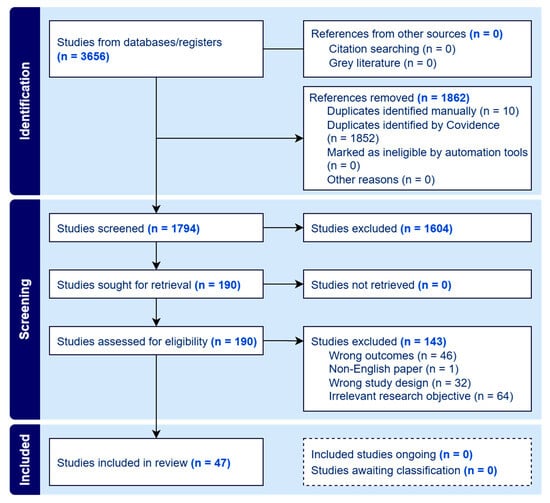
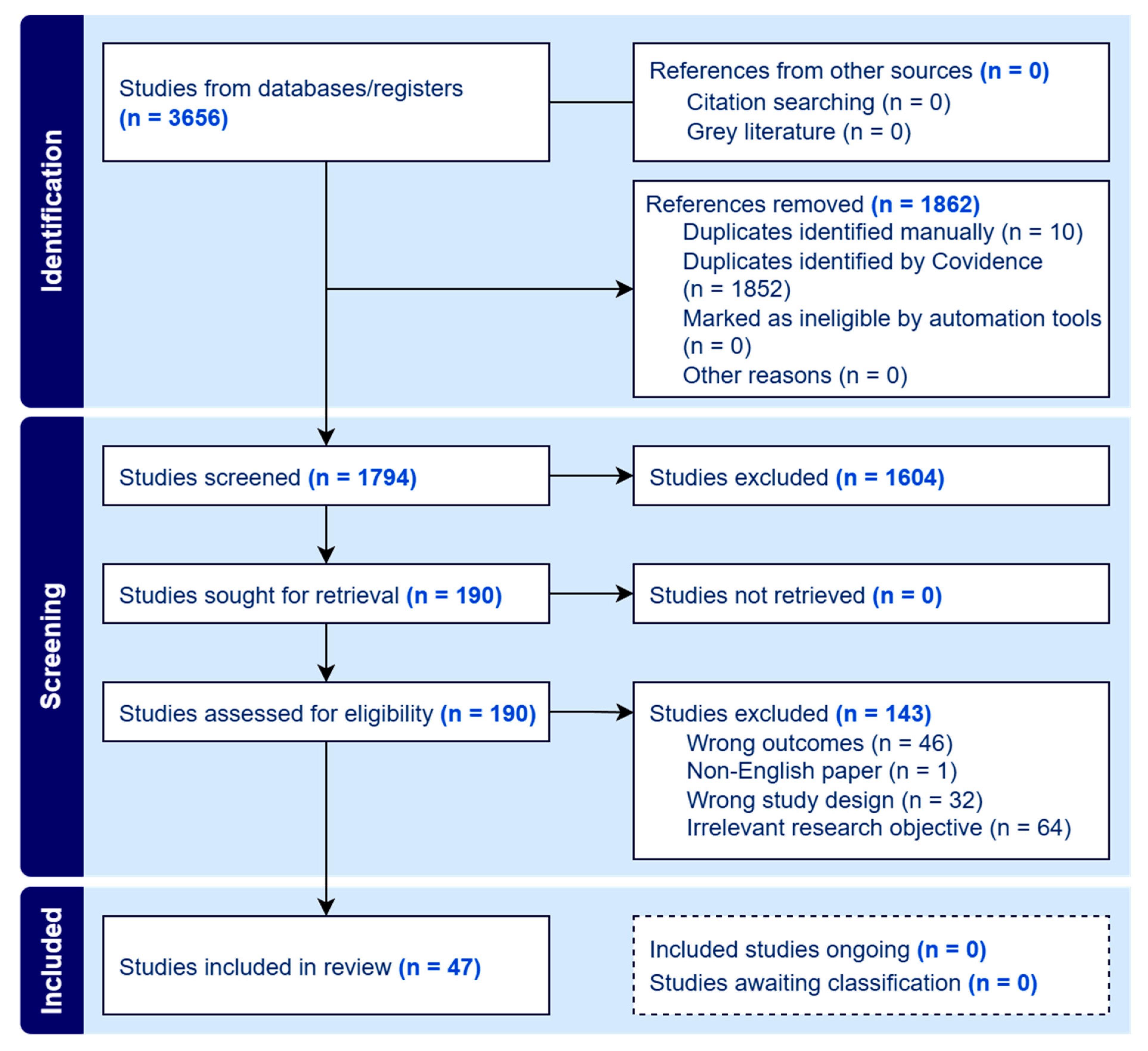
The database searches identified 3656 records. Following the removal of 1862 duplicates (1852 via automated tools and 10 manually), 1794 records remained for title and abstract screening. Of these, 190 full-text articles were assessed for eligibility. After excluding 143 articles (46 for wrong outcomes, 1 for non-English language, 32 for wrong study design, and 64 for irrelevant research objectives), a total of 47 studies met the inclusion criteria and were included in the synthesis.
The study selection process is summarised in the PRISMA 2020 flow diagram (Figure 1).
Figure 1.
PRISMA flow diagram.
3.2. Study Characteristics
The 47 included studies spanned diverse professional sectors, including healthcare (e.g., nursing, pharmacy, public health), education, engineering, veterinary medicine, and industrial workforce development. Geographically, studies were conducted across multiple continents, with representation from high-, middle-, and low-income countries.
Most studies employed mixed-methods (n = 23), combining literature reviews, stakeholder engagement, and consensus-building techniques such as Delphi studies. Purely qualitative approaches (n = 15) frequently incorporated focus groups, interviews, and thematic analysis, while quantitative designs (n = 9) often included large-scale surveys for validation (see Table 1). A detailed summary of each included study is presented in the Supplementary Data.
Table 1.
Study Characteristics.
3.3. Methodological Quality of Included Studies
Formal risk of bias tools was not applied due to the methodological rather than intervention-based focus of the review. Instead, we appraised reporting completeness, which revealed variability across the included studies: (1) High-quality studies (n = 5): These provided transparent, step-by-step accounts of framework development, including clear rationales, detailed methods, and participant characteristics (Zhu et al., 2024; Zhang et al., 2020; Meilianti et al., 2021; Guerreiro et al., 2021; X. Hong et al., 2021); (2) Moderate-quality studies (n = 18): These described the main stages of framework development but provided limited detail in validation and/or refinement procedures, affecting replicability (Hrzic et al., 2024; Miller et al., 2021; Liang et al., 2022; Azevedo et al., 2012; Zafošnik et al., 2024; Tackett et al., 2023; Rabie et al., 2020; Penciner et al., 2013; McCloskey et al., 2011; Augeard et al., 2022; Weston et al., 2020; Grigg, 2021; Barraclough et al., 2024; Almalki et al., 2021; Al-Haqan et al., 2021, 2024; Sadofsky et al., 2014); (3) Low-detail studies (n = 24): These offered only brief or partial methodological descriptions, with limited transparency on validation/adaptation steps (Czabanowska et al., 2013; Benhamza Hlihel et al., 2024; Barry et al., 2012; Albarqouni et al., 2018; Rodger et al., 2008; Riesen et al., 2012; Lam et al., 2015; Hoffman et al., 2008; Hasani et al., 2021; Gong et al., 2024; Daniali et al., 2022; Blanchette et al., 2022; Joy Chao & Taa, 2015; Czabanowska et al., 2012; Cicutto et al., 2017; Ryan et al., 2024; Keijser et al., 2019; Lee et al., 2011; Moreau et al., 2023; Sacre et al., 2022); and (4) Potential selective reporting bias (subset; n = 1): One study appeared to adapt a pre-existing framework without fully documenting the adaptation process, raising the risk of selective reporting (Moreau et al., 2023).
3.4. Results of Individual Studies
Across the 47 studies reviewed, methodological activities could be grouped into complementary categories, each contributing to the credibility of competency framework development. The most common activity was the literature review (n = 32), which identified existing frameworks, competencies, and evidence-based practices to ground new designs in established knowledge (Almalki et al., 2021; Augeard et al., 2022; Azevedo et al., 2012; Barraclough et al., 2024; Barry et al., 2012; Benhamza Hlihel et al., 2024; Blanchette et al., 2022; Bürkin et al., 2024; Cicutto et al., 2017; Czabanowska et al., 2012, 2013; Daniali et al., 2022; Gong et al., 2024; Grigg, 2021; Guerreiro et al., 2021; X. Hong et al., 2021; Hrzic et al., 2024; Jerman et al., 2020; Keijser et al., 2019; Lee et al., 2011; Meilianti et al., 2023; Miller et al., 2021; Penciner et al., 2013; Pichini & Bishop, 2022; Ryan et al., 2024; Sadofsky et al., 2014; Schofield et al., 2018; Tackett et al., 2023; Weston et al., 2020; Zafošnik et al., 2024; Zhang et al., 2020; Zhu et al., 2024).
The Delphi process (n = 19) was widely used for iterative consensus building, engaging multiple rounds of expert feedback to refine competencies (Barraclough et al., 2024; Barry et al., 2012; Blanchette et al., 2022; Chen et al., 2022; Childs et al., 2022; Cicutto et al., 2017; Czabanowska et al., 2012, 2013; Guerreiro et al., 2021; X. Hong et al., 2021; Hrzic et al., 2024; Meilianti et al., 2023; Penciner et al., 2013; Ryan et al., 2024; Sacre et al., 2022; Schofield et al., 2018; Zafošnik et al., 2024; Zhang et al., 2020; Zhu et al., 2024). Likewise, surveys (n = 15) provided large-scale validation of competencies and captured broader perspectives (Al-Haqan et al., 2024; Almalki et al., 2021; Augeard et al., 2022; Azevedo et al., 2012; Bürkin et al., 2024; Daniali et al., 2022; de Goumoëns et al., 2025; X. Hong et al., 2021; Keijser et al., 2019; Lee et al., 2011; Meilianti et al., 2023; Pichini & Bishop, 2022; Shaw et al., 2019; Weston et al., 2020; Zhu et al., 2024).
Focus groups (n = 10) facilitated stakeholder engagement, ensuring draft frameworks aligned with practical realities (Almalki et al., 2021; X. Hong et al., 2021; Joy Chao & Taa, 2015; Keijser et al., 2019; Liang et al., 2022; Miller et al., 2021; Moreau et al., 2023; Pichini & Bishop, 2022; Van Hecke et al., 2025; Zhang et al., 2020). Interviews (n = 7) complemented this by eliciting insights from domain specialists, further contextualising frameworks (Benhamza Hlihel et al., 2024; Jerman et al., 2020; Keijser et al., 2019; Lee et al., 2011; Rabie et al., 2020; Van Hecke et al., 2025; Zhu et al., 2024).
Workshops (n = 9) created collaborative spaces for reviewing and refining draft frameworks (Barry et al., 2012; Benhamza Hlihel et al., 2024; Bürkin et al., 2024; Czabanowska et al., 2013; Hrzic et al., 2024; Joy Chao & Taa, 2015; Liang et al., 2022; Miller et al., 2021; Shaw et al., 2019). Expert validation (n = 18) provided independent review, strengthening credibility (Al-Haqan et al., 2024; Almalki et al., 2021; Augeard et al., 2022; Blanchette et al., 2022; Bok et al., 2011; Gong et al., 2024; Grigg, 2021; Haruta et al., 2018; X. Hong et al., 2021; Hrzic et al., 2024; Keijser et al., 2019; Liang et al., 2022; Meilianti et al., 2021; Pichini & Bishop, 2022; Sacre et al., 2022; Van Hecke et al., 2025; Weston et al., 2020; Zhang et al., 2020). Finally, translation and adaptation (n = 6) ensured linguistic and cultural appropriateness across diverse settings (Al-Haqan et al., 2021, 2024; Keijser et al., 2019; Liang et al., 2022; Tackett et al., 2023; Zhang et al., 2020).
Taken together, these activities highlight that competency framework development is multi-method and iterative. Literature reviews establish foundations, consensus and validation processes enhance legitimacy, surveys and interviews broaden applicability, while workshops and cultural adaptation secure contextual relevance. Collectively, they confirm that framework development is best understood as a cyclical and adaptive process.
3.5. Results of Syntheses
The thematic analysis identified three overarching themes that represent common stages in the development of professional competency frameworks. These stages, Foundational Inquiry and Evidence Gathering, Consensus-Building and Collaborative Validation, and Framework Development and Iterative Refinement, were consistently observed across all 47 included studies, though their application varied by context and sector.
3.5.1. Foundational Inquiry and Evidence Gathering
This stage was the most prevalent across studies, forming the bedrock of competency framework development. It typically began with comprehensive literature reviews and environmental scans designed to identify existing frameworks, clarify definitions, and highlight gaps. For instance, Czabanowska et al. (2013) and Liang et al. (2022) systematically mapped existing competencies to establish an evidence-informed foundation for new frameworks. In several cases, literature reviews were supplemented with surveys, interviews, or focus groups involving practitioners, educators, and policymakers to contextualise competencies within specific cultural or institutional environments (e.g., Kart & Şimşek, 2024; Gong et al., 2024). These activities ensured that frameworks were not only theoretically grounded but also aligned with practical workforce needs.
3.5.2. Consensus-Building and Collaborative Validation
Once preliminary competencies were identified; frameworks advanced to consensus-building stages. Structured engagement of experts and stakeholders was central to this phase. Delphi studies were the most widely applied technique (Batt et al., 2020), providing iterative rounds of consultation to refine competencies and establish consensus thresholds. Other studies relied on workshops, expert panels, or stakeholder consultations to achieve collaborative validation (Palermo et al., 2016; Barry et al., 2012). This stage was not simply confirmatory; it often revealed areas of contention, such as whether competencies should be generic or specialised, prompting iterative adjustments. Importantly, consensus-building also legitimised frameworks by ensuring broad professional acceptance, which is crucial for implementation and adoption in practice.
3.5.3. Framework Development and Iterative Refinement
The final stage focused on operationalising and finalising the framework. Activities here included drafting competency statements, refining categories and domains, and structuring frameworks into hierarchies or clusters (Zhu et al., 2024; Zhang et al., 2020). Many studies employed pilot testing to evaluate feasibility and usability in practice, while others conducted translation and cultural adaptation to ensure contextual relevance (Al-Haqan et al., 2021; Sacre et al., 2022). Iterative feedback loops were common; for example, some frameworks underwent revisions following pilot implementation, while others re-engaged expert panels to refine wording or structure. This phase underscored the importance of adaptability, ensuring frameworks could evolve alongside professional and educational demands.
Although presented as three stages, the synthesis demonstrated that these themes were not discrete or sequential but interdependent and overlapping. Many studies cycled repeatedly between evidence gathering and validation. For instance, early expert input often informed the literature review stage, blurring boundaries between inquiry and consensus (e.g., Hrzic et al., 2024). Similarly, iterative refinements frequently incorporated renewed evidence searches or follow-up validation activities (e.g., Doshmangir et al., 2024; Ryan et al., 2024). This cyclical process reflects design-based research logic, where evidence, consensus, and refinement continuously interact to strengthen framework credibility. All 47 studies employed at least one method from each stage, with most incorporating 5–7 distinct methodological approaches in combination. For example, high-quality studies typically began with literature reviews, followed by Delphi consensus, stakeholder workshops, and pilot testing (e.g., Miller et al., 2021; Liang et al., 2022). This multi-method design was particularly evident in cross-sector studies, which combined qualitative and quantitative approaches to ensure both contextual depth and generalisability.
Taken together, the synthesis suggests that framework development is best conceptualised as a cyclical, iterative process rather than a linear pathway. Evidence gathering, validation, and refinement continuously interact, ensuring frameworks are empirically grounded, professionally endorsed, and contextually adaptable. This iterative design approach enhances both the credibility and transferability of competency frameworks across diverse professional settings.
4. Discussion
This review aimed to address the research question: “What underlying design principles inform the development of professional competency frameworks across diverse professional contexts?” Through thematic synthesis of 47 studies, three interrelated research-informed design principles were identified: (1) Foundational Inquiry and Evidence Gathering; (2) Consensus-Building and Collaborative Validation; and (3) Framework Development and Iterative Refinement. These principles represent the analytical outcomes of the review, rather than procedural steps, and collectively describe a coherent, cross-sector design logic underpinning competency framework development.
A central finding of this review is the primacy of evidence-informed foundations in competency framework development. Across professions, frameworks consistently begin with systematic or scoping reviews, environmental scans, and, in some cases, supplementary empirical data such as interviews or surveys. This aligns with established literature in health and education, which emphasises that robust frameworks derive legitimacy from their grounding in existing knowledge and practice (Frank et al., 2010; Albarqouni et al., 2018). While prior studies have demonstrated this within specific sectors, the present synthesis extends this insight by showing that evidence anchoring is a cross-professional design principle, not confined to any single domain.
A second key principle is the importance of collaborative and iterative consensus-building. The widespread use of Delphi studies, stakeholder workshops, expert panels, and surveys highlights the necessity of engaging diverse professional perspectives to refine and validate competencies. This finding reinforces earlier work in global health and interprofessional education, where triangulation and stakeholder engagement are seen as essential for ensuring relevance and acceptance (Batt et al., 2020; Palermo et al., 2016). Importantly, this review demonstrates that such collaborative validation is not merely confirmatory but often generative, shaping the structure and scope of competency frameworks through iterative negotiation.
The third principle, iterative development and refinement, underscores the dynamic nature of competency framework design. Activities such as drafting, pilot testing, translation, and revalidation indicate that frameworks evolve through repeated cycles of feedback and adjustment. This finding resonates with design-based research traditions and professional learning models, which conceptualise development as cyclical rather than linear (Mulder, 2014; McKenney & Reeves, 2012). The synthesis shows that frameworks are rarely finalised in a single pass; instead, they are continuously adapted to ensure contextual relevance and usability.
Taken together, these three principles reveal that competency framework development is best understood as a cyclical, multi-method, and iterative process, rather than a sequence of discrete steps. Although different studies emphasise different methods, the underlying design logic remains consistent across sectors. This supports the argument that while methodological tools may vary (e.g., Delphi vs. workshops), their functional roles (evidence generation, validation, and refinement) are broadly transferable.
This review also contributes to the literature by challenging linear representations of framework development found in some professional guidelines (e.g., World Health Organization, 2016). Instead, the findings highlight recursive interactions between stages, where for example, stakeholder input may inform further evidence gathering, or pilot testing may prompt renewed consensus-building. Such flexibility reflects the complexity of professional practice and strengthens the adaptability of competency frameworks across contexts (Milton et al., 2025).
Another important contribution is the identification of a lack of standardised methodological reporting. Consistent with sector-specific reviews (Palermo et al., 2016), this study found considerable variation in how development processes are documented, particularly in relation to stakeholder selection, consensus thresholds, and validation procedures. This inconsistency limits comparability and reproducibility, suggesting a need for reporting guidelines tailored to competency framework development, analogous to PRISMA for systematic reviews.
Finally, this cross-sector synthesis demonstrates that the design logic of competency frameworks is highly transferable, with differences across professions arising primarily in method selection rather than underlying principles. By quantifying methodological patterns and synthesising them into overarching principles, this review provides an evidence-based, generalisable blueprint for developing competency frameworks that are rigorous, credible, and contextually adaptable (Bassi, 2025; Rotondo et al., 2025).
Limitations
This review is subject to several limitations that should be acknowledged when interpreting its findings. First, there was considerable variability in the quality and completeness of methodological reporting across the included studies. While some provided comprehensive step-by-step accounts of framework development, others offered only broad descriptions, which may have led to the underrepresentation of certain methodological activities in the synthesis. Second, the inclusion criterion restricting studies to English-language publications may have excluded relevant methodological innovations documented in other languages, thereby limiting the global scope of the review. Third, there was an imbalance in sectoral representation, with healthcare and education dominating the sample, while other fields, such as creative industries, technology, and certain vocational domains, were comparatively underrepresented. This uneven distribution could affect the generalisability of the identified research-informed design principles to less-represented sectors. Fourth, the inclusion criterion restricting studies to peer-reviewed journal articles means that competency frameworks developed and disseminated exclusively through grey literature—such as government reports, organisational policy documents, and professional association guidelines—were excluded. This may have omitted important practical and applied development approaches that are not captured within the academic publishing record. Finally, because this review synthesised methodological processes rather than intervention outcomes, a formal risk of bias assessment was not applied. Instead, reporting completeness was used as a proxy for methodological quality, which, while informative, is not a direct measure of bias.
5. Conclusions
This review provides a cross-sector synthesis of methodological processes underpinning the development of professional competency frameworks, identifying three overarching and transferable research-informed design principles: (1) Foundational Inquiry and Evidence Gathering, (2) Consensus-Building and Collaborative Validation, and (3) Framework Development and Iterative Refinement. These principles, derived through thematic analysis of 47 studies, reflect recurring patterns in how competency frameworks are designed, validated, and refined across diverse professional domains.
The findings demonstrate that competency framework development is inherently cyclical, multi-method, and iterative, rather than linear. Across sectors, frameworks are constructed through continuous interaction between evidence generation, stakeholder engagement, and refinement processes. This reinforces the view that methodological rigor in competency development depends not on any single method, but on the integration of complementary approaches that enhance both credibility and contextual relevance. By synthesising methodological practices across professions, this review advances the literature beyond sector-specific insights and offers a generalisable methodological blueprint for competency framework development. The identified principles highlight the importance of grounding frameworks in evidence, engaging stakeholders meaningfully, and iterating designs in response to feedback and contextual demands.
However, the review also reveals a persistent lack of standardised reporting in framework development studies, limiting transparency and comparability. Future research should prioritise the development of reporting guidelines tailored to competency framework methodology, alongside expanding investigations into underrepresented professional sectors. Overall, this study provides a robust foundation for guiding future competency framework design, supporting the development of frameworks that are methodologically sound, professionally credible, and adaptable across diverse contexts.
Supplementary Materials
The following supporting information can be downloaded at: https://www.mdpi.com/article/10.3390/educsci16050725/s1, Supplementary Data S1: PRISMA Checklist; Supplementary Data S2: Full Data Extraction Table; Supplementary Data S3: Thematic Analysis; and Supplementary Data S4: Search Strategies.
Author Contributions
C.U.A. (Corresponding Author): Conceptualisation, Methodology, Software, Validation, Formal analysis, Investigation, Data curation, Writing—original draft, Writing—review & editing, Visualization, Project administration, Funding acquisition. S.R.: Methodology, Formal analysis, Investigation, Data curation, Writing—review & editing. W.C.: Conceptualisation, Methodology, Validation, Formal analysis, Investigation, Resources, Writing—review & editing, Visualisation, Supervision, Project administration. L.R.P.: Methodology, Validation, Writing—review & editing, Visualisation, Supervision. Author Wayne Cotton passed away prior to the publication of this manuscript. All authors have read and agreed to the published version of the manuscript.
Funding
This research was funded by the Ministry of Higher Education, Science and Technology (Kemendiktisaintek), Republic of Indonesia, under grant number 3321/BPPT/BPI.LG/V/2024, through a doctoral research scholarship awarded to Author 1 under the Indonesian Education Scholarship (Beasiswa Pendidikan Indonesia, BPI). The scholarship is administered by the Center for Higher Education Funding and Assessment (PPAPT) and supported by the Indonesian Endowment Fund for Education (LPDP). The funding body had no role in the design of the study; in data collection, analysis, and interpretation; or in the preparation of the manuscript.
Institutional Review Board Statement
Not applicable.
Informed Consent Statement
Not applicable.
Data Availability Statement
The original contributions presented in this study are included in the article/Supplementary Materials. Further inquiries can be directed to the corresponding author.
Conflicts of Interest
The authors declare that they have no known competing financial interests or personal relationships that could have appeared to influence the work reported in this paper.
References
- Albarqouni, L., Hoffmann, T., Straus, S., Olsen, N. R., Young, T., Ilic, D., Shaneyfelt, T., Haynes, R. B., Guyatt, G., & Glasziou, P. (2018). Core competencies in evidence-based practice for health professionals: Consensus statement based on a systematic review and delphi survey. JAMA Network Open, 1(2), e180281. [Google Scholar] [CrossRef] [Scilit] [PubMed]
- Al-Haqan, A., Smith, F., Bader, L., & Bates, I. (2021). Competency development for pharmacy: Adopting and adapting the global competency framework. Research in Social and Administrative Pharmacy, 17(4), 771–785. [Google Scholar] [CrossRef] [Scilit]
- Al-Haqan, A., Waheedi, S., Abdullah, I., Meilianti, S., & Shaaban, J. (2024). Competency development for pharmacy: Adopting and adapting the FIP global advanced development framework. Frontiers in Medicine, 11, 1442643. [Google Scholar] [CrossRef] [Scilit] [PubMed]
- Almalki, M., Jamal, A., Househ, M., & Alhefzi, M. (2021). A multi-perspective approach to developing the Saudi health informatics competency framework. International Journal of Medical Informatics, 146, 104362. [Google Scholar] [CrossRef] [Scilit]
- Augeard, N., Bostick, G., Miller, J., Walton, D., Tousignant-Laflamme, Y., Hudon, A., Bussières, A., Cooper, L., McNiven, N., Thomas, A., Singer, L., Fishman, S. M., Bement, M. H., Hush, J. M., Sluka, K. A., Watt-Watson, J., Carlesso, L. C., Dufour, S., Fletcher, R., … Wideman, T. H. (2022). Development of a national pain management competency profile to guide entry-level physiotherapy education in Canada. Canadian Journal of Pain, 6(1), 1–11. [Google Scholar] [CrossRef] [Scilit]
- Azevedo, A., Apfelthaler, G., & Hurst, D. (2012). Competency development in business graduates: An industry-driven approach for examining the alignment of undergraduate business education with industry requirements. International Journal of Management Education, 10(1), 12–28. [Google Scholar] [CrossRef] [Scilit]
- Barraclough, F., Stein, V., Smith-Merry, J., & Pit, S. (2024). An international competency framework for high-quality workforce development in integrated care: A modified Delphi study. International Journal of Integrated Care, 24(2), 11. [Google Scholar] [CrossRef] [Scilit]
- Barry, M. M., Battel-Kirk, B., & Dempsey, C. (2012). The CompHP core competencies framework for health promotion in Europe. Health Education and Behavior, 39(6), 648–662. [Google Scholar] [CrossRef] [Scilit]
- Bassi, C. (2025). Theoretical frameworks for mathematics teacher’s professional development with technology: A narrative review. Education Sciences, 15(9), 1231. [Google Scholar] [CrossRef] [Scilit]
- Batt, A. M., Tavares, W., & Williams, B. (2020). The development of competency frameworks in healthcare professions: A scoping review. In Advances in health sciences education (Vol. 25, Number 4, pp. 913–987). Springer. [Google Scholar] [CrossRef] [Scilit]
- Benayoune, A. (2024). Competency-based framework development and implementation: Current and future perspectives. Information Management and Business Review, 16(3(I), 606–615. [Google Scholar] [CrossRef] [Scilit]
- Benhamza Hlihel, F., Chater, Y., & Boumane, A. (2024). Developing a competency model for maintenance 4.0 stakeholders. International Journal of Quality and Reliability Management, 41(6), 1519–1549. [Google Scholar] [CrossRef] [Scilit]
- Blanchette, V., Andoulsi, Y., Brousseau, M., Leblanc, C., Guillemette, F., & Hue, O. (2022). Competency framework for podiatric medicine training in Canada: An adapted Delphi study. Advances in Medical Education and Practice, 13, 1207–1241. [Google Scholar] [CrossRef] [Scilit] [PubMed]
- Bok, H. G. J., Jaarsma, D. A. D. C., Teunissen, P. W., Van Der Vleuten, C. P. M., & Van Beukelen, P. (2011). Development and validation of a competency framework for veterinarians. Journal of Veterinary Medical Education, 38(3), 262–269. [Google Scholar] [CrossRef] [Scilit] [PubMed]
- Booth, A., Sutton, A., & Papaioannou, D. (2016). Systematic approaches to a successful literature review (2nd ed.). Sage. [Google Scholar]
- Boztas, C., Ghadafi, E., & Ibrahim, R. (2025). Metaverse architectures: A comprehensive systematic review of definitions and frameworks. Future Internet, 17(7), 283. [Google Scholar] [CrossRef] [Scilit]
- Braun, V., & Clarke, V. (2006). Using thematic analysis in psychology. Qualitative Research in Psychology, 3(2), 77–101. [Google Scholar] [CrossRef] [Scilit]
- Bürkin, B. M., Czabanowska, K., Babich, S., Casamitjana, N., Vicente-Crespo, M., De Souza, L. E., Ehrenberg, J. P., Hoffmann, A., Kamath, R., Matthiä, A., Okumu, F., Rutebemberwa, E., Waser, M., Kuenzli, N., & Bohlius, J. (2024). Competencies for Transformational Leadership in Public Health—An International Delphi Consensus Study. International Journal of Public Health, 69, 1606267. [Google Scholar] [CrossRef] [Scilit] [PubMed]
- Campbell, M., McKenzie, J. E., Sowden, A., Katikireddi, S. V., Brennan, S. E., Ellis, S., Hartmann-Boyce, J., Ryan, R., Shepperd, S., Thomas, J., Welch, V., & Thomson, H. (2020). Synthesis without meta-analysis (SWiM) in systematic reviews: Reporting guideline. BMJ, 368, l6890. [Google Scholar] [CrossRef] [Scilit]
- Chen, Y., Cai, Z., Lin, B., Yan, L., Zheng, W., Kuo, M. C., Hübner, U., & Chang, P. (2022). Developing a professional-practice-model-based nursing organizational informatics competency model. International Journal of Medical Informatics, 166, 104840. [Google Scholar] [CrossRef] [Scilit]
- Childs, J., Thoirs, K., Quinton, A., Osborne, B., Edwards, C., Stoodley, P., Lombardo, P., Mcdonald, S., Slade, D., Chandler, A., Taylor, L., Long, J., Pollard, K., & Halligan, T. (2022). Development of a professional competency framework for Australian sonographers—Perspectives for developing competencies using a Delphi methodology. International Journal for Quality in Health Care, 34(2), mzac017. [Google Scholar] [CrossRef] [Scilit]
- Cicutto, L., Gleason, M., Haas-Howard, C., Jenkins-Nygren, L., Labonde, S., & Patrick, K. (2017). Competency-based framework and continuing education for preparing a skilled school health workforce for asthma care: The Colorado experience. Journal of School Nursing, 33(4), 277–284. [Google Scholar] [CrossRef] [Scilit]
- Czabanowska, K., Klemenc-Ketis, Z., Potter, A., Rochfort, A., Tomasik, T., Csiszar, J., & Van den Bussche, P. (2012). Development of a competency framework for quality improvement in family medicine: A qualitative study. Journal of Continuing Education in the Health Professions, 32(3), 174–180. [Google Scholar] [CrossRef] [Scilit]
- Czabanowska, K., Smith, T., Könings, K. D., Sumskas, L., Otok, R., Bjegovic-Mikanovic, V., & Brand, H. (2013). In search for a public health leadership competency framework to support leadership curriculum-a consensus study. European Journal of Public Health, 24(5), 850–856. [Google Scholar] [CrossRef] [Scilit]
- Daniali, S. M., Barykin, S. E., Khortabi, F. M., Kalinina, O. V., Tcukanova, O. A., Torosyan, E. K., Poliakova, S., Prosekov, S., Moiseev, N., & Senjyu, T. (2022). An employee competency framework in a welfare organization. Sustainability, 14(4), 2397. [Google Scholar] [CrossRef] [Scilit]
- de Goumoëns, V., Lefrançois, L. E., Forestier, A., Grandjean, C., Balice-Bourgois, C., Quillet-Cotting, J., Thévoz, A. L., & Ramelet, A. S. (2025). Bachelor nursing competencies to care for children in hospital and home settings: A Delphi study. Nurse Education Today, 145, 106487. [Google Scholar] [CrossRef] [Scilit]
- Doshmangir, L., Alipouri Sakha, M., Mostafavi, H., Kabiri, N., Ghaffarifar, S., & Takian, A. (2024). Essential core competencies for health policy graduates: A multi-method consensus study. Health Research Policy and Systems, 22(1), 136. [Google Scholar] [CrossRef] [Scilit] [PubMed]
- Falagas, M. E., Pitsouni, E. I., Malietzis, G. A., & Pappas, G. (2008). Comparison of PubMed, Scopus, web of science, and google scholar: Strengths and weaknesses. FASEB Journal, 22(2), 338–342. [Google Scholar] [CrossRef] [Scilit]
- Frank, J. R., Snell, L. S., Cate, O. T., Holmboe, E. S., Carraccio, C., Swing, S. R., Harris, P., Glasgow, N. J., Campbell, C., Dath, D., Harden, R. M., Iobst, W., Long, D. M., Mungroo, R., Richardson, D. L., Sherbino, J., Silver, I., Taber, S., & Talbot, M. (2010). Competency-based medical education: Theory to practice. Medical Teacher, 32(8), 638–645. [Google Scholar] [CrossRef] [Scilit] [PubMed]
- Gong, X., Zhang, X., Zhang, X., Li, Y., Zhang, Y., & Yu, X. (2024). Developing a competency model for Chinese general practitioners: A mixed-methods study. Human Resources for Health, 22(1), 31. [Google Scholar] [CrossRef] [Scilit] [PubMed]
- Gough, D., Oliver, S., & Thomas, J. (2017). An introduction to systematic reviews (2nd ed.). Sage. [Google Scholar]
- Grigg, R. (2021). EntreCompEdu, a professional development framework for entrepreneurial education. Education and Training, 63(7–8), 1058–1072. [Google Scholar] [CrossRef] [Scilit]
- Guerreiro, M. P., Strawbridge, J., Cavaco, A. M., Félix, I. B., Marques, M. M., & Cadogan, C. (2021). Development of a European competency framework for health and other professionals to support behaviour change in persons self-managing chronic disease. BMC Medical Education, 21(1), 287. [Google Scholar] [CrossRef] [Scilit]
- Haruta, J., Yoshida, K., Goto, M., Yoshimoto, H., Ichikawa, S., Mori, Y., Yoshimi, K., & Otsuka, M. (2018). Development of an interprofessional competency framework for collaborative practice in Japan. Journal of Interprofessional Care, 32(4), 436–443. [Google Scholar] [CrossRef] [Scilit] [PubMed]
- Hasani, R., Hosseini, S. H., & Omran, A. (2021). Developing a competency model for safety supervisors in construction projects. Safety Science, 142, 105387. [Google Scholar] [CrossRef] [Scilit]
- Higgins, J. P. T., Thomas, J., Chandler, J., Cumpston, M., Li, T., Page, M. J., & Welch, V. A. (Eds.). (2022). Cochrane handbook for systematic reviews of interventions (2nd ed.). Wiley. [Google Scholar]
- Hoffman, S. J., Rosenfield, D., Gilbert, J. H., & Oandasan, I. F. (2008). Student leadership in interprofessional education: Benefits, challenges and implications for educators, researchers and policymakers. Medical Education, 42(7), 654–661. [Google Scholar] [CrossRef] [Scilit]
- Hong, Q. N., Fàbregues, S., Bartlett, G., Boardman, F., Cargo, M., Dagenais, P., Gagnon, M. P., Griffiths, F., Nicolau, B., O’Cathain, A., & Rousseau, M. C. (2018). The mixed methods appraisal tool (MMAT) version 2018 for information professionals and researchers. Education for Information, 34(4), 285–291. [Google Scholar] [CrossRef] [Scilit]
- Hong, Q. N., Pluye, P., Fàbregues, S., Bartlett, G., Boardman, F., Cargo, M., Dagenais, P., Gagnon, M. P., Griffiths, F., Nicolau, B., O’Cathain, A., Rousseau, M. C., & Vedel, I. (2019). Improving the content validity of the mixed methods appraisal tool (MMAT): A modified e-Delphi study. Journal of Clinical Epidemiology, 111, 49–59. [Google Scholar] [CrossRef] [Scilit] [PubMed]
- Hong, X., Li, Y., Chen, Z., Lai, Y., Dai, Q., & Liang, H. (2021). Developing a reliable and valid competency model for assistant dentists in China. BMC Medical Education, 21(1), 551. [Google Scholar] [CrossRef] [Scilit]
- Hrzic, R., Cade, M. V., Wong, B. L. H., McCreesh, N., Simon, J., & Czabanowska, K. (2024). A competency framework on simulation modelling-supported decision-making for master of public health graduates. Journal of Public Health, 46(1), 127–135. [Google Scholar] [CrossRef] [Scilit] [PubMed]
- Jemal, I. (2025). Competency frameworks mapping: A multi-method analysis. Expert Systems with Applications, 252, 124587. [Google Scholar] [CrossRef] [Scilit]
- Jerman, A., Bertoncelj, A., Dominici, G., Pejić Bach, M., & Trnavčević, A. (2020). Conceptual key competency model for smart factories in production processes. Organizacija, 53(1), 68–79. [Google Scholar] [CrossRef] [Scilit]
- Joy Chao, S. B., & Taa, L. F. (2015). Development of the competency framework for southeast Asian school heads (2014 Edition): A journey into excellent school leadership (Vol. 2). Available online: https://www.academia.edu/77505883/Development_of_the_Competency_Framework_for_Southeast_Asian_School_Heads_2014_Edition_A_Journey_into_Excellent_School_Leadership (accessed on 24 March 2026).
- Kart, M., & Şimşek, H. (2024). Defining competencies in curriculum and instruction and developing a new competency model. Humanities and Social Sciences Communications, 11(1), 1496. [Google Scholar] [CrossRef] [Scilit]
- Keijser, W. A., Handgraaf, H. J. M., Isfordink, L. M., Janmaat, V. T., Vergroesen, P. P. A., Verkade, J. M. J. S., Wieringa, S., & Wilderom, C. P. M. (2019). Development of a national medical leadership competency framework: The Dutch approach. BMC Medical Education, 19(1), 441. [Google Scholar] [CrossRef] [Scilit] [PubMed]
- Lam, P., Wong, F., & Yeung, M. (2015). A competency framework for nursing informatics practice in Hong Kong. CIN: Computers, Informatics, Nursing, 33(12), 556–567. [Google Scholar] [CrossRef] [Scilit]
- Lee, T. S., Kim, D. H., & Lee, D. W. (2011). A competency model for project construction team and project control team. KSCE Journal of Civil Engineering, 15(5), 781–792. [Google Scholar] [CrossRef] [Scilit]
- Liang, J. F., Hsu, T. F., Chen, C. Y., Yang, C. W., Jean, W. H., Ou, L. S., Cheng, H. M., Huang, C. C., Yang, Y. Y., & Chen, C. H. (2022). Developing a competency-based framework for resident-as-teacher. Journal of the Formosan Medical Association, 121(10), 1956–1962. [Google Scholar] [CrossRef] [Scilit]
- McCloskey, J. (2011). Developing a competency framework for academic research administrators. Research Management Review, 18(1), 1–15. [Google Scholar]
- McKenney, S., & Reeves, T. C. (2012). Conducting educational design research. Routledge. [Google Scholar]
- McMullen, J., Arakawa, N., Anderson, C., Pattison, L., & McGrath, S. (2023). A systematic review of contemporary competency-based education and training for pharmacy practitioners and students. Research in Social and Administrative Pharmacy, 19(2), 192–217. [Google Scholar] [CrossRef] [Scilit]
- Meilianti, S., Galbraith, K., Bader, L., Udoh, A., Ernawati, D., & Bates, I. (2023). The development and validation of a global advanced development framework for the pharmacy workforce: A four-stage multi-methods approach. International Journal of Clinical Pharmacy, 45(4), 940–951. [Google Scholar] [CrossRef] [Scilit] [PubMed]
- Meilianti, S., Smith, F., Bader, L., Himawan, R., & Bates, I. (2021). Competency-Based Education: Developing an Advanced Competency Framework for Indonesian Pharmacists. Frontiers in Medicine, 8, 769326. [Google Scholar] [CrossRef] [Scilit]
- Miller, L., Brushett, S., Ayn, C., Furlotte, K., Jackson, L., MacQuarrie, M., Massie, A. S., Mathias, H., McKay, M., Meisner, B. A., Moritz, L., Stilwell, C., & Weeks, L. E. (2021). Developing a competency framework for population health graduate students through student and faculty collaboration. Pedagogy in Health Promotion, 7(3), 280–288. [Google Scholar] [CrossRef] [Scilit]
- Milton, D., Bryant, A., Appleton, P. R., & Duda, J. L. (2025). Using the principles from community of practice: Developing sustainable professional development programmes in physical education. Education Sciences, 15(6), 713. [Google Scholar] [CrossRef] [Scilit]
- Moher, D., Shamseer, L., Clarke, M., Ghersi, D., Liberati, A., Petticrew, M., Shekelle, P., & Stewart, L. A. (2015). Preferred reporting items for systematic review and meta-analysis protocols (PRISMA-P) 2015 statement. Systematic Reviews, 4(1), 1. [Google Scholar] [CrossRef]
- Moreau, P., Qaddoumi, M., Al-Taweel, D., Alghanem, S., Bayoud, T., Alowayesh, M., Al-Soraj, M., Hedaya, M., Al-Haqan, A., & Alsane, D. (2023). Development and refinement of a matrix competency framework, with associated Entrustable professional activities, to support initial pharmacy education in Kuwait. Pharmacy, 11(5), 149. [Google Scholar] [CrossRef] [Scilit]
- Mulder, M. (2014). Conceptions of professional competence. In S. Billett, C. Harteis, & H. Gruber (Eds.), International handbook of research in professional and practice-based learning (pp. 107–137). Springer. [Google Scholar] [CrossRef] [Scilit]
- Munn, Z., Moola, S., Riitano, D., & Lisy, K. (2014). The development of a critical appraisal tool for use in systematic reviews addressing questions of prevalence. International Journal of Health Policy and Management, 3(3), 123–128. [Google Scholar] [CrossRef] [Scilit]
- Muñoz-Collazos, C., & González-Serrano, C. (2025). Machine learning approaches for evaluating STEM education projects within artificial intelligence in education: A systematic review of frameworks and rubrics. Applied Sciences, 15(23), 12812. [Google Scholar] [CrossRef] [Scilit]
- Page, M. J., McKenzie, J. E., Bossuyt, P. M., Boutron, I., Hoffmann, T. C., Mulrow, C. D., Shamseer, L., Tetzlaff, J. M., Akl, E. A., Brennan, S. E., Chou, R., Glanville, J., Grimshaw, J. M., Hróbjartsson, A., Lalu, M. M., Li, T., Loder, E. W., Mayo-Wilson, E., McDonald, S., … Moher, D. (2021). The PRISMA 2020 statement: An updated guideline for reporting systematic reviews. BMJ, 372, n71. [Google Scholar] [CrossRef] [Scilit]
- Palermo, C., Conway, J., Beck, E. J., Dart, J., Capra, S., & Ash, S. (2016). Methodology for developing competency standards for dietitians in Australia. Nursing and Health Sciences, 18(1), 130–137. [Google Scholar] [CrossRef] [Scilit] [PubMed]
- Penciner, R., Woods, R. A., McEwen, J., Lee, R., Langhan, T., & Bandiera, G. (2013). Core competencies for emergency medicine clerkships: Results of a Canadian consensus initiative. Canadian Journal of Emergency Medicine, 15(1), 24–33. [Google Scholar] [CrossRef] [Scilit]
- Pichini, A., & Bishop, M. (2022). A nationally agreed cross-professional competency framework to facilitate genomic testing. Genetics in Medicine, 24(8), 1743–1752. [Google Scholar] [CrossRef] [Scilit]
- Pluye, P., Bush, P. L., Francis, D., Bartlett, G., Macaulay, A. C., Jagosh, J., & Seller, R. (2013). A mixed methods appraisal tool for systematic mixed studies reviews. International Journal of Nursing Studies, 50(6), 779–783. [Google Scholar] [CrossRef] [Scilit]
- Rabie, G. H., Rabie, T., & Dinkelmann, M. (2020). Developing a competency profile for newly graduated registered nurses in South Africa. BMC Nursing, 19(1), 68. [Google Scholar] [CrossRef] [Scilit] [PubMed]
- Riesen, E., Morley, M., Clendinneng, D., Ogilvie, S., & Ann Murray, M. (2012). Improving interprofessional competence in undergraduate students using a novel blended learning approach. Journal of Interprofessional Care, 26(4), 312–318. [Google Scholar] [CrossRef] [Scilit] [PubMed]
- Rodger, S., Hoffman, S. J., & World Health Organization Study Group. (2008). Developing an interprofessional competency framework for health and social care. Journal of Interprofessional Care, 22(5), 475–482. [Google Scholar] [CrossRef] [Scilit]
- Rotondo, B., Bakker, C., Balkenende, R., & Arquilla, V. (2025). Integrating circular economy principles in the new product development process: A systematic literature review and classification of available circular design tools. Sustainability, 17(9), 4155. [Google Scholar] [CrossRef] [Scilit]
- Rusli, K. D. B., Lau, Y., Lau, S. T., Tham, L. S., Kee, M. M. N., Ng, Q. W., Ong, S. F., Karen, S., & Liaw, S. Y. (2025). Development and validation of competencies for home-based nursing care: An e-Delphi study. International Journal of Nursing Studies Advances, 8, 100330. [Google Scholar] [CrossRef] [Scilit]
- Ryan, C., Cant, R., Ossenberg, C., Ahchay, D., Hughes, L., & Bogossian, F. (2024). Competency domains for registered nurse preceptor professional development: Evidence from a modified e-Delphi study. Nurse Education in Practice, 77, 103952. [Google Scholar] [CrossRef] [Scilit] [PubMed]
- Sacre, H., Hallit, S., Hajj, A., Zeenny, R. M., Akel, M., Raad, E., & Salameh, P. (2022). Developing core competencies for pharmacy graduates: The Lebanese experience. Journal of Pharmacy Practice, 35(2), 332–339. [Google Scholar] [CrossRef] [Scilit] [PubMed]
- Sadofsky, M., Knollmann-Ritschel, B., Conran, R. M., & Prystowsky, M. B. (2014). National standards in pathology education: Developing competencies for integrated medical school curricula. Archives of Pathology and Laboratory Medicine, 138(3), 328–332. [Google Scholar] [CrossRef] [Scilit]
- Schofield, R., Chircop, A., Baker, C., Dietrich Leurer, M., Duncan, S., & Wotton, D. (2018). Entry-to-practice public health nursing competencies: A Delphi method and knowledge translation strategy. Nurse Education Today, 65, 102–107. [Google Scholar] [CrossRef] [Scilit]
- Shaw, R. J., Rackley, S., Walker, A., Catherine Fuchs, D., Meadows, A., Dalope, K., & Pao, M. (2019). Perspective core competencies for pediatric consultation-liaison psychiatry in child and adolescent psychiatry fellowship training. Available online: www.psychosomaticsjournal.org (accessed on 24 March 2026).
- Tackett, S., Ng, C. J., Sugarman, J., Daniel, E. G. S., Gopalan, N., Kamarulzaman, A., & Ali, J. (2023). A competency framework for health research ethics educational programs: Results from a stakeholder-driven mixed-method process. Ethics & Human Research, 45(3), 29–39. [Google Scholar] [CrossRef] [Scilit]
- Van Hecke, A., Decoene, E., Embo, M., Beeckman, D., Bergs, J., Courtens, A., Dancot, J., Dobbels, F., Goossens, G. A., Jacobs, N., Van Achterberg, T., Van Bogaert, P., Van Durme, T., Verhaeghe, S., Vlaeyen, E., & Goossens, E. (2025). Development of a competency framework for advanced practice nurses: A co-design process. Journal of Advanced Nursing, 81(1), 353–365. [Google Scholar] [CrossRef] [Scilit]
- Weston, E., Foster, T., Crilly, J., & Mossop, L. (2020). Development of a professional competency framework for UK food science graduates. Journal of Food Science Education, 19(1), 10–25. [Google Scholar] [CrossRef] [Scilit]
- World Health Organization. (2016). Global strategy on human resources for health: Workforce 2030. WHO Press. [Google Scholar]
- Zafošnik, U., Cerovečki, V., Stojnić, N., Belec, A. P., & Klemenc-Ketiš, Z. (2024). Developing a competency framework for training with simulations in healthcare: A qualitative study. BMC Medical Education, 24(1), 180. [Google Scholar] [CrossRef] [Scilit] [PubMed]
- Zhang, X., Meng, K., & Chen, S. (2020). Competency framework for specialist critical care nurses: A modified Delphi study. Nursing in Critical Care, 25(1), 45–52. [Google Scholar] [CrossRef] [Scilit] [PubMed]
- Zhu, Y., Sun, X., Cai, M., Shi, J., & Li, X. (2024). Construction of a competency evaluation model for clinical research coordinators in China: A study based on the Delphi method and questionnaire survey. BMJ Open, 14(9), e083957. [Google Scholar] [CrossRef] [Scilit]

Disclaimer/Publisher’s Note: The statements, opinions and data contained in all publications are solely those of the individual author(s) and contributor(s) and not of MDPI and/or the editor(s). MDPI and/or the editor(s) disclaim responsibility for any injury to people or property resulting from any ideas, methods, instructions or products referred to in the content. |
© 2026 by the authors. Licensee MDPI, Basel, Switzerland. This article is an open access article distributed under the terms and conditions of the Creative Commons Attribution (CC BY) license.