


Abstract
Mathematics achievement in South African schools continues to be limited by identifiable barriers to instructional improvement, including inadequate technological infrastructure, excessive teacher workloads, and inconsistent institutional support for professional learning. Although data-driven instruction is widely promoted, little is known about how psychological constructs such as instrumental attitudes, perceived control, social norms, and self-efficacy influence teachers’ use of data. This study, therefore, explored mathematics teachers’ perspectives on data use, guided by the Theory of Planned Behaviour (TPB). TPB was selected because, unlike purely cognitive or socio-cultural models, it integrates individual psychological factors, attitudes, perceived control, and self-efficacy with social and contextual influences on behaviour, making it particularly well suited to examining data use within complex, resource-constrained school environments. A qualitative design was employed, involving focus-group discussions with senior-phase mathematics teachers. Data were thematically analysed using NVivo 14, with iterative coding aligned with TPB constructs. Findings revealed that while teachers valued data for diagnosing learning gaps, they perceived data tasks as administratively demanding. Collegial collaboration fostered authentic engagement, whereas hierarchical accountability and limited technological capacity reduced motivation and autonomy. The interaction among attitudes, social norms, and perceived control showed that both belief systems and institutional conditions shape teachers’ behavioural intentions. The study concludes that professional development should strengthen teachers’ data literacy, encourage collaborative learning cultures, and improve infrastructural support to promote effective data-driven mathematics instruction in resource-constrained contexts.
1. Introduction
1.1. Introduction
In contemporary education systems, the capacity to use data effectively has become a defining feature of instructional improvement and accountability (Schildkamp & Poortman, 2015; Mandinach & Gummer, 2016). Teachers are increasingly expected to collect, interpret, and apply learner performance data to inform decisions about pedagogy, assessment, and learner support (Hamilton et al., 2009; Datnow & Hubbard, 2016). Within mathematics education, this expectation is particularly significant, as data-driven insights can guide differentiated instruction, identify conceptual gaps, and improve learner achievement (Jimerson & Wayman, 2015). Yet teachers’ ability to transform data into actionable instructional strategies depends not only on access to assessment tools but also on their beliefs, attitudes, and the institutional cultures that shape how data are valued and used (Prenger & Schildkamp, 2018).
In South Africa, education policies and quality-assurance frameworks have emphasised evidence-based decision-making to improve learning outcomes (Department of Basic Education, 2019). However, mathematics teachers often work in environments marked by limited technological infrastructure, high workloads, and inconsistent support for professional learning (Spaull & Jansen, 2019). These contextual realities shape how teachers perceive and use data in their everyday instructional practice. Understanding such perceptions is essential for strengthening data-informed teaching, particularly as schools strive to balance accountability pressures with learner-centred pedagogy (Schildkamp et al., 2020).
The way teachers use or resist data is seldom a purely technical process; it reflects a complex interaction of personal attitudes, social expectations, and perceived control within the school context (Ajzen, 2014). The Theory of Planned Behaviour (TPB) provides a valuable lens for examining these dynamics, positing that behaviour is shaped by an individual’s attitude toward the behaviour, subjective norms, and perceived behavioural control (Ajzen, 2014; Fishbein & Ajzen, 2010). Applying this framework to mathematics teachers’ use of data enables a deeper understanding of why some educators adopt data-driven instruction while others remain hesitant or inconsistent (Lockton et al., 2020).
1.2. Literature Review
Recent research underscores the growing importance of teachers’ data literacy in promoting instructional quality and learner achievement. Data-driven instruction enables teachers to use assessment and feedback data to refine lesson planning, adapt teaching strategies, and address learners’ individual needs (Hamilton et al., 2009; Mandinach & Gummer, 2016; Schildkamp et al., 2020). However, teachers’ engagement with data is neither uniform nor automatic; it is mediated by personal beliefs, contextual influences, and institutional cultures (Datnow & Hubbard, 2016; Jimerson & Wayman, 2015). These factors reflect the core constructs of the Theory of Planned Behaviour (Ajzen, 1991), which helps explain why teachers differ in their willingness and capacity to engage in data-informed decision-making.
Studies have consistently shown that teachers’ attitudes toward data use significantly affect their instructional behaviour. Teachers who view data as a meaningful resource for improving teaching and learning are more likely to integrate it systematically into their practice (Mandinach & Schildkamp, 2021; Jimerson & Wayman, 2015). Positive attitudes are often associated with a belief that data help personalise instruction, identify struggling learners, and validate professional judgement (Hamilton et al., 2009). Conversely, negative or ambivalent attitudes arise when teachers perceive data as externally imposed or disconnected from authentic classroom realities (Beck & Nunnaley, 2021; Schildkamp et al., 2020). In some cases, teachers express “data fatigue,” particularly when data are used primarily for accountability or evaluation rather than for formative improvement (Prenger & Schildkamp, 2018). Such findings suggest that attitude is not merely an individual disposition but is shaped by the perceived purpose and utility of data within the teaching context.
Alongside attitudes, social and organisational influences play a crucial role in shaping teachers’ data use practices. The collective culture of a school, its leadership expectations, peer collaboration, and shared professional norms often determines whether data use becomes a genuine learning tool or a bureaucratic requirement (Poortman et al., 2022; Schildkamp & Poortman, 2015). When school leaders model and encourage evidence-based reflection, teachers tend to view data as an instrument for collective improvement (Earl & Katz, 2006). Collaborative data teams have been found to enhance teachers’ confidence in interpreting results and translating them into instructional decisions (Mandinach & Gummer, 2016; Schildkamp et al., 2020). However, in many contexts especially those with rigid accountability systems data use can become compliance-driven, limiting teachers’ professional autonomy and reflective capacity (Lockton et al., 2020; Vanlommel & Schildkamp, 2019). These findings indicate that supportive professional norms and leadership practices are essential for fostering sustained engagement with data-driven instruction.
A third body of literature highlights the role of perceived behavioural control, which concerns teachers’ sense of capacity and opportunity to use data effectively. Even when teachers express positive attitudes and work in supportive environments, their engagement may be constrained by limited time, resources, or expertise (Mandinach & Schildkamp, 2021). Studies across various education systems show that teachers often lack sufficient training in data interpretation, particularly in analysing student performance beyond basic test scores (Prenger & Schildkamp, 2018). Access to digital tools and data management systems further affects perceived control, especially in under-resourced schools (Hamilton et al., 2009). In the South African context, persistent challenges such as large class sizes, limited ICT infrastructure, and uneven access to professional development exacerbate these constraints (Spaull & Jansen, 2019; Mokgwathi, 2025). Consequently, teachers may feel less confident using data, which weakens the intention–behaviour link proposed by the Theory of Planned Behaviour (Ajzen, 2014).
While this growing body of research provides valuable insight into the factors influencing teachers’ data use practices, few studies have explored how these dynamics unfold in developing-country contexts or within mathematics classrooms specifically. Much of the existing evidence originates from Western settings with established data infrastructures and continuous professional development systems (Mandinach & Gummer, 2016; Schildkamp et al., 2020). By contrast, empirical evidence from South Africa remains limited, particularly regarding how mathematics teachers interpret, adapt, and apply data under resource and policy constraints. Moreover, studies rarely consider how teachers’ psychological dispositions attitudes, social expectations, and perceived control interact with contextual realities to shape their instructional decision-making (Beck & Nunnaley, 2021; Vanlommel & Schildkamp, 2019).
Despite the global growth of research on data literacy and data-based teaching (Mandinach & Schildkamp, 2021), few empirical studies have examined how mathematics teachers in South Africa interpret and apply data in classroom decision-making. Most existing work has focused on policy implementation or general teacher beliefs without exploring how contextual and psychological factors interact to shape actual practice (Beck & Nunnaley, 2021; Vanlommel & Schildkamp, 2019). Addressing this gap, the present study investigates how mathematics teachers’ attitudes, social influences, and perceived behavioural control affect their use of data for instructional decisions. Specifically, it explores how their attitudes toward data, social influences within schools, and perceived control over resources and processes shape their engagement with data-driven instruction. Through this inquiry, the study aims to contribute a contextually grounded understanding of the behavioural and systemic factors influencing data use in mathematics teaching.
1.3. Research Questions
The following three questions guided the study:
- How do mathematics teachers perceive and feel about data-driven instructional decisions?
- How do social and organisational expectations influence mathematics teachers’ use of data for instructional decision-making?
- How does perceived autonomy influence teachers’ willingness to engage in data-driven instruction?
2. Theoretical Framework
This study is underpinned by the Theory of Planned Behaviour (TPB) proposed by Ajzen (1991), which explains how human behaviour is shaped by three interrelated determinants: attitude toward the behaviour, subjective norms, and perceived behavioural control. According to the theory, these factors collectively influence a person’s intention to perform a given behaviour, which in turn predicts actual behavioural enactment (Ajzen, 2014). The TPB has been widely applied across education, health, and organisational studies to explain how beliefs, social expectations, and perceptions of control shape individual actions (Lockton et al., 2020; Beck & Nunnaley, 2021).
In the context of teaching, the TPB provides a robust lens for understanding why some teachers embrace data-driven instructional practices while others remain hesitant. Attitude toward the behaviour reflects teachers’ positive or negative evaluations of using data to inform instruction. Teachers who perceive data use as beneficial for improving learning outcomes are more likely to adopt it, whereas those who associate it with bureaucratic accountability may resist its application (Mandinach & Gummer, 2016).
The second component, subjective norms, captures the perceived social pressures teachers experience from colleagues, school leadership, or education authorities to engage in data-based decision-making. When data use is culturally embedded in a school’s professional norms, teachers feel encouraged and supported to integrate data into instructional planning (Schildkamp & Poortman, 2015; Prenger & Schildkamp, 2018). Conversely, where such norms are weak or punitive, teachers may engage superficially with data to satisfy administrative expectations rather than to enhance learning (Poortman et al., 2022).
Finally, perceived behavioural control refers to teachers’ beliefs about their capacity and opportunity to use data effectively. This includes access to resources, training, and technological support (Hamilton et al., 2009; Schildkamp et al., 2020). When teachers feel confident and adequately supported, their sense of control increases, leading to stronger intentions and more consistent data use. However, low confidence, time constraints, or lack of institutional support can reduce the likelihood of meaningful engagement (Mandinach & Schildkamp, 2021).
In this study, the TPB serves as both an analytic and interpretive framework. It guided the development of focus group questions that probed teachers’ beliefs, social influences, and perceived control related to data use. More importantly, it was used to interpret the qualitative findings by linking teachers’ expressed attitudes, professional norms, and contextual barriers to the behavioural components outlined by the theory. Through this lens, the study interprets mathematics teachers’ use of data not as isolated acts, but as socially and psychologically mediated behaviours shaped by individual cognition and contextual affordances.
3. Methodology
We employed a qualitative research design situated within an interpretivist paradigm to explore mathematics teachers’ perspectives on data literacy and instructional decision-making in the classroom. The interpretivist approach was considered appropriate because it focuses on understanding how individuals construct meaning from their lived experiences within particular social and institutional contexts (Creswell & Poth, 2018). Qualitative inquiry allowed participants to articulate how they interpret and utilise learner data to inform instructional choices, revealing depth and nuance that quantitative approaches could not capture.
3.1. Participants and Sampling
This study involves five participants, all of whom are senior-phase mathematics teachers at a single public school in Gauteng Province, South Africa. Among them, one participant served as the departmental head of mathematics and simultaneously taught in the senior phase, supervising the remaining four teachers. The teachers’ years of teaching experience ranged from five to eighteen years. A purposive sampling technique was used to select participants based on their subject knowledge, professional expertise, and experience with mathematics teaching. This ensured that those involved were sufficiently knowledgeable to contribute meaningful insights into data-driven instructional decision-making. The small sample size was consistent with qualitative traditions that prioritise depth of understanding over breadth of generalisation. Table 1 outlines the participants’ profiles, which featured five teachers.
Table 1.
Demographic profile of the participants.
3.2. Data Collection Procedures
Data were collected through two focus group discussions (FGDs) to elicit mathematics teachers’ shared experiences and collective reflections on the use of data for instructional decision-making. The focus group method was selected because it fosters interactive dialogue among participants, enabling them to compare, challenge, and refine their perspectives through social interaction (Morgan, 2018). This approach was particularly suitable for exploring teachers’ perceptions, beliefs, and practices related to data use within a collegial school environment. Each focus group comprised all five senior-phase mathematics teachers and was conducted in a quiet meeting room at the school to ensure comfort and confidentiality. Each session lasted approximately 90 min and was facilitated by the lead researcher, who acted as a neutral moderator. The participants were allowed to express themselves in their home languages, isiZulu and Sepedi, to encourage open and effective communication. Where participants responded in isiZulu or Sepedi, the lead researcher, who is proficient in both languages, translated the responses into English during transcription. To preserve meaning and minimise interpretation bias, back-translation was employed: a bilingual colleague independently retranslated the English transcripts into the original languages for verification, and any discrepancies were resolved through discussion until consensus was reached.
Before data collection, participants were briefed on the study’s purpose, confidentiality measures, and their rights, after which they provided informed consent. With permission, all discussions were audio-recorded and later transcribed verbatim to preserve the integrity of participants’ voices. Field notes were taken to capture non-verbal cues, group dynamics, and contextual details. The focus group discussions were guided by a semi-structured interview protocol aligned with the study’s objectives and the Theory of Planned Behaviour constructs (attitudes, subjective norms, and perceived behavioural control). The protocol ensured consistency while allowing flexibility for participants to expand on emerging ideas.
3.3. Data Analysis
The researchers followed a thematic analysis approach to analyse data using Braun and Clarke’s (2019) six-step process: familiarisation, coding, theme identification, theme review, definition, and reporting. A hybrid coding approach was used, combining inductive (data-driven) coding with deductive coding informed by the constructs of the Theory of Planned Behaviour: attitudes, social norms, and perceived behavioural control. To strengthen analytic rigour, two researchers independently coded the same transcript and compared interpretations until consensus was reached. An audit trail of decisions, code lists, and memos was maintained to ensure transparency. NVivo 14 software was used to organise and retrieve coded data.
3.4. Trustworthiness
Credibility, transferability, dependability, and confirmability were addressed using Lincoln and Guba’s (1985) criteria. Credibility was achieved through member checking, prolonged engagement, and triangulation of researcher reflections with participants’ statements. Transferability was enhanced by providing rich descriptions of participants’ roles and teaching contexts. Dependability was ensured through detailed documentation of analytical procedures and peer debriefing. Confirmability was promoted by maintaining reflexive journals that captured the researchers’ assumptions and methodological decisions throughout the process. Representative quotations are included in the findings section to substantiate the interpretation of themes and preserve participants’ authentic voices.
3.5. Ethical Considerations
Ethical approval for this study was obtained from the Faculty of Education Research Ethics Committee (Reference No. UFS-HSD2024/2082) of University of the Free State Permission was also secured from the school principal before data collection began. All participants received written information about the purpose of the study, the voluntary nature of participation, and measures taken to protect confidentiality. They signed informed-consent forms and were reminded of their right to withdraw at any time without consequence. All identifying information was removed from transcripts, and pseudonyms were assigned to participants. Data were stored securely in password-protected electronic files accessible only to the research team.
4. Findings
This section presents the findings according to the three research questions, each aligned with the core constructs of the Theory of Planned Behaviour (TPB): teachers’ attitudes toward data use, social and organisational influences, and perceived behavioural control. The analysis revealed how teachers’ beliefs, social expectations, and contextual realities jointly shape their data-driven instructional practices. Themes were identified through iterative coding until data saturation was achieved.
4.1. Overview of Emergent Themes
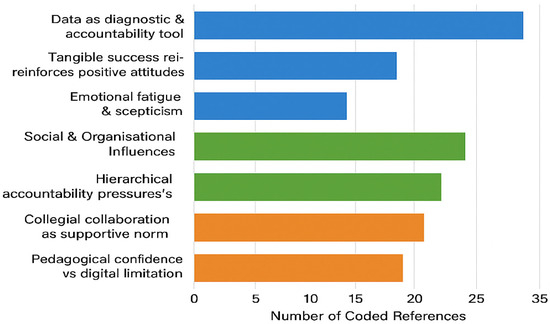
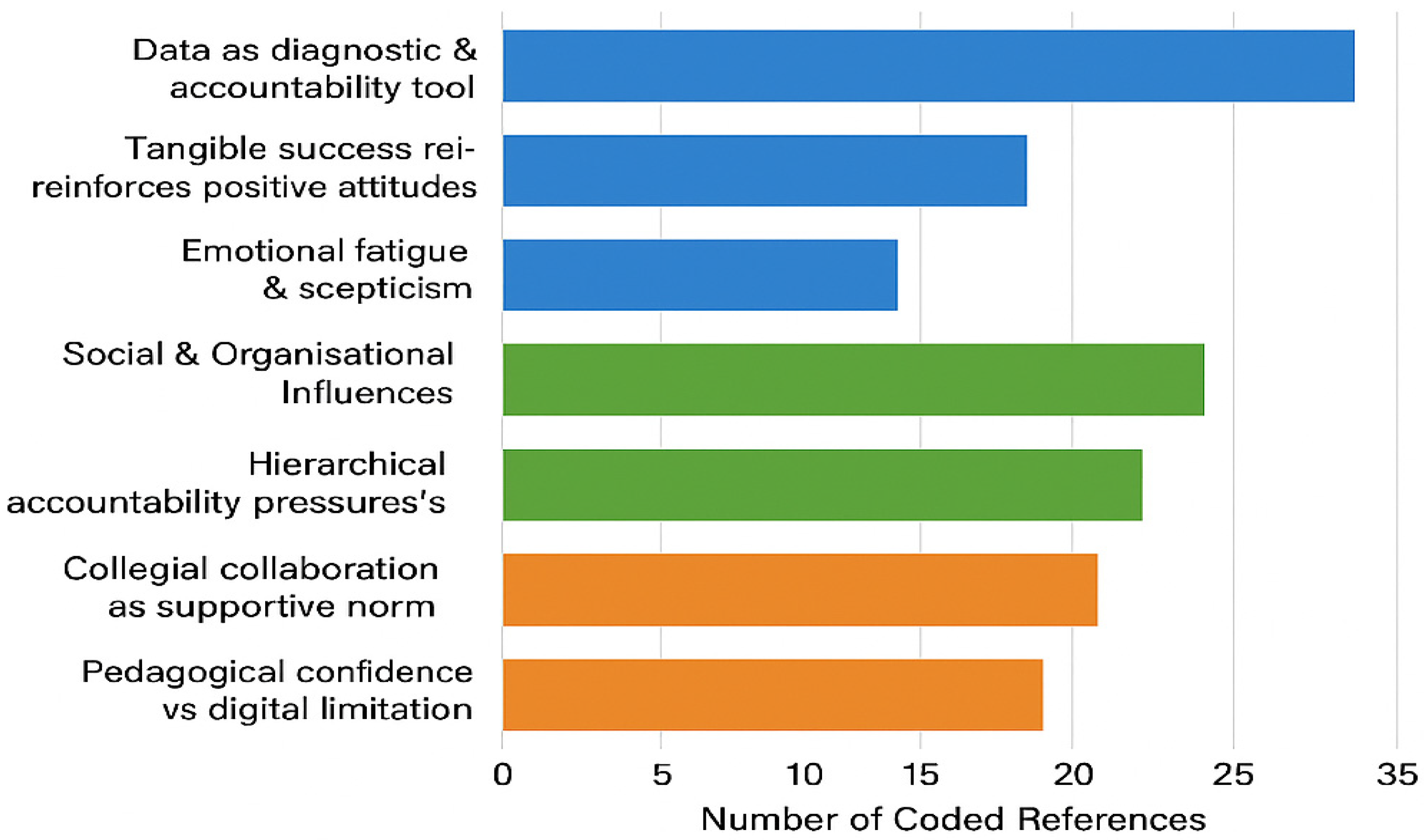
Data analysis generated three main themes corresponding to the TPB constructs: Teachers’ Attitudes toward Data Use, Social and Organisational Influences on Data Engagement, and Perceived Behavioural Control (Capacity and Autonomy). Within these categories, six sub-themes emerged: (1) Data as a diagnostic and accountability tool, (2) Tangible success reinforces positive attitudes, (3) Emotional fatigue and scepticism, (4) Hierarchical accountability pressures, (5) Collegial collaboration as a supportive norm, and (6) Pedagogical confidence versus digital limitation and resource-based autonomy (see Figure 1). Together, these themes illuminate how personal beliefs, professional culture, and institutional constraints interact to shape teachers’ behavioural intentions toward data-driven instruction.
Figure 1.
Frequency of emergent themes and sub-themes in teachers’ data use narratives. Note. The figure summarises the three constructs of the Theory of Planned Behaviour: Attitudes toward Data Use, Social and Organisational Influences, and Perceived Behavioural Control, and their six associated sub-themes. Frequencies indicate the number of coded references derived from the focus-group data, representing the relative prominence of each sub-theme within the dataset. Source: Author’s field data (2025).
As illustrated in Figure 1, the qualitative analysis yielded three major themes and six sub-themes that correspond to the constructs of the Theory of Planned Behaviour. The following sections present each research question in detail.
4.2. RQ 1: Teachers’ Attitudes Toward Data Use
Consistent with the TPB’s conceptualisation of attitude as a multidimensional evaluative disposition toward a behaviour (Ajzen, 1991), two analytically distinct sub-themes emerged from participants’ accounts: instrumental attitudes, characterised by an ambivalent recognition of data’s utility alongside concern about procedural burden; and experiential attitudes, wherein positive affect toward data use was formed and reinforced through direct evidence of learner improvement. These sub-themes reflect the dual cognitive-affective structure of attitudes recognised in TPB scholarship (Armitage & Conner, 2001) and highlight that attitude formation in professional contexts is neither static nor unidimensional.
4.2.1. Instrumental Attitudes: Data as Useful Yet Burdensome
The dominant attitudinal pattern among participants was ambivalence: most teachers affirmed the diagnostic value of learner data while simultaneously expressing frustration with the procedural and cognitive demands of its collection and use. This tension aligns with what Ajzen (1991) describes as the coexistence of favourable outcome beliefs alongside negative evaluations of the behavioural process itself, a configuration that can significantly attenuate behavioural intention even when the behaviour is conceptually endorsed.
T1 and T3 articulated this ambivalence in notably similar terms, suggesting it reflects a shared professional experience rather than idiosyncratic sentiment:
“Good teaching has always been about knowing where learners are struggling… however, this data business feels like another administrative burden.”(T1)
“Using data in our teaching is good and can improve learners’ achievement; however, it can be draining sometimes, as a teacher, you find yourself thinking about ideas and learners.”(T3)
T1’s reference to “good teaching” as inherently responsive to learner need is significant: it positions data use as professionally normative in principle, yet the qualifier “this data business” signals a perceived discontinuity between authentic pedagogical responsiveness and formalised data management procedures. T3’s account extends this by foregrounding the emotional and cognitive residue of sustained engagement with learner data, a dimension of teacher wellbeing that is under-theorised within the TPB framework.
Taken together, these responses indicate that instrumental attitudes toward data are not simply a matter of perceived usefulness but involve a complex cost–benefit calculus in which procedural, emotional, and relational costs are weighed against anticipated outcomes.
4.2.2. Experiential Attitudes: Data Validated Through Learner Progress
A smaller subset of participants reported more unambiguously positive orientations toward data use, though crucially, these attitudes were not abstract or principled in origin. Rather, they were grounded in direct, observable evidence of learner improvement, which Bandura and Wessels (1997) might characterise as enactive mastery experiences that strengthen efficacy beliefs and, by extension, positive affect toward a behaviour. Under the TPB, such experiential reinforcement operates on the evaluative component of attitude: when data-driven adjustments demonstrably improve outcomes, the affective valence attached to data use becomes positive and self-sustaining.
T2 and T4 provided illustrative accounts of this experientially grounded positivity:
“Last year 70% of my learners struggled with fractions… after an extra week of revision, the pass rate rose to 85%.”(T2)
“When assessment results show clear progress, it reinforces confidence in my instructional approach. However, when scores stagnate or improve only marginally, it can lead to self-doubt and frustration, especially when the data doesn’t seem to reflect the effort and strategies being put in.”(T4)
T2’s account illustrates the feedback loop through which data-driven intervention produces measurable change, which in turn consolidates positive attitudes and motivates continued engagement. However, T4’s account introduces an important qualification: positive experiential attitudes are contingent on outcomes that are visible, substantial, and attributable to one’s own instructional decisions. When data showed stagnation, the same teacher who reported confidence during periods of improvement described self-doubt and frustration. In sum, teachers across the sample conceptually valued data as a diagnostic tool but harboured significant reservations about its implementation under current conditions. Positive attitudes were most stable when teachers could draw a clear, experiential line between data use and learner improvement.
4.3. RQ 2: Social and Organisational Influences on Data Engagement
The TPB distinguishes between two operationalisations of subjective norm: injunctive norms, which reflect perceived social expectations regarding what one ought to do, and descriptive norms, which reflect perceptions of what others do (Cialdini & Trost, 1998). Two sub-themes captured these normative dynamics in the present study: hierarchical accountability pressures, which operated largely as injunctive mandates imposed through formal authority structures; and collegial collaboration as a supportive norm, which functioned as both a descriptive model and an injunctive source of professional validation.
4.3.1. Hierarchical Accountability Pressures
Participants consistently identified school principals, departmental heads, and district officials as the primary referent groups whose expectations shaped their engagement with learner data. Within the TPB, the motivating power of subjective norms depends on the extent to which individuals are motivated to comply with perceived expectations (Ajzen, 1991). The data suggest that compliance motivation, in this case, was high but that compliance was experienced as externally imposed rather than internally endorsed a distinction with significant implications for the depth and durability of data use behaviour.
“I’m accountable for our mathematics results to both the principal and the district… I try to shield my team from unrealistic demands.”(T4)
T4’s position as a departmental head adds an important mediating layer to the normative structure: rather than a simple top-down transmission of accountability expectations, this account reveals a form of normative buffering in which mid-level leaders absorb and moderate external pressures before they reach classroom teachers. This dynamic, while protective in intent, also obscures the systemic origins of data use mandates and can inadvertently position data engagement as a departmental rather than pedagogical priority.
T2 and T5 further illuminated the disconnect between accountability expectations and practical support:
“They want detailed tracking systems but don’t give us the technology or time.”(T2)
“The district sends us templates, tells us what to measure, but when you ask for training on how to interpret the results, there is nothing. We are held accountable for a skill we were never taught.”(T5)
T5’s observation that teachers are “held accountable for a skill we were never taught” is particularly notable for its identification of a structural contradiction at the heart of data accountability regimes: responsibility is assigned without the development of the corresponding competence. Within the TPB, such conditions function as barriers to perceived behavioural control, and their normative framing as accountability mandates may paradoxically intensify the aversive experience of data engagement rather than motivating genuine behaviour change.
4.3.2. Collegial Collaboration as a Supportive Norm
In contrast to the compliance orientation associated with hierarchical accountability, peer-level professional interactions generated a qualitatively different normative climate, one characterised by voluntary engagement, mutual recognition, and professional solidarity. These interactions functioned as injunctive norms insofar as they communicated shared professional expectations, but their motivational force derived from relational reciprocity rather than formal authority.
“We share strategies informally during breaks… we often compare results to see patterns across classes.”(T1)
“I am so lucky to have my colleagues because we are each other’s support system, like the other day we were talking about long division, I shared with my colleagues that the majority of my learners got it right, and my other colleague was like, ‘Share what you did’… so that is what I appreciate the most with my colleagues.”(T3)
T3’s account is analytically rich in several respects. First, it illustrates how informal professional learning communities generate descriptive norms that make data sharing a visible and valorised practice. Second, the peer request to “share what you did” operationalises a form of social proof that reinforces data-driven practice without institutional mandate. Third, the relational framing of “being each other’s support system” positions data engagement as an expression of professional solidarity rather than surveillance, a reframing with significant implications for how data cultures are cultivated in schools.
Collegial norms, by contrast, generated intrinsically motivated, problem-focused engagement with data as a shared professional resource. This distinction suggests that efforts to strengthen data use culture in schools would be better served by investing in collaborative professional structures such as subject-area learning communities, co-planning time, and peer observation cycles than by intensifying accountability mechanisms.
4.4. RQ 3: Perceived Behavioural Control—Capacity and Autonomy
The TPB theorises perceived behavioural control (PBC) as comprising two interrelated elements: internal control, associated with personal capacity, skill, and self-efficacy; and external control, associated with autonomy, resources, and environmental facilitators (Ajzen, 1991; Bandura & Wessels, 1997). This dual structure was clearly reflected in participants’ accounts, with two corresponding sub-themes emerging: capacity, encompassing pedagogical confidence alongside digital limitation; and autonomy, reflecting the extent to which structural conditions enabled or constrained teachers’ exercise of professional judgement in data-driven instructional decision-making.
4.4.1. Capacity: Pedagogical Strength Versus Digital Limitation
Most teachers described a profile of uneven self-efficacy: high confidence in the pedagogical dimensions of data use, identifying learning gaps, designing responsive interventions, and adjusting pacing, but markedly lower confidence in the technical dimensions associated with digital data management systems.
“Very confident in collecting and using information… not confident at all with these computer systems.”(T2)
“The school has a data management system, but most of us don’t use it properly. I revert to my own marksheet because at least I understand it.”(T3)
T3’s account of reverting to a personal marksheet is analytically instructive. Rather than withdrawing from data practice entirely, T3 enacted a workaround strategy that preserved engagement with the underlying pedagogical activity while circumventing the specific tool associated with low efficacy. While this workaround maintains some continuity of practice, it also forecloses access to the analytical affordances of the school’s data management system, limiting the sophistication and scalability of data use.
Less experienced teachers articulated a different but related form of capacity constraint one rooted not in digital discomfort but in data literacy more broadly:
“Even if I had the data dashboard or software, I wouldn’t always know what question to ask of the data. That is the part that worries me the most.”(T5)
T5’s concern about “what question to ask of the data” points to a more foundational capacity deficit than that described by T2 or T3: not simply a lack of technical skill, but an underdeveloped capacity for data interrogation the ability to formulate analytically meaningful questions, identify relevant variables, and interpret patterns in relation to instructional decisions.
4.4.2. Autonomy: Control Shaped by Position and Resources
Perceived autonomy, the sense that engaging in a behaviour is a matter of personal choice and agency rather than external compulsion, varied significantly across participants and was strongly mediated by both institutional role and resource availability. This finding corroborates Ajzen’s (1991) contention that PBC is sensitive to the controllability dimension of behaviour and extends it by demonstrating that autonomy in professional contexts is not merely a psychological attribute but is materially constituted by access to resources and positionally determined latitude for decision-making.
“I have more autonomy than classroom teachers; I get to choose what materials we use based on data.”(T4)
“I don’t feel like I have autonomy… I feel forced, and we don’t even have enough textbooks.”(T1)
The contrast between T4 and T1 is striking in its clarity. T4’s positional authority affords genuine decision-making power over material resources, rendering data use purposeful and consequential. T1’s experience, by contrast, is one of compulsion without agency, a configuration that the TPB would predict to exert minimal positive influence on behavioural intention. The additional reference to a shortage of textbooks is not incidental: it signals that for T1, the absence of autonomy is not merely a matter of institutional culture but is materially grounded in resource scarcity that forecloses the instructional adjustments that data might otherwise prompt.
T3 elaborated on how resource scarcity frustrates even data-literate teachers who identify actionable needs:
“I identified through my tracking that a group needed more visual material for geometry. But there’s nothing in the storeroom and no budget to print. So what do I do with that data?”(T3)
T3’s rhetorical question “So what do I do with that data?” encapsulates the central dilemma of data use in under-resourced contexts: when data accurately identify learning needs, but no material resources exist to address them, data literacy becomes professionally demoralising rather than empowering. Overall, the capacity and autonomy sub-themes jointly demonstrate that PBC in data-driven instructional practice is neither uniformly distributed nor individually determined. Competence without autonomous decision-making latitude renders data use directionless; autonomy without material resources renders it futile. Sustained data use behaviour, therefore, requires simultaneous investment in teacher capacity development and in the structural conditions that enable teachers to act meaningfully on what data reveals.
Across all research questions, teachers exhibited conceptually positive orientations toward data but struggled to enact data-driven practice amid administrative pressure and limited support. Favourable attitudes, supportive peer norms, and adequate autonomy interacted as the most significant predictors of behavioural intention, consistent with the TPB model. Sustainable improvement, therefore, depends on cultivating collaborative professional cultures, targeted data-literacy training, and structural conditions that enable teachers to exercise genuine control over instructional decisions.
As a cognitive-behavioural model, TPB directed analytical attention productively toward individual beliefs, perceived social expectations, and self-efficacy, revealing nuanced variation within each construct. Yet its individual-level orientation risks underweighting the extent to which institutional culture itself generates or suppresses the conditions under which any of its three constructs can operate. The findings suggest that, in South African school contexts, institutional culture does not merely moderate TPB constructs but constitutes them. Hierarchical accountability cultures shaped what counted as a subjective norm; resource scarcity defined the ceiling of perceived control; and the absence of collaborative structures limited the experiential feedback through which positive attitudes are formed and sustained. A purely cognitive reading of TPB would miss these structural dynamics.
5. Discussion
This study examined mathematics teachers’ attitudes, social influences, and perceived behavioural control in data-driven instructional decision-making. The findings illuminate how cognitive beliefs, contextual pressures, and institutional structures collectively shape teachers’ behavioural intentions, consistent with the Theory of Planned Behaviour (Ajzen, 1991).
5.1. Teachers’ Attitudes Toward Data Use
Teachers’ ambivalent attitudes toward data use reflected a tension between valuing data for diagnostic purposes and viewing it as administrative labour. This ambivalence exemplifies TPB’s assertion that behavioural intention is weakened when positive cognitive evaluations coexist with negative affective beliefs. Similar dualities were reported by Lockton et al. (2020) and Mandinach and Gummer (2016), who found that teachers recognise data’s instructional value yet resist bureaucratic data tasks. The present study extends those insights by revealing that, in South African schools, this tension is amplified by excessive paperwork and a lack of streamlined digital systems. Teachers’ emotional fatigue and scepticism are therefore not mere attitudes but reflections of systemic overload and accountability surveillance. From a TPB perspective, such negative experiential beliefs offset favourable outcome expectations, reducing behavioural commitment. Conversely, teachers who experienced tangible learner improvement after using data demonstrated strengthened positive attitudes. Their success experiences mirror the outcome-evaluation mechanism described by Ajzen (2014), where reinforcement of efficacy consolidates intention. Thus, positive feedback loops that show learners progressing appear crucial to converting abstract beliefs in data use into sustained behaviour.
5.2. Social and Organisational Influences
Social norms emerged as a powerful determinant of data use behaviour. Hierarchical accountability pressures from principals and district officials created a compliance-driven culture, echoing findings by Prenger and Schildkamp (2018). Within the TPB framework, these represent subjective norms expectations perceived as obligatory rather than intrinsically valued. Teachers complied with data-reporting requirements mainly to satisfy external authorities, rather than because they had internalised data-informed teaching as a professional norm. However, collegial collaboration offered an alternative normative pathway. Informal data sharing among peers nurtured trust and professional dialogue, paralleling Mandinach (2012) and van Kleef (2024), who emphasised peer interaction as a catalyst for authentic data engagement. The present findings, therefore, highlight that injunctive norms grounded in collegiality motivate more enduring data use than top-down directives. A plausible explanation for this pattern lies in the culture of performativity within South African schools, where compliance metrics dominate teacher evaluation. Peer collaboration counterbalances this pressure, restoring professional agency and intrinsic motivation. Hence, building collaborative learning communities may be more effective than enforcing accountability mandates.
5.3. Perceived Behavioural Control: Capacity and Autonomy
Perceived behavioural control encapsulated two interrelated elements: teachers’ capability (capacity) and their sense of agency (autonomy). Consistent with Mandinach (2012) and Prenger and Schildkamp (2018), teachers possessed strong pedagogical diagnostic skills but limited digital competence, reflecting uneven development of data literacy. From a TPB standpoint, insufficient perceived capability undermines behavioural intention even when attitudes are positive. Resource scarcity and heavy workloads further constrained autonomy. Many teachers described data initiatives as being imposed rather than self-directed, illustrating how a perceived lack of control diminishes motivation. Similar findings in Spaull and Jansen (2019) indicate that inadequate resources and overly restrictive policies reduce teachers’ confidence in sustaining innovative practices. Importantly, teachers in leadership positions reported higher autonomy and commitment, confirming Ajzen’s proposition that control beliefs, the perceived ease or difficulty of performing a behaviour, are shaped by structural affordances. The evidence suggests that empowerment through leadership roles, access to digital tools, and reduced bureaucratic demands enhances behavioural control and fosters genuine engagement with data.
5.4. Integrative Interpretation
Across constructs, the interaction among attitudes, norms, and control beliefs demonstrates that intention to use data is not linear but recursive. Positive attitudes lose potency under restrictive norms, while supportive peer cultures can offset capacity constraints. This interdependence reinforces TPB’s assumption that behavioural intention results from a dynamic balance of belief systems rather than from any single determinant (Ajzen, 2014). These findings also contribute contextually to the literature by situating data-driven decision-making within the realities of South African schooling, where policy compliance, workload, and uneven infrastructure mediate teachers’ psychological readiness for reform. The study thereby extends international discussions (Datnow & Hubbard, 2016; Mandinach & Gummer, 2016) into a Global South perspective, foregrounding how systemic inequities intersect with individual belief systems.
6. Conclusions
This study revealed that mathematics teachers’ engagement with data-driven instruction is shaped by a dynamic interaction of attitudes, social influences, and perceived behavioural control. Teachers conceptually valued data as a diagnostic and improvement tool, yet their motivation was undermined by administrative burden, limited digital skills, and externally imposed accountability. Peer collaboration emerged as a protective factor that encouraged authentic data use, while hierarchical mandates restricted autonomy and reduced intrinsic motivation. A key strength of this study lies in its integration of a robust theoretical framework (Theory of Planned Behaviour) with context-specific qualitative evidence from South African mathematics classrooms. By situating teachers’ beliefs within the realities of workload, resource constraints, and institutional culture, this study offers an in-depth, contextualised understanding rarely captured in earlier international research. Another strength is its methodological transparency; the use of focus-group triangulation and iterative coding provided credible, data-grounded insights. Together, these strengths enhance the trustworthiness and transferability of the findings across similar educational contexts. In summary, this study contributes a valuable understanding of how mathematics teachers interpret and act upon assessment data in resource-constrained environments. It highlights the need for systems that support teacher agency, reduce administrative overload, and foster collegial collaboration as a pathway to more effective data-driven instructional decision-making.
6.1. Educational Implications
The findings of this study may inform teacher education, school leadership, and policy development in several ways. First, teacher-training programmes could integrate data literacy and interpretation components within mathematics education curricula to enable teachers to translate assessment information into meaningful instructional strategies. Second, school leaders and district officials might consider promoting professional learning communities that emphasise collaboration rather than compliance. Creating spaces where teachers jointly examine learner data can encourage reflective dialogue and reduce feelings of isolation or pressure to account. Third, policy initiatives could shift from prescriptive data-reporting mandates toward developmental support models, recognising that the use of data is not only a technical exercise, but a behavioural process influenced by beliefs, norms, and perceived autonomy. Finally, investment in digital infrastructure and sustained mentoring may facilitate teachers’ confidence and autonomy, allowing data use to become a more embedded and valued aspect of everyday teaching practice.
6.2. Limitations and Future Directions
This study has several limitations. The sample was limited to five senior-phase mathematics teachers within one district, which restricts broad generalisability. The qualitative design provided depth but not statistical representativeness. Additionally, self-reported perceptions may be influenced by social desirability bias during focus group interactions. Future research could address these limitations through mixed-methods or longitudinal designs that examine how teachers’ beliefs and data use behaviours evolve after targeted professional development interventions. Comparative studies across provinces or between subject areas could also clarify how contextual differences shape behavioural intention. Finally, future investigations may explore the interaction between digital data management systems and teachers’ perceived control, thereby informing technology integration policies in resource-constrained schools.
6.3. Recommendations
Based on the findings of this study, several actionable recommendations are proposed to strengthen data-driven instructional decision-making in mathematics classrooms. Teacher professional development programmes should explicitly incorporate sustained training in data literacy, focusing on how assessment information can be effectively translated into lesson planning and learner support. These initiatives should be embedded within collaborative professional learning communities, where teachers continuously analyse assessment trends, exchange strategies, and reflect on the impact of their instructional decisions. School leaders and district officials should streamline administrative reporting requirements to minimise teacher workload and prevent data fatigue. Reducing redundant data submissions would enable teachers to devote more time to interpreting learner performance and designing responsive teaching interventions. Additionally, education departments need to provide reliable technological infrastructure and ongoing mentorship to support teachers’ capacity to integrate data tools into daily practice. Finally, policymakers should recognise that data use is most effective when teachers are trusted as decision-makers rather than treated as data collectors. Systems of accountability need to prioritise professional autonomy, mutual trust, and empowerment, ensuring that data serves as a tool for pedagogical reflection and improvement rather than compliance.
Author Contributions
Conceptualization, N.B. and M.M.; methodology, N.B.; software, F.E.; validation, N.B., M.M. and F.E.; formal analysis, N.B.; investigation, N.B.; resources, N.B.; data curation, N.B.; writing—original draft preparation, N.B.; writing—review and editing, F.E.; visualization, F.E.; supervision, M.M.; project administration, M.M.; funding acquisition, M.M. All authors have read and agreed to the published version of the manuscript.
Funding
This research received no external funding.
Institutional Review Board Statement
The study was conducted in accordance with the Declaration of Helsinki and approved by the Faculty of Education Research Ethics Committee (Reference No. UFS-HSD2024/2082) of University of the Free State.
Informed Consent Statement
Informed consent was obtained from all subjects involved in the study. Written informed consent has been obtained from the patient(s) to publish this paper.
Data Availability Statement
The data are not publicly available due to privacy or ethical restrictions.
Acknowledgments
The authors take full responsibility for the content and its accuracy.
Conflicts of Interest
The authors declare no conflicts of interest.
References
- Ajzen, I. (1991). The theory of planned behaviour. Organizational Behaviour and Human Decision Processes, 50(2), 179–211. [Google Scholar] [CrossRef] [Scilit]
- Ajzen, I. (2014). The theory of planned behaviour is alive and well, and not ready to retire: A commentary on sniehotta, presseau, and araújo-soares. Health Psychology Review, 9(2), 131–137. [Google Scholar] [CrossRef] [Scilit] [PubMed]
- Armitage, C. J., & Conner, M. (2001). Efficacy of the theory of planned behaviour: A meta-analytic review. British Journal of Social Psychology, 40(4), 471–499. [Google Scholar] [CrossRef] [Scilit] [PubMed]
- Bandura, A., & Wessels, S. (1997). Self-efficacy (Vol. 10). Cambridge University Press. [Google Scholar]
- Beck, J. S., & Nunnaley, D. (2021). A continuum of data literacy for teaching. Studies in Educational Evaluation, 69, 100871. [Google Scholar] [CrossRef] [Scilit]
- Braun, V., & Clarke, V. (2019). Reflecting on reflexive thematic analysis. Qualitative Research in Sport, Exercise and Health, 11(4), 589–597. [Google Scholar] [CrossRef] [Scilit]
- Cialdini, R. B., & Trost, M. R. (1998). Social influence: Social norms, conformity and compliance. In The handbook of social psychology. McGraw-Hill. [Google Scholar]
- Creswell, J. W., & Poth, C. N. (2018). Qualitative inquiry and research design: Choosing among five approaches. Sage. [Google Scholar]
- Datnow, A., & Hubbard, L. (2016). Teacher capacity for and beliefs about data-driven decision making: A literature review of international research. Journal of Educational Change, 17(1), 7–28. [Google Scholar] [CrossRef] [Scilit]
- Department of Basic Education. (2019). Annual performance plan 2018/2019. Department of Basic Education. Available online: https://www.education.gov.za/ (accessed on 1 October 2019).
- Earl, L. M., & Katz, S. (Eds.). (2006). Leading schools in a data-rich world: Harnessing data for school improvement. Corwin Press. [Google Scholar]
- Fishbein, M., & Ajzen, I. (2010). Predicting and changing behaviour: The reasoned action approach. Psychology Press. [Google Scholar] [CrossRef] [Scilit]
- Hamilton, L., Halverson, R., Jackson, S., Mandinach, E., Supovitz, J., & Wayman, J. (2009). Using student achievement data to support instructional decision making (NCEE 2009-4067). National Center for Education Evaluation and Regional Assistance, Institute of Education Sciences, U.S. Department of Education. Available online: https://www.researchgate.net/publication/304049488_Using_Student_Achievement_Data_to_Support_Instructional_Decision_Making (accessed on 1 September 2009).
- Jimerson, J. B., & Wayman, J. C. (2015). Professional learning for using data: Examining teacher needs & supports. Teachers College Record, 117(4), 1–36. [Google Scholar] [CrossRef] [Scilit]
- Lincoln, Y. S., & Guba, E. G. (1985). Naturalistic inquiry. Sage. [Google Scholar]
- Lockton, M., Weddle, H., & Datnow, A. (2020). When data don’t drive: Teacher agency in data use efforts in low-performing schools. School Effectiveness and School Improvement, 31(2), 243–265. [Google Scholar] [CrossRef] [Scilit]
- Mandinach, E. B. (2012). A perfect time for data use: Using data-driven decision making to inform practice. Educational Psychologist, 47(2), 71–85. [Google Scholar] [CrossRef] [Scilit]
- Mandinach, E. B., & Gummer, E. S. (2016). What does it mean for teachers to be data literate: Laying out the skills, knowledge, and dispositions. Teaching and Teacher Education, 60, 366–376. [Google Scholar] [CrossRef] [Scilit]
- Mandinach, E. B., & Schildkamp, K. (2021). Misconceptions about data-based decision making in education: An exploration of the literature. Studies in Educational Evaluation, 69, 100842. [Google Scholar] [CrossRef] [Scilit]
- Mokgwathi, M. S. (2025). Investment in Mathematics Education and Curriculum Reform in South Africa: Addressing Inequities and Bridging the Achievement Gap. In C. Lin, & L. Sun (Eds.), Diversity, equity, and inclusion for mathematics and science education: Cases and perspectives (pp. 189–232). IGI Global Scientific Publishing. [Google Scholar] [CrossRef] [Scilit]
- Morgan, D. L. (2018). Basic and advanced focus groups. Sage. [Google Scholar]
- Poortman, C. L., Brown, C., & Schildkamp, K. (2022). Professional learning networks: A conceptual model and research opportunities. Educational Research, 64(1), 95–112. [Google Scholar] [CrossRef] [Scilit]
- Prenger, R., & Schildkamp, K. (2018). Data-based decision making for teacher and student learning: A psychological perspective on the role of the teacher. Educational Psychology, 38(6), 734–752. [Google Scholar] [CrossRef] [Scilit]
- Schildkamp, K., & Poortman, C. L. (2015). Factors influencing the functioning of data teams. Teachers College Record, 117(4), 1–42. Available online: https://www.tcrecord.org/Content.asp?ContentID=17851 (accessed on 1 April 2015). [CrossRef] [Scilit]
- Schildkamp, K., van der Kleij, F. M., Heitink, M. C., Kippers, W. B., & Veldkamp, B. P. (2020). Formative assessment: A systematic review of critical teacher prerequisites for classroom practice. International Journal of Educational Research, 103, 101602. [Google Scholar] [CrossRef] [Scilit]
- Spaull, N., & Jansen, J. D. (2019). South African schooling: The enigma of inequality. Springer. [Google Scholar]
- van Kleef, G. A. (2024). Bottom-up influences on social norms: How observers’ responses to transgressions drive norm maintenance versus change. Current Opinion in Psychology, 60, 101919. [Google Scholar] [CrossRef] [Scilit] [PubMed]
- Vanlommel, K., & Schildkamp, K. (2019). How do teachers make sense of data in the context of high-stakes decision making? American Educational Research Journal, 56(3), 792–821. [Google Scholar] [CrossRef] [Scilit]

Disclaimer/Publisher’s Note: The statements, opinions and data contained in all publications are solely those of the individual author(s) and contributor(s) and not of MDPI and/or the editor(s). MDPI and/or the editor(s) disclaim responsibility for any injury to people or property resulting from any ideas, methods, instructions or products referred to in the content. |
© 2026 by the authors. Licensee MDPI, Basel, Switzerland. This article is an open access article distributed under the terms and conditions of the Creative Commons Attribution (CC BY) license.