


Abstract
Contemporary educator preparation programs face sociopolitical constraints that limit critical discussions surrounding how systemic, structural, and institutional inequities influence teaching and learning, leaving future educators underprepared to meaningfully nurture diverse ways of knowing in K-12 schools. To address this challenge, in this study we explored how video-mediated transcultural dialogues between 60 pre-service educators from Taiwan and the U.S. influenced the development of essential critical cultural competencies. Using a nested theoretical perspective, we analyzed participants’ discussions related to internalized notions of teaching and learning across diverse ecologies. Analysis revealed that through these conversations, incremental development of interconnected global awareness, self-determination, reflexive relationality, and social justice orientations occurred. Modest individual perspective shifts transpired as participants cultivated emerging critical cultural competencies. Despite limitations including a small sample size and a term duration, this pedagogical innovation demonstrated a possible pathway for further exploration to develop future educators’ critical cultural competencies while bridging global relations even within restrictive sociopolitical contexts.
1. Introduction
Critical culturally competent educators are well equipped to foster both belonging and academic thriving across multilingual learners’ language and literacy experiences in schools. Yet educator preparation programs (EPPs), charged with preparing the next generation of teachers, face increasing constraints that systematically erode their capacity to develop these competencies in pre-service educators. The consequences of this erosion are not abstract. When EPPs do not cultivate critical awareness of global, multicultural, and sociopolitical realities, they not only produce less culturally informed educators, but they also actively reproduce the conditions that sustain inequality. How then, under real institutional and political constraints, might EPPs develop critical cultural competencies so that pre-service educators are prepared to nurture the language and literacy development of ethnoracially and linguistically diverse children in K-12 schools? Carter-Andrews (2021) calls for EPPs to normalize critical conversations that challenge the status quo and enrich teachers’ praxis as a regular, ordinary component of their educator development. Doing so sustains an intentional focus on “critical self-reflection [in order to] grow their sociocultural consciousness and develop transgressive pedagogies and practices for advancing justice and transformative change in the classroom and beyond” (p. 418). In this study, we explored one possibility for EPPs to cultivate critical cultural competencies which included direct engagement with critical frameworks, critical conversations, and diverse ways of thinking and knowing even when constrained by systemic, structural, and institutional barriers.
Through a nested theoretical framework that centered critical global literacies (Yoon, 2016), this qualitative study explored the possibilities of transcultural dialogues during conversations around shared viewing experiences to support incremental development of critical cultural competencies. For this study, we partnered two universities, one in the Pacific Northwest United States and one in central suburban Taiwan, to explore how transcultural conversations might serve as a tool for developing the cultural awareness, reflexivity, and social justice orientations essential to humanizing teaching and learning in K-12 schools. This study documents how pre-service educators’ evolving perspectives represented incremental yet crucial foundational shifts that accumulated over time. By examining these incremental changes, we discuss the possibilities transcultural dialogues may present for EPPs to offer pedagogically safe spaces for critical conversations. Current restrictive, anti-DEI (diversity, equity, and inclusion) policy contexts in the United States and similarly constraining dynamics within educational institutions in Taiwan differ in form but share a common logic. In both contexts, dominant-language pedagogies and practices impose cultural assimilation by systematically marginalizing multilingual learners’ languages and literacies across the K-12 continuum. Yet structural constraints, however entrenched, are not deterministic. Research consistently points to the prepared educator as a critical site of possibility. Educators who develop critical language awareness and culturally sustaining pedagogical repertoires can interrupt assimilationist patterns even within systems not designed to support them. Thus, building sustainable praxis in EPPs that support the development of critical cultural competencies for future educators is paramount to disrupting inequities not only in K-12 schools, but in society at large.
1.1. Theoretical Perspectives
Preparing future educators for critical engagement in our interconnected world challenges traditional approaches to educator preparation by integrating interdisciplinary frameworks (Yoon, 2016) to meaningfully navigate the complex social, political, and community world-building challenges schools face today. There is important resistance in the mundane everyday acts that shape incremental shifts in awareness over time through unofficial curriculum. These incremental shifts do not require dramatic confrontation but rather, strategic and purposeful acts. This is especially true in diverse education contexts, for example, the majority of educators in the United States identify as white and monolingual and yet are tasked with serving ethnoracially and linguistically diverse students and families well (Cochran-Smith, 1995; Sleeter, 2017).
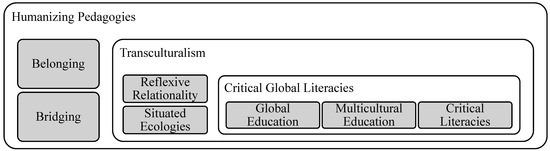
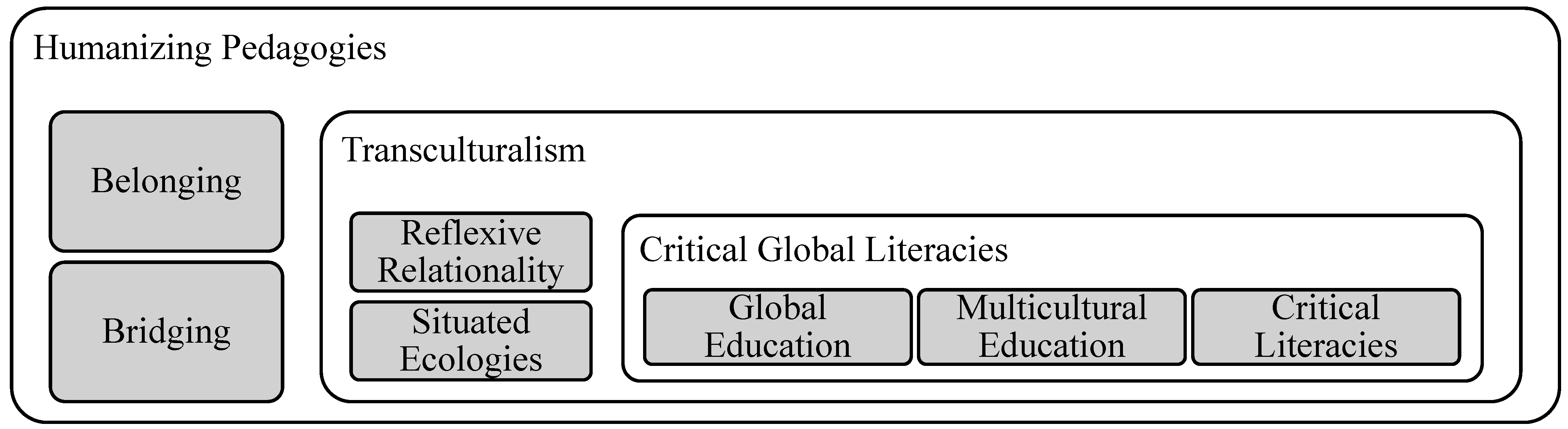
To support diverse ways of knowing in K-12 schools, educators need to develop critical cultural competencies grounded in three primary perspectives: (1) critical global literacies; (2) transculturalism; and (3) humanizing pedagogies. Nesting critical global literacies within transculturalism and humanizing pedagogies, we aimed to understand the potential role of transcultural dialogue within video-mediated discussions as a framework for developing critical cultural competence (see Figure 1). The goal was to purposefully provide opportunities for pre-service educators to engage with their own and their peers’ ways of thinking and talking about teaching and learning in schools. Below is a brief overview of the nested theoretical perspectives that informed this study.
Figure 1.
Nested Framework for Critical Cultural Competence.
Critical global literacies, situated within transcultural and humanizing pedagogies, provided a framework for understanding belonging in teaching and learning as relational and ecologically embedded across multiple levels. Below is a brief overview of each of these theoretical constructs.
1.2. Critical Global Literacies
Critical global literacies refer “to critical practices of integrating global and multicultural dimensions into literacy teaching and learning” (Yoon, 2016, p. 46). Critical global literacies draw from critical pedagogy (P. Freire, 1968/2005; hooks, 1994; Janks, 2010) with a focus on the macropolitical, cross-cultural, and individual interdependence for meaning making, agentive power, and criticality that shape identity development. As individuals respond to critically reading their world through critiquing social systems, they develop a sense of cultural pluralism and move toward a more grounded critical stance (Holland et al., 1998; Yoon, 2016). Yoon (2016) proposed four dimensions of critical global literacies summarized as: (1) building global awareness; (2) bridging connections from self to the broader world context; (3) critiquing the word and world; and (4) developing action-oriented advocacy. Yoon (2016) emphasized these are not per se linear nor fixed but rather present a framework within which meaningful competences can be developed in this transcultural world. This framework represents the intersection of critical literacies, global education, and multicultural education.
Yoon (2016) emphasized that global and multicultural education should be approached with criticality. Critical literacies teach how to read both the word and the world (P. Freire, 1968/2005; Holland et al., 1998; Street & Leung, 2010) while analyzing and developing deep understandings of the relationships between language and power (Janks, 2010). Critical literacies provide space to interrogate the status quo and the norms governing the maintenance of instantiating hierarchical power (P. Freire, 1968/2005; Lewis, 2001; Luke, 2012). Given the understanding that texts, all texts, are never neutral (Bakhtin, 1935/1981) and serve particular groups, critical global literacies center the interrogation of power structures as text. This interrogation shapes perceptions of moral universalism, notions of foundational human rights, understanding of the roles and obligations of a democratic citizenry, and contextualizes a critical stance towards global realities that shape the way one understands injustice and inequality (Hanvey, 1976; Yoon, 2016). In Yoon’s critical global literacies framework, this critical stance challenges the structures of power that dictate the social order and evoke action towards social justice.
Multicultural education, on the other hand, focuses on the local context through understanding the cultural realities and the liberation of the oppressed by individuals themselves (Banks, 2004; P. Freire, 1968/2005; Yoon, 2016). Multicultural education explores the ‘isms of education such as ageism, linguicism, racism, and ableism through a form of targeted universalism (Grant & Sleeter, 2009; powell, 2024) with the goal of equity for all within educational spaces and society at large. In today’s global economy, individuals can no longer view themselves solely through a nationalist lens. The world is deeply interconnected, and decisions made in one part of the world have ripple effects across others. The framework of critical global literacies (Yoon, 2016) informed the current study by providing a lens for understanding pre-service educators’ ways of viewing and shaping this interconnected transcultural world.
1.3. Transculturalism
To understand how transcultural dialogues may inform the development of critical cultural competencies within EPPs, this study was also situated within transculturalism. Transculturalism proposes that productive participation in a globalized world predicates the ability to adapt to different cultural and social settings with an awareness that cultures shift and changes over time (Li, 2008; Li & Bian, 2024). This awareness situates an understanding of one’s position within a diverse world by recognizing how local ecologies bridge to broader global realities (Li, 2017). Bridging connections from the broader world context to oneself locates an opportunity for reflexivity wherein one is able to critically examine the systems, structures, and institutions within which education occurs. Transcultural spaces foster authentic contexts to interrogate familiar assumptions about these systems, structures, and institutions, which has potential to expand understanding of what it means to know, to think, and to be through reflexive relationality. Reflexive relationality, grounded in transcultural perspectives, is not simply introspective, it is also relationally situated (Yol & Yoon, 2020) through sustained engagement with transcultural interactions. Transculturalism is therefore tethered to lived experience shared across cross-cultural contact that iteratively reshapes situated ecologies (Malsbary, 2014; Pennycook, 2007). Reflexive relationality and subsequent interrogations of familiar assumptions foster incremental change or transformative orientations towards social justice making educational inequities visible. Making inequities visible gives way to action-focused responses to systemic barriers connecting individual transformation to collective action and responsibility for bringing about change. This change occurs incrementally (Romijn et al., 2021) and shapes both praxis and practice. In sum, transculturalism, one of the primary perspectives underlying critical cultural competence, is grounded in social justice.
1.4. Humanizing Pedagogies
Another key perspective for developing critical cultural competence is humanizing pedagogy. Humanizing pedagogical frameworks situate notions of belonging and bridging (Block, 2018; Destin et al., 2022; Hill & Wong, 2024; powell, 2024) as tools to support inclusive spaces where all participants are seen and valued. Creating spaces of belonging is a humanizing enterprise wherein intentionality and an embrace of difference are prioritized through an asset-based lens. Block (2018) articulates the idea of belonging through understanding that we can structure community, including classrooms, around identified gifts and possibilities. He notes gifts as being the assets and possibilities individuals bring to a space being used to strengthen the whole. For Block, belonging is grounded in mutual investment and trust and if we are to humanize educational spaces in such a way that all students are able to belong, we are compelled to develop pedagogical skills in EPPs that foster belonging by challenging deficit frameworks in order to elevate individual assets and values (Hill & Wong, 2024; hooks, 1994). This comes forward through critical conversations that challenge systems of power and the ways we have come to be and know (P. Freire, 1968/2005). Honoring the diverse ontological and epistemological orientations that inform people’s ways of existing in the world and in our classrooms are key to amplifying students’ gifts and possibilities as we bridge to belonging (Carter-Andrews, 2021). Introduced by powell (2024) was the idea of bridging as a tangible possibility within humanizing pedagogies. For powell, bridging informs humanizing pedagogy by finding common ground across difference that seeks to build connection within ecologies and relationships in order to engage in meaningful conversations to strengthen that bridge. Bridging provides an opportunity to connect different ways of generating and discussing one’s ways of knowing and being so that people are able to relate to, learn from, and collaborate with each other (Granados-Beltrán, 2022).
1.5. Research Questions
The nested theoretical framework informed the methodological decisions and the interpretations of the findings for this study in order to answer the following research questions: (1) does video-mediated cuing foster critical conversations that reflect participants’ understanding of their connection to global educational contexts; and (2) how do participants articulate changes in their orientations toward teaching, learning, and cultural awareness during transcultural dialogues?
2. Materials and Methods
2.1. Participants
For this study, there were 60 participants, 12 enrolled at a university in the United States and 48 enrolled at a university in Taiwan. Participants were selected based on a convenience sampling of those that volunteered following recruitment efforts. Participant language is reproduced as spoken or written and reflects participants’ own framing, not the authors’ geopolitical characterizations.
2.2. Procedure
Grounded in the nested theoretical framework, the methodological choice for encouraging transcultural dialogues was video-mediated cuing. Video-mediated cuing provided a shared artifact from which students across two unique cultural contexts viewed the same episode(s) of teaching and learning and then brought their perspectives and noticings to synchronous Zoom conversations (Tobin, 2019; Xiao & Tobin, 2018). These were chosen because they documented different ways of thinking about teaching and learning across the globe. Each scenario showcased a day in the life of a student from Argentina and New Zealand highlighting their experiences across time. For mediated discussions, these videos provided contexts that were unfamiliar to participants and offered a space for participants to think about their values systems related to teaching and learning and discuss those values with their peers who may or may not have shared their lived experiences. While we do not try to claim that the videos selected were the best or only videos to facilitate rich conversations about teaching and learning, these videos provided mediated texts for critical conversations with common reference points while maintaining sufficient cultural distance to encourage reflexive critique.
Using a structured noticing protocol, participants were asked to: (1) watch the video; (2) choose 1 image that was impressive (positive, negative, or new); (3) take a screen shot of that moment; (4) write a brief reflection with the rationale for why that image; (5) choose a second image that challenged their view of what teaching and learning should look like; (6) take a screen shot of that image; and (7) write a brief reflection with the rationale for why that image. In addition, participants were invited to talk about the teaching methods they noticed, strategies they might choose to include in their own classrooms, lessons they learned that helped improve their understanding of diverse cultures, and lessons they learned that might help improve their teaching practices to support students from diverse backgrounds. This approach encouraged deep engagement with cultural and pedagogical noticing, with an autonomous opportunity to interrogate one’s own thinking prior to the discussion.
These online conversations were informed not only by participants but also by the researchers. The researchers, who are bi and multilingual educational researchers with origins in Korea, Taiwan, and the United States, working in educator preparation at their respective universities, chose the teaching and learning episodes. In addition, the researchers prompted participants to select images from the videos that stood out to them and articulate why they selected those particular videos in preparation for their discussion. The videos, which were in English or English glossed, were chosen because they provided a visual landscape through which participants had the opportunity to discuss how they understood what they saw, how they were prioritizing what they noticed, and how they made sense of the notions of teaching and learning across different contexts. This methodological tool drew forward participants’ perspectives around teaching and learning and provided an opportunity within the mediated task for participants to vet their perspectives within the situated ecologies of students from different ontological and epistemological orientations. The video-mediated cuing offered participants the opportunity to deconstruct their global perspectives in the company of transcultural peers exploring how transcultural dialogues, grounded in video-mediated cuing, between pre-service educators in Taiwan and the United States influenced the development of critical cultural competence.
2.3. Data Collection
The data in this study were part of a larger multi-phase study. The data described below were taken from data collection in the fall of 2023. Data collection for this study had a duration of 9 weeks. There were two initial weeks of recruitment. Then in week 3, participants were given a pre-test using the Cultural Competence Self-assessment Checklist (Central Vancouver Island Multicultural Society, 2021). During weeks 4 through 6, pre-service educators were divided into focus groups of 4 to 6 people with a mix of students from Taiwan and the U.S. Participants watched two teaching scenarios, one scenario based in New Zealand and one based in Argentina (Free Documentary, 2019). During weeks 7 and 8, the participants met for synchronous online transcultural conversation groups that were recorded. Participants were invited to share their noticings and discuss their rationale in the language of their choosing. Multilingual translators were provided for all focus groups with participants choosing Mandarin Chinese or English for their engagement. Participants were encouraged to use the language(s) with which they felt most comfortable. Translators in this study included one researcher, one research assistance, and two students who provided simultaneous real-time interpretation as speakers presented. This methodological choice was intended to foster a safe communicative environment. Such conditions were designed to support participants’ engagement with critical conversations although the nature and extent of this influence warrants further investigation beyond the scope of the current study. Participants were asked to submit reflections to the aforementioned questions following the viewing of each video prior to their focus group discussions. Participants met with their focus groups for one hour each session and discussed their reflections. In week 9, data concluded with a post-survey using the same Cultural Competence Self-Assessment Checklist capturing participants’ perspectives on their own learning journey.
2.4. Analysis
Verbatim transcripts were created following the focus group discussions. The transcripts were inductively coded across three rounds of data analysis. First, the authors used In Vivo coding. Using participants own words to identify which images were chosen and what participants had to say about those images. The authors met for regular reconciliation meetings to ensure consistency. Next, we engaged in Evaluation and Values coding (Saldaña, 2021). Evaluation coding identified participants’ observed teaching practices, while Values coding analyzed underlying beliefs that arose during the transcultural dialogues. As a result of the first three initial rounds of coding, we developed the codebook below in Table 1, which reflects the inductive codes that emerged from the data.
Table 1.
Codebook.
3. Results
Below we discuss the data from both pre-service educators in Taiwan and the United States to understand how video-mediated cuing situated conversational opportunities for participants to move across critical global literacies, transcultural transactions, and discuss notions of bridging and belonging, all of which contributed to cultivating critical cultural competencies. After briefly presenting the observable patterns that emerged, we provide detailed evidential examples of each theme.
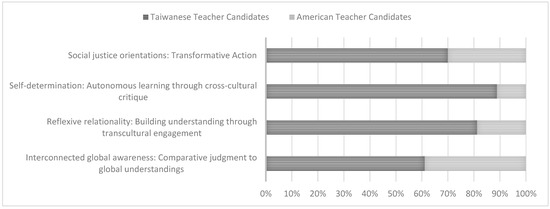
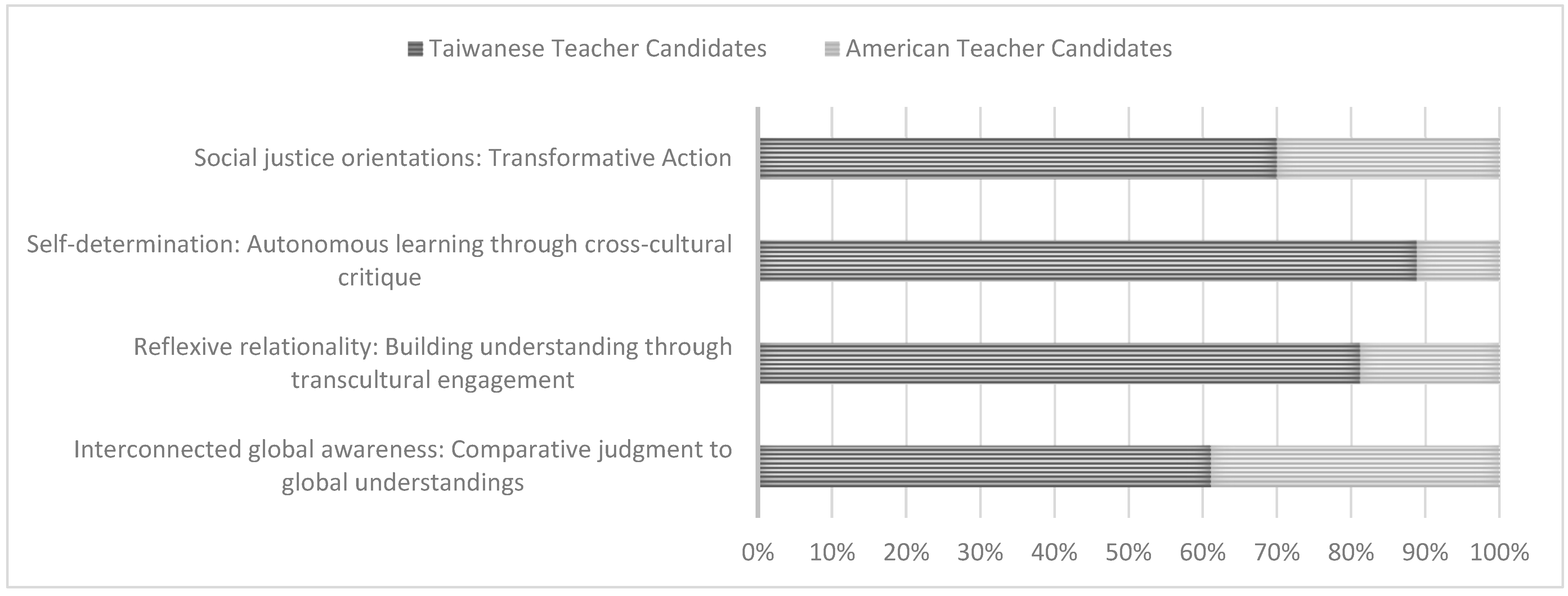
Figure 2 illustrates the four identified themes pre-service educators in Taiwan and the United States demonstrated during their collaborative discussions of their shared noticings or observations. These inductively identified themes, reflect participant development of critical global literacies, transculturalism, and an emergence of humanizing pedagogies. The first theme, interconnected global awareness, represented the area of greatest convergence, with both pre-service educators in Taiwan and the United States demonstrating nearly equivalent types of engagement with multicultural education. The main focus of participant responses centered around safety concerns, transportation concerns, distance to school, and pedagogical structural comparisons. The tone tended to be evaluative and situated through a difference as deficit lens. This alignment suggested that when participants from both contexts initially discussed their image selections, they were thinking about their rationale for their selected images through the lens of comparative judgment to their own experiences. As they discussed their selections with one another, they were then able to build shared frameworks that surpassed their situated ecologies and moved towards reflexive relationality.
Figure 2.
Teacher Candidate Observations and Comments.
Pre-service educators in Taiwan and the United States explored reflexive relationality by bridging understanding through their shared conversation. This focus demonstrated a movement towards humanizing pedagogies that balanced between empathy and curiosity indicating that participants’ thinking was informed by their shared interactions and desires to understand differences, connected through shared humanity with a mixed tone of compassion and romanticizing differences. This may have suggested systemic commonalities rather than isolated variations in how pre-service educators’ respective EPPs framed effective pedagogies and critical literacies.
Participants maintained autonomy during the transcultural dialogues, but the very nature of the dialogues gave way to participants critiquing familiar systems. This dimension of self-determination through autonomous learning revealed the most substantial difference between the groups. The primary foci here included exam-focused education, passive learning, and a desire for opportunities to engage in applied learning. The stark differences may reflect differing situated ecologies, differing experiences with global education, and differing experiences with educational philosophical orientations as viewed through their lived experiences.
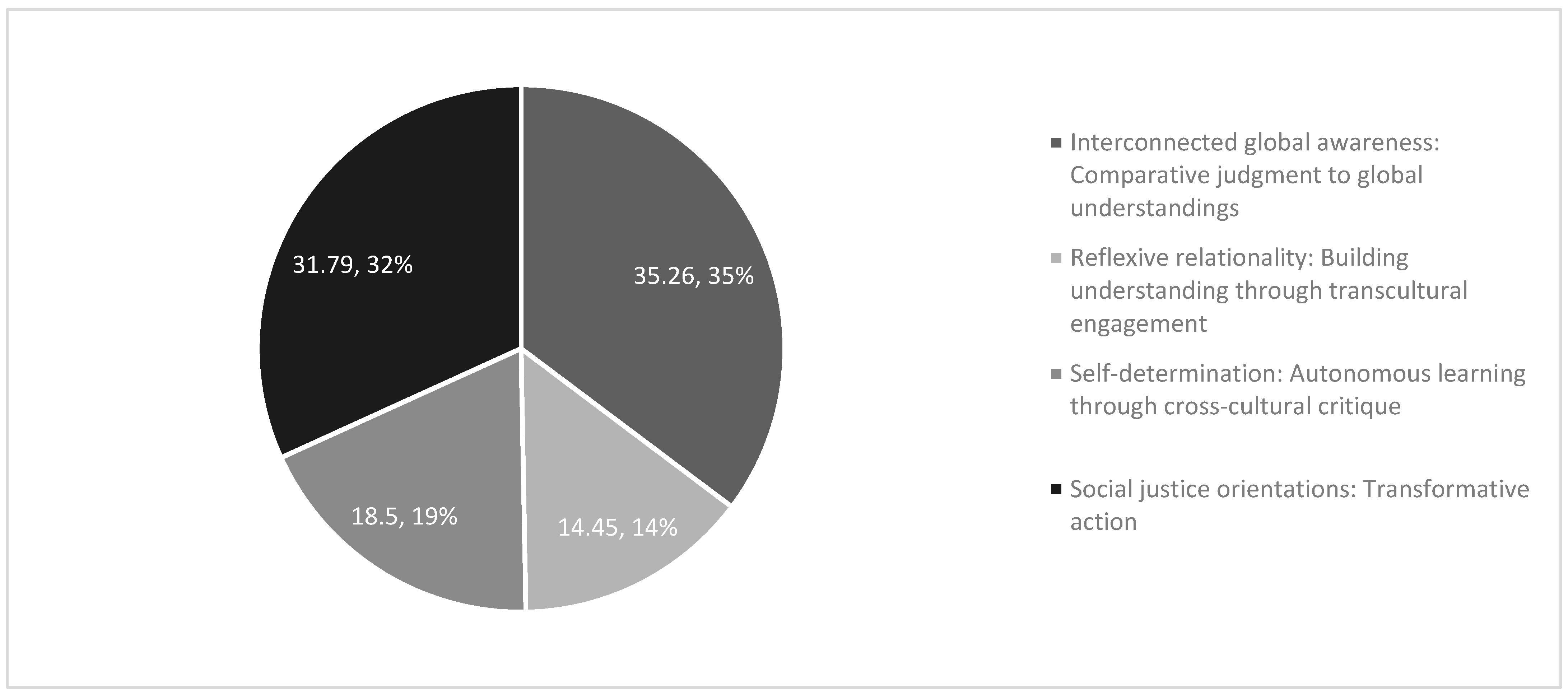
Both groups demonstrated strong commitment to belonging, bridging, and social justice orientations with relatively balanced engagement across contexts. Participant later responses were equity focused with attention to innovative pedagogy and cultural exchange. Participants shared perspectives and built on one another’s ideas around transformative teaching. These approaches emerged as shared resources that resonated meaningfully across participant contexts, with participants drawing substantially on social justice frameworks to inform their developing ideas around teaching and learning. Below, Figure 3 presents the distribution of participant responses across four overarching themes.
Figure 3.
Overall Percentage of Each Theme.
The categories are summarized here and evidenced and explained in detail below. As illustrated in Figure 3, interconnected global awareness, defined as comparison, intrigue, or critique of the unfamiliar through a deficit frame with a stance of superiority or the normal being one’s own, with a passive comparative judgment to global understanding, emerged as the most prominent theme, comprising 35.26 percent of all coded instances. This substantial proportion suggests that comparative judgment provided complexly nuanced ground for cross-cultural dialogue. Participant discussions in this category included observations of unfamiliar cultural practices such as tablecloths on desks, outdoor classrooms, and varied modes of transportation to school.
Social justice orientations and transformative action represented 31.79 percent of responses. Social justice orientations and transformative action was defined as positive appreciation, respect, admiration, and favorable views towards observed difference with a focus on compassion for resilience, dedication, and persistence through a lens of strength and power. Examples included recognizing creative problem-solving approaches, dedication to the pursuit of education, and efforts to improve learning environments. The prevalence of this theme indicated that equity-focused frameworks served as shared resources for collaborative meaning-making across both cultural contexts.
Self-determination through questioning, challenging, or reconsidering previous beliefs or assumptions about education and one’s own way of knowing by critiquing familiar systems accounted for 18.5 percent of discussions. Participant exchanges in this category included challenging assumptions about presentation styles and traditional authority dynamics in educational settings. This engagement reflected substantive dialogue around learner autonomy and the value of critical self-examination for improvement of educational systems in one’s own context.
Reflexive relationality, the smallest category at 14.45 percent, encompassed expressions of curiosity, empathy, compassion, or exuberance at the possibility of learning environments being joyful places to bridge transcultural understanding. Examples included celebrating perseverance, honoring creative and engaging learning environments, and strengthening familial connections across differing contexts. This theme represented elevated thinking about belonging in a global world, honoring differences as assets while identifying common ground for bridging connections.
Taken together, the distribution across all four themes demonstrated that pre-service educators brought multifaceted perspectives to their cross-cultural dialogues, with each dimension contributing meaningfully to their collective development of globally responsive pedagogical practices. The following section provides evidence of critical conversations that reflected participants’ understanding of their connection to global educational contexts and the subsequent survey data demonstrates participants’ incremental change in orientation towards critical cultural competencies following these transcultural dialogues.
3.1. Theme 1, Participant Understanding of Their Connection to Global Awareness: Comparative Judgment to Global Understandings
As is a common and perhaps even typical response, most often, participants approached unfamiliar educational practices by measuring them against familiar systems. Participants most often engaged in structural critique. For example, a U.S. participant critiqued a cultural presentation by noting, “so to have everyone sit down just for two students to present things from their culture, and the rest of the students who’s kind of passively there. I don’t know that I necessarily agree with it.” In kind, a participant from Taiwan questioned an outdoor learning approach when they articulated, “I [can’t] help but wonder can one really acquire knowledge this way? From my teaching perspective, I still can’t imagine such a class schedule.”
Participants also noted comparative judgment around appropriateness with normative assumptions. For example, a participant from Taiwan evaluated the risk tolerance differences when they said, “I think that [it is] a little bit dangerous…if I’m a teacher, if students are using some dangerous item, I will be very careful. So, but in this [context], they seem, [it] is very common and they encourage the student to do something adventur[ous] or some dangerous things.” For this participant, the idea of being outdoors to learn posed risks as being dangerous or not careful. Likewise, a U.S. participant judged the footwear in the outdoor learning environment when they said, “that bothered me that he didn’t have shoes on and he’s climbing. I know he’s like roped up there, but there [were no] shoes. I mean, as a parent, I don’t know if I would like [that] too much.” Here the participant was standardizing wearing shoes as the normative assumption for what one does when they are outside climbing a tree. In this space, participants were not asking questions or being curious about how or why differences existed but rather noting the differences as compared to their own experiences and situating those differences through the lens of deficit.
3.2. Theme 2, Participant Understanding of Their Connection to Transculturalism Through Self-Determination: Autonomous Learning Through Cross-Cultural Critique
Participants developed notions of pedagogical agency as they integrated their new learning through a critical lens. One participant from Taiwan reflecting on systemic factors noticed that “it challenged me to reconsider the impact of society economic factor[s] on occasion and the role of educators in creating an inclusive and supportive learning environment for all students.” Another participant from Taiwan contrasting theoretical versus practical learning articulated:
Compare with the live education in Taiwan. We will teach everyone how to cooperate and divide labor in textbooks. Compare with it is not as useful as a series of outdoor courses. This class not only teaches them [the] ability to create in the world but also allows them to learn the ability to cooperate and communicate.
A U.S. participant shared that the outdoor experience was a “genius way of showcasing different methods of math and science in a very practical way and it keeps students interested because it’s doing everything with their hands.” Participants were recognizing pedagogical choices as a tool towards self-determination in that it could be innovative as they admired experimental learning. Another participant from Taiwan pointed out that:
The current teaching situation in Taiwan is mostly teachers teaching and students listening. There’s not many opportunities for students to stand up and speak out. This also plays to the fact that talented students are very good at starting but they are not good at speaking in front of [the public] so I think Taiwan’s current education should give students more opportunities to show themselves in front of the public.
For this participant, self-determined, autonomous learning contributed to life skill development and seeing so in a different context inspired consideration for change. In kind, a U.S. participant, when reflecting on the tablecloth on the desks considered that “the schools here, kids write on the desks a lot. And so, I think that this would be a really great way to keep everything protected, and hopefully to show kids more respect for the furniture in the classroom.” Here this pre-service teacher was engaging in a cross-cultural critique and noting how having a tablecloth might support students’ autonomously respecting schools and school property.
3.3. Theme 3, Participant Understanding of Their Connection to Reflexive Relationality: Building Understanding Through Transcultural Engagement
Participants moved beyond essentialist views to engage in reflexivity about their own experiences and future classrooms. Bolton (2010) defines reflexivity as requiring “being able to stay with personal uncertainty, critically informed curiosity, and flexibility to find ways of changing deeply held ways of being” (p. xix), involving a deliberate step outside oneself to examine situations in relation to one’s context. Participants in this study demonstrated this reflexive process. For example, a student from Taiwan noted:
Their special math class students design their Canoe by themselves. I think this is not possible in Taiwan; in present classes in Taiwan, [we] are always catching up on book progress. I have never seen anything other than textbooks in math class. I learned by doing [which is the form] that need[s] to be adopted now.
This example illustrates how the student connected new experiences to their existing understanding and considered ways to adapt their future teaching practice. Yet another student from Taiwan recalled,
it is really something special. And this reminds me of a class called [a labor class] in elementary school. It [was] a course that will arrange [for] students [to] dig ditches or doing something heavy that [the] teacher want[s] you to experience the hard work of a farm, so they cleared a small piece of paddy field on a school farm and let us personally plant the rice seeding and I still have the impression even now.
As both participants engaged in reflexivity, they were drawing meaningful and important connections to their lived experiences and while both were participants from Taiwan, their lived experiences were vastly different and a learning opportunity to pivot from over generalizations ensued. A U.S. participant recalled her grandmother’s tales after viewing the video as she stated, “I know that it’s something that used to be very, very common. My grandma has mentioned that it would take her about an hour to an hour and half to walk to school when she was young.” Here the participant is drawing relational connections from the experience she viewed and the stories she has been told bridging across shared, albeit adjacent, experiences.
3.4. Theme 4, Participant Understanding of Their Connection to Social Justice Orientations: Transformative Action
From admiration to transformative action, participants expanded their awareness of assets and potential transformative actions. Participants demonstrated a developing social justice orientation through compassion-led engagement with broader educational realities. Participants discussed ideas such as, resilience, dedication, and efforts to find ways to solve problems in unfamiliar contexts. Participants translated learning into the ways they were thinking about equity-oriented practices in their future classrooms. For example, one participant from Taiwan described plans to “host events where students can showcase their talents and their own culture” to create spaces where students are able to “show others what their culture is like.” Seeing the presentations in the video, inspired potential transformative action, demonstrating movement from observation to equity-oriented action by fostering transcultural experiences in their future classrooms so all students might feel seen and known. A U.S. participant appreciated the equity provisions they observed and stated, “Argentina like allowing the children from Paraguay to attend, and the fact that they give out all the school supplies, including shoes, I think that’s really awesome.” Similarly, a participant from Taiwan wrote, “besides, I also saw the gap, between the rich and the poor [which] feels very serious [and] I thought it was a noble school.” Another example that a participant from Taiwan pointed out was:
I thought it was very interesting that they are teaching more of like life skills versus like a standard like grammatical or like structured lesson. I thought that was very interesting and a great way to expand their thinking and to like learn things that might actually be useful like later on in life. Not that things aren’t useful, but like, just like, standard like living kind of things like you might need to start a fire at some point in your life.
Here the participant is bridging transformative action in thinking differently about the purpose of education in general and the possibilities of teaching applicable content as a purposeful learning approach to foster diverse perspectives. Following up on this idea, a U.S. participant also noted,
I just flat out had never thought of something like that, where a school allows students to go basically to another school during some days a week or during one day of the week, where they learn in a completely different way. I think that a lot of schools could definitely benefit from that.
Here the participant is recognizing learning across different environments as an asset. Another example from a participant from Taiwan was:
Taiwan has [an] abundance [of] natural resources. But we rarely bring our teaching into nature, I think this is a pity, usually we focus more on schools, such as biology or literature. We rarely truly experience nature as if we think it lets getting high costs can truly master nature…if there are literature or symbols, or articles by nature in future course materials, I will like to take students into natural fields to truly feel and learn.
Participants’ orientations here were focused on equity, innovative pedagogies, dedication, cultural exchange, and hands-on learning.
Following the series of transcultural dialogues, participants were asked to complete a final survey that captured their evolving perspectives in their orientations towards teaching, learning, and cultural awareness. The survey responses revealed incremental growth trajectories, documenting how participants moved from initial surface-level observations to sophisticated, equity-oriented understandings of global education. This transformation emerged following their sustained engagement in transcultural dialogues, where the act of communicating across linguistic and cultural boundaries became a catalyst for deeper pedagogical insight. Participants’ growth was first evident in their developing contextual and interconnected awareness. Early in the dialogue series, participants tended toward simple comparisons between educational systems by focusing on differences. However, by the final survey, they demonstrated capacity to position global educational experiences as interconnected with local realities. One participant captured this shift, noting, “my group members were all so wonderful to talk to and there were so many moments that made me see the differences in our cultural backgrounds while seeing the similarities we have in our ideals and our lives.” Through repeated video-mediated exchanges, participants progressed from viewing differences as deficits to recognizing interconnected systems of educational access and opportunity, demonstrating developing capacity to understand the interconnected global world in which we currently find ourselves.
The video-mediated cuing format of the dialogues proved particularly powerful in developing reflexive relationality. The visual and auditory nature of the exchanges made linguistic diversity visible and immediate, prompting participants to critically examine their own communication practices and assumptions, especially when they were asked to talk publicly about the ideas they had written privately. One participant’s final reflection demonstrated this growth:
I think that it was a great way to learn a lot about my future students. I thought it was helpful because at least in my group my fellow peers appeared to be of Asian ancestry and not all spoke English fluently. That was helpful to me because there will be times I might not get a student who can speak fluently, and I need to make sure I’m giving them the time to fully translate from one language to the other. My peers were using their translanguaging skills and they were awesome. Being able to see how different their English was compared to mine and what I’m used to really helped me slow down and think about when I teach my student, I want to make sure the information I give out can be understood and is clear. Just because they don’t speak as fast doesn’t mean they don’t have wonderful things to contribute. Each one of my peers had very interesting moments to comment about in each film we discussed.
This reflection reveals how the transcultural dialogue experience created conditions for reflexive relationality to emerge. The participant’s recognition of peers’ translanguaging skills and the connection drawn to future teaching practice illustrated how cultural vulnerability with the video conversations fostered reflective examination of pedagogical approaches. While this reflection also revealed that significant learning still needed to take place, there was meaningful movement toward culturally responsive practice. Other participants similarly expressed cultural humility through recognizing commonalities across differences. As this participant reflected, “I found that I have similar education experience from Taiwan, so our thoughts of teaching diverse cultures are similar.” Through sustained dialogue, participants learned to critique their own perspectives while engaging authentically with transcultural viewpoints.
Over time, participants’ final reflections demonstrated increasing pedagogical ownership and confidence. The cumulative effect of multiple dialogue sessions enabled participants to integrate observed practices into their developing pedagogical knowledge. One participant articulated this growth when they wrote,
I think [this project] made me a bit more confident in working with culturally and linguistically diverse learners because it gave me the opportunity to see how students feel when their first language [is not] one used in the classroom and showed me how similar students across cultures are.
This confidence emerged not from abstract learning but from embodied experiences, from navigating multilingual and multicultural dialogues and witnessing peers successfully communicate across these perceived boundaries. Participants demonstrated self-determination by actively owning their learning and developing autonomous pedagogical ideals through critically examining educational systems across contexts.
Perhaps most significantly, the transcultural dialogue experience fostered growth in social justice orientations through sustained exposure to asset-based perspectives. Final survey responses from participants revealed that they were moving beyond tolerance toward active appreciation, describing learning to “appreciate and value all children’s value to learn” and recognized that diverse students have “wonderful things to contribute.” The dialogues also prompted systemic critique, as participants used insights from international contexts to examine exclusionary practices in their home settings. After observing schooling in other contexts, participants connected that students “don’t focus on where they’re from, they focus on what they can do while they’re in school,” using this insight to critique deficit-based approaches in their own educational contexts. By the conclusion of the dialogue series, participants moved from admiration of different educational approaches to articulating concrete plans for acting on issues of injustice, developing an emerging stance and voice as critically socio-politically conscious (J. A. Freire, 2020) global citizens.
4. Discussion
Our findings suggest modest shifts in individual perspectives may establish foundations for developing critical cultural competencies. These competencies, when developed well, foster belonging and academic thriving for multilingual learners’ language and literacy experiences in K-12 spaces. Developing capacity for critical reflection is particularly significant in the current context of legislative constraints on critical frameworks in educator preparation programs. While participants’ evolving awareness occurred on a relatively small scale, these incremental shifts represented important developments across the tenets of our nested theoretical framework: humanizing pedagogies, transculturalism, and critical global literacies. The outcomes affirm that transformative education occurs incrementally and shapes both praxis and practice (Yoon, 2016).
Transcultural dialogues emerged as pedagogical innovation for creating and supporting spaces for reflexive relationality within the situated ecology of the video-mediated conversations. By facilitating opportunities for pre-service educators to engage with unfamiliar educational systems alongside ethnoracially and linguistically diverse peers, participants developed increasingly nuanced understandings of their own assumptions, experiences, and perceptions. This pedagogical approach operationalized Yoon’s (2016) principle that in-depth discussions about the diversity of ideas in human practices are essential to promoting cross-cultural understanding. Rather than eliminating, marginalizing, or attempting to invisibilize cultural differences, approaches that perpetuate anglonormative narratives (Carter-Andrews, 2021), transcultural dialogues supported participants’ recognition of commonalities while appreciating distinctiveness as an asset (Li, 2017). Through a lens of appreciating distinctiveness as an asset, educators can more dynamically build communities of belonging while nurturing students’ thriving and self-determination (Carter-Andrews, 2021). Such approaches are essential for educators working effectively with multilingual learners by interrupting essentialist approaches to difference.
Participants’ perspectives evolved over the course of this study, demonstrating a development of more humanizing pedagogical stances which may suggest a potential bridge in individual transformation contributing to collective change. Although our study was not designed to compare participants by geographic or institutional context, we observed distinct patterns that appeared to correlate with participants’ educational backgrounds in Taiwan and the United States. U.S. participants initially demonstrated a tendency to position their own norms as default but also showed capacity for recognizing value in alternative approaches. This pattern may inform the current challenge in U.S. educator preparation, where many pre-service educators identify as white and monolingual and they must prepare to serve ethnoracially and linguistically diverse students and families well (Cochran-Smith, 1995; Sleeter, 2017).
Over time, participants from Taiwan and the U.S. moved from othering and privileged perspectives towards critically reflective stances. Participants specifically attended to pedagogical elements they admired in the New Zealand video, specifically the outdoor school context and application of content. Regarding teaching and learning in Argentina, participant responses revealed complex thinking around equity and access. This trajectory aligns with the dimensions of critical global literacies (Yoon, 2016) for building global awareness, bridging connections from self to the broader world contexts, critiquing both word and world while developing action-oriented advocacy. Each educator who developed critical cultural competence through this process demonstrated progress toward building more equitable futures to foster multilingual community thriving in K-12 schools. As educators engage in critical transcultural dialogue discussions, they develop the capacity to engage in critical reflection, ask critical questions, and advocate for social justice (Allen et al., 2017). While comparative judgment is typical for initial responses to pedagogical differences, the goal in educator preparation is to foster an evolution toward transformative change. Through cultivating self-determination, participants became better able to engage deeply with differing ontologies and epistemologies. With sustained engagement, participants demonstrated movement toward reflexive relationality, which is crucial for humanizing difference (Yol & Yoon, 2020) situated within transcultural viewpoints.
Creating spaces of belonging requires intentionality and an embrace of difference through an asset-based lens (Block, 2018; Hill & Wong, 2024). The nested theoretical framework proved generative for understanding how pre-service educators developed critical cultural competence. Positioning critical global literacies within transculturalism and humanizing pedagogies provided a framework for understanding notions of belonging within teaching and learning contexts as situated between ecologies across multiple levels. Participants demonstrated interconnected global awareness by examining their positions relative to diverse others and recognizing how local educational practices bridge to global realities (Yoon, 2016). Bridging, as conceptualized by powell (2024), emerged as particularly relevant to find common ground across difference, seeking to build connections across ecologies that strengthened educators’ ability to engage in meaningful conversations. This bridging capacity enabled pre-service educators to connect different ways of generating and discussing their ontological and epistemological orientations facilitating mutual understanding (Granados-Beltrán, 2022).
5. Conclusions
These findings carry important implications for how EPPs might reorganize to develop critical cultural competence despite restrictive policy contexts, particularly where direct engagement with critical frameworks faces institutional barriers. Transcultural dialogues situated in authentic partnerships offer pedagogically rich alternatives that honor both critical sociopolitical consciousness and incremental changes as potential pathways towards transformative educational practices that shape the language and literacy experiences of students in schools, as can be seen in participants’ post survey responses where they are reflecting on what they learned through the critical conversations and as a result, what they plan to do in their own classrooms. Resistance in the mundane everyday acts of scaffolded conversations informed incremental shifts in awareness over time through unofficial curriculum, which did not require dramatic confrontation but rather strategic and purposeful acts (Yoon, 2016). Supporting transcultural dialoguing opportunities with students across the globe is one such strategic, purposeful act. The critical culturally competent educator is better able to judiciously read both the word and the world, and they are better positioned to understand how their own identities and power shape the habitus of the classroom to negotiate, resist, and interrupt structural and institutional inequities through tasks, texts, and talk in the classroom (Lewis et al., 2007).
This is especially important in bilingual education contexts where educators need deeper engagement with critical global literacies, transculturalism, and humanizing pedagogies to meaningfully support both the language and literacies of school for multilingual students and families. Drawing on the sociocultural framework, figured worlds proposed by Holland et al. (1998), our figured worlds are socially and culturally constructed, and people are positioned relative to ongoing repositioning within social structures by others and by oneself through mediated actions. We see this in participants’ initial engagement with the teaching and learning episodes where they were holding a stance of comparative judgment which evolved into a meaningful criticality over time. In the context of this study, the mediated action, transcultural dialogues, created space for agency to author their own ways of thinking about teaching and learning, to resist positioning, and to reshape the worlds they inhabit. Following this example, educators may be better able to take seriously the texts students bring from their lived experiences into the classroom.
The approach we examined represented such strategic resistance by working within and around constraints to foster the critical competencies future educators need. The realities of engaging in conversations with peers across difference inevitably and dialogically shaped our thinking as evidenced in the ways participants’ conversations changed over time. Practical action steps drawn from this study for implementing this approach include: (1) supporting pre-service educator transitions from judgment to reflection through discussions, sentence frames and prompts, and models of how to ask questions stemming from curiosity and understanding, as provided in the video-mediated tasks; (2) creating spaces where educators of different backgrounds and ways of seeing and experiencing the world can discuss, debate, and engage in self-critique without defensiveness, as evidenced with the online conversations across two distinct global contexts and bridging dialogues; and (3) highlighting spaces where innovation toward decolonial anti-racist design across the curriculum becomes possible, as evidenced in post-survey reflections and participants’ plans for conducting their own classrooms differently as a result of this work. These three action steps offer opportunity to amplify diverse narratives (Giroux, 1996) in critically analytical ways that move pre-service educators toward enacting transgressive pedagogies and practices. In so doing, they can interrupt the perpetuation of narratives that misrepresent what pre-service educators know and understand about diverse cultural beliefs, values, norms, and practices (Carter-Andrews, 2021).
This study examined perspective evolution rather than performance transformation in actual classrooms. Future research might observe educators in their classrooms to document how transcultural dialogues translate into instructional approaches thereby informing this proposed pedagogical practice in important ways. Longitudinal studies tracking educators through their transition into professional practice may highlight the durability and application of critical cultural competence developed through transcultural dialogues. We acknowledge our small sample size and focus on two specific cultural contexts limits generalizability. With that said, we view the significance of these findings as contributing meaningfully to shared understanding of how EPPs may reorganize to develop critical cultural competence despite restrictive contexts.
Future research may expand transcultural dialogue approaches to include additional cultural contexts and examine how the number of diverse contexts may influence the depth and breadth of critical cultural competence development. Additional research directions could also include investigating more concrete examples of how to implement suggested practices including examining the duration and intensity of transcultural dialogues and their impact on outcomes; examining the role of the facilitator positionality in shaping dialogue quality and outcomes; and analyzing the intersection of transcultural dialogue experiences with other critical pedagogical approaches to understand additive and synergistic effects.
Research might also explore how transcultural dialogues function in different institutional contexts, including those with varying degrees of policy constraints on critical frameworks. Understanding the conditions under which transcultural dialogues most effectively foster critical cultural competence would help EPPs implement this approach strategically. Investigation into how technology-mediated transcultural dialogues compare to in-person exchanges might also inform implementation decisions, particularly given increasing globalization and virtualization of educational experiences.
This study demonstrated that video-mediated transcultural dialogues offer a viable pedagogical approach for developing critical cultural competence in pre-service educators. By nesting critical global literacies within transculturalism and humanizing pedagogies, transcultural dialogues were understood as spaces where pre-service educators could develop interconnected global awareness, self-determination, reflexive relationality, and social justice orientations. The incremental shifts in perspectives documented in this study represented foundational building blocks for systemic educational transformation needed to serve increasingly diverse student populations effectively. As EPPs navigate restrictive policy environments, transcultural dialogues situated in authentic partnerships offer pedagogically promising alternatives that advance educational justice.
Author Contributions
Conceptualization, K.L.P., Y.-F.C. and B.Y.; methodology, K.L.P., Y.-F.C. and B.Y.; writing—original draft preparation, K.L.P., Y.-F.C. and B.Y.; writing—review and editing, K.L.P., Y.-F.C. and B.Y. All authors have read and agreed to the published version of the manuscript.
Funding
This research was supported by Institutional Faculty Development Funds.
Institutional Review Board Statement
The study was conducted in accordance with the Declaration of Helsinki, and approved by the Institutional Review Board of Western Oregon University (protocol code 1241 and date of approval: 25 March 2023).
Informed Consent Statement
Informed consent was obtained from all participants involved in the study.
Data Availability Statement
The data presented are not readily available as they are part of a larger ongoing study. Requests to access the datasets should be directed to prattk@wou.edu.
Acknowledgments
The authors gratefully acknowledge the invaluable contributions of Dr. Shu-Ling Huang and Dr. Pin-Kuei Chen, whose expertise and commitment enriched this research. We extend our sincere appreciation to the teacher candidate participants for their thoughtful engagement and willingness to share their experiences and insights. We also recognize the dedicated efforts of the student workers whose support proved essential to the completion of this work and to the editors and reviewers of this manuscript whose insights were invaluable. This research has been strengthened immeasurably by their collaborative spirit and shared commitment to advancing educational practices that benefit students and families worldwide. The authors assume full responsibility for the content presented in this publication.
Conflicts of Interest
The authors declare no conflicts of interest. Funders had no role in the design of the study; in the collection, analyses, or interpretation of data; in the writing of the manuscript; or in the decision to publish the results.
References
- Allen, A., Hancock, S. D., Starker-Glass, T., & Lewis, C. W. (2017). Mapping culturally relevant pedagogy into teacher education programs: A critical framework. Teachers College Record, 119(1), 1–26. [Google Scholar] [CrossRef] [Scilit]
- Bakhtin, M. M. (1981). Discourse in the novel. In C. Emerson, & M. Holquist (Eds.), The dialogic imagination: Four essays (pp. 259–422). University of Texas Press. (Original work published 1935). [Google Scholar]
- Banks, J. (2004). Multicultural education: Characteristics and goals. In J. Banks, & C. Banks (Eds.), Multicultural education: Issues and perspectives (pp. 3–30). Jossey-Bass. [Google Scholar]
- Block, P. (2018). Community: The structure of belonging (2nd ed.). Berrett-Koehler Publishers. [Google Scholar]
- Bolton, G. (2010). Reflective practice: Writing and professional development (3rd ed.). SAGE Publications. [Google Scholar]
- Carter-Andrews, D. (2021). Preparing teachers to be culturally multidimensional: Designing and implementing teacher preparation programs for pedagogical relevance, responsiveness, and sustenance. The Education Forum, 85(4), 416–428. [Google Scholar] [CrossRef] [Scilit]
- Central Vancouver Island Multicultural Society. (2021). Cultural competence self-assessment checklist. Available online: https://www.cvims.org/community/cultural-competency/ (accessed on 14 March 2023).
- Cochran-Smith, M. (1995). Color blindness and basket making are not the answers: Confronting the dilemmas of race, culture, and language diversity in teacher education. American Educational Research Journal, 32(3), 493–522. [Google Scholar] [CrossRef] [Scilit]
- Destin, M., Silverman, D. M., & Rogers, L. O. (2022). Expanding the social psychological study of educators through humanizing principles. Social and Personality Psychology Compass, 16(6), e12668. [Google Scholar] [CrossRef] [Scilit]
- Free Documentary. (2019, July 4). School in New Zealand and Argentina|Planet School|S01 E03|free documentary [Video]. YouTube. Available online: https://www.youtube.com/watch?v=Y0OaAlmKFKQ (accessed on 14 March 2023).
- Freire, J. A. (2020). Promoting sociopolitical consciousness and bicultural goals of dual language education: The transformational dual language educational framework. Journal of Language, Identity and Education, 19(1), 56–71. [Google Scholar] [CrossRef] [Scilit]
- Freire, P. (2005). Pedagogy of the oppressed. Continuum. (Original work published 1968). [Google Scholar]
- Giroux, H. A. (1996). Fugitive cultures: Race, violence, and youth. Routledge. [Google Scholar]
- Granados-Beltrán, C. (2022). Disrupting colonial tensions in initial language teacher education: Criteria based on critical interculturality. Íkala Revista de Lenguaje y Cultura, 27(3), 627–645. [Google Scholar] [CrossRef] [Scilit]
- Grant, C. A., & Sleeter, C. E. (2009). Turning on learning: Five approaches for multicultural teaching plans for race, class, gender, and disability (5th ed.). Wiley. [Google Scholar]
- Hanvey, R. (1976). An attainable global perspective. Center for Global Perspectives. [Google Scholar]
- Hill, H. C., & Wong, K. M. (2024). Beyond Lau: Envisioning humanizing and culturally sustaining workspaces for teachers in dual-language bilingual education schools. Bilingual Research Journal, 47(4), 472–486. [Google Scholar] [CrossRef] [Scilit]
- Holland, D., Lachicotte, W., Skinner, D., & Cain, C. (1998). Identity and agency in cultural worlds. Harvard University Press. [Google Scholar]
- hooks, b. (1994). Teaching to transgress: Education as the practice of freedom. Routledge. [Google Scholar]
- Janks, H. (2010). Literacy and power. Routledge. [Google Scholar]
- Lewis, C. (2001). Literary practices as social acts: Power, status, and cultural norms in the classroom. Lawrence Erlbaum Associates, Inc. [Google Scholar]
- Lewis, C., Enciso, P. E., & Moje, E. B. (Eds.). (2007). Reframing sociocultural research on literacy: Identity, agency, and power. Routledge. [Google Scholar]
- Li, G. (2008). Culturally contested literacies: America’s “rainbow underclass” and urban schools. Routledge. [Google Scholar]
- Li, G. (2017). Preparing culturally and linguistically competent teachers for EIL education. TESOL Journal, 8(2), 250–276. [Google Scholar] [CrossRef] [Scilit]
- Li, G., & Bian, Y. (2024). Creating a dialogic online space for preparing critically reflective TESOL professionals. In F. Karam, & A. Kibler (Eds.), Critical dialogic TESOL teacher education: Preparing future advocates and supporters of multilingual learners (pp. 183–204). Routledge. [Google Scholar]
- Luke, A. (2012). Critical literacy: Foundational notes. Theory into Practice, 51, 4–11. [Google Scholar] [CrossRef] [Scilit]
- Malsbary, C. B. (2014). “It’s not just learning English, it’s learning other cultures”: Belonging, power, and possibility in an immigrant contact zone. International Journal of Qualitative Studies in Education, 27(10), 1312–1336. [Google Scholar] [CrossRef] [Scilit]
- Pennycook, A. (2007). Global Englishes and transcultural flows. Routledge. [Google Scholar]
- powell, j. (2024). Bridging for belonging: How belonging and bridging can create a fair, just, and equitable society. Berrett-Koehler Publishers. [Google Scholar]
- Romijn, B. R., Slot, P. L., & Leseman, P. P. (2021). Increasing teachers’ intercultural competences in teacher preparation programs and through professional development: A review. Teaching and Teacher Education, 98, 103236. [Google Scholar] [CrossRef] [Scilit]
- Saldaña, J. (2021). The coding manual for qualitative researchers. SAGE Publications. [Google Scholar]
- Sleeter, C. E. (2017). Critical race theory and the Whiteness of teacher education. Urban Education, 52(2), 155–169. [Google Scholar] [CrossRef] [Scilit]
- Street, B., & Leung, C. (2010). Sociolinguistics, language teaching and new literacy studies. In N. Hornberger, & S. L. McKay (Eds.), Sociolinguistics and language education (pp. 290–316). Multilingual Matters. [Google Scholar]
- Tobin, J. (2019). The origins of the video-cued multivocal ethnographic method. Anthropology and Education Quarterly, 50(3), 255–269. [Google Scholar] [CrossRef] [Scilit]
- Xiao, B., & Tobin, J. (2018). The use of video as a tool for reflection with pre-service teachers. Journal of Early Childhood Teacher Education, 39(4), 328–345. [Google Scholar] [CrossRef] [Scilit]
- Yol, Ö., & Yoon, B. (2020). Engaging English language learners with critical global literacies during the pull-out: Instructional framework. TESOL Journal, 11(2), 115. [Google Scholar] [CrossRef] [Scilit]
- Yoon, B. (2016). Critical literacies: Global and multicultural perspectives. Springer. [Google Scholar]

Disclaimer/Publisher’s Note: The statements, opinions and data contained in all publications are solely those of the individual author(s) and contributor(s) and not of MDPI and/or the editor(s). MDPI and/or the editor(s) disclaim responsibility for any injury to people or property resulting from any ideas, methods, instructions or products referred to in the content. |
© 2026 by the authors. Licensee MDPI, Basel, Switzerland. This article is an open access article distributed under the terms and conditions of the Creative Commons Attribution (CC BY) license.