


Abstract
School principals face increasing demands that compete for their time and attention, yet contingency—the unexpected situations that interrupt daily work—remains understudied. This study, conducted in Chile’s highly segregated education system, advances beyond frequency-based measures by proposing a Multidimensional Contingency Index (MCI) that integrates both frequency and intensity of contingencies, enabling distinction between “noise contingencies” (frequent, low-impact disruptions) and “crisis contingencies” (less frequent but high-complexity situations demanding significant cognitive and emotional resources). Using data from a nationally representative survey of 381 principals, four key findings emerge. First, family–school relationships represent the heaviest contingency burden, exceeding other domains by up to 320% when considering intensity. Second, individual characteristics (gender, experience, training) do not explain contingency levels: only structural factors matter. Third, public school principals face contingency levels exceeding 300% of those of their private counterparts in critical domains, suggesting that wicked problems are unequally distributed across the school system. Fourth, high contingency strongly correlates with reduced principal well-being, including insufficient preparation time and elevated stress levels. These findings have implications for leadership standards, principal preparation programs, and equity-oriented policies that must address the systematically unequal burden facing schools serving vulnerable populations.
1. Introduction
The role of school principals has shifted in recent decades from relatively predictable administration toward management characterized by volatility and complexity. While the international literature has emphasized the role of instructional leadership as an engine for school improvement (Leithwood et al., 2020; Grissom et al., 2021), the daily reality of principals is often dominated by the unexpected, described here as contingencies. Some studies describe schools as “complex adaptive systems” where linearity is the exception (Uhl-Bien & Marion, 2009; Ronnstrom & Skott, 2019). In this scenario, contingency can be understood as emerging situations that cannot be anticipated and must be addressed by principals to ensure the adequate development of institutional and pedagogical processes.
International research has shown that workload pressures, derived from the increasing number and difficulty of responsibilities, are the most frequent challenges faced by school leadership (Tintoré et al., 2022; Tamadoni et al., 2024). Tintoré et al. (2022), based on the analysis of 153 studies from 2003 to 2019, pointed out 56 studies that cited the increasing number and difficulty of responsibilities, including investigations performed in Canada, Chile, Jamaica, New Zealand, Spain, Trinidad and Tobago, the United Kingdom, the USA, and other countries. Tamadoni et al. (2024), based on 169 investigations from 2001 to 2020, cited 59 studies which described challenges related to workload pressures, including dealing with unexpected matters, managing students’ misbehavior, and working with complex and diverse contexts.
The first attempts to understand contingencies derived from investigations based on how school leaders allocate and spend their time (Horng et al., 2010; Grissom et al., 2015; Pollock et al., 2017). Based on this perspective of time use, a recent meta-analysis observed the frequency of principals’ unplanned meetings (UPMs) from 1970 to 2022, concluding that UPMs comprise at least 16% of principal workdays, involving informal, immediate, and confidential activities related to information exchange, crisis management, and emotional support (Midha, 2025). This evidence is complemented by studies on school effectiveness, which shows that leaders who best fulfill their objectives are those that successfully manage the complexity of demands, “safeguarding” the instructional process from turbulence inherent to schoolwork (Meyers & Hambrick Hitt, 2017; Bellei et al., 2020).
A recent study by Shaked (2025) on Israeli principals confirms this perspective, showing how effective leaders develop specific strategies to protect instructional time from external interruptions. Kraft and Novicoff (2024) identify disruptions as key factors that reduce engaged learning time, distinguishing between external disruptions (such as announcements, assemblies, and administrative intrusions) and internal disruptions (including behavioral issues and transitions between activities). The model demonstrates that minimizing these disruptions has significant effects on student achievement by maximizing the time students are actively engaged in learning. Building on this framework, Shaked (2025) demonstrates how principals actively work to minimize contingencies that fragment instructional time.
The literature has also shown how the complexity of a principal’s role eventually impacts their job satisfaction and subjective well-being (De Jong et al., 2017; Reid & Creed, 2021), where management of contingent problems plays a priority role (Aravena & González, 2021; Burke et al., 2022). This “organizational stress”, increased by the emotional burden inherent in a principal’s role, may result in an ongoing sense of being overwhelmed, leading to a significantly higher risk of abandoning their position (Mahfouz, 2020; Oplatka, 2021). Understanding the magnitude and nature of contingency is therefore essential not only for improving school effectiveness but also for protecting principals’ well-being.
2. Theoretical Framework
There is not a consensus regarding the definition of “contingency” in the educational field. Muñoz et al. (2023) noted that managing conflicts and addressing emerging or unplanned situations is a crucial aspect of the principal’s role, particularly in highly complex social and cultural contexts. In this paper, we classify contingency as emergent activities that were not previously planned and may lead to several interruptions affecting school routines. Part of the literature on leadership in general (Brinck & Tanggaard, 2016) and on instructional leadership (Davies, 2002) has described leadership as a difficult-to-predict process in which acceptance and management of the unexpected is a condition for its effectiveness.
Yurkofsky (2022) provides a useful framework for understanding the hidden complexity of educational organizations by identifying three forms of uncertainty that pervade school systems: environmental uncertainty, arising from turbulence and multiplicity in the external context; technical uncertainty, emanating from the variability, ambiguity, and interdependence of internal work; and representational uncertainty, related to the difficulty of constructing accurate mental models of complex situations. This framework suggests that contingencies are not homogeneous: some arise from routine variability (technical), while others emerge from unpredictable environmental forces or from the inherent ambiguity of educational work. Importantly, Yurkofsky (2022) argues that uncertainty is a “double-edged phenomenon” that can be both destructive and necessary for improvement, and that underestimating its different forms has contributed to the failures of many reform efforts. On the one hand, excessive uncertainty and constant contingencies can overwhelm organizational capacity, diverting attention and resources from improvement initiatives and preventing the establishment of stable routines necessary for innovation. On the other hand, some degree of uncertainty creates opportunities for learning and adaptation: it exposes problems that require new solutions, generates pressure for change, and creates spaces for experimentation. The key distinction lies in whether contingencies can be managed productively—transforming them into learning opportunities—or whether they accumulate to the point of organizational paralysis, making systematic improvement impossible.
To illustrate these distinctions in the school context, we present the following examples: A recurring problem might be chronic student absenteeism, which, while persistent, follows predictable patterns and can be addressed through established protocols. An emergency, such as a fire alarm or a student medical crisis, demands immediate action but typically has clear response procedures. A contingency—the focus of this study—refers to an unexpected situation that interrupts planned work and requires the principal’s direct intervention, such as a parent arriving unannounced demanding an immediate meeting about their child’s disciplinary situation, or a sudden teacher resignation that requires reorganizing classroom coverage on the same day. Among these contingencies, however, there are difficulties with markedly different levels of significance for the school organization: some are manageable disruptions, while others rise to the level of what the literature calls “wicked problems.”
Building on this perspective, Alford and Head (2017) developed a contingency framework proposing a typology of different forms of wicked problems. These authors argue that complex problems vary in the extent of their wickedness via dimensions such as cognitive complexity or the diversity and irreconcilability of actors involved. Rather than treating all problems as equally intractable, they propose distinguishing between technical problems (with known solutions) and genuinely wicked problems that require adaptive and collaborative approaches. A wicked problem in the school context, following this typology, involves situations of greater complexity with no clear solution and multiple stakeholders with conflicting interests—for instance, managing the integration of a large influx of migrant students with diverse linguistic and socio-emotional needs into a school with limited support staff and community resistance. This framework suggests that vulnerable schools not only face more problems—in terms of frequency—but confront problems of a qualitatively different nature: wicked challenges that lack clear solutions and generate greater cognitive and emotional burden for leaders.
Despite the importance of these conceptual advances, most empirical studies on contingency have focused exclusively on the frequency of occurrence. While this metric has been fundamental for making visible the volume of unplanned work, it has an important limitation: it implicitly assumes that all contingencies have similar weight if they occur with the same frequency. This approach cannot distinguish between what we might call “noise contingencies”—frequent but low-impact events that create background disruption—and “crisis contingencies”—less frequent but high-complexity situations that demand significant cognitive and emotional resources. While these represent two ends of a continuum, the reality is more nuanced: contingencies vary not only in their frequency but also in the depth of their impact on school operations, the cognitive and emotional resources they demand from principals, and their effects on institutional and pedagogical processes. Some contingencies may be moderately frequent and moderately impactful, requiring intermediate levels of attention and resources. However, the distinction between noise and crisis remains analytically useful because it highlights a fundamental dimension often overlooked: the intensity or severity of disruption, beyond mere frequency. As Yurkofsky’s (2022) framework suggests, ignoring this qualitative distinction can lead to underestimating the real burden of principals who, although they face fewer numerical events, deal with situations of greater complexity and institutional risk that can compromise core organizational functioning and educational outcomes.
In Latin America, the first study to investigate the magnitude of contingencies was developed in Chile (Muñoz et al., 2023). This study proposed the Leadership Contingency Index (LCI), which quantified, for the first time at the national level, the magnitude of these interruptions. The results demonstrated that contingencies are more frequent in more vulnerable contexts, especially regarding differences between public and private schools. It was also found that this “daily struggle” against the unexpected is a structural barrier that prevents leaders from focusing on curricular management and teacher professional development. However, the original index was constructed based exclusively on frequency, without incorporating the intensity or complexity dimension that the conceptual literature identifies as crucial.
3. Research Objectives and Contribution
This article proposes a Multidimensional Contingency Index (MCI), integrating the intensity and frequency of school contingencies. This approach responds to recent calls in the literature to move beyond purely frequency-based measures (Yurkofsky, 2022; Alford & Head, 2017) and allows us to distinguish between noise contingencies and crisis contingencies based not only on their occurrence patterns but also on the magnitude of their effect on institutional and pedagogical management. While noise contingencies may create cumulative friction in daily operations, crisis contingencies have the potential to significantly disrupt core organizational processes, derail improvement initiatives, and demand immediate reallocation of leadership attention and resources. The MCI thus provides a more nuanced measure of the actual burden faced by school leaders, one that captures not only how often unexpected situations occur but also how demanding they are when they do occur and, critically, the extent to which they affect the school’s capacity to maintain and improve its educational processes.
The specific objective of this article is to describe the contingency of the school principal’s role through a Multidimensional Contingency Index (MCI) that integrates both the frequency and intensity of unexpected situations, applied in the Chilean context.
Specifically, this article addresses the following research questions: (1) How can the different contingencies faced by primary school principals in Chile be classified, considering their relevance for school management? (2) How can these contingencies be differentiated not only by their origin (the actors who generate them) but also by their frequency of occurrence and the intensity of their effect on management? (3) What variations exist in the distribution of contingencies according to the characteristics of Chilean primary schools and the characteristics of their principals? (4) What effects does working in educational establishments with different levels of contingency have on principals’ well-being?
Chile constitutes an interesting case study due to its highly segregated school system (Valenzuela et al., 2014; Bellei & Muñoz, 2023). This segregation manifests not only in the socioeconomic composition of schools but also in the distribution of educational resources and outcomes: public schools serve 36% of the student population and predominantly educate vulnerable students, achieving significantly lower academic results than subsidized private schools (55% of enrollment) and fee-paying private schools (9% of enrollment). This stratification creates markedly different working conditions for principals, with public school leaders operating in contexts of accumulated institutional complexity that extend beyond the socioeconomic vulnerability of their student populations. Most public and subsidized private schools operate in challenging contexts, though the nature and intensity of these challenges vary substantially across school types.
At the same time, Chile represents an intermediate case in the Latin American landscape of educational leadership policies. Unlike more fragile systems where leadership development has received minimal policy attention, Chile has invested significantly in creating professional standards and frameworks that guide principals toward instructional leadership and teacher professional development (Flessa, 2014; Marfán et al., 2023). These policies include the “Marco para la Buena Dirección y el Liderazgo Escolar” (Framework for Good Management and School Leadership) and specific professional development programs for school leaders. However, unlike more developed systems with robust support structures and lower complexity, Chilean principals—particularly those in public schools—continue to face complex conditions that may severely limit their capacity to exercise the instructional leadership these frameworks and policies envision (Marfán et al., 2023).
The question guiding this article is relevant since school leaders’ dedication to managing contingency has a direct impact on their scope of action, especially in terms of exercising effective instructional leadership (Leithwood et al., 2020; Grissom et al., 2021) and meeting the growing demands required to achieve high standards of instructional quality (Pont et al., 2008). Understanding school leadership from the perspective of the complexity of tasks currently faced by principals, many of which are highly unpredictable (Brinck & Tanggaard, 2016), ensures a realistic view of the possibilities and limitations of leadership in action and provides better tools to strengthen the school leadership role.
4. Materials and Methods
4.1. Design and Sample
This is a descriptive and quantitative cross-sectional study based on Chilean school principals’ perceptions of the contingency of their work. As such, it captures contingency patterns at a single point in time, which limits the possibility of establishing causal relationships between variables. Associations identified—for instance, between contingency levels and principal well-being—should be interpreted as correlational rather than causal. The reported results are based on a structured questionnaire administered during the second half of 2019. The research focused on urban primary schools in Chile. A face-to-face questionnaire was administered by interviewers trained for this task.
The study cohort comprises 3811 urban primary schools distributed in 16 Chilean regions. The sampling frame comprises schools in which the principal has held the position for at least one year. Probability sampling was carried out, stratified by clusters. The variables considered for stratification were the regions of the country and the school administration system (public, subsidized private, and fee-paying private). The final sample consists of 381 schools. The results are representative of all urban primary schools in Chile. The maximum estimation error of the survey is 4.4% for the principal’s responses.
4.2. Instruments
The questionnaire included questions on leadership and the school context. The items on contingencies were developed based on the evidence available in Chile regarding the difficult-to-plan tasks that school principals must perform (Weinstein et al., 2011; Montecinos et al., 2018; Aravena & González, 2021). The central question on this topic was formulated as follows: “During 2019, approximately how often did you have to deal with the following contingencies?” Principals were asked to rate each contingency on a scale ranging from “daily” to “I have never faced this contingency,” including five intermediate frequency options.
Eleven types of contingencies were included, organized into five areas of school functioning: students, parents, infrastructure, staff, and administrative environment. The complete list of questionnaire items is presented in Table 1. The internal consistency of the set of contingency items was assessed using Cronbach’s alpha coefficient, obtaining a value of α = 0.805, which indicates a significant level of internal consistency.
Table 1.
Contingencies included in study, organized by area.
4.3. Construction of Multidimensional Contingency Index (MCI)
As already mentioned, school management is affected by the constant emergence of contingencies that divert attention from teaching, require time and create tension in the school. Some contingencies occur routinely and are relatively manageable, while others are infrequent but highly disruptive. To capture this complexity, we propose a Multidimensional Contingency Index (MCI), an instrument that integrates two complementary dimensions: the frequency with which contingencies occur and the intensity or severity they represent for establishment’s administration.
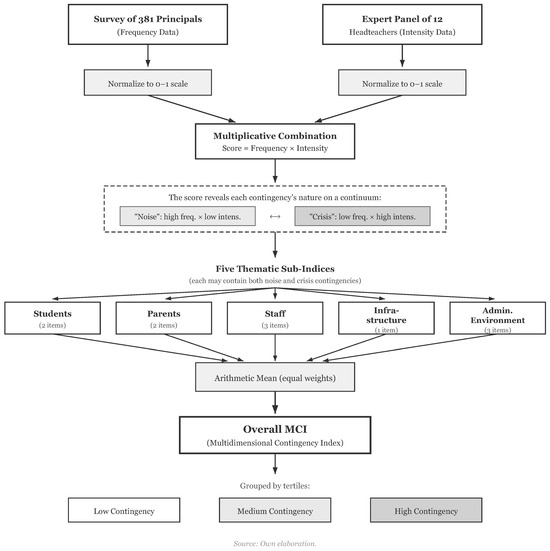
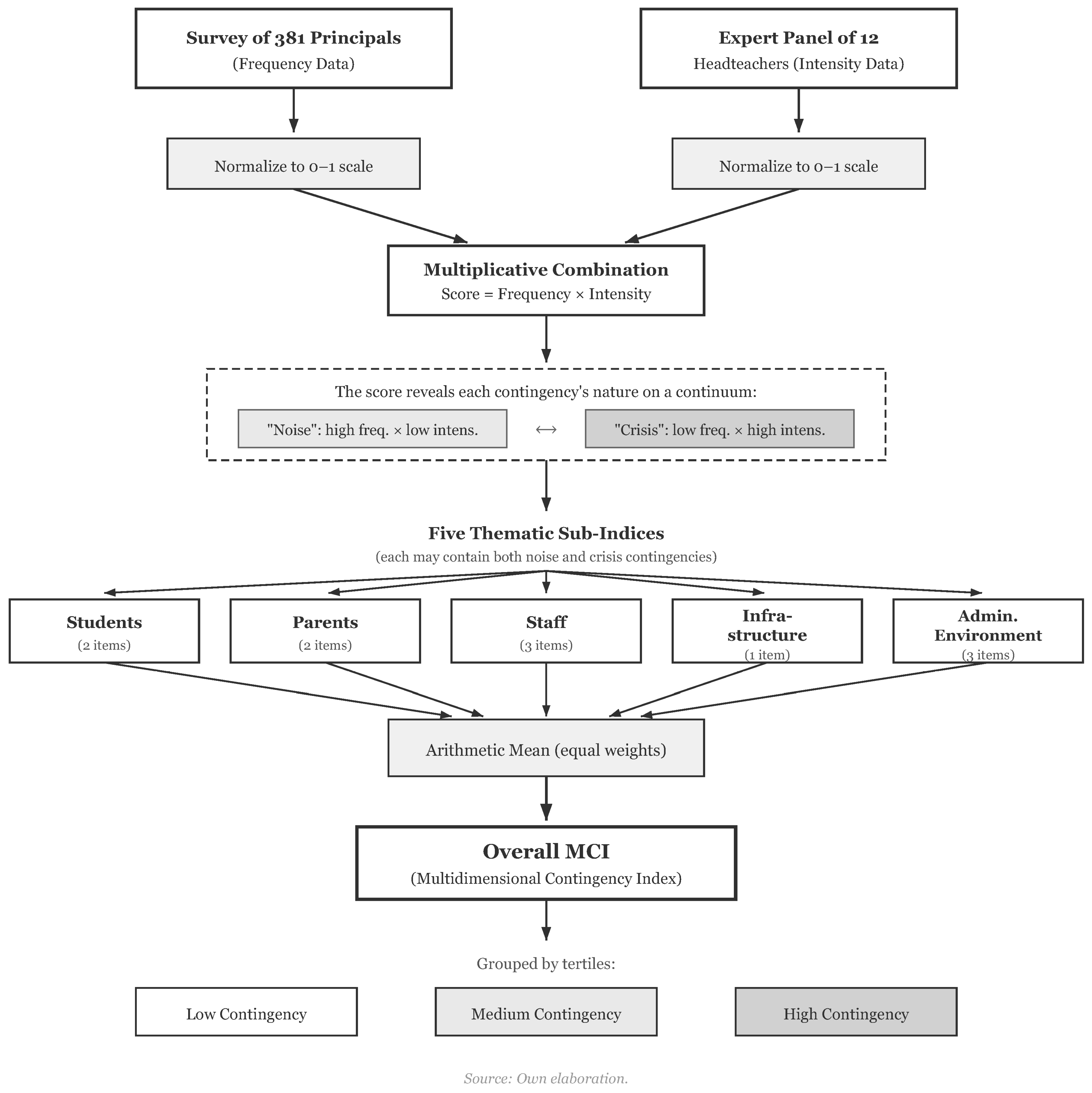
The construction of the MCI involves several sequential steps, illustrated in Figure 1. First, the two input dimensions are obtained from independent sources: frequency data from the nationally representative survey of principals, and intensity ratings from an expert panel of serving headteachers. Both dimensions are normalized to a 0–1 scale to enable comparison. Second, a multiplicative combination produces a contingency score for each item, capturing the intuition that burden depends simultaneously on how often and how severely a contingency disrupts school operations. This multiplicative logic means that each contingency score implicitly reveals its position on a continuum between what we term “noise contingencies”—events that are frequent but low in intensity—and “crisis contingencies”—less frequent situations that carry high intensity and demand significant cognitive and emotional resources from principals. Third, contingency scores are grouped into five thematic sub-indices corresponding to key areas of school functioning, each of which may contain both noise and crisis elements. Finally, the overall MCI is computed as the arithmetic mean of the five sub-indices. The following subsections detail each of these steps.
Figure 1.
Architecture of Multidimensional Contingency Index (MCI).
4.3.1. Frequency Dimension
The first dimension corresponds to information from the questionnaire administered nationwide. This instrument asked how many times, during the period evaluated, principals had to deal with situations such as meeting with parents, intervening in student conflicts, or resolving infrastructure problems. This information makes it possible to measure the “actual volume” of interruptions experienced by a principal.
The original response options correspond to an ordinal scale of eight categories, where the values represent different levels of recurrence of each contingency. However, these categories were not equidistant in terms of time. In order to work quantitatively with this information, a normalization process was carried out, interpreting the ordinal scale as an approximate time gradient, equivalent to a scale of 0 to 20 occurrences in a reference period (month). The frequency variable was normalized by dividing its equivalent value by 20, which allowed it to be brought to a range of 0–1. Thus, for example, “daily” equals 1.0; “2 to 3 times a week” equals 0.5; “once a week” equals 0.2; and “never” equals 0.0.
4.3.2. Intensity Dimension
The second dimension comes from a different process: the assessment of the intensity of each contingency, based on the judgment of serving headteachers. During November 2025, a validation panel composed of 12 school headteachers—including both public and private sector managers with varying levels of management experience—assessed the severity of each type of contingency according to the degree to which it disrupts the pedagogical and administrative routine, using a four-level scale (1 = not serious; 2 = somewhat serious; 3 = quite serious; 4 = very serious).
The averages obtained show substantial differences between types of contingencies. For example, intervening in cases of school violence (2.9) and dealing with complex family situations (2.9) were assessed as significantly more serious than receiving external visits from the school owner (1.4). Intensive attention from parents (2.4) also represented a significant threat to school normality. The intensity scale was normalized to the range 0–1 by dividing by the maximum value. It is important to note that intensity does not have zero value: even a “not serious” contingency implies some level of disruption, so the minimum normalized value is 0.25.
4.3.3. Multiplicative Combination
Once the frequency and intensity dimensions have been normalized, the specific contingency score for each variable is obtained by means of a multiplicative combination:
Contingencyi = Frequencyi × Intensityi
This approach is not merely operational, but responds to a conceptual logic: the burden that a contingency imposes on management depends simultaneously on how often it occurs and how profoundly it alters institutional normality when it does occur. If either of these two dimensions is low, the contingency of the event decreases proportionally. If both are high, the contingency has a greater impact on management.
4.3.4. Sub-Indices and Construction of the General Index
Before calculating the overall value of the MCI, we estimated how contingency is distributed within the different areas of school functioning. To this end, five thematic sub-indices were constructed, each corresponding to a specific area in which disruptions relevant to management may arise: students, parents, staff, infrastructure, and external administrative environment. These sub-indices constitute a preliminary and fundamental stage of the MCI, as they allow the relative weight of each dimension to be disaggregated before synthesizing the whole into a single global indicator.
Once the sub-indices corresponding to each of the five areas had been estimated, the Multidimensional Contingency Index was developed. This index synthesizes, in a single continuous value, the total level of disruption, pressure and institutional abnormality experienced by each establishment. To this end, each thematic sub-index was treated as an equivalent component, assigning each area the same relative weight in the final configuration. The MCI was defined as the simple arithmetic mean of the five sub-indices.
This equal weighting reflects a deliberate decision grounded in two considerations: (a) the absence of a prior theoretical or empirical basis that would justify privileging one area of contingency over another in terms of its overall impact on school leadership, and (b) the precedent established by composite indices in educational research where, in the absence of domain-specific weights, equal weighting provides a transparent and replicable baseline (e.g., OECD well-being indices). To assess the robustness of this decision, a sensitivity analysis was conducted testing an alternative weighting scheme that double-weighted the intensity dimension relative to frequency. The results show that the overall patterns and rankings of contingency sub-indices remain substantively unchanged under this alternative specification: the same areas (Parents, Students) rank highest, and the same structural factors (school type, SES) emerge as significant predictors. The primary effect of alternative weighting is to amplify the gaps between school types, further accentuating the differences between public and private schools. These results provide confidence that the findings reported here are not artifacts of the weighting scheme chosen.
4.3.5. Contingency Levels
To facilitate interpretation, the MCI was grouped into three contingency levels, defined by tertiles:
- Low contingency: establishments with infrequent and/or low-intensity contingencies, whose interruptions are manageable and do not significantly alter institutional management or functioning.
- Medium contingency: establishments exposed to medium contingency pressure, either due to the frequency of moderate-intensity events or the occasional occurrence of more intense contingencies, which require recurring managerial attention.
- High contingency: establishments where the frequency and/or intensity of contingencies is high, placing structural pressure on the management and operation of the establishment.
This typology allows us to investigate significant differences between the institutional characteristics of educational establishments and the individual characteristics of managers (demographics, experience, and professional training).
4.4. Data Analysis
A descriptive analysis was conducted to characterize the different contingencies perceived by headteachers, including their distribution by type of administrative unit. In addition, bivariate correlations and chi-square tests were performed to analyze the relationship between contingency levels and the school management system. Finally, a multiple regression analysis was conducted to assess which characteristics of schools and their principals influence the level of contingency.
The school-level variables included in the analysis were school size (small, medium, large); performance category according to the classification of the Education Quality Agency (insufficient/medium–low, medium, high); management system (public, subsidized private, fee-paying private); and average socioeconomic level of students (low, medium–low, medium, medium–high, high). The variables at the headteacher level were gender, years of experience in the position (less than 10 years, 11–25 years, more than 26 years), and specialized training (basic, intermediate, advanced).
5. Results
The results are presented in five sections: (i) the frequency of contingencies faced by principals; (ii) factors that determine the level of contingency; (iii) the distribution of the MCI according to the type of administrative dependency; (iv) comparative analysis of the sub-indices by area; and, finally, (v) the relationship between contingency and managerial well-being.
5.1. Frequency of Contingencies
Table 2 shows the frequency with which headteachers face each of the 11 contingencies included in the study. The data reveal that, in general terms, headteachers must manage a high level of contingencies in each of the areas or dimensions studied, as most unforeseen tasks occur at least once a week and several of them have significant daily frequency.
Table 2.
Contingencies faced by headteachers (% according to frequency).
The most frequent contingencies are concentrated in the areas of family support, resolving problems between students, and assisting school staff. In particular, the tasks that headteachers report facing most frequently are “unplanned attention to parents” (67.6% at least once a week), “intervening in student discipline issues or cases of school violence” (47.5% at least once a week), and “attending to school staff regarding everyday issues” (43.5% at least once a week). The most common contingencies, then, are those that involve assisting and interacting directly with members of the school community: families, students, and teachers.
Although less frequent than the previous contingencies, headteachers also devote significant time to unplanned activities related to responding to external demands and providing basic conditions for school functioning. Some 32.6% of headteachers report that at least once a week they must “respond to unexpected requests for information from the school owner or other external agents,” and 31.7% indicate that they must “resolve unexpected issues related to the school’s infrastructure and equipment” with the same frequency.
5.2. Determinants of Level of Contingency
A second objective of this study was to analyze the factors that determine or explain the levels of contingency faced by headteachers. This was achieved using different linear regression models, the results of which are summarized in Table 3. The procedure combined variables at the school level and at the headteacher level, as both could be expected to affect the frequency of contingencies faced by school leaders.
Table 3.
Relationship between school and headteacher characteristics and contingency level.
The results show that individual characteristics (gender, experience, and training received) do not contribute to explaining the level of contingency faced, as they do not seem to have a significant impact. Model 2, which includes only headteacher variables, has very limited explanatory power, accounting for 3.6% of the variance, a proportion that falls to 2.3% when considering the adjusted R2. Firstly, it could be argued that the level of contingency depends mainly on contextual factors linked to the type of school, while individual characteristics would be irrelevant in the face of these structural factors. An alternative hypothesis is that, even though leaders can exert a significant influence on the ‘management’ of this contingency—for example, mitigating its occurrence through ad hoc organization of the leadership team—previous training and experience do not contribute to this type of practice due to the low effectiveness of training trajectories on leaders’ ability to manage contingency, which is consistent with the literature arguing that school leadership training lacks practicality and applicability (Weinstein et al., 2018; Young, 2015).
Another finding of the analysis shows that, among the contextual variables at the school level, the administration system (type of dependency) and the socioeconomic status of the students are the most relevant factors behind the level of contingency faced by leaders. Thus, headteachers face a significantly higher level of contingency when the school is public (Coef. 0.041, p < 0.001) and a significantly lower level when it serves students from high SES (Coef. −0.037, p < 0.01). The fact that municipal dependence significantly increases contingency, even when controlling for other variables, reinforces the hypothesis that public management in Chile carries a burden of institutional complexity that goes beyond the social vulnerability of its students.
One hypothesis to explain this additional complexity is that it could manifest itself in multiple dimensions: greater demands for accountability and administrative procedures before local educational authorities; more formalized and unionized labor relations that generate more frequent negotiations and conflicts; greater exposure to local political pressures and changes in municipal administration; links with families that demand greater participation in school decisions; and budgetary and decision-making autonomy restrictions that limit the ability to respond to emerging situations. Additionally, public schools in Chile serve a significantly more diverse student population, including higher proportions of students with special educational needs and students of migrant origin, a dimension of complexity not fully captured by aggregate socioeconomic indicators.
These dimensions of complexity would operate independently of the socioeconomic level of the students and would be rooted in the institutional characteristics of the Chilean public education sector. The MCI shows that training and support for school leaders, however advanced, has a very limited effect unequal structural conditions.
5.3. Distribution of Multidimensional Contingency Index by Type of School
Given the impact of the administrative system on the level of contingency, it is pertinent to examine this specific variable in greater detail. Table 4 presents the distribution of the MCI by type of administrative unit.
Table 4.
Multidimensional Contingency Index by type of school.
The results show highly significant differences between contingency distributions according to school dependency. Fifty-two point nine per cent of municipal schools fall into the “High Contingency” category, a reality that is practically non-existent in the private fee-paying sector (1.5%). In contrast, 62.3% of private fee-paying schools have low contingency. Subsidized private establishments show an intermediate pattern, with more balanced distributions among the three levels.
The chi-square test confirms that these differences are systematic and statistically robust (χ2 = 65.5, p < 0.001), indicating that contingency is structurally unequal according to the type of dependency. As an explanatory hypothesis, this could be due to the greater socio-educational disadvantage that characterizes public education in Chile, as well as the institutional fragility of the municipal system, whose responsible body at the time of the study (the municipalities) did not have the institutional infrastructure or professional capacity to support schools in the management of their various tasks, including school contingency. The evidence available in Chile shows that municipal bodies could even increase the complexity of this work by imposing excessive administrative demands and maintaining an ill-defined relationship with school management (Marcel & Raczynski, 2009).
5.4. Specific Contingencies by Type of Dependency
Although public education has significantly higher levels of contingencies than subsidized and fee-paying private education, the relative ranking of specific contingencies is similar across all types of schools. This means that Chilean headteachers face a common pattern of priority unforeseen situations—the same contingencies tend to rank highest in frequency and intensity—although their magnitude varies substantially depending on the type of school. Table 5 presents the details of each contingency by school.
Table 5.
Headteacher contingencies by school type (% at least once a week).
There are some contingencies where public education differs more markedly from the other two types of schools. This is the case for “resolving problems related to teacher replacement” (52.1% in municipal schools vs. 26.9% in private paid schools), “responding to unexpected requests for information from external agents” (53.5% vs. 14.6%), “resolving unexpected infrastructure issues” (48.4% vs. 16.4%), and “dealing with problematic family situations” (43.8% vs. 2.4%). In contrast, the smallest differences between types of institutions are observed in contingencies such as “receiving visits from the school owner or other external agents” or “attending to school staff,” all of which are linked to the day-to-day management of schools and less influenced by the specific context.
5.5. Analysis of Sub-Indices by Area: Distinguishing Between Noise and Crisis Contingencies
One of the most relevant contributions of the Multidimensional Contingency Index (MCI) is that it allows us to disaggregate which type of contingency weighs more heavily on management, overcoming a significant limitation of approaches based exclusively on frequency. By integrating the dimension of intensity, the MCI allows us to conceptually distinguish between what we might call “noise contingencies” those that are frequent but have a low impact on institutional normality—and “crisis contingencies”—less frequent, but with a higher impact and greater complexity.
When comparing the MCI sub-indices at the national level, a very marked difference between types of contingencies can be observed. “Parents” present the greatest burden on the system: between 26% and 320% more than any other sub-index, revealing the centrality of the family–school link as the main source of institutional disruption. This finding qualifies the traditional view that bureaucracy is the main enemy of pedagogical leadership. Although the “administrative noise” of the external environment may be constant, “unplanned attention from parents” and “problematic family situations” represent the real sources of critical disruption for headteachers, at least in Chile.
Specifically, the parent sub-index encompasses two types of contingencies that, when combined with their high intensity ratings, produce the heaviest burden. The first—”unplanned attention to parents”—refers to guardians arriving at the school without prior appointment demanding immediate meetings with the principal, often regarding disciplinary measures, academic concerns, or conflicts with teachers. This is the single most frequent contingency in the study, reported by 67.6% of principals as occurring at least weekly. The second—”addressing problematic family situations”—involves situations such as domestic violence affecting students, substance abuse in the family environment, or parental neglect requiring the school’s intervention with social services. While less frequent, this contingency receives one of the highest intensity scores from the expert panel (2.9 out of 4), reflecting the significant cognitive and emotional resources it demands from principals who must often act simultaneously as mediators, counselors, and institutional representatives. In the Chilean context, the regulatory framework assigns schools—and particularly principals—significant responsibilities in managing family–school relationships, including mandatory attention to parental complaints and coordination with child protection services. The proposed index shows that schools act, de facto, as a first line of social containment, a function that consumes considerable cognitive and emotional resources from administrators.
Contingencies associated with students constitute the second major focus, exceeding Personnel and Infrastructure by between 35% and 53% and more than doubling the contingency of the Environment. “Personnel” and “Infrastructure” are at an intermediate level, while the “Administrative Environment” is clearly marginal in terms of total workload: these are constant interruptions, but of low intensity—that is, contingencies of noise rather than crisis. Taken together, these results show that school abnormality is driven mainly by relational and socio-emotional conflicts, rather than by routine internal processes linked to the administrative environment.
It is when comparing the specific sub-indices by type of dependency that the added value of the multidimensional index becomes most evident. If we compare frequency alone, we could erroneously conclude that all principals suffer from similar infrastructure or administrative problems. When intensity is incorporated, the gaps widen significantly. Table 6 presents the percentage gaps between school types for each sub-index.
Table 6.
Gaps in contingency sub-indices between types of institutions.
The data reveal that, in all sub-indices, municipal establishments have contingency levels more than double—and even more than quadruple—those of private paid establishments. The greatest differences are observed in Infrastructure (+306.7%) and Administrative Environment (+278.6%), followed by Parents/Guardians (+256.9%). Even in relational areas such as Students and Staff, contingencies in municipal schools exceed those in paid establishments by more than 124% and 175%, respectively.
Subsidized private schools also show significant gaps compared to fee-paying private schools, especially in Administrative Environment (+107.1%) and Infrastructure (+96.7%), confirming a structural and persistent gradient in contingency according to school dependency. These differences are not only substantial but also statistically significant in all sub-indices (p < 0.001), showing that contingency does not vary randomly but is markedly differentiated by school type within the Chilean education system.
The magnitude of these figures (more than 300% difference in some areas) suggests that while a headteacher at a private fee-paying school manages minor disruptions—‘noise’ contingencies—their counterpart in the public sector is managing more serious crises and demands—crisis contingencies. Principals of subsidized private schools find themselves in an intermediate position, facing higher levels of contingency than fee-paying schools but significantly lower than those of public schools, reflecting the heterogeneity of the Chilean private sector and the need not to treat it as a homogeneous block. This could validate the hypothesis that we are facing “wicked problems” that are unevenly distributed throughout the school system: the fundamentally technical and manageable contingency in private fee-paying schools contrasts with the fundamentally social contingency in the public sector, which lacks clear solutions and generates a much greater cognitive and emotional burden for school leaders (Alford & Head, 2017). Subsidized private schools, which serve more vulnerable populations than fee-paying schools but have greater autonomy than public schools, show that both the characteristics of the student population and institutional structures contribute to shaping the level and type of contingencies faced by headteachers.
5.6. Relationship Between Contingency and Managerial Well-Being
Finally, the MCI allows us to establish a relationship with managerial well-being. Table 7 presents indicators of subjective well-being among headteachers according to the level of contingency in their schools.
Table 7.
Relationship between principals’ subjective well-being and level of contingency.
The results indicate a strong relationship between the level of contingency and the subjective well-being of headteachers. In high-contingency establishments, the proportion of headteachers reporting “very little time to prepare” (53.5%) is almost three times higher than in low-contingency establishments (18.6%). Similarly, very high stress affects 45.6% of headteachers in high-contingency contexts, compared to only 14.7% in low-contingency contexts—a difference of more than 30 percentage points.
This pattern suggests that contingencies are not just episodes that disrupt day-to-day management, but structural factors that reconfigure working conditions and significantly reduce the space for pedagogical leadership and strategic decision-making. The MCI, therefore, is not only a metric of institutional management but can also be a useful indicator of occupational health risk (burnout). The intensity of contingency affects the strategic capacity of headteachers and schools, confirming that, without addressing this issue, pedagogical leadership policies have a very low implementation ceiling.
These findings on the well-being of school leaders are particularly relevant when considering previous results on administrative dependence. Given that public school principals face contingency levels more than 300% higher than their peers in private fee-paying schools, the differential burden on managerial well-being is also unevenly distributed across the Chilean school system (Muñoz et al., 2023). In other words, the problem of burnout and lack of time for preparation does not affect all headteachers equally. On the contrary, it is disproportionately concentrated among those who lead public schools serving the most vulnerable populations.
6. Discussion
This study has addressed the phenomenon of school leadership complexity by developing and applying a Multidimensional Contingency Index (MCI) that integrates both the frequency and intensity of unforeseen situations faced by school principals. The results provide empirical evidence that advances our understanding of contingency as a structural feature of the leadership role, particularly in highly segregated education systems.
6.1. Main Findings
Three main findings warrant discussion in light of the conceptual framework presented. The first important contribution of this study is to demonstrate that contingency is not a one-dimensional phenomenon that can be adequately captured by frequency alone. By incorporating intensity into the measurement, the CMI reveals patterns that remain hidden in frequency-only approaches. This finding aligns with Yurkofsky’s (2022) framework on uncertainty in educational organizations, which distinguishes between forms of environmental, technical, and representational uncertainty. Our distinction between “noise contingencies” and “crisis contingencies” operationalizes this conceptual perspective: while noise contingencies (frequent, low-intensity events) may correspond to routine technical uncertainty, crisis contingencies (less frequent but high intensity) reflect the environmental and representational uncertainties that Yurkofsky (2022) identifies as particularly relevant to school improvement.
The data reveal that the family–school relationship (parents) represents the heaviest burden on school principals, surpassing other areas in terms of intensity. This finding challenges the traditional view that bureaucracy is the main enemy of pedagogical leadership. Although the “administrative noise” of the external environment may be constant, unplanned attention to parents and problematic family situations represents the greatest sources of critical disruption for headteachers. The MCI makes it clear that schools act, de facto, as a first line of social containment, a function that consumes considerable cognitive and emotional resources from headteachers.
A second key finding is that the individual characteristics of headteachers—gender, experience, and training—do not significantly explain the level of contingency they face. Regression models show that school-level variables, particularly administrative dependence and socioeconomic status, are the determining predictors. This result has important theoretical implications: it suggests that contingency is fundamentally a contextual phenomenon that exceeds individual agency, regardless of how prepared or experienced a leader may be.
Two complementary hypotheses may explain this finding. First, the level of contingency may depend primarily on structural factors linked to school type, rendering individual traits largely irrelevant in the face of overwhelming contextual forces. Second, even when leaders could exert significant influence on the ‘management’ of contingency—for example, by mitigating its occurrence through ad hoc organization of the leadership team—prior training and experience may not contribute to this type of practice. This interpretation is consistent with the literature arguing that leadership preparation programs often lack the practicality and applicability necessary for the challenges of the real school world (Weinstein et al., 2018; Young, 2015). The finding that advanced training does not reduce contingency levels is particularly striking and requires a fundamental rethinking of how school leaders are prepared.
The third main finding concerns the marked disparities in contingency between types of schools. Municipal schools have contingency levels more than four times higher than those of private fee-paying schools in critical areas such as infrastructure (+306.7%), administrative environment (+278.6%), and relations with parents (+256.9%). These differences are not merely quantitative; they suggest qualitatively different leadership experiences. Based on Alford and Head’s (2017) typology of wicked problems, we can hypothesize that while private school principals predominantly manage “tame” or technical problems—contingencies with known solutions and manageable complexity—their public sector counterparts face genuinely wicked problems: situations that lack clear solutions, involve multiple actors with conflicting interests, and generate significant cognitive and emotional burden.
This interpretation helps explain why the gap between school types widens when intensity is incorporated into the measurement. If we compare frequency alone, we might mistakenly conclude that all headteachers suffer from similar infrastructure or administrative problems. By incorporating intensity, the MCI reveals that what appears similar on the surface reflects fundamentally different experiences: while one headteacher manages a minor equipment failure (technical problem), another faces a crisis of habitability in a deteriorating building (wicked problem). The magnitude of these gaps (greater than 300% in some areas) validates the hypothesis that wicked problems are unevenly distributed in the Chilean school system, which has relevant implications for equity in educational leadership.
The strong association between high contingency and reduced well-being indicators—with headteachers in high-contingency environments three times more likely to report having “very little time to prepare” and more than three times more likely to report “very high stress”—suggests that the MCI can serve not only as a management metric but also as an occupational health risk indicator. This finding connects with the broader literature on burnout and principal attrition (Mahfouz, 2020; Oplatka, 2021), adding a structural dimension to what is often framed as a problem of individual resilience. The data suggests that contingencies are not merely episodes that disrupt day-to-day management, but structural factors that shape working conditions and significantly reduce the space for pedagogical leadership and strategic decision-making.
6.2. Implications for Policy and Practice
The incorporation of ‘contingency management’ as an integral part of leadership work has significant implications for research, policy, and leadership development.
Renew studies on time use and the challenges faced by headteachers. Research on principals’ time use must go beyond the “administrative versus pedagogical tasks” dichotomy. It is necessary to incorporate “contingency management” as an analytical category in itself, distinguishing between reactive and proactive time, and analyzing how the frequency and intensity of contingencies impact the distribution of other tasks. The MCI demonstrates that contingency can be a key indicator of the social and cultural context—perhaps one of the most relevant variables for showing impact on the work of the headteacher. It also contributes to studies that analyzed the challenges faced by school principals, as shown in the syntheses conducted by Tamadoni et al. (2024) and Tintoré et al. (2022).
Enriching leadership standards. Action frameworks and performance standards should reflect complexity management as a core competency. It is not enough to define desirable practices in an ideal scenario; it is essential to include the ability to diagnose complex problems, manage crises, anticipate risks, and foster organizational learning from the unpredictable. The finding that experience and training do not reduce contingency levels suggests that current standards may be disconnected from the actual demands of the role. Following Shaked’s (2025) work on protecting instructional time, standards should explicitly address how leaders can shield pedagogical processes from the turbulence of contingency.
Update management training. Initial and continuing training programs should explicitly develop the personal competencies and resources needed to manage contingency. This includes not only technical skills (such as designing protocols for crisis situations) but also adaptive capacities such as resilience, emotional intelligence, stress management, and the ability to lead in uncertainty. As Brinck and Tanggaard (2016) argue, effective leadership involves ‘embracing the unpredictable’—understanding this as the ability to recognize that uncertainty is inherent in organizational work, and to develop dispositions and practices that allow for continuous learning and adaptation rather than resistance or paralysis in the face of the unexpected. This represents a disposition that must be intentionally cultivated through training, rather than assumed to be a natural or given ability. Evidence that training does not currently impact contingency levels indicates the need for fundamental curricular reform in leadership preparation and development.
Redefining support at intermediate levels. The role of supporters (municipalities, local education services, private networks, etc.) must be rethought to enhance the capacity of managers to deal with contingencies. This involves acting as a “filter” that reduces bureaucracy and unnecessary contingencies imposed by the central system. Simultaneously, it implies providing resources and specialized support (e.g., mental health teams, crisis management advisors) for schools during high-intensity contingencies situations. The wide gaps between public and private schools suggest that institutional support structures are a critical factor in determining whether a contingency becomes manageable or overwhelming.
The findings of this study are particularly relevant in the context of the current process of institutional transformation of the Chilean public education. Since 2018, Chile has been implementing a process of institutional change in which municipalities are no longer responsible for public schools. Local Public Education Services (SLEPs) have been designed to provide greater technical and pedagogical support and reduce the administrative burden on headteachers (Anderson et al., 2021). The results of this study suggest that this institutional reform should pay particular attention to how the new SLEPs can help headteachers manage not only plannable tasks but also—and crucially—the contingencies that fragment their work. This includes developing rapid crisis support systems, establishing clear protocols for emergencies, and—crucially—avoiding replicating the municipal system’s patterns of imposing administrative demands that exacerbate rather than alleviate the contingency burden.
Addressing contingency as an equity issue. Perhaps the most important implication is to recognize that contingency is not equally distributed. The finding that public school principals face levels of contingency that exceed 300% of those of their private school counterparts in critical areas suggests that addressing contingency is fundamentally an equity issue. Without reducing the ‘baseline abnormality’ faced by public school leaders, policies that promote instructional leadership have a very low ceiling for implementation. Equity-oriented policies must consider not only the distribution of resources but also the invisible burden of contingency that systematically disadvantages schools serving vulnerable populations.
6.3. Limitations and Future Research
This study has several limitations that should be acknowledged. First, the intensity dimension of the MCI was constructed through expert panel validation rather than direct self-reporting by principals. While this approach was a deliberate methodological choice designed to avoid common-method bias—by separating the sources of frequency data (principals’ survey) and intensity assessments (independent expert panel)—it may not fully capture the subjective experience of the contingency burden as perceived by individual principals. Future research could incorporate intensity measures reported by principals themselves, enabling triangulation between expert-assigned and self-assessed intensity weights and further strengthening construct validity.
Second, the cross-sectional design limits causal inference; longitudinal studies could examine how contingency levels change over time, how they relate to headteacher turnover and school improvement trajectories, and whether sustained exposure to high contingency produces cumulative effects on leadership capacity and well-being.
Third, the MCI was developed and applied specifically in the context of primary schools, which is a significant limitation given that school organization presents different challenges at different educational levels. For example, in secondary education (high schools), contingencies originating from the students themselves—such as more complex disciplinary conflicts, drug use, teenage pregnancy, or school disengagement—may be more relevant and complex than in primary education, while other types of contingencies related to families may decrease. Future research should develop and validate the MCI for secondary education, exploring how both the type and intensity of contingencies vary according to school level. Fourth, although the study provides robust evidence at the national level for Chile, generalizing the findings to other contexts requires further research, particularly in education systems with different governance structures and levels of autonomy for school leaders.
Future research should explore several promising directions. First, qualitative studies could shed light on how principals actually experience and manage different types of contingencies, providing rich descriptions that complement our quantitative findings. Second, intervention studies could test whether training focused on contingency management can improve principals’ well-being and school outcomes, addressing the finding that current preparation does not impact contingency levels. Third, cross-country comparative studies could examine whether the patterns observed in Chile—particularly the dramatic disparities between public and private sectors—are replicated in other segregated education systems. Fourth, comparative research between different educational and cultural realities could examine the very nature of the contingencies faced by school principals, allowing us to distinguish between universal contingencies—those that seem inherent to the managerial role regardless of context—and idiosyncratic contingencies—those specific to education systems, regulatory frameworks, or cultural configurations. This analysis could reveal, for example, whether family-related contingencies have similar characteristics in diverse cultural contexts, or whether administrative contingencies vary substantially according to governance structures and education systems. Understanding this dimension is essential to determining which aspects of leadership development and support may be transferable across contexts and which require local adaptation.
7. Conclusions
This study has demonstrated the value of a multidimensional approach to measuring contingency in school leadership. It has highlighted the centrality of family relationships as a source of crisis contingency, the irrelevance of individual characteristics in explaining levels of contingency, and the marked disparities between types of schools that suggest that wicked problems are unevenly distributed across the education system.
The evidence presented here suggests that contingency is not a residual aspect of school leadership that can be minimized through better planning or individual preparation. Rather, it is a structural feature of the leadership role that varies systematically with context and has profound implications for what leaders can achieve. Understanding and analyzing school leadership from the perspective of contingency complexity ensures a realistic view of the possibilities and limitations of leadership in action.
The MCI offers a framework with significant potential for future research and practice. First, it provides a basis for renewing time use studies by moving beyond the traditional “administrative versus pedagogical tasks” dichotomy. By distinguishing between reactive and proactive time, and by capturing how the frequency and intensity of contingencies shape the distribution of leadership work, the MCI enables researchers to analyze how the social and cultural context of schools influences leadership practice beyond what traditional measures of school composition reveal.
Second, the MCI opens avenues for connecting contingency research with school improvement and school culture studies. Principals can play a role in preventing or mitigating contingencies by building and mobilizing individual and collective capabilities among school staff and community members—a process that involves shifting school culture toward more collaborative and educationally focused practices (Hargreaves & Fullan, 2012; Stoll et al., 2006). The relationship between contingency prevention and leadership capacity-building suggests that the MCI could serve not only as a diagnostic tool but also as a measure of progress in school improvement efforts that aim to reduce the baseline level of institutional disruption. Schools where principals succeed in fostering collaborative cultures and distributed leadership may progressively reduce the frequency and intensity of contingencies by developing organizational routines that absorb and process disruptions before they reach the principal’s desk.
Third, the MCI framework can be adapted for cross-national comparative research, examining whether the patterns observed in Chile—particularly the dramatic disparities between public and private sectors—are replicated in other segregated education systems. Such comparative work could help distinguish between universal contingencies that seem inherent to the managerial role regardless of context and context-specific contingencies shaped by governance structures, regulatory frameworks, or cultural configurations. This distinction is essential for determining which aspects of leadership development and support may be transferable across contexts and which require local adaptation.
Fourth, the identification of specific contingency patterns through the MCI has practical implications for the design of principal preparation programs. Rather than training leaders for idealized scenarios, preparation programs could use the MCI to identify the actual challenges that principals face in specific contexts and develop targeted modules that address contingency management, emotional regulation under pressure, and the capacity to build organizational systems that filter and distribute the contingency burden across the leadership team.
For education systems seeking to strengthen school leadership, the message is clear: without addressing the structural conditions that generate differential contingency loads, policies that promote instructional leadership will have limited impact precisely where they are most needed—in schools serving vulnerable populations. The MCI offers a tool to make this contingency visible, providing a conceptual and methodological basis for more equitable and realistic approaches to supporting school leaders in their daily work.
Author Contributions
Conceptualization, G.M.S., J.W. and L.S.; methodology, G.M.S., J.W. and M.S.; validation, G.M.S., J.W. and M.S.; formal analysis, G.M.S., J.W., M.S. and L.S.; investigation, G.M.S., J.W., M.S. and L.S.; resources, G.M.S., J.W., M.S. and L.S.; data curation, M.S. and G.M.S.; writing—original draft preparation, G.M.S., J.W., M.S. and L.S.; writing—review and editing, G.M.S., J.W. and L.S.; supervision, G.M.S.; project administration, G.M.S. and J.W. All authors have read and agreed to the published version of the manuscript.
Funding
This research received no external funding.
Institutional Review Board Statement
The research was designed and executed in strict accordance with the Declaration of Helsinki. Although the study did not require a specific biomedical registration code—given its nature as a social science survey with minimal risk involving non-vulnerable adult professionals—it followed all institutional ethical protocols. In compliance with Chilean Law (No. 19.628 on Privacy Protection), the protocol guaranteed strict anonymity. Data were collected by a specialized agency (Datavoz) and handled through an identification coding system to ensure that no individual or school could be identified.
Informed Consent Statement
Informed consent was obtained from all subjects involved in the study.
Data Availability Statement
The original data presented in this study are available on request from the authors. The data are not publicly available due to privacy restrictions, as the dataset contains information that could potentially identify participating schools and principals.
Conflicts of Interest
The authors declare no conflicts of interest.
References
- Alford, J., & Head, B. W. (2017). Wicked and less wicked problems: A typology and a contingency framework. Policy and Society, 36(3), 397–413. [Google Scholar] [CrossRef] [Scilit]
- Anderson, S., Stein, L., & Valenzuela, J. P. (2021). Reforming the Chilean school system: A century of change, conflict, and the search for quality and equity. In C. Ornelas (Ed.), Politics of education in Latin America (pp. 117–146). Brill. [Google Scholar]
- Aravena, F., & González, A. (2021). Principal’s well-being: A review of the literature. School Leadership & Management, 41(4–5), 458–475. [Google Scholar]
- Bellei, C., & Muñoz, G. (2023). Models of regulation, education policies, and changes in the education system: A long-term analysis of the Chilean case. Journal of Educational Change, 24(1), 49–76. [Google Scholar] [CrossRef] [Scilit]
- Bellei, C., Vanni, X., Valenzuela, J. P., & Contreras, D. (2020). School improvement trajectories: An empirical typology. School Effectiveness and School Improvement, 31(3), 443–468. [Google Scholar] [CrossRef] [Scilit]
- Brinck, L., & Tanggaard, L. (2016). Embracing the unpredictable: Leadership, learning, changing practice. Human Resource Development International, 19(5), 374–387. [Google Scholar] [CrossRef] [Scilit]
- Burke, W. W., Dumbleton, S., & Lake, D. G. (2022). Organisation change: Theory and practice (6th ed.). Sage. [Google Scholar]
- Davies, B. (2002). Rethinking schools and school leadership for the twenty-first century: Changes and challenges. International Journal of Educational Management, 16(4), 186–192. [Google Scholar] [CrossRef] [Scilit]
- De Jong, D., Grundmeyer, T., & Yankey, J. (2017). Identifying and addressing themes of job dissatisfaction for secondary principals. School Leadership & Management, 37(4), 354–371. [Google Scholar] [CrossRef] [Scilit]
- Flessa, J. (2014). Learning from school leadership in Chile. Canadian and International Education, 43(1), 2. [Google Scholar] [CrossRef] [Scilit]
- Grissom, J. A., Egalite, A. J., & Lindsay, C. A. (2021). How headteachers affect students and schools: A systematic synthesis of two decades of research. Wallace Foundation. [Google Scholar]
- Grissom, J. A., Loeb, S., & Master, B. (2015). Effective instructional time use for school leaders: Longitudinal evidence from observations of headteachers. Educational Researcher, 42(8), 433–444. [Google Scholar] [CrossRef] [Scilit]
- Hargreaves, A., & Fullan, M. (2012). Professional capital: Transforming teaching in every school. Teachers College Press. [Google Scholar]
- Horng, E. L., Klasik, D., & Loeb, S. (2010). Principal’s time use and school effectiveness. American Journal of Education, 116(4), 491–523. [Google Scholar] [CrossRef] [Scilit]
- Kraft, M. A., & Novicoff, S. (2024). Time in school: A conceptual framework, synthesis of the causal research, and empirical exploration. American Educational Research Journal, 61(4), 724–766. [Google Scholar] [CrossRef] [Scilit]
- Leithwood, K., Harris, A., & Hopkins, D. (2020). Seven strong claims about successful school leadership revisited. School Leadership & Management, 40(1), 5–22. [Google Scholar]
- Mahfouz, J. (2020). Headteachers and stress: Few coping strategies for abundant stressors. Educational Management Administration & Leadership, 48(3), 484–505. [Google Scholar]
- Marcel, M., & Raczynski, D. (2009). The unfinished business: Keys to the revalidation of locally managed public education in Chile. Uqbar. [Google Scholar]
- Marfán, J., Muñoz, G., Weinstein, J., & Sembler, M. (2023). School leadership policy and change in principals practices. Evidence after a decade of reforms in Chile (2009–2019). Leadership and Policy in Schools, 22(4), 857–872. [Google Scholar] [CrossRef] [Scilit]
- Meyers, C. V., & Hambrick Hitt, D. (2017). School turnaround principals: What does initial research literature suggest they are doing to be successful? Journal of Education for Students Placed at Risk, 22(1), 38–56. [Google Scholar] [CrossRef] [Scilit]
- Midha, G. (2025). Unplanned meetings: Shifting school principal practice 5 min at a time. Educational Management Administration & Leadership, 53(3), 704–723. [Google Scholar]
- Montecinos, C., Bush, T., & Aravena, F. (2018). Moving the school forward: Problems reported by novice and experienced principals during a succession process in Chile. International Journal of Educational Development, 62, 201–210. [Google Scholar] [CrossRef] [Scilit]
- Muñoz, G., Weinstein, J., & Sembler, M. (2023). ‘Contingency’, an overlooked factor by school leadership: Evidence from primary urban schools in Chile. Journal of Educational Administration, 61(1), 41–59. [Google Scholar] [CrossRef] [Scilit]
- Oplatka, I. (2021). The organisational stress of teachers and school administrators: A multi-dimensional perspective. International Journal of Educational Management, 35(2), 424–438. [Google Scholar]
- Pollock, K., Wang, F., & Hauseman, C. (2017). Complexity and volume: An inquiry into factors that drive principals’ work. Societies, 5(2), 537–565. [Google Scholar] [CrossRef] [Scilit]
- Pont, B., Nusche, D., & Moorman, H. (2008). Improving school leadership, Volume 1: Policy and practice. OECD Publishing. [Google Scholar]
- Reid, W. M., & Creed, M. (2021). The relationship between headteacher well-being and student achievement. Educational Management Administration & Leadership, 49(6), 1029–1049. [Google Scholar]
- Ronnstrom, N., & Skott, P. (2019). When complexity meets uncertainty: Principals working in complex school organisations. Scandinavian Journal of Educational Research, 63(2), 271–287. [Google Scholar]
- Shaked, H. (2025). Protecting instructional time: Insights from Israeli headteachers. Educational Management Administration & Leadership. Epub ahead of printing. [Google Scholar] [CrossRef] [Scilit]
- Stoll, L., Bolam, R., McMahon, A., Wallace, M., & Thomas, S. (2006). Professional learning communities: A review of the literature. Journal of Educational Change, 7(4), 221–258. [Google Scholar] [CrossRef] [Scilit]
- Tamadoni, A., Hosseingholizadeh, R., & Bellibaş, M. Ş. (2024). A systematic review of key contextual challenges facing school headteachers: Research-informed coping solutions. Educational Management Administration & Leadership, 52(1), 116–150. [Google Scholar]
- Tintoré, M., Cunha, R. S., Cabral, I., & Alves, J. J. M. (2022). A scoping review of problems and challenges faced by school leaders (2003–2019). Educational Management Administration & Leadership, 50(4), 536–573. [Google Scholar]
- Uhl-Bien, M., & Marion, R. (2009). Complexity leadership in bureaucratic forms of organising: A meso model. The Leadership Quarterly, 20(4), 631–650. [Google Scholar] [CrossRef] [Scilit]
- Valenzuela, J. P., Bellei, C., & de los Ríos, D. (2014). Socioeconomic school segregation in a market-oriented educational system: The case of Chile. Journal of Education Policy, 29(2), 217–241. [Google Scholar] [CrossRef] [Scilit]
- Weinstein, J., Azar, A., & Flessa, J. (2018). An ineffective preparation? The scarce effect of in-service training on principals’ performance. International Journal of Educational Leadership and Management, 6(2), 102–123. [Google Scholar]
- Weinstein, J., Muñoz, G., & Raczynski, D. (2011). School leadership in Chile: Breaking the inertia. In International handbook of leadership for learning (pp. 297–317). Springer. [Google Scholar]
- Young, M. D. (2015). The leadership challenge: Supporting the learning of all students. Leadership and Policy in Schools, 14(2), 155–169. [Google Scholar] [CrossRef] [Scilit]
- Yurkofsky, M. M. (2022). Environmental, technical, and representational uncertainty: A framework for making sense of the hidden complexity of educational change. Educational Researcher, 51(6), 399–410. [Google Scholar] [CrossRef] [Scilit]

Disclaimer/Publisher’s Note: The statements, opinions and data contained in all publications are solely those of the individual author(s) and contributor(s) and not of MDPI and/or the editor(s). MDPI and/or the editor(s) disclaim responsibility for any injury to people or property resulting from any ideas, methods, instructions or products referred to in the content. |
© 2026 by the authors. Licensee MDPI, Basel, Switzerland. This article is an open access article distributed under the terms and conditions of the Creative Commons Attribution (CC BY) license.