


Abstract
Self-management plays an important role for students transitioning from elementary to secondary school, and yet many enter junior high lacking this ability. Although the problem is well known, there are limited theoretical models to inform adequate intervention. We tested the Socially Empowered Learning Framework (SELF) as a model for instructional design, asking if contexts associated with increased social empowerment create conditions for acquiring ability in self-management. We proposed that when social empowerment is established across a group there will be a positive association with individual levels of self-management within the group. To test this, we used a two-wave correlational pretest–posttest design with international data from 691 students. Findings from linear regression analyses support our hypothesis. Specifically, we found that social empowerment and self-management were significantly positively associated, with the greatest effect seen in students with low levels of self-management early in the year. Implications for theory and practice are discussed with recommendations for teacher effectiveness and student success.
1. Introduction
Growing up in North America involves a socialization process of emerging individualization and independence. In Canada and the U.S., the pace of this quickens when adolescents advance from elementary school to junior high, with increased expectations for them to be more self-reliant and responsible for their own academic success. It is a time of rapid transition, from a learning environment managed predominantly by the teacher, to one where students largely manage themselves. This involves coordinating academic priorities such as studying, homework, and weekend projects amidst other competing interests such as athletics, part-time jobs, and family commitments. Ironically, adolescence is also a time when social belonging becomes more important (Drolet & Arcand, 2013; Lardier et al., 2019). Just when friends and social cohesion matter the most to students, the system weans them away from interdependence (Farley & Kim-Spoon, 2014). Many find this challenging, especially when facing the drastic decrease in teacher oversight often in conjunction with increasing class sizes (Akos & Galassi, 2004; Feldlaufer et al., 1988; Midgley et al., 1988; J. S. Eccles et al., 1991; Zimmerman, 2000).
For teachers, this is a situation with a problem yet to be resolved: although we know that academic independence requires an ability in self-management (Cleary & Zimmerman, 2004), teaching this ability is rarely included in public education curricula and there is limited scholarly knowledge to inform classroom practices that promote it (CASEL, 2013; Ross & Tolan, 2018; West et al., 2020). More alarmingly, scholars have found that as students leave elementary school, there is a decline in perceived self-management and other social emotional skills (Archambault et al., 2009; Symonds & Hargreaves, 2016; West et al., 2020). One thing is certain: the education system is not set up for every student’s success. As it is now, all students are essentially dropped into the deep end of the academic pool with many lacking the required skills and abilities to succeed. The implicit message is sink or swim. In this analogy, some capably swim off, perhaps through natural ability, experience, or other supports that better prepared them for the drop; others sink to become disheartening stats in a failing system. The rest flail and gasp for breath until they figure it out—or at least learn to stay afloat. The point is that simply immersing someone in a challenge does not teach them how to overcome it—at least not without a lot of unnecessary stress, lost time, and confusion. Thus, we are confronted with a problem situation: self-management is required in secondary school, yet we do not have any best practices for teaching it. There is a need to better scaffold the acquisition of self-management ability, and a need to identify theories for empirical research that better inform this.
Self-management is an important psychological construct, central to social-emotional learning along with self-awareness, social awareness, responsible decision-making, and relationship skills (CASEL, 2013). The five constructs of social-emotional learning are complex (CASEL, 2013), each with its own broad lineage of scholarly work (Weissberg et al., 2015). For this study we focus exclusively on self-management in order to first, address the lack of supports for students who need it, and second, to address the lack of empirically tested pedagogy for teachers to effectively teach it. Thus, this study is of upmost importance, especially for the students at risk and their teachers lacking tools to support them. Our purpose is to identify and test a pedagogical framework that might promote self-management during the transition from elementary to junior high.
With the natural tendency in adolescence to gravitate toward socialization and peers, there is an opportunity to leverage the power of the group. Returning to the previous analogy, we propose that the group can serve as a metaphorical life raft for individuals otherwise destined to sink (Drolet & Arcand, 2013; Lardier et al., 2019; Ryan, 2000). Put another way, we wonder if group-based learning design can be leveraged to create the conditions for individual success. To explore this possibility, we turn to social cognitive theory and trending pedagogies designed to foster social empowerment (Bandura, 2000; Martin, 2014, 2018).
1.1. Socially Empowered Learning and Self-Management
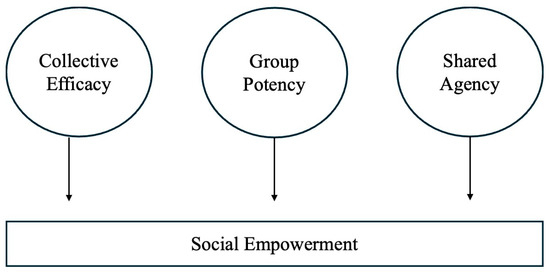
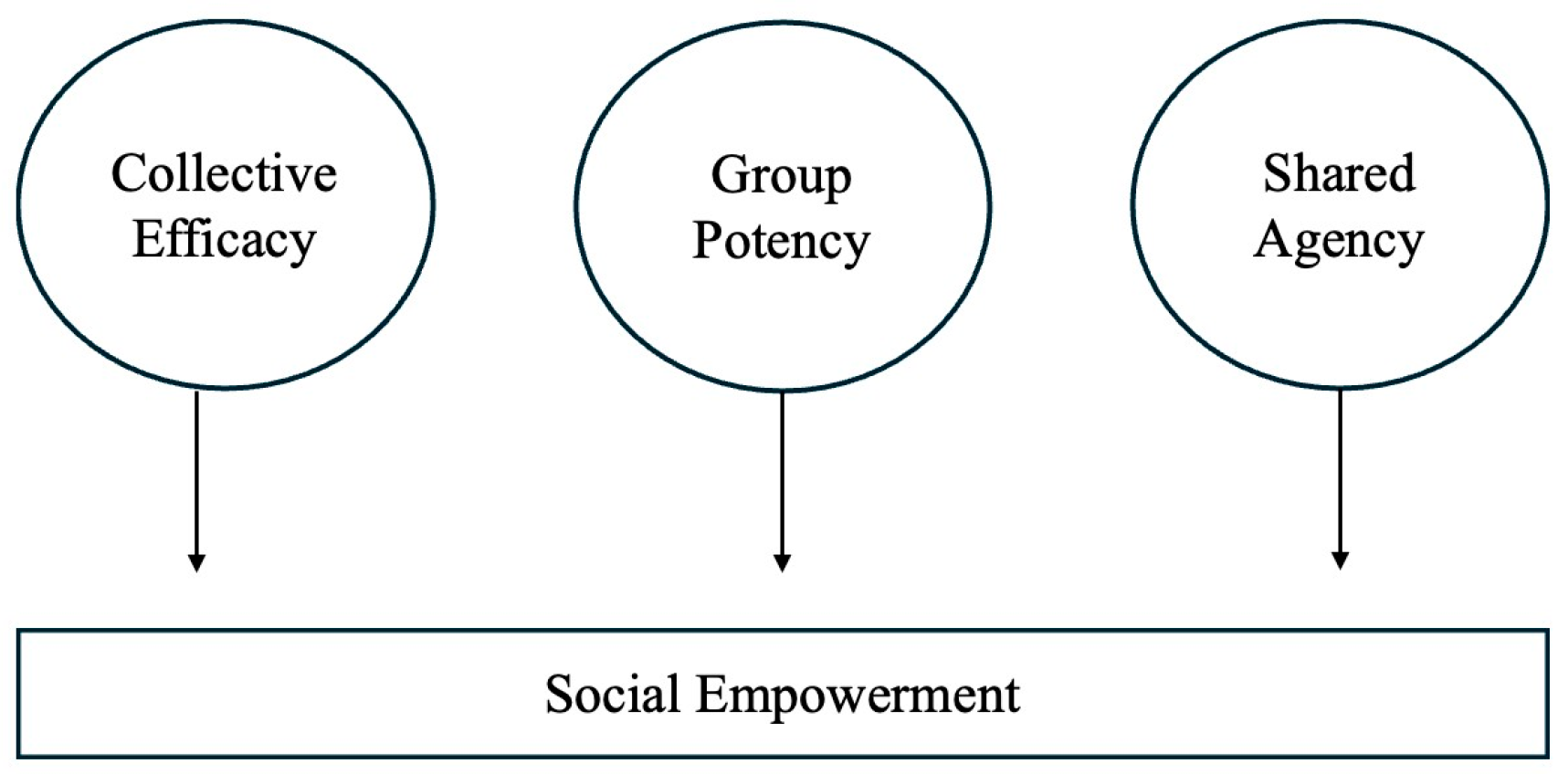
Socially empowered learning is a pedagogical model for instruction that integrates group-based and agency-rich activities designed to address real-world issues and make a positive social impact. The instructional design is informed by Martin’s (2018) Socially Empowered Learning Framework (SELF1), a conceptual model of socio-cognitive effects that occur when groups have perceivable agency to make a difference in the world (Martin & Harris, 2022). The model is informed by interdisciplinary research on motivation and engagement and the effects of three specific constructs, as seen in Figure 1: collective efficacy (Bandura, 2000), group potency (Guzzo et al., 1993), and shared agency (Martin, 2018).
Figure 1.
The Socially Empowered Learning Framework (SELF), (Martin & Harris, 2022).
Together, the three factors of SELF, in Figure 1, each moderate levels of social empowerment based on individual perceptions about the group. This relationship has been tested through structural equation modelling with a model that included empathy and ethical mindset, finding a Goodness of Fit Index = 0.99 (Martin, 2018). Studies with adolescents using the emerging scale for social empowerment reported very good scale reliability, with internal consistencies assessed by Cronbach’s Alpha, α = 0.84, N = 359 (Martin, 2018); and, α = 0.86, N = 354 (Burbidge et al., 2018). Efforts in scale development and psychometric testing have produced a reliable, stable, and dependable measurement instrument for assessing the level of social empowerment. The SELF Scale is an 18-item composite scale composed of three subscales for collective efficacy, group potency, and shared agency (see Appendix A).
Socially empowered learning is defined as, “group-based, creative and agency-rich projects that address real-world issues and make a positive social impact,” (Martin & Calvert, 2018, p. 28). This definition prescribes four requisite elements as criteria for instructional design: (1) group-based, (2) agency-rich, (3) real-world, (4) social-impact. Together, these elements create a learning context designed to trigger all three factors of SELF with effects that aggregate into a perceivable sense of social empowerment.
Socially empowered learning is situated within the field of social cognitive theory (Bandura, 2001), an interdisciplinary field that blends cognitive psychology, social psychology, and education. The construct of social empowerment was originally informed by research in positive psychology (Csikszentmihalyi & Csikszentmihalyi, 1988; Hunter & Csikszentmihalyi, 2003), educational psychology (Bandura, 1977, 1994, 1982, 1997, 2000; Baumeister & Finkle, 2010; Dweck & Leggett, 1988; Fernández-Ballesteros et al., 2002; Reeve & Tseng, 2011; Walls & Little, 2005), and social psychology (Fiske & Taylor, 2013; Guzzo et al., 1993; Pavez et al., 2021; Wang & Eccles, 2012). These streams of research commonly investigate interactions between group and individual perceptions, with the assumption that changes in group perceptions can influence changes in self-perceptions (Bandura, 1997, 2001; Guzzo et al., 1993; Martin, 2018; Van Ryzin & Roseth, 2021). In a nutshell, social empowerment assumes that when individuals work together to design and lead initiatives that make a social impact, there are generative, motivational effects within group dynamics that influence a sense of social empowerment (Gully et al., 2002; Klassen & Krawchuk, 2009; Stajkovic et al., 2009).
Theoretically, the benefits of socially empowered learning can be realized when learning is designed to capitalize on the psychological effects of group processes in Figure 1. A variety of classroom practices have been identified as optimal SELF contexts through their associated positive effects on social empowerment, including service-learning (Martin & Harris, 2022; Harris, 2025), arts-based collective creation, (Snook et al., 2020; Burbidge et al., 2018; Martin & Calvert, 2018), and educational social enterprise (Martin & Calvert, 2018). Thus, pedagogically, socially empowered learning is not limited to a specific type of learning activity—it simply provides a framework of criteria for teachers to design a learning context that is optimized for social empowerment. Through this, there is opportunity to capitalize on a range of research-informed effects, including the following: improved academic performance (Snook et al., 2020); increased intellectual engagement, empathy, ethical mindset, entrepreneurial spirit (Burbidge et al., 2018; Martin & Calvert, 2018; Martin & Harris, 2022); and improved self-perceptions for social and mental well-being (Harris, 2025).
The basic premise of socially empowered learning is that there are benefits at the group and the individual level. The assumption that individuals can hold two, distinct expectations at the same time (one for their group’s performance, and one for their own performance) aligns with social cognitive and other psychological theories that assume effects at the group level influence effects at the individual level (Bandura, 2000; Guzzo et al., 1993; Van Ryzin & Roseth, 2021). As seen in Figure 1, SELF theoretically activates three socio-cognitive mechanisms (collective efficacy, shared agency, and group potency). Over time, positive effects on each factor aggregate into a perceivable sense of social empowerment (Martin & Calvert, 2018). Social empowerment, as a construct, is a state of engagement where the group’s perceivable efficacy, agency, and potency can increase through shared successes together (Martin & Harris, 2022). It is, thereby, logical to assume that this shared perception of confidence-in-and-effectiveness-as a group may also manifest at the individual level in specific abilities, such as self-management (Capone et al., 2018; Smith et al., 2013).
In the literature, self-management is defined as, “the ability to regulate one’s emotions, thoughts, and behaviors effectively in different situations,” (West et al., 2020, p. 282). The construct of self-management includes managing stress, delaying gratification, and motivating oneself to set and work towards academic goals (CASEL, 2013; West et al., 2020). Although the term self-management is sometimes used interchangeably with self-regulation (Lengua, 2003; Zimmerman, 2000), the latter is actually an umbrella term that encompasses many more behaviors and constructs (e.g., planning, attention control, task shifting, etc.), where self-management is a more specific, and often the preferred term when referring to the classroom context (J. Eccles & Wang, 2012). Both constructs are recognized as important to social-emotional learning (Durlak et al., 2011; Elliot & Dweck, 1988; Schunk, 1990; Schunk & Zimmerman, 1994; West et al., 2020). They are also both important for development in adolescence, central to the academic and social adjustments that take place during this time (Checa et al., 2008; J. S. Eccles & Wigfield, 2002; Farley & Kim-Spoon, 2017; King et al., 2013; Lengua, 2003).
With its importance duly noted, self-management has yet to receive adequate theoretical or practical attention in terms of best practices for instructional design. In fact, self-management is often wrongly assumed to be something that naturally manifests through hard work, homework, and study (CASEL, 2013). If anything, the decreasing levels of self-management found in adolescents entering junior high (West et al., 2020) are a testament to the contrary. Not only do scholars need to better understand this complex construct, but educators need to figure out better ways to teach it. Designing learning contexts in alignment with SELF offers the possibility for disrupting the sink or swim transition by providing a model for instructional design that harnesses peer support and collaborative processes.
Returning to the assumption that individual effects can arise from group effects, we wonder if individual empowerment in self-management can arise out of social empowerment, particularly within an educational context (Gehlbach & Hough, 2018; West et al., 2020). Specifically, we ask the following: do contexts associated with increased social empowerment create conditions for acquiring ability in self-management? Given the social mechanisms of SELF, and the kinds of projects that socially empowered learning engenders (i.e., making a social impact), we suggest yes, and propose SELF as a model for creating prime conditions for the acquisition and application of self-management skills (Gehlbach & Hough, 2018).
The learning context has an enormous influence on student motivation and achievement (J. S. Eccles & Wigfield, 2002; Stipek & Seal, 2002). Within SELF contexts, the steady interdependence of group members provides fertile ground for the mutual sharing of knowledge, skills, and abilities for academic success. Socially empowered students are embedded in a context where they can learn from each other as they attempt to rise and meet peer expectations. Unpacking the complexity of this group dynamic is well-beyond the scope of this paper, and there is no doubt that group success, group norms, and group abilities come into play. What matters here is the recognition that aspects of group empowerment influence aspects of individual empowerment. In terms of self-management, when a group learns to be effective together, there is potential for individuals in the group to learn how to be effective for themselves. Thus, we propose that, when social empowerment increases across a group, this will positively associate with levels of self-management for individuals within the group.
1.2. Self-Management in Socially Empowered Groups
Research reviewed previously has established that SELF-based pedagogies create contexts that influence collective efficacy, shared agency, and group potency; and that, together, these variables contribute to an overall perception of social empowerment. We know that when students are socially empowered, they perceive a high sense of efficacy in the task at hand; agency that they can control, oversee, and direct their work; and potency in the group’s effectiveness together. Logically, as they work collaboratively toward group-based goals, individual abilities in self-management can contribute to the group’s success.
Within the group’s collective efforts, individual accountability comes into play, and we suspect that self-management is an untested effect of socially empowered learning—one that is particularly important for students in need of its development. Thus, we derive a testable hypothesis: social empowerment will be positively associated with the development of self-management. To test this, we studied students participating in a program that fits the criteria of SELF (group-based, agency-rich, real-world, social impact) to measure the effects of their changing social empowerment in relation to changes in self-management. On an exploratory level, we were also interested in the relationship between each of the subcomponents of social empowerment (collective efficacy, shared agency, group potency) and self-management, as well as possible interaction effects. Hence, we derived a testable hypothesis and a case for exploratory investigation to better understand the phenomenon. Through this we sought empirical evidence of an effective framework to inform pedagogical intervention for ill-prepared adolescents entering junior high.
2. Materials and Methods
2.1. Participants and Procedures
This study utilized a two-wave correlational pretest–posttest design, with participants using online surveys administered at the beginning and end of one academic school year. Data were collected in conjunction with an international non-profit education organization offering a program that aligns with SELF criteria and focuses on classrooms in low socioeconomic and/or remote rural areas.2 While 4726 students in grades 3–10 completed surveys throughout the 2017–2018 implementation of the program, we narrowed our sample to 691 students in 6th and 7th grade to fit our research interest on effects at the point of transition from elementary to junior high. Approximately 66% (n = 454) of students were in 6th grade with the remaining third (n = 237) in 7th grade. A total of 50% of students identified as boy. Just over half the student sample (58%) attended school in the United States and the rest attended in Canada. All respondents were participants in the non-profit program as part of the teacher’s delivery of curriculum. Data were collected prior to implementation, in early fall (time 1) and after implementation in late spring (time 2) of the same school year.
All students participating in the nonprofit program were recruited into the study through ethics certified protocols via an email to the teachers inviting their classes to participate in the research at the beginning of the school year. Each teacher was provided with information on the project to distribute to students’ parents with parental consent forms. Students with signed, parental consent received a link to the survey from their teachers to complete the electronic survey via computer. At the end of the school year, students once again completed an online survey administered by the teacher. Focal items of this study were embedded within a variety of other measures of interest to the researchers and nonprofit partners.
2.1.1. Self-Management
Students reported on their perceptions of self-management using a scale developed for use by California CORE districts (Gehlbach & Hough, 2018). Students responded to six items assessing various aspects of their ability to manage themselves in the classroom (e.g., “I came to class prepared”) using a 5-point Likert scale ranging from “1-Almost Never” to “5-Almost All the Time.” This self-management scale has shown discriminant and predictive validity (West et al., 2018; West et al., 2020) and in the present sample showed acceptable internal consistency at both time 1 (α = 0.81) and time 2 (α = 0.84). Moreover, these self-management items demonstrated no evidence of differential item functioning (DIF) based on students’ gender, grade level (6th and 7th), race/ethnicity (White, African-American, Hispanic), and English Language Learner (ELL) status (Meyer et al., 2018), indicating that all items function similarly across each of these student subgroups. Although we did not re-estimate invariance of the self-management items in this sample, prior work has found no DIF by gender, grade, race/ethnicity, or ELL status, supporting their comparability across student groups (Meyer et al., 2018).
2.1.2. Social Empowerment
Students reported on their perceptions of social empowerment at time 2 responding to the 18 items of the Social Empowerment Scale. This scale is composed of three subscales: 5 items measure collective efficacy (e.g., “We can make a difference through our work”), 8 items measure group potency (e.g., “We feel there is no task too big for us”), and 5 items measure shared agency (e.g., “We have opportunities for choice and input”). Students indicated their agreement with each item using a 5-point Likert scale ranging from “1-Not at all” to “5-Absolutely.” The Social Empowerment Scale showed high internal consistency across all items (α = 0.96), as well as each subscale: collective efficacy (α = 0.86), shared agency (α = 0.89), and group potency (α = 0.91). See Section 2.2 for results from testing measurement invariance.
2.1.3. Social-Emotional Learning Practices
In order to control for potential overlap of socially empowered learning with other evidence-based social-emotional practices, we controlled for teacher-reported use of social-emotional practices by having teachers report on the frequency with which they implemented them at time 1, using the 11-item Classroom Practices Frequency Scale (CPFS; Nathanson et al., 2007). Teachers used an 8-point Likert scale ranging from “1–Almost never” to “8–More than 1x per day” to respond to items like, “Students greet each other by name during morning class meetings,” and “I provide opportunities for students to choose how to do work, what kind of work to do, or both (e.g., in studying marine biology, students may choose the animal they want to study and/or students can demonstrate knowledge about this animal through writing a report, drawing a picture book, crafting a clay model).” The CPFS has shown construct and predictive validity (Rimm-Kaufman et al., 2014) and showed acceptable internal consistency in the present study (α = 0.84).
2.1.4. Teacher and Student Demographics
Teachers and students reported on their demographic characteristics via electronic survey at both time 1 and time 2.3
2.2. Analytic Plan
Measurement invariance of the Social Empowerment Scale across country (USA, Canada), student gender (boy, girl), and grade (6th, 7th) was assessed in two ways: (1) a single factor model in which all items loaded onto one latent factor representing social empowerment and (2) a three-factor correlated model where specific items loaded onto one of the three correlated latent factors, representing collective efficacy, group potency, and shared agency. Students’ endorsement of response option “1–Not at all” was low and at times zero, creating a barrier to invariance testing. As such, students who endorsed response option “1–Not at all” for any of the social empowerment items were dropped (n = 62, spread evenly across demographic subgroups). Mplus version 8 (Muthén & Muthén, 2017) was used to examine invariance models specifying theta parameterization and weighted least squares means and variances (WLSMV) estimation given the ordered categorical data, and robust standard errors to account for the nested data.
Results supported scalar (strong) invariance for the social empowerment single factor model across all three student subgroups (see Appendix B). However, the three-factor model produced a Haywood case such that correlations among the three latent factors were greater than one. Given the validity of data points on students who endorsed response option one, we did not exclude them from analyses (see Section 3.2 for a description of sensitivity analyses). We proceeded with our analytical plan to analyze social empowerment and its three parts, despite the lack of differentiation found between them, with the assumption that subcomponent results may help guide refinement of the conceptual model and associated instrument of social empowerment as an emergent construct. We accept the limitations of this approach, as discussed in Section Strengths, Limitations, and Future Research.
To test our hypothesis, a series of two-level (level 1 = students, level 2 = teacher/classroom) random intercept models were run in Mplus version 8 (Muthén & Muthén, 2017). First, we analyzed an unconditional two-level model to determine if dependency in the data needed to be accounted for. Results showed 6% of the variation in students’ time 2 self-management to exist between classrooms and the level-2 variance component was statistically significant. We therefore proceeded with multilevel modeling and constructed two models to probe our research inquiry.
Model 1 examined the main effects of students’ time 1 self-management and students’ social empowerment on students’ time 2 self-management. Model 2 included the interaction between time 1 self-management and students’ social empowerment. All student-level predictors were group mean centered and all teacher/classroom-level predictors were grand mean centered (Enders & Tofighi, 2007; Yaremych et al., 2023). This allowed us to appropriately partition the within- and between-variance and thus more precisely estimate within-and between-effects. We then calculated a pseudo R2 as the proportion of total variance explained by the full compared to the unconditional model and a semi-partial R2 to estimate the unique variance explained by each focal predictor (i.e., the proportion of total variance explained by the model including the focal predictor compared to one excluding it), to gain insight into the predictive power of each model and each focal predictor (Snijders & Bosker, 2012, pp. 112–113).
An additional six models were constructed to examine our exploratory research aims. These consisted of three main effects models—one for each subcomponent of social empowerment (collective efficacy, group potency, shared agency)—and three models in which interaction terms between each subcomponent and students’ time 1 self-management were included. To isolate aspects of socially empowered learning that may overlap with other relevant classroom practices, we controlled for teacher-reported use of evidence-based social-emotional classroom practices (Nathanson et al., 2007). Missing data, the prevalence of which ranged from 0–28%, were assumed to be missing at random. To recover missing data, we generated twenty multiple-imputed datasets per outcome using Blimp version 4.0 (Keller & Enders, 2026). Blimp allows for model-based multiple imputation, which means random effects, covariates, and interactions can be accounted for when estimating the imputed data (making this approach to multiple imputation more rigorous than alternatives). Covariates included gender/sex, grade-level, country, and classroom-level student self-management.
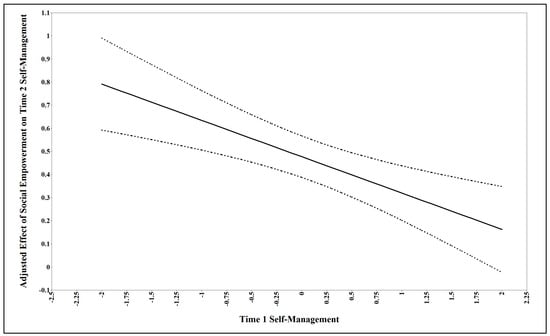
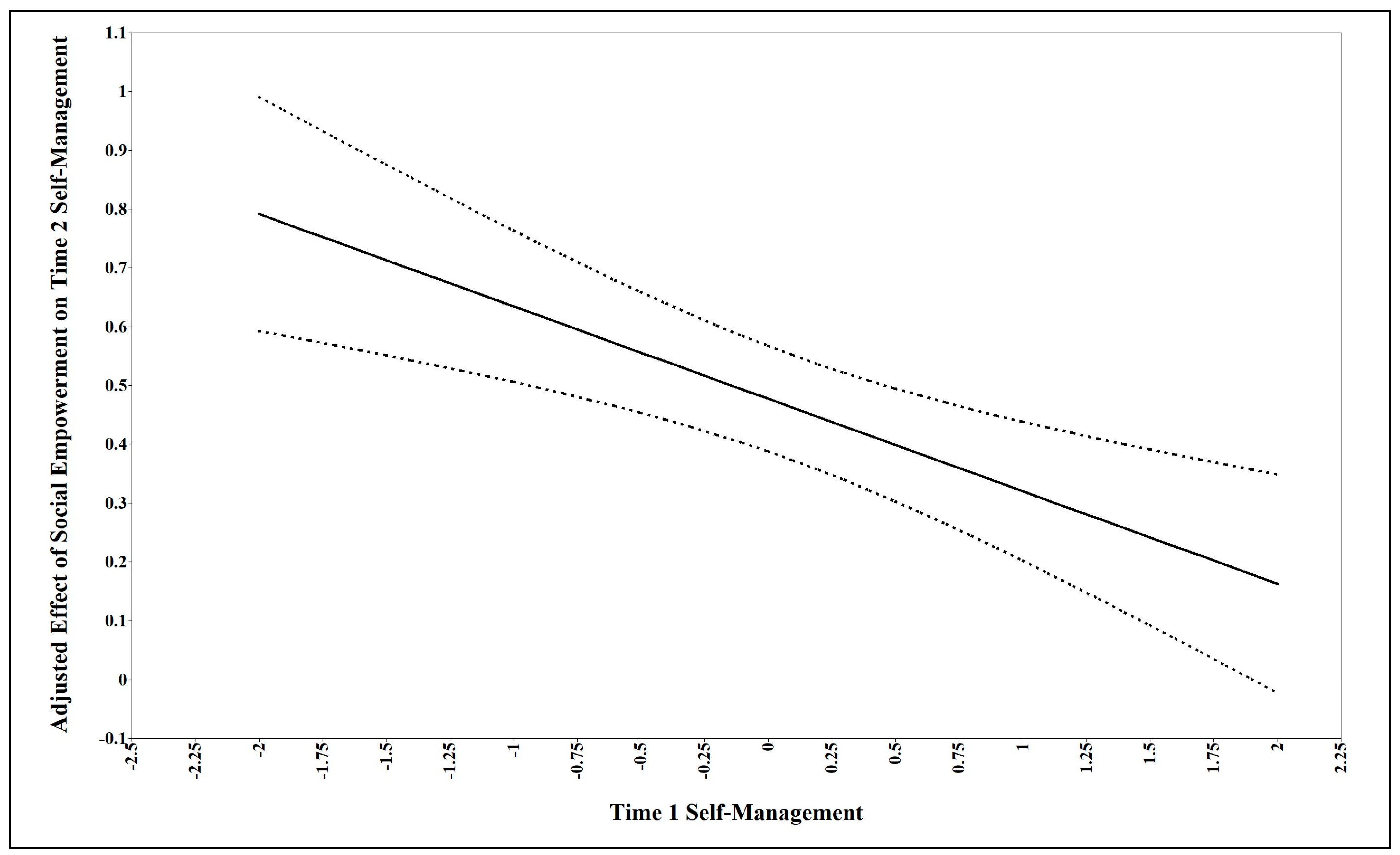
Two methods were used to probe significant interactions. We used the Johnson–Neyman technique to identify the region(s) along the moderating variable’s scale where the interaction is statistically significant; (Johnson & Neyman, 1936). This technique provides greater detail about the interaction effect between social empowerment and self-management. Regions of significance are identified by points at which the 95% confidence interval bands do not cross the x-axis. We also plotted simple slopes to interpret the interaction.
3. Results
3.1. Descriptive
Table 1 presents descriptive statistics at the individual and class level (CL) and bivariate correlations for key study variables. First, students reported moderate levels of social empowerment (M = 4.05, SD = 0.77), as well as moderate levels of each subcomponent (). These findings confirmed alignment of the non-profit program with SELF and the context as socially empowered. Second, on average, student-reported self-management decreased slightly from time 1 (M = 4.24, SD = 0.70) to time 2 (4.09, SD = 0.77) and was moderately stable (r = 0.54, p < 0.001). This slight change indicated that, while average levels of students’ self-management did not change substantively across time, individual levels did.
Table 1.
Univariate statistics and bivariate correlations among key study variables.
Given the theoretical premise that group-based processes can pull up lower individual scores through collective social empowerment, we investigated the effects of social empowerment specifically on individuals with low scores in self-management at time 1. The following sections describe results from analysis investigating whether the association between social empowerment and self-management is dependent on students’ initial level of self-management, as well as exploratory analyses investigating similar moderating associations for each subcomponent of social empowerment.
3.2. Primary Analysis
Table 2 shows results from the Model 1 testing main effects, finding time 1 self-management (b = 0.37, p ≤ 0.001) and social empowerment (b = 0.49, p ≤ 0.001) to be significantly positively associated with time 2 self-management. Models 1 and 2 explained 51% and 53% of the variance in time 2 self-management, respectively, whereas social empowerment explained 28% of the total variance.
Table 2.
Main and interaction results from models examining the link between social empowerment and change in students’ self-management.
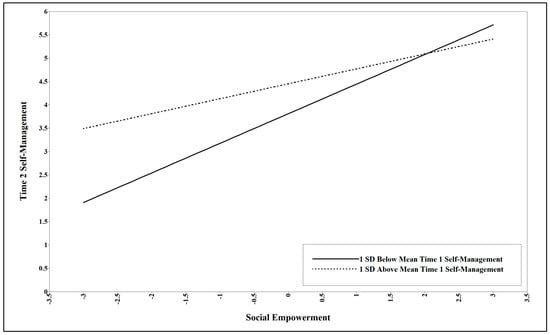
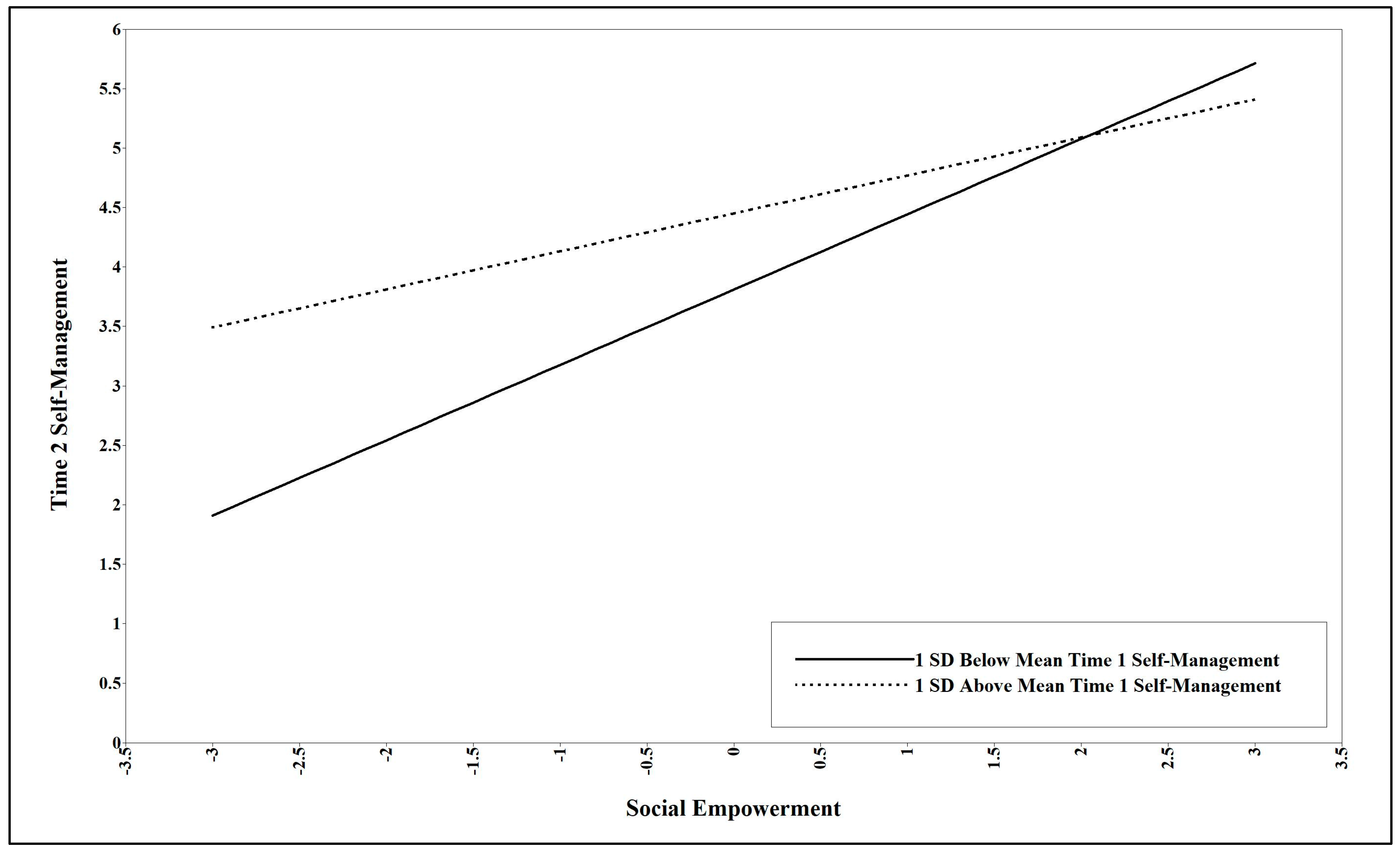
A one-point increase in time 1 self-management and social empowerment was associated with a 0.37- and 0.49-point increase in time 2 self-management, respectively. In addition, Model 2 showed a significant interaction between time 1 self-management and social empowerment (b = −0.16, p ≤ 0.001). The interaction explained 3% of the variance in time 2 self-management.
Figure 2 illustrates the interaction, showing that it was statistically significant across all values of time 1 self-management up to two standard deviations above the mean, at which point social empowerment no longer significantly influenced change in self-management across time (see Appendix C, Table A2a for numeric regions of significance).
Figure 2.
Johnson–Neyman plot presenting regions of significance over which group mean centered time 1 social empowerment significantly moderates the association between time 1 and time 2 self-management.
Figure 3 presents a graph of the simple slopes, indicating that students’ perception of social empowerment was associated with increases in self-management from time 1 to time 2 for all students (see Appendix C, Table A2b). Importantly, the slope was steeper for students who started the year with low levels of self-management relative to other students in their classroom. Students who started the school year with low self-management compared to their classroom peers and reported high social empowerment were estimated to increase their ability to self-manage by 1.16 points compared to those reporting low social empowerment. This result is nearly double the increase expected of students starting with high self-management (see Appendix C, Table A2b for marginal means). In other words, social empowerment was particularly beneficial to the students who had the greatest need for self-management support.
Figure 3.
Simple slopes for group mean centered time 1 self-management moderating the association between social empowerment and time 2 self-management.
3.3. Exploratory Analyses
Table 3, Table 4 and Table 5 show results from the exploratory analyses investigating similar moderating associations for each subcomponent of social empowerment, namely collective efficacy, group potency, and shared agency.
Table 3.
Results from exploratory model examining collective efficacy and change in students’ self-management.
Table 4.
Results from exploratory model examining group potency and change in students’ self-management.
Table 5.
Results from exploratory model examining shared agency and change in students’ self-management.
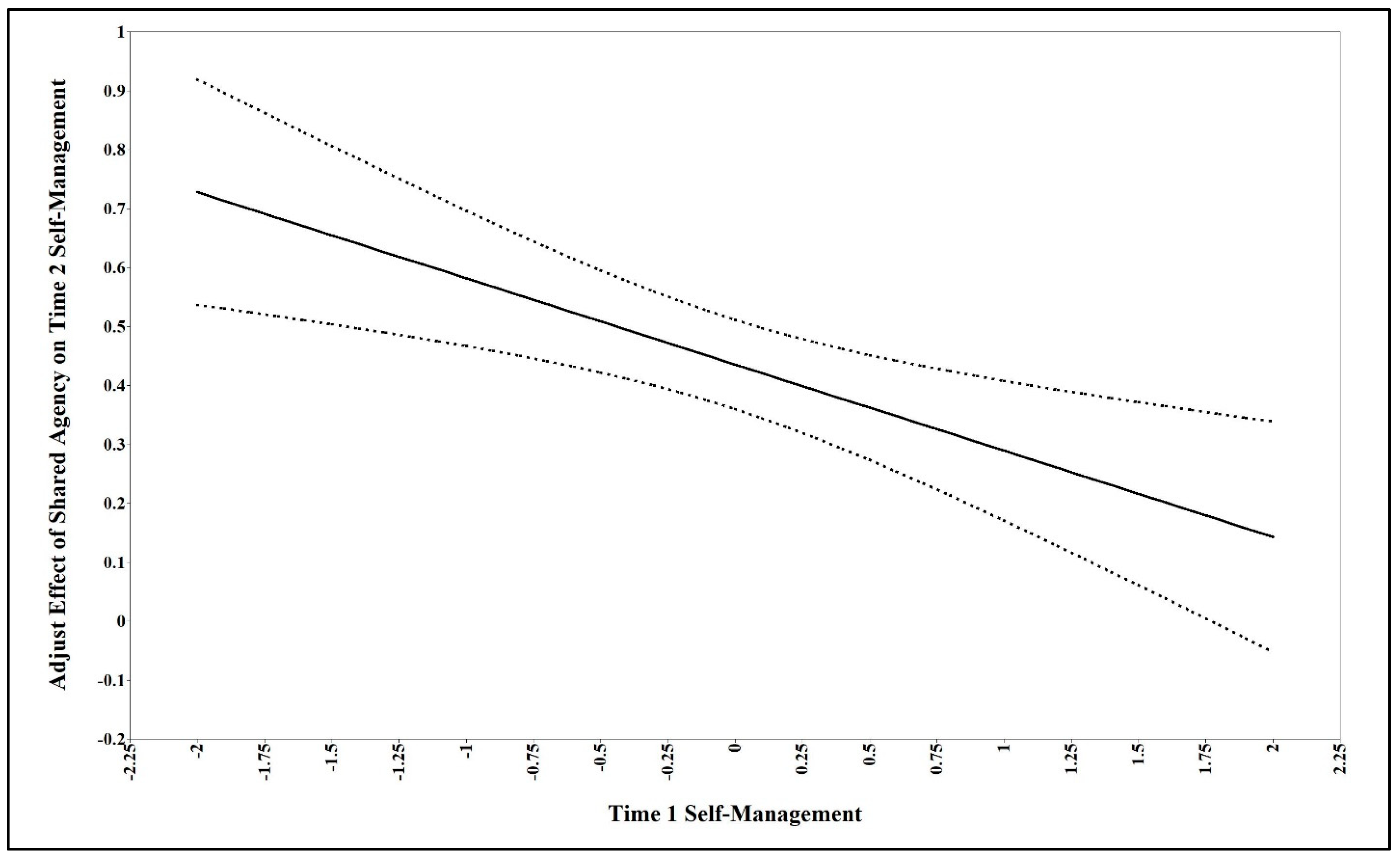
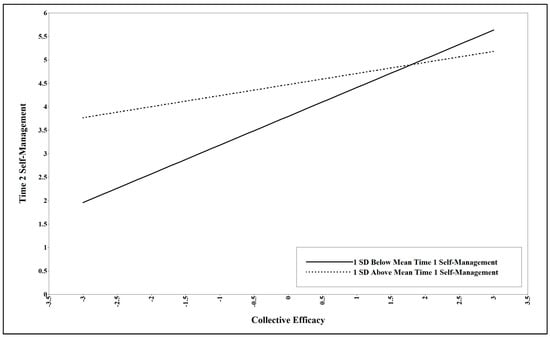
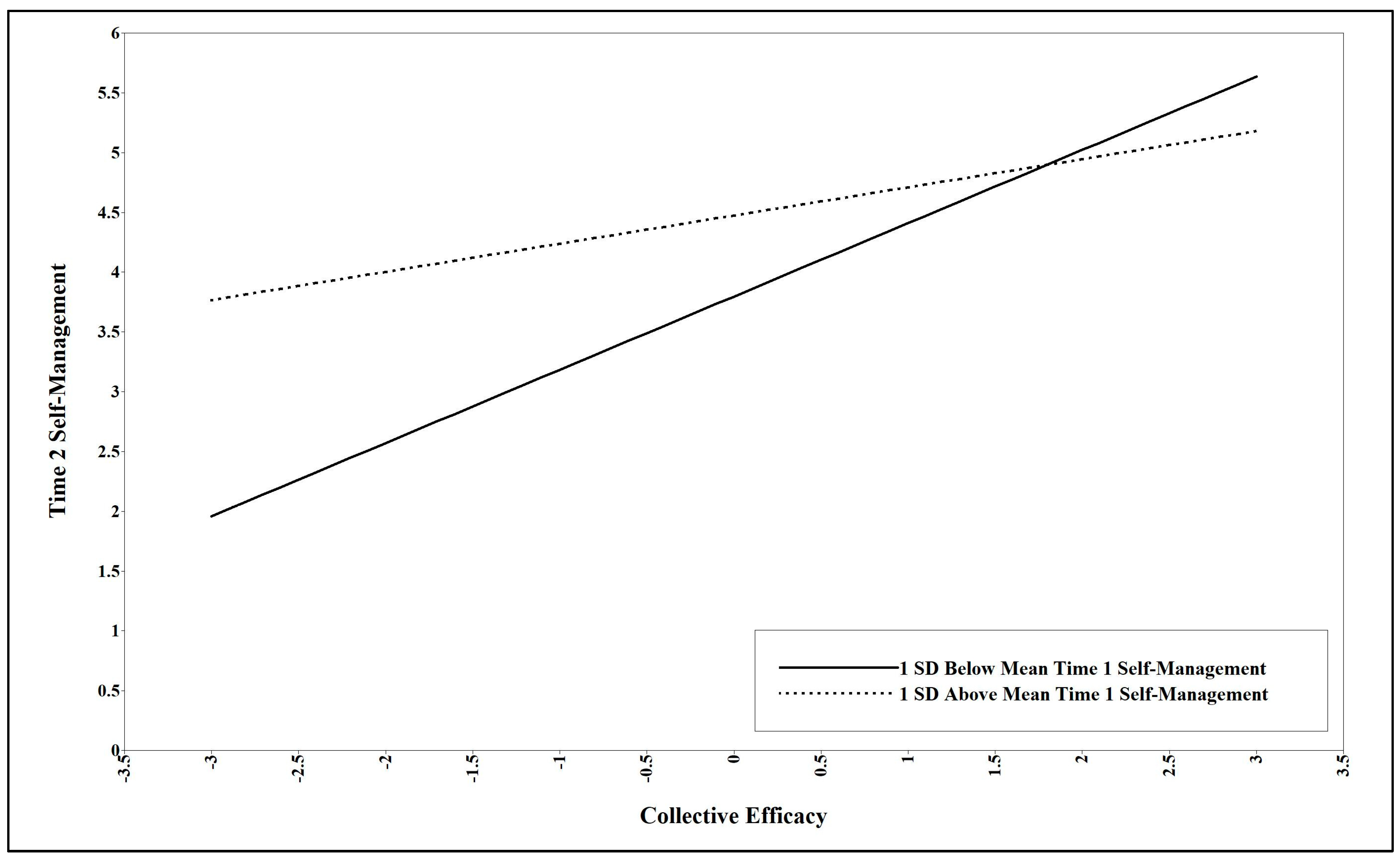
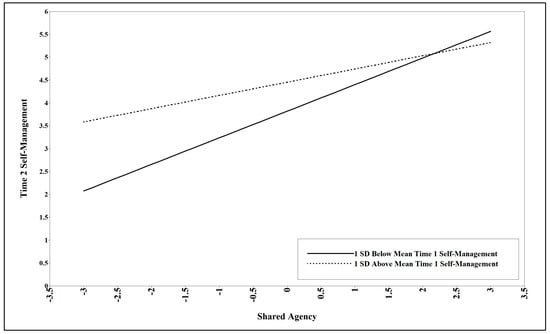
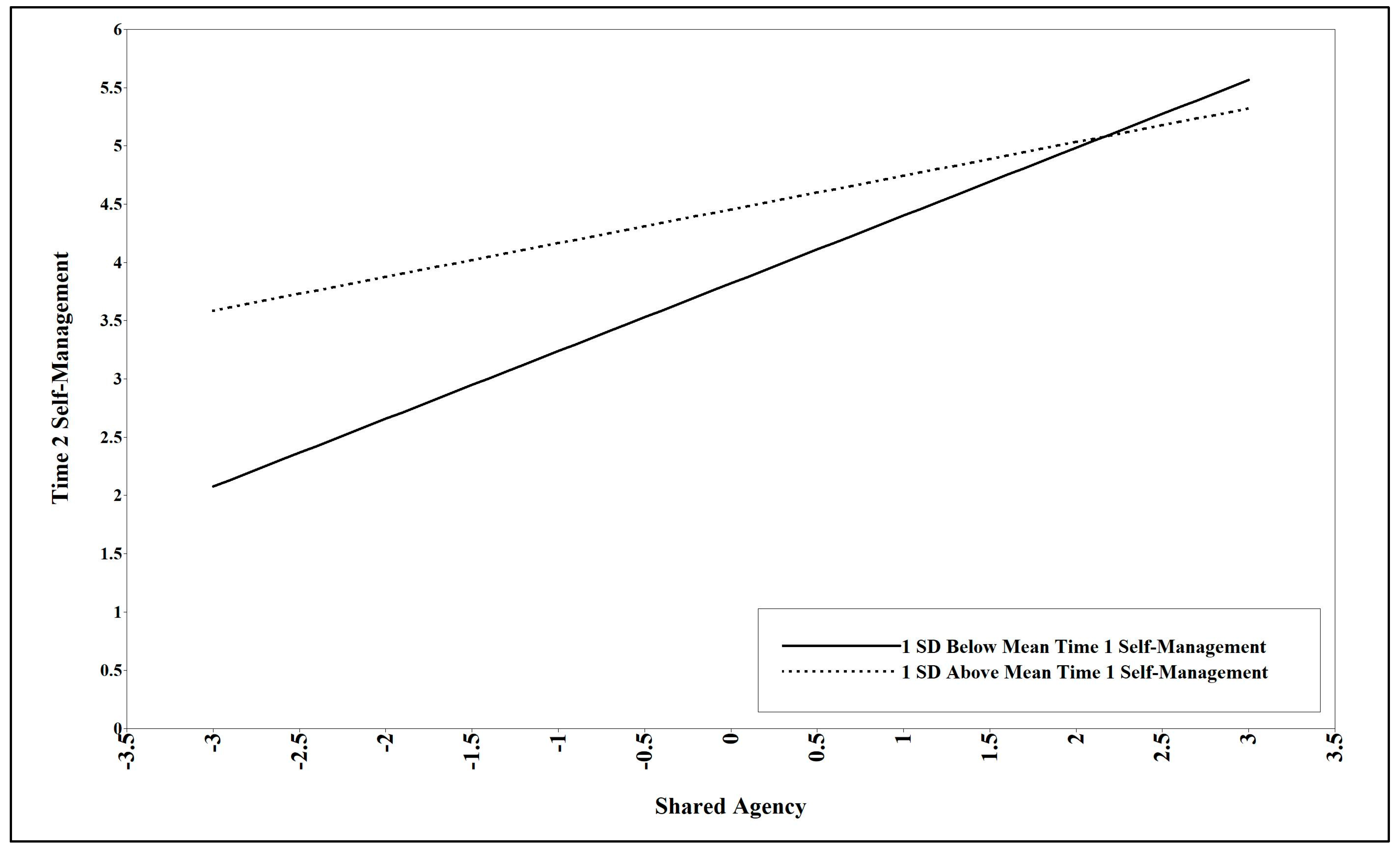
Results from Model 1 testing main effects indicated that the subcomponents of social empowerment, namely collective efficacy (b = 0.44, p ≤ 0.001), group potency (b = 0.45, p ≤ 0.001), and shared agency (b = 0.45, p ≤ 0.001), were all significantly positively associated with time 2 self-management, controlling for time 1. Model 2 found two significant interactions, showing that collective efficacy (b = −0.19, p ≤ 0.001) and shared agency (b = −0.15, p ≤ 0.001) each negatively moderated the association between time 1 and time 2 self-management. The Johnson–Neyman plots for collective efficacy and shared agency are not depicted because they looked nearly identical to findings for social empowerment, as seen in Figure 2. However, they can be found in Appendix D. The simple slopes results are shown in Figure 4 and Figure 5 (see Appendix C, Table A3b and Table A4b).
Figure 4.
Simple slopes for group mean centered time 1 self-management moderating the association between collective efficacy and time 2 self-management.
Figure 5.
Simple slopes for group mean centered time 1 self-management moderating the association between shared agency and time 2 self-management.
Figure 4 and Figure 5 show that, as with social empowerment, all students benefitted from increased collective efficacy and shared agency. Again, students reporting low levels of self-management at the outset of the school year experienced the greatest gains in self-management, compared to students in their classroom (marginal means are reported in Appendix C). We tested the invariance of social empowerment across student subgroups, using a different sample which excluded students reporting the lowest levels of each social empowerment item. As a sensitivity check, we estimated all two-level models using the invariance sample of students to compare results across both samples. Results generally demonstrated the same trends as reported above (see Appendix E, Table A5, Table A6, Table A7 and Table A8) with the exceptions of the interaction between group potency and time 1 self-management, and the direct association between gender of student and sex of teacher (covariates) and change in self-management, which both reached statistical significance.
4. Discussion
In the alignment of program with the design criteria for SELF (group-based, agency-rich, real-world, social impact), the context of our study positioned us to test the association of social empowerment as it relates to change in self-management. Results are encouraging and make an important contribution in finding that social empowerment is associated with self-management—but there is a twist. Our initial finding was that self-management decreased slightly in the sample. While the finding itself was in line with other research in the field (West et al., 2020), this was a signal that we were not asking the right question. The moderate stability suggested to us that our inquiry was not actually about the association of social empowerment and self-management in all students; but in the association of social empowerment in students beginning the year with low self-management—those in need of intervention. For those students (individuals who reported low self-management at time 1), we found a significant positive association between social empowerment and self-management. Thus, we make a novel contribution in identifying SELF as a theoretical model for pedagogical design that positively associates with self-management acquisition. Additionally, we make a contribution to the growing field of SELF research in adding self-management as another, individual benefit of socially empowered learning.
Findings suggest that self-management ability is somehow socialized across the group without being explicitly taught. In this, we also make a valuable contribution to practice in identifying SELF as a viable way for teachers to structure experiential learning with predicted outcomes associated with improved self-management for students in need. Not only were participants socially empowered, but the sub-group of individuals who started out with low self-management were able to achieve major gains and catch up with their peers. Although teacher-reported SEL practices were negatively (but not significantly) associated with students’ self-management in our models, the coefficients were very small in magnitude. This pattern may reflect collinearity with social empowerment, compensatory assignment of SEL practices to more struggling classes, or simply sampling variability; however, given the non-significance, we do not interpret these coefficients substantively.
Given the immediate need for self-management upon entry to junior high, we recommend teachers in upper elementary and lower junior high consider employing socially empowered learning, with a particular urgency for this in the sixth grade, prior to the transition. This is not to say that conventional practices of more individual assignments are not also useful, but findings here suggest that group-based projects designed for social empowerment offer a potential, peer-supported intervention that might better prepare adolescents for the self-managerial responsibilities to come. Without intervention, students with low self-management are otherwise left to struggle on their own.
In practice, this means designing group-based projects that are infused with opportunities for students to imagine and implement solutions to real-world issues with support from teachers to manifest ideas into reality. This means designing agency-rich activities that engage student input, invite student voice, and provide options for authentic choice. It means asking students what matters to them and engaging their thoughts on how they might make a social impact through their coordinated efforts. It means creating conditions for students to collectively take the lead so they can witness their own influence in the world, with concerted efforts by teachers and administrators to remove bureaucratic barriers and facilitate community connections.
At the very least, findings here support teachers in re-thinking learning design so that it better supports the transition to junior high, with an empirically tested option: socially empowered learning. When learning is designed for students to be socially empowered, there is opportunity to capitalize on the many empirically tested benefits that now include self-management acquisition for students at risk. This is reinforced by findings from our exploratory analyses, where we found that all three subcomponents of SELF were significantly, positively associated with self-management. This is important because it supports a call for more socially empowered learning in adolescence, beyond traditional group-based and project-based learning practices (scholarly fields of their own). Socially empowered learning is about being part of making a positive change in the world, and findings suggest that adolescents respond positively to contexts where they are empowered to take charge and do something meaningful as part of their education.
We also want to touch on the interaction effect of time 1 self-management moderating collective efficacy and shared agency, but not group potency. We suspect this could have something to do with the fact that group potency is a global construct (not task specific) that increases through shared, repeated success on a variety of tasks. The significance of the interactions illustrated in the Johnson–Neyman plots informed our adjustment of perceptions at time 2 on these variables which were stronger for students with low self-management at the beginning of the year.
Overall, findings encourage us to consider the possibility that there may be other social-emotional benefits acquired in SELF contexts (CASEL, 2013; West et al., 2020), and we suggest future research that investigates other social-emotional learning constructs in association with social empowerment.
Strengths, Limitations, and Future Research
One of the strengths of this study is its approach to measure the effects of a framework that can fit a variety of classroom practices. SELF, as investigated here, aligns with practices of the Responsive Classroom approach (NEFC, 2003, 2007) in its principle to focus on how students learn over what they learn. Additionally, it is a strength that our sample is large and diverse, with international representation from Canada and the United States, and composed of students in 6th and 7th grade—a noted transition period for adolescents.
As in all studies, there are some limitations. Our moderator was measured before our X variable, which is acceptable when piloting research on relatively new constructs, but we note it as a limitation, with the caveat that it would have been impossible to identify students at the greatest risk concurrently with social empowerment which develops over time. Data captured support the idea that self-management increases as part of the social empowerment process and aligns with our theory about how these effects transpire. That stated, while the pattern found is consistent with a stronger association for low-T1 students, it is not definitive, and more research is needed to rule out regression-to-the-mean as an alternative explanation.
We were also limited in not having full access to SES data (due to constraints of the data collection method), especially since our sample is partially identified as lower SES. In retrospect, we see this as a limitation in not being able to assess whether or not SES comes into play and/or if the strength of the effect is different between students of different SES categories. We encourage future researchers to examine this effect using a repeated measures design and survey items that capture fulsome SES data for a deeper understanding in this regard. Also, we noted data were collected on gender for students and sex for teachers. While these were not integral to our primary inquiry, we acknowledge these constructs as not the same, but useful as covariates within the analyses. In line with APA policy, we make no assumptions about gender on reported sex, or vice versa, and results are reported as they were captured. We encourage future SELF research on hypotheses specific to sex or gender differences to use parallel items across all samples.
Finally, we opted to analyze observed variables to discuss findings on the response scale used by participants. We view this as a critical step in early research on social empowerment. However, we also acknowledge that this approach results in an unknown ratio of true score to measurement error and encourage future work to apply latent variable modeling (e.g., latent change scores) to estimate differences in true scores. Students’ endorsement of lower response options suggests room for improvement. Future research might explore creating a 4-point Likert scale that collapses response options one and two and removes the neutral midpoint option, which may distribute item responses more evenly. Relatedly, the psychometric properties of the social empowerment scale require more, rigourous examination to bolster confidence in its use and/or refine items to improve its overall functioning, with a need for studies that investigate directionality and explore plausible third-variable explanations. This is particularly important in relation to the hypothesized subcomponents of collective efficacy, group potency, and shared agency and the need to better understand their distinguishing factors as part of the underlying theory of social empowerment.
On a positive note, this was the first application and testing of the 18-item Social Empowerment Scale with a large, international sample of adolescents, with added strengths in finding excellent reliability in this sample (α = 0.96), acceptable model fit, and evidence of scalar (strong) invariance across student subgroups (see Appendix B).
5. Conclusions
Self-management is an ability that becomes increasingly more important for student success, especially for adolescents transitioning into secondary school. To date, few pedagogical interventions exist for teachers to effectively support students with low self-management ability. Findings here support the Socially Empowered Learning Framework as an evidence-based tool for teachers who want to design a learning context with positive effects on low self-management during this critical time. Through SELF’s requisite elements, teachers can capably create the conditions for social empowerment with potential to boost self-management ability for students in need.
In conclusion, this study reinforces SELF as an effective way for teachers to promote student success—not only for the group, but also for individuals who might otherwise enter junior high disadvantaged. Thus, we establish SELF as an empirically tested framework for pedagogy that supports students entering junior high with low self-management ability, and we position socially empowered learning as a metaphorical life raft for keeping all students afloat.
Author Contributions
Conceptualization, B.H.M.; Methodology, R.M.M.; Software, C.M.C.; Formal analysis, C.M.C.; Data curation, R.M.M.; Writing—original draft, B.H.M., C.M.C. and R.M.M.; Writing—review & editing, B.H.M., C.M.C. and R.M.M.; Supervision, R.M.M.; Project administration, R.M.M. All authors have read and agreed to the published version of the manuscript.
Funding
Partial funding for this study was provided by the Spencer Foundation, Grant #201700011.
Institutional Review Board Statement
The study was conducted in accordance with the Declaration of Helsinki, and approved by the Human Subjects Research Ethics Committee of the University of Lethbridge (protocol number 2016-083; date of approval, 12 October 2016).
Informed Consent Statement
Informed consent was obtained for all subjects involved in the study from their legal guardians (parental consent).
Data Availability Statement
Restrictions apply to the datasets. The datasets presented in this article are not readily available due to restrictions of consent protocols for data collection involving minors. Requests to access the datasets should be directed to Dr. Mesler.
Conflicts of Interest
The authors declare no conflict of interest.
Appendix A. SELF Scale for Measuring Social Empowerment
The SELF Scale is an 18-item self-report instrument for measuring the level of social empowerment perceived by a member of a group at a point in time. Higher scores indicate a stronger level of social empowerment. Psychometric evaluation of the SELF scale has consistently reported it as a reliable measurement instrument (i.e., α = 0.96, N = 691, Martin, Corbin & MacDonnell, 2026). The scale was developed by Dr. Brittany Harker Martin and is composed of three subscales adapted from Bandura (2000), Guzzo et al. (1993), and Athayde (2009) for collective efficacy, group potency, and shared agency. Items each relate to the group and are rated on a 5-point scale to indicate respondents’ degree of confidence, frequency, or agreement as indicated with each sub-scale.
Collective Efficacy: 5-item subscale of items adapted from Bandura (2000). This subscale scores the degree of confidence in items of perceived efficacy about the group.
- Prompt: How confident are you in each statement about your group?Rating Scale: 1—Not at all 2—Not really 3—Somewhat 4—Mostly 5—Absolutely
- My group can make change in the world.
- My group can make a difference.
- My group can help others.
- My group can solve problems.
- My group can improve the lives of others.
Group Potency: 8-item subscale of items adapted from Guzzo et al. (1993). This subscale scores degree of frequency in items of perceived potency as a group.
- Prompt: How often does each statement apply to your group?Rating Scale: 1—Never 2—Rarely 3—Sometimes 4—Often 5—Always
- My group is confident.
- My group knows how to work well together.
- My group feels it can solve any problem.
- My group can get a lot done when it works hard.
- There is no task too tough [or hard] for my group.
- My group can learn to do high-quality work.
- My group can make a difference in the world.
- My group expects to have a lot of influence in our world.
Shared Agency: 5-item subscale informed by Martin (2018) of items adapted from Athayde (2009). This subscale scores degree of agreement in items of perceived agency in the group.
- Prompt: How much do you agree with each statement about your group?Rating Scale: 1—Not at all 2—Not really 3—Somewhat 4—Mostly 5—Absolutely
- We can influence what we work on together.
- We are able to take responsibility for our own work.
- We have power to make change around us.
- We get to make suggestions as part of our learning.
- We have opportunities for choice in our activities.
Appendix B
Table A1.
Results of testing invariance of the one-factor social empowerment measurement model across grade, gender, and country.
Appendix C
Table A2.
(a) Johnson-Neyman regions of significance for Socially Empowered Learning. (b) Estimated marginal means and simple slopes for the interaction between Socially Empowered Learning and Time 1 Self-Management predicting Time 2 Self-Management.
Table A3.
(a) Johnson-Neyman regions of significance for Collective Efficacy. (b) Estimated marginal means and simple slopes for the interaction between Collective Efficacy and Time 1 Self-Management predicting Time 2 Self-Management.
Table A4.
(a) Johnson-Neyman regions of significance for Shared Agency. (b) Estimated marginal means and simple slopes for the interaction between Shared Agency and Time 1 Self-Management predicting Time 2 Self-Management.
Appendix D
Figure A1.
Johnson-Neyman plot presenting regions of significance over which group mean centered Time 1 self-management significantly moderates the association between collective efficacy and Time 2 self-management.
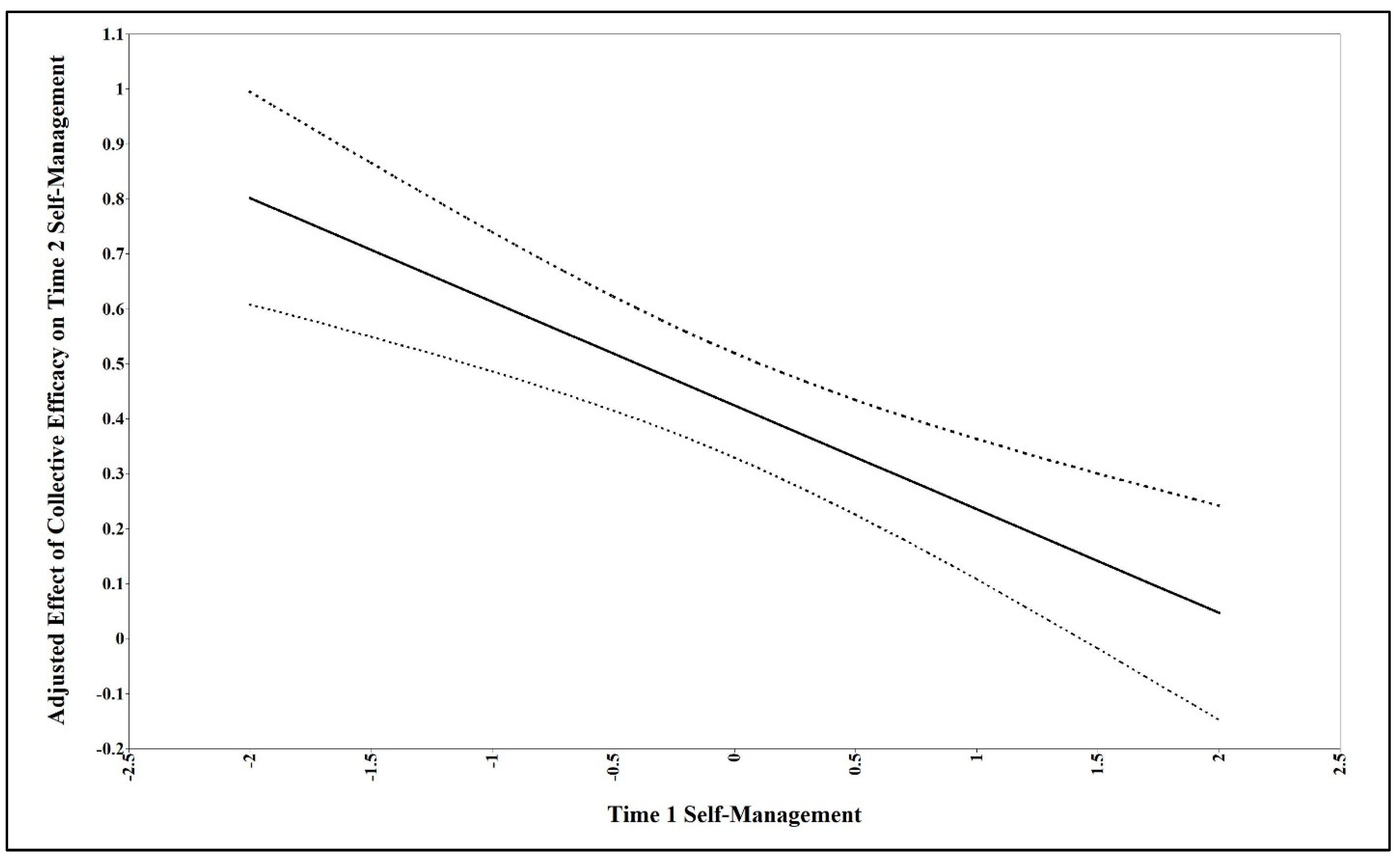
Figure A2.
Johnson-Neyman plot presenting regions of significance over which group mean centered Time 1 self-management significantly moderates the association between shared agency and Time 2 self-management.
Appendix E. Sensitivity Checks
Table A5.
Main and interaction results from models examining the link between social empowerment and change in students’ self-management, excluding students who endorsed the first response option for any social empowerment items.
Table A6.
Main and interaction results from models examining the link between collective efficacy and change in students’ self-management, excluding students who endorsed the first response option for any social empowerment items.
Table A7.
Main and interaction results from models examining the link between group potency and change in students’ self-management, excluding students who endorsed the first response option for any social empowerment items.
Table A8.
Main and interaction results from models examining the link between shared agency and change in students’ self-management, excluding students who endorsed the first response option for any social empowerment items.
Notes
| 1 | The acronym SELF is preferred over SEL to avoid confusion with Social-Emotional Learning while including the word “framework” as a reminder that SELF is a pedagogical tool for effective instructional design in practice. |
| 2 | The non-profit provided services to only Title 1 schools during this implementation, suggesting that the sample is comprised of a high percentage of children from low-income families. No standardized socioeconomic data is available in Canada, where no similar standard exists. |
| 3 | The study team acknowledges that students’ poverty has been shown to meaningfully influence self-management (Piotrowski et al., 2013; Raver, 2012); however, at the request of partnering districts, these data were not collected. We also note that teachers identified sex and not gender. See Section Strengths, Limitations, and Future Research for a more detailed discussion of these as limitations. |
References
- Akos, P., & Galassi, J. P. (2004). Middle and high school transitions as viewed by students, parents, and teachers. Professional School Counseling, 7(4), 212–221. [Google Scholar]
- Archambault, I., Janosz, M., Fallu, J. S., & Pagani, L. S. (2009). Student engagement and its relationship with early high school dropout. Journal of Adolescence, 32(3), 651–670. [Google Scholar] [CrossRef] [Scilit] [PubMed]
- Athayde, R. (2009). Measuring enterprise potential in young people. Entrepreneurship Theory and Practice, 33(2), 481–500. [Google Scholar] [CrossRef] [Scilit]
- Bandura, A. (1977). Self-efficacy: Toward a unifying theory of behavioral change. Psychological Review, 84(2), 191–215. [Google Scholar] [CrossRef] [PubMed]
- Bandura, A. (1982). Self-efficacy mechanisms in human agency. American Psychologist, 37(2), 122–147. [Google Scholar] [CrossRef]
- Bandura, A. (1994). Self-efficacy. In V. S. Ramachaudran (Ed.), Encyclopedia of human behavior (Vol. 4, pp. 71–81). Academic Press. [Google Scholar]
- Bandura, A. (1997). Self-efficacy: The exercise of control. Freeman. [Google Scholar]
- Bandura, A. (2000). Exercise of human agency through collective efficacy. Current Directions in Psychological Science, 9(3), 75–78. [Google Scholar] [CrossRef] [Scilit]
- Bandura, A. (2001). Social cognitive theory: An agentic perspective. Annual Review of Psychology, 52, 1–26. [Google Scholar] [CrossRef] [Scilit]
- Baumeister, R. F., & Finkle, E. J. (2010). Advanced social psychology: The state of science. Oxford University Press. [Google Scholar]
- Burbidge, G., Muraki, E., & Martin, B. H. (2018, September 10–11). Developing engaged thinkers, ethical citizens and entrepreneurial spirit: Applying the socially empowered learning framework in community. 13th International Conference on the Arts in Society, Vancouver, BC, Canada. [Google Scholar]
- Capone, V., Donizzetti, A. R., & Petrillo, F. (2018). Classroom relationships, sense of community, perceptions of justice, and collective efficacy for students’ social-well-being. Journal of Community Psychology, 46(3), 374–382. [Google Scholar] [CrossRef] [Scilit]
- CASEL. (2013). 2013 CASEL guide: Effective social and emotional learning programs—Preschool and elementary school edition. Collaborative for Academic, Social, and Emotional Learning (CASEL). [Google Scholar]
- Checa, P., Rodríguez-Bailón, R., & Rueda, M. R. (2008). Neurocognitive and temperamental systems of self-regulation and early adolescents’ social and academic outcomes. Mind, Brain, and Education, 2(4), 177–187. [Google Scholar] [CrossRef] [Scilit]
- Cleary, T. J., & Zimmerman, B. J. (2004). Self-regulation empowerment program: A school-based program to enhance self-regulated and self-motivated cycles of student learning. Psychology in the Schools, 41(5), 537–550. [Google Scholar] [CrossRef] [Scilit]
- Csikszentmihalyi, M., & Csikszentmihalyi, I. S. (1988). Optimal experience: Psychological studies of flow in consciousness. Cambridge University. [Google Scholar]
- Drolet, M., & Arcand, I. (2013). Positive development, sense of belonging, and support of peers among early adolescents: Perspectives of different actors. International Education Studies, 6(4), 29–38. [Google Scholar] [CrossRef] [Scilit]
- Durlak, J. A., Weissberg, R. P., Dymnicki, A. B., Taylor, R. D., & Schellinger, K. B. (2011). The impact of enhancing students’ social and emotional learning: A meta-analysis of school-based universal interventions. Child Development, 82(1), 405–432. [Google Scholar] [CrossRef] [Scilit]
- Dweck, C. S., & Leggett, E. L. (1988). A social-cognitive approach to motivation and personality. Psychological Review, 95(2), 256–273. [Google Scholar] [CrossRef]
- Eccles, J., & Wang, M. T. (2012). Part I commentary: So what is student engagement anyway? In S. Christenson, A. Reschly, & C. Wylie (Eds.), Handbook of research on student engagement (pp. 133–145). Springer. [Google Scholar] [CrossRef] [Scilit]
- Eccles, J. S., Lord, S., & Midgley, C. (1991). What are we doing to early adolescents? The impact of educational contexts on early adolescents. American Journal of Education, 99(4), 521–542. [Google Scholar] [CrossRef] [Scilit]
- Eccles, J. S., & Wigfield, A. (2002). Motivational beliefs, values, and goals. Annual Review of Psychology, 53, 109–132. [Google Scholar] [CrossRef] [Scilit] [PubMed]
- Elliot, E. S., & Dweck, C. S. (1988). Goals: An approach to motivation and achievement. Journal of Personality and Social Psychology, 54(1), 5–12. [Google Scholar] [CrossRef]
- Enders, C. K., & Tofighi, D. (2007). Centering predictor variables in cross-sectional multilevel models: A new look at an old issue. Psychological Methods, 12(2), 121–138. [Google Scholar] [CrossRef] [Scilit]
- Farley, J. P., & Kim-Spoon, J. (2014). The development of adolescent self-regulation: Reviewing the role of parent, peer, friend, and romantic relationships. Journal of Adolescence, 37(4), 433–440. [Google Scholar] [CrossRef] [Scilit]
- Farley, J. P., & Kim-Spoon, J. (2017). Parenting and adolescent self-regulation mediate between family socioeconomic status and adolescent adjustment. The Journal of Early Adolescence, 37(4), 502–524. [Google Scholar] [CrossRef] [Scilit]
- Feldlaufer, H., Midgley, C., & Eccles, J. S. (1988). Student, teacher, and observer perceptions of the classroom environment before and after the transition to junior high school. The Journal of Early Adolescence, 8(2), 133–156. [Google Scholar] [CrossRef] [Scilit]
- Fernández-Ballesteros, R., Díez-Nicolás, J., Caprara, G. V., Barbaranelli, C., & Bandura, A. (2002). Determinants and structural relation of personal efficacy to collective efficacy. Applied Psychology, 51(1), 107–125. [Google Scholar] [CrossRef] [Scilit]
- Fiske, S. T., & Taylor, S. E. (2013). Social cognition: From brains to culture (2nd ed.). Sage. [Google Scholar] [CrossRef] [Scilit]
- Gehlbach, H., & Hough, H. J. (2018). Measuring social emotional learning through student surveys in the CORE districts: A pragmatic approach to validity and reliability. Policy Analysis for California Education, PACE. Available online: https://eric.ed.gov/?id=ED591082 (accessed on 1 January 2026).
- Gully, S. M., Incalcaterra, K. A., Joshi, A., & Beaubien, J. M. (2002). A meta-analysis of team-efficacy, potency, and performance: Interdependence and level of analysis as moderators of observed relationships. Journal of Applied Psychology, 87(5), 819–832. [Google Scholar] [CrossRef] [Scilit]
- Guzzo, R. A., Yost, P. R., Campbell, R. J., & Shea, G. P. (1993). Potency in groups: Articulating a construct. British Journal of Social Psychology, 32(1), 87–106. [Google Scholar] [CrossRef] [Scilit]
- Harris, M. (2025). A qualitative case study exploring social empowerment and student leader well-being [Doctoral dissertation, University of Calgary]. [Google Scholar]
- Hunter, J. P., & Csikszentmihalyi, M. (2003). The positive psychology of interested adolescents. Journal of Youth and Adolescence, 32(1), 27–35. [Google Scholar] [CrossRef] [Scilit]
- Johnson, P. O., & Neyman, J. (1936). Tests of certain linear hypotheses and their application to some educational problems. Statistical Research Memoirs, 1, 57–93. [Google Scholar]
- Keller, B. T., & Enders, C. K. (2026). Blimp user’s guide (Version 4). Available online: www.appliedmissingdata.com/blimp (accessed on 1 January 2026).
- King, K. M., Lengua, L. J., & Monahan, K. C. (2013). Individual differences in the development of self-regulation during pre-adolescence: Connections to context and adjustment. Journal of Abnormal Child Psychology, 41, 57–69. [Google Scholar] [CrossRef] [Scilit]
- Klassen, R. M., & Krawchuk, L. L. (2009). Collective motivation beliefs of early adolescents working in small groups. Journal of School Psychology, 47(2), 101–120. [Google Scholar] [CrossRef] [Scilit] [PubMed]
- Lardier, D. T., Opara, I., Bergeson, C., Herrera, A., Garcia-Reid, P., & Reid, R. J. (2019). A study of psychological sense of community as a mediator between supportive social systems, school belongingness, and outcome behaviors among urban high school students of color. Journal of Community Psychology, 47(5), 1131–1150. [Google Scholar] [CrossRef] [Scilit] [PubMed]
- Lengua, L. J. (2003). Associations among emotionality, self-regulation, adjustment problems, and positive adjustment in middle school. Journal of Applied Developmental Psychology, 24(5), 595–618. [Google Scholar] [CrossRef] [Scilit]
- Martin, B. H. (2014, April 3–7). Reaching out and drawing in: A conceptual framework for socially empowered learning and student engagement. Conference Proceedings, American Educational Research Academy, Philadelphia, PA, USA. [Google Scholar]
- Martin, B. H. (2018). Social empowerment: The evolution of a model to measure the effects of arts integration and other forms of socially empowered learning. The International Journal of Arts Education, 13(1), 1–17. [Google Scholar] [CrossRef] [Scilit]
- Martin, B. H., & Calvert, A. (2018). Socially empowered learning in the classroom: Effects of arts integration and social enterprise in schools. Journal of Teaching and Learning, 11(2), 27–42. [Google Scholar] [CrossRef] [Scilit]
- Martin, B. H., & Harris, M. (2022). Becoming leaders of change through service: An investigation of socially empowered learning in post-secondary education. International Journal of Leadership in Learning, 22(2), 266–286. [Google Scholar] [CrossRef] [Scilit]
- Meyer, R. H., Wang, Y. C., & Rice, A. B. (2018). Measuring students’ social-emotional learning among California’s CORE districts: An IRT modeling approach. Policy Analysis for California Education. [Google Scholar]
- Midgley, C., Feldlaufer, H., & Eccles, J. S. (1988). The transition to junior high school: Beliefs of pre-and posttransition teachers. Journal of youth and adolescence, 17(6), 543–562. [Google Scholar]
- Muthén, L. K., & Muthén, B. O. (2017). Mplus: Statistical analysis with latent variables: User’s guide (8th ed.). Scientific Research Publishing. [Google Scholar]
- Nathanson, L., Sawyer, B., & Rimm-Kaufman, S. E. (2007). Classroom practices frequency survey [Unpublished instrument]. University of Virginia.
- NEFC. (2003). Responsive classroom: Level 2 resource book. Northeast Foundation for Children (NEFC). [Google Scholar]
- NEFC. (2007). Responsive classroom: Level 1 resource book. Northeast Foundation for Children (NEFC). [Google Scholar]
- Pavez, I., Gómez, H., Laulié, L., & González, V. A. (2021). Project team resilience: The effect of group potency and interpersonal trust. International Journal of Project Management, 39(6), 697–708. [Google Scholar] [CrossRef] [Scilit]
- Piotrowski, J. T., Lapierre, M. A., & Linebarger, D. L. (2013). Investigating correlates of self-regulation in early childhood with a representative sample of English-speaking American families. Journal of Child and Family Studies, 22(3), 423–436. [Google Scholar] [PubMed]
- Raver, C. C. (2012). Low-income children’s self-regulation in the classroom: Scientific inquiry for social change. American Psychologist, 67(8), 681. [Google Scholar] [CrossRef] [Scilit] [PubMed]
- Reeve, J., & Tseng, C. M. (2011). Agency as a fourth aspect of students’ engagement during learning activities. Contemporary Educational Psychology, 36(4), 257–267. [Google Scholar] [CrossRef] [Scilit]
- Rimm-Kaufman, S. E., Larsen, R. A. A., Baroody, A. E., Curby, T. W., Ko, M., Thomas, J. B., Merritt, E. G., Abry, T., & DeCoster, J. (2014). Efficacy of the responsive classroom approach: Results from a 3-year, longitudinal randomized controlled trial. American Educational Research Journal, 51(3), 567–603. [Google Scholar] [CrossRef] [Scilit]
- Ross, K. M., & Tolan, P. (2018). Social and emotional learning in adolescence: Testing the CASEL model in a normative sample. The Journal of Early Adolescence, 38(8), 1170–1199. [Google Scholar] [CrossRef] [Scilit]
- Ryan, A. M. (2000). Peer groups as a context for the socialization of adolescents’ motivation, engagement, and achievement in school. Educational Psychologist, 35(2), 101–111. [Google Scholar] [CrossRef] [Scilit]
- Schunk, D. H. (1990). Goal setting and self-efficacy during self-regulated learning. Educational Psychologist, 25(1), 71–86. [Google Scholar] [CrossRef] [Scilit]
- Schunk, D. H., & Zimmerman, B. J. (1994). Self-regulation of learning and performance: Issues and educational applications. Lawrence Erlbaum Associates, Inc. [Google Scholar]
- Smith, E. P., Osgood, D. W., Caldwell, L., Hynes, K., & Perkins, D. (2013). Measuring collective efficacy among children in community-based afterschool programs: Exploring pathways toward prevention and positive youth development. American Journal of Community Psychology, 52, 27–40. [Google Scholar] [CrossRef] [Scilit] [PubMed]
- Snijders, T. A. B., & Bosker, R. J. (2012). Multilevel analysis: An introduction to basic and advanced multilevel modeling (2nd ed.). SAGE. [Google Scholar]
- Snook, B. H., Buck, R., & Martin, B. H. (2020). Arts integration in Northland, New Zealand: A case of socially empowered learning. Journal of Artistic and Creative Education, 14(1). Available online: https://jace.online/index.php/jace/article/view/237 (accessed on 1 January 2026).
- Stajkovic, A. D., Lee., D., & Nyberg, A. J. (2009). Collective efficacy, group potency, and group performance: Meta-analysis of their relationships, and test of a mediation model. Journal of Applied Psychology, 94(3), 814–828. [Google Scholar] [CrossRef] [Scilit] [PubMed]
- Stipek, D., & Seal, K. (2002). Motivating minds: Nurturing your child’s desire to learn. Our Children, 27(5), 7–8. [Google Scholar]
- Symonds, J., & Hargreaves, L. (2016). Emotional and motivational engagement at school transition: A qualitative stage-environment fit study. The Journal of Early Adolescence, 36(1), 54–85. [Google Scholar] [CrossRef] [Scilit]
- Van Ryzin, M. J., & Roseth, C. J. (2021). The cascading effects of reducing student stress: Cooperative learning as a means to reduce emotional problems and promote academic engagement. The Journal of Early Adolescence, 41(5), 700–724. [Google Scholar] [CrossRef] [Scilit]
- Walls, T., & Little, T. D. (2005). Relations among personal agency, motivation, and school adjustment in early adolescence. Journal of Educational Psychology, 97(1), 23–31. [Google Scholar] [CrossRef] [Scilit]
- Wang, M. T., & Eccles, J. S. (2012). Social support matters: Longitudinal effects of social support on three dimensions of school engagement from middle to high School. Child Development, 83(3), 877–895. [Google Scholar] [CrossRef] [Scilit]
- Weissberg, R. P., Durlak, J. A., Domitrovich, C. E., & Gullotta, T. P. (Eds.). (2015). Social and emotional learning: Past, present, and future. In Handbook of social and emotional learning: Research and practice (pp. 3–19). The Guilford Press. [Google Scholar]
- West, M. R., Buckley, K., Krachman, S. B., & Bookman, N. (2018). Development and implementation of student social-emotional surveys in the CORE districts. Journal of Applied Developmental Psychology, 55, 119–129. [Google Scholar] [CrossRef] [Scilit]
- West, M. R., Pier, L., Fricke, H., Hough, H., Loeb, S., Meyer, R. H., & Rice, A. B. (2020). Trends in student social-emotional learning: Evidence from the first large-scale panel student survey. Educational Evaluation and Policy Analysis, 42(2), 279–303. [Google Scholar] [CrossRef] [Scilit]
- Yaremych, H. E., Preacher, K. J., & Hedeker, D. (2023). Centering categorical predictors in multilevel models: Best practices and interpretation. Psychological Methods, 28(3), 613–630. [Google Scholar] [CrossRef] [Scilit] [PubMed]
- Zimmerman, B. J. (2000). Attaining self-regulation: A social cognitive perspective. In Handbook of self-regulation (pp. 13–39). Academic Press. [Google Scholar] [CrossRef] [Scilit]

Disclaimer/Publisher’s Note: The statements, opinions and data contained in all publications are solely those of the individual author(s) and contributor(s) and not of MDPI and/or the editor(s). MDPI and/or the editor(s) disclaim responsibility for any injury to people or property resulting from any ideas, methods, instructions or products referred to in the content. |
© 2026 by the authors. Licensee MDPI, Basel, Switzerland. This article is an open access article distributed under the terms and conditions of the Creative Commons Attribution (CC BY) license.