


Abstract
Teachers’ well-being continues to attract global attention due to rising workload demands and emotional exhaustion in educational settings. In secondary education, stress and burnout remain critical issues that impact both teaching quality and teacher retention. This study explored gender differences in how workload demands and motivation influence teachers’ stress and burnout, using a multigroup structural equation modelling (SEM) approach based on the Job Demands–Resources (JD–R) model, Self-Determination Theory (SDT), and the Transactional Model of Stress and Coping. Data were collected from 353 Nigerian secondary school science, mathematics, and technology teachers using validated questionnaires measuring workload demands, motivation, attitudes toward work, stress, and burnout. Results indicated that workload demands significantly predict stress and burnout across genders, with a stronger relationship among female teachers. Motivation positively affected attitudes towards work but showed mixed effects on stress and burnout depending on gender. Additionally, attitude towards work predicts stress and burnout, while stress also strongly predict burnout in both groups. These findings suggest that burnout is driven by both demands and motivation, with gender moderating teachers’ responses to occupational pressures. The study concludes that interventions aimed at improving teacher well-being must be gender-sensitive, focusing on reducing excessive workload, fostering intrinsic motivation, and strengthening professional support networks. These insights offer valuable guidance for policymakers and educational administrators seeking to enhance teacher resilience and performance through targeted professional development initiatives.
Keywords:
workload demand; motivation; burnout; stress; gender; science; mathematics; technology teachers 1. Introduction
Teaching has long been regarded as one of the most influential professions, as teachers form the foundation of educational systems and play a crucial role in shaping learners’ intellectual and social development. This is especially evident in secondary education, where science, mathematics, and technology teachers bear significant responsibility in preparing students for further study and careers in fields vital to national development. In Nigeria, the significance of teachers in these subjects cannot be overstated, as science, technology, engineering, and mathematics (STEM) education is widely seen as the foundation of innovation, economic growth, and global competitiveness (Nwabufo, 2024; Popoola & Falebita, 2016). However, while these teachers are responsible for equipping students with future-ready skills, their own working conditions are often fraught with challenges that undermine both their effectiveness and well-being.
The reality for many Nigerian teachers is that the classroom is an environment of constant strain rather than professional fulfilment. Overcrowded classrooms, inadequate resources, and growing administrative demands contribute to excessive workloads, which over time erode teachers’ mental and physical well-being and increase the risk of burnout (Abubakar et al., 2022; Adeogun & Osifila, 2008; Adeyemi, 2008). These conditions not only reduce teachers’ ability to deliver engaging and effective lessons but also erode their mental and physical health over time. The cumulative effect of these stressors often manifests in burnout, a state of prolonged exhaustion and disengagement that leaves teachers emotionally depleted and detached from their work. Burnout has been described as one of the most pressing occupational hazards in education today, with consequences that extend beyond the individual to the school system and the students they serve (Maslach & Leiter, 2022).
This context makes Nigeria a valuable setting for examining occupational stress models in under-resourced educational systems. As the most populous country in Africa, with one of the largest secondary school systems in sub-Saharan Africa, Nigeria faces persistent challenges related to teacher workload, resource scarcity, and systemic pressure to improve STEM outcomes. Compared with many high-income contexts, Nigerian teachers operate within environments characterized by large class sizes, limited instructional resources, and expanding administrative demands, making it a critical case for testing stress and burnout models developed largely in Western settings (Gituriandu et al., 2022; Okeke & Dlamini, 2013). Examining these dynamics within Nigeria therefore contributes to the contextual validation and extension of established occupational stress theories.
The consequences of stress and burnout in the teaching profession are well-documented. Teachers experiencing high levels of burnout are more likely to report absenteeism, diminished job commitment, and reduced teaching quality, all of which negatively affect student achievement (Skaalvik & Skaalvik, 2020). In Nigeria, these issues are particularly acute in the public secondary school sector, where the strain of poor infrastructure, resource scarcity, and heavy workloads further exacerbate teachers’ vulnerability. Recent studies have highlighted worrying trends. For example, Ifunanya (2024) found that secondary school teachers in Nigeria were experiencing severe stress and emotional exhaustion, with mental health outcomes closely linked to resilience levels and health behaviours. Similarly, Azeez et al. (2025) reported that digital workload significantly contributed to burnout among secondary school teachers in Oyo State, with direct implications for job satisfaction and retention. These findings highlight that teacher burnout is a real experience with tangible effects on educational outcomes in Nigeria.
Although prior studies have established relationships among workload demands, motivation, stress, and burnout, most evidence is derived from Western or high-income educational contexts and often treats gender differences as secondary or descriptive findings. Moreover, existing gender-based studies rarely integrate motivational processes, stress appraisal, and workload demands within a single explanatory model. Consequently, in this study, gender is conceptualized not merely as a demographic grouping variable but as a moderator of the psychological and motivational processes underlying teacher stress and burnout. Drawing from sociocultural and role-expectation perspectives, female teachers may experience heightened emotional strain due to multitasking and caregiving responsibilities, whereas male teachers may experience stress differently, linked to role-based performance expectations. This conceptualization allows us to explore how gender shapes the relational dynamics among workload, motivation, stress, and burnout, addressing gaps in the literature that often treat gender descriptively rather than analytically.
This gap is particularly important in the Nigerian context, where secondary school science, mathematics, and technology teachers often face unique pressures. Not only are they responsible for delivering demanding curricula in subjects that require practical demonstrations and problem-solving, but they also work in environments where laboratories, teaching aids, and digital resources are often inadequate or absent. The mismatch between expectations placed on these teachers and the resources available to them intensifies workload demands and creates fertile ground for stress and burnout. Without addressing these challenges, there is a real risk of undermining the government’s ongoing efforts to strengthen STEM education as part of broader national development strategies.
This study addresses the urgent need by examining how workload demands influence stress and burnout among science, mathematics, and technology teachers in Nigerian secondary schools, with a particular focus on gender differences. By framing the inquiry within the Nigerian educational system, the study recognizes both global perspectives and local realities, understanding that teachers’ experiences are shaped not only by universal patterns of stress and burnout but also by specific socio-cultural and institutional factors. In addition to enriching theoretical understanding of the relationship between workload, stress, burnout, and gender, the study offers important practical implications. Its findings provide evidence-based insights to help policymakers, school administrators, and education stakeholders develop targeted strategies that safeguard teacher well-being, boost motivation, and reduce turnover. Ultimately, supporting teachers in this manner is not just about occupational health; it is a crucial investment in education quality and in preparing future generations for the challenges and opportunities of the twenty-first century. To further clarify the focus of the study and guide the proposed multigroup analysis, the following research questions are posed:
- How do workload demand and teacher motivation influence teachers’ attitudes toward work?
- To what extent do workload demand, teacher motivation, and attitudes toward work influence teacher stress and burnout, and do these relationships differ between male and female teachers?
2. Literature Review and Theoretical Foundation
Teacher well-being can be viewed as a combination of emotional, psychological, and professional stability within the work environment, the absence of which can lead to significant stress. The workload, administrative burden, and emotional labour involved in the profession characterize it as a source of stress and burnout (Ozoemena et al., 2021). The well-being of teachers is vital to their health, as well as to the learning outcomes of students and the productivity of the school. In sub-Saharan Africa, the various structural factors, including class sizes, lack of support mechanisms and infrastructure, exacerbate the pressures associated with the teaching occupation. Teachers are vulnerable to stress and burnout due to these factors, particularly in settings with low levels of available professional development and coping mechanisms (Okoro & Ojide, 2023). To mitigate teacher stress and burnout, it is essential to understand how workload demand, motivation, and attitudes interrelate under specific gendered conditions.
2.1. Theoretical Foundation
The study is based on the Job Demands-Resources (JD-R) Model, Self-Determination Theory (SDT), and the Transactional Model of Stress and Coping. These frameworks posit a positive interrelationship between workload demands, motivation, and work attitudes, and stress and burnout among teachers of both genders. JD-R model (Bakker & Demerouti, 2017; Demerouti et al., 2001) states that high workload pressure in the job, lacking sufficient resources, results in burnout. The empirical data of African settings support the claim that teacher stress and exhaustion can be predicted by workload and a lack of support from the institution (Gituriandu et al., 2022; Okeke & Dlamini, 2013). SDT (Deci & Ryan, 2000; Ryan & Deci, 2017) highlights intrinsic motivation and autonomy, competence, and achievement as the factors that enhance resilience and positive work attitudes, and mitigate the effects of burnout (Van Staden-Payne & Nel, 2023). To complement these, there is also the Transactional Model of Stress and Coping (Kyriacou, 2011) wherein the cognitive evaluation of job stressors among teachers determines the emotional response, and long-term stress results in burnout (Fourie & De Klerk, 2024; Maslach & Leiter, 2016). Rather than treating the JD–R model, Self-Determination Theory (SDT), and the Transactional Model as independent, this study adopts JD–R as the primary structural model, positing workload demands and resources as the central drivers of stress and burnout. SDT complements this by explaining motivational processes that influence attitudes and engagement, while the Transactional Model provides the cognitive appraisal mechanism linking demands to stress outcomes. Together, these frameworks allow a holistic analysis of both structural and individual-level processes affecting teacher well-being across genders. The JD–R model explains how workload demands act as structural stressors, SDT accounts for motivational processes shaping teachers’ attitudes and engagement, and the Transactional Model clarifies how these demands and resources are cognitively appraised, resulting in stress and burnout. Together, these frameworks provide a coherent explanation of how structural conditions, environmental demands, psychological motivation, and individual appraisal interact to shape teachers’ well-being across gender groups.
2.2. Attitude Towards Work and Its Effects
The psychological background of teachers’ commitment, motivation, and emotional stability in the profession relies on their attitudes towards work. A positive attitude fosters enthusiasm, resilience, and engagement, whereas a negative attitude tends to create detachment, stress, and burnout. Work attitude refers to the perceived value of work to teachers, the sense they derive from their work, and their satisfaction with working conditions (Taris et al., 2017). It has been discovered that the work attitudes of teachers deteriorate in the presence of heavy workload, lack of support, and poor recognition, leading to stress and emotional exhaustion (Fourie & De Klerk, 2024; Gituriandu et al., 2022). On the other hand, those teachers who perceive their work as meaningful and aligned with personal and institutional goals report higher coping capacity and lower burnout levels (Van Staden-Payne & Nel, 2023). This relationship is also moderated by gender. It has been argued that male and female teachers have different perceptions and reactions to job-related issues. Females tend to be more emotionally stressed due to cultural expectations and differences in multitasking, whereas males may be less stressed because they focus less on their work or discontinue it (Okeke & Dlamini, 2013). In this way, the correlation between attitude towards work, stress, and burnout is complex, influenced not merely by the institutional and individual conditions but also by gender attitudes towards teaching roles. The dynamics are crucial in understanding and designing interventions tailored to these dynamics to promote positive attitudes towards work and enhance teacher well-being among both genders. In this study, it is proposed that:
H1.
Attitude toward work influences teacher burnout, and this relationship differs by gender.
H2.
Attitude toward work influences teacher stress, and this relationship differs by gender.
2.3. Teacher Stress and Burnout
Teacher stress and burnout are serious issues that impact the quality of instruction and the career of the professional. Stress occurs when work requirements exceed the perceived coping capacity of teachers, and burnout is characterized by a set of emotions, including exhaustion, depersonalization, and a loss of individual achievement (Maslach & Leiter, 2016). Consistently high workloads, administrative pressures, and a lack of institutional support in the teaching field can increase stress, which, unless managed, can eventually lead to burnout (Fourie & De Klerk, 2024). Studies attest to the fact that teachers experience a psychological burden due to congested classrooms, inadequate facilities, and conflicting parental and administrative expectations (Gituriandu et al., 2022; Okeke & Dlamini, 2013). Burnout is not an acute phenomenon but rather the result of a prolonged stress exposure and ineffective coping mechanisms. According to the Transactional Model of Stress and Coping (Lazarus & Folkman, 1984), the emotional consequences of job stressors in teachers depend on how they appraise and cope with them. Gender also influences such reactions, with female teachers tending to be more emotional and more prone to fatigue, while male teachers usually depersonalize when faced with the same workload (Adigun et al., 2021), suggesting that female teachers experience higher stress level than their male counterparts (Antoniou et al., 2013). International evidence on gender differences in teacher stress and burnout remains mixed. For example, Bermejo-Toro and Prieto-Ursúa (2014) indicates that male and female teachers do not differ in their level of stress and burnout, suggesting that such effects may be highly context-dependent. Understanding these gender-specific mechanisms, especially among science, mathematics and technology teachers, could be crucial in developing targeted interventions that promote resilience, enhance coping processes, and support teacher well-being. Schools can reduce burnout and maintain teacher effectiveness in the long term by managing individual and institutional factors that contribute to stress. This study thus proposed that:
H3.
Teacher stress influences teacher burnout, and this relationship differs by gender.
2.4. Teacher Motivation and Work Attitude
Teacher motivation is the key to successful teaching as it affects not only the classroom results but also the psychological state and attitude of teachers toward their work. Intrinsic or extrinsic motivation determines how teachers view challenges, continue to engage, and manage profession-related stress (Ryan & Deci, 2017). Self-Determination Theory (SDT) states that highly committed and resilient teachers are those who enjoy the work they do and find it meaningful, which helps them to survive in stressful situations (Dörnyei & Ushioda, 2021). Conversely, extrinsically motivated teachers (teachers whose primary motivation factors are rewards or job security) tend to be subject to more burnout when such external incentives are reduced (Roohani & Dayeri, 2019). Teacher expertise is also influenced by motivation and the attitude towards work, which affects their enthusiasm, versatility, and readiness to innovate. The African setting is one where resource scarcity, poor appreciation, and unsuitable remuneration tend to demoralize the teaching occupation and induce apathy and demotivation (Bawalla, 2021). Nevertheless, research indicates that motivation and resistance to burnout can be enhanced through supportive leadership and professional development opportunities (Trigueros et al., 2020). Gender also attributes more to motivational experiences, such that female teachers tend to have more intrinsic satisfaction with student achievement and engagement, whereas male teachers cite more motivation associated with career growth (Bukhari et al., 2023). Therefore, motivation, as a subjective and situational phenomenon should be interpreted to encourage positive workplace emotions and reduce stress and burnout among males and females.
H4.
Teacher motivation influences attitude toward work, and this relationship differs by gender.
H5.
Teacher motivation influences teacher burnout, and this relationship differs by gender.
H6.
Teacher motivation influences teacher stress, and this relationship differs by gender.
2.5. Workload Demands and Teacher Outcomes
Workload demands, including teaching hours, administrative duties, and extracurricular activities, are important predictors of stress, burnout, and general job satisfaction among teachers. The JD-R model (Bakker & Demerouti, 2017; Demerouti et al., 2001) suggests that overwhelming demands with insufficient resources strain the mental and physical well-being of teachers, making them more susceptible to stress and burnout. The empirical evidence in African settings suggests that the impact of high workload demands, combined with low levels of instructional support and a large number of students, is detrimental to the attitude of teachers and their work-related well-being (Gituriandu et al., 2022; Okeke & Dlamini, 2013). Workload not only impacts stress and burnout but also teachers’ motivation and engagement. Teachers who have too much work become less willing to have a positive attitude towards work, which reduces intrinsic motivation and satisfaction (Baroudi et al., 2022). In contrast, teachers are more resilient and committed to their work when the workload is manageable and there are opportunities to grow professionally (Low et al., 2022). These relationships are moderated by gender, where female teachers tend to be more emotionally strained when they have to balance work and home life and male teachers are likely to develop stress through disengagement or low job satisfaction (Rajendran et al., 2020; Xu et al., 2023). The interplay between workload, stress, burnout, and motivation is crucial for developing targeted interventions. Workload inequities, improvement of support systems and personalized professional development may help reduce adverse effects and facilitate positive work attitudes, which in turn positively impact teacher well-being and quality of teaching. In this study, we proposed that:
H7.
Workload demands influence attitude toward work, and this relationship differs by gender.
H8.
Workload demands influence teacher burnout, and this relationship differs by gender.
H9.
Workload demands influence teacher stress, and this relationship differs by gender.
Although some studies conducted in Africa have affirmed that workload, motivation, and attitudes are determinants of stress and burnout, not many have employed multigroup structure or gender-moderated structure models to establish the connections between them. The JD-R, SDT, and transactional models have very little integration in explaining the gendered experiences of teacher stress and burnout. This lapse explains why the current study examines these relationships between male and female teachers through a structural equation modelling (SEM) approach.
3. Methodology
3.1. Research Design
To achieve the study’s goal, a cross-sectional research design was used. By collecting data from participants only once, this design enables researchers to examine the relationships between variables without needing to monitor them over a long period (Creswell & Creswell, 2017). However, this design does not permit causal inferences. All variables can be assessed simultaneously, providing a complete view of their current states.
3.2. Participants
The sample of the study consists of 353 teachers drawn from science, mathematics, and technology teachers in Ekiti State secondary schools. Ekiti State is located in the southwestern region of Nigeria and is predominantly characterized by public secondary schools serving urban, semi-urban and rural communities. A purposive sampling technique was employed, targeting science, mathematics, and technology teachers who are directly relevant to the study’s focus. This choice ensures the selection of participants with the specific expertise and classroom experience necessary to provide meaningful insights into the research objectives. The demographic characteristics of the participants in this study are summarized in Table 1. A total of 353 participants were surveyed, with a gender distribution of 39.4% male and 60.6% female. This indicates a predominance of female participants in the sample. In terms of specialization, the majority of participants were from the science field (57.2%), followed by mathematics (28.3%) and technology (14.4%). These figures indicate a substantial representation of educators teaching science subjects in secondary schools. Teaching experience varied among participants. The largest group, constituting 43.9%, had 6 to 10 years of teaching experience, while 34.3% had between 1 and 5 years. The remaining participants were distributed across the other experience categories: 10.8% had 11 to 15 years of experience, 2.0% had 16 to 20 years of experience, and 9.0% had over 20 years of experience. Regarding school location, the participants were predominantly from urban (40.2%) and semi-rural areas (40.8%). A smaller percentage of participants came from semi-urban (16.7%) and rural locations (2.3%). Class size, defined by the number of students per class, indicated that 59.5% of participants taught classes with 15 to 30 students. Other class sizes included less than 15 students (22.1%), 31 to 50 students (13.3%), and over 50 students (5.1%). Lastly, the workload was assessed by the number of teaching periods. A majority of participants (53.3%) reported having less than 20 periods, while 25.2% had 21 to 25 periods, 13.3% had 26 to 30 periods, and 8.2% had over 30 periods.
Table 1.
Respondents Demographic Characteristics.
3.3. Instrumentation
To collect data for this study, we designed a structured questionnaire that captured five key constructs: attitude, motivation, workload demand, stress, and burnout. The questionnaire consisted of 15 items, while each construct was measured using three items adapted from well-established instruments, which were then refined to suit the secondary school teaching context (see Appendix A). Teachers’ Attitude was measured with items such as “I feel positive about my ability to teach effectively”, which reflect teachers’ confidence and enjoyment in their classroom roles (Falebita & Olofin, 2020). Motivation items, including “I feel enthusiastic about teaching my students”, focused on both the intrinsic drive and professional commitment that sustain teachers in their daily practice (Criado-Del Rey et al., 2024). Workload Demand was assessed with items such as “I feel overwhelmed by the amount of work required to prepare for classes”, highlighting the pressures of lesson preparation, administrative duties, and balancing work with personal life. The workload demand items were developed based on prior empirical studies examining teaching workload, administrative burden, and work–life balance in educational contexts (Bakker & Demerouti, 2017; Gituriandu et al., 2022). Although not drawn from a single standardized instrument, the items reflect commonly used indicators of perceived workload in teacher stress research. Teachers’ Stress was measured with statements like “I experience anxiety about meeting the expectations of my students and administration”, addressing the psychological strains associated with teaching (Mantilla & Díaz, 2012). Finally, Burnout was assessed with items such as “I often feel emotionally drained after teaching classes”, which reflects emotional exhaustion and detachment specific to teachers (Mantilla & Díaz, 2012). All responses were rated on a seven-point Likert scale, ranging from 1 (Strongly Disagree) to 7 (Strongly Agree), with higher scores indicating stronger agreement. Before the questionnaire was rolled out, it was reviewed by experts in educational psychology and teacher professional development to ensure that the wording was clear and relevant. A pilot test with a small group of teachers also helped refine the instrument, ensuring it was practical and easy to complete.
Although each construct in this study was measured using three items, this approach is consistent with PLS-SEM research that prioritizes parsimony and predictive accuracy, particularly in complex multigroup models (Hair et al., 2019; Sarstedt et al., 2017). Prior studies have demonstrated that well-specified three-item scales can adequately capture latent constructs when items are theoretically grounded and demonstrate strong reliability and validity. While the workload demand items were partially self-developed, they were informed by the Job Demands–Resources framework and previous empirical studies in African educational contexts. Nonetheless, the authors acknowledge that using short scales may limit the breadth of construct coverage, and future studies could employ more comprehensive, fully validated instruments to enhance content validity.
3.4. Data Collection
A Google Forms-hosted online survey was used to gather data for this study, and the link (https://forms.gle/2RLdZRpK2xefnK7d9) was shared via WhatsApp with science, mathematics, and technology teachers across various groups. Because the questionnaire was easily accessible, participants could respond to the survey at their own leisure and in a comfortable environment. To encourage a large number of teachers to complete the survey, it was left open for twelve weeks (3 February to 25 April 2025), with frequent reminders.
The survey was distributed via WhatsApp to secondary school STEM teachers through professional teacher groups within Ekiti State. Participation was voluntary, and no incentives were offered. Although the exact number of teachers who accessed the survey link could not be determined, the final sample represents a substantial cross-section of science, mathematics, and technology teachers in the state. Nevertheless, the reliance on online professional groups may limit representativeness, and findings should be interpreted with this consideration in mind. Ethical approval was obtained from the institutional review body. Participation was voluntary, informed consent was obtained, and data were collected anonymously in compliance with data protection standards.
3.5. Analysis of Data
We employed the PLS-SEM method, which is considered suitable for this inquiry, to analyze the data. Due to its adaptability and durability, it can be effectively used to manage complex models containing latent variables, particularly when working with small sample sizes and non-normally distributed data (Hair et al., 2014). Beyond sample size considerations, PLS-SEM was selected due to the study’s emphasis on prediction, theory extension, and the examination of complex gender-based multigroup relationships. PLS-SEM is particularly suitable for comparing structural paths across subgroups and for models that integrate multiple theoretical frameworks, as in the present study. Furthermore, the primary objective was not model fit confirmation but the exploration of differential path strengths between male and female teachers, making PLS-SEM an appropriate analytical choice. Traditional inferential statistics such as chi-square tests or ANOVA were not reported, as PLS-SEM focuses on variance explanation and prediction rather than model fit indices used in covariance-based approaches. Statistical significance was assessed using bootstrapped path coefficients and confidence intervals. We conducted the analysis using the measurement and structural model, which is a two-stage evaluation process (Hair et al., 2017). The first step involved analyzing the measurement model with a focus on the validity and reliability of the latent constructs. Cronbach’s alpha (CA) and composite reliability (CR) were used to assess reliability. The average variance extracted (AVE) was examined for validity, and discriminant validity was established using the Fornell–Larcker criterion. To confirm each item’s contribution to the model, we also examined its factor loadings. According to Hair et al. (2019), this process showed that the observed variables correctly matched the theoretical concepts they were intended to evaluate. To investigate the anticipated interactions and effects among the latent variables, the second phase looked at the structural model. With empirical data that might support or contradict the proposed hypotheses, this study demonstrated the significance and importance of the interactions across constructs (Sarstedt et al., 2017). Prior to evaluating the substantive relationships of the conceptual model, the two-step SEM analytical approach enabled the confirmation of the psychometric properties of the measurement model. In quantitative research through the use of latent variable techniques, this comprehensive analytical methodology is typically accepted as standard practice, guaranteeing the reliability and validity of the findings (Hair et al., 2021).
4. Results
4.1. Measurement Model Assessment
Table 2 presents the results of the reliability and validity tests for the constructs included in the study. The outer loadings of most of the items were above the minimum acceptable threshold of 0.70 (Hair et al., 2019), indicating that the items strongly represent their respective constructs. For example, the loadings for Burnout ranged from 0.862 to 0.933, while those for Attitude ranged from 0.788 to 0.842, indicating high indicator reliability. However, the outer loading of workload demand, which ranged from 0.665 to 0.862, this values were considered acceptable because other criteria were satisfied, and it contributed to the strength of the model (Falebita et al., 2025; Hair et al., 2010; Sander & Teh, 2014). The Variance Inflation Factor (VIF) values for all items fell below the cut-off of 5.0, with the highest value being 3.874 for BUR2. This suggests that multicollinearity is not a concern, and each indicator contributes uniquely to the construct it measures. In terms of internal consistency, the Cronbach’s Alpha (CA) and Composite Reliability (CR) values for all constructs exceeded the recommended minimum of 0.70 (Hair et al., 2011). For instance, Burnout recorded the highest reliability (CA = 0.871, CR = 0.921), followed closely by Attitude (CA = 0.744, CR = 0.852). Even the construct with the lowest CA, Teacher Motivation (0.725), was still within the acceptable range, demonstrating adequate reliability across constructs. The Average Variance Extracted (AVE) values also met the 0.50 threshold (Fornell & Larcker, 1981), confirming convergent validity. Notably, Burnout showed the strongest convergent validity (AVE = 0.795), followed by Attitude (AVE = 0.657) and Workload Demand (AVE = 0.639). These results affirm that the latent constructs explain a substantial proportion of variance in the indicators.
Table 2.
Reliability and Validity of Constructs.
Table 3 reports the Fornell–Larcker criterion results used to assess discriminant validity among the constructs. According to Fornell and Larcker (1981), discriminant validity is established when the square root of the Average Variance Extracted (AVE) of each construct (shown on the diagonal in bold) is greater than its correlations with other constructs. The diagonal values in the table, Attitude (0.811), Burnout (0.892), Stress (0.798), Teacher Motivation (0.754), and Workload Demand (0.799), are all higher than the off-diagonal correlations in their respective rows and columns. This confirms that each construct shares more variance with its own indicators than with the indicators of other constructs in the model. Notably, the correlations reveal meaningful relationships between constructs. For instance, Stress is strongly correlated with Burnout (r = 0.645) and Workload Demand (r = 0.669), reinforcing the notion that increased workload and stress are key contributors to teacher burnout. Similarly, Attitude shows a strong positive association with Teacher Motivation (r = 0.681), suggesting that higher motivation is closely linked to more positive attitudes toward teaching. On the other hand, weak correlations, such as those between Workload Demand and Teacher Motivation (r = 0.010), indicate little overlap between these constructs, supporting their conceptual distinctiveness. In general, the results demonstrate that the measurement model satisfies the requirements for discriminant validity. Each construct is empirically distinct, yet the pattern of correlations aligns with theoretical expectations: teacher motivation influences attitudes, while stress and workload demand are closely tied to burnout. This provides confidence that the constructs are appropriately measured and can be reliably used in subsequent structural model analysis.
Table 3.
Fornell–Larcker Criterion—Discriminant Validity Analysis.
4.2. Structural Model Assessment
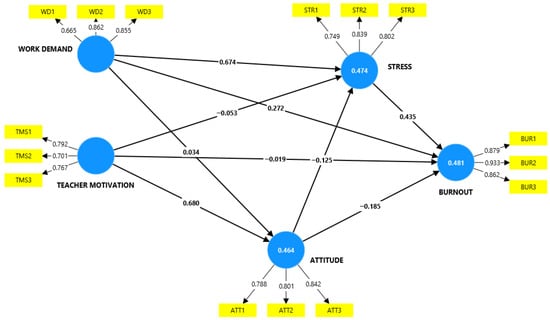
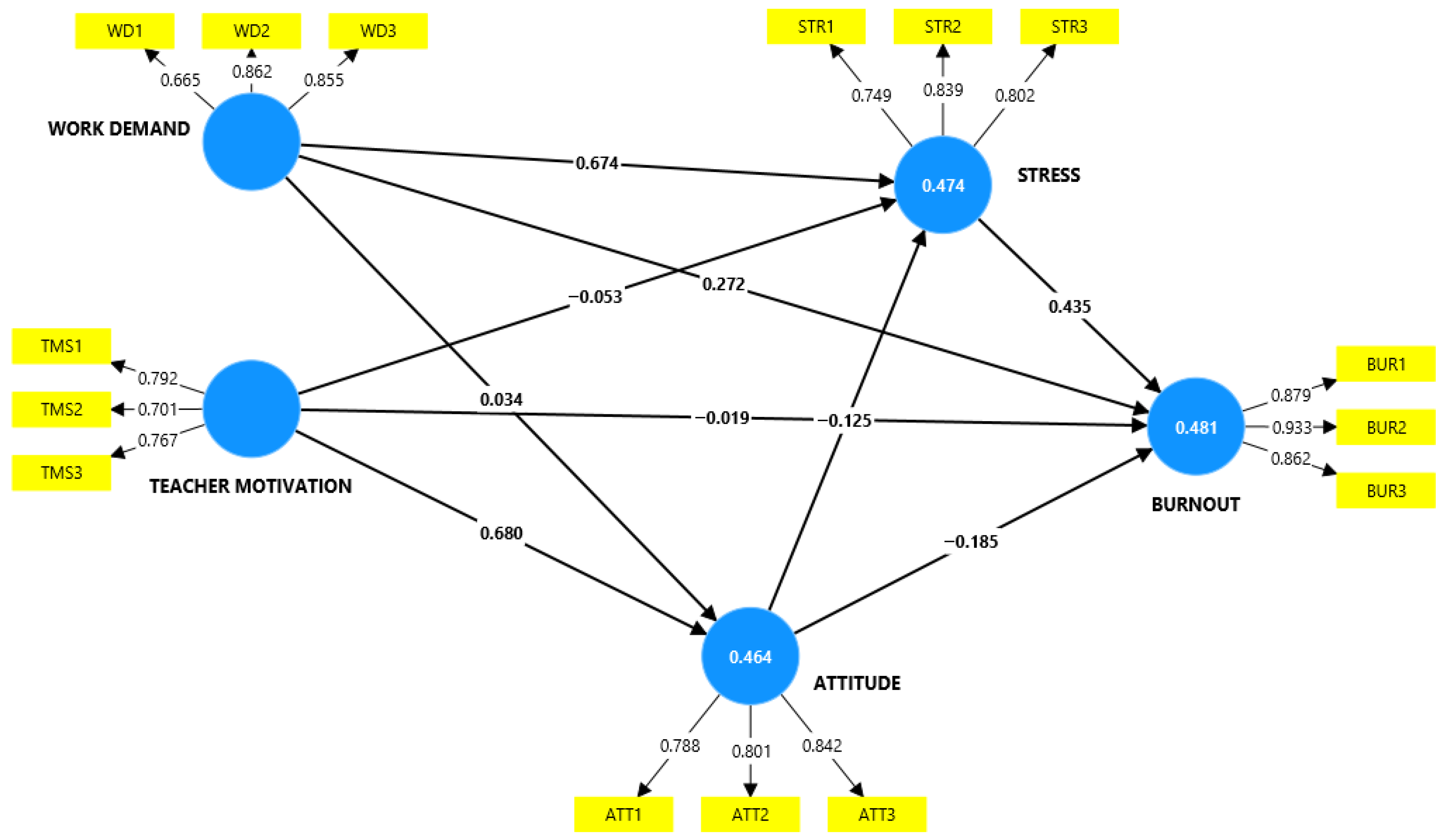
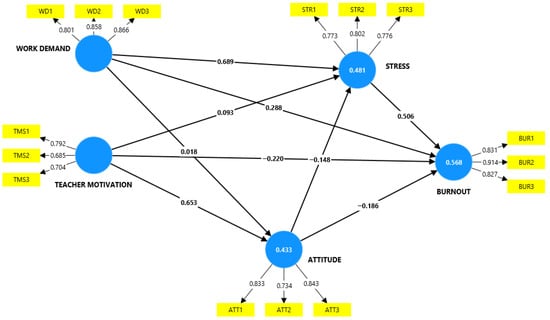
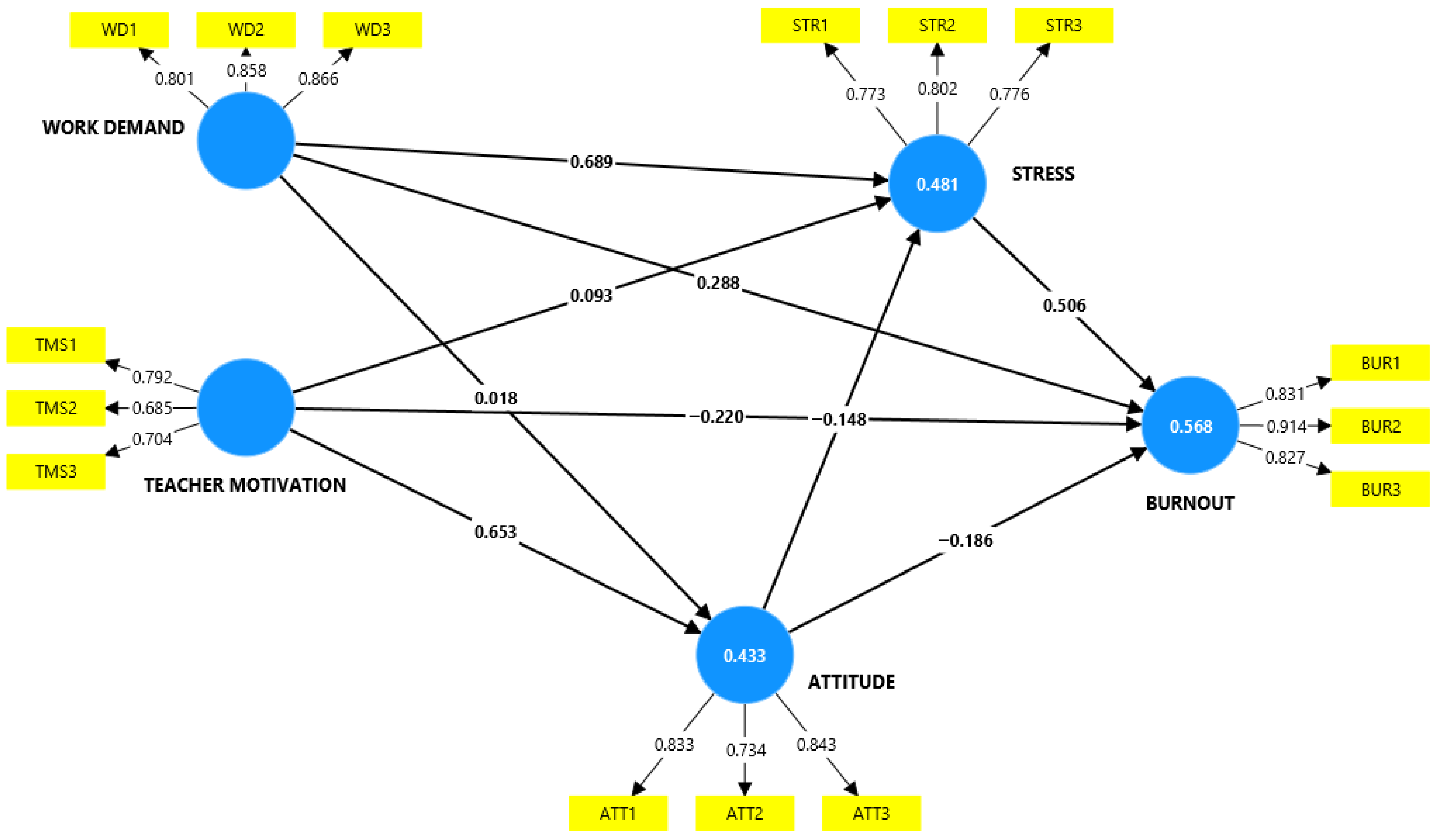
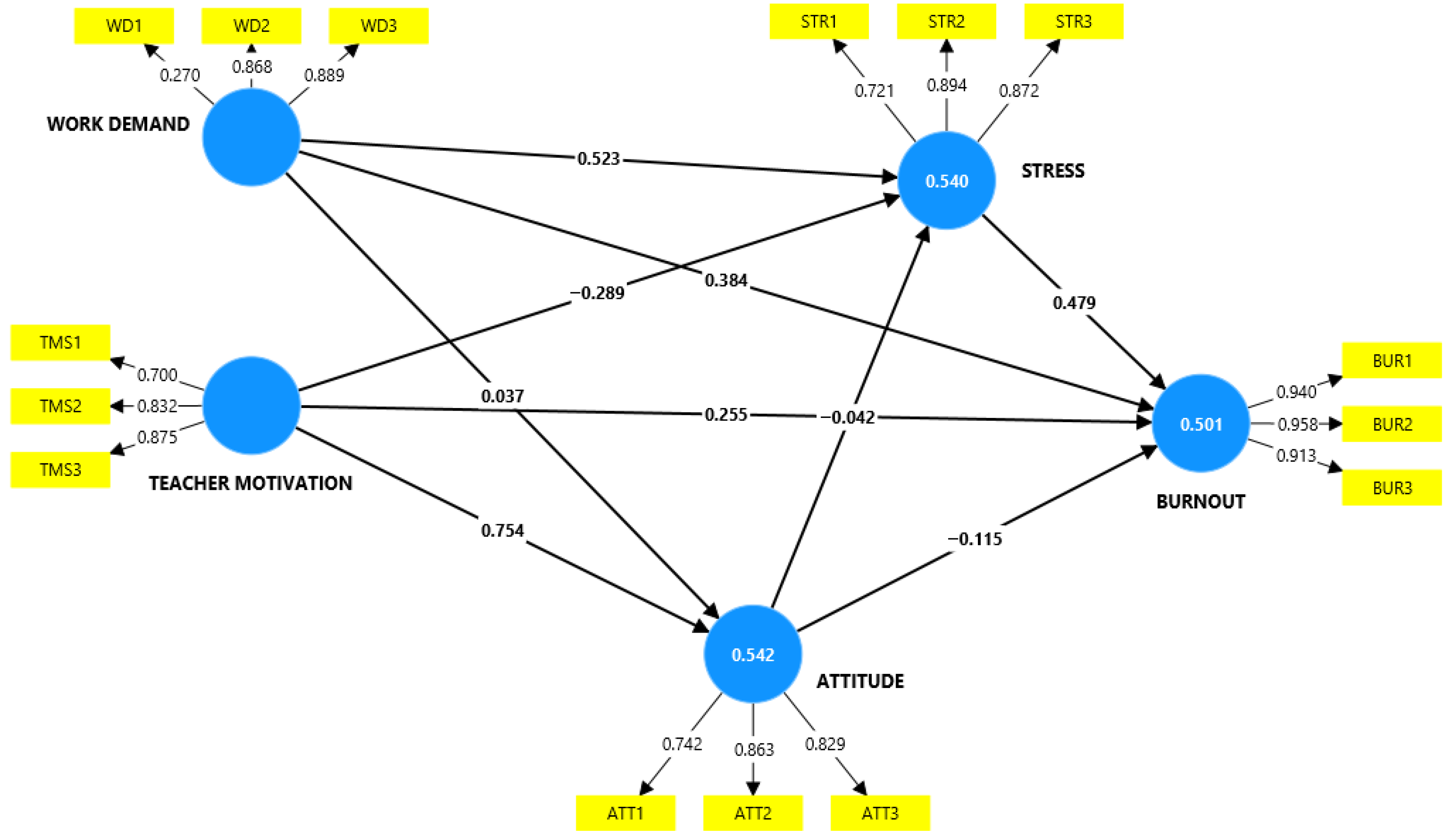
Table 4 presents the results of the multigroup analysis (MGA) based on gender, examining the structural relationships between constructs. The analysis revealed several significant paths in the complete model (also see Figure 1) as well as across female (also see Figure 2) and male (also see Figure 3) subgroups. In the complete sample, Attitude (ATT) negatively predicted both Burnout (BUR) (β = −0.185, t = 4.905, p < 0.05) and Stress (STR) (β = −0.125, t = 3.217, p < 0.05), suggesting that more positive attitudes were associated with lower levels of stress and burnout. Stress strongly and positively predicted Burnout (β = 0.435, t = 7.601, p < 0.05), confirming that teachers experiencing higher stress are more likely to feel burnt out. Similarly, Teacher Motivation (TMS) had a substantial positive effect on Attitude (β = 0.680, t = 21.043, p < 0.05), highlighting motivation as a key driver of teachers’ positive dispositions. Workload Demand (WD) emerged as a powerful predictor of both Stress (β = 0.674, t = 25.606, p < 0.05) and Burnout (β = 0.272, t = 5.485, p < 0.05).
Table 4.
Multigroup Analysis by Gender.
Figure 1.
Structural Model of Teacher Attitude, Stress, and Burnout.
Figure 2.
Structural Model of Female Teacher Attitude, Stress, and Burnout.
Figure 3.
Structural Model of Male Teacher Attitude, Stress, and Burnout.
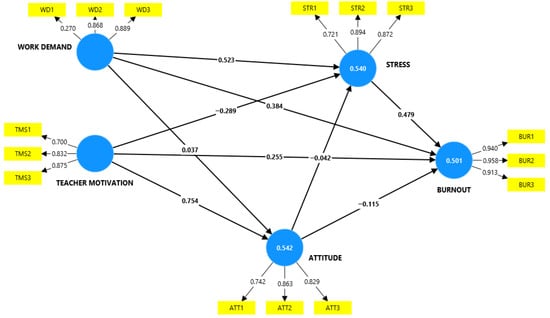
When analyzed by gender, the findings showed some interesting variations. For female teachers, Teacher Motivation not only predicted Attitude (β = 0.653, t = 15.710, p < 0.05) but also had a significant negative effect on Burnout (β = −0.220, t = 3.323, p < 0.05). However, among male teachers, Teacher Motivation positively influenced Burnout (β = 0.255, t = 3.790, p < 0.05) while negatively predicting Stress (β = −0.289, t = 6.497, p < 0.05). These results indicate statistically significant differences in the strength and direction of the associations between teacher motivation and burnout across gender groups. However, given the cross-sectional nature of the data, these relationships should be interpreted as correlational rather than causal. Workload demand was consistently significant for both groups, but with varying magnitudes. For female teachers, WD strongly predicted Stress (β = 0.689, t = 20.462, p < 0.05), while for male teachers, although still significant (β = 0.523, t = 11.910, p < 0.05), the effect size was slightly smaller. Notably, the gender difference test confirmed significant disparities in the effects of Teacher Motivation on Burnout (t = 5.048, p < 0.05), Teacher Motivation on Stress (t = 4.730, p < 0.05), and Workload Demand on Stress (t = 3.010, p < 0.05).
The explanatory power of the model also varied by gender. For female teachers, Burnout had the highest explained variance (R2 = 0.568, Q2 = 0.380), while for males, Attitude showed the strongest explained variance (R2 = 0.542, Q2 = 0.520). This indicates that motivational and work-related factors explain stress and burnout differently across genders. Taken together, these results suggest that gender is associated with differential patterns in the relationships among motivation, attitude, stress, and workload demand. While the overall model demonstrates strong predictive validity, the gender-based findings highlight important contextual differences: among female teachers, higher motivation is associated with lower burnout, whereas among male teachers, higher motivation is associated with higher burnout, indicating divergent relational patterns rather than direct effects.
Figure 1 shows that workload demand functions as a core job demand that is positively associated with stress and indirectly linked to burnout, consistent with the Job Demands–Resources model. Motivation is positively associated with teacher attitude, reflecting Self-Determination Theory, while also showing an association with stress and burnout, indicating that engagement may coexist with strain. From a transactional perspective, these patterns suggest that teachers’ appraisal of job demands and motivational resources jointly shape stress and burnout outcomes.
Figure 2 indicates that for female teachers, motivation is strongly associated with positive work attitudes and shows a weaker association with burnout, suggesting a resource-like role in line with Self-Determination Theory and the JD–R model. Although workload demand remains positively associated with stress, motivational resources appear to mitigate the progression from stress to burnout. Consistent with the Transactional Model, this pattern reflects adaptive appraisal and coping processes among female teachers.
Figure 3 reveals that among male teachers, motivation is positively associated with both stress and burnout, alongside its link to work attitude, indicating a more demanding engagement pattern. Within the JD–R and SDT frameworks, this may reflect heightened role investment and performance expectations accompanying higher motivation rather than a direct causal effect. From a transactional standpoint, this suggests differences in stress appraisal and coping processes that warrant gender-sensitive interpretation.
5. Discussion
This study demonstrates how workload and motivation are associated with teachers’ stress and burnout, revealing notable gender-related differences in these associations. Beyond statistical association, the findings underscore that teachers’ experiences are strongly shaped by contextual and gendered factors. Also, the study’s novel contribution lies in its integration of three theoretical frameworks into a unified gender-sensitive model, demonstrating that the relationships between motivation, workload, stress, and burnout differ across genders in a sub-Saharan African context. Unlike prior studies that treat gender descriptively, this study explicitly models gender as a moderator of psychological and structural processes, highlighting nuanced patterns such as the divergent influence of motivation on male versus female teacher burnout. This extends existing research by showing context-specific differences that refine our understanding of occupational stress mechanisms in STEM education.
5.1. Attitude Toward Work, Teacher Burnout, and Stress
The findings showed that teachers’ attitudes toward work significantly influence teacher burnout, with no gender differences. This indicates that high levels of engagement, while essential for effective teaching, can be emotionally and physically demanding. Over time, this may contribute to burnout when recovery resources are insufficient. This aligns with Wanyonyi and Ouda (2019), who emphasized that teachers’ multiple demanding roles, such as preparing lessons, assessing students, creating a conducive learning environment, and monitoring student progress, can cumulatively contribute to stress and burnout. The lack of gender difference suggests that both male and female teachers are equally susceptible to burnout resulting from their involvement in the classroom. The study also revealed that teachers’ attitudes toward work significantly influence teacher stress, but this effect was significant only for female teachers. This suggests that female teachers may be more sensitive to the pressures of classroom engagement and responsibilities. These results support Antoniou et al. (2006), who reported that female teachers often experience higher occupational stress due to their workload and interactions with students. The gendered pattern for stress suggests that female teachers may experience classroom engagement pressures more intensely, consistent with studies showing higher occupational strain among women in teaching contexts (Antoniou et al., 2006), though other work finds no sex differences in stress outcomes (Bermejo-Toro & Prieto-Ursúa, 2014). These results underscore that attitudes toward work interact with contextual workload demands and gendered social roles to shape well-being (Taris et al., 2017).
5.2. Teacher Stress and Burnout
The findings of this study show that teacher stress has a significant influence on burnout for both genders. Consistent with established models, stress strongly predicted burnout for both male and female teachers, confirming that sustained psychological strain translates into emotional exhaustion and reduced professional efficacy (Maslach & Leiter, 2016). The Transactional Model of Stress and Coping helps explain this pathway: appraisals of demands and the availability of coping resources determine whether exposures become chronic stressors that fuel burnout (Lazarus & Folkman, 1984). Contextual evidence from African and similar settings also shows that higher workload pressures, inadequate facilities, and administrative burdens intensify this progression (Fourie & De Klerk, 2024; Gituriandu et al., 2022). This further suggests that stress is a major predictor of burnout, which arises from a combination of internal and external demands as teachers perform their duties. The uniform effect across genders suggests that once stress reaches a certain threshold, it has a similar impact on burnout regardless of gender.
5.3. Teacher Motivation and Attitude Toward Work, Burnout, and Stress
Findings indicated that teacher motivation has a positive influence on attitude toward work for both genders. This indicates that motivated teachers generally maintain a positive and engaged approach to their responsibilities. Motivation strengthened teachers’ attitudes toward work across genders, aligning with SDT-based findings that intrinsic motivation and autonomy support sustain engagement (Ryan & Deci, 2017; Skaalvik & Skaalvik, 2020). This result also suggests that both internal and external motivational factors encourage teachers to maintain their work effort and engagement, regardless of gender. Additionally, this study reveals that teacher motivation has differential effects on burnout, depending on gender. Motivation negatively influenced burnout for females, suggesting it may serve as a protective factor by buffering against exhaustion. Conversely, motivation positively influenced burnout for males. These findings highlight the intricate relationship between motivation and burnout across genders. These results extend previous research by showing that motivational orientation interacts with gendered role expectations to produce contrasting burnout outcomes, challenging assumptions that motivation uniformly protects against stress. The findings refine the literature by revealing that gender moderates the effect of motivation and workload differently, emphasizing the need for context-aware interventions in teacher well-being strategies (Bukhari et al., 2023; Trigueros et al., 2020). The positive association between motivation and burnout among male teachers should be interpreted with caution. Rather than indicating that motivation causes burnout, this finding may reflect underlying contextual or role-related factors that co-occur with higher motivation, such as increased responsibility, role overload, or heightened performance expectations. Longitudinal and qualitative research is needed to clarify the mechanisms underlying this association. In addition, teacher motivation was found to influence stress differently by gender, being significant only for males. The findings show a significant negative association between motivation and stress among male teachers, whereas this relationship is non-significant among female teachers. From the Job Demands–Resources and Self-Determination Theory perspectives, this suggests that motivation may function more clearly as a psychological resource for male teachers, helping to attenuate stress arising from workload demands. Consistent with the Transactional Model of Stress and Coping, these gender differences may reflect variations in stress appraisal processes, underscoring the need for gender-sensitive interpretations of motivational dynamics.
Gendered patterns observed in this study may reflect broader socio-cultural norms and role expectations within the Nigerian context. Male teachers may experience heightened pressure related to breadwinner expectations or leadership roles, while female teachers may rely more heavily on intrinsic motivation as a coping resource. These interpretations remain tentative and highlight the need for culturally grounded and qualitative investigations.
5.4. Workload Demands, Attitudes Toward Work, Burnout, and Stress
The findings indicate that workload demands did not significantly influence teachers’ attitudes toward their work, regardless of gender. This suggests that teachers’ attitudes remain largely stable despite workload pressures, indicating that their attitudes toward work are influenced more by intrinsic commitment and professional values than by external workload (Klassen & Chiu, 2010). However, workload demands were found to significantly influence teacher burnout for both genders. This suggests that teachers facing excessive workload experience emotional exhaustion and a decline in teaching effectiveness. The absence of gender differences here suggests that excessive workload is equally detrimental to the well-being of both male and female teachers. Additionally, workload demands significantly influenced teacher stress for both genders, but the effect was stronger among female teachers compared to male teachers. This is consistent with previous studies reporting that female teachers often experience higher stress levels due to dual work-family responsibilities, overcommitment, or lower perceived job resources (Antoniou et al., 2006; Tsubono et al., 2024). This highlights that workload management is particularly critical for female teachers to mitigate stress. Overall, workload demands exerted a significant and direct influence on both stress and burnout across genders, corroborating the JD–R model’s assertion that excessive job demands combined with insufficient resources inevitably lead to strain (Bakker & Demerouti, 2017; Demerouti et al., 2001). Although attitudes toward work were relatively stable and less likely to fluctuate in response to workload pressures alone, excessive workload still proved detrimental, consistently undermining teachers’ overall well-being (Gituriandu et al., 2022; Okeke & Dlamini, 2013).
6. Conclusions
This study has provided valuable insights into the complex interplay between workload demands, motivation, stress, and burnout among secondary school teachers, with a particular focus on gender differences. The findings indicate that workload demands are a significant predictor of both stress and burnout across genders, though the strength of this relationship varies. Female teachers experience a stronger correlation between workload demands and both stress and burnout, highlighting their heightened vulnerability to occupational pressures. Motivation emerged as a crucial factor influencing teachers’ attitudes toward their work. It not only positively affected attitudes but also demonstrated differential impacts on stress and burnout based on gender. For female teachers, motivation appeared to serve as a protective factor against burnout, suggesting that those who find intrinsic satisfaction in their teaching roles are better equipped to manage stress. Conversely, male teachers exhibited a paradox in which increased motivation was associated with higher levels of burnout, suggesting that the relationship between motivation and burnout differs across genders, highlighting the need for further investigation into contextual and coping-related factors. The study further established that teachers’ attitudes toward their work play a significant role in influencing both stress and burnout levels. A positive attitude is correlated with lower levels of stress and burnout for both genders, although the relationship was more pronounced for female teachers in terms of stress. This suggests that the emotional and psychological investments that teachers make in their roles can have profound implications for their overall well-being. Theoretically, this study extends the JD–R and SDT frameworks by demonstrating how motivational processes interact with workload demands differently across gender in a sub-Saharan African context. By integrating stress appraisal perspectives, the findings highlight the contextual sensitivity of established occupational stress models.
7. Implications and Future Research
The findings of this study have important implications for teacher well-being, school management, and education policy. Teacher attitude toward work was found to influence burnout and stress significantly, with stress effects particularly pronounced among female teachers, highlighting the need for gender-sensitive interventions such as stress management programmes, counselling services, and workload adjustments. Motivation was shown to enhance attitude toward work for both genders, but influenced burnout and stress differently across genders, suggesting that professional development, recognition, and support strategies should be tailored to ensure motivation strengthens engagement without increasing pressure. Workload demands significantly impacted stress and burnout, particularly for female teachers, indicating the importance of equitable task distribution, manageable class sizes, and additional support resources to mitigate stress. Future research could employ longitudinal designs to investigate causal relationships over time, explore cultural and contextual influences, and assess the effectiveness of targeted interventions. Additionally, investigating other moderators or mediators, such as coping strategies, social support, and technology integration, could provide deeper insights into the mechanisms affecting teacher stress and burnout. Cross-cultural comparative studies are also needed to assess the generalisability of these findings beyond the Nigerian context. Collectively, these findings underscore the need for holistic, context-aware strategies to promote teacher wellbeing and sustain effective teaching practices.
8. Limitations
While this study offers valuable insights into gender differences regarding how workload demands and motivation influence teacher stress and burnout, it is important to recognize some limitations. First, reliance on self-reported data may have introduced bias, as teachers’ responses could have been influenced by personal perceptions or a desire to appear favourable. Future research could improve validity by combining surveys with interviews or classroom observations to gather more comprehensive and objective perspectives. Second, as the study was conducted in a single state, the generalizability of the findings is limited; therefore, the results should be interpreted with caution and should not be uncritically generalized to all teachers in Nigeria. Conducting research across multiple regions or countries would provide a broader understanding of teachers’ experiences. Third, since the study employed a cross-sectional design, it provides only a snapshot in time and does not demonstrate how workload, motivation, stress, and burnout evolve, and as well precludes causal conclusions. Longitudinal studies can help observe these relationships over time to better understand patterns and causality. Fourth, the use of purposive sampling and online data collection via WhatsApp may have introduced self-selection bias, as teachers experiencing higher stress or stronger engagement with professional networks may have been more likely to participate. Additionally, the model did not include control variables such as age, teaching experience, or school type. While this was a deliberate decision to maintain model parsimony and focus on gender-based multigroup comparisons, future studies could incorporate these variables to further strengthen causal inferences and robustness. Fifth, all constructs were measured using relatively short scales, and the workload demand construct was partially self-developed. Although the measurement model demonstrated satisfactory reliability and validity, the limited number of indicators may not fully capture the multidimensional nature of these constructs. Future research should consider using longer, well-established instruments to improve construct coverage and allow for more complex analyses. In addition, measurement invariance across gender groups was not formally tested using procedures such as MICOM. Consequently, the observed gender differences should be interpreted with caution, as they may partially reflect measurement rather than structural differences. Future research should establish full or partial measurement invariance prior to multigroup comparisons. Lastly, although variables such as teaching experience, subject specialization, and class size were collected, they were not included as control variables in the structural model. This decision was made to maintain model parsimony and focus on gender-based multigroup comparisons. Future studies should examine how these factors interact with workload and motivation to influence stress and burnout.
Author Contributions
Conceptualization, O.S.F. and S.E.A.; Methodology and Data Analysis, O.S.F.; Writing—original draft preparation, O.S.F., S.E.A., S.K.E., A.B.A., N.S.X. and H.B.B.; Writing—review and editing, O.S.F., S.E.A., S.K.E., A.B.A., N.S.X. and H.B.B.; Resources, O.S.F., S.E.A. and N.S.X.; Supervision, S.K.E. All authors have read and agreed to the published version of the manuscript.
Funding
This research received no external funding.
Institutional Review Board Statement
The study was conducted in accordance with the Declaration of Helsinki, and approved by University Ethical Review Committee of FederalUniversity Oye Ekiti (Approval Code: ELRC/SE/EDU/001/27, Approval Date: 12 November 2024).
Informed Consent Statement
Informed consent was obtained from all subjects involved in the study.
Data Availability Statement
Data presented in this study are openly available in https://docs.google.com/spreadsheets/d/1lgMNePlSUQF0xshKNO0tjhFkrulG4Hvd/edit?usp=sharing&ouid=102606767094141455146&rtpof=true&sd=true (accessed on 2 February 2026).
Conflicts of Interest
The authors declare that they have no conflicts of interest.
Appendix A
Appendix A.1. Section A: Demographic Information
Gender: Male [ ] Female [ ]
Specialization: Science [ ] Mathematics [ ] Technology [ ]
Teaching Experience 1–5 years [ ] 6–10 years [ ] 11–15 years [ ] 16–20 years [ ] Above 20 years [ ]
School Location: Urban [ ] Semi-urban [ ] Semi-rural [ ] Rural [ ]
Class Size (Number of students per class): Less than 15 [ ] 15–30 students [ ] 31–50 students [ ] Over 50 students [ ]
Workload: Less than 20 periods [ ] 21–25 periods [ ] 26–30 periods [ ] Over 30 periods [ ]
Appendix A.2. Section B
Strongly Agree (SA)—7; Agree (A)—6; Somewhat Agree (SWA)—5; Neutral (N)—4; Somewhat Disagree (SWD)—3; Disagree (D)—2; Strongly Disagree (SD)—1.
| Construct | Items | 7 | 6 | 5 | 4 | 3 | 2 | 1 |
| Teacher’s Attitude | ||||||||
| ATT1 | I feel positive about my ability to teach effectively. | |||||||
| ATT2 | I believe that my teaching has a significant impact on students’ learning outcomes. | |||||||
| ATT3 | I enjoy interacting with students during lessons. | |||||||
| Teacher Motivation | ||||||||
| TMS1 | I pursue professional development opportunities to enhance my skills in teaching. | |||||||
| TMS2 | I feel enthusiastic about teaching my students. | |||||||
| TMS3 | I set personal goals for myself to achieve in my teaching practice. | |||||||
| Workload Demand | ||||||||
| WD1 | I feel overwhelmed by the amount of work required to prepare for classes. | |||||||
| WD2 | I often stay late to complete my teaching responsibilities. | |||||||
| WD3 | I find it difficult to balance teaching responsibilities with other commitments. | |||||||
| Stress | ||||||||
| STR1 | I experience anxiety about meeting the expectations of my students and administration. | |||||||
| STR2 | I feel pressure to perform well in my teaching role. | |||||||
| STR3 | I frequently feel stressed due to my teaching responsibilities. | |||||||
| Burnout | ||||||||
| BUR1 | I usually feel a sense of detachment from my students due to exhaustion. | |||||||
| BUR2 | I often feel emotionally drained after teaching classes. | |||||||
| BUR3 | I worry that I may need to take a break from teaching because of how I feel about being drained. | |||||||
References
- Abubakar, A., Madawaki, A., & Naabu, A. (2022). Influence of overcrowded classrooms on students’ academic performance in secondary schools of Nigeria. Archives of Educational Studies (ARES), 2(2), 258–276. [Google Scholar]
- Adeogun, A. A., & Osifila, G. I. (2008). Relationship between educational resources and students’ academic performance in Lagos State Nigeria. International Journal of Educational Management, 5(6), 144–153. [Google Scholar]
- Adeyemi, T. O. (2008). The influence of class-size on the quality of output in secondary schools in Ekiti State, Nigeria. Pakistan Journal of Social Sciences, 5(2), 202–208. [Google Scholar] [CrossRef] [Scilit]
- Adigun, O. T., Hlongwane, M. M., & Isaiah, O. O. (2021). Personality traits and occupational stress among special needs education teachers. Journal of Psychology in Africa, 31(6), 595–601. [Google Scholar] [CrossRef] [Scilit]
- Antoniou, A.-S., Ploumpi, A., & Ntalla, M. (2013). Occupational stress and professional burnout in teachers of primary and secondary education: The role of coping strategies. Psychology, 4(3), 349–355. [Google Scholar] [CrossRef]
- Antoniou, A.-S., Polychroni, F., & Vlachakis, A.-N. (2006). Gender and age differences in occupational stress and professional burnout between primary and high-school teachers in Greece. Journal of Managerial Psychology, 21(7), 682–690. [Google Scholar] [CrossRef] [Scilit]
- Azeez, N. O., Katibi, S. O., Okorie, G. S., & Dauda, R. B. (2025). Digital workload, teacher burnout, and retention strategies in public secondary schools, Kajola local government, Oyo state, Nigeria. Available online: https://kwasuspace.kwasu.edu.ng/handle/123456789/5578 (accessed on 5 October 2025).
- Bakker, A. B., & Demerouti, E. (2017). Job demands–resources theory: Taking stock and looking forward. Journal of Occupational Health Psychology, 22(3), 273–285. [Google Scholar] [CrossRef] [Scilit]
- Baroudi, S., Tamim, R., & Hojeij, Z. (2022). A quantitative investigation of intrinsic and extrinsic factors influencing teachers’ job satisfaction in Lebanon. Leadership and Policy in Schools, 21(2), 127–146. [Google Scholar] [CrossRef] [Scilit]
- Bawalla, O. G. (2021). Employees’ rewards and job commitment among public secondary school teachers in Ogun state, Nigeria [Doctoral dissertation, University of Ibadan]. Available online: http://140.105.46.132:8080/xmlui/handle/123456789/1661 (accessed on 5 October 2025).
- Bermejo-Toro, L., & Prieto-Ursúa, M. (2014). Absenteeism, burnout and symptomatology of teacher stress: Sex differences. International Journal of Educational Psychology, 3(2), 175–201. [Google Scholar] [CrossRef] [Scilit]
- Bukhari, S. G. A. S., Jamali, S. G., Larik, A. R., & Chang, M. S. (2023). Fostering intrinsic motivation among teachers: Importance of work environment and individual differences. International Journal of School & Educational Psychology, 11(1), 1–19. [Google Scholar] [CrossRef] [Scilit]
- Creswell, J. W., & Creswell, J. D. (2017). Research design: Qualitative, quantitative, and mixed methods approaches. Sage Publications. [Google Scholar]
- Criado-Del Rey, J., Portela-Pino, I., Domínguez-Alonso, J., & Pino-Juste, M. (2024). Assessment of teacher motivation, psychometric properties of the Work Tasks Motivation Scale for Teachers (WTMST) in Spanish teachers. Education Sciences, 14(3), 212. [Google Scholar] [CrossRef] [Scilit]
- Deci, E. L., & Ryan, R. M. (2000). The “what” and “why” of goal pursuits: Human needs and the self-determination of behavior. Psychological Inquiry, 11(4), 227–268. [Google Scholar] [CrossRef] [Scilit]
- Demerouti, E., Bakker, A. B., Nachreiner, F., & Schaufeli, W. B. (2001). The job demands-resources model of burnout. Journal of Applied Psychology, 86(3), 499–512. [Google Scholar] [CrossRef] [PubMed]
- Dörnyei, Z., & Ushioda, E. (2021). Teaching and researching motivation (3rd ed.). Routledge. [Google Scholar] [CrossRef] [Scilit]
- Falebita, O. S., Kok, P. J., Ayanwoye, O. K., & Ogunjobi, A. O. (2025). Virtual reality in education 4.0: Pre-service teachers’ technology readiness and behavioral intention. The International Journal of Technology, Knowledge, and Society, 21(2), 151–177. [Google Scholar] [CrossRef] [Scilit]
- Falebita, O. S., & Olofin, S. O. (2020). Impact of teachers’ instructional practices on students’ achievement and self-efficacy in mathematics. Commonwealth Journal of Academic Research (CJAR.EU), 1(3), 1–14. [Google Scholar] [CrossRef]
- Fornell, C., & Larcker, D. F. (1981). Evaluating structural equation models with unobservable variables and measurement error. Journal of Marketing Research, 18(1), 39–50. [Google Scholar] [CrossRef] [Scilit]
- Fourie, A., & De Klerk, W. (2024). The psychological well-being of schoolteachers in South Africa: A critical review. Journal of Psychology in Africa, 34(1), 95–105. [Google Scholar] [CrossRef] [Scilit]
- Gituriandu, T., Kimani, M., & Mukolwe, N. (2022). Effects of workload on teacher burnout in public secondary schools in Tharaka Nithi County, Kenya. African Journal of Empirical Research, 3(1), 189–207. [Google Scholar] [CrossRef] [Scilit]
- Hair, J. F., Black, W. C., Babin, B. J., & Anderson, R. E. (2010). Multivariate data analysis (785p). Pearson. Available online: https://www.drnishikantjha.com/papersCollection/Multivariate%20Data%20Analysis.pdf (accessed on 24 June 2024).
- Hair, J. F., Hult, G. T. M., Ringle, C. M., Sarstedt, M., Danks, N. P., & Ray, S. (2021). Evaluation of the structural model. In J. F. Hair Jr., G. T. M. Hult, C. M. Ringle, M. Sarstedt, N. P. Danks, & S. Ray (Eds.), Partial least squares structural equation modeling (PLS-SEM) using R: A workbook (pp. 115–138). Springer International Publishing. [Google Scholar] [CrossRef] [Scilit]
- Hair, J. F., Hult, G. T. M., Ringle, C. M., & Sarstedt, M. A. (2017). Primer on partial least squares structural equation modeling (PLS-SEM) (2nd ed.). Sage. [Google Scholar]
- Hair, J. F., Ringle, C. M., & Sarstedt, M. (2011). PLS-SEM: Indeed a silver bullet. Journal of Marketing Theory and Practice, 19(2), 139–152. [Google Scholar] [CrossRef] [Scilit]
- Hair, J. F., Sarstedt, M., Hopkins, L., & Kuppelwieser, V. G. (2014). Partial least squares structural equation modeling (PLS-SEM): An emerging tool in business research. European Business Review, 26(2), 106–121. [Google Scholar] [CrossRef] [Scilit]
- Hair, J. F., Sarstedt, M., & Ringle, C. M. (2019). Rethinking some of the rethinking of partial least squares. European Journal of Marketing, 53(4), 566–584. [Google Scholar] [CrossRef] [Scilit]
- Ifunanya, A. J. (2024). Predictors of mental health and job burnout of secondary school teachers in Owerri education zone I, Imo State Nigeria. Research and Advances in Education, 3(4), 1–9. [Google Scholar] [CrossRef] [Scilit]
- Klassen, R. M., & Chiu, M. M. (2010). Effects on teachers’ self-efficacy and job satisfaction: Teacher gender, years of experience, and job stress. Journal of Educational Psychology, 102(3), 741–756. [Google Scholar] [CrossRef] [Scilit]
- Kyriacou, C. (2011). Teacher stress: From prevalence to resilience. In J. Langan-Fox, & C. Cooper (Eds.), Handbook of stress in the occupations (p. 14333). Edward Elgar Publishing. [Google Scholar] [CrossRef] [Scilit]
- Lazarus, R. S., & Folkman, S. (1984). Stress, appraisal, and coping. Springer Publishing Company. [Google Scholar]
- Low, E. L., Goh, S.-E., & Tan, J. S. Y. (2022). The future of work in education: Teachers’ professional commitment in a changing world. New England Journal of Public Policy, 34(1), 8. [Google Scholar]
- Mantilla, J. M. R., & Díaz, M. J. F. (2012). Development and validation of a measuring instrument for burnout syndrome in teachers. The Spanish Journal of Psychology, 15(3), 1456–1465. [Google Scholar] [CrossRef] [Scilit]
- Maslach, C., & Leiter, M. P. (2016). Understanding the burnout experience: Recent research and its implications for psychiatry. World Psychiatry, 15(2), 103–111. [Google Scholar] [CrossRef] [Scilit] [PubMed]
- Maslach, C., & Leiter, M. P. (2022). The burnout challenge: Managing people’s relationships with their jobs. Harvard University Press. [Google Scholar]
- Nwabufo, E. (2024). The changing landscape of stem education: A comparative analysis (SSRN scholarly paper no. 4791918). Social Science Research Network. [Google Scholar] [CrossRef] [Scilit]
- Okeke, C. I. O., & Dlamini, C. C. (2013). An empirical study of stressors that impinge on teachers in secondary schools in Swaziland. South African Journal of Education, 33(1), 1–12. Available online: https://eric.ed.gov/?id=EJ1135948 (accessed on 5 October 2025). [CrossRef] [Scilit]
- Okoro, U. O., & Ojide, R. N. (2023). Gender differences in perceived sources of stress: A cross sectional survey of public secondary school teachers in Ebonyi state, Nigeria. Journal of Education and Practice, 14(15), 129. [Google Scholar] [CrossRef] [Scilit]
- Ozoemena, E. L., Agbaje, O. S., Ogundu, L., Ononuju, A. H., Umoke, P. C. I., Iweama, C. N., Kato, G. U., Isabu, A. C., & Obute, A. J. (2021). Psychological distress, burnout, and coping strategies among Nigerian primary school teachers: A school-based cross-sectional study. BMC Public Health, 21(1), 2327. [Google Scholar] [CrossRef] [Scilit] [PubMed]
- Popoola, A. A., & Falebita, O. S. (2016). Effects of teachers’ lesson study on Ekiti state secondary school students’ achievement in mathematics. Researchjournali’s Journal of Education, 4(5), 1–10. [Google Scholar]
- Rajendran, N., Watt, H. M. G., & Richardson, P. W. (2020). Teacher burnout and turnover intent. The Australian Educational Researcher, 47(3), 477–500. [Google Scholar] [CrossRef] [Scilit]
- Roohani, A., & Dayeri, K. (2019). On the relationship between Iranian EFL teachers’ burnout and motivation: A mixed methods study. Iranian Journal of Language Teaching Research, 7(1), 77–99. [Google Scholar]
- Ryan, R. M., & Deci, E. L. (Eds.). (2017). Self-determination theory: Basic psychological needs in motivation, development, and wellness. Guilford Press. [Google Scholar] [CrossRef] [Scilit]
- Sander, T., & Teh, P. L. (2014). SmartPLS for the human resources field to evaluate a model. New Challenges of Economic and Business Development, 2014, 346–358. Available online: http://eprints.sunway.edu.my/243/ (accessed on 5 June 2024).
- Sarstedt, M., Ringle, C. M., & Hair, J. F. (2017). Partial least squares structural equation modeling. In C. Homburg, M. Klarmann, & A. Vomberg (Eds.), Handbook of market research (pp. 1–40). Springer International Publishing. [Google Scholar] [CrossRef] [Scilit]
- Skaalvik, E. M., & Skaalvik, S. (2020). Teacher burnout: Relations between dimensions of burnout, perceived school context, job satisfaction and motivation for teaching. A longitudinal study. Teachers and Teaching, 26(7–8), 602–616. [Google Scholar] [CrossRef] [Scilit]
- Taris, T. W., Leisink, P. L. M., & Schaufeli, W. B. (2017). Applying occupational health theories to educator stress: Contribution of the job demands-resources model. In T. M. McIntyre, S. E. McIntyre, & D. J. Francis (Eds.), Educator stress (pp. 237–259). Springer International Publishing. [Google Scholar] [CrossRef] [Scilit]
- Trigueros, R., Padilla, A., Aguilar-Parra, J. M., Mercader, I., López-Liria, R., & Rocamora, P. (2020). The influence of transformational teacher leadership on academic motivation and resilience, burnout and academic performance. International Journal of Environmental Research and Public Health, 17(20), 7687. [Google Scholar] [CrossRef] [Scilit] [PubMed]
- Tsubono, K., Oba, K., Fudetani, Y., Ikeda, C., & Sakamoto, J. (2024). Multidimensional analysis of schoolteachers’ occupational stress by the new brief job stress questionnaire: Focusing on gender differences. Industrial Health, 62(1), 39–55. [Google Scholar] [CrossRef] [Scilit]
- Van Staden-Payne, I., & Nel, M. (2023). Exploring factors that full-service school teachers believe disable their self-efficacy to teach in an inclusive education system. Frontiers in Education, 7, 1009423. [Google Scholar] [CrossRef] [Scilit]
- Wanyonyi, C., & Ouda, J. (2019). Administrative climate, burnout and productivity of teachers: A three-wave study in public secondary schools in Kenya. International Journal of Research and Innovation in Social Science, 3, 391–398. [Google Scholar]
- Xu, L., Guo, J., Zheng, L., & Zhang, Q. (2023). Teacher well-being in Chinese universities: Examining the relationship between challenge—Hindrance stressors, job satisfaction, and teaching engagement. International Journal of Environmental Research and Public Health, 20(2), 1523. [Google Scholar] [CrossRef] [Scilit]

Disclaimer/Publisher’s Note: The statements, opinions and data contained in all publications are solely those of the individual author(s) and contributor(s) and not of MDPI and/or the editor(s). MDPI and/or the editor(s) disclaim responsibility for any injury to people or property resulting from any ideas, methods, instructions or products referred to in the content. |
© 2026 by the authors. Licensee MDPI, Basel, Switzerland. This article is an open access article distributed under the terms and conditions of the Creative Commons Attribution (CC BY) license.