


Abstract
The accelerated integration of generative artificial intelligence (GenAI) into education poses a paradox of cognitive benefit. Those who possess greater knowledge, critical thinking and autonomy can better evaluate, guide and make use of its responses, whereas those who know less end up depending more on assistance that substitutes processes necessary for learning. This asymmetry can generate two recursive trajectories: a virtuous cycle of cognitive expansion and a vicious cycle of dependence and cognitive contraction. This article proposes Productive Cognitive Latency (PCL) as a theoretically derived pedagogical construct for intervening in both trajectories, while recognising that its mechanisms require further empirical validation across learning contexts. PCL regulates the degree and timing of access to the problem-solving power of GenAI so that cognitively formative learner activity is preserved while it retains value for learning. Its application to the design of learning experiences and generative tutors is examined. It is argued that educational AI should optimise not only task resolution, but also the learner’s future capacity to think autonomously.
1. Introduction
Education has historically been organised around a condition that, until very recently, seemed relatively stable. Obtaining a complex response from a learner normally required that they had followed some kind of cognitive path. The classic works on critical thinking by Ennis (1985), Facione (1990) and Halpern (1998) converge precisely on the importance of processes such as interpreting, analysing, evaluating, inferring, justifying and reviewing one’s own judgements. Faced with a question or a problem, the learner had to mobilise some of these processes before reaching a sufficiently satisfactory response.
However, in the current period of growing algorithmic mediation, generative artificial intelligence radically changes this condition. A growing proportion of academic tasks can now receive, within seconds, considerably elaborate explanations, arguments, hypotheses, syntheses, feedback and solutions. In this regard, Chen and Cheung (2025) found positive effects of GenAI on academic achievement and higher-order thinking, although they also identified considerable heterogeneity across contexts and the absence of a significant aggregate effect on metacognition. These results suggest that the educational power of the technology is real, but that its cognitive benefits do not emerge automatically from its availability.
Other recent results reinforce this interpretation, such as those of Ma and Zhong (2025), who found an overall positive effect of GenAI on cognitive, competence-related and affective outcomes across 34 experimental and quasi-experimental studies. At the same time, Han et al. (2025) found a moderate overall effect favourable to GenAI, accompanied by very high heterogeneity across interventions. The available evidence is thus beginning to shift the discussion from the question of whether AI works as a mechanism for leveraging learning towards much more pedagogically significant issues related to how, when, for whom and under what conditions it works appropriately.
The urgency of these questions is increasing because the adoption of generative systems is advancing more rapidly than educational institutions are developing pedagogical criteria for deciding which forms of assistance should be promoted and which could negatively and unintentionally alter what is intended to be taught. In this regard, Kestin et al. (2025) showed through a controlled trial that a carefully designed generative tutor could produce learning gains greater than those of an in-person active-learning condition. However, the system used intentionally incorporated principles of scaffolding, sequencing, active learning and feedback. Taking this into consideration, the result does not demonstrate that any chatbot is a good tutor, but rather shows that the generative capacity of AI can become a powerful educational infrastructure when its behaviour is pedagogically designed.
The evidence also warns that ease of performance and learning should not be considered equivalent. In this regard, Barcaui (2025) found that students who used ChatGPT-4 freely during study showed lower performance than those who studied through traditional methods, despite initially having more efficient assistance. This isolated result does not allow the conclusion that GenAI negatively affects learning, but it illustrates a central distinction for the discussion. Solving a task better while assistance is available does not in itself demonstrate that an equivalent capacity has been developed to solve it subsequently without that assistance.
This distinction leads to the central argument of this article, which is that GenAI introduces what we call a “paradox of cognitive benefit” when it is used as a mechanism for learning assistance. In this sense, the more a person knows about a domain, the better positioned they are to recognise a superficial response, formulate additional questions, challenge assumptions and exploit the iterative possibilities of AI. Conversely, the less knowledge they possess, the greater their need for assistance may be and the lower their initial capacity to judge the quality of what they receive. Thus, the tool that may be most necessary for those who know less may also, when it repeatedly provides highly problem-solving assistance, reduce the opportunities through which those learners could develop the knowledge and judgement needed to require less external resolution in the future.
This dynamic has a conceptual antecedent in the Matthew effect, originally formulated by Merton (1968) and subsequently applied to learning by Stanovich (1986). In education, the concept describes cumulative processes through which certain initial advantages can facilitate further learning opportunities and progressively widen starting differences. The paradox of cognitive benefit shares this recursive logic, although it introduces a mechanism specific to GenAI. Learners with greater cognitive resources can use them to guide, evaluate and transform generative assistance, whereas those who are still developing such resources may need more help while simultaneously facing a greater risk of delegating the very operations through which those resources could develop.
This paradox does not imply that people with less expertise always obtain poorer immediate results. Noy and Zhang (2023) experimentally showed that ChatGPT increased productivity in professional writing tasks and reduced initial performance inequalities. In the same direction, Ma and Zhong (2025) found no significant moderation by prior knowledge in their synthesis of educational outcomes. These findings are especially important because they prevent the proposed paradox from becoming a simplistic generalisation according to which AI benefits experts only.
The issue raised here is different and could be explained in the following terms: a learner with little knowledge can today produce an excellent text, an apparently sophisticated explanation or a correct solution thanks to AI. The pedagogical problem lies in determining whether that interaction leaves them tomorrow more or less prepared to understand, evaluate or solve a similar situation. That difference between assisted performance and capacity development constitutes the centre of the paradox.
When interactions with GenAI are repeated within educational processes, an initial advantage or disadvantage can acquire a recursive character. A learner who has knowledge and judgement can use AI to broaden perspectives, contrast hypotheses and deepen their learning, progressively increasing their capacity to interact with it. On the other hand, a different learner might use a highly problem-solving response to overcome a difficulty without performing the cognitive operations through which they would have acquired greater capacity to deal subsequently with similar problems.
We therefore propose calling these trajectories a “virtuous cycle of cognitive expansion” and a “vicious cycle of cognitive contraction”. In this regard, it should be noted that such cycles do not represent permanent categories among learners, since the same learner can move between them according to the task, discipline, knowledge they possess, type of interaction and educational design structuring AI assistance.
In response to this situation, we propose a foundational construct: Productive Cognitive Latency (PCL). In view of what has been discussed above, it should be noted that PCL does not seek artificially to restore the difficulties of pre-AI education, but rather seeks, among other things, to preserve those cognitive operations whose exercise remains necessary for learning, regulating when and with what degree of problem-solving capacity generative AI assistance is made available to the learner.
However, the complexity of the above makes it necessary to consider that the urgency of the problem lies precisely in the fact that generative systems are already assuming functions of explanation, feedback and tutoring while we still know relatively little about which cognitive operations should be delegated and which should remain temporarily under the learner’s responsibility. Thus, the absence of an explicit pedagogical decision does not constitute neutrality but, in practice, means accepting as an educational model the default behaviour of “intelligent systems” whose main objective has been to provide useful responses, not necessarily to protect the cognitive conditions of learning.
From this perspective, a central concern emerges, not precisely about whether we should use GenAI in education, but about establishing how to design its assistance so that those with less knowledge do not prematurely delegate the cognitive operations they need to perform in order eventually to use it with greater critical thinking and autonomy.
2. Knowing More in Order to Make Better Use of GenAI
Tetzlaff et al. (2025) provide evidence that is especially relevant for understanding the relationship between knowledge and assistance, beyond what is already widely known about scaffolding. Their meta-analysis of the expertise reversal effect showed that learners with less prior knowledge obtain better results when they receive more assistance, whereas students with greater knowledge can benefit from lower levels of support. Educational help, therefore, does not produce the same effects regardless of the learner’s initial resources.
This finding introduces a fundamental distinction for the paradox proposed in this article, insofar as knowing less does not mean needing less help. It usually means the opposite. However, greater assistance does not necessarily amount to greater external resolution. Thus, a novice learner may need more structuring, feedback, questions, examples, diagnosis and hints without it being pedagogically desirable to provide the complete solution immediately.
Accordingly, the difference between expert knowledge and novice knowledge does not consist solely of a quantitative difference either. Research on expertise, such as that of Kalyuga et al. (2003) and Tetzlaff et al. (2025), has shown for decades that those with greater knowledge organise information differently, recognise relevant patterns more quickly and have schemas that allow them to interpret new data more efficiently.
For example, a response about an educational theory may appear grammatically impeccable, coherent and plausible to a student encountering that field for the first time. A researcher with specialised knowledge may immediately detect a conceptual simplification, an incorrect historical relationship or an unjustified inference. Both receive the same response, but cognitively they do not receive the same object because the capacity to interpret it depends on what they already know.
This dependence on prior knowledge should not be understood as an argument for restricting AI to experts. Quite the opposite. The technology’s most transformative potential could lie precisely in providing novice learners with levels of support that were not previously available on an individualised basis. What is necessary, then, is to recognise that such assistance should compensate for the novice’s limitations without automatically substituting the operations through which they will progressively cease to be a novice. Viewed from this perspective, GenAI therefore ceases to be simply a resource used from a prior level of expertise and potentially becomes a mechanism that modifies future expertise. This recursive condition explains why the paradox must be analysed in terms of trajectories and not only immediate outcomes.
3. Two Cumulative Trajectories (or Cycles) of Interaction with GenAI
The paradox of cognitive benefit acquires its true pedagogical relevance when interaction with GenAI ceases to be considered an isolated episode and is viewed as part of a learning trajectory. The heterogeneity of results identified by Chen and Cheung (2025) suggests precisely that access to the technology does not by itself determine its effects.
From this perspective, each interaction can have a cumulative effect. When assistance helps to establish new conceptual relationships, recognise errors, contrast explanations or improve strategies, the learner reaches the next situation with greater resources for interpreting and governing AI. When assistance makes it possible to close the task without equivalent elaboration, the product may improve without the capacity that made it possible to produce it increasing in the same proportion. The vicious and virtuous cycles proposed in this article describe these two possibilities as recursive trajectories, not as fixed categories of users.
3.1. The Vicious Cycle of Dependence and Cognitive Contraction
The concept of cognitive offloading developed by Risko and Gilbert (2016) makes it possible to understand the mechanism that can feed the first trajectory. Offloading part of a cognitive demand onto external resources is a common and, in many cases, functional practice. Writing, calculators and diaries make it possible to distribute cognitive activity between the person and their environment. GenAI substantially expands this possibility because it allows not only memory or calculation to be externalised, but also operations such as explaining, comparing, arguing, planning and even evaluating. Cognitive offloading, therefore, does not in itself constitute a loss of capacity or a pedagogically problematic practice. Its meaning depends on the function that the externalised operation fulfilled within the learning process. When that operation no longer has relevant formative value for the intended objective, delegating it may be fully compatible with the development of capacities; when its performance still contributes to constructing the knowledge, judgement or strategy being developed, its repeated substitution may alter the opportunities through which that capacity would otherwise develop.
The vicious cycle can begin, paradoxically, with a reasonable decision. Faced with a difficulty, the learner asks for help and receives a response sufficiently complete to solve the problem. If they have few criteria with which to examine it, they are likely to use it with limited elaboration. The immediate difficulty disappears, but with it an opportunity to formulate hypotheses, retrieve knowledge, attempt an explanation, detect an error or justify a decision may also disappear. When this pattern is repeated, assistance that compensates for a limitation in the present may contribute to that same limitation persisting in subsequent interactions.
Barcaui’s (2025) results illustrate why this distinction deserves attention. In his study, the benefit that could be perceived during the use of ChatGPT did not translate equivalently into a subsequent retention test. Rather than turning this finding into evidence of a general negative effect of AI, it is more productive to interpret it as a warning about the distance that can exist between assisted performance and learning available subsequently. The vicious cycle is configured when a weaker knowledge base increases the need for problem-solving assistance and that assistance, by repeatedly reducing the learner’s own elaboration, diminishes the opportunities to build the resources that would make less external resolution necessary in the future.
In this article we call “cognitive contraction” this cumulative process of reducing opportunities to exercise intellectually and formatively relevant operations. The term does not refer to neurocognitive deterioration and does not imply that the use of GenAI automatically diminishes previously acquired capacities. Rather, it describes a pedagogical trajectory in which external resolution repeatedly substitutes processes whose performance would have contributed to developing knowledge, judgement or autonomy. Its relevance therefore depends not on externalisation itself, but on which processes cease to be exercised and on the function they fulfilled within learning.
3.2. The Virtuous Cycle of Cognitive Expansion
In contrast to what was presented above, a learning trajectory can start from the same capacity for AI assistance but produce a very different dynamic. The positive effects identified by Ma and Zhong (2025) show that GenAI can expand learning opportunities when it is integrated into appropriate configurations, which may seem quite obvious, but is not therefore easy to achieve. From this perspective, a learner can use AI to contrast a hypothesis, explore alternative explanations, obtain counterexamples or submit an interpretation to objections that they would hardly have generated on their own. In these situations, technology does not necessarily eliminate cognitive activity and, on the contrary, can shift it towards much more demanding levels of comparison, evaluation and revision.
Cognitive expansion appears when the interaction leaves some new resource for the next interaction. Let us illustrate the above through a possible sequence of learner interaction with AI: an initial elaboration makes it possible to formulate a more precise query; the generated response introduces alternatives or tensions; the learner evaluates them on the basis of their available knowledge and revises their position; that revision increases their knowledge and, in turn, improves their capacity to question AI critically. When done in this way, the result of interaction with AI is a recursive relationship in which learning progressively improves the conditions for making use of the technology and the well-regulated use of the technology generates new learning opportunities (Cheng et al., 2025).
However, from the perspective of educational research related to AI, this explains why frequency of use is an insufficient indicator for distinguishing dependence from the enhancement of learning, insofar as a learner situated on an expansion trajectory could use GenAI intensively and yet retain the same degree of intellectual agency. The decisive issue is what happens to the distribution of cognitive activity and what capacity remains with the user after assistance. From this perspective, an interaction is pedagogically valuable not only when it makes it possible to solve the present problem, but when it leaves the learner better prepared to understand, evaluate or solve a similar problem in the future.
The coexistence of both trajectories makes it possible to understand why positive results and warnings about dependence are not necessarily contradictory. They describe different possibilities for applying the same technology. Precisely for this reason, the pedagogical problem cannot be solved simply by deciding whether the use of GenAI is permitted or restricted in education. It is therefore necessary to intervene in the way assistance is incorporated into the cognitive process. To do so, it is useful first to examine a set of antecedents that have shown, from different traditions, that the timing and form of help (in our case, AI help) matter for learning.
4. The Cognitive Space Between Difficulty and Response
Long before the emergence of generative AI, different traditions of educational research had shown that the relationship between difficulty, elaboration and help is not pedagogically neutral. Rowe’s (1986) work on “wait time” showed that extending the interval before teacher intervention could modify the length and quality of students’ responses. Its contribution is suggestive for the current problem of the spontaneous use of AI by teachers and students because it reminds us that a response does not produce the same effects when it appears immediately as when it is preceded by a genuine opportunity for cognitive elaboration. However, with generative AI the issue can no longer be reduced to chronological time, since a few seconds may contain intense cognitive activity and several minutes may pass without it.
The tradition of “desirable difficulties” provides a second antecedent by questioning the equivalence between ease of performance and quality of learning. As Bjork and Bjork (2020) note, certain conditions that temporarily make performance more difficult can favour more durable learning when they require the retrieval, discrimination or reorganisation of information. A similar intuition appears in the “generation effect” documented several decades ago by Slamecka and Graf (1978), according to which producing information can generate different memory effects, comparatively speaking, from simply receiving information. In both cases, difficulty acquires value only when it mobilises relevant processes and, from this perspective, introducing obstacles in themselves does not constitute an effective pedagogical strategy.
This logic receives a broader formulation in generative learning, where learning involves actively selecting, organising, relating and transforming information rather than merely receiving it (Fiorella & Mayer, 2015). From this perspective, assistance can support learning when it helps learners carry out these operations, but it can also reduce their formative value when it performs them prematurely on the learner’s behalf. The pedagogical problem lies not in receiving help, but in determining whether that help keeps available the processes through which the learner constructs understanding.
Another perspective that precedes PCL as a concept is presented by Kapur (2008), who extends this logic to more complex situations through the concept of “productive failure”. In this context, an initial attempt, even when it leads to incomplete or incorrect solutions, can prepare the learner to understand a subsequent explanation because it requires them to activate knowledge, explore relationships and recognise the limits of their own representations. The pedagogical value of error, then, does not lie in prolonging it, but in making use of what the attempt, cognitively speaking, leaves of value in the learner, enabling them to be better prepared to face subsequent instruction. This perspective also makes it possible to add another relevant function to the space between difficulty and resolution. Generative assistance capable of detecting and correcting every deviation immediately may increase executional efficiency while reducing opportunities for the learner to make their own representations visible, recognise why a strategy does not work and revise the criteria that guided the response. The formative value does not lie in deliberately producing errors or prolonging them when the learner cannot move forward, but in allowing errors that emerge during an activity to become objects of interpretation and revision before being replaced by an external solution. From this perspective, a PCL-based intervention may decide not to correct an error immediately when examining it forms part of the cognitive process being developed, using subsequent assistance to guide its understanding and reconstruction.
However, the work of Tetzlaff et al. (2025) on the evidence concerning “expertise reversal” confirms something that seems obvious regarding the relationship between level of expertise and assistance, namely that learners with less knowledge usually need more assistance, which is additionally supported by the already extensive literature published on scaffolding (Puntambekar, 2022). Going further, van de Pol et al. (2010) emphasise that effective support should be contingent, adjust to the learner’s needs and progressively transfer responsibility. In other words, helping more those who know less does not require solving more on their behalf.
Taken together, these antecedents suggest that learning depends partly on how the transition between difficulty and resolution is regulated, which forms the basis of what we propose as Productive Cognitive Latency.
5. Productive Cognitive Latency
We define Productive Cognitive Latency as the pedagogical regulation of the degree and timing at which external problem-solving capacity becomes available to perform a formatively relevant cognitive operation, with the purpose of preserving opportunities for the learner to exercise that operation while its performance retains formative value. In this framework, latency does not designate a predetermined amount of time or a deliberate delay in assistance, but the pedagogically regulated space during which a cognitive operation with formative value continues to require activity from the learner before being substituted by external problem-solving capacity. Its purpose is not to preserve effort for its own sake, because not all effort leads to learning, but to prevent external resolution from prematurely substituting the cognitive activity that makes it possible to construct knowledge, judgement or autonomy.
PCL has clear relationships with the antecedents already presented above, although it addresses a different problem. In summary, Rowe (1986) makes it possible to recognise the potential value of the space preceding a response; Slamecka and Graf (1978) show that producing and receiving are not cognitively equivalent; Kapur (2008) highlights the preparatory value of initial elaboration; Fiorella and Mayer (2015) emphasise the generative character of learning and the learner’s active selection, organisation and transformation of information; van de Pol et al. (2010) explain the importance of adjusting and withdrawing support; and Risko and Gilbert (2016) make it possible to understand the externalisation of cognitive demands. A specific contribution of PCL is to articulate these ideas in relation to a technology whose problem-solving capacity can be available from the very first moment of the activity.
Although PCL draws on the scaffolding tradition, it is not intended as a reformulation of conventional scaffolding. Scaffolding concerns contingent and temporary support that enables learners to perform beyond what they could initially do independently and progressively transfers responsibility as competence develops (van de Pol et al., 2010; Puntambekar, 2022). PCL introduces a more specific regulatory problem made especially salient by GenAI: how much of the target cognitive operation an external system is allowed to resolve, and at what point that resolution becomes available. Thus, two interventions can offer equally frequent or extensive support while differing substantially in their problem-solving power. A tutor may provide questions, diagnosis, feedback, examples and hints without performing the operation that has formative value, whereas a brief response may substitute that operation almost completely. PCL therefore focuses on the degree of external resolution relative to the cognitively formative learner activity that the educational design intends to preserve.
This distinction also provides an initial basis for differentiating PCL empirically from scaffolding. Whereas scaffolding can be characterised through dimensions such as contingency, fading and transfer of responsibility, PCL requires attention to at least two additional features of an assistance episode: the degree of external resolution, understood as the extent to which the target cognitive operation is performed by the external system, and the formatively relevant learner activity preserved, understood as the extent to which the learner continues to perform the operation that contributes to developing the intended capacity. These dimensions are conceptually independent from the frequency or overall amount of support. A learner may therefore receive intensive scaffolding while retaining substantial responsibility for the target operation or receive relatively little assistance that nevertheless resolves that operation almost completely. What PCL regulates, therefore, is not simply how much support is provided, but the point at which external assistance begins to make unnecessary the learner’s own performance of an operation that still retains formative value.
For this reason, latency does not mean waiting or technological delay. A generative tutor can respond immediately and, at the same time, preserve PCL if its intervention keeps active the operation intended to be developed. It can request a justification before evaluating an argument, point out an inconsistency without correcting it, offer a counterexample instead of a solution or provide a hint that allows the learner to continue. What an assistance system based on PCL ultimately regulates is not the system’s response time, but the learner’s access to external resolution that makes unnecessary or replaces a formatively valuable part of their own cognitive activity.
This definition avoids two problematic interpretations. The first would be to turn PCL into a pedagogy of frustration that withholds assistance even when the learner can no longer make productive progress on the operation being developed. The second would be to turn it into a uniform rule according to which every activity must begin without AI. Neither follows from the construct. Accordingly, the form and timing of assistance depend on the available knowledge, the characteristics of the task and, above all, the cognitive operations that need to remain under the learner’s responsibility in order to achieve a particular educational objective.
PCL also does not assume that every operation that can be delegated should temporarily remain under the learner’s responsibility, because its application makes sense only when that operation retains formative value for the capacity being developed. Some activities can be externalised from early stages when performing them contributes little to the intended learning, when the learner already has sufficient mastery of them, or when delegating them enables the educational activity to concentrate on other relevant processes. Other operations, by contrast, contribute to constructing knowledge, criteria or strategies required for later, more complex tasks, so substituting them prematurely may reduce important learning opportunities. Determining this difference is a pedagogical decision that precedes the regulation of assistance, because latency can be considered productive only when it preserves an activity whose performance still contributes to developing capacity.
By way of example, if a learning experience seeks to develop argumentation, it may be necessary for the initial formulation of a thesis and its reasons to remain temporarily under the learner’s exclusive responsibility. If the objective is to develop critical evaluation, AI could generate arguments from the outset, because the activity to be preserved is their evaluation. The same cognitive operation can be central to one learning activity and legitimately delegable in another. Accordingly, the unit of analysis for PCL is not the cognitive operation in the abstract, but the relationship between that operation, its formative function in a particular learning situation and the degree to which external assistance assumes its execution. PCL does not protect cognitive processes indiscriminately, but those that, in a specific situation, constitute part of the learning intended to be promoted.
This relational character also clarifies what makes latency productive. Productivity does not arise from delaying resolution itself, but from the alignment between the assistance provided and the cognitive activity that the learner still needs to perform. Latency can be unproductive when it delays external resolution without keeping an operation with formative value active, and productive when it creates conditions for the learner to retrieve, formulate, infer, contrast, argue, evaluate or revise what they need to learn. It can also cease to be productive when assistance is withheld even though the learner can no longer make meaningful progress on the operation in question. PCL, therefore, does not seek to prolong difficulty, but to regulate assistance so that it accompanies the process without prematurely substituting what still needs to be learnt through doing.
At its current stage, PCL should be understood as a theoretically derived pedagogical construct rather than as an empirically validated instructional model. Its proposed mechanism is grounded in established research on scaffolding, cognitive offloading, generative learning, desirable difficulties and expertise reversal, but the specific relationships proposed here still require empirical validation across disciplines, learner populations, task types and GenAI configurations. In particular, empirical testing should determine whether the degree of external resolution and the learner activity preserved can be measured reliably, distinguished from established dimensions of scaffolding and related systematically to subsequent independent capacity and problem-solving dependence. Future studies also need to establish whether repeated differences in the regulation of external resolution are associated with the cumulative trajectories proposed in this article.
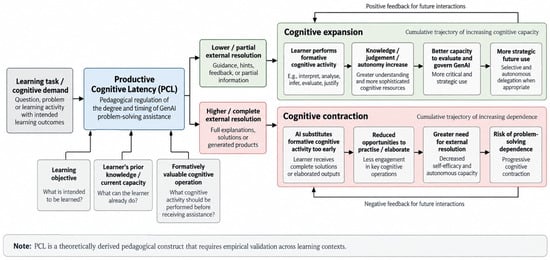
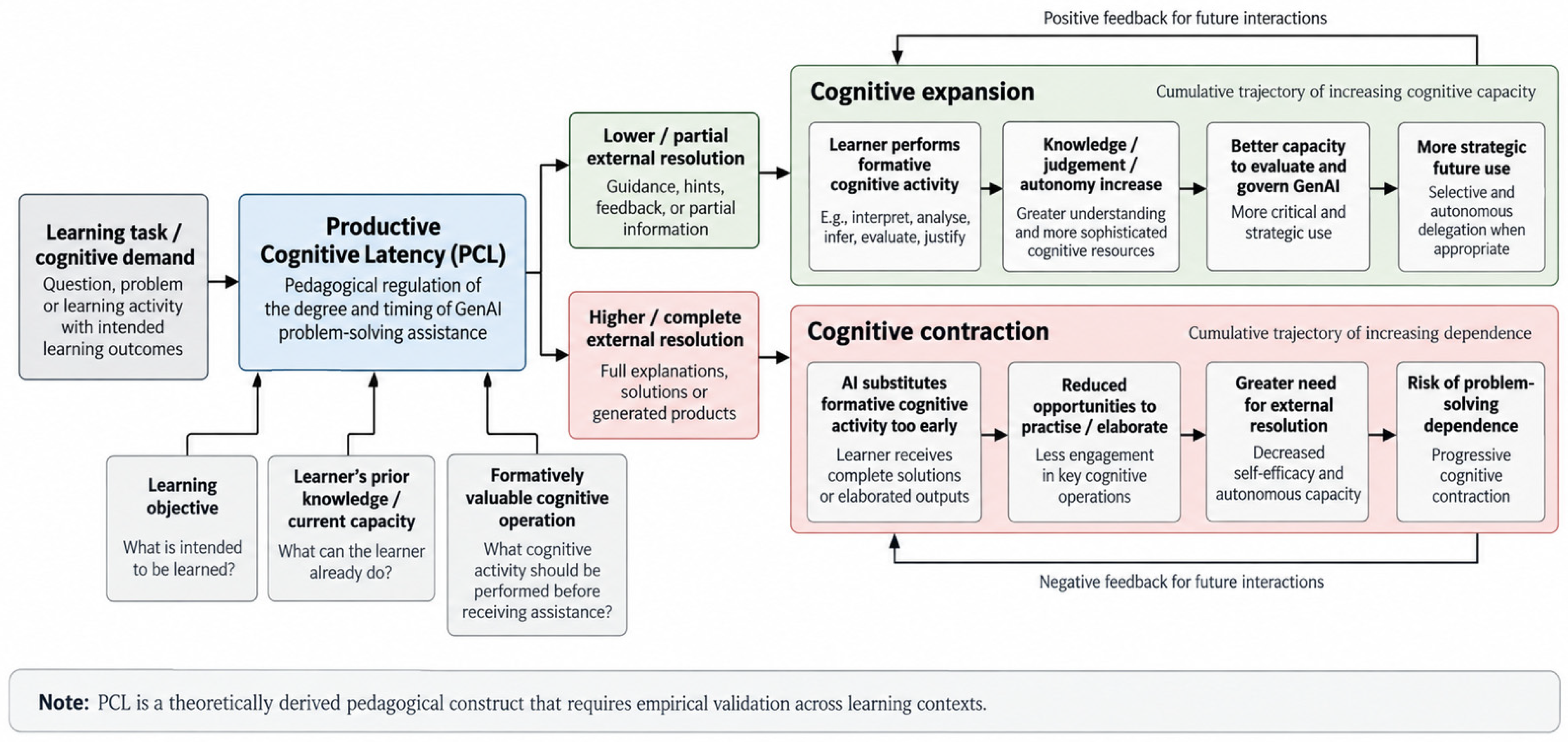
Figure 1 synthesises these relationships by representing PCL as a regulatory mechanism between a learning demand and the degree of GenAI problem-solving assistance that becomes available. The same learning task can lead to different trajectories depending on how the degree and timing of GenAI problem-solving assistance relate to the learner’s current capacity and to the cognitive operation that retains formative value. These trajectories are hypotheses about cumulative patterns rather than deterministic consequences of a single episode of assistance.
Figure 1.
Proposed mechanism of Productive Cognitive Latency (PCL) and the cumulative trajectories of cognitive expansion and cognitive contraction.
PCL regulates the degree and timing of GenAI problem-solving assistance in relation to the learning objective, the learner’s current capacity and the cognitive operation that retains formative value. The figure represents theoretical relationships that require empirical validation.
6. From Cycles to Pedagogical Design
The same logic can be applied to argumentation. In this regard, Abrami et al. (2015) show that critical thinking is strengthened when there are explicit opportunities for judgement, dialogue and contrast. Instead of asking generative AI to produce a complete position, the learner can construct an initial thesis and use the tool as an intellectual adversary that generates counterarguments or tests the consistency of their reasons. Technology then increases the demands of the activity because it broadens what must be considered, without appropriating the final judgement that constitutes the learning objective.
These examples also show that PCL is not equivalent to a fixed sequence of “first without AI and then with AI”. In a simulation, generative AI can participate from the outset by producing perspectives of different people, scenarios or data that the learner must interpret. In that case, the generation of information does not need to be protected because the learning lies in comparing, deciding and justifying. The pedagogically relevant moment is not when AI appears, but when its problem-solving power reaches the operation intended to be developed.
This formulation turns PCL into a design principle. Traditionally, an educational experience organises objectives, content, activities, resources, forms of interaction and assessment. The presence of generative AI adds an additional decision that cannot be left in the background, making it necessary to establish which cognitive activity the learner should perform, what can be delegated without compromising it and what type of assistance can expand learning without substituting it.
Determining which operations retain formative value is therefore a pedagogical decision that precedes regulation by AI. A generative tutor may subsequently adapt the form of its intervention on the basis of the learner’s performance and the needs identified during interaction, but the learning purposes and the processes considered necessary to develop should not be defined exclusively by the system itself. Their configuration requires criteria derived from educational design, disciplinary knowledge and professional teacher judgement, even when the day-to-day execution of assistance may later be automated to different degrees.
With regard to the above, Tetzlaff et al. (2025) also provide a reason for this distribution to be adaptive and, in principle, oriented towards personalisation. The same assistance may be insufficient for a novice learner and excessively problem-solving for another with greater knowledge. Consequently, a learning experience designed on the basis of PCL must combine two requirements that only appear contradictory. Someone who knows less may need more support and, precisely for that reason, needs that support to preserve opportunities to perform the operations through which they will be able to know more. Consequently, the criterion of quality is not the amount of restriction imposed on AI, but the relationship between assistance received and cognitive activity preserved.
7. PCL in the Design of Generative Tutors
Incorporating PCL means turning the degree of problem-solving in the response into a pedagogical variable. Faced with the same difficulty, the tutor could formulate a question, offer a hint, present a counterexample, point out an inconsistency or provide a complete explanation. The choice would depend on what the learner knows, what they have attempted and, above all, which operation they still need to perform because exercising it retains formative value. In this way, personalisation ceases to be limited to vocabulary, difficulty or pace and reaches a deeper dimension concerned with which processes remain with the learner and which can be assumed by the system at a given point (Yan et al., 2025).
Personalising PCL does not simply mean providing more assistance to those who know less and reducing it as mastery increases, because the frequency of intervention and the problem-solving power of each intervention are different dimensions. A novice learner may require more frequent support to sustain progress while, at the same time, needing that support to substitute fewer of the cognitive operations they are still developing. As knowledge increases, some of those operations can be delegated without compromising learning, while assistance can shift towards more complex problems. Personalisation therefore consists in adjusting which part of the activity remains under the learner’s responsibility, taking into account prior knowledge, the learning objective and the point reached in the process.
This perspective also changes the way assistance to those with less knowledge is understood. A more active tutor does not have to be a tutor that solves more. It can intervene more frequently to diagnose, guide, ask questions and provide feedback, while keeping with the learner the activity that has formative value. In terms of the paradox raised at the beginning of the article, someone who knows less does not necessarily need AI to think more in their place. They may need AI to do more so that they can think better.
8. From External Regulation to Autonomy
PCL would lose part of its educational meaning if it remained indefinitely under the teacher’s control. Halpern (1998) places metacognition among the conditions necessary for critical thinking because it makes it possible to monitor one’s own performance and assess the appropriateness of the strategies used. With generative AI, this self-regulation incorporates an additional decision, which is that the learner needs to learn not only how to approach a problem, but also which part of their approach should be externalised and when to do so (Xia et al., 2026).
We propose provisionally calling this capacity “self-regulation of cognitive delegation”, which involves recognising the learning purpose, estimating what is known and what is not yet known, identifying where assistance can expand reasoning and deciding which processes still have value in remaining under one’s own control. From this perspective, autonomy does not consist in dispensing with AI, but in being able to use it without inadvertently surrendering to it the cognitive decisions that define one’s own learning.
This progressive transfer of regulation towards the learner cannot be assumed to be uniform. The capacity to decide what to delegate, when to request assistance and how much problem-solving power to allow AI depends on the development of resources for autonomy and self-regulation that may vary considerably according to the educational stage and the characteristics of the learner. For learners who do not yet have these resources, PCL will require stronger external regulation through teaching or the design of the system itself, whereas their development should enable control over delegation decisions to be transferred progressively to the learner. In this way, autonomy in relation to AI can also be understood as an educational outcome of PCL and not only as a prior condition for applying it.
9. Discussion
9.1. Theoretical Tensions
The framework developed in the previous sections gains explanatory value precisely where it encounters tensions rather than straightforward applications. One of the most important concerns the long history of distributed cognition in education. Many operations once considered indispensable have progressively been externalised as technologies have changed what learners need to do themselves. From this perspective, PCL could be interpreted as an unnecessary defence of capacities that technological development is making less relevant. Yet the framework does not seek to preserve every historically human activity. Its concern is narrower and more pedagogically specific, namely to identify which operations still retain formative value and which can be delegated without compromising the development of the intended capacity. Automating routine procedures or operations that have lost formative value can reduce the cognitive resources required for their execution and allow learners to concentrate on other processes. What remains to be determined is whether the activity that replaces them is genuinely more valuable for learning.
This concern leads directly to a second tension, because preserving an operation could easily be mistaken for defending effort itself. PCL does not assume that effort should be maximised or prolonged. Its formative value depends on the cognitive processes from which it arises and on whether those processes contribute to the intended learning. Accordingly, withholding assistance becomes problematic when it is treated as a principle independent of the learner’s needs. Research on scaffolding and expertise reversal shows that learners with lower prior knowledge generally benefit from greater instructional assistance, whereas the same support may become unnecessary or even counterproductive as expertise increases (Tetzlaff et al., 2025; van de Pol et al., 2010). The implication for PCL is therefore not that latency should be extended, but that external resolution should be regulated while cognitively formative learner activity remains productive. A novice may need frequent support and, at the same time, still need particular operations to remain under their responsibility because those operations form part of what they are learning to do.
Seen in this way, the relationship between PCL and scaffolding becomes more precise. Both traditions are concerned with assistance and the progressive development of learner capacity, but they foreground different dimensions of that relationship. Scaffolding emphasises contingency, adaptation to learner needs, fading and the transfer of responsibility (van de Pol et al., 2010). PCL focuses more specifically on how much of the target cognitive operation an external system is allowed to resolve and on when that resolution becomes available. This distinction matters particularly with GenAI because the system can execute the very operation that learners are expected to develop. Two interventions may therefore provide comparable amounts of assistance while differing substantially in their problem-solving power. A tutor may offer frequent questions, feedback, examples and hints while leaving argument generation, inference or evaluation with the learner. Conversely, a single concise response may almost completely substitute the operation intended to be developed. The theoretical contribution of PCL lies in making this degree of external resolution explicit and relating it to the formative value of the activity that remains necessary for the learner.
A different tension emerges when the focus shifts from the form of assistance to its consequences. GenAI can considerably improve the quality of a product while assistance is available without necessarily producing an equivalent increase in independent capacity. At the same time, intensive use of GenAI should not automatically be interpreted as dependence. Learners may interact frequently with the technology while retaining sufficient knowledge and judgement to govern its contribution strategically. For this reason, frequency of AI use and problem-solving dependence should remain analytically distinct. What matters for PCL is how cognitive activity is distributed between learner and system, what capacity remains available after assistance and whether repeated interactions modify the amount of external resolution required in subsequent comparable situations.
Once regulation is transferred from a general pedagogical principle to an adaptive technological system, an additional tension becomes unavoidable. A generative tutor that regulates its own problem-solving power must infer what the learner knows, what they can still perform and which cognitive operation should remain temporarily under their responsibility. An inaccurate inference can produce two opposite errors. The tutor may resolve prematurely and substitute an operation that still has formative value, or it may withhold resolution when the learner no longer has sufficient resources to progress productively. Moreover, deliberately limiting the completeness of an available response entails a form of control over access to assistance. Any implementation of PCL should therefore incorporate transparency and genuine opportunities for learners to understand and, when appropriate, modify the assistance they receive, preventing an approach intended to promote autonomy from becoming a form of algorithmic paternalism.
9.2. Limitations of the Proposed Framework
The tensions outlined above also delimit what can currently be claimed for PCL. Most importantly, the framework should still be understood as a theoretically derived pedagogical construct rather than as an empirically validated instructional model. Its proposed mechanism is grounded in established research on scaffolding, cognitive offloading, generative learning, desirable difficulties and expertise reversal, but the specific relationships articulated by PCL have not yet been directly tested as an integrated framework. Cognitive expansion, cognitive contraction and problem-solving dependence should therefore be treated as theoretically proposed relationships whose empirical status remains to be established.
This provisional status becomes especially relevant when considering construct differentiation. Because PCL addresses assistance, learner activity and the progressive transfer of responsibility, conceptual overlap with established traditions is inevitable. Its empirical contribution will therefore depend on demonstrating that the degree of external resolution captures a dimension not sufficiently represented by conventional measures of scaffolding, cognitive effort, general self-regulation or frequency of AI use. PCL cannot be inferred merely from the presence of hints, delayed responses, reduced assistance or learner activity. What distinguishes it is the relationship between the amount of the target cognitive operation resolved externally and the cognitively formative activity that remains necessary for the learner.
An important consequence follows from this distinction. A learning environment could display high levels of scaffolding because support is contingent, progressively adjusted and faded, while simultaneously providing high external resolution if the system repeatedly performs the operation that learners are expected to develop. The reverse configuration is also possible. A tutor could provide intensive scaffolding through diagnosis, questioning, feedback and examples while maintaining relatively low external resolution by leaving the target operation with the learner. Empirical studies will therefore need to establish whether PCL-related indicators explain outcomes beyond those accounted for by conventional scaffolding measures.
The framework is also limited by the context-dependent nature of formative value. The same cognitive operation may need to remain under learner responsibility in one educational situation and be legitimately delegated in another. Generating an argument, for instance, may constitute the central learning objective in one activity and merely provide input for critical evaluation in another. Operationalisation will consequently need to be domain-specific and explicitly connected to the learning objective, the learner’s current knowledge and the function of the target operation within the capacity being developed. This makes universal thresholds for high or low PCL difficult to justify independently of a specific educational purpose.
The temporal nature of the framework introduces a further methodological limitation. Cognitive expansion and cognitive contraction are proposed as cumulative trajectories rather than as outcomes of isolated interactions. Their empirical identification therefore requires repeated observations across comparable tasks and sufficient time to determine whether independent capacity and the need for external resolution change. A single episode can provide evidence about the degree of resolution and the learner activity preserved, but it cannot establish the existence of an expansive or contractive trajectory.
This temporal limitation is particularly relevant for the proposed self-regulation of cognitive delegation. Research on GenAI and self-regulated learning indicates that generative systems can support processes such as planning, monitoring, strategy selection and self-assessment (Xia et al., 2026). What remains uncertain is whether decisions about what to delegate, which type of assistance to request and how much external resolution to accept constitute an empirically distinguishable dimension of self-regulation or should instead be interpreted as a context-specific expression of established self-regulatory processes.
9.3. Future Research Agenda and Empirical Testing
These limitations provide a direct agenda for empirical development. A first priority is to refine the operationalisation of PCL at both episode and trajectory levels. At the episode level, the degree of external resolution could be coded according to how much of the target cognitive operation is performed by GenAI. A provisional continuum could range from assistance that leaves the operation largely with the learner, such as questions, prompts or hints, through partial execution, to complete external resolution. Crucially, this measure should be defined relative to the cognitive operation identified as formatively relevant rather than to response length, interaction frequency or technological sophistication.
Once the degree of resolution is specified, the learner side of the interaction also needs to become observable. Preserved learner activity could be examined through intermediate artefacts, revisions, interaction logs, verbal protocols or domain-specific coding of operations such as generating, inferring, evaluating and justifying. Assisted performance could be measured through the quality or accuracy of the product obtained while AI is available, whereas independent capacity could be assessed through transfer tasks or equivalent tasks in which the external system no longer performs the target operation. At the trajectory level, problem-solving dependence could then be estimated from changes in the amount of external resolution required across comparable tasks.
The same logic can be extended to learner regulation. Self-regulation of cognitive delegation could be examined through learners’ choices among different forms of assistance, such as a hint, critique, example, partial solution or complete solution, together with the reasons for those choices. The relevant evidence would not consist in learners systematically requesting less help, but in whether the assistance selected corresponds appropriately to the learning purpose, their current capacity and the operation they still need to perform. These indicators remain provisional and require domain-specific operational definitions, reliability testing and evidence of convergent, discriminant and predictive validity before they can support strong empirical claims about PCL.
Among these validation priorities, the empirical distinction from scaffolding deserves particular attention. Future studies could simultaneously code established scaffolding characteristics such as contingency, fading and transfer of responsibility (van de Pol et al., 2010) and PCL-specific indicators such as degree of external resolution and preservation of the target cognitive operation. Evidence for discriminant validity would be strengthened if learning environments with comparable levels of contingent support nevertheless differed in external resolution and if those differences predicted subsequent independent capacity or problem-solving dependence. Such findings would indicate that PCL captures a dimension of AI-mediated assistance not sufficiently represented by conventional scaffolding constructs.
One way to test this possibility would be through a randomised experimental design in which learners complete equivalent tasks under different degrees of GenAI problem-solving resolution while the overall amount or frequency of assistance is kept as comparable as possible. In an argumentation task, for example, one condition could receive questions, feedback and hints that preserve thesis formulation as the learner’s responsibility, whereas another could receive AI-generated thesis statements or substantially elaborated arguments. Immediate product quality would provide a measure of assisted performance, while a subsequent transfer task completed with reduced external resolution would provide evidence of independent capacity. The central prediction would be that greater external resolution may improve immediate performance while producing smaller gains in the cognitive operation that has been repeatedly substituted, provided that the operation retains formative value and learners possess sufficient prerequisites to perform it. By keeping assistance relatively constant while manipulating how much of the target operation GenAI performs, this design would also provide a direct empirical test of the distinction between PCL and conventional scaffolding.
The recursive nature of the framework requires a complementary design that extends beyond a single intervention. A longitudinal repeated-measures study conducted over several weeks or an academic semester could analyse learners’ interactions with GenAI across comparable tasks to estimate the degree of external resolution, the cognitive activity preserved and the amount of assistance subsequently required. Repeated transfer tasks could assess whether learners progressively become able to perform the target operation with less external resolution. An expansive trajectory would be indicated by increasing independent capacity together with a decreasing need for external resolution for previously practised operations. A contractive trajectory, by contrast, would be suggested by stable or increasing problem-solving dependence despite continued successful assisted performance.
Such a longitudinal design would also make it possible to separate two variables that PCL treats as conceptually different. Total frequency of GenAI use should be analysed independently from problem-solving dependence because intensive AI use may coexist with increasing autonomy when delegation progressively shifts towards operations that no longer retain the same formative value. This distinction could become especially informative when learners continue to use GenAI frequently while requiring less external resolution for operations they previously could not perform without assistance.
Over time, the same design could also reveal whether regulation itself progressively shifts towards the learner. If self-regulation of cognitive delegation can be developed, learners should become increasingly able to select assistance according to what they know, what the task requires and which cognitive operations they still need to exercise. Evidence of development would therefore consist not simply in a movement from complete solutions towards hints, but in a more strategic correspondence between the form of assistance requested and the formative requirements of the situation. This line of research is consistent with emerging work examining the relationship between GenAI and self-regulated learning processes (Xia et al., 2026).
Beyond these initial studies, replication across disciplines, educational stages, learner populations, task types and GenAI configurations will be essential. PCL should also be tested under conditions in which its predictions may not hold. Complete external resolution may sometimes produce equal or greater subsequent learning than preserving the operation, particularly when learners lack sufficient prior knowledge, when cognitive load is excessive or when studying a worked solution has greater instructional value than attempting the operation independently. The expertise reversal literature already indicates that the benefits of assistance vary systematically with prior knowledge (Tetzlaff et al., 2025), reinforcing the need to examine such variables as moderators rather than treating lower external resolution as universally preferable.
For this reason, future research should actively seek not only evidence supporting PCL, but also conditions under which its proposed mechanism is weak, unnecessary or counterproductive. Identifying those boundaries will be essential if the framework is to develop from a theoretically derived construct into an empirically supported pedagogical theory.
9.4. Conclusions
The research agenda outlined above returns the argument to the central problem with which the article began. As GenAI acquires greater problem-solving capacity, the educational value of assistance cannot be inferred solely from whether it improves immediate performance. It also depends on how that assistance redistributes cognitive activity, which operations remain under learner responsibility and what capacity becomes available in subsequent situations.
Within that problem, PCL proposes a specific pedagogical principle. Educational AI should regulate not merely the presence or absence of assistance, but the degree and timing of external resolution in relation to the learning objective, the learner’s current capacity and the formative value of the cognitive operation involved. This distinction allows extensive support to coexist with meaningful learner activity because a system can provide diagnosis, questions, feedback, examples and guidance without necessarily performing the operation that still needs to be developed.
From this perspective, educational effectiveness also acquires a different meaning. Whereas a technological system may be considered more capable when it solves more problems with less human intervention, an educational system may be more successful when its intervention contributes to learners progressively needing less external resolution for the capacities they are developing. Importantly, this reduction in problem-solving dependence does not require less use of GenAI. Learners may continue to use artificial intelligence intensively while shifting delegation towards operations that no longer retain the same formative value and directing their own activity towards increasingly complex forms of understanding, judgement and decision-making.
The theoretical contribution of PCL therefore lies in treating external problem-solving capacity as a pedagogically regulable variable rather than as a neutral property of the technology. This formulation connects the immediate structure of assistance with longer-term questions about capacity development, autonomy and dependence, while also providing a basis for distinguishing between support that enables cognitive activity and support that prematurely substitutes it.
At the same time, the framework remains a theoretically derived proposal whose explanatory and predictive value requires systematic empirical testing. Its future contribution will depend on whether degree of external resolution, preserved cognitive activity and problem-solving dependence can be measured reliably, distinguished empirically from adjacent constructs and related predictably to subsequent learning trajectories. If these relationships receive empirical support, PCL may provide a basis for designing learning experiences and generative tutors that optimise not only present task resolution, but also the learner’s future capacity to understand, judge and decide with increasing autonomy.
Author Contributions
Conceptualization, A.C., E.O.G. and I.D.Á.d.S.; Writing—original draft, A.C., E.O.G. and I.D.Á.d.S.; Writing—review & editing, A.C., E.O.G. and I.D.Á.d.S. All authors have read and agreed to the published version of the manuscript.
Funding
This research was funded by Universidad de La Sabana, Project “Education 4.0: Teaching and Learning with Artificial Intelligence”, project code EDUPHD-20-2022.
Institutional Review Board Statement
Not applicable.
Informed Consent Statement
Not applicable.
Data Availability Statement
No new data were created or analyzed in this study.
Acknowledgments
We thank Universidad de La Sabana, Campus Universitario Puente del Común, KM 7 Autopista Norte de Bogotá, Chía, Cundinamarca, Colombia, for the support received in the preparation of this article. Isabel Dans Álvarez de Sotomayor’s contribution to this work was developed during a research stay at Universidad de La Sabana, Colombia, funded by the Magallanes Programme of the Asociación Universitaria Iberoamericana de Postgrado (AUIP). We would also like to declare that GenAI (ChatGPT version 5.5) was used to improve translation, writing and refine the tone and consistency throughout the manuscript.
Conflicts of Interest
The authors declare no conflict of interest.
References
- Abrami, P. C., Bernard, R. M., Borokhovski, E., Waddington, D. I., Wade, C. A., & Persson, T. (2015). Strategies for teaching students to think critically: A meta-analysis. Review of Educational Research, 85(2), 275–314. [Google Scholar] [CrossRef] [Scilit]
- Barcaui, A. (2025). ChatGPT as a cognitive crutch: Evidence from a randomized controlled trial on knowledge retention. Social Sciences & Humanities Open, 12, 102287. [Google Scholar] [CrossRef] [Scilit]
- Bjork, R. A., & Bjork, E. L. (2020). Desirable difficulties in theory and practice. Journal of Applied Research in Memory and Cognition, 9(4), 475–479. [Google Scholar] [CrossRef] [Scilit]
- Chen, S., & Cheung, A. C. K. (2025). Effect of generative artificial intelligence on university students’ learning outcomes: A systematic review and meta-analysis. Educational Research Review, 49, 100737. [Google Scholar] [CrossRef] [Scilit]
- Cheng, Y., Fan, Y., Li, X., Chen, G., Gašević, D., & Swiecki, Z. (2025). Asking generative artificial intelligence the right questions improves writing performance. Computers and Education: Artificial Intelligence, 8, 100374. [Google Scholar] [CrossRef] [Scilit]
- Ennis, R. H. (1985). A logical basis for measuring critical thinking skills. Educational Leadership, 43(2), 44–48. [Google Scholar]
- Facione, P. A. (1990). Critical thinking: A statement of expert consensus for purposes of educational assessment and instruction. American Philosophical Association. [Google Scholar]
- Fiorella, L., & Mayer, R. E. (2015). Learning as a generative activity: Eight learning strategies that promote understanding. Cambridge University Press. [Google Scholar] [CrossRef] [Scilit]
- Halpern, D. F. (1998). Teaching critical thinking for transfer across domains: Disposition, skills, structure training, and metacognitive monitoring. American Psychologist, 53(4), 449–455. [Google Scholar] [CrossRef]
- Han, X., Peng, H., & Liu, M. (2025). The impact of GenAI on learning outcomes: A systematic review and meta-analysis of experimental studies. Educational Research Review, 48, 100714. [Google Scholar] [CrossRef] [Scilit]
- Kalyuga, S., Ayres, P., Chandler, P., & Sweller, J. (2003). The expertise reversal effect. Educational Psychologist, 38(1), 23–31. [Google Scholar] [CrossRef] [Scilit]
- Kapur, M. (2008). Productive failure. Cognition and Instruction, 26(3), 379–424. [Google Scholar] [CrossRef] [Scilit]
- Kestin, G., Miller, K., Klales, A., Milbourne, T., & Ponti, G. (2025). AI tutoring outperforms in-class active learning: An RCT introducing a novel research-based design in an authentic educational setting. Scientific Reports, 15, 17458. [Google Scholar] [CrossRef] [Scilit]
- Ma, N., & Zhong, Z. (2025). A meta-analysis of the impact of generative artificial intelligence on learning outcomes. Journal of Computer Assisted Learning, 41(5), e70117. [Google Scholar] [CrossRef] [Scilit]
- Merton, R. K. (1968). The Matthew effect in science. Science, 159(3810), 56–63. [Google Scholar] [CrossRef] [Scilit]
- Noy, S., & Zhang, W. (2023). Experimental evidence on the productivity effects of generative artificial intelligence. Science, 381(6654), 187–192. [Google Scholar] [CrossRef] [Scilit]
- Puntambekar, S. (2022). Distributed scaffolding: Scaffolding students in classroom environments. Educational Psychology Review, 34, 451–472. [Google Scholar] [CrossRef] [Scilit]
- Risko, E. F., & Gilbert, S. J. (2016). Cognitive offloading. Trends in Cognitive Sciences, 20(9), 676–688. [Google Scholar] [CrossRef] [Scilit]
- Rowe, M. B. (1986). Wait time: Slowing down may be a way of speeding up! Journal of Teacher Education, 37(1), 43–50. [Google Scholar] [CrossRef] [Scilit]
- Slamecka, N. J., & Graf, P. (1978). The generation effect: Delineation of a phenomenon. Journal of Experimental Psychology: Human Learning and Memory, 4(6), 592–604. [Google Scholar] [CrossRef]
- Stanovich, K. E. (1986). Matthew effects in reading: Some consequences of individual differences in the acquisition of literacy. Reading Research Quarterly, 21(4), 360–407. [Google Scholar] [CrossRef] [Scilit]
- Tetzlaff, L., Simonsmeier, B. A., Peters, T., & Brod, G. (2025). A cornerstone of adaptivity—A meta-analysis of the expertise reversal effect. Learning and Instruction, 98, 102142. [Google Scholar] [CrossRef] [Scilit]
- van de Pol, J., Volman, M., & Beishuizen, J. (2010). Scaffolding in teacher–student interaction: A decade of research. Educational Psychology Review, 22(3), 271–296. [Google Scholar] [CrossRef] [Scilit]
- Xia, Q., Liu, Q., Tlili, A., & Chiu, T. K. F. (2026). A systematic literature review on designing self-regulated learning using generative artificial intelligence and its future research directions. Computers & Education, 240, 105465. [Google Scholar] [CrossRef] [Scilit]
- Yan, L., Martinez-Maldonado, R., Jin, Y., Echeverria, V., Milesi, M., Fan, J., Zhao, L., Alfredo, R., Li, X., & Gašević, D. (2025). The effects of generative AI agents and scaffolding on enhancing students’ comprehension of visual learning analytics. Computers & Education, 234, 105322. [Google Scholar] [CrossRef] [Scilit]
Disclaimer/Publisher’s Note: The statements, opinions and data contained in all publications are solely those of the individual author(s) and contributor(s) and not of MDPI and/or the editor(s). MDPI and/or the editor(s) disclaim responsibility for any injury to people or property resulting from any ideas, methods, instructions or products referred to in the content. |
© 2026 by the authors. Licensee MDPI, Basel, Switzerland. This article is an open access article distributed under the terms and conditions of the Creative Commons Attribution (CC BY) license.