


Abstract
This non-randomized controlled longitudinal study compared coordination and physical fitness in 108 healthy preschool children aged 5–6 years from existing sports-school (n = 61) and preschool (n = 47) programs. Both groups received preschool physical education twice weekly for 45 min; the sports-school group additionally attended two 60-min sessions weekly over 36 weeks. Parents chose program enrollment. The analytic sample required at least 80% attendance and complete measurements. Outcomes were Körperkoordinationstest für Kinder (KTK) Motor Quotients (MQ) and eight fitness and functional-performance tests. Main analyses accounted for seven activity groups. Baseline-adjusted total MQ was 9.97 points higher in the sports-school group (95% confidence interval 5.66–14.28; p = 0.004; wild cluster bootstrap p = 0.031). Three KTK task comparisons met the main false-discovery-rate criterion, although one was sensitive to the inferential method. No fitness comparison met that criterion. Parental selection, previous program experience, unequal activity exposure, selective inclusion, and the small number of groups limit interpretation. The findings describe an association with higher baseline-adjusted follow-up coordination in healthy, adherent children with complete data. They support further evaluation of adapted gymnastics activities; comparable benefits within existing preschool lesson time remain untested.
1. Introduction
Early childhood education provides opportunities for children to explore movement, practice fundamental skills, and participate in varied physical activities. Motor competence is relevant to children’s development and participation, although its relationships with physical activity and health change with age and should not be treated as automatic or uniform (Barnett et al., 2022; Stodden et al., 2008). An international expert statement identifies motor competence as an important component of healthy development in children aged 3–5 years and emphasizes opportunities for developmentally appropriate practice (Martins et al., 2024). For preschool physical education, an important question is which movement content can provide useful practice opportunities and how its outcomes should be evaluated.
Intervention research supports the potential of organized movement practice, while also indicating substantial variation in programs and outcomes. Wick et al. (2017) reported favorable fundamental-movement-skill findings in childcare and kindergarten interventions but rated the certainty of the evidence as very low. More recent syntheses have examined structured and unstructured approaches to preschool skill development (Chen et al., 2024), while the Active Learning Norwegian Preschool(er)s (ACTNOW) trial evaluated a staff-led program combining several physical-activity components (Haugland et al., 2024). A meta-analysis of interventions targeting movement behaviors and socioecological factors reported improvements in fundamental motor skills without corresponding statistically significant pooled improvements in physical fitness or 24-h movement behaviors (Alonso-Martínez et al., 2025). These findings support examining a profile of outcomes rather than assuming that improvement in one capacity will be accompanied by improvement in all others.
Developmental gymnastics offers opportunities to practice balance, jumping and landing, body support, hanging, climbing, and movement around gymnastics apparatus. These activities address stability and whole-body control, complementing locomotor and object-control skills (Rudd et al., 2015). Radanović et al. (2025) examined a developmental gymnastics program in a separate preschool study using the Test of Gross Motor Development, Second Edition (TGMD-2). That study provides a comparison for locomotor and object-control outcomes; the present study examines a separate dataset, gross motor coordination assessed using the Körperkoordinationstest für Kinder (KTK), and eight fitness and functional-performance outcomes.
Assessment choice influences the interpretation of program outcomes. Preschool movement-assessment tools differ in the constructs they measure and in their administration and scoring procedures (Cools et al., 2009). The KTK assesses gross motor coordination through four tasks and provides a system for converting raw scores into age-referenced Motor Quotient (MQ) values (Kiphard & Schilling, 2007). Longitudinal research has shown that raw KTK performance and age-referenced MQ may follow different trajectories (Biino et al., 2023). MQ can therefore complement raw performance when evaluating change, although the age of the original reference sample and the limitations of its use in contemporary populations require consideration (Iivonen et al., 2015).
The present study compared preschool children receiving the same preschool physical-education program with and without a supplementary sports-school program primarily based on developmental gymnastics and complemented by introductory multisport activities. During the observation period, the preschool group had no organized physical activity outside preschool physical education. Parents chose to enroll their children in the sports-school program before the study began, and most children in the sports-school group had previous program experience. The study therefore examined longitudinal differences between existing groups. The contribution lies in examining age-referenced coordination alongside task-specific fitness and functional performance, using regular preschool physical education as an active comparator. This provides a basis for selecting movement content and outcomes for future preschool program evaluations.
The primary aim of the present analysis was to determine whether participation in this gymnastics-based program over a 36-week observation period was associated with a higher follow-up total KTK MQ after adjustment for baseline coordination. Secondary aims were to examine the four task-specific KTK MQ values and eight physical-fitness and functional-performance outcomes. We hypothesized a favorable baseline-adjusted difference in total KTK MQ for the sports-school group. The secondary analyses were intended to characterize the distribution of differences across capacities, without assuming a uniform response.
2. Materials and Methods
2.1. Study Design and Participants
This study used a non-randomized controlled longitudinal field design over a 36-week observation period from September 2024 to May 2025. Baseline assessments were conducted during the week before the start of the program observation period, and follow-up assessments during the week after its completion. The present analysis focused on children aged 5–7 years because the original KTK normative system begins at 5 years of age. All children in the analytic sample were aged 5 or 6 years at baseline; follow-up normative age categories ranged from 5 to 7 years. The initial cohort comprised 175 children: 97 recruited from the sports school and 78 from the preschool institution. Eligibility for the final analytic sample required children to be healthy and free from injuries, to be at least 5 years old at baseline, to attend at least 80% of the scheduled sessions in their respective program, and to have complete baseline and follow-up data for the outcomes examined. The attendance threshold was established prospectively. Attendance was recorded at the beginning of each session in both groups.
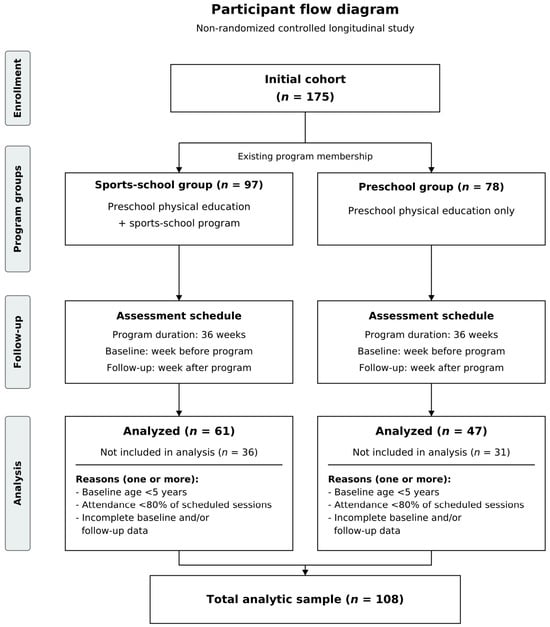
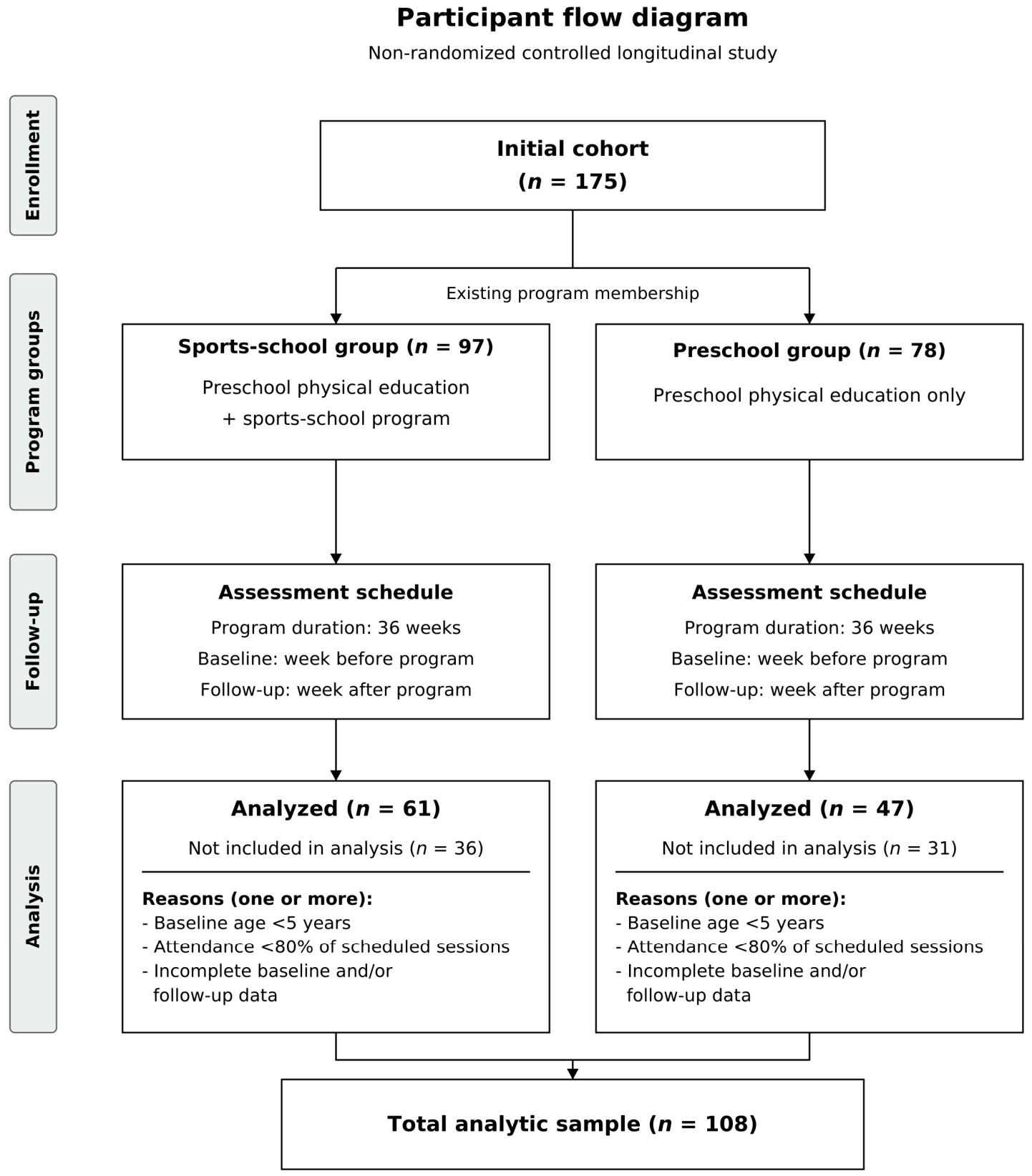
The final analytic sample comprised 108 children: 61 in the sports-school group (SSG; 48 boys and 13 girls; age 5.96 ± 0.52 years) and 47 in the preschool group (PG; 26 boys and 21 girls; age 6.02 ± 0.43 years). Thus, 67 of 175 children (38.3%) were not included: 36 of 97 sports-school children (37.1%) and 31 of 78 preschool children (39.7%; Figure 1). All 67 non-included children met one or more of the following three criteria: baseline age below 5 years, attendance below 80% of scheduled sessions, or incomplete baseline and/or follow-up data. Counts for the individual reasons, including the number excluded specifically for insufficient attendance, were unavailable. Baseline information permitting a comparison of included and non-included children was also unavailable. No outcome data were missing within the final analytic sample, and no imputation was performed. Sample size was determined by the available eligible cohort rather than an a priori sample-size calculation for this analysis. Eligibility did not depend on the magnitude or direction of the outcomes.
Figure 1.
Participant flow through the existing programs.
Parents chose to enroll their children in the sports-school program before the study began. The researchers observed these existing groups and did not assign children to programs. Most children in the sports-school group had attended the program since approximately four years of age, so baseline marked the start of observation rather than initial program exposure. Precise child-level durations and frequencies of previous participation were unavailable and could not be included as covariates. All children attended preschool institutions and received the same regular physical-education program. Apart from regular preschool physical education, children in the preschool group had not participated in organized physical activity during the six months before baseline and did not participate in such activities during the 36-week observation period.
Testing procedures were standardized with respect to instructions, examiner responsibilities, test order, and environmental conditions. The same trained examiners conducted the baseline and follow-up assessments. Children were tested in their respective program settings, and examiners were aware of group membership. Written informed consent was obtained from parents or legal guardians.
2.2. Sports-School Program and Preschool Physical Education
Children in both groups received preschool physical education twice weekly for 45 min per session. The sports-school group additionally attended two 60-min sessions per week over 36 weeks. The supplementary program combined developmental gymnastics and introductory multisport activities. The analyzed sports-school children belonged to four stable activity groups, with the same coaching team working across them. Table 1 summarizes program delivery using the Template for Intervention Description and Replication (TIDieR) framework (Hoffmann et al., 2014).
Table 1.
Program description using the TIDieR framework.
Gymnastics and multisport activities addressed stability, locomotor, and object-manipulation skills through circuits, stations, obstacle courses, rhythmic activities, and games. Progression generally followed a preplanned schedule. Assistance and easier variants adapted tasks to individual ability, without formal individual mastery thresholds. Approximate session components and staffing are reported in Table 1; delivery-group sizes include children outside the analytic sample.
The preschool group received the shared physical-education program and had no other organized physical activity during observation. The analyzed children belonged to three activity groups within one large preschool institution. Activity groups identify children who exercised together; two older preschool classes sharing physical-education sessions were treated as one activity group. Each activity group attended at its own scheduled time, and all groups followed the same program. Sessions were led by a university-qualified sport and physical-education educator.
Scheduled organized activity totaled 210 min per week in the sports-school group and 90 min per week in the preschool group. Across 36 weeks, these schedules corresponded to 7560 and 3240 min, respectively, a 2.33-fold difference. These are planned totals: mean attendance and actual accumulated activity minutes were unavailable. The comparison addressed the complete program, combining gymnastics, multisport content, additional practice time, coaching, and equipment; their separate contributions could not be estimated.
2.3. Anthropometry
Body height was measured to the nearest 0.1 cm using a fixed GPM Anthropometer 100 (DKSH Switzerland Ltd., Zurich, Switzerland), with children barefoot and standing upright on a firm horizontal surface. Body mass was measured to the nearest 0.1 kg using a BC1000 digital scale (Tanita Corp., Tokyo, Japan) positioned on a level surface. Body mass index (BMI) was calculated as body mass divided by height squared (kg/m2). Completed age in years was used to assign the age-specific KTK normative category. Baseline age was calculated from the recorded birth and assessment dates. For follow-up normative age assignment, an estimated assessment date was obtained by adding 36 weeks (252 days) to each child’s baseline date because individual follow-up dates were not available in the analysis dataset. This retained scoring rule is an approximation to the assessment interval, not an observed follow-up date. Testing in the weeks before and after the observation period does not establish that each child’s assessment interval was exactly 252 days.
2.4. Gross Motor Coordination
Gross motor coordination was assessed with the Körperkoordinationstest für Kinder (KTK) according to the original Kiphard–Schilling procedure (Kiphard & Schilling, 2007). Walking Backward was performed on three 3-m balance beams of decreasing width (6.0, 4.5, and 3.0 cm). After familiarization, three scored trials were completed on each beam, with a maximum of eight successful backward steps per trial and a maximum raw score of 72. Hopping for Height was performed on gym mats using stackable foam blocks (60 × 20 × 5 cm) that allowed obstacle height to be increased in 5-cm increments. A successful trial was awarded 3, 2, or 1 point when completed on the first, second, or third attempt, respectively, and both legs were assessed. Jumping Sideways was performed over a wooden slat (60 × 4 × 2 cm) during two 15-s trials timed with a stopwatch; successful bilateral jumps were summed across trials. Moving Sideways was performed using two wooden platforms (25 × 25 × 5.7 cm) during two 20-s trials. One point was awarded for repositioning the free platform and one point for transferring the body onto it; points were summed across both trials. The recorded sum of points from both Moving Sideways trials was used directly for normative conversion.
Raw scores from the four KTK tasks were converted to age-specific and, where required, sex-specific MQ values using the original German normative tables reproduced in the second edition of the manual (Kiphard & Schilling, 2007): A1 for Walking Backward, A2/A3 for Hopping for Height, A4/A5 for Jumping Sideways, and A6 for Moving Sideways. These tables derive from the original 1974 normative system. The four task-specific MQ values were summed and converted to the overall KTK Motor Quotient using Table A7 for typically developing children. When a Jumping Sideways raw score exceeded the highest value represented in the relevant normative stratum, the highest available tabulated MQ for that stratum was assigned. This was the scoring decision used in the present analysis. It occurred for 4 baseline and 8 follow-up observations; 3 children exceeded the range at both assessments, giving 9 unique children, all in the sports-school group. Sensitivity analyses excluded these 9 children and repeated the baseline-adjusted comparisons for both Jumping Sideways MQ and total KTK MQ. Total KTK MQ was the primary outcome of the present analysis.
2.5. Physical Fitness and Functional Performance Assessment
Eight field-based tests were used to characterize complementary aspects of physical fitness and functional performance. Reviews of preschool assessment describe the feasibility and range of such measures (Ke et al., 2022; Ortega et al., 2015). The tests used in the present study are reported individually, including their apparatus, units, trial number, and scoring procedures. This selection was not administered as the complete Assessing Fitness in Preschoolers (PREFIT) battery.
Running speed was assessed with a 20-m sprint from a standing start. Sprint time was recorded using a Witty electronic timing system with photocell gates (Microgate Srl, Bolzano, Italy) positioned at the start and finish lines, and performance was recorded to the nearest 0.01 s. Two timed trials were completed, and the faster time was retained. Lower-limb explosive performance was assessed with a standing long jump using a graduated long-jump mat and take-off board. Children jumped forward bilaterally from a stationary position; three valid trials were completed and the longest distance was retained in centimeters.
Repetitive trunk muscular endurance was assessed using sit-ups completed during 30 s on a gymnastics mat, with duration controlled by stopwatch. Children began supine with the knees flexed to approximately 90°, feet stabilized, and arms crossed over the chest; only correctly completed repetitions were counted. Upper-body static muscular endurance was assessed with a bent-arm hang using a fixed horizontal bar and stopwatch. The child was assisted into the starting position with the chin above the bar and attempted to maintain the position with the body and legs extended. Time was recorded in seconds, with a maximum duration of 120 s.
Flexibility was assessed with a standard sit-and-reach task using a Baseline Sit n’ Reach box (Fabrication Enterprises Inc., Elmsford, NY, USA) with a centimeter scale and sliding measurement indicator. The child sat on the floor with the legs extended and together and the whole soles of both feet placed flat against the vertical foot plate. The foot-plate level corresponded to the 23-cm mark, and scores were recorded as direct scale readings. With the knees extended, the child reached forward with both hands without bouncing; three trials were completed, and the greatest scale reading was retained in centimeters.
Handgrip strength was assessed using a Baseline pneumatic squeeze-bulb dynamometer (Fabrication Enterprises Inc., Elmsford, NY, USA) with a gauge rated at 30 pounds per square inch (psi). The assessment followed the dominant-hand procedure described by Trajković et al. (2021). Following instructions and familiarization, children performed two maximal squeezes with the dominant hand, with the elbow flexed to approximately 90° and a 15-s rest between attempts. The better result was retained and expressed in psi.
Upper-limb explosive performance was assessed with a two-handed medicine-ball chest throw using a 2-kg medicine ball and measuring tape. From a stationary feet-together position, the ball was held at the chest and pushed forward as far as possible. Three valid attempts were performed and the longest distance was retained in centimeters.
Complex whole-body functional performance was assessed using a wall-bars (Swedish-ladder) climbing task performed on four adjacent wall-bar frames and timed with a stopwatch. The child climbed the first wall-bar frame, traversed the second and third frames at approximately the same height, and descended the fourth frame as quickly as possible. Completion was defined as placing both feet on the floor after descent. One timed trial was recorded after a familiarization attempt, and performance was expressed in seconds. A related wall-bars task was included in the functional assessment described by Fjørtoft et al. (2011). Its published measurement properties provide context for this type of assessment; reliability of the present implementation was not estimated separately. Lower values indicated better performance for the 20-m sprint and wall-bars climb; higher values indicated better performance for the remaining outcomes.
2.6. Statistical Analysis
Data are presented as mean ± standard deviation (SD) unless otherwise specified. Baseline characteristics were summarized by program group, with standardized mean differences used to describe imbalance. Total KTK MQ was the primary outcome. The primary model compared follow-up MQ between groups using analysis of covariance (ANCOVA), with baseline MQ as a covariate. This model estimates the adjusted follow-up contrast at a common baseline score (Vickers & Altman, 2001). A separate model compared observed total-MQ changes using change (follow-up minus baseline) as the outcome and program group as the predictor. These contrasts address different questions, particularly in non-randomized groups differing at baseline (Van Breukelen, 2006). Sensitivity analyses additionally adjusted for baseline age, sex, and BMI; excluded the 9 children affected by the Jumping Sideways normative-table ceiling; and fitted a baseline-MQ × program interaction, with the program contrast evaluated at the full-sample mean baseline MQ.
Each of the four KTK task-specific follow-up models included program group and the corresponding baseline task-specific MQ. Common baseline slopes were retained from the original model specifications. The Benjamini–Hochberg procedure controlled the false discovery rate (FDR) across these four comparisons (Benjamini & Hochberg, 1995). The Jumping Sideways model was also repeated after excluding the 9 children affected by the normative-table ceiling. Raw KTK scores were summarized descriptively by group and assessment in Appendix A.
Each of the eight fitness and functional-performance models included program group, the corresponding baseline outcome, baseline age, sex, and baseline BMI. Baseline outcomes were centered at their full-sample means. The original type 3 heteroscedasticity-consistent (HC3) screening (MacKinnon & White, 1985) had identified baseline × program interactions at p < 0.05 for bent-arm hang, handgrip strength, and wall-bars climbing. These interactions were retained, and their program contrasts were evaluated at the sample mean baseline score. The remaining models retained common slopes. Model specifications were kept fixed for the revised inference; interactions were not reselected using the new p-values. FDR was controlled separately across the eight fitness comparisons.
Adjusted differences in original measurement units and their confidence intervals (CIs) are the principal measures of association. For comparisons across measurement scales, differences were also divided by the pooled baseline SD; signs for timed outcomes were reversed so that positive values favored the sports-school group. Reported 95% confidence intervals are pointwise intervals, with FDR-adjusted q-values reported separately. Tests were two-sided, with p < 0.05 for the primary contrast and q < 0.05 for the two secondary outcome families.
Participant-level activity-group membership was recovered and linked to all 108 analytic records. Among the 108 analyzed children, seven activity groups were represented: four sports-school groups with 1, 19, 25, and 16 analyzed children, and three preschool groups with 8, 19, and 20. The group represented by one analyzed child was a larger delivery group. Primary inference used the bias-reduced cluster-robust variance estimator (CR2) with contrast-specific Satterthwaite degrees of freedom (df), allowing dependence within activity groups (Pustejovsky & Tipton, 2018/2023). A restricted wild cluster bootstrap-t provided sensitivity p-values under the null program contrast, using finite-sample-corrected cluster-sandwich studentization and all 128 Rademacher sign combinations, including ties (MacKinnon & Webb, 2018). Studentization used the multiplier [G/(G − 1)] × [(n − 1)/(n − k)], where G is the number of activity groups, n the number of observations, and k the number of fitted coefficients. Enumeration removes simulation randomness but is not a randomization test. FDR adjustment was applied separately to the CR2 and bootstrap p-values within each secondary family. Both procedures assume independence between activity groups; dependence associated with shared staff or institutions was not estimated. An additional exploratory check repeated the primary model after omitting the activity group represented by one analyzed child, leaving 107 children in six groups and enumerating all 64 Rademacher sign combinations.
An exploratory sensitivity analysis identified children within 14 days of an integer-age boundary at baseline or estimated follow-up, using recorded decimal-year age and a 252/365.25-year follow-up increment. The primary model was repeated after excluding these children, with existing MQ scores unchanged. Recorded ages had mixed precision: 67 values at two decimal places and 41 at greater precision. An additional illustrative exclusion allowed a hypothetical ±0.005-year interval for two-decimal ages; this was a sensitivity convention, not a verified recording process. These checks use estimated ages, not observed follow-up dates.
Primary residual checks included quantile–quantile and residual-versus-fitted plots, skewness, kurtosis, and the Shapiro–Wilk test; the latter was descriptive because its usual calibration assumes independent observations. IBM SPSS Statistics 26 (IBM Corp., Armonk, NY, USA) and Python were used for the original analyses. Revised CR2, bootstrap, and diagnostic calculations were implemented and checked in Python 3.12 with pandas 2.2.3, NumPy 2.3.5, and SciPy 1.17.0, without independent SPSS execution. Checks reproduced original coefficients and HC3 results and verified CR2 and FDR calculations.
3. Results
3.1. Participant Characteristics
The analytic sample included 61 sports-school and 47 preschool children. Baseline age and height were similar between groups, whereas body mass and BMI were lower in the sports-school group. The proportion of boys was higher in the sports-school group (78.7%) than in the preschool group (55.3%). Baseline characteristics are presented in Table 2; participant flow and non-inclusion are reported in Section 2.1 and Figure 1.
Table 2.
Baseline characteristics of the sports-school and preschool groups.
3.2. Age-Standardized Motor Coordination
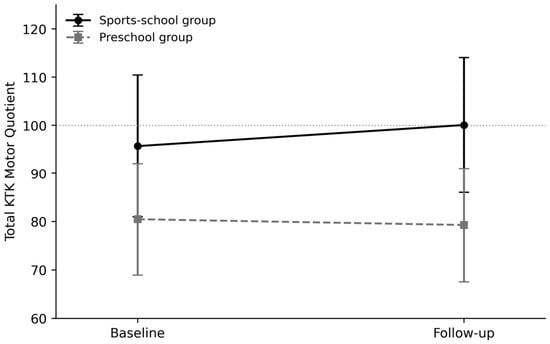
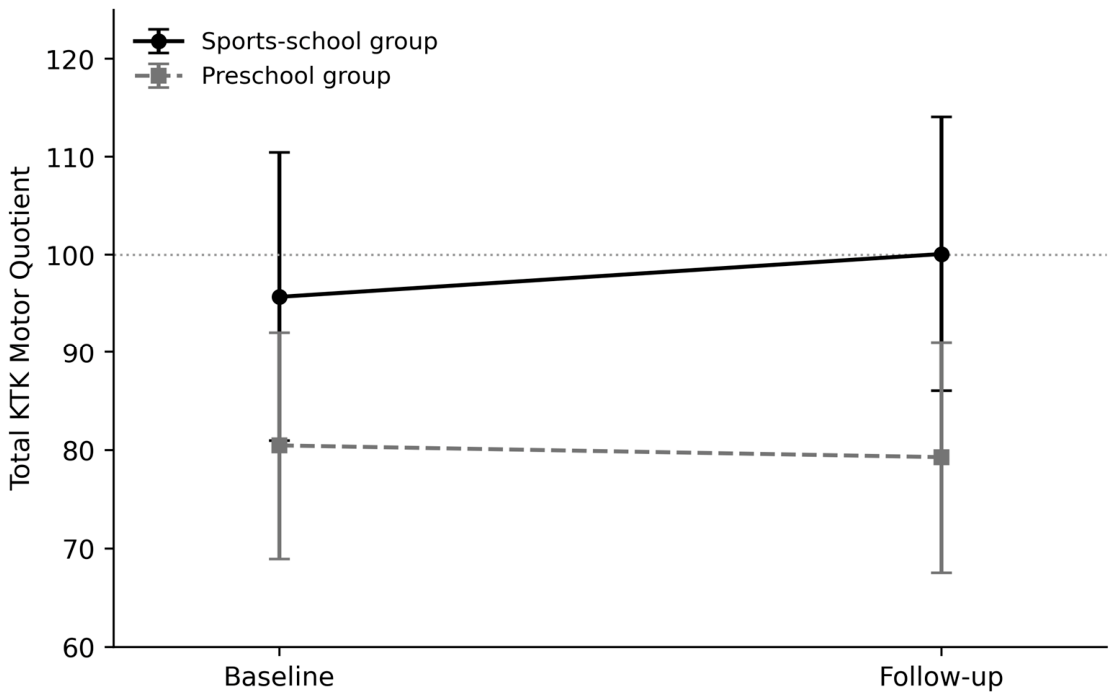
Total KTK MQ increased from 95.70 ± 14.73 to 100.08 ± 14.01 in the sports-school group, compared with 80.49 ± 11.55 to 79.30 ± 11.74 in the preschool group (Figure 2). The primary ANCOVA estimate was 9.97 MQ points (95% CR2 confidence interval 5.66–14.28; p = 0.004; Satterthwaite df = 3.55), with a wild cluster bootstrap p-value of 0.031. The common baseline-MQ coefficient was 0.71068. Primary and sensitivity estimates are summarized in Table 3.
Figure 2.
Observed mean total Motor Quotient (MQ) on the Körperkoordinationstest für Kinder (KTK) at baseline and follow-up in the sports-school group (SSG) and preschool group (PG). Error bars show ±1 standard deviation (SD) and describe variation among children; they are not confidence intervals or tests of program differences. The dotted horizontal line indicates the original normative mean (MQ = 100). Inferential comparisons use the baseline-adjusted models with activity-group clustering.
Table 3.
Primary and sensitivity analyses accounting for activity-group clustering.
Additional age, sex, and BMI adjustment, allowing different baseline slopes, and exclusion of the nine children affected by the normative-table ceiling yielded similar total-MQ point estimates (Table 3). The difference in observed changes was less conclusive, with its cluster-adjusted interval including zero. In the different-slopes model, estimated baseline slopes were 0.72081 for preschool and 0.70590 for sports-school children (interaction CR2 p = 0.908). Failure to detect an interaction does not establish identical slopes.
Nine children were within 14 days of an age boundary at baseline (two sports-school; seven preschool) and eleven at estimated follow-up (five; six), with no overlap. Excluding these 20 children left 88 (54 sports-school; 34 preschool). An additional illustrative rounding-sensitive exclusion left 87 (53; 34). Both estimates remained positive (Table 3). These checks retained the original MQ values and did not establish actual follow-up dates.
Primary residual plots showed mild right asymmetry (skewness 0.445; excess kurtosis −0.270). Shapiro–Wilk W was 0.978 (p = 0.067). These descriptive checks were not treated as proof of normality or independence; inference retained the activity-group adjustments.
Walking Backward, Hopping for Height, and Jumping Sideways had positive adjusted differences meeting the CR2-based FDR criterion (all q = 0.010). The bootstrap-based FDR analysis supported Walking Backward and Jumping Sideways (both q = 0.031), whereas Hopping for Height did not meet that criterion (q = 0.083). Moving Sideways remained inconclusive (adjusted difference 2.25 MQ points; 95% CR2 CI −1.21 to 5.70; q = 0.140; bootstrap q = 0.125). The largest point estimate was observed for Jumping Sideways (14.53 points), followed by Hopping for Height (10.86 points; Table 4). The Jumping Sideways ceiling-exclusion estimate remained positive (Table 3).
Table 4.
Age-referenced KTK outcomes and baseline-adjusted between-group differences.
Mean raw KTK scores increased from baseline to follow-up in both groups for all four tasks (Appendix A, Table A1). These absolute-score trajectories complement the age-referenced MQ comparisons.
3.3. Domain-Specific Physical Fitness and Functional Performance
The original fitness-model specifications were retained, including baseline × program interactions for bent-arm hang, handgrip strength, and wall-bars climbing. Their adjusted contrasts refer to the full-sample mean baseline score. None of the eight comparisons met the CR2-based FDR criterion (q = 0.051–0.789; Table 5). The bootstrap-based FDR analysis supported the favorable contrasts for sprint, sit-and-reach, and wall-bars climbing (all q = 0.042), while the remaining comparisons did not meet that criterion. Thus, inference for several fitness outcomes depended on the method used.
Table 5.
Physical-fitness and functional-performance outcomes and adjusted between-group differences.
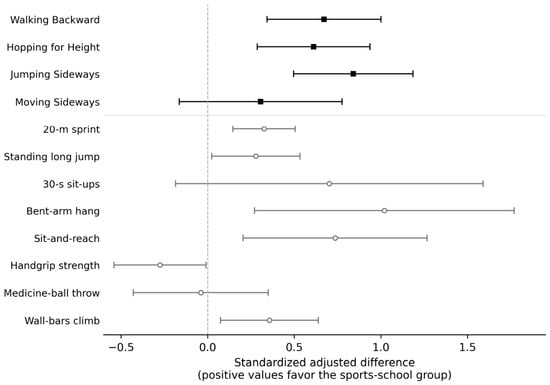
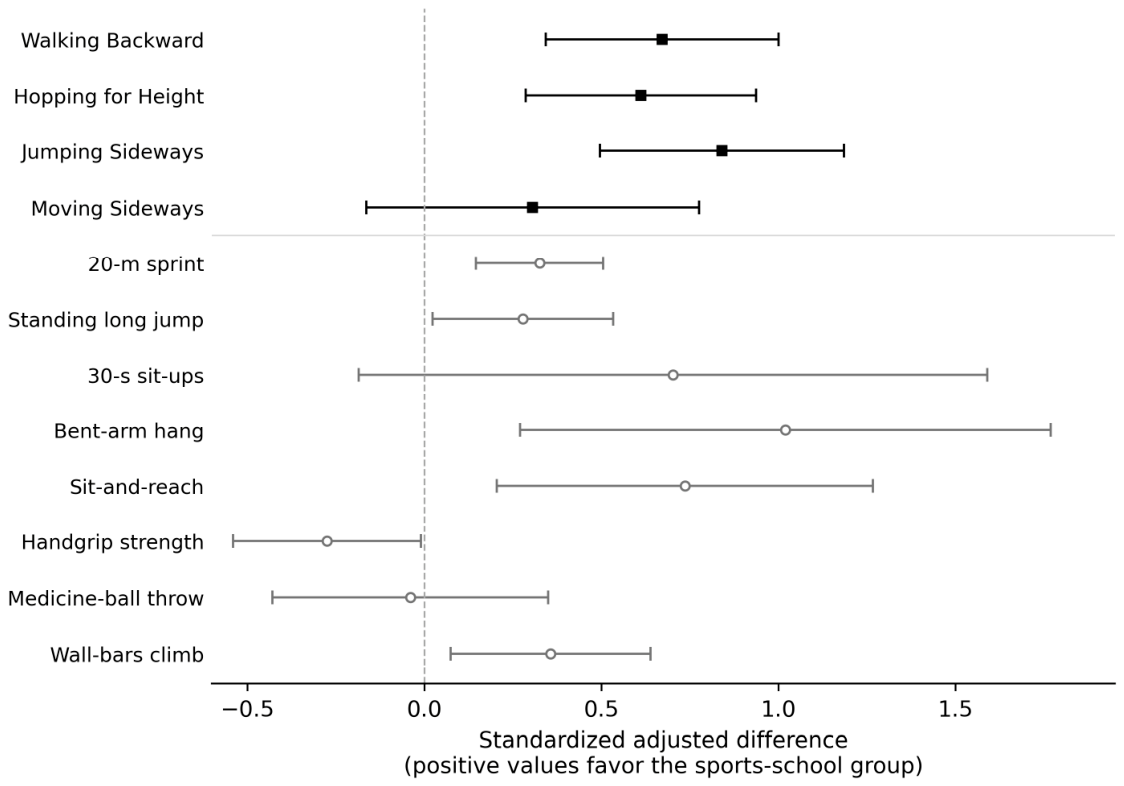
Point estimates were largest in standardized units for bent-arm hang (1.02 SD), sit-and-reach (0.74 SD), and 30-s sit-ups (0.70 SD; Figure 3). These magnitudes should be considered alongside their uncertainty and the multiplicity-adjusted results. The handgrip estimate was in the direction favoring the preschool group, but did not meet the FDR criterion under either cluster-aware method (CR2 q = 0.060; bootstrap q = 0.063). The medicine-ball comparison remained inconclusive.
Figure 3.
Standardized adjusted between-group differences across coordination and fitness/functional-performance outcomes. Contrasts and their CR2/Satterthwaite 95% confidence limits were divided by the pooled baseline SD. Signs for timed outcomes were reversed so that positive values favor the sports-school group. Intervals are pointwise and do not incorporate multiplicity adjustment; FDR q-values are reported in Table 4 and Table 5. Contrasts for bent-arm hang, handgrip strength, and wall-bars climbing refer to the sample mean baseline score. All intervals account for the seven activity groups. CR2, bias-reduced cluster-robust variance estimator; FDR, false discovery rate; SD, standard deviation.
4. Discussion
4.1. Main Findings and Interpretation
Participation in the existing sports-school program was associated with a higher follow-up Total KTK MQ after adjustment for baseline coordination. The estimate of 9.97 points was supported by both cluster-aware procedures, although inference rests on only seven activity groups. Observed mean changes were +4.38 points in the sports-school group and −1.19 points in the preschool group, giving a difference in change of 5.57 points. Its cluster-adjusted confidence interval included zero. The change-score analysis therefore provides weaker evidence for a difference in observed improvement than the primary ANCOVA provides for an adjusted follow-up difference.
The two estimates answer different questions. The baseline gap was 15.216 MQ points and the follow-up gap was 20.784 points. With an estimated baseline coefficient of 0.71068, the ANCOVA contrast is approximately 20.784 − 0.71068 × 15.216 ≈ 9.97, whereas the difference in changes is 20.784 − 15.216 ≈ 5.57. ANCOVA remains the principal analysis because the study’s primary question concerns follow-up coordination at a common measured baseline score. This choice does not establish that ANCOVA is an unbiased estimate of a program effect in self-selected groups (Van Breukelen, 2006). The model allowing different baseline slopes produced a similar point estimate, but the limited number of groups restricts the ability to detect slope heterogeneity.
Previous gymnastics exposure and parental self-selection may have contributed to the baseline imbalance. Serbian studies linking activity participation, coordination, and fitness provide context for pre-existing variation (Đurović et al., 2025; Popović et al., 2020; Stojiljković et al., 2024). Adjustment for the measured starting score does not establish equivalence in program history, family choices, or other unmeasured influences.
Raw performance and age-referenced MQ also describe different aspects of development. Mean raw scores increased in both groups for all four KTK tasks (Appendix A, Table A1), although mean total MQ decreased slightly in controls. Increasing absolute performance alongside declining MQ has also been reported in longitudinal research with school-aged children (Biino et al., 2023). The control-group MQ trajectory therefore indicates change relative to the original age-specific reference distribution and should not be interpreted as deterioration in absolute motor performance.
4.2. Task-Specific Coordination and Fitness Findings
Walking Backward and Jumping Sideways showed the most consistent task-specific associations across the CR2 and bootstrap FDR analyses. Hopping for Height met the CR2 criterion but was sensitive to the inferential method, while Moving Sideways remained inconclusive. The pattern is compatible with the program’s balance, jumping, and landing activities, although the separate contributions of gymnastics and multisport content were not isolated. In school-aged children, Rudd et al. (2017) reported gymnastics-related advantages in stability and object-control skills without a significant advantage in general coordination. The preschool study by Radanović et al. (2025) assessed locomotor and object-control skills using TGMD-2. These comparisons underline the importance of distinguishing the capacities measured by different assessment tools.
Responses also vary across preschool coordination programs. Using a three-item KTK supplemented by an eye–hand coordination task (KTK3+), Başarır et al. (2025) reported greater Moving Sideways improvement in controls, while Şendil et al. (2024) reported advantages in Jumping Sideways and eye–hand coordination after structured coordinative exercise. KTK3+ differs from the four-task KTK battery used here, so these studies provide comparisons of response patterns rather than directly interchangeable MQ estimates. In the present study, the Moving Sideways interval included zero; this result does not establish equivalence between programs.
The fitness-point estimates varied by component, with the largest standardized favorable differences in bent-arm hang, sit-and-reach, and trunk muscular endurance. However, none met the main CR2-based FDR criterion, and the bootstrap findings were only partly concordant. The data therefore do not support a general claim of improved physical fitness attributable to the program. Reviews report improvements in selected preschool fitness components across programs and activity doses (García-Hermoso et al., 2020; Liang et al., 2025). Tomić et al. (2024) found greater improvements in sit-and-reach, 30-s sit-ups, standing long jump, and modified shuttle-run performance after rhythmic exercise. Those findings provide context, but they do not resolve the uncertainty in the present comparisons.
Apparatus familiarity, hanging, and supporting activities are possible explanations for some point-estimate patterns, but these mechanisms were not measured. The negative handgrip estimate does not establish a preschool-group advantage after multiplicity correction, and the medicine-ball interval permits differences in either direction. Grip measured with a bulb dynamometer, as described by Trajković et al. (2021), assesses a different aspect of performance from hanging or throwing. The relationship between motor competence and fitness reported by Utesch et al. (2019) does not make these capacities interchangeable. Bofosa et al. (2026) similarly reported several fitness components separately in adolescents with and without intellectual disability; their study provides an assessment comparison in a different population.
The contrasts for bent-arm hang, handgrip, and wall-bars climbing apply at the sample mean baseline score because their models retained baseline × group interactions. Their magnitudes should therefore be interpreted at that starting level. Standardized differences facilitate comparisons across scales, but do not establish an educationally meaningful threshold for an individual child.
4.3. Educational and Practical Implications
The observed coordination association provides a rationale for prospectively evaluating adapted balance, jumping and landing, rolling, support, hanging, and climbing tasks within preschool physical education. The present comparison combined this content with multisport activities, 2.33 times as much scheduled organized activity, specialist coaching, and equipment. It cannot determine whether the association reflects content, additional practice, instructional support, or their combination. Comparable outcomes within the existing preschool timetable, and superiority over another program offering the same additional activity time, remain untested. Acquisition of specific movement-skill technique, movement vocabulary, and movement-related knowledge was not assessed.
Instructor assistance and easier task variants could inform the design of future preschool activities. In the observed program, progression generally followed a preplanned schedule, with assistance adapted to individual ability; no formal individual mastery thresholds were used. Future evaluations should document assistance, task difficulty, progression, and participation alongside motor outcomes. Research on mastery-oriented practice and on teacher-led and teacher-guided instruction illustrates possible approaches (Marinšek et al., 2026; Robinson et al., 2016). The present study did not estimate the separate contribution of these instructional features.
Implementation would require assessment of space, equipment, staff preparation, and opportunities to assist children. Reporting frameworks provide guidance for documenting delivery, adaptation, and fidelity (Carroll et al., 2007; Hoffmann et al., 2014). In a different institutional population, Spaić et al. (2026) identified staff expertise, contextual preparedness, and continuity as concerns in sports programs for children without parental care. These organizational considerations can inform prospective documentation of preschool programs; the present study did not evaluate implementation using a formal fidelity framework.
Broader educational or activity outcomes would require direct assessment. Jones et al. (2020) found small associations between fundamental motor skills and physical activity in early childhood, with limited longitudinal evidence. The Children’s Health Activity Motor Program (CHAMP) study improved motor skills without a corresponding between-group advantage in physical activity during outdoor free play (K. K. Palmer et al., 2019). A later study found positive concurrent associations of locomotor gains with moderate-to-vigorous physical activity, and negative concurrent associations for object-control gains; no significant prospective associations were found six months later (S. A. Palmer et al., 2026). Daily activity, motivation, confidence, and cognitive outcomes should therefore be measured when evaluating the wider contribution of an adapted program.
4.4. Strengths and Limitations
Strengths include the longitudinal comparison, complementary coordination and fitness outcomes, baseline adjustment, separate FDR control for the two secondary families, and analyses addressing activity-group clustering. The primary estimate remained positive after additional covariate adjustment, allowing different baseline slopes, excluding children near estimated age boundaries, and excluding the nine children affected by the Jumping Sideways normative-table ceiling. The ceiling-exclusion analysis retained an adjusted total-MQ difference of 9.57 points. However, excluding high-scoring children does not validate assigning the maximum available MQ, and uncertainty about the magnitude of the Jumping Sideways association remains.
The pre-existing groups differed in baseline performance and organized activity exposure. Parental self-selection, prior program experience, and setting differences limit causal interpretation. Precise individual histories of previous participation were unavailable. The comparison cannot separate gymnastics content, multisport activities, additional time, coaching, and equipment. Although activity-group clustering is now incorporated, only seven groups were available, with unequal analytic sizes including one singleton. In an additional exploratory check, omitting the activity group represented by one analyzed child left 107 children in six groups. The adjusted difference remained similar at 9.91 MQ points (95% CR2 CI 5.22–14.60; p = 0.006), but the wild cluster bootstrap p-value was 0.063 (4/64), compared with 0.031 (4/128) in the full sample. Thus, the point estimate was stable, whereas statistical support depended on the inferential method and the small number of activity groups. Shared coaches and institutional conditions may also induce dependence between activity groups, which these models do not address. CR2 and wild bootstrap inference remain small-sample approximations and should not be interpreted as definitive evidence of a program effect.
The analytic sample comprised healthy, injury-free children with at least 80% attendance and complete measurements. Non-inclusion of 67 of the initial 175 children may have selected children differing in performance, motivation, health, or family support. Reason-specific exclusion counts, including attendance-related counts, and baseline information for included-versus-non-included comparisons were unavailable; the magnitude and direction of this selection bias could not be quantified. The findings therefore apply most directly to healthy, adherent children with complete data in these existing programs. Mean attendance and formal fidelity measures were unavailable, and examiners knew program membership.
Follow-up normative ages were estimated by adding 252 days to baseline dates. The assessment schedule does not supply individual follow-up dates, and differences from the assumed interval could alter age categories near birthdays. The decimal-age boundary analysis is approximate and does not validate the original normative assignments. Historical and geographical differences between the original German reference population and contemporary Serbian preschool children further constrain MQ interpretation (Iivonen et al., 2015; Vandorpe et al., 2011). Future evaluations should retain actual assessment dates and group identifiers, document delivered activity and adaptation, compare similar activity exposure, and assess persistence of outcomes.
5. Conclusions
Among healthy preschool children with at least 80% attendance and complete measurements, participation in an existing sports-school program was associated with higher follow-up total KTK MQ after adjustment for baseline coordination. Point estimates were similar across sensitivity analyses, but statistical support depended on the inferential method and available activity groups; the difference in observed changes was also less certain. Task-specific support was most consistent for Walking Backward and Jumping Sideways; fitness findings were sensitive to the inferential method and none met the main CR2-based FDR criterion. Parental selection, previous experience, unequal activity exposure, selective inclusion, and the small number of groups constrain interpretation. Prospective evaluations should compare similar activity exposure and directly assess whether adapted gymnastics tasks can benefit children within regular preschool lessons.
Author Contributions
Conceptualization, D.R., D.M.M. and B.P.; methodology, D.R., D.M. (Dragan Marinković), D.M.M. and B.P.; software, D.R. and D.M. (Draženka Mačak); validation, D.M. (Draženka Mačak), D.M.M., B.P. and N.T.; formal analysis, D.R.; investigation, D.M. (Dragan Marinković) and D.M.M.; resources, D.M. (Dragan Marinković), D.M.M. and B.P.; data curation, D.R., D.M. (Dragan Marinković) and D.M.M.; writing—original draft preparation, D.R.; writing—review and editing, D.R., D.M. (Dragan Marinković), D.M. (Draženka Mačak), D.M.M. and B.P.; visualization, D.R. and D.M. (Draženka Mačak); supervision, D.M.M., B.P. and N.T.; project administration, D.R. and D.M. (Dragan Marinković); funding acquisition, D.R. All authors have read and agreed to the published version of the manuscript.
Funding
This research was partially funded by the Provincial Secretariat for Higher Education and Scientific Research of the Autonomous Province of Vojvodina, Republic of Serbia, through the projects “PROMO: Contemporary Digital Technologies and Motor Skills of Children and Youth” (Grant No. 003878976 2025 09418 003 000 000 001 04 004) and “Contemporary Technologies in the Assessment and Enhancement of Physical Activity and Motor Development in Children” (Grant No. 004109242 2026 09418 002 000 000 001 04 004).
Institutional Review Board Statement
The study was conducted in accordance with the Declaration of Helsinki and approved by the Ethics Committee of the Faculty of Sport and Physical Education, University of Niš (No. 04-428/2, approved 23 March 2024).
Informed Consent Statement
Written informed consent was obtained from the parents or legal guardians of all children included in the study.
Data Availability Statement
The data supporting the findings of this study are available from the corresponding author upon reasonable request. Public sharing of individual-level data is restricted because the dataset contains information from children. Analysis code is available from the corresponding author upon reasonable request.
Acknowledgments
During manuscript preparation, the authors used ChatGPT (OpenAI, San Francisco, CA, USA; GPT-6.1 Sol) to assist with language editing, manuscript organization, analysis-code preparation, checking calculations, and figures. All scientific content, data, analyses, interpretations, and conclusions remain the sole responsibility of the authors. The authors reviewed and verified all content prepared with artificial intelligence (AI) assistance and accept full responsibility for the integrity of this work.
Conflicts of Interest
The authors declare no conflicts of interest. The funder had no role in the design of the study; in the collection, analyses, or interpretation of data; in the writing of the manuscript; or in the decision to publish the results.
Abbreviations
The following abbreviations are used in this manuscript:
| ANCOVA | analysis of covariance |
| BMI | body-mass index |
| PG | preschool group |
| CI | confidence interval |
| SSG | sports-school group |
| FDR | false discovery rate |
| KTK | Körperkoordinationstest für Kinder |
| MQ | Motor Quotient |
| psi | pounds per square inch |
| SD | standard deviation |
| SMD | standardized mean difference |
| CR2 | bias-reduced cluster-robust variance estimator |
| TIDieR | Template for Intervention Description and Replication |
Appendix A. Raw KTK Scores
Table A1.
Raw KTK scores at baseline and follow-up in the analytic sample.
References
- Alonso-Martínez, L., Ramírez-Vélez, R., García-Hermoso, A., Izquierdo, M., & Alonso-Martínez, A. M. (2025). Improving preschool fundamental motor skills through interventions targeting 24-hour movement behaviors and socioecological factors: A meta-analysis. Journal of Physical Activity and Health, 22(9), 1076–1085. [Google Scholar] [CrossRef] [Scilit]
- Barnett, L. M., Webster, E. K., Hulteen, R. M., De Meester, A., Valentini, N. C., Lenoir, M., Pesce, C., Getchell, N., Lopes, V. P., Robinson, L. E., Brian, A., & Rodrigues, L. P. (2022). Through the looking glass: A systematic review of longitudinal evidence, providing new insight for motor competence and health. Sports Medicine, 52(4), 875–920, (Correction in 2022, Sports Medicine, 52, 921). [Google Scholar] [CrossRef] [Scilit]
- Başarır, B., Canlı, U., Şendil, A. M., Alexe, C. I., Tomozei, R. A., Alexe, D. I., & Burchel, L. O. (2025). Effects of coordination-based training on preschool children’s physical fitness, motor competence and inhibition control. BMC Pediatrics, 25(1), 539. [Google Scholar] [CrossRef] [Scilit]
- Benjamini, Y., & Hochberg, Y. (1995). Controlling the false discovery rate: A practical and powerful approach to multiple testing. Journal of the Royal Statistical Society: Series B (Methodological), 57(1), 289–300. [Google Scholar] [CrossRef] [Scilit]
- Biino, V., Pellegrini, B., Zoppirolli, C., Lanza, M., Gilli, F., Giuriato, M., & Schena, F. (2023). Gross motor coordination in relation to weight status: A longitudinal study in children and pre-adolescents. Frontiers in Public Health, 11, 1242712. [Google Scholar] [CrossRef] [Scilit]
- Bofosa, T., Bunga, P., Buhendwa, A., Klass, M., Bumoko, G., Kam, E., Feipel, V., Nkiama, C., & Miangindula, B. (2026). Assessment of physical fitness, physical activity level and sedentary behavior in adolescents with and without intellectual disability. Exercise and Quality of Life, 18(1), 38–46. [Google Scholar] [CrossRef] [Scilit]
- Carroll, C., Patterson, M., Wood, S., Booth, A., Rick, J., & Balain, S. (2007). A conceptual framework for implementation fidelity. Implementation Science, 2, 40. [Google Scholar] [CrossRef] [Scilit]
- Chen, D., Zhao, G., Fu, J., Shun, S., Su, L., He, Z., Chen, R., Jiang, T., Hu, X., Li, Y., & Shen, F. (2024). Effects of structured and unstructured interventions on fundamental motor skills in preschool children: A meta-analysis. Frontiers in Public Health, 12, 1345566. [Google Scholar] [CrossRef] [Scilit]
- Cools, W., De Martelaer, K., Samaey, C., & Andries, C. (2009). Movement skill assessment of typically developing preschool children: A review of seven movement skill assessment tools. Journal of Sports Science and Medicine, 8(2), 154–168. [Google Scholar]
- Đurović, M., Stupar, D., Petković, E., Lilić, A., Pelemiš, V., Mijalković, S., & Stamenković, S. (2025). Physical activity and sex as predictors of motor development in Serbian preschoolers. Sports, 13(10), 333. [Google Scholar] [CrossRef] [Scilit]
- Fjørtoft, I., Pedersen, A. V., Sigmundsson, H., & Vereijken, B. (2011). Measuring physical fitness in children who are 5 to 12 years old with a test battery that is functional and easy to administer. Physical Therapy, 91(7), 1087–1095. [Google Scholar] [CrossRef] [Scilit]
- García-Hermoso, A., Alonso-Martinez, A. M., Ramírez-Vélez, R., & Izquierdo, M. (2020). Effects of exercise intervention on health-related physical fitness and blood pressure in preschool children: A systematic review and meta-analysis of randomized controlled trials. Sports Medicine, 50(1), 187–203. [Google Scholar] [CrossRef] [Scilit]
- Haugland, E. S., Nilsen, A. K. O., Vabø, K. B., Pesce, C., Bartholomew, J., Okely, A. D., Tjomsland, H. E., Aadland, K. N., & Aadland, E. (2024). Effects of a staff-led multicomponent physical activity intervention on preschooler’s fundamental motor skills and physical fitness: The ACTNOW cluster-randomized controlled trial. International Journal of Behavioral Nutrition and Physical Activity, 21(1), 69. [Google Scholar] [CrossRef] [Scilit]
- Hoffmann, T. C., Glasziou, P. P., Boutron, I., Milne, R., Perera, R., Moher, D., Altman, D. G., Barbour, V., Macdonald, H., Johnston, M., Lamb, S. E., Dixon-Woods, M., McCulloch, P., Wyatt, J. C., Chan, A.-W., & Michie, S. (2014). Better reporting of interventions: Template for intervention description and replication (TIDieR) checklist and guide. BMJ, 348, g1687. [Google Scholar] [CrossRef] [Scilit]
- Iivonen, S., Sääkslahti, A. K., & Laukkanen, A. (2015). A review of studies using the Körperkoordinationstest für Kinder (KTK). European Journal of Adapted Physical Activity, 8(2), 18–36. [Google Scholar] [CrossRef] [Scilit]
- Jones, D., Innerd, A., Giles, E. L., & Azevedo, L. B. (2020). Association between fundamental motor skills and physical activity in the early years: A systematic review and meta-analysis. Journal of Sport and Health Science, 9(6), 542–552. [Google Scholar] [CrossRef]
- Ke, D., Maimaitijiang, R., Shen, S., Kishi, H., Kurokawa, Y., & Suzuki, K. (2022). Field-based physical fitness assessment in preschool children: A scoping review. Frontiers in Pediatrics, 10, 939442. [Google Scholar] [CrossRef] [Scilit]
- Kiphard, E. J., & Schilling, F. (2007). Körperkoordinationstest für Kinder (KTK) [Body coordination test for children] (2nd rev. and expanded ed.). Beltz Test. [Google Scholar]
- Liang, Y., Yang, Y., Yuan, Y., Chen, L., Wang, T., Luo, B., Wang, J., & Zhuang, J. (2025). Effects of physical activity interventions on physical fitness in preschool children: A meta-analysis of randomized controlled trials and dose–response study. BMC Public Health, 25(1), 3029. [Google Scholar] [CrossRef] [Scilit]
- MacKinnon, J. G., & Webb, M. D. (2018). The wild bootstrap for few (treated) clusters. The Econometrics Journal, 21(2), 114–135. [Google Scholar] [CrossRef] [Scilit]
- MacKinnon, J. G., & White, H. (1985). Some heteroskedasticity-consistent covariance matrix estimators with improved finite sample properties. Journal of Econometrics, 29(3), 305–325. [Google Scholar] [CrossRef] [Scilit]
- Marinšek, M., Bedenik, K., & Kovač, M. (2026). The effects of teacher-led and teacher-guided interventions on preschool children’s motor competency. European Early Childhood Education Research Journal, 34(2), 274–290. [Google Scholar] [CrossRef] [Scilit]
- Martins, C., Valentini, N. C., Sääkslahti, A., Africa, E. K., Webster, E. K., Nobre, G., Robinson, L. E., Duncan, M., Tortella, P., Bandeira, P. F., & Barnett, L. M. (2024). Motor competence as key to support healthy development of 3- to 5-year-old children: An expert statement on behalf of the International Motor Development Research Consortium. Journal of Motor Learning and Development, 12(3), 437–454. [Google Scholar] [CrossRef] [Scilit]
- Ortega, F. B., Cadenas-Sánchez, C., Sánchez-Delgado, G., Mora-González, J., Martínez-Téllez, B., Artero, E. G., Castro-Piñero, J., Labayen, I., Chillón, P., Löf, M., & Ruiz, J. R. (2015). Systematic review and proposal of a field-based physical fitness-test battery in preschool children: The PREFIT battery. Sports Medicine, 45(4), 533–555. [Google Scholar] [CrossRef] [Scilit]
- Palmer, K. K., Chinn, K. M., & Robinson, L. E. (2019). The effect of the CHAMP intervention on fundamental motor skills and outdoor physical activity in preschoolers. Journal of Sport and Health Science, 8(2), 98–105. [Google Scholar] [CrossRef] [Scilit]
- Palmer, S. A., Palmer, K. K., Arslanian, J. P., & Robinson, L. E. (2026). Fundamental motor skills and physical activity: Short-term but not sustained associations between improved locomotor skills and preschoolers’ physical activity following a motor skill intervention. Pediatric Exercise Science, 38(3), 250–258. [Google Scholar] [CrossRef] [Scilit]
- Popović, B., Gušić, M., Radanović, D., Andrašić, S., Madić, D. M., Mačak, D., Stupar, D., Đukić, G., Grujičić, D., & Trajković, N. (2020). Evaluation of gross motor coordination and physical fitness in children: Comparison between soccer and multisport activities. International Journal of Environmental Research and Public Health, 17(16), 5902. [Google Scholar] [CrossRef] [Scilit]
- Pustejovsky, J. E., & Tipton, E. (2018). Small-sample methods for cluster-robust variance estimation and hypothesis testing in fixed effects models. Journal of Business & Economic Statistics, 36(4), 672–683, (Correction in 2023, Journal of Business & Economic Statistics, 41, 650–652). [Google Scholar] [CrossRef] [Scilit]
- Radanović, D., Marinković, D., Mačak, D., Milić, Z., Popović, B., Pantović, M., & Madić, D. M. (2025). Effects of developmental gymnastics exercise program on preschoolers’ motor skills: A randomised controlled trial. Children, 12(12), 1590. [Google Scholar] [CrossRef] [Scilit]
- Robinson, L. E., Palmer, K. K., & Bub, K. L. (2016). Effect of the children’s health activity motor program on motor skills and self-regulation in head start preschoolers: An efficacy trial. Frontiers in Public Health, 4, 173. [Google Scholar] [CrossRef] [Scilit]
- Rudd, J. R., Barnett, L. M., Butson, M. L., Farrow, D., Berry, J., & Polman, R. C. J. (2015). Fundamental movement skills are more than run, throw and catch: The role of stability skills. PLoS ONE, 10(10), e0140224. [Google Scholar] [CrossRef] [Scilit]
- Rudd, J. R., Barnett, L. M., Farrow, D., Berry, J., Borkoles, E., & Polman, R. (2017). Effectiveness of a 16 week gymnastics curriculum at developing movement competence in children. Journal of Science and Medicine in Sport, 20(2), 164–169. [Google Scholar] [CrossRef] [Scilit]
- Spaić, P., Milovanović, I. M., & Matić, R. (2026). Intersectoral cooperation in civil society sports programs for children without parental care in Serbia. Exercise and Quality of Life. Advanced online publication. [Google Scholar] [CrossRef] [Scilit]
- Stodden, D. F., Goodway, J. D., Langendorfer, S. J., Roberton, M. A., Rudisill, M. E., Garcia, C., & Garcia, L. E. (2008). A developmental perspective on the role of motor skill competence in physical activity: An emergent relationship. Quest, 60(2), 290–306. [Google Scholar] [CrossRef] [Scilit]
- Stojiljković, N., Trajković, N., Rančić, D., Olanescu, M., Suciu, A., & Popa, D. (2024). Relationship between gross motor coordination and health-related fitness in Serbian preschool children. Children, 11(8), 933. [Google Scholar] [CrossRef] [Scilit]
- Şendil, A. M., Canlı, U., Bin Sheeha, B., Alkhamees, N. H., Batrakoulis, A., & Al-Mhanna, S. B. (2024). The effects of structured coordinative exercise protocol on physical fitness, motor competence and inhibitory control in preschool children. Scientific Reports, 14(1), 28462. [Google Scholar] [CrossRef] [Scilit]
- Tomić, B., Balać, S., & Mesaroš Živkov, A. (2024). Effects of rhythmic-based exercise program in children. Exercise and Quality of Life, 16(2), 33–40. [Google Scholar] [CrossRef] [Scilit]
- Trajković, N., Radanović, D., Madić, D., Andrašić, S., Cadenas-Sanchez, C., Mačak, D., & Popović, B. (2021). Normative data for handgrip strength in Serbian children measured with a bulb dynamometer. Journal of Hand Therapy, 34(3), 479–487. [Google Scholar] [CrossRef] [Scilit]
- Utesch, T., Bardid, F., Büsch, D., & Strauss, B. (2019). The relationship between motor competence and physical fitness from early childhood to early adulthood: A meta-analysis. Sports Medicine, 49(4), 541–551. [Google Scholar] [CrossRef] [Scilit]
- Van Breukelen, G. J. P. (2006). ANCOVA versus change from baseline: More power in randomized studies, more bias in nonrandomized studies. Journal of Clinical Epidemiology, 59(9), 920–925, (Correction in 2006, Journal of Clinical Epidemiology, 59, 1334). [Google Scholar] [CrossRef] [Scilit]
- Vandorpe, B., Vandendriessche, J., Lefevre, J., Pion, J., Vaeyens, R., Matthys, S., Philippaerts, R., & Lenoir, M. (2011). The KörperkoordinationsTest für Kinder: Reference values and suitability for 6–12-year-old children in Flanders. Scandinavian Journal of Medicine & Science in Sports, 21(3), 378–388. [Google Scholar] [CrossRef] [Scilit]
- Vickers, A. J., & Altman, D. G. (2001). Analysing controlled trials with baseline and follow up measurements. BMJ, 323(7321), 1123–1124. [Google Scholar] [CrossRef] [Scilit]
- Wick, K., Leeger-Aschmann, C. S., Monn, N. D., Radtke, T., Ott, L. V., Rebholz, C. E., Cruz, S., Gerber, N., Schmutz, E. A., Puder, J. J., Munsch, S., Kakebeeke, T. H., Jenni, O. G., Granacher, U., & Kriemler, S. (2017). Interventions to promote fundamental movement skills in childcare and kindergarten: A systematic review and meta-analysis. Sports Medicine, 47(10), 2045–2068. [Google Scholar] [CrossRef] [Scilit]

Disclaimer/Publisher’s Note: The statements, opinions and data contained in all publications are solely those of the individual author(s) and contributor(s) and not of MDPI and/or the editor(s). MDPI and/or the editor(s) disclaim responsibility for any injury to people or property resulting from any ideas, methods, instructions or products referred to in the content. |
© 2026 by the authors. Licensee MDPI, Basel, Switzerland. This article is an open access article distributed under the terms and conditions of the Creative Commons Attribution (CC BY) license.