


Abstract
The rural Dakotas of the United States face serious teacher shortages that severely impact tribal school communities. These areas continue to experience the lasting effects of COVID-19, along with longstanding challenges like intergenerational trauma, limited resources, and unequal access to professional development. Worsening these issues is the ongoing teacher diversity gap, as people from historically underserved communities—particularly Native Americans—remain underrepresented in the teaching workforce, especially in STEM fields. Moreover, Indigenous teachers who enter the field often lack adequate mentoring and support systems that honor cultural practices essential to Indigenous ways of knowing. As part of a large project, we aim to develop sustained, culturally grounded professional learning experiences for in-service Indigenous teachers to improve retention and promote mentorship pathways. This study documents our experiences planning and experiencing one workshop. Drawing on participatory action research traditions, the process of facilitating an Indigenous mathematics workshop is a location of inquiry where the authors, Renuka de Silva and Elizabeth Suazo-Flores, positioned themselves as cultural outsiders and prioritized engaging Indigenous scholars and cultural practitioners to lead the workshop. This approach helped highlight teachers’ voices, values, and identities. Field texts included written reflections, audio-recorded conversations, and planning documents. Through individual and group narratives, we highlight how teachers experienced and shaped professional learning in ways that affirmed their identities and practices. This research adds to the literature by providing insights into relational, culturally sustaining, and responsive professional development attuned to Indigenous ways of knowing, with implications for teacher educators seeking to design relevant and contextually grounded learning experiences for Native Indigenous educators.
1. Contextualizing the Study
This mathematics workshop study is situated within a larger, federally funded professional development initiative designed to support the retention and professional growth of Native American teachers. Supported by a substantial U.S. federal grant through the Office of Indian Education, the three-year project engages a pre-recruited cohort of Indigenous educators serving in diverse teaching roles and classroom contexts. Across the project period, participants engage in a series of intentionally designed professional development workshops and trainings aligned with the overarching goals and priorities of the grant.
Rather than employing a standardized approach to professional development, the project is grounded in a responsive, needs-informed model. The focus and content of individual workshops are shaped by the professional and pedagogical needs identified by participating teachers (Kahakalau, 2019; Wright, 2021), priorities articulated by leadership within the two participating schools, and insights emerging from the authors’ ongoing research and sustained engagement with Indigenous educational contexts. Consistent participant feedback is integral to this process, creating an iterative feedback loop through which professional learning needs are identified, revisited, and addressed throughout the project. Accordingly, each workshop represents a purposeful component of the broader project trajectory while remaining responsive to the particular educational contexts, lived experiences, and professional learning needs of participating Indigenous teachers.
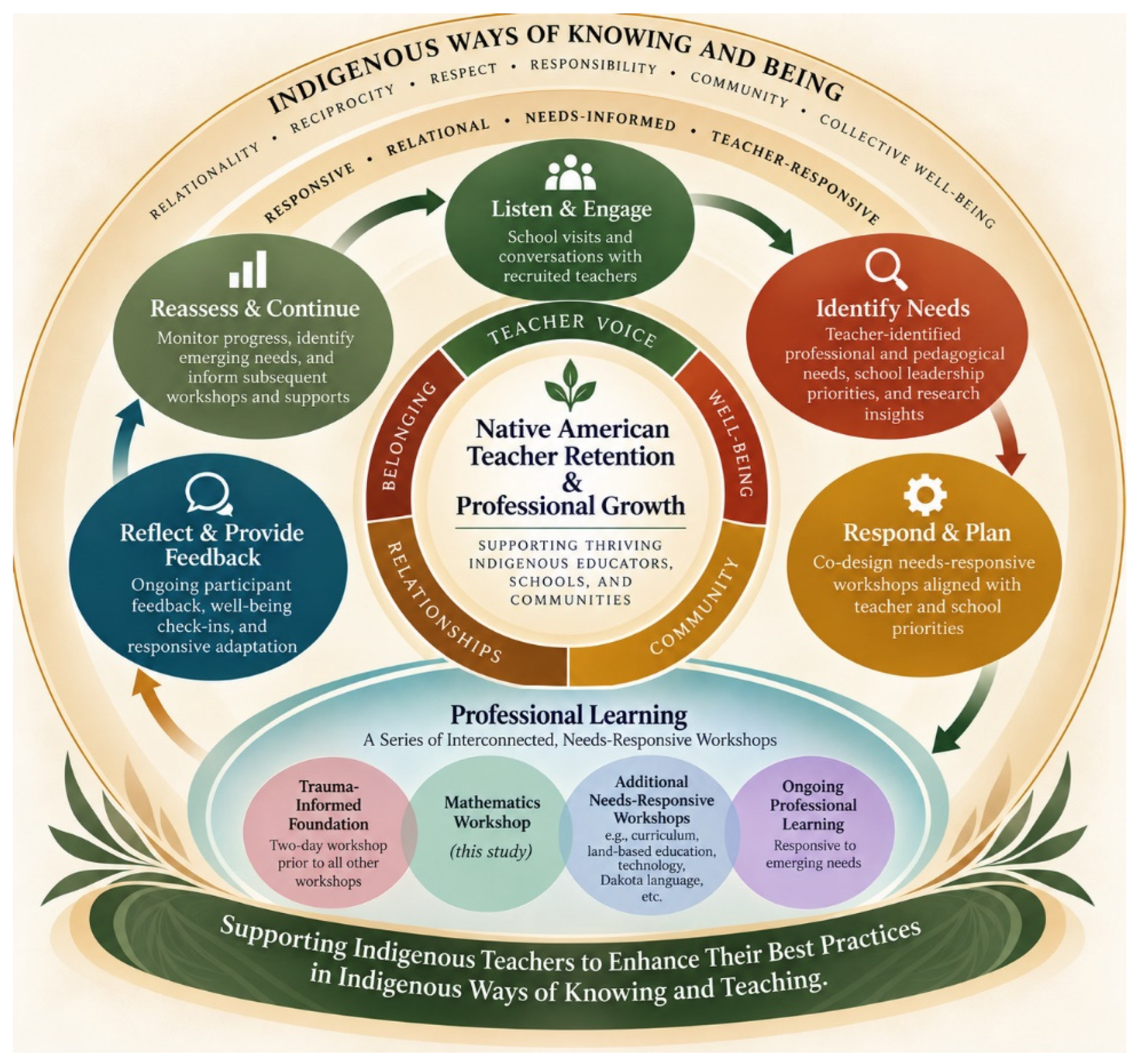
As discussed later in this article, the initial trajectory of the professional development initiative was set by the primary authors Renuka de Silva and Elizabeth Suazo-Flores through visits to participating schools and conversations with recruited teachers. These early engagements revealed that professional learning could not be considered separately from teachers’ experiences of trauma, well-being, and the broader realities shaping their personal and professional lives. Participants emphasized the need for ongoing trauma-informed professional learning, as well as a sustained mechanism for feedback and attention to personal health and well-being throughout the project. In response, trauma-informed practice became a foundational component of the initiative rather than an ancillary topic within the workshop sequence. These early conversations also informed the authors’ development of a relational and responsive professional learning framework for the Native American Teacher Retention Initiative (see Figure 1), designed to foreground teacher voice, well-being, relationships, community, and belonging while guiding the project’s ongoing trajectory.
Figure 1.
Relational and Responsive Professional Learning Framework for Native American Teacher Retention Initiative. A Conceptual Framework Developed by Renuka de Silva and Elizabeth Suazo-Flores, December 2025.
Consequently, before the broader professional development programming began, an Indigenous scholar-practitioner intentionally designed and facilitated a trauma-informed workshop. The decision to engage Indigenous scholar-practitioners as facilitators of the workshops is significant to the epistemological orientation of the project. These facilitators bring not only disciplinary and professional expertise, but also culturally situated knowledge and ways of knowing and being that can create conditions for professional learning to be understood through Indigenous perspectives—sense abilities (Oliveira, 2014). Such an orientation recognizes knowledge as relational, embodied, situated, and connected to ancestral knowledge systems, community, and the natural world.
Oliveira (2014) describes sense abilities as the “capacity to receive and perceive stimuli” (p. 94) from the places and spaces where people live. Within Indigenous epistemological contexts, this concept offers a way to understand how knowledge may be experienced through relationships among body, place, land, community, and ancestral knowledge rather than solely through abstract or cognitive processes. This epistemological grounding is consequential for both the planning and facilitation of the project’s professional learning experiences because it creates space for Indigenous teachers to engage in professional learning through frameworks that recognize and affirm culturally situated ways of knowing and being. As Gegeo (2001) argues, such approaches can strengthen “Indigenous ways of thinking, and of creating and reformulating knowledge, using traditional discourses and media of communication and anchoring the truth of the discourse in culture” (p. 493). This is a critical element in professional development because the beneficiaries of these trainings are the Indigenous students who make up approximately 99% of the student population in these two schools, from which the teachers are recruited.
Positioning health and well-being at the outset with a trauma-informed workshop served more than a sequential or preparatory function. It established a relational and epistemological foundation for subsequent professional learning and reinforced the project’s commitment to an approach in which teacher voice, lived experience, well-being, cultural knowledge, and relationships inform the ongoing trajectory of professional development. Within this framework, professional learning is understood not merely as the acquisition of new instructional strategies but as a relational process through which existing knowledge, cultural understandings, professional experience, and new learning can encounter and inform one another.
The mathematics workshop examined in this study is one of several professional development workshops delivered as part of this longitudinal initiative. Accordingly, it is understood not as an isolated intervention but as a component of an interconnected and evolving program of professional learning and development. The present article likewise represents one study within a broader program of empirical inquiry through which the authors are examining various dimensions of the initiative and their implications for the professional learning, experiences, well-being, and retention of Indigenous teachers.
1.1. Authors’ Positionality
Renuka de Silva and Elizabeth Suazo-Flores are associate and assistant professors, respectively, at the University of North Dakota and serve as the study’s primary researchers. Throughout this article, we use we and us to refer collectively to our positioning, relationships, and responsibilities in the research. We understand positionality not simply as a declaration of identity but as an ongoing practice of reflexivity and relational accountability that shapes how we enter research spaces, build relationships, interpret knowledge, and represent the experiences and knowledge shared with us.
Our co-authors, RunningHorse Livingston (Bad River Nation, Wisconsin) and Nadine Eastman (Sisseton Wahpeton Oyate, Lake Traverse Reservation, South Dakota), are Native American mathematics educator scholars whose contributions are integral to both the professional learning initiative and the inquiry presented in this article. Their roles extend beyond facilitating the mathematics workshops. As Indigenous mathematics experts and knowledge holders, they participated in research conversations and the inquiry process that helped ensure the study remained attentive to Indigenous knowing, being, relating, and interpreting. Their involvement was critically important to us in establishing culturally and spiritually meaningful spaces for the gatherings and learning, guiding our attention to appropriate Indigenous protocols, and informing how Indigenous knowledge systems were interpreted and represented within the research. Such attention is necessary when engaging Indigenous knowledge so that educational and research processes create possibilities for learning without requiring the displacement or loss of Indigenous identities (Sandercock, 2018; L. T. Smith, 1999).
In this study, Indigenous thinking is understood through worldviews in which knowledge is relational and cannot be readily separated from land, spirit, community, experience, and everyday life (Bear, 2007; Meyer, 2008, 2020). From this perspective, knowing is not confined to an intellectual or cognitive exercise; understanding and application are situated within relationships to the broader living world. This epistemological orientation is consequential for our positionality because it requires us to consider not only what knowledge is generated through research, but also how, where, with whom, and through what relationships that knowledge comes into being.
This distinction is important because neither de Silva nor Suazo-Flores is Indigenous to the lands, communities, or Tribal Nations and places of the teacher participants. We therefore do not position ourselves as authorities on the Native American knowledge systems represented in these spaces. However, both authors carry ways of knowing shaped by the Indigenous knowledge traditions, cultures, places, and relationships of our respective birthplaces, Sri Lanka and Chile. At times, these epistemological orientations resonate with relational ways of knowing encountered through our work with Indigenous Peoples on Dakota lands. We understand such resonances not as equivalence with, or claims upon, Native American ways of knowing, but as points from which we can listen, learn, reflect, and enter relationships with humility and respect for the distinctiveness and sovereignty of the knowledge systems with which we engage.
Additionally, de Silva has written extensively on Hawaiian epistemology and storytelling, scholarship informed in part by longstanding childhood connections to the Hawaiian Islands and subsequent scholarly engagement with Indigenous epistemologies. Suazo-Flores brings expertise as a mathematics teacher educator and researcher, alongside ways of knowing shaped by family and culture. As a mathematics teacher educator and researcher, she has contributed an extensive body of research to the field of mathematics education in K-12 classrooms, interdisciplinary research, and mathematics teacher education. These different scholarly and lived orientations shape how we approach this collaborative work while also requiring continuing reflexivity regarding the boundaries of our own knowledge and the responsibilities that accompany research within Indigenous educational contexts.
For de Silva and Suazo-Flores, participation in this initiative therefore entails an ongoing responsibility to listen, learn, respond, and reconsider how we can most appropriately support participating teachers. This orientation is reflected in the Relational and Responsive Professional Learning Framework for the Native American Teacher Retention Initiative (Figure 1), in which teacher voice, well-being, community, relationships, and belonging continually inform the direction of professional learning. Within this framework, mentorship is not conceptualized as a unidirectional relationship in which knowledge flows from university researchers to teachers. Rather, mentorship and professional learning are relational and collective. Indigenous scholar-practitioners who facilitate workshops remain part of this evolving network of relationships and may return to provide continued guidance and mentorship within teachers’ school and classroom environments. Teachers, facilitators, knowledge holders, and researchers thus participate in an ongoing process of learning with and from one another.
Our positionality within this work is therefore neither fixed nor separate from the research process. It evolves through relationships, accountability, listening, and continued engagement with participating teachers, Indigenous scholar-practitioners, schools, and communities. This understanding requires us to remain attentive to whose knowledge is being centered, how that knowledge is interpreted and represented, and our responsibilities to the people and relationships through which this research becomes possible.
1.2. Importance of Place and Space
Regardless of the research, methodology, or methods employed, when engaging with Indigenous participants, researchers must remember that participants’ identities are inevitably tied to the land, specifically to a place and space (Hunn, 1996; Oliveira, 2014; Christian & Wong, 2017; Burkhart, 2019). This is because “place names for Indigenous Peoples offer a framework for cultural transmission and moral instruction as a symbolic link to their land and as ground for their identity” (Hunn, 1996, p. 4; Kari, 2010). From this position, they relate to and understand concepts such as science, technology, engineering, arts, and mathematics (STEAM). However, since the first arrival of settler colonists in the sixteenth century, Indigenous ways of knowing and honoring their systems of knowledge have dwindled as Indigenous Peoples were progressively marginalized and oppressed (Antane Kapesh, 2020; Burkhart, 2019; Beamer, 2014). Part of this oppression began with land division, the taking of control of the land, and the removal of children and their placement in Christian boarding schools with the aim of providing English education, individualizing, and Christianizing (Adams, 1995; Lajimodiere, 2019). Many centuries later, Indigenous Peoples still carry the trauma in their bodies, which manifests in myriad ways. Today, many Indigenous Peoples carry ancestral trauma that is exacerbated by continuous marginalization and unequal access to higher education, food security, and health. Understanding these facts, de Silva and Suazo-Flores set out to plan, mentor, and deliver professional development in a way that supported and respected the individual and the culture.
Our first step in this project was to visit the schools and meet with school leadership and the recruited teacher participants. Several participants were our university’s alumni. This meant that we appreciated the opportunity to continue strengthening our relationship with them now as in-service teachers. After visiting them in person to resume our relationship and consult with them and their school leadership, we decided the best way to initiate the project was to offer an Indigenous Trauma workshop as a first step toward self-renewal and support teachers’ mental well-being.
1.3. Contextualizing Indigenous Renewal Process
“Each new day is an inikagapi, a chance to be renewed and reborn—another opportunity to be a part of the circle that is life, knowing that it is a journey, not a race, and that no one doesn’t travel it alone”.(Marshall III, 2002, p. 229)
Iñikagapi (in Dakota) is one of the many shared spiritual traditions that describe a ceremonial renewal process among the Lakota, Dakota, and Nakota. In the Indigenous context, many ceremonies revolve around renewal. These ceremonies often take the form of a sweat lodge, a Sundance, and a medicine bundle ceremony (Bear, 2012). The iñi purifies “sufficiently humble participants who stoop to enter a small womb-shaped lodge; in the darkness the prayer periodically pours water on red hot stones to produce a breath-slowing steam, much too hot to be soothing or bracing” (Rice, 1983, p. 39). In this instance, a space is created for prayers and support from all participants for those who enter to renew and heal from within. Our renewal, however, did not take place in a sweat lodge but in a carefully considered space in the Indigenous Student Center at our University campus.
Place and space are important aspects of Indigenous cultures because “culture has an origin, a present expression, and a future design” (Meyer, 2003, p. 53). Space is also critical because a system of knowledge is “shaped by space and time, is open to historic influences and becomes current, because it is the nature of culture to survive” (p. 53). According to the Indigenous Lakota tradition, the Lakota, Dakota, and Nakota tribes, whose names mean an alliance of friends, share strong linguistic and cultural similarities. They are closely related groups that make up the Oceti Sakowin–Seven Council Fires (Marshall III, 2002). Therefore, to come together in healing and to celebrate a new journey, it was crucial to first meet and greet as friends and relatives and to participate in Iñikagapi: Returning to Ourselves, an Indigenous trauma workshop facilitated by a Native Indigenous professor and social worker from the Blackfoot Nation in Montana. He introduced several healing exercises, songs, drumming, and smudging to help our teacher participants heal their lived and living trauma and create ongoing pathways to release it before beginning our professional development initiative. This initial engagement in addressing personal and ancestral traumas proved essential to moving forward with the teachers’ professional development journey.
Learning to apply inquiry-based Indigenous Mathematics was one of several workshops offered to our in-service Native Indigenous teachers and facilitated by Author3, a Native Indigenous mathematics educator from the Bad River Nation, Wisconsin. The teachers’ experiences with this workshop constitute the focus of this manuscript. Our guiding research question for this study was: In what ways did Indigenous American educators experience an Indigenous mathematics workshop?
2. Methodology
This study employed Participatory Action Research (PAR) as its methodological approach (Gaffney, 2008; Wright, 2021), with an Indigenous mathematics professional learning workshop serving as the primary site of inquiry. Consistent with our positionality, de Silva and Suazo-Flores entered this research as cultural outsiders to the Tribal communities represented by the participating teachers. Recognizing the limits of our own cultural positioning and knowledge, we intentionally prioritized the leadership and expertise of Indigenous mathematics educator-scholars and cultural practitioners in conceptualizing and facilitating the workshop and throughout the broader inquiry process. We ensured at least one of us participated in the workshop and provided on-site support for educators and facilitators.
PAR provided an appropriate methodological orientation because it positions participants as active contributors to the knowledge-making process rather than as subjects upon whom research is conducted. Accordingly, learning and inquiry occurred with participating teachers rather than on or about them. The workshop created a collaborative space in which teachers could engage with Indigenous mathematics educator-scholars, examine multiple approaches to mathematics teaching and learning, reflect upon their own pedagogical knowledge and practices, and contribute their experiences, perspectives, and cultural understandings to the inquiry. In this way, the research foregrounded teacher voice, values, identities, and professional knowledge while creating space for participants to exercise agency in examining and articulating practices they considered meaningful within their own educational contexts.
Agency is particularly important within this participatory orientation. From a capability perspective, opportunities to develop personal and collective capabilities can strengthen individuals’ capacity to exercise agency (Wright, 2021). Agency, in this sense, refers to a person’s ability to act in relation to what they value and have reason to value (Ibrahim & Alkire, 2007). Rather than positioning agency as something conferred upon participants by researchers, we understood the PAR process as creating conditions in which teachers could exercise their existing professional agency through questioning, dialogue, reflection, and consideration of possibilities for their own practice.
Within the mathematics workshop, this participatory process provided opportunities for teachers to pose questions relevant to the focus of the inquiry: how mathematics teaching strategies might be aligned with Indigenous ways of knowing and connected to relatable stories, lived experiences, and cultural contexts. Teachers engaged with strategies for solving mathematics tasks and with mathematics instructional approaches, participated in inquiry-based learning experiences, and reflected individually and collectively on the implications of this learning for their own classroom practices. Their reflections and responses to surveys conducted in relation to the workshop provided opportunities for participants to articulate their experiences of the professional learning, including what they found meaningful, how they understood the learning in relation to their existing practices, and how they envisioned applying or adapting these understandings within their own educational contexts. In this way, participants’ reflections became an important source of knowledge within the inquiry rather than simply evaluations of the workshop.
These reflections also extended beyond questions of mathematical performance to consideration of how mathematics might become more meaningful and relevant to students’ everyday lives and how mathematics education might contribute to more just and equitable educational experiences (Cotton, 2013; Gutstein, 2006; Skovsmose, 2011). The PAR process created opportunities for participating teachers to critically examine teacher-centered pedagogies associated with the “exercise paradigm” (Wright, 2021, p. 157) where mathematics instruction is organized largely around teacher-demonstrated procedures followed by sets of closed exercises that students are expected to reproduce.
In contrast, engagement with the Indigenous mathematics educator-scholar, participation in inquiry-oriented mathematical activities, and connections among mathematics, Indigenous cultures, stories, experiences, and everyday life invited teachers to consider alternative possibilities for mathematics teaching and learning. Through dialogue, inquiry, and reflection, participants critically considered their existing classroom practices and explored how mathematics might be experienced not as knowledge separated from life and culture, but as knowledge situated within relationships, lived experiences, cultural contexts, and the world around them.
As with any methodological approach, PAR requires researchers to remain reflexive throughout the research process. For de Silva and Suazo-Flores, this meant remaining attentive to our own positioning, assumptions, and interpretive responsibilities while responding to the voices and experiences of participating teachers and the guidance of Indigenous scholar-practitioners. Reflexivity therefore involved an ongoing willingness to listen, reflect, and, when necessary, adapt our research practices as relationships and understandings developed throughout the inquiry.
3. Methods
3.1. Honoring Data Sovereignty
This study received Institutional Review Board (IRB) approval from the University of North Dakota and approval through the respective Tribal governance processes associated with the two participating schools [April and May 2026]. Obtaining our university IRB and Tribal approval required a deliberate, multistage process. To finalize the university IRB, we first secured the Tribal IRBs. We therefore sought approval from the appropriate Tribal School Boards where teachers were tribal members, and the proposed research specifically associated with the Indigenous mathematics workshop was introduced, reviewed, and approved. Following School Board approval, the research proposal for the mathematics workshop was submitted through the respective Tribal Council review processes. At this stage, we provided all research materials associated with the workshop study and intended for use with participating teachers, including survey instruments and informed-consent documents. We also communicated the anticipated timeline for data collection and analysis, procedures for protecting and securely storing research data, and expectations for sharing the data and findings with the appropriate Tribal authorities within an agreed-upon timeframe.
We understood this process as more than procedural compliance or institutional permission to conduct research. Tribal review set the conditions under which the research could proceed and affirmed Tribal Nations’ authority to govern research involving their communities, knowledge, and data. Honoring these processes was therefore integral to our ethical and methodological responsibilities as researchers and to our commitment to Indigenous data governance and sovereignty. This orientation emphasizes Indigenous Peoples’ rights and interests in relation to the collection, ownership, interpretation, stewardship, and sharing of data concerning their communities (Carroll et al., 2019; D. Smith, 2020).
These processes also shaped how we understood our responsibilities within the research relationship. After obtaining the required approvals, researchers and participating teachers engaged in research conversations, storytelling, interviews, and surveys within the parameters established by the institutional and Tribal review processes. For de Silva and Suazo-Flores, particularly given our positioning as cultural outsiders to the Tribal communities represented in this study, the Tribal approval process became an important site for learning and reflexivity. It required us to attend carefully to questions of accountability, reciprocity, ownership, representation, and the responsibilities that accompany working with knowledge shared by Indigenous participants and communities.
In this sense, honoring data sovereignty was not separate from the study’s relational orientation; it was one way to enact relational accountability throughout the research process. The review process also created opportunities for us to reflect on our responsibilities to participating teachers and their communities, recognize Tribal authority to determine the conditions under which research is conducted, and consider how reciprocity extends beyond data collection to the interpretation, representation, and sharing of knowledge. These responsibilities are consistent with the relational and responsive orientation represented in Figure 1, in which listening, relationship-building, reflection, and continued responsiveness are understood as interconnected rather than discrete stages of engagement.
3.2. Data Sources and Analysis
Data for this study were drawn from multiple sources, including researcher field notes, participant survey responses, and transcripts of conversations and interviews with participating Native American teachers. These sources documented teachers’ experiences with the Indigenous mathematics workshop, their reflections on the learning and inquiry that occurred during the workshop, and their perspectives on the relevance and potential of the approaches explored for their own teaching contexts. Consistent with the study’s participatory and relational orientation, conversations with teachers gave participants opportunities to articulate their experiences in their own words and connect workshop learning with their existing professional, cultural, and pedagogical knowledge. Teacher voice was therefore treated not only as data but also as an important source of knowledge for understanding the meaning and relevance of the professional learning experience.
Data were analyzed thematically (Lochmiller, 2021) in NVivo 14 (Lumivero, Denver, CO, USA) to support the organization and examination of the qualitative data. de Silva and Suazo-Flores engaged in an iterative process of reading and rereading field notes, survey responses, and transcripts; identifying recurring ideas and patterns across the data; examining relationships among these patterns; and developing themes that captured salient dimensions of teachers’ experiences and learning. Throughout this process, analysis remained attentive to the study’s relational and epistemological commitments, particularly teacher voice, lived experience, cultural knowledge, professional practice, relationships, community, and the ways participants made meaning of mathematics teaching and learning within their own educational contexts.
Reflexivity was integral to the analytic process. As researchers who are not Indigenous to the Tribal communities represented by the participants, de Silva and Suazo-Flores remained attentive to how our experiences, assumptions, and epistemological orientations could shape interpretation. Analysis therefore involved not only identifying patterns in the data but also continually returning to participants’ words and considering whether our interpretations remained grounded in what teachers communicated about their experiences. The involvement and guidance of our Indigenous co-authors and scholar-practitioners further reinforced our attention to cultural context and to the responsibilities associated with interpreting and representing Indigenous knowledge and teachers’ experiences.
Importantly, the analysis did not end with the researchers’ initial identification of themes. We returned our emerging interpretations to participating teachers and shared what the analysis suggested about their experiences and learning during the mathematics workshop. Teachers were invited to respond to these interpretations and offer insights that helped us assess whether the emerging findings meaningfully represented their experiences. This process added another layer of participant reflection and interpretive validation while maintaining a clear distinction between teachers’ contributions to meaning making and the researchers’ responsibility for formal data analysis.
Following this process, the Indigenous mathematics facilitator and scholars (i.e., RunningHorse Livingston and Eastman) contributed to the ongoing interpretation and development of the scholarly work emerging from the study. Their involvement was distinct from that of the teacher participants. As Indigenous mathematics educator-scholars, workshop facilitators, knowledge holders, and co-authors, they brought disciplinary, cultural, and epistemological expertise to conversations about interpreting and representing the study. Their contributions provided an additional interpretive perspective and helped ensure that the developing scholarship remained attentive to the cultural and epistemological contexts in which the workshop and teachers’ experiences were situated.
Thus, participating teachers contributed their experiences, reflections, survey responses, and perspectives on the researchers’ emerging interpretations, but they did not participate in the study’s formal analysis or manuscript writing. Formal analysis and manuscript development remained the authors’ responsibility. This distinction recognizes the different forms of participation and knowledge contributions within the study while maintaining the centrality of teachers’ voices and experiences to the inquiry.
Consistent with the Relational and Responsive Professional Learning Framework (Figure 1), we viewed data generation, interpretation, participant reflection, and continued professional learning as interconnected and iterative rather than a strictly linear sequence. Teachers’ reflections helped us understand their experiences in the mathematics workshop and contributed to our ongoing understanding of their professional learning needs. In this way, the processes of listening, learning, reflecting, and responding informed one another, reinforcing the broader project’s commitment to teacher voice, relationships, community, well-being, and belonging.
Taken together, these practices sought to maintain a clear link between teachers’ experiences and the study’s findings, while acknowledging our responsibility for how those experiences are interpreted and represented. The following section describes the Indigenous mathematics workshop in greater detail, providing the pedagogical and cultural context needed to interpret the study’s findings.
4. The Mathematics Workshop
As described above, we started the project with a workshop around self-care or trauma-informed care. Among others, we planned for an indigenous mathematics workshop that would take teachers to consider mathematics as a problem-solving activity that takes place in everyday life and be led by a Native Indigenous facilitator. RunningHorse Livingston was known to teachers from one of the schools and agreed to facilitate an in-person mathematics workshop. Suazo-Flores and Eastman were present during the workshop supporting teachers and the facilitator.
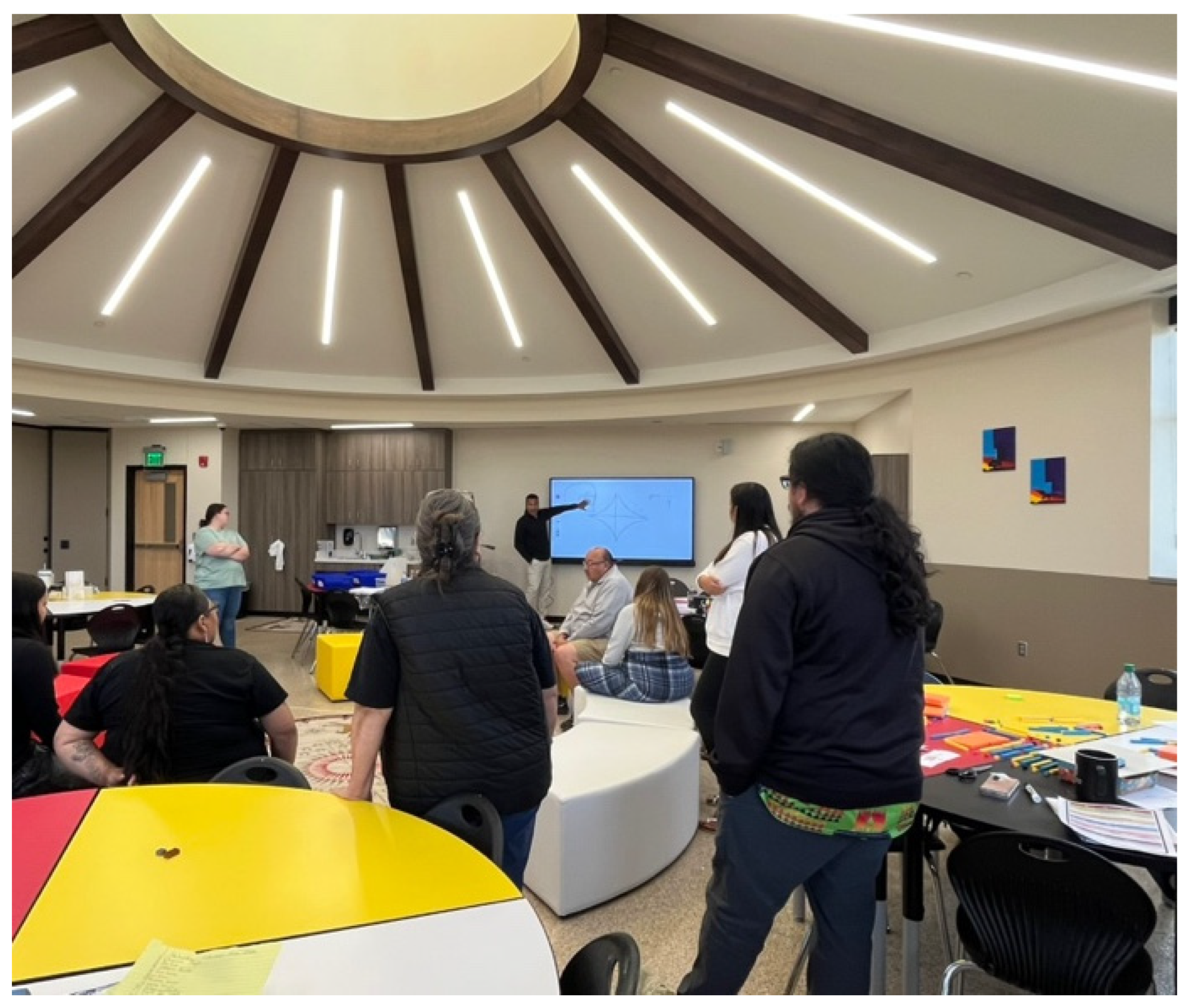
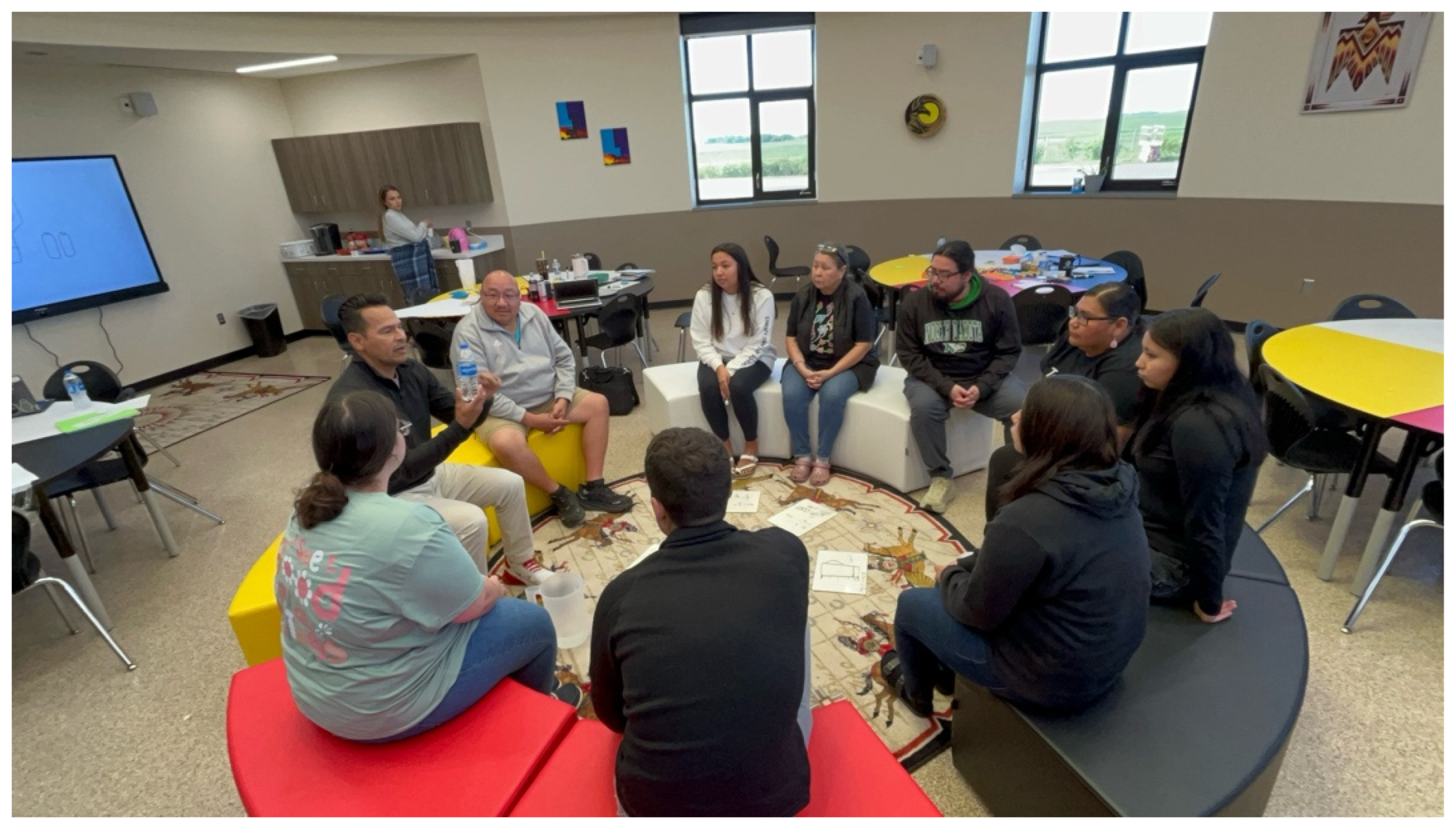
The workshop took place in one of the participant teachers’ schools in a classroom with a tipi-shaped ceiling; in the center of the classroom, comfortable seats formed a circle, creating a talking circle space. The seats sat on a circular rug with a visible circle for those seated. The talking circle area was lit by a window coming from a tunnel that led to the ceiling of the building. The classroom tables were circular and had four congruent sections shaded red, yellow, white, and black, in the fashion of a medicine wheel (see Figure 2).
Figure 2.
Classroom where the Mathematics Workshop occurred. Photograph: Suazo-Flores, June 2026.
4.1. Day 1 of the Workshop
On day 1, Livingston invited teachers to imagine what it would have been like to teach mathematics before colonization and discuss how they learned all that they know about their culture. A teacher shared how, as a child, he would go to cut trees with other community members. Most of the expert community members would tell him to stay away from certain trees; that is how he learned to distinguish them. Missing steps would lead him to make mistakes, and then he learned. Another teacher shared how she learned about medicinal plants with her grandparents. They took her into the field, showed her the plants’ characteristics, and what they were good for.
Livingston motivated teachers to use the workshop as an opportunity to connect real-life practices with mathematical thinking and doing. He mentioned that for him, problem-solving was what we do when we don’t know what to do.
The first mathematics task we worked on was about planting sweetgrass seeds. There were 19 pots where you could place two or three seeds out of 47 seeds. Our task was to identify how many pots would have two and three seeds.
Teachers had plenty of time to solve the task in their own ways, and then we sat in the talking circle area to share our ways of solving it. Teachers used their own experiences planting seeds and created visual models for the pots. Others used their knowledge of factors and thought of how many factors of two and how many factors of three would make the 47 seeds. Others used algebraic expressions and equations. When sharing, Livingston invited the speaker to explain the meaning of their drawings or mathematical symbols in the context of the task, opening the space so everyone could understand what was being said.
We then worked on a mental addition mathematics task and used a similar sharing method to learn from each other’s ways of computing the sum. We learned how a child created their own method for solving the same task. It was called the smiling method as it made smiles from putting together the digits of the two addends by place value. Author3 asked us, what is indigenous about the smiling method? A teacher shared. Storytelling is a way to teach indigenous mathematics because numbers have meaning.
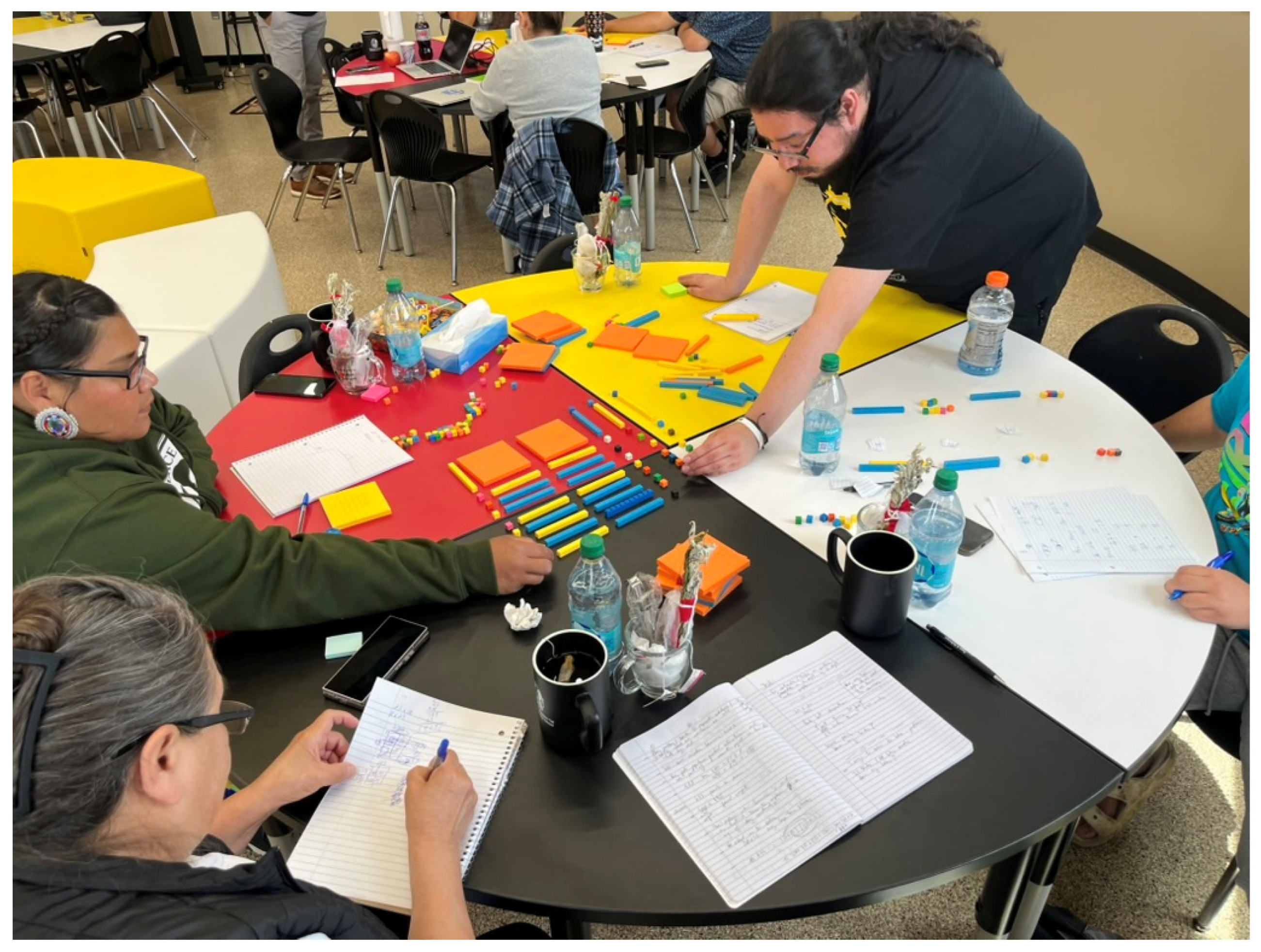
We then solved a multiplication task mentally; we were introduced to the Chinese method to solve multiplication tasks; and were offered base ten blocks to solve a multiplication task. The base ten blocks led us to discuss the box method for solving multiplication tasks (see Figure 3). Livingston shared that the key ideas to teach mathematics for him were story problems, tools to represent solutions, and talking about the solutions.
Figure 3.
Teachers working with manipulatives. Photograph: Suazo-Flores, June 2026.
At the end of day 1, we worked on fractions and visual ways of representing them. Livingston then invited us to create a story that could involve solving the following mathematics sentence: 6 ÷ ½ (six divided by one half). A teacher thought of ribbons, as she is an expert in creating ribbon skirts. Her mathematics task was: I have six ribbons, and I need to cut them in half. How many halves do I have?
4.2. Day 2 of the Workshop
We started day 2 sharing our insights from day 1 and working on a game where we were tasked with placing decimals and fractions on a number line.
We then worked on a water task in the talking circle area. Livingston showed us a regular plastic bottle of water and how much he filled it up to, then poured the water into a jar (see Figure 4). The task we worked on consisted of investigating how many water bottles would be needed to fill the jar if 2 bottles filled 1/5 of the jar. We worked on the talking circle area the whole time we worked on the water task. Teachers shared their ideas and explained their methods freely. Livingston then introduced us to the bar model to represent tasks and then asked us to create a mathematics task with Dakota context that involved operating with fractions. Teachers created tasks involving ribbon skirts, picking sage, buffalo meat, and making fried bread and a potato dish.
Figure 4.
Talking circle. Photograph: Suazo-Flores, June 2026.
Building from the importance of circles in Indigenous culture, Livingston used the circle shown on the rug located in the talking circle area and a piece of string to show us a constant relationship in the circle (i.e., the ratio of a circle’s circumference to its diameter is roughly 3). He shared how our Indigenous ancestors knew that 22/7 was close to pi (mathematics symbol) and used that relationship to make Tippies.
We then moved into a discussion about increasing the level of rigor of tasks and the use of models such as the number line and base ten blocks to represent mathematical thinking. Some teachers debated whether teaching the methods first was the best way to teach mathematics or allowing students to explore and come up with their own methods. A teacher shared: As an indigenous person, I know that we are all unique. We have gifts from the creator; how do we build knowledge from them?
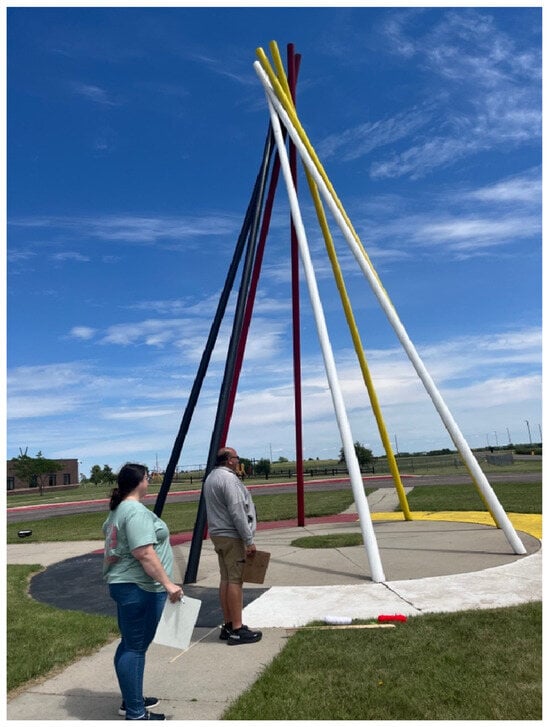
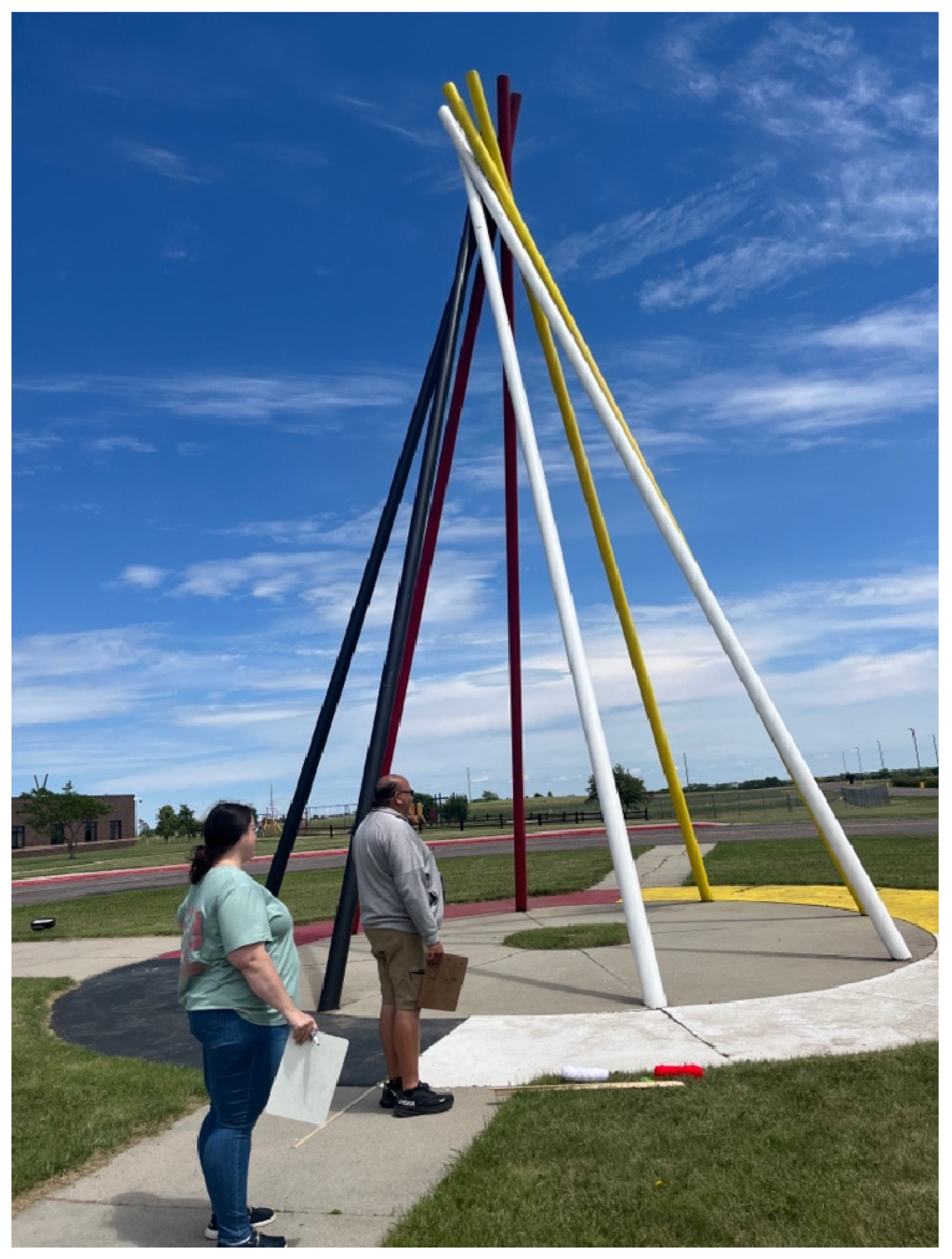
In the last part of day 2, we went outside to continue working with circular shapes. Outside the school, there is a structure depicting a Tippie (see Figure 5). At the bottom of the structure, a circular shape is divided into four equal areas colored red, yellow, white, and black. We compared our foot length to the diameter of the circle and its length (i.e., we computed the circumference of the circle using our foot).
Figure 5.
Tippie outside of the school. Photograph: Suazo-Flores, June 2026.
We then returned to the classroom to work on the last activity. Teachers were asked to create a mathematics lesson and adjust it using eight indigenous principles created by and for Indigenous educators. The Siċanġu Indigenous Principles of Learning (Sioux Tribe, Siċanġu Lakota Education Department, 2023) build on educational theories such as self-determination, culturally responsive, growth mindset, critical pedagogy, and constructivism. The eight principles are: context and content relationships, recognition of personal sovereignty, student-to-student conversation, community-oriented learning environment, self-directed learning, celebration of effort and thinking, divergent mindfulness, and embracing error and vulnerability.
5. Findings
Native Indigenous teachers shared having enjoyed the Indigenous mathematics workshop. They were willing to adopt pedagogical strategies to teach mathematics that are culturally rich and offer a frame of reference to “liberate the captive mind” (Chilisa, 2011, p. 14) from Western ideologies, enabling the expression and development of pedagogies that align with their own “cultural practices, thinking patterns, beliefs and values” (p. 14) and to empower their students. Native Indigenous teachers’ views of mathematics shifted after participating in the Indigenous Mathematics workshop. Most had not done or thought about mathematics since high school, and some remembered struggling with it. The findings below are presented by themes that represent how the participating educators experienced the mathematics workshop. Our analysis unearthed the following themes: Staying away from mathematics; Dakota practices and mathematics; bringing mathematics to Indigenous students; and seeing mathematics as a social activity.
5.1. Staying Away from Mathematics
During the workshop, participating teachers were reminded of their school experiences with mathematics. In general, their school mathematics experiences were negative.
Kind of brought me back to high school math because it was my first time being reintroduced to fractions. That was the last time I had any kind of participation in math relating to fractions. So it was reintroduced as a review in a way.[Native Indigenous Teacher, R]
I guess I did hate math a long time ago, or before the workshop; I was just kind of like, “If I could stay away from math, I will.” Yeah, he [Livingston] just makes you have a different outlook on how math is, and it doesn’t have to be one set way. And I just like that he makes you feel comfortable expressing how you maybe got your solution, or a different way you’re doing a problem. Or it’s just like he makes you feel comfortable in the workshop and doesn’t bring you down because I feel like maybe that’s what I’m scared of is like, “Oh no, you’re wrong.” So it’s kind of like a confidence booster, I guess, the way he held his workshop and presented.[Native Indigenous Teacher, I]
5.2. Dakota Practices and Mathematics
Participating teachers realized there is so much mathematics in their daily lives and Dakota activities. They began seeing their regular activities such as doing grocery shopping or Dakota practices, such as attending a powwow, as instances where they use mathematics, or where mathematics helps them reason and make decisions about next steps.
Math is in everyday life, isn’t it? Really. You don’t think of it that way, but really it is. It is. Whether we go grocery shopping or whatever, math is there.[Native Indigenous Teacher, L]
One way that I learned from the workshop is that you can make math connected to our culture by creating problems that have a context that relates to the kids’ experiences. Going to a powwow is an experience that your kids have. So, they have been doing that, like getting a suitcase ready or picking up sage and then putting it in little bundles, packages to sell it. Those are things that the kids do. So that’s something I learned from Author3. That’s how you can make math related.[Native Indigenous Teacher, D]
I enjoyed that one presenting up there like that. And then that’s where it helped me to understand. And so, as I said, I never thought about math being in it like that, but when it comes to the sewing especially, yeah, we do use mathematics.[Native Indigenous Teacher, L]
5.3. Bringing Mathematics to Indigenous Students
As they became aware that their regular Dakota practices are instances where they use mathematics, or where mathematics helps them reason, educators started thinking about their students. The workshop shifted teachers’ views of mathematics, motivating them to envision how to engage students in Indigenous Mathematics.
Easier ways to do the math. I mean, what sticks with me the most is the smile method. The smile method and the Chinese method—that’s what it’s called. And just being able to talk to the Indigenous students so that they better understand it and showing them the examples. It’s the smile method that really sticks with me.[Native Indigenous Teacher, L]
Well, I’ve always kind of liked math, but I’ve been scared of it because of the algebra. I had a hard time with it in high school. Yeah, I really had a hard time with it in high school. And when I was in high school, I didn’t ask any questions. So I’ve always been scared of math. I handled it in college, but I’ve always liked math. I always have. So I was looking forward to it; I was a little bit scared, but I thought, “Well, this is going to be great because I’ll be able to. Hopefully we can learn how to do algebra easier.” And we did do some algebra problems, and then I finally understood a couple things. I don’t know how to say it now, but it seems really dumb now that I think about it.[Native American Teacher, P]
Because there are a lot of them [school students] who struggle with math. In the indigenous community, there’s a lot of Native American kids who don’t want to do it because it looks hard. But when you look at it that way with that smile method, and for me, it opened my mind to, okay, okay, I can do this. I know that it’ll help all the grade levels that I work with.[Native American Teacher, L]
5.4. Seeing Mathematics as a Social Activity
Participating teachers realized the importance of positioning mathematics as a social activity after having shared thinking while doing mathematics. They described appreciating being with colleagues, working in groups, and learning from others’ ways of thinking during the workshop.
A light bulb turned on in my brain, and that was kind of unique in how they [other colleagues] thought about their lesson or how they thought about how to solve that math problem. So, it was great to hear from their perspectives and their point of view on solving math problems or doing an activity. So it was great to hear from them.[Native American Teacher, R]
I really liked that he made everything almost like a group, kind of brought us all together, and then let us ask questions that we’re scared to ask and then talk it out kind of.[Native American Teacher, I]
6. Discussion
We aimed to disseminate Native Indigenous teachers’ experiences participating in an Indigenous Mathematics workshop. The teachers, who mostly taught Dakota language and culture in their respective schools, started the workshop feeling skeptical about mathematics, but realized how their cultural practices and everyday experiences involved mathematical thinking and doing. By the end of the workshop, participating educators were motivated to introduce some of the mathematics activities and ideas shared at the workshop to their students. The workshop expanded teachers’ understanding of what counts as mathematics by situating mathematical knowledge within everyday Indigenous experiences rather than treating mathematics as an abstract body of knowledge taught through the “exercise paradigm” (Wright, 2021, p. 157), a feature of dominant Western discourse. Teachers moved from seeing mathematics as something associated with school, difficulty, or past negative experiences toward recognizing mathematics in everyday activities and Dakota cultural practices. For example, teachers identified mathematics in sewing, powwows, gathering sage, preparing food, and other community activities. This finding aligns with our literature review, which states that Indigenous identity is inseparable from place and space and that Indigenous peoples understand knowledge through relationships with land, culture, and community (Meyer, 2003).
Several teachers described previous discomfort, fear, or avoidance of mathematics. After the Indigenous Mathematics workshop, they described feeling more comfortable, confident, and willing to engage in mathematics problem solving. The workshop’s transformative potential emerged partly from creating a mathematical environment in which teachers’ existing ways of thinking were valued rather than judged against a single prescribed method. We intend to follow up with several other mathematics workshops to continue supporting teachers in doing and teaching Indigenous mathematics in ways that are relevant to their students (Skovsmose, 2011; Cotton, 2013; Gutstein, 2006).
In the workshop, teachers were encouraged to solve problems in different ways, represent their thinking visually, explain their reasoning, listen to alternative strategies, make mistakes, and recognize the value of different approaches. This connects directly to the eight Siċanġu Indigenous Principles of Learning, particularly: celebration of effort and thinking, divergent mindfulness, embracing error and vulnerability, student-to-student conversation, and self-directed learning.
6.1. Importance of Storytelling in Mathematics
The workshop modeled Indigenous mathematics not simply through the selection of culturally situated activities, but through relational ways of engaging in mathematics tasks. The “Indigenous” dimension of the workshop resided partly in how participants interacted around mathematics, not only in the cultural context of the mathematics tasks. Participants engaged in talking circles, collective meaning-making, oral explanation, storytelling, multiple representations, learning from peers, and relationality. We anticipate that their engagement resulted from the relationship we have developed over time with them and our shared experiences in the trauma-informed workshop. We attended first to the educators’ bodies and well-being, giving them time and space to see themselves as unique human beings who have so much to contribute to their communities.
6.2. Implications to Practice and Moving Beyond
In future workshops, teacher educators could position Native Indigenous teachers as knowledge holders, not simply recipients of professional development, and invite them to draw upon their own knowledge. For example, teachers in our workshop shared their experiences with harvesting medicinal plants, sewing, cooking, and planning community events, and these became resources for mathematical thinking. Our workshop did not begin from the assumption that teachers lacked culturally relevant mathematical knowledge and needed researchers or facilitators to provide it. Instead, the workshop helped teachers recognize and articulate knowledge they already used and possessed. This could lead other teachers to realize “that there is so much mathematics in their daily lives and Dakota activities,” as one of our Native Indigenous teachers expressed.
Teacher educators facilitating workshops could also create spaces where teachers learn from each other. We believe that the shifts in our participants’ views of mathematics occurred not only through the facilitator but through relationships among teachers strengthened by the trauma-informed workshop. In this way, Indigenous workshops could be a collective, holistic knowledge-building process rather than an individual and cognitive transfer of instructional techniques.
Author Contributions
Conceptualization, R.M.d.S. and E.S.-F.; Methodology, R.M.d.S. and E.S.-F.; Software, R.M.d.S. and E.S.-F.; Validation, R.M.d.S., E.S.-F., R.L. and N.E.; Formal analysis, R.M.d.S. and E.S.-F.; Investigation, R.M.d.S. and E.S.-F.; Resources, R.M.d.S., E.S.-F., R.L. and N.E.; Data curation, R.M.d.S. and E.S.-F.; Writing—original draft, R.M.d.S. and E.S.-F.; Writing—review & editing, R.M.d.S., E.S.-F., R.L. and N.E.; Visualization, R.M.d.S. and E.S.-F.; Supervision, R.M.d.S., E.S.-F., R.L. and N.E.; Project administration, R.M.d.S. and E.S.-F. All authors have read and agreed to the published version of the manuscript.
Funding
This research received no external funding.
Data Availability Statement
The original contributions presented in this study are included in the article. Further inquiries can be directed to the corresponding authors.
Acknowledgments
We express our sincere gratitude to the participating teachers who generously collaborated with us and shared their experiences and insights. We acknowledge the time they dedicated to engaging with the authors during the interviews. Through their reflexivity and reflection, our participating teachers pioneered new avenues for understanding mathematics within the classroom, emphasizing Indigenous pedagogical paradigms. We also thank Komal Mangle for her unwavering commitment to supporting the data collection process.
Conflicts of Interest
Author RunningHorse Livingston is employed by the company Mathematize, Inc. The remaining authors declare that the research was conducted in the absence of any commercial or financial relationships that could be construed as a potential conflict of interest.
References
- Adams, D. W. (1995). Education for extinction: American Indians and the boarding school experience, 1875–1928. University Press of Kansas. [Google Scholar]
- Antane Kapesh, A. (2020). Eukuan nin matshi-manitu innushkueu; Tanite nene etutamin nitassi? [I am a damn savage: What have you done to my country?]. Wilfrid Laurier University Press. [Google Scholar] [CrossRef] [Scilit]
- Beamer, K. (2014). No Makou Ka mana: Liberating the nation. Kamehameha Schools Press. [Google Scholar]
- Bear, L. L. (2007). Jagged worldviews colliding. In Reclaiming indigenous voice and vision (pp. 77–85). University of British Columbia Press. [Google Scholar] [CrossRef] [Scilit]
- Bear, L. L. (2012). Traditional knowledge and humanities: A perspective by a Blackfoot. Journal of Chinese Philosophy, 39(4), 518–527. [Google Scholar] [CrossRef] [Scilit]
- Burkhart, B. (2019). Indigenizing philosophy through the land: A trickster methodology for decolonizing environmental ethics and Indigenous futures. MSU Press. [Google Scholar]
- Carroll, S. R., Rodriguez-Lonebear, D., & Martinez, A. (2019). Indigenous data governance: Strategies from United States native nations. Data Science Journal, 18(1), 31. [Google Scholar] [CrossRef] [Scilit]
- Chilisa, B. (2011). Indigenous research methodologies (Vol. 54). Sage Publications. [Google Scholar]
- Christian, D., & Wong, R. (2017). Downstream: Reimagining water. Wilfrid Laurier University Press. [Google Scholar]
- Cotton, T. (2013). Critical mathematics education: From theory to practice. In A. Coles, R. Barwell, T. Cotton, J. Winter, & L. Brown (Eds.), Teaching secondary mathematics as if the planet matters (pp. 87–97). Routledge. [Google Scholar]
- Gaffney, M. (2008). Participatory action research. What makes it tick? Kairaranga, 9(3), 9–15. [Google Scholar] [CrossRef] [Scilit]
- Gegeo, D. W. (2001). Cultural rupture and indigeneity: The challenge of (re)visioning “place” in the Pacific. The Contemporary Pacific, 13(2), 491–507. [Google Scholar] [CrossRef] [Scilit]
- Gutstein, E. (2006). Reading and writing the world with mathematics: Toward a pedagogy for social justice. Taylor & Francis. [Google Scholar]
- Hunn, E. (1996). Columbia Plateau Indian place names: What can they teach us? Journal of Linguistic Anthropology, 6(1), 3–26. [Google Scholar] [CrossRef] [Scilit]
- Ibrahim, S., & Alkire, S. (2007). Agency and empowerment: A proposal for internationally comparable indicators. Oxford Development Studies, 35(4), 379–403. [Google Scholar] [CrossRef] [Scilit]
- Kahakalau, K. (2019). MA‘AWE PONO. Treading on the trail of honor and responsibility. In The past before us (pp. 9–27). University of Hawai‘i Press. [Google Scholar] [CrossRef] [Scilit]
- Kari, J. (2010). The concept of geolinguistic conservatism in Na-Dene prehistory. Anthropological Papers of the University of Alaska, 5(1–2), 194–222. [Google Scholar]
- Lajimodiere, D. K. (2019). Stringing rosaries: The history, the unforgivable, and the healing of northern plains American Indian boarding school survivors. Indigenous Peoples Resources. [Google Scholar]
- Lochmiller, C. R. (2021). Conducting thematic analysis with qualitative data. The Qualitative Report, 26(6), 2029–2044. [Google Scholar] [CrossRef] [Scilit]
- Marshall III, J. M. (2002). The Lakota way: Stories and lessons for living. Penguin. [Google Scholar]
- Meyer, M. A. (2003). Hoʻoulu: Our time of becoming: Collected early writings of Manulani Meyer. Ai Pohaku Press. [Google Scholar]
- Meyer, M. A. (2008). Indigenous and authentic: Hawaiian epistemology and the triangulation of meaning. In N. K. Denzin, Y. S. Lincoln, & L. T. Smith (Eds.), Handbook of critical and indigenous methodologies (pp. 217–232). Sage Publications. [Google Scholar] [CrossRef] [Scilit]
- Meyer, M. A. (2020). Holographic epistemology: Native common sense. In C. Smith (Ed.), Encyclopedia of global archaeology (pp. 5232–5240). Springer. [Google Scholar] [CrossRef] [Scilit]
- Oliveira, K. R. (2014). Ancestral places: Understanding kanaka geographies. First Peoples New Directions. [Google Scholar]
- Rice, J. (1983). An Ohunkakan brings a virgin back to camp. American Indian Quarterly, 7(4), 37–55. [Google Scholar] [CrossRef] [Scilit]
- Sandercock, L. (2018). Finding my way: Emotions and ethics in community-based action research with Indigenous communities. In J. Christensen, C. Cox, & L. Szabo-Jones (Eds.), Activating the heart: Storytelling, knowledge sharing, and relationship (pp. 3–28). Wilfrid Laurier University Press. [Google Scholar] [CrossRef] [Scilit]
- Sioux Tribe, Siċanġu Lakota Education Department. (2023). Siċanġu indigenous principles of learning. Sioux Tribe, Siċanġu Lakota Education Department. [Google Scholar]
- Skovsmose, O. (2011). An invitation to critical mathematics education. Sense Publishers. [Google Scholar] [CrossRef] [Scilit]
- Smith, D. (2020). Governing data and data for governance: The everyday practice of Indigenous sovereignty. In M. Walter, T. Kukutai, S. R. Carroll, & D. Rodriguez-Lonebear (Eds.), Indigenous data sovereignty and policy (pp. 117–135). Routledge. [Google Scholar] [CrossRef] [Scilit]
- Smith, L. T. (1999). Decolonizing methodologies: Research and Indigenous peoples. Zed Books. [Google Scholar]
- Wright, P. (2021). Transforming mathematics classroom practice through participatory action research. Journal of Mathematics Teacher Education, 24, 155–177. [Google Scholar] [CrossRef] [Scilit]
Disclaimer/Publisher’s Note: The statements, opinions and data contained in all publications are solely those of the individual author(s) and contributor(s) and not of MDPI and/or the editor(s). MDPI and/or the editor(s) disclaim responsibility for any injury to people or property resulting from any ideas, methods, instructions or products referred to in the content. |
© 2026 by the authors. Licensee MDPI, Basel, Switzerland. This article is an open access article distributed under the terms and conditions of the Creative Commons Attribution (CC BY) license.