


Abstract
The educational response of students with extensive and generalized support needs in regular centers poses a challenge for making inclusive education effective. Thus, the general objective of this study is to analyse the perceptions of education professionals working in the participating mainstream schools in the Region of Murcia regarding the barriers they identify to the inclusion of pupils with extensive and generalised educational support needs, as well as the organisational, pedagogical and collaborative responses they consider appropriate for addressing these barriers. A qualitative descriptive design was adopted, using a deductive–inductive content analysis approach. Semistructured interviews and focus groups were conducted with 35 professionals (teachers, counsellors and headteachers) from six regular primary schools in the Region of Murcia (Spain) using the ATLAS.ti 24 program for data coding. The results reveal four dimensions of barriers to inclusion: educational resources, classroom organization, professional development and social participation. Moreover, the consolidation of multidisciplinary teams, the application of universal design for learning (UDL), collaborative professional learning and the flexibilization of teaching practices in the classroom were identified by professionals as practices with the potential to strengthen inclusion. The results indicate that inclusion requires continuous organizational and pedagogical transformation and that professionals can become key agents of innovation capable of transforming obstacles into opportunities for systemic improvement.
1. Introduction
Advancing toward inclusive education systems is one of the main priorities of the 2030 Agenda for Sustainable Development (UN, 2015). In goal 4, inclusive education is presented as a collective and sustained commitment linked to equity, social justice and the universal right to quality education. In this context, inclusive education cannot be reduced to specific actions aimed at certain students but involves transforming policies, cultures and educational practices to ensure that no student is excluded from ordinary learning environments (Ainscow, 2024b; UNESCO, 2022). International educational policies recognize diversity as an inherent value of schools and as an opportunity to enrich the teaching–learning processes that take place in them (Messiou et al., 2025; OECD, 2018; UNESCO, 2023).
Inclusive education can therefore be understood as a process of systemic transformation aimed at identifying and eliminating the barriers that limit the presence, participation, learning and well-being of all students in schools (Arnaiz-Sánchez et al., 2024; UNESCO, 2020; Walton, 2025). This conception shifts the focus from the individual characteristics of students to the interaction between these characteristics and the contextual conditions in which the educational experience develops. This process is aimed at ensuring that all students, regardless of their personal, social or educational characteristics, learn and participate in common educational environments (Florian, 2014; Graham, 2024; Messiou, 2025; Slee & Tait, 2022).
In recent decades, research has questioned approaches focused on the deficit model, which is characteristic of conceptions associated with more traditional special education and the school integration movement, to evolve toward models of action that promote inclusive schools (Ainscow, 2024a; Arnaiz-Sánchez et al., 2007; Thomas & Loxley, 2022). Diversity is considered an inherent characteristic of humans and a source of collective wealth (Johansson & Herrebrøden, 2025; Woodcock et al., 2026). This conception requires strengthening collaborative professional cultures, changing the organizational structures of schools and developing teaching practices that respond to the diverse characteristics of students, although these are linked to extensive and generalized support needs (Holzer & Moser-Opitz, 2025; Rönn-Liljenfeldt et al., 2024). In this study, extensive and generalized educational support needs refer to situations in which students require intensive, sustained and coordinated disability-related support to promote their presence, participation, learning and well-being in regular classrooms (Dirección General de Atención a la Diversidad, 2023). Specifically, it requires creating conditions for teaching teams to plan together, share responsibilities, mobilize support and develop flexible responses to different forms of participation and learning (Decuyper et al., 2024).
However, the literature has identified structural, professional and pedagogical barriers that limit the development of inclusive education (Keles et al., 2024; Lakkala et al., 2021; Wang, 2026). These include the insufficiency of specialized professionals, limited access to adapted educational resources, high student–teacher ratios, the presence of rigid organizational structures, scarce opportunities for collaborative teaching and continuous professional development, and difficulties in the processes to promote meaningful peer participation.
These results indicate that the advancement of inclusion depends not only on legislative commitment but also on the ability of schools to identify and transform the structural, organizational and pedagogical conditions that generate barriers to student diversity (Echeita, 2022; Norwich, 2023). Similarly, other studies have highlighted that students’ sense of belonging, opportunities for social interaction and participation in school life are as relevant to achieving truly inclusive education as access to the curriculum is (Margas, 2023; Schmidt & Thygesen, 2024). Similarly, behavioral and personal autonomy problems, along with difficulties in social interaction, are considered barriers that favor situations of isolation, frustration or bullying.
1.1. Education Professionals as Agents of Innovation to Strengthen Inclusion
Although studies focused on identifying barriers to inclusion have considerably increased in recent years, less attention has been given to research that aims to understand how education professionals themselves face and respond to these challenges in their daily practice (Cologon, 2019; Lindner et al., 2023; DeMatthews et al., 2025). Few studies have explored the professional knowledge generated by teachers, management teams, educational guidance services (counsellors) and other educational specialists when designing innovative organizational, pedagogical and collaborative responses to strengthen inclusive education in regular schools. The few studies in this regard constitute an important knowledge gap for inclusive education since education professionals are not only those who apply educational policies but also agents of innovation whose daily decisions determine the quality and sustainability of practices and inclusive cultures (Reinius et al., 2022).
In this context, the path toward inclusive education depends, to a large extent, on the capacity of educational centers for inclusion (Hasbiyallah et al., 2026; Yngve et al., 2026). This concept refers to the development of structures, resources, professional cultures and improvement processes that allow a sustained response to the diversity of students and eliminate those obstacles that condition their presence, participation and learning (Ainscow, 2024b). Thus, the construction of inclusive schools requires not only the provision of resources or specialized support but also the implementation of a process of institutional training, through which the centers analyze their own practices, extract lessons from their experience and offer more adjustments to the needs of their entire educational community (Brussino, 2021; Wood et al., 2026).
Several studies have indicated that the schools that make the most progress toward inclusion are those that favor collaboration among teachers, shared reflection on their practices, exchange of experiences and creation of professional learning communities (Booth & Ainscow, 2016; Brennan & Pennycook, 2025; Sannen et al., 2021). In this context, teachers and education professionals cease to be conceived as mere executors of previously designed programs to become protagonists of the processes of educational transformation. In effect, their professional experience, the knowledge constructed from practice and the innovative strategies that they develop collaboratively constitute a source of learning that research needs to explore in greater depth, although their great potential has been recognized to guide the strengthening of increasingly inclusive schools (Heyder et al., 2026).
Therefore, this article focuses on understanding how professionals, drawing on their experience, interpret the barriers identified in their schools and propose responses to advance towards inclusive education. From this perspective, innovation is not limited to the introduction of new techniques, resources or strategies; rather, it lies in how these are used and combined to transform educational practices through the contributions of professionals in organisational and pedagogical roles (Vlachou & Tsirantonaki, 2026).
1.2. Context of the Study and Research Objective
This is not a trivial issue, but is particularly relevant in the Spanish educational context, in which successive legislative reforms have reinforced the principles of inclusive education (LOMLOE, 2020). These educational reforms attempt to strengthen the capacity of regular schools to respond to the diversity of students by eliminating barriers that hinder learning and participation. In addition, they promote the provision of support to teams of educational professionals to transform the organization of teaching and learning environments, favoring more flexible, preventive and inclusive responses.
However, the Spanish educational system maintains a schooling system consisting of regular schools, special education centers and specific support classrooms in regular schools. This reality exemplifies the complexity of progress toward inclusion and highlights the need to strengthen the capacity of the centers of the Spanish educational system to offer educational responses that are adjusted to student diversity. This organizational model results in a permanent debate about the best way to guarantee the right to education of students, which requires extensive and generalized support, and to strengthen the inclusive capacity of regular schools (Norwich, 2025). Understanding how professionals interpret these challenges and identify opportunities for innovation can provide relevant evidence to contribute to the strengthening of the culture, policies and inclusive practices of educational centers.
In the Spanish context, where the role of special education schools and the existence of specific support classrooms in regular schools continue to be debated from an inclusive education perspective, listening to the voices of professionals working in regular schools is essential, given their central role in educational transformation. In this regard, their perceptions and experiences make it possible to identify the barriers that hinder inclusion and formulate educational innovation proposals aimed at promoting the inclusion of students in regular classrooms.
The study is situated within the broader debate on the inclusion of pupils with extensive and generalised educational support needs. However, the empirical evidence is drawn exclusively from six mainstream schools in the Region of Murcia, Spain, selected, among other criteria, because they did not have dedicated support classrooms. Therefore, the study does not directly examine the organisation or practices of special education schools or those developed in such classrooms. Its empirical scope is limited to the perceptions of professionals working in the participating schools. References made by participants to other contexts should only be interpreted as information about those contexts when the transcripts explicitly identify the experience or source of knowledge on which they are based; under no circumstances should such references be regarded as direct observations of institutions that did not participate in the study.
Consequently, the analysis focuses on the experiences and perceptions expressed by the participating professionals in relation to their own educational contexts. References in their accounts to pupils, settings or practices outside their schools are interpreted in light of the information provided by the participants and the sources of knowledge they explicitly identify. Accordingly, such references are not considered direct empirical evidence of the functioning of special education schools or dedicated support classrooms.
On this basis, this study aims to analyse the perceptions of education professionals working in the participating mainstream schools in the Region of Murcia regarding the barriers they identify to the inclusion of pupils with extensive and generalised educational support needs, as well as the organisational, pedagogical and collaborative responses they consider appropriate for addressing these barriers.
2. Materials and Methods
2.1. Research Design
In accordance with the nature of the data, this study adopted a qualitative approach, which was based on an interpretive research paradigm with deductive–inductive orientation and cross-sectional design. This type of design makes it possible to understand how education professionals address the barriers to inclusion and the responses they develop in their practice (Strauss & Corbin, 2018).
2.2. Participants and Context
This study was conducted in six regular early childhood and primary education centers in the Region of Murcia (Spain). A total of 35 education professionals, including those belonging to the management teams (headteacher), individuals in educational guidance services, regular teachers and support teachers, were selected by intentional sampling for their knowledge and experience in the processes of educational inclusion implemented in the centers (see Table 1).
Table 1.
Participants.
The six schools were selected through purposive sampling according to the following criteria: (1) being a school providing primary education; (2) not having a specific support classroom; (3) ensuring diversity in terms of school ownership (state-run or state-subsidised); (4) ensuring diversity in terms of geographical location; and (5) having at least one student with extensive and generalised educational support needs requiring specific human and material resources.
The selection of mainstream schools without dedicated support classrooms was guided by the aim of examining barriers to inclusion and opportunities to improve inclusive provision in schools whose organisational structures did not incorporate this specific form of educational placement. The involvement of professionals with responsibilities for school organisation, educational guidance and direct classroom practice made it possible to examine the phenomenon from complementary professional perspectives. Purposive sampling was not intended to achieve statistical representativeness, but rather to capture experiences and perceptions relevant to the objectives of the study.
Initial contact with the schools was made by email to explain the aims of the study and invite their professionals to participate. The professionals were selected through purposive sampling, distinguishing between two profiles: the organisational profile, comprising headteachers and educational guidance professionals, and the pedagogical profile, comprising support teachers and mainstream classroom teachers. Participation was voluntary. The final sample of 35 professionals from six schools provided complementary perspectives, without seeking statistical representativeness.
The diversity of professional profiles and the broad professional trajectory of most of the participants allowed us to gather complementary perspectives on the organizational, pedagogical and support conditions necessary to favor the inclusion of students in regular classrooms.
2.3. Information Collection Techniques
For the collection of information, semistructured individual interviews were conducted with members of the management teams and educational guidance professionals, and focus groups were held with regular and support teachers. These approaches were selected for their suitability to explore in depth the perceptions and meanings constructed on the basis of the professional profiles of the participants in their educational contexts. As indicated by Brinkmann and Kvale (2018), semistructured interviews allow nuanced information about personal experiences, values and interpretations associated with the social and educational environment to be obtained, providing access to individual participants’ perspectives.
Data were collected through individual semi-structured interviews and focus groups to explore professionals’ perceptions in relation to their different educational responsibilities. Twelve individual interviews were conducted with members of school leadership teams (n = 6) and educational guidance professionals (n = 6). In addition, focus groups were held with class teachers and support teachers. These focus groups involved 23 professionals: 15 mainstream class teachers and eight support teachers, distributed across six focus groups, each comprising a minimum of three participants. Overall, the 35 professionals took part in a single data collection method: 12 participated in individual interviews and 23 in focus groups, with no overlap between the two methods.
The combination of these two data collection techniques made it possible to examine the phenomenon from complementary professional perspectives. Individual interviews facilitated an in-depth exploration of the experiences and views of school leadership and educational guidance professionals, whereas focus groups enabled the examination of shared experiences, areas of convergence and potential differences between mainstream class teachers and support teachers. The suitability of the data collected was assessed in terms of their relevance to the study objectives, the diversity of professional profiles represented and the depth of the information obtained in relation to the established analytical categories. This methodological complementarity enabled the researchers to examine the barriers to inclusive education and the organisational and pedagogical practices proposed by the professionals, without seeking statistical representativeness of the findings.
A script was prepared for both interviews and focus groups covering issues related to the inclusion of students in regular classrooms. This script was validated by eight experts in the research group “Inclusive education: A school for all” of the University of Murcia and was structured into four broad categories: perceptions about the barriers that hinder inclusive education; organizational and pedagogical challenges in daily educational practices; experiences of collaboration between different education professionals; and innovative practices considered effective for strengthening inclusive education.
The initial structure of the interview guide provided a deductive framework for data collection. However, the questions were open-ended, allowing participants to introduce experiences, barriers and proposals that had not been anticipated at the outset. These areas guided data collection but did not constitute a closed coding framework.
The interviews were conducted in person by members of the research team and lasted approximately 60 min. The information was recorded through audio recordings.
2.4. Data Analysis
The data analysis followed a deductive–inductive content analysis approach (Miles & Huberman, 1994). The deductive component was linked to the areas of inquiry defined in advance in the interview and focus group protocols, which guided the exploration of participants’ perceptions across four areas: barriers to inclusion, organisational and pedagogical challenges, professional collaboration, and inclusive practices.
The inductive component made it possible to identify meaning units, develop descriptive codes, and progressively group them into subcategories and analytical categories through an iterative process of comparison and interpretation.
The analysis was conducted in two complementary phases. In the first phase, the four researchers independently carried out an initial coding of the data, enabling them to develop preliminary interpretations of the participants’ accounts and identify meaningful units relevant to the research objectives. In the second phase, a collaborative analysis was undertaken in which the individual interpretations were compared, and coding decisions and the organisation of categories were jointly reviewed. This approach made it possible to distinguish the initial individual interpretation from the subsequent process of discussion and the development of a shared understanding of the data.
To structure the analysis, an initial codebook was developed based on the topics addressed in the data collection instruments. Organised into categories, codes and subcodes, this codebook was reviewed throughout the analysis to ensure coherence among the units of meaning, codes, subcodes and analytical categories. This system made it possible to organise the identified units of meaning and establish relationships between the different levels of analysis. Differences in interpretation among the researchers were addressed through joint discussion until an interpretive consensus was reached. The software ATLAS.ti 24 was used for coding and organization of the data and the development of analytical networks between the emerging categories.
The analytical sequence comprised an initial reading of the transcripts, the identification of units of meaning, the assignment of descriptive codes, and their progressive grouping into subcategories and analytical categories. Subsequently, the decisions made during the individual coding phase were examined through collaborative discussion among the four researchers. This process enabled the researchers to compare their initial interpretations, review the structure of the coding system, and relate the emerging categories to the areas of enquiry established in advance in the data collection instruments. The coding decisions and the organisation of categories were discussed and reviewed by the research team until an interpretative consensus was reached. When differences in interpretation arose, they were addressed through collaborative discussion of coding decisions and the organisation of categories. The joint analysis aimed to compare the proposed interpretations and examine their consistency with the meanings identified in the participants’ accounts. Furthermore, during these collaborative discussions, the researchers’ prior ideas and knowledge were reviewed to prevent them from exerting an unexamined influence on the interpretation of the accounts and the analytical decisions. The analytical decisions were reviewed until an interpretive consensus was reached regarding the organisation and interpretation of the data. This procedure made it possible to integrate the researchers’ individual perspectives without assuming that initial interpretations should automatically be accepted as definitive.
This procedure made it possible to compare interpretations and develop a shared understanding of the meanings identified in the participants’ accounts, in line with approaches to collaborative coding and researcher consensus in qualitative analysis (Coulston et al., 2025). This process allowed the identification of two major analytical categories: (1) barriers to inclusive education and (2) innovative practices to strengthen inclusive education.
In addition to these categories, the analysis revealed two complementary professional perspectives that consistently characterize the results. On the one hand, management teams and educational guidance professionals (organizational perspective) focused their discourses on school organization, resource allocation and institutional planning. On the other hand, tutors and support teachers (pedagogical perspective) interpreted inclusion from their daily experience of working in the classroom, emphasizing teaching and learning processes, teaching methodologies and student participation.
The organisational and pedagogical profiles were treated as analytical tendencies rather than homogeneous or mutually exclusive groups. Since professional profile was associated with the data collection method used—individual interviews with members of school leadership and educational guidance teams, and focus groups with teachers—differences between accounts cannot be attributed exclusively to professional role. The frequencies represent coded units of meaning rather than participants and should therefore not be interpreted as indicating the prevalence of particular opinions, levels of agreement or measures of effectiveness.
Differences between the researchers’ interpretations were distinguished from substantive differences in the participants’ accounts. While the former were addressed during the collaborative analysis phase, the latter were regarded as reflecting the diversity of professional perspectives represented in the data. In this respect, the organisational and pedagogical perspectives were interpreted as complementary ways of understanding inclusive education rather than as necessarily opposing positions.
Regarding the quantification of units of meaning, a differentiated counting procedure was established for the main dimensions and their subcategories. A single unit of meaning could be assigned multiple subcodes within the same dimension. Consequently, the frequencies reported for the subcategories represent the number of units of meaning associated with each code. Therefore, the sum of the frequencies or percentages across subcategories may exceed the corresponding figure for the main dimension.
Far from representing opposing views, both perspectives constitute complementary forms of professional knowledge that allow us to understand how the inclusive capacity of schools develops.
The organisational and pedagogical perspectives were interpreted as analytical tendencies that help explain different levels of action related to educational inclusion, rather than as rigid or mutually exclusive professional positions. The interpretation took into account the fact that professional profile was associated with the mode of data collection; therefore, differences between the accounts may reflect both the responsibilities undertaken and the interactional conditions inherent in individual interviews and focus groups. The numerical values correspond to coded meaning units, not participants. A single participant may have contributed several units. Accordingly, these values are descriptive and do not indicate prevalence, relative importance or degree of agreement.
2.5. Ethical Considerations
The study was conducted in accordance with the ethical principles of the Declaration of Helsinki of the World Medical Association (WMA, 2024) and the institutional regulations applicable to educational research. The study was reviewed and approved by the Research Ethics Committee of the University of Murcia (ID: 4312/2023). Before data collection, all participants were informed of the aims of the study, the voluntary nature of their participation and the intended use of the information collected. Informed consent was obtained from all participants before they were enrolled in the study.
Furthermore, measures were taken to ensure data confidentiality and protect the anonymity of participants’ views. The information collected was treated confidentially and used exclusively for the intended research purposes, with efforts made to prevent the identification of individual participants during the analysis and presentation of the findings.
3. Results
The findings are organised into two analytical categories: barriers to inclusive education and the responses that professionals consider appropriate to address them. Professional roles help to contextualise the testimonies, but are not interpreted as homogeneous or necessarily conflicting positions. The analysis that follows primarily identifies recurring patterns and nuances in the emphasis of the accounts. Differences are highlighted where they can be illustrated by specific testimonies; no disagreements or variations between schools are inferred that are not documented in the analysed material.
3.1. Category 1. Barriers to Inclusive Education
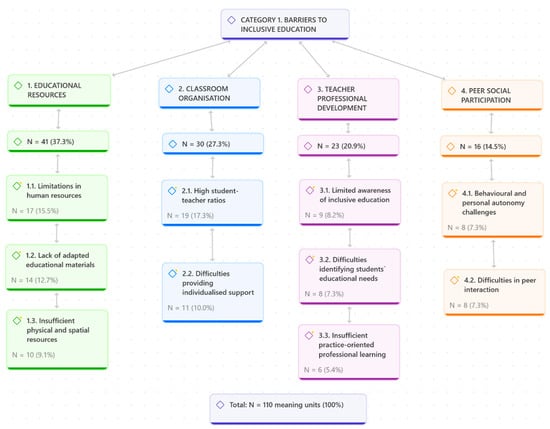
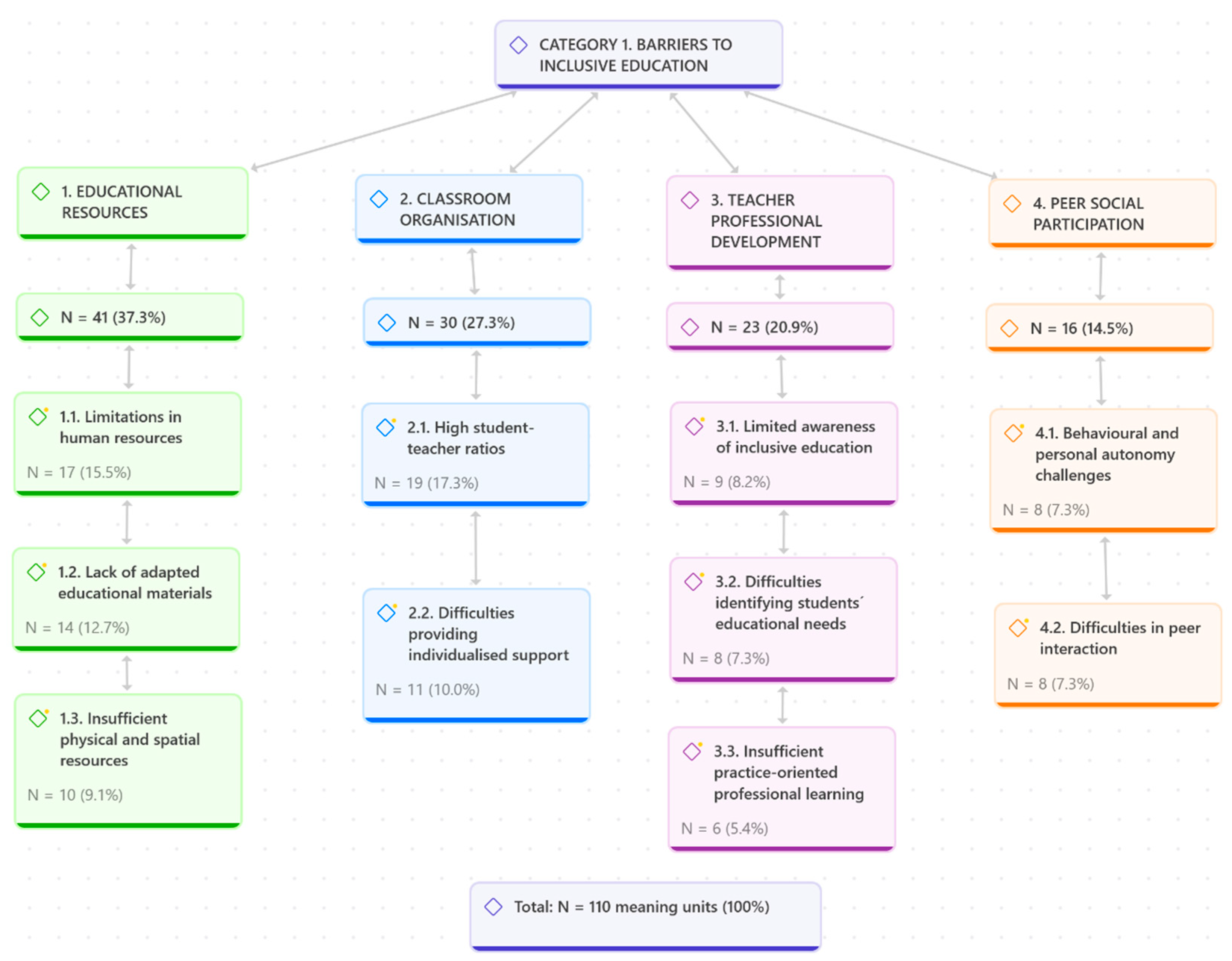
The first analytical category consisted of 110 quotes related to the barriers that hinder the inclusion of students who require extensive and generalized support in regular schools. Four closely related dimensions emerged from the inductive analysis: educational resources, classroom organization, teacher professional development and student social participation (see Figure 1).
Figure 1.
Analytical structure of Category 1: Barriers to inclusive education identified by education professionals.
Educational resources constitute a barrier to inclusive education. The participants noted that the lack of specialized personnel, the scarcity of adapted materials and the limited availability of accessible environments significantly hinder the development of inclusive education.
What we need most are personal resources; the teachers are very involved, but they cannot cope.(CO04-C4)
From the organizational perspective, the participating management teams and counsellors noted the need for stable multidisciplinary teams, specialized profiles (physiotherapists, nurses or specialists in augmentative and alternative communication) and accessible resources that facilitate the participation of all the students.
If we do not have enough personal resources, such as specialist teachers and educational technical assistants, students cannot receive the support they need.(HT04-C4)
From the pedagogical perspective, teachers focused their discourse on the insufficiency of resources that, together with the rigidity of school spaces and timetable organization, conditions the adaptation of teaching, the application of inclusive methodologies, the personalization of learning and student participation.
Schools require a transformation of their spaces to adequately respond to the diversity of students. It is necessary to have accessible environments with spatial resources and materials that allow the participation of students with different support needs.(ST03-C2)
Classroom organization was also identified as a barrier to inclusive education. The participants noted that the size of the groups, the distribution of time and the possibility of coordination between professionals condition the development of inclusive practices.
From the organizational perspective, the management teams and guidance professionals interpreted the organization of the classroom as an institutional responsibility closely linked to the planning of human and material resources. Furthermore, they highlighted that high student–teacher ratios hinder the implementation of inclusive models and reduce the ability of schools to organize effective support.
The current complexity of classrooms makes it unfeasible for a single teacher to respond adequately to the diversity. The incorporation of a second professional should be a priority to ensure inclusive educational care.(HT06-C6)
From a pedagogical perspective, teachers highlighted the specific consequences that these organizational conditions have for daily teaching. For the participants, the organization of the classroom directly determines their ability to adapt activities, perform individualized monitoring and provide support tailored to the needs of each student.
The methodology and activities must be continuously adapted to the needs of each student, which requires constant monitoring that is difficult to assume when a single teacher must attend to the entire group.(ST05-C3)
Teacher professional development was also identified as an important aspect of the barriers to inclusive education. Although all the participants recognized their importance, differences were identified on the basis of the responsibilities undertaken by each group.
From an organizational perspective, professional development is conceived as an institutional responsibility that should be integrated into the improvement strategy of schools. A participant stressed the need to design permanent training plans, promote collaborative professional cultures and ensure that teacher learning is aligned with the objectives of inclusive education. Similarly, another participant stated that inclusive schools require specific times for teacher coordination, stable coordination structures and an institutional culture that favors continuous learning by professionals.
Training should be integrated into working hours, taking advantage of teaching coordination times to develop collaborative processes focused on inclusive methodologies, universal design for learning (UDL) and attention to diversity.(CO01-C1)
From the pedagogical perspective, teachers emphasized the need to have learning opportunities directly linked to the real problems of educational practice, highlighting peer observation, shared planning, shared teaching, mentoring, collective reflection on situations and authentic teaching methods. Rather than demanding an increase in theoretical courses, participants defended training models on the basis of the exchange of experiences and the joint construction of solutions adapted to student diversity.
Training is insufficient when limited to theoretical content; teachers need practical orientations that allow them to confidently face the real situations that arise daily in the classroom.(RT03-C2)
Professional learning was conceived as a collaborative process that is developed within the educational centers themselves and that contributes to progressively improving inclusive practices.
Social participation of students was another aspect highlighted by participants, who described difficulties in ensuring participation in school life, meaningful peer relationships and a sense of belonging.
From the organizational perspective, management teams and guidance professionals noted social participation as a characteristic of the inclusive culture of the center. Their accounts highlighted the importance of generating organizational environments that favor the feeling of belonging, positive relationships between equals and the co-responsibility of the entire educational community with respect to inclusion.
Student participation depends on the center building an inclusive culture in which everyone feels part of the educational community. When the organization favors coexistence and collaboration, inclusion becomes a daily reality.(CO04-C4)
From the pedagogical perspective, teachers described participation in specific situations of daily life in the classroom. A participant noted cooperative learning, peer support, the establishment of friendly relationships and the active involvement of students in school activities. The participant also noted that inclusion acquires real meaning when students participate in group dynamics, establish meaningful social bonds and experience an authentic feeling of belonging to the school community.
Inclusion is reflected when students work, learn and participate together. It is in these daily interactions in which friendships and the true feeling of belonging to the group arise.(RT15-C5)
3.2. Category 2. Innovative Practices to Strengthen Inclusive Education
The second category comprises 120 units of meaning relating to resources, teaching practices and organisational changes that professionals consider relevant to addressing the identified barriers. The analysis distinguishes between the provision of human and material support, established inclusive practices, proposed organisational improvements for schools, and those actions that participants explicitly describe as novel within their own contexts. Classification as a potential response to the barriers does not imply that a measure is innovative in itself, nor that its effectiveness has been evaluated in this study.
Educational resources were identified as a relevant dimension in strengthening inclusive education. The participants agreed that moving toward more inclusive schools requires increasing the availability of specialized resources and reorganizing the way in which these resources are distributed, coordinated and integrated into the daily life of the centers.
From the organizational perspective, management teams and guidance professionals interpreted educational resources as an organizational component. They expressed that inclusive education can be consolidated only when teacher-tutors, support teachers, guidance professionals, health personnel and other specialists work in a coordinated manner within the same educational project.
Real inclusion begins when the center has a transdisciplinary team; we cannot expect a tutor to assume all the responsibility alone. They need to have a nurse by their side for cases of chronic health problems or a physiotherapist who intervenes in motor skills and other postural aspects.(HT01-C1)
Moreover, participants highlighted the need to redesign school spaces to guarantee universal accessibility. In this context, accessibility ceases to be understood as a set of specific adaptations to become an organizational responsibility that requires planning, investment and a long-term institutional vision. Taken together, these discourses reveal that professionals conceive of educational resources as structural conditions that make the development of a truly inclusive school possible.
From the pedagogical perspective, teachers noted the need to expand educational resources. Rather than emphasizing an indiscriminate increase in specialists, they stressed the importance of having accessible materials, flexible teaching resources and augmentative and alternative communication systems to encourage student participation.
The materials should be previously designed with different levels of difficulty. Every time a student needs an augmentative or alternative communication system, it has to be developed from scratch, and teachers end up assuming a workload that is hardly sustainable.(RT14-C5)
For these participants, educational resources are not only additional support but also pedagogical tools that allow personalized teaching, favor participation and reduce the need for continuous individual adaptations. Consequently, teachers emphasized a conception of resources centered on their daily integration within the teaching and learning process rather than their use as external support to the regular classroom.
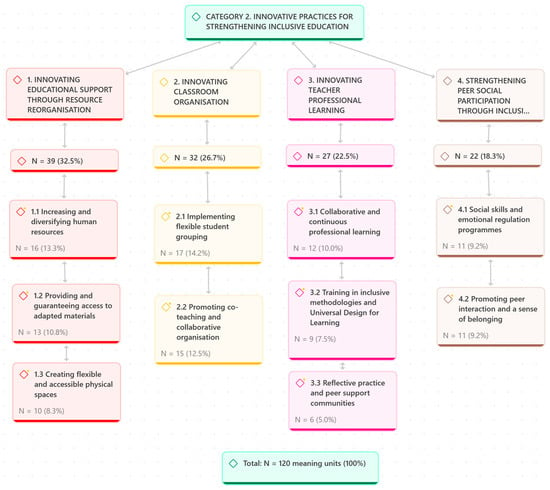
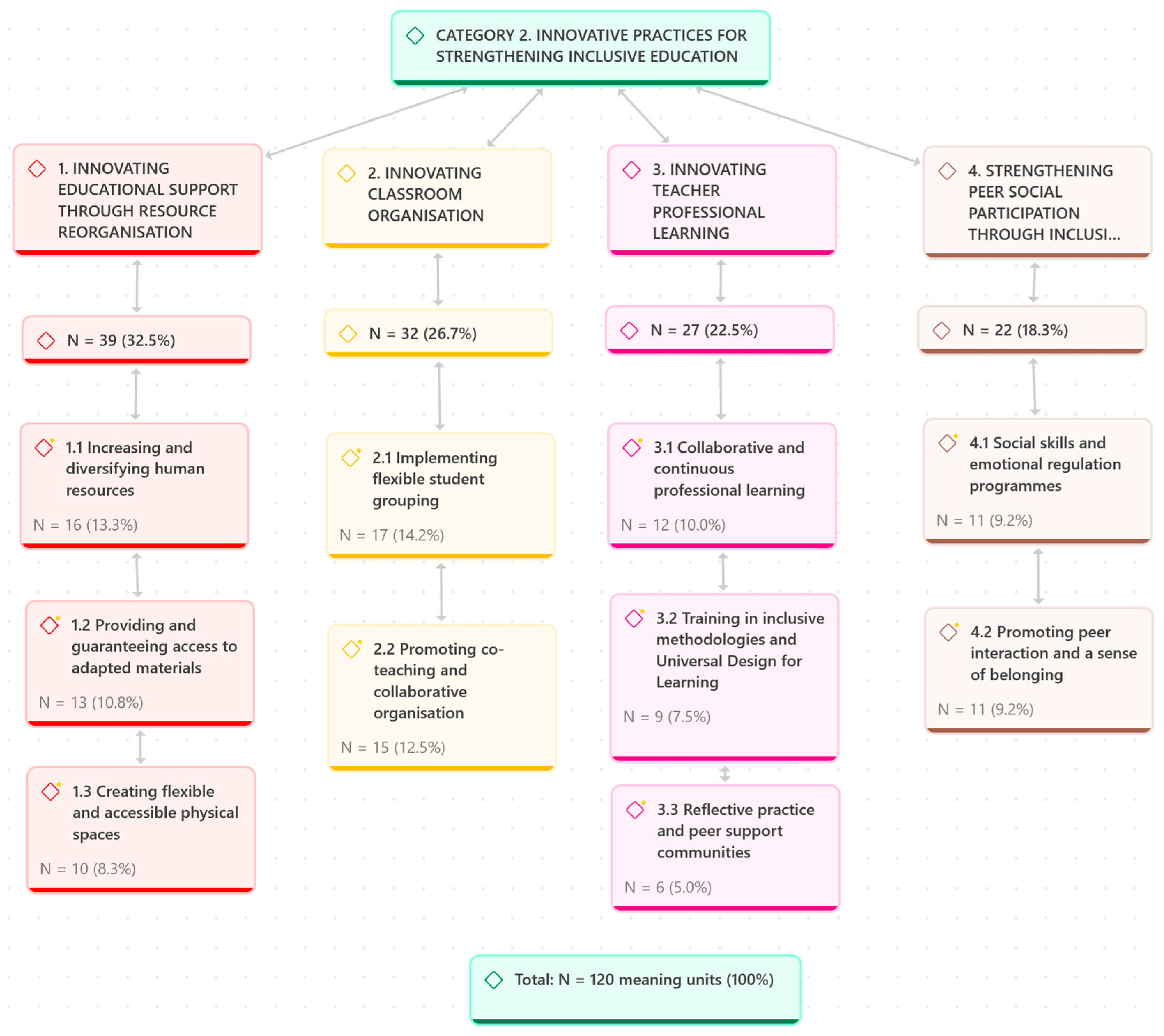
The analytical dimension of organizational and pedagogical innovation (see Figure 2) focused on how the two professional perspectives understood innovation and the meaning they attributed to it. Furthermore, this dimension revealed one of the most relevant differences between the two professional perspectives identified in the study: the meaning attributed to innovation.
Figure 2.
Analytical structure of Category 2: Innovative practices for strengthening inclusive education.
From the organizational perspective, management teams and guidance professionals noted innovation as a process of organizational transformation. They emphasized the need to review the operating structures of the centers, promote forms of shared leadership, make school organization more flexible and strengthen coordination mechanisms between different professionals and centers.
From the pedagogical perspective, teachers interpreted innovation mainly through the changes introduced in teaching practice. Their proposals focused on active methodologies capable of responding to student diversity, among which shared teaching, cooperative learning, differentiated teaching and UDL were notable.Innovation requires pedagogical leadership, coordination times and organizational structures that allow joint planning of educational responses and promote sustainable changes in the center.(CO01-C1)
Training in inclusive methodologies, UDL and augmentative and/or alternative communication systems is essential to respond effectively to the diversity present in ordinary classrooms.(RT07-C3)
Participants insisted that these strategies should not be understood as isolated techniques but as interdependent practices that require permanent reflection, joint planning and close collaboration between the different professionals involved in the teaching and learning processes. Similarly, the teachers emphasized that the effectiveness of these methodologies depends largely on the existence of organizational conditions that allow them to be developed continuously and not as isolated experiences.
The analytical dimension of teacher professional development focused on the differences between the two professional perspectives regarding professional learning and teacher training.
From the organizational perspective, management teams and counsellors noted professional learning as a responsibility of the school organization. They emphasized the design of long-term institutional strategies aimed at consolidating collaborative cultures, favoring professional exchange and integrating continuous learning into the improvement processes of the center.
Teacher training should preferably be developed in the center itself, linked to the real needs of students and supported by stable spaces of coordination and shared learning.(HT05-C5)
Participants insisted that inclusive schools require stable coordination structures, specific times for collaborative work and institutionalized spaces for the shared analysis of educational practice.
From the pedagogical perspective, teachers described professional learning as a collaborative process built on daily classroom experience. Rather than demanding a greater supply of external training, teachers highlighted the importance of peer observation, mentoring, shared planning, shared teaching and the collective resolution of problems that arise during educational practice.
Training acquires true value when a specialized professional accompanies teachers in the classroom, shares strategies, provides resources and helps them resolve real situations of educational practice.(RT01-C1)
The analytical dimension of participation as a shared result of inclusive innovation revealed that despite the existing differences between the two professional perspectives, all the participants converge on the same educational objective: to favor the full participation of students in school life.
From the organizational perspective, management teams and counsellors associated participation with the development of inclusive school cultures characterized by a sense of belonging, shared responsibility and equal opportunities for all students.
Participation is possible only when the center builds an inclusive culture in which all students feel that they are a part of the educational community. The responsibility of inclusion does not correspond to a single professional but must be favored, first, by the school organization.(CO03-C3)
They highlighted the need to create institutional conditions that incorporate participation as a cross-cutting principle of the center.
From the pedagogical perspective, teachers highlighted cooperative learning, peer support, the construction of friendly relationships and the active involvement of students in school activities as essential processes to promote inclusion.
Inclusion becomes visible when students learn, work and live together. Support relationships between peers, participation in classroom activities and the feeling of belonging to the group are indicators that show that inclusion is really occurring.(ST01-C1)
Participation was noted as an educational process that is built daily through interactions between students and teachers and that manifests itself when all students have real opportunities to learn, collaborate and feel like valuable members of the group.
Overall, the accounts analysed highlight the interrelationship between schools’ organisational conditions and educational practices aimed at promoting inclusion. The need for resources and coordination is linked to the capacity to adapt teaching, foster pupil participation and develop training processes tailored to the needs of each educational context. The quotations presented illustrate these connections and help identify areas of convergence, as well as nuances in the professionals’ experiences and perceptions, without presupposing that all participants share the same interpretation. Accordingly, the findings reflect patterns identified in the accounts and should be interpreted within the limits of the qualitative evidence analysed.
4. Discussion
Based on the results, the fundamental contributions of this study are discussed below.
The proposals gathered should be interpreted according to the meaning that professionals attribute to them within their respective contexts. The involvement of specialists and the use of accessible materials constitute a demand for resources; Universal Design for Learning (UDL), cooperative learning and co-teaching can be understood as established inclusive practices; and coordination, shared planning or flexible timetables are described as potential organisational improvements. These actions should not automatically be classified as innovations. The analytical value of the study lies in showing how professionals identify, prioritise and relate different responses to barriers. When the testimonies do not explicitly state that a practice is new in their context, it is more accurate to speak of potentially useful proposals or practices rather than proven innovations. The study’s design captures professional perceptions and does not evaluate the effectiveness of these responses.
Notably, owing to their amplitude, the barriers identified by the participating professionals as hindering inclusive education include organizational restrictions in educational centers, the scarcity of resources, the lack of training of teachers and the different ways in which professional groups interpret barriers according to their organizational responsibilities (Echeita, 2022; Keles et al., 2024; Lakkala et al., 2021; Wang, 2026). Therefore, changes in educational policies and in the work of educational institutions are required to definitively abandon the deficit model and to promote inclusive, equitable and high-quality education (Ainscow, 2024b; Arnaiz-Sánchez et al., 2007; Norwich, 2025; OECD, 2018; Thomas & Loxley, 2022).
Similarly, the results suggest that although not all professionals interpret inclusive education in the same way (Arnaiz-Sánchez et al., 2024; Graham, 2024; Walton, 2025), their perception of it is directly related to the roles and institutional responsibilities they assume in the development of inclusive schools (Florian, 2014; Slee & Tait, 2022). Although certain differentiating nuances are sometimes perceived, in general, a complementary nature is described in the professional perspectives identified, which constitutes one of the most relevant findings of this research. While management teams and guidance professionals systematically emphasized aspects related to school organization, resource allocation, institutional coordination, interdisciplinary work and distributed leadership, teacher-tutors and support teachers focused their discourses on daily educational practice, describing how organizational decisions condition the implementation of curricular adaptations, teaching methodologies, student participation and real learning opportunities.
These affirmations reflect different dimensions, but they are deeply interrelated and refer to the same educational reality, since they suggest that inclusion not only depends exclusively on the quality of the practices developed in the classroom but also on the organizational conditions that allow teachers to implement these practices (Ainscow, 2024b). Therefore, organizational transformations only make sense when they translate into better opportunities for learning, participation and well-being for students (UNESCO, 2020). These results are consistent with the findings of different studies and the recommendations of organizations reporting that inclusive education requires the simultaneous transformation of school cultures, policies and practices (Ainscow, 2024a; Johansson & Herrebrøden, 2025; Reinius et al., 2022; UNESCO, 2023; Woodcock et al., 2026). However, the results of this study allow us to expand this approach, suggesting that these transformations are constructed through the interaction between different forms of professional knowledge linked to the different roles within schools (UNESCO, 2022).
The way in which participants conceptualize educational innovation is relevant in the present study, given the differences between the meanings they attribute to it, according to the professional perspectives included in this study. From the organizational perspective, the participants understand innovation as a transformation of the structures and operating conditions of the centers—shared leadership, organizational flexibility, coordination and professional collaboration—whereas from the pedagogical perspective, they link innovation with the transformation of teaching practices, including the use of inclusive methodologies—shared teaching, cooperative learning, differentiated teaching or UDL. However, the proposals of both perspectives are not independent actions but are components of a broader process of institutional improvement (Cologon, 2019; DeMatthews et al., 2025). In addition, the analysis of the participants’ perceptions revealed the development of innovative practices derived from the incorporation of new methodologies—such as cooperative learning—as noted in other studies (Decuyper et al., 2024; Lindner et al., 2023; Reinius et al., 2022). Nevertheless, its identification as a potentially useful practice does not imply that it constitutes an innovation in the participating schools, nor that its effectiveness has been demonstrated.
The literature on professional learning communities and organizational learning has also suggested that the sustainable improvement in schools depends on their ability to generate, share and apply professional knowledge collectively (Hasbiyallah et al., 2026; Yngve et al., 2026). From this perspective, progress toward inclusive education depends less on the implementation of external reforms than on the ability of the professionals themselves to critically interpret their reality, identify the existing barriers and construct responses tailored to each educational context (Ainscow, 2024b; Brussino, 2021).
The close relationship between organizational innovation and pedagogical innovation constitutes another relevant finding in this study. The participants repeatedly noted that inclusive methodologies cannot be consolidated if schools do not simultaneously modify their organizational structures, their forms of coordination and their mechanisms of resource allocation (DeMatthews et al., 2025; Heyder et al., 2026; Holzer & Moser-Opitz, 2025). With respect to this finding, the management teams and counsellors insisted that practices such as shared teaching, cooperative learning or differentiated teaching require specific times for joint planning, flexible schedules, interdisciplinary coordination and institutional leadership that can sustain these changes. These needs sometimes complicate the implementation of these strategies, but the teachers insisted there was great potential and need for their use.
Therefore, organizational innovation cannot be understood as merely an administrative process, just as pedagogical innovation is not the exclusive responsibility of teachers (Margas, 2023; OECD, 2018; UNESCO, 2020). Both dimensions appear closely linked and form two inseparable components of the development of inclusive schools. These results have important implications for educational policies. Initiatives focused exclusively on increasing specialized resources or expanding the supply of teacher training will have a limited impact if they are not accompanied by organizational transformations that favor collaborative work and the integration of inclusive practices in the daily life of the centers.
The investigation of the professional development of teachers also yielded some relevant results in this study. All participants defended professional learning models that are integrated into the daily practices of schools on the basis of peer observation, shared planning, collaborative teaching and joint reflection on the real problems that arise during teaching (Brussino, 2021; Wood et al., 2026). They also criticized traditional training models based on theoretical courses and isolated training actions, considering them insufficient to respond to the complexity of inclusive education. These results agree with the current conceptions of professional development by considering it a continuous process that is situated and closely linked to the work context (Brennan & Pennycook, 2025; Sannen et al., 2021). In addition, they highlight the importance of educational leadership to generate the necessary organizational conditions for the consolidation of collaborative professional learning cultures within schools.
The strengthening of educational resources is also highly relevant to the results of the present work (Booth & Ainscow, 2016; DeMatthews et al., 2025). The participants agreed on the need to strengthen the resources available to move toward more inclusive education, although there were differences in the perspectives among the different professionals. From an organizational point of view, the disposition of human resources, coordination and accessibility are emphasized; from a pedagogical perspective, accessible materials and their integration in the classroom are notable. Therefore, the strengthening of resources requires not only increasing their availability but also ensuring adequate organization, coordination and integration in the classroom (Brussino, 2021; Wood et al., 2026).
Similarly, the social participation of students is important for the advancement of inclusive education (Messiou et al., 2025; Rönn-Liljenfeldt et al., 2024; Schmidt & Thygesen, 2024), although there are differences among organizational and pedagogical perspectives. The first highlights the link between participation and a sense of belonging and shared responsibility, which requires highly planned environments. The second highlights cooperative learning and peer support as the main conditions for effective participation and for the creation of bonds of friendship. Both approaches converge, thus, in a consensus on the existing structural barriers, recognizing that ensuring meaningful interactions for students is a great challenge for the educational system.
In summary, this study proposes a conceptual interpretation that can contribute to the current debate on inclusive education beyond the empirical data obtained. Instead of understanding inclusion exclusively as the elimination of barriers or the application of isolated innovative practices, the results suggest that the development of inclusive schools arises from the interaction between complementary forms of professional knowledge. From the organizational perspective, knowledge related to leadership, coordination and institutional capacity is provided. From the pedagogical perspective, it contributes knowledge on classroom practices, adaptations of the curriculum and student participation. However, none of these perspectives is sufficient by itself, but both forms of knowledge must interact within collaborative organizational cultures so that inclusive education acquires a sustainable character. This study suggests that the professional diversity existing in schools constitutes a strategic resource for generating organizational learning and moving toward truly inclusive models of education.
From this perspective, innovation in inclusive education should be interpreted in light of the perceptions and experiences of the professionals involved in the educational contexts under study. In this study, the organisational and pedagogical practices identified as innovative reflect participants’ assessments of the responses they consider appropriate for addressing barriers to inclusion, as well as the conditions that, in their experience, may facilitate their development.
Therefore, the findings provide insight into how professionals conceptualise innovation and the potential they attribute to it in advancing towards more inclusive schools. However, they do not establish the effectiveness of these practices or demonstrate that they directly improve students’ participation, learning, well-being or sense of belonging. This distinction is essential for an appropriate interpretation of the findings and for defining the scope of their implications. Accordingly, future research should examine how these practices are implemented in schools and incorporate direct evidence to assess their actual contribution to the development of inclusive education.
5. Conclusions
The findings highlight the importance participants attribute to educational policies and professional knowledge in advancing inclusion. These, as producers of knowledge, must be able to promote organizational learning processes and convert schools into authentic professional communities oriented toward inclusion.
The first conclusion confirms that inclusive education continues to face multiple interrelated barriers, including insufficient specialized resources, the organizational limitations of the centers, limited opportunities for teachers’ professional development and difficulty promoting the meaningful social participation of teachers and students. The analysed accounts indicate that professionals perceive opportunities to address identified barriers through organisational, pedagogical and collaborative strategies aimed at advancing inclusive education.
Another notable conclusion is the identification of two complementary professional perspectives that explain how inclusive education is constructed. Management teams and educational guidance professionals interpret inclusion fundamentally from an organizational perspective, focused on leadership, institutional coordination and resource management. Tutoring teachers and support teachers conceive it from a pedagogical perspective, emphasizing teaching methodologies, shared teaching, curricular adaptation and student participation. Both approaches are not opposed but represent complementary forms of professional knowledge that, when integrated, favor the development of more inclusive schools.
Therefore, the results suggest that progress toward inclusive education depends not only on increased funding or the expansion of specialized resources but also on the ability of schools to integrate organizational leadership with pedagogical innovation. Inclusive schools are built when different professionals collaborate, share knowledge and develop collective responses to the challenges posed by student diversity.
This study suggests various practical priorities for educational policies and school improvement processes. These priorities include strengthening multidisciplinary teams, promoting collaborative professional learning, consolidating shared teaching and UDL, increasing coordination between regular centers and special education centers, and creating organizational structures that allow the transfer of principles of inclusive education to classrooms’ daily practices.
In conclusion, this research makes important conceptual contributions by proposing that professional knowledge constitutes a strategic resource for the development of inclusive schools. It suggests that innovation does not arise only from external reforms or an increase in resources but also from the ability of professionals to learn collectively, reinterpret educational challenges and jointly transform organizational and pedagogical practices. Considering these contributions implies favoring the transformation of regular centers into inclusive centers and offering an educational response that provides support to any student who needs it (Messiou, 2025; Norwich, 2023). Following this path requires a high degree of coordination among education professionals and the implementation of flexible responses in classrooms with great methodological richness.
Overall, the findings highlight the importance of examining organisational conditions and pedagogical practices together, based on the perceptions of education professionals. The priorities identified may inform processes of reflection and improvement in schools, particularly regarding support coordination, classroom organisation, teacher training and student participation. Nevertheless, the actual contribution of these responses to inclusion will need to be investigated in future studies incorporating direct evidence of their implementation and their effects on students’ participation, learning, well-being and sense of belonging.
6. Limitations and Future Research
Several limitations of this study should be considered. Although many of the identified barriers and innovative practices coincide with those described in the literature and international reports on inclusive education (UN, 2015), the organizational characteristics of the participating centers and the regulatory framework in which they are inscribed can limit transferability of the findings to other educational contexts, as the context of this study is specific to the regional Spanish educational system.
This study focused exclusively on the perceptions of education professionals. Future studies should explore the perceptions of students, their families and other members of the educational community to more broadly understand the processes related to the development of inclusive schools.
The cross-sectional nature of this study reflects how professionals currently interpret barriers and innovative practices but does not allow the evolution of these perspectives to be analyzed over time or their influence on the sustained implementation of the processes related to educational transformation to be assessed. The combination of qualitative and quantitative methodologies would also allow the relationship between the organizational conditions identified in this study and variables such as participation, learning, well-being and the sense of belonging of the students to be analyzed.
Professional profile was associated with the data collection method, as members of the management and educational guidance teams participated in individual interviews, whereas teachers participated in focus groups. Therefore, the differences identified should be interpreted as analytical trends, taking into account both professional roles and interactional conditions. In addition, the purposive selection of schools and participants limits the transferability of the findings. Potential socially desirable responses, the influence of the researchers on the analysis, and the fact that coded frequencies do not indicate how many participants share a particular view or how important that view is must also be considered. Finally, the study does not directly assess the effects of the practices analysed on students’ educational outcomes.
Furthermore, any references that may appear in participants’ accounts to pupils, settings or practices outside their own schools are interpreted on the basis of the information provided by the participants and the sources of knowledge that they explicitly identify. Consequently, such references are not regarded as direct empirical evidence regarding the functioning of special educational needs schools or specialised support classrooms.
Future research should include longitudinal and comparative qualitative studies that analyze how the processes of organizational and pedagogical innovation evolve in different school contexts. Similarly, conducting research in different autonomous communities or countries would contribute to determining the extent to which the professional perspectives identified respond to contextual characteristics or constitute a common feature of the development of inclusive schools.
The role of professional learning communities could also be investigated as spaces of integration between organizational knowledge and pedagogical knowledge, providing new evidence on the processes through which schools generate sustainable innovation to advance toward a truly inclusive education.
Author Contributions
P.A.-S.: Conceptualization, methodology, supervision, validation, investigation, writing—review and editing. She contributed particularly to the scientific leadership of the study, its theoretical and methodological foundations, and the critical revision of the manuscript’s intellectual content. J.A.R.: Conceptualization, methodology, investigation, formal analysis, data curation, visualization, writing—original draft preparation, writing—review and editing. He contributed particularly to the development of the analytical process, interpretation of the results, systematization of the findings, and scientific preparation of the manuscript. S.A.: Investigation, validation, writing—review and editing. He contributed to the development of the study, interpretation of the results, and critical review of the scientific content. C.M.C.-G.: Investigation, validation, writing—review and editing. She contributed to the development of the research, assessment of the results, and improvement of the manuscript’s content and scientific coherence. All authors have read and agreed to the published version of the manuscript.
Funding
This research was conducted within the framework of the R&D&I project PID2022-138349NB-I00, entitled “The Role of Special Education Centres at the Crossroads of Inclusion from the Voices of the Key Stakeholders: Proposals for Innovation and Improvement”, funded by the Ministry of Science, Innovation and Universities of the Government of Spain (MICIU/AEI/10.13039/501100011033), together with the European Regional Development Fund (ERDF) “A Way of Making Europe”.
Institutional Review Board Statement
The study was conducted in accordance with the Declaration of Helsinki and approved by the Research Ethics Committee of the University of Murcia (protocol code 4312/2023, approved on 26 January 2023).
Informed Consent Statement
Informed consent was obtained from all subjects involved in the study.
Data Availability Statement
The data presented in this study are not publicly available due to privacy and ethical restrictions concerning the confidentiality and anonymity of the participants. Further information may be obtained from the corresponding author upon reasonable request, subject to applicable ethical and institutional restrictions.
Conflicts of Interest
The authors declare no conflicts of interest.
References
- Ainscow, M. (2024a). Developing inclusive schools: Pathways to success. Routledge. [Google Scholar]
- Ainscow, M. (2024b). Every learner matters and matters equally: Making education inclusive. UNESCO. Available online: https://unesdoc.unesco.org/ark:/48223/pf0000388991 (accessed on 15 July 2026).
- Arnaiz-Sánchez, P., Alcaraz, S., & Caballero, C. M. (2024). Meanings attributed to inclusive education by the educational community. Revista Electrónica Interuniversitaria de Formación del Profesorado, 27(3), 135–152. [Google Scholar]
- Arnaiz-Sánchez, P., Guirao Lavela, J.-M., & Garrido Gil, C. F. (2007). Attention to diversity: From the deficit model to the curricular model. Education Policy Analysis Archives, 15(23), 1–41. [Google Scholar] [CrossRef] [Scilit]
- Booth, T., & Ainscow, M. (2016). Index for inclusion: A guide to school development led by inclusive values. CSIE. [Google Scholar]
- Brennan, A., & Pennycook, C. (2025). Fostering teacher leadership for inclusion: The role of school-university partnerships and professional learning communities. School Leadership & Management, 45(5), 446–466. [Google Scholar] [CrossRef] [Scilit]
- Brinkmann, S., & Kvale, S. (2018). Doing interviews (2nd ed.). SAGE Publications. [Google Scholar]
- Brussino, O. (2021). Building capacity for inclusive teaching: Policies and practices to prepare all teachers for diversity and inclusion. OECD Education Working Papers, 256, 1–125. [Google Scholar] [CrossRef]
- Cologon, K. (2019). Towards inclusive education: A necessary process of transformation. Report. Macquarie University. Available online: https://cyda.org.au/wp-content/uploads/2023/08/towards_inclusive_education_a_necessary_transformation.pdf (accessed on 7 July 2026).
- Coulston, F., Lynch, F., & Vears, D. F. (2025). Collaborative coding in inductive content analysis: Why, when, and how to do it. Journal of Genetic Counseling, 34, 1–12. [Google Scholar] [CrossRef] [Scilit] [PubMed]
- Decuyper, A., Tack, H., Vanblaere, B., Simons, M., & Vanderlinde, R. (2024). The complexity of team-teaching models: The relationship with collaboration and shared responsibility. Educational Studies, 52(1), 1–16. [Google Scholar] [CrossRef] [Scilit]
- DeMatthews, D., Bettini, E., Billingsley, B., & Burns, E. M. (2025). Educators’ perspectives of working conditions in inclusive elementary schools. Journal of Learning Disabilities, 58(4), 304–324. [Google Scholar] [CrossRef] [Scilit] [PubMed]
- Dirección General de Atención a la Diversidad. (2023, November 20). Resolución de 20 de noviembre de 2023, por la que se dictan instrucciones para la elaboración de los planes de actuación personalizados destinados al alumnado con necesidades específicas de apoyo educativo. Consejería de Educación, Formación Profesional y Empleo, Comunidad Autónoma de la Región de Murcia. Available online: https://www.carm.es/web/pagina?IDCONTENIDO=73136&IDTIPO=100&RASTRO=c148%24m71511%2C71555 (accessed on 15 June 2026).
- Echeita, G. (2022). Evolución, desafíos y barreras frente al desarrollo de una educación más inclusiva. Revista Española de Discapacidad, 10(1), 207–218. [Google Scholar] [CrossRef] [Scilit]
- Florian, L. (2014). What counts as evidence of inclusive education? European Journal of Special Needs Education, 29(3), 286–294. [Google Scholar] [CrossRef] [Scilit]
- Graham, L. J. (Ed.). (2024). Inclusive education for the 21st century: Theory, policy and practice (2nd ed.). Routledge. [Google Scholar] [CrossRef] [Scilit]
- Hasbiyallah, H., Karman, K., Khoiruddin, H., & Ihsan, M. N. (2026). Capacity building for inclusive schools: Empowering teachers and parents in child-friendly education. Communautaire: Journal of Community Service, 5(1), 106–119. [Google Scholar] [CrossRef] [Scilit]
- Heyder, A., Tometten, L., & Steinmayr, R. (2026). Teachers’ knowledge and misconceptions about diversity: Correlations with personal contact, attitudes, self-efficacy and instructional. Journal of Research in Special Educational Needs, 26(2), 1–17. [Google Scholar] [CrossRef] [Scilit]
- Holzer, E. M., & Moser-Opitz, E. (2025). The benefits of inclusive education: A systematic review of student achievement in secondary schools. European Journal of Special Needs Education, 41(4), 783–801. [Google Scholar] [CrossRef] [Scilit]
- Johansson, V. M. F., & Herrebrøden, M. K. (2025). Cultivating inclusive schools: The role of extended professional learning communities. Educational Research, 67(4), 442–460. [Google Scholar] [CrossRef] [Scilit]
- Keles, S., Ten Braak, D., & Munthe, E. (2024). Inclusion of students with special education needs in Nordic countries: A systematic scoping review. Scandinavian Journal of Educational Research, 68(3), 431–446. [Google Scholar] [CrossRef] [Scilit]
- Lakkala, S., Galkien, A., Navaitien, J., Cierpiałowska, T., Tomecek, S., & Uusiautti, S. (2021). Teachers supporting students in collaborative ways—An analysis of collaborative work creating supportive learning environments for every student in a school: Cases from Austria, Finland, Lithuania, and Poland. Sustainability, 13, 2804. [Google Scholar] [CrossRef] [Scilit]
- Ley Orgánica 3/2020, de 29 de diciembre, por la que se modifica la Ley Orgánica 2/2006, de 3 de mayo, de Educación [LOMLOE]. (2020, December 30) Boletín Oficial del Estado, núm. 340. Available online: https://www.boe.es/buscar/doc.php?id=BOE-A-2020-17264 (accessed on 20 June 2026).
- Lindner, K. T., Schwab, S., Emara, M., & Avramidis, E. (2023). Do teachers favour the inclusion of all students? A systematic review of primary schoolteachers’ attitudes towards inclusive education. European Journal of Special Needs Education, 38(6), 766–787. [Google Scholar] [CrossRef] [Scilit]
- Margas, N. (2023). Inclusive classroom climate development as the cornerstone of inclusive school building: Review and perspectives. Frontiers in Psychology, 14, 1171204. [Google Scholar] [CrossRef] [Scilit] [PubMed]
- Messiou, K. (2025). Inclusive journeys: Addressing marginalisation in schools. Routledge. [Google Scholar] [CrossRef] [Scilit]
- Messiou, K., de los Reyes, J., Potnis, C., Dong, P., & Rwang, V. K. (2025). Student voice for promoting inclusion in primary schools. International Journal of Inclusive Education, 29(7), 1168–1182. [Google Scholar] [CrossRef] [Scilit]
- Miles, M. B., & Huberman, A. M. (1994). Qualitative data analysis: An expanded sourcebook (2nd ed.). SAGE Publications. [Google Scholar]
- Norwich, B. (2023). Addressing tensions and dilemmas in inclusive education: Resolving democratically. Routledge. [Google Scholar]
- Norwich, B. (2025). How to make schools more inclusive for children and young people with special education needs/disabilities: A deliberative democratic approach. British Journal of Special Education, 52, 234–241. [Google Scholar] [CrossRef] [Scilit]
- Organisation for Economic Co-operation and Development [OECD]. (2018). Equity in education. Breaking down barriers to social mobility. OECD. [Google Scholar]
- Reinius, H., Kaukinen, I., Korhonen, T., Juuti, K., & Hakkaraine, K. (2022). Teachers as transformative agents in changing school culture. Teaching and Teacher Education, 120, 103888. [Google Scholar] [CrossRef] [Scilit]
- Rönn-Liljenfeldt, M., Sundqvist, C., Ström, K., & Korhonen, J. (2024). Students’ perceptions of co-teaching in the general classroom. European Journal of Special Needs Education, 39(2), 311–326. [Google Scholar] [CrossRef] [Scilit]
- Sannen, J., De Maeyer, S., Struyf, E., De Schauwer, E., & Petry, K. (2021). Connecting teacher collaboration to inclusive practices using a social network approach. Teaching and Teacher Education, 97, 103182. [Google Scholar] [CrossRef] [Scilit]
- Schmidt, M. C., & Thygesen, S. (2024). Think carefully, let’s bond, and other tutoring strategies: Socio-academic participation patterns in peer tutoring. European Journal of Inclusive Education, 3(1), 25–42. [Google Scholar] [CrossRef] [Scilit]
- Slee, R., & Tait, G. (2022). Ethics and inclusive education. Disability, schooling and justice. Springer. [Google Scholar]
- Strauss, A. L., & Corbin, J. (2018). Basics of qualitative research: Techniques and procedures for developing grounded theory (4th ed.). SAGE Publications. [Google Scholar]
- Thomas, G., & Loxley, A. (2022). Deconstructing special education and constructing inclusion (3rd ed.). MacGraw Hill. [Google Scholar]
- UNESCO. (2020). Global education monitoring report, 2020: Inclusion and education: All means all. UNESCO. [Google Scholar] [CrossRef] [Scilit]
- UNESCO. (2022). Leave no child behind: Global report on boys’ disengagement from education. UNESCO. Available online: https://unesdoc.unesco.org/ark:/48223/pf0000381105 (accessed on 1 June 2026).
- UNESCO. (2023). Transforming education for the future. UNESCO. Available online: https://unesdoc.unesco.org/ark:/48223/pf0000382765 (accessed on 4 June 2026).
- United Nations [UN]. (2015). Transforming our world: The 2030 agenda for sustainable development. General Assembly of the United Nations. [Google Scholar]
- Vlachou, A., & Tsirantonaki, S. (2026). Promoting inclusive education through school leadership: The mediating role of principal self-efficacy. Education Sciences, 16(9), 1428. [Google Scholar] [CrossRef] [Scilit]
- Walton, E. (2025). The knowledge of inclusive education. An ecological approach. Routledge. [Google Scholar]
- Wang, W. (2026). Socio-pedagogical support for students with special educational needs in inclusive mainstream schools: A systematic review. Psychology Research and Behaviour Management, 19, 1–17. [Google Scholar] [CrossRef] [Scilit] [PubMed]
- Wood, S., Leif, E., & Sharma, U. (2026). Building inclusive education capability through an in-school consultation model: Changes in educator attitudes and practice use after a yearlong program. Journal of Educational and Psychological Consultation, 1–27. [Google Scholar] [CrossRef] [Scilit]
- Woodcock, S., Avramidis, E., Sharma, U., Subban, P., Sahli Lozano, C., Kullmann, H., & Knickenberg, M. (2026). ‘School is no longer a lone wolf effort’: Leadership strategies for inclusive, community-based school cultures. School Leadership & Management, 1–26. [Google Scholar] [CrossRef] [Scilit]
- World Medical Association [WMA]. (2024). World medical association declaration of helsinki: Ethical principles for medical research involving human participants. JAMA. Advanced online publication. [Google Scholar] [CrossRef] [Scilit] [PubMed]
- Yngve, M., Baric, V., Wilder, J., Borgestig, M., & Klang, N. (2026). Enhancing school professionals’ capacity for inclusive education: Interprofessional collaboration when using the Partnering for Change (P4C) in Sweden. European Journal of Special Needs Education, 1–18. [Google Scholar] [CrossRef] [Scilit]

Disclaimer/Publisher’s Note: The statements, opinions and data contained in all publications are solely those of the individual author(s) and contributor(s) and not of MDPI and/or the editor(s). MDPI and/or the editor(s) disclaim responsibility for any injury to people or property resulting from any ideas, methods, instructions or products referred to in the content. |
© 2026 by the authors. Licensee MDPI, Basel, Switzerland. This article is an open access article distributed under the terms and conditions of the Creative Commons Attribution (CC BY) license.