


Abstract
The rapid emergence of generative Artificial Intelligence (AI) has reshaped higher education by extending AI use beyond specialized applications into broader academic practices. Although student adoption has occurred rapidly, effective integration of generative AI in teaching and learning depends largely on faculty readiness and institutional support. This study conducted a preliminary examination of self-reported faculty AI readiness and adoption among 144 faculty members who responded to a cross-sectional quantitative survey distributed across higher education institutions in the United Arab Emirates. Exploratory factor analysis identified five dimensions of faculty AI engagement: AI Awareness and Literacy, AI Teaching Use, Perceived AI Benefits, Institutional Support, and Personal Readiness. The findings indicate that respondents reported high self-perceived AI Awareness and Literacy and comparatively lower AI Teaching Use. However, Spearman correlations showed that AI Teaching Use was positively associated with both AI Awareness and Literacy and Perceived AI Benefits, with a stronger association observed for Perceived AI Benefits. Individual faculty characteristics, including academic rank, discipline, and teaching experience, were not significantly associated with differences in AI engagement, whereas institutional context was associated with variation in perceived support and benefits. These findings suggest that strengthening faculty AI adoption requires universities to move beyond awareness-building toward providing clear pedagogical guidance, appropriate infrastructure, and targeted professional development opportunities.
1. Introduction
The use of Artificial Intelligence (AI) in education has been investigated for several decades, with early applications mainly focusing on defined instructional and educational-support functions. In a systematic review of 146 studies published between 2007 and 2018, Zawacki-Richter et al. (2019) classified the principal uses of AI in higher education into four areas: profiling and prediction, assessment and evaluation, adaptive systems and personalization, and intelligent tutoring systems. Their review also found that the literature was concentrated primarily in computer science and STEM disciplines, relied largely on quantitative research designs, and gave limited attention to educators’ roles, pedagogical considerations, and ethical implications. The emergence of general-purpose Generative AI (GenAI), which became widely accessible to the public in late 2022, changed this trajectory by enabling non-specialists to generate and transform text, images, code, and instructional materials through natural-language interaction (Bond et al., 2024; Abulibdeh, 2025). This development shifted AI from specialized systems into everyday academic practice, which led to its rapid adoption across higher education. For instance, ChatGPT reached 100 million monthly active users by January 2023, entering universities before many institutions had established clear rules for its use (Ibrahim et al., 2023; Miao & Holmes, 2023).
The early adoption of GenAI was largely student-driven, with students rapidly using ChatGPT for explanations, writing, and assignment support, while educators focused on plagiarism, authorship, assessment validity, and unreliable AI-detection systems (Crawford et al., 2023; Ibrahim et al., 2023; Tlili et al., 2023). The scale of this disruption was illustrated by Ibrahim et al. (2023), who found that ChatGPT performed at or above the level of students in many courses and that available AI-text detectors at the time could not reliably distinguish AI-generated from human-written work. In the same study, 74% of students in a five-country survey reported an intention to use ChatGPT in their studies, primarily to save time and improve their skills. These findings suggested that a prohibition-based approach was difficult to sustain. Therefore, subsequent research broadened the focus from whether GenAI should be permitted to how it can be integrated responsibly into teaching and assessment (Lee et al., 2024; Wang et al., 2024; Rehman et al., 2026).
Achieving this integration depends largely on faculty, who play a critical role in determining how GenAI is incorporated into teaching, learning, and assessment. However, access to technology alone does not necessarily lead to meaningful educational change. Instead, GenAI adoption in higher education is a multilevel process that is shaped by individual, pedagogical, and institutional conditions. At the individual level, adoption is influenced by faculty perceptions of usefulness, ease of use, and enjoyment, as well as prior technological experience, pedagogical beliefs, and confidence in using AI (Cambra-Fierro et al., 2025). Effective integration also requires faculty to combine technological, pedagogical, and disciplinary knowledge and to critically evaluate AI-generated outputs for accuracy and ethical considerations, including fairness, transparency, and accountability (Celik, 2023). At the pedagogical level, faculty must consider how AI influences learning processes, redesign activities and assessments when necessary, and identify contexts where AI can support learning while preserving independent reasoning and authentic student contributions (Kallunki et al., 2024). These practices are further shaped by institutional conditions, including infrastructure, training opportunities, policies, and ongoing support (Al-Mughairi & Bhaskar, 2025; Hasanein & Sobaih, 2023).
The interaction among these individual, pedagogical, and institutional dimensions varies across national and institutional contexts, which contributes to differences in faculty readiness and levels of GenAI adoption. Evidence from several countries indicates generally positive attitudes toward GenAI, although faculty readiness remains uneven. For example, a study conducted in Australia found that nearly half of participating educators reported using AI in teaching, yet fewer than one quarter believed that their university had adequately prepared them, and more than three quarters wanted further support (Lee et al., 2024). Studies in Finland and Sweden similarly identified uncertainty, limited knowledge, and insufficient resources (Kallunki et al., 2024; McGrath et al., 2023). Research in Spain and Mexico linked adoption to perceived usefulness, ease of use, enjoyment, and behavioral intention, whereas work in Oman identified reliability, reduced human interaction, privacy, insufficient institutional support, and overreliance as inhibitors (Al-Mughairi & Bhaskar, 2025; Cambra-Fierro et al., 2025; Nevárez Montes & Elizondo-Garcia, 2025). These findings highlight the importance of examining faculty adoption within specific institutional and national contexts.
Despite growing interest in AI adoption and integration, evidence on faculty experiences remains limited, especially across diverse higher education systems and regional contexts. Assad and Alomari (2026) reviewed 40 studies that were published between 2023 and 2025 and found that research was dominated by quantitative, student-focused investigations, whereas faculty-centred research remained limited. In the United Arab Emirates (UAE), existing studies have provided valuable but narrow evidence. For instance, Ibrahim et al. (2023) examined ChatGPT across 32 courses at one institution, while Hamd et al. (2023) assessed AI knowledge and organizational readiness in dentistry among students, practitioners, and a smaller group of faculty members. Other UAE studies reviewed by Assad and Alomari (2026) were predominantly student-focused, discipline-specific, or conducted within single institutions.
Accordingly, limited evidence exists on the factors that characterize faculty readiness for and engagement with GenAI across UAE universities and whether these factors differ by faculty characteristics or institutional context. This study addresses this gap through a cross-sectional survey of faculty members across UAE universities. Exploratory factor analysis was used to identify the underlying dimensions of faculty AI engagement, after which composite scores were compared across discipline, academic rank, teaching experience, mode of delivery, typical class size, and institution. The study therefore examines several proposed aspects of faculty GenAI readiness and the extent to which the corresponding domain scores vary across individual and institutional contexts.
Drawing on the theoretical foundations of Celik (2023) and Miao and Holmes (2023), faculty GenAI readiness in this study is defined as faculty members’ perceived capacity to evaluate and integrate GenAI into their teaching responsibly. It is not synonymous with AI awareness, current teaching use, or favorable attitudes. AI awareness and literacy concerns knowledge of AI capabilities and limitations, prompting, and the critical evaluation of AI-generated output (Long & Magerko, 2020; Celik, 2023; Miao & Holmes, 2023). Perceived AI benefits concerns judgments about the usefulness of GenAI for teaching and learning (Davis, 1989; Nevárez Montes & Elizondo-Garcia, 2025). Personal readiness concerns confidence in redesigning teaching and assessment and evaluating AI-assisted work (Celik, 2023; Lee et al., 2024). Institutional support concerns institutional guidance, training, peer support, infrastructure, and access to approved resources (Lee et al., 2024; Miao & Holmes, 2023). It is worth noting that AI Teaching Use in this study is treated as enacted self-reported practice and therefore as an outcome related to, but conceptually distinct from, readiness, perceived usefulness, and acceptance (Davis, 1989; Nevárez Montes & Elizondo-Garcia, 2025).
These distinctions are also consistent with technology acceptance research that identifies perceived usefulness and ease of use as important considerations in technology acceptance and use (Davis, 1989). Additionally, Celik (2023) emphasizes that technological, pedagogical, disciplinary, and ethical knowledge are needed for teachers to integrate AI into their teaching. At the institutional level, institutional policies, training, infrastructure, and collegial support can provide conditions that facilitate or constrain implementation. Collectively, these perspectives suggest that the domains examined in this study are related but conceptually distinct.
Building on this conceptualization, the study addresses four research questions: (1) What dimensions characterize faculty readiness for and engagement with GenAI in teaching and learning? (2) What levels of GenAI awareness and literacy, teaching use, perceived benefits and risks, personal readiness, and institutional support are reported by the participating faculty members? (3) To what extent are faculty members’ GenAI awareness and literacy, teaching use, perceived benefits, personal readiness, and institutional support associated with one another? (4) To what extent do faculty readiness for GenAI vary according to individual and institutional characteristics?
The remainder of the paper is structured as follows. Section 2 describes the research design, survey instrument, sampling and data-collection procedures, and analytical methods. Section 3 presents and discusses the participant characteristics, exploratory factor analysis results, descriptive findings, and comparisons of faculty AI engagement across individual and institutional characteristics. Section 4 concludes the study by summarizing the principal findings, outlining their practical implications for higher education institutions, acknowledging the study’s limitations, and identifying directions for future research.
2. Methodology
2.1. Research Design and Survey Instrument
This study used a cross-sectional quantitative survey design to examine faculty readiness for integrating generative AI into teaching and learning in higher education. The survey measured faculty AI awareness and literacy, use of AI in teaching, attitudes toward AI, perceived readiness, and institutional support. The study targeted faculty members working in higher education institutions in the UAE. It included faculty and teaching staff involved in undergraduate or graduate instruction, including professors, associate professors, assistant professors, instructors, adjunct faculty, visiting faculty, and other academic staff with teaching responsibilities. A non-probability sampling strategy was employed. The sampling frame was developed by compiling publicly available faculty contact information from the official websites of UAE higher education institutions. Individual email invitations were then sent to all faculty members included in the sampling frame, inviting them to participate in an online survey; no reminder invitations were sent after the initial invitation.
The survey was administered online in February 2026 and was available in English only. Approximately 3000 individual email invitations were sent. Of these, around 500 were undeliverable due to invalid email addresses, resulting in an estimated 2500 successfully delivered invitations. Participation was voluntary, and the first section of the survey included an informed-consent question. Only participants who provided consent were included in the analysis. A total of 146 responses were received, and 144 valid responses were analyzed, which corresponds to an approximate usable response rate of 5.8% (144/2500).
It is worth noting that the low response rate and voluntary participation increase the potential of self-selection bias as faculty members who were already interested in or knowledgeable about GenAI may have been more likely to participate in the survey. As a result, the reported results may be different than those that would be observed across the broader population of faculty members in UAE higher education institutions. Accordingly, the findings should be interpreted as exploratory and as reflecting the characteristics, experiences, and perceptions of the faculty members who participated in the study. Future research using probability-based sampling and strategies to improve response rates would provide stronger evidence regarding the extent to which the findings can be generalized to the broader UAE higher education context.
Data were collected using a questionnaire that was organized into five sections. The first section, teaching profile, collected information on respondents’ teaching profiles, including institution, discipline, academic role, teaching experience, class size, course level, delivery mode, and language of instruction. The second section, AI awareness and literacy, measured respondents’ perceived awareness and literacy regarding generative AI, including their familiarity, understanding, and ability to evaluate AI-generated content. The third section, AI teaching use, assessed the extent to which faculty use generative AI in teaching-related activities and instructional practice. The fourth section, AI attitudes and perceptions, examined faculty attitudes and perceptions toward generative AI by capturing both perceived educational benefits and concerns about potential risks. The last section, personal readiness and institutional support, measured faculty readiness to integrate generative AI into teaching as well as their perceptions of institutional support for effective AI adoption. The items measuring AI awareness and literacy, AI attitudes and perceptions, and personal readiness and institutional support used agreement anchors ranging from 1 (strongly disagree) to 5 (strongly agree). The AI Teaching Use items used frequency anchors ranging from 1 (never) to 5 (very frequently). The questionnaire is provided in Supplementary Material S1.
The questionnaire items were drafted through discussions among the co-authors regarding the main aspects of faculty engagement with generative AI that were relevant to the objectives of the study. During these discussions, the items were reviewed for clarity and consistency with the intended questionnaire sections. Although the individual items were developed by the research team, the areas measured by the questionnaire are consistent with previous research examining teachers’ knowledge for pedagogical and ethical AI integration, faculty use of AI and institutional support, and perceived usefulness and attitudes toward generative AI (Celik, 2023; Lee et al., 2024; Nevárez Montes & Elizondo-Garcia, 2025). Before administration, the co-authors tested and reviewed the questionnaire internally as part of their discussions about item clarity and alignment with the intended sections. This internal review was not a separate pilot study or formal cognitive testing with members of the target population.
2.2. Data Analysis
Exploratory factor analysis (EFA) was conducted to examine the latent factor structure of the AI awareness and literacy, AI teaching use, attitudes and perceptions, and readiness and institutional support scales. It is worth noting that given the final sample size of 144 respondents, the EFA intended to provide preliminary evidence regarding the underlying structure of each of the five study scales rather than to establish the dimensional structure of the complete questionnaire.
The EFAs were conducted in R version 4.6.1 using the psych (version 2.6.5) and GPArotation (version 2026.6-1) packages. Minimum residual extraction was used based on polychoric correlation matrices given that the questionnaire items used five-point ordinal response scales. The suitability of the data for EFA was assessed using the Kaiser-Meyer-Olkin (KMO) measure (>0.5) and Bartlett’s test of sphericity (p < 0.05) (Denis, 2021). The number of factors to retain was determined primarily through parallel analysis for the common-factor model using 500 resampling iterations and the 95th percentile of the resampled factor eigenvalues as the retention threshold. This decision was supported by scree plot inspection, and the Kaiser criterion (eigenvalues > 1) (Hadi et al., 2016). Because the expected constructs were conceptually related, an oblimin rotation was applied. Items were retained if they exhibited a primary loading of at least 0.40 and cross-loadings below 0.30 on other factors (Hadi et al., 2016). The internal consistency of the extracted factors was evaluated using Cronbach’s alpha. Consistent with Taber (2018), alpha coefficients were interpreted in relation to the number and content of the items and the exploratory purpose of each score rather than against a universal adequacy threshold. Composite scores were created by averaging the items belonging to each retained factor to allow each score to remain interpretable on the original five-point response scale. Potential composite scores included AI Awareness and Literacy, AI Teaching Use, Perceived AI Benefits, Personal Readiness, and Institutional Support. If the EFA and reliability results did not support combining certain items, those items were analyzed individually.
Additionally, group comparisons were conducted to examine whether composite scores differed according to faculty characteristics, such as discipline, academic rank, and teaching experience. Given the final sample size, categories with small cell sizes were collapsed where appropriate and comparisons involving very small groups were interpreted cautiously. Welch’s t-tests were used for comparisons involving two independent groups, whereas Welch’s ANOVA was used for comparisons involving three or more independent groups. These procedures assume independent observations and approximately normal distributions within groups but do not require equal variances across groups (Field, 2024; Ruxton, 2006). Where Welch’s ANOVA results were statistically significant, Games-Howell post hoc comparisons were conducted. Mann–Whitney U and Kruskal–Wallis tests were used as nonparametric alternatives when the assumptions of parametric tests were violated and for analyses of individual items. To account for multiple comparisons, the composite-score tests conducted for each grouping factor were treated as a separate family, and Holm adjustment was applied within that family. Tests involving individual items were treated separately from the composite-score analyses, and Benjamini–Hochberg adjustment was applied within the items’ original questionnaire domains. Adjustments were not applied across different composite-score grouping factors or across different item domains. Finally, associations among the five retained composite measures were examined using two-sided Spearman’s rank-order correlations.
3. Results and Discussion
3.1. Participant Characteristics
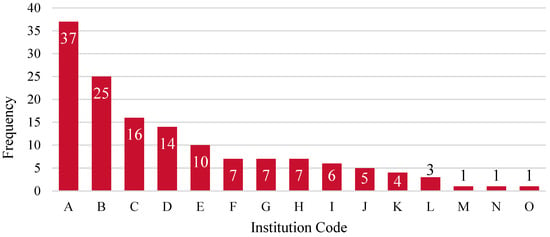
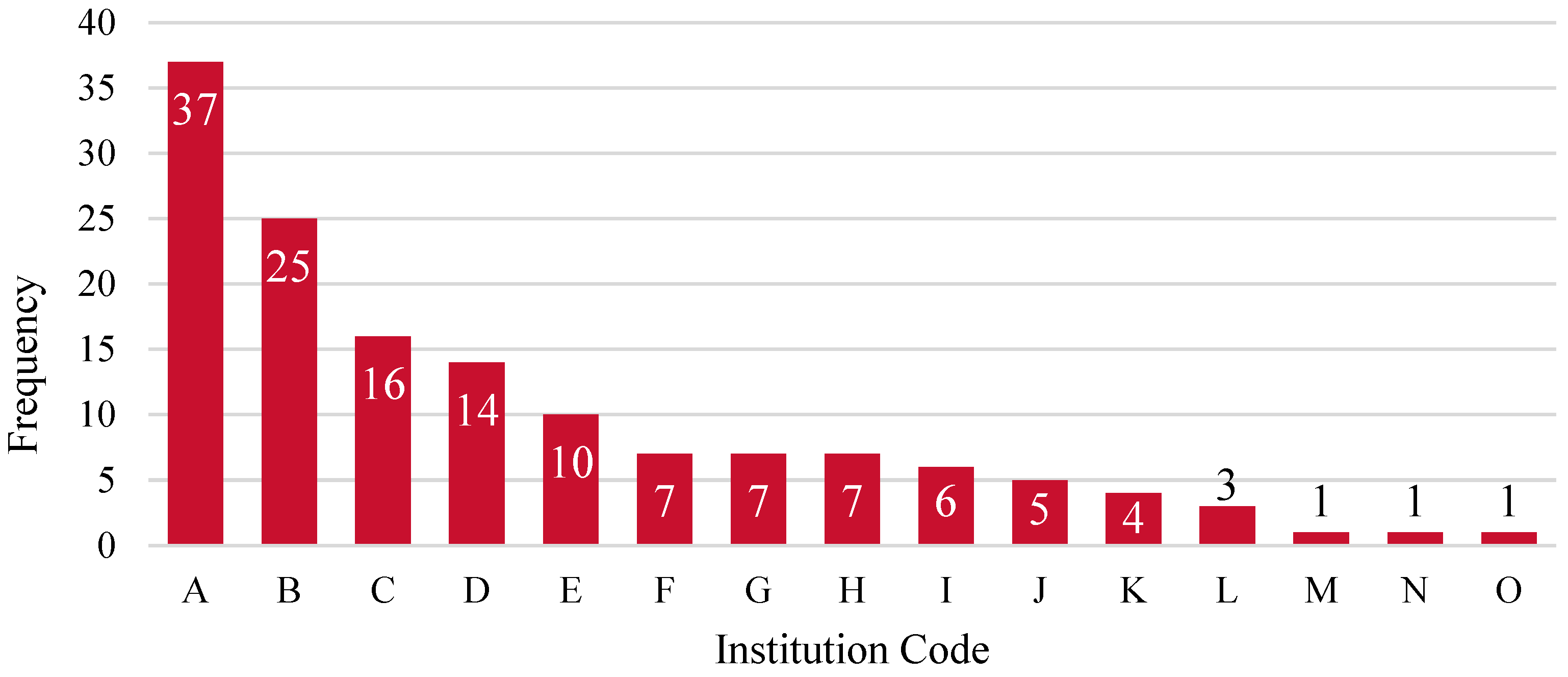
A total of 144 faculty members from 15 higher education institutions in the United Arab Emirates participated in the study, as shown in Figure 1. The names of the participating institutions were masked and replaced with alphabetic codes (A–O) as the objective of the study was not to evaluate or compare individual institutions. Rather, the study aimed to provide an exploratory understanding of the current state of faculty readiness for Generative AI integration among the participating faculty members in the UAE and to identify areas that may require further support and improvement. As shown in Figure 1, respondent representation varied across institutions, with institutions A, B, and C accounting for the largest shares of respondents. The relatively higher representation of these institutions is consistent with anecdotal observations that they are among the larger higher education institutions in the UAE in terms of student enrollment and number of faculty members.
Figure 1.
Distribution of Survey Participants by Institution.
Table 1 summarizes the participants’ academic and teaching characteristics. The table shows that health sciences was the most frequently represented discipline (30.6%), followed by engineering (25.0%) and humanities and social sciences (23.6%). The rest of the respondents represented natural sciences (7.6%), business (4.7%), law (3.5%), education (2.8%), and fine arts and design (2.1%). Participants also represented different academic ranks. Assistant professors formed the largest group (28.5%), followed by associate professors (25.7%), professors (23.6%), instructors (16.0%), and other ranks (6.2%). Additionally, half of the respondents had 16 or more years of teaching experience, while 29 respondents (20.1%) had 11–15 years. The remaining respondents had fewer than 10 years of teaching experience.
Table 1.
Summary of Participant Characteristics.
Regarding teaching context, 73 respondents (50.6%) taught only undergraduate courses. Of these, 30 (20.8%) taught lower-level undergraduate courses, 12 (8.3%) taught upper-level undergraduate courses, and 31 (21.5%) taught across all undergraduate levels. In addition, 64 respondents (44.4%) taught both undergraduate and graduate courses, while 7 (4.9%) taught only graduate courses. Additionally, face-to-face teaching was the dominant mode of delivery (80.6%), and English was the principal language of instruction for most participants (85.4%). Finally, most respondents taught relatively small to medium-sized classes, with 46.5% teaching classes of 25–49 students and 31.3% teaching classes of fewer than 25 students. The remaining 22.2% of the sample taught classes of 50 or more students.
3.2. Exploratory Factor Analysis
Separate EFAs were conducted for each of the four prespecified study scales: AI awareness and literacy (five items), AI teaching use (six items), AI attitudes and perceptions (six items), and personal readiness and institutional support (seven items). All EFAs were based on complete responses from the 144 participants, with no cases excluded due to missing data.
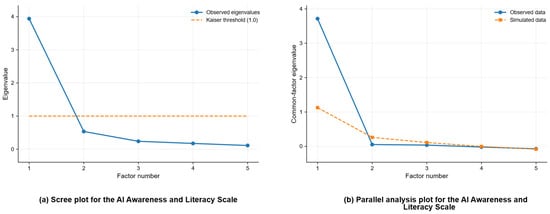
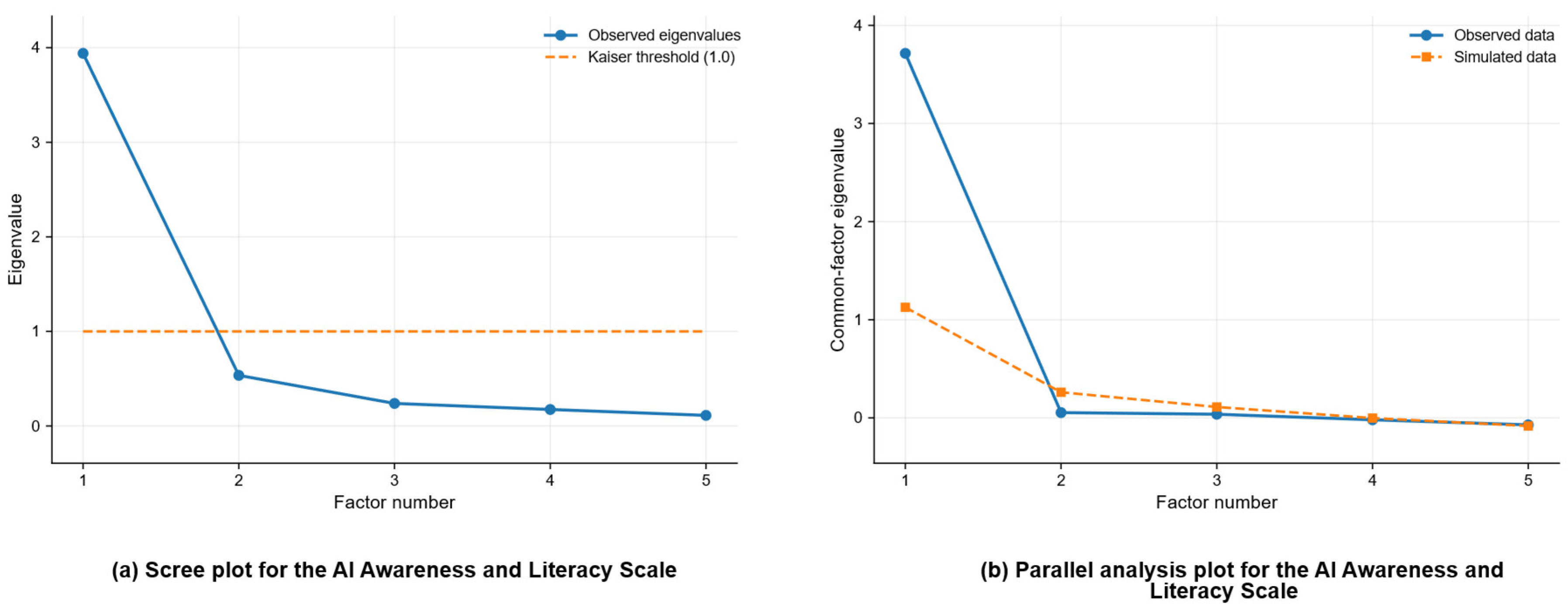
The results of the EFA for the AI Awareness and Literacy scale (AWL) are presented in Table 2. The KMO value for this analysis was 0.870, and Bartlett’s test was significant (χ2 (10) = 649.9, p < 0.001), which indicated that the data were suitable for factor analysis. One factor was retained as only the first eigenvalue exceeded 1.00, with a value of 3.94. Similarly, the scree plot showed a clear break after the first factor (Figure 2a). Additionally, parallel analysis confirmed this result, with only the first observed eigenvalue (3.714) exceeding the simulated benchmarks (Figure 2b). All five items loaded positively on the factor, with loadings ranging from 0.65 to 0.93 and communalities from 0.42 to 0.86. The factor demonstrated strong internal consistency (Cronbach’s α = 0.898) and explained 74.3% of the total item variance. Overall, these results provide preliminary support that the five items represent a single construct of AI Awareness and Literacy.
Table 2.
EFA Results for the AI Awareness and Literacy Scale.
Figure 2.
(a) Scree analysis plots for the AI Awareness and Literacy Scale. (b) Parallel analysis plots for the AI Awareness and Literacy Scale.
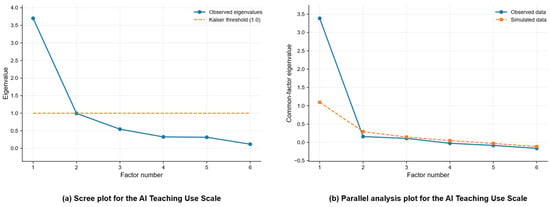
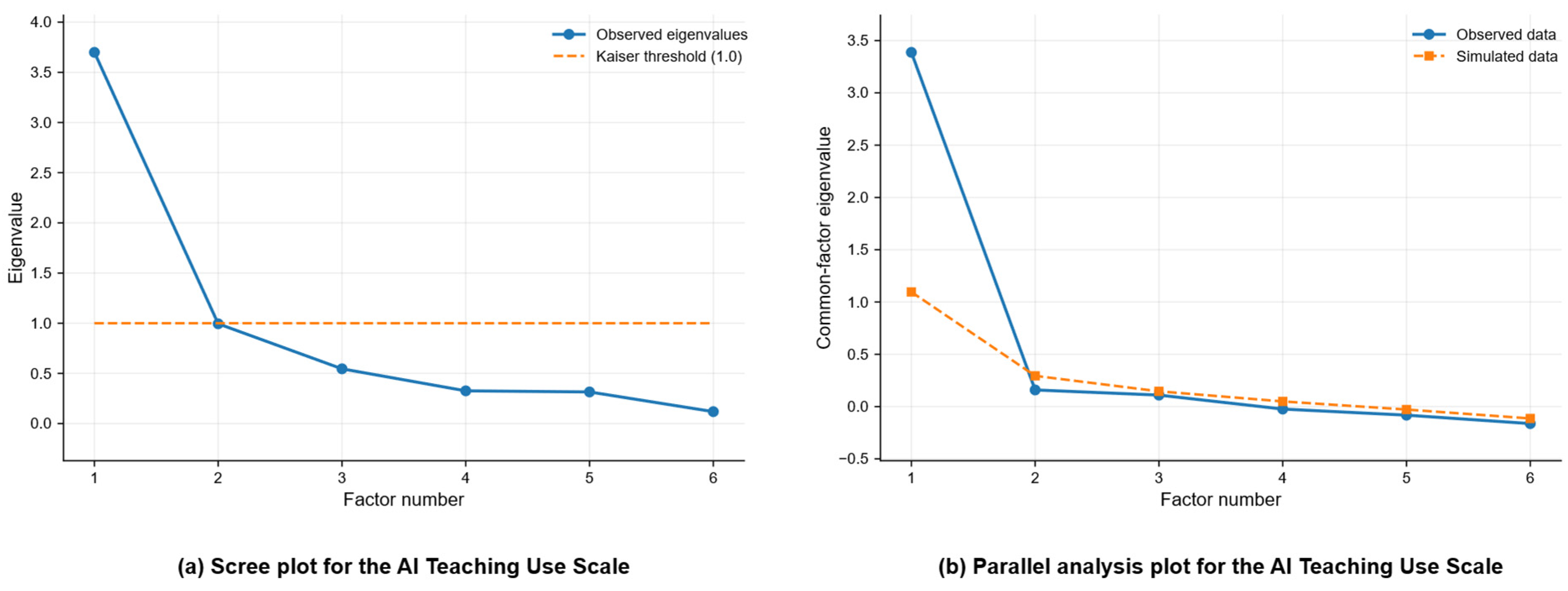
Table 3 summarises the results of the EFA for the AI teaching use scale (TU). The KMO value was 0.841, and Bartlett’s test of sphericity was statistically significant, χ2 (15) = 519.32, p < 0.001, which supports the suitability of the correlation matrix for factor analysis. The factor-retention criteria converged on a one-factor solution as the first eigenvalue was 3.70, whereas all subsequent eigenvalues were below 1. Similarly, the scree plot showed a clear break after the first factor (Figure 3a) and the parallel analysis showed that only the first observed eigenvalue exceeded the corresponding simulated benchmarks (Figure 3b). Five items (TU1, TU2, TU3, TU5, and TU6) loaded satisfactorily on the factor, with loadings ranging from 0.71 to 0.94 and communalities ranging from 0.50 to 0.88. In contrast, TU4 (“I require disclosure of AI use in assignments”) had a weak factor loading of 0.16 and a very low communality of 0.03 and therefore was not retained. The weak loading of TU4 could reflect a conceptual distinction between this item and the remaining scale items. Whereas the other items assessed the pedagogical use of AI, TU4 reflected a practice related to academic integrity that may be influenced more by institutional policies and assessment practices than by instructors’ use of AI in teaching. Following the removal of TU4, the extracted factor, based on the five retained items, demonstrated strong internal consistency (raw Cronbach’s α = 0.880) and accounted for 67.3% of the variance.
Table 3.
EFA Results for the AI Teaching Use Scale.
Figure 3.
(a) Scree analysis plots for the AI Teaching Use Scale. (b) Parallel analysis plots for the AI Teaching Use Scale.
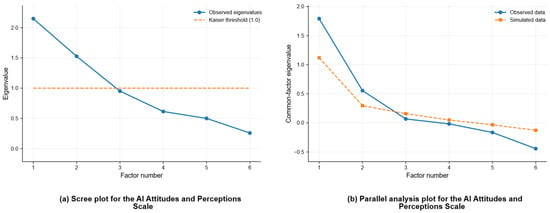
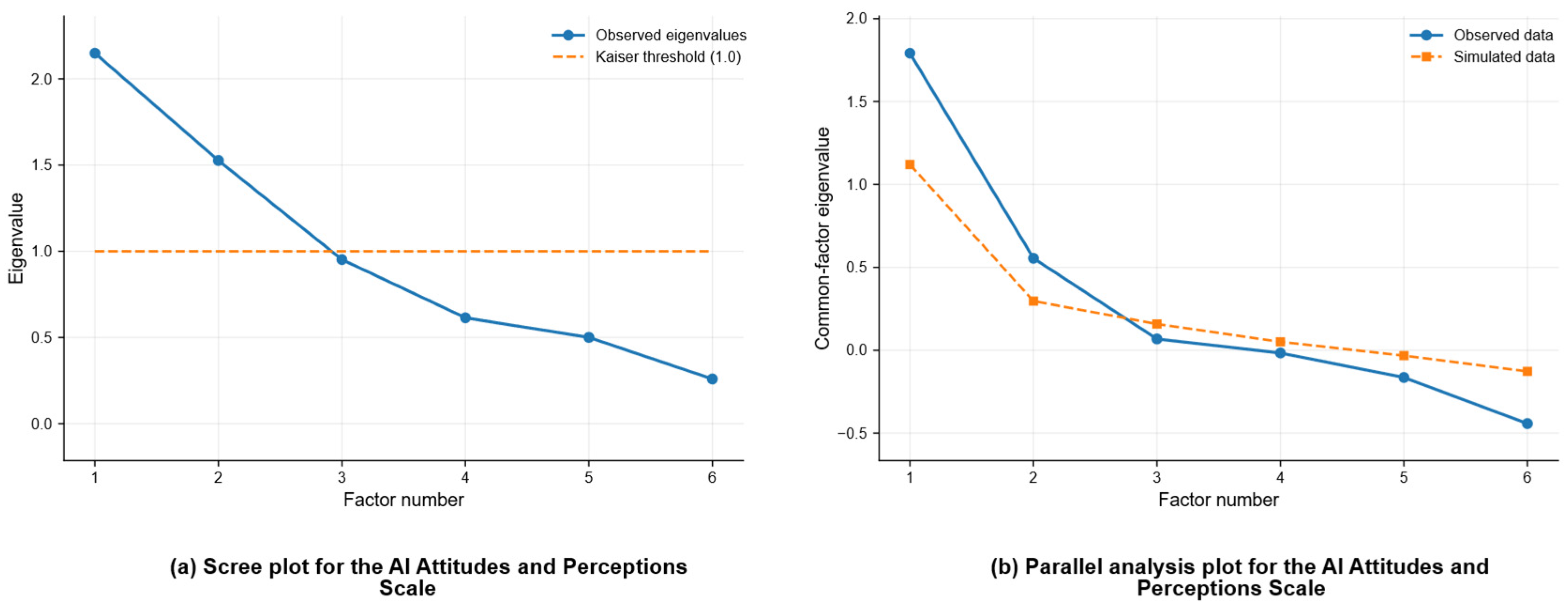
The EFA results for the AI Attitudes and Perceptions scale (AP) are shown in Table 4. The KMO statistic was 0.588, indicating acceptable sampling adequacy, while Bartlett’s test was significant, χ2 (15) = 195.37, p < 0.001. The first two eigenvalues were greater than 1.00, with values of 2.15 and 1.53, respectively, supporting the retention of two factors. The scree curve also began to level after the second factor (Figure 4a). This conclusion was confirmed by parallel analysis as the first two observed eigenvalues, 1.79 and 0.56, exceeded the simulated benchmarks (Figure 4b). The first factor represented perceived AI benefits and included AP1, AP3, and AP5. These items had factor loadings ranging from 0.63 to 0.93 and communalities between 0.40 and 0.88. The second factor represented perceived AI risks. However, after re-estimating the factor solution using only the retained items, only one item loaded above the acceptable threshold of 0.5 on this factor. As a result, the second factor was not considered sufficiently stable for interpretation, and only the first factor was retained for subsequent analyses. The perceived AI benefits yielded raw Cronbach’s α = 0.75 and accounted for 36.0% of the variance. It is worth noting that the low KMO value in the EFA, instability of the proposed risk factor, and retention of only three benefit items indicate limited item coverage and uncertain structural validity. The failure of the risk items to form a stable factor should not be interpreted as evidence that critical-thinking, assessment-validity, and equity concerns represent distinct risk dimensions. As each concern was measured by a single item, the current item set does not provide sufficient coverage to reliably assess these dimensions separately. Future studies should therefore include additional items for each concern and evaluate their structural validity using independent samples.
Table 4.
EFA Results for the AI Attitudes and Perceptions Scale.
Figure 4.
(a) Scree analysis plots for the AI Attitudes and Perceptions Scale. (b) Parallel analysis plots for the AI Attitudes and Perceptions Scale.
The three perceived AI risk items (AP2, AP4, and AP6) did not form a sufficiently stable common factor in this study. This result does not demonstrate that the items represent distinct dimensions. Rather, it indicates that, with one item addressing each concern, the collected data did not provide adequate evidence for combining them into a single composite score or for establishing separate risk constructs. Therefore, the items were retained as stand-alone indicators. Specifically, diminished critical thinking relates to individual learning, assessment validity relates to educational practice and academic integrity, while widening equity gaps relates to broader issues of access and opportunity. Accordingly, respondents may have endorsed these concerns to different degrees. For instance, an educator may perceive AI as reducing students’ critical thinking while also recognizing its potential to improve accessibility. Similarly, instructors who have adopted alternative assessment approaches may be less concerned about assessment validity while remaining concerned about students’ overreliance on AI.
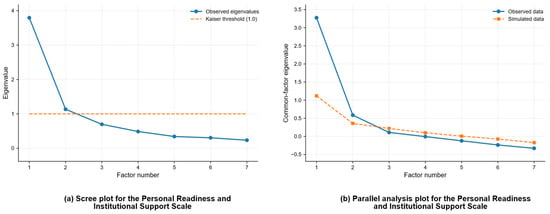
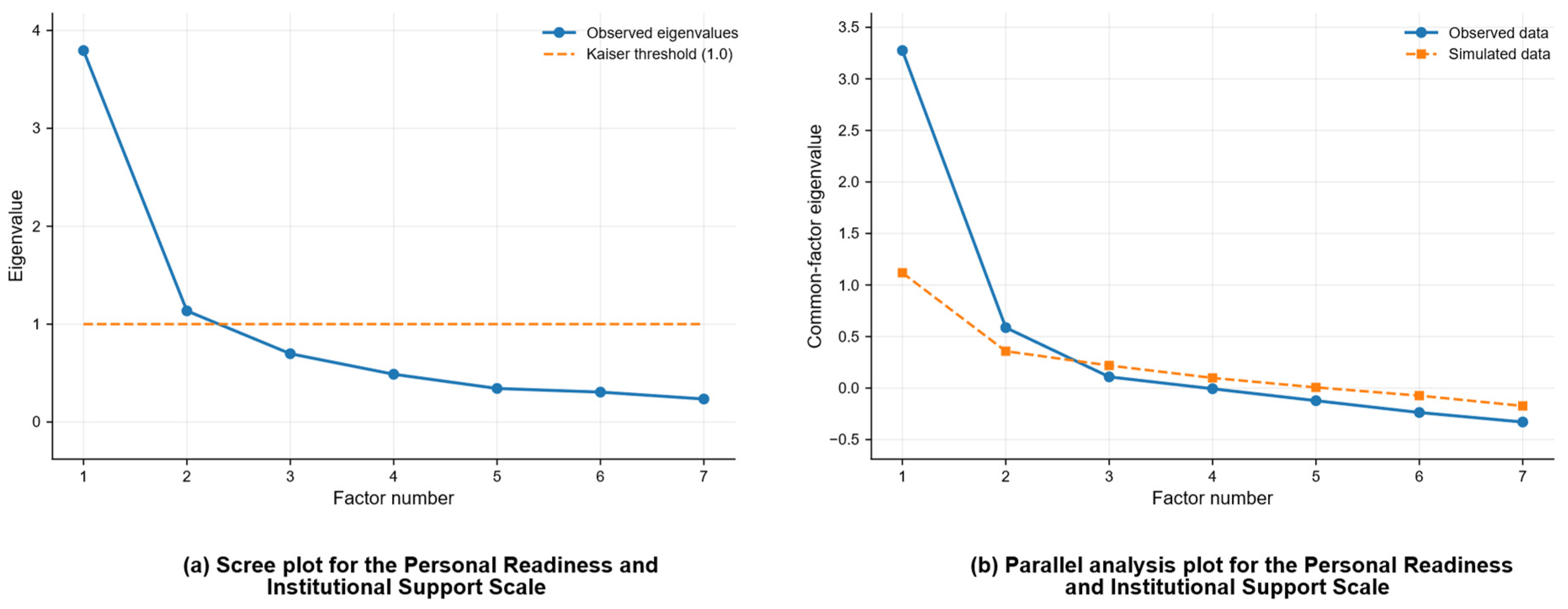
Finally, the results of the EFA for the personal readiness and institutional support (PRIS) scale are presented in Table 5. The overall KMO value was 0.804, and Bartlett’s test of sphericity was statistically significant, χ2 (21) = 464.10, p < 0.001, which indicated that the data were appropriate for factor analysis. Two factors were retained because the first two eigenvalues, 3.795 and 1.135, were above 1.00. The two-factor structure was also supported by the scree plot and parallel analysis, as shown in Figure 5a and Figure 5b, respectively. The first factor represented institutional support and comprised PRIS4, PRIS5, PRIS6, and PRIS7. Factor loadings for these items ranged from 0.56 to 0.86, with communalities between 0.47 and 0.67. The second factor reflected Personal Readiness and included PRIS1, PRIS2, and PRIS3. Their loadings ranged from 0.47 to 0.92, and their communalities ranged from 0.37 to 0.82. All seven items met the specified retention criteria. The estimated correlation between the two factors was 0.541, which indicated a moderate association but supporting the distinction between them. Collectively, the two factors explained 60.2% of the total item variance. Institutional Support accounted for 34.4% of the variance, while Personal Readiness accounted for a further 25.8%. Both factors demonstrated acceptable internal consistency, with raw Cronbach’s alpha values of 0.81 for Institutional Support and 0.75 for Personal Readiness.
Table 5.
EFA Results for the Personal Readiness and Institutional Support Scale.
Figure 5.
(a) Scree analysis plots for the Personal Readiness and Institutional Support Scale. (b) Parallel analysis plots for the Personal Readiness and Institutional Support Scale.
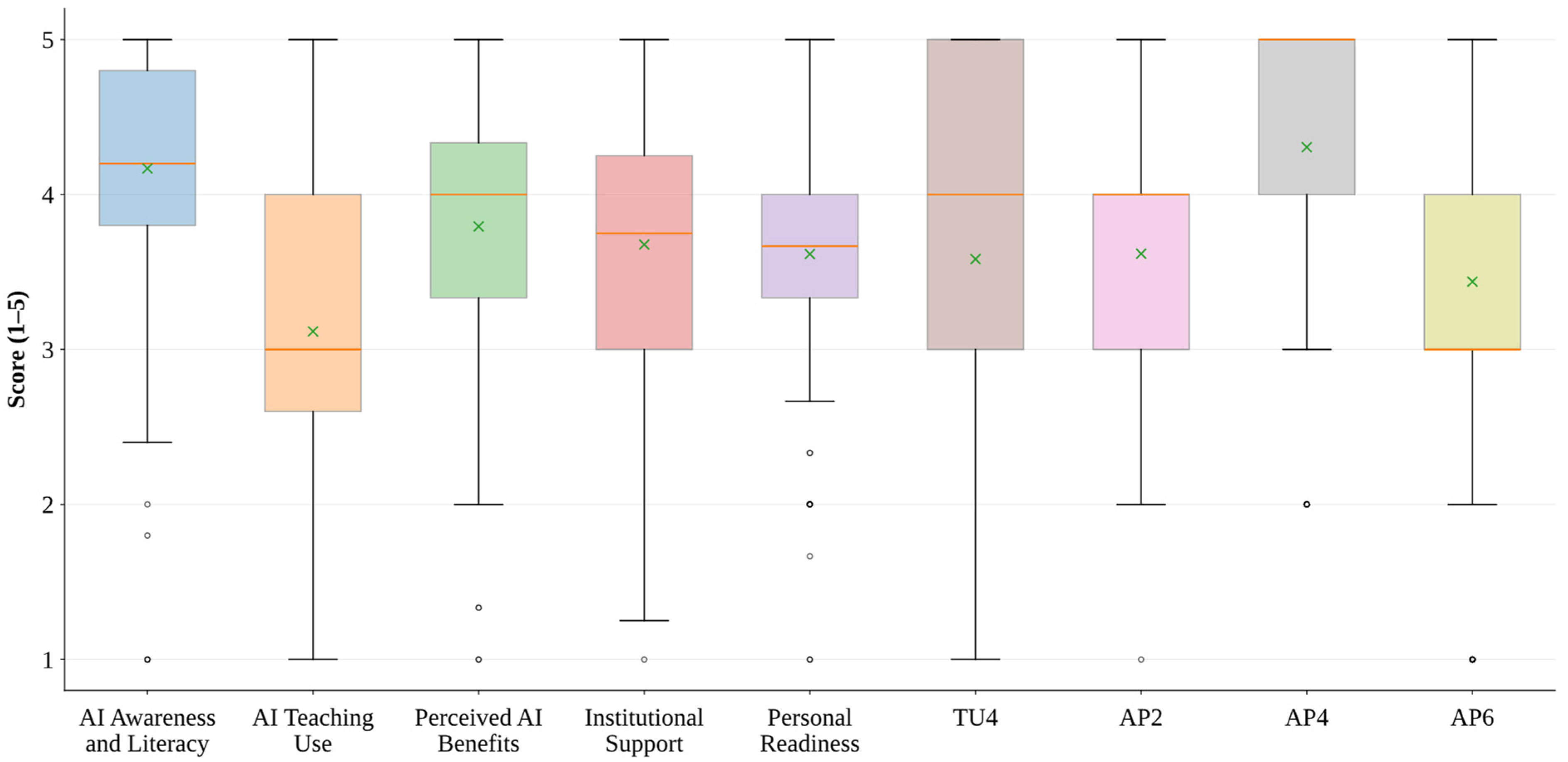
In summary, the EFA identified five constructs: AI Awareness and Literacy, AI Teaching Use, Perceived AI Benefits, Institutional Support, and Personal Readiness. Four items did not load sufficiently on any retained factor, including the item related to disclosure of AI use and the three perceived AI risk items. This finding does not imply that these items are unimportant; rather, it indicates that they did not share sufficient common variance with the other items to represent a common construct. Accordingly, the retained factors were treated as composite scales, whereas the excluded items were analyzed and interpreted individually. It is important to note that as the EFAs were conducted separately within prespecified item families, these findings support the internal structure of the candidate domain scores but do not demonstrate that the five domains are mutually distinct across the complete questionnaire. Table 6 presents the descriptive statistics for the retained factors and the stand-alone items that were not retained in the factor solution, including mean, median, and standard deviation (SD). Figure 6 shows boxplots of their score distributions.
Table 6.
Descriptive Statistics for Composite Scales and Stand-alone Items.
Figure 6.
Box plots of the Retained Composite Scale Scores and Stand-Alone Items. Orange lines indicate medians, green crosses indicate means, and circles indicate outliers.
An interesting result was that AI awareness and literacy had the highest mean among the retained factors (4.17), with scores concentrated toward the upper end of the response scale, whereas AI teaching use had the lowest mean (3.12) and exhibited greater variability. Spearman’s rank-order correlation showed a moderate positive association between AI Awareness and Literacy and AI Teaching Use (ρ = 0.33, 95% CI [0.17, 0.48], Holm-adjusted p < 0.001). Thus, respondents who reported greater awareness and literacy also tended to report more frequent teaching use. However, this association does not establish that awareness causes teaching use or that knowledge necessarily translates into pedagogical practice. This interpretation should remain cautious as AI awareness and literacy was measured through self-report rather as opposed to objective assessment. Therefore, the relatively high score may reflect respondents’ perceived competence or confidence rather than demonstrated proficiency. Nevertheless, the lower and more variable teaching-use scores show that high self-reported awareness and frequent teaching use were not equally endorsed in this sample. Adoption of AI may also depend on time, access to suitable tools, confidence in redesigning teaching activities, assessment requirements, and institutional guidance, although these possible explanations were not directly tested in this study.
Similarly, the respondents reported generally favorable perceptions of AI benefits (mean = 3.79), which had a strong positive association with AI Teaching Use (ρ = 0.62, 95% CI [0.49, 0.73], Holm-adjusted p < 0.001). This finding indicates that respondents who perceived greater educational benefits from AI therefore tended to report more frequent use of AI in their teaching. The strength of this association suggests that perceived benefits and teaching use are closely related, at least in this sample, but the cross-sectional design does not establish the direction of the relationship or demonstrate that favorable perceptions cause teaching use.
Personal readiness and institutional support had similar mean scores of 3.62 and 3.68, respectively. This similarity in score distributions is also demonstrated in Figure 6. The two measures were moderately positively associated (ρ = 0.47, 95% CI [0.33, 0.60], Holm-adjusted p < 0.001), indicating that respondents who perceived greater institutional support also tended to report greater personal readiness. At the same time, the two-factor EFA solution provided preliminary support for treating Personal Readiness and Institutional Support as related but separate domains. Personal readiness reflects respondents’ confidence, preparation, and perceived capacity to engage with AI. On the other hand, institutional support represents the policies, training, infrastructure, and organizational conditions that facilitate such engagement.
Item TU4 (“I require disclosure of AI use in assignments”) received a moderately positive level of endorsement (mean = 3.58), although responses varied considerably (SD = 1.31). This high variability in the item score may reflect differences in institutional and disciplinary contexts rather than differences in pedagogical AI use. The three AI-risk items also reflected varying levels of concern. The strongest endorsement was for the view that overreliance on AI may diminish critical thinking (mean = 4.31), with responses concentrated near the upper end of the scale. Additionally, the concern that AI may undermine the validity of traditional assessments was also relatively high (mean = 3.62), but responses were more varied, which suggests that perceptions might have differed according to respondents’ experiences and circumstances. The possibility that AI may widen equity gaps among students received the lowest endorsement of the three risk items (mean = 3.44). The item’s distribution was closer to the midpoint and reflected greater disagreement, which suggests that respondents held more diverse views on this issue.
3.3. Group Comparisons of Composite Scores and Stand-Alone Items
Comparisons of composite scores across faculty characteristics and institution were performed using statistical tests selected based on the distributional characteristics of each composite score. As shown in Table 7, the AI awareness and literacy factor demonstrated the greatest departure from normality with pronounced negative skewness (−1.82) and 18.1% of respondents achieving the maximum possible score. Accordingly, Mann–Whitney U and Kruskal–Wallis tests were used for this composite. On the other hand, the remaining four composites displayed moderately skewed distributions and were therefore analyzed primarily using Welch’s t-tests and Welch’s ANOVA. Individual items were analyzed using nonparametric tests as they represent ordinal responses with five categories.
Table 7.
Distribution of Composite Scores.
Six grouping factors were examined: discipline, academic rank, teaching experience, mode of delivery, typical class size, and institution. For each grouping factor, the five composite-score comparisons formed a separate family, and Holm adjustment was applied only across the five tests within that factor. Institutional comparisons excluded institutions contributing fewer than six valid observations. Nine institutions and 129 respondents were therefore retained for institution-level analyses. Additionally, the original discipline categories were combined into three broader groups (Health Sciences, Science, Technology, Engineering and Mathematics (STEM), and Humanities, Professional and Arts) as several of the original categories contained very small sample sizes. Comparisons involving discipline, academic rank, teaching experience, and mode of delivery included 144 respondents, while class-size comparisons included 143 respondents because one class-size value was missing. Table 8 and Table 9 show the results of the comparison analysis for the five composite scores and the four stand-alone items, respectively.
Table 8.
Results of Group Comparisons of Composite Scores by Faculty Characteristics and Institution.
Table 9.
Results of Group Comparisons of Stand-alone Items by Faculty Characteristics and Institution.
The results showed that none of the five composite scores or considered individual items differed significantly based on faculty characteristics after applying the Holm adjustment within each grouping factor. On the other hand, institution was associated with significant differences in two composite scores after adjustment. Specifically, institutional support differed significantly across institutions with mean scores ranging from 3.00 at Institution E to 4.50 at Institution H. Games–Howell post hoc comparisons indicated that the latter reported significantly higher Institutional Support than the former (mean difference = 1.50, 95% CI [0.34, 2.66], p = 0.007). The comparison between Institution E and Institution B was marginally significant (mean difference = 0.92, 95% CI [0.001, 1.84], p = 0.05). Similarly, perceived AI benefits varied across institutions with mean scores ranging from approximately 3.45 at Institution C to 4.20 at Institution H. Games–Howell post hoc comparisons indicated that Institution C reported lower Perceived AI Benefits than Institution B (mean difference = 1.29, 95% CI [0.15, 2.44], p = 0.02).
The observed differences in perceived institutional support and AI benefits indicate variation among the nine institutions included in this exploratory analysis. However, because institutional policies and practices were not measured independently, the cause of this variation cannot be determined from the present data. Faculty members within the same institution may share similar policies, access to AI tools, training opportunities, and guidance regarding AI use. Therefore, differences between institutions may reflect variation in how universities support AI adoption. For instance, institutions that provide clearer strategies and ongoing support may be more likely to foster positive perceptions of AI. Nevertheless, the findings should be interpreted cautiously given that they may also reflect differences in respondent composition, unequal institutional sample sizes, or sampling variability. Accordingly, the findings support the narrower conclusion that perceived Institutional Support differed among the institutions represented in the analytic sample. They do not establish that institutional context is more influential than individual faculty characteristics.
4. Conclusions
4.1. Research Summary
This study provides preliminary evidence, from a self-selected sample of faculty members recruited across multiple UAE institutions, that GenAI engagement may comprise dimensions not captured by awareness alone. Exploratory factor analysis distinguished five constructs: AI awareness and literacy, AI teaching use, perceived AI benefits, personal readiness, and institutional support. Respondents reported high self-perceived awareness and generally positive views of GenAI, yet substantially lower levels of teaching use. Nevertheless, AI Teaching Use was positively associated with both AI Awareness and Literacy and Perceived AI Benefits. In particular, the strong association between Perceived AI Benefits and Teaching Use suggests that respondents who recognized greater educational benefits also tended to report more frequent teaching use.
The three AI-risk items, relating to critical thinking, assessment validity, and equity, did not form a stable common factor in the present instrument and were therefore reported as stand-alone items. Among these items, concern that overreliance on AI may diminish students’ critical thinking received the strongest endorsement. Requiring students to disclose AI use also did not align with the broader teaching-use construct. This suggests that disclosure is better understood as an assessment-governance and academic-integrity practice than as evidence of pedagogical adoption. After adjustment for multiple comparisons, the retained constructs did not differ significantly by discipline, academic rank, teaching experience, delivery mode, or class size. However, institution-level variation was observed in institutional support and perceived AI benefits among the nine analyzed institutions. It is important to recognize that these findings indicate variation in selected outcomes across the represented institutions but do not establish that institutional context is more influential than individual faculty characteristics.
4.2. Theoretical and Practical Contributions
The present study offers several important conceptual and practical implications. First, the lower descriptive level of AI Teaching Use, together with its positive association with AI Awareness and Literacy, suggests that awareness-building should be accompanied by support for pedagogical implementation. Universities should therefore complement introductory AI initiatives with sustained professional development focused on teaching practice. Such initiatives should support faculty in redesigning learning activities and assessments, critically evaluating the accuracy and bias of AI-generated outputs, assessing AI-assisted student work appropriately, and making informed decisions about when AI use enhances, rather than undermines, intended learning outcomes.
Second, the empirical distinction between personal readiness and institutional support highlights that faculty readiness operates at multiple levels. Faculty may feel personally capable of engaging with GenAI while still lacking clear policies, accessible training, or institutionally approved resources. On the other hand, institutional provisions may be available without necessarily producing the confidence and pedagogical judgment required for meaningful adoption. Accordingly, universities should provide clear and regularly updated guidance, access to approved AI tools, technical and pedagogical consultation, opportunities for experimentation, and peer communities where faculty can exchange practices and discuss emerging challenges.
Third, the observed differences across institutions in perceived support and AI benefits and the absence of adjusted differences across faculty characteristics highlights the importance of examining the organizational contexts in which faculty engage with GenAI. Furthermore, the AI-risk and disclosure items did not form stable common factors in the present instrument, which suggests that these items may require further development and validation before being treated as a common construct.
4.3. Limitations and Future Research
Several limitations should be considered when interpreting the findings. The non-probability sampling strategy, voluntary participation, and relatively small and uneven institutional subsamples increase the potential for nonresponse and self-selection bias and limit generalizability beyond the participating respondents. Additionally, reliance on self-reported measures may mean that the high Awareness and Literacy scores reflect perceived rather than demonstrated competence. Moreover, the cross-sectional design prevents conclusions about temporal or causal relationships among the measured factors. Finally, the questionnaire was not subject to formal independent expert review before administration, and the EFAs were conducted separately within the prespecified item families.
Accordingly, the findings of this study should be considered preliminary and require further validation using larger and more representative samples. Future research should examine the validity of the proposed constructs through confirmatory factor analysis and adopt longitudinal or intervention-based approaches to assess changes in faculty AI engagement over time. Research should also investigate which specific forms of institutional support are most effective in converting faculty awareness and positive perceptions into sustained pedagogical practice.
Overall, the central challenge for UAE higher education is no longer simply to increase faculty awareness of GenAI, but to create the conditions through which awareness can be translated into effective and responsible pedagogical practice. Therefore, faculty readiness should be evaluated not only by familiarity with AI tools or positive perceptions of their potential, but by whether faculty are equipped and supported to use them in ways that strengthen learning while preserving critical thinking, assessment integrity, transparency, and equitable participation.
Supplementary Materials
The following supporting information can be downloaded at: https://www.mdpi.com/article/10.3390/educsci16111856/s1, Questionnaire.
Author Contributions
Conceptualization, A.R.M., M.F., A.B., and M.S.Z.; methodology, B.O. and A.R.M.; validation, A.R.M.; formal analysis, B.O. and A.R.M.; investigation, B.O. and A.R.M.; resources, A.R.M.; data curation, B.O.; writing—original draft preparation, B.O. and A.R.M.; writing—review and editing, A.R.M., M.F., A.B., and M.S.Z.; visualization, B.O. and A.R.M.; supervision, A.R.M., M.F., A.B., and M.S.Z. All authors have read and agreed to the published version of the manuscript.
Funding
This research received no external funding.
Institutional Review Board Statement
This study received ethical approval from the UAEU Social Sciences Ethics Committee under application No. ERSC_2025_8376, granted on 2 February 2026. Participation was voluntary, and informed consent was obtained from all participants before they completed the online questionnaire.
Informed Consent Statement
Informed consent was obtained from all subjects involved in the study.
Data Availability Statement
The dataset is available from the corresponding author upon reasonable request for research purposes. The names of the participating universities will be anonymized in the shared dataset.
Conflicts of Interest
The authors declare no conflicts of interest.
Abbreviations
The following abbreviations are used in this manuscript:
| AI | Artificial Intelligence |
| AP | AI Attitudes and Perceptions |
| AWL | AI Awareness and Literacy |
| EFA | Exploratory factor analysis |
| GenAI | Generative AI |
| KMO | Kaiser-Meyer-Olkin |
| PRIS | Personal readiness and institutional support |
| SD | Standard deviation |
| UAE | United Arab Emirates |
References
- Abulibdeh, A. (2025). A systematic and bibliometric review of artificial intelligence in sustainable education: Current trends and future research directions. Sustainable Futures, 10, 101033. [Google Scholar] [CrossRef] [Scilit]
- Al-Mughairi, H., & Bhaskar, P. (2025). Exploring the factors affecting the adoption AI techniques in higher education: Insights from teachers’ perspectives on ChatGPT. Journal of Research in Innovative Teaching & Learning, 18(2), 232–247. [Google Scholar] [CrossRef] [Scilit]
- Assad, A., & Alomari, M. S. (2026). A systematic literature review of ChatGPT adoption in Arab higher education. Discover Artificial Intelligence, 6, 546. [Google Scholar] [CrossRef] [Scilit]
- Bond, M., Khosravi, H., De Laat, M., Bergdahl, N., Negrea, V., Oxley, E., Pham, P., Chong, S. W., & Siemens, G. (2024). A meta systematic review of artificial intelligence in higher education: A call for increased ethics, collaboration, and rigour. International Journal of Educational Technology in Higher Education, 21(1), 4. [Google Scholar] [CrossRef] [Scilit]
- Cambra-Fierro, J. J., Blasco, M. F., López-Pérez, M. E. E., & Trifu, A. (2025). ChatGPT adoption and its influence on faculty well-being: An empirical research in higher education. Education and Information Technologies, 30(2), 1517–1538. [Google Scholar] [CrossRef] [Scilit]
- Celik, I. (2023). Towards Intelligent-TPACK: An empirical study on teachers’ professional knowledge to ethically integrate artificial intelligence (AI)-based tools into education. Computers in Human Behavior, 138, 107468. [Google Scholar] [CrossRef] [Scilit]
- Crawford, J., Cowling, M., & Allen, K. A. (2023). Leadership is needed for ethical ChatGPT: Character, assessment, and learning using artificial intelligence (AI). Journal of University Teaching & Learning Practice, 20(3), 2. [Google Scholar] [CrossRef] [Scilit]
- Davis, F. D. (1989). Perceived usefulness, perceived ease of use, and user acceptance of information technology. MIS Quarterly, 13(3), 319–340. [Google Scholar] [CrossRef] [Scilit] [PubMed]
- Denis, D. J. (2021). Applied univariate, bivariate, and multivariate statistics using Python: A beginner’s guide to advanced data analysis. John Wiley & Sons. [Google Scholar]
- Field, A. (2024). Discovering statistics using IBM SPSS Statistics (6th ed.). SAGE Publications. [Google Scholar]
- Hadi, N. U., Abdullah, N., & Sentosa, I. (2016). An easy approach to exploratory factor analysis: Marketing perspective. Journal of Educational and Social Research, 6(1), 215–223. [Google Scholar] [CrossRef] [Scilit]
- Hamd, Z. Y., Elshami, W., Al Kawas, S., Aljuaid, H., & Abuzaid, M. M. (2023). A closer look at the current knowledge and prospects of artificial intelligence integration in dentistry practice: A cross-sectional study. Heliyon, 9(6), e17089. [Google Scholar] [CrossRef] [Scilit] [PubMed]
- Hasanein, A. M., & Sobaih, A. E. E. (2023). Drivers and consequences of ChatGPT use in higher education: Key stakeholder perspectives. European Journal of Investigation in Health, Psychology and Education, 13(11), 2599–2614. [Google Scholar] [CrossRef] [Scilit] [PubMed]
- Ibrahim, H., Liu, F., Asim, R., Battu, B., Benabderrahmane, S., Alhafni, B., Adnan, W., Alhanai, T., AlShebli, B., Baghdadi, R., Bélanger, J. J., Beretta, E., Celik, K., Chaqfeh, M., Daqaq, M. F., El Bernoussi, Z., Fougnie, D., Garcia de Soto, B., Gandolfi, A., … Zaki, Y. (2023). Perception, performance, and detectability of conversational artificial intelligence across 32 university courses. Scientific Reports, 13(1), 12187. [Google Scholar] [CrossRef] [Scilit] [PubMed]
- Kallunki, V., Kinnunen, P., Pyörälä, E., Haarala-Muhonen, A., Katajavuori, N., & Myyry, L. (2024). Navigating the evolving landscape of teaching and learning: University faculty and staff perceptions of the artificial intelligence-altered terrain. Education Sciences, 14(7), 727. [Google Scholar] [CrossRef] [Scilit]
- Lee, D., Arnold, M., Srivastava, A., Plastow, K., Strelan, P., Ploeckl, F., Lekkas, D., & Palmer, E. (2024). The impact of generative AI on higher education learning and teaching: A study of educators’ perspectives. Computers and Education: Artificial Intelligence, 6, 100221. [Google Scholar] [CrossRef] [Scilit]
- Long, D., & Magerko, B. (2020). What is AI literacy? Competencies and design considerations. In Proceedings of the 2020 CHI conference on human factors in computing systems (pp. 1–16). Association for Computing Machinery. [Google Scholar] [CrossRef] [Scilit]
- McGrath, C., Cerratto Pargman, T., Juth, N., & Palmgren, P. J. (2023). University teachers’ perceptions of responsibility and artificial intelligence in higher education—An experimental philosophical study. Computers and Education: Artificial Intelligence, 4, 100139. [Google Scholar] [CrossRef] [Scilit]
- Miao, F., & Holmes, W. (2023). Guidance for generative AI in education and research (UNESCO Report). Available online: https://unesdoc.unesco.org/ark:/48223/pf0000386693 (accessed on 12 July 2026).
- Nevárez Montes, J., & Elizondo-Garcia, J. (2025). Faculty acceptance and use of generative artificial intelligence in their practice. Frontiers in Education, 10, 1427450. [Google Scholar] [CrossRef] [Scilit]
- Rehman, N., Huang, X., Zhang, Y., & Mahmood, A. (2026). The nexus of Gen-AI features in higher education: Reducing cognitive load, building resilience, and personalising learning. Journal of Computer Assisted Learning, 42(5), e70312. [Google Scholar] [CrossRef] [Scilit]
- Ruxton, G. D. (2006). The unequal variance t-test is an underused alternative to student’s t-test and the Mann–Whitney U test. Behavioral Ecology, 17(4), 688–690. [Google Scholar] [CrossRef] [Scilit]
- Taber, K. S. (2018). The use of Cronbach’s alpha when developing and reporting research instruments in science education. Research in Science Education, 48(6), 1273–1296. [Google Scholar] [CrossRef] [Scilit]
- Tlili, A., Shehata, B., Adarkwah, M. A., Bozkurt, A., Hickey, D. T., Huang, R., & Agyemang, B. (2023). What if the devil is my guardian angel: ChatGPT as a case study of using chatbots in education. Smart Learning Environments, 10(1), 15. [Google Scholar] [CrossRef] [Scilit]
- Wang, H., Dang, A., Wu, Z., & Mac, S. (2024). Generative AI in higher education: Seeing ChatGPT through universities’ policies, resources, and guidelines. Computers and Education: Artificial Intelligence, 7, 100326. [Google Scholar] [CrossRef] [Scilit]
- Zawacki-Richter, O., Marín, V. I., Bond, M., & Gouverneur, F. (2019). Systematic review of research on artificial intelligence applications in higher education—Where are the educators? International Journal of Educational Technology in Higher Education, 16(1), 39. [Google Scholar] [CrossRef] [Scilit]

Disclaimer/Publisher’s Note: The statements, opinions and data contained in all publications are solely those of the individual author(s) and contributor(s) and not of MDPI and/or the editor(s). MDPI and/or the editor(s) disclaim responsibility for any injury to people or property resulting from any ideas, methods, instructions or products referred to in the content. |
© 2026 by the authors. Licensee MDPI, Basel, Switzerland. This article is an open access article distributed under the terms and conditions of the Creative Commons Attribution (CC BY) license.