


Abstract
This study investigated how children’s gender and teachers’ support of self-regulation during play were associated with kindergarteners’ self-regulation in play-based learning environments. Drawing on data from 174 kindergarteners and their teachers across 15 Ontario classrooms, findings indicate that girls were consistently rated higher on teacher-reported self-regulation across the school year, whereas gender differences in directly assessed self-regulation emerged only in the spring. Classroom observations further suggest that gendered play choices were associated with differences in the type and frequency of self-regulation supports teachers provided. These findings suggest that early gender differences in self-regulation may reflect differences in classroom experiences and socialization, rather than differences in underlying capacity, and underscore the importance of supporting educators in providing equitable and developmentally appropriate self-regulation support across diverse play contexts in classrooms.
1. Introduction and Literature Review
1.1. Early Self-Regulation Development
Kindergarten represents a critical period for the development of self-regulation. Fundamentally, self-regulation involves monitoring, adapting, and inhibiting one’s own actions and responses in a goal-directed manner (McClelland et al., 2010). Although self-regulation develops throughout childhood and adolescence (McClelland et al., 2015), the most significant gains occur in early childhood, progressing from reactive self-regulation and coregulation in toddlerhood to more advanced self-regulation during kindergarten (Montroy et al., 2016).
Early development of these skills is essential, as self-regulation is foundational to all areas of children’s development and learning. Self-regulation supports the development of social competence (e.g., improved peer relationships; adapting to social expectations), school engagement (Robson et al., 2020), and academic achievement (e.g., positive association with literacy and math scores; McClelland et al., 2010). Strong self-regulation in the early years results in better long-term social outcomes (e.g., lower risk of unemployment and less criminal behaviour; Robson et al., 2020) and greater success in later life (Posner et al., 2013).
1.2. Play and Self-Regulation
Given the importance of self-regulatory skills, research and policy have advocated for their inclusion in early years curricula and practice, often emphasizing the role of play in supporting their development (Ontario Ministry of Education, 2016; Venitz & Perels, 2019). Child-led imaginary play, specifically, provides the opportunity for children to practice their self-regulation skills and has been associated with self-regulation gains (e.g., Ivrendi, 2016), as it involves inhibiting and regulating behaviour to take on roles (Whitebread & O’Sullivan, 2012), and negotiating these narratives requires emotional regulation and flexible thinking (Baumeister & Vohs, 2011).
While child-led imaginary play has long been touted as the ideal context to support the development of children’s self-regulation, contemporary research has identified the importance of teacher scaffolding. Research has explored teachers’ implementation of educational programs for supporting children’s self-regulation development. For example, the Tools of the Mind program, which involves teachers intentionally scaffolding children’s play, was found to support children’s self-regulation development (Solomon et al., 2018). Outside of formal programs, researchers have also examined the implementation of teacher-facilitated play-based activities in classrooms, demonstrating the benefits of teacher-initiated games with prescribed rules such as Red Light, Green Light (Tominey & McClelland, 2011) and teacher facilitation of story-telling and story-acting (Nicolopoulou et al., 2015) to self-regulation development across different domains. These findings emphasize the importance of extending research beyond the exploration of child-led play to consider the critical role of teachers (Pyle et al., 2022). Rather than viewing teacher involvement as either present or absent, contemporary models of play-based learning conceptualize teacher participation as existing along a continuum. The Play-Based Learning Continuum (Pyle & Danniels, 2017) proposes that educators may assume varying roles in play depending on children’s needs and the intended learning outcomes.
This shift is particularly important for students who struggle when adult guidance and structure are lacking, as children with weaker self-regulation often benefit from more explicit support from educators (Blair & Raver, 2015; Solomon et al., 2018). For example, Solomon et al. (2018) found differential benefits of the Tools of the Mind program, whereby only children with higher baseline hyperactivity and inattention showed statistically significant gains in self-regulation compared to their peers. These findings are consistent with research demonstrating that children from socioeconomically disadvantaged backgrounds are at greater risk of experiencing self-regulation difficulties (Evans & Rosenbaum, 2008; Lengua et al., 2015; Raver et al., 2013) and may be particularly responsive to play-based interventions facilitated by teachers (Blair & Raver, 2015). Together, this body of research suggests that teacher involvement in play may serve a compensatory role by providing the structure, guidance, and opportunities for practice necessary to support self-regulation development.
1.3. Gender and Self-Regulation
Alongside socioeconomic and behavioural factors, gender represents an important dimension of student diversity that may influence how children engage in play and develop self-regulation. Research has often found that girls demonstrate stronger self-regulation than boys, especially in early childhood and elementary school (e.g., Matthews et al., 2009). These findings are often interpreted as reflecting developmental differences between boys and girls (Liu et al., 2024; Montroy et al., 2016); however, self-regulation develops within social contexts that may reinforce or amplify such differences. In particular, teachers’ perceptions and interactions may shape opportunities for children to develop self-regulatory skills. One framework that helps explain how gendered perceptions may influence classroom experiences is Gender Schema Theory (Bem, 1981), which posits that individuals develop cognitive frameworks, or schemas, about gender that shape how they perceive, interpret, and respond to the behaviour of others.
Consistent with this perspective, research has found that teachers are more likely to perceive boys as more disruptive and less compliant (Li & Rubie-Davies, 2017) and tend to expect boys to exhibit lower levels of self-regulation than girls (Matthews et al., 2009). Such gendered perceptions may be associated with differential interactions and support. For example, teachers have been found to interact with children in gendered ways and encourage the selection of gendered play materials more often than gender-neutral or cross-gender materials (Mweru, 2012). These gendered teacher-child interactions may impact the development of children’s self-regulation (Cadima et al., 2016). When considered concurrently with teachers’ tendency to rate boys’ self-regulation lower, these factors could influence teacher-child relationships, which have been found to impact self-regulation development (Vitiello et al., 2022).
Further complicating the relationship between gender and self-regulation development is the finding that not only do girls and boys often play separately (Blaise, 2005; Martin, 2011), but the types of play activities they engage in often vary. Research has found that girls more frequently participate in sociodramatic play (MacNaughton, 2001; Martin, 2011), while boys more often engage in building activities (Martin, 2011; Prioletta & Pyle, 2017). These play choices may in turn impact the types of skills practiced and thus developed during play (Prioletta & Pyle, 2017). However, evidence regarding gender differences in self-regulation has not been entirely consistent, suggesting that how self-regulation is assessed may influence conclusions about gender-related patterns. Some studies report robust gender differences favouring girls across both teacher-reported and directly assessed measures of self-regulation (Gestsdottir et al., 2014; Matthews et al., 2009), whereas others find no gender differences (Gestsdottir et al., 2014) or discrepancies between teacher-report and direct assessment methods (Wanless et al., 2013; Yamamoto & Imai-Matsumura, 2019).
These inconsistencies raise important questions regarding the extent to which observed gender differences reflect true differences in children’s underlying abilities, as opposed to how these abilities are perceived and assessed within classroom contexts. While teacher-report measures capture children’s behaviour in naturalistic classroom contexts, they are also susceptible to educators’ gendered expectations and interpretations of children’s behaviour. In contrast, direct assessments aim to provide a more standardized measure of self-regulation yet may not fully capture how these skills are enacted in everyday classroom interactions (Schirmbeck et al., 2020). Taken together, methodological differences underscore the need for research that integrates multiple sources of data to better understand the nature and origins of gender differences in self-regulation.
The present study integrated teacher-report and direct assessment of children’s self-regulation with naturalistic classroom observations during play to provide insight into classroom processes that may contribute to gender differences in children’s self-regulation scores. This methodological approach allowed for the examination of (1) alignment or misalignment between methods of assessing children’s self-regulation across gender, (2) the nature and frequency of self-regulation supports provided by teachers across gender and play context, and (3) how patterns observed in classroom interactions may help explain gender-related patterns across methods of assessing self-regulation.
2. Method
2.1. Participants and Procedures
Data for this study were collected from 15 Ontario kindergarten classrooms across two school districts and four independent schools. Ontario’s kindergarten program is a two-year model with intentionally age-heterogeneous classes that typically include both first-year and second-year kindergarten students ranging from approximately four to six years of age. This program emphasizes play as an ideal context for fostering young children’s self-regulation development, making it well-suited for this study (Ontario Ministry of Education, 2016).
Teachers were recruited through convenience and snowball sampling methods following institutional and school board ethics approval. Most teachers were female (80%) and experienced educators, with the majority reporting over eight years of teaching experience (range: 2–33 years). Ten educators indicated that their highest level of education was a bachelor’s degree, while the remaining five educators reported completing a master’s degree. Teachers also had diverse training backgrounds in play-based learning: nine educators learned about play-based learning during their pre-service training, another eight educators completed school or school board-level training, and seven educators completed additional training (e.g., Early Childhood Education diploma).
Participating classrooms represented a range of socioeconomic school contexts, including high (50%), medium (10%), and low (40%) SES schools. Although all students in participating classrooms were invited to participate, only children from whom active parental consent was received and who assented through a storybook method (Pyle & Danniels, 2016) participated in data collection ( = 11.8 students per class, range: 3–22 per class), resulting in a final sample of 174 students (88 male, 86 female; M age = 4.91 ± 0.58 years, range: 3.83–5.93 years).
2.2. Self-Regulation Measures
Children’s self-regulation was assessed in the fall and spring of a single school year using both teacher-report and direct measures. In the fall, parents completed a demographic questionnaire, which included their child’s birth date and gender. Teachers completed the self-regulation subscale of the Child Behaviour Rating Scale (CBRS; Bronson et al., 1995), rating 10 goal-oriented behaviours (e.g., following directions and rules, persisting on tasks) on a 5-point scale (‘never’ to ‘always’). This measure has strong internal consistency (a = 0.96; Matthews et al., 2009).
Children also completed the Head Toes Knees Shoulders task (HTKS; Ponitz et al., 2008), a measure validated for our target sample (3–6 years), with established convergent and construct validity with the CBRS (Matthews et al., 2009). This playful task, similar to Simon-Says, measured children’s ability to keep simple rules in mind, inhibit impulses, and flexibly adapt to increasingly complex directions.
Receptive vocabulary was measured using the Peabody Picture Vocabulary Test (PPVT-4), which has demonstrated strong test–retest reliability and criterion-related validity (Dunn & Dunn, 2007). The PPVT-4 was included as a control variable to account for individual differences in receptive vocabulary that may affect performance on the HTKS.
2.3. Classroom Observations
Naturalistic observations were collected concurrently with the student measures in the fall and spring of a single school year for each classroom. Trained research assistants used hand-held cameras to video record classroom play over 2–3 days at each time point (approximately three hours per time point; ~90 h total), with observations scheduled based on teacher availability and periods of sustained play.
2.4. Analysis of Self-Regulation Measures
Two 2 (gender) × 2 (time) mixed-design analyses of covariance (ANCOVAs) were conducted to examine whether children’s gender influenced their performance on two measures of self-regulation over time. In the first analysis, teacher-reported scores on the CBRS served as the dependent variable, while in the second analysis, children’s performance on the HTKS task was used. Age and PPVT scores were included as covariates to control for developmental and language-related differences. Assumptions of mixed-design ANCOVA were examined prior to analysis. Results indicated that assumptions of normality, homogeneity of variance, homogeneity of regression slopes, and covariance structure were adequately met. Although the initial sample included 174 children, missing data on one or more study variables resulted in reduced analytic samples. Listwise deletion used for ANCOVA yielded a final sample size of 158 children for the CBRS analyses and 155 children for the HTKS analyses.
2.5. Analysis of Classroom Observations
Inclusion and Exclusion Criteria. Consistent with research identifying play as a key context for self-regulation development (e.g., Foley, 2017) and the role of teacher scaffolding in supporting these skills (e.g., Pyle et al., 2022; Tominey & McClelland, 2011), analyses focused on video segments capturing teacher involvement in children’s play. Videos were included if they (a) occurred in play-based contexts, (b) involved active teacher engagement, and (c) contained observable instances of self-regulation support (e.g., behaviour or emotion regulation, conflict mediation, rule reminders, or support for planning and reflection). Conversely, videos were excluded if they (a) occurred in non-play contexts (e.g., transitions, whole-group instruction), (b) lacked teacher involvement, or (c) did not permit reliable coding of children’s gender due to audiovisual or consent limitations. These criteria ensured alignment with the study aim to examine how teachers support self-regulation during play and whether this varies by children’s gender. The final dataset consisted of 108 video segments.
Analysis. Analysis of observational data began with coding video data from each classroom, followed by cross-class analysis. First, video segments were inductively coded for the strategies teachers used to support children’s self-regulation (Patton, 2014). A method of constant comparison was used to identify similarities among teachers’ approaches to supporting self-regulation in play contexts, resulting in the emergence of two primary approaches: management and facilitation (Fram, 2013). Next, video segments were inductively coded for play context. Constant comparison led to the emergence of eight play contexts: building, teacher-directed play, physical and risky play, sociodramatic play, art, sensory play, puzzles and other play (i.e., play types that did not occur frequently enough to warrant a separate category). Then, children’s genders were deductively coded. To enhance coding consistency, two researchers independently coded video segments. Inter-coder agreement was 91% (Miles & Huberman, 1994), with discrepancies resolved through discussion. Finally, data across all classrooms were analyzed using constant comparison to identify patterns in how teachers provided different types of self-regulation support across play contexts and with children of different genders.
2.6. Integration of Student Measures and Classroom Observation Findings
This study employed a convergent parallel mixed-methods design (Creswell & Plano Clark, 2018), in which quantitative and observational data were collected concurrently, analyzed separately, and integrated during interpretation. Quantitative analyses were used to identify alignment or misalignment of children’s self-regulation scores across teacher-report and direct assessments, while thematic analysis of observational data examined patterns in self-regulation support teachers providedduring play. Integration occurred through comparing findings across datasets to identify points of convergence, divergence, and complementarity. Observational findings were used to contextualize and help explain patterns identified in quantitative results.
3. Results
3.1. Student Measures of Self-Regulation
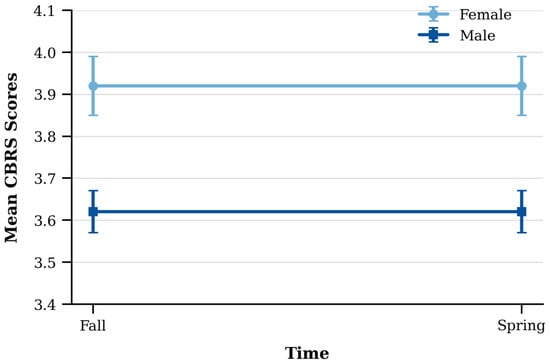
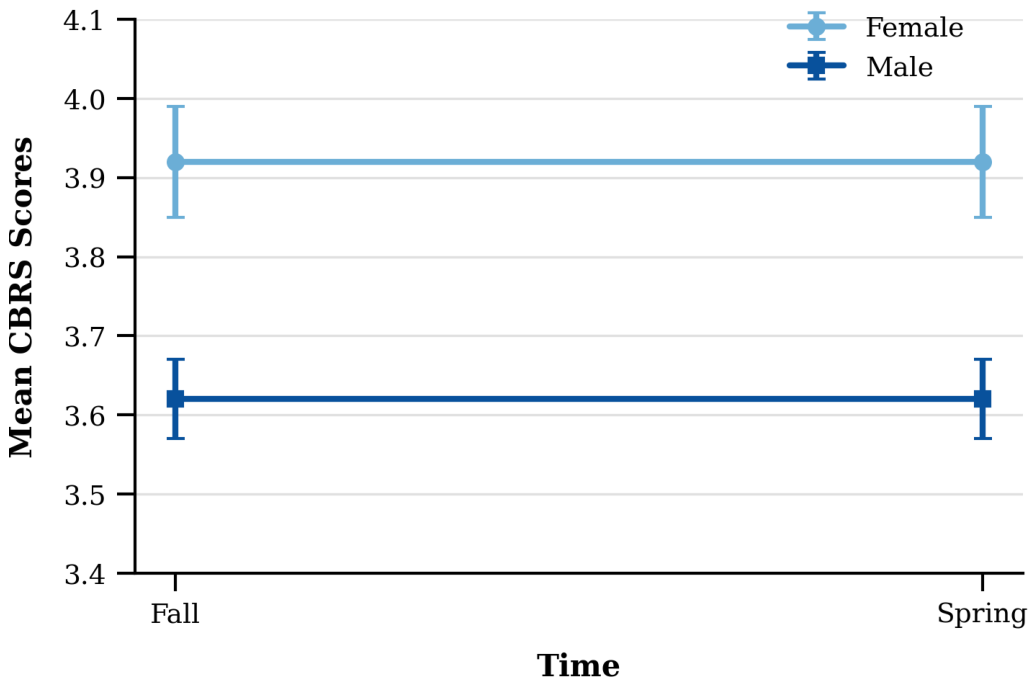
In the CBRS analysis (Table 1), we found no main effect of time, F(1,154) = 2.74, p = 0.100, indicating that teacher ratings of children’s self-regulation did not significantly differ between fall and spring. There was also no significant interaction between gender and time, F(1,154) = 0.10, p = 0.755, suggesting that changes in ratings over time did not differ by gender. The only significant main effect was a main effect of gender, F(1,154) = 8.49, p = 0.004, ηp2 = 0.05, indicating a small-to-moderate effect, with female students receiving higher teacher ratings of self-regulation than male students. Pairwise comparisons with Bonferroni corrections revealed that teachers’ ratings for female students, M = 3.92, SE = 0.07) were significantly higher than those for male students (M = 3.62, SE = 0.05) (Figure 1).
Table 1.
Mixed-measures analyses of covariance (ANCOVA) output for CBRS.
Figure 1.
Mean CBRS scores as a function of time and gender.
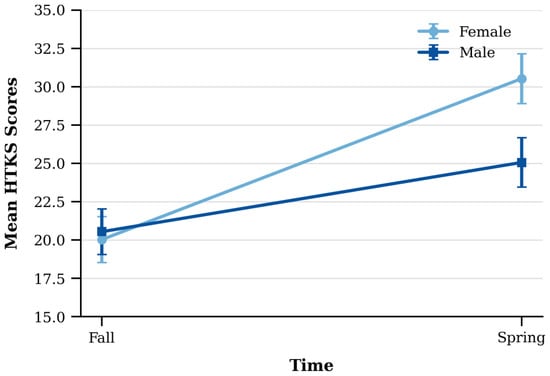
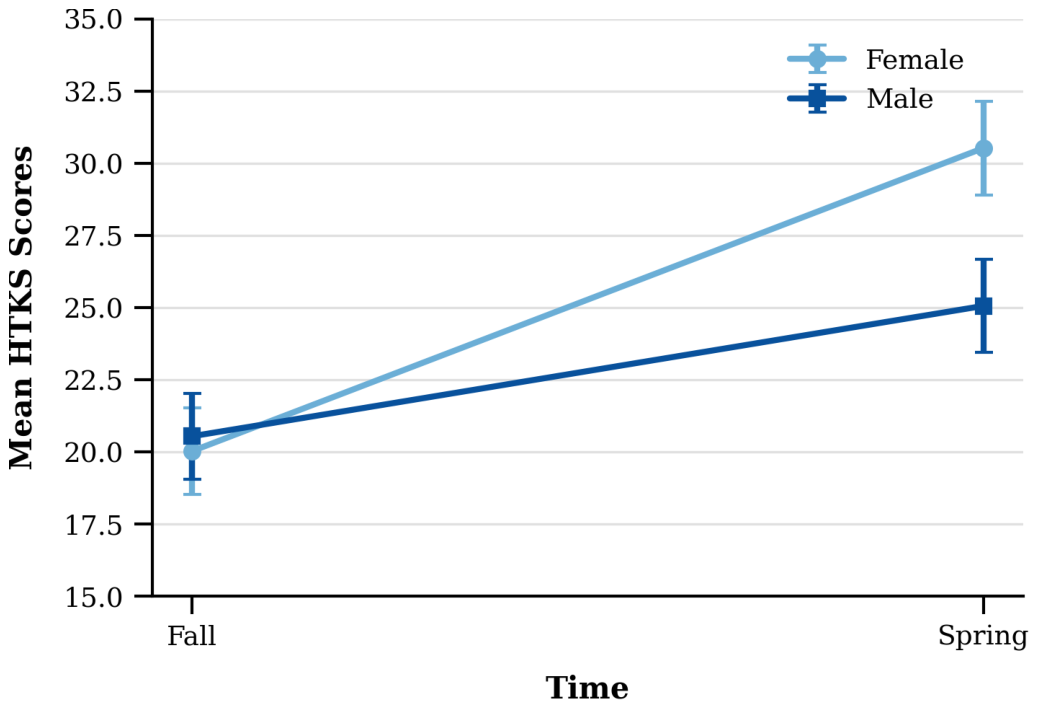
In contrast, the HTKS analysis of variance (Table 2) revealed no significant main effects of time, F(1,151) = 0.92, p = 0.388 or gender, F(1,151) = 1.82, p = 0.180, suggesting that, on average, HTKS scores did not differ across time points or between genders when considered separately. However, there was a significant interaction between time and gender, F(1,151) = 5.99, p = 0.016, ηp2 = 0.04, with a small-to-moderate effect, indicating that changes in self-regulation over time differed by gender. Pairwise comparisons with Bonferroni corrections showed that fall HTKS scores were similar for female (M = 20.02, SE = 1.50) and male students (M = 20.54, SE = 1.49). By spring, both groups improved, but female students (M = 30.53, SE = 1.62) demonstrated significantly greater gains than male students (M = 25.06, SE = 1.61) (Figure 2), resulting in a widening gender gap over time.
Table 2.
Mixed-measures analyses of covariance (ANCOVA) output for HTKS.
Figure 2.
Mean HTKS scores as a function of time and gender.
In sum, teachers consistently rated female students’ self-regulation higher than male students. However, gender differences in directly measured self-regulation only emerged by the end of the school year. Put together, these findings suggest that on the HTKS task, female students demonstrated greater improvement in self-regulation over the course of the school year compared to male students, whereas no differential change was observed in teacher-reported CBRS ratings. These results held after controlling for students’ age and receptive language skills.
3.2. Classroom Observations of Teacher Self-Regulation Support in Play-Based Contexts
To better understand teacher support in play-based contexts in relation to the gender discrepancies observed between teacher ratings and direct assessments of kindergarteners’ self-regulation, observational classroom data were analyzed. Both theoretical and empirical research highlight play as a unique and optimal context for young children to develop and practice self-regulation skills, as well as the important role teachers play in supporting this development (Bodrova et al., 2013; Foley, 2017; Pyle et al., 2022; Whitebread & O’Sullivan, 2012). Accordingly, the present study focused on observations of teachers supporting children’s self-regulation during play.
We first examined how frequently educators entered play to support self-regulation. During observations, participating educators infrequently engaged with students in this way (8% of videos). Instead, educators were more often observed monitoring students’ play or using play periods as an opportunity to withdraw students for individual or small group academic instruction or assessment. This pattern aligns with earlier research emphasizing the developmental benefits of providing children with opportunities for free play with minimal adult involvement (Fantuzzo et al., 2004; Miller & Almon, 2009). However, more contemporary research in play-based learning has expanded on this perspective by advocating for the provision of diverse play opportunities with varied teacher involvement (Pyle et al., 2022).
We next examined the gender composition of the play contexts that teachers entered to support self-regulation. When teachers were actively supporting children’s self-regulation during play, boys outnumbered girls, with a male-to-female ratio of 3:2. This pattern suggests that teachers were more likely to enter boys’ play to provide self-regulation support (Table 3). Additionally, both children’s gender and the type of play in which children engaged influenced how often such support was observed. Approximately 40% of videos capturing teachers supporting self-regulation occurred in building contexts (e.g., blocks, magnet tiles), which showed a markedly higher male-to-female ratio of 7:2.
Table 3.
Frequencies of video segments and gender distribution of children observed across play context and type of self-regulation support.
Self-regulation Support Type. In alignment with previous studies on teacher facilitation of self-regulation (e.g., Pyle et al., 2022) and social emotional skills more broadly (e.g., Larsen et al., 2025), our thematic analysis revealed two overarching approaches: management and facilitation. The key distinction between these two approaches lies in the locus of control—whether it resided primarily with the educator or the child.
Teacher management of self-regulation. When educators managed children’s self-regulation, they provided didactic instruction or solutions to support students’ management of their thoughts, behaviours, and emotions during play. Management strategies were especially common when children encountered peer conflict. For example, in Class 1, three students were arguing and pushing each other at the playdoh table. The teacher intervened to help the student who got knocked over during the exchange and directed the conflict resolution. The teacher asked: “What happened?” and was able to discern that the children were arguing about who had more playdoh: “He took ours” and “Now he got more than us”. The educator then promptly prescribed the solution by handing one student some playdoh, telling the students: “You have to share. Look, there’s a whole bunch here. If you can get it out, then you’ll have more.” While the educator initially asked clarifying questions to guide reflection, the resolution was entirely adult-directed, offering limited opportunity for student agency or input.
In other instances, where the educator perceived the self-regulation demands of a situation exceeded children’s capacity, they opted to withdraw students from play to provide support. For instance, Teacher 2 withdrew a student from the building centre after they knocked over a peer’s structure, explaining the impact of their actions on others: “That really hurt his feelings when you knocked over his tower” and redirecting the child’s energy towards an activity that was acceptable and regulating: “I’m going to ask you to go drink water and then pick an exercise to do [referencing images posted on the wall showing children engaged in 12 different exercises, such as jumping jacks and lunges]”.
Another common management strategy focused on maintaining classroom structure and order by reinforcing rules and expectations. For example, several teachers enforced pre-established occupancy limits at play centres. In Class 1, the teacher removed a student from the water table: “We’re going to keep to three people and when one person leaves you can come back and play.” Teacher 3 also modelled this strategy when two students were playing the piano, stating: “One person at a time. Gentle, gentle”. Teachers also used rule and behaviour reminders to promote self-regulation by restricting students’ movement around the classroom: Teacher 10 reminded a student to stay at their designated play centre until given permission to leave, Teacher 1 enforced inclusion of others in play when they escorted a student to play with another student sitting alone in the corner, Teacher 3 instructed students to take turns adding pieces to a puzzle, and Teacher 15 reminded students to abide by game rules while playing a matching game: “Remember when we peak [at a card], we have to flip it”.
In other cases, rules and guidelines for play were not predetermined but created by teachers in response to a perceived risk for conflict or injury. For example, during a student-initiated ninja-themed game (in the style of follow-the-leader), Teacher 2 joined to establish safety guidelines: “You can’t start kicking and hurting people when you’re playing. You don’t hurt people with the moves that you learn. It’s about self-control”. The educator also provided cues to help students avoid accidental contact: “When you stretch your arms out, you shouldn’t be touching anyone”, prompted game progression: “Show us the next positions [to the leader]”, and reinforced expectations: “That’s too close… Don’t touch your friend”.
Teacher management of self-regulation was common in our sample, with over two-thirds of play videos (74 of 108 videos) depicting educators providing this type of support in play. Among management videos, boys outnumbered girls seven to four (138 individual instances where boys received management support from teachers during play, 79 instances for girls). These gender differences became more pronounced when examining gender distributions by play context. Notably, boys were managed nearly five times more often than girls while building (26 videos) and twice as many boys were managed during physical and risky play (11 videos). While teacher management of self-regulation was more commonly experienced by boys, it was not exclusive to boys. For example, management was more common among girls engaged in sociodramatic play (4 videos) and teacher-directed play (activities with established rules of play such asnumber bingo and board games; 1 video), with twice as many girls than boys being managed in those play settings.
Teacher facilitation of self-regulation. Although less common, educators were also observed using facilitation strategies to support children’s self-regulation in play (34 videos). When teachers engaged facilitation strategies, they took on a more collaborative role, sharing the locus of control with the child. This facilitation served to scaffold self-regulation skills students may not develop in the absence of adult involvement. Teachers served as sounding boards to support students’ development of their internal dialogue, thereby guiding the development of strategies that children could use to self-regulate independently, under novel and potentially challenging conditions.
For example, Teacher 11 was observed facilitating students’ cognitive self-regulation as they were building a safety-themed room with large blocks during free play. The teacher asked open-ended questions to prompt the student to think critically about the purpose behind a safety room: “Why do we need a safety room?” and to deepen their engagement with the activity by asking them to brainstorm additional features or items to improve their safety room: “Do you have everything you need in your safety room to be safe? [What would we need] in case we have to stay longer in the safety room?”. The teacher also connected the play to recent school events, such as fire drills, helping students link their imaginative play to real-world experiences.
Teachers were also observed facilitating self-regulation in emotionally charged situations. For instance, Teacher 5 approached a group of students struggling to share train track pieces and initiated a conversation: “I think we’re going to have a little chat on how we’re going to negotiate this because we have a very upset friend.” Rather than immediately offering a solution, the teacher encouraged students to reflect and propose fair ways to resolve the conflict: “How do we make this fair so that [student without any pieces] can have his own pieces and build his own track?” When students struggled to generate solutions, the teacher scaffolded the process by suggesting possibilities: “Can we give away some pieces?”, allowing students to retain agency: “Which pieces can we share?” and make decisions collaboratively: “What’s your idea?”
In other cases, teachers chose to withdraw children from play to facilitate self-regulation before helping them reintegrate into play. For example, in Class 2, the teacher pulled a student aside because they upset another student by knocking over their structure. Teacher 2 asked the student to reflect on how they could repair their relationship with their peer and return to play: “He was building and you knocked it down. What would you like to do?” The student settled on an apology, which the teacher supported: “Say sorry? Okay, go find [him] then and say sorry to him.” When the student hesitated upon locating their peer, the teacher gently reminded them of their plan: “Remember what you wanted to say to [him]?” Subsequently, the two children were able to reconcile, and the teacher left them to play after providing some suggestions on how they could avoid future conflict: “You can look at it. You can even help him, but ask him first, okay?”
Teachers’ facilitation of self-regulation was not limited to open-ended play activities; it was also observed during more structured teacher-directed activities. For example, in Class 1, a student was competing against their teacher in a game that involved rolling dice. The goal of the game was to roll five-of-a-kind before your opponent. Even after the teacher had already won the round, she validated the student’s emotions and encouraged them to persist through frustration (i.e., repeatedly rolling unfavourable numbers) using a playful frame: “Should we wish for sixes?” When the child eventually rolled a desirable number, she celebrated with them.
When facilitating children’s self-regulation, teachers tailored their involvement during play, adjusting both the level and type of assistance based on individual children’s needs and responses. This facilitation was more frequently observed among boys, with an average ratio of three boys for every two girls (58 instances where boys received facilitation support from teachers during play, 39 for girls). Gender differences varied by play context, with the most notable difference occurring at the building centre (18 videos), where twice as many boys were observed in play when teachers provided facilitation support.
3.3. Interactions Between Self-Regulation Support Type, Play Context and Student Gender
Up to this point, gender, play context, and the type of self-regulation support provided have been examined in pairs. However, when all three variables were considered together, two notable interactions emerged that offer deeper insight into how these factors intersected to shape teacher behaviour during play.
Firstly, although gender differences were observed at the building centre where teachers were observed both managing and facilitating self-regulation, greater differences were observed in instances of management-type support. Specifically, teachers managed boys’ self-regulation five times more often than girls during building play. In contrast, facilitation support at the building centre showed a smaller gender gap, with boys receiving this support twice as often as girls. Put another way, students who were male and chose to play at the building centre had the highest likelihood of receiving management self-regulation support from teachers.
The second observed interaction involved physical and risky play. While girls experienced both teacher facilitation and management of self-regulation in this play context, boys only encountered management support. For example, in Class 2, three male students disagreed on the rules of playing soccer. The teacher intervened to establish what could and could not be done with a soccer ball: “This is for playing with your feet [motions to soccer ball]. Don’t take it and run away. We leave it on the ground, and we kick it to each other. You have to kick it, no grabbing it with your hands.” The teacher subsequently outlined what to do if they did not want to abide by the rules: “If you want to hold a ball, you can find a different ball.”
In contrast, female students in our sample were more likely to encounter facilitation-style self-regulation support from educators when engaged in physical and risky play. For example, in Class 5, four girls playing outside at the playground kept colliding as they came down the slide. In response, the teacher facilitated a discussion with the students to identify the issue and brainstorm possible solutions, pausing to check on understanding as needed: “Did you understand what she said to you?… What does that mean when she’s going down [the slide]? What do you need to do?” Once all parties agreed with the plan, the teacher scaffolded the solution: “Alright, who is coming [down] next?” and prompted students to reflect on the effectiveness of the solution: “Let’s keep trying and see if the solution worked out. Is it working?”
While male students experienced more self-regulation management and girls experienced more teacher facilitation during physical and risky play, not all our observations aligned with this dichotomy. Girls in our sample did experience some management-style self-regulation support. For example, in Class 13, the teacher directed a female student to exercise inhibitory control to stop interfering with the balance of another student who was standing on a narrow wooden post: “You can’t touch [student’s] body while she’s there. She’s in charge of her own body right there.”
Overall, observational data revealed that teachers infrequently entered children’s play to support self-regulation. When such support was provided, management (more teacher-directed approach) was more common than facilitation (more collaborative approach). Moreover, boys were often disproportionately represented in observations of teachers providing self-regulation support in play.
Although gender differences were also observed within other play contexts, boys were most likely to experience self-regulation management from teachers when engaged in play that involved building. The data also revealed an interesting interaction between gender and support type, during physical and risky play. Namely, girls encountered both teacher facilitation and management of self-regulation, while boys only experienced management from teachers in this play setting.
4. Discussion
4.1. Interpreting Gender Differences in Student Scores
Teachers in the current study consistently rated female students higher in self-regulation across the school year, whereas gender differences on the direct assessment only emerged in the spring. Consistent with the findings of the current study, studies with East Asian samples report that teachers rate girls’ self-regulation higher despite minimal or no observed gender differences on direct assessments (Wanless et al., 2013; Yamamoto & Imai-Matsumura, 2019). In contrast, findings from Western and European samples are more mixed (Gestsdottir et al., 2014; Matthews et al., 2009; Wanless et al., 2013). For instance, U.S.-based research carried out by Matthews et al. (2009) found that girls outperformed boys on the HTKS in both the fall and spring, as well as the CBRS in the spring. Similarly, Gestsdottir et al. (2014) reported that Icelandic girls outperformed boys on both direct and teacher-reported measures; however, no gender differences were observed among French and German children on either measure within the same study. Notably, when gender differences were observed, they typically favoured girls, with little evidence of boys outperforming girls. The current study found that gender differences on the direct assessment were not present in the fall but emerged by the spring. Although the interaction effect was modest in magnitude, its practical significance lies in the developmental trajectory it reflects. Boys and girls began the year with comparable levels of self-regulation, but girls showed greater growth, resulting in an approximately 5.5-point difference on the HTKS in the spring. These findings suggest that factors operating during the kindergarten year may contribute to differential self-regulation development for boys and girls. Exposure to different types and amounts of support across the school year may gradually shape children’s opportunities to practice and internalize self-regulation strategies, eventually leading to observable differences on direct assessments (Blair & Raver, 2015). Collectively, these findings raise the possibility that gender differences in self-regulation may reflect not only children’s developmental trajectories but also the social expectations and experiences they encounter in classroom contexts.
The present study integrates teacher-report, direct assessment, and observational data, allowing for a more comprehensive examination of both children’s self-regulation skills and the classroom processes that may shape them. Drawing on this integrated approach, our data suggest that these gendered perceptions may influence not only how teachers rate students’ self-regulation but also how they interact with students in the classroom. This finding aligns with Rosenthal and Jacobson’s classic study of the Pygmalion Effect (Rosenthal & Jacobson, 1968), which argued that teachers’ expectations can shape students’ performance through differential treatment. Recent research has extended these findings, demonstrating that teachers’ expectations shape both the learning opportunities students receive and their academic outcomes (Timmons et al., 2022) and are increasingly linked to students’ self-regulation outcomes (Timmons, 2019; Timmons et al., 2022).
Drawing on this literature, teachers’ gendered perceptions regarding children’s capacity to self-regulate may have influenced their decision-making regarding how often and in what contexts they chose to support children’s self-regulation. In turn, these differential interactions may help explain why gender differences between teacher-reported and directly assessed self-regulation were initially misaligned in the fall but became aligned by the spring. Although causal conclusions cannot be drawn, these findings are consistent with the possibility of a self-fulfilling process in which teachers’ perceptions and interactions may have contributed to differences in children’s self-regulation development over time.
4.2. Exploring Mechanisms of Gender Differences
In line with the concept of differential support, teachers in the current study provided self-regulation support more frequently to boys than girls during play, with a male-to-female ratio of 3:2. In light of research suggesting that boys are more likely to be perceived as disruptive and less compliant than girls (Li & Rubie-Davies, 2017), this pattern may suggest that teachers anticipated boys would have greater difficulties self-regulating in play and were thus more likely to intervene during boys’ play. An additional consideration is that these teacher-child interactions are likely bidirectional. Children’s behaviours may shape the type of support they receive, such that higher rates of observable impulsivity, conflict, or physical activity in certain play contexts may elicit more immediate, management-oriented responses from teachers. This interpretation is consistent with recent research suggesting a reciprocal relationship between children’s externalizing behaviours and the quality of teacher-student relationships, highlighting how children’s behaviour may shape the interactions and support they receive from teachers (Magro et al., 2026). Thus, differences in teacher support may reflect not only teachers’ expectations but also children’s regulatory demands. Notably, despite receiving more frequent support from teachers, boys in this study were significantly outperformed by their female counterparts on the direct assessment of self-regulation in the spring. Considered together, these results suggest that simply increasing the frequency with which teachers provide self-regulation support to boys may not be sufficient to support the development of this critical skill.
A more in-depth examination of the observational data revealed that teachers provided two distinct types of self-regulation support: management and facilitation, with varying frequency. Management-style support appeared in approximately two-thirds of observed play episodes involving teachers supporting children’s self-regulation. In these instances, teachers assumed primary responsibility for guiding how students regulated their thoughts, emotions, and behaviours during play. Although this approach often yielded more immediate results and was sometimes necessary, especially when children’s safety was at risk (e.g., preventing injuries), this teacher-directed approach may not fully equip children to self-regulate independently in novel play scenarios where adult support is not readily accessible. Evidence suggests that when teachers rely more heavily on controlling or managerial approaches, such as directing or regulating students’ behaviour for them, children show weaker gains in self-regulation over time, whereas autonomy-supportive, facilitation practices are associated with stronger development of self-regulation skills (Opdenakker, 2022; Phillips et al., 2022; Özgenel & Avcı, 2025). Research has traditionally indicated that children organically engage in aspects of self-regulation during socio-dramatic play, such as regulating emotions (Miller & Almon, 2009), planning future behaviours (Bodrova & Leong, 2008) and practice following rules (De La Riva & Ryan, 2015), overlooking the role of educator support. However, recent research emphasizes the support required by students who struggle when adult guidance is limited (Blair & Raver, 2015; Solomon et al., 2018), and more pressure is placed on independent learning skills (Schlesinger et al., 2020), making research into the educator role in supporting student self-regulation critical.
Adding yet another layer to the discussion, boys in this study received noticeably more management-style support than girls when teachers were supporting self-regulation during building and physical and risky play. These observations suggest a possible unintentional gender bias in self-regulation support related to children’s play choices. Prior research has shown that girls and boys tend to play separately and engage in different types of play activities (Blaise, 2005; MacNaughton, 2001; Martin, 2011). Girls have been found to more frequently engage in sociodramatic play (MacNaughton, 2001; Martin, 2011; Prioletta & Pyle, 2017; Thorne, 1993), while boys were more often observed in building activities (Davies, 1989; Martin, 2011; Prioletta & Pyle, 2017; Thorne, 1993). These findings suggest that children’s gender and play choices may have intersected to shape the type and frequency of self-regulation support they received, raising the question of whether observed differences were driven primarily by gendered expectations, play context, or some combination of the two. Even if these differences reflect a combination of expectations and play contexts, from an equity perspective, these findings raise important questions about how subtle, and likely unintentional, differences in teacher perceptions and interactions may lead to fewer opportunities to develop autonomy and independent self-regulation skills.
Earlier research in play-based learning discouraged extensive adult involvement in play, cautioning teachers against “hijacking” children’s play, as it could interfere with the development of peer-mediated self-regulation skills (Fantuzzo et al., 2004; Miller & Almon, 2009). This research continues to inform the practices of many teachers (Pyle et al., 2022). As such, one possible explanation for teachers’ frequent use of management strategies is that these approaches allowed them to quickly resolve problems during play and ensure students’ safety before stepping back to allow children to maintain control of the play. However, this need to remain uninvolved has been challenged in recent research of play-based learning, which advocates for providing students with diverse play opportunities with varying teacher involvement (Pyle et al., 2022). Experimental research supports this broadening of play-based learning, demonstrating that varying levels of adult involvement in play produce different effects on self-regulation, with some aspects benefiting from adult guidance and others from more independent play (Veresov et al., 2021). For example, teacher-directed games, where children are expected to follow explicit rules of play designed by the teacher have been shown to improve children’s regulatory abilities (Savina, 2021) by requiring children to exercise aspects of self-regulation, such as working memory, cognitive flexibility, inhibitory and attentional control (Re et al., 2015; Röthlisberger et al., 2011; Traverso et al., 2015). Together, these findings highlight the limitations of relying solely on management-oriented support and point to the importance of integrating more intentional, scaffolded forms of teacher involvement.
In the current study, when teachers became more involved in the play, they tailored their support to the individual needs of children, responding to cues and feedback provided during play. This facilitative approach aligns with research highlighting the importance of responsive scaffolding, dialogue, and collaborative problem-solving in extending children’s social and emotional competencies (Larsen et al., 2025; Granone & Pollarolo, 2025). Notably, facilitation-style support was observed less frequently in this study overall. These findings suggest that management support may not have been inherently harmful to boys’ self-regulation, but that the relative absence of facilitation-style support may account for the gender differences observed in students’ spring self-regulation scores, although this relationship cannot be tested directly in the current study. This pattern is particularly evident when looking at the gender distribution in the physical and risky play category, where boys exclusively received management-style self-regulation support, while girls encountered a combination of management and facilitation. These findings underscore the need for teacher training that equips educators with strategies to facilitate self-regulation across diverse play contexts, especially in play activities that boys tend to gravitate towards.
Finally, it is important to consider that the discrepancy between teachers’ gendered ratings in the fall and the absence of gender differences on the direct measure of self-regulation suggests that teachers may face challenges in reliably evaluating children’s self-regulation using report-based measures alone. This discrepancy may reflect differences in what each method captures. Teacher-report measures are embedded in classroom contexts and therefore reflect children’s behaviour as enacted in everyday interactions (high ecological validity), whereas direct assessments provide more standardized but decontextualized indicators of self-regulation ability. These approaches should be viewed as complementary. While teacher reports provide insights into how self-regulation is expressed in everyday classroom interactions, direct assessments offer a standardized benchmark that may help mitigate potential teacher biases, including those related to gender. As such, providing teachers with access to evidence-based, direct measures of self-regulation may support more balanced and accurate evaluations of children’s abilities. In turn, this may assist educators in more effectively identifying students who are at risk for poor self-regulation and the associated negative academic outcomes (McClelland et al., 2010; Robson et al., 2020) and inform the provision of earlier and more differentiated intervention. For example, preliminary evidence suggests that HTKS-Kids, a tablet-based version of the HTKS designed for use in classrooms, may provide a more equitable alternative to teacher-report measures like the CBRS (Cameron et al., 2024). Future studies should explore the effectiveness and feasibility of integrating direct assessment tools into classroom contexts.
5. Limitations
While the mixed-methods approach employed in the current study contributed valuable insight into how teachers’ gendered perceptions and interactions with children during play may have influenced students’ outcomes on a direct measure of self-regulation, caution should be exercised in generalizing these findings to other populations and contexts. First, we did not have consent for all children in participating classrooms, and thus the final sample size was insufficient for multilevel analysis. Future research should recruit larger samples and sufficient classroom-level representation to permit multilevel analyses that account for the nested structure of the data. Second, although classrooms were drawn from high-, medium- and low-SES school contexts, individual-level SES data were not available and therefore could not be included as a covariate. As socioeconomic factors have been associated with children’s self-regulation and classroom experiences, future research should explore the extent to which SES may contribute to the relations observed in this study. Third, this study took place in Ontario, Canada, where a play-based pedagogical approach is mandated and self-regulation is an integral part of the kindergarten curriculum. As such, teachers in this context may be uniquely positioned to support self-regulation through play. Future research in varied educational contexts will be important for determining whether these patterns hold in settings with different pedagogical priorities and levels of emphasis on self-regulation. Finally, teachers’ expectations were not directly measured but were instead inferred by comparing teacher-reported and direct measures of children’s self-regulation. Consequently, conclusions regarding teachers’ expectations should be interpreted with caution, and future research should incorporate direct measures of teacher expectations.
6. Conclusions
The current study provides novel evidence that gender differences in children’s self-regulation may not simply reflect inherent differences in ability but may instead be shaped by teachers’ perceptions and interaction patterns within play-based classrooms. By integrating teacher reports, direct assessments, and observational data, the findings highlight a potential self-reinforcing cycle in which gendered perceptions and interactions may contribute to observed gender disparities over time. Importantly, the results suggest that increasing the quantity of support alone is insufficient. Instead, the quality and nature of teacher support, particularly the balance between management and facilitation, may play a critical role in fostering equitable self-regulation development. These findings underscore the need for teacher training that promotes reflective practice, provides access to objective assessment tools, and equips educators with strategies to scaffold self-regulation across diverse play contexts. More broadly, this work contributes to a growing body of research emphasizing the role of classroom practices in shaping developmental outcomes and calls for greater attention to how gendered expectations may influence early learning experiences in subtle but consequential ways. Together, these findings suggest that gender differences in self-regulation are not merely observed in classrooms but may also be associated with classroom experiences, highlighting the potential role of educators in either reinforcing or disrupting these patterns.
Author Contributions
Conceptualization, K.N. and A.P.; Methodology, K.N. and A.P.; Formal analysis, K.N.; Investigation, A.P.; Data curation, A.P.; Writing—original draft, K.N. and A.P.; Writing—review and editing, K.N. and A.P.; Visualization, K.N.; Supervision, A.P.; Funding acquisition, A.P. All authors have read and agreed to the published version of the manuscript.
Funding
The work was supported by the Social Sciences and Humanities Research Council of Canada (435-2018-1462).
Institutional Review Board Statement
The study was conducted in accordance with the Declaration of Helsinki, and approved by the University of Toronto Research Ethics Board (protocol code #16635 and with approval granted on 17 September 2019).
Informed Consent Statement
Informed consent was obtained from all subjects involved in the study.
Data Availability Statement
The datasets presented in this article are not readily available due to ethical and confidentiality restrictions related to the nature of the data.
Conflicts of Interest
The authors declare no conflicts of interest.
References
- Baumeister, R. F., & Vohs, K. D. (2011). Handbook of self-regulation: Research, theory, and applications (2nd ed.). Guilford Press. [Google Scholar]
- Bem, S. L. (1981). Gender schema theory: A cognitive account of sex typing. Psychological Review, 88(4), 354–364. [Google Scholar] [CrossRef]
- Blair, C., & Raver, C. C. (2015). School readiness and self-regulation: A developmental psychobiological approach. Annual Review of Psychology, 66, 711–731. [Google Scholar] [CrossRef] [Scilit]
- Blaise, M. (2005). Performing femininities through gender discourses. In Power and voice in research with children (pp. 105–116). Peter Lang. [Google Scholar]
- Bodrova, E., Germeroth, C., & Leong, D. J. (2013). Play and self-regulation: Lessons from Vygotsky. American Journal of Play, 6(1), 111–123. [Google Scholar]
- Bodrova, E., & Leong, D. J. (2008). Developing self-regulation in kindergarten. Young Children, 63(2), 56–58. [Google Scholar]
- Bronson, M. B., Tivnan, T., & Seppanen, P. S. (1995). Relations between teacher and classroom activity variables and the classroom behaviors of prekindergarten children in Chapter 1 funded programs. Journal of Applied Developmental Psychology, 16(2), 253–282. [Google Scholar] [CrossRef] [Scilit]
- Cadima, J., Verschueren, K., Leal, T., & Guedes, C. (2016). Classroom interactions, dyadic teacher–child relationships, and self–regulation in socially disadvantaged young children. Journal of Abnormal Child Psychology, 44(1), 7–17. [Google Scholar] [CrossRef] [Scilit]
- Cameron, C. E., McClelland, M. M., Kwan, T., Starke, K., & Lewis-Jones, T. (2024). HTKS-Kids: A tablet-based self-regulation measure to equitably assess young children’s school readiness. Frontiers in Psychology, 14, 1202239. [Google Scholar] [CrossRef] [Scilit]
- Creswell, J. W., & Plano Clark, V. L. (2018). Designing and Conducting Mixed Methods Research (3rd ed.). SAGE. [Google Scholar]
- Davies, D. (1989). Encounters with Harpo Marx in the Wendy house. Education 3–13, 17(3), 55–59. [Google Scholar] [CrossRef] [Scilit]
- De La Riva, S., & Ryan, T. G. (2015). Self-regulating behaviour and academic success. International Journal of Early Childhood Special Education, 7(1), 69–96. [Google Scholar] [CrossRef] [Scilit]
- Dunn, L. M., & Dunn, D. M. (2007). Peabody picture vocabulary test–Fourth edition (PPVT-4). Pearson. [Google Scholar] [CrossRef] [Scilit]
- Evans, G. W., & Rosenbaum, J. (2008). Self-regulation and the income-achievement gap. Early Childhood Research Quarterly, 23(4), 504–514. [Google Scholar] [CrossRef] [Scilit]
- Fantuzzo, J., Sekino, Y., & Cohen, H. L. (2004). An examination of the contributions of interactive peer play to salient classroom competencies for urban head start children. Psychology in the Schools, 41(3), 323–336. [Google Scholar] [CrossRef] [Scilit]
- Foley, G. M. (2017). Play as regulation: Promoting self-regulation through play. Topics in Language Disorders, 37(3), 241–258. [Google Scholar] [CrossRef] [Scilit]
- Fram, S. M. (2013). The Constant Comparative Analysis Method Outside of Grounded Theory. The Qualitative Report, 18(1), 1–25. [Google Scholar] [CrossRef] [Scilit]
- Gestsdottir, S., von Suchodoletz, A., Wanless, S. B., Hubert, B., Guimard, P., Birgisdottir, F., Gunzenhauser, C., & McClelland, M. (2014). Early behavioral self-regulation, academic achievement, and gender: Longitudinal findings from France, Germany, and Iceland. Applied Developmental Science, 18(2), 90–109. [Google Scholar] [CrossRef] [Scilit]
- Granone, F., & Pollarolo, E. (2025). Facilitating children’s communication in problem-solving activities with a coding toy: Teachers’ semiotic mediation in early childhood education and care. Frontiers in Psychology, 15, 1426165. [Google Scholar] [CrossRef] [Scilit]
- Ivrendi, A. (2016). Choice-driven peer play, self-regulation and number sense. European Early Childhood Education Research Journal, 24(6), 895–906. [Google Scholar] [CrossRef] [Scilit]
- Larsen, N., Pyle, A., Danniels, E., Marzouca, M., & Nazeem, R. (2025). Kindergarten teachers’ facilitation of social and emotional learning in classroom play contexts. Education Inquiry, 16(2), 195–216. [Google Scholar] [CrossRef] [Scilit]
- Lengua, L. J., Moran, L., Zalewski, M., Ruberry, E., Kiff, C., & Thompson, S. (2015). Relations of growth in effortful control to family income, cumulative risk, and adjustment in preschool-age children. Journal of Abnormal Child Psychology, 43(4), 705–720. [Google Scholar] [CrossRef] [Scilit]
- Li, H., & Rubie-Davies, C. M. (2017). Teachers’ beliefs and expectations in the United States: A review of the literature. Educational Review, 69(4), 479–501. [Google Scholar] [CrossRef] [Scilit]
- Liu, Q., Razza, R. A., Zhang, Y., & Merrin, G. J. (2024). Differential growth trajectories of behavioral self-regulation from early childhood to adolescence: Implication for youth domain-general and school-specific outcomes. Applied Developmental Science, 30(2), 182–202. [Google Scholar] [CrossRef] [Scilit]
- MacNaughton, G. (2001). Dolls for equity: Foregrounding children’s voices in learning respect and unlearning unfairness. Early Childhood Folio, 5, 27–30. [Google Scholar] [CrossRef] [Scilit]
- Magro, S. W., Berry, D., Palmer, A. R., & Roisman, G. I. (2026). Teacher-student relationship quality and social, academic, and behavioral adjustment are associated within and between persons from kindergarten to grade 6. Developmental Psychology, 62(2), 475–491. [Google Scholar] [CrossRef] [Scilit]
- Martin, B. (2011). Children at play: Learning gender in the early years. Trentham Books Ltd. [Google Scholar]
- Matthews, J. S., Ponitz, C. C., & Morrison, F. J. (2009). Early gender differences in self-regulation and academic achievement. Journal of Educational Psychology, 101(3), 689. [Google Scholar] [CrossRef] [Scilit]
- McClelland, M. M., Geldhof, G. J., Cameron, C. E., Wanless, S. B., & Lerner, R. M. (2015). Handbook of child psychology and developmental science. John Wiley & Sons. [Google Scholar]
- McClelland, M. M., Ponitz, C. C., Messersmith, E. E., & Tominey, S. (2010). Self-regulation: Integration of cognition and emotion. In The handbook of life-span development. Wiley. [Google Scholar] [CrossRef] [Scilit]
- Miles, M. B., & Huberman, A. M. (1994). Qualitative data analysis: An expanded sourcebook. SAGE Publications. [Google Scholar]
- Miller, E., & Almon, J. (2009). Crisis in the kindergarten: Why children need to play in school. Education Digest, 75(1), 42–45. [Google Scholar]
- Montroy, J. J., Bowles, R. P., Skibbe, L. E., McClelland, M. M., & Morrison, F. J. (2016). The development of self-regulation across early childhood. Developmental Psychology, 52(11), 1744. [Google Scholar] [CrossRef] [Scilit]
- Mweru, M. (2012). Teachers’ influence on children’s selection and use of play materials in Kenya. African Journal of Teacher Education, 2(2). [Google Scholar] [CrossRef] [Scilit][Green Version]
- Nicolopoulou, A., Cortina, K. S., Ilgaz, H., Cates, C. B., & de Sá, A. B. (2015). Using a narrative-and play-based activity to promote low-income preschoolers’ oral language, emergent literacy, and social competence. Early Childhood Research Quarterly, 31, 147–162. [Google Scholar] [CrossRef] [Scilit]
- Ontario Ministry of Education. (2016). The kindergarten program. Ontario Ministry of Education. [Google Scholar]
- Opdenakker, M. C. (2022). Developments in early adolescents’ self-regulation: The importance of teachers’ supportive vs. undermining behavior. Frontiers in Psychology, 13, 1021904. [Google Scholar] [CrossRef] [Scilit]
- Özgenel, M., & Avcı, S. (2025). Parental and teacher autonomy support in developing self-regulation skills. Behavioral Sciences, 15(12), 1621. [Google Scholar] [CrossRef] [Scilit]
- Patton, M. Q. (2014). Qualitative research & evaluation methods: Integrating theory and practice. Sage publications. [Google Scholar]
- Phillips, D. A., Hutchison, J. E., Martin, A., Castle, S., & Johnson, A. D. (2022). First do no harm: How teachers support or undermine children’s self-regulation. Early Childhood Research Quarterly, 59, 172–185. [Google Scholar] [CrossRef] [Scilit]
- Ponitz, C. E. C., McClelland, M. M., Jewkes, A. M., Connor, C. M., Farris, C. L., & Morrison, F. J. (2008). Touch your toes! Developing a direct measure of behavioral regulation in early childhood. Early Childhood Research Quarterly, 23(2), 141–158. [Google Scholar] [CrossRef] [Scilit]
- Posner, M. I., Rothbart, M. K., & Tang, Y. Y. (2013). Developing self-regulation in early childhood. Trends in Neuroscience and Education, 2(3–4), 107–110. [Google Scholar] [CrossRef] [Scilit]
- Prioletta, J., & Pyle, A. (2017). Play and gender in Ontario kindergarten classrooms: Implications for literacy learning. International Journal of Early Years Education, 25(4), 393–408. [Google Scholar] [CrossRef] [Scilit]
- Pyle, A., & Danniels, E. (2016). Using a picture book to gain assent in research with young children. Early Child Development and Care, 186(9), 1438–1452. [Google Scholar] [CrossRef] [Scilit]
- Pyle, A., & Danniels, E. (2017). A continuum of play-based learning: The role of the teacher in play-based pedagogy and the fear of hijacking play. Early Education and Development, 28(3), 274–289. [Google Scholar] [CrossRef] [Scilit]
- Pyle, A., Danniels, E., Larsen, N. E., & Martinussen, R. (2022). Supporting children’s self-regulation development in play-based kindergarten classrooms. International Journal of Educational Research, 116, 102059. [Google Scholar] [CrossRef] [Scilit]
- Raver, C. C., Blair, C., & Willoughby, M. (2013). Poverty as a predictor of 4-year-olds’ executive function: New perspectives on models of differential susceptibility. Developmental Psychology, 49(2), 292. [Google Scholar] [CrossRef] [Scilit]
- Re, A. M., Capodieci, A., & Cornoldi, C. (2015). Effect of training focused on executive functions (attention, inhibition, and working memory) in preschoolers exhibiting ADHD symptoms. Frontiers in Psychology, 6, 1161. [Google Scholar] [CrossRef] [Scilit]
- Robson, D. A., Allen, M. S., & Howard, S. J. (2020). Self-regulation in childhood as a predictor of future outcomes: A meta-analytic review. Psychological Bulletin, 146(4), 324–354. [Google Scholar] [CrossRef] [Scilit]
- Rosenthal, R., & Jacobson, L. (1968). Pygmalion in the classroom: Teacher expectation and pupils’ intellectual development. Holt, Rinehart & Winston. [Google Scholar]
- Röthlisberger, M., Neuenschwander, R., Cimeli, P., Michel, E., & Roebers, C. M. (2011). Improving executive functions in 5- and 6-year-olds: Evaluation of a small group intervention in prekindergarten and kindergarten children. Infant and Child Development, 21(4), 411–429. [Google Scholar] [CrossRef] [Scilit]
- Savina, E. (2021). Self-regulation in preschool and early elementary classrooms: Why it is important and how to promote it. Early Childhood Education Journal, 49(3), 493–501. [Google Scholar] [CrossRef] [Scilit]
- Schirmbeck, K., Rao, N., & Maehler, C. (2020). Similarities and differences across countries in the development of executive functions in children: A systematic review. Infant and Child Development, 29(1), e2164. [Google Scholar] [CrossRef] [Scilit]
- Schlesinger, M. A., Hassinger-Das, B., Zosh, J. M., Sawyer, J., Evans, N., & Hirsh Pasek, K. (2020). Cognitive behavioral science behind the value of play: Leveraging everyday experiences to promote play, learning, and positive interactions. Journal of Infant, Child and Adolescent Psychotherapy, 19(2), 202–216. [Google Scholar] [CrossRef] [Scilit]
- Solomon, T., Plamondon, A., O’Hara, A., Finch, H., Goco, G., Chaban, P., Huggins, L., Ferguson, B., & Tannock, R. (2018). A cluster randomized-controlled trial of the impact of the Tools of the Mind curriculum on self-regulation in Canadian preschoolers. Frontiers in Psychology, 8, 2366. [Google Scholar] [CrossRef] [Scilit]
- Thorne, B. (1993). Gender play: Girls and boys in school. Rutgers University Press. [Google Scholar]
- Timmons, K. (2019). Kindergarten expectations and outcomes: Understanding the influence of educator and child expectations on Children’s self-regulation, early Reading, and vocabulary outcomes. Journal of Research in Childhood Education, 33(3), 471–489. [Google Scholar] [CrossRef] [Scilit]
- Timmons, K., Pyle, A., Danniels, E., Cowan, E., & McCann, A. (2022). Teacher expectations in the early primary grades: A scoping review. Review of Education, 10(3), e3375. [Google Scholar] [CrossRef] [Scilit]
- Tominey, S. L., & McClelland, M. M. (2011). Red light, purple light: Findings from a randomized trial using circle time games to improvebehavioral self-regulation in preschool. Early Education & Development, 22(3), 489–519. [Google Scholar] [CrossRef] [Scilit]
- Traverso, L., Viterbori, P., & Usai, M. C. (2015). Improving executive function in childhood: Evaluation of a training intervention for 5-year-old children. Frontiers in Psychology, 6, 525. [Google Scholar] [CrossRef] [Scilit]
- Venitz, L., & Perels, F. (2019). The promotion of self-regulated learning by kindergarten teachers: Differential effects of an indirect intervention. International Electronic Journal of Elementary Education, 11(5), 437–448. [Google Scholar] [CrossRef] [Scilit]
- Veresov, N., Veraksa, A., Gavrilova, M., & Sukhikh, V. (2021). Do children need adult support during sociodramatic play to develop executive functions? Experimental evidence. Frontiers in Psychology, 12, 779023. [Google Scholar] [CrossRef] [Scilit]
- Vitiello, V. E., Nguyen, T., Ruzek, E., Pianta, R. C., & Whittaker, J. V. (2022). Differences between Pre-K and Kindergarten classroom experiences: Do they predict children’s social-emotional skills and self-regulation across the transition to kindergarten? Early Childhood Research Quarterly, 59, 287–299. [Google Scholar] [CrossRef] [Scilit]
- Wanless, S. B., McClelland, M. M., Lan, X., Son, S. H., Cameron, C. E., Morrison, F. J., Chen, F.-M., Chen, J.-L., Li, S., Lee, K., & Sung, M. (2013). Gender differences in behavioral regulation in four societies: The United States, Taiwan, South Korea, and China. Early Childhood Research Quarterly, 28(3), 621–633. [Google Scholar] [CrossRef] [Scilit]
- Whitebread, D., & O’Sullivan, L. (2012). Preschool children’s social pretend play: Supporting the development of metacommunication, metacognition and self-regulation. International Journal of Play, 1(2), 197–213. [Google Scholar] [CrossRef] [Scilit]
- Yamamoto, N., & Imai-Matsumura, K. (2019). Gender differences in executive function and behavioural self-regulation in 5 years old kindergarteners from East Japan. Early Child Development and Care, 189(1), 56–67. [Google Scholar] [CrossRef] [Scilit]

Disclaimer/Publisher’s Note: The statements, opinions and data contained in all publications are solely those of the individual author(s) and contributor(s) and not of MDPI and/or the editor(s). MDPI and/or the editor(s) disclaim responsibility for any injury to people or property resulting from any ideas, methods, instructions or products referred to in the content. |
© 2026 by the authors. Licensee MDPI, Basel, Switzerland. This article is an open access article distributed under the terms and conditions of the Creative Commons Attribution (CC BY) license.