Abstract
Generative textbooks are AI-powered educational resources generated using generative AI tools to create a variety of content types. However, this is a relatively new notion, and it is still under exploration. The current study aims to explore how the concept of a generative textbook can be effectively integrated into higher education academic programs. Specifically, it examined the creation, integration, and usability of generative textbooks in a college course, an area previously unexplored in higher education settings. A design-based research approach is employed to conduct this study through three phases: analysis and exploration, design and development, and evaluation and reflection. The instruments and participants are varied throughout the phases. The iterative process of this approach demonstrated how the generative textbook was generated. The output of this design-based research is a generative textbook chatbot (OLAD), which is an LLM; a responsive platform where students can post their queries regarding online learning and receive instant responses. The findings showed that the speed, creativity, adaptability, and efficiency of the OLAD are the critical advantages of this tool. Regarding the disadvantages, the study revealed that AI-generated content lacks accuracy, depth of information, and human insights. In addition, it is identified that the usefulness and ease of use of the OLAD of the generative textbook were at a moderate level. Further investigation is needed to inform pedagogical designs of integrating LLM into a college course.
1. Introduction
The term generative textbook is relatively new. It was introduced by Wiley (2023) and defined as a type of textbook students learn via interaction with a large language model (LLM) like ChatGPT instead of reading textbooks. Generative textbooks are AI-powered educational resources that are produced or customized using generative AI (GenAI) tools to create various types of content, including text, images, videos, audio, and more.
According to Wiley (2023), the concept of the generative textbook is to be dynamic, conversational, and interactive, unlike traditional textbooks. The concept of generative textbooks is to utilize GenAI to generate new content based on user prompts, enabling a personalized learning experience. The prompts here become the core curriculum in an educational setting where users interact with an LLM. To date, there have been attempts to understand the term “generative textbook” in relation to its appearance, functionality, development, usage, impact on teaching and learning, and integration into higher education settings; however, they remain very limited. As a result, this study presents the first iteration of producing a generative textbook by enabling students to interact directly with the LLM, which is a GenAI tool that was used to produce the content of the intended textbook.
Consequently, as an output of the current study, a generative textbook entitled “The Design of Online Learning Experiences” was created by the utilization of GenAI tools to generate content about “online learning”. Then, a chatbot for this generative textbook was designed to serve as a responsive tool for student prompts that will be applied in the next iteration of this study. The method used to develop this product was a design-based research (DBR) approach. The phases were conducted as follows: analysis and exploration, design and development, and implementation and evaluation.
Purpose of Study
The current study reports the process used to design the course curriculum in alignment with the concept of generative textbooks, as well as the usability testing results of the generative textbook chatbot based on students’ actual experiences. The overarching objective of this study was to explore the creation, integration, and usability of generative textbooks. Accordingly, the overall objectives of the current research are as follows:
- To explore how the concept of a generative textbook can be effectively integrated into academic programs in higher education.
- To investigate the potential use of generative textbooks in enhancing teaching and learning practices in higher education.
- To examine the process, opportunities, and challenges associated with using GenAI to generate the content for generative textbooks in higher education settings.
The following research questions guided this study:
Q1. How are generative textbooks produced in higher education settings?
Q2. What are students’ perspectives about the process they used to generate the content of the generative textbook from GenAI tools?
Q3. What is the perceived usability level of the generative textbook chatbot among students in a higher education setting?
2. Literature Review
2.1. Theoretical Background
David Wiley’s suggestion of “Generative textbooks” is based on Gordon Pask’s conversation theory, which considers conversation an essential process of learning. Similarly, Sharples (2023) proposed a model in which humans and AI agents engage in conversations within a pervasive computational medium. In Sharples’ model, generative AI contributes to a social learning process where learners set shared goals, collaborate on tasks, explore possibilities, and engage in conversations to reach agreements (Sharples, 2023).
Sharples (2023) identified five roles for GenAI in social learning: possibility engine, Socratic opponent, co-designer, exploratorium, and storyteller. In the possibility engine scenario, students work in groups to write prompts in ChatGPT and submit the exact prompt multiple times to observe alternative responses. In the Socratic opponent scenario, teachers ask their students to write prompts into ChatGPT to prepare for discussions and debates. In the co-designer scenario, students work in groups and utilize ChatGPT to search for information or ideas to complete assignments, such as designing a website, video, or game. In the exploratorium scenario, students can collaborate with the help of ChatGPT to explore diverse methods for visualizing and describing extensive databases, such as census data. In the storyteller scenario, students work together or in turn using ChatGPT to create a story, prompting it to involve a diversity of characters.
Moreover, Su and Yang (2023) designed the IDEE Framework as a guide for using GenAI in education. Educators can utilize this four-step framework to ensure the effectiveness of incorporating GenAI into their practices. In the first step, educators should identify the intended outcomes to ensure they achieve the desired outcomes. Secondly, they should decide the level of using AI in their teaching; is it fully automated with AI or an additional activity to their traditional approach? In the third step, they should carefully consider the ethical implications of using GenAI, including potential biases and their impact on teachers and students. Ultimately, it is crucial to assess the effectiveness of using generative AI in achieving the planned outcomes.
2.2. Overview of GenAI
Alan Turing envisioned the foundation of Artificial Intelligence (AI) in his 1950 article, where he outlined the necessity of machine learning capable of simulating human cognitive functions (Muggleton, 2014). In recent years, GenAI has been developed to perform more complex tasks in producing content that resembles human-generated content, such as coherent text, images, audio, and video. The focus of GenAI definitions is generally on the type of content produced. Such definitions are outlined by IBM Research (Feuerriegel et al., 2024; Lawton, 2025; Martineau, 2023). According to Martineau (2023), GenAI is defined as deep-learning models that can generate high-quality text, images, and other content based on the data they were trained on. It is also determined by Lawton (2025) as a type of AI technology that can produce various types of content, including text, imagery, audio, and synthetic data. Feuerriegel et al. (2024) defined it as computational techniques capable of generating seemingly new, meaningful content, such as text, images, or audio, from training data.
Other definitions are more precise, as they focus on both the written prompts and the output. For example, Holmes and Miao (2023) defined it as an AI technology that automatically generates content in response to prompts written in natural language conversational interfaces. In addition, Bommasani et al. (2021) referred to GenAI as a given natural language prompt or instruction that synthesizes novel text, code, or multimedia content by modelling the statistical distribution of their training data.
Nowadays, students utilize GenAI engines like ChatGPT to generate content that aids them in their learning. This led David Wiley to propose the term “Generative textbooks”, which refers to the process of students learning by interacting with a large language model (LLM) (Wiley, 2023). He suggested that students might learn by interacting with GenAI models, rather than relying on textbook content. He added that rather than reading a book and not understanding anything, students can engage in conversations with GenAI models to gain a deeper understanding of any topic. Some studies have recently begun to study this area. For instance, Xu and Xiao (2024) explored the approach of using GenAI to generate the content of a textbook in vocational education. They investigated the design, development, and usage of textbooks that are generative-AI-generated. They argued that traditional textbooks are static, outdated, costly, and lack interactivity and flexibility for customization to meet students’ needs. They found that using GenAI to generate textbooks lowers the time and cost of producing traditional textbooks and enables educators to concentrate on innovating teaching strategies and customizing content to meet their students’ needs. In addition, Zhou and Zhao (2024) examined the concept of replacing static textbooks with an interactive, generative textbook by generating the metaverse virtual simulation into the STEM digital textbook. They found that using GenAI to create the content of this digital textbook added interactivity and provided an adaptive learning environment for learning related concepts.
2.3. Benefits of Using Generative AI
A review of the literature reveals several benefits of utilizing GenAI in education for both learners and teachers. A review of the literature by Noroozi et al. (2024) found that GenAI can facilitate personalized learning experiences by offering individualized feedback and improving language skills. Additionally, it can support specific academic tasks, such as writing reports or creating lesson plans. Furthermore, GenAI can impact educational methodology and pedagogy by fostering students’ engagement and facilitating effective communication among learners and educators. Moreover, Su and Yang (2023) outlined four benefits of GenAI for students: providing a personalized learning experience, answering their questions, engaging them in the learning process, and offering valuable suggestions for essay writing. An exploratory study by Baidoo-Anu and Ansah (2023) explored recent literature to investigate the benefits and drawbacks of ChatGPT in education. They found that ChatGPT helps promote personalized and interactive learning, as well as in creating formative assessment activities. A recent study found that utilizing GenAI tools to produce videos in education increased students’ motivation toward learning in terms of the quality of media embedded in the video (Jang et al., 2025)
2.4. Limitations of Using Generative AI
The emergence of GenAI has sparked a debate about its use in education compared to human learning. Wu (2023) discussed the difference between human learning and ChatGPT. The researcher stated that ChatGPT lacks understanding, creativity, and adaptability. In contrast to human learning, ChatGPT relies on data-driven algorithms and is unable to learn from mistakes and improve its knowledge. Another limitation of ChatGPT is the cognitive overload it causes due to the vast amount of available information. Instead of learning everything quickly as imagined, this can lead to an inadequate learning process that exceeds the cognitive load’s capacity, which in response cannot be mastered appropriately. Hindering social learning is another limitation of this AI tool. This limitation arises due to the reduced face-to-face interaction, which is an essential aspect of in-depth discussions for acquiring knowledge and developing critical thinking through communication with peers and teachers.
The literature has also revealed several limitations of using GenAI in education. The review by Noroozi et al. (2024) found that GenAI is prone to failing to capture contextual nuances and relies heavily on existing data, which can lead to mistakes or outdated information. Moreover, GenAI raises ethical concerns, including privacy, bias, and security. Su and Yang (2023) identified three limitations of using GenAI in education: its effectiveness has not yet been thoroughly tested, the generated data may not be reliable, and these models struggle with more complex tasks. Similarly, the exploratory study by Baidoo-Anu and Ansah (2023) found that ChatGPT generates incorrect information and contains biases in its data training.
2.5. Chatbot in Teaching and Learning
The chatbot has been integrated in higher education in various aspects, including administration, communication, and teaching and learning, as a support provider. Biswas et al. (2024) defined a Chatbot as a computer program designed to mimic human conversation, providing immediate responses to user inquiries.
In teaching and learning, Hamam (2021) stated that Chatbots can improve learning outcomes through facilitating students’ interaction and participation through text-based platforms. In addition, using a Chatbot in higher education enhances students’ learning experience, particularly in terms of its usefulness and ease of use. Furthermore, Chatbots assist in providing real-time feedback and enhancing personalized learning experiences (Lambebo & Chen, 2024; Zou, 2024).
The usability and ease-of-use of the Chatbot are critical to user satisfaction with its usage. For example, Kayali et al. (2023) highlighted that user-friendly interfaces and relevant responses enhance students’ learning performance. Some of the functional features of Chatbots are to understand and respond to user inquiries effectively through utilizing Natural Language Processing (NLP), and to provide appropriate and relevant responses to users’ prompts to enhance their usage satisfaction (Darwish, 2024; Nicolescu & Tudorache, 2022). Sartono et al. (2023) showed that the perceived usefulness, ease of use, trust, functionality, interactivity, and positive attitudes toward cutting-edge technology noticeably enhance students’ desire to use chatbots in teaching and learning.
Despite the beneficial features of the Chatbot, challenges exist with its usage. These challenges include the technical issues the user may encounter, privacy concerns, and academic integrity when using the AI-generating content, and a lack of understanding of user input (Chukwuere, 2024; Hamam, 2021).
3. Materials and Methods
The current study was conducted from Spring 2024 to Spring 2025. It employed McKenney and Reeves’s (2019) educational design research approach to design, develop, and evaluate the emergent notion of generative textbooks. Thus, it used the three main phases of DBR: (1) Analysis and exploration, (2) design and development, and (3) evaluation and reflection. Several iterations have been performed and discussed in this paper.
3.1. Design-Based Research
In DBR, the result of each model guides the development of the next phase. Thus, all three phases built on each other. The McKenney and Reeves (2019) model comprises three phases. The first phase is the analysis and exploration phase, which refers to a collaboration of researchers and practitioners to design the product. This phase involves brainstorming the design of the intended product, followed by a supporting literature review to gather contextual requirements that inform the subsequent phases. Second, the design and development phase refers to a collaboration of researchers and developers to design the product based on the results obtained from the analysis and exploration phase. In this phase, a prototype of the intended product is designed, informed by the needs assessment in the first phase. The third phase is evaluation and reflection, which is based on users’ feedback about the process, prototype, and other aspects, for further refinement and generalization. All three phases are carried out in a non-linear iterative process until the optimal actual product is reached and a theoretical understanding is developed that is valid for dissemination.
In DBR, the data for the current study were collected through various instruments and data sources across the three phases. Needs assessment was utilized in the analysis and exploration phase. Students’ reflections, peer reviews, and experts’ reviews were employed in the design and development phase. Finally, the usability testing was utilized in the evaluation and reflection phase, as presented in Table 1. Additionally, the research questions of this study are addressed through various phases, as presented later.
Table 1.
Instruments and Source data used through the three phases of DBR.
Procedures
The current study spanned 1.5 years, encompassing the design, development, implementation, and evaluation phases. The participants of this study varied across the three phases (phase 1: three peer experts; phase 2: twenty undergraduate students and five experts; and phase 3: forty-four undergraduate students). In Spring 2024, the study began with an analysis and exploration aimed at developing insights and a deep understanding of the concept of the generative textbook. That is, all the following steps and procedures rely on it. After getting an overview of the concept behind the generative textbooks, a suitable course was selected and customized. Then, at the beginning of Fall 2024, the instructor introduced students to the study, including its purpose, their roles, the strategies to be used for their assignments and activities throughout the semester, and the assessments that would be used to evaluate their work. In addition, the instructor introduced students to the concept of generative textbooks and explained how students contribute to generating the content of this type of textbook. GenAI tools were also introduced to students, providing them with resources to learn how to write prompts in GenAI to generate accurate and reliable information. Furthermore, the process of generating the content using GenAI tools is explained to students. The instructor clarified that students’ participation in this study is voluntary, and they can withdraw from it at any time.
The content generation took only one semester, in Fall 2024, during the design and development phase. The redesigned course curriculum was implemented with the current students. At the end of the semester, the instructor asked students to write a reflective essay about their perspectives on the methods used in the course to learn about online learning using GenAI tools. Throughout the semester, the instructor reviewed the content generated by students from GenAI in terms of its accuracy and relevance. Finally, it was compiled into a Word document to create the textbook, entitled “The Design of Online Learning Experiences.”
Next, in Spring 2025, in the evaluation and reflection phase, the content was reviewed in terms of accuracy, relevance, reliability, and quality. Peer and expert reviews were utilized to ensure the quality of the generated content. Internal and external experts in Learning Technology and Instructional Design were invited to participate as reviewers in this study through LinkedIn and email. Therefore, the comments received were revised and addressed directly in the textbook. After that, an educational technology specialist was contacted to create a chatbot for the generative textbook. Then, the peer experts and undergraduate students in the ILT specialization were approached to perform usability testing. Finally, the analysis process has been taken to obtain the findings of this study and to explore the potential value of the generative textbook in higher education sessions. A more detailed description of the phrases is as follows.
3.2. Phase 1: Analysis and Exploration
The first phase, analysis and exploration, aimed to develop the procedures for generating the generative textbook. To date, there is no existing case study about this new technology, which is under exploration. The research question guided this phase was as follows:
Q1. How is the generative textbook produced in higher education settings?
To understand how the generative textbook is created, a needs assessment was conducted in collaboration between the instructor and peer experts to gain an in-depth understanding of the concept behind the generative textbook. Accordingly, the intended course was selected, and the learning outcomes were reviewed to reflect higher-order thinking skills (e.g., evaluation, creation, synthesis). The process of producing the generative textbook was also identified. Additionally, GenAI tools were be utilized to generate content that will be determined.
The predetermined tools used by students to create the content throughout the semester were as follows: ChatGPT (OpenAI: https://openai.com/chatgpt, accessed on 13 February 2025), Gemini (Google DeepMind: https://deepmind.google/technologies/gemini/, accessed on 15 January 2025), Napkin (Napkin Inc: https://napkin.one/, accessed on 23 March 2025), Mapify AI (https://mapify.ai/, accessed on 23 March 2025), and Copilot (Microsoft 365 Copilot—AI assistant in Office apps: https://www.microsoft.com/en-us/microsoft-copilot, accessed on 20 March 2025). The detailed procedures for producing the generative textbook through the course are described below.
- Conducted a theoretical background.
- Understood the concept of a generative textbook.
- Selected a course from the ILT program:Reviewed the course learning outcomes to be clear, measurable, and reflect higher-order thinking skills, such as critical thinking, creativity, engagement, analysis, synthesis, and evaluation.
- Revised the course’s content outline.
- Developed the course syllabus.
- Created a detailed design table using the Backward Design Model to align students’ learning tasks with the course’s learning outcomes, learning activities, and assessment. Backward Design is a pedagogical model developed by Wiggins and McTighe (2005), that guides curriculum design toward student-centered learning. It starts by defining the ultimate goals of the course. It consists of three main stages: (1) defining the desired results of the course, including determining the course’s learning outcomes, (2) determining the assessment methods, and (3) determining the instructional strategies, resources, and technology that will be used to teach the course to accomplish the desired results.
- Created instructions that guide students in generating content using GenAI (students worked in pairs—each team was responsible for writing a particular topic that was chosen by each team). Prompts were used to generate the content in GenAI.
3.2.1. Setting
The selected course for this study is “Online Teaching Methodology”, which is offered to enrolled students in the Instructional and Learning Technologies (ILT) specialization. The aim of providing this course is to equip students with the knowledge and skills necessary for designing, developing, and facilitating online courses for various purposes. The selection of the intended course was based on several reasons. First, the selected course is taught entirely online (asynchronous and synchronous). Second, as the concept behind the generative textbook is to use GenAI tools to generate or customize its content, the topic of online learning is therefore aligned with the context of this study. Third, the enrolled students have prior knowledge of the key concepts of online learning from previous courses, as outlined in the program plan. As a result, it was convenient to apply the idea of generative textbooks in this course with the current enrolled students. Finally, the activities of the selected course were designed to be performed through both individual and collaborative work. The collaboration feature of this course allowed students to co-create different content for the textbook on creating online courses
3.2.2. Participants
The participants in this study were undergraduate students enrolled in the ILT Major, and their participation varied across phases due to the nature of the DBR.
The participants in the analysis and exploration phase were the instructor and the research team (peer experts), who are experts in the field of instructional design and learning technologies. The peer experts collaborated with the instructor and brainstormed the idea of a generative textbook, designing the course curriculum to align with the study’s purpose. There were three experts with diverse work experiences in higher education, with expertise ranging from 3 to 40 years. All of them were up to date about the use of GenAI tools in teaching and learning. They were from different countries: Oman, Malaysia, Sudan, and the United States.
3.2.3. Data Source
Needs Assessment: This was carried out through collaboration between the instructor and peer experts to discuss, brainstorm, and plan the generation of the generative textbook. Several online meetings were conducted to collaborate on conceptualizing the idea of the generative textbook, its production, design, and implementation. The data discussed and agreed upon in the meeting were used to redesign the course curriculum.
3.3. Phase 2: Design and Development
The design and development phase aimed to: (1) redesign the course curriculum, (2) generate the content of a generative textbook through direct interaction with GenAI tools as an LLM, and (3) develop a prototype of a chatbot to make the textbook generative for future use. The idea here is to make the generative textbook an LLM itself, where students will have direct interaction and conversation with it. After students completed generating the content for the generative textbooks as part of their learning journey in the course, the instructor revised it to ensure relevance and accuracy. Finally, the generative textbooks were reviewed by peer experts in the field of Educational Technologies in higher education, and comments were addressed accordingly to ensure the reliability and quality of the content. The final product is a responsive chatbot (OLAD Chatbot) that allows students to write prompts to generate content related to online learning. The guiding research question for this phase was as follows:
Q2. What are students’ perspectives about the process they used to generate the content of the generative textbook from GenAI tools?
In the design stage, based on the results obtained from the first phase, analysis and exploration, the selected curriculum was customized to meet the purpose of this study. The customization included outlining the topics students should acquire by the end of the course and redesigning the activities and assignments to align with the purpose of the generative textbook. The Backward Design Model was employed to align the course’s learning outcomes with its topics, learning activities, and assessments. In addition, supporting resources on how to write prompts in GenAI tools were provided to guide students in generating content on a topic-by-topic basis.
During the development phase, the final version of the generative textbook was created by students as part of their learning process and then advanced to the next stage of development, which is developing a responsive chatbot to be implemented with future students who will enroll in the same course or other related courses within the program and across the university. To develop the chatbot, the following process was followed.
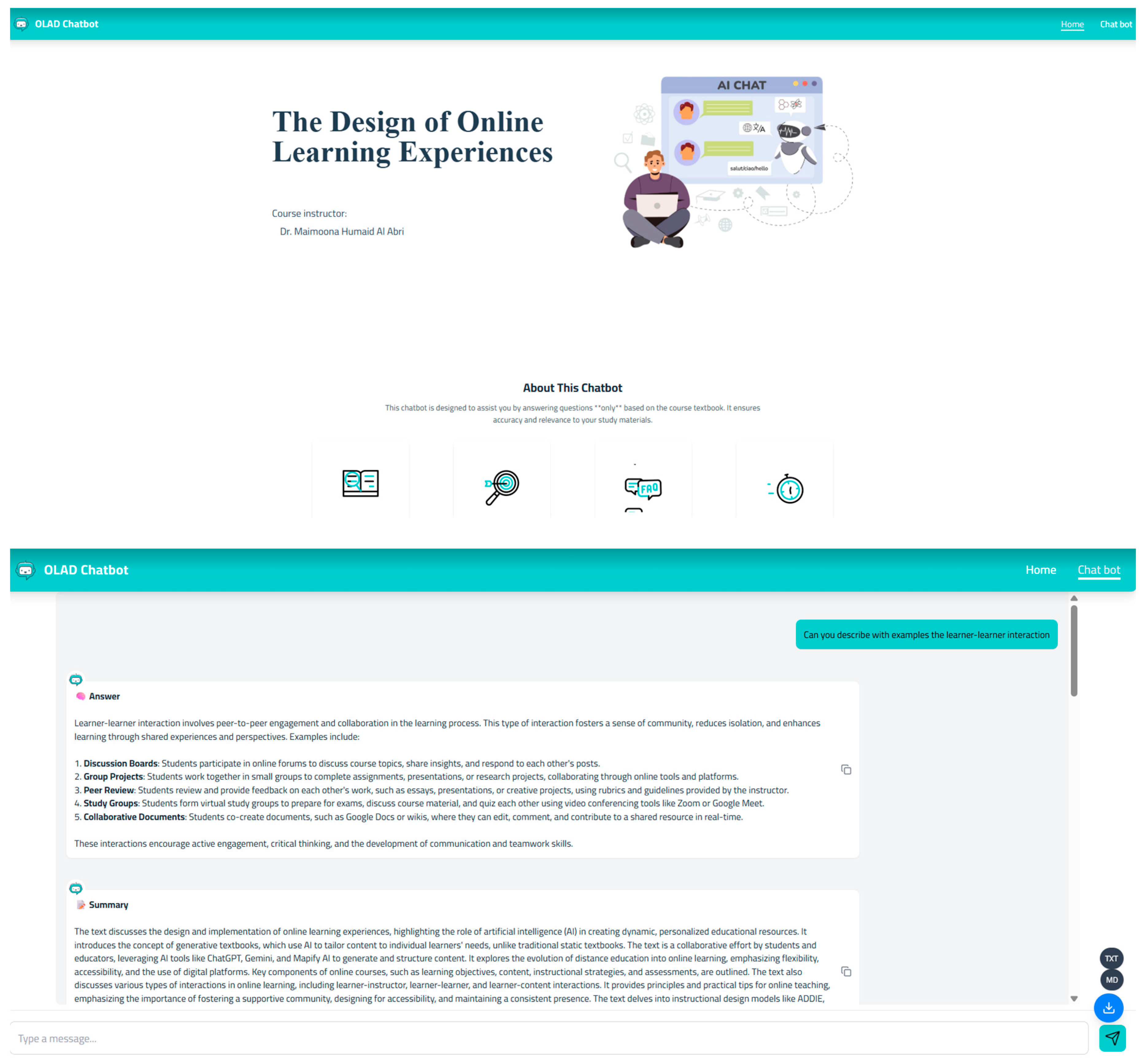
First, the website was developed to reflect the purpose of the generative textbook. The Figma app was used to create the raw idea, and NextJS and Custom CSS were utilized to build the actual app. Then, a Python proxy server was designed to function as a connection between the website and the API (the API is a link that can request and respond directly from the LLM provider, called Mistral.ai), utilizing a custom command-line interface (question and text from the textbook itself). The idea is that when the user sends a question to the chatbot, the proxy will receive this request and forward it to Mistral.ai, which will respond with the answer directly from the text. Finally, the website will display both the questions and the answers to the user. The chatbot is accessible through the following link: https://www.olad.info (accessed 22 May 2025).
3.3.1. Participants and Setting
The participants of the design and development phase were undergraduate students who enrolled in a college university course “Online Teaching Methodology”, and five experts in Learning Technology and Instructional Design, two external experts and three peer experts.
Undergraduate students: The number of participating students was (N = 20), including 11 females and 9 males. Most students were in the fourth and fifth academic years in the ILT specialization. Their technology literacy level ranges from intermediate to advanced, depending on their major. They have an adequate level of using GenAI such as ChatGPT, Copilot, Napkin, etc. The participants in this phase were the creators of the content for the generative textbook, utilizing the GenAI tools embedded in the course curriculum.
Experts in Learning Technology and Instructional Design: Five experts, both internal and external, showed a willingness to participate in this study and review the content generated by students in online learning. All of them have a strong background in instructional design, learning theories, learning technology, and learning and development. Their experience ranges from 8 to 40 years. They hold PhD degrees in instructional design and learning technology. They have strong knowledge about online learning and its related concepts.
3.3.2. Instruments and Data Sources
Students’ Reflection: The purpose of the reflection was to (1) examine the process students used to generate content from GenAI to generate the content of a generative textbook, and (2) to understand the effectiveness of the development process of these generative textbooks on students’ achievement in this course, specifically on their understanding of the principles and related components of online learning experiences. The guiding questions of the reflection were as follows:
- What do you think are the advantages and disadvantages of the process/strategies used for developing this textbook in terms of generating the content from AI generative tools (e.g., CHATGPT and Gemini)?
- What new skills or knowledge did you gain through this experience of generating the content for the generative textbook, which involves the use of AI generative tools?
- How did the process of developing a generative textbook enhance your understanding of distance education? How does it help you in learning the principles and components of distance education this semester?
- How did you use AI generative tools to generate the content for the generative textbook? What prompts did you use?
- What recommendations would you give to others for developing generative textbooks for the first time?
Expert reviews: The expert review aims to ensure the accuracy, validity, and quality of the generated content from the perspectives of subject matter experts before considering it for broader use. The type of expert reviews in this study is an informal review without structured heuristics. It is based on their knowledge and experience in the field of instructional and learning technology. The comments received are directly addressed in the static textbook. Therefore, no data analysis was conducted at this stage.
3.3.3. Data Analysis
Inductive thematic analysis was used to analyze the students’ reflections. A constant comparison analysis technique was employed by grouping data into units seeking codes (Onwuegbuzie et al., 2009). In addition, Maxwell (2013) described this process of analysis as iterative and interpretive. Thus, the analysis process began with reading the students’ reflective essays multiple times, along with taking notes and looking for patterns by highlighting the key phrases. Then, open codes were created. After several iterative readings throughout all reflections, broader themes were developed and refined. Finally, these themes were classified into organizational themes.
3.4. Phase 3: Evaluation and Reflection
The evaluation and reflection phase aimed to examine the usability of the OLAD Chatbot based on students’ experiences. The guiding research question for this phase was:
Q3. What is the perceived usability level of the generative textbook chatbot among students in a higher education setting?
Usability testing was used to evaluate the usability of the OLAD Chatbot’s interface and its functions in supporting students’ performance while completing tasks related to online learning. The comments received were used to refine and improve the interface and features of the chatbot.
3.4.1. Participants and Setting
The sample consists of approximately (N = 44) participants enrolled in different academic courses in the ILT program, comprising 23 males (52.3%) and 21 females (47.7%). Participants were from six different academic years, starting from 2019 to 2025. The largest group belonged to the 2021–2022 cohort (36.4%), followed by both the 2022–2023 and 2024–2025 cohorts (15.9% each). Only 13.6% were from the 2019–2020 cohort, the 2023–2024 cohort (11.4%), and the 2020–2021 cohort (6.8%). This distribution indicates that the respondents have a diverse range of academic backgrounds.
In terms of technology skills, about 63.6% identified themselves as having an intermediate level of technology skills, and only 15.9% reported having advanced skills. Regarding prior knowledge on writing prompts in ChatGPT, more than half of the participants rated themselves at the intermediate level of knowledge, representing 65.9% of participants, followed by 18.2% at the beginner level and 15.9% at the advanced level. This indicates a generally moderate familiarity with AI writing prompts among participants.
3.4.2. Instruments and Data Sources
Usability Testing
The usability testing examined the usability of the generative textbook chatbot according to specific criteria. A usability checklist was developed to be administered to students in ILT departments. This checklist was adopted from a recent study conducted by Wan Sulaiman and Mustafa (2020) in their research entitled “Usability Elements in Digital Textbook Development: A Systematic Review”. The original checklist includes 15 criteria: Accuracy, Aesthetics, Appearance, Completeness, Comprehensibility, Consistency, Content, and Feedback. Information, navigability, reliability, seeking, simplicity, visibility, and privacy. For this study, thirteen criteria were tested, but two criteria were excluded because they do not fit with the nature of the chatbot, which are: Simplicity and visibility. Statements were created to meet the purpose of usability testing. Three experts from ILT departments reviewed the statement of this checklist for validation purposes before administering it to students.
3.4.3. Data Analysis
To assess and interpret the usability of the chatbot, a classification scale was created to provide a meaningful interpretation of the mean scores, based on the method outlined by Alkharusi (2022). As shown in Table 2, five interpretation ranges were established using the following formula:
Range width = (Maximum Score − Minimum Score)/Number of Scales = (5 − 1)/5 = 0.8
Table 2.
Interpretation of mean.
Statistical Package for the Social Sciences (SPSS) was used to analyze the intended data, version 21. Descriptive measures such as frequencies, means, medians, and standard deviations were utilized to summarize participants’ responses regarding chatbot usability. The resulting mean scores were then categorized according to the defined intervals to determine the overall level of usability perceived by users.
3.5. Reliability
The reliability of the instrument was assessed using Cronbach’s Alpha. The analysis revealed a Cronbach’s Alpha value of 0.836 across 13 items, which indicates a high level of internal consistency among the items.
4. Results
The three research questions of this study are addressed in different phases separately, as shown in Table 3. The result of each phase is discussed next.
Table 3.
Results obtained from different phases of the DBR.
4.1. Result of First Research Question
The first question pertains to the procedures used to create the generative textbook in a college course. The result of this question was obtained from phases 1 and 2 (analysis and exploration, and design and development).
4.1.1. Understanding the Concept of Generative Textbook
As mentioned earlier in this study, the research team endeavored to understand the concept of a generative textbook introduced by David Wiley in 2023. The literature review of generative learning, along with discussions and brainstorming among the instructor and the peer expert, led to a clear understanding of how it would be designed and developed. The insights gained are as follows: the generative textbook should be generated by using a Large Language Model (LLM); a course should be selected to align with the concept of a generative textbook; the course curriculum, including the topics, activities, and assessment, should be redesigned to align with this concept; the learning outcome and assignments should focus on higher-order thinking skills; and students should have the chance to write a clear prompt to obtain accurate and relevant information about their search.
4.1.2. Course’s Learning Outcomes Revision
The learning outcomes are developed to align with the higher-order thinking skills in Bloom’s taxonomy (as shown in Table 4). Five learning outcomes (LO) were revised, and one learning outcome was added to enhance the use of GenAI in content generation.
Table 4.
The revision of LO to align with higher-order thinking skills.
4.1.3. Redesign the Course Curriculum
Redesigning the course curriculum involved redesigning the activities, assignments, and tasks that guide students in performing the tasks. As a result, the course outline was updated using the Backward Design Model. This improvement resulted from a collaborative and iterative process involving the course instructor and peer experts in educational technology. Consequently, the syllabus was revised for implementation, as shown in the Appendix A. To ensure clarity for students, detailed instructions are provided along with the rubrics for evaluating their work in the assignments and activities (as shown in the Appendix A).
4.1.4. Development of OLAD Chatbot
The design requirement to develop the OLAD Chatbot was based on the concept of a generative textbook for designing a responsive chatbot. The responses are based on the content generated by students by utilizing GenAI throughout the semester. At this stage, the chatbot responses are limited to text, mind mapping, and quizzes. Screenshots of the OLAD Chatbot are presented below in Figure 1.
Figure 1.
The interaction with the OLAD Chatbot.
4.2. Result of Second Research Question
The second research question explored students’ perspectives about the process they used to generate the content of the generative textbook from GenAI tools.
4.2.1. Experts Review
After students generated content through the course assignments, the instructor compiled the content into a Word document. Then, we reached out to the experts to ensure the accuracy, validity, relevance, and academic rigor of the material before considering it for broader use. The received comments were addressed accordingly. Examples of comments were as follows: “One thing that stood out for me is that the term ‘distance education’ is outdated, so I suggest you move to ‘online learning’ or ‘digital learning’ at some point in the intro and then continue using the new terminology moving forward.”, and a comment to include “bichronous” learning to the textbook. Other comments pertained to the types of relationships within the online learning environment. It was initially generated as four types of relationships, but was modified to three types based on the experts’ review.
Another expert commented, “Insert content on the rationale why it’s important to have it structured. Is there a framework that supports this? Include citations. I suggest writing an introduction and then, why, and the outline”.
4.2.2. Reflection Analysis
Students who participated in the development phase of creating the content for the generative textbook were asked to reflect on their experience. They reflected on the extent to which they had benefited from the learning strategies employed on the course. Fourteen reflections were submitted from two genders. Several themes were revealed from these reflections. Five themes were identified from the data analysis, as discussed below.
Advantages of Generative AI Tools in Content Creation
The reflections from participating students revealed common advantages in using generative AI for creating textbooks, highlighting several benefits of its use in textbook development. Key points have been highlighted under this theme, such as speed, efficiency, customization, creativity, cost-effectiveness, and the ability to generate diverse content.
Most participants agreed that speed and efficiency are the most important benefits gained from AI tools. AS, AR, and FA emphasized how AI can enable the creative generation of content and significantly save time. YM and ZB both noted that AI is beneficial in academic contexts as it generates high-quality content instead of requiring extensive time to create material from scratch. Therefore, this efficiency enables teachers and students to concentrate more on improving rather than developing.
Students emphasized AI’s flexibility, adaptability, and speed. The ability of AI to enable rapid content changes was invaluable to AB. Similarly, MD and HM noted that AI is a flexible tool for teachers, as it can adapt instructional materials to meet the demands of various learners. HN stated that users can easily enhance and improve created material due to AI’s ability to react to changes.
Students’ reflections also revealed creativity and invention as major topics. According to SH, AI is a tool that encourages creativity and innovation by generating new ideas while maintaining a consistent tone and style. According to AN, AI was beneficial in offering several perspectives on a topic, leading to the development of more complex and in-depth textbook content. YM and AR further supported this argument, acknowledging AI’s potential to introduce innovative ideas that enhance education.
Cost-effectiveness was another remarkable advantage highlighted by some participants. SH noted that AI can reduce the cost of content generation by eliminating the need for multiple writers. MM also emphasized this point by saying that using AI in textbook production is less expensive than traditional methods.
Additionally, AI’s ability to generate a wide range of customized content was recognized as a key advantage. MR appreciated the breadth of content AI can produce. At the same time, MD highlighted its capability to integrate multiple personalized concepts and multimedia elements that cater to different types of learners, thereby enhancing textbooks. This makes AI a valuable tool for creating engaging and interactive learning materials.
Several ideas for the advantages of using AI emerge from these reflections: AI is transforming textbook development by making content creation more accessible, faster, adaptable, cost-effective, and innovative. The students’ perspectives indicate that AI is not only a convenience but a powerful tool that enhances both the efficiency and quality of educational materials. Their findings suggest that incorporating AI into the classroom may lead to a more active and personalized learning environment that ultimately benefits both educators and students.
Disadvantages of Generative AI Tools in Content Creation
Although generative AI tools have proven to be powerful assistants in content creation, students reflected on several disadvantages they faced when using these tools to generate content for the generative textbook. Their insights highlighted concerns about depth, repetitiveness, accuracy, over-reliance, and ethical considerations.
One of the most common issues students pointed out was the lack of depth in AI-generated content. Many participants, including AS, AB, and SH, emphasized that AI tools often provide superficial responses that do not delve deeply into specific topics. This was a weakness in academic settings, where a deeper understanding of subjects is required. According to AS, “AI-generated responses may lack the depth that students develop through their learning processes,” indicating a risk that students may miss out on more cognitive engagement with their subjects.
Closely related to this area, another disadvantage revealed by participants was the lack of human insight into AI-generated content. SH and ZB pointed out that AI lacks human touch, which is required for producing engaging and dynamic educational content. YM and ZB noted that AI often repeats similar points, making the content less engaging and less interesting. As ZB stated, this issue could result in a less engaging learning experience, as AI-generated content may be “overly formulaic or generic.”
Another disadvantage raised by participants was the issue of inaccuracy and false information. Students such as AN and AR noted that AI-generated content often provides incorrect information that needs to be reviewed and verified. This concern was also mentioned by MD, who stated that “AI tools may produce content that contains inaccurate or unreliable information,” emphasizing the need for expert review to ensure credibility. The possibility of AI generating outdated content was also a key issue, as noted by HN. He stresses the importance of checking information generated by AI.
Additionally, many students expressed concerns about how AI can affect critical thinking because of its over-reliance. AN and AR warned that over-dependence on AI reduces the use of the mind and creative critical thinking. HM added that extreme reliance on AI could “hinder the development of essential writing and research skills,” which are fundamental for students’ academic growth. This concern suggests that AI can be a helpful tool. However, it should complement but not replace the student’s role in learning and content creation.
Finally, ethical concerns and intellectual property issues were essential and sensitive points in students’ reflections. MM warned about copyright and direct plagiarism, claiming that information produced by AI can unintentionally duplicate content from other sources without reference. In addition, HN was wondering to what extent one can depend on AI generative tools without losing their voice. This leads to an essential need for clear protocols to control and organize the use of generative AI tools.
Overall, students’ reflections highlighted many issues that are considered as limitations of AI-generated content. Although AI tools offer efficiency, they also have significant drawbacks, including a lack of depth, limitations on creativity, accuracy issues, repetitive outputs, risks of over-reliance, and ethical concerns. It was concluded that AI tools should be used as supportive tools rather than replacing human work, thereby acknowledging their role in enhancing creativity and critical thinking in academic contexts
Skills and Knowledge Gained
Generating content experience provided students with a range of skills. Participants highlighted different areas in which they developed, including prompt engineering, research skills, technical proficiency, critical thinking, and ethical awareness.
Most participants agreed that mastering prompt engineering is one of the most crucial skills they gained. Several participants, including AS, AN, FA, MR, YM, ZB, and HM, emphasized that they became skilled in writing precise and impactful prompts. AS, YM and AS noted that this skill guarantees that the AI response will meet their exact need and provide meaningful content. Additionally, some participants, such as AB and SH, reflected on their enhanced research skills. They realized that using AI tools improved their techniques for finding, analyzing, and using information. Moreover, using AI for generative textbooks enhances the acquisition of technical skills. MD, AR, and SH all agreed on how they had become more proficient at using AI tools.
Furthermore, many participants came to critical insight that AI-generated content requires vital evaluation. YM, HN, AN, MR, and FA emphasized their ability to evaluate AI outputs for accuracy, clarity, and coherence. AI enhanced their ability to assess and refine AI-generated content critically. Another critical aspect raised by HM was the importance of ethical awareness. He expressed that working with AI tools deepened his understanding of the responsibility to consider issues such as transparency and plagiarism when working in educational settings—the assigned tasks required including the APA references in the output.
The experience of using AI-generated tools to develop textbook content provided students with a rich learning experience. It strengthens both their technical and cognitive abilities. They not only gained proficiency in crafting prompts and utilizing AI research tools, but also enhanced their critical evaluation and ethical reasoning skills. These reflections underscored the pivotal role of AI in supporting the lifelong learning process.
Using AI in Generating Content
In analyzing participants’ reflections on how they used AI generative tools to create content for the generative textbook, several common themes emerged. A central idea was prompting with clear and specific instructions. Many participants emphasized the importance of writing with clear and specific prompts to get a valuable and functional result. Others, such as HM and HN, underscored the importance of continually refining their prompts to improve the quality of AI responses. Participants like SH, FA, MD, and MM described using AI tools to draft initial content, and then editing and enhancing it through review. In addition, AR, MD, and ZB stated that they did not use AI solely for explanations, but also for generating educational materials, such as questions and tasks. Additionally, many participants tried different tools and adjusted their prompts to enhance the quality of the output, as mentioned by SH, AR, HN, and HM.
AI platforms such as ChatGPT and Gemini were widely used, as mentioned by AS, AR, MD, ZB, and HN, with some also exploring tools like Napkin. In conclusion, participants highlighted several ways of utilizing AI for generating content, including prompting with clear and specific instructions, drafting and editing content, creating questions and exercises, and experimenting with various prompts and tools.
Recommendation for First-Time Users
The reflections provided by participants revealed several recommendations for first-time developers of AI-generated textbooks. Almost all participants recommended continuously reviewing and proofreading AI-generated output to ensure the accuracy and quality of the content. Moreover, the majority of participants emphasized the importance of starting with clear goals and structured planning, as mentioned by AS, MD, YM, MD M., and MR. Additionally, AS, AB, FA, YM, and HM highlighted the importance of learning prompt engineering, sympathizing that precise and iterative prompts lead to high-quality output. Furthermore, SH, AS, YM, FA, MD, and AN emphasized the importance of combining AI outputs with their expertise, peer feedback, and educational context to create high-quality instructional materials. In addition, the importance of staying up to date with new emerging AI tools was recommended by SH, AR, and MD. Surprisingly, only HM mentioned the importance of considering ethical AI usage.
In conclusion, participants suggested several recommendations, including setting clear goals and structured planning, learning to craft effective prompts, conducting continuous review and editing, balancing AI with human expertise, staying up to date with AI developments, and considering the ethical use of AI.
4.2.3. Results of Third Research Questions
To answer this research question, an evaluation of the generative textbook chatbot’s usability was conducted using 13 criteria, each rated on a 5-point Likert scale. The criteria were accuracy, aesthetics, appearance, completeness, comprehensibility, consistency, content, feedback, information, navigability, readability, seeking, and privacy. Forty-four participants responded to the usability test. The results of the mean usability scores across those criteria are illustrated and interpreted in Table 5. The analysis of the results reveals that the chatbot demonstrates a moderate level of usability with a mean score of 3.34 (as shown in Table 5). Most mean scores fall within the “moderate” to “high” range of usability. Specifically, 5 out of the 13 criteria were interpreted as having high usability, while the remaining 8 criteria were rated as moderate. This indicates that users were satisfied with the chatbot; however, there are still some areas that need to be improved.
Table 5.
Statistical analysis of the chatbot’s usability.
The highest-rated criterion was readability (M = 3.61, R = 1), indicating that users found the text and icons displayed by the chatbot easy to read and understandable. This was followed by seeking (M = 3.48, R = 2), which reflected that users highly agree that the process of searching for information through the chatbot of the generative textbook is easy to use. Consistency came directly after seeking (M = 3.45, R = 3), admitting that the elements of the user interface are consistent and easy to use. Both content and navigability placed fourth (M = 3.43), highlighting high satisfaction with the chatbot’s focus on relevant topics and ease of navigation.
In contrast, accuracy had the lowest usability range (M = 3.02, R = 13), indicating that users reflect a moderate satisfaction with the correctness and reliability of the chatbot’s responses. In addition, users admitted that the chatbot had a moderate completeness (M = 3.14, R = 12), as it allowed for successful searching of specific information. Comprehensibility came directly above (M = 3.18, R = 11), suggesting that the chatbot had a moderate ability to provide an understanding of the intended content.
The rest of the criteria all had a moderate level of satisfaction with the chatbot’s usability. The evaluation for appearance, aesthetics, and feedback were moderate (mean of 3.30–3.32). The chatbot’s privacy was rated as slightly better but still at the moderate level (M = 3.39, R = 6). It suggests that people thought them to be adequate but not very strong. Therefore, further modification is required.
In conclusion, the overall mean of usability is moderate. Five criteria were rated as high, whereas the other eight criteria were moderate. The bar chart shows that readability, seeking, and consistency received the highest usability ratings, while accuracy, completeness, and comprehensibility scored the lowest, indicating that users were most satisfied with the clarity and ease of use but had concerns about the reliability and completeness of the chatbot’s responses.
Reflecting on the usability of OLAD Chatbot, it was found to be simple and easy to use. However, it is slightly slow in responding to queries, which takes too much time compared with other standard chatbots. For instance, after posting the queries, the system lacks a “loading icon” to inform users that the prompt is in process. In addition, it was limited to text, mind mapping, and quizzes—additional features needed to be added in the subsequent iterations. Furthermore, the output of this chatbot includes extra information that the user does not request, such as quizzes for each inquiry, which require solving technical issues.
Regarding the content of the generative textbook, it is limited to text and a few visual aids. Enhancing the textbook with additional types of content, multimedia, and activities will be the goal for the next iteration. Moreover, designing innovative teaching strategies that focus on problem-solving and critical thinking based on the content of the generative textbook will also be tailored for the following students.
5. Discussion
An initial objective of the project was to identify the way the generative textbook is produced in higher education settings. The results presented in this section provide valuable insights about the creation approach used, students’ perspectives about the process embedded in the course curriculum, and the usability level of the study’s output.
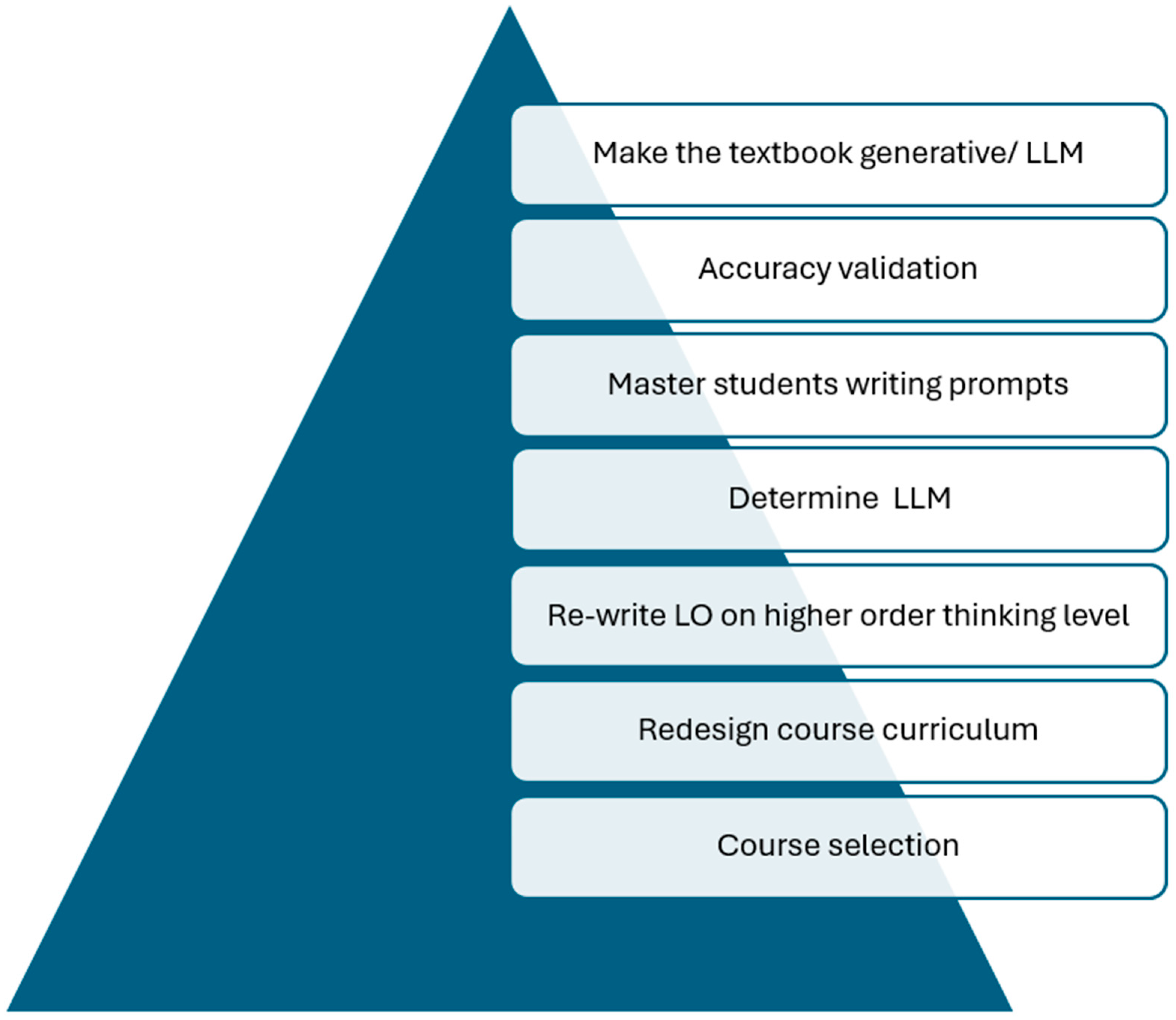
Regarding research question Q1, this study established a process of producing and integrating the generative textbook in a college course. These processes are summarized in Figure 2 below.
Figure 2.
Process of producing and integrating the generative textbook in a college course.
This process is based on instructional design procedures for designing courses based on a systematic approach. With respect to the IDEE Framework developed by Su and Yang (2023) as a guide for using GenAI in education, it was found that the three steps were used in this study. The researchers started by identifying the intended outcomes of this research project and aligning them with the desired outcomes. Then, they agreed on the level of AI integration in teaching the intended course, which involves additional activities embedded in the course assignments and tasks. Finally, the use of GenAI tools was evaluated in terms of its effectiveness in achieving the predetermined outcomes. However, the ethical implications of using GenAI in teaching this course are unclear. Future research is needed to consider it in terms of its potential biases and its impact on instructors and students.
According to the five roles for GenAI in social learning developed by Sharples (2023), it was found that three roles were applied in this study. The possibility engine scenario aligns with the process applied in this study, where students worked in groups to write prompts in the predetermined GenAI tools multiple times, observing alternative responses. The co-designer scenario is applied, where students work collaboratively and utilize predetermined GenAI tools to search for information and complete their assignments. That is, the use of GenAI tools was embedded in the intended course’s curriculum. As a result, students used them based on each assignment’s instructions. Finally, the exploratorium scenario was applied, where students interacted with GenAI tools such as Napkin for creating visualizations of data about the obtained information from ChatGPT and Gemini. These findings confirm the initial concept behind the generative textbook, where students had direct interaction with LLM through using different GenAI tools as a conversational learning experience to learn about online learning.
With respect to research question Q2, it was found that the efficiency of GenAI tools lies in generating diverse and high-quality content in a short time, as well as their flexibility and adaptability in customizing content based on students’ needs. This finding is well-supported by several studies that AI tools provide a reduction in the time to generate the content and provide valuable suggestions for education needs (Baidoo-Anu & Ansah, 2023; Su & Yang, 2023; Xu & Xiao, 2024). These benefits are evident in this study, where students collaborated to produce a textbook in a short time. As a result, the instructor can spend more time on updating the content and designing innovative teaching strategies than creating materials from scratch.
Despite the benefits indicated above, this study revealed a range of concerns about the limitations of using GenAI for content development. The finding reported here was about inaccurate, outdated, and false information driven by GenAI tools. These findings aligned with both Su and Yang (2023) and Noroozi et al. (2024), who highlighted concerns about providing inaccurate information due to the outdated data available in the tool. Baidoo-Anu and Ansah (2023) also found that GenAI tools generate incorrect and biased information. These findings are rather disappointing. A possible explanation for this might be that students are required to compare the content generated by GenAI with content from a scientific paper.
Another key concern is about the potential impact of AI on critical thinking, mental capacity, and social interactions due to its over-reliance. This result resonates with Wu (2023), who argued that GenAI tools hinder social learning and affect the critical thinking gained by peer discussions and communications. Closely related to this area, this study found that GenAI lacks depth of information, creativity, and human insights. This result aligned with the difference between ChatGPT and human learning, as covered by Wu in that ChatGPT lacks comprehensiveness, creativity, and adaptability (Wu, 2023). That is, unlike human learning, ChatGPT relies on data-driven algorithms to grow its knowledge and learn from its failures. Consequently, to obtain optimal benefits from the GenAI/LLM, focus is required on developing critical thinking skills such as evaluating the quality of generated content, comparing it with other reliable resources, and mixing it with other information to generate accurate and high-quality content. In this study, these concerns mentioned above were revised and validated by internal and external experts; thereby, the accuracy and quality of the AI-generated content was assured. In addition, this study suggests using LLM as supplementary technology in teaching and learning practices. Hence, this limitation will contribute to inform future pedagogical designs in using LLM in higher education.
Additionally, students highlighted ethical concerns like copyright infringement and direct plagiarism while using GenAI tools. These issues are directly linked to Noroozi et al. (2024), who emphasized ethical risks, data privacy, and security. This finding was minimized in this study by citing the generated content in this study to the original authors. The prompts used by students included the citation of the generated content, which is mostly related to a scientific paper.
Regarding the moderate level of usability of the chatbot implementation, it can refer to students’ skills of writing prompts and inquiries in LLM. In this stage of implementation and evaluation, the generative textbook was used as an LLM, where students had direct interaction with it to learn about topics related to online learning. This implementation will be expanded in the second iteration of this study for further investigation and refinement of its usability.
6. Implications and Future Research
The current study has several implications. It provides evidence of best practices and empirical data about the concept of a generative textbook and serves as a starting point for future research. The findings of the current study will contribute to the body of research on the design, development, and evaluation of generative textbooks in higher education. In addition, it paves the route to other ways of thinking regarding integrating LLM into higher education settings.
The study suggests that the content of the generative textbooks can be updated, adapted, and customized to meet individual needs and different course objectives. That is, it is an AI-powered tool that allows instructors to make real-time updates or customization, unlike traditional textbooks that often become outdated. This OLAD Chatbot can be integrated into different courses within the ILT program and across the university. This generative textbook will help students develop multiple skills aligned with the college attributes, program outcomes, and international standards (e.g., students improve their writing, research, and evaluation of the reliability of AI-generated content).
With all of the above, future research will be conducted through the next iteration of this study, which will focus on enhancing students’ prompts to boost direct interaction and conversational learning experiences with LLM. The generative textbook will be used as an LLM to learn about online learning and related concepts. It will be applied to all relevant courses. In addition, future research can be conducted to explore the potential of designing an innovative pedagogy approach with the use of LLM/GenAI in higher education. Instructors can design critical thinking and problem-solving activities that focus on high-level learning strategies. Another study will be conducted in the area of ethical issues of using GenAI to generate the content of the generative textbook in an education setting.
7. Conclusions
The present study was designed to explore how the concept of a generative textbook can be integrated into academic programs in higher education, focusing on its creation, integration, and usability. In the process of creation, the DBR approach by McKenney and Reeves (2019) was adopted. Three iterative phases were employed to understand the concept itself. These phases were followed by rewriting the learning outcomes to focus on higher-order thinking skills. Next, the instructional design model, Backward Design, was employed to redesign the course curriculum, encompassing topics, assessments, and learning experiences, in alignment with the concept of a generative textbook. Different GenAI tools were used to generate the content of the intended textbook.
Every product has challenges and opportunities. In terms of opportunities, this study has found that speed, creativity, adaptability, and efficiency of the LLM are the critical advantages of using it in teaching and learning practices. In addition, this study’s findings showed that accessibility and generating a variety of content are the significant advantages of integrating generative textbooks in higher education.
Regarding the disadvantages, the findings revealed that AI-generated content lacks depth of information and human insights. In addition, the information generated may be repetitive and inaccurate. These weaknesses can make the content less engaging. Furthermore, relying on GenAI to generate content is another disadvantage of this approach. Hence, in the next step, the instructor will design activities to help students master the required course material and develop other life study skills, such as writing skills. Ethical issues such as plagiarism and intellectual property rights are also raised in this study, which require further investigation.
In regard to employing a generative textbook as an LLM in courses through the OLAD Chatbot, this study has identified that the usefulness and ease of use of the OLAD were at a moderate level. It is indicated that the Chatbot is readable and easy to find the required information. The elements of the OLAD Chatbot’s interface were consistent and provided relevant information. This study has found that generally, the most satisfaction was with the clarity and navigation of the Chatbot. Nevertheless, accuracy, completeness, and comprehensibility require further improvement.
This study established that the skills students gained from using GenAI to generate the topics of the generative textbooks included prompt engineering and research skills. During their performance, students recognized that the quality of prompts they used in posting queries in GenAI will be reflected in the quality of responses.
This study recommends that generating content through direct interaction with LLM through college courses entails developing learning outcomes at the level of higher-order thinking skills at the forefront, and then designing course activities accordingly. In addition, the efficiency of using GenAI in the learning process enhances students’ critical thinking skills by fostering a deep understanding of what they are learning. Thereby, it informs future pedagogical designs for better learning experiences.
Author Contributions
Conceptualization, M.A.A., N.D. and A.E.; Methodology, M.A.A. and N.D.; Validation, R.M.R.H.; Formal analysis, M.A.; Resources, M.A.; Writing—original draft, M.A.A.; Writing—review & editing, N.D., R.M.R.H. and A.E.; Project administration, M.A.A. All authors have read and agreed to the published version of the manuscript.
Funding
This research was funded by the Sultan Qaboos University; grant number IG/EDU/TECH/24/01.
Institutional Review Board Statement
The study was approved by The Deanship of Research of Sultan Qaboos University (Approval Code: IG/EDU/TECH/24/01; Approval Date: 1 September 2024).
Informed Consent Statement
Informed consent was obtained from all subjects involved in the study.
Data Availability Statement
Data supporting reported results can be found from the corresponding author.
Conflicts of Interest
The authors declare no conflicts of interest.
Abbreviation
The following abbreviations are used in this manuscript:
| GenAI | Generative Artificial Intelligence |
Appendix A
The revision and updates of the course outline.
TECH3412: Online Teaching Methodology.
Course description: The purpose of this course is to introduce students to the effective design of online learning experiences. It will combine the principles and strategies used by teachers to enable and enhance students’ learning in an online learning environment. As an online learning environment is very different from face-to-face learning, students will apply the principles of instructional design to design and develop high-quality online courses, including structure, communication and collaboration strategies, instructional strategies, learning activities, and assessment methods to assess students online. The students will also learn to design and facilitate online courses in a learning management system.
Learning Outcomes:
- Understand: and apply GenAI technology for content creation.
- Evaluate: the definitions and associated concepts of online learning.
- Compare: the different kinds of online learning. programs.
- Develop: strategies for effective online instruction and student engagement.
- Use: ID principles to design online learning experiences for a specific audience.
- Develop: an online learning environment or training module tailored to specific learning outcomes and the target audience.
Course: Outline based on Backward Design.
| Week | Lecture Format | Learning Outcomes | Topic/Material to Be Covered | Assessment | Plan Learning Experiences | Weekly Learning Outcomes |
| 1 | Synchronous (Google Meet) | Understand and apply GenAI technology for content creation |
| Discussion Forum: Post a brief bio to the Meet & Greet discussion forum. Introductory Video:
| ||
| 2 | Asynchronous | Evaluate the definitions and associated concepts of online learning. Understand and apply GenAI technology for content creation Understand and apply prompt engineering principles to effectively query GenAI technologies | Introduction to Online Learning
| Task 1: Collaborative Glossary Creation
Submission: 27 September 2024 |
|
|
| 3 | Asynchronous | Compare the different types of online learning programs | Exploration of Online Learning Environment
| Assignment 1: Online Courses Analysis
|
|
|
| 4 | Asynchronous | Use ID principles to design online learning experiences for a specific audience | Designing a Distance learning environment
| Task 2: Framework and principles of designing an online learning environment
|
|
|
| 5 | Synchronous | Develop strategies for effective online instruction and student engagement |
| Task 3: Instructional strategies for designing an online learning environment
|
|
|
| 6 | Synchronous | Use ID principles to design online learning experiences for a specific audience | Assessment in an Online Learning Environment | Task 4: Assessing Students in an Online Learning Environment
|
| |
| 7 | Synchronous | Develop an online learning environment or training module tailored to specific learning outcomes and target audience. | Design an outline for an online course | Assignment 2: Design a plan for an effective online course
| Assignment guidelines |
|
Examples of reshaping the tasks of the course to align with the concept of a generative textbook.
Task 1: Collaborative Glossary Creation.
- Group formation: Please select your partner based on shared interests and preferences, and fill in the table with your names through the sahredlink: Glossary creation: Each group will contribute 2 definitions of online learning and associated concepts.
- Watch the following videos to learn how to write a prompt in GAI tools like ChatGPT and Gemini.
- I Discovered The Perfect ChatGPT Prompt Formula
- Learn to prompt in ChatGPT
- How to Use Google Gemini
- Use the following GAI tools to search for the definitions:
- ○
- CHATGPT: https://chatgpt.com/, accessed on 13 February 2025
- ○
- Gemini: Content generation: https://gemini.google.com/app, accessed on 15 January 2025
- ○
- Napkin: https://app.napkin.ai/, accessed on 23 March 2025
- Compare the definitions you generated by GAI tools to definitions in journal articles by searching on the SQU library (online resources) or Scholar Google. Please indicate these definitions and include the citation of these journals.
The final submission will include the following parts:
- 2 definitions of online learning. Please add the citation of these definitions. See this example of how to cite content generated by AI: APA STYLE: https://guides.lib.purdue.edu/c.php?g=1371380&p=10135074, accessed on 20 March 2025.
- List: the GAI tools you have used to search for these definitions.
- Indicate: the prompt you used to search for these definitions.
- Provide: a comparison of these 2 definitions with definitions found in scientific articles.
Rubric: Rubric for evaluating collaborative glossary creation.
References
- Alkharusi, H. (2022). A descriptive analysis and interpretation of data from Likert scales in educational and psychological research. Indian Journal of Psychology and Education, 12(2), 13–16. [Google Scholar]
- Baidoo-Anu, D., & Ansah, L. O. (2023). Education in the era of generative artificial intelligence (AI): Understanding the potential benefits of ChatGPT in promoting teaching and learning. Journal of AI, 7(1), 52–62. [Google Scholar] [CrossRef]
- Biswas, N., Biswas, S., & Maity, S. (2024). Analysis of chatbots (pp. 62–81). IGI Global. [Google Scholar] [CrossRef]
- Bommasani, R., Hudson, D. A., Adeli, E., Altman, R. B., Arora, S., von Arx, S., Bernstein, M. S., Bohg, J., Bosselut, A., Brunskill, E., Brynjolfsson, E., Buch, S., Card, D., Castellon, R., Chatterji, N. S., Chen, A., Creel, K., Davis, J., Demszky, D., … Wu, B. (2021). On the opportunities and risks of foundation models. arXiv, arXiv:2108.07258. [Google Scholar] [CrossRef]
- Chukwuere, J. E. (2024). The future of AI chatbots in higher education. Preprint. [Google Scholar] [CrossRef]
- Darwish, D. (2024). Chatbot concepts and basics (pp. 1–25). IGI Global. [Google Scholar] [CrossRef]
- Feuerriegel, S., Hartmann, J., Janiesch, C., & Zschech, P. (2024). Generative AI. Business & Information Systems Engineering, 66(1), 111–126. [Google Scholar] [CrossRef]
- Hamam, D. (2021). The new teacher assistant: A review of chatbots’ use in higher education (pp. 59–63). Springer. [Google Scholar] [CrossRef]
- Holmes, W., & Miao, F. (2023). Guidance for generative AI in education and research (pp. 62–81). Unesco Publishing. [Google Scholar] [CrossRef]
- Jang, M., Ha, M., Kim, Y., Bae, Y., Yun, S., & Hwang, Y. (2025). An exploration of the impact of generative AI video on historical learning motivation in digital textbooks. Culture, Visual Communication and Art Journal, 3(1), 45–58. Available online: https://journals.zycentre.com/cvca/article/view/88 (accessed on 12 July 2025). [CrossRef]
- Kayali, B., Yavuz, M., Balat, Ş., & Çalişan, M. (2023). Investigation of student experiences with ChatGPT-supported online learning applications in higher education. Australasian Journal of Educational Technology. [Google Scholar] [CrossRef]
- Lambebo, E. A., & Chen, H. (2024). Chatbots in higher education: A systematic review. Interactive Learning Environments, 33(4), 2781–2807. [Google Scholar] [CrossRef]
- Lawton, G. (2025, March 13). What is GenAI? Generative AI explained. TechTarget. Available online: https://www.techtarget.com/searchenterpriseai/definition/generative-AI (accessed on 3 September 2024).
- Martineau, K. (2023, April 20). What is generative AI? IBM Research. Available online: https://research.ibm.com/blog/what-is-generative-AI (accessed on 25 October 2024).
- Maxwell, J. A. (2013). Qualitative research design: An interactive approach (3rd ed.). SAGE Publications. [Google Scholar]
- McKenney, S., & Reeves, T. C. (2019). Conducting educational design research (2nd ed.). Routledge. [Google Scholar]
- Muggleton, S. (2014). Alan turing and the development of artificial intelligence. AI Communications, 27(1), 3–10. [Google Scholar] [CrossRef]
- Nicolescu, L., & Tudorache, M. T. (2022). Human-computer interaction in customer service: The experience with AI chat-bots—A systematic literature review. Electronics, 11(10), 1579. [Google Scholar] [CrossRef]
- Noroozi, O., Soleimani, S., Farrokhnia, M., & Banihashem, S. K. (2024). Generative AI in education: Pedagogical, theoretical, and methodological perspectives. International Journal of Technology in Education, 7(3), 373–385. Available online: https://eric.ed.gov/?id=EJ1438410 (accessed on 11 March 2025). [CrossRef]
- Onwuegbuzie, A. J., Dickinson, W. B., Leech, N. L., & Zoran, A. G. (2009). A qualitative framework for collecting and analyzing data in focus group research. International Journal of Qualitative Methods, 8(3), 1–21. [Google Scholar] [CrossRef]
- Sartono, E. S., Princes, E., & Gui, A. (2023, August 31–September 1). Exploring the impact of chatbot functionality and interactivity on chatbot usage intention in higher education. 2023 10th International Conference on Information Technology, Computer, and Electrical Engineering (ICITACEE) (pp. 143–148), Semarang, Indonesia. [Google Scholar] [CrossRef]
- Sharples, M. (2023). Towards social generative AI for education: Theory, practices and ethics. Learning: Research and Practice, 9(2), 159–167. [Google Scholar] [CrossRef]
- Su, J., & Yang, W. (2023). Unlocking the power of ChatGPT: A framework for applying generative AI in education. ECNU Review of Education, 6(3), 355–366. [Google Scholar] [CrossRef]
- Wan Sulaiman, W. N. A., & Mustafa, S. E. (2020). Usability elements in digital textbook development: A systematic review. Publishing Research Quarterly, 36(1), 74–101. [Google Scholar] [CrossRef]
- Wiggins, G., & McTighe, J. (2005). Understanding by design. Pearson Education. [Google Scholar]
- Wiley, D. (2023, July 6). Generative textbooks—A brief example [Blog post]. Improving Learning. Available online: https://opencontent.org/blog/archives/7238 (accessed on 30 September 2024).
- Wu, Y. (2023). Integrating generative AI in education: How ChatGPT brings challenges for future learning and teaching. Journal of Advanced Research in Education, 2(4), 6–10. [Google Scholar] [CrossRef]
- Xu, H., & Xiao, F. (2024, November 22–24). Generative artificial intelligence empowers the research of digital textbooks in vocational education. 2024 International Conference on Artificial Intelligence and Education (ICAIE 2024) (pp. 132–139), Xiamen, China. [Google Scholar] [CrossRef]
- Zhou, Y., & Zhao, Q. (2024, November 8–10). A design scheme of STEM digital textbook based on metaverse and generative artificial intelligence. 2024 International Conference on Artificial Intelligence and Education (ICAIE 2024) (pp. 145–152), Changsha, China. [Google Scholar] [CrossRef]
- Zou, Z. (2024). Exploring the impact of using chatbots on teacher-student relationships in today’s higher education. Journal of Education, Humanities and Social Sciences, 45, 33–39. [Google Scholar] [CrossRef]
Disclaimer/Publisher’s Note: The statements, opinions and data contained in all publications are solely those of the individual author(s) and contributor(s) and not of MDPI and/or the editor(s). MDPI and/or the editor(s) disclaim responsibility for any injury to people or property resulting from any ideas, methods, instructions or products referred to in the content. |
© 2025 by the authors. Licensee MDPI, Basel, Switzerland. This article is an open access article distributed under the terms and conditions of the Creative Commons Attribution (CC BY) license (https://creativecommons.org/licenses/by/4.0/).